Summertime: Part 6 – rose vine

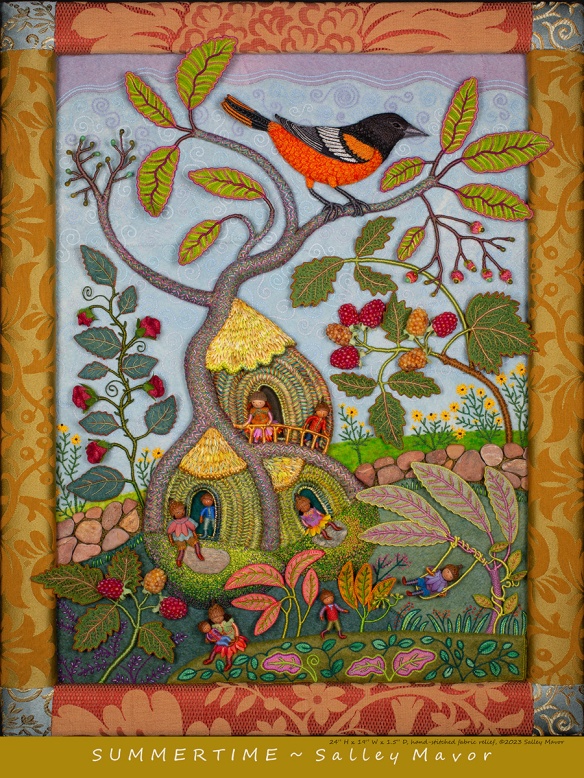
In Part 6 of the series about Summertime, I share photos and videos that document the process of making the rose vine. So far, I’ve written an overview of the piece, Part 1 – Tree Trunks, Part 2 – Tree Houses, Part 3 – leaves, stems & branches, Part 4 – Baltimore Oriole (body), and Part 5 – Baltimore oriole (head and feet). Part 7 – raspberry plants, and Part 8 – stitching flora.

Summertime is the summer scene in a series of four seasonal landscapes that capture the wonder and magic of the natural world. Posters, note cards, prints, bookmarks, and jigsaw puzzles of Summertime and the other scenes in the series (Frosty Morning, Mossy Glen and Harvest Time) are available in my Etsy Shop.

See the Four Seasons Series and dozens of other works in my exhibition, To Every Season: Works by Salley Mavor at the New England Quilt Museum, Sept. 9 – Dec. 31, 2025. The show includes recent work, as well as rarely seen early pieces on loan from private collections.

ROSES
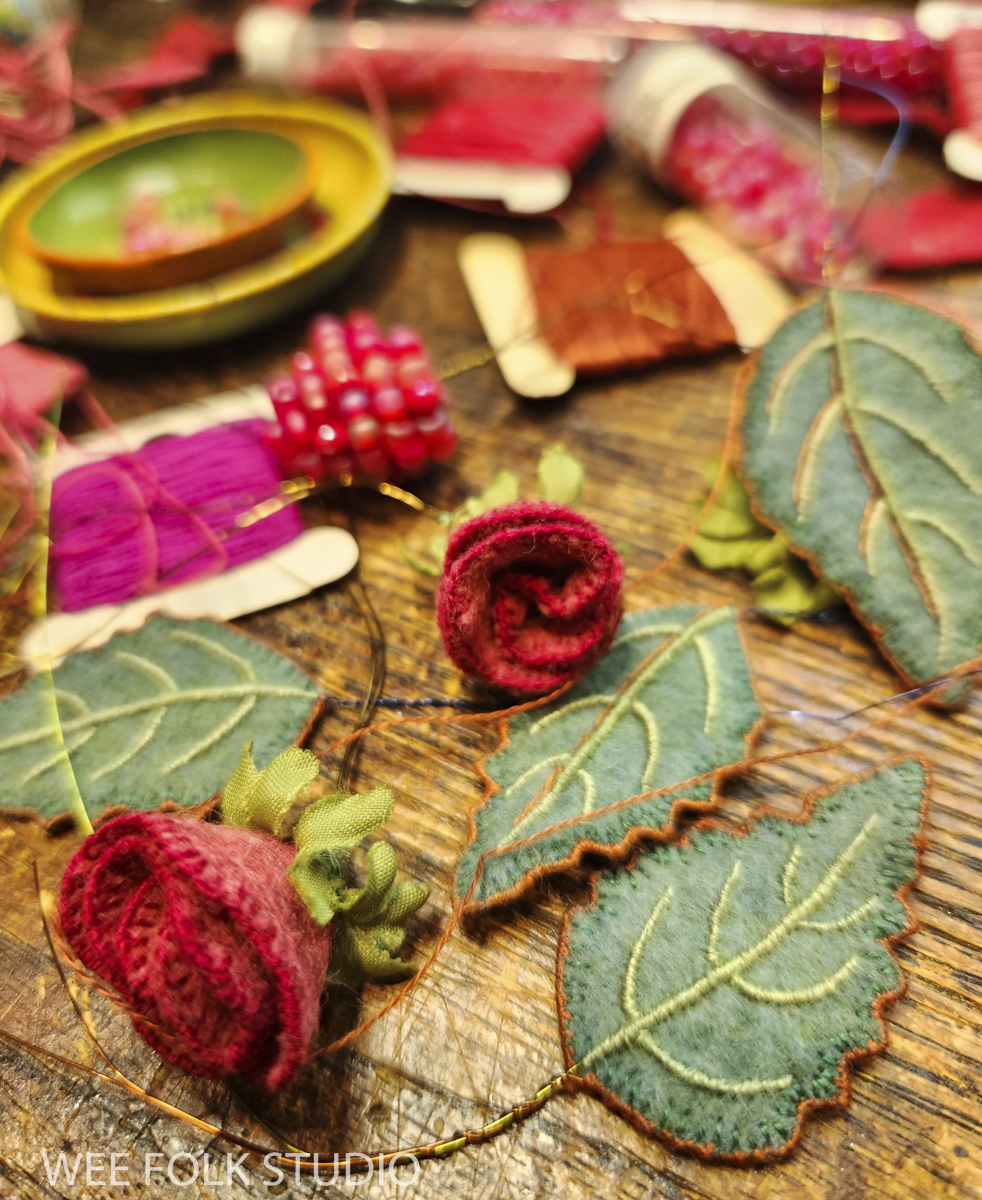
I learned how to make basic felt roses like these years ago from Mimi Kirchner’s blog. Mimi’s tutorial is available here. I love how deceptively simple the process is, starting with a circle of felt and folding it like origami to make a rose shape. Watch the following video to see how I finished off the raw felt edges with blanket stitching and folded the circle to make a rose.

Felt Rose

LEAVES
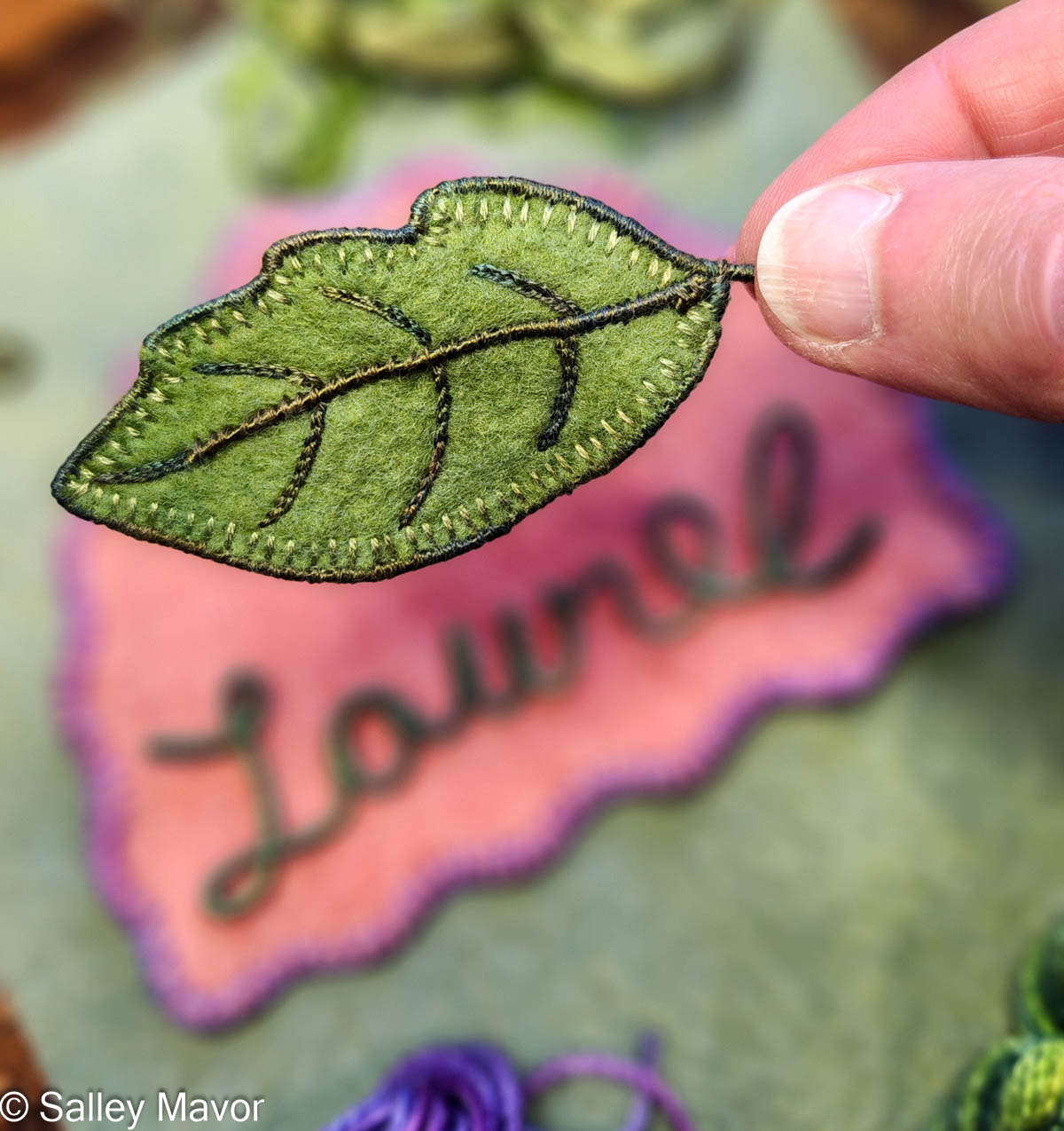
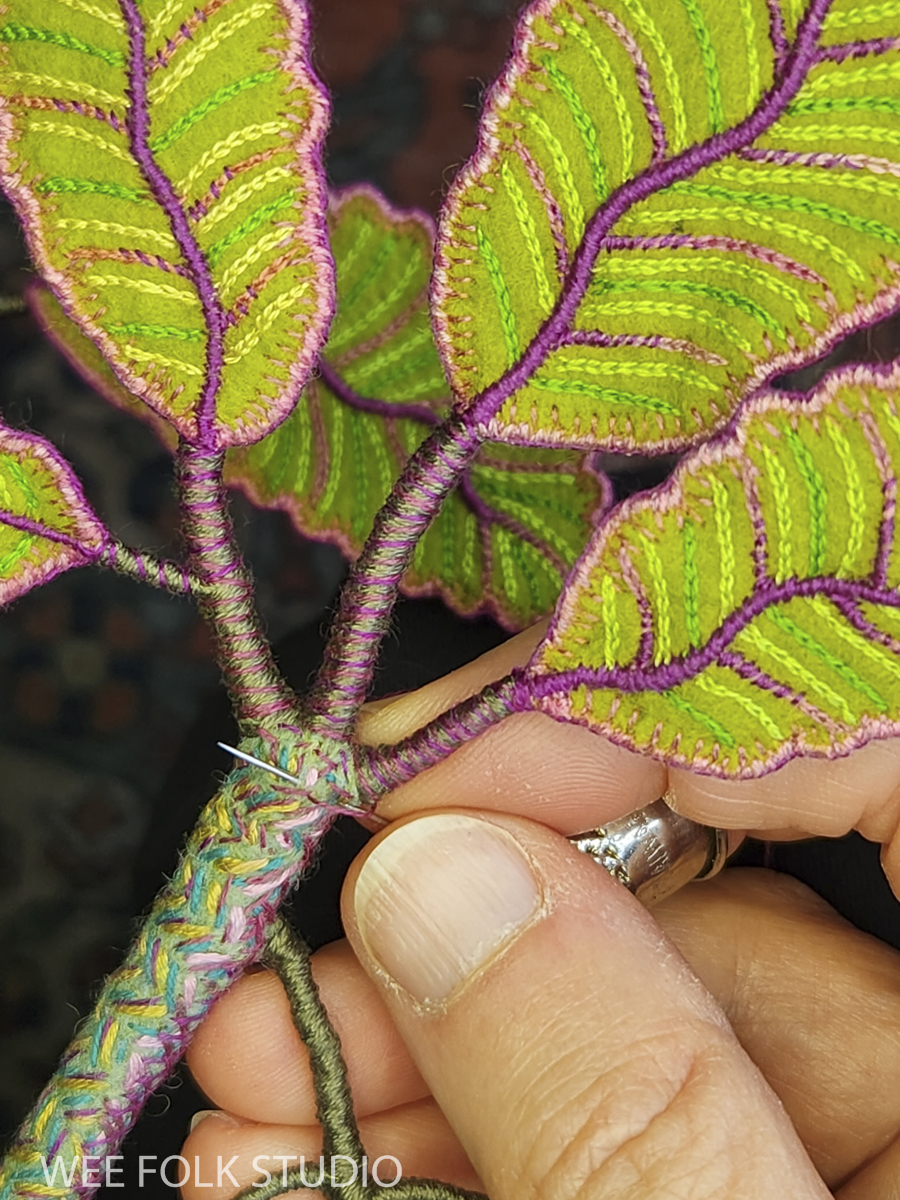
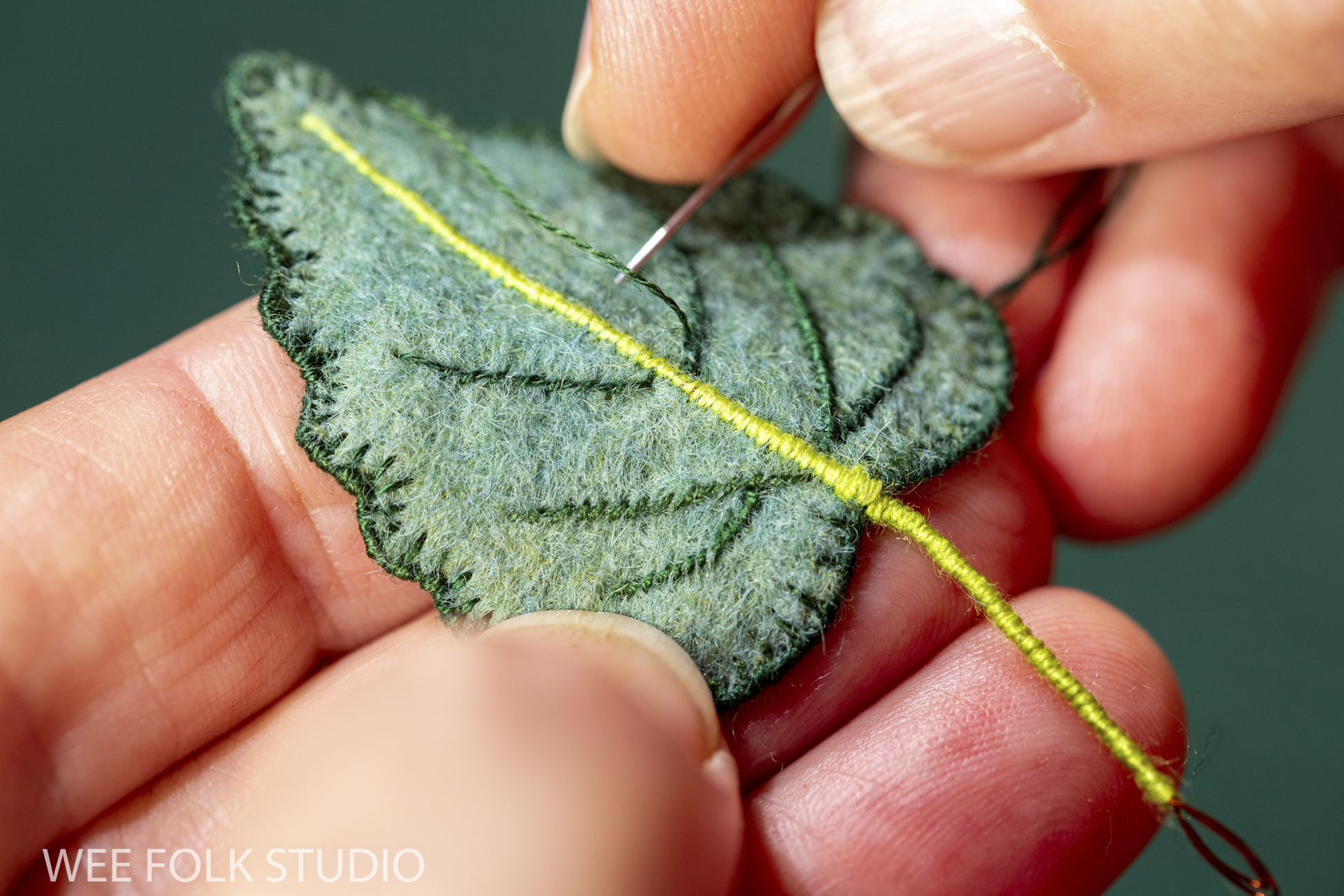
To cut out the sharp-toothed edge around the rose leaves, I used pinking shears. The following video shows how I stitched wire around the outside of a felt leaf and embroidered its stem and veins.

Felt Rose Leaf

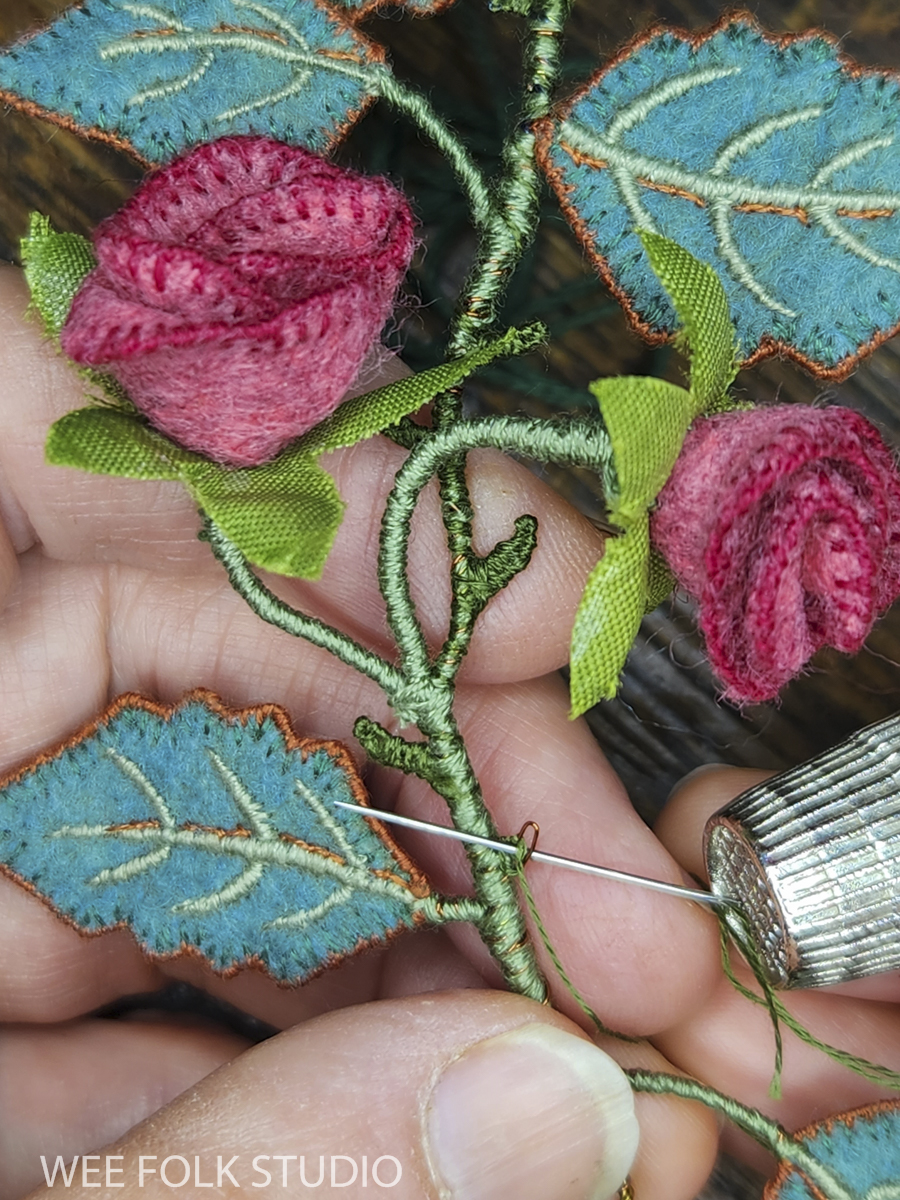
I twisted wire to make a central vine and added the roses, leaves, thorns, and curly tendrils. Besides felt and embroidery floss, the most common material in my artwork is wire. Felt alone is too floppy and needs structural supports. I used Parawire in a range of gauges, from 24 to 32, to build up the thickness and strength I wanted.

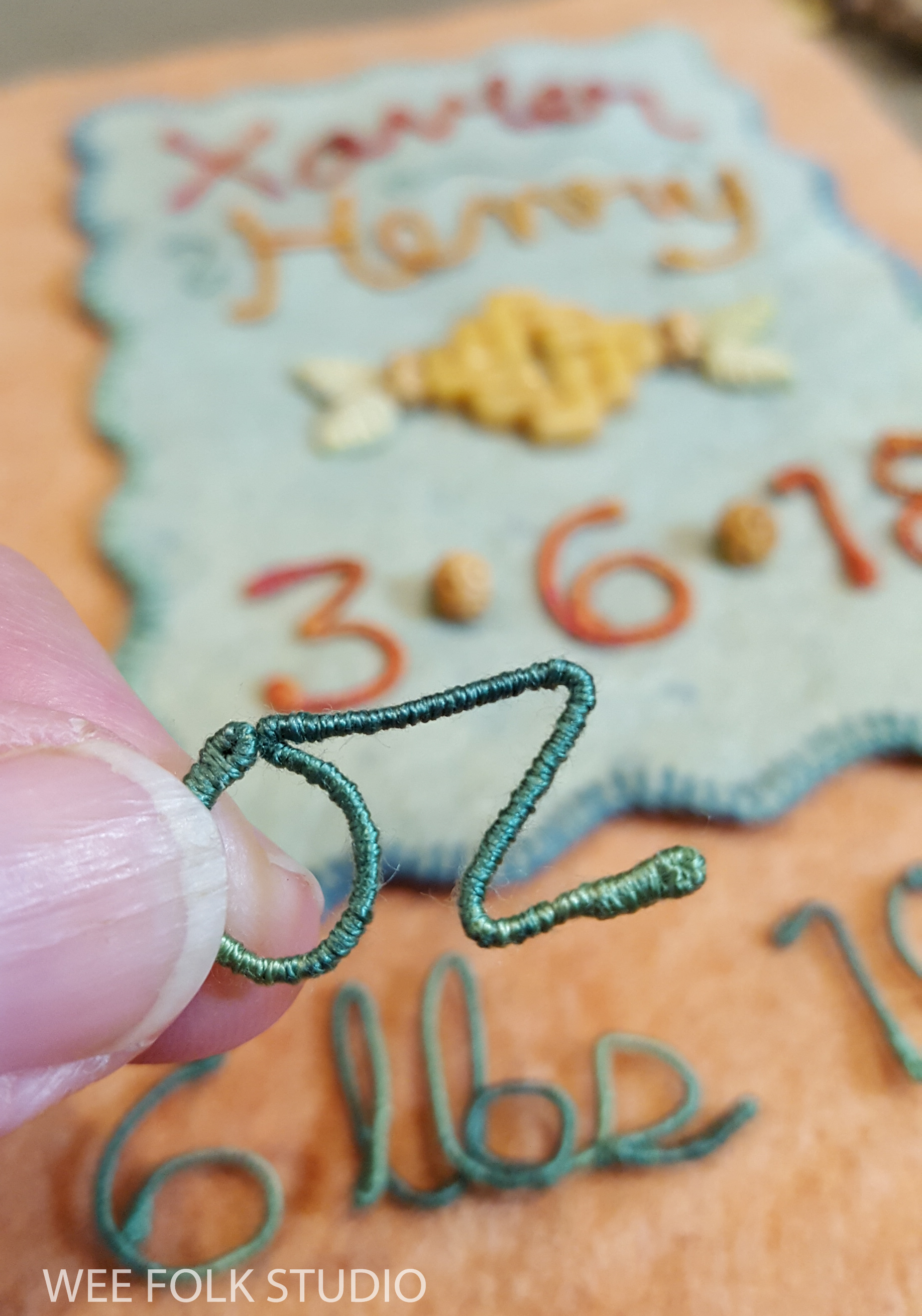
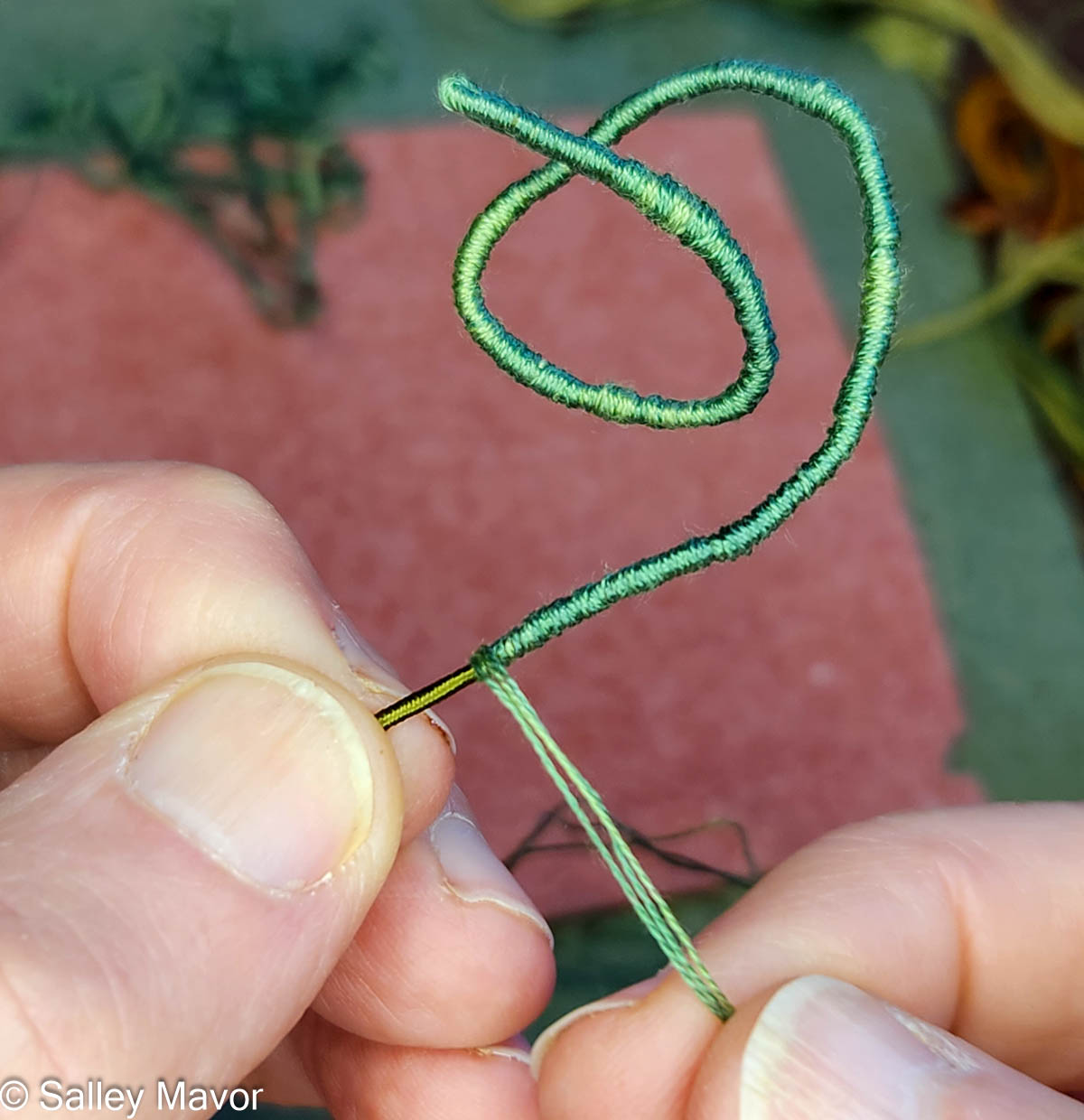
The last step was disguising the shiny metallic wire with embroidery floss. Part 3 in this series includes videos of wrapping wire stems and branches on other foliage in the Summertime piece. I wound 1 or 2 strands of floss around and around the stems until the surface was evenly covered. It was a bit tricky to make the thorns look sharp!

Stay tuned for Part 7, where I’ll share photos and videos documenting the process of making the raspberry plants in Summertime. To keep up with new posts, please subscribe to this blog. Your contact info will not be sold or shared. If you’d like to see more frequent photos tracking the projects in my studio, please follow me on Facebook, Instagram and BlueSky.
Summertime: Part 5 – Baltimore Oriole (head and feet)

In this Part 5 of the series about Summertime, I share photos, videos and commentary that document the process of making the Baltimore Oriole’s head and feet. So far, I’ve written an overview of the piece, Part 1 – Tree Trunks, Part 2 – Tree Houses, Part 3 – leaves, stems & branches, and Part 4 – Baltimore Oriole (body), Part 6 – rose vine , Part 7 – raspberry plants, and Part 8 – stitching flora.

Summertime is the summer scene in a series of four seasonal landscapes that capture the wonder and magic of the natural world. Posters, note cards, prints, bookmarks, and jigsaw puzzles of Summertime and the other scenes in the series (Frosty Morning, Mossy Glen and Harvest Time) are available in my Etsy Shop.

See the Four Seasons Series and dozens of other works in my exhibition, To Every Season: Works by Salley Mavor at the New England Quilt Museum, Sept. 9 – Dec. 31, 2025. The show includes recent work, as well as rarely seen early pieces on loan from private collections.

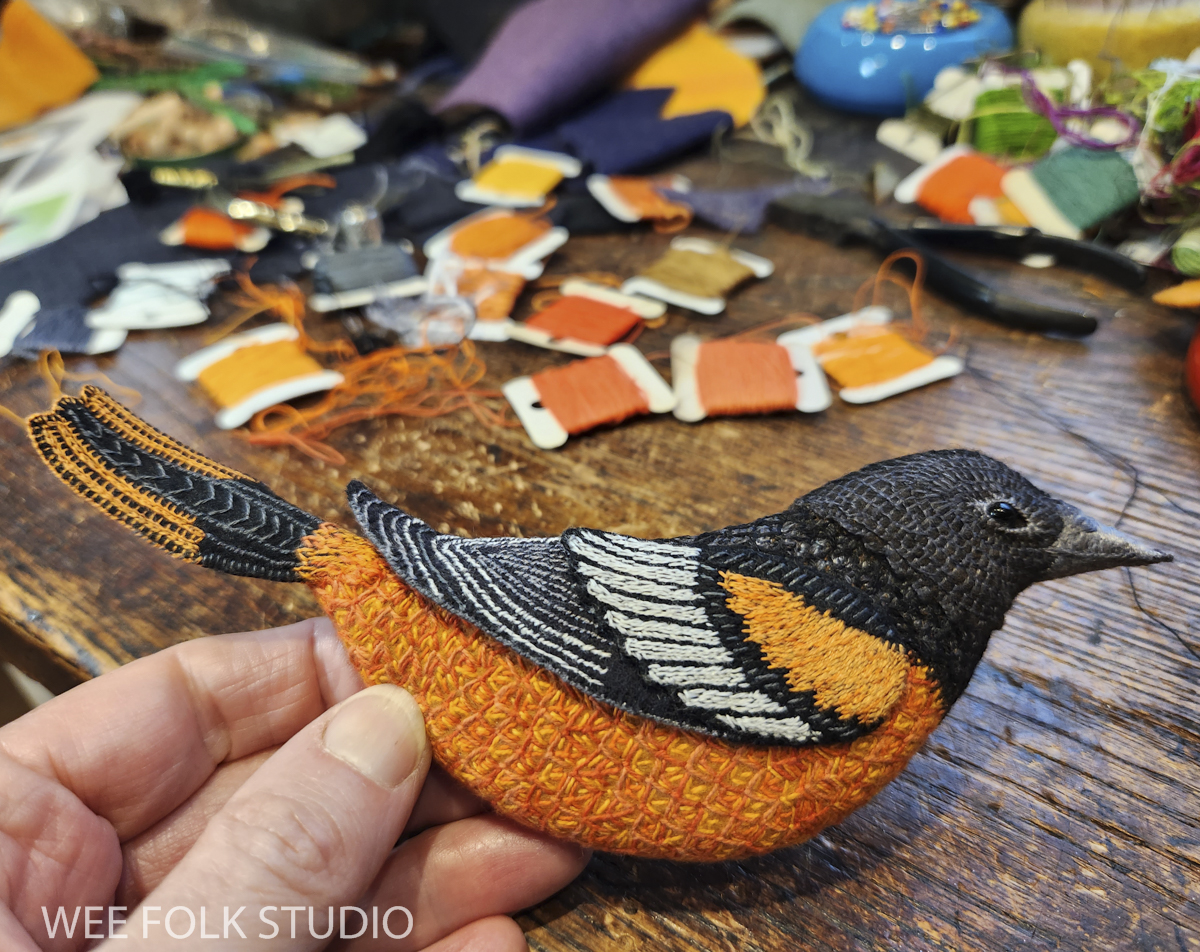
I wouldn’t call myself an avid bird watcher, but I do appreciate the subtle differences that make each species unique. For this piece, the trick was to capture the bird’s distinguishing features without being too scientific. To understand the nuances of an Oriole, I studied photos and made sketches, paying particular attention to the position, size and angle of its head, eyes and beak.

BEAK
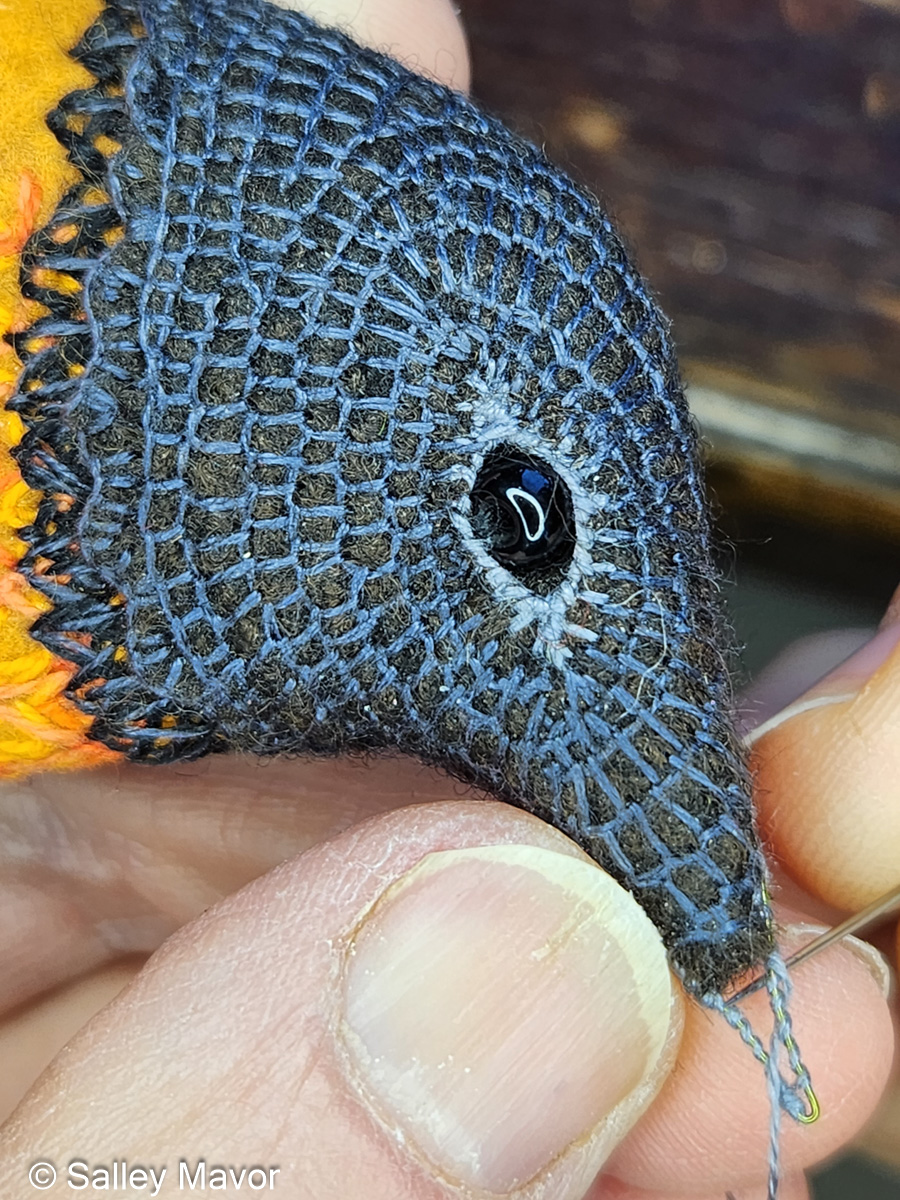
I must have been so focused on making the bird’s hood and eye (it’s a glass bead) that I forgot to take photos of that part. So, let’s skip ahead to the beak. To make it pointy, I formed a wire extension and wrapped it with embroidery floss.

I articulated the shape of the beak with floss, stitching over and around, until it had a smooth and seamless appearance.

Watch this video to see how I stitched the beak. It even shows what the back looks like!

After the beak was finished, I embroidered black feathers with fly stitches on the neck and throat area.

I sewed the wing and tail (see Part 4) in place and got to work on making the Oriole’s feet.

FEET
I shaped the bird’s feet and legs with wire, twisting it around to form 4 toes – 1 short and 3 long. Then, I wrapped the wire with embroidery floss, winding the thread up and down until no shiny wire was exposed and the feet were the right thickness.

Watch this video to see how I constructed the legs and feet and attached them to the bird’s body.

Stay tuned for Part 6, where I’ll share photos and videos documenting the process of making the rose vine. If you want to receive email notices when I publish new posts, please subscribe to this blog using the form below.

To keep up with new posts, please subscribe to this blog. Your contact info will not be sold or shared. If you’d like to see more frequent photos tracking the projects in my studio, please follow me on Facebook, Instagram and BlueSky.
Inuit Doll remake

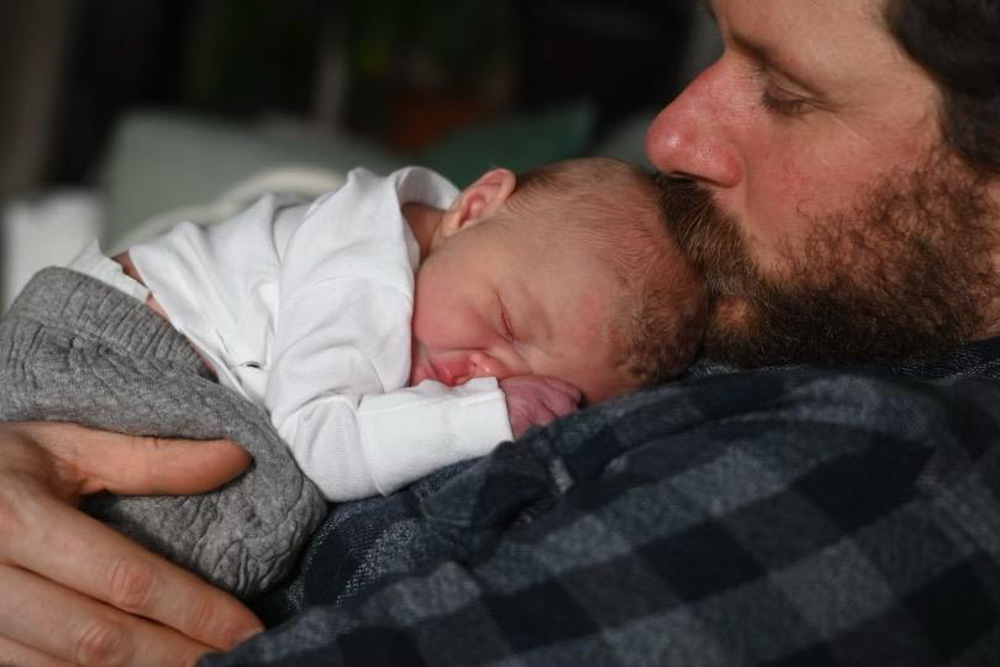
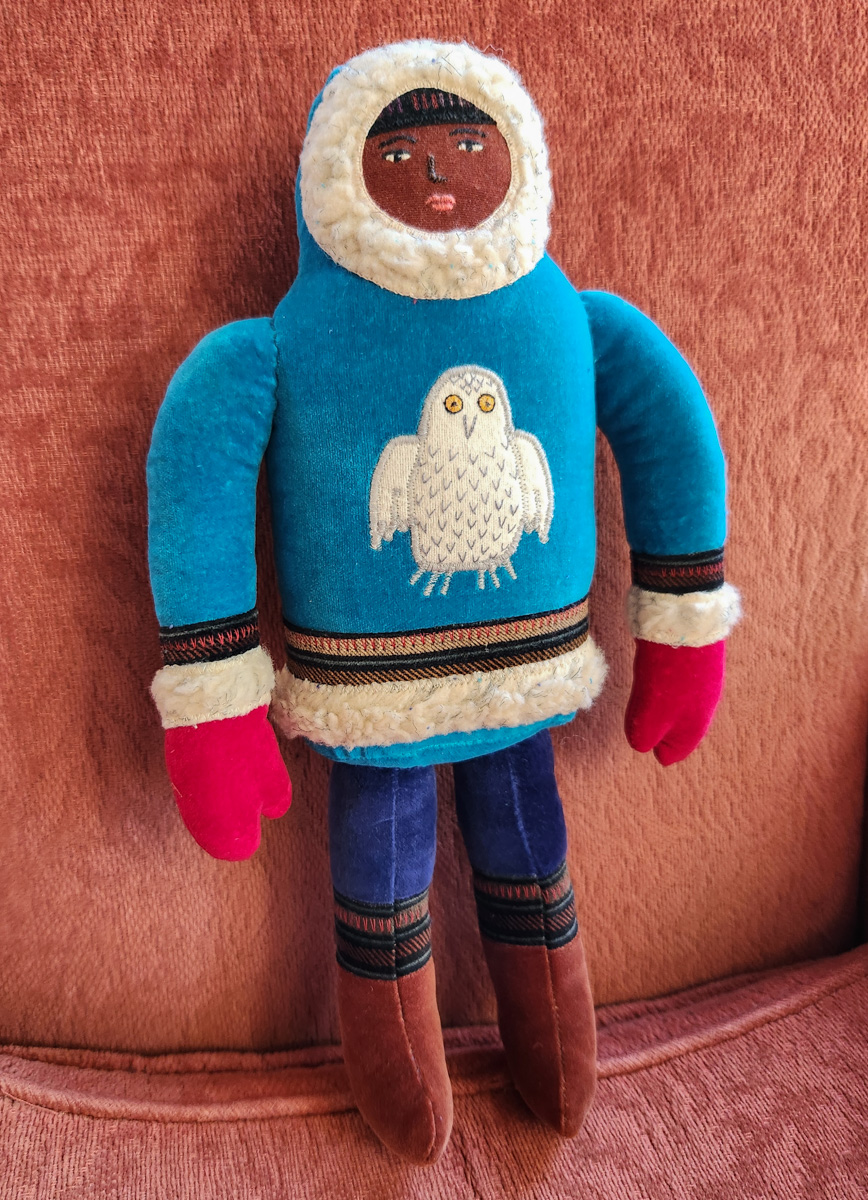
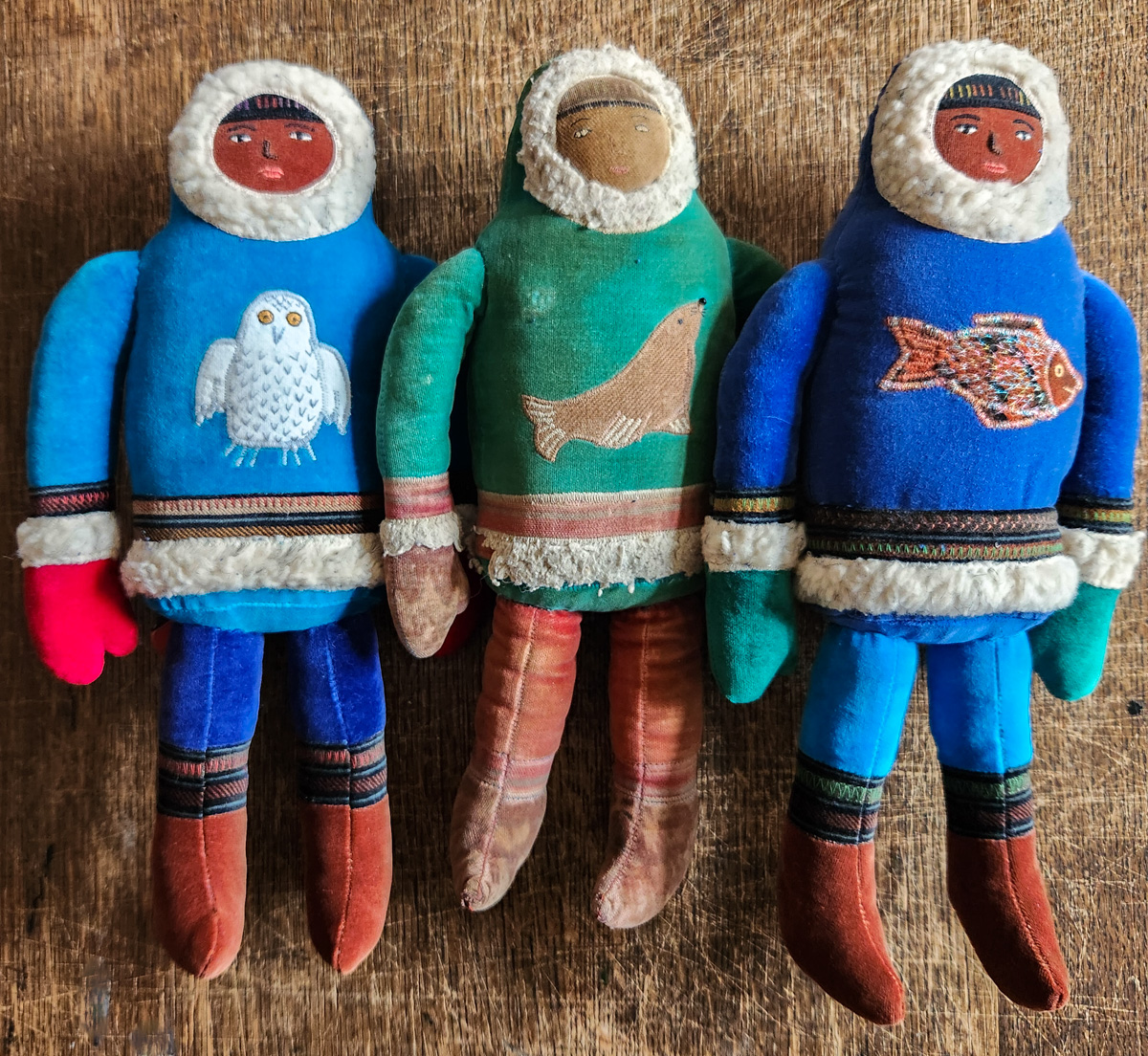
In 1985, I made a velveteen Inuit doll with a seal appliqued on its parka for my son, Peter. When you make something for a toddler, or anyone for that matter, you never know how it will be received. Will they actually play with it or leave it in the corner? I needn’t have worried, because Peter loved this doll to the point where its arms and legs had to be sewn back on several times. All these years later, I have 2 really good reasons to make dolls for a new generation, because a few weeks ago Peter became a father! So, it seemed right that little Eddie and his 1 yr. old cousin, Elias would each have their own Inuit doll to love.

Little Eddie and his father Peter

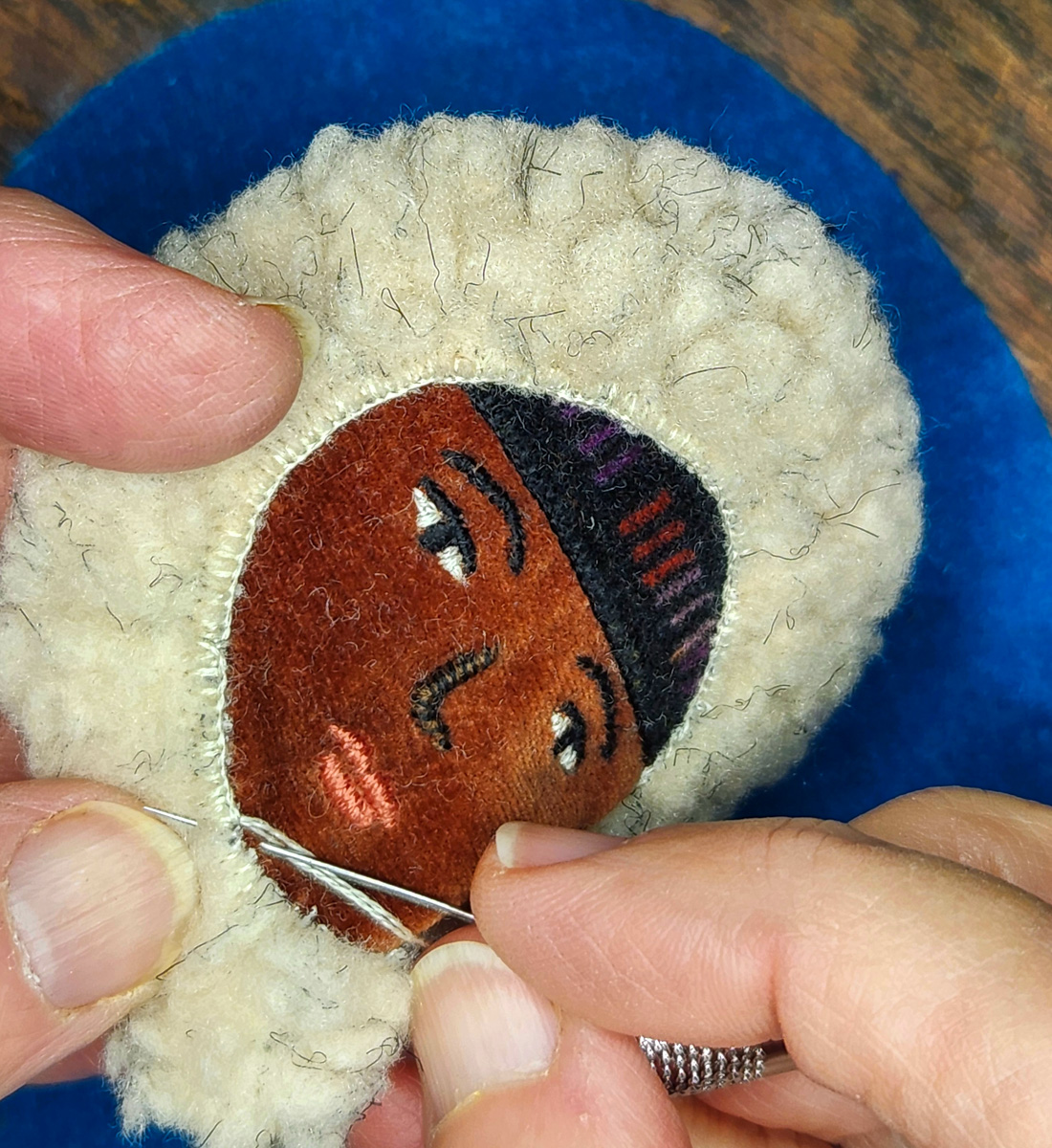
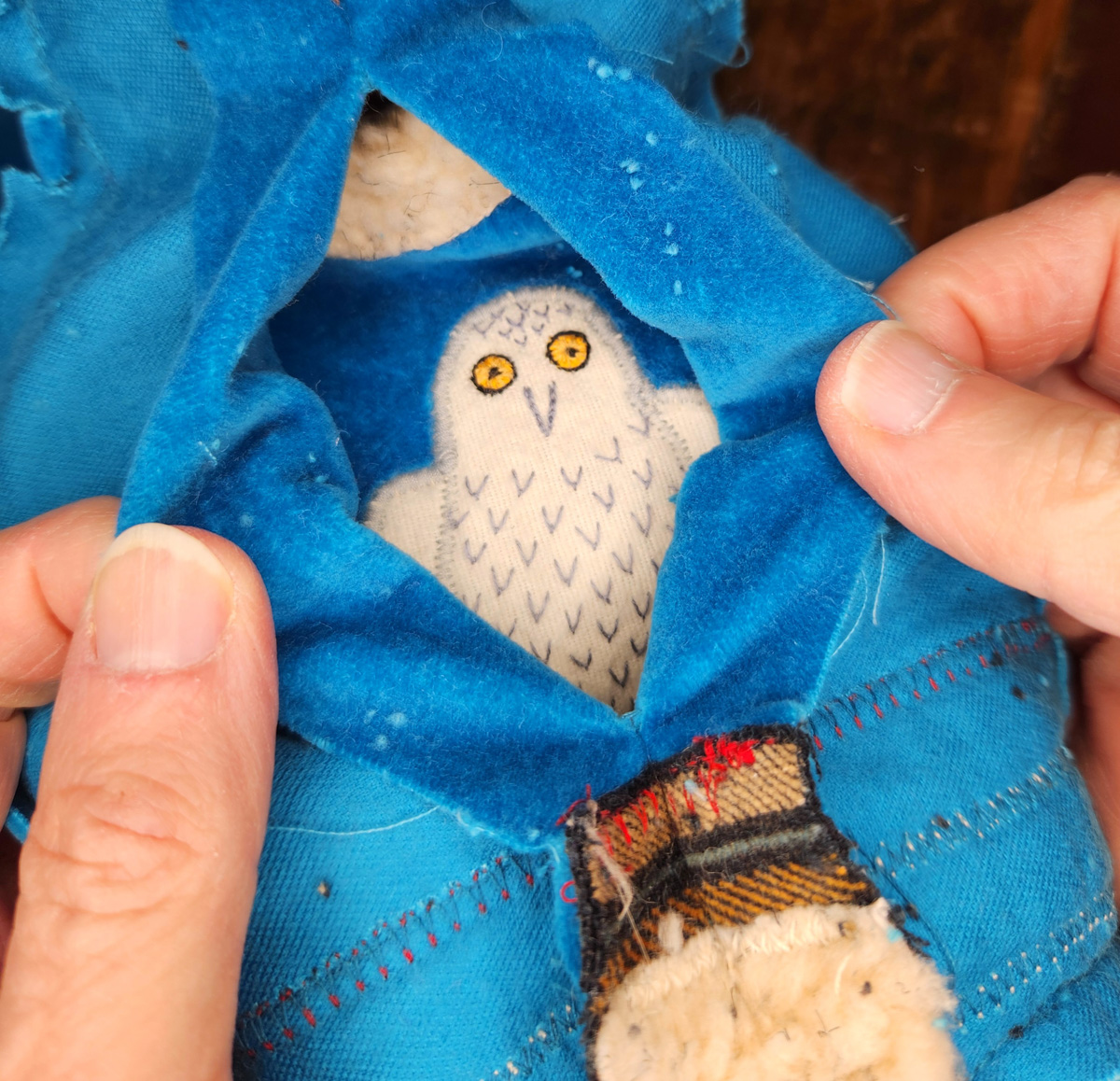
I found the original sketches and patterns for Peter’s doll in my files and unearthed pieces of cotton velveteen left over from my doll-making days. The only material I needed to buy was some sherpa fabric for the fur trim. This post includes photos and videos that show the process of making the 2 new dolls for my grandsons, one decorated with a snowy owl and the other with a fish.

Back in the 80s, when practically every checkout line at the supermarket had a rack full of homey women’s magazines, I designed sewing projects for Better Homes and Gardens. Sewing projects are conspicuously absent from today’s version of the magazine, which is limited to home decor ideas, gardening, and recipes. 

I mostly designed cloth dolls, including one with a prairie bonnet that they styled on the cover of their December 1982 issue. You can also see a crèche that Better Homes and Gardens published in 1981 here. When I submitted a photo of Peter’s Inuit doll to the magazine’s crafts editor, they asked me to design 3 dolls, which were included in the December 1986 issue.

During this early phase of my career, I enjoyed coming up with project ideas and making prototypes, even though the pay was dismal and I signed away my design rights (I was young and inexperienced). By the end of the 1980s, I was ready to move on to children’s book illustration, which came with its own suite of challenges.

When I was designing projects for the magazine, writing out step-by-step instructions was my least favorite part of the job. Describing what I’d done in words felt overly analytical and thoroughly anal! It took years to learn to show and tell how to make something in a way that intuitive and visual learners like me could understand. Then, I was ready to write my how-to book, Felt Wee Folk, which combines visual diagrams and step-by-step instructions for making little dolls. To find out more about my philosophy of sharing knowledge, please read this post.

Nowadays, I’m relieved to not have to explain in detail how I make something. Demonstrating my process through photos and videos is much more natural than describing every step in words.

I hope that you enjoy the following photos and videos that show how I embroidered the doll’s face, stitched and appliquéd the snowy owl, and sewed on the arm.

To keep up with new posts, please subscribe to this blog. Your contact info will not be sold or shared. If you’d like to see more frequent photos tracking the projects in my studio, please follow me on Facebook, Instagram and BlueSky.
Baby Polar Bear Suit

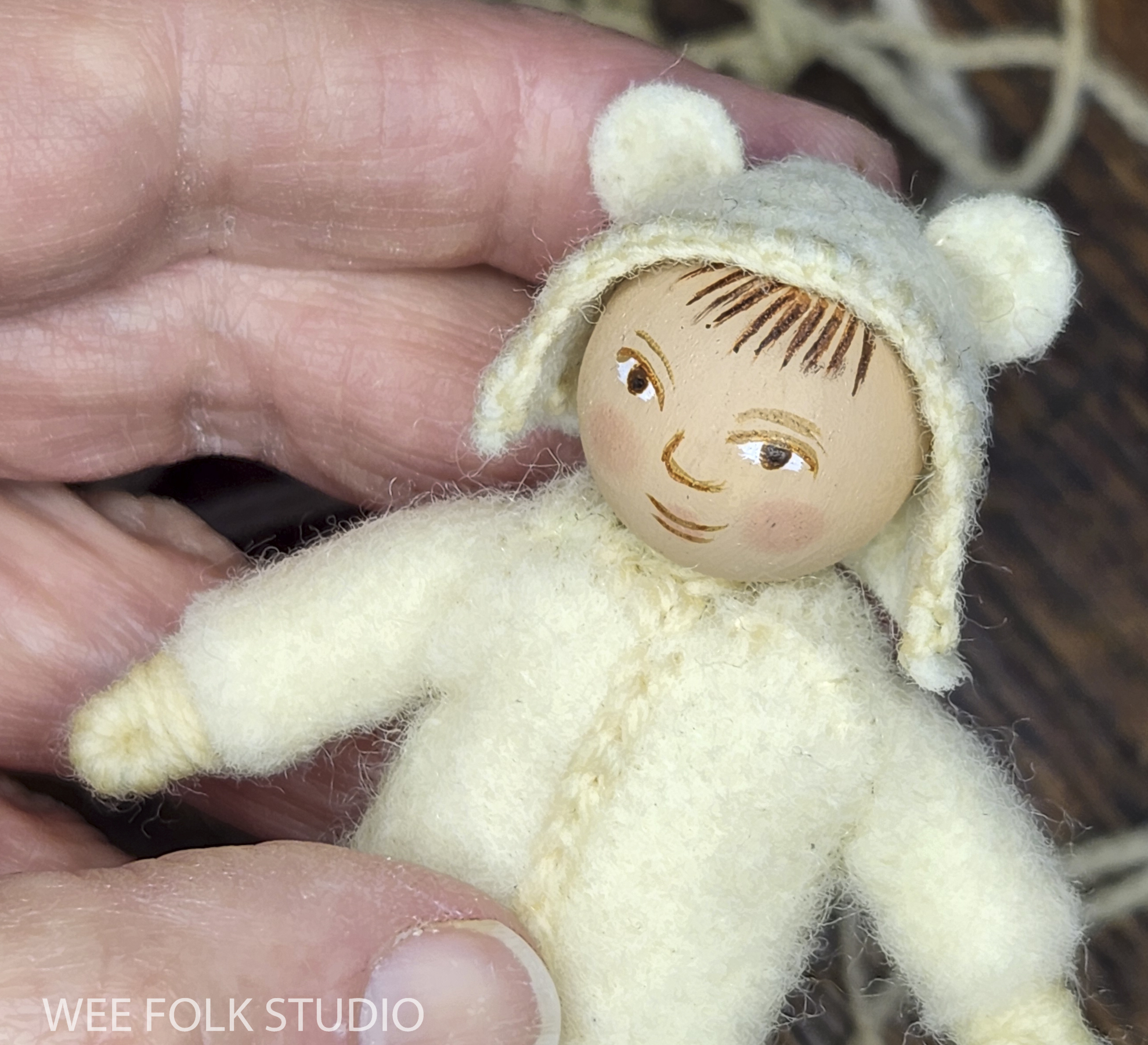
Last December, I made some small gifts, including a little version of my grandson Elias in his polar bear snow suit. I’m looking forward to making more mementos like this and hope it becomes a yearly tradition! These days, it seems that practically every children’s hat and hooded outfit comes with a pair of animal ears on top. That’s fine with me – the more playful, the better!

I also made new Inuit dolls, which I’ll write about in a future post. They are a redo of a project I originally made for my kids and designed for Better Homes and Gardens magazine in 1986.

Baby Polar Bear Doll
The 4″ doll is based on the figures in my how-to book, Felt Wee Folk, only I used wool needlepoint yarn (regular knitting yarn is too bulky) instead of embroidery floss to wrap the hands and feet on the pipe cleaner armature.

As usual, I painted multiple faces on wooden beads and picked out the one I like best. Even after painting thousands of faces, I still mess up sometimes.

The suit is made with some really thick wool felt that I was given years ago. It is probably manufactured for industrial purposes rather than little polar bear suits. The video below shows how I wrapped the feet and hands and sewed on the suit.

In the past year or so, I’ve used a hands-free phone/light stand made by Canvas that makes documenting my process a lot easier. I used to have to bug Rob to stop whatever he was doing and come film different steps with his camera. Now, I can take photos or videos whenever I want to. The downside is that I can’t get into the flow because I’m always thinking about recording some aspect of how I work. And there are times when I’m so engrossed that I skip entire sections of the process. That’s why my demonstration videos aren’t really tutorials. They’re more like peeking over my shoulder while I work. You might not see every detail, but you can get the gist of it.

After sewing on the suit, I made the hood – ears and all. The hood is made from a lighter weight wool felt.

The following video shows how I glued on the head and constructed the hood.

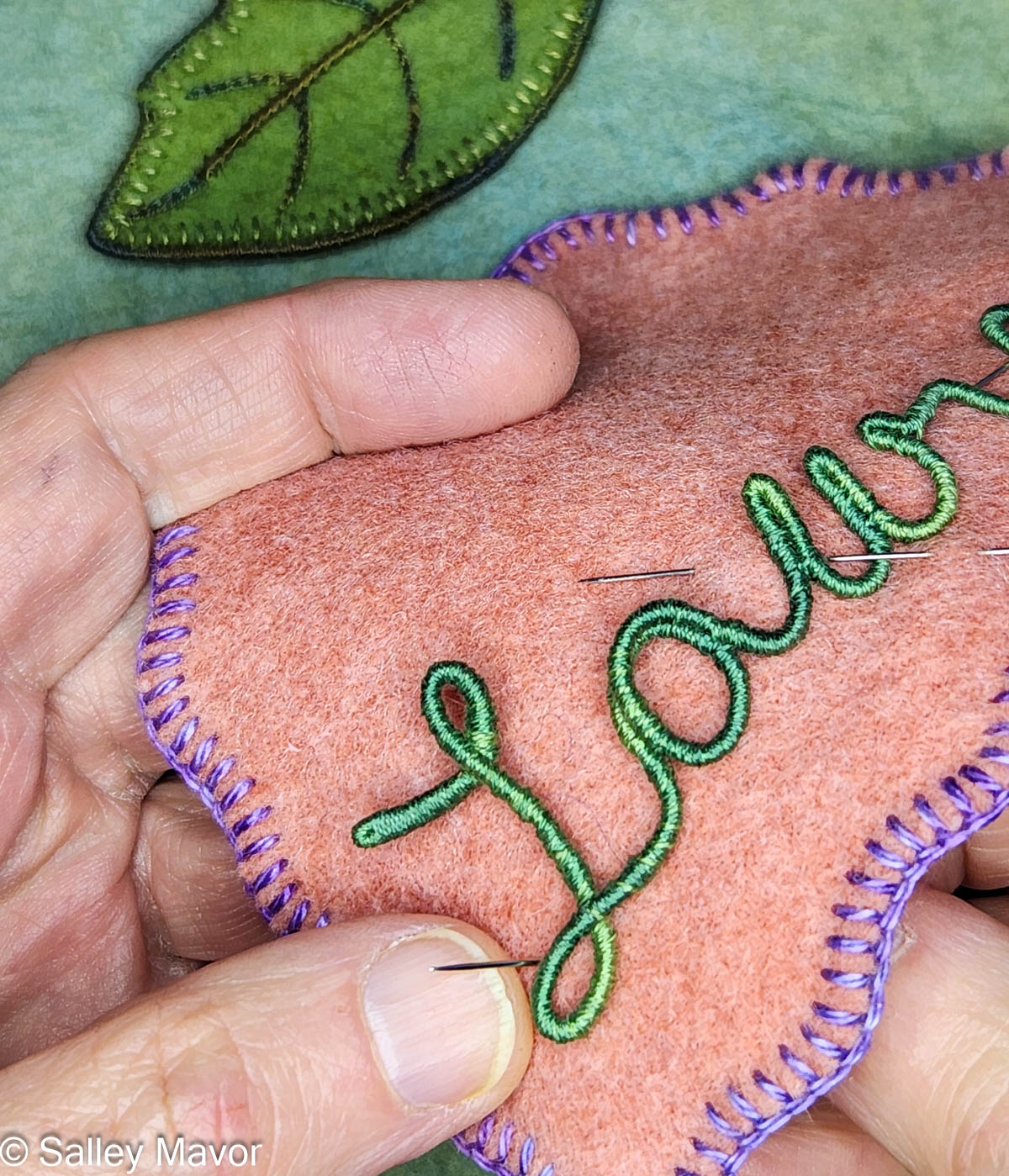
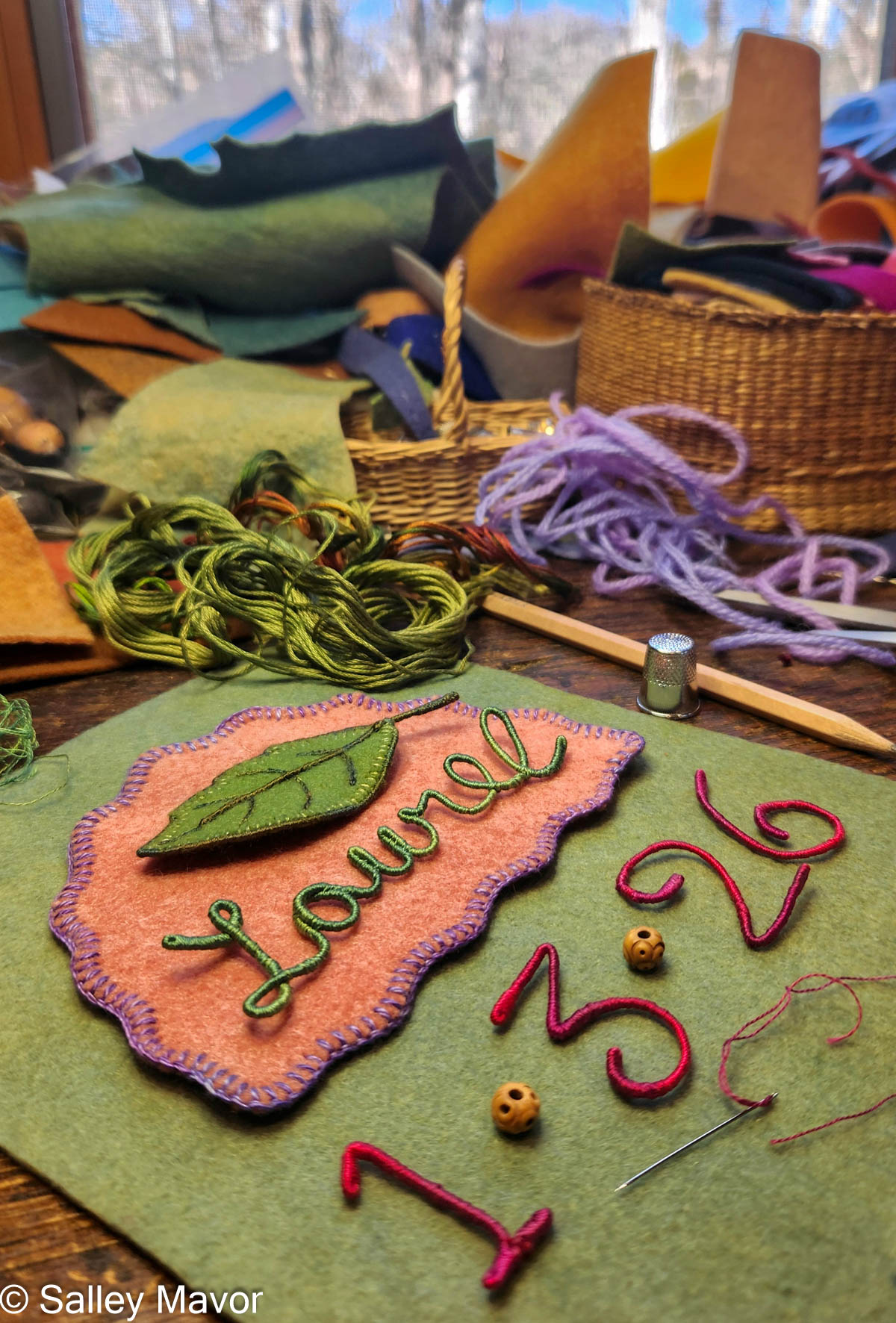
After the doll was finished, I got the idea of chain stitching Elias’s name and the year on the back. Yes, this will definitely be a yearly tradition!

To keep up with new posts, please subscribe to this blog. Your contact info will not be sold or shared. If you’d like to see more frequent photos tracking the projects in my studio, please follow me on Facebook, Instagram and BlueSky.
Harvest Time – Part 7 (wee folk)

In Part 7 in the continuing series about making Harvest Time, I share photos and commentary about the wee folk characters who populate the landscape. In the coming weeks, I will post more stories that focus on different aspects of making the fall scene, including the miniature storage containers and the embroidered trees. So far, I’ve written the following posts:
The overview introduces the Harvest Time piece.
Part 1 features moss making.
Part 2 is about making the turkey tail mushroom.
Part 3 shows the construction of felt leaves.
Part 4 gives a peek at embroidering the plants.
Part 5 is about making the toadstool mushroom.
Part 6 covers the underground tunnels, roots and stones.

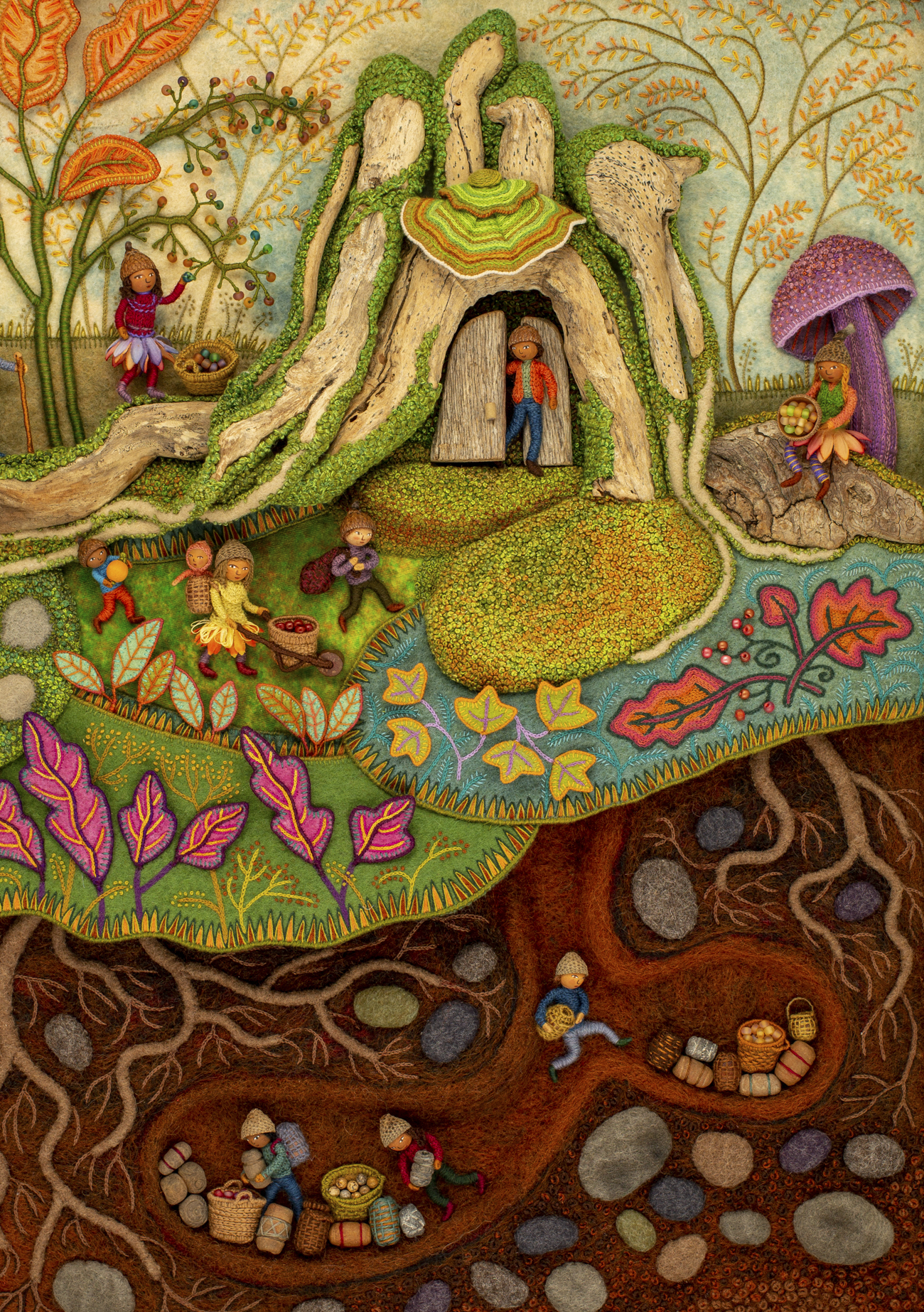
Harvest Time is the fall scene in a series of seasonal landscapes that capture the wonder and magic of the natural world, both real and imagined. Note cards and jigsaw puzzles of the this and other scenes in the series (Frosty Morning and Mossy Glen) are available in my Etsy Shop.

Everything I make includes some sort of living being with eyes, be they animal or human. I can’t imagine spending months working on a piece that is purely decorative, abstract or simply a landscape, without a storytelling element. The interplay between characters and their surroundings is what drives me to create. As I paint their faces, form their little bodies and stitch their clothes, I grow to care about them. This emotional connection is what motivates me to spend copious amounts of time creating an imaginary world that is worthy of their existence.

For this scene, I painted more faces than I needed, in different sizes and shades. That way, I could select a cast of characters later. I’m never sure how many figures I’ll need or exactly where they’ll end up. They are like actors in an improvisational skit or a group posed in a tableau.

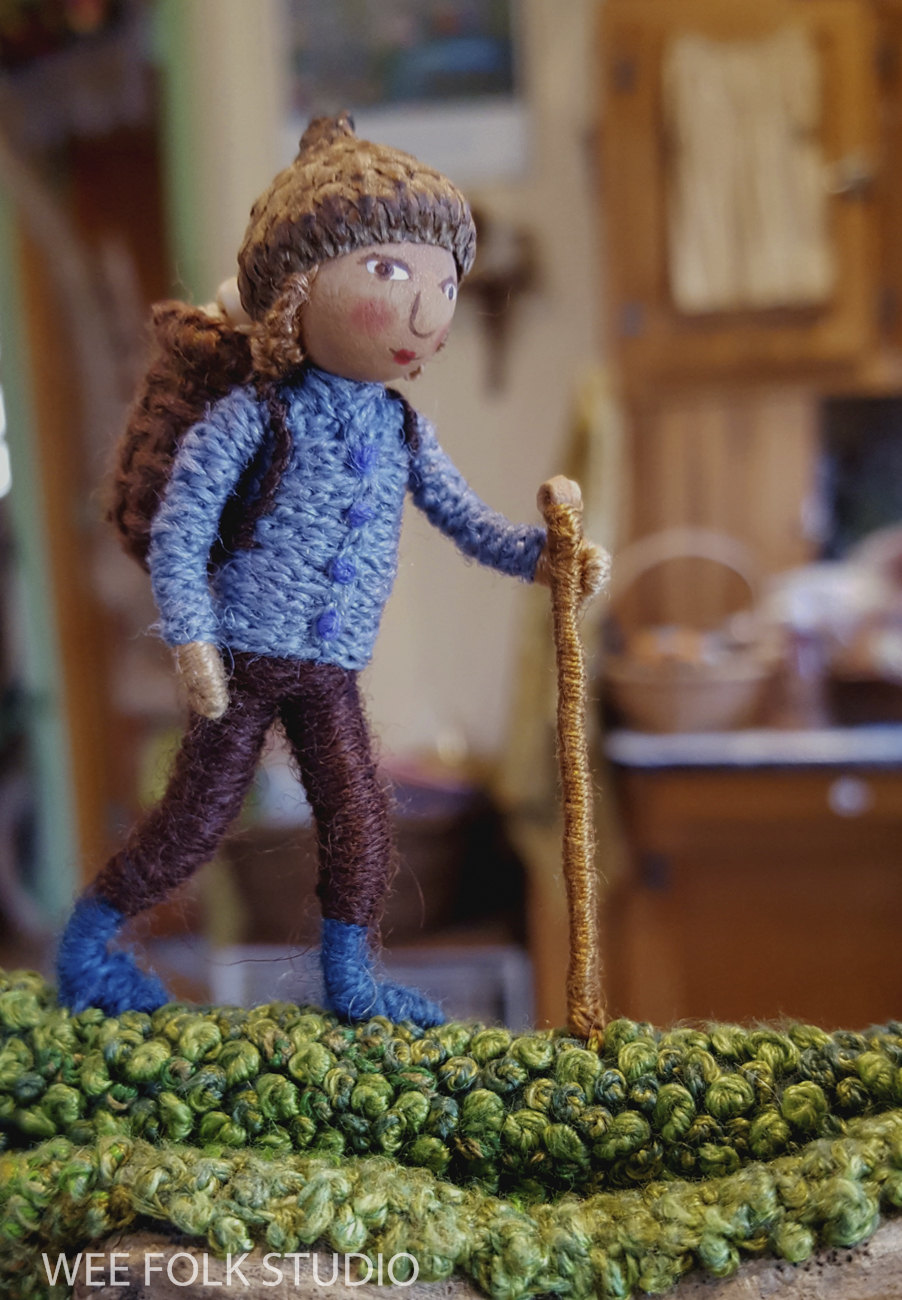
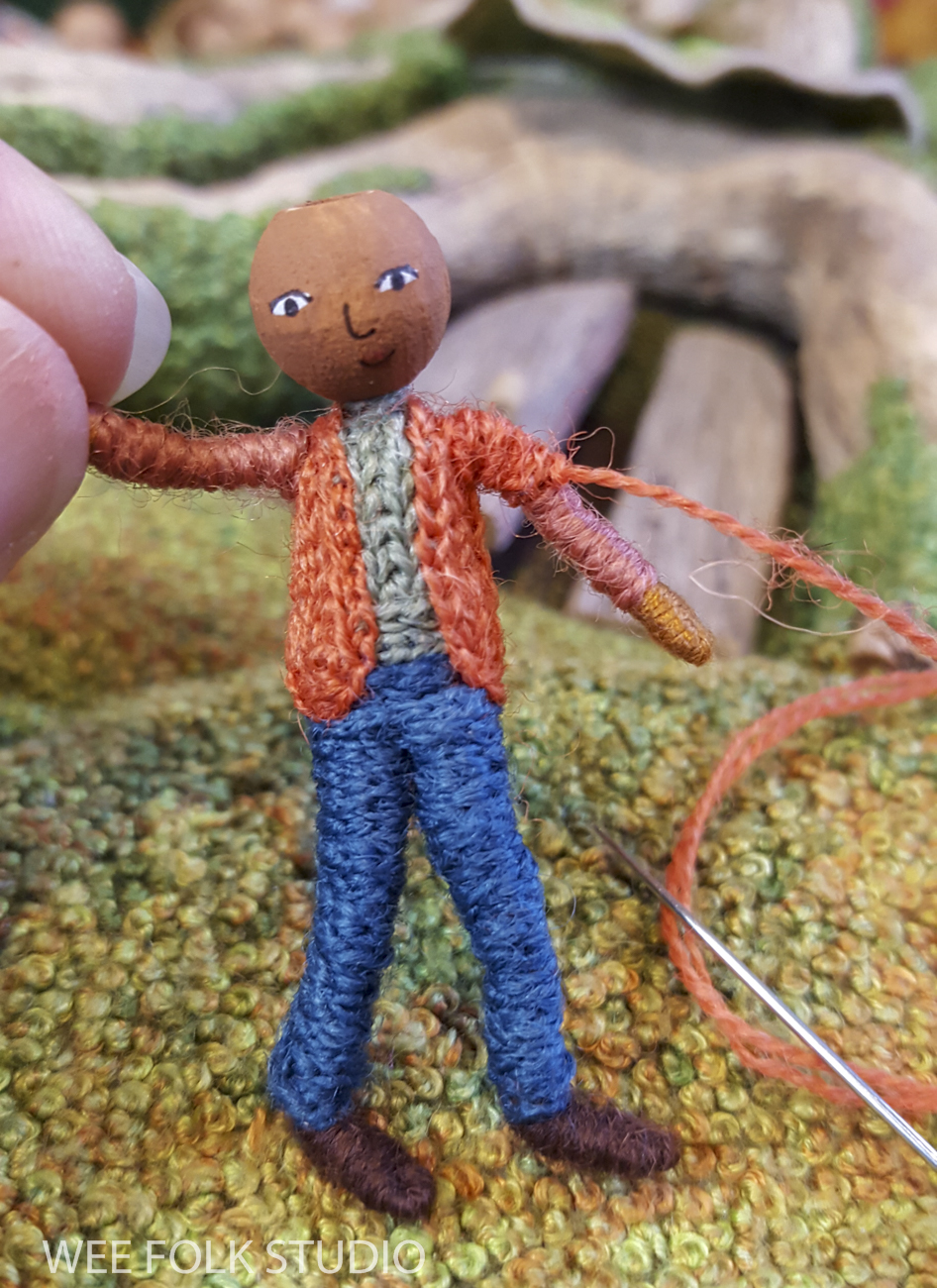
The little people range in size between 1″ to 2″ tall. They were made the same way as the wee folk dolls in my how-to book, Felt Wee Folk, with slight variations. For instance, I used wire instead of pipe cleaners for their tiny armatures.

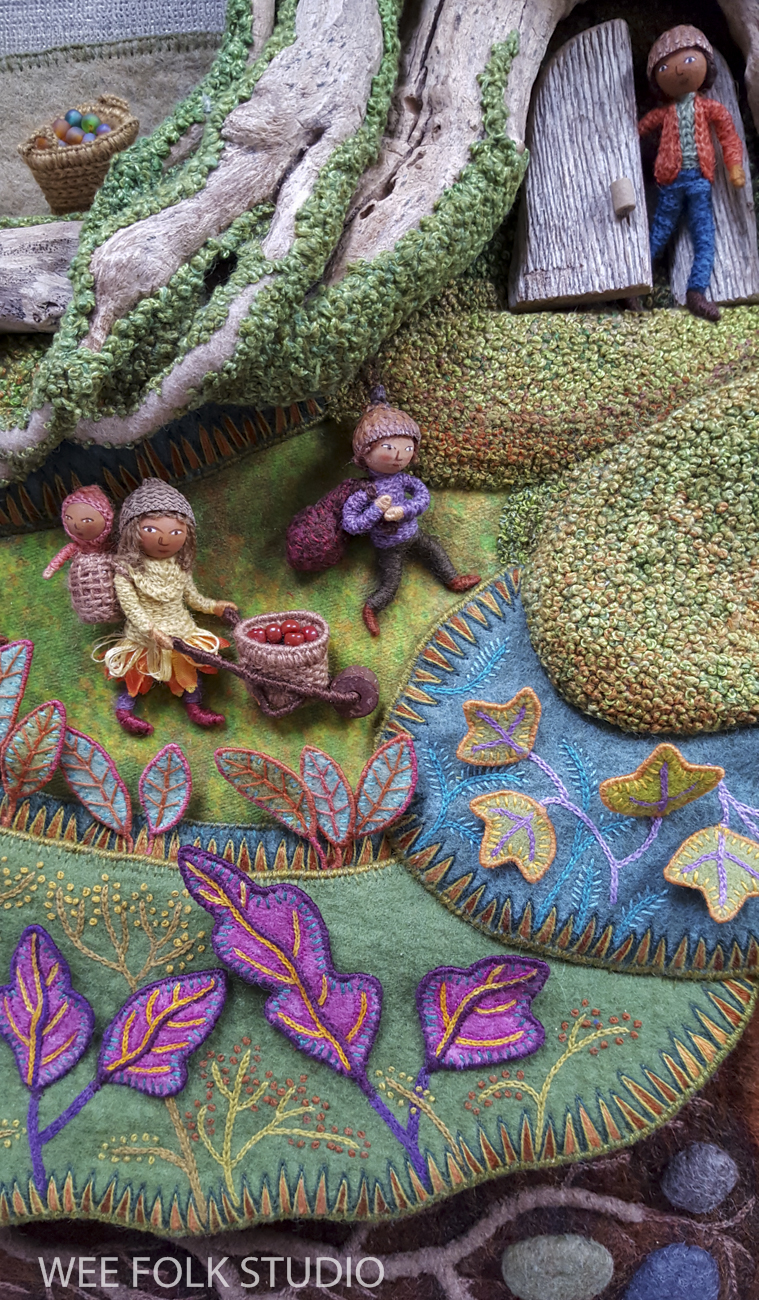
In keeping with the harvesting theme, all of the people are bringing produce to the mossy stump, where it will be stored in the cellar.

I’m often asked, “How do you knit their tiny outfits?” There might be someone out there who can knit or crochet a tiny sweater for a 2″ doll, but I challenge them to stuff their arms through the sleeves! Remember, this is make believe. The wee folk never have to bathe or change their clothes. Why knit, when you can embroider a piece of clothing directly onto a body? Rows of chain stitching are pretty convincing, don’t you think? I call it faux knitting.

Please stay tuned for more stories about making Harvest Time, including the storage containers and embroidered trees.
The overview introduces the Harvest Time piece.
Part 1 features moss making.
Part 2 is about making the turkey tail mushroom.
Part 3 shows the construction of felt leaves.
Part 4 gives a peek at embroidering the plants.
Part 5 is about making the toadstool mushroom
Part 6 covers the underground tunnels, roots and stones.

To keep up with new posts, please subscribe to this blog. Your contact info will not be sold or shared. If you’d like to see more frequent photos tracking the projects in my studio, please follow me on Facebook, Instagram and BlueSky.

Studio News

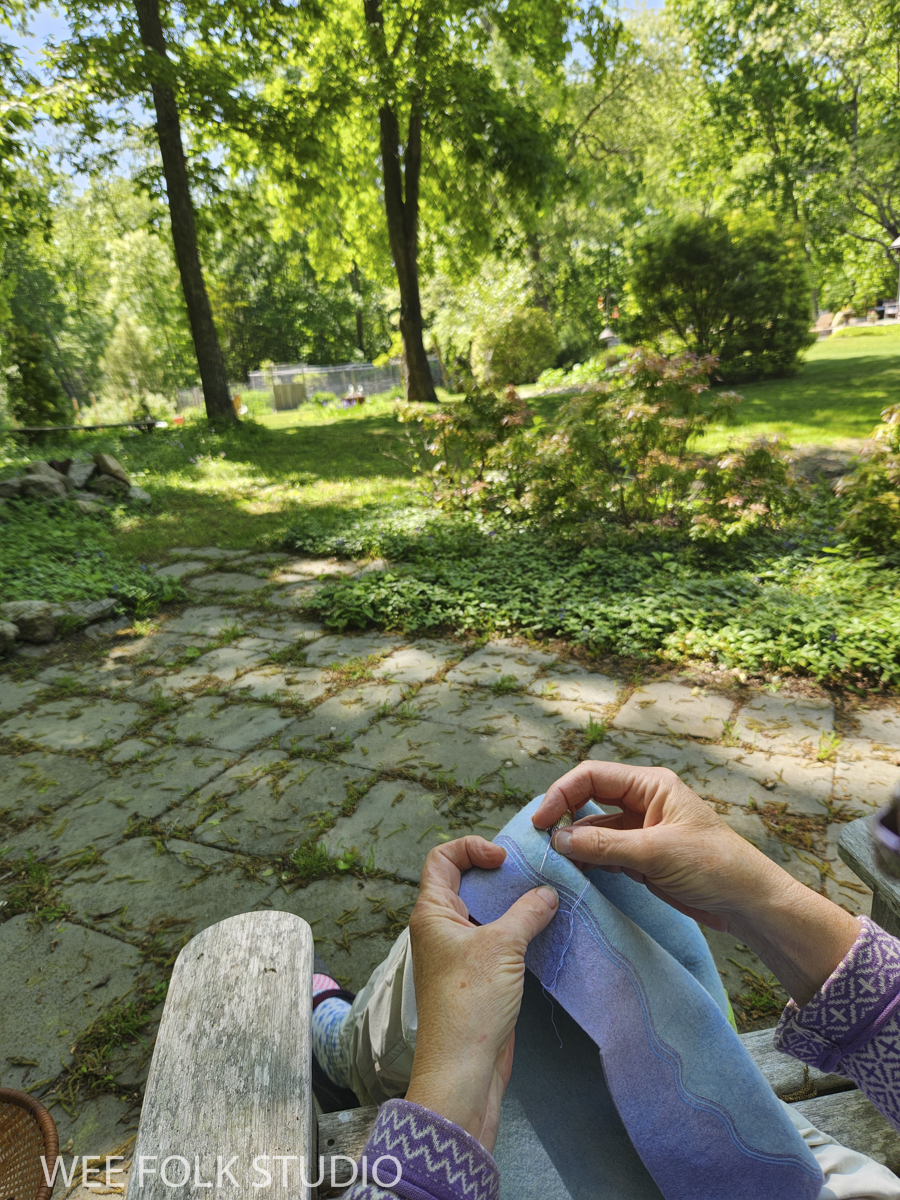
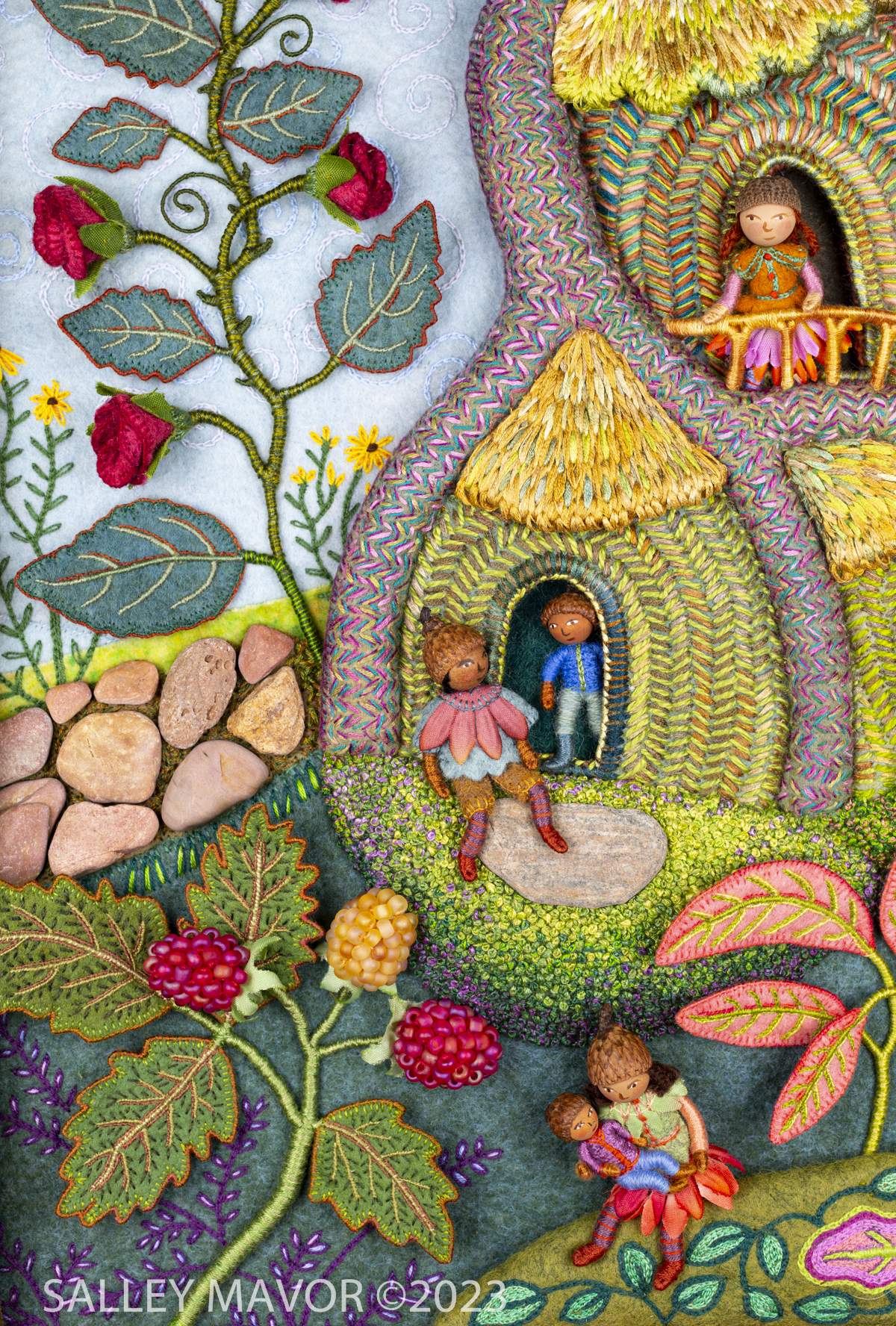
On a recent glorious afternoon, I sat outside and stitched. It was one of those idyllic moments, when I felt truly at peace, doing something I value, in a place I love. Some people read books to immerse themselves in another world. I do it with a needle and thread. It’s embarrassing to admit that when given the choice of reading or stitching, I pick stitching every time. That’s a good thing, because otherwise I’d never get anything done! Right now, I’m in the middle of making a summer scene in my series of seasonal landscapes. I usually wait until a piece is finished before writing about it, but this one is taking so long that I’m giving previews, like the Baltimore Oriole Sneak peek.

Grandma Salley and 4 month old Elias

One welcome change in my studio routine this year are the almost daily visits by my grandson Elias, who is now 4 months old. As you can imagine, this little guy is bringing about a shift in my priorities.

In this post, I share info about 2 upcoming exhibits, as well as photos and videos of some special parts of the summer scene, including roses, raspberries, trees, and tree houses. But first, I’d like to let you know about a magazine article about my 45-year art career and a fun and entertaining podcast interview that just came out,

MAGAZINE ARTICLE
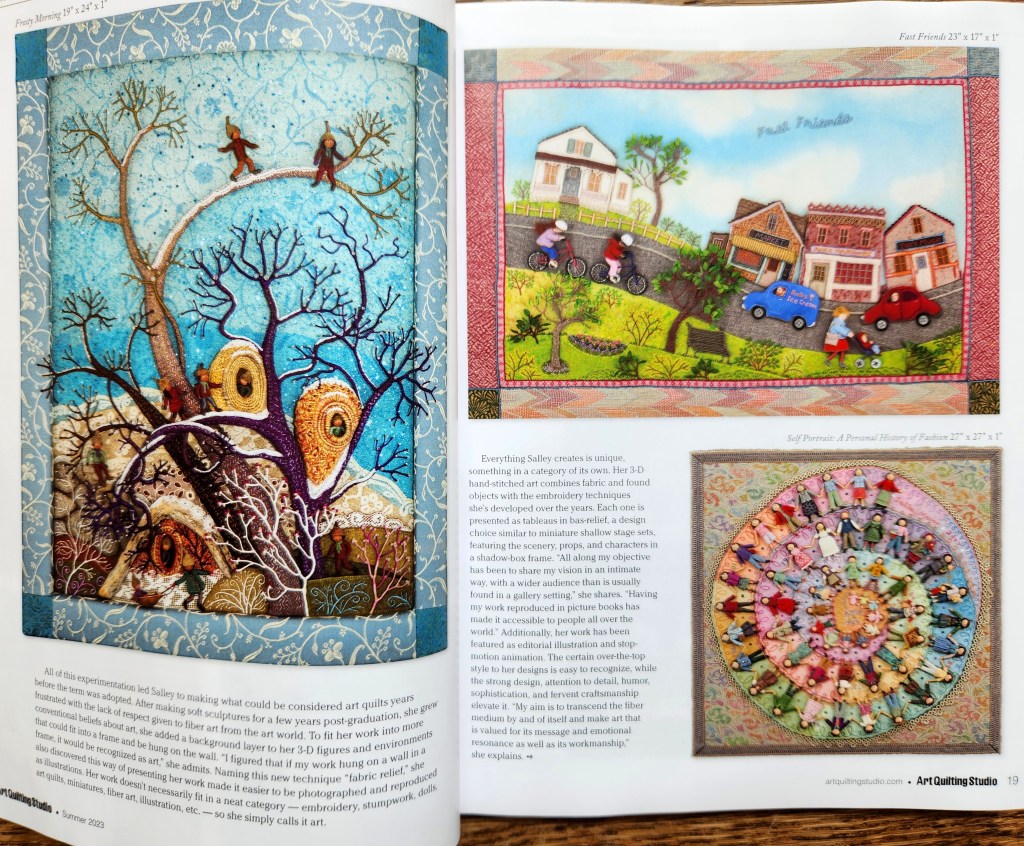
The summer issue of Art Quilting Studio features a 12-page artist portfolio about my work. I sent the editor a large selection of photos to choose from and to my surprise, they printed everything! The article covers a lot of ground and describes how and why I came to do what I do. I’m excited that more people will be seeing and learning about my artwork for the first time! This issue of the magazine can be purchased here.

PODCAST
I had the pleasure of being interviewed by Julie Wake, the very personable executive director of the the Arts Foundation of Cape Cod, for an episode in their series of Creative Exchange Podcasts. Listen to Salley Mavor / Staying True to Yourself and Your Work here.

EXHIBITIONS
The next showing of Bedtime Stitches, the touring exhibition of original artwork for my picture book, MY BED: Enchanting Ways to Fall Asleep around the World will be July 6 – Sept. 15, 2023 at the Southeastern Quilt and Textile Museum in Carrollton, GA. To see the tour schedule, please visit the exhibitions page.

Afghanistan scene in MY BED

THE WEE WORLDS OF SALLEY MAVOR

SOUTHERN VERMONT ARTS CENTER, Manchester, VT
ON VIEW: Saturday, September 30, 2023 – Sunday, January 7, 2024
OPENING RECEPTION: Saturday, September 30 from 2 to 4 P.M.
GALLERY TOUR with the artist at 3 P.M.

SUMMER SCENE PREVIEW
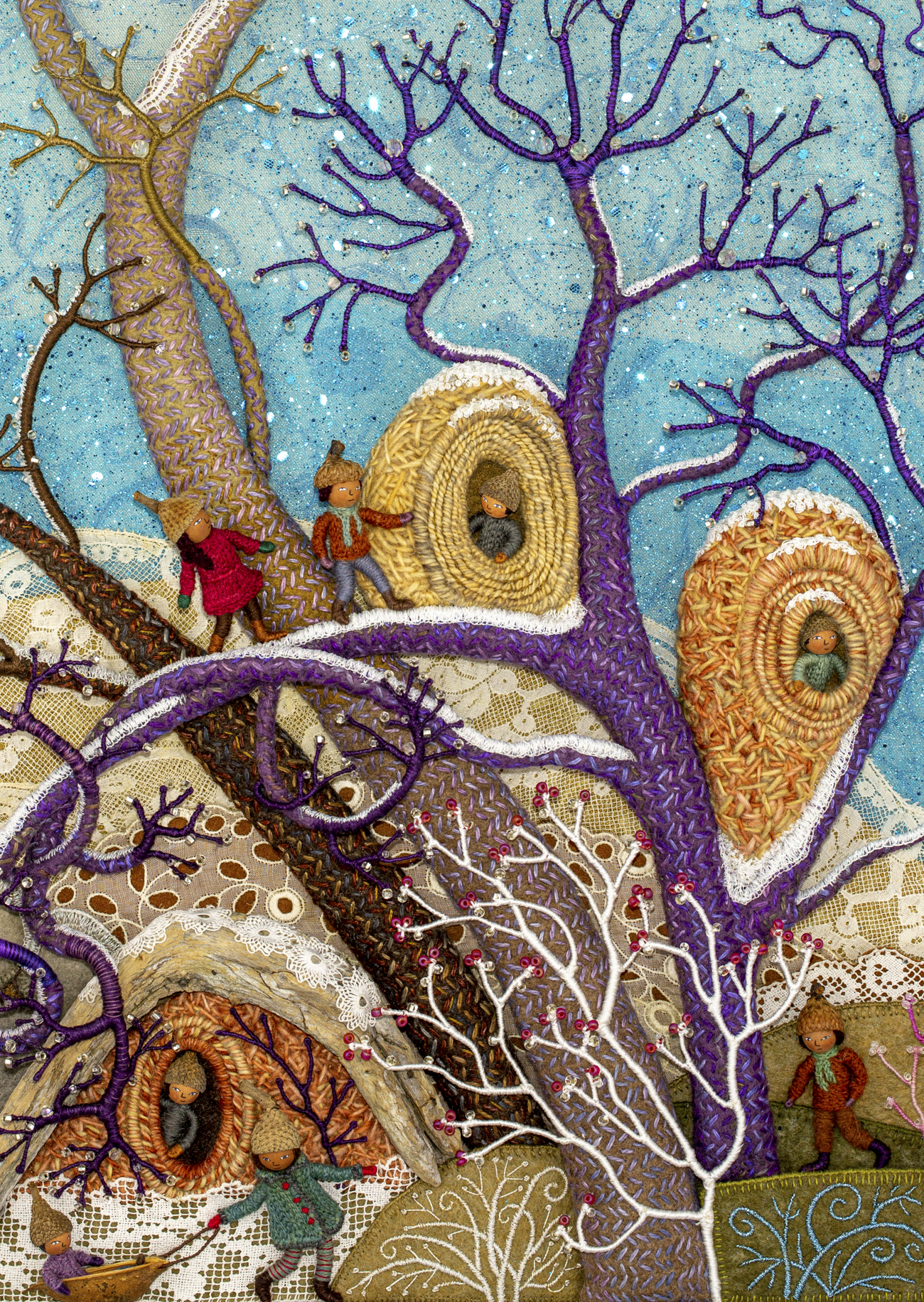
When the summer scene is finished, hopefully in time for my exhibit in Vermont this fall, I’ll write a series of posts that go into more detail, with commentary and photos that document my process. It will be the 4th in my seasonal landscape series. You can learn about how I made the other three, Frosty Morning, Mossy Glen and Harvest Time, in earlier posts on this blog. The images are printed as cards and jigsaw puzzles, which are available in my Etsy Shop.

And now for the summer scene teaser!

Here’s a Stitch Minute video of making a felt rose. It’s an embellished version of a rose that Mimi Kirchner shared years ago on her blog.

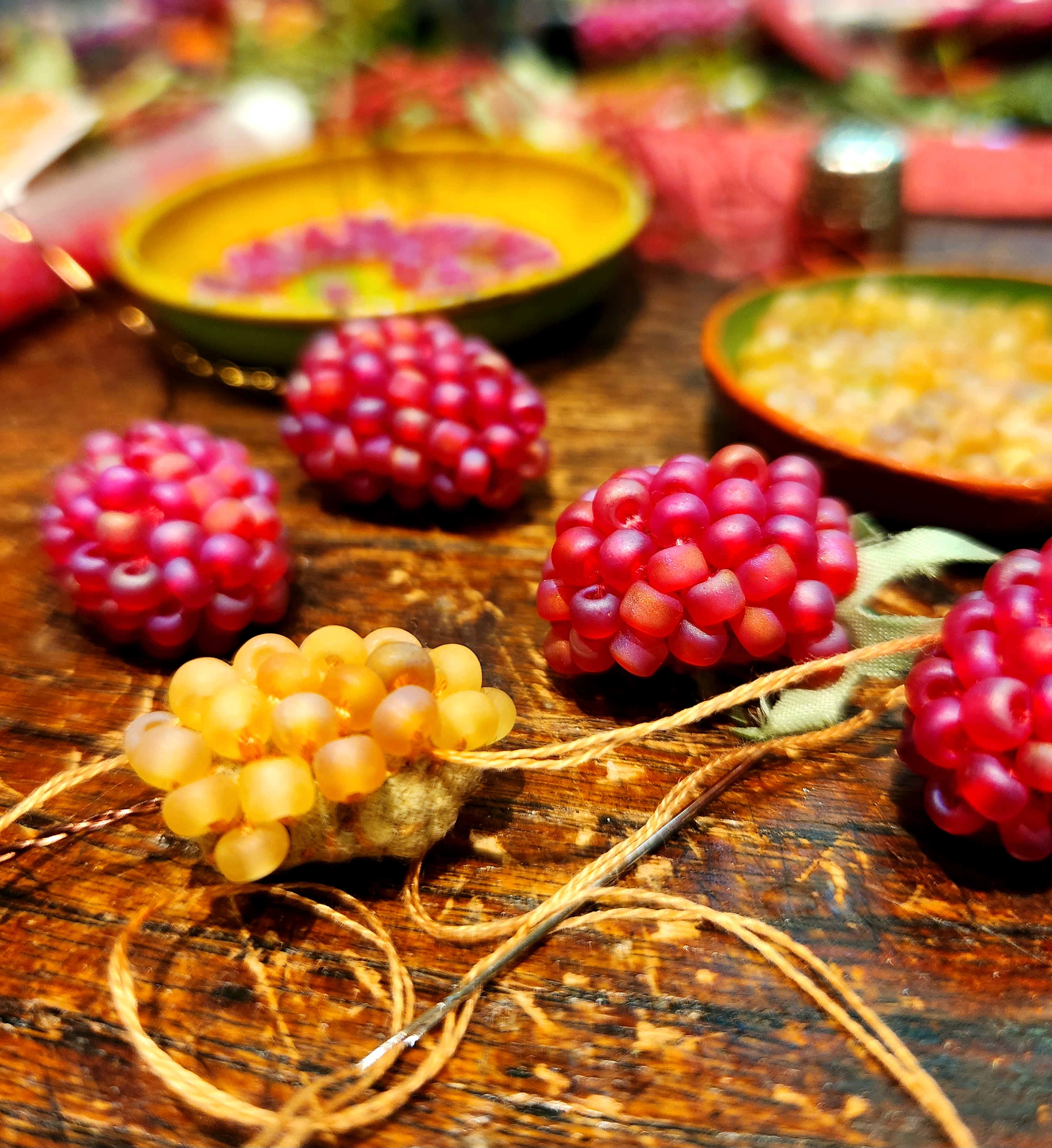
I also made raspberries for the scene.

You can watch how I made them in this Stitch Minute video.

Here’s a close up of the tree, which is the main focal point.

I’ll leave with this little video of the tree houses in the summer scene. I just couldn’t resist playing! You may recognize the character peeking out as a member of the Woodland Family in my how-to book, Felt Wee Folk: New Adventures. I’ll eventually make all new wee folk dolls to inhabit the landscape.

Tree houses in the summer scene.

To keep up with new posts, please subscribe to this blog. Your contact info will not be sold or shared. If you’d like to see more frequent photos tracking the projects in my studio, please follow me on Facebook, Instagram and BlueSky.
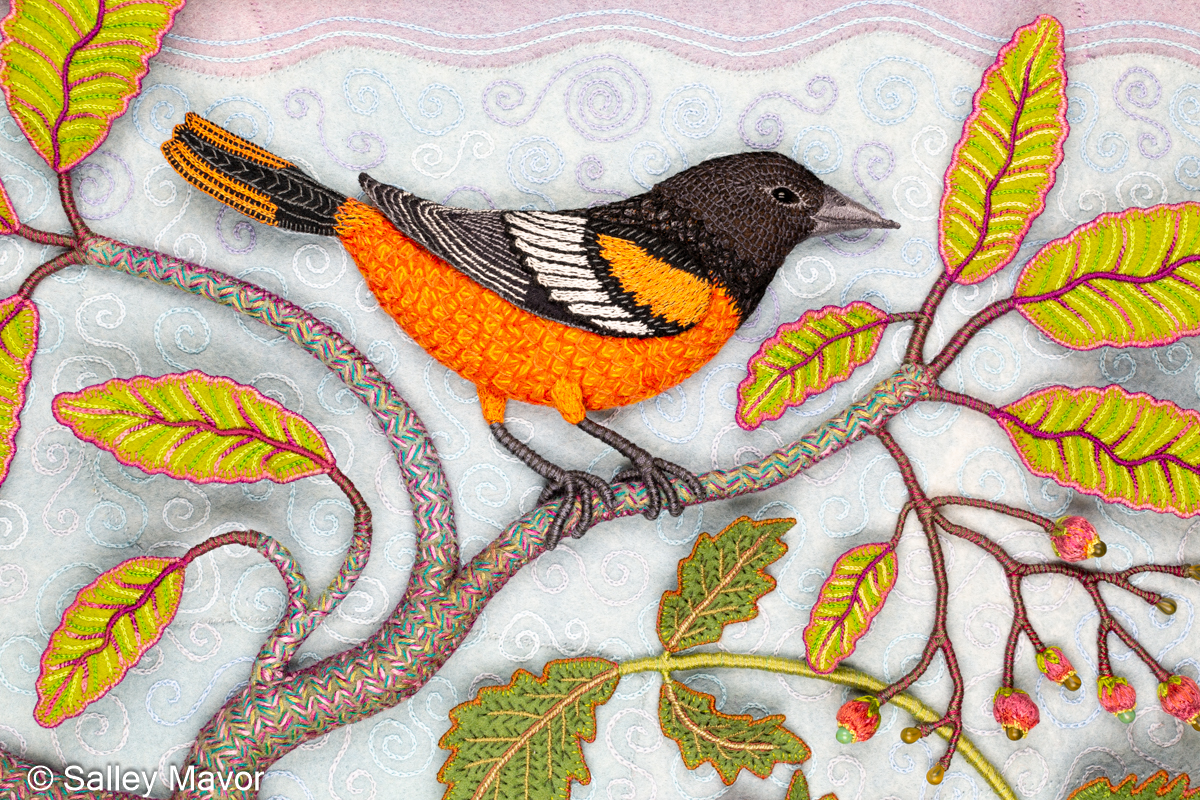
Baltimore Oriole sneak peek

I’m right in the middle of making the summer scene in my series of seasonal landscapes. Normally, I wait until a piece is finished before writing blog posts about it, but I just have to give you a preview of what’s to come! This scene features a flashy male Baltimore Oriole, which I’m excited to show.

It’s been ten years since I made a bird this size, like the ones in Birds of Beebe Woods. Back then, I didn’t take many pictures while I worked. This time, I documented every stage of the process with photos and videos, which I’ve shared on Facebook and Instagram over the past month and now here in this post.

The Baltimore Oriole will be perched in the upper branches of a tree that has little huts nestled at the base. Like the other scenes in the series, Frosty Morning, Mossy Glen and Harvest Time, the summer landscape will be full of wee folk characters cavorting outside in nature. The first 3 seasons are available as Jigsaw Puzzles and Note Cards in my Etsy Shop. When its finished, the summer scene will also be reproduced as a card and puzzle.

I hope to finish the summer scene in a few months, so that all four seasons will be displayed together at my exhibition in Vermont this fall.

The Wee Worlds of Salley Mavor (includes Bedtime Stitches).
Southern Vermont Arts Center, Manchester, VT
Sept. 30, 2023 – Jan. 7, 2024
Opening – Sat., Sept 30, 2 to 4 pm. Galley tour with the artist at 3 pm.

When the piece is completed, I’ll write my usual series of detailed posts about different aspects of how I work, like I’ve done with Frosty Morning, Mossy Glen and am currently doing with Harvest Time.

For now, I hope that you enjoy looking over my shoulder, while I work. The following five videos are condensed versions of different steps I used in creating the bird’s breast, beak, wing, tail, and feet.

Making the Breast

The videos aren’t intended to be tutorials, but you can pick up a lot of my stitching techniques. If you’ve followed me for a while, you’ve probably heard my personal philosophy about sharing knowledge. Basically, I’m happy to give peeks at how I work, as long as the act of creating isn’t overly dissected, else it loses its magic.

This video shows how I created the beak.

Making the Beak

This video demonstrates how I stitched the wing.

Making the Wing

This video shows the process of making the tail.

Making the Wing

This video shows how I formed the feet.

Making the Feet

Now that the bird is finished, I’ve resumed working on other parts of the landscape. But, I have a feeling that this Baltimore Oriole, in all his orange glory will not want to share the stage with whatever and whomever shows up next!

To keep up with new posts, please subscribe to this blog. Your contact info will not be sold or shared. If you’d like to see more frequent photos tracking the projects in my studio, please follow me on Facebook, Instagram and BlueSky.
Mossy Glen: Part 7 – Violets and Berries

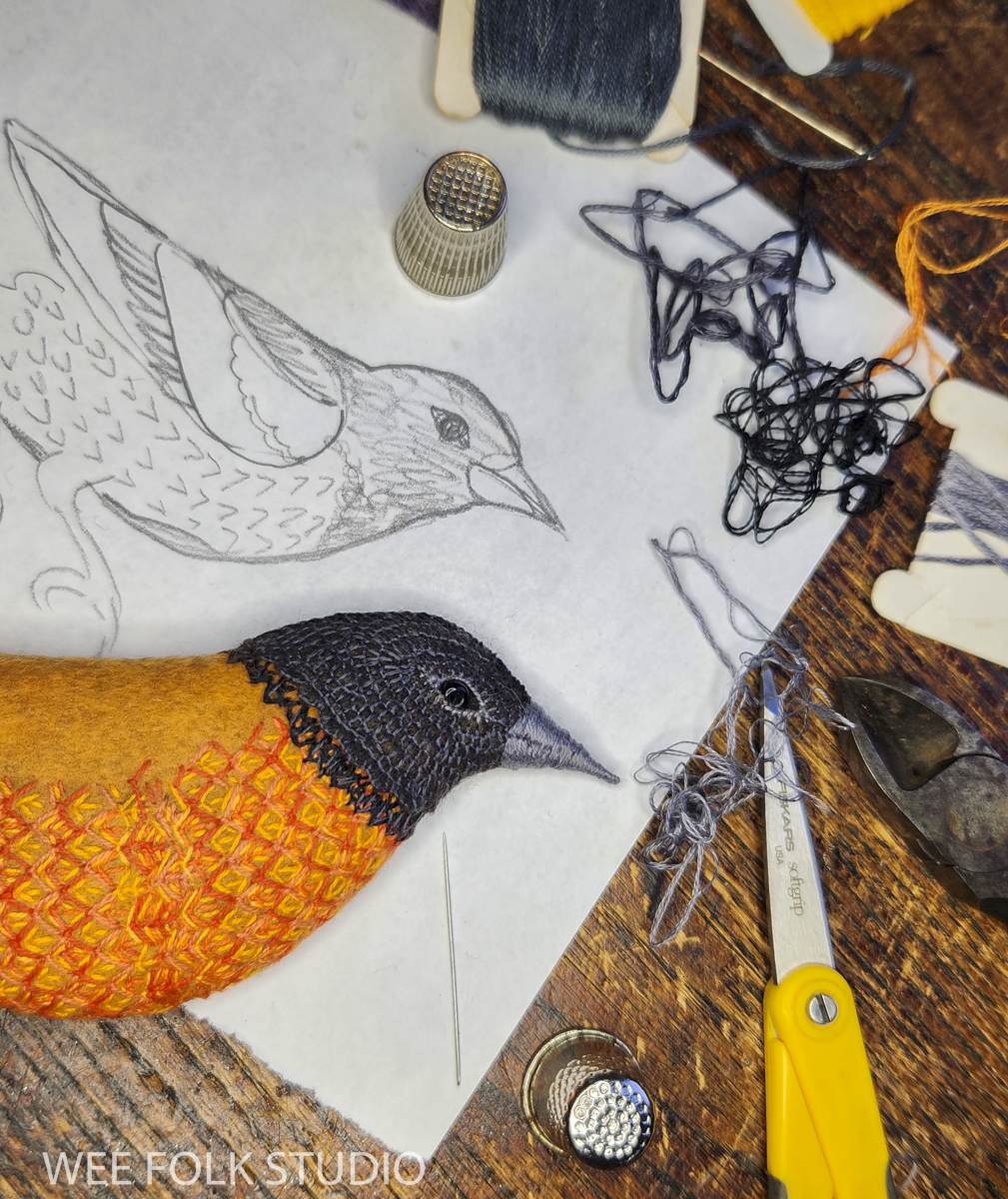
In this Part 7 of the series about making the spring landscape, Mossy Glen, I share photos, videos and commentary about how I created violets and berry bushes. Part 1 is all about stitching a moss-like texture, Part 2 gives a glimpse at how I made the cherry trees, Part 3 is about the stone walls, Part 4 shows how I made the forsythia blossoms, Part 5 features wire and felt leaves and Part 6 is about chain-stitching leaves.

winding wire stems with embroidery floss

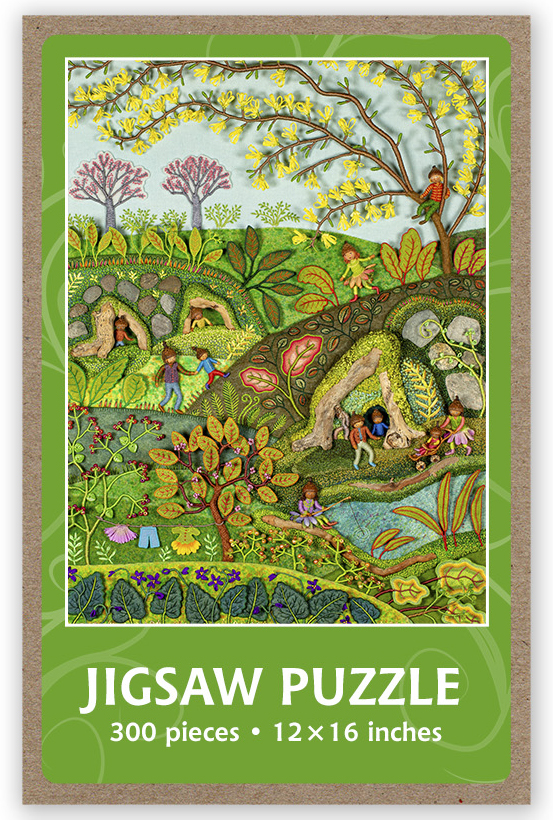
Mossy Glen is the spring scene in a series of seasonal landscapes that capture the wonder and magic of the natural world. Note cards, prints, bookmarks, and jigsaw puzzles of Mossy Glen and the other scenes in the series (Frosty MorningHarvest Time, and Summertime) are available in my Etsy Shop.


While I write this post, I’m in the midst of preparing for my upcoming retrospective exhibition in Kennebunk, Maine at the Brick Store Museum. Even though I’ve hardly picked up a needle and thread this spring, I’m still being creative, but in a different way. My approach to curating this show is similar to how I imagine and labor over my artwork. It’s all about taking a lot of small details and arranging them in a way that contributes to the story. The exhibition, What a Relief: The Art of Salley Mavor will tell the story of my evolution as an artist, from childhood to today. Just like my art, this exhibit will be very busy, with a ton of original 3-dimensional pieces to eye as closely as you like. As my husband Rob says, “With Salley’s art, more is more.”

Early work from the 80’s and 90’s on loan for the exhibition, What a Relief: The Art of Salley Mavor.

What a Relief: The Art of Salley Mavor at the Brick Store Museum in Kennebunk, Maine, (June 7 – Sept. 11, 2022). I will be there on Sat., June 25th from 1 – 3 pm for a meet and greet and book-signing event.

The retrospective exhibition will feature a large selection of my artwork, spanning over 40 years, from early on to the present day. Over 100 pieces from my collection and rarely seen works on loan from private collections will fill walls a cases in multiple galleries on the museum’s entire first floor. Original picture book illustrations, including the entire series from my most recent book, MY BED will also be shown.

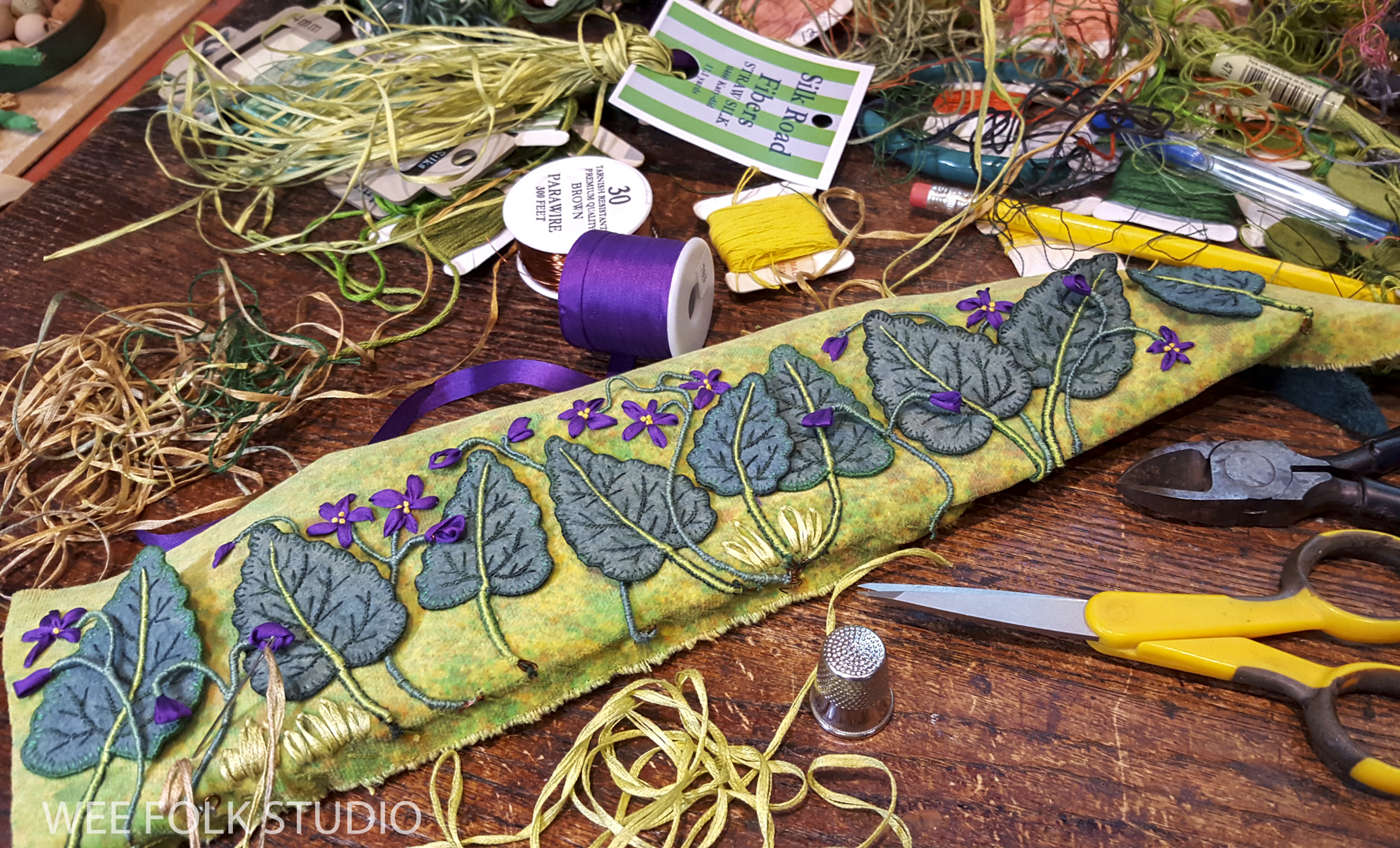
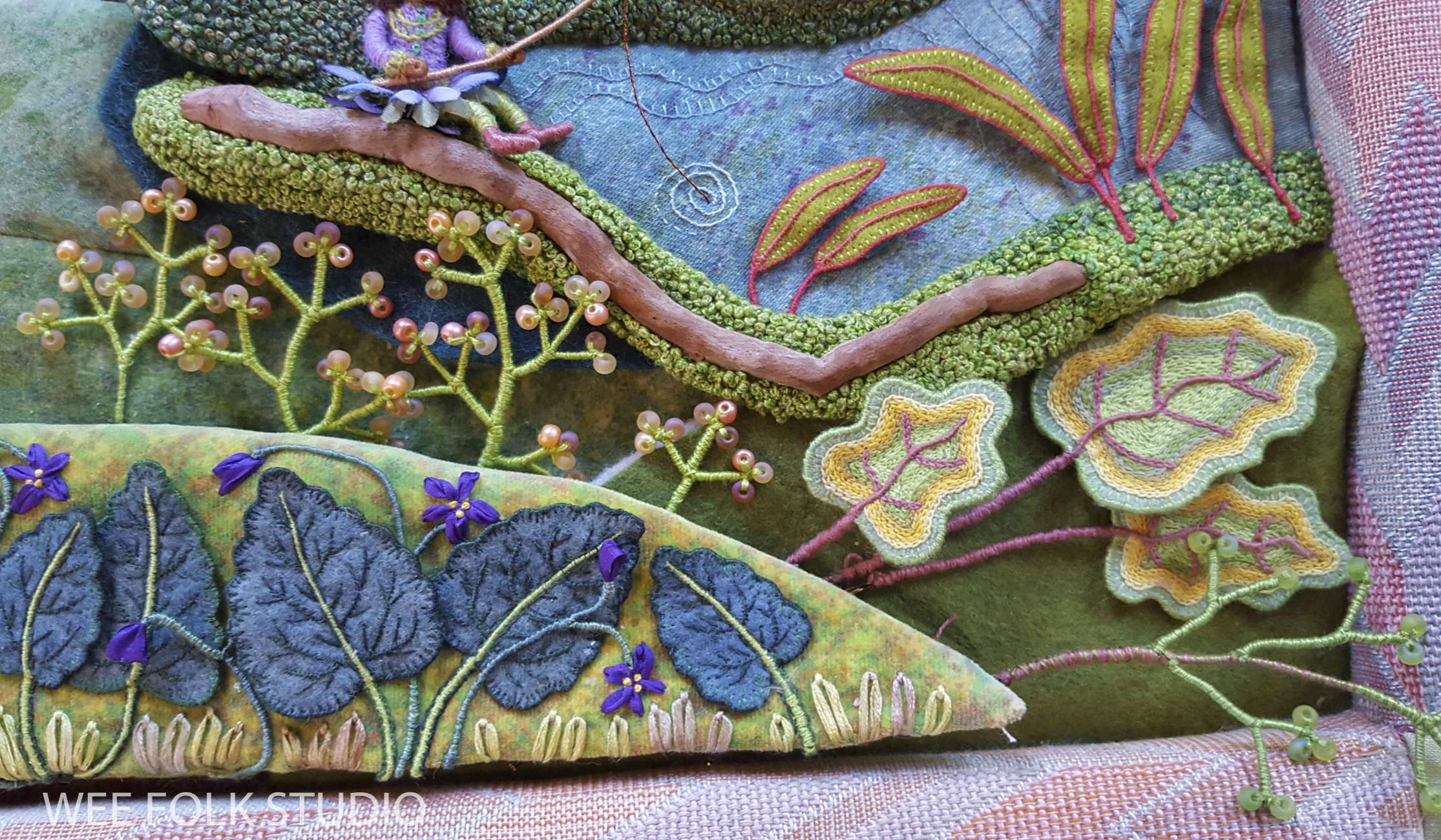
Now back to the patch of violets, which appear in the lower left foreground of Mossy Glen. I chose violets because I thought a dark leafed plant would bring some weight to the bottom of the composition. I also wanted something larger scale, to offset all of the itty bitty berries and leaves.

I constructed the leaves out of wool felt and wire and embroidered the veins.

You can see the process of making the leaves in this Stitch Minute video.

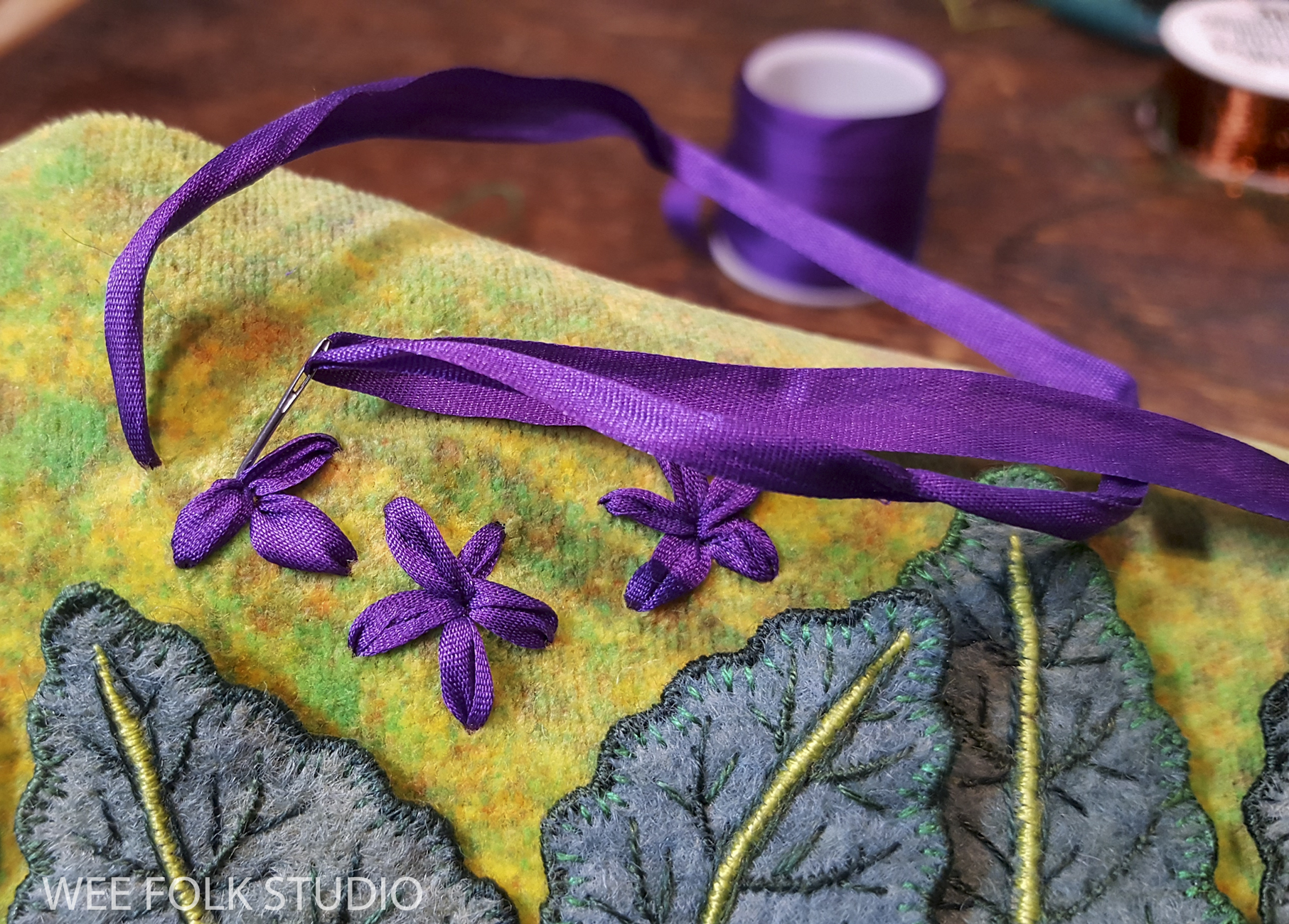
After sewing the leaves to the background fabric, I stitched flowers with silk ribbon.

I created stems with wire, silk ribbon and embroidery floss.

The silk ribbon was so fun to use that I couldn’t resist adding some “grass” to the bottom edge.

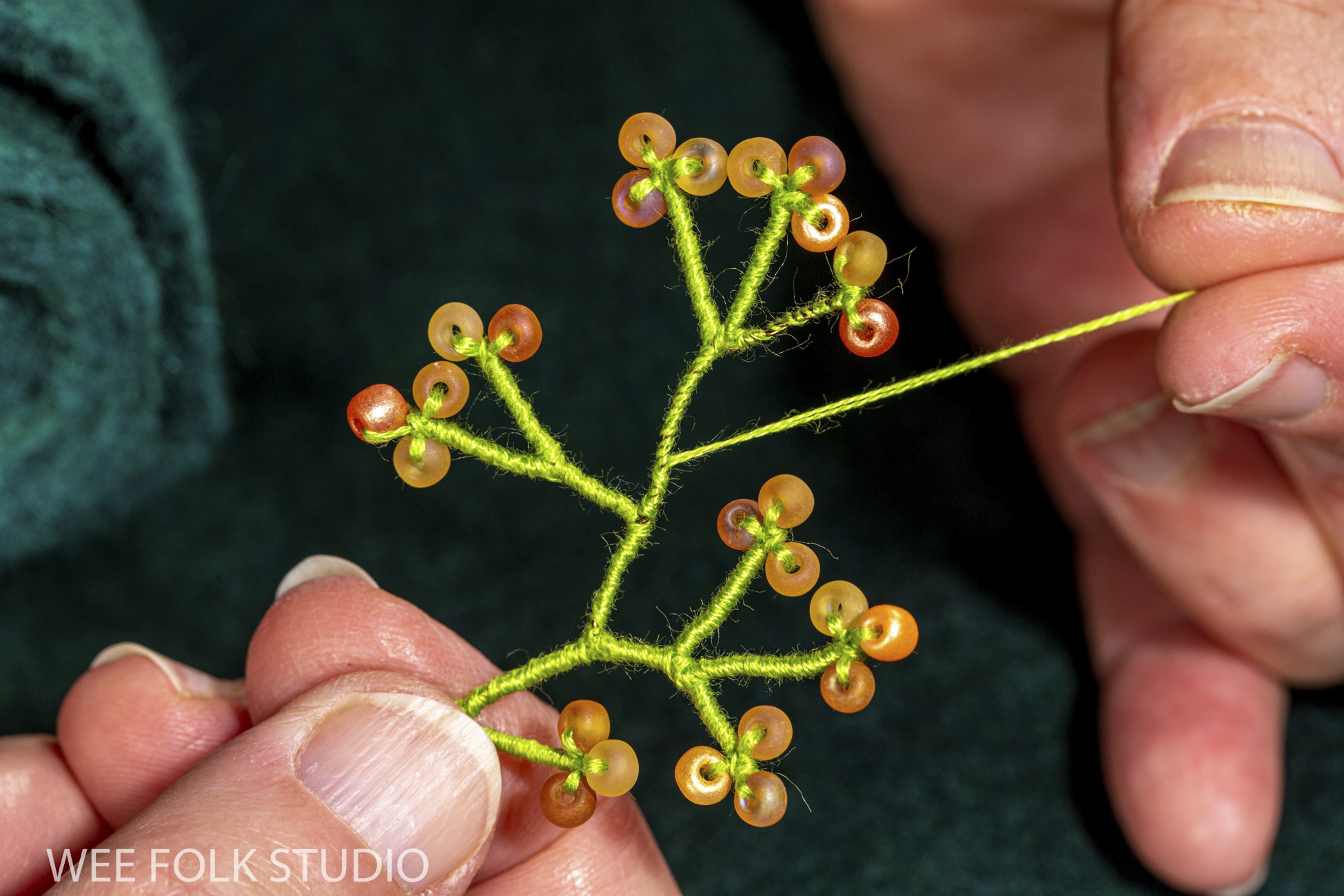
Scattered throughout Mossy Glen are berry bushes, which I make with wire, glass beads and embroidery floss.

You can see how I form wire and bead berry bushes in this Stitch Minute video.

Wire and glass bead berry bush

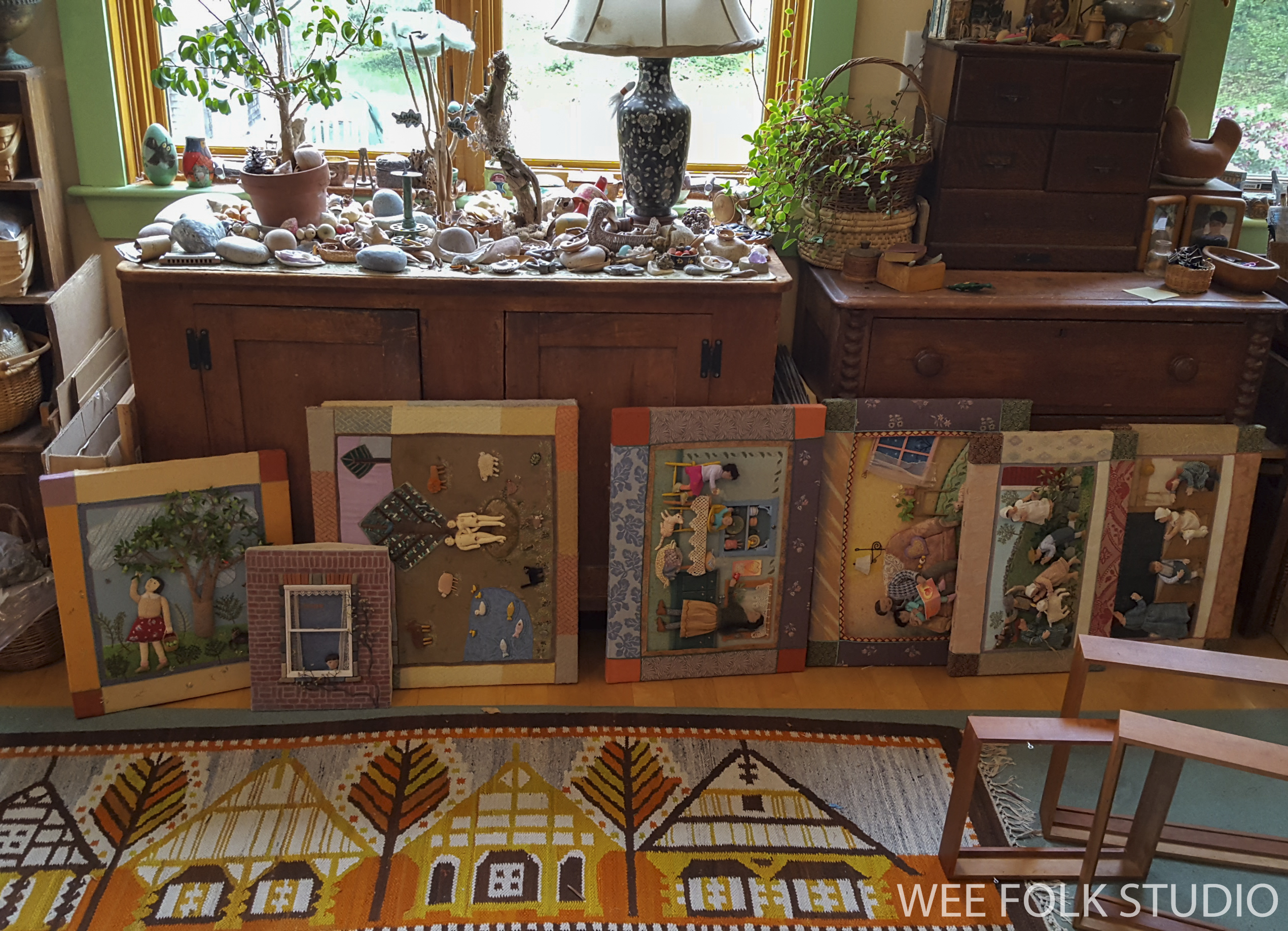
At this stage of the project, I picked out some upholstery fabric from my stash and used it to cover the stretcher frames. It hurts my brain to try to explain why and how it’s done, but the process involves cotton padding and lots of contorted hand sewing, kind of like upholstering a piece of furniture. In putting the covered stretcher on top, I’m basically freeing up an extra 1/2″ of depth that would normally be wasted behind the stretched fabric.

I then stapled the background fabric to the back of the covered stretcher and started assembling the pieces on top, inside the upholstered border frame.

Stay tuned for a final post about making the wee folk characters in Mossy Glen.
Mossy Glen (overview)
Part 1 (moss)
Part 2 (cherry trees)
Part 3 (stone walls)
Part 4 (forsythia)
Part 5 (wire and felt leaves)
Part 6 (chain stitched leaves)

To keep up with new posts, please subscribe to this blog. Your contact info will not be sold or shared. If you’d like to see more frequent photos tracking the projects in my studio, please follow me on Facebook and/or Instagram.

Mossy Glen: Part 2 – Cherry Trees

Flowering trees in the spring are glorious, aren’t they? Maybe we appreciate them because their showy display is so brief. In this Part 2 of the series about making Mossy Glen, I share photos, videos and commentary about how I created the cherry trees that sit atop the hillside, off in the distance.

Mossy Glen is the spring scene in a series of seasonal landscapes that capture the wonder and magic of the natural world. Note cards, prints, bookmarks, and jigsaw puzzles of Mossy Glen and the other scenes in the series (Frosty MorningHarvest Time, and Summertime) are available in my Etsy Shop.

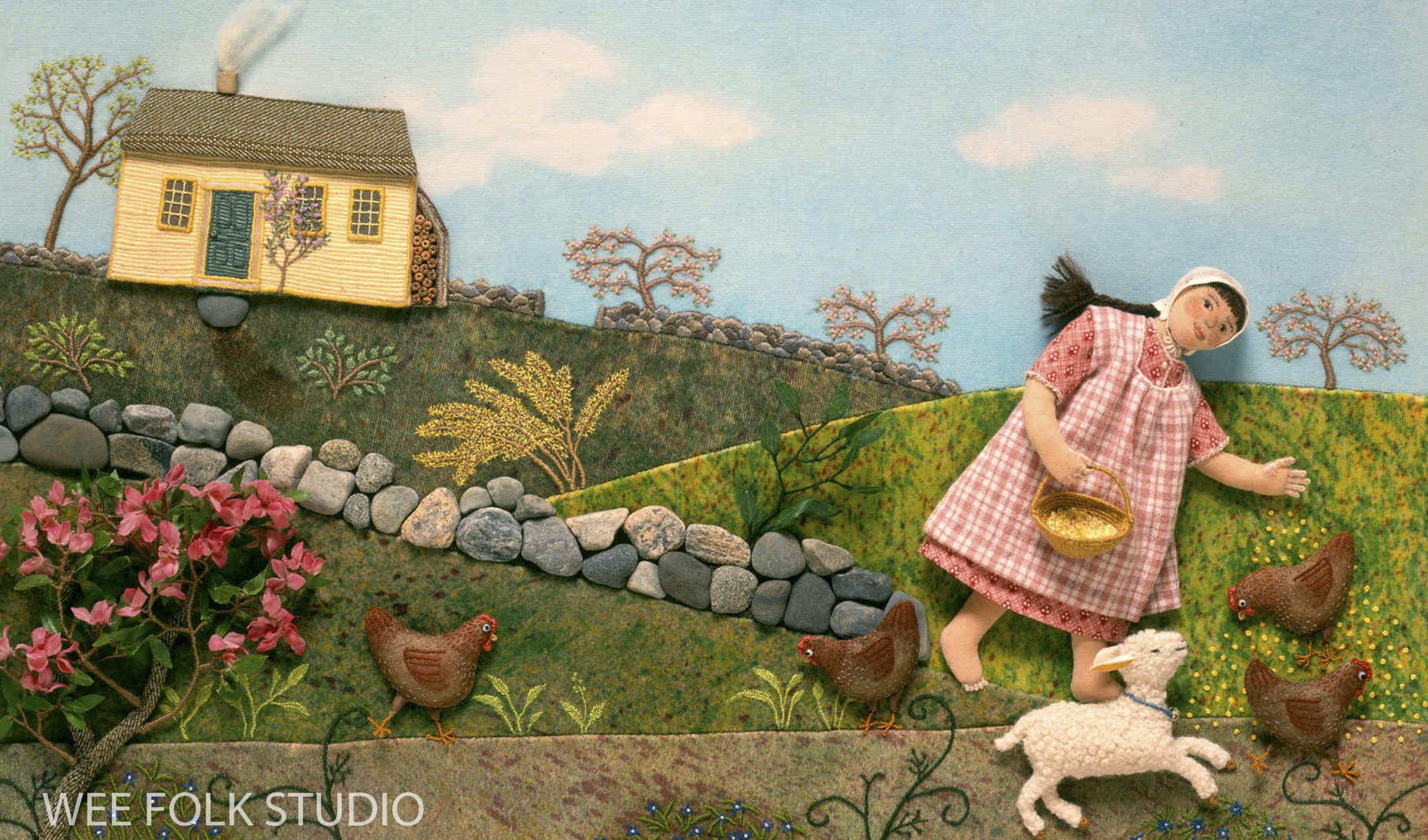
The pink tinted trees against the blue sky remind me of the blossoming apple trees in this book jacket illustration for my 1995 book, Mary Had a Little Lamb.

Mary Had a Little lamb 1995

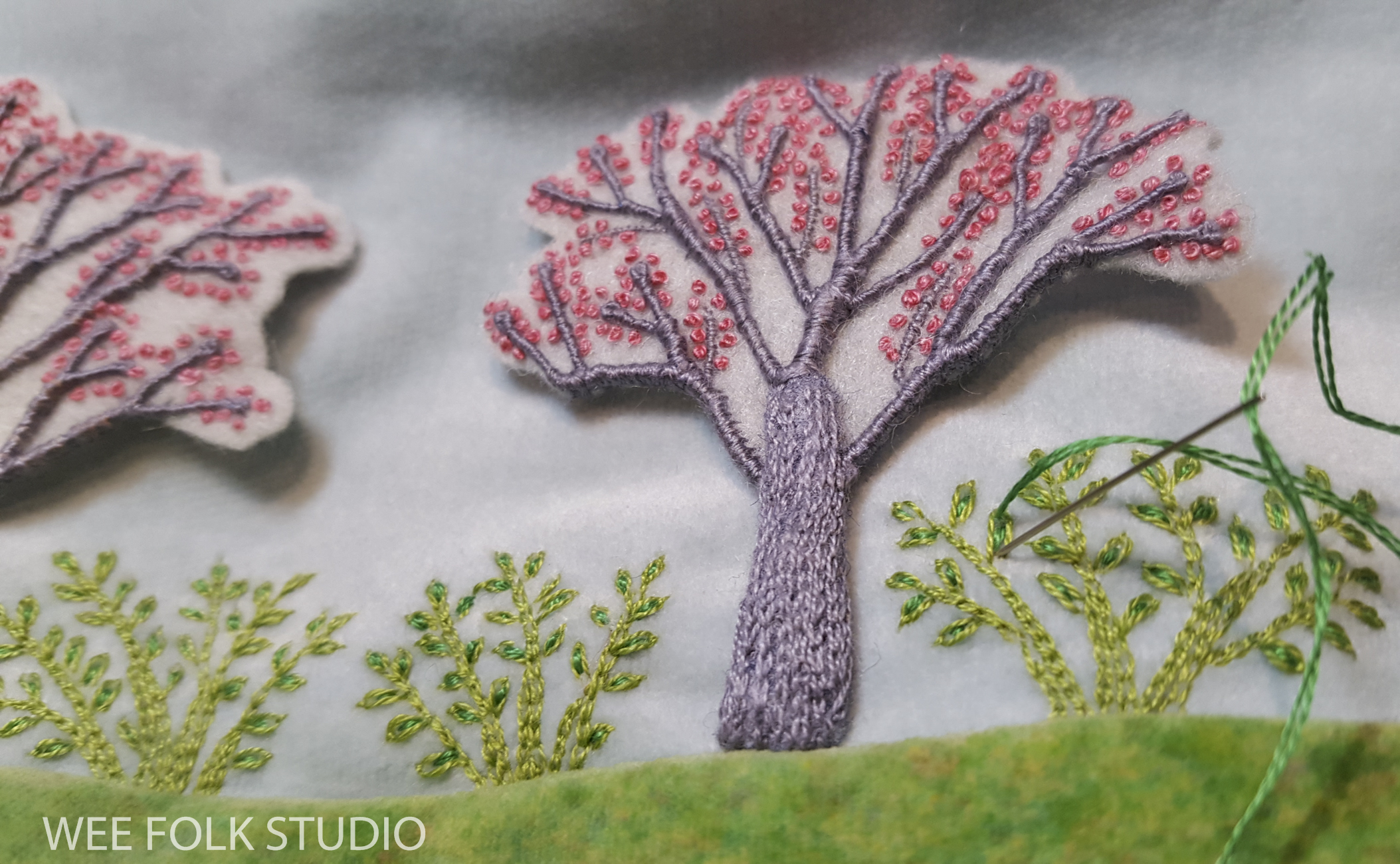
Of course, apple and cherry trees are shaped differently and their flowers aren’t the same shade of pink. I also constructed them differently – the apple trees are embroidered directly onto cotton velveteen, whereas the cherry trees in Mossy Glen are made with a combination of wrapped wire and embroidery on wool felt.

I also made the cherry trees as separate objects that could be shifted around. That way, I could adjust their position according to how the surrounding parts came out. Over the years, I’ve found that keeping an open-ended playful element in my process is more and more important. The idea of following a set pattern or grid, without much wiggle room, such as in knitting, cross-stitching or weaving makes me feel trapped and constrained, without room to breath.

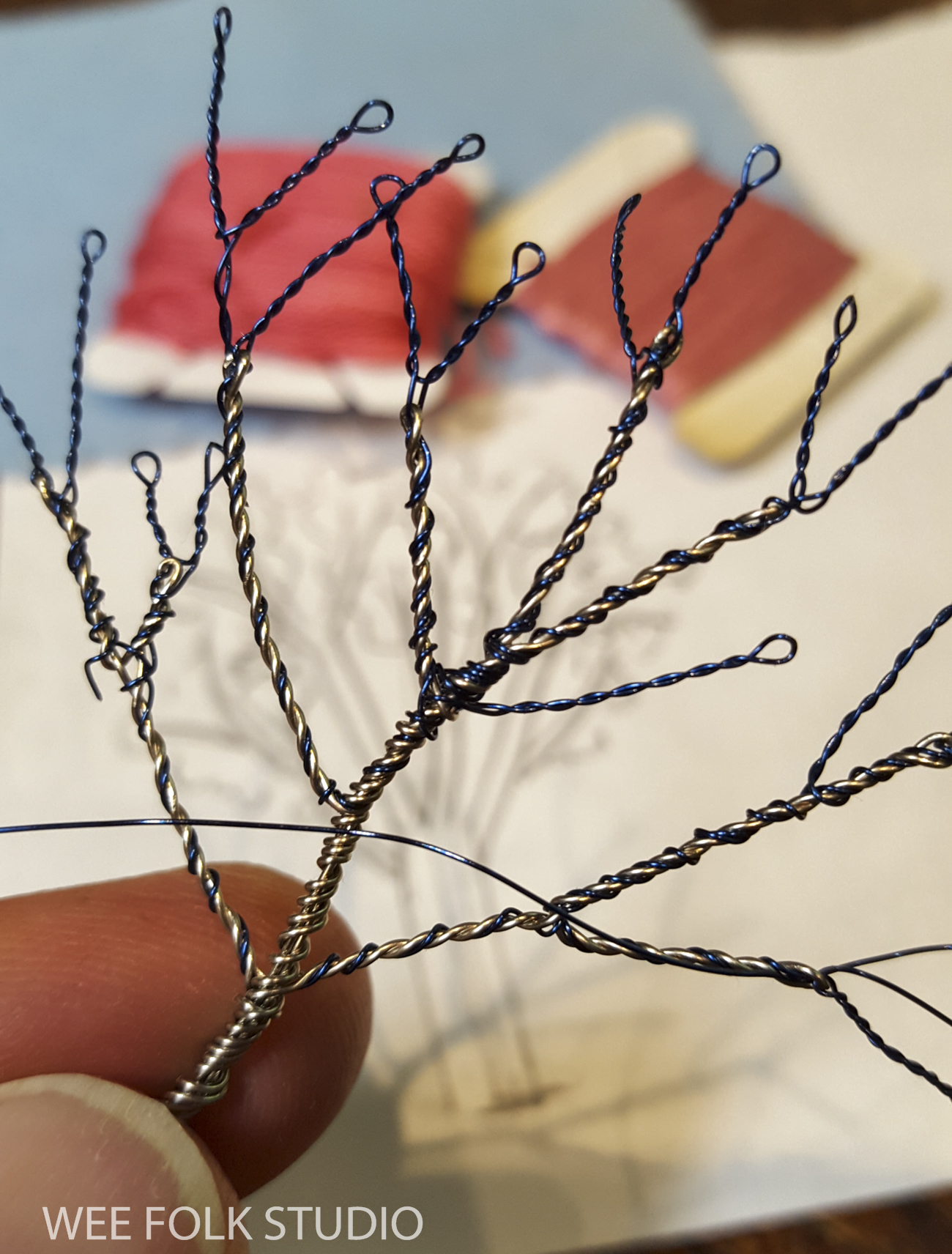
I formed the tree shapes with wire, using a finer gauge for the smaller branches. The loops on the ends were big enough to sew a needle and thread through.

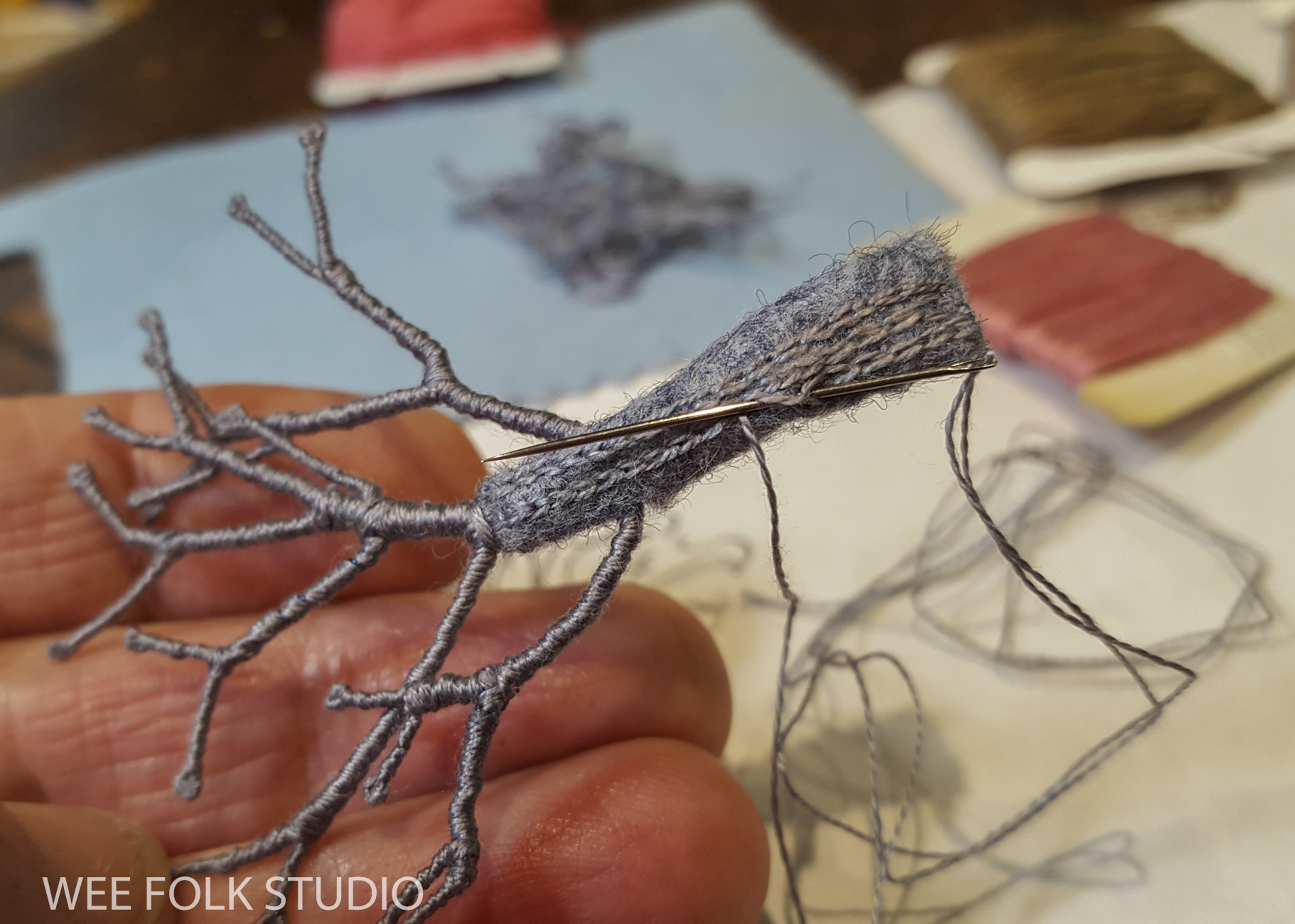
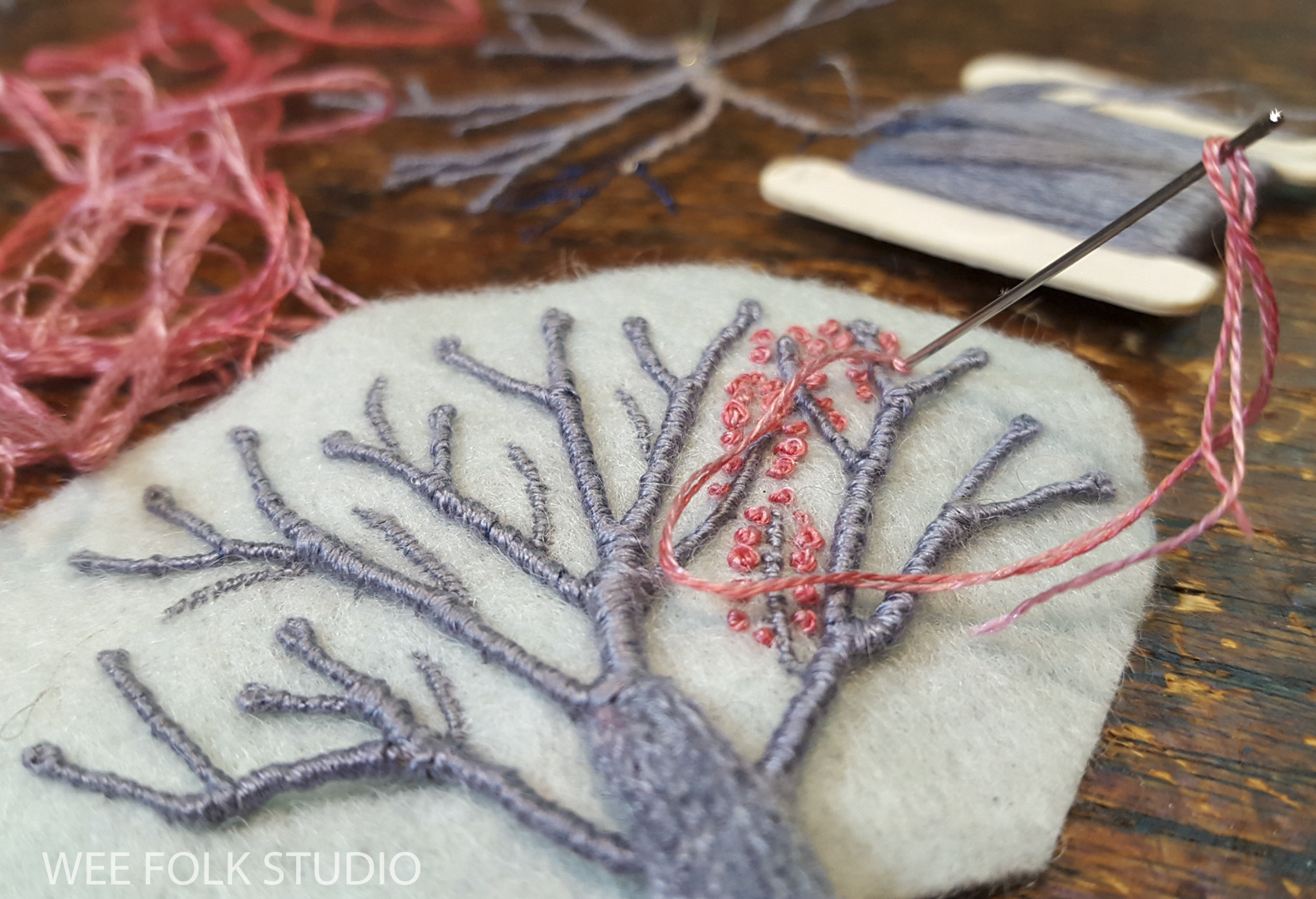
I wrapped the branches with embroidery floss and covered the trunk with wool felt, which I embellished with vertical rows of chain stitching. This Stitch Minute video shows how I wrapped the wire and stitched the blossoms with french knots.

Stitch Minute – wire tree

This was the first time I can remember creating a tree with its own section of sky attached. Luckily, I had some pale blue felt that was almost the same shade as the cotton velveteen background sky.

After sewing the wire tree to the felt, I embroidered a few extra branches to fill in the gaps and added pink blossoms with french knots.
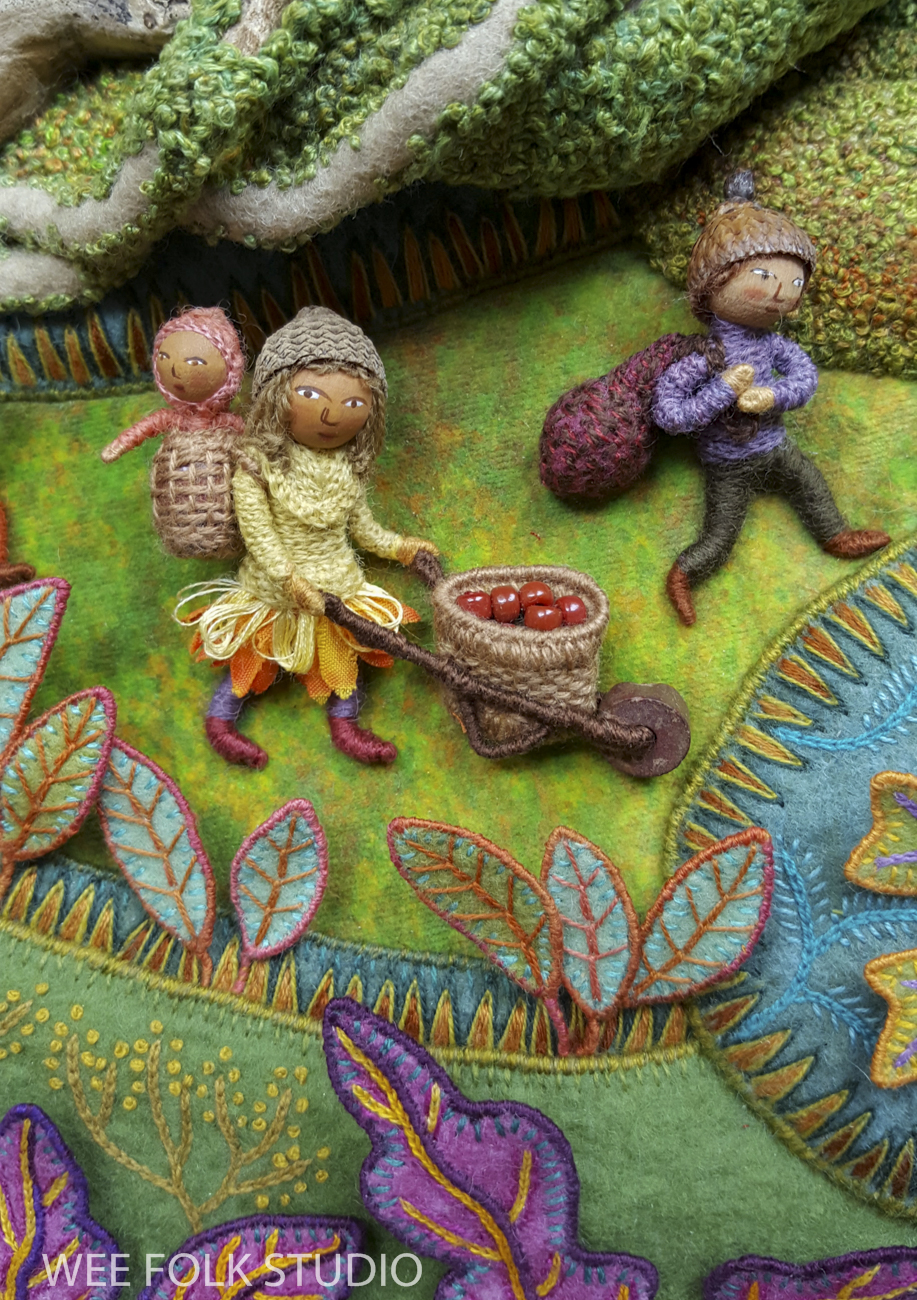
I made a patch of sorts, by cutting the felt around the contours of the treetop. At this point, I’d figured out where to put the trees, so it was okay to decorate the surrounding area. Watch this Stitch Minute video to see how I stitched some little bushes onto the velveteen background.

Stitch Minute – bushes

In the future, I’ll give a closer look at how I made the foliage on the hillside that’s positioned below and in front of the cherry trees.

Stay tuned for more posts about making Mossy Glen. Other parts in the series will focus on the stone walls, forsythia bush, embroidered embellishments and the wee folk characters.
Mossy Glen (overview)
Part 1 (moss)
Part 2 (cherry trees)
Part 3 (stone walls)
Part 4 (forsythia)

To keep up with new posts, please subscribe to this blog Your contact info will not be sold or shared. If you’d like to see more frequent photos tracking the projects in my studio, please follow me on Facebook and/or Instagram.

Making My Bed video

My husband Rob and I are pleased to announce the release of our new 8 minute documentary about making the artwork for my picture book, MY BED. It’s an inside view into my process and motivations, showing in words, video, and photos how I approached the project from start to finish. I hope that you enjoy the film! Please feel free to share it with your family and friends.

8 minute documentary about how Salley Mavor made the artwork for her picture book, MY BED.

We had planned to produce the film earlier, to coincide with the publication of the book in September. But, there were so many other pressing things to do, such as prepare for the Bedtime Stitches touring exhibition, which included building frames for the artwork. Now that the exhibition has started traveling for the next few years, we could concentrate on the film.

Thank goodness for the quiet of winter! I don’t know how I would survive without the pace of the external world slowing down for a few months every year. Over the past several weeks, we focused our attention on writing and recording the script and sorting through a gazillion photos and videos. Our good friend Bonnie Simon, who produces Maestro Classics: Stories in Music kindly agreed to help edit the script and be the narrator.

We had about 3 years of material to review. I’ve documented the process in photos from the beginning and Rob took videos during the last year or so. I constantly pestered him to stop what he was doing and come take a video of me working on different stages of the process. He had to set up lights and other equipment, so it was no simple task. Even though it was a nuisance, he filmed some good shots that added a lot to the movie. The following photos appear in the movie at different parts of the storytelling.

To make the animated title sequence, we set up a camera facing down at a table top. We were a stop-motion animation team – I moved the pieces of thread little by little, while Rob snapped the camera.

We also filmed an arrangement of found objects from my collection. It was a simple slide, not stop-motion animation this time. That would be whole other movie!

Rob did a marvelous job editing the movie on his computer. He started with the speaking parts to set the timing and then added photos and videos that corresponded with the narration. After he had completed a draft of visuals and sound, we sent it to Matthias Bossi at Stellwagen Symphonette for the musical underscore. They wrote the music and sound effects for our film Liberty and Justice and we were thrilled to work with them again.

Rob and I are excited to share the fruits of our labor with you! The Making My Bed video can be watched and shared on YouTube here.
Autographed copies of the book, MY BED are available in my shop here.

To keep up with new posts, please subscribe to this blog. Your contact info will not be sold or shared. If you’d like to see more frequent photos tracking the projects in my studio, please follow me on Facebook and/or Instagram.