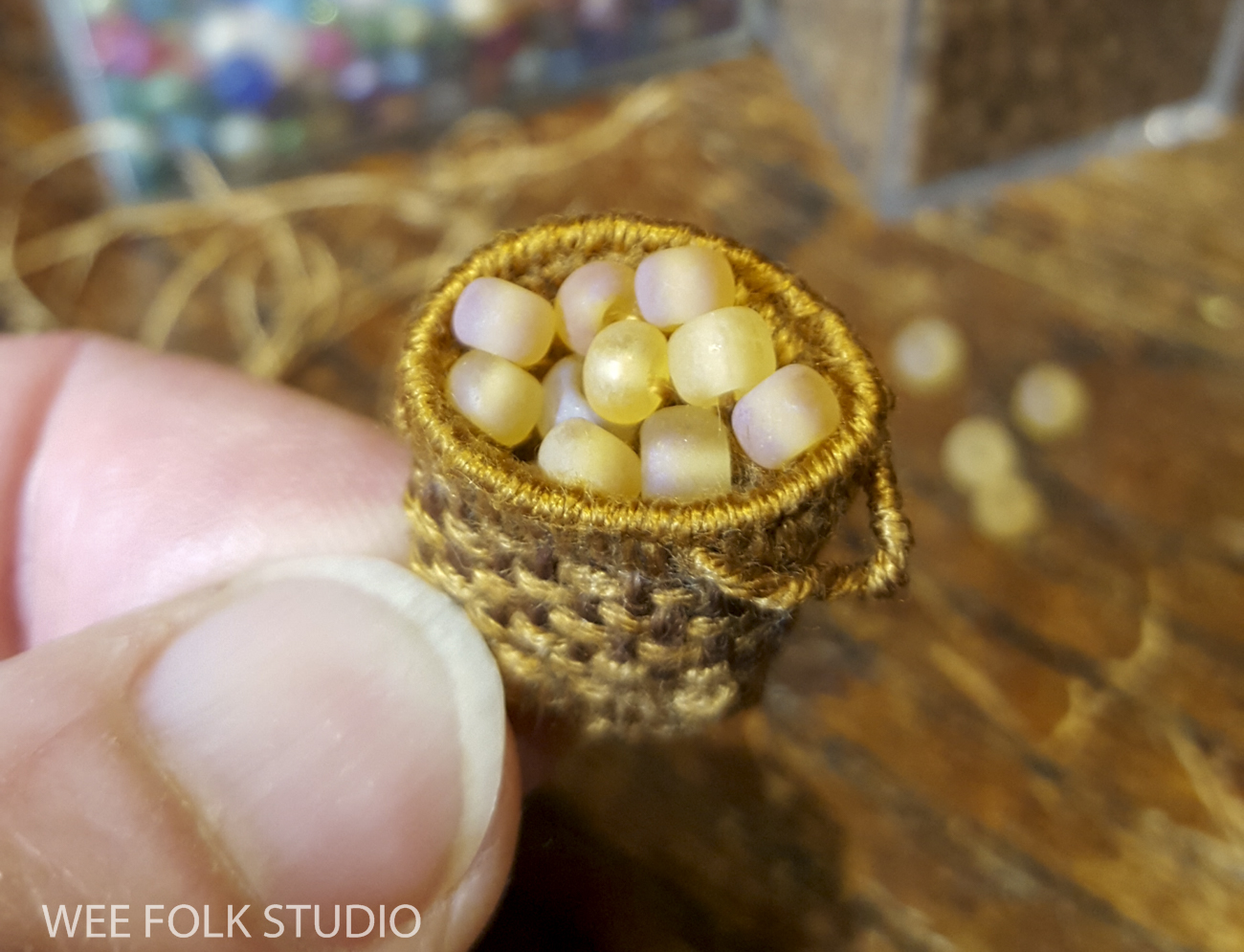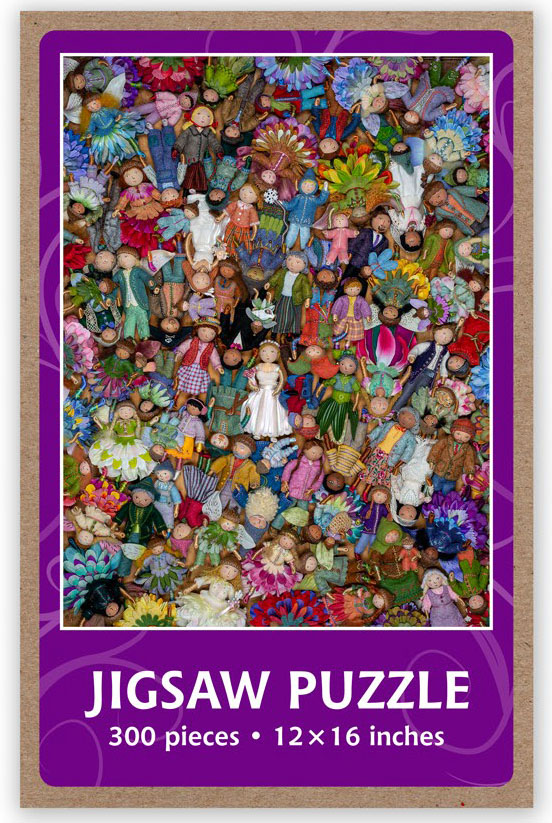
Wee Worlds on view in Vermont

photo by Dave Barnum

I want to express my appreciation to all of the people who helped celebrate the opening of my exhibition, The Wee Worlds of Salley Mavor at the SOUTHERN VERMONT ARTS CENTER. It was wonderful to meet you and feel your enthusiasm! I’m overwhelmed by the response to the show. In its first 3 weeks, visitors have traveled from several northeastern states and across the border from Canada. Sally, who drove to Vermont from Glen Ridge, NJ, wrote with this over-the-top review, “I’m blown away and my husband reacted like he did to the Grand Canyon.” Whether or not you’re able to get to the show, I thank you for your support and encouragement!

photo by Dave Barnum

THE WEE WORLDS OF SALLEY MAVOR
On view through January 7, 2024 at the
SOUTHERN VERMONT ARTS CENTER, Manchester, VT

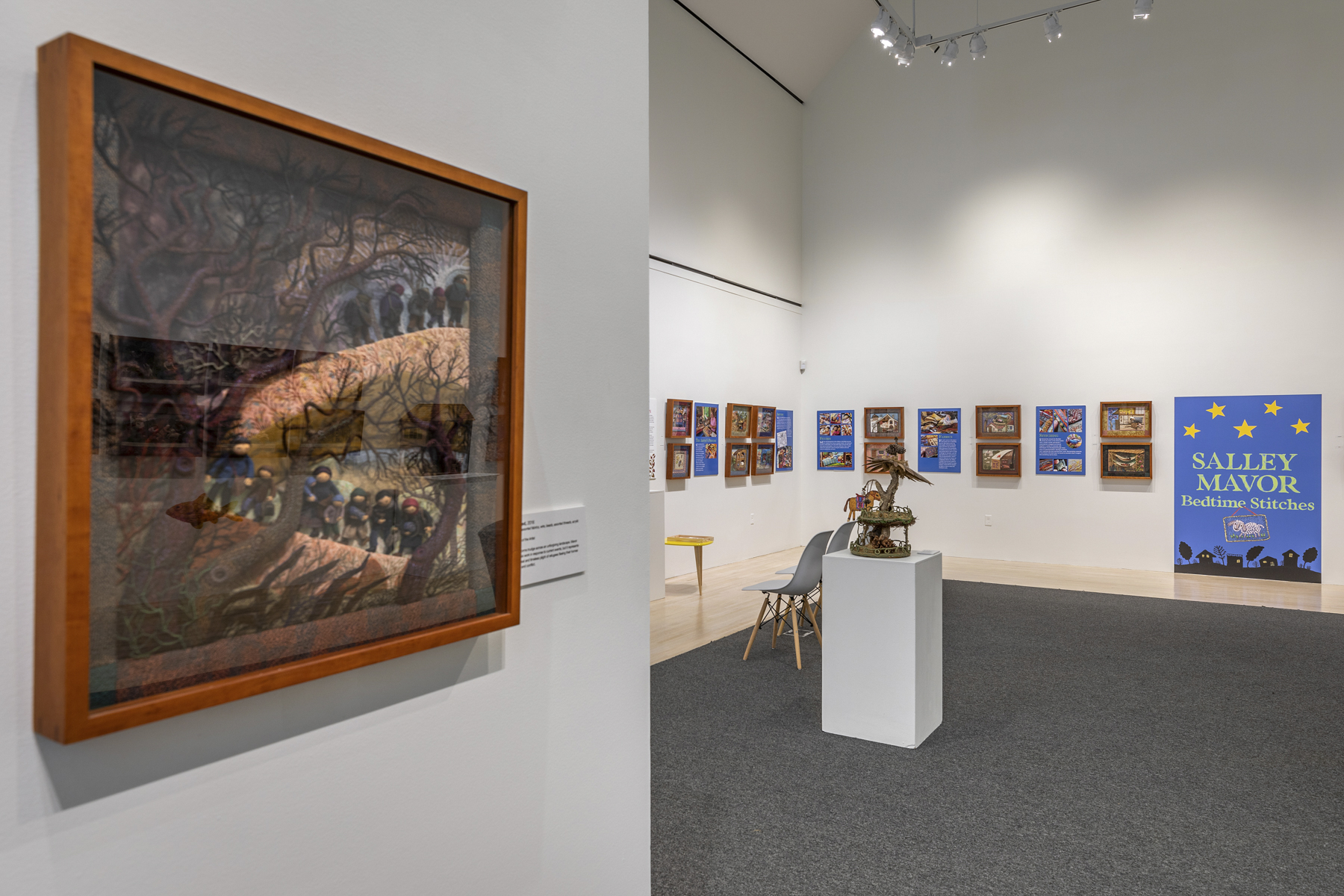
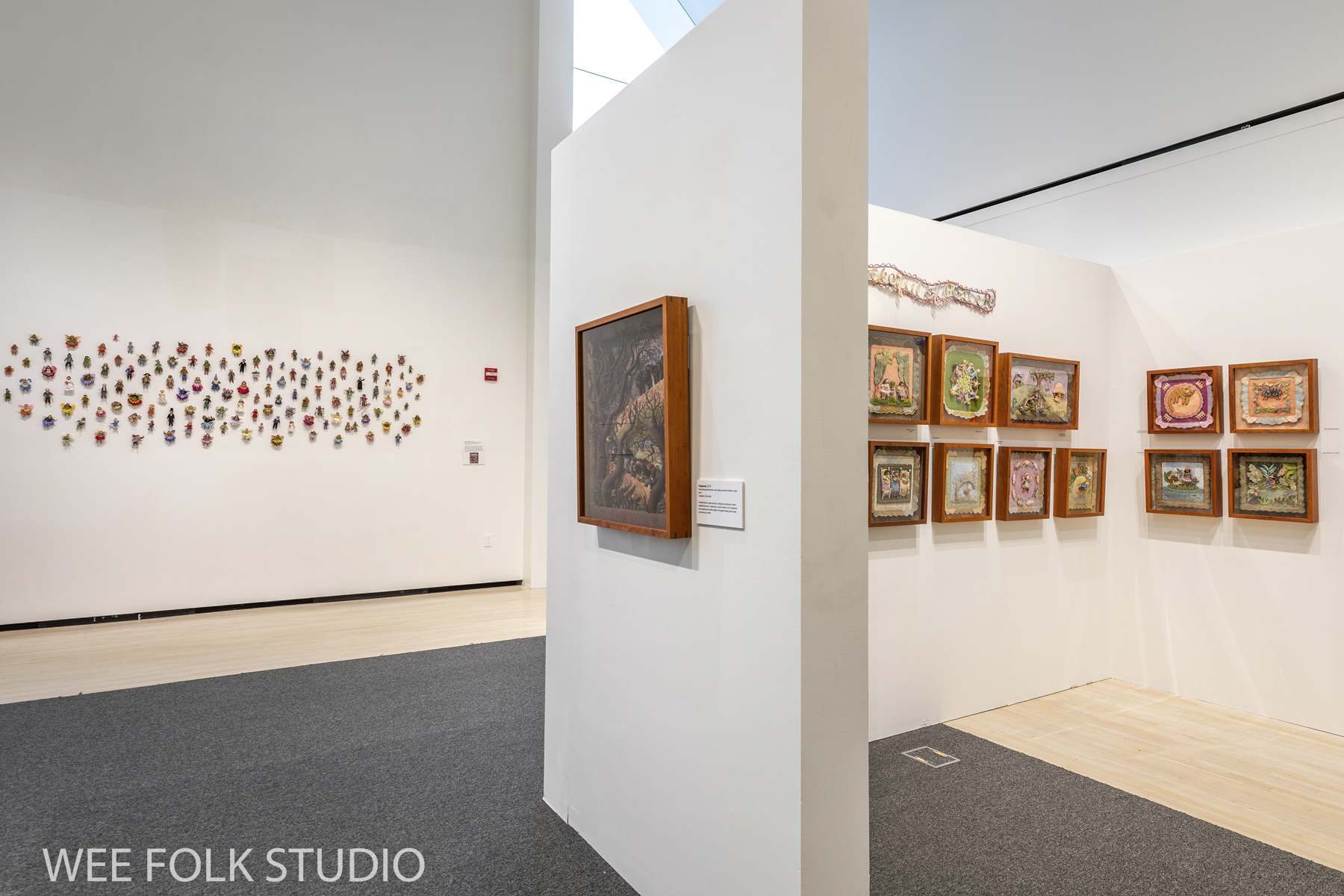
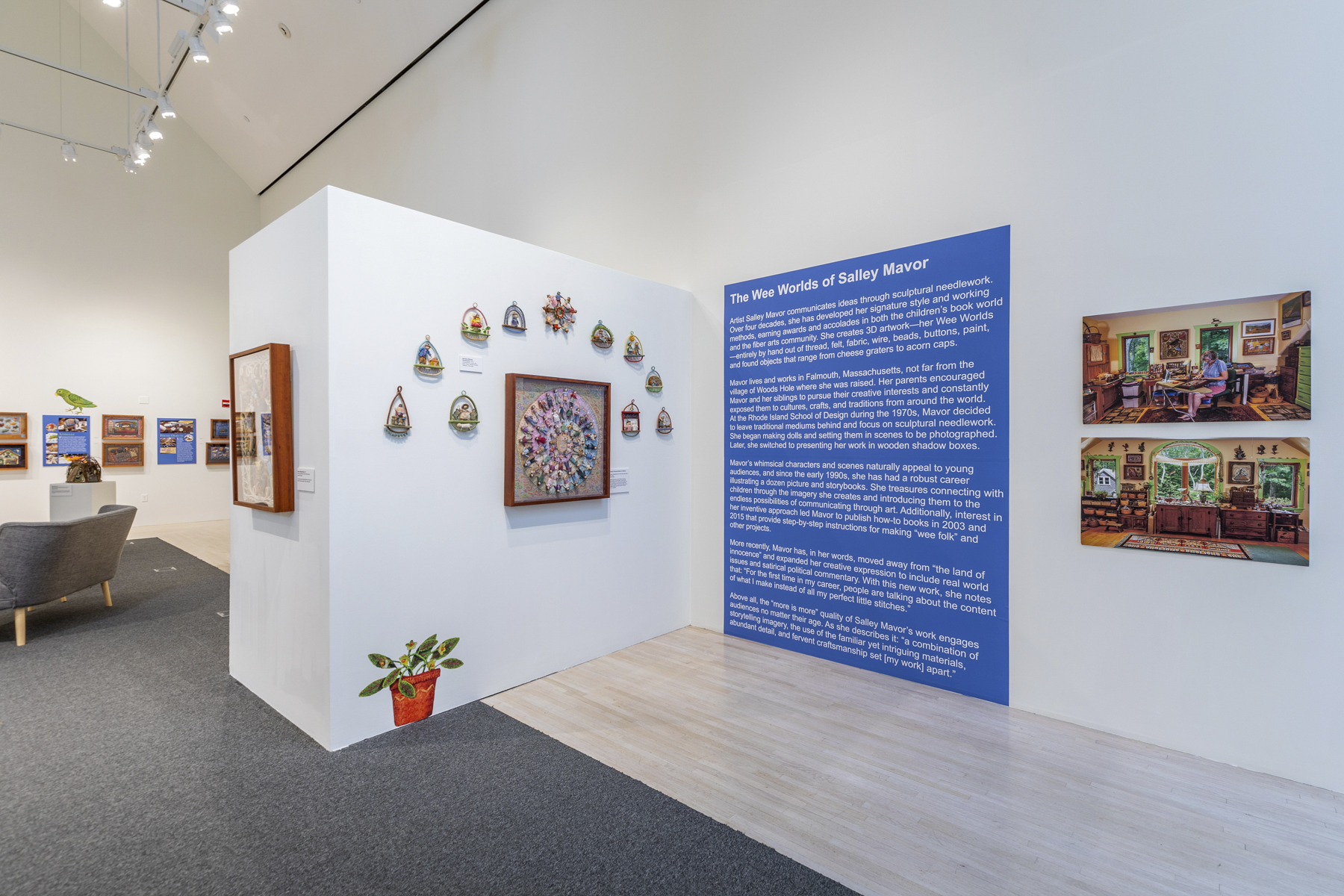
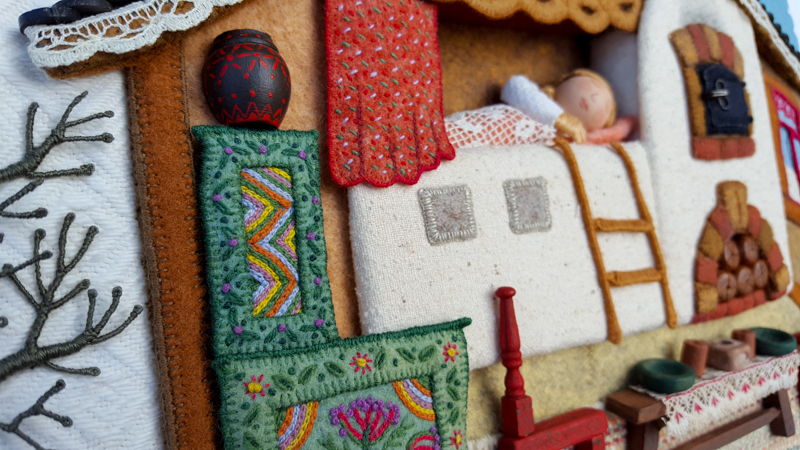
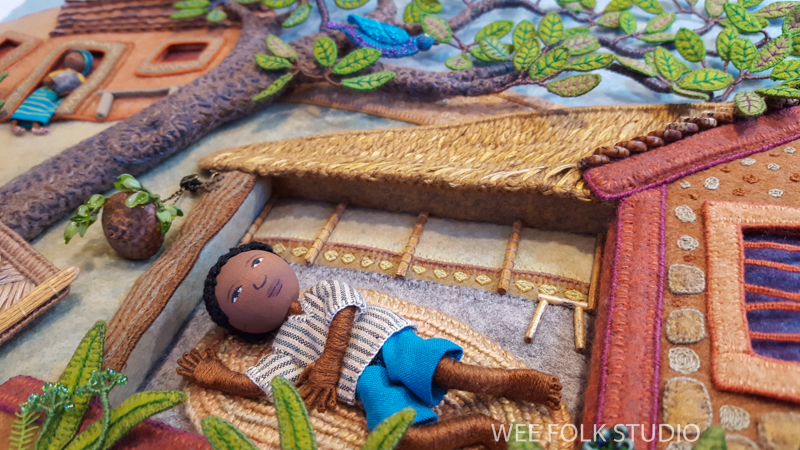
On view are are over 75 bas-relief embroideries, including original picture book illustrations spanning my career. In order to hang a representative sampling from earlier books, I borrowed several pieces from private collectors. The show contains BEDTIME STITCHES, the touring exhibition of artwork for my most recent book, MY BED: Enchanting Ways to Fall Asleep around the World. Also on display are recent works that explore cultural diversity, migration, fashion, the natural world, and a range of social narratives, from the everyday to topical subjects.

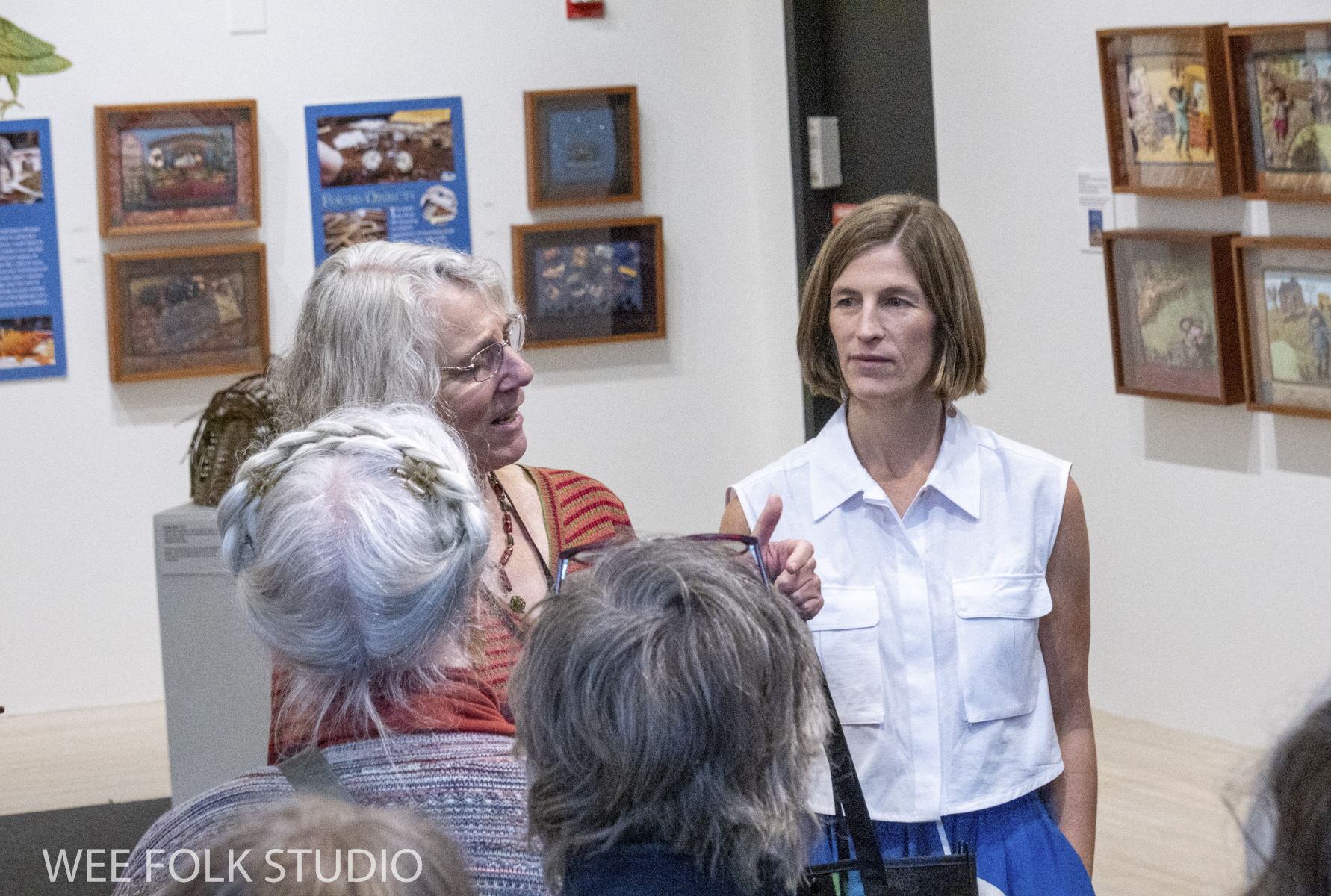
Salley Mavor spoke about her work at the opening, while manager of exhibitions, Alison Crites looked on.

My approach to exhibiting is similar to how I plan and make a single piece of art. I first envision the overall composition and define the scope of the project. After that it’s all about arranging lots of small elements to create something whole. The idea for this exhibition came about 2 years ago, when Alison Crites, SVAC‘s Manager of Exhibitions, inquired about having a show of my work. That was a good day! After meeting in person at the museum, we formed a great working relationship through Zoom meetings and countless email exchanges. I feel grateful that Alison reached out and offered this opportunity to share my life’s passion with a wider audience. Visitors to my shows point out all the time how seeing the real 3-dimensional pieces is a totally different experience, so I’m glad that more exhibitions are being planned. I will add them to the exhibitions page when the locations and dates are finalized.

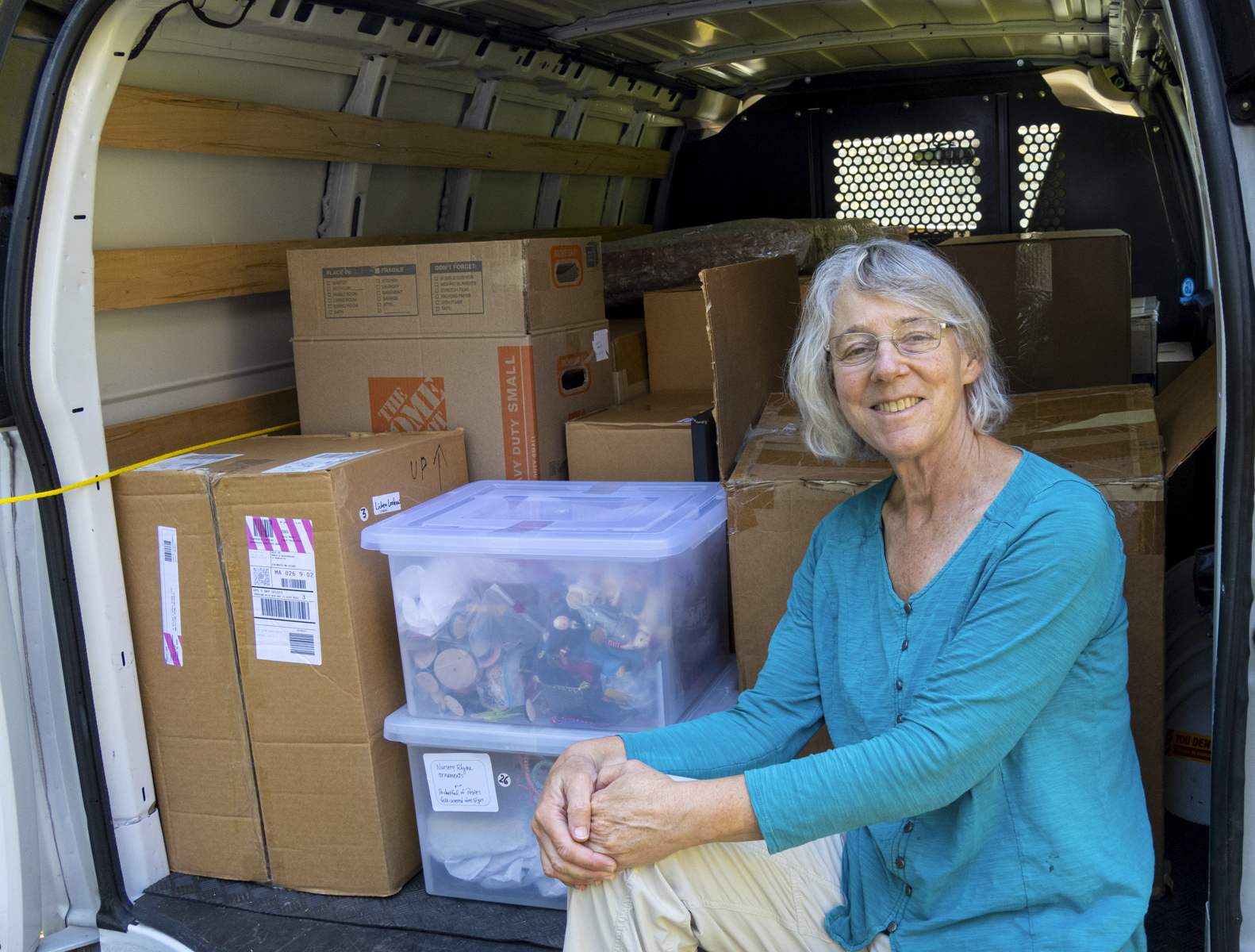
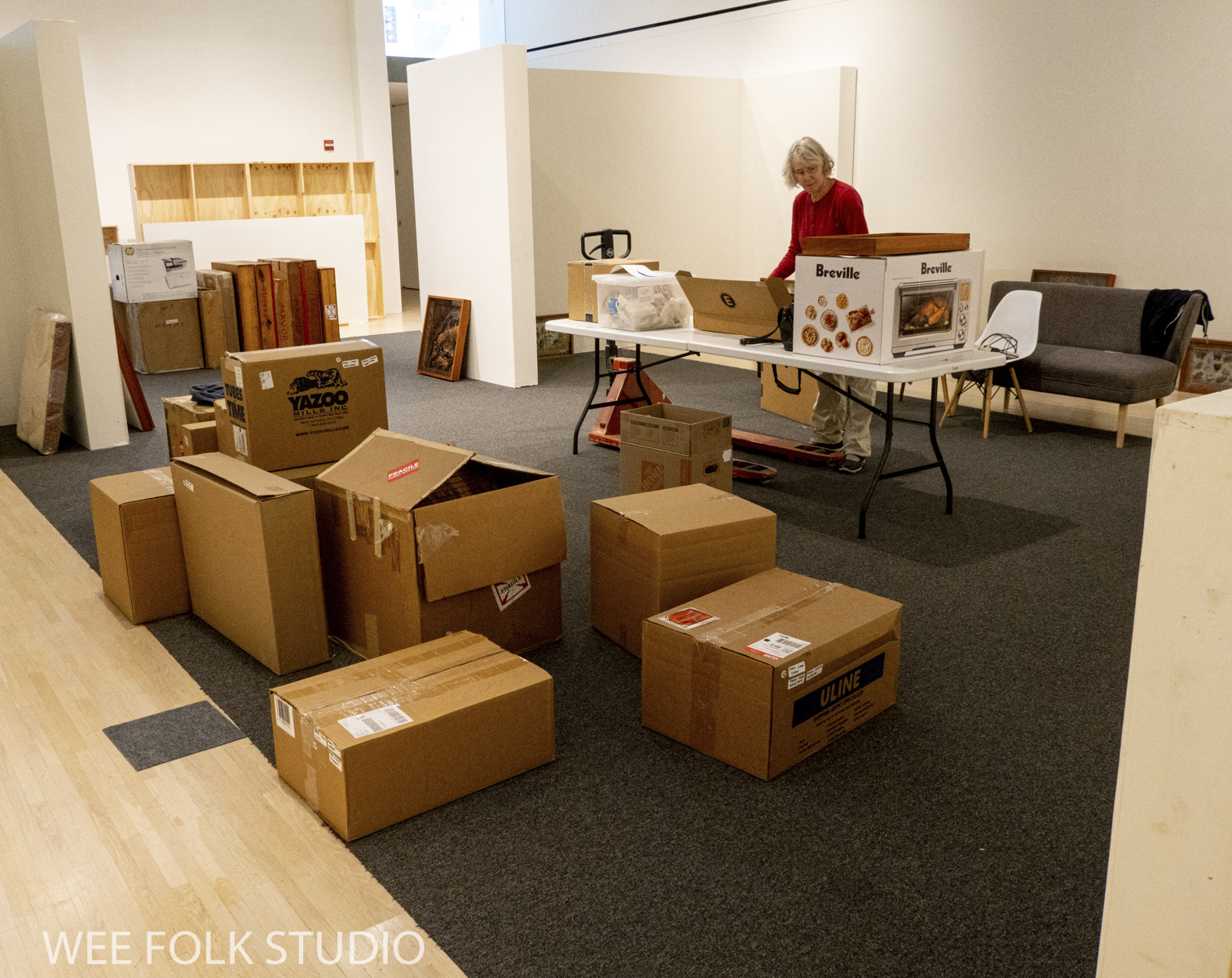
A few days before the opening, Rob and I drove to Vermont from our home on Cape Cod to help with the installation. The museum had previously sent a van to pick up the artwork and I spent the first day unpacking boxes and positioning pieces around the gallery.

Over 3 days, a team of volunteers and professionals hung artwork, applied vinyl signage and adjusted the lighting for the show.

The Wall of Women, which debuted at the Brick Store Museum last year, is back again. It features enlarged photographs of women from my collective portrait, Cover Up (also on display). Their faces are blown up about 12 times the size of the 1″ wooden bead doll heads in the piece. I like playing with scale, taking something tiny and making it huge.

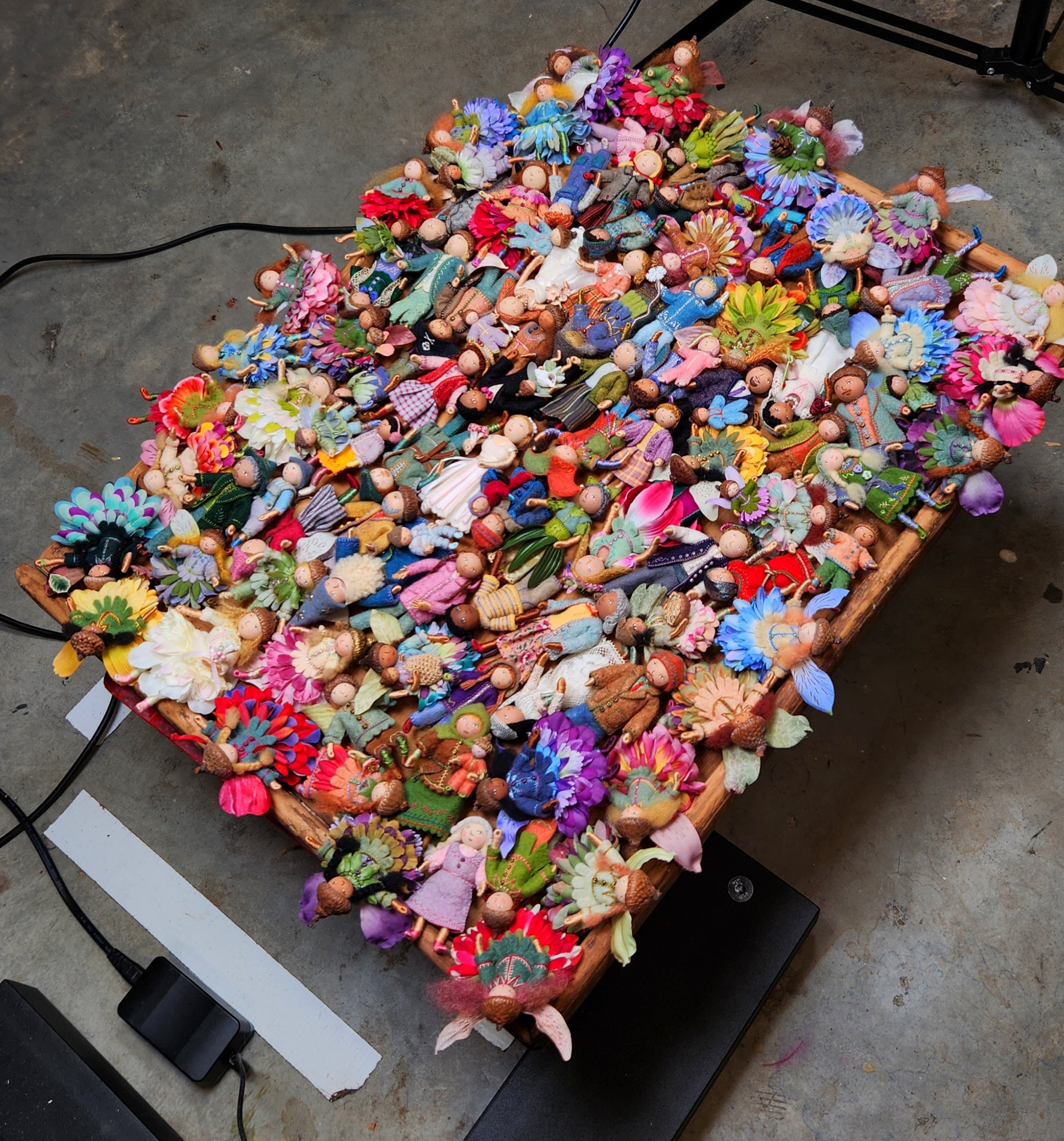
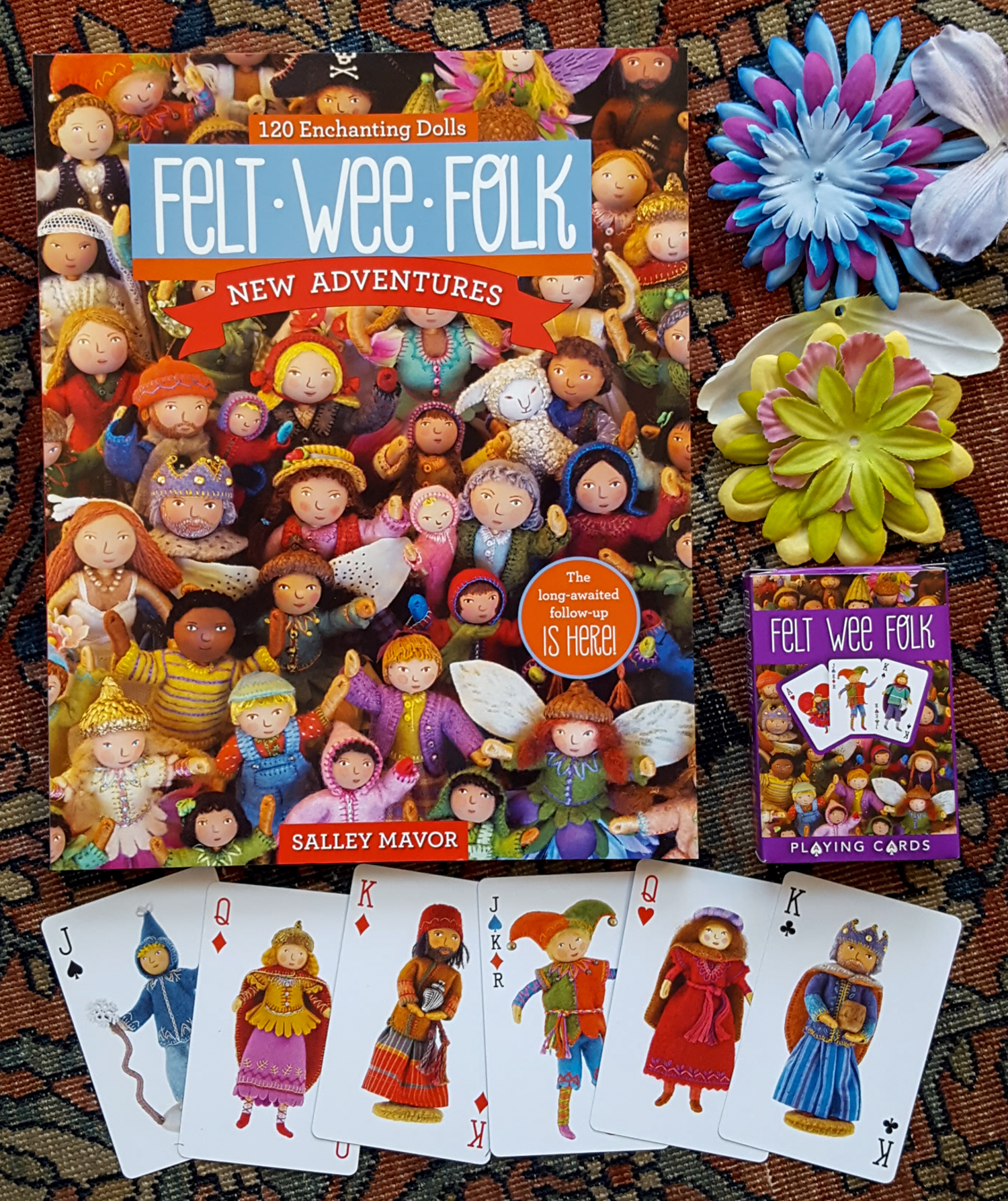
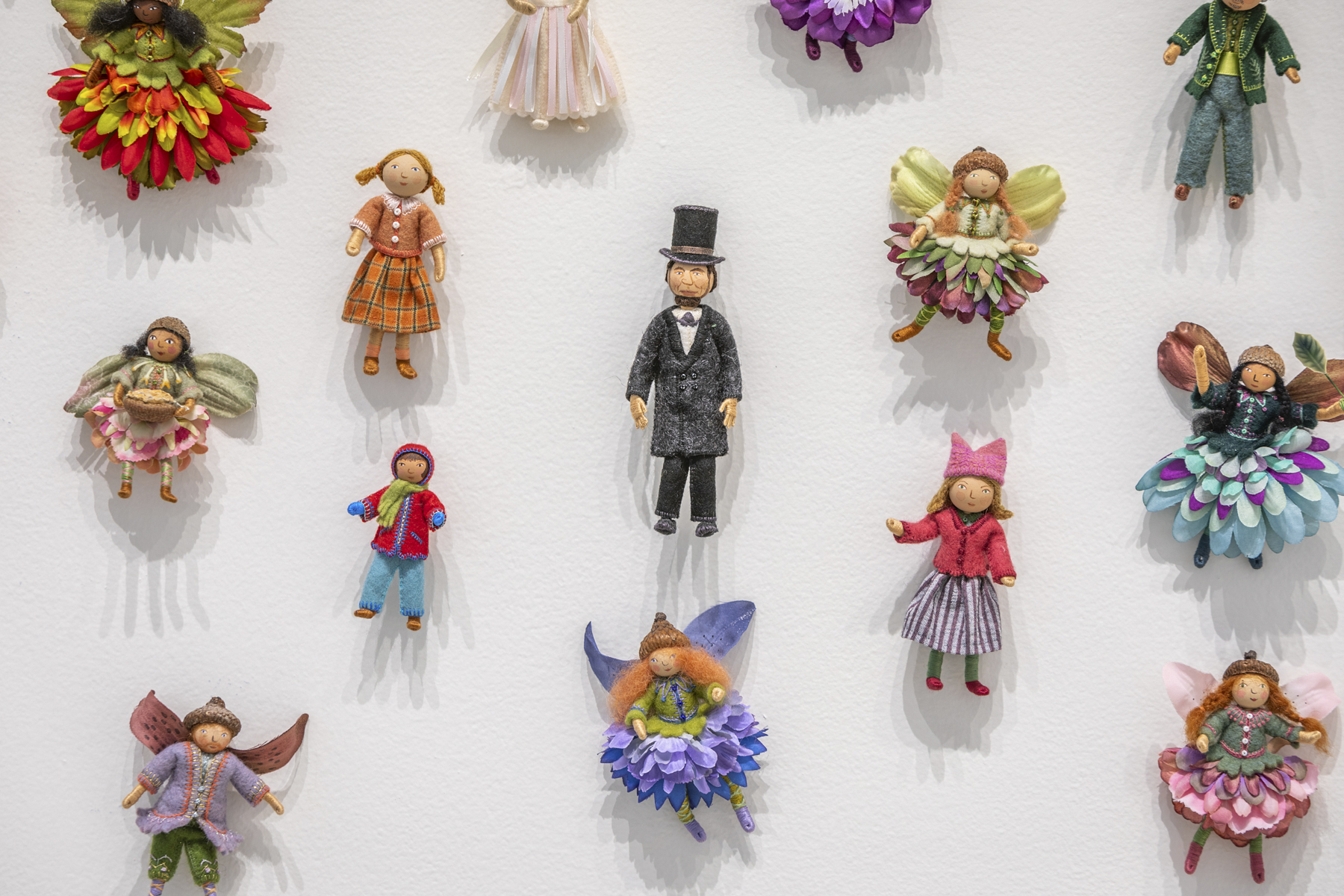
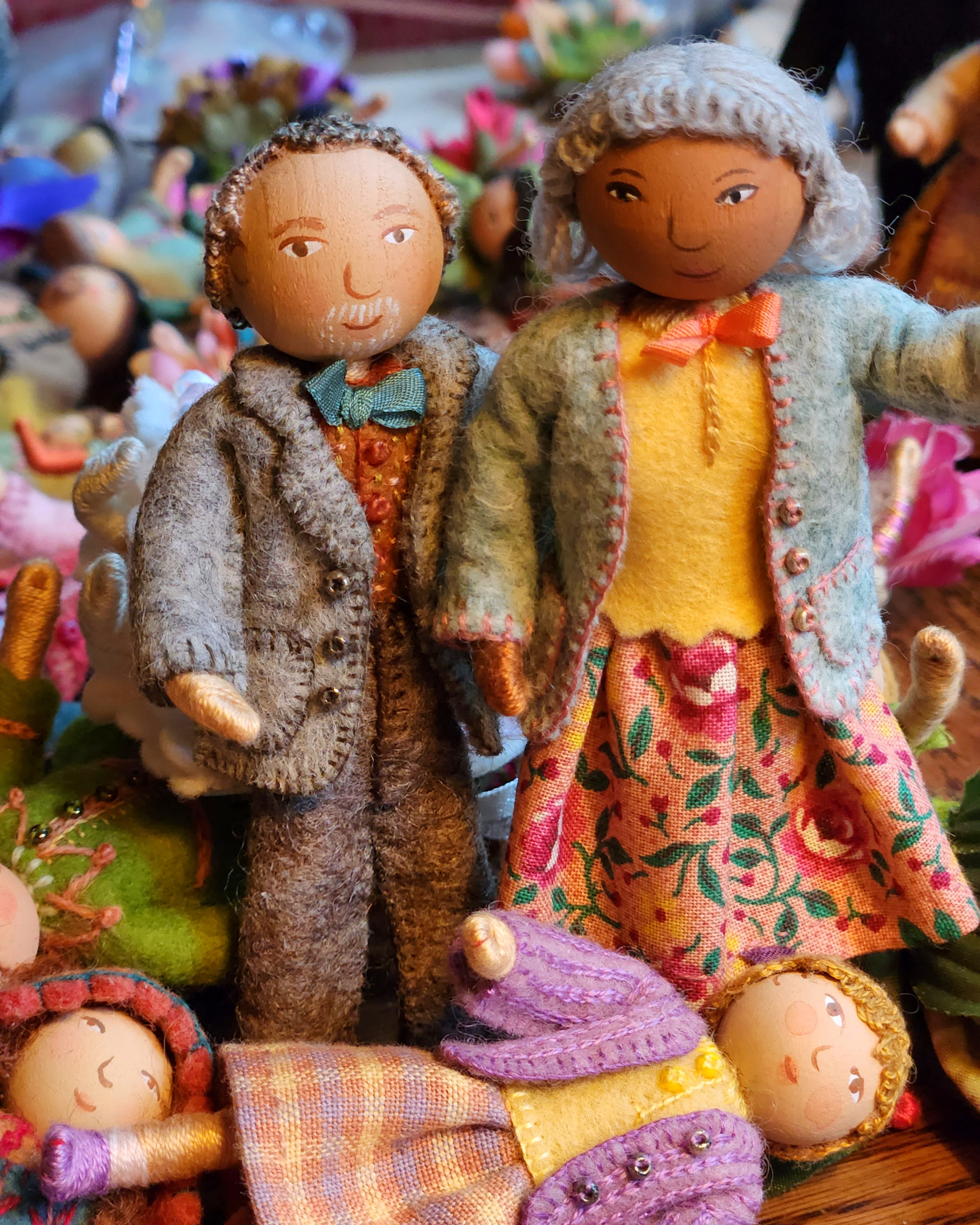
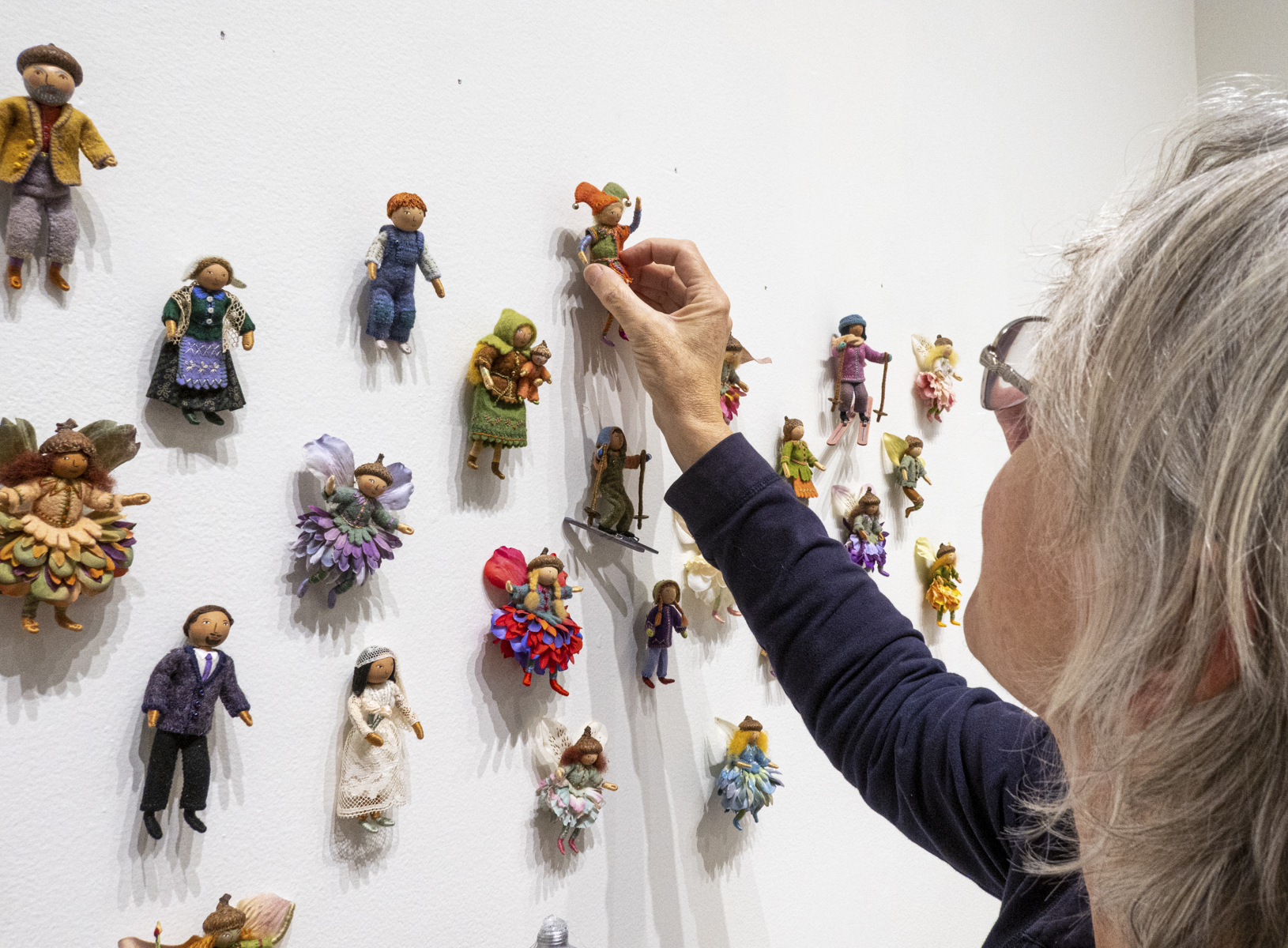
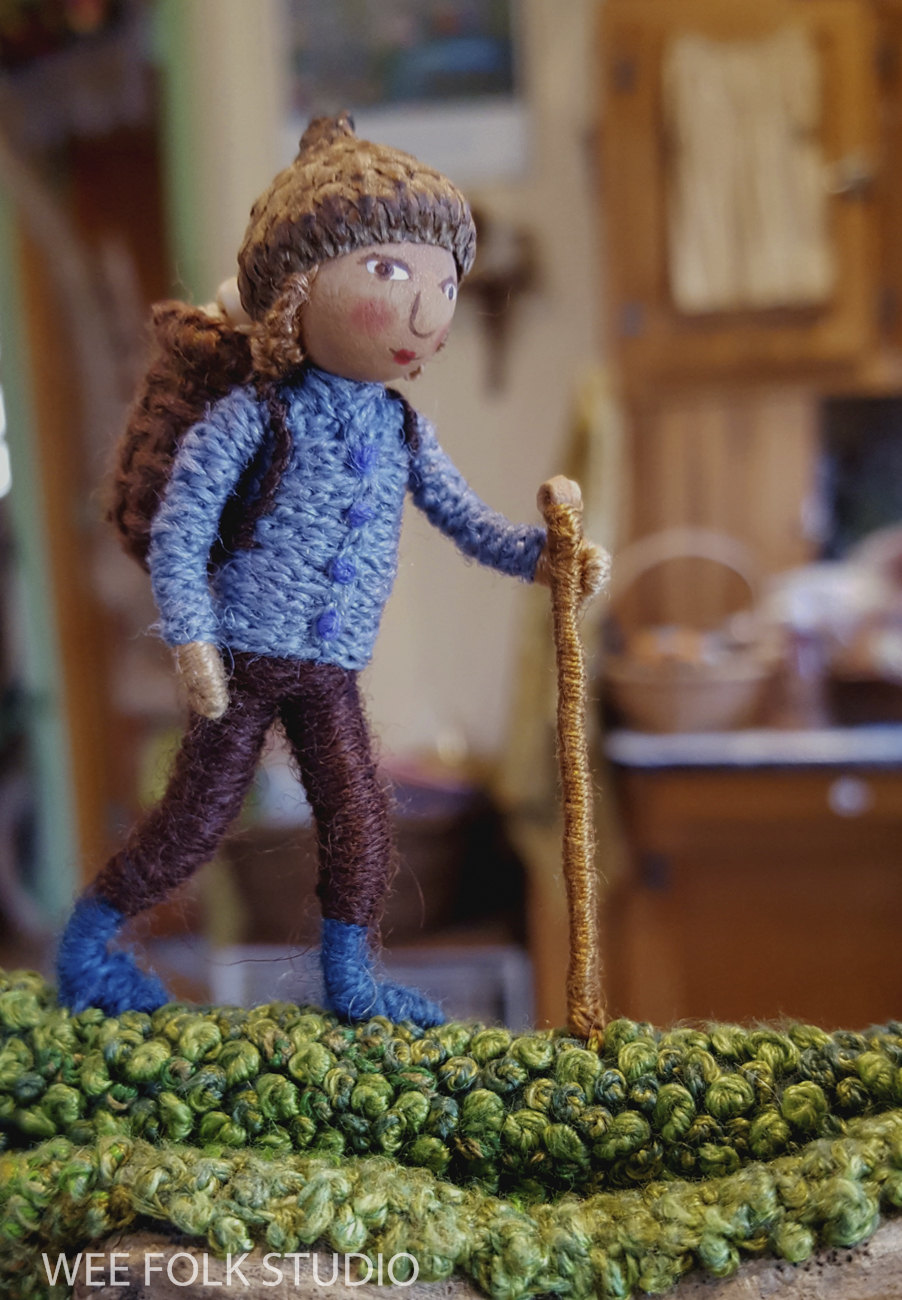
New to this show, is the Wall of Wee Folk, which includes 150 little dolls I’ve made over the past 20 years. Many of the figures are prototypes for my how-to book, Felt Wee Folk.

photo by Dave Barnum

I set up my recently refurbished dollhouse, which I built 48 years ago. You can view the series of posts about the dollhouse renovation process here.

photo by Dave Barnum

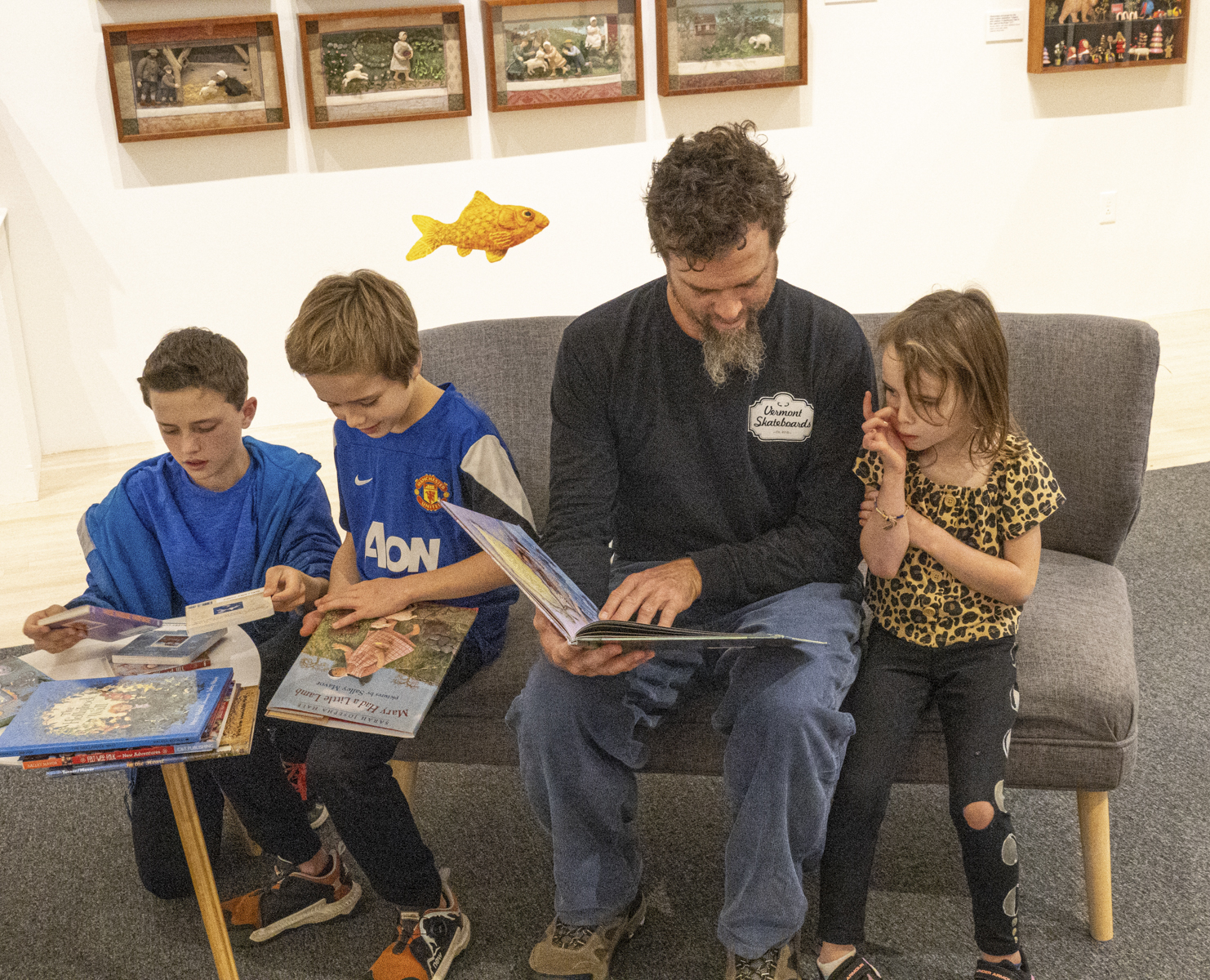
In the center of the gallery is a sitting area with sample copies of all of my books for visitors to look at.

On display is BEDTIME STITCHES, the entire collection of original artwork for my picture book, MY BED. This portion of the show has been touring the country since the book was published in 2020. Coming up, it will be in Greenville, SC, Albany, NY and Seward, NE. Find out details on the Exhibitions Page.

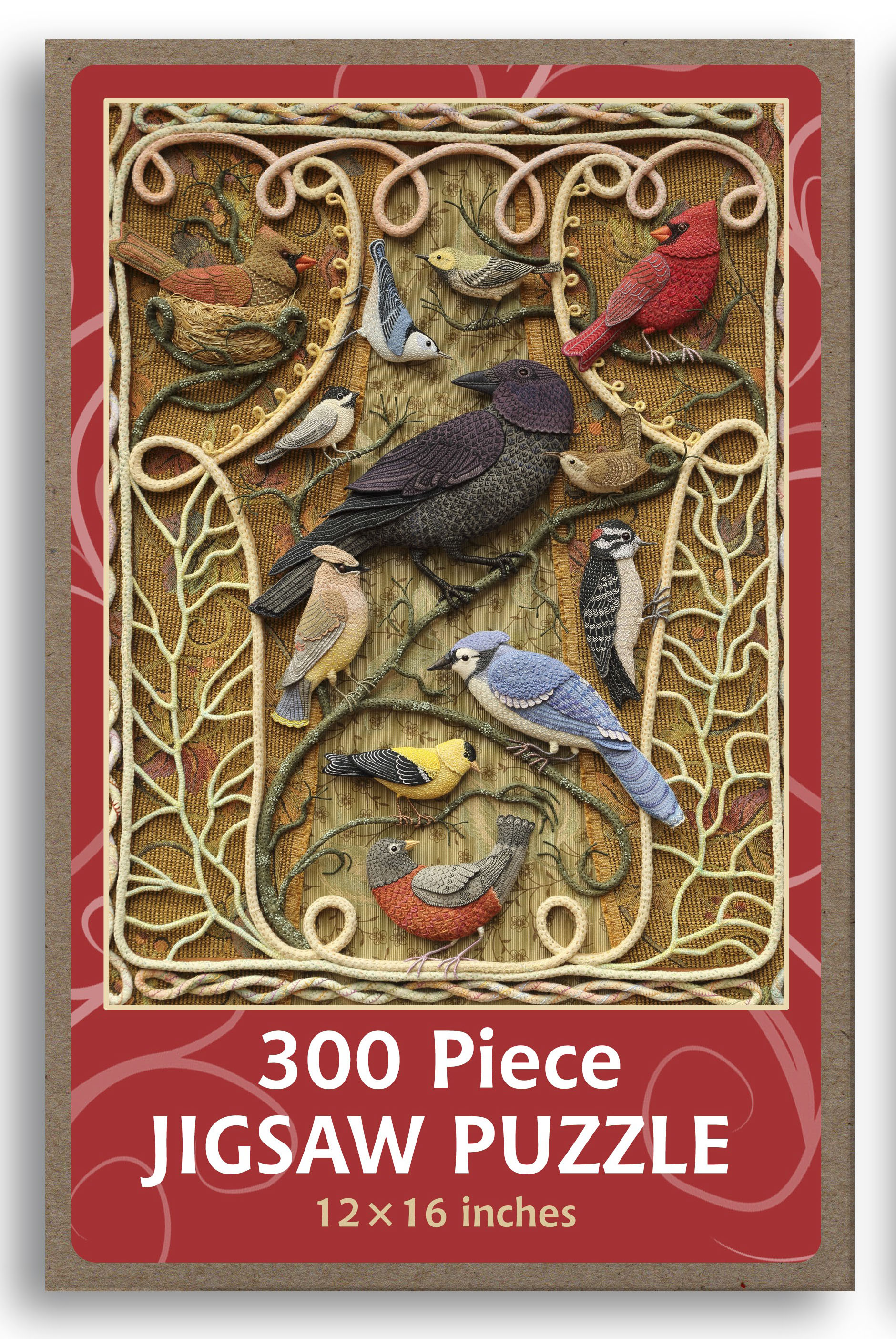
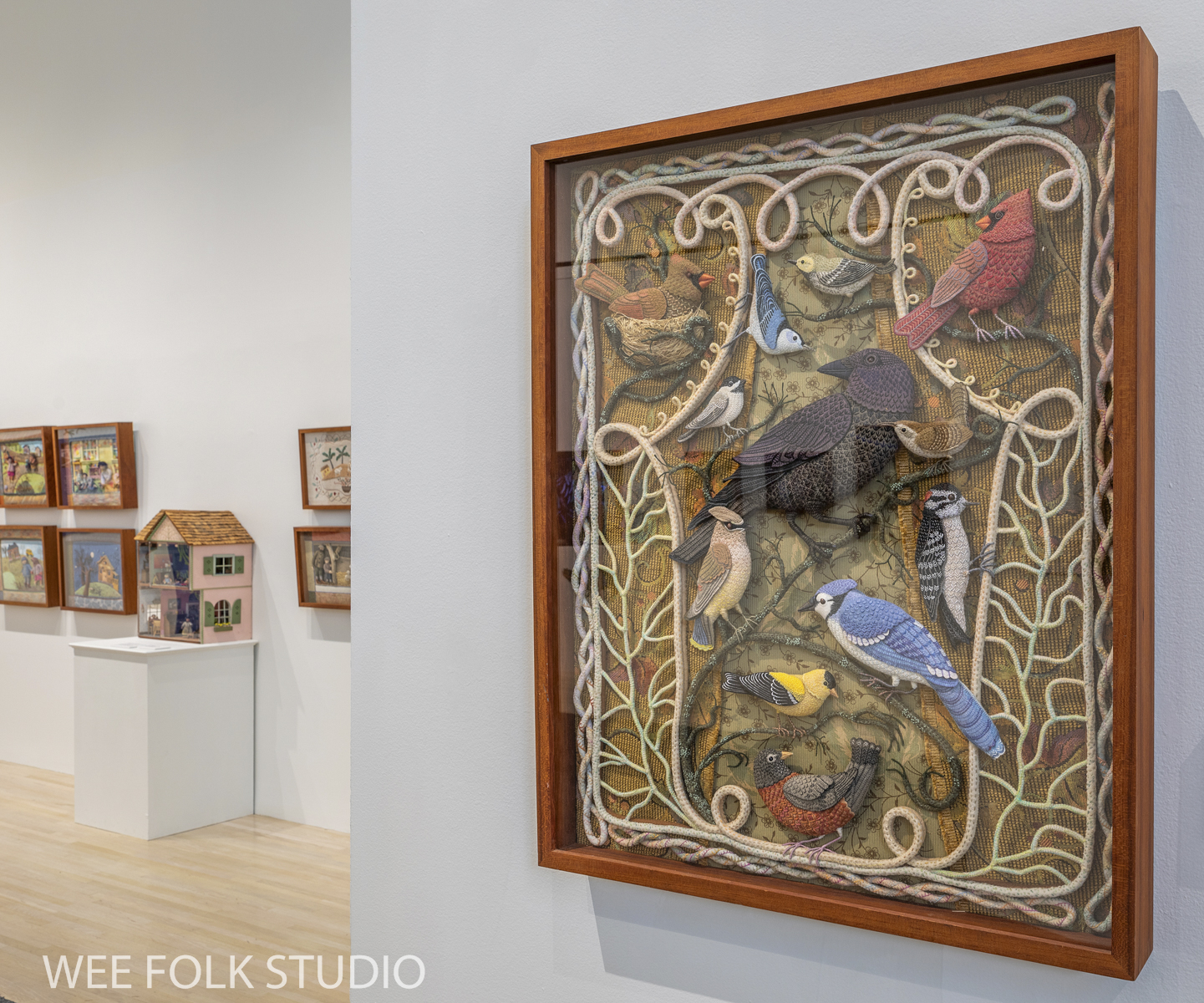
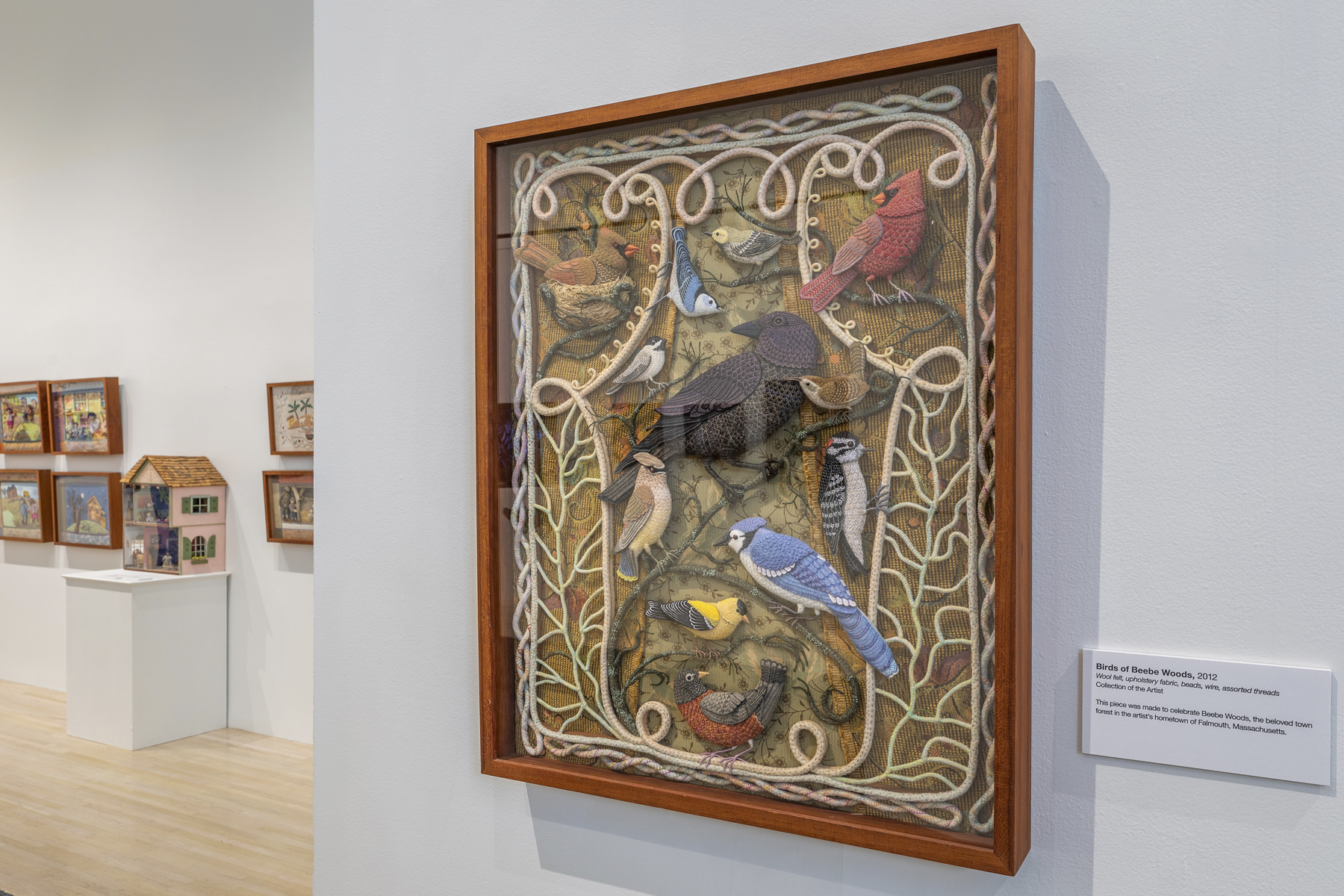
Interspersed around the gallery are several works from my personal collection, including Birds of Beebe Woods, Displaced, Rabbitat, Whiskers, Face Time, Cover Up, 2 fairy houses and political cartoons from the Wee Folk Players.

Birds of Beebe Woods – photo by Dave Barnum
detail from Birds of Beebe Woods – photo by Dave Barnum

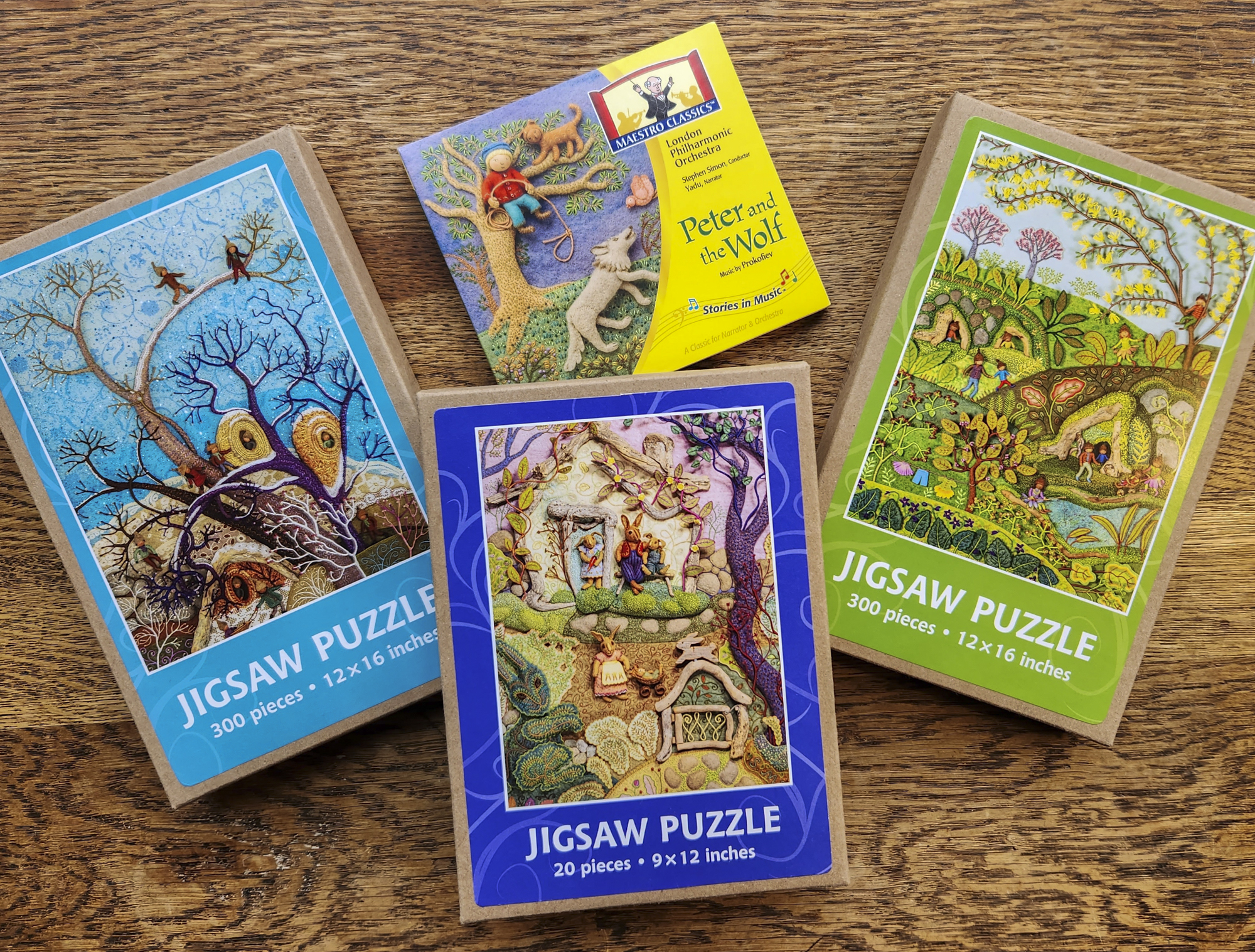
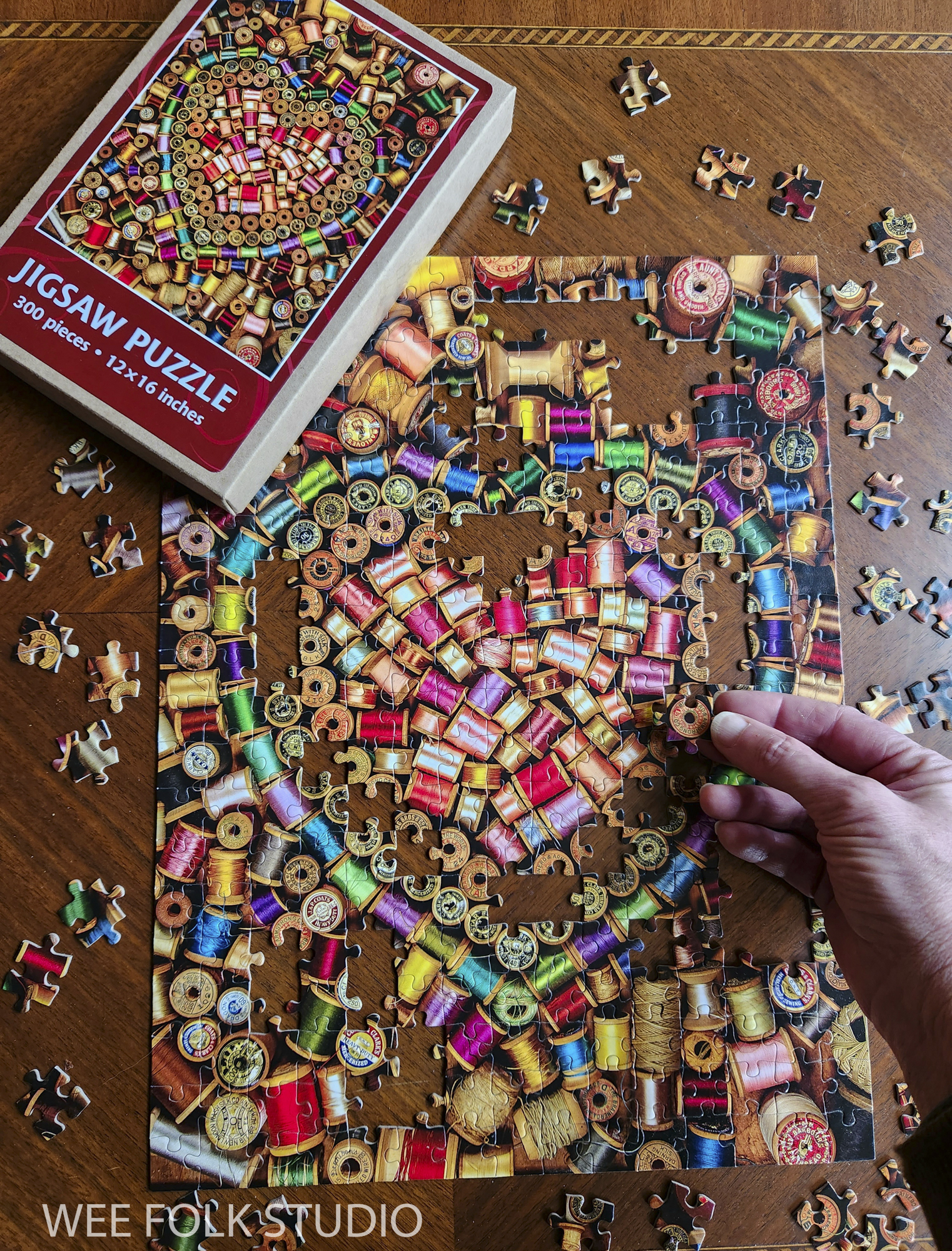
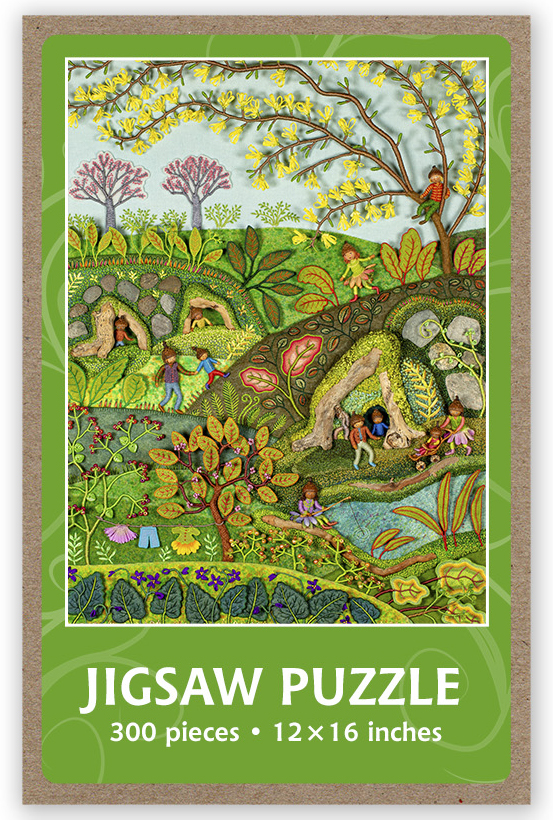
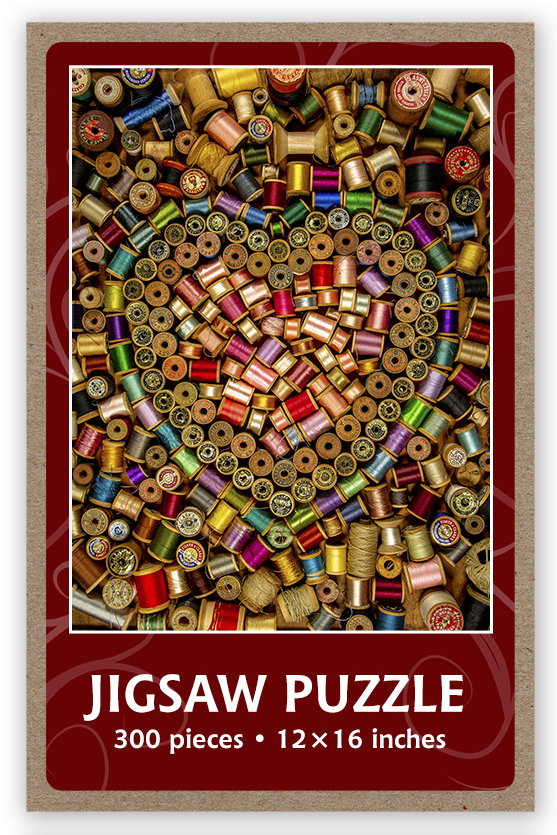
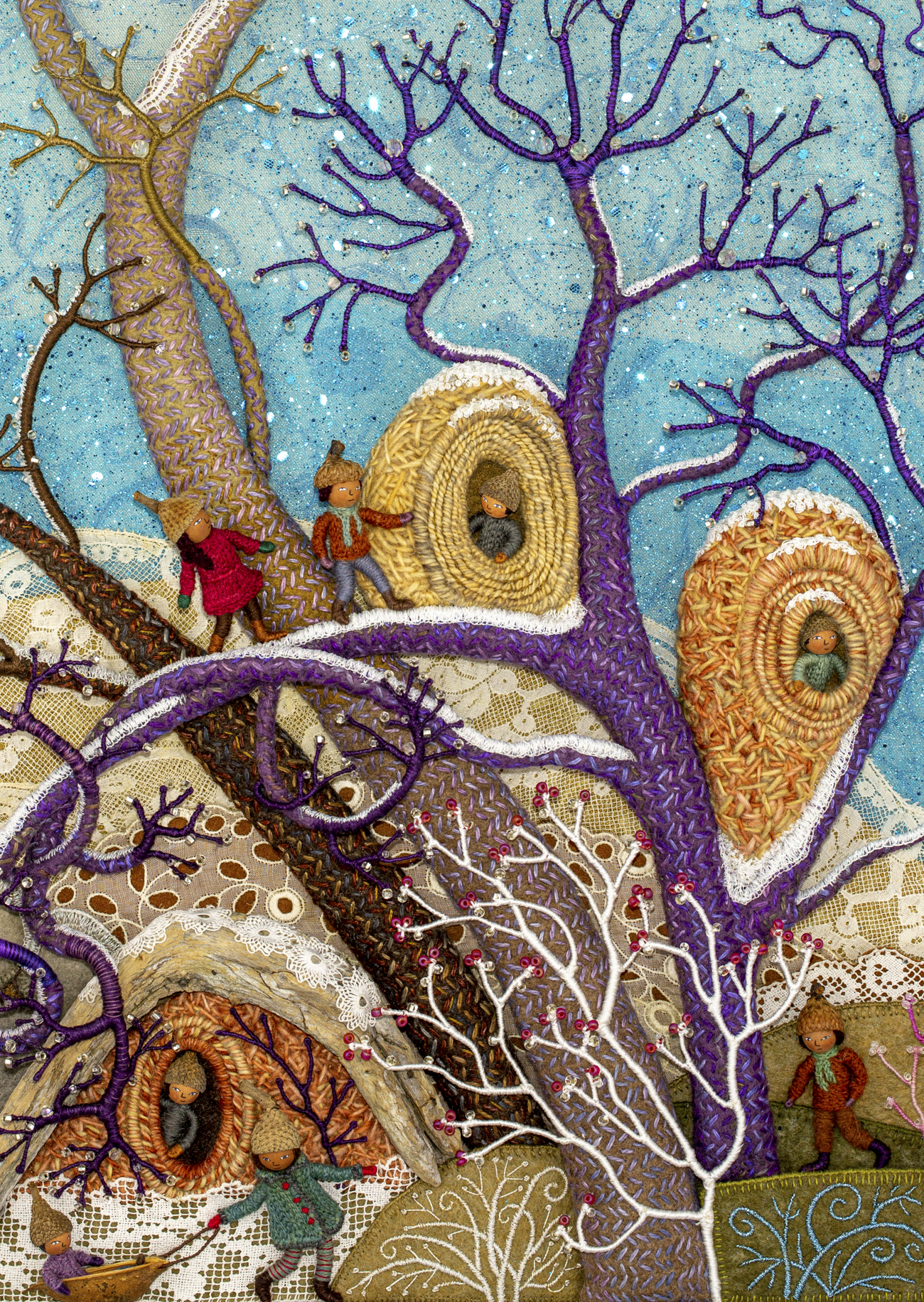
This is the first time that all four pieces in my recently completed seasonal landscape series are being shown together. Over the past few years, I’ve shared photos, commentary and videos that give a behind the scenes peek at how I created these bas-relief embroideries. You can catch up in the archives here: Frosty Morning, Mossy Glen, Summertime, Harvest Time. The scenes are also available as cards, puzzles and prints in my Etsy Shop.

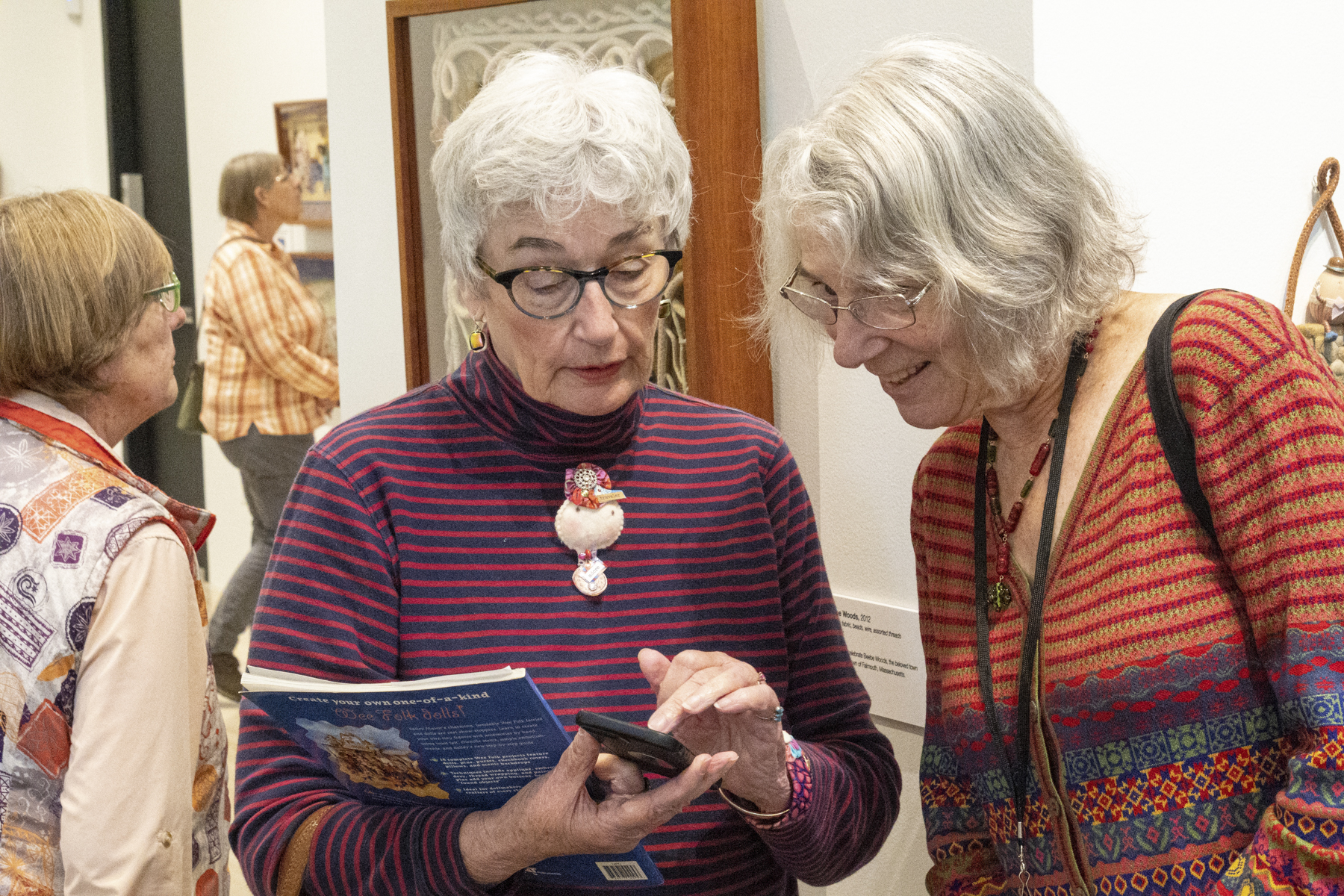
I enjoyed chatting with both new and long-time fans at the opening reception. Some brought old copies of my books to sign and some were eager to share photos of what they are working on. It reminded me that there is a warm and vibrant community of people out there who are linked not only by a needle and thread, but the desire to be a part of the wee world!

To keep up with new posts, please subscribe to this blog. Your contact info will not be sold or shared. If you’d like to see more frequent photos tracking the projects in my studio, please follow me on Facebook, Instagram and BlueSky.

Wall of Wee Folk

When you enter my exhibition at the Southern Vermont Arts Center, you will be greeted by about 150 little dolls which form the Wall of Wee Folk. It’s a small part of the exhibition, but the collection of wee folk set the stage for the rest of show, which includes over 75 bas-relief scenes that span 25 years of my career.
The Wee Worlds of Salley Mavor will be on view through January 7th, 2024.

On the wall are a whole cast of characters, including public figures like RBG, Greta Thunberg and Abe Lincoln. Many of the dolls are sample projects from my how-to book, Felt Wee Folk. Over the past 20 years, I’ve accumulated quite a collection, which I purposefully haven’t sold, so they can be exhibited along with my wall pieces.

They are usually displayed in cases, but for this show, I tried a new kind of presentation, which you can see in this video. I understand that it will be very tempting for both young and old to touch the dolls. However, I’m willing to take the risk. It’s important to me that visitors have an opportunity to look closely at my work without a barrier, since just about everything else is protected behind glass.

I’ve thought about displaying a group of dolls directly on a wall for a long time, so when I visited the museum to get a sense of the exhibit space, I envisioned a wall dotted with wee folk. I just had to come up with a way to hold them in place.

This photo shows what the gallery looked like when Rob and I were helping install the exhibition. The Wall of Wee Folk is straight ahead, on the distant wall behind stack of boxes that the artwork was transported in.

Installation of The Wee Worlds of Salley Mavor at the Southern Vermont Arts Center

Many of the dolls are ltd. edition Blossom Fairies I used to make, including a sleeping fairy in a nest I made out of grass.

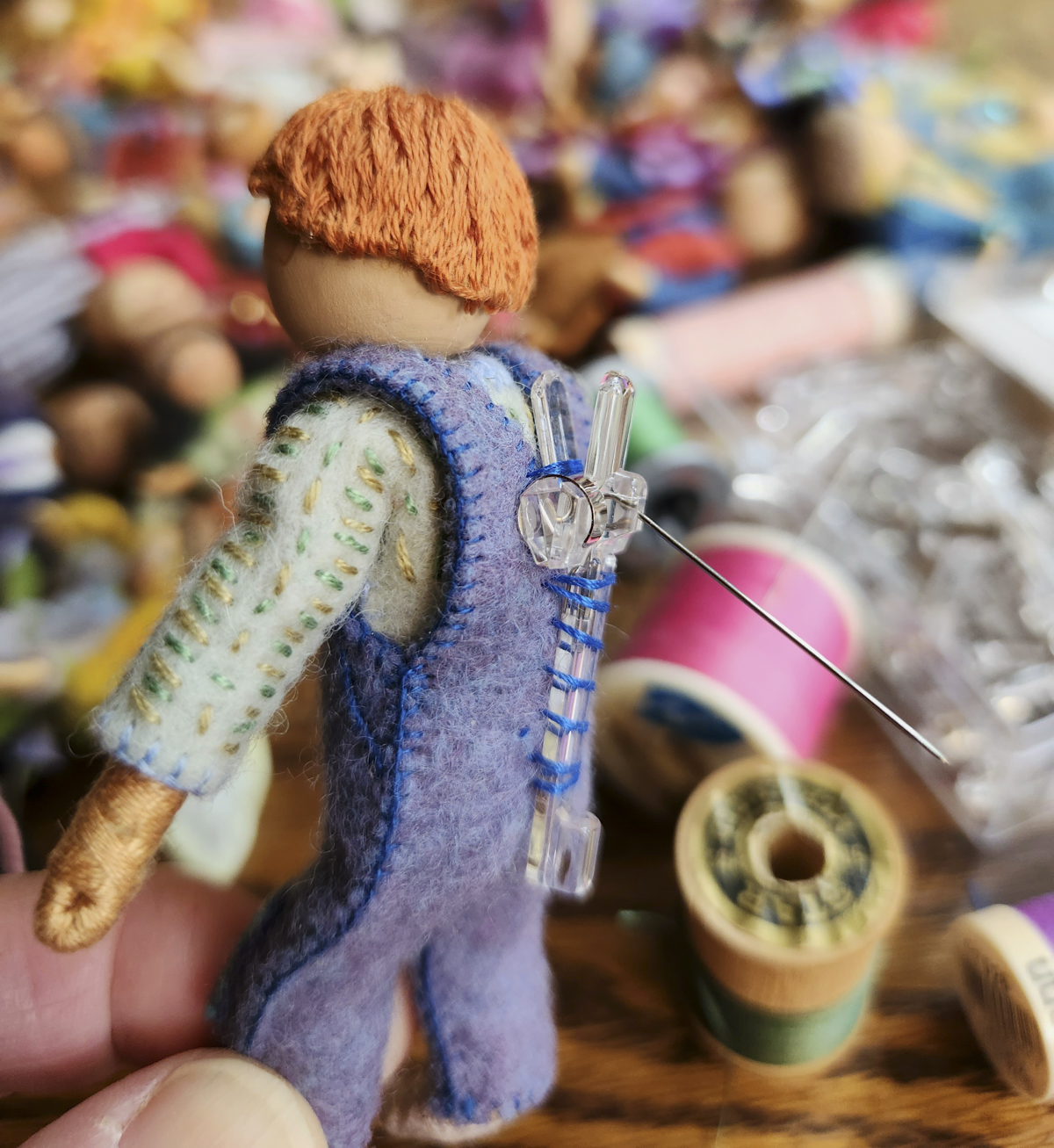
My solution to how to affix them to the wall involved tiny clear plastic clips with a pin backing. These were given to me by Alison Crites, who helped curate the show.

In preparation at home, I spent a few evenings sewing the clip/pins to the back of each doll.

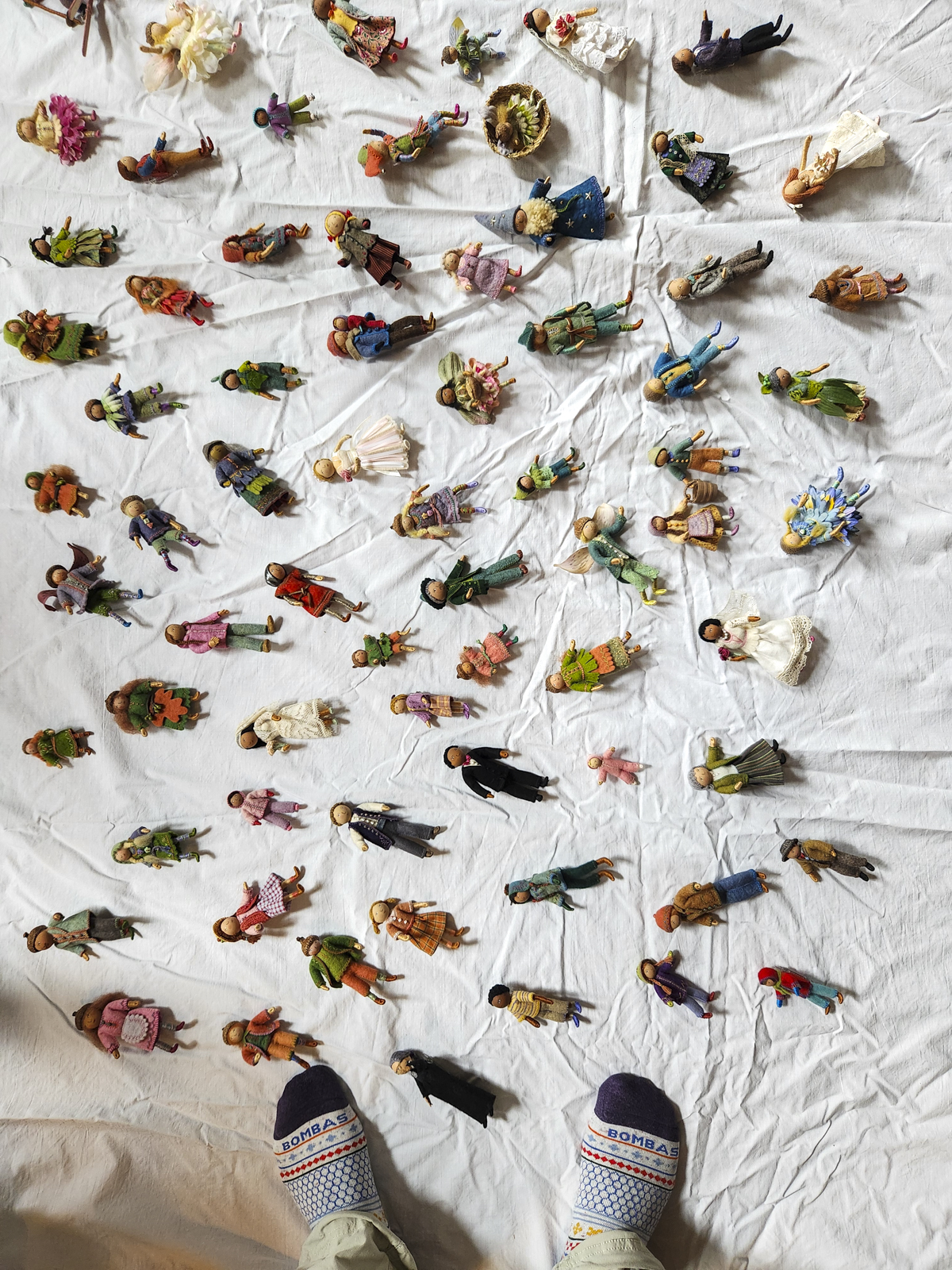
Also ahead of time at home, I arranged the dolls on a white sheet on the floor to get an idea of their spacing.

Once in the museum, we drilled small holes in the gallery wall and stuck the pins in, with a little Goop to hold them in place. Hopefully, they won’t take a walk!

In the coming weeks, I’ll share more photos of the exhibition. Here I am, standing in front of the wall with Anne Corso, the museum’s executive director and Alison Crites, the manager of exhibitions.

The Wee Worlds of Salley Mavor will be on view at the Southern Vermont Arts Center, through January 7th, 2024. Besides the Wall of Wee Folk, the exhibition includes a wide array of original picture book illustrations spanning my career, including BEDTIME STITCHES, the touring exhibition of artwork for MY BED: Enchanting Ways to Fall Asleep around the World. Also on view are pieces that explore cultural diversity, migration, fashion, the natural world, and a range of social narratives, from the everyday to topical subjects.

To keep up with new posts, please subscribe to this blog. Your contact info will not be sold or shared. If you’d like to see more frequent photos tracking the projects in my studio, please follow me on Facebook, Instagram and BlueSky.
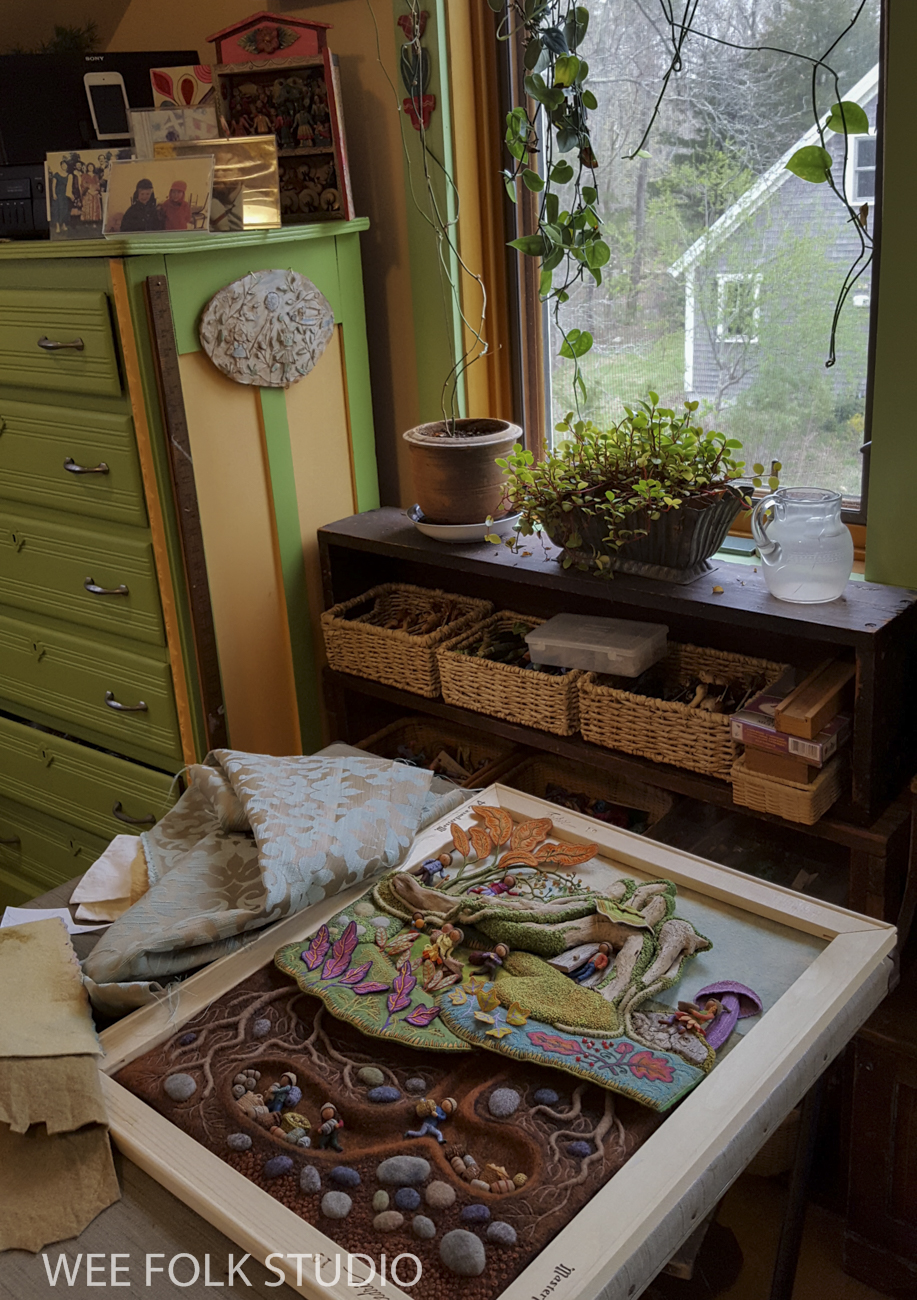
Summertime makes the finish line!

I’m happy to report that after almost a year of work, Summertime, the newest scene in my seasonal landscape series, is finished! Now all four seasons will be included in my upcoming exhibition at the Southern Vermont Arts Center. The Wee Worlds of Salley Mavor will be on view Sept. 30, 2013 – Jan. 7, 2024.

Further ahead in this post, you will find information about the exhibition, a preview of future posts about making Summertime and new items in my Etsy Shop.

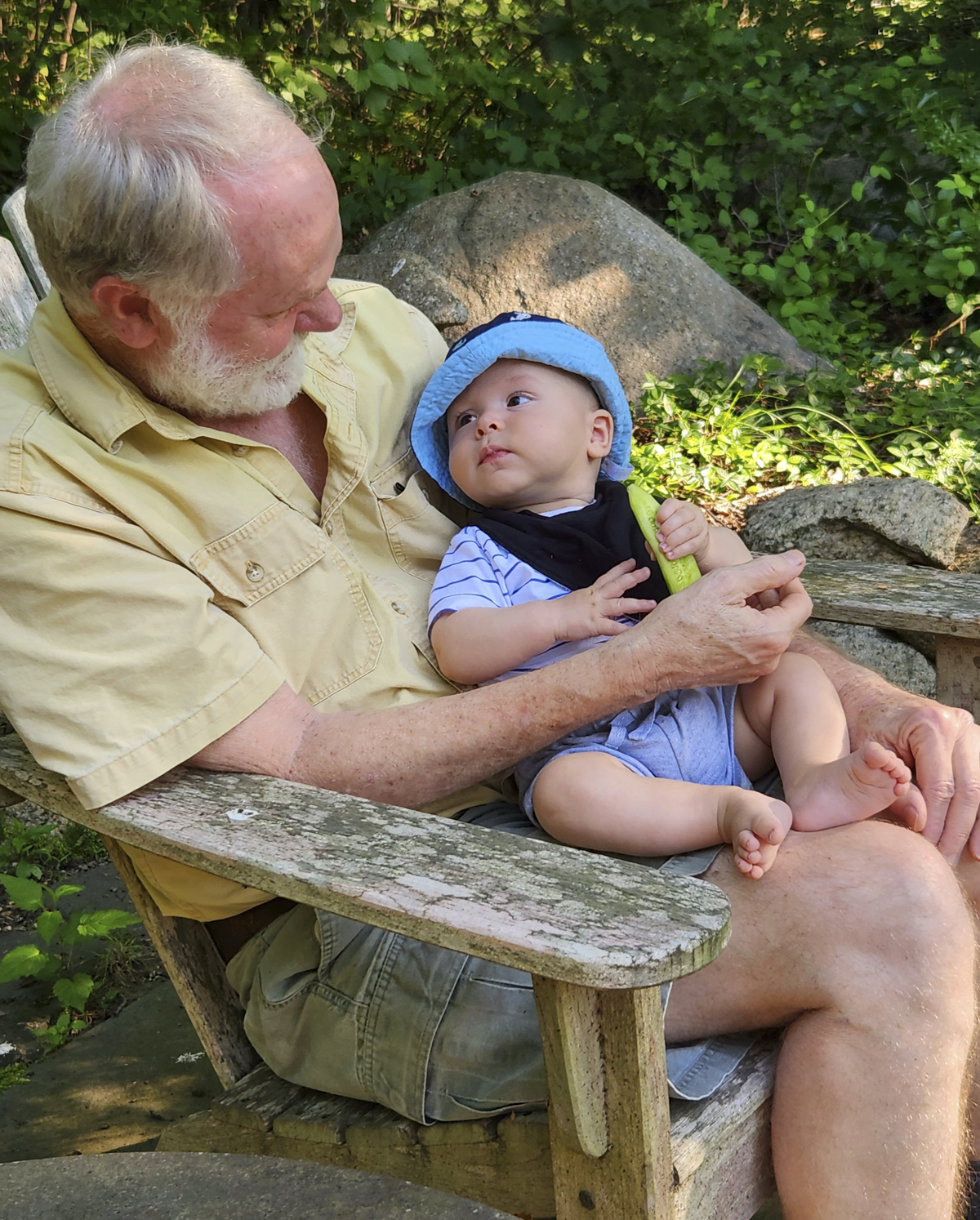
I don’t know why Summertime took so much longer to complete than the other seasons in the series. Mossy Glen, Frosty Morning and Harvest Time also have a gazillion stitches, but they each only took about 4 months to make. It could have something to do with the change in my daily routine since my grandson, Elias was born in January. Playing with the baby is now high on my list of essential activities, which includes sleeping, eating and stitching. Obviously, my priorities have shifted!

To reach the exhibition deadline, I spent the past few months stitching as much as possible, including in the evenings, like I used to do when my children were little. That’s why this is the first blog post I’ve written in months!

As with the other landscapes in the 4 Seasons series, I documented the process of making Summertime with photos and videos along the way, so there’s a lot of material to share in future blog posts, including a varied assortment of Stitch Minute videos.

If you’ve followed me on Instagram and Facebook during the past year, you’ve seen Stitch Minute videos that show different aspects of my process. I’m happy to offer photos and minute-long peeks over my shoulder while I work, but please don’t ask me to explain my techniques in detail. Much of what I do is instinctual and I worry that over-analyzing my process would spoil the magic for me. To learn my personal philosophy about sharing knowledge, please read my post to teach or not to teach.

Here are two Stitch Minute videos that I made in August, while working on Summertime.


New 4 Seasons Items in my Esty Shop

Now that the seasonal landscape series is finished, I’m excited to offer note cards, jigsaw puzzles and archival prints of all four seasons:
Summertime, Mossy Glen, Harvest Time and Frosty Morning.
My Etsy Shop offers FREE SHIPPING on US orders of $35.00 or more. I’m sorry to disappoint my international fans, but due to the prohibitive cost of shipping overseas, I now only take orders from the USA and Canada.

$ Seasons Note Card Sampler is available in my Etsy Shop
Summertime Jigsaw Puzzle is available in my Etsy Shop
8.5 x 11 Archival Print of Summertime is available in my Etsy Shop

The Wee Worlds of Salley Mavor exhibition

Yesterday, my artwork was picked up and driven in a van to Manchester, Vermont for my exhibition at the Southern Vermont Arts Center. It’ll be a large show, with over 75 pieces, including the 4 Seasons and the original illustrations for my most recent picture book, MY BED. On view will be a wide range of work, from early in my career to today, as well as a wall covered with over 100 wee folk dolls!

There will be a lot to enjoy at the Southern Vermont Arts Center this fall, especially for those of you with a playful bent. I’m so pleased that my work will be just around the corner from a fascinating and whimsical display of the late illustrator Ashley Bryan’s collection of toys, objects, puppets and paintings. Ashley Bryan: The Spirit of Joy and The Wee Worlds of Salley Mavor will be on view Sept. 30, 2013 – Jan. 7, 2024. I hope to see some you at the opening reception on Sept. 30th, where l will give a gallery talk at 3:00 PM.

This image has an empty alt attribute; its file name is svac-flyer2.jpg

To keep up with new posts, please subscribe to this blog. Your contact info will not be sold or shared. If you’d like to see more frequent photos tracking the projects in my studio, please follow me on Facebook, Instagram and BlueSky.

Summer Tidbits

With so much going on this summer, I decided to list everything in one post. There are current and upcoming exhibitions to see, new Stitch Minute videos to watch, as well as new products and a Sale in my Etsy shop.

But first, a little Barbie nostalgia.

With all of the chatter about the new Barbie movie, I thought I’d show mine from the early 1960’s. She co-mingled with the trolls, who mostly tolerated her. Looking back, I can see why the trolls won my heart. Barbie’s world was conventional and limiting, whereas the trolls opened up possibilities for a kind of magic to happen.


EXHIBITIONS

MY BED – The Netherlands

BEDTIME STITCHES heads south!

The touring exhibition of original artwork for my picture book, My Bed,
is currently on view at the
Southeastern Quilt and Textile Museum
in Carrollton, Georgia thru Sept. 15th.

MY BED – India


Since its premiere at the Cahoon Museum of American Art in 2020, Bedtime Stitches has been seen by thousands of visitors at 8 different museums across the country from Maine to Washington State. And it’s not over yet! To find out where Bedtime Stitches will be going into 2025, visit the exhibitions page.

MY BED – Russia

Hearing reactions from people who’ve seen my artwork in person makes me feel that organizing this show was worth all of the effort. I especially enjoyed this comment written earlier this year in the guest book at the Pacific Northwest Quilt & Fiber Arts Museum:

“It makes you think that everything is possible!”
~ Eleanor, Seattle, WA


2023 WOODS HOLE ART SHOW
July 24 – 29, 10 AM to 8 PM
Woods Hole Community Hall, Water St., Woods Hole, MA

This delightfully eclectic annual community art show is made up of artwork from people who live, work or lurk in Woods Hole. It’s been a long time since I had anything available during the summer to put in, but this year, 2 pieces from my seasonal landscape series, Harvest Time and Mossy Glen, will be included. Please note that the show is up for one week only (July 24 – 29).

If you’re heading down to the village of Woods Hole and manage to find a place to park, you can also see my Self Portrait: A Personal History of Fashion, which is on semi-permanent display at the Woods Hole Public Library.

Self Portrait: A Personal History of Fashion at the Woods Hole Public Library

THE WEE WORLDS OF SALLEY MAVOR

SOUTHERN VERMONT ARTS CENTER, Manchester, VT
September 30, 2023 – January 7, 2024
OPENING RECEPTION: Saturday, September 30 from 2 to 4 P.M.
GALLERY TOUR with the artist at 3 P.M.

This will be a large retrospective exhibition in the Art Center’s main gallery. It will include a wide array of original picture book illustrations spanning my career, including Bedtime Stitches, the touring exhibition of artwork for my most recent book, MY BED. Also on display will be recent pieces that explore cultural diversity, migration, fashion, the natural world, and a range of social narratives, from the everyday to topical subjects.

Southeastern Vermont Arts Center, Manchester, VT

New STITCH MINUTE Videos

SUMMER SCENE PREVIEW
The summer scene is slowly taking shape and I hope to finish it in time for my exhibit in Vermont this fall. When the piece is complete, I’ll write a series of posts that go into more detail, with commentary and photos that document my process. It’s the 4th in my seasonal landscape series. You can learn about how I made the other three, Frosty Morning, Mossy Glen and Harvest Time, in earlier posts on this blog. The images are printed as cards and jigsaw puzzles (20% off sale July 23 – 31), which are available in my Etsy Shop.


ETSY SHOP NEWS

New Note Card – George’s Chair

NEW CARDS in my Etsy shop.

George’s Chair features a child nestled in an upholstered armchair, engrossed in a storybook, surrounded by imaginary characters, including St. George and the Dragon. There are also four new cards with images from Mary Had a Little Lamb. They include Mary and her lamb in the garden, in the barn, in the kitchen and in an apple orchard. The different scenes are available separately or in a sampler.

Mary Ha a Little Lamb Note Cards

JIGSAW PUZZLES

Enter my Etsy Shop here.

To keep up with new posts, please subscribe to this blog. Your contact info will not be sold or shared. If you’d like to see more frequent photos tracking the projects in my studio, please follow me on Facebook, Instagram and BlueSky.

Harvest Time – Part 7 (wee folk)

In Part 7 in the continuing series about making Harvest Time, I share photos and commentary about the wee folk characters who populate the landscape. In the coming weeks, I will post more stories that focus on different aspects of making the fall scene, including the miniature storage containers and the embroidered trees. So far, I’ve written the following posts:
The overview introduces the Harvest Time piece.
Part 1 features moss making.
Part 2 is about making the turkey tail mushroom.
Part 3 shows the construction of felt leaves.
Part 4 gives a peek at embroidering the plants.
Part 5 is about making the toadstool mushroom.
Part 6 covers the underground tunnels, roots and stones.

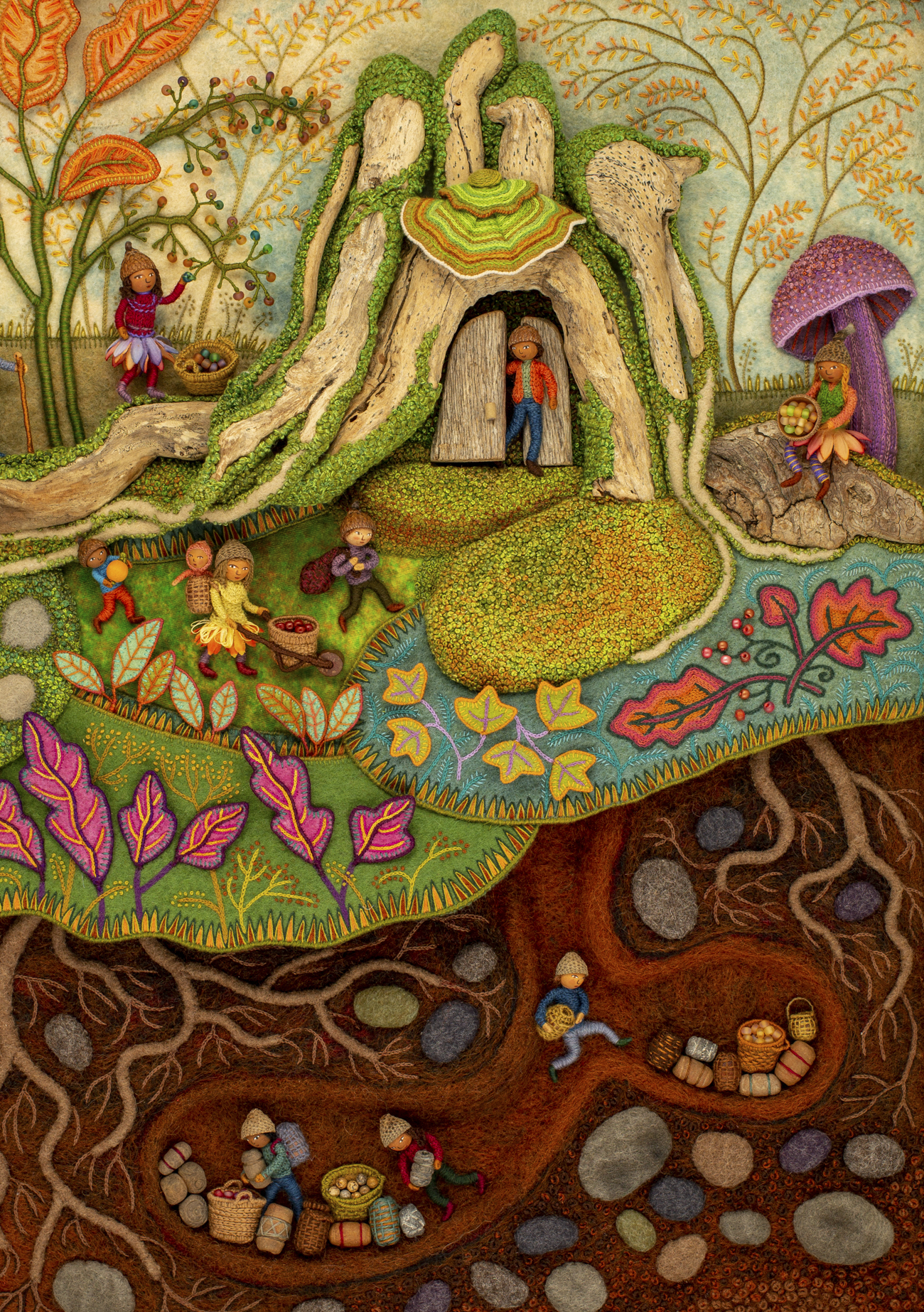
Harvest Time is the fall scene in a series of seasonal landscapes that capture the wonder and magic of the natural world, both real and imagined. Note cards and jigsaw puzzles of the this and other scenes in the series (Frosty Morning and Mossy Glen) are available in my Etsy Shop.

Everything I make includes some sort of living being with eyes, be they animal or human. I can’t imagine spending months working on a piece that is purely decorative, abstract or simply a landscape, without a storytelling element. The interplay between characters and their surroundings is what drives me to create. As I paint their faces, form their little bodies and stitch their clothes, I grow to care about them. This emotional connection is what motivates me to spend copious amounts of time creating an imaginary world that is worthy of their existence.

For this scene, I painted more faces than I needed, in different sizes and shades. That way, I could select a cast of characters later. I’m never sure how many figures I’ll need or exactly where they’ll end up. They are like actors in an improvisational skit or a group posed in a tableau.

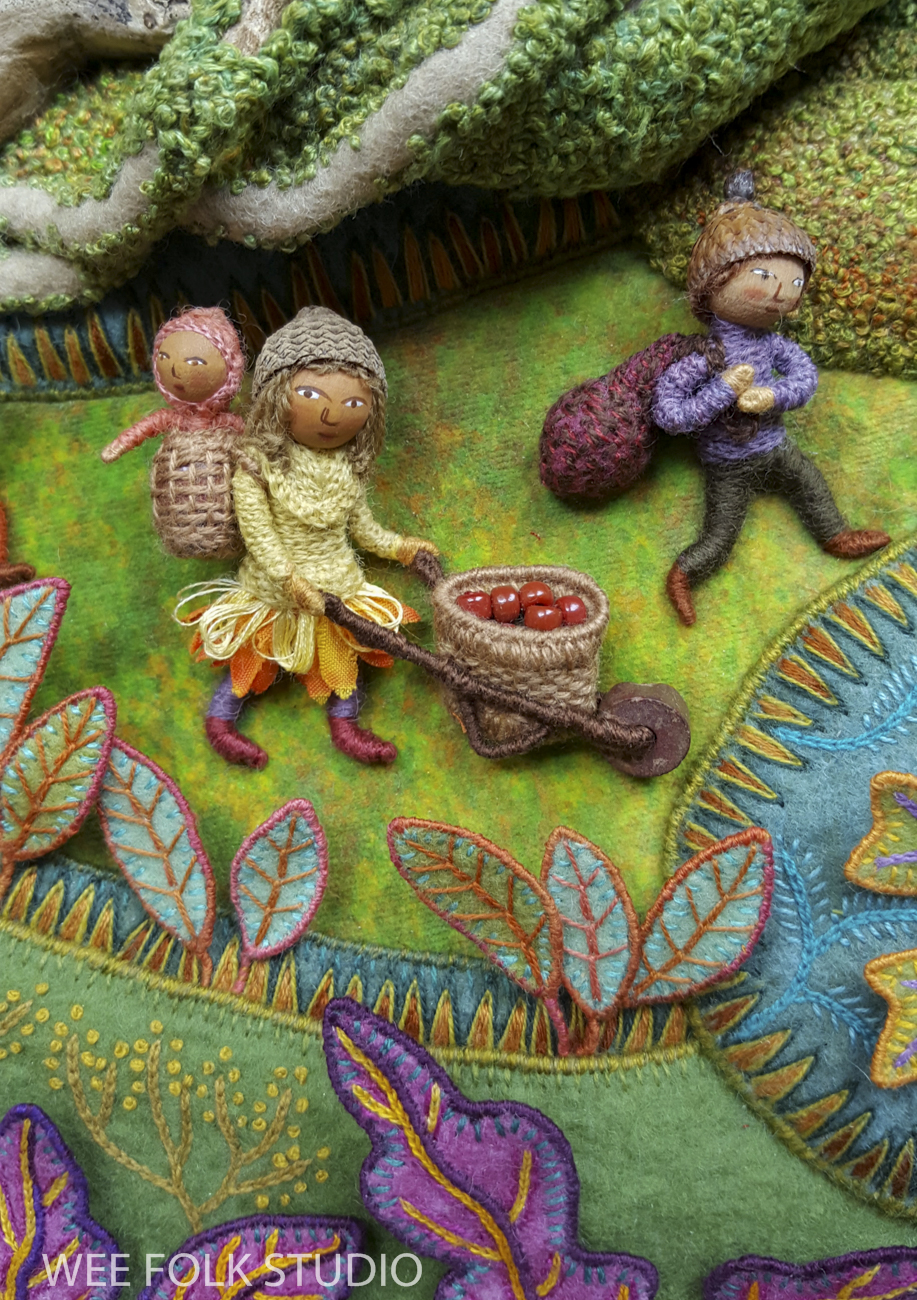
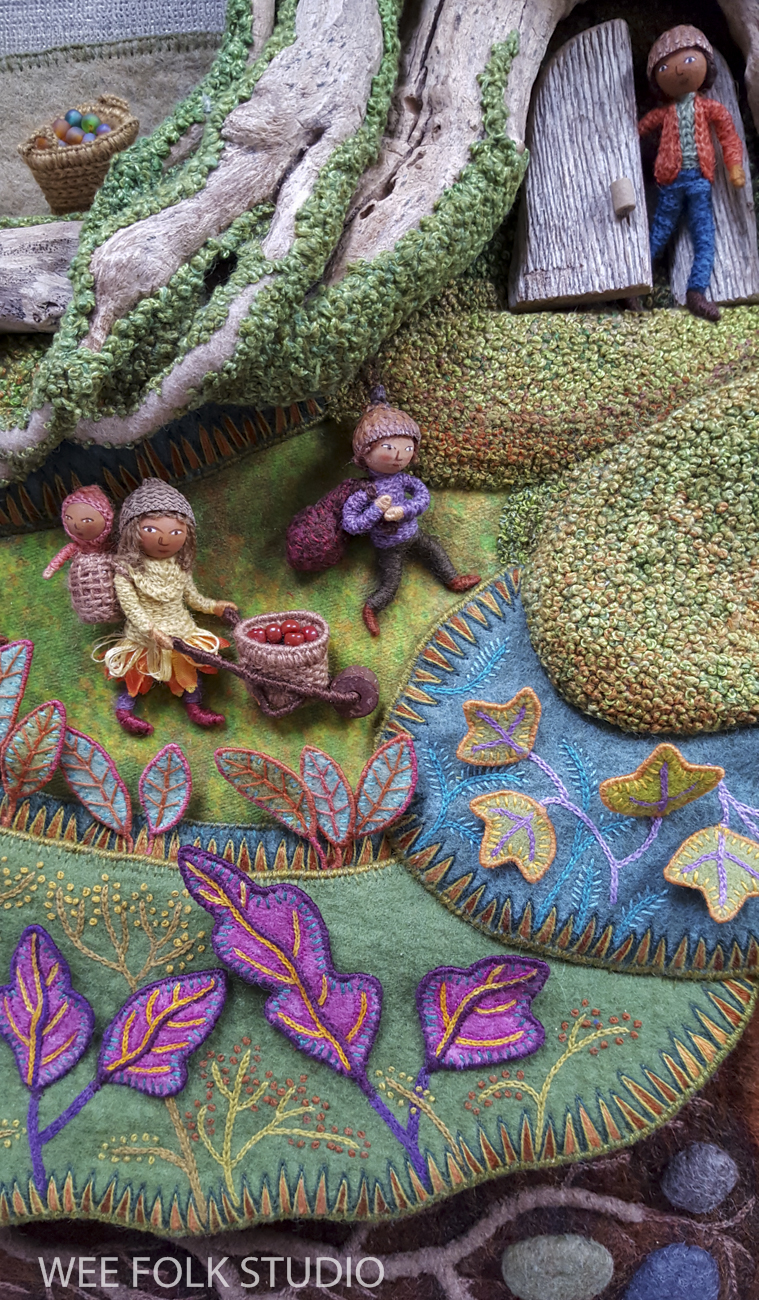
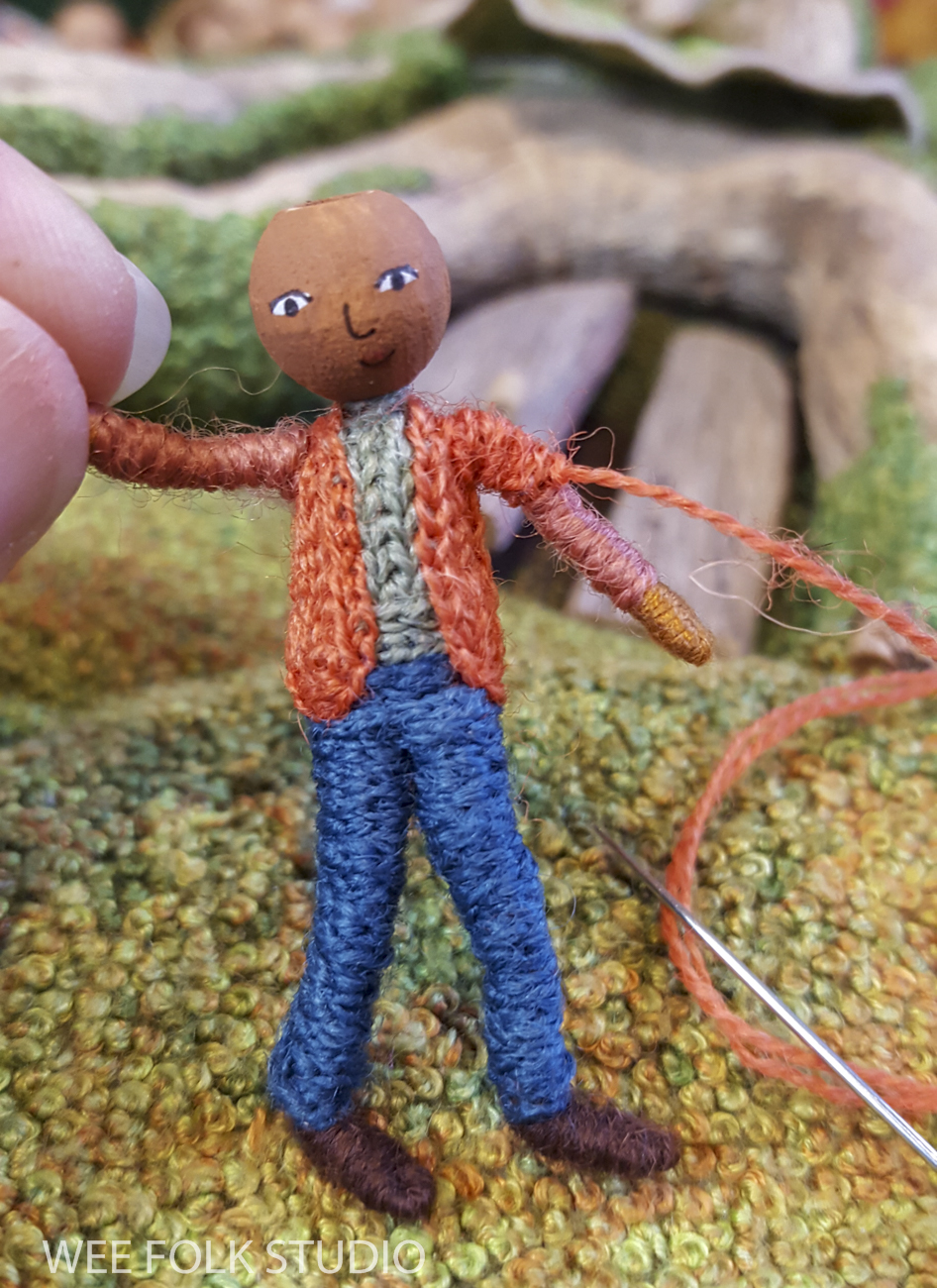
The little people range in size between 1″ to 2″ tall. They were made the same way as the wee folk dolls in my how-to book, Felt Wee Folk, with slight variations. For instance, I used wire instead of pipe cleaners for their tiny armatures.

In keeping with the harvesting theme, all of the people are bringing produce to the mossy stump, where it will be stored in the cellar.

I’m often asked, “How do you knit their tiny outfits?” There might be someone out there who can knit or crochet a tiny sweater for a 2″ doll, but I challenge them to stuff their arms through the sleeves! Remember, this is make believe. The wee folk never have to bathe or change their clothes. Why knit, when you can embroider a piece of clothing directly onto a body? Rows of chain stitching are pretty convincing, don’t you think? I call it faux knitting.

Please stay tuned for more stories about making Harvest Time, including the storage containers and embroidered trees.
The overview introduces the Harvest Time piece.
Part 1 features moss making.
Part 2 is about making the turkey tail mushroom.
Part 3 shows the construction of felt leaves.
Part 4 gives a peek at embroidering the plants.
Part 5 is about making the toadstool mushroom
Part 6 covers the underground tunnels, roots and stones.

To keep up with new posts, please subscribe to this blog. Your contact info will not be sold or shared. If you’d like to see more frequent photos tracking the projects in my studio, please follow me on Facebook, Instagram and BlueSky.

Studio News

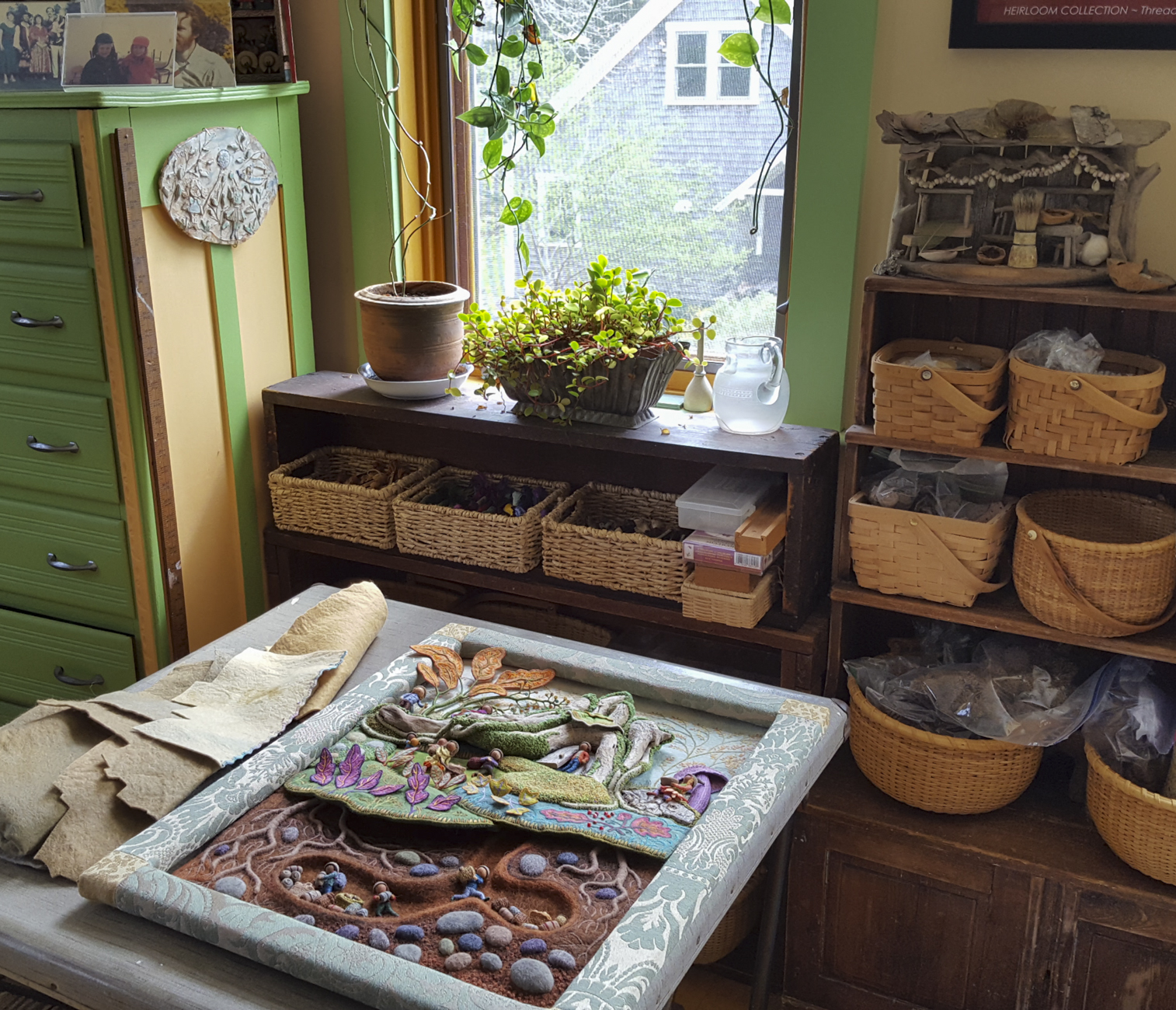
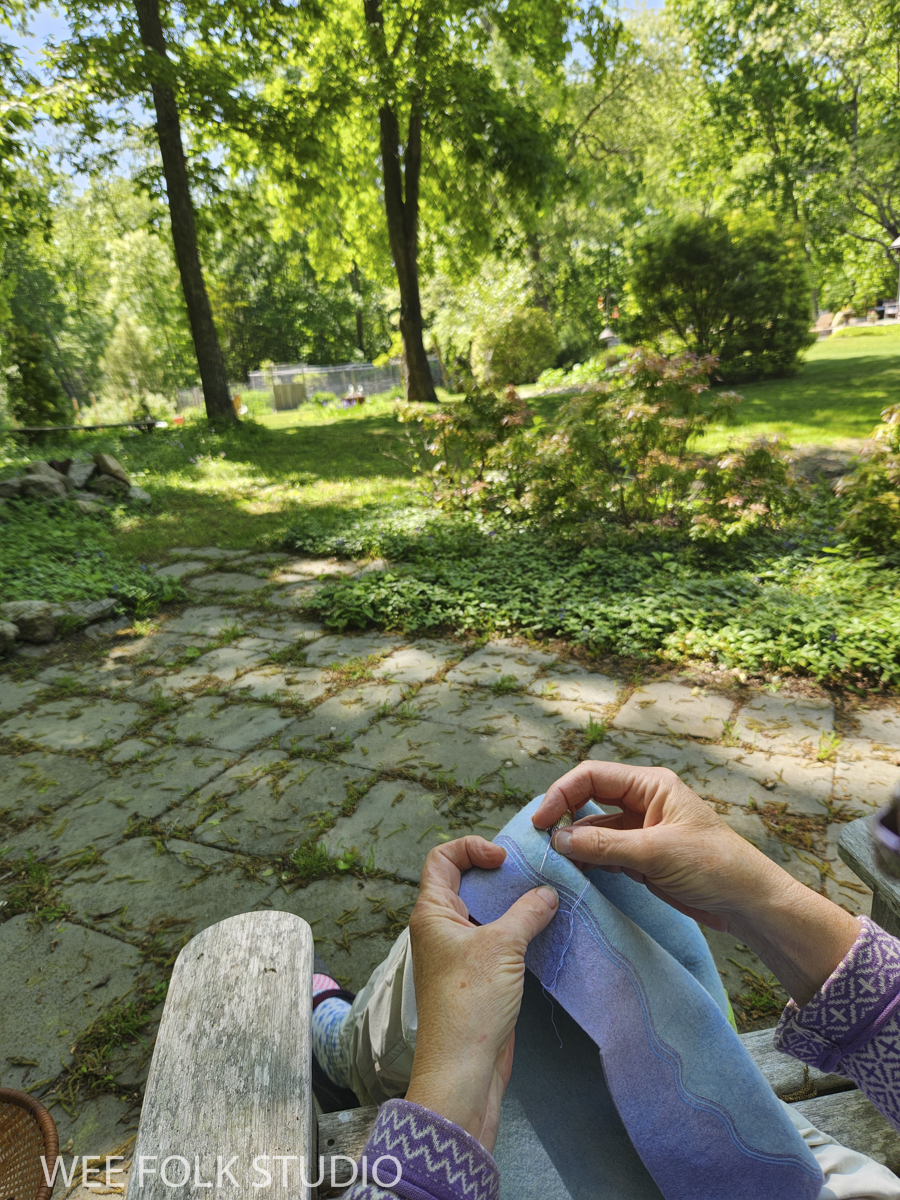
On a recent glorious afternoon, I sat outside and stitched. It was one of those idyllic moments, when I felt truly at peace, doing something I value, in a place I love. Some people read books to immerse themselves in another world. I do it with a needle and thread. It’s embarrassing to admit that when given the choice of reading or stitching, I pick stitching every time. That’s a good thing, because otherwise I’d never get anything done! Right now, I’m in the middle of making a summer scene in my series of seasonal landscapes. I usually wait until a piece is finished before writing about it, but this one is taking so long that I’m giving previews, like the Baltimore Oriole Sneak peek.

Grandma Salley and 4 month old Elias

One welcome change in my studio routine this year are the almost daily visits by my grandson Elias, who is now 4 months old. As you can imagine, this little guy is bringing about a shift in my priorities.

In this post, I share info about 2 upcoming exhibits, as well as photos and videos of some special parts of the summer scene, including roses, raspberries, trees, and tree houses. But first, I’d like to let you know about a magazine article about my 45-year art career and a fun and entertaining podcast interview that just came out,

MAGAZINE ARTICLE
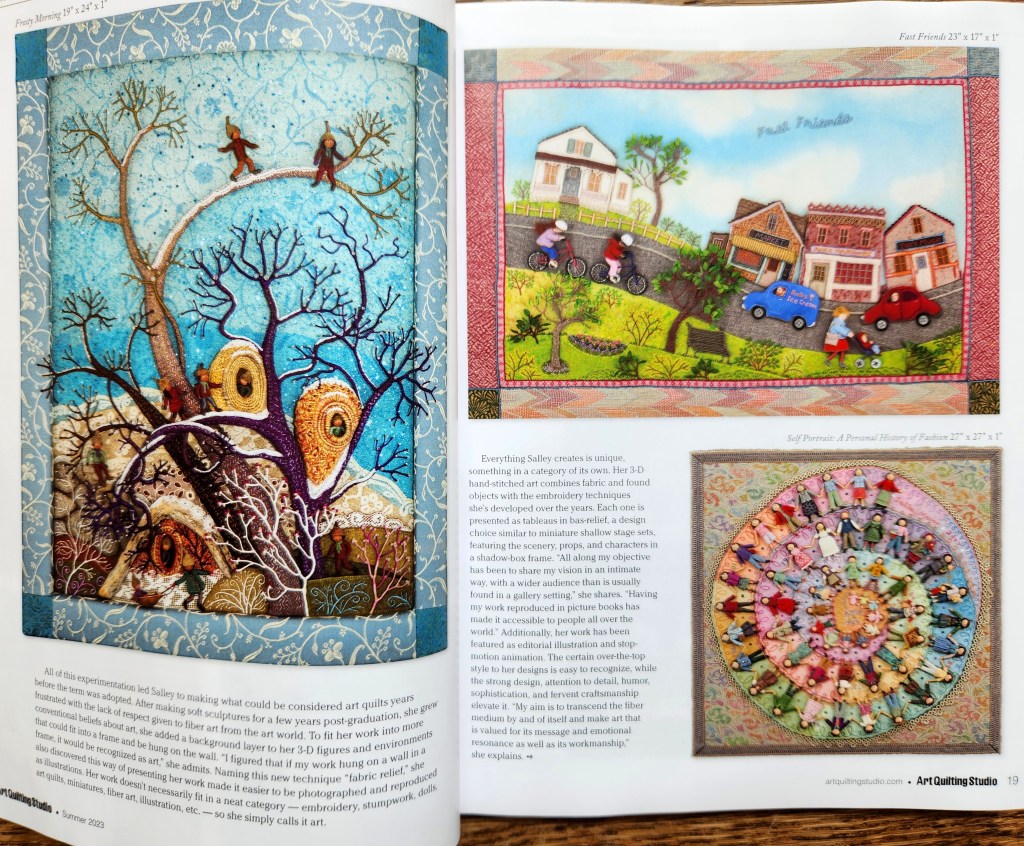
The summer issue of Art Quilting Studio features a 12-page artist portfolio about my work. I sent the editor a large selection of photos to choose from and to my surprise, they printed everything! The article covers a lot of ground and describes how and why I came to do what I do. I’m excited that more people will be seeing and learning about my artwork for the first time! This issue of the magazine can be purchased here.

PODCAST
I had the pleasure of being interviewed by Julie Wake, the very personable executive director of the the Arts Foundation of Cape Cod, for an episode in their series of Creative Exchange Podcasts. Listen to Salley Mavor / Staying True to Yourself and Your Work here.

EXHIBITIONS
The next showing of Bedtime Stitches, the touring exhibition of original artwork for my picture book, MY BED: Enchanting Ways to Fall Asleep around the World will be July 6 – Sept. 15, 2023 at the Southeastern Quilt and Textile Museum in Carrollton, GA. To see the tour schedule, please visit the exhibitions page.

Afghanistan scene in MY BED

THE WEE WORLDS OF SALLEY MAVOR

SOUTHERN VERMONT ARTS CENTER, Manchester, VT
ON VIEW: Saturday, September 30, 2023 – Sunday, January 7, 2024
OPENING RECEPTION: Saturday, September 30 from 2 to 4 P.M.
GALLERY TOUR with the artist at 3 P.M.

SUMMER SCENE PREVIEW
When the summer scene is finished, hopefully in time for my exhibit in Vermont this fall, I’ll write a series of posts that go into more detail, with commentary and photos that document my process. It will be the 4th in my seasonal landscape series. You can learn about how I made the other three, Frosty Morning, Mossy Glen and Harvest Time, in earlier posts on this blog. The images are printed as cards and jigsaw puzzles, which are available in my Etsy Shop.

And now for the summer scene teaser!

Here’s a Stitch Minute video of making a felt rose. It’s an embellished version of a rose that Mimi Kirchner shared years ago on her blog.

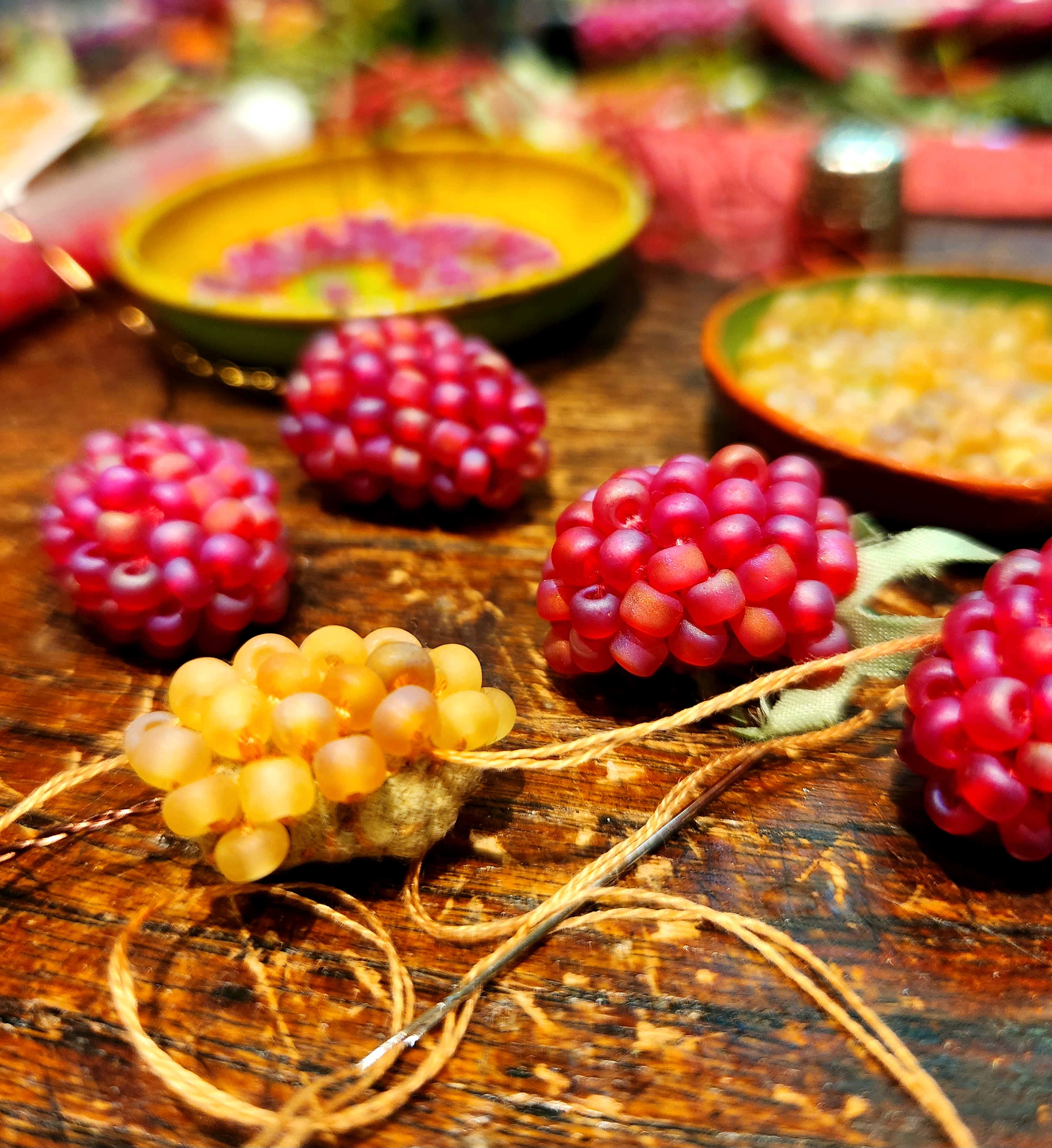
I also made raspberries for the scene.

You can watch how I made them in this Stitch Minute video.

Here’s a close up of the tree, which is the main focal point.

I’ll leave with this little video of the tree houses in the summer scene. I just couldn’t resist playing! You may recognize the character peeking out as a member of the Woodland Family in my how-to book, Felt Wee Folk: New Adventures. I’ll eventually make all new wee folk dolls to inhabit the landscape.

Tree houses in the summer scene.

To keep up with new posts, please subscribe to this blog. Your contact info will not be sold or shared. If you’d like to see more frequent photos tracking the projects in my studio, please follow me on Facebook, Instagram and BlueSky.

Baltimore Oriole sneak peek

I’m right in the middle of making the summer scene in my series of seasonal landscapes. Normally, I wait until a piece is finished before writing blog posts about it, but I just have to give you a preview of what’s to come! This scene features a flashy male Baltimore Oriole, which I’m excited to show.

It’s been ten years since I made a bird this size, like the ones in Birds of Beebe Woods. Back then, I didn’t take many pictures while I worked. This time, I documented every stage of the process with photos and videos, which I’ve shared on Facebook and Instagram over the past month and now here in this post.

The Baltimore Oriole will be perched in the upper branches of a tree that has little huts nestled at the base. Like the other scenes in the series, Frosty Morning, Mossy Glen and Harvest Time, the summer landscape will be full of wee folk characters cavorting outside in nature. The first 3 seasons are available as Jigsaw Puzzles and Note Cards in my Etsy Shop. When its finished, the summer scene will also be reproduced as a card and puzzle.

I hope to finish the summer scene in a few months, so that all four seasons will be displayed together at my exhibition in Vermont this fall.

The Wee Worlds of Salley Mavor (includes Bedtime Stitches).
Southern Vermont Arts Center, Manchester, VT
Sept. 30, 2023 – Jan. 7, 2024
Opening – Sat., Sept 30, 2 to 4 pm. Galley tour with the artist at 3 pm.

When the piece is completed, I’ll write my usual series of detailed posts about different aspects of how I work, like I’ve done with Frosty Morning, Mossy Glen and am currently doing with Harvest Time.

For now, I hope that you enjoy looking over my shoulder, while I work. The following five videos are condensed versions of different steps I used in creating the bird’s breast, beak, wing, tail, and feet.

Making the Breast

The videos aren’t intended to be tutorials, but you can pick up a lot of my stitching techniques. If you’ve followed me for a while, you’ve probably heard my personal philosophy about sharing knowledge. Basically, I’m happy to give peeks at how I work, as long as the act of creating isn’t overly dissected, else it loses its magic.

This video shows how I created the beak.

Making the Beak

This video demonstrates how I stitched the wing.

Making the Wing

This video shows the process of making the tail.

Making the Wing

This video shows how I formed the feet.

Making the Feet

Now that the bird is finished, I’ve resumed working on other parts of the landscape. But, I have a feeling that this Baltimore Oriole, in all his orange glory will not want to share the stage with whatever and whomever shows up next!

To keep up with new posts, please subscribe to this blog. Your contact info will not be sold or shared. If you’d like to see more frequent photos tracking the projects in my studio, please follow me on Facebook, Instagram and BlueSky.

Harvest Time – part 6 (underground)

In Part 6 in the continuing series about making Harvest Time, I share photos and commentary about making the tunnels, roots, and stones in the underground portion of the landscape. In the coming weeks, I will post more stories that focus on different aspects of making the fall scene, including the wee folk figures, their storage containers, and the embroidered trees. So far, I’ve written the following posts:
The overview introduces the Harvest Time piece.
Part 1 features moss making.
Part 2 is about making the turkey tail mushroom.
Part 3 shows the construction of felt leaves.
Part 4 gives a peek at embroidering the plants.
Part 5 is about making the toadstool mushroom

Harvest Time is the fall scene in a series of seasonal landscapes that capture the wonder and magic of the natural world, both real and imagined. Note cards and jigsaw puzzles of the this and other scenes in the series (Frosty Morning, Mossy Glen and Summertime) are available in my Etsy Shop.

I’m never sure where my ideas come from. The usually appear in my head as pictorial concepts that ferment for a long time before transferring into my sketchbook and then as finished pieces. The fall scene lived in my imagination for many months before I began visualizing 3 separate areas – sky, a forest floor and below ground. I’ve always been fascinated by dioramas of underground tunnels and burrows dug by animals. I wanted to create similar storage areas for the wee folk to keep their fall harvest.

Once I became fixated with the idea of a cut-away underground view, I couldn’t wait to bring it to life! From the start, I knew that translating the picture in my mind’s eye into something real was going to require exploring different ways of working. While mulling over the possibilities, I decided to try both wet and dry felting, which I’ve dabbled in over the years.

Felting does have an appeal, but in the end, all that poking and meshing of wool fibers creates a uniform fuzzy texture that blends everything together. I wouldn’t ordinarily want that in my work because I’m more interested in creating lines and clear, defined edges. But for this project, a soft texture might be exactly what I needed for the dark soil below ground.

I also thought that felting would be a good way to form the concave shaped tunnel and storage areas. After reviewing the wet felting process on this YouTube tutorial, I wrapped a couple of stones and a curved stick with brown wool fleece and felted them in soapy water. When they dried, I cut through the thick felt and removed the stones and stick.

At this stage of the process, I needle felted the different parts together. An advantage to working with a barbed needle is that with enough jabbing, you can make seamless joints. Then, I cut out openings in a sheet of red felt (it happened to be what I had), inserted the tunnel, and needle felted them together.

To create the soil color, I needle felted layers of brown fleece on top of the red felt background.

I made the underground roots by covering wire with felt, the same way that I make trees.

The stones are made with 2 layers of heather shades of felt, folded over and sewn on the back.

Once the roots and stones were sewn in place, I could go in and add embroidered details like the chain stitched finer roots…

and French knot “dirt”.

After all of the manic stabbing with a barbed needle, it was a relief to get back into stitching mode. It felt great to get out a large embroidery needle, thread it with tapestry yarn, and create a distinctive texture that contrasted with the fleecy wool.

With the underground section in place and most of the landscape complete, I could now begin to focus on populating the scene with the wee folk who lived and worked there.

Please stay tuned for more stories about making Harvest Time, including the wee folk figures, storage containers, and embroidered trees.
The overview introduces the Harvest Time piece.
Part 1 features moss making.
Part 2 is about making the turkey tail mushroom.
Part 3 shows the construction of felt leaves.
Part 4 gives a peek at embroidering the plants.
Part 5 is about making the toadstool mushroom

To keep up with new posts, please subscribe to this blog. Your contact info will not be sold or shared. If you’d like to see more frequent photos tracking the projects in my studio, please follow me on Facebook, Instagram and BlueSky.

Revisiting Mary and her lamb

Today, I’d like to revisit the classic rhyme, Mary Had a Little Lamb, which I illustrated in 1995. The smaller board book version was published 10 years later. It’s hard to believe that 28 years have gone by since it first came out. The reality hits me, though, when I meet grownup people who remember the book from their childhood. Both versions are out of print, but you may be able to find used copies online.

Mary Had a Little Lamb remains one of my favorite projects and I’ve wanted to reuse the artwork from the book for some time. So, I’m happy to say that I just added 4 new note cards with images from the book to my Etsy Shop. There’s Mary and her lamb in the garden, in the barn, in the kitchen and in an apple orchard. The cards are available in 4 or 8 card samplers. Individual designs are also sold separately in packs of 4.

Note cards are available in my Etsy Shop..

All of the original 3-dimensional scenes I made for Mary Had a Little Lamb are in private collections. Fortunately, several owners are willing to loan them from time to time for exhibition purposes. Last summer, 8 pieces from the book were in my retrospective at the Brick Store Museum in Maine. And this coming fall, I hope to include a group of them in The Wee Words of Salley Mavor at the Southern Vermont Arts Center.

“Mary in the Garden” in a private home.

Judy Sue Goodwin-Sturges, my former teacher from RISD, generously loans pieces from her art collection for exhibitions. Picking them up is also a good excuse to visit her in Providence, RI. By the way, take a look at her shelves full of Guatemalan huipils behind us!

Mary Had a Little Lamb – apple tree note card
Mary Had a Little Lamb – barn note card

When I borrow the pieces, I often remove the stretched artwork from its frame to clean the inside of the glass. Then, I can take close up photos, like this one of Mary and her lamb in the barn and others you can see below.

Mary Had a Little Lamb – garden note card

Back in the 90’s, I embroidered character’s faces on hand-me-down fabric from my grandmother. The cloth was originally an old woolen petticoat that had been laundered so many times that it became felted. It was the perfect weight to work with and had a sturdy and forgiving texture that put up with multiple stabbings from a needle and thread. Eventually, I used up all the fabric and could never find anything to replace it. By then, I’d begun painting faces on wooden beads and I really didn’t miss embroidering faces. Sometimes, I would spend all day ripping out the stitching and starting again to get the right facial expression.

In this close up you can probably tell that the strawberries are made from polymer clay. The basket is made of wire wrapped in embroidery floss.

Mary Had a Little Lamb – kitchen note card

The blue and white knitting in the mother’s lap was originally part of a sculpture of a knitter sitting on a couch that I made in about 1980, which you can see below. I figured that the doll didn’t need her knitting any more, so I stole it and gave it to Mary’s mother. I’ve never been much of knitter and this would save me having to make a new one. And besides, it was the perfect scale!

Practically everyone who sees this asks, “Did you actually knit this on those tiny knitting needles?” I suppose it’s possible to knit with tooth picks, but I’m not that neurotic. Remember, making art is all about creating illusions. I used real needles, the kind that are for knitting baby booties and such, and then replaced them with with tooth picks.

Enter my Etsy Shop here.
A note to my international followers – Due to the unreasonably high cost of shipping overseas, I now only take orders from the USA and Canada.

To keep up with new posts, please subscribe to this blog. Your contact info will not be sold or shared. If you’d like to see more frequent photos tracking the projects in my studio, please follow me on Facebook, Instagram and BlueSky.

Harvest Time – part 5 (toadstool mushroom)

In Part 5 in the continuing series about making Harvest Time, I share photos and commentary about making the purple toadstool mushroom and the wee folk forager sitting under it. In the coming weeks, I will continue to post stories that focus on different aspects of making the fall scene, including the other wee folk figures, storage containers, tunnels, roots, and stones. So far, I’ve written the following posts:
The overview introduces the Harvest Time piece.
Part 1 features moss making.
Part 2 is about making the turkey tail mushroom.
Part 3 shows the construction of felt leaves.
Part 4 gives a peek at embroidering the plants.
Part 6 shows the process of making the underground

Harvest Time is the fall scene in a series of seasonal landscapes that capture the wonder and magic of the natural world, both real and imagined. Note cards and jigsaw puzzles of the this and other scenes in the series (Frosty Morning and Mossy Glen) are available in my Etsy Shop.

Harvest Time Jigsaw Puzzle

I don’t know why I didn’t include mushrooms in the original sketch. It seems so obvious now, especially for a fall landscape. The idea of putting one in the scene came later, when I shifted over the stump and created a place to fill on the right horizon.

Toadstool mushrooms have popped out in my artwork for over 40 years. These are some mushroom houses I made in 1979, back when I used a sewing machine.

When I went into business selling fairy kits in 1998, I designed a logo with a red-capped mushroom house. My 10 year stint making kits is long gone, but I still use the same logo.

In this scene from 2009, I used both real mushrooms from the supermarket and more fanciful ones that I made with polymer clay and painted kid leather.

This mushroom with a fairy taking shelter underneath is in my 2010 picture book, Pocketful of Posies, illustrating the rhyme, “Rain on the green grass, and rain on the tree; Rain on the housetop, but not on me.”

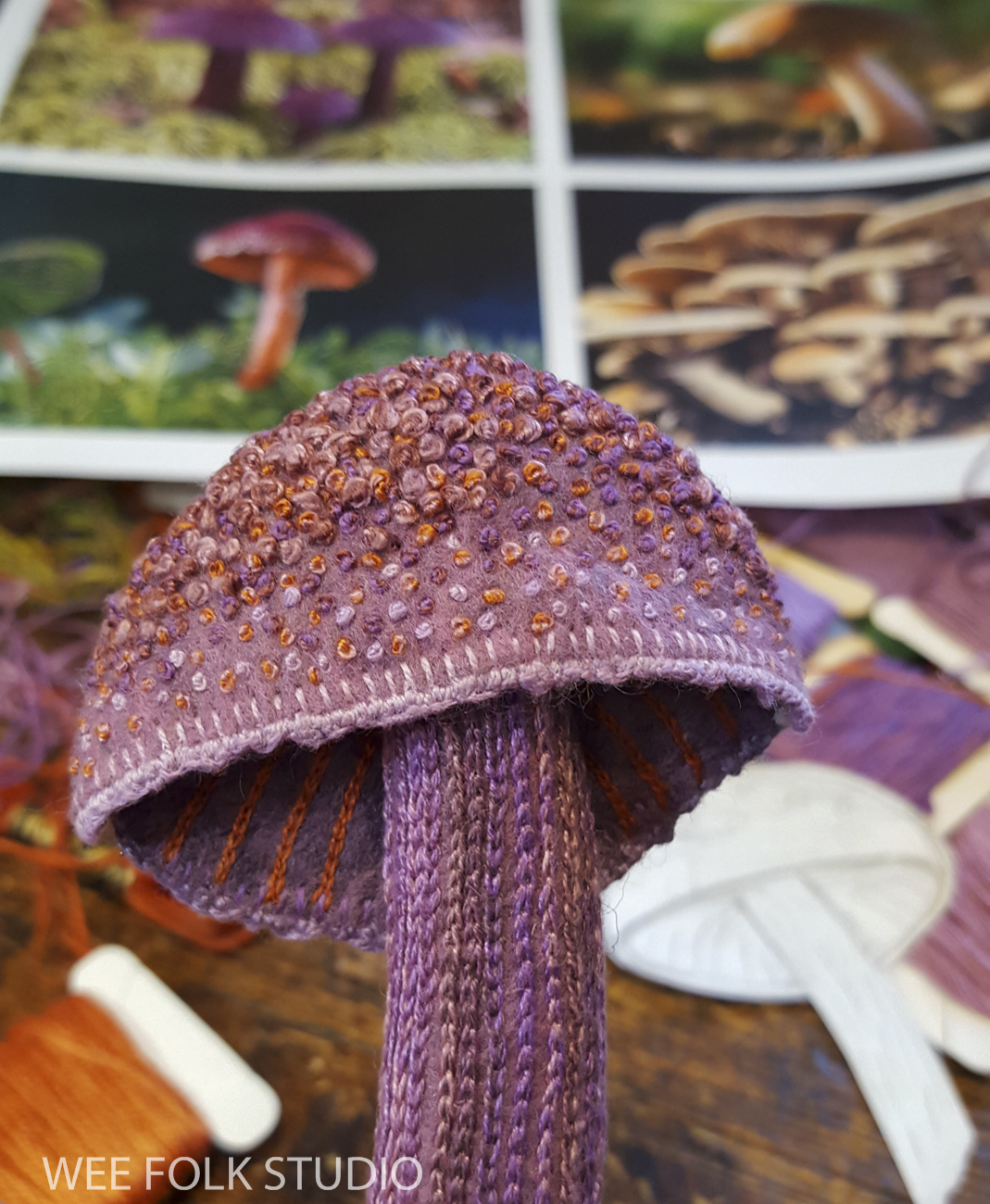
For Harvest Time, I chose a different type of mushroom. The idea of a purple toadstool struck my fancy, so I researched the Inky Cap variety. Besides being attracted to the purple/orange color combo, I looked forward to replicating the texture on the cap.
To begin, I drew the mushroom to size and used a paper cutout as a guide. It took some fudging to figure out the size and shape to cut the felt, because the front piece of the cap would be curved and sticking out about 1/2″,

I sewed wire along the rim of the cap to help hold its curve. After covering the wire with stitches, I created an uneven edge with messy loops, so it would look more realistic. To make the bumpy texture on top, I stitched French knots with different shades of purple and orange embroidery floss.

To make the stem, I cut out a thin strip of felt and covered it with lines of chain stitching.

I forgot exactly how I did this part, but it looks like I added a felt stem back piece that was reinforced with iron-on interfacing material. I must have thought it needed stiffening, since felt by itself is usually too floppy. Also, I probably stuffed the hollow cavity with wool fleece to keep it from collapsing.

I chain stitched scales with a contrasting shade of orange thread to the inside of the cap and sewed on the stem.

The mushroom and surrounding area looked lonely and plain, so I made a wee person to sit underneath.

To make a figure, I formed an armature with 24 gauge jewelry wire and wrapped it with thread. This is the same basic technique that I teach in my how-to book, Felt Wee Folk, but on a smaller scale. I didn’t make separate clothing, but faux knitted a shirt and vest directly onto the body with chain stitching. The skirt is an artificial flower.

This Stitch Minute video shows faux knitting for a character in the spring landscape, Mossy Glen.

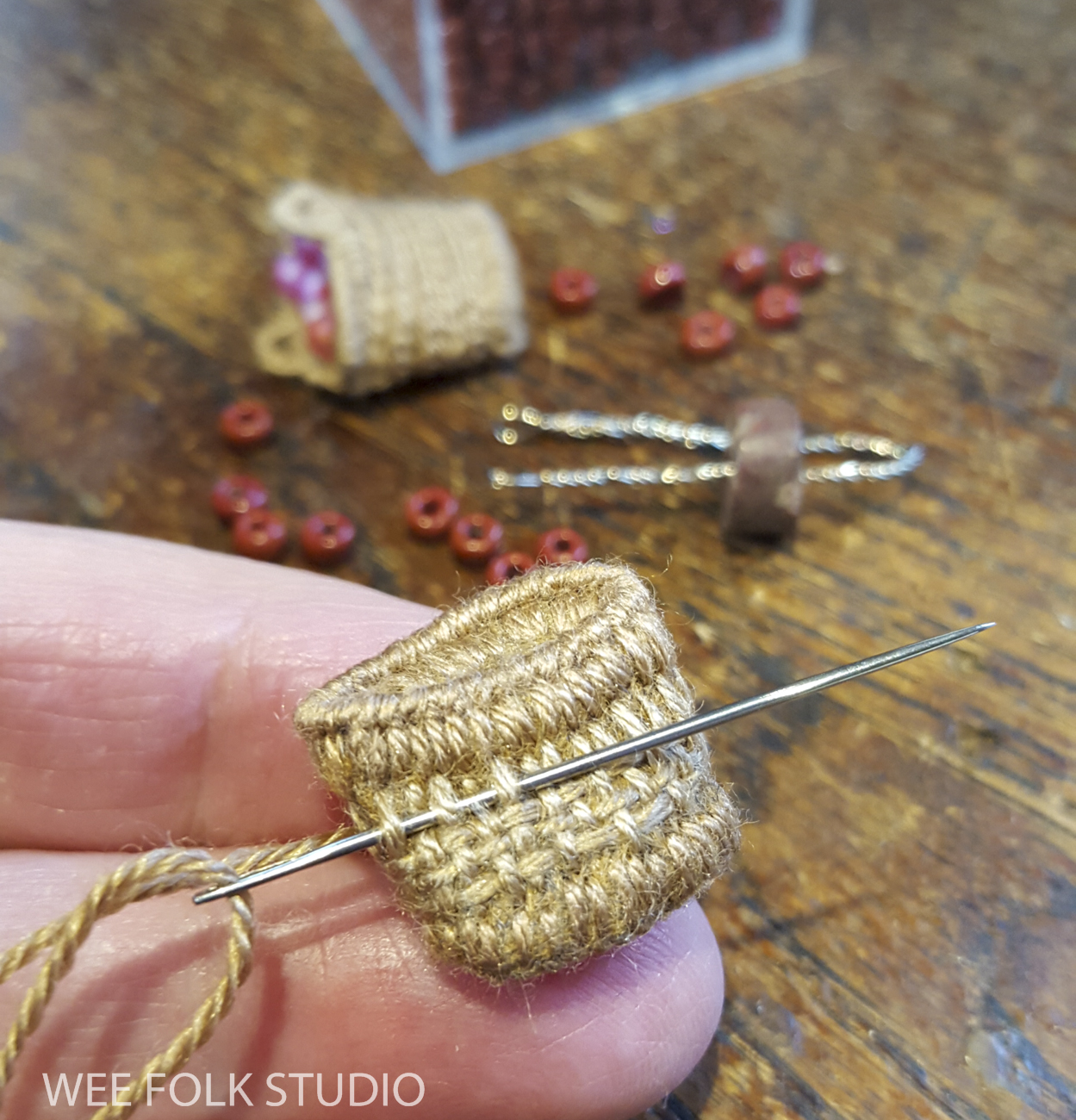
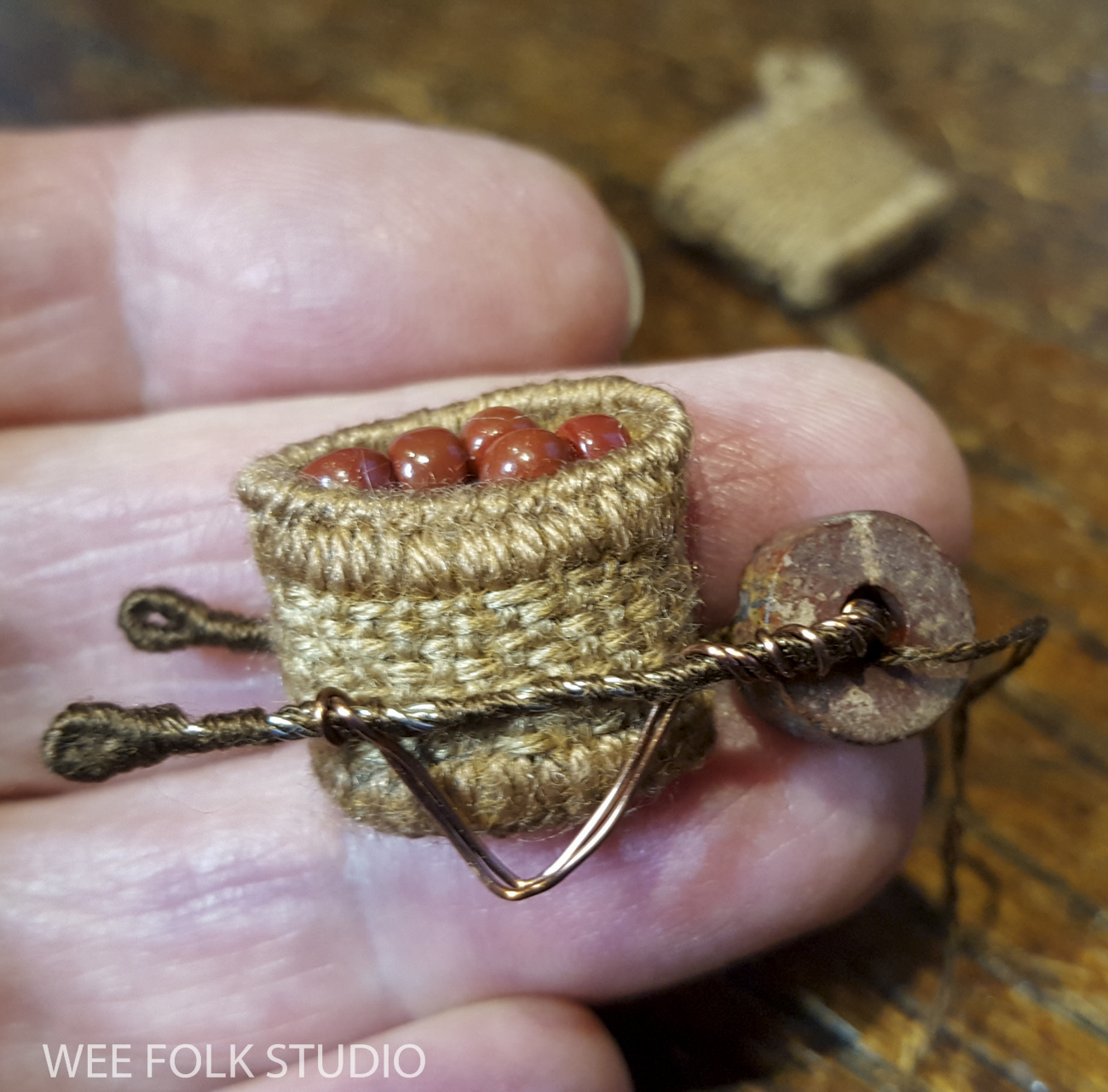
I painted a face on a wooden bead and glued braids and an acorn cap on top. Another acorn cap served as a container for glass bead “food”, which I sewed together in a bunch. The beads were sewn in place through drill holes in the acorn cap.

At this stage of the process, miscellaneous parts piled up, waiting to be assembled at the end, when everything is sewn to the background fabric. Please stay tuned for more stories about making Harvest Time, including the other wee folk figures, storage containers, tunnels, roots, and stones.

To keep up with new posts, please subscribe to this blog. Your contact info will not be sold or shared. If you’d like to see more frequent photos tracking the projects in my studio, please follow me on Facebook, Instagram and BlueSky.