Harvest Time – Part 9 (embroidered trees)

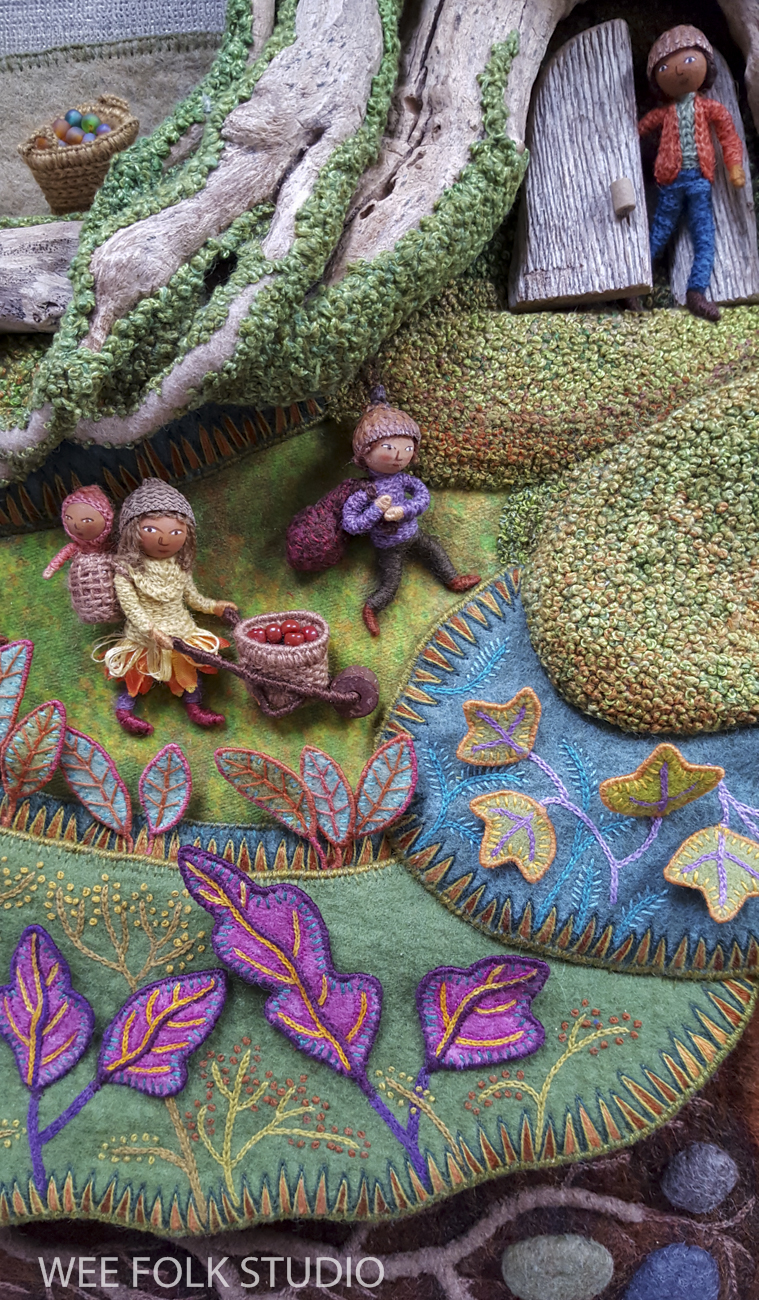
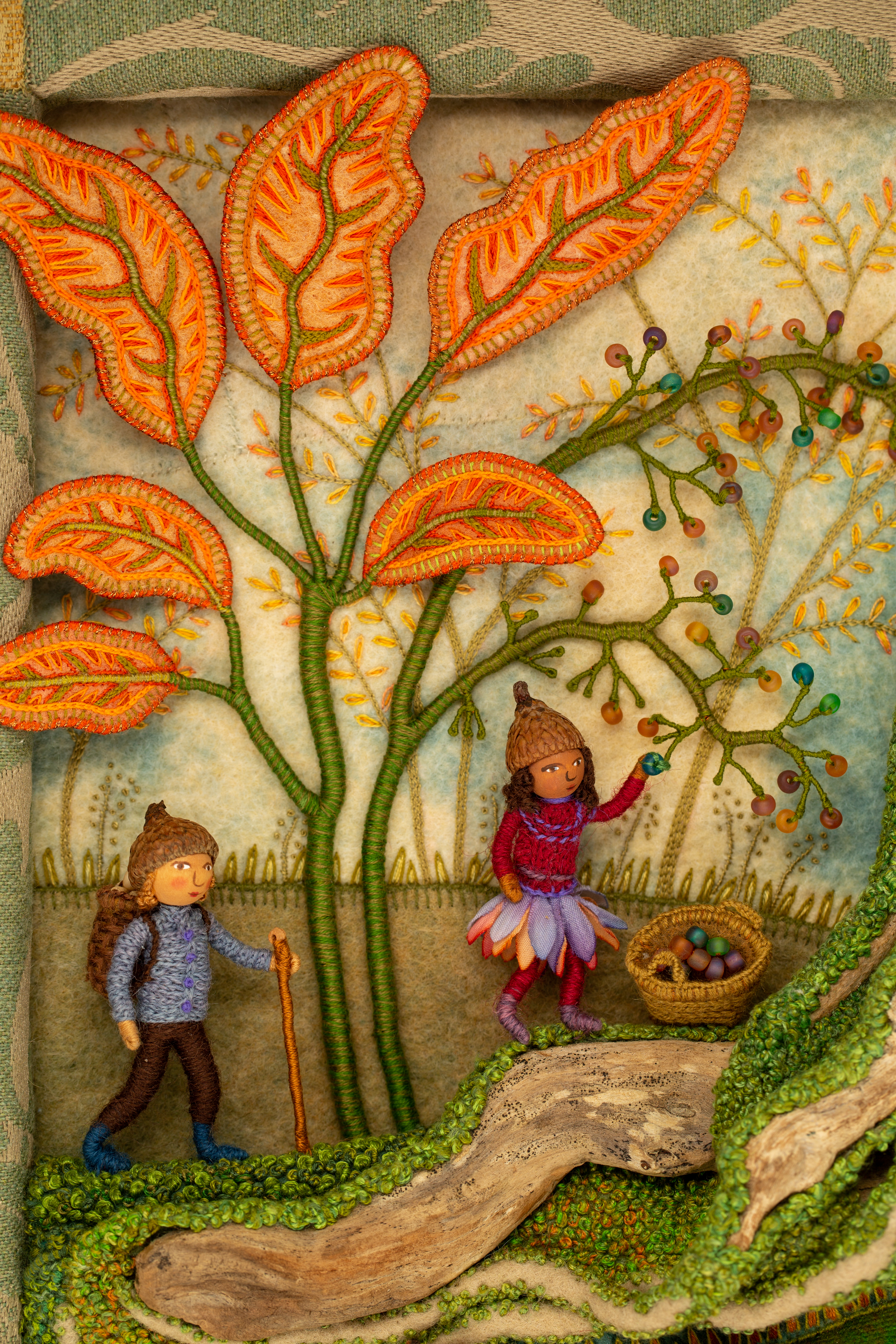
As promised, I’m winding down the string of posts about Harvest Time, the fall scene in my series of seasonal landscape. Part 9 features the embroidered trees in the background sky portion of the piece. For over a year now, I’ve shared photos, videos and commentary about different aspects of the project, from moss to underground tunnels to miniature storage containers (see list with links below). This year, I’ll be writing about Summertime, so stay tuned!
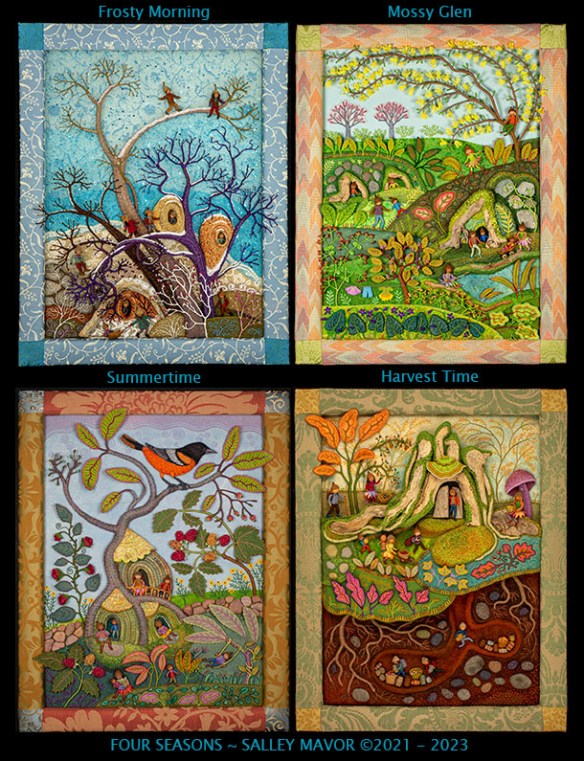
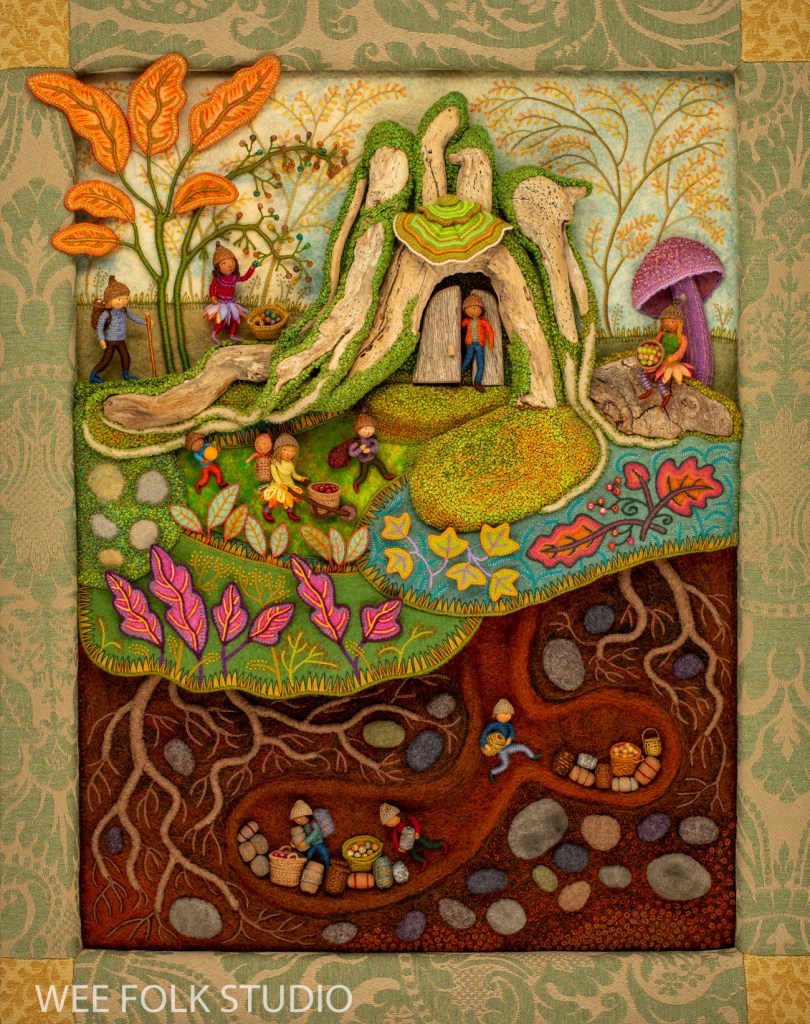
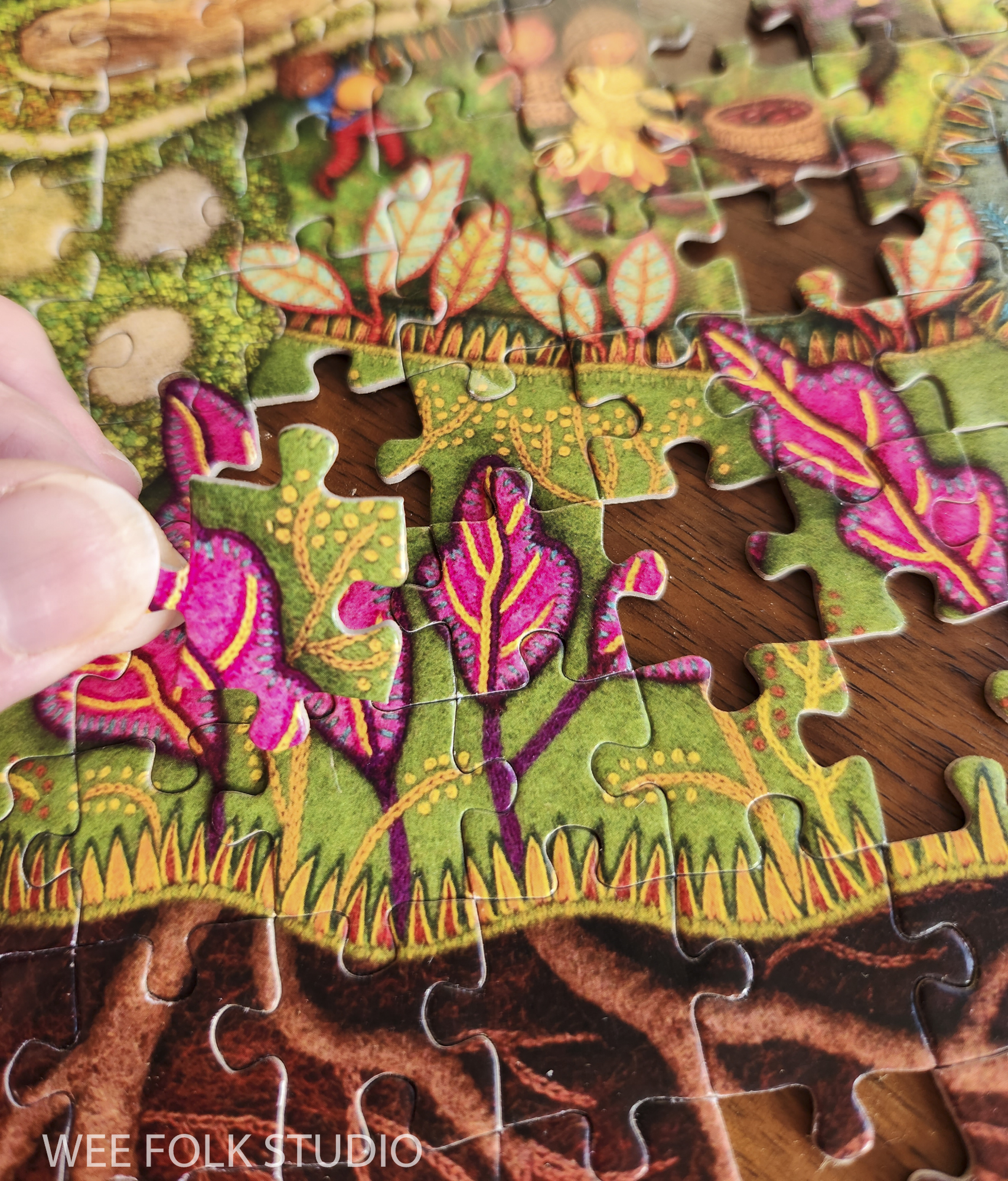
Harvest Time is the fall scene in a series of seasonal landscapes that capture the wonder and magic of the natural world. Note cards, prints, bookmarks, and jigsaw puzzles of Harvest Time and the other scenes in the series (Frosty Morning, Mossy Glen and Summertime) are available in my Etsy Shop.

Here’s a list of the other posts about Harvest Time:
The overview introduces the piece.
Part 1 features moss making.
Part 2 is about making the turkey tail mushroom.
Part 3 shows the construction of felt leaves.
Part 4 gives a peek at embroidering the plants.
Part 5 is about making the toadstool mushroom.
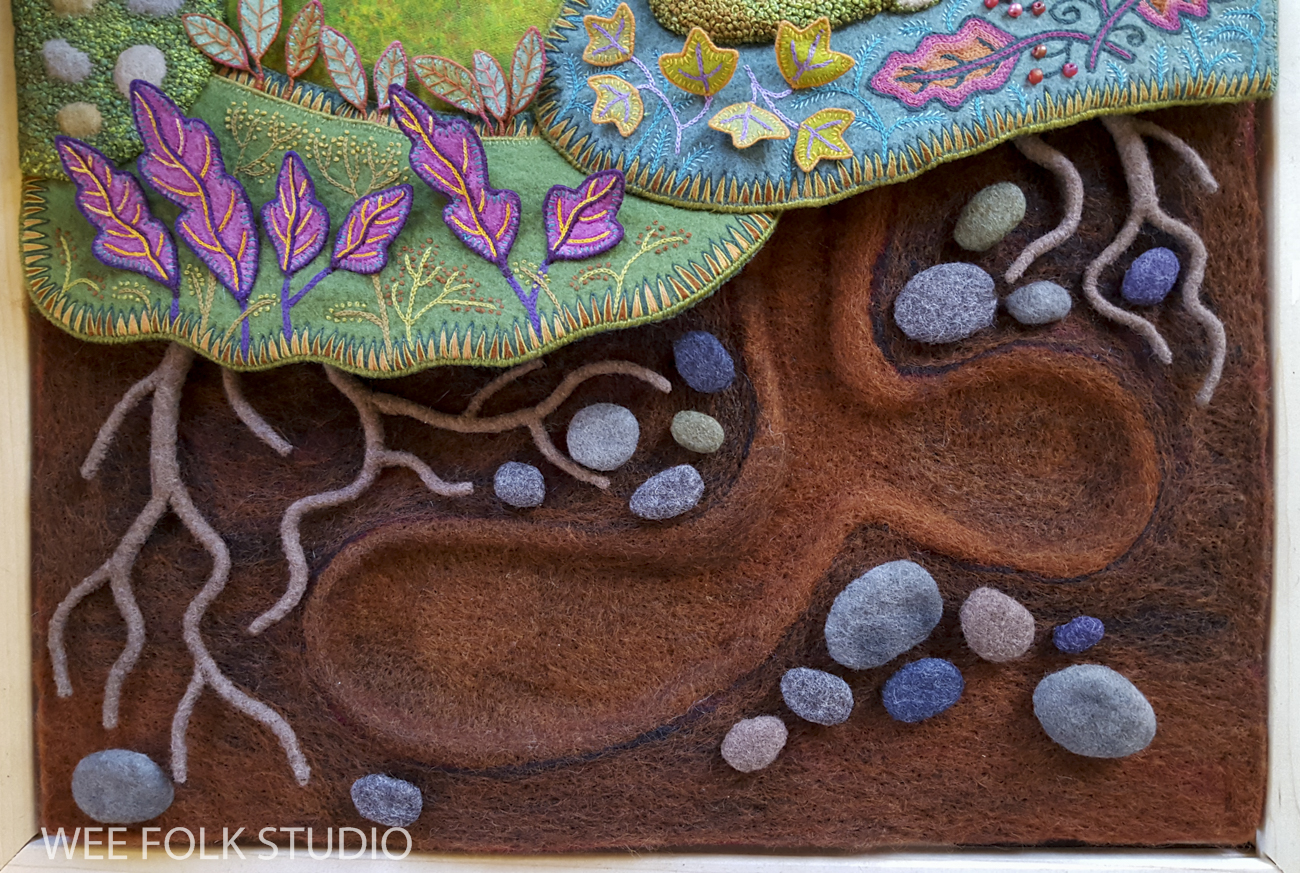
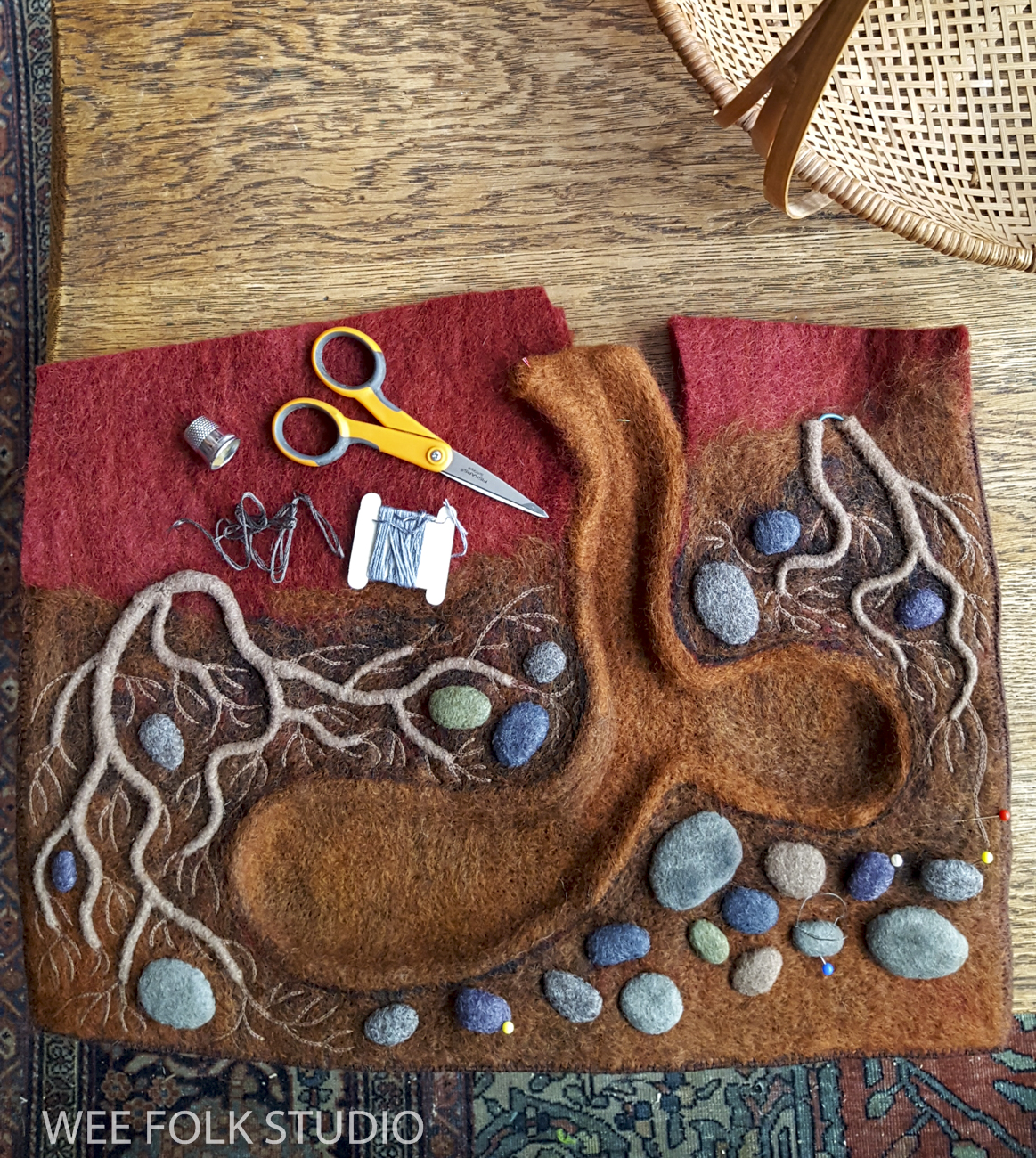
Part 6 covers the underground tunnels, roots and stones.
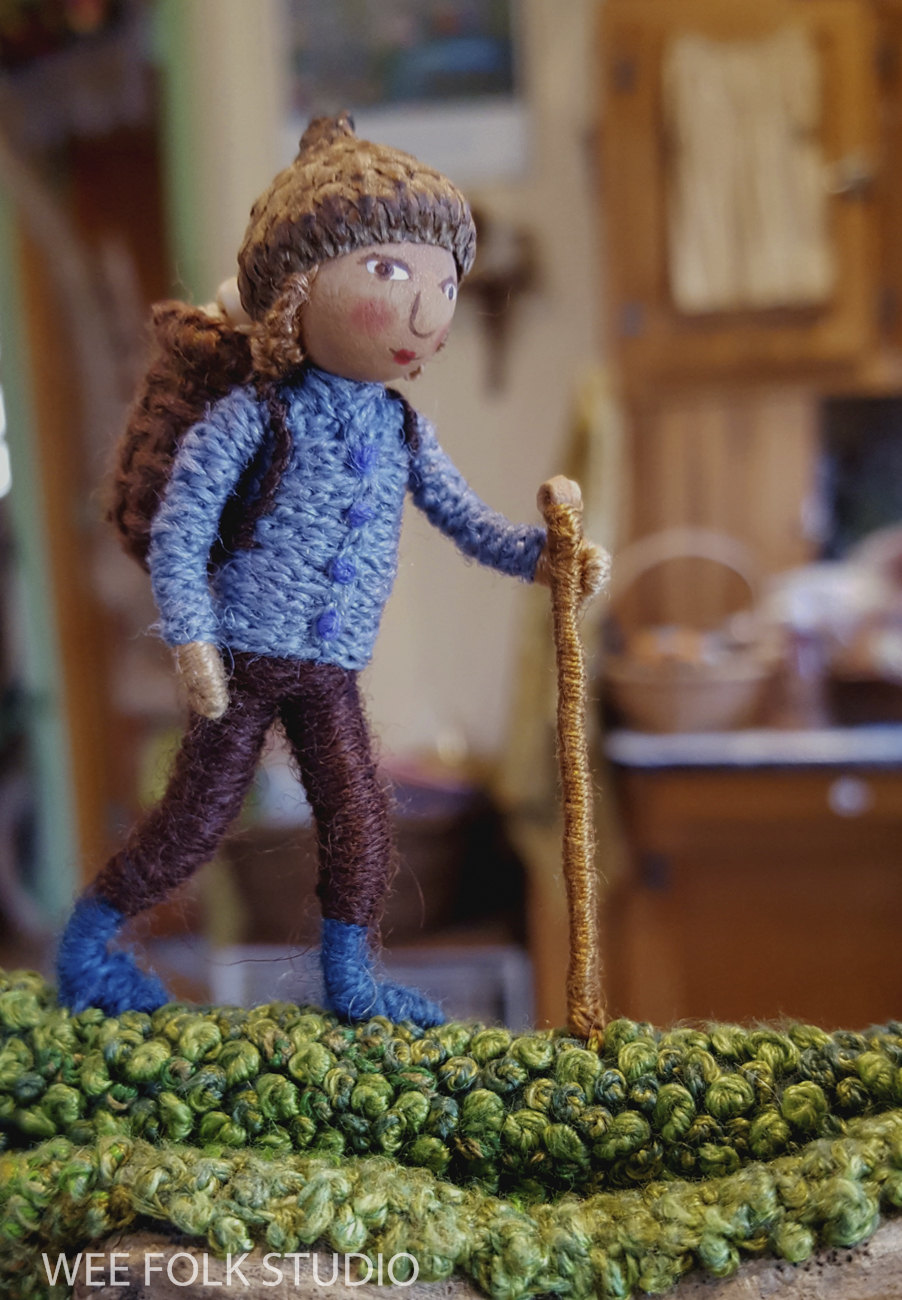
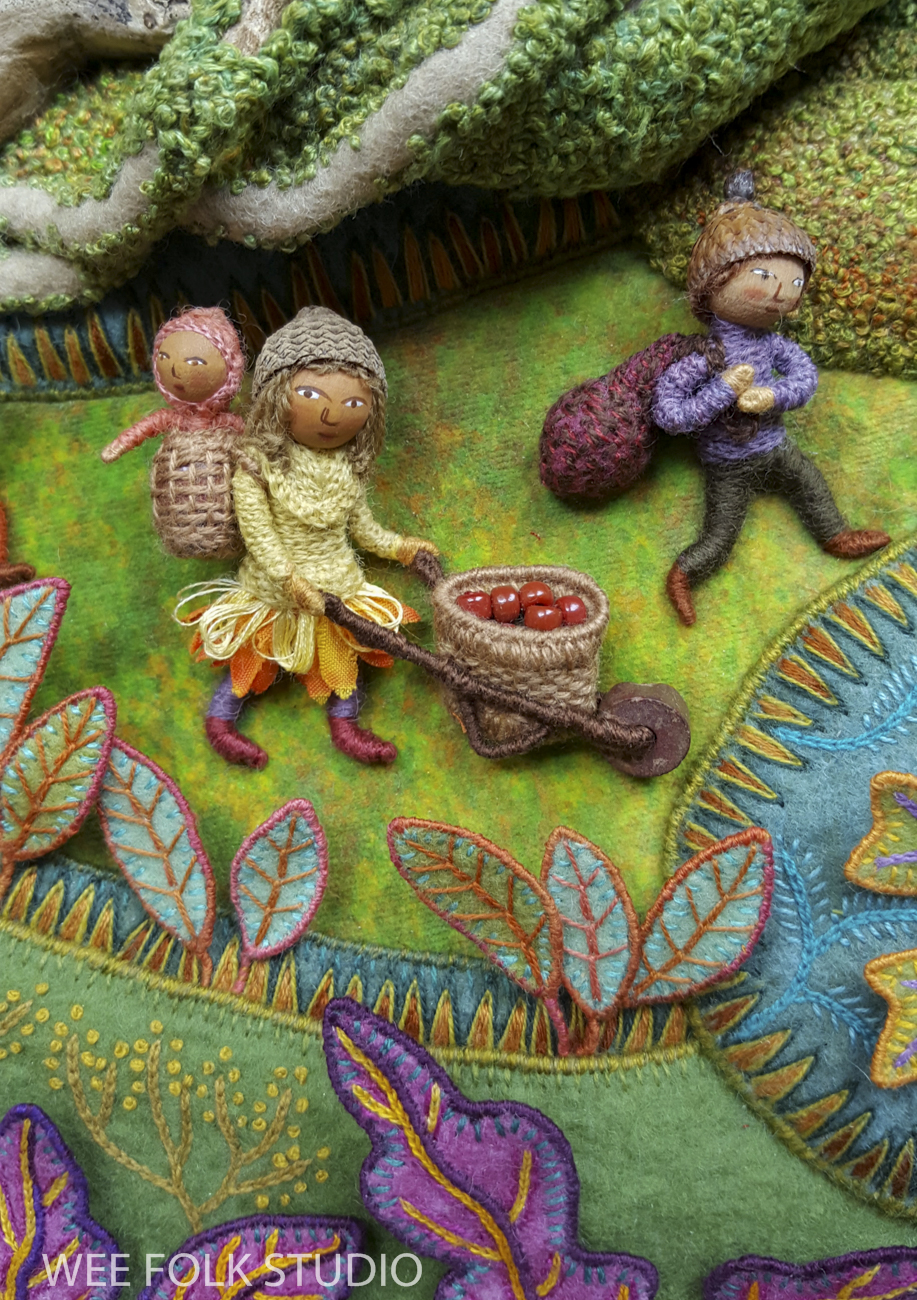
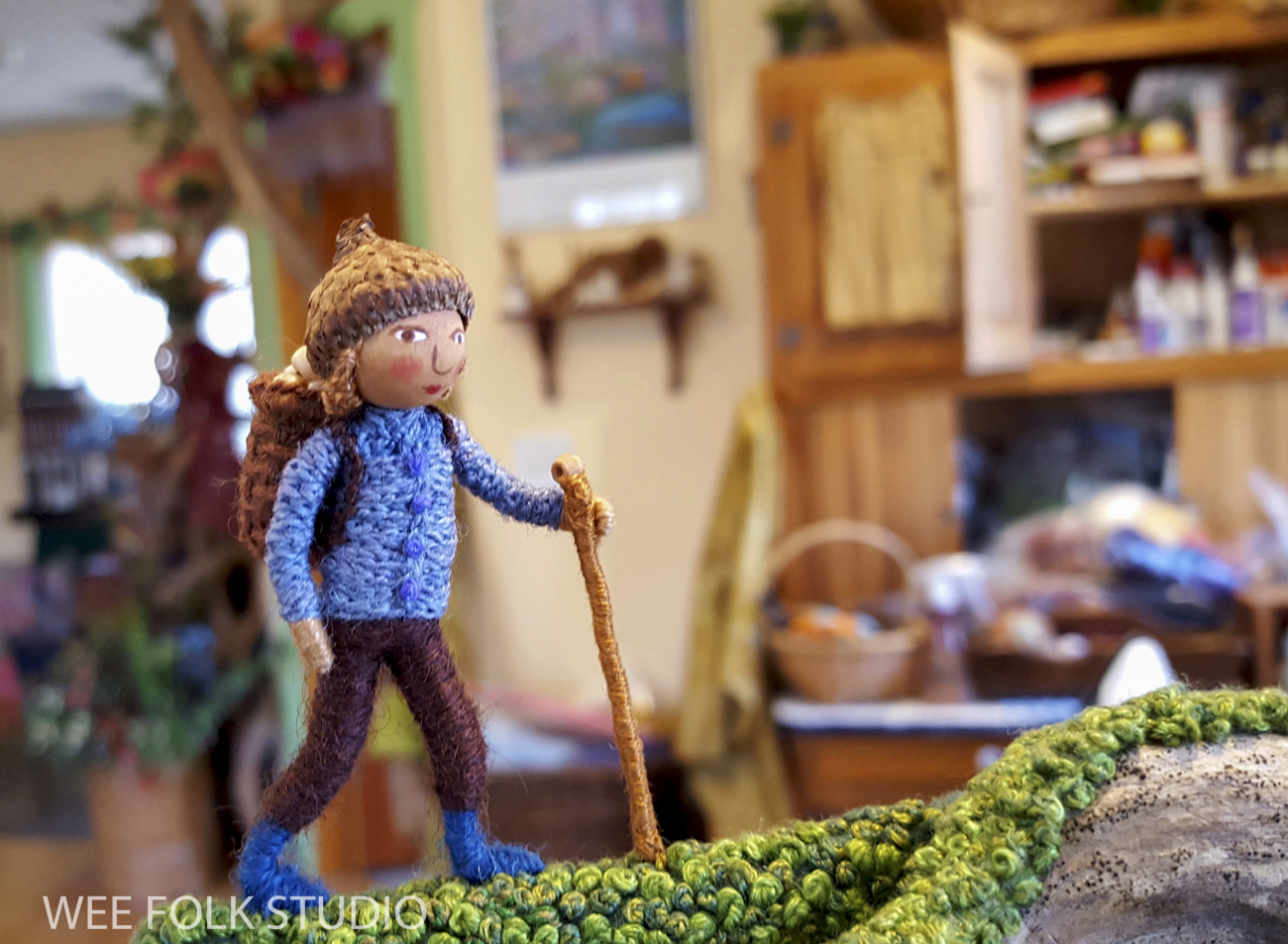
Part 7 shows how I made the wee folk harvesters.
Part 8 is about miniature storage containers

Embroidered Trees
I saved this part until the very end, when it was clear how much of the sky area would be visible. During the months-long process of making this piece, all of the separate parts and figures piled up, waiting in the wings until it was time to go on stage, like scenery and characters in a play.
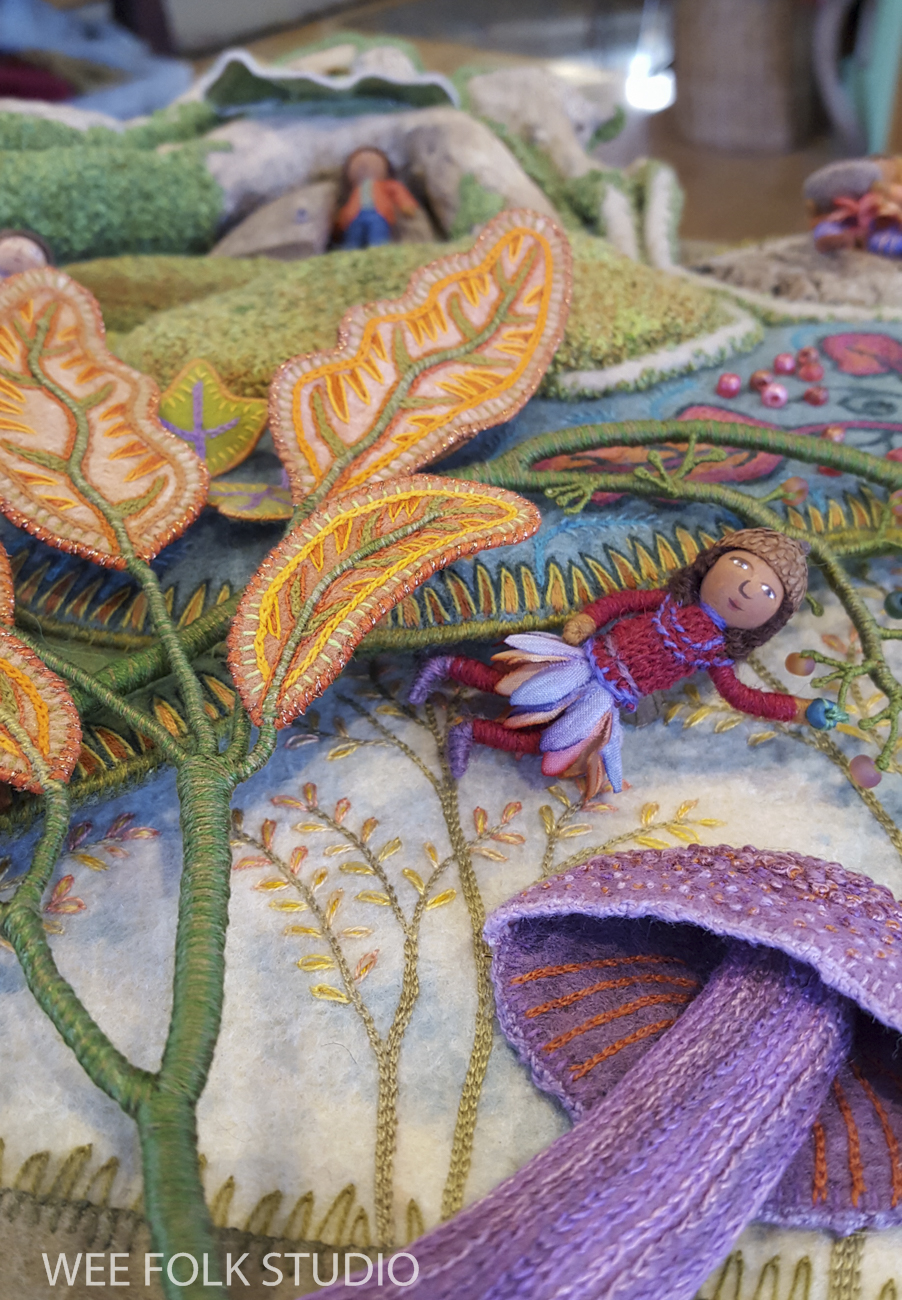
I used a mottled blue naturally dyed wool felt to make the sky portion. Years ago, I bought some unevenly dyed felt, which was sold as “seconds”. Unfortunately, I can’t get it anymore, so I make do with what I have. Since I didn’t have a large enough piece of this color combo, I sewed together smaller scraps from my stash. If you’re looking for naturally dyed wool felt in solid colors, check out A Child’s Dream.

This felt is so precious that I’ve kept every little scrap. I used some of the smallest pieces of blue and lavender to patch together a background for mounting the animals from my book, MY BED.
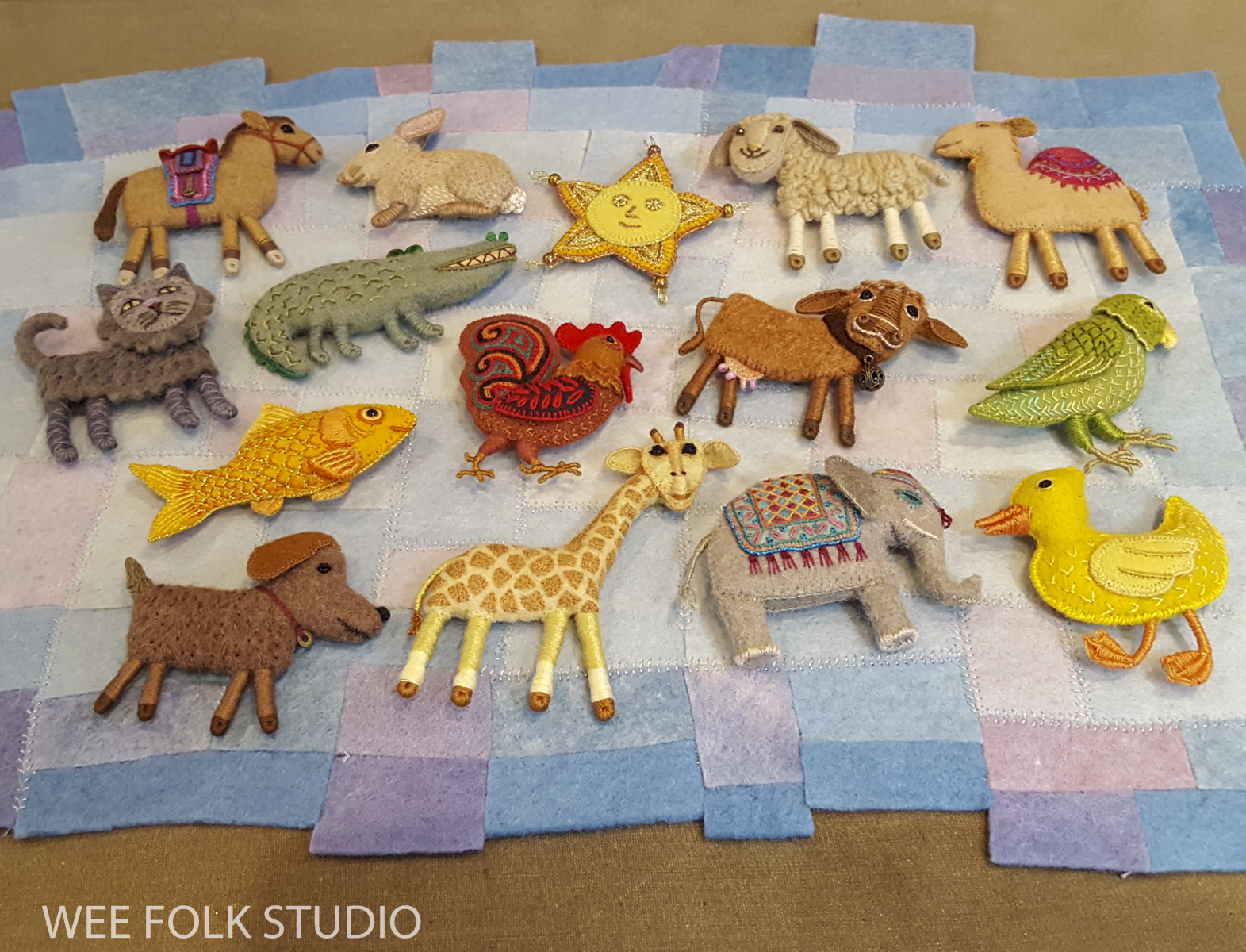
Animals from MY BED

It’s one of the 18 framed originals from My Bed included in my touring exhibition, Bedtime Stitches. For information about the book and where the show is going through 2025, please visit this page.

Bedtime Stitches at the Southern Vermont Arts Center in 2023

Now, back to Harvest Time. After sewing together the pieces of felt, I marked the edges of the open areas with large stitches.
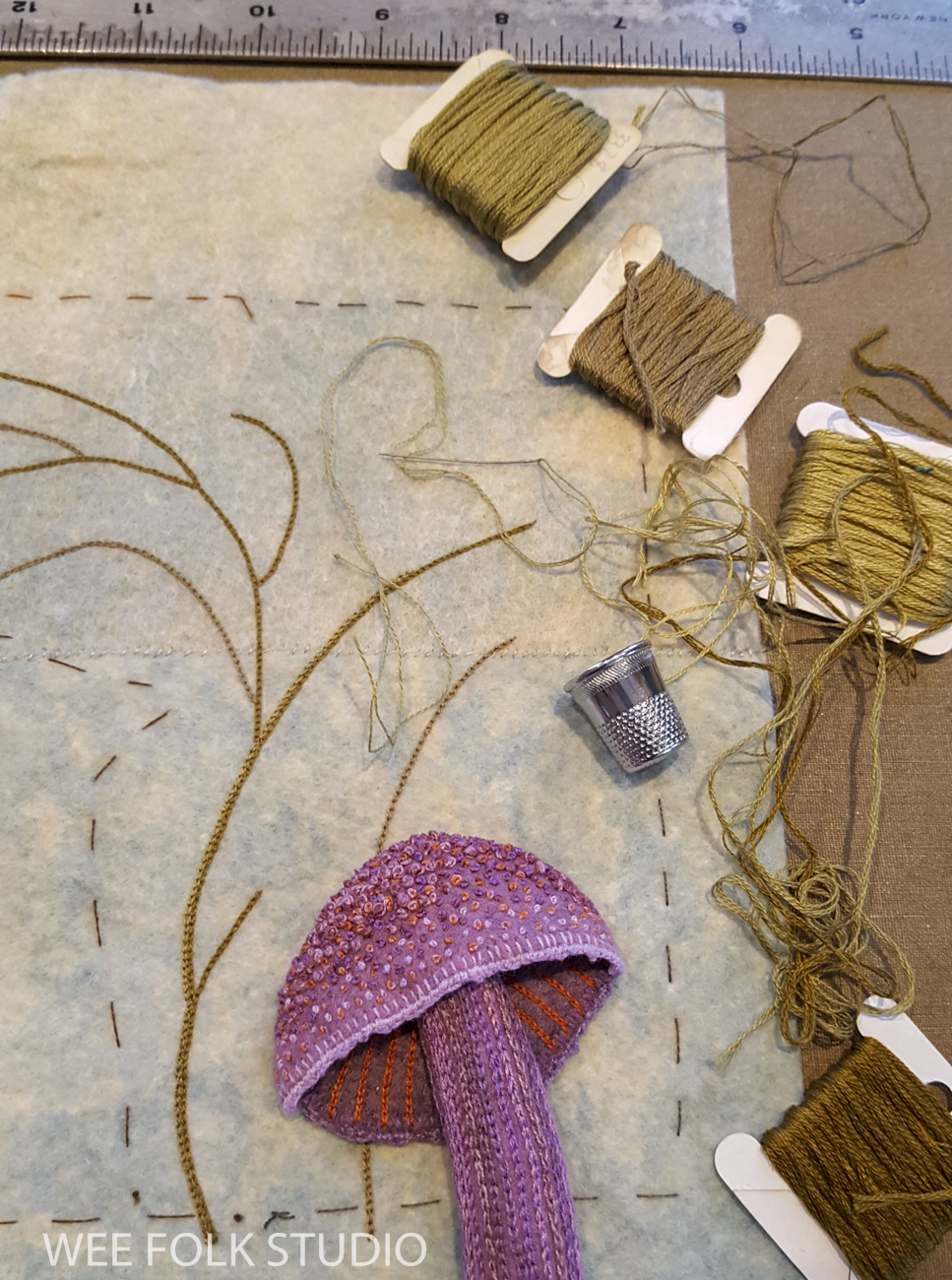
Drawing on felt isn’t very effective, but I managed to mark a few faint lines with a pink chalk pencil. While I chain-stitched the branches and handled the felt, most of the chalk brushed away.

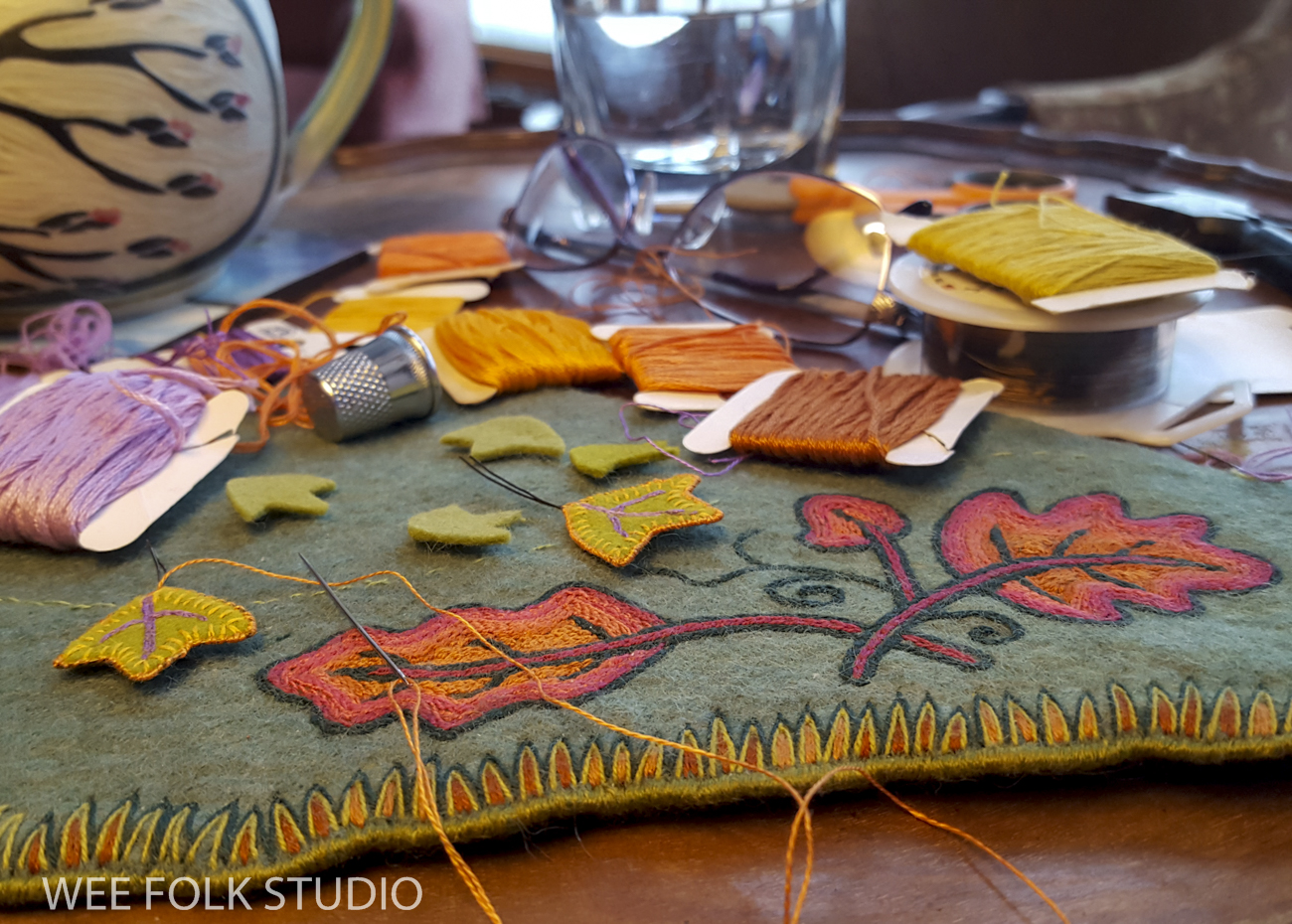
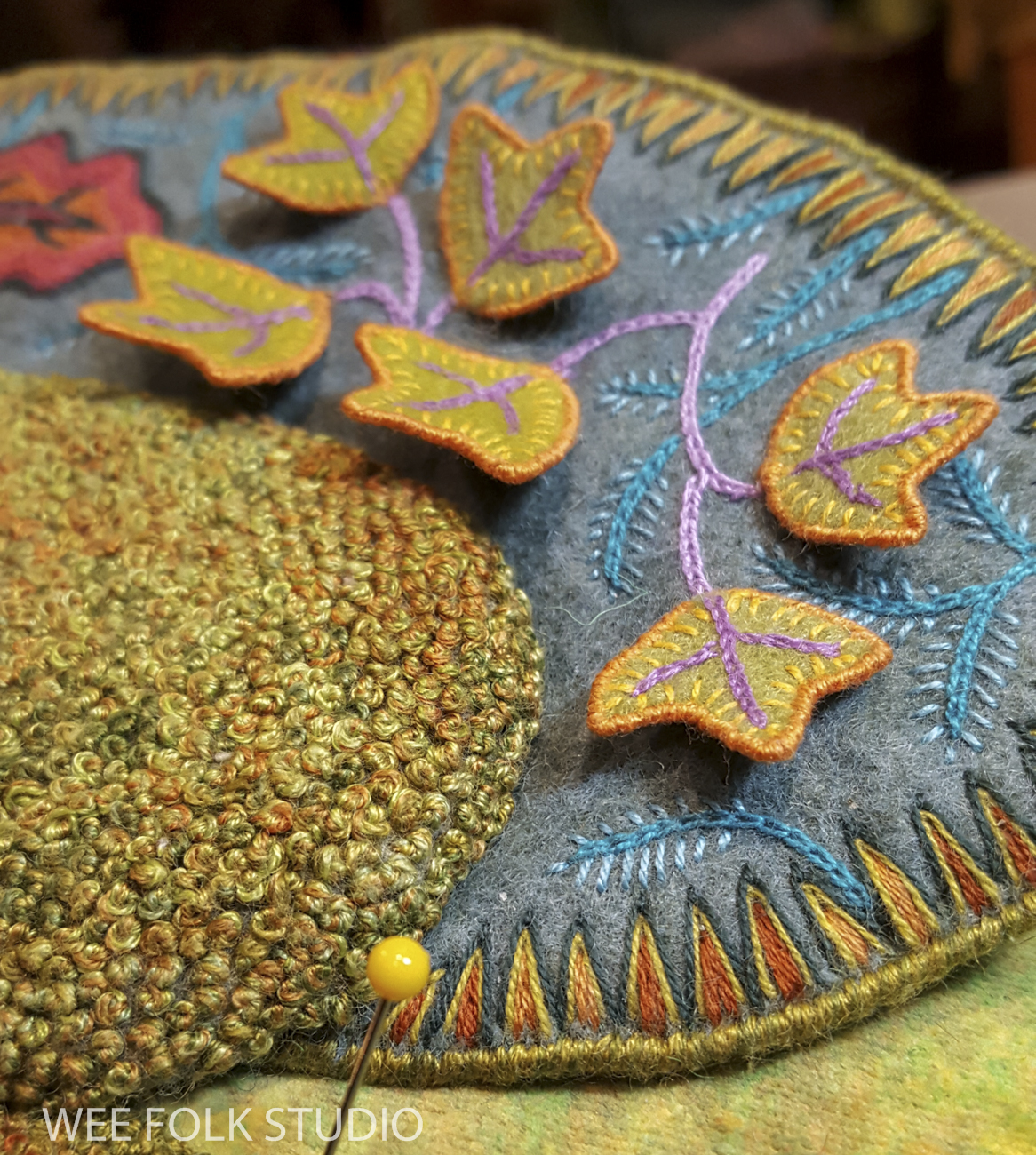
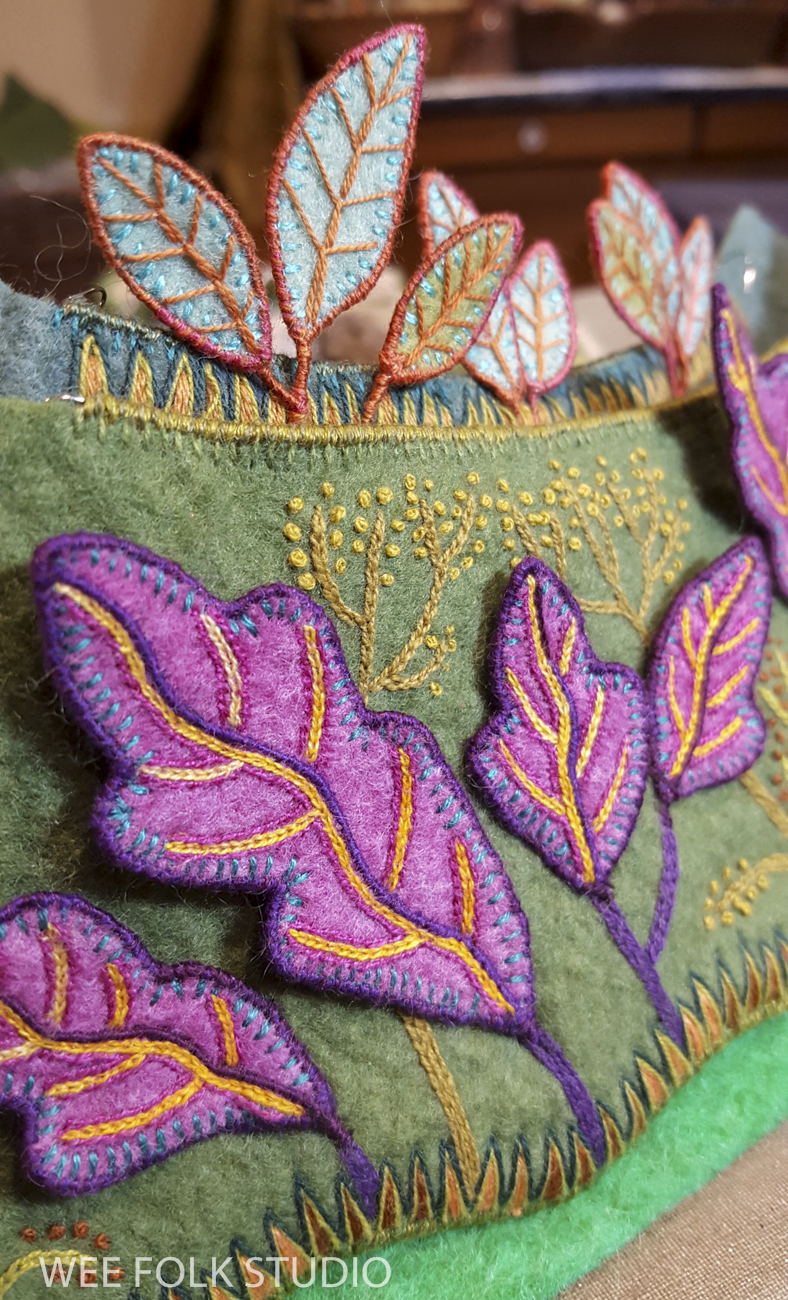
The next step was to add leaves along the branches with daisy chain stitches. For a naturalistic look, I used single strands of variegated embroidery floss.

I created a horizon line by sewing pieces of grayish brown felt along the bottom of the sky section. Every once in a while, I tested how it looked by temporarily positioning parts on top.
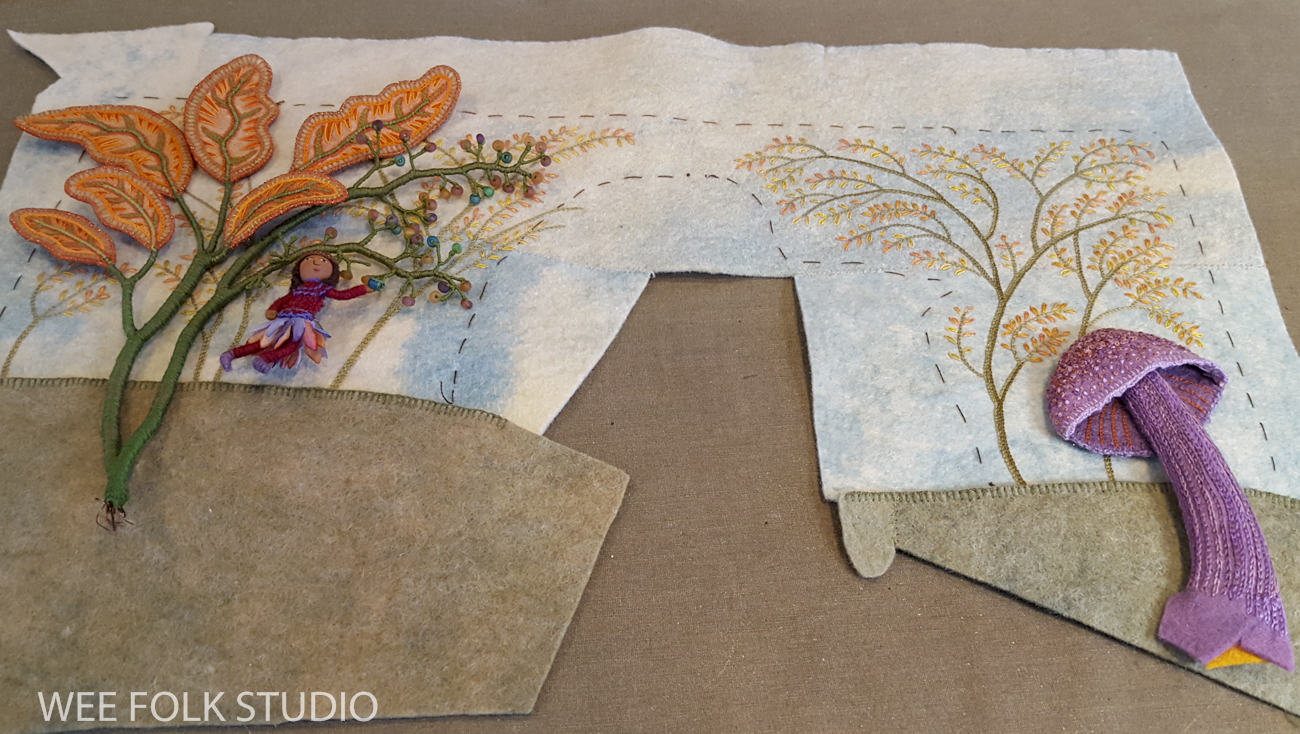
To make the leaves stand out visually, I filled them in with bright yellow floss. I then stitched blades of grass and other vegetation that was growing up along the ground.

Before assembling the scene, I covered the wooden stretcher bars with upholstery fabric. Then, I stapled the background fabric to the back of the stretcher and sewed all of the individual trees and figures in place on top. Everything is secured with a needle and thread. This video shows the whole piece put together.

I hope that you enjoyed this behind the scenes peek at my process. To start from the beginning, please go to Harvest Time’s introductory post here.

To keep up with new posts, please subscribe to this blog. Your contact info will not be sold or shared. If you’d like to see more frequent photos tracking the projects in my studio, please follow me on Facebook, Instagram and BlueSky.

Summertime makes the finish line!

I’m happy to report that after almost a year of work, Summertime, the newest scene in my seasonal landscape series, is finished! Now all four seasons will be included in my upcoming exhibition at the Southern Vermont Arts Center. The Wee Worlds of Salley Mavor will be on view Sept. 30, 2013 – Jan. 7, 2024.

Further ahead in this post, you will find information about the exhibition, a preview of future posts about making Summertime and new items in my Etsy Shop.

I don’t know why Summertime took so much longer to complete than the other seasons in the series. Mossy Glen, Frosty Morning and Harvest Time also have a gazillion stitches, but they each only took about 4 months to make. It could have something to do with the change in my daily routine since my grandson, Elias was born in January. Playing with the baby is now high on my list of essential activities, which includes sleeping, eating and stitching. Obviously, my priorities have shifted!

To reach the exhibition deadline, I spent the past few months stitching as much as possible, including in the evenings, like I used to do when my children were little. That’s why this is the first blog post I’ve written in months!

As with the other landscapes in the 4 Seasons series, I documented the process of making Summertime with photos and videos along the way, so there’s a lot of material to share in future blog posts, including a varied assortment of Stitch Minute videos.

If you’ve followed me on Instagram and Facebook during the past year, you’ve seen Stitch Minute videos that show different aspects of my process. While I enjoy sharing these visual moments, I kindly ask that you not request detailed explanations of my techniques. Much of what I do is guided by instinct, and I believe that analyzing my process too closely would diminish the magic. For those interested in understanding my philosophy on teaching and sharing knowledge, I invite you to read my post to teach or not to teach.

Here are two Stitch Minute videos that I made in August, while working on Summertime.


New 4 Seasons Items in my Esty Shop

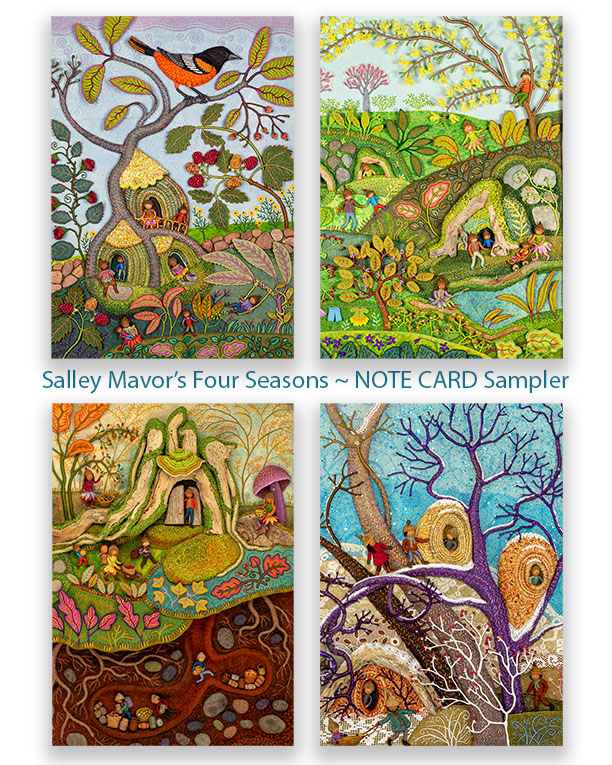
Now that the seasonal landscape series is finished, I’m excited to offer note cards, jigsaw puzzles and archival prints of all four seasons:
Summertime, Mossy Glen, Harvest Time and Frosty Morning.

4 Seasons Note Card Sampler is available in my Etsy Shop
Summertime Jigsaw Puzzle is available in my Etsy Shop
8.5 x 11 Archival Print of Summertime is available in my Etsy Shop

The Wee Worlds of Salley Mavor exhibition

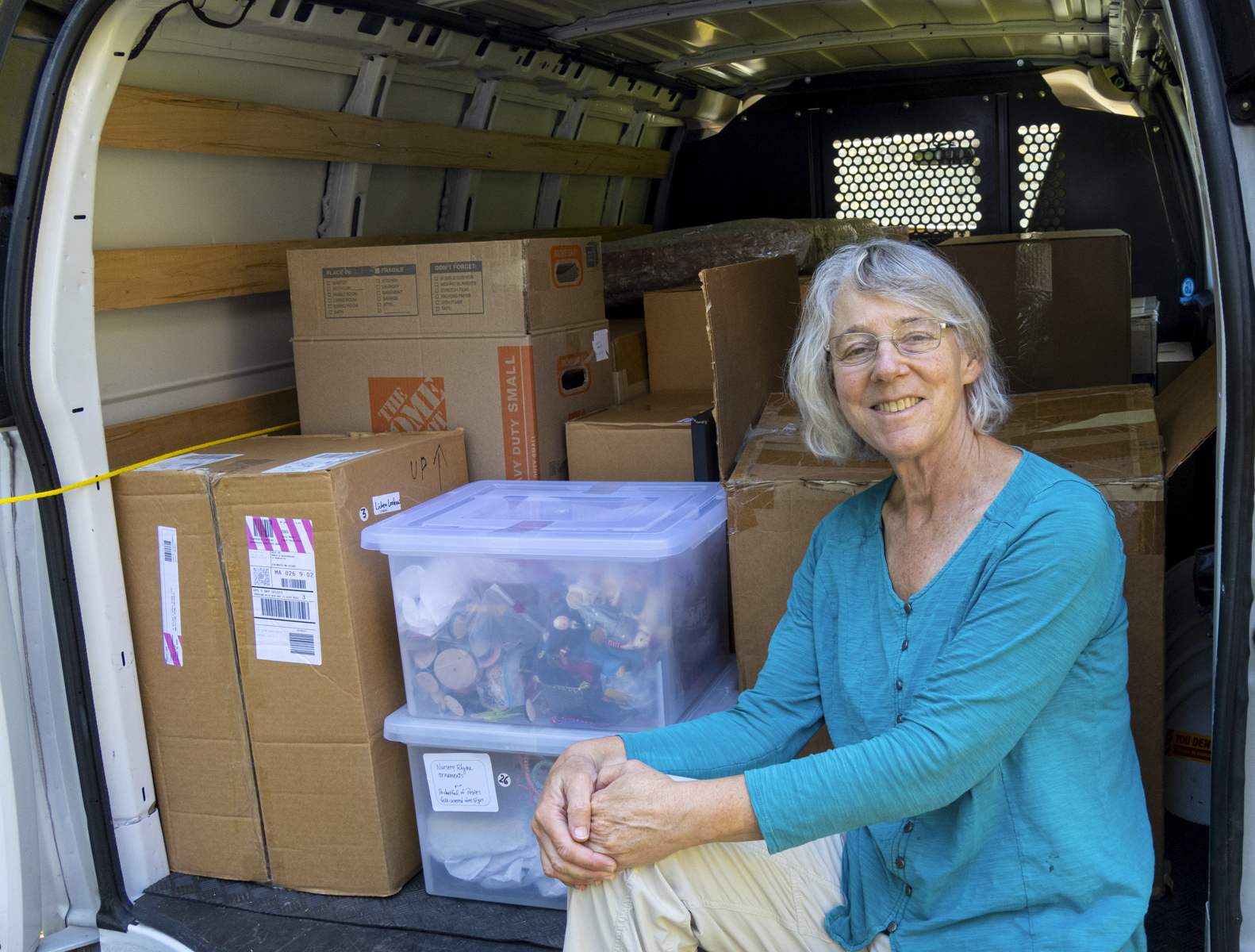
Yesterday, my artwork was picked up and driven in a van to Manchester, Vermont for my exhibition at the Southern Vermont Arts Center. It’ll be a large show, with over 75 pieces, including the 4 Seasons and the original illustrations for my most recent picture book, MY BED. On view will be a wide range of work, from early in my career to today, as well as a wall covered with over 100 wee folk dolls!

There will be a lot to enjoy at the Southern Vermont Arts Center this fall, especially for those of you with a playful bent. I’m so pleased that my work will be just around the corner from a fascinating and whimsical display of the late illustrator Ashley Bryan’s collection of toys, objects, puppets and paintings. Ashley Bryan: The Spirit of Joy and The Wee Worlds of Salley Mavor will be on view Sept. 30, 2013 – Jan. 7, 2024. I hope to see some you at the opening reception on Sept. 30th, where l will give a gallery talk at 3:00 PM.

This image has an empty alt attribute; its file name is svac-flyer2.jpg

To keep up with new posts, please subscribe to this blog. Your contact info will not be sold or shared. If you’d like to see more frequent photos tracking the projects in my studio, please follow me on Facebook, Instagram and BlueSky.
Harvest Time – Part 7 (wee folk)

In Part 7 in the continuing series about making Harvest Time, I share photos and commentary about the wee folk characters who populate the landscape. In the coming weeks, I will post more stories that focus on different aspects of making the fall scene, including the miniature storage containers and the embroidered trees. So far, I’ve written the following posts:
The overview introduces the Harvest Time piece.
Part 1 features moss making.
Part 2 is about making the turkey tail mushroom.
Part 3 shows the construction of felt leaves.
Part 4 gives a peek at embroidering the plants.
Part 5 is about making the toadstool mushroom.
Part 6 covers the underground tunnels, roots and stones.

Harvest Time is the fall scene in a series of seasonal landscapes that capture the wonder and magic of the natural world, both real and imagined. Note cards and jigsaw puzzles of the this and other scenes in the series (Frosty Morning and Mossy Glen) are available in my Etsy Shop.

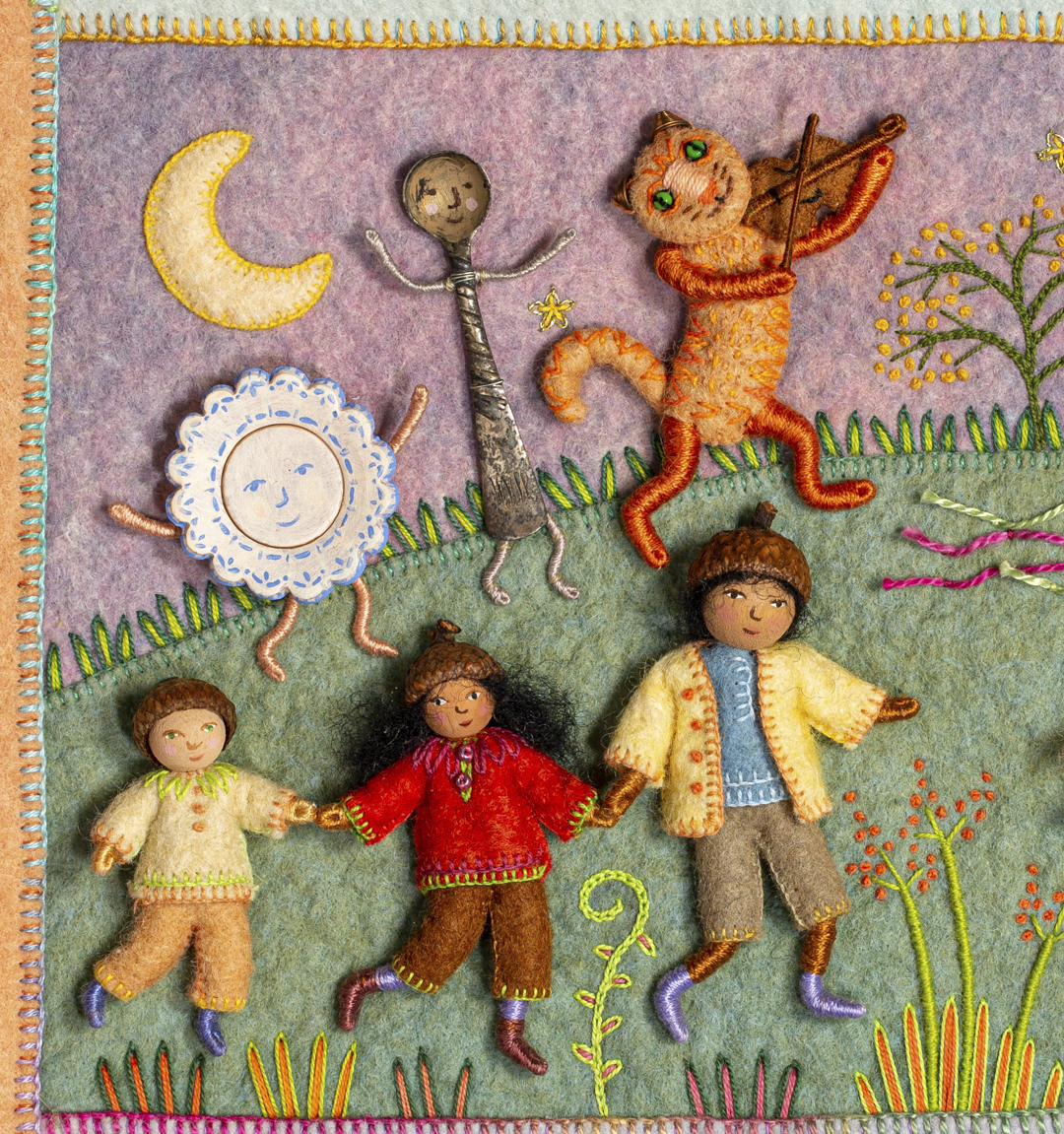
Everything I make includes some sort of living being with eyes, be they animal or human. I can’t imagine spending months working on a piece that is purely decorative, abstract or simply a landscape, without a storytelling element. The interplay between characters and their surroundings is what drives me to create. As I paint their faces, form their little bodies and stitch their clothes, I grow to care about them. This emotional connection is what motivates me to spend copious amounts of time creating an imaginary world that is worthy of their existence.

For this scene, I painted more faces than I needed, in different sizes and shades. That way, I could select a cast of characters later. I’m never sure how many figures I’ll need or exactly where they’ll end up. They are like actors in an improvisational skit or a group posed in a tableau.

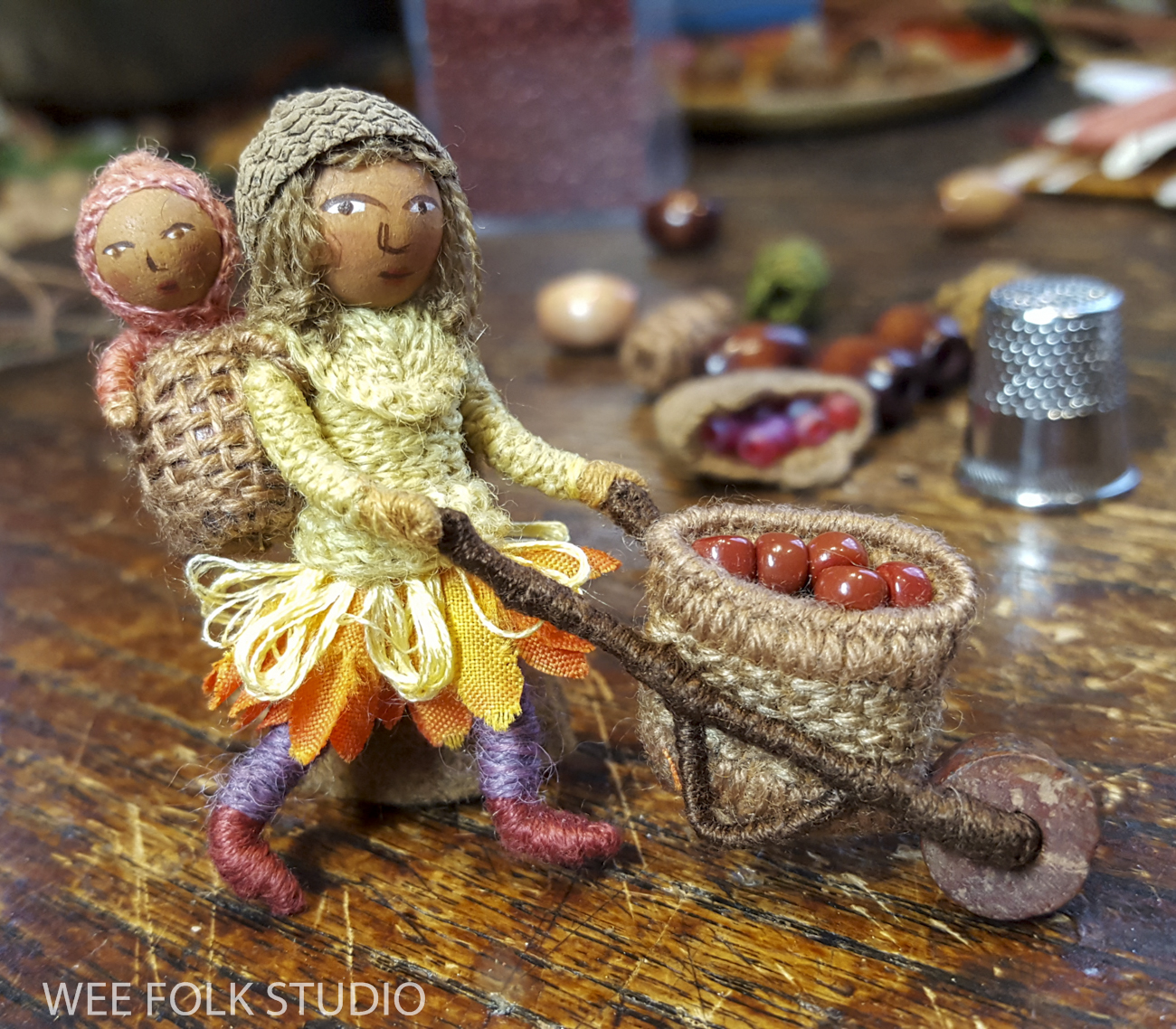
The little people range in size between 1″ to 2″ tall. They were made the same way as the wee folk dolls in my how-to book, Felt Wee Folk, with slight variations. For instance, I used wire instead of pipe cleaners for their tiny armatures.

In keeping with the harvesting theme, all of the people are bringing produce to the mossy stump, where it will be stored in the cellar.

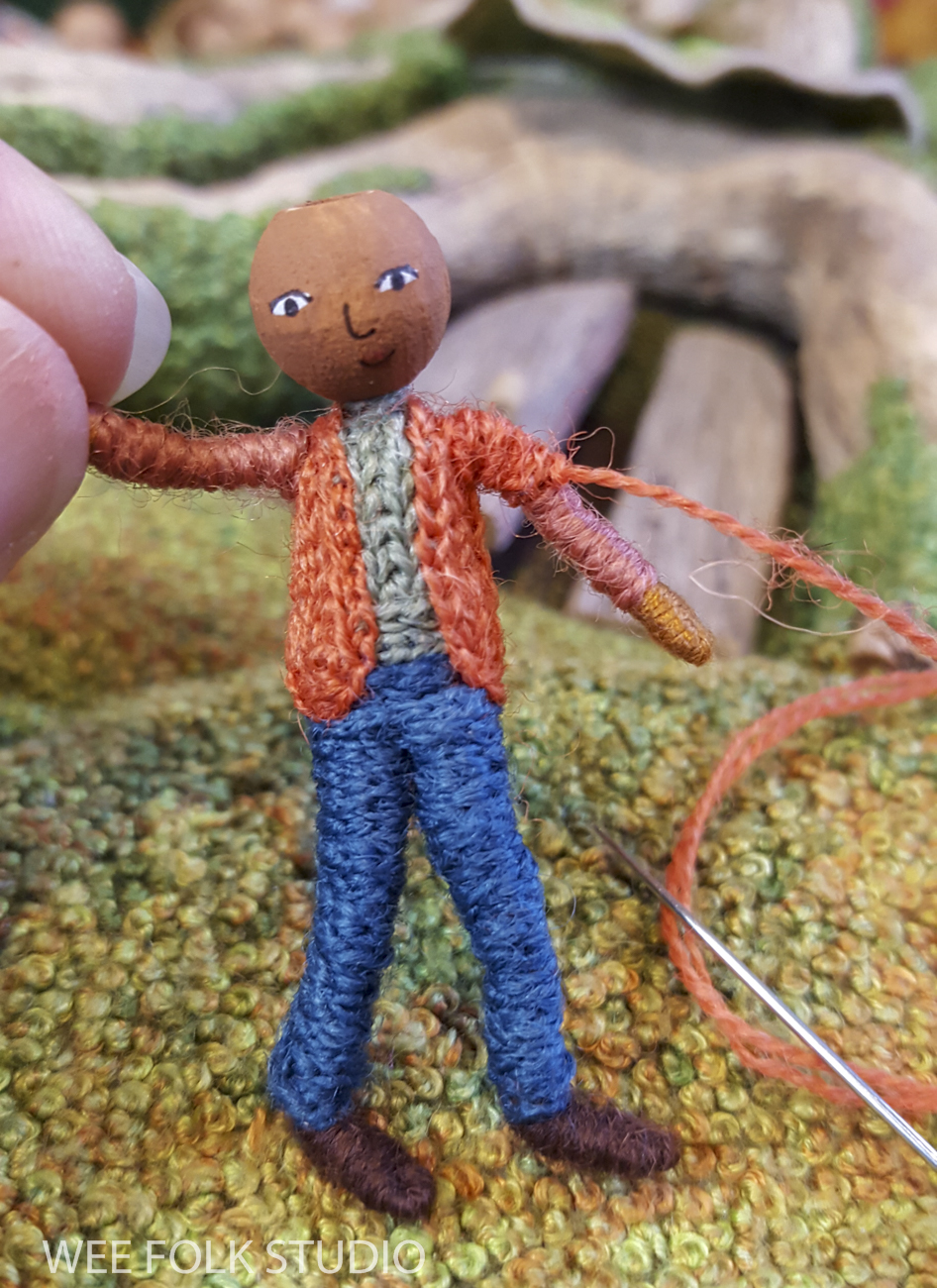
I’m often asked, “How do you knit their tiny outfits?” There might be someone out there who can knit or crochet a tiny sweater for a 2″ doll, but I challenge them to stuff their arms through the sleeves! Remember, this is make believe. The wee folk never have to bathe or change their clothes. Why knit, when you can embroider a piece of clothing directly onto a body? Rows of chain stitching are pretty convincing, don’t you think? I call it faux knitting.

Please stay tuned for more stories about making Harvest Time, including the storage containers and embroidered trees.
The overview introduces the Harvest Time piece.
Part 1 features moss making.
Part 2 is about making the turkey tail mushroom.
Part 3 shows the construction of felt leaves.
Part 4 gives a peek at embroidering the plants.
Part 5 is about making the toadstool mushroom
Part 6 covers the underground tunnels, roots and stones.

To keep up with new posts, please subscribe to this blog. Your contact info will not be sold or shared. If you’d like to see more frequent photos tracking the projects in my studio, please follow me on Facebook, Instagram and BlueSky.

Harvest Time – part 5 (toadstool mushroom)

In Part 5 in the continuing series about making Harvest Time, I share photos and commentary about making the purple toadstool mushroom and the wee folk forager sitting under it. In the coming weeks, I will continue to post stories that focus on different aspects of making the fall scene, including the other wee folk figures, storage containers, tunnels, roots, and stones. So far, I’ve written the following posts:
The overview introduces the Harvest Time piece.
Part 1 features moss making.
Part 2 is about making the turkey tail mushroom.
Part 3 shows the construction of felt leaves.
Part 4 gives a peek at embroidering the plants.
Part 6 shows the process of making the underground

Harvest Time is the fall scene in a series of seasonal landscapes that capture the wonder and magic of the natural world, both real and imagined. Note cards and jigsaw puzzles of the this and other scenes in the series (Frosty Morning and Mossy Glen) are available in my Etsy Shop.

Harvest Time Jigsaw Puzzle

I don’t know why I didn’t include mushrooms in the original sketch. It seems so obvious now, especially for a fall landscape. The idea of putting one in the scene came later, when I shifted over the stump and created a place to fill on the right horizon.

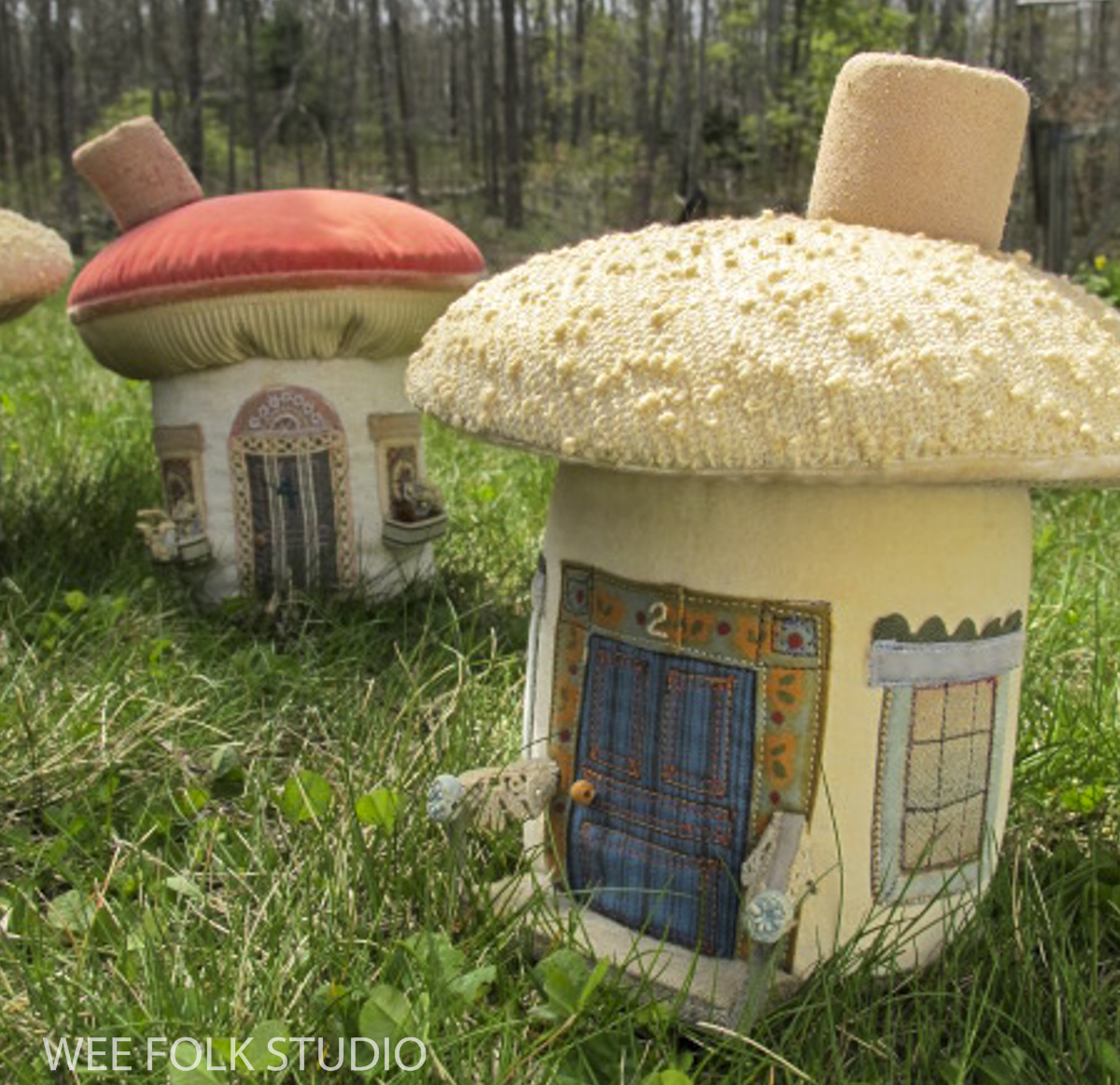
Toadstool mushrooms have popped out in my artwork for over 40 years. These are some mushroom houses I made in 1979, back when I used a sewing machine.

When I went into business selling fairy kits in 1998, I designed a logo with a red-capped mushroom house. My 10 year stint making kits is long gone, but I still use the same logo.

In this scene from 2009, I used both real mushrooms from the supermarket and more fanciful ones that I made with polymer clay and painted kid leather.

This mushroom with a fairy taking shelter underneath is in my 2010 picture book, Pocketful of Posies, illustrating the rhyme, “Rain on the green grass, and rain on the tree; Rain on the housetop, but not on me.”

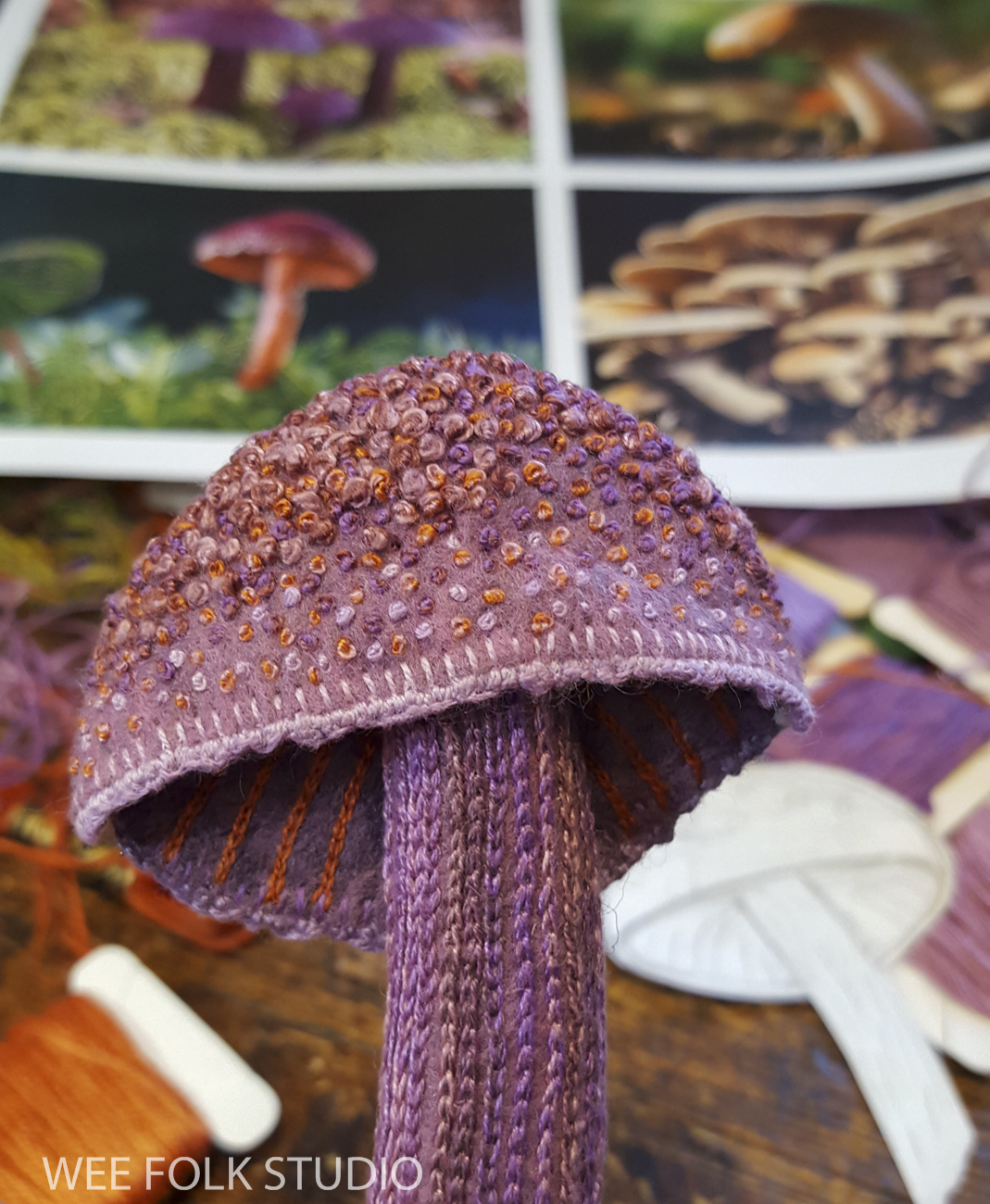
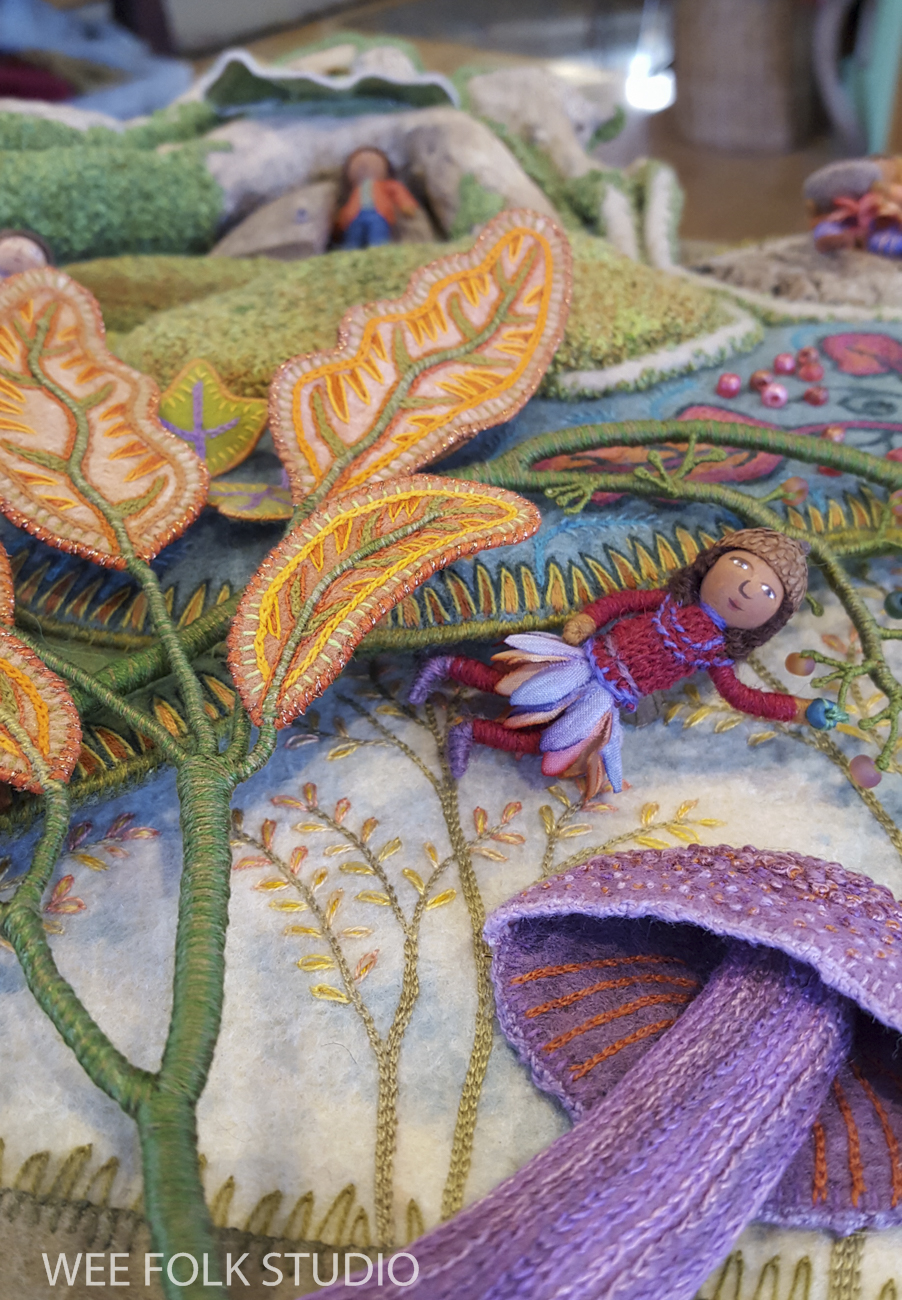
For Harvest Time, I chose a different type of mushroom. The idea of a purple toadstool struck my fancy, so I researched the Inky Cap variety. Besides being attracted to the purple/orange color combo, I looked forward to replicating the texture on the cap.

To begin, I drew the mushroom to size and used a paper cutout as a guide. It took some fudging to figure out the size and shape to cut the felt, because the front piece of the cap would be curved and sticking out about 1/2″,

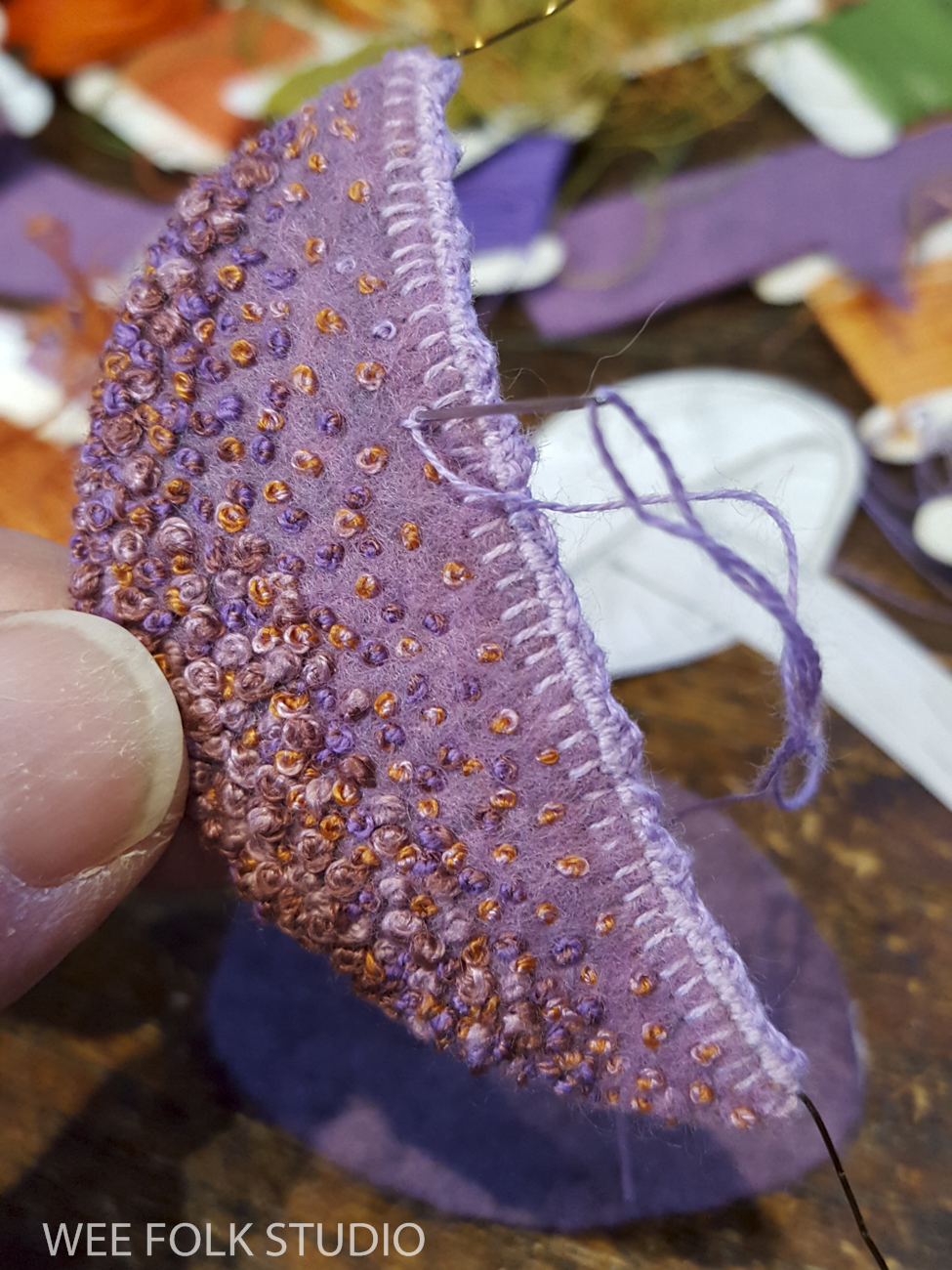
I sewed wire along the rim of the cap to help hold its curve. After covering the wire with stitches, I created an uneven edge with messy loops, so it would look more realistic. To make the bumpy texture on top, I stitched French knots with different shades of purple and orange embroidery floss.

To make the stem, I cut out a thin strip of felt and covered it with lines of chain stitching.

I forgot exactly how I did this part, but it looks like I added a felt stem back piece that was reinforced with iron-on interfacing material. I must have thought it needed stiffening, since felt by itself is usually too floppy. Also, I probably stuffed the hollow cavity with wool fleece to keep it from collapsing.

I chain stitched scales with a contrasting shade of orange thread to the inside of the cap and sewed on the stem.

The mushroom and surrounding area looked lonely and plain, so I made a wee person to sit underneath.

To make a figure, I formed an armature with 24 gauge jewelry wire and wrapped it with thread. This is the same basic technique that I teach in my how-to book, Felt Wee Folk, but on a smaller scale. I didn’t make separate clothing, but faux knitted a shirt and vest directly onto the body with chain stitching. The skirt is an artificial flower.

This Stitch Minute video shows faux knitting for a character in the spring landscape, Mossy Glen.

I painted a face on a wooden bead and glued braids and an acorn cap on top. Another acorn cap served as a container for glass bead “food”, which I sewed together in a bunch. The beads were sewn in place through drill holes in the acorn cap.

At this stage of the process, miscellaneous parts piled up, waiting to be assembled at the end, when everything is sewn to the background fabric. Please stay tuned for more stories about making Harvest Time, including the other wee folk figures, storage containers, tunnels, roots, and stones.

To keep up with new posts, please subscribe to this blog. Your contact info will not be sold or shared. If you’d like to see more frequent photos tracking the projects in my studio, please follow me on Facebook, Instagram and BlueSky.

Harvest Time – part 4 (embroidered plants)

In Part 4 in the series about making Harvest Time, I share photos and commentary about embroidering plants to fill in around the 3-D felt leaves shown in Part 3. When planning out this piece, I wanted to come up with a way to separate the above ground front yard from the underground cutaway portion. I ended up embellishing gardens on pieces of felt that overlap the soil, roots, and stones below.

Harvest Time is the fall scene in a series of seasonal landscapes that capture the wonder and magic of the natural world, both real and imagined. Note cards and jigsaw puzzles of the this and other scenes in the series (Frosty Morning, Summertime and Mossy Glen) are available in my Etsy Shop.

Harvest Time Jigsaw Puzzle

I use a combination of flat embroidery and 3-D forms in my artwork because I think it’s more dynamic and eye catching that way. I also like the process of doing both, so I mix it up to keep myself interested.

This part of the process was more free form and reminded me of the simple embroidered foliage I made in the illustrations for Hey, Diddle, Diddle.

Hey, Diddle, Diddle! board book, 2005

To stabilize the floppy pieces of felt, I stitched and wrapped wire along the outside edges and then embroidered blades of grass.

Then I doodled stems with chain stitches and added French knot seeds.

This kind of work is portable, so I carried around all of the parts and supplies wherever I went…

…and did most of the stitching in front of the wood stove.

The orange and red leaves are chain stitched with DMC flower thread, which unfortunately has been discontinued. It’s thicker and not as shiny as regular embroidery floss and has a sturdy feel that I find satisfying. I treasure my supply of flower thread and have enough to last my lifetime.

Glass beads make great berries.

I glued a piece of driftwood to the top of one section to make a perch for a wee folk forager to sit on. Doesn’t the whole thing look like a shoe!

I also created a mossy patch of front lawn to go just below the doorway with hundreds, if not thousands of French knots.

I padded the back of the embellished pieces with layers of thick felt so that they would stick out and float above the cutaway underground portion, which I’ll get to later in the series.

In future posts, I will focus on different aspects of making Harvest Time, including the toad stool mushroom, wee folk figures, storage containers, needle felted tunnels and cold cellars, roots, and stones.

The overview introduces the series.
Part 1 features moss making.
Part 2 is about making the turkey tail mushroom.
Part 3 shows the construction of felt leaves.
Part 4 gives a peek at embroidering the plants.
Part 5 is about making the toadstool mushroom
Part 6 shows the process of making the underground

To keep up with new posts, please subscribe to this blog. Your contact info will not be sold or shared. If you’d like to see more frequent photos tracking the projects in my studio, please follow me on Facebook, Instagram and BlueSky.

Baby Banner for Elias

For the past 15 years or so, I’ve made personalized gifts for friends and family that commemorate special events like weddings and births. These embellished felt banners combine two of my favorite things, hand embroidery and handwriting. You can see this and other banners by scrolling through the archives here.

Now, I finally had the opportunity to make a banner celebrating a birth in my immediate family! Last month, our son Ian and his wife Liz became the parents of our first grandchild! Little Elias was born on Jan. 18th, 2023, 100 years to the day after my father.

We are all completely in love with with this little guy! I just love watching my son interacting with his son. As an extra bonus, the new family lives practically across the street, so we get to see Elias all the time. I can already feel my focus shifting into Grandma mode, which is a welcome change. Hopefully, there will be room in my heart and daily schedule for both art and being a Grandma.

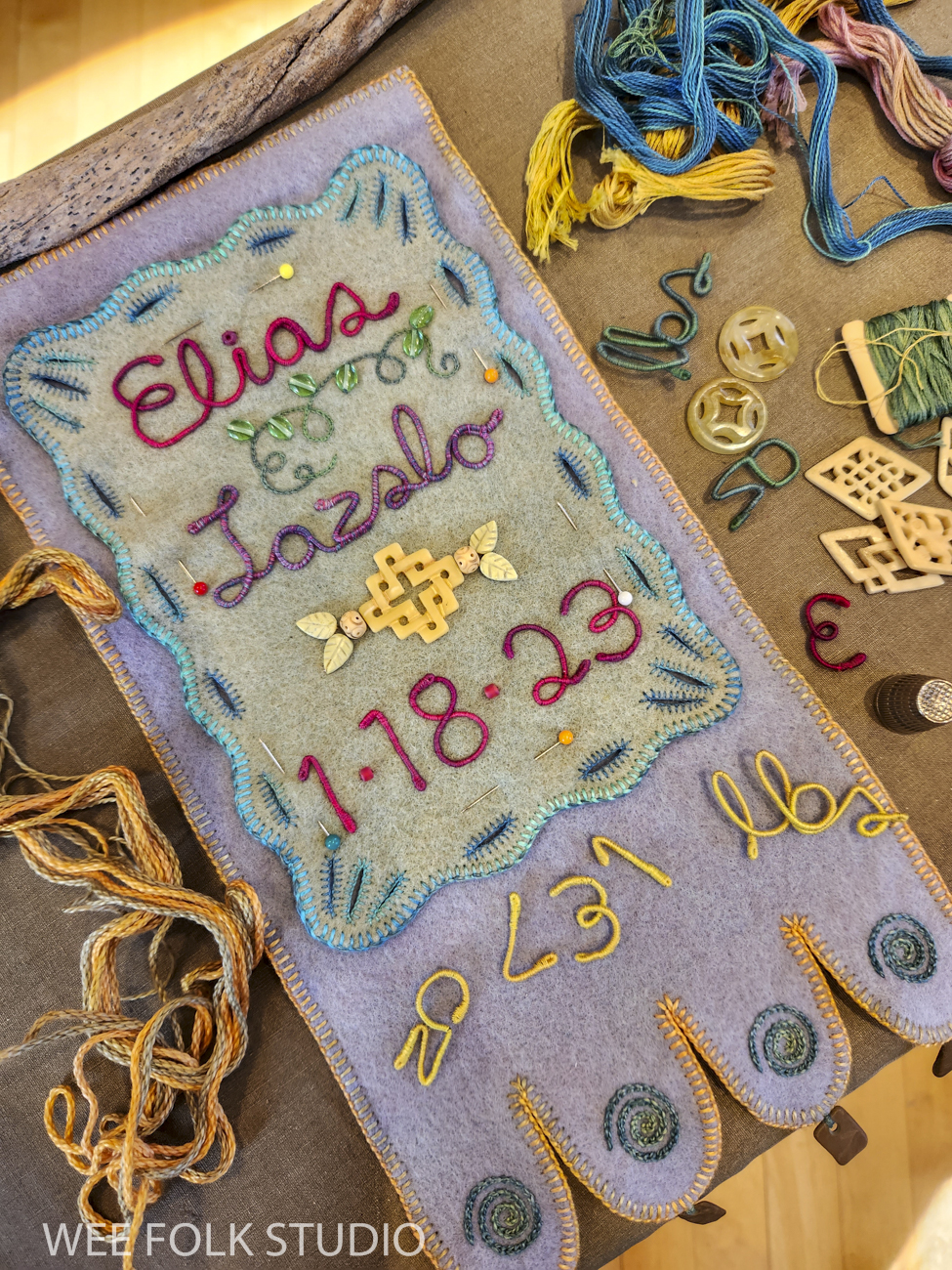
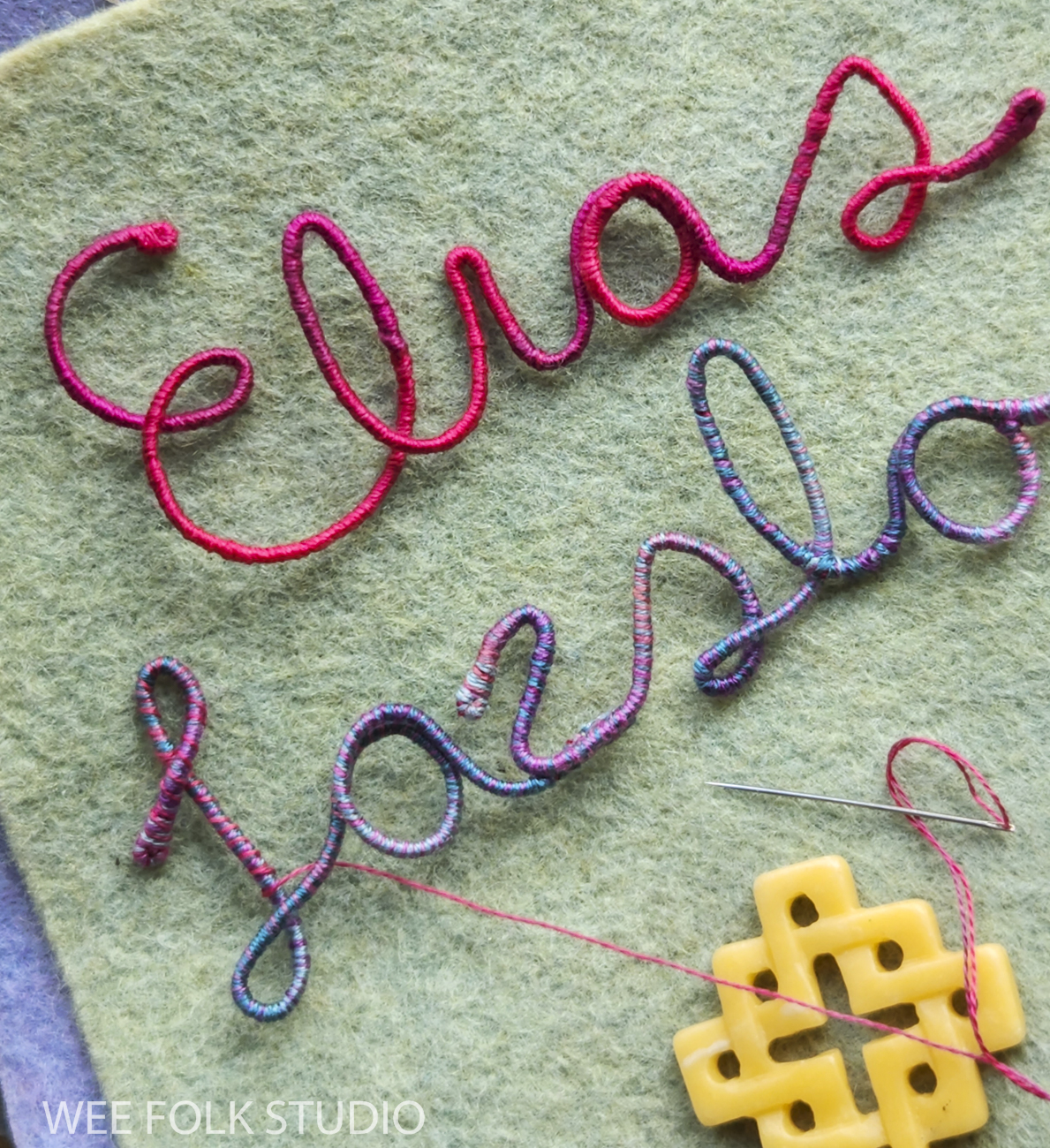
Naturally, I quickly got to work making a banner for Elias. After picking out the basic color scheme, I wrote his first and middle names in cursive handwriting on paper. Using that as a template, I made a 3-dimensional copy with memory thread. That way, I knew what length of wire to use.

I wrapped the memory thread (or wire) with 3 strands of embroidery floss.
UPDATE: I misspelled Laszlo, which is the baby’s maternal great-grandfather’s name! Watch this video to see the remake.

Remaking Laszlo

I usually use variegated floss to wrap the wire, which can look like stripes on the 2nd pass. The wire ends are bent over and wrapped, so that no raw ends are hanging out. It’s similar to the technique I use to make doll limbs in my how-to book Felt Wee Folk.

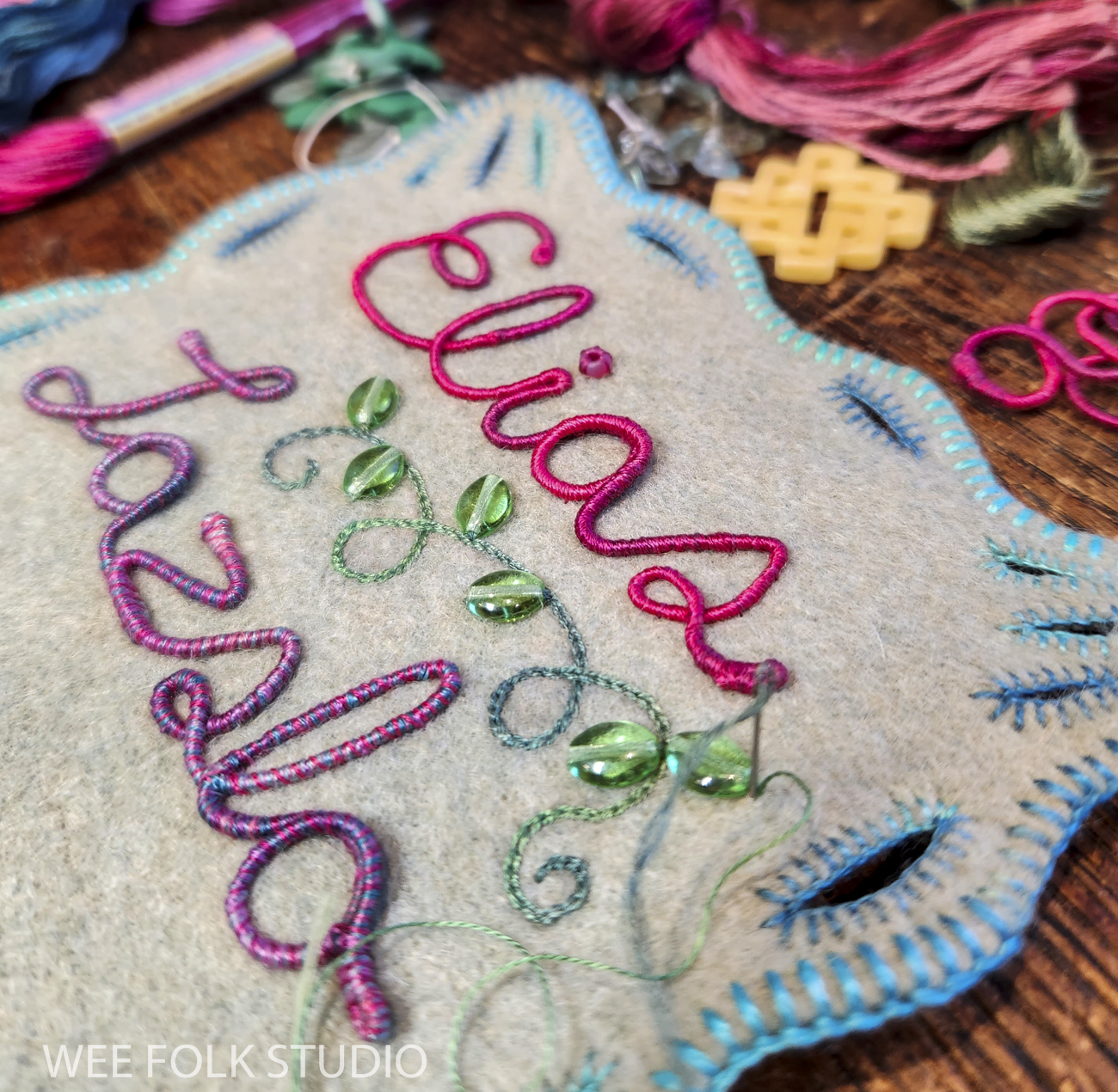
When I finished wrapping Lazslo and positioned it on the felt background, there wasn’t enough contrast, so I gave it a candy stripe to make it pop more.

I use an ironing board as a work surface. Here, you can see what I’m working on in the middle. On either side are printouts of banners I’ve made in the past, which I used for reference.

I had to wrap the numbers a couple of times because the size was off.

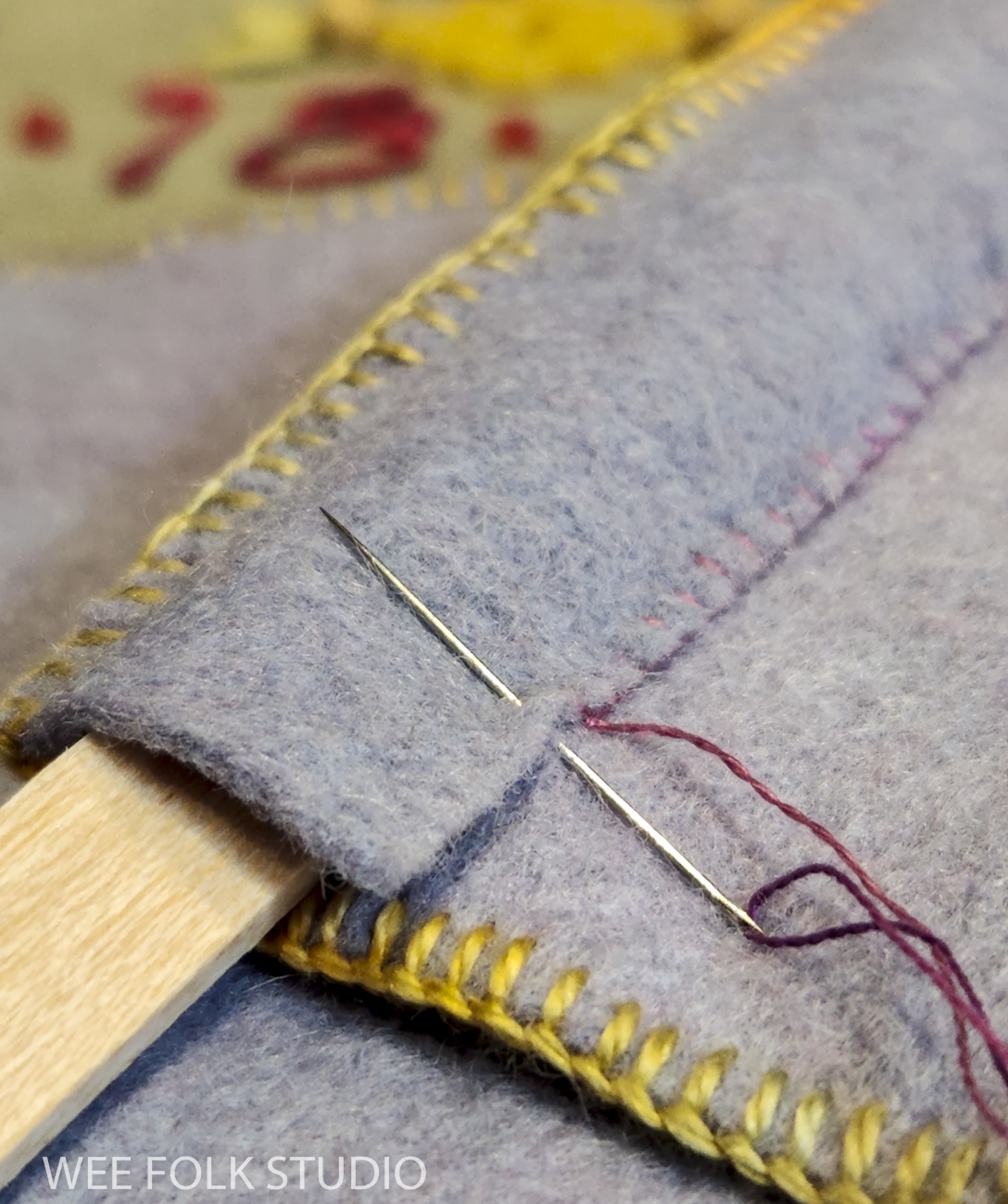
I edged the green felt panel with blanket stitches, using variegated pima cotton thread from the Caron Collection,

I wrote out the birth weight in green first and then did it over in yellow to create more contrast, which seemed to be a recurring theme with this banner.

After sewing the lettering onto the green background panel, I chain-stitched a vine to fill the open space between the names.

Out of my stash, I selected bone beads to make a decorative separator between the names and birth date.

I then sewed the green panel to the lavender background felt.

To make the banner rigid at the top, I made a sleeve and inserted a piece of wood.

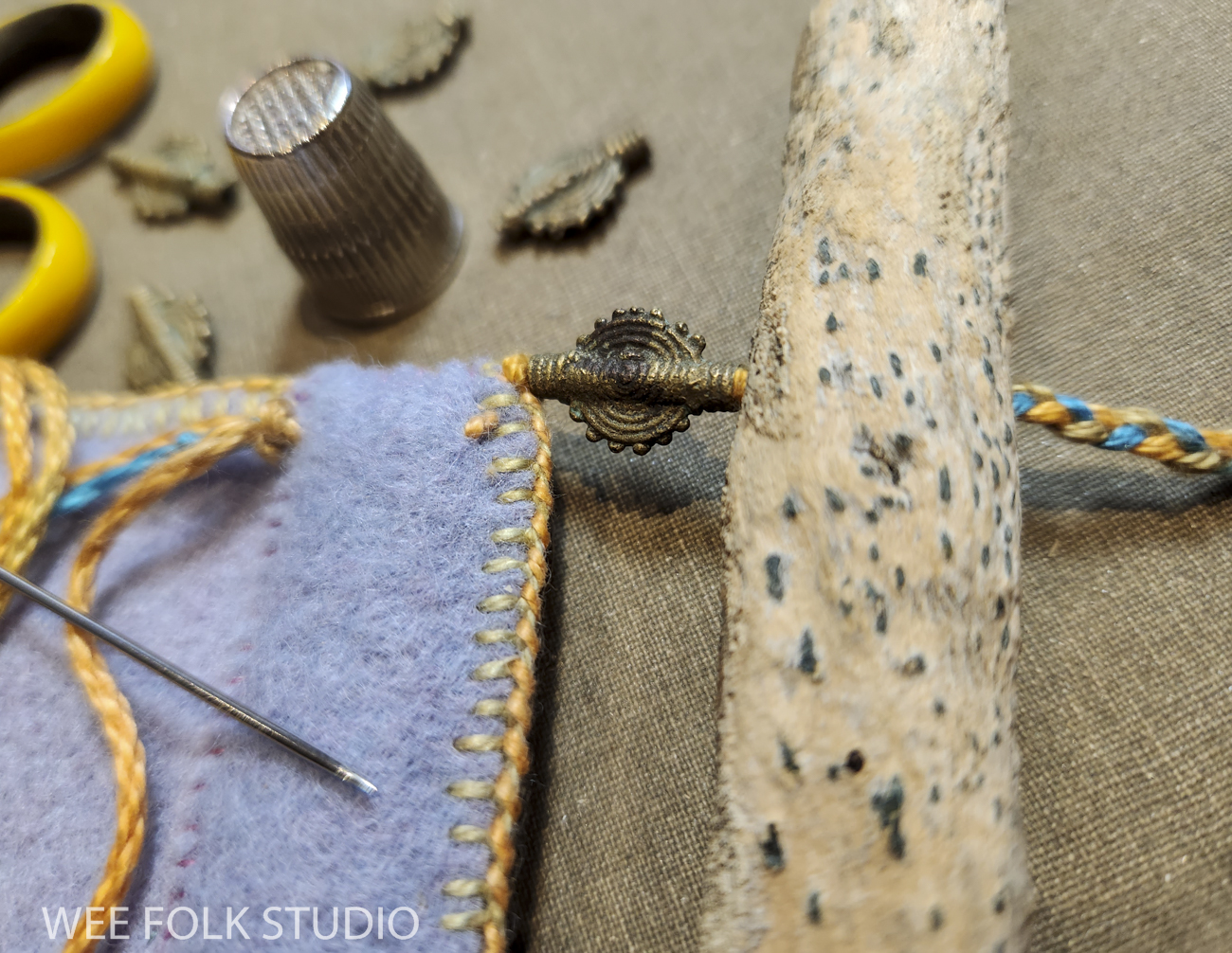
I looked through my driftwood collection and found the right sized stick that would work as a hanging bar. I drilled holes big enough to thread cord through.

I fed cord through the holes and a metal bead separator, hiding the tail threads on the back.

This banner will soon hang on Elias’s bedroom door. Welcome to the world little one! We look forward to getting to know you!

To keep up with new posts, please subscribe to this blog. Your contact info will not be sold or shared. If you’d like to see more frequent photos tracking the projects in my studio, please follow me on Facebook and/or Instagram.

Harvest Time – part 3 (felt leaves)

In Part 3 in the series about making Harvest Time, I share photos, commentary and a stitch-minute video about embellishing the felt leaves that appear on the ground-cover and bushes. Please note that when I use the word ‘felt”, I’m referring to the noun, not the verb. Felting is agitating and manipulating wool fleece fibers with a barbed needle or soapy water to create a felted surface. That’s how I made the brown soil in the underground part, which I’ll describe in a future post.

In the coming weeks and months, I will post more stories that focus on different aspects of making the fall scene, including the toad stool mushroom, wee folk figures, needle felted tunnels, roots, stones and foliage of all kinds. Part 1 featured moss making. Part 2 is about making the turkey tail mushroom.

Harvest Time is the fall scene in a series of seasonal landscapes that capture the wonder and magic of the natural world, both real and imagined.
Harvest Time note cards and a jigsaw puzzle are available in my Etsy Shop.

When envisioning this piece, I wasn’t sure how it would come together, but that’s normal for me. I knew that I needed to figure out a way to clearly define the edge between above ground and below ground. This is the kind of thing I think about when doing busy work, like stitching hundreds of French knots. I’m always one step ahead, planning the next move. I ended up creating a kind of flap with two sections of felt “sod” that overlapped the underground tunnel to the root cellar.

Felt Leaves
After edging the felt leaves with blanket stitches, I bent wire to match the shape and stitched it to the outside edge. Then I kept going around until the wire was completely covered with thread. I used single strands of floss to give it a fine finished look.

I wanted to fill the ground cover with an eye-catching array of textures, colors and shapes that would balance the composition of the whole piece. To help the leaves perk up and create shadows, I pushed the wire stems through a small hole to the back of the felt background, where it became a leverage point.

Because this scene has an element of fantasy, I felt free to incorporate bright unnatural looking shades.

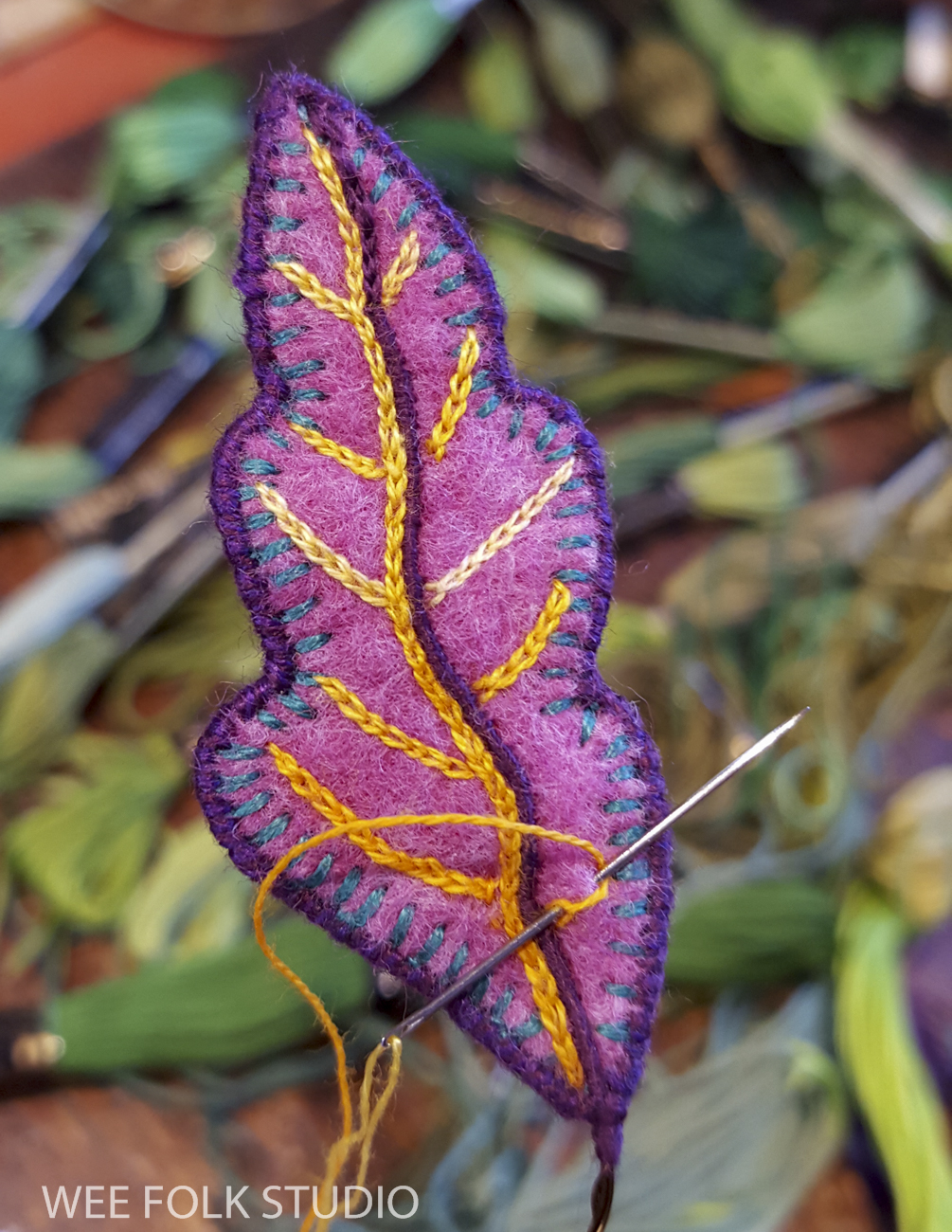
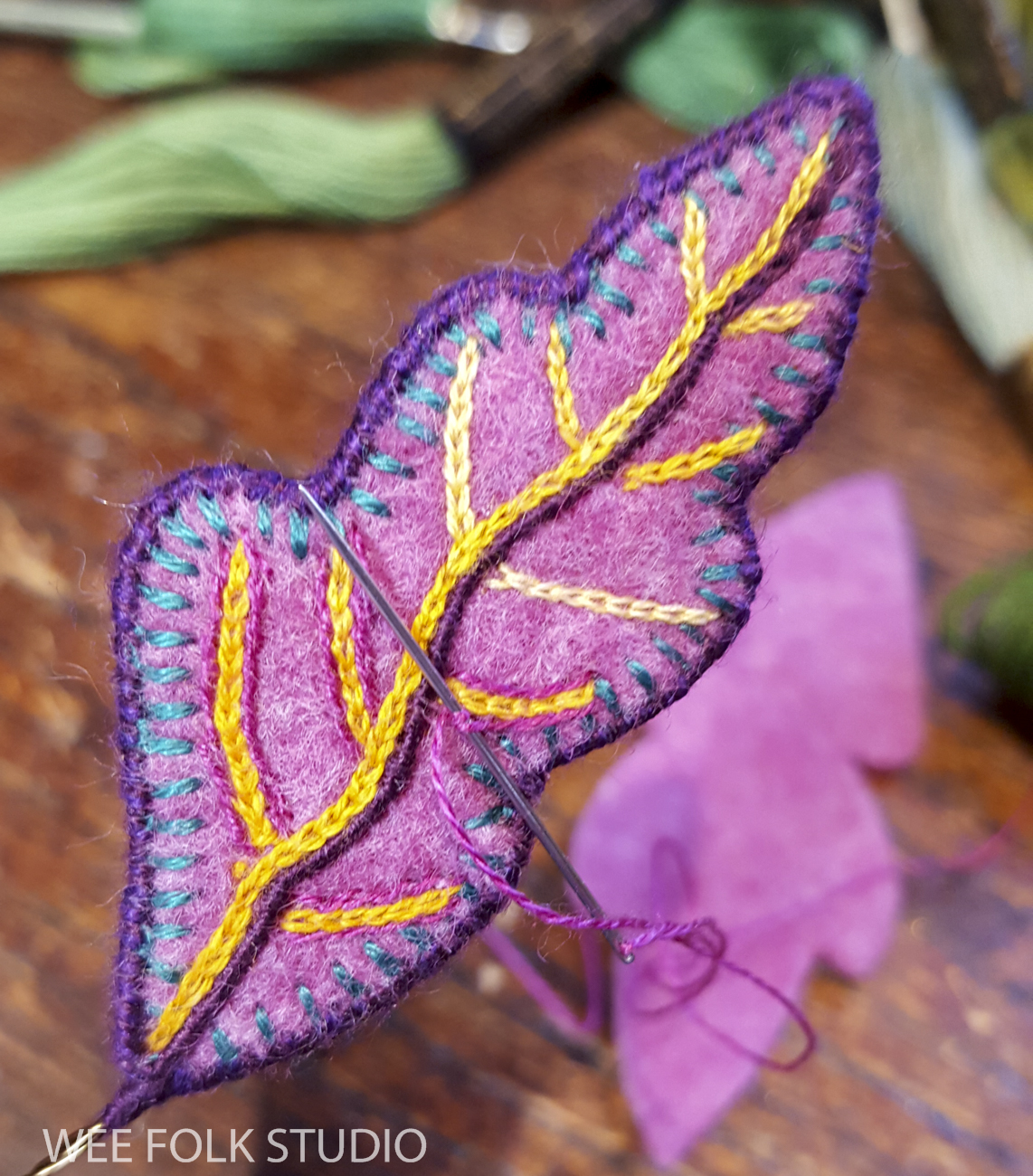
I searched through my stash and found some variegated yellow embroidery floss to use for the chain stitched veins on these hot pink leaves.

When I embellish with thread, I constantly think about how to enhance and articulate the form, without becoming too cluttered. For instance, adding a dark pink outline around the veins on this leaf help emphasize the lines.

I hadn’t noticed it before, but now I see that the leaves are all made with complimentary colors. That way they pop out at you, both visually and physically!

This Stitch Minute video shows how I made a wire edged felt leaf.

As you can see, I constructed this background piece separately from the other parts of the scene. At the very end, after months of work, I assembled all of the pieces and stitched the sections onto one stretched fabric layer.

I also made larger orange leaves for the berry bush that’s growing next to the moss covered stump.

In future posts, I will focus on different aspects of making Harvest Time, including the toad stool mushroom, wee folk figures, needle felted tunnels, roots, stones and foliage of all kinds.
The overview introduces the Harvest Time piece.
Part 1 features moss making.
Part 2 is about making the turkey tail mushroom.
Part 3 shows the construction of felt leaves.
Part 4 gives a peek at embroidering the plants.
Part 5 is about making the toadstool mushroom
Part 6 shows the process of making the underground

Harvest Time – Part 2 (turkey tail mushroom)

In Part 2 in the series about making Harvest Time, I share photos, commentary and a stitch-minute video about creating the turkey tail mushroom overhanging the doorway in the stump. In the coming weeks and months, I will post more stories that focus on different aspects of the process of making the fall scene, including the toad stool mushroom, wee folk figures, tunnels, roots, stones and foliage of all kinds.
The overview introduces the Harvest Time piece.
Part 1 features moss making.
Part 2 is about making the turkey tail mushroom.
Part 3 shows the construction of felt leaves.
Part 4 gives a peek at embroidering the plants.
Part 5 is about making the toadstool mushroom
Part 6 shows the process of making the underground

Harvest Time is the fall scene in a series of seasonal landscapes that capture the wonder and magic of the natural world, both real and imagined. Harvest Time and 2 other scenes I’ve completed and written about, Frosty Morning and Mossy Glen, are available as note cards and jigsaw puzzles in my shop here.

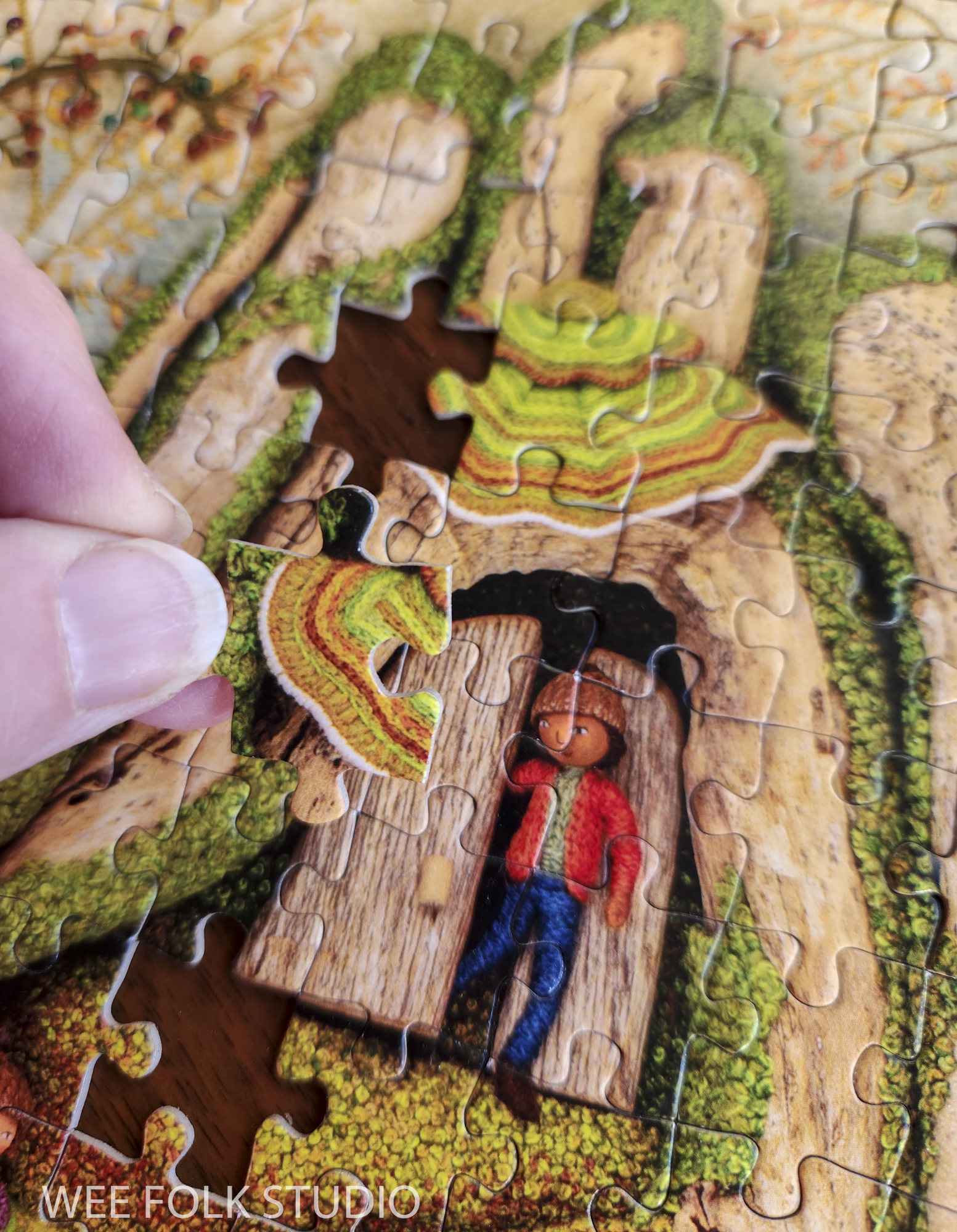
Harvest Time Puzzles are available in my Etsy shop.

Turkey tail mushrooms or shelf fungi are found all over the world. They usually grow on dead hardwood stumps and downed hardwood trunks or branches.

Turkey Tail Mushrooms

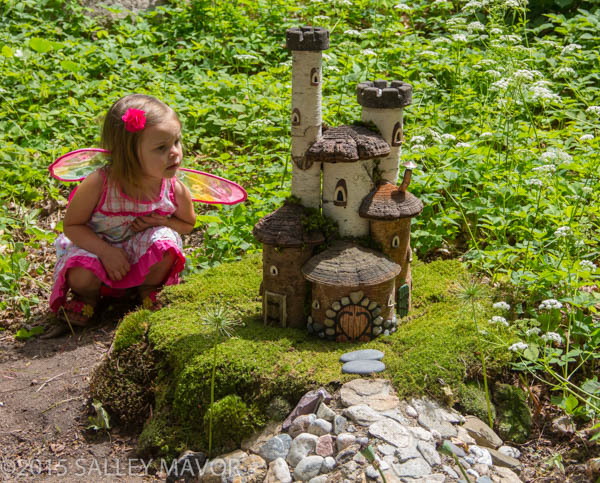
I love how Glen Carliss used shelf fungi for the roofs in “Glendell Towers”, which he made for The Fairy Houses of Highfield Hall, an outdoor exhibition that I curated in 2015. Glen told me that he’d been eyeing the mushrooms growing on trees along his road for years, imaging what to do with them.

Glendell Towers by Glen Carliss

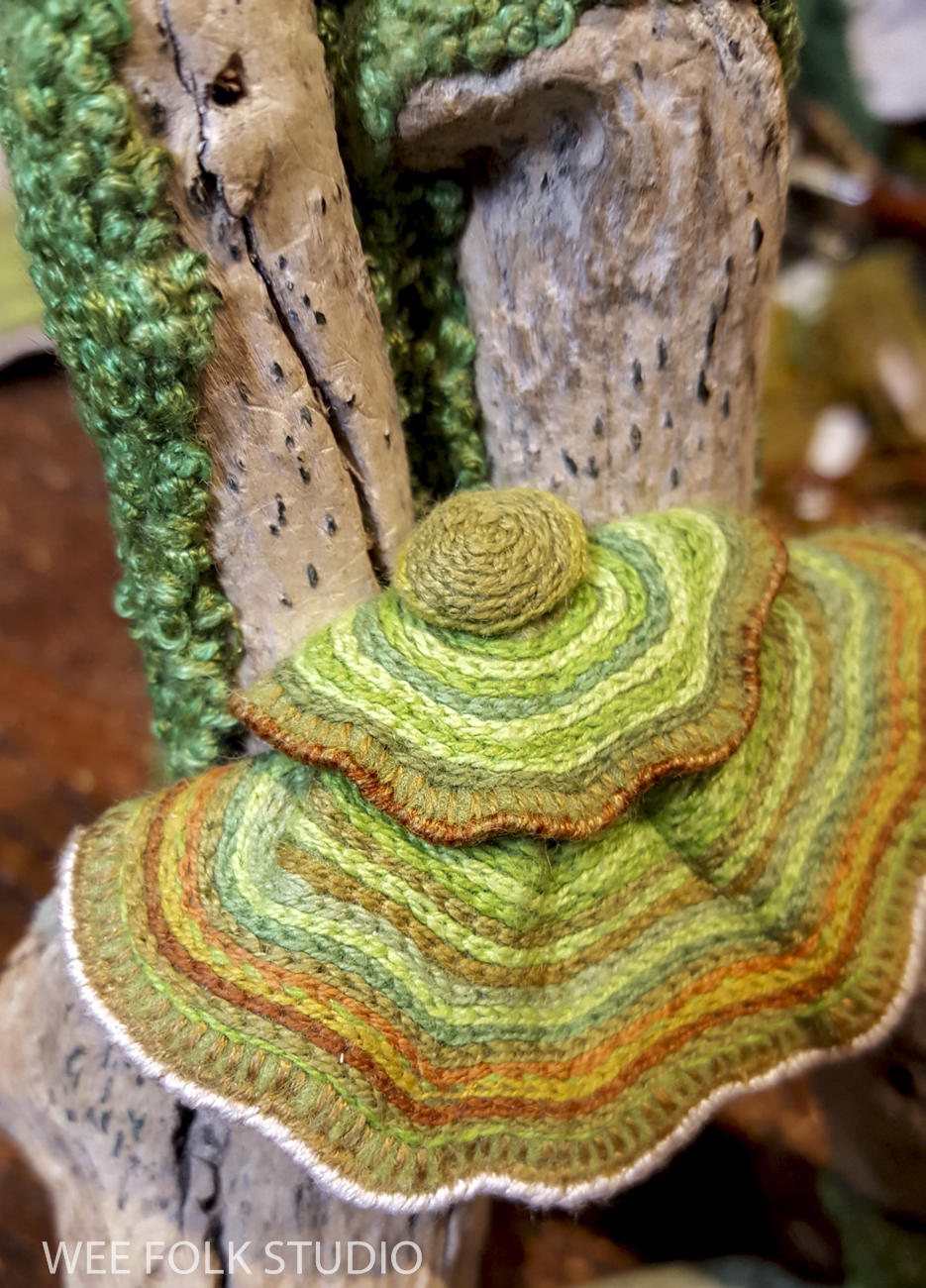
I didn’t use actual mushrooms in Harvest Time, but I was inspired by their fanciful appearance. My photo search came up with multiple color combinations, from earthy hues to shades as garish as 1960’s fashion. I chose a more subdued mixture of fall colors for the mushroom roof.

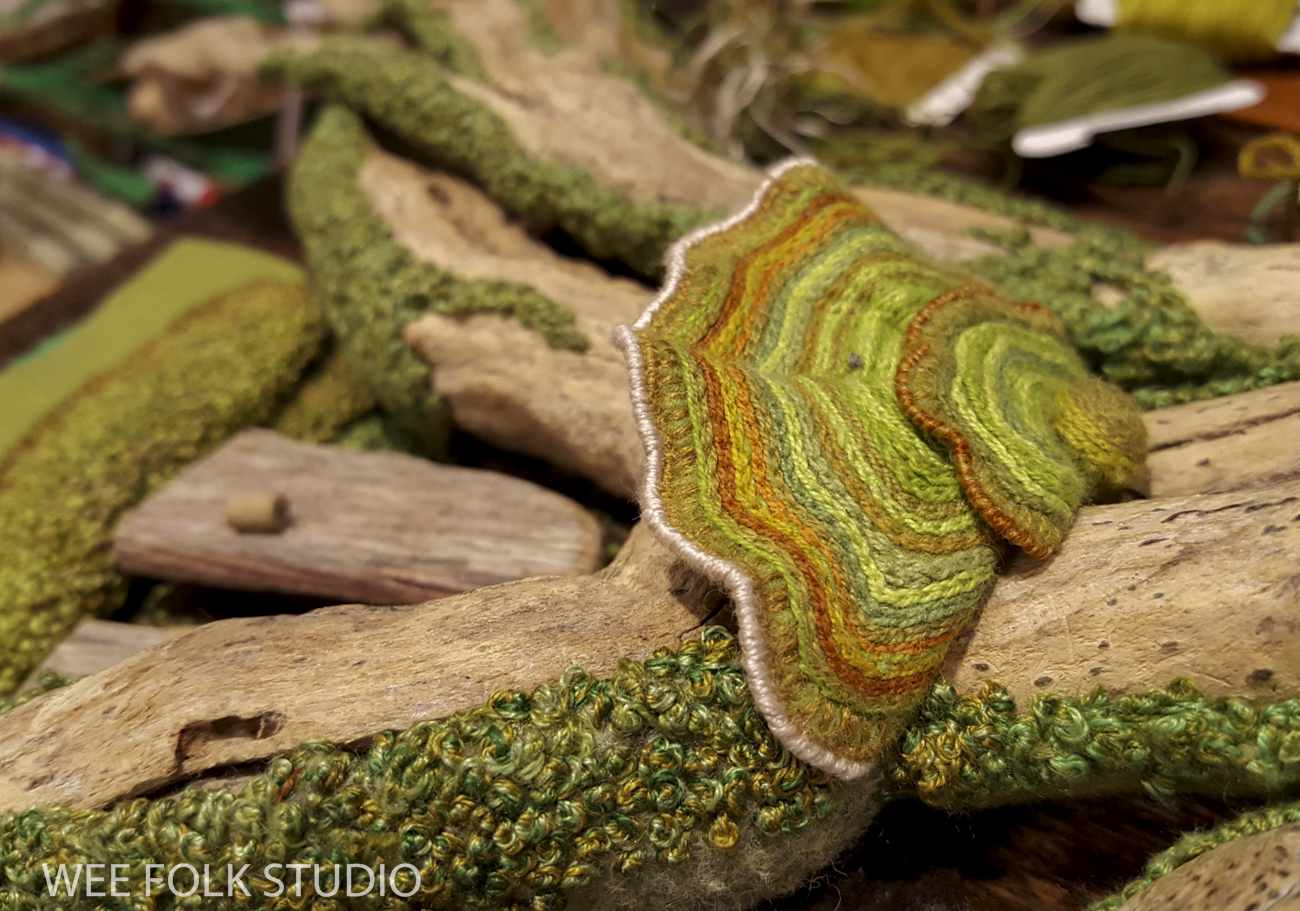
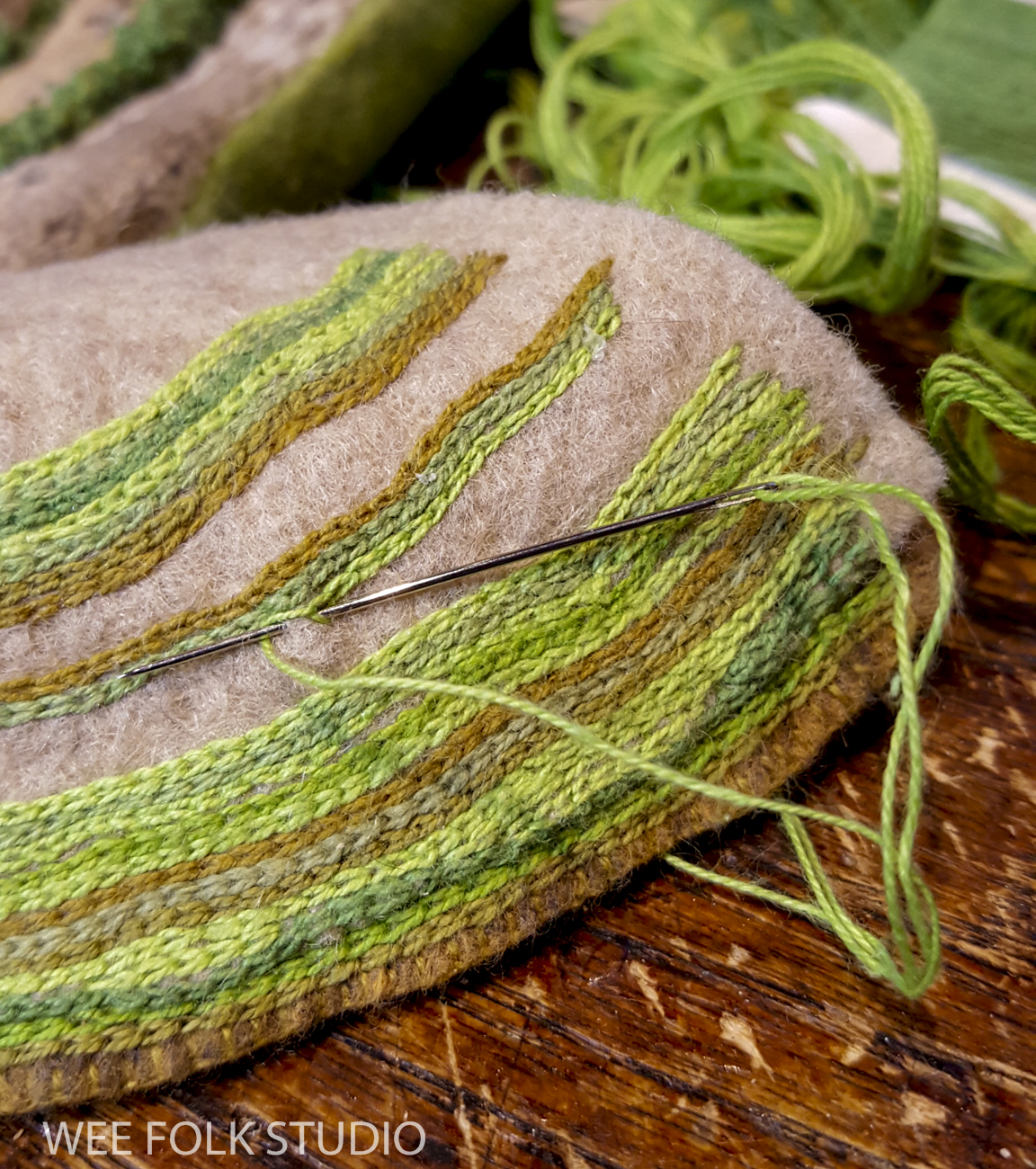
To make the striped concentric pattern, I chain stitched rows and rows of different shades of green and orange DMC cotton flower thread to a piece of felt. It took two tries to get the shape and colors the way I wanted it.

In this Stitch Minute video, I demonstrate chain stitching the stripes and adding wire.

After we filmed it, I wasn’t happy with the overall shape and color combo, so I started over and made a new one that was more curvy and included orange and yellow.

I stitched wire around the outside edge and covered it with white embroidery floss.

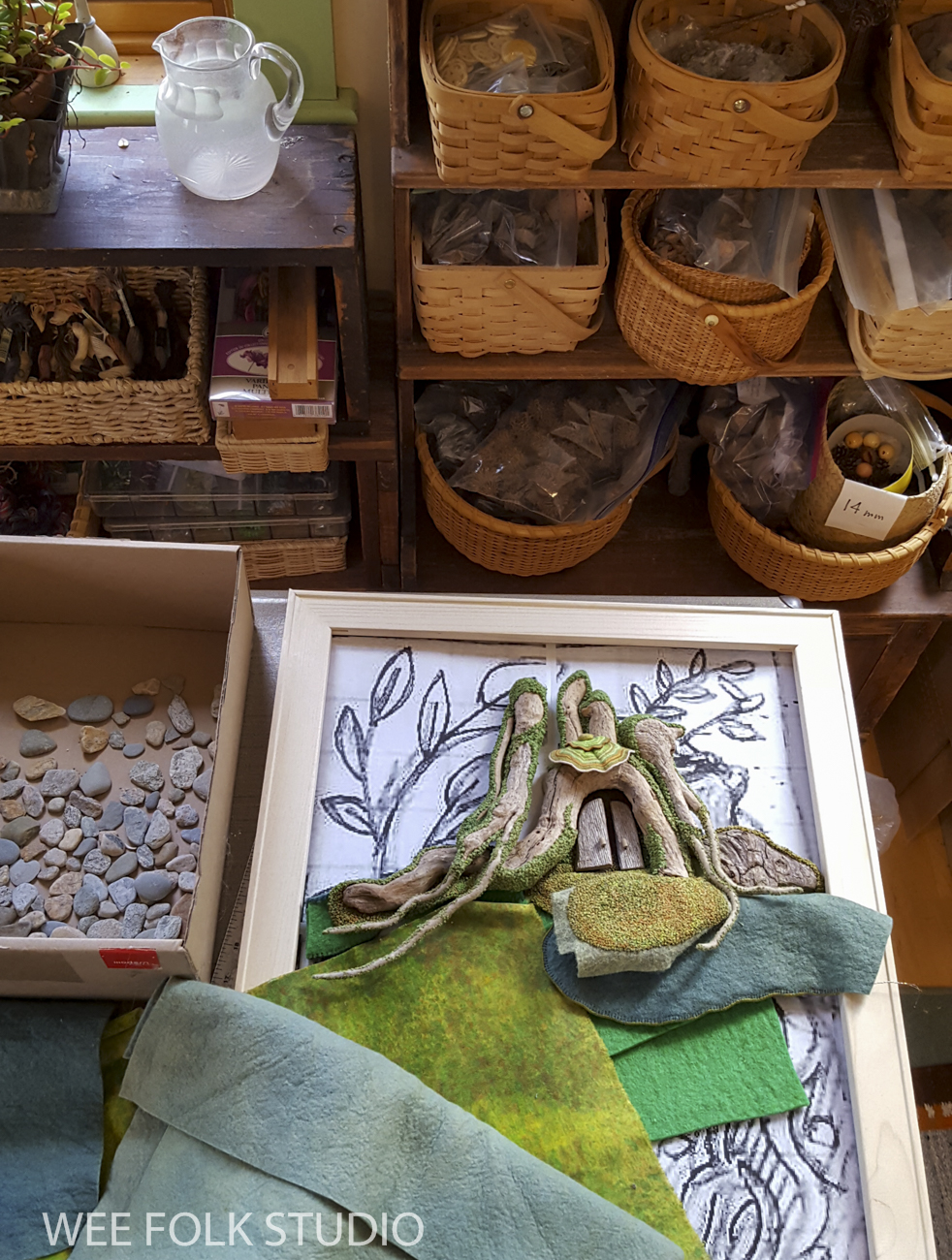
Then I made a smaller mushroom and a really little one that looked like a pompom on top of a hat. It’s been a year since I started working on this piece, so my memory is a bit foggy. I can only guess at how I formed the layers into a roof shape and attached it to the driftwood. I do remember that the mushroom wasn’t very cooperative and I had to torture it into shape. Most likely, I glued felt to the wood and then sewed the mushroom to the felt.
During the process, I constantly measured the depth of the trunk to make sure that it would fit behind the glass when the finished piece was framed. After the mushroom roof was added, there was just enough clearance!

My use of found objects is mostly limited to individual items that are sewn in place and incorporated into embroidered scenes. This trunk was different because it was made up of several driftwood parts that created a fairly large mass that stuck out from the background. Its depth and breadth would determine how I created everything else in the landscape.

Now that the trunk was finished, I could start building the other parts of the scene, including the ground at its base.

Next time, I will show the process of making the felt and stitched foliage growing on the ground at the foot of the tree trunk.

Harvest Time – overview

Fall, the glorious time of year that reminds us it’s time to prepare for cold weather, has arrived in New England. Over the coming months, I will be sharing a series of posts with photos, videos and commentary about making Harvest Time, which is a fall themed piece I finished earlier this year. Each story will focus on a different aspect of the process, from stitching moss to needle felting to creating the busy little characters.
Part 1 features moss making.
Part 2 is about making the turkey tail mushroom.
Part 3 shows the construction of felt leaves.
Part 4 gives a peek at embroidering the plants.
Part 5 is about making the toadstool mushroom
Part 6 shows the process of making the underground
Part 7 is about making the wee folk figures
Part 8 features miniature storage containers
Part 9 is about the embroidered trees

Harvest Time is the fall scene in a series of seasonal landscapes that capture the wonder and magic of the natural world, both real and imagined. Harvest Time and 2 other scenes I’ve completed and written about, Frosty Morning and Mossy Glen, are available as jigsaw puzzles and note cards in my Etsy shop.

Harvest Time Jigsaw Puzzle

From the start, I imagined the fall landscape as a cutaway view, showing both above and below ground. Future posts will give a close look at making the moss covered stump, the area around it and the earth underground, including the tunnel and storage areas.

I will show the process of making the industrious wee folk…

and the storage containers for them to transport their harvest.

There will be a whole post devoted to making this purple mushroom…

and another about creating the underground root cellar.

I’ll write about different ways I embroidered plants…

both flat and 3-dimensional.

I’ll explain how I covered driftwood with mossy French knots…

and filled the felt sky with delicate foliage.

I look forward to delving into this multi-part series with you. Right now, I’m sifting through about a gazillion photos I took along the way. Just like with Frosty Morning and Mossy Glen, there will be a lot of little details to cover!
Harvest Time posts: Part 1 – mossy tree trunk, Part 2 – turkey tail mushroom

Harvest Time 2022

To keep up with new posts, please subscribe to this blog. Your contact info will not be sold or shared. If you’d like to see more frequent photos tracking the projects in my studio, please follow me on Facebook and/or Instagram.

Sam and Louisa’s wedding dolls

This summer, both my son Ian and Sam, his best friend from childhood, got married. Here they are at age 3 and at Sam’s wedding last weekend. So, I had the pleasure of making personalized cake toppers for 2 wedding couples! You can see the post I wrote about Ian and Liz’s dolls here.

Sam and Louisa hosted a heart-felt and whimsical ceremony and reception, full of do-it-yourself touches, at their home in Falmouth, MA. Sam is a radio announcer and reporter for WCAI, our local NPR station and Louisa teaches ballet and is also the handwork teacher at the Waldorf School of Cape Cod.

A few weeks before the wedding, Sam and Louisa sent photos of their wedding attire and accessories, including their shoes. As I teach in my how-to book, Felt Wee Folk, the figures are constructed from the feet upward.

I also asked them to send head shots, specifically with closed mouths – no toothy grins, which are difficult to paint. When depicting real people, I like to paint their likenesses way in the beginning of the process. That way, I feel attached to them. They aren’t just dolls, but individuals with unique characteristics who are dressing up for a special occasion.

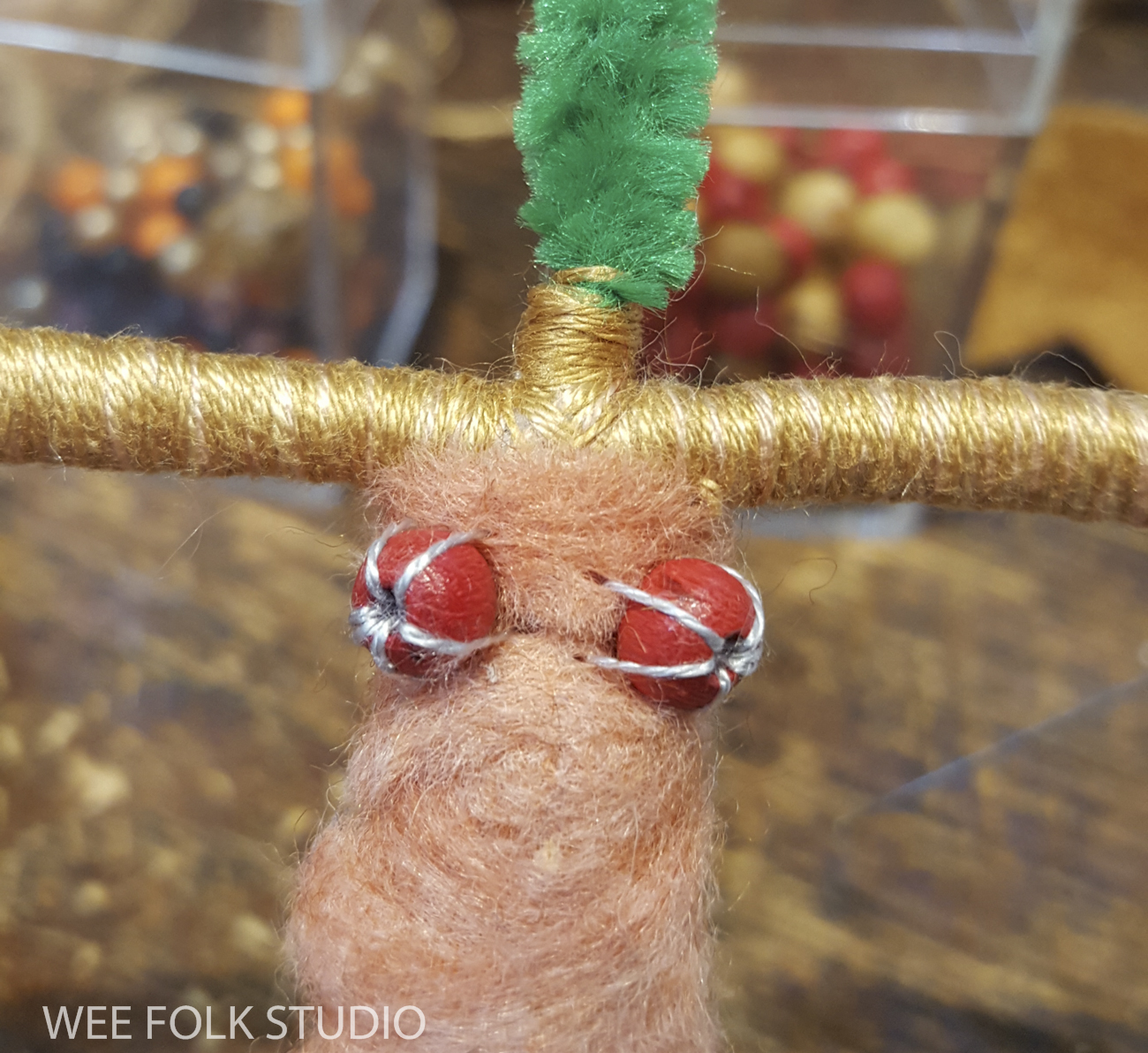
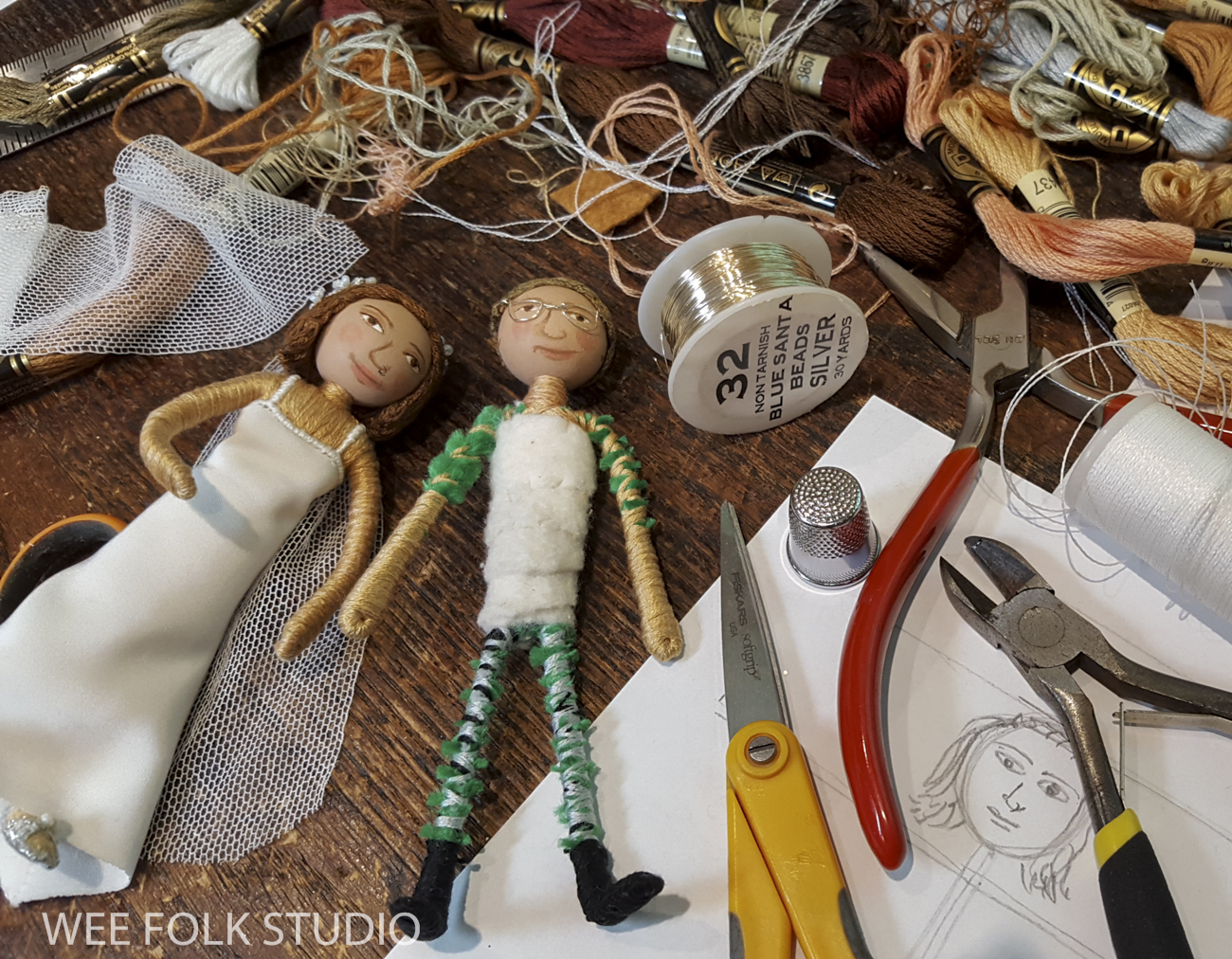
After forming the bride’s limbs with pipe cleaners and wrapping the arms and legs with embroidery floss, I sewed felt around the torso and stitched on boob beads.

Then, I covered the torso and boob beads with a layer of cotton batting and stitched more embroidery floss onto the upper chest area. Dressing bride dolls is a challenge because so often they wear skimpy gowns that show a lot of exposed skin. It’s so much easier to make the groom’s suit out of wool felt!

To make Louisa’s hair, I stitched embroidery floss onto the felt “wig”, which I’d previously glued onto her wooden bead head (see photo above). I should mention that at this point, her head is not yet glued onto the neck. That came at the end, after her clothing was finished. I popped her head on and off throughout the process to check how it looked.

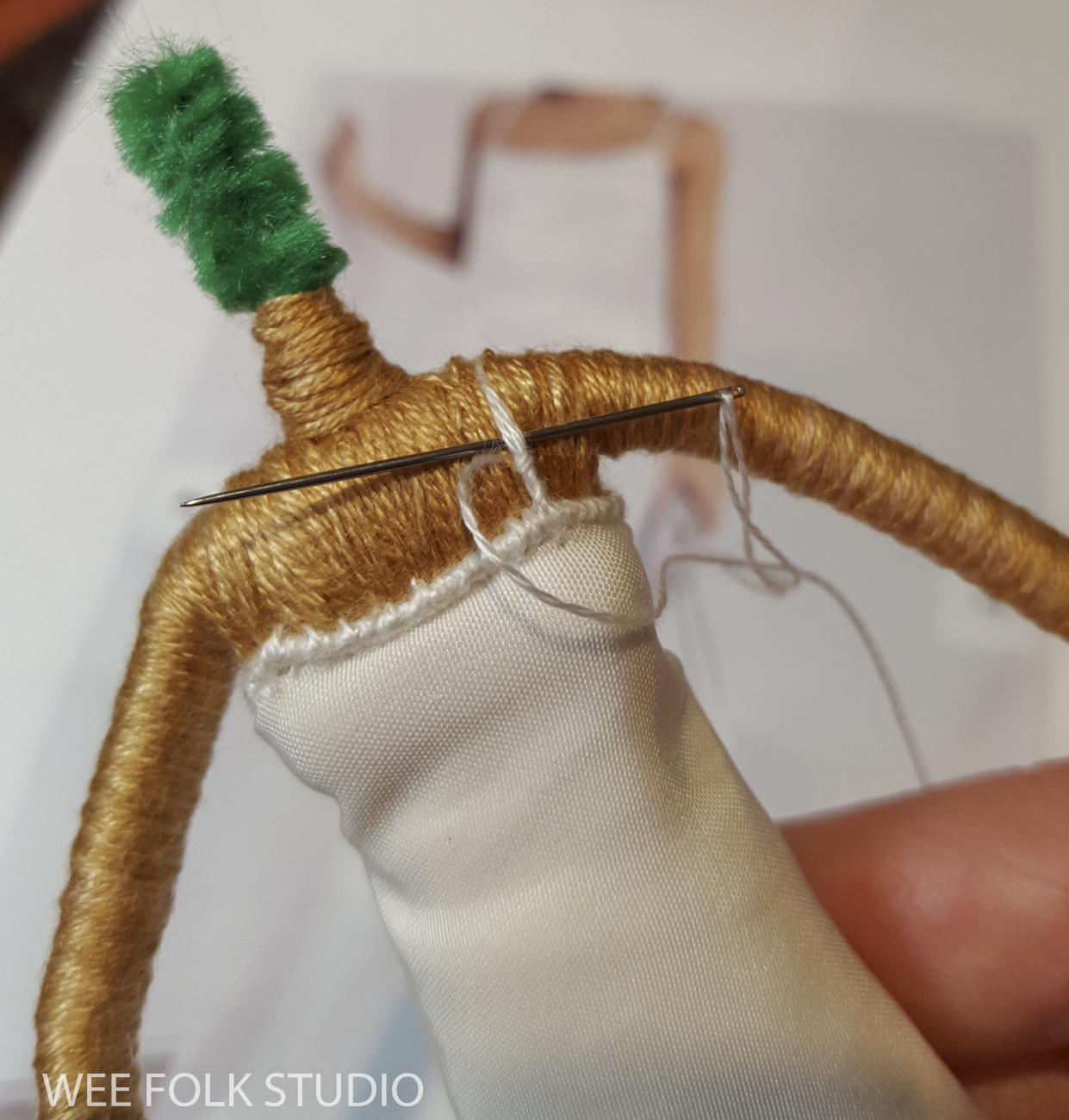
I found some white silk (or silk-like) fabric in my stash to make Louisa’s gown.

I formed Sam’s pipe cleaner body and he lay on my work table in his underwear, while I waited for photos of his suit.

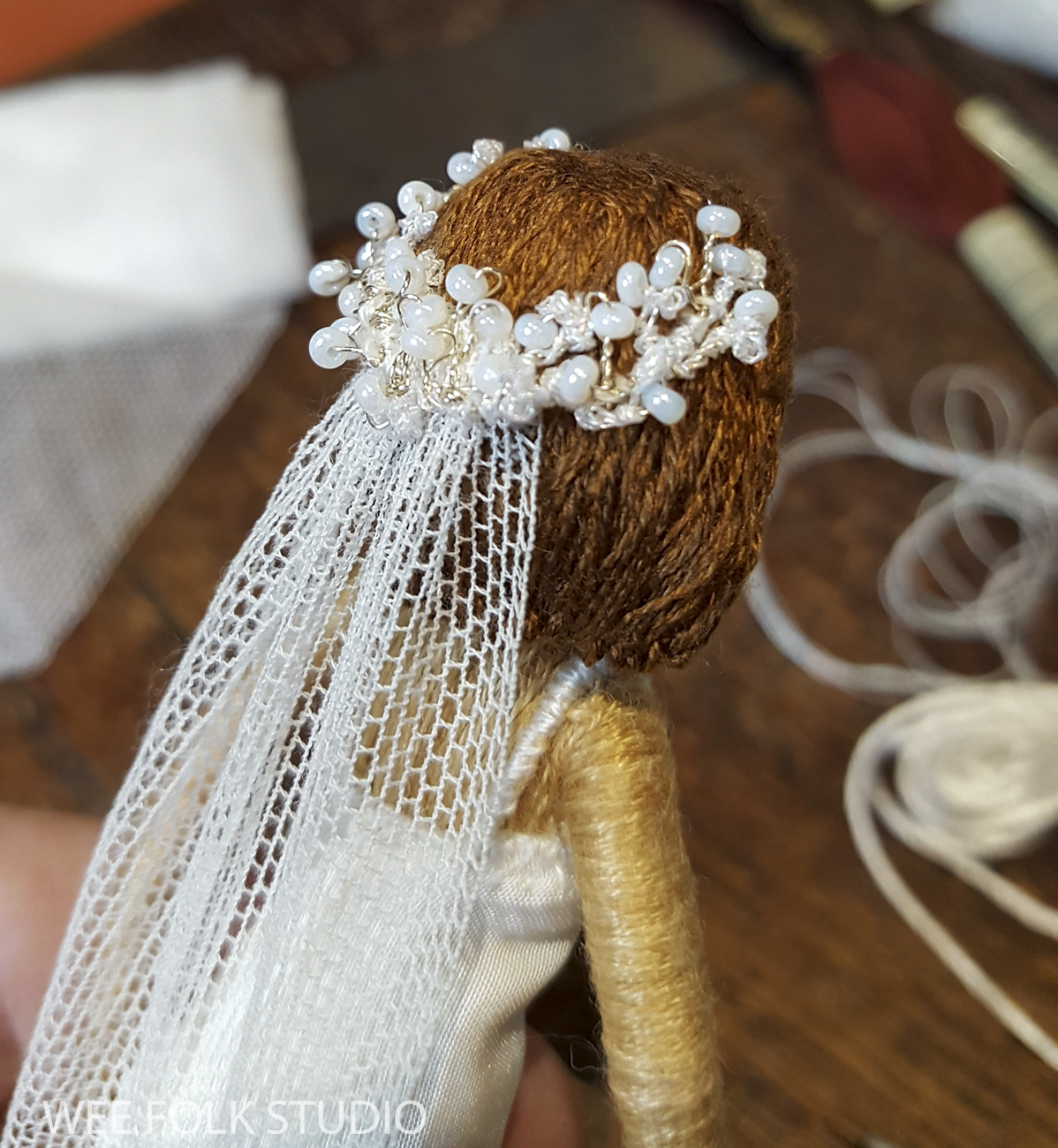
Using photos of Louisa’s family heirlooms, I fashioned her veil and pearl necklace.

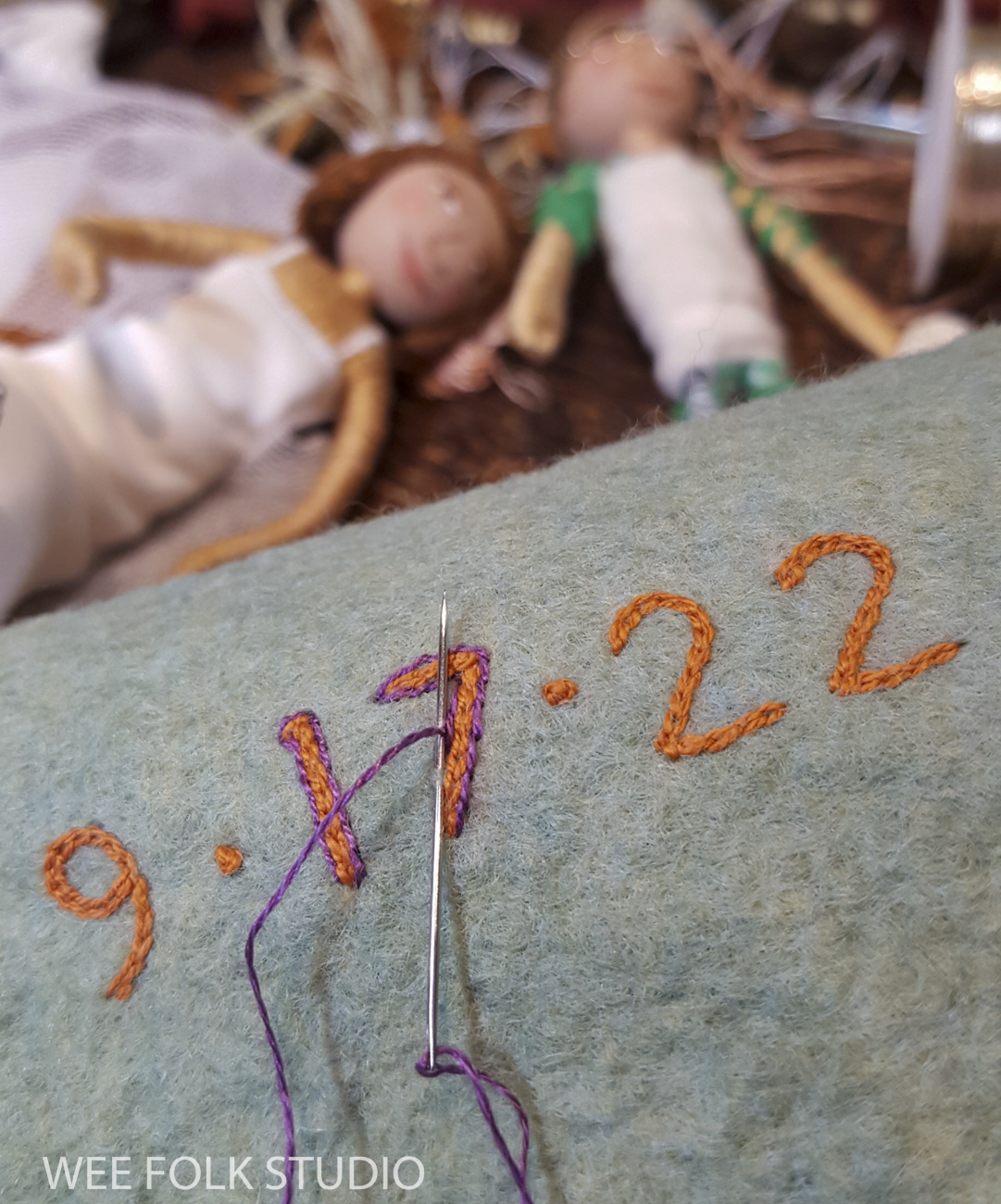
With Sam still in his underwear, I pressed forward and made the platform that they would stand on, which is basically a piece of wood covered with felt. I chain stitched their wedding date in orange and outlined the numbers in purple to make them more prominent.

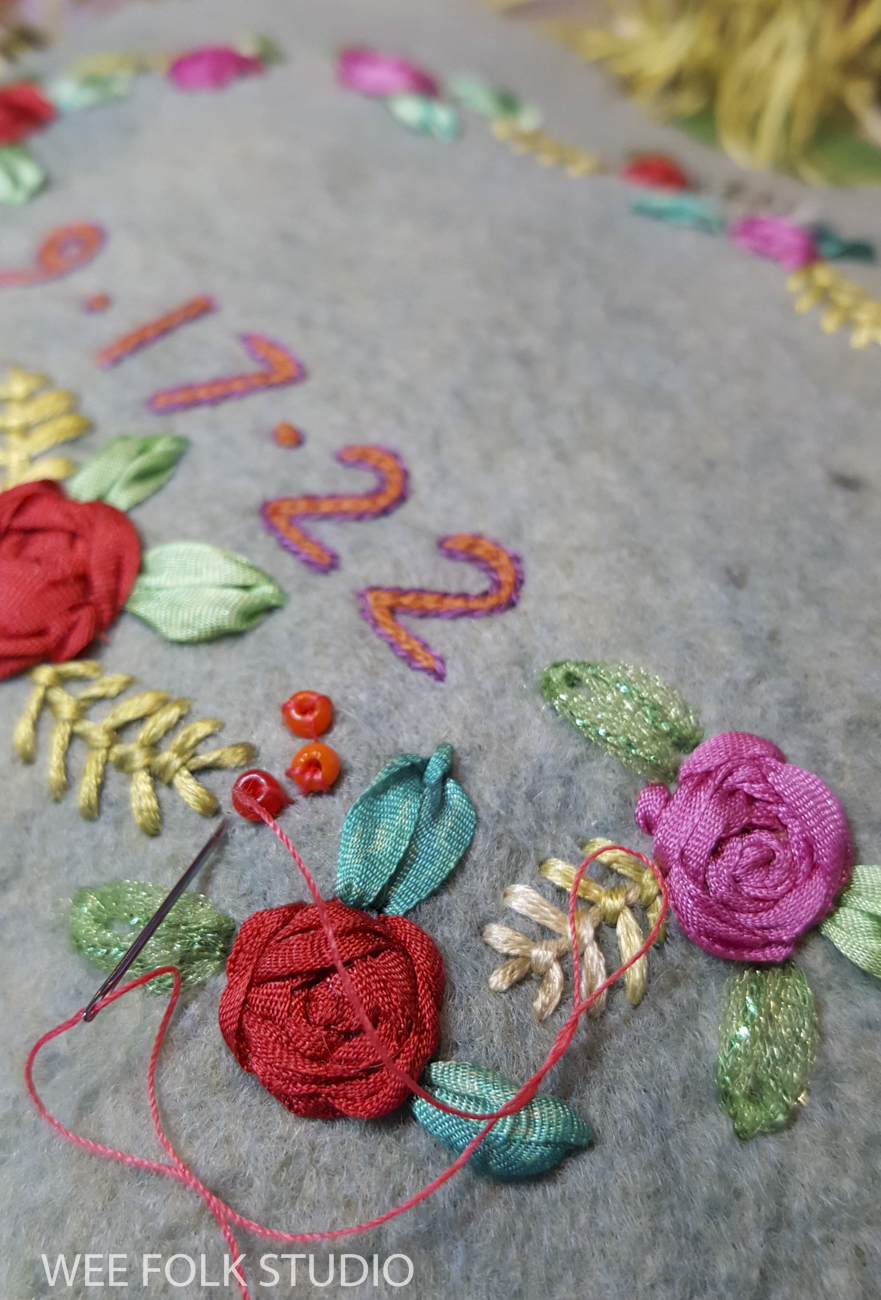
I used a spider web technique to embroider ribbon roses, which I learned on YouTube.

I added more ribbon embroidery and bead embellishments.

I glued a piece of felt to the bottom of the wooden platform and stitched the embellished felt top piece to it around the outside edge. Then I edged the base with twisted memory wire and braid.

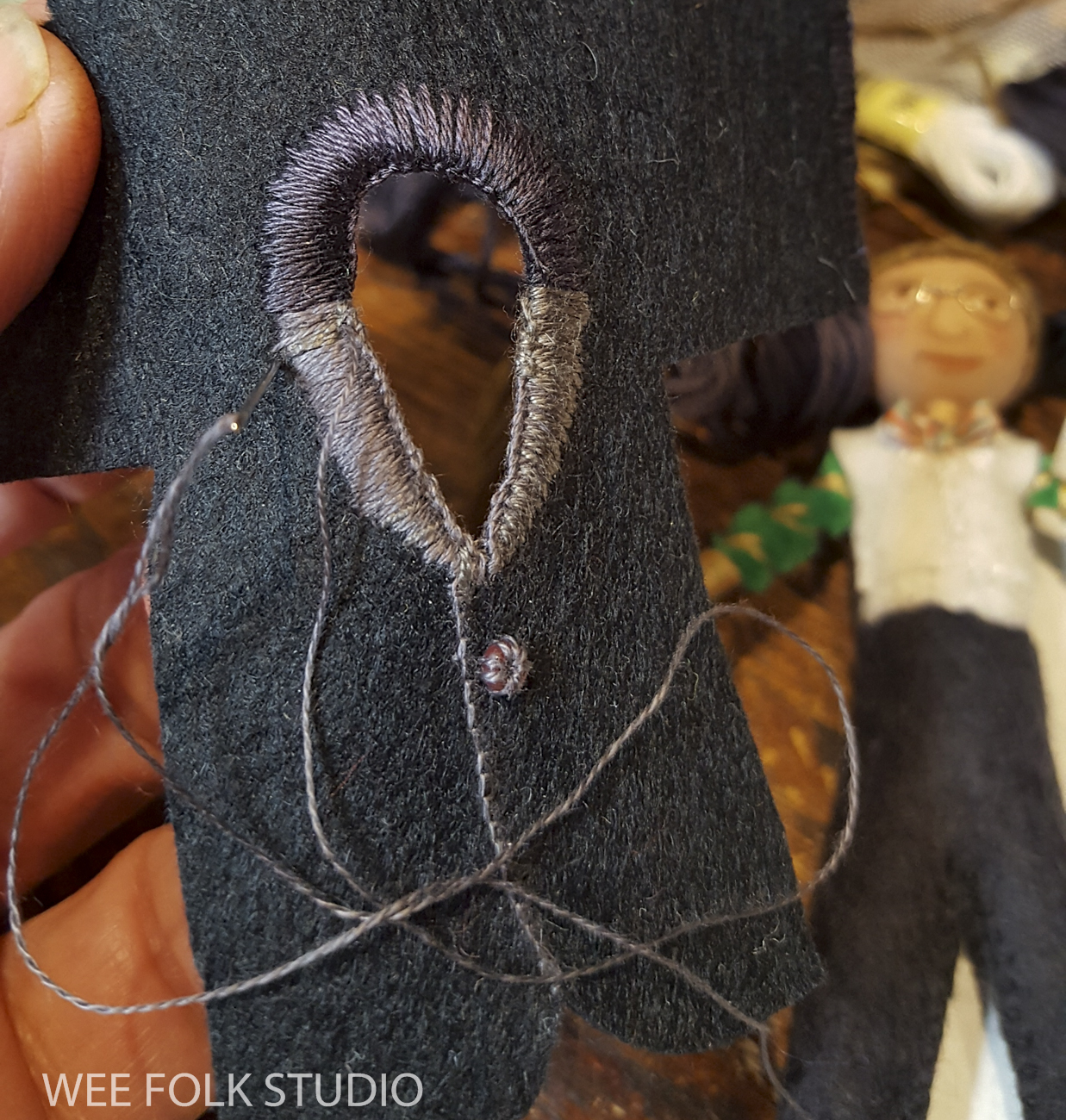
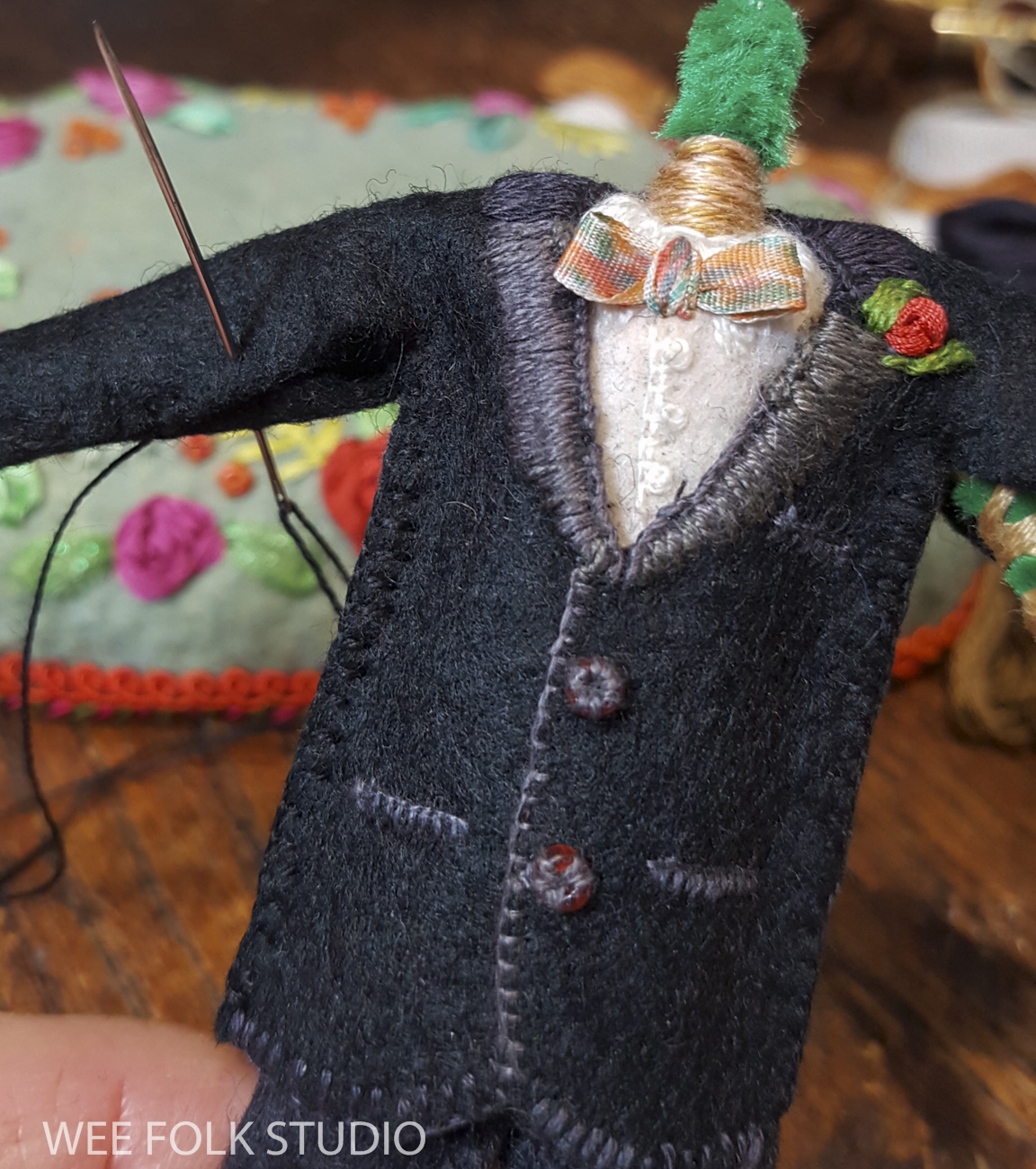
As soon as the photo of Sam in his black velvet jacket appeared on my phone, I got to work creating its wee version.

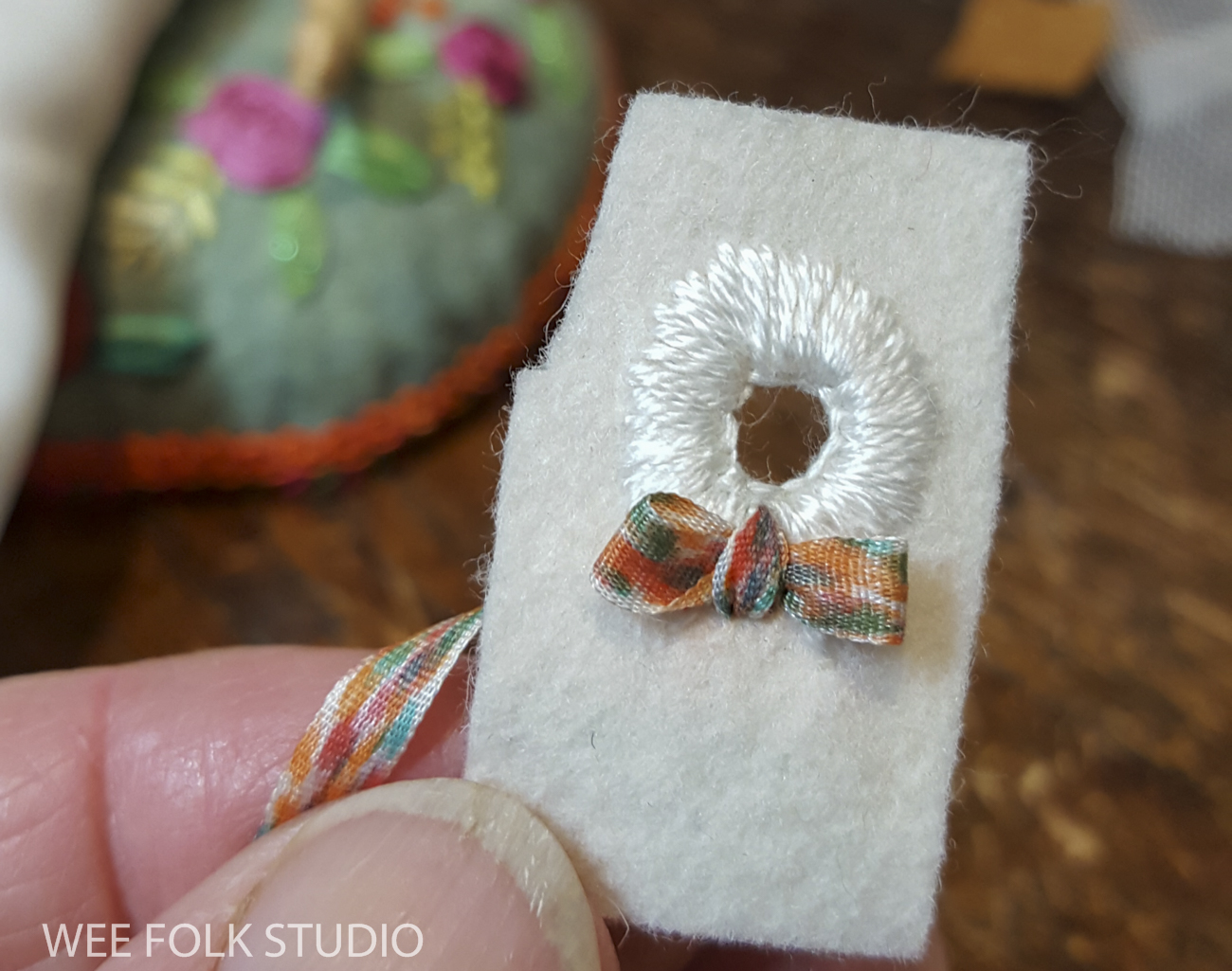
To make Sam’s floral bow-tie, I decorated silk ribbon with markers and stitched it to his shirt.

It didn’t take long to sew his jacket onto the pipe cleaner body, and glue his head on top. Now, he was all ready to get married!

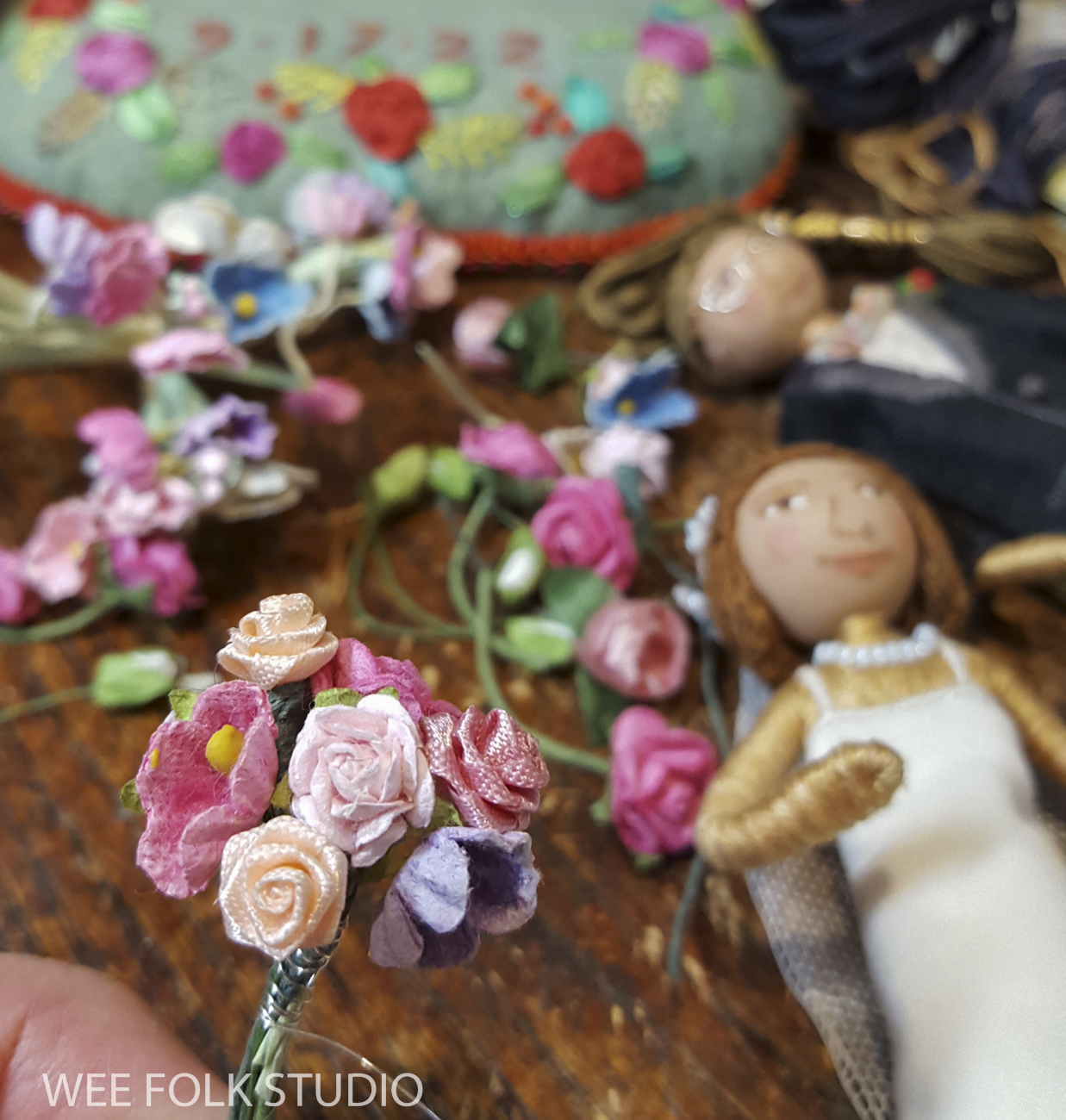
For her bouquet, i weeded through my collection of miniature flowers, guessing what it might look like. In reality, it turned out that she held a bouquet of dahlias in a very similar color scheme.

Before covering the wooden base with felt, I had drilled holes for sewing their feet in place. I had marked the location of the drill holes on the felt, so it was easy to anchor their feet with a few stitches using a long sewing needle.

Here they are, atop their lemon poppy seed wedding cake, which was homemade by the bride’s sister. Congratulations and best wishes to Sam and Louisa!

To keep up with new posts, please subscribe to this blog. Your contact info will not be sold or shared. If you’d like to see more frequent photos tracking the projects in my studio, please follow me on Facebook and/or Instagram.