Revisiting Mary and her lamb

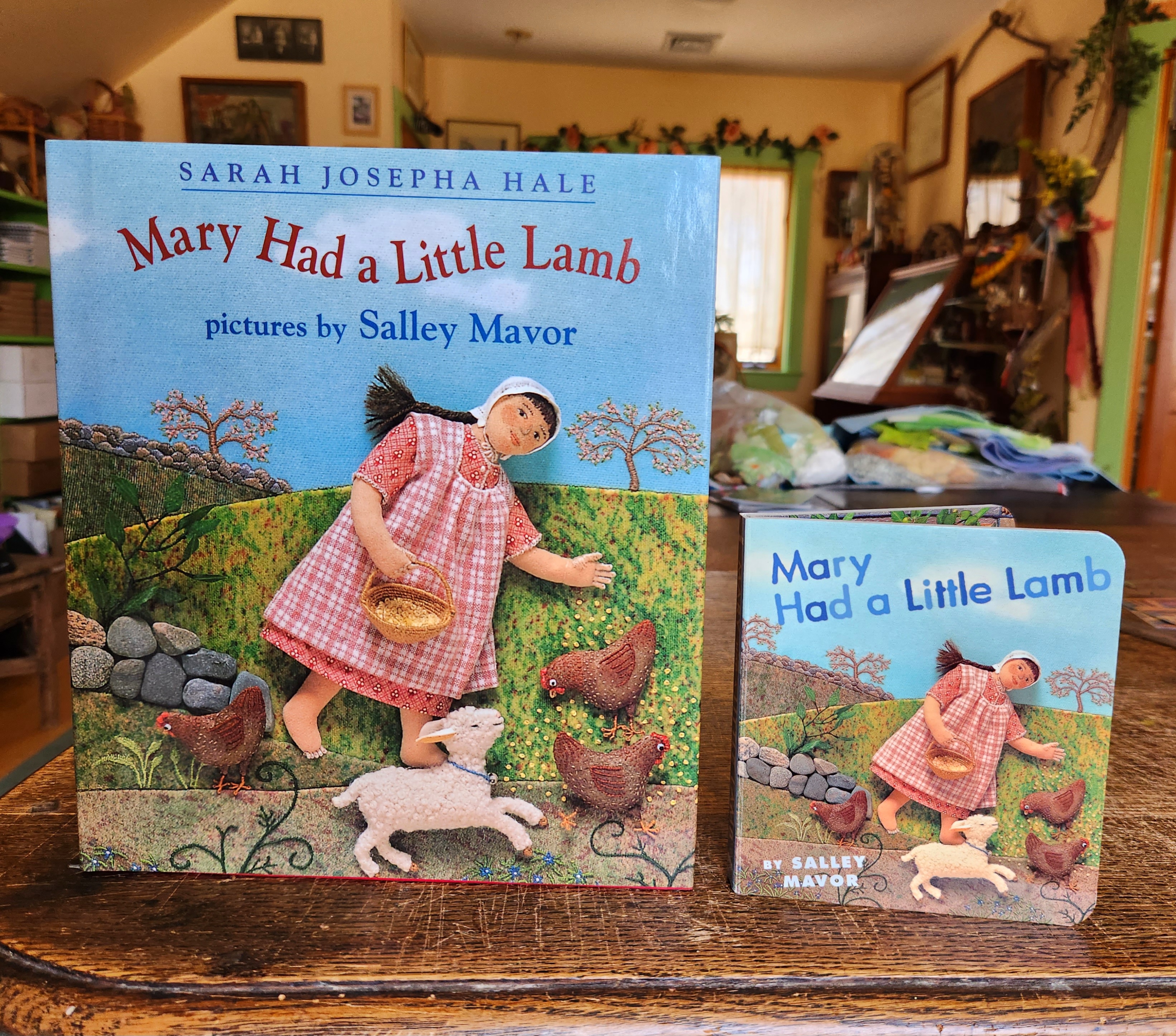
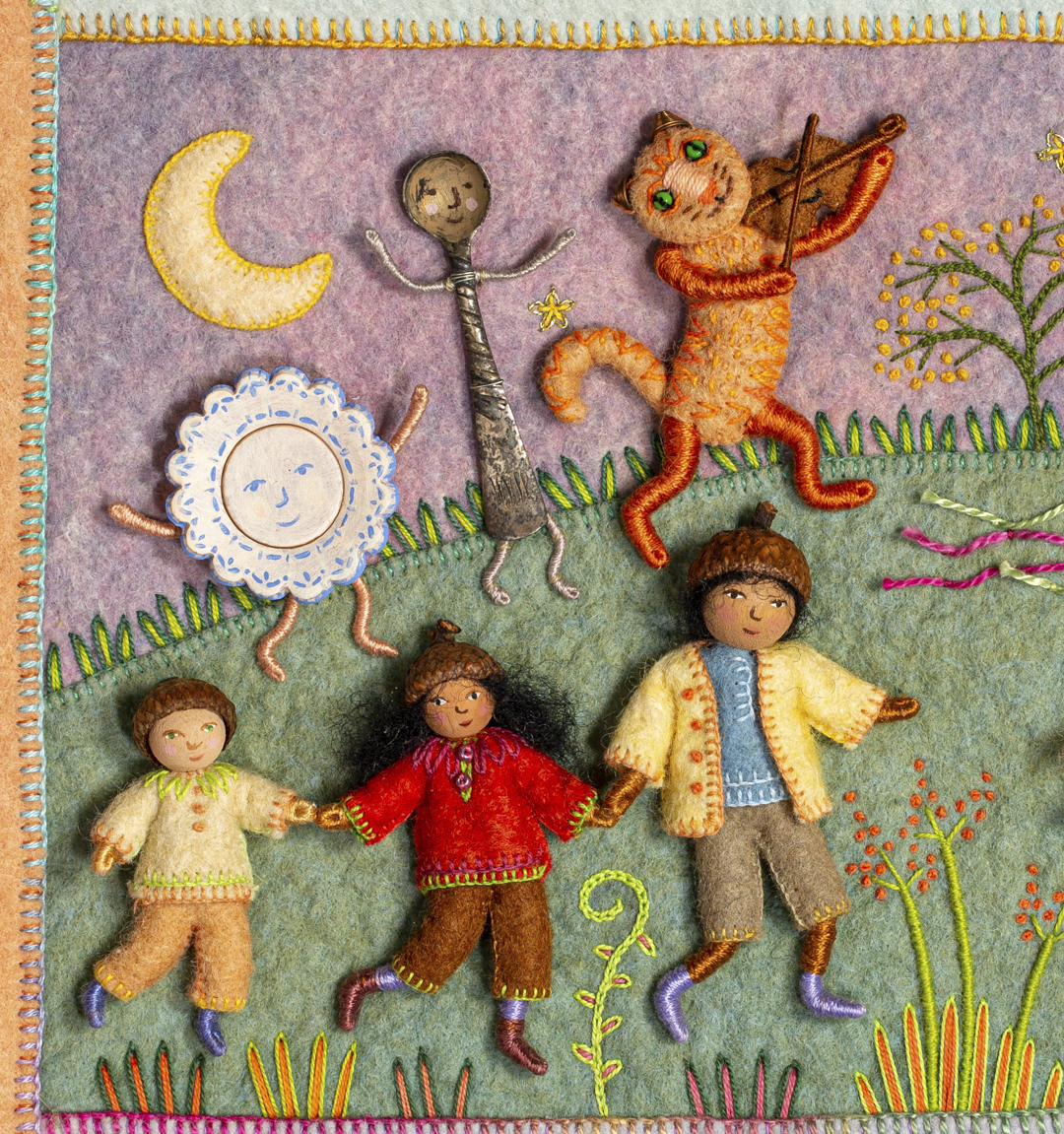
Today, I’d like to revisit the classic rhyme, Mary Had a Little Lamb, which I illustrated in 1995. The smaller board book version was published 10 years later. It’s hard to believe that 28 years have gone by since it first came out. The reality hits me, though, when I meet grownup people who remember the book from their childhood. Both versions are out of print, but you may be able to find used copies online.

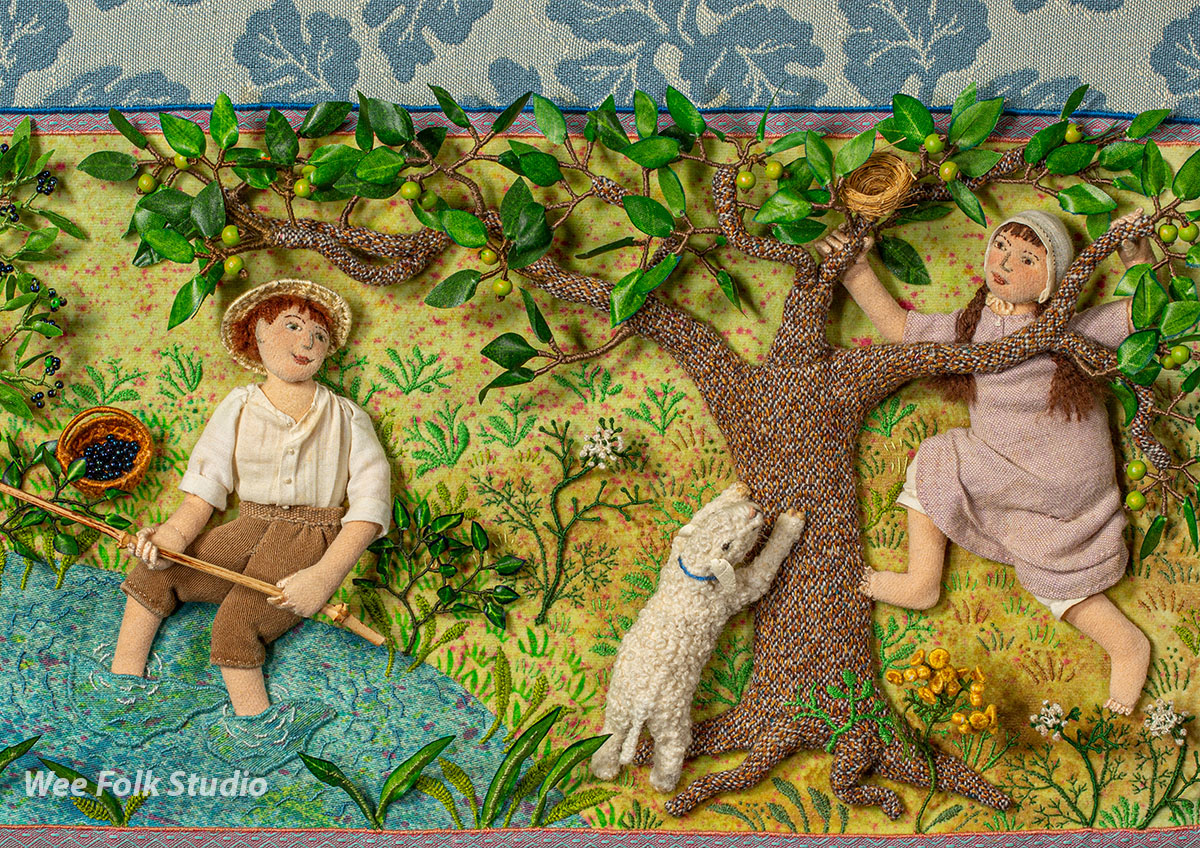
Mary Had a Little Lamb remains one of my favorite projects and I’ve wanted to reuse the artwork from the book for some time. So, I’m happy to say that I just added 4 new note cards with images from the book to my Etsy Shop. There’s Mary and her lamb in the garden, in the barn, in the kitchen and in an apple orchard. The cards are available in 4 or 8 card samplers. Individual designs are also sold separately in packs of 4.

Note cards are available in my Etsy Shop..

All of the original 3-dimensional scenes I made for Mary Had a Little Lamb are in private collections. Fortunately, several owners are willing to loan them from time to time for exhibition purposes. Last summer, 8 pieces from the book were in my retrospective at the Brick Store Museum in Maine. And this coming fall, I hope to include a group of them in The Wee Words of Salley Mavor at the Southern Vermont Arts Center.

“Mary in the Garden” in a private home.

Judy Sue Goodwin-Sturges, my former teacher from RISD, generously loans pieces from her art collection for exhibitions. Picking them up is also a good excuse to visit her in Providence, RI. By the way, take a look at her shelves full of Guatemalan huipils behind us!

Mary Had a Little Lamb – apple tree note card
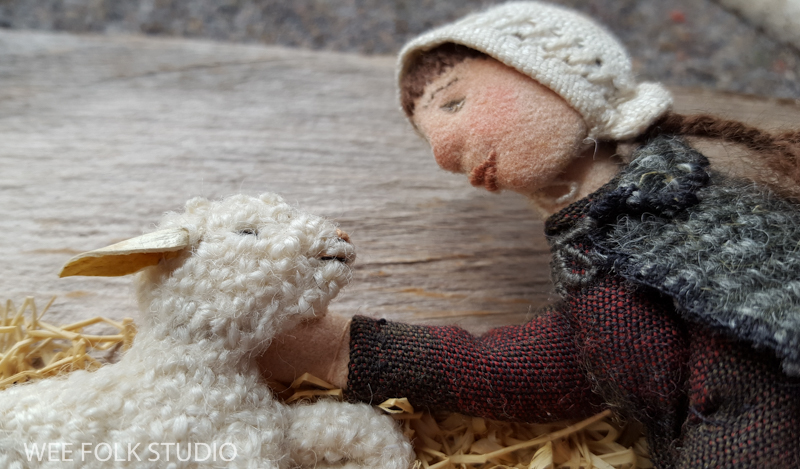
Mary Had a Little Lamb – barn note card

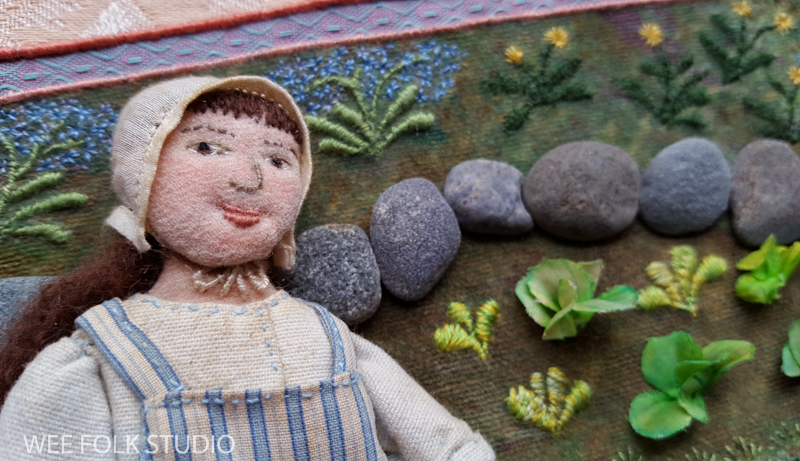
When I borrow the pieces, I often remove the stretched artwork from its frame to clean the inside of the glass. Then, I can take close up photos, like this one of Mary and her lamb in the barn and others you can see below.

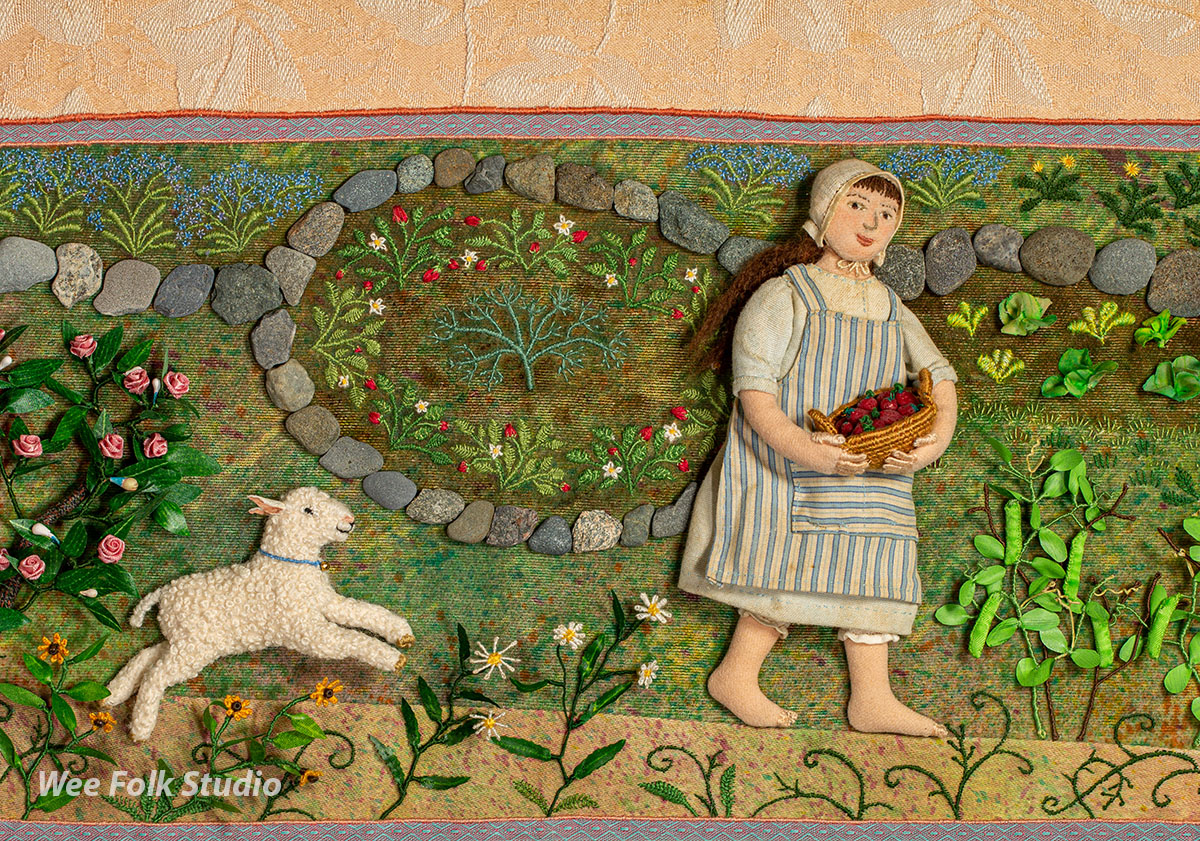
Mary Had a Little Lamb – garden note card

Back in the 90’s, I embroidered character’s faces on hand-me-down fabric from my grandmother. The cloth was originally an old woolen petticoat that had been laundered so many times that it became felted. It was the perfect weight to work with and had a sturdy and forgiving texture that put up with multiple stabbings from a needle and thread. Eventually, I used up all the fabric and could never find anything to replace it. By then, I’d begun painting faces on wooden beads and I really didn’t miss embroidering faces. Sometimes, I would spend all day ripping out the stitching and starting again to get the right facial expression.

In this close up you can probably tell that the strawberries are made from polymer clay. The basket is made of wire wrapped in embroidery floss.

Mary Had a Little Lamb – kitchen note card

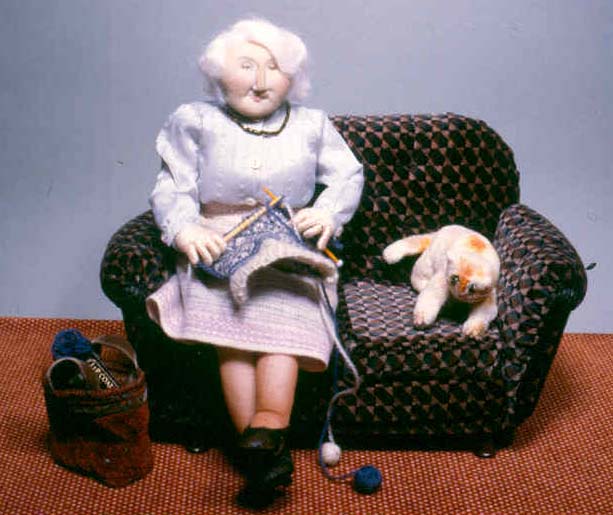
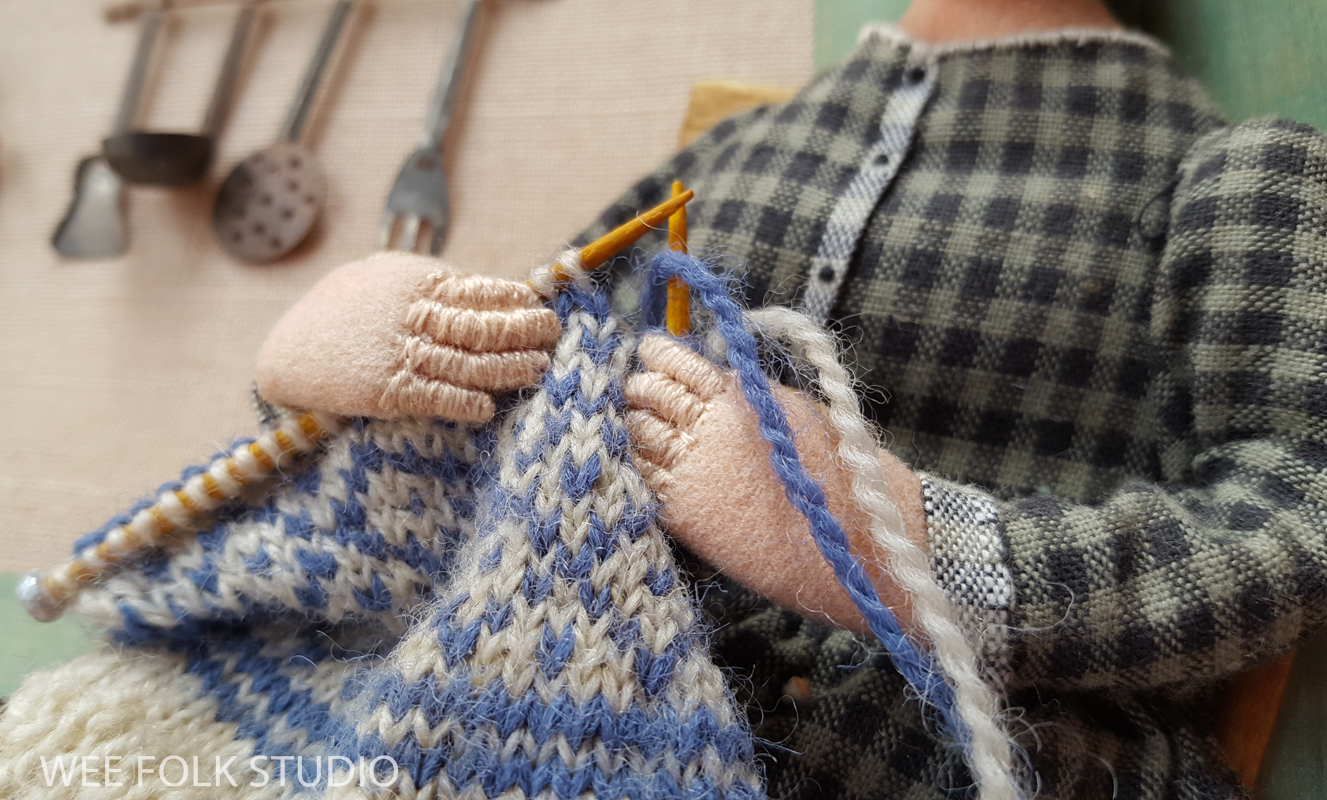
The blue and white knitting in the mother’s lap was originally part of a sculpture of a knitter sitting on a couch that I made in about 1980, which you can see below. I figured that the doll didn’t need her knitting any more, so I stole it and gave it to Mary’s mother. I’ve never been much of knitter and this would save me having to make a new one. And besides, it was the perfect scale!

Practically everyone who sees this asks, “Did you actually knit this on those tiny knitting needles?” I suppose it’s possible to knit with tooth picks, but I’m not that neurotic. Remember, making art is all about creating illusions. I used real needles, the kind that are for knitting baby booties and such, and then replaced them with with tooth picks.

Enter my Etsy Shop here.
A note to my international followers – Due to the unreasonably high cost of shipping overseas, I now only take orders from the USA and Canada.

To keep up with new posts, please subscribe to this blog. Your contact info will not be sold or shared. If you’d like to see more frequent photos tracking the projects in my studio, please follow me on Facebook, Instagram and BlueSky.

Harvest Time – part 5 (toadstool mushroom)

In Part 5 in the continuing series about making Harvest Time, I share photos and commentary about making the purple toadstool mushroom and the wee folk forager sitting under it. In the coming weeks, I will continue to post stories that focus on different aspects of making the fall scene, including the other wee folk figures, storage containers, tunnels, roots, and stones. So far, I’ve written the following posts:
The overview introduces the Harvest Time piece.
Part 1 features moss making.
Part 2 is about making the turkey tail mushroom.
Part 3 shows the construction of felt leaves.
Part 4 gives a peek at embroidering the plants.
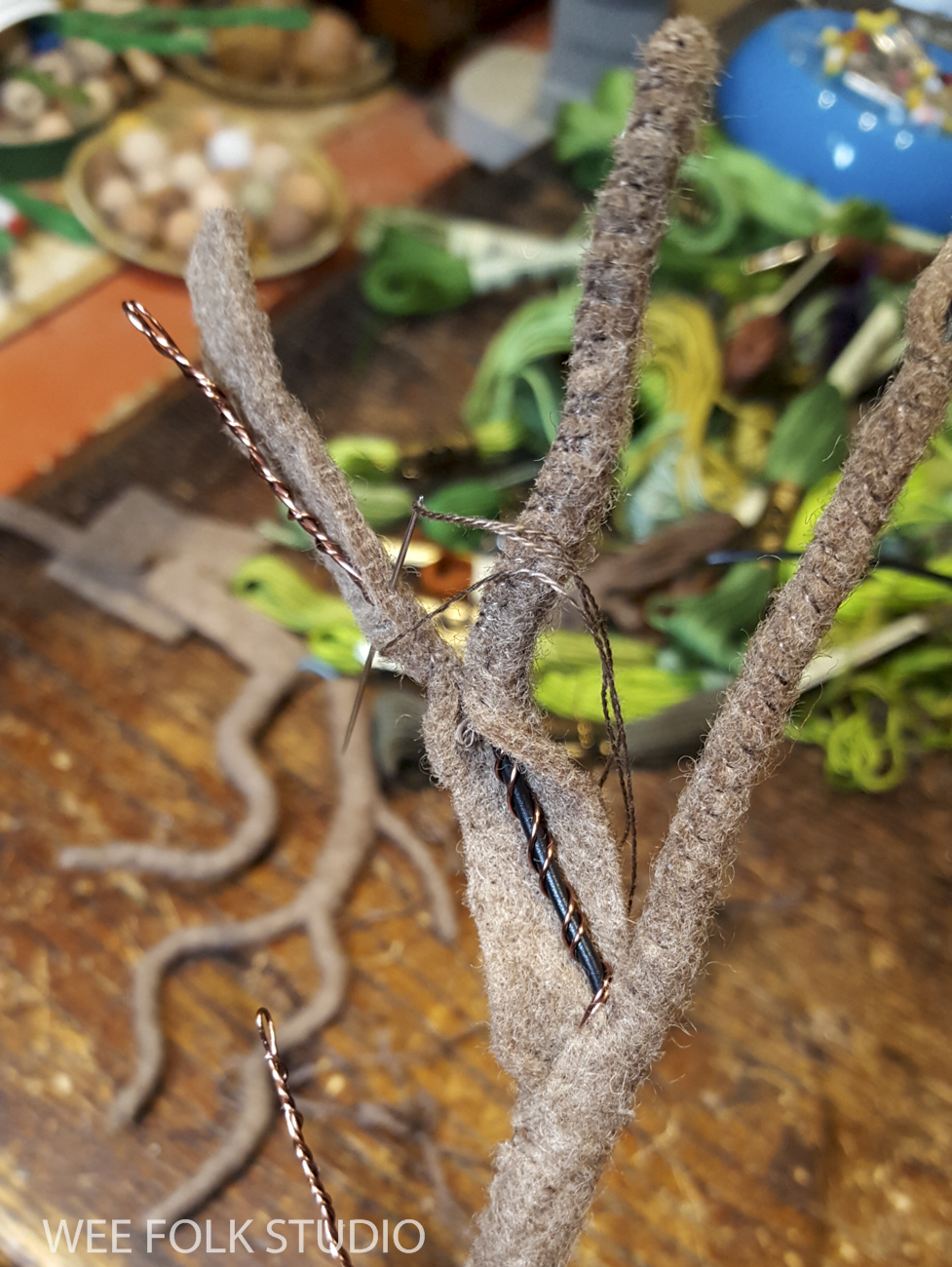
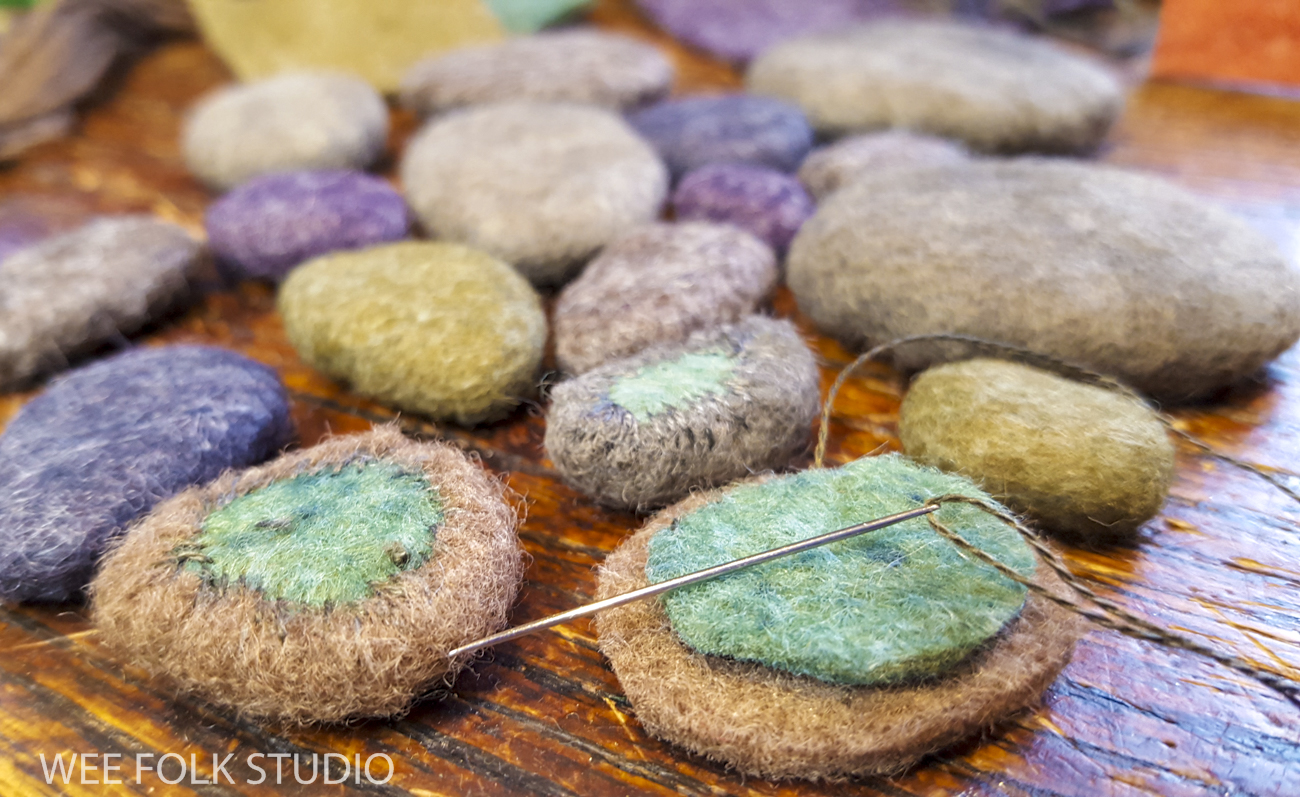
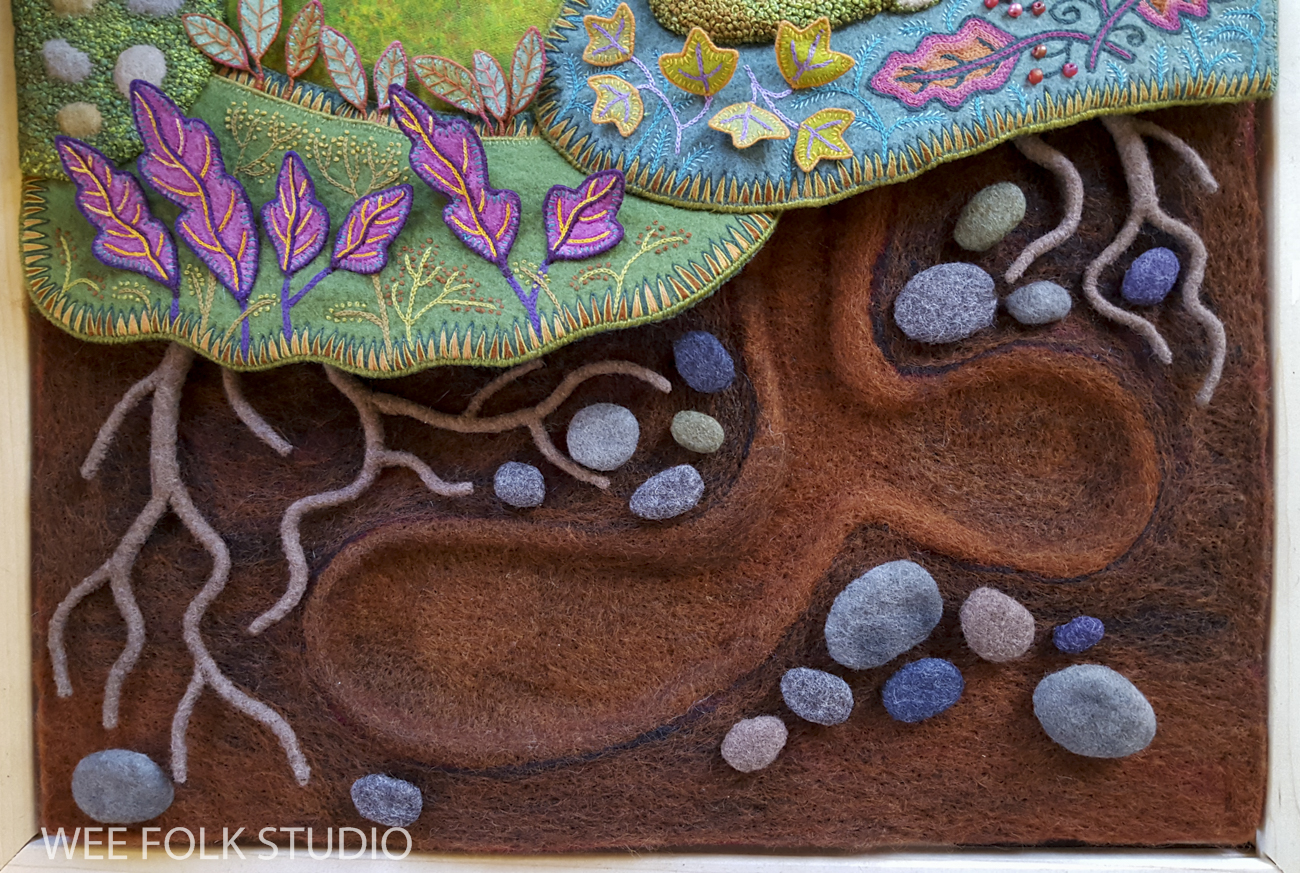
Part 6 shows the process of making the underground

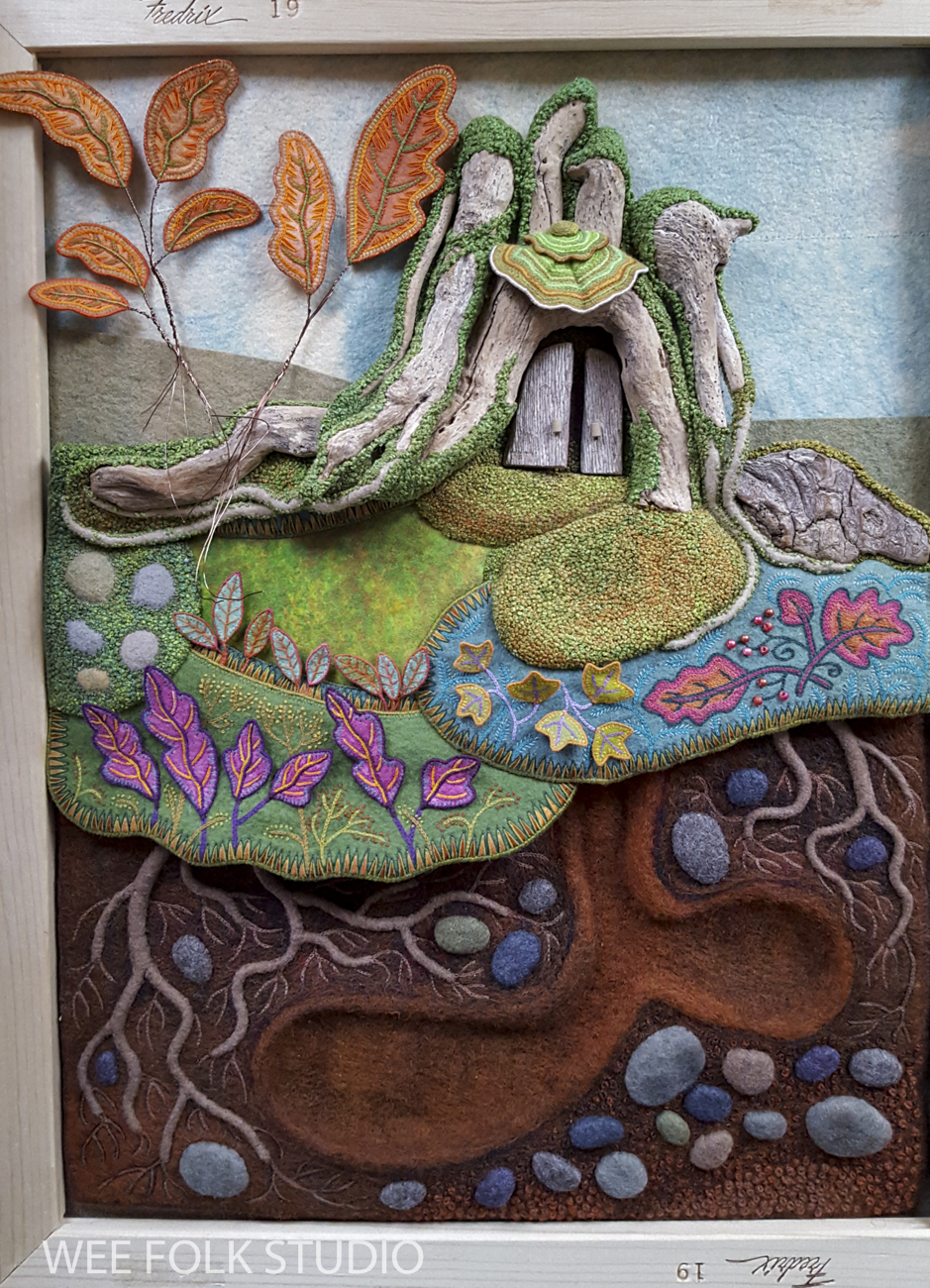
Harvest Time is the fall scene in a series of seasonal landscapes that capture the wonder and magic of the natural world, both real and imagined. Note cards and jigsaw puzzles of the this and other scenes in the series (Frosty Morning and Mossy Glen) are available in my Etsy Shop.

Harvest Time Jigsaw Puzzle

I don’t know why I didn’t include mushrooms in the original sketch. It seems so obvious now, especially for a fall landscape. The idea of putting one in the scene came later, when I shifted over the stump and created a place to fill on the right horizon.

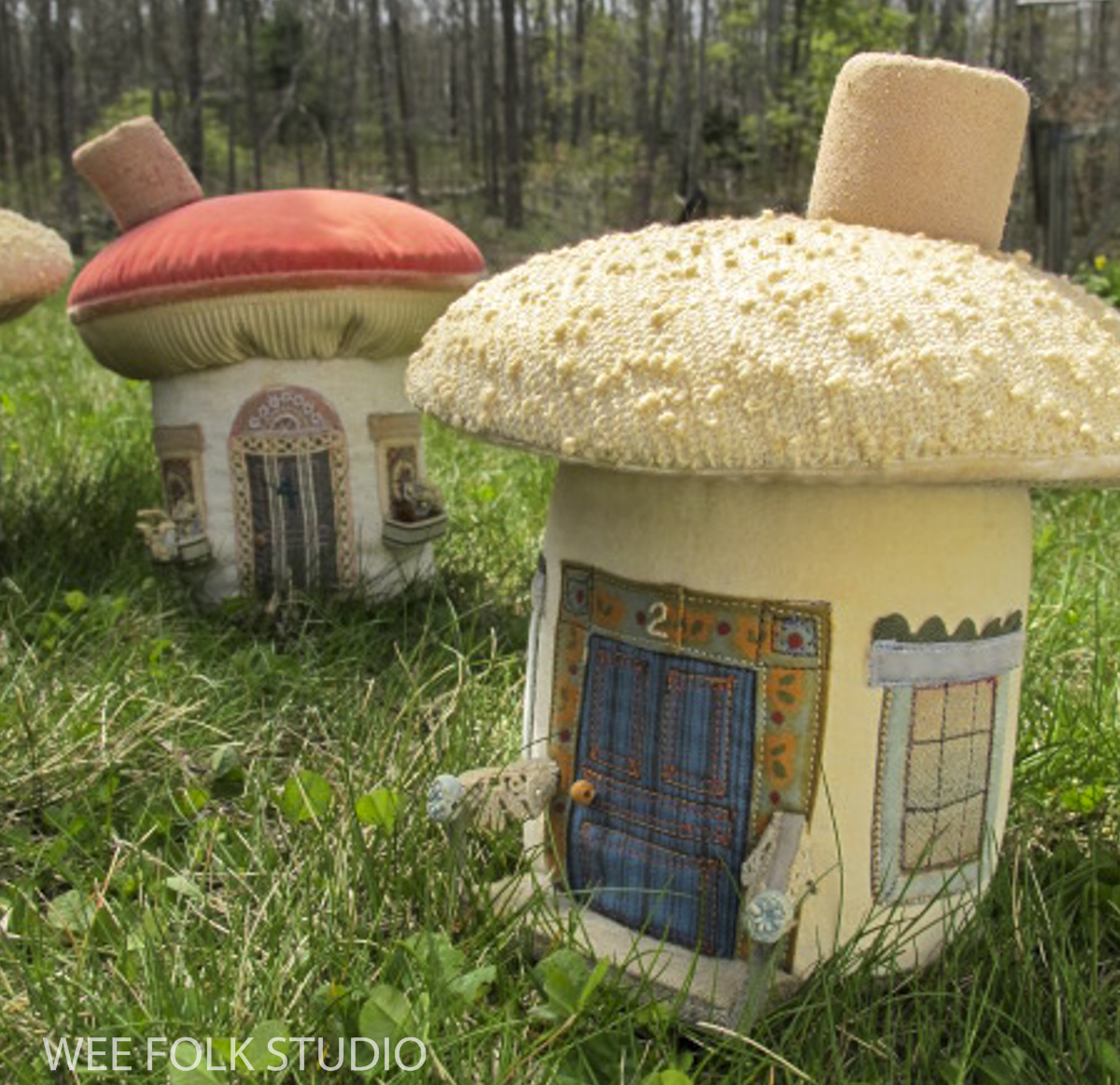
Toadstool mushrooms have popped out in my artwork for over 40 years. These are some mushroom houses I made in 1979, back when I used a sewing machine.

When I went into business selling fairy kits in 1998, I designed a logo with a red-capped mushroom house. My 10 year stint making kits is long gone, but I still use the same logo.

In this scene from 2009, I used both real mushrooms from the supermarket and more fanciful ones that I made with polymer clay and painted kid leather.

This mushroom with a fairy taking shelter underneath is in my 2010 picture book, Pocketful of Posies, illustrating the rhyme, “Rain on the green grass, and rain on the tree; Rain on the housetop, but not on me.”

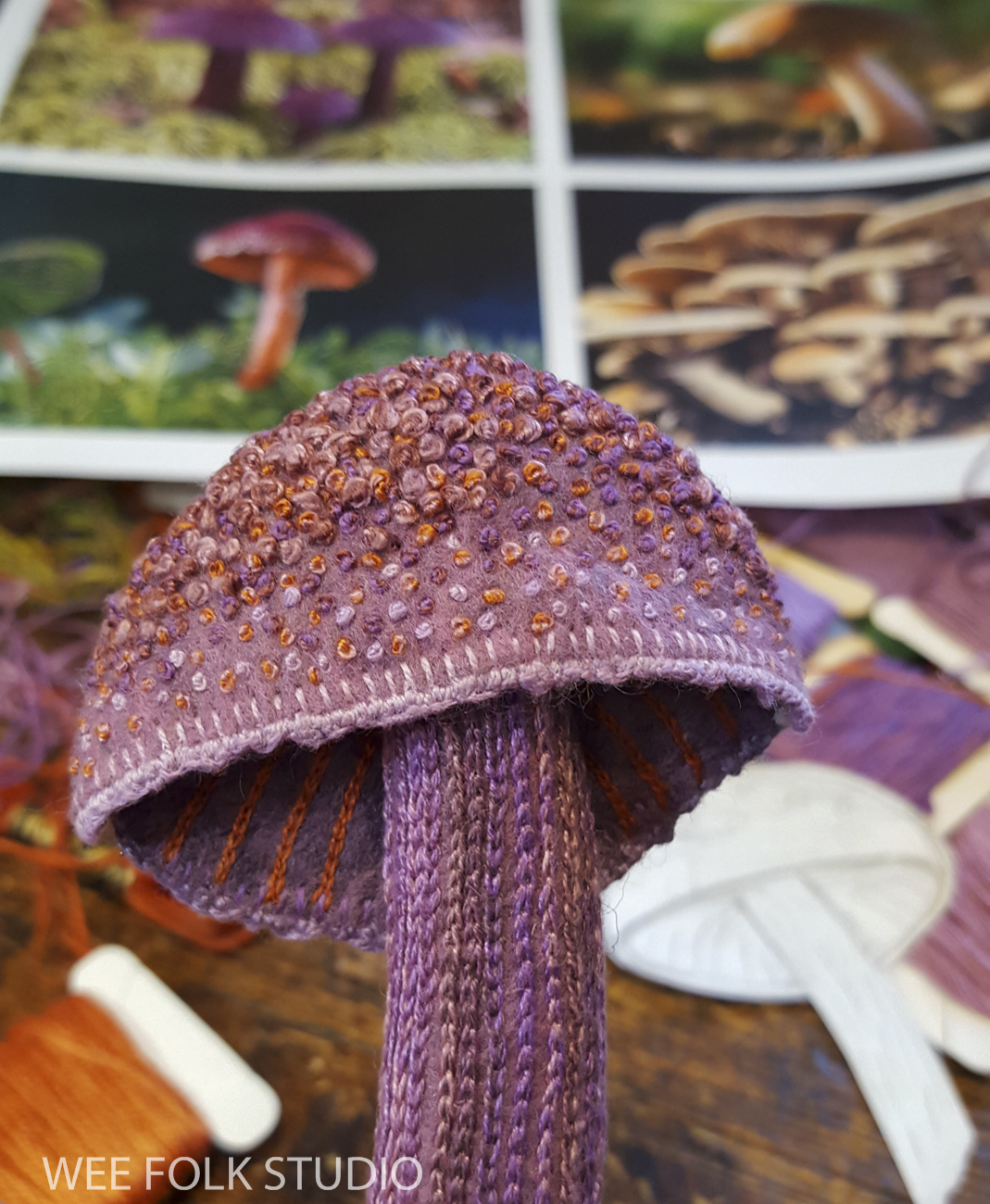
For Harvest Time, I chose a different type of mushroom. The idea of a purple toadstool struck my fancy, so I researched the Inky Cap variety. Besides being attracted to the purple/orange color combo, I looked forward to replicating the texture on the cap.

To begin, I drew the mushroom to size and used a paper cutout as a guide. It took some fudging to figure out the size and shape to cut the felt, because the front piece of the cap would be curved and sticking out about 1/2″,

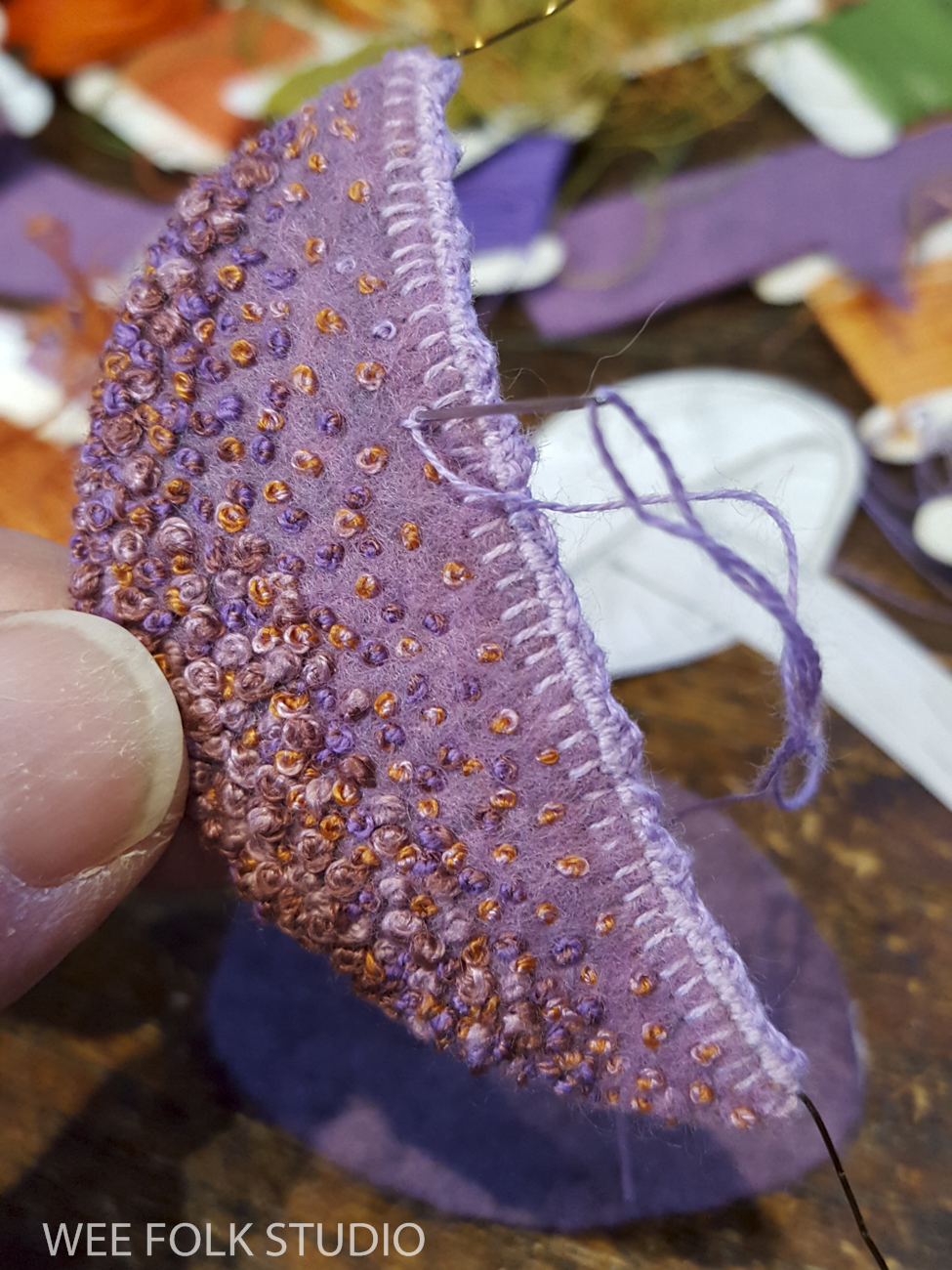
I sewed wire along the rim of the cap to help hold its curve. After covering the wire with stitches, I created an uneven edge with messy loops, so it would look more realistic. To make the bumpy texture on top, I stitched French knots with different shades of purple and orange embroidery floss.

To make the stem, I cut out a thin strip of felt and covered it with lines of chain stitching.

I forgot exactly how I did this part, but it looks like I added a felt stem back piece that was reinforced with iron-on interfacing material. I must have thought it needed stiffening, since felt by itself is usually too floppy. Also, I probably stuffed the hollow cavity with wool fleece to keep it from collapsing.

I chain stitched scales with a contrasting shade of orange thread to the inside of the cap and sewed on the stem.

The mushroom and surrounding area looked lonely and plain, so I made a wee person to sit underneath.

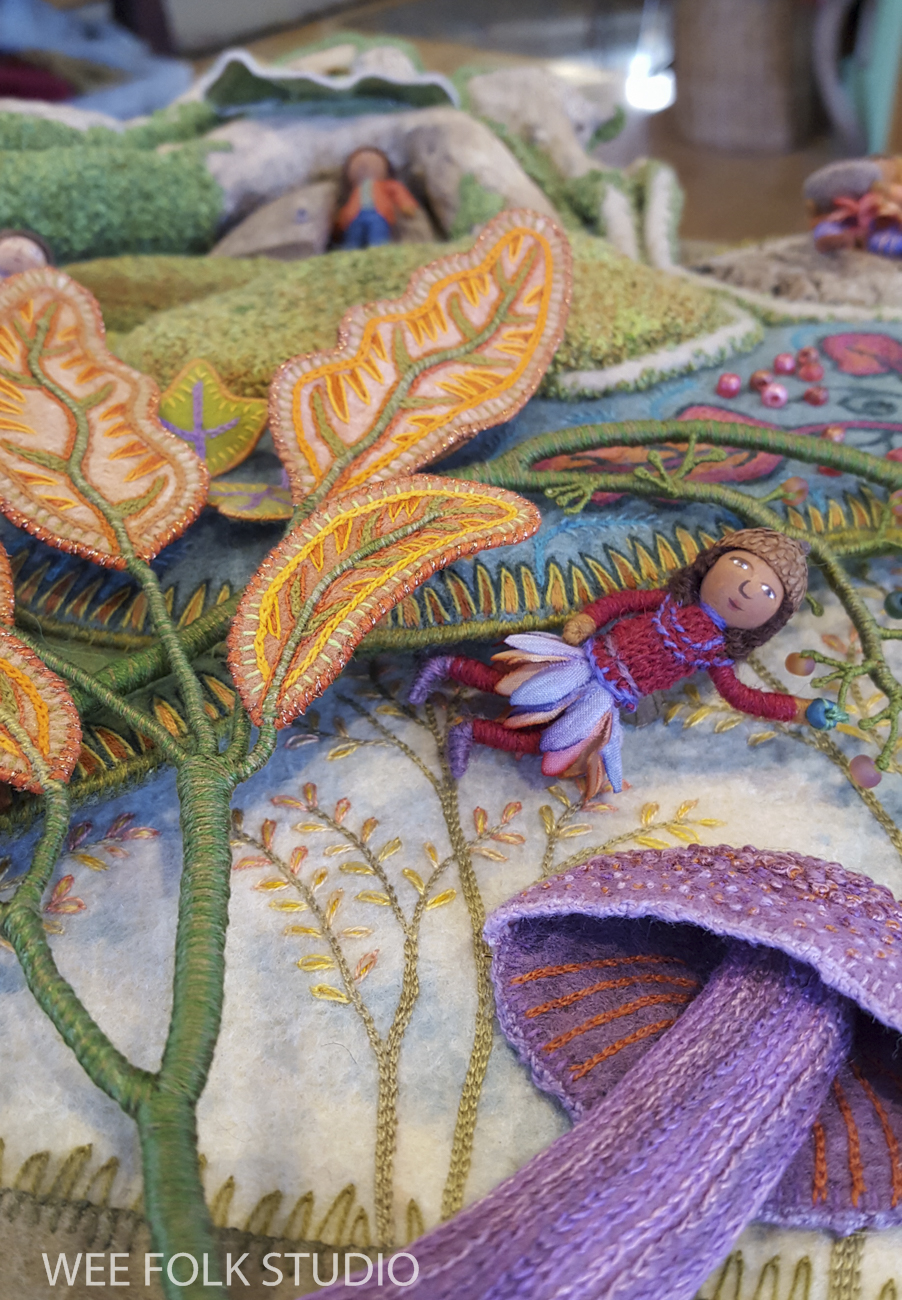
To make a figure, I formed an armature with 24 gauge jewelry wire and wrapped it with thread. This is the same basic technique that I teach in my how-to book, Felt Wee Folk, but on a smaller scale. I didn’t make separate clothing, but faux knitted a shirt and vest directly onto the body with chain stitching. The skirt is an artificial flower.

This Stitch Minute video shows faux knitting for a character in the spring landscape, Mossy Glen.

I painted a face on a wooden bead and glued braids and an acorn cap on top. Another acorn cap served as a container for glass bead “food”, which I sewed together in a bunch. The beads were sewn in place through drill holes in the acorn cap.

At this stage of the process, miscellaneous parts piled up, waiting to be assembled at the end, when everything is sewn to the background fabric. Please stay tuned for more stories about making Harvest Time, including the other wee folk figures, storage containers, tunnels, roots, and stones.

To keep up with new posts, please subscribe to this blog. Your contact info will not be sold or shared. If you’d like to see more frequent photos tracking the projects in my studio, please follow me on Facebook, Instagram and BlueSky.
Harvest Time – part 4 (embroidered plants)

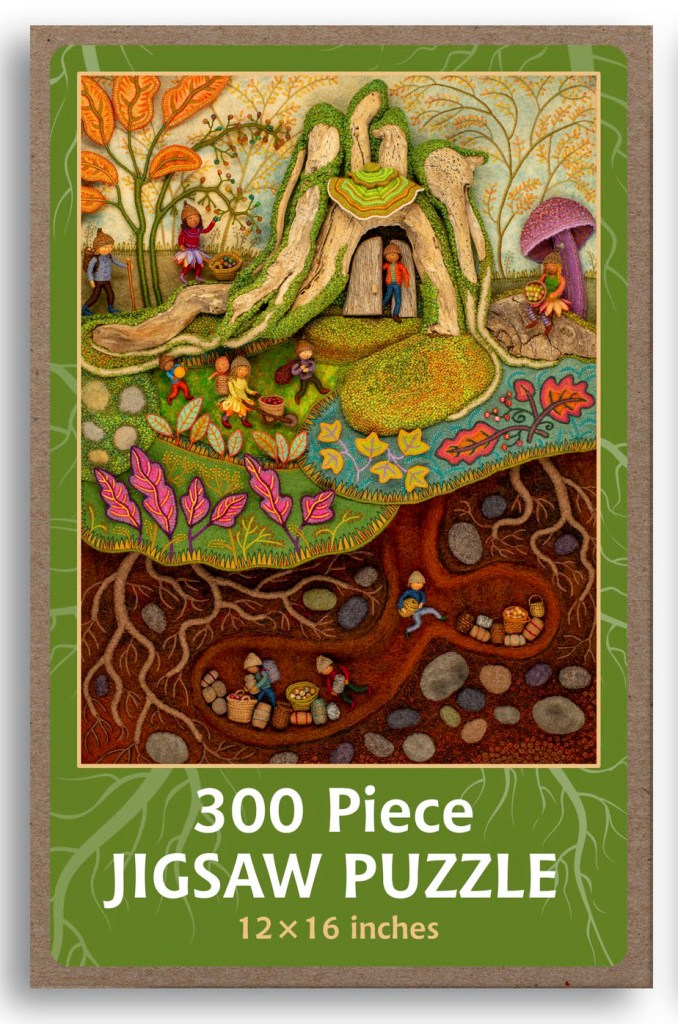
In Part 4 in the series about making Harvest Time, I share photos and commentary about embroidering plants to fill in around the 3-D felt leaves shown in Part 3. When planning out this piece, I wanted to come up with a way to separate the above ground front yard from the underground cutaway portion. I ended up embellishing gardens on pieces of felt that overlap the soil, roots, and stones below.

Harvest Time is the fall scene in a series of seasonal landscapes that capture the wonder and magic of the natural world, both real and imagined. Note cards and jigsaw puzzles of the this and other scenes in the series (Frosty Morning, Summertime and Mossy Glen) are available in my Etsy Shop.

Harvest Time Jigsaw Puzzle

I use a combination of flat embroidery and 3-D forms in my artwork because I think it’s more dynamic and eye catching that way. I also like the process of doing both, so I mix it up to keep myself interested.

This part of the process was more free form and reminded me of the simple embroidered foliage I made in the illustrations for Hey, Diddle, Diddle.

Hey, Diddle, Diddle! board book, 2005

To stabilize the floppy pieces of felt, I stitched and wrapped wire along the outside edges and then embroidered blades of grass.

Then I doodled stems with chain stitches and added French knot seeds.

This kind of work is portable, so I carried around all of the parts and supplies wherever I went…

…and did most of the stitching in front of the wood stove.

The orange and red leaves are chain stitched with DMC flower thread, which unfortunately has been discontinued. It’s thicker and not as shiny as regular embroidery floss and has a sturdy feel that I find satisfying. I treasure my supply of flower thread and have enough to last my lifetime.

Glass beads make great berries.

I glued a piece of driftwood to the top of one section to make a perch for a wee folk forager to sit on. Doesn’t the whole thing look like a shoe!

I also created a mossy patch of front lawn to go just below the doorway with hundreds, if not thousands of French knots.

I padded the back of the embellished pieces with layers of thick felt so that they would stick out and float above the cutaway underground portion, which I’ll get to later in the series.

In future posts, I will focus on different aspects of making Harvest Time, including the toad stool mushroom, wee folk figures, storage containers, needle felted tunnels and cold cellars, roots, and stones.

The overview introduces the series.
Part 1 features moss making.
Part 2 is about making the turkey tail mushroom.
Part 3 shows the construction of felt leaves.
Part 4 gives a peek at embroidering the plants.
Part 5 is about making the toadstool mushroom
Part 6 shows the process of making the underground

To keep up with new posts, please subscribe to this blog. Your contact info will not be sold or shared. If you’d like to see more frequent photos tracking the projects in my studio, please follow me on Facebook, Instagram and BlueSky.

What’s NEW in my shop?

Mossy Glen jigsaw puzzle

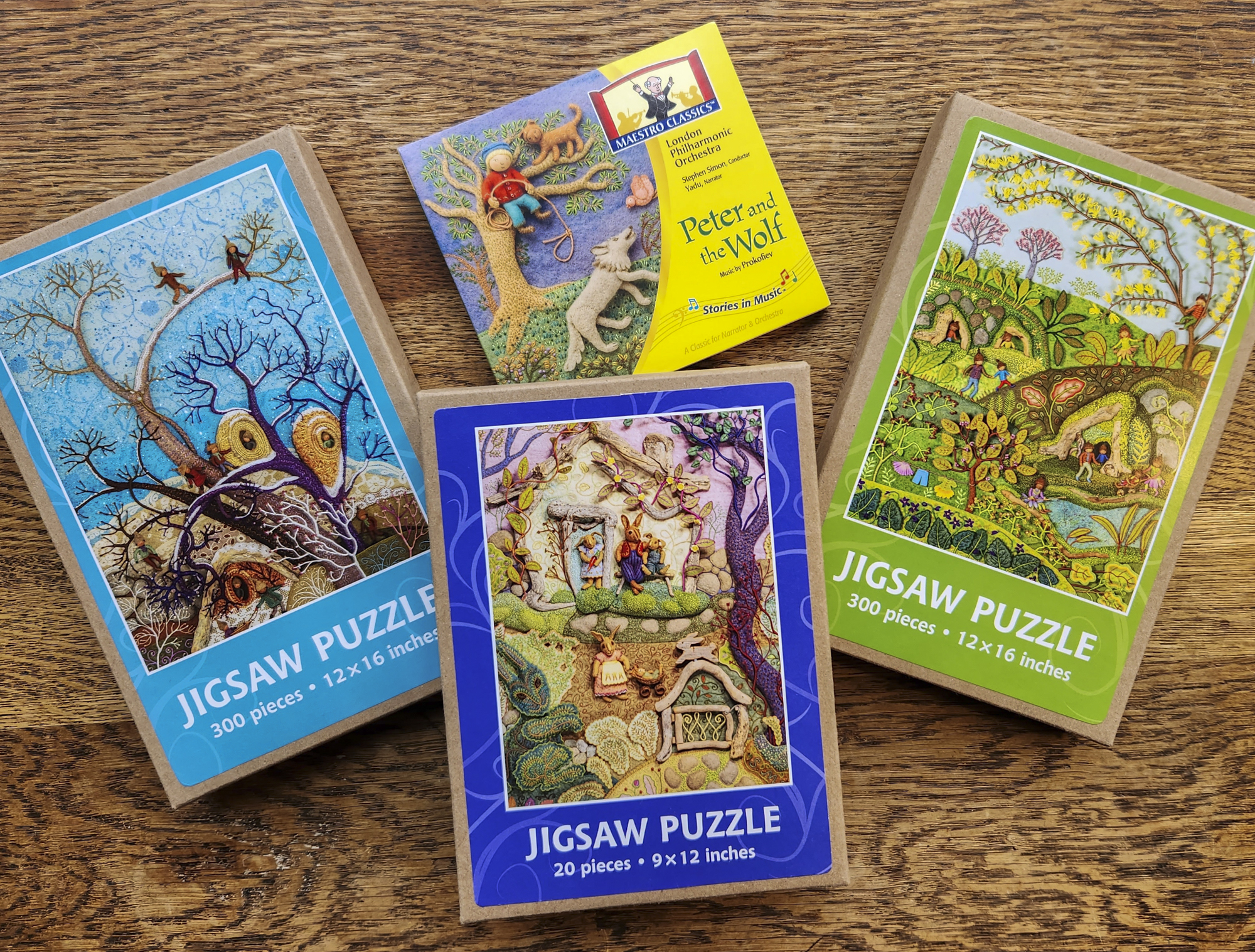
With Spring presumably right around the corner and Easter coming on April 9th, it seems like a good time to let you know about some new items in my Etsy Shop. I’ve added 3 more jigsaw puzzles, including Rabbitat, a bunny filled puzzle for children, made with 2″ x 3″ sized pieces. I’m also offering CDs of the award-winning Maestro Classics version of Prokofiev’s Peter and the Wolf, which features my artwork on the case and 20-page activity booklet.

RABBITAT, the 20-piece 9″ x 12″ jigsaw puzzle for children and other new items are available in my Etsy Shop here.

When setting out to make Rabbitat in 2011, I had just two things in mind – a driftwood house and a rabbit shaped topiary. As I built up the scene, an imagined scenario unfolded. Over time, a family of rabbits came to live in the house and a whole landscape grew around the topiary.
RABBITAT jigsaw puzzle for children

RABBITAT is the focus in this short documentary film about my work.


For a long time, fans have suggested that my artwork would translate well into puzzle form. I thought so, too, but was too busy stitching to do anything about it. After years of searching, I finally found a high quality and economically feasible manufacturing arrangement. So, last fall I tested the market with two puzzle designs: Birds of Beebe Woods and Harvest Time, the fall scene in my seasons series. The response was so positive, that I was encouraged to add the Spool Heart puzzle for Valentine’s Day.

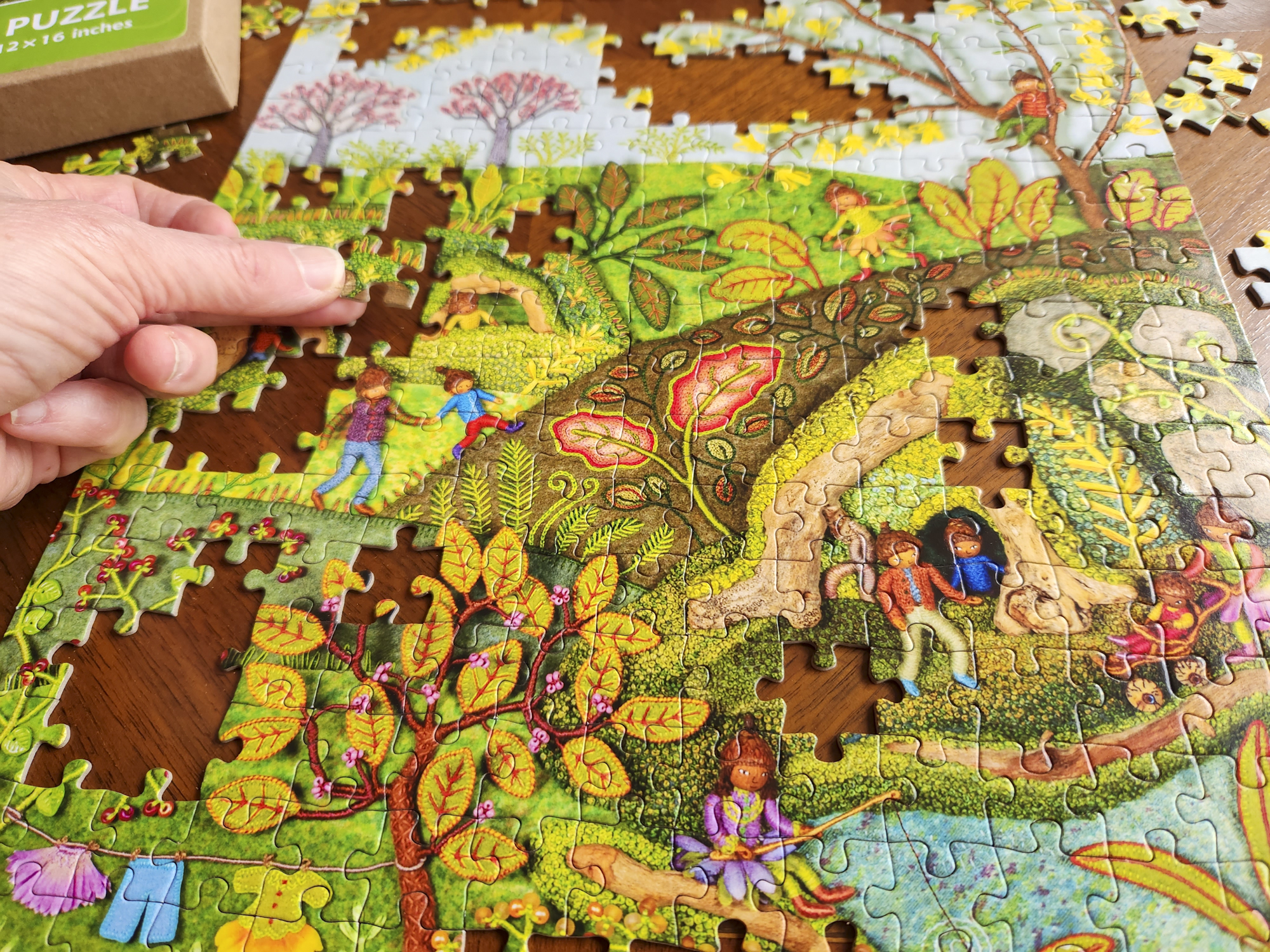
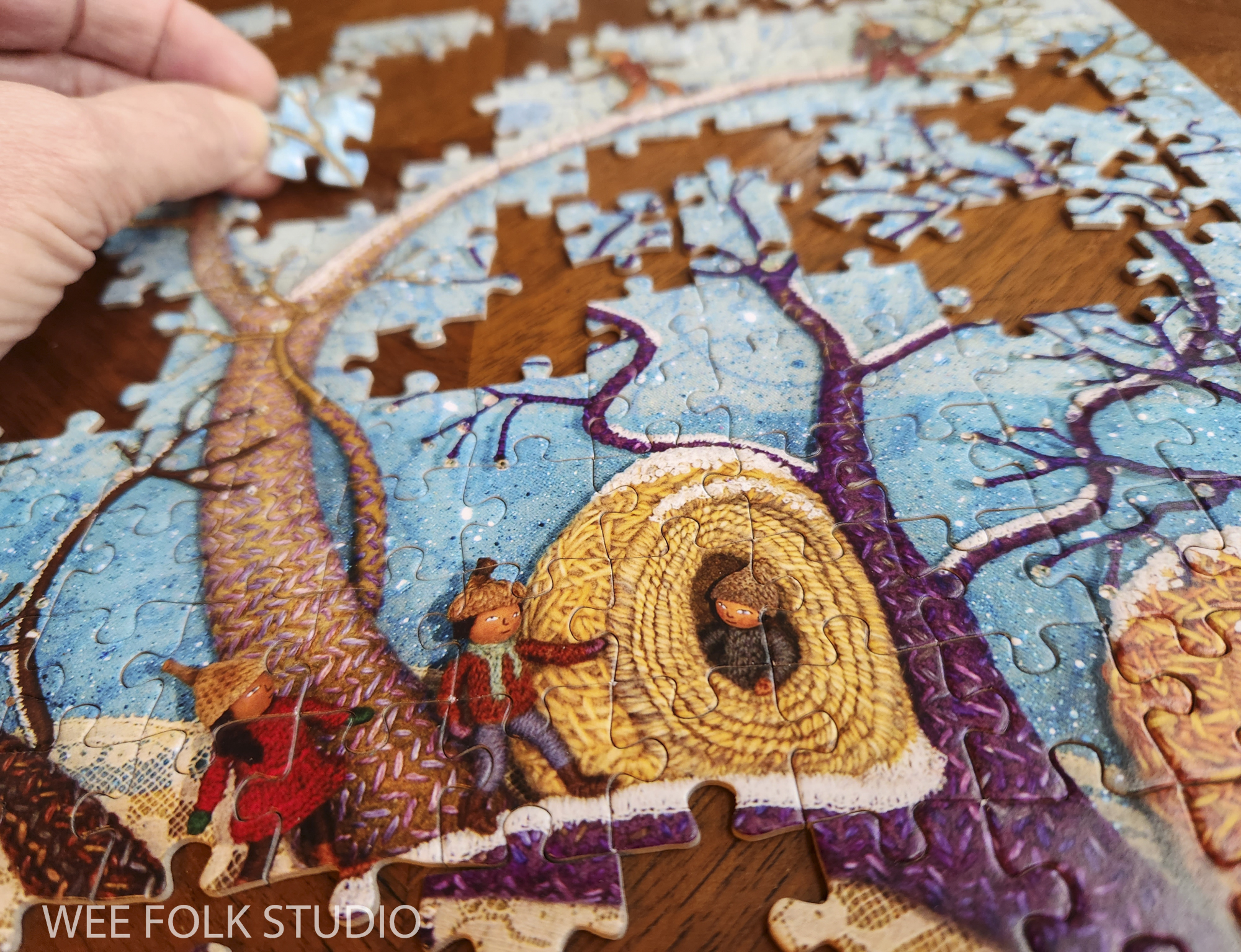
Along with the children’s puzzle, Rabbitat, I’ve added two more scenes from my series of seasonal landscapes to the jigsaw puzzle collection: Frosty Morning (winter) and Mossy Glen (spring). So, when will all 4 seasons be completed? The summer scene is coming along slowly but surely and I hope to have it finished, photographed, and made into a puzzle and cards by the fall. You can follow its progress on Facebook and Instagram.

Mossy Glen jigsaw puzzle
Frost Morning jigsaw puzzle

Peter and the Wolf CD
I just loved creating the artwork to go along with the Maestro Classics CD of Peter and the Wolf. The Russian story and my folk art style were a perfect match it was a joy to bring Peter and the animals to life.

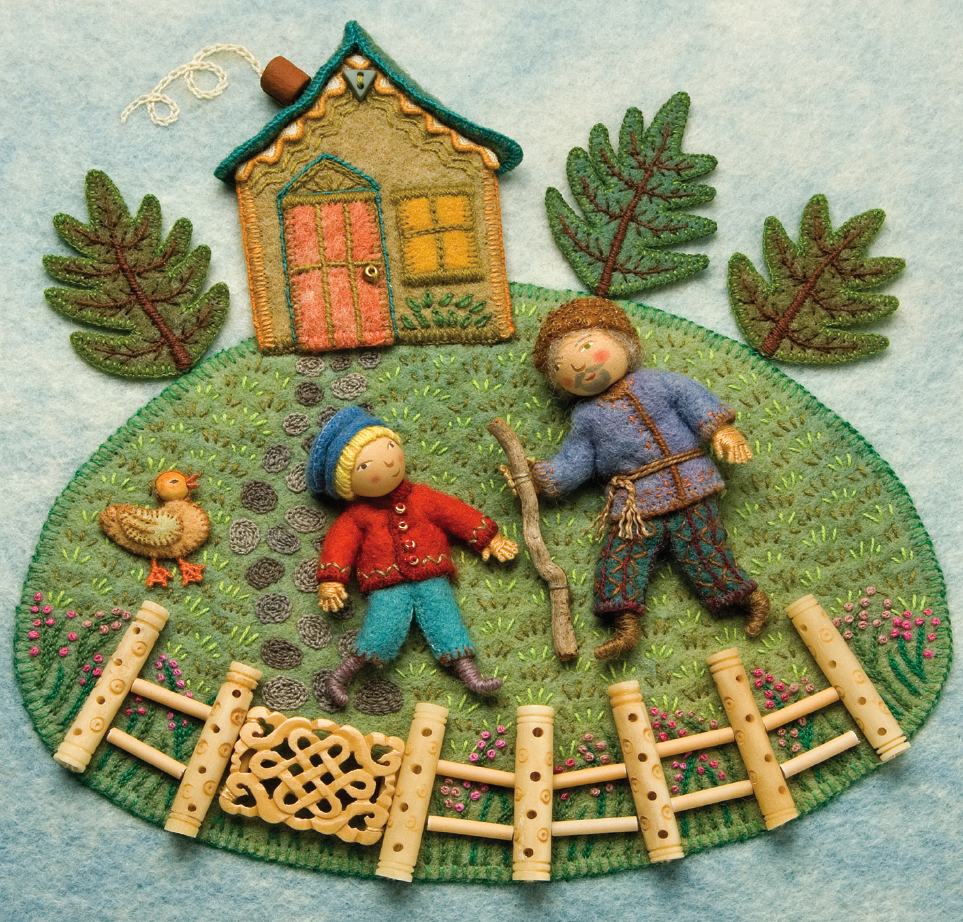
In addition to designing the cover illustration with Peter and the cat in the tree, with the bird taunting the wolf, I made a scene with Peter, his grandfather, and the duck to be used inside the case. 

I also made individual characters from the story, including the hunters, to be used in a little activity booklet of games and information that comes with the CD. After 10 years in print, the Maestro Classics production of Peter and the Wolf continues to be a best seller!

To keep up with new posts, please subscribe to this blog. Your contact info will not be sold or shared. If you’d like to see more frequent photos tracking the projects in my studio, please follow me on Facebook and/or Instagram.

Baby Banner for Elias

For the past 15 years or so, I’ve made personalized gifts for friends and family that commemorate special events like weddings and births. These embellished felt banners combine two of my favorite things, hand embroidery and handwriting. You can see this and other banners by scrolling through the archives here.

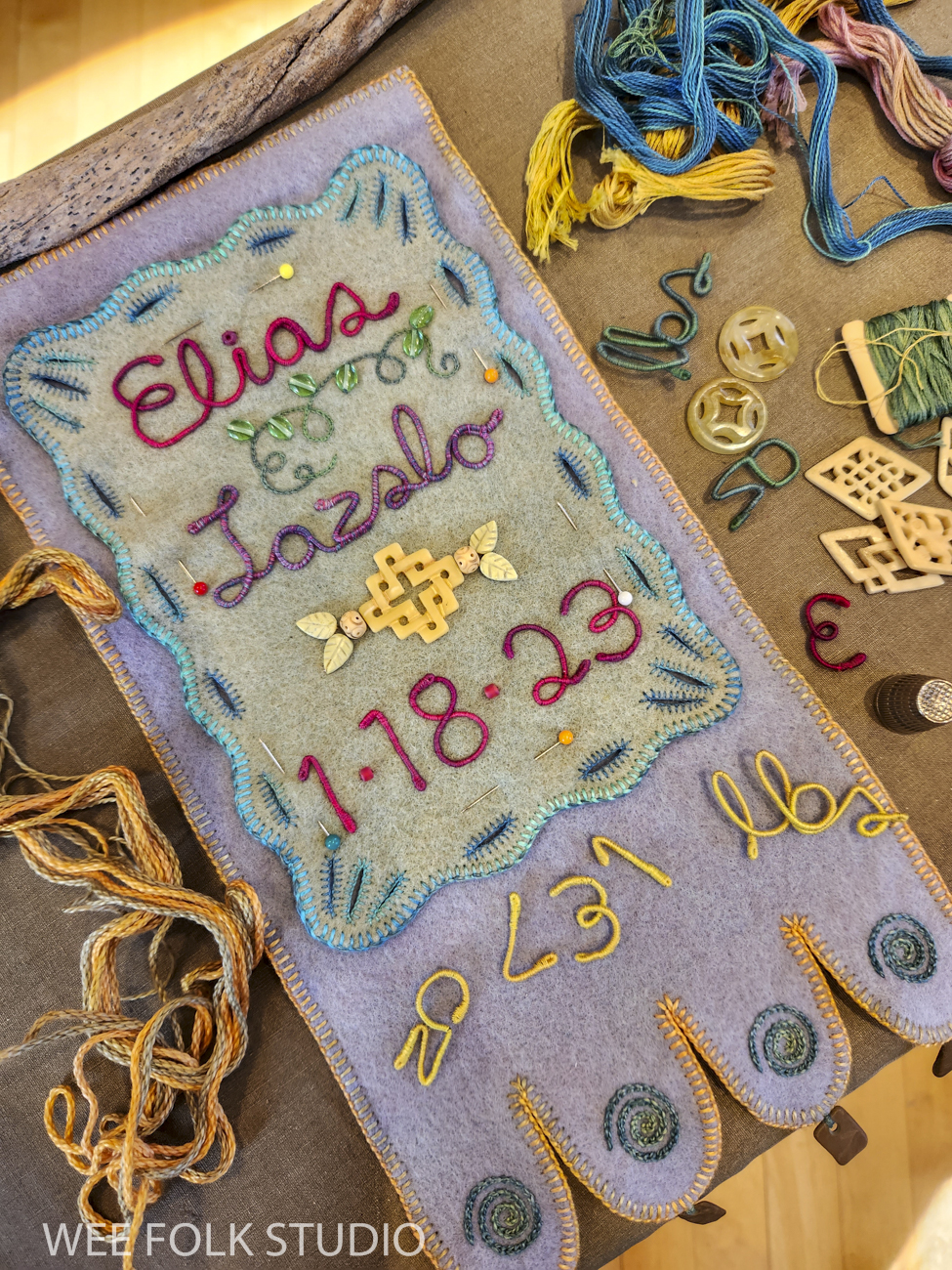
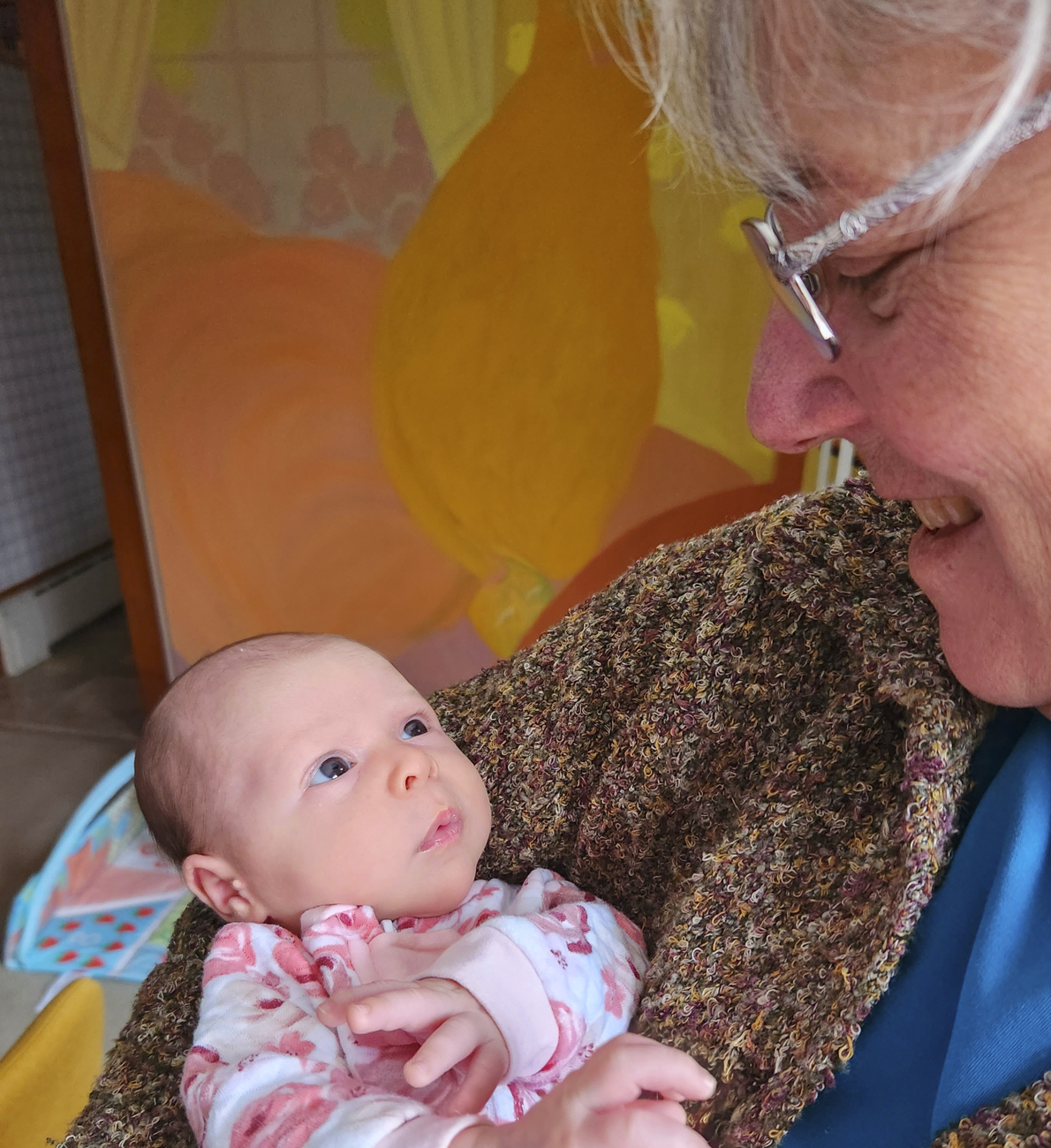
Now, I finally had the opportunity to make a banner celebrating a birth in my immediate family! Last month, our son Ian and his wife Liz became the parents of our first grandchild! Little Elias was born on Jan. 18th, 2023, 100 years to the day after my father.

We are all completely in love with with this little guy! I just love watching my son interacting with his son. As an extra bonus, the new family lives practically across the street, so we get to see Elias all the time. I can already feel my focus shifting into Grandma mode, which is a welcome change. Hopefully, there will be room in my heart and daily schedule for both art and being a Grandma.

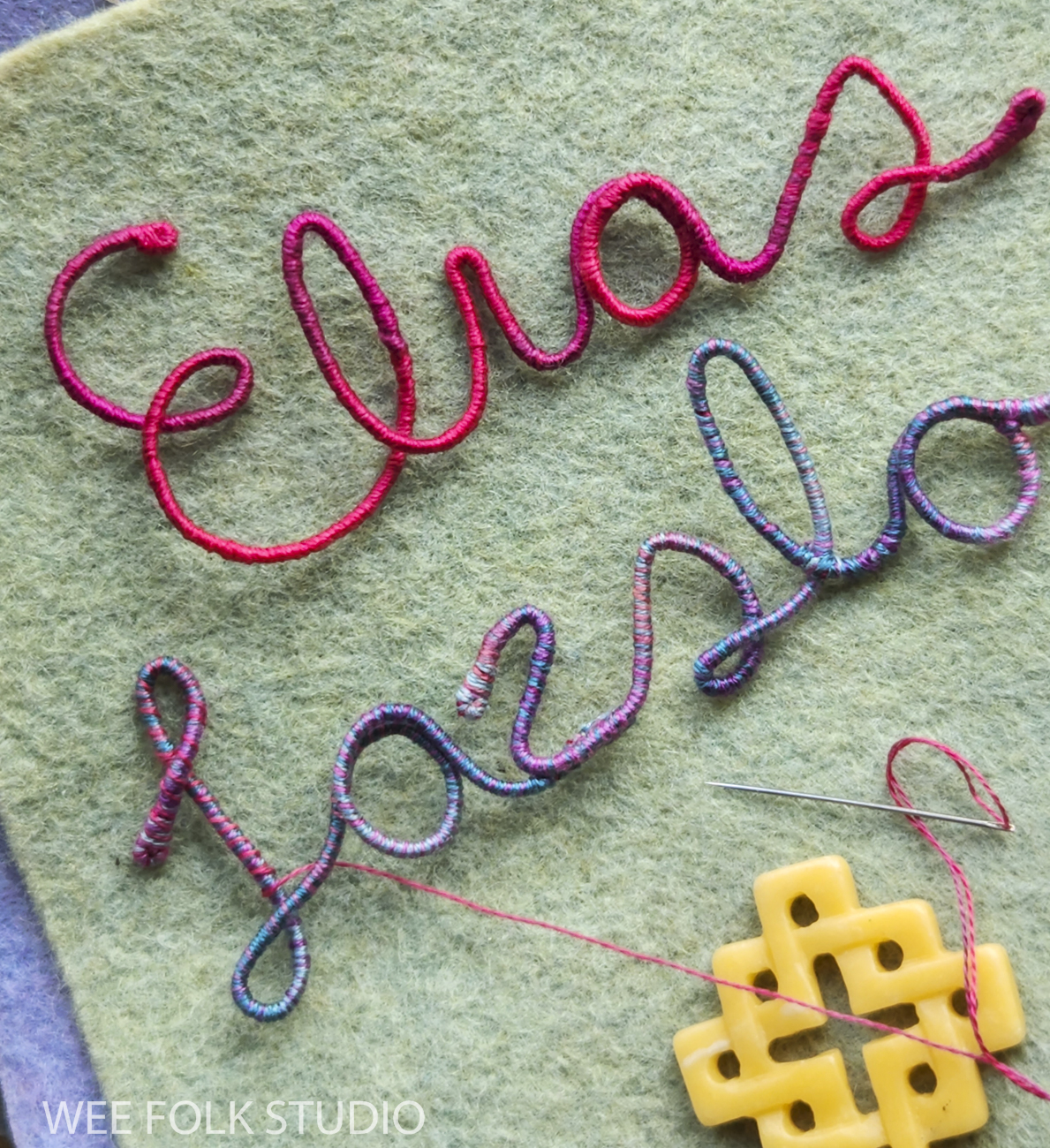
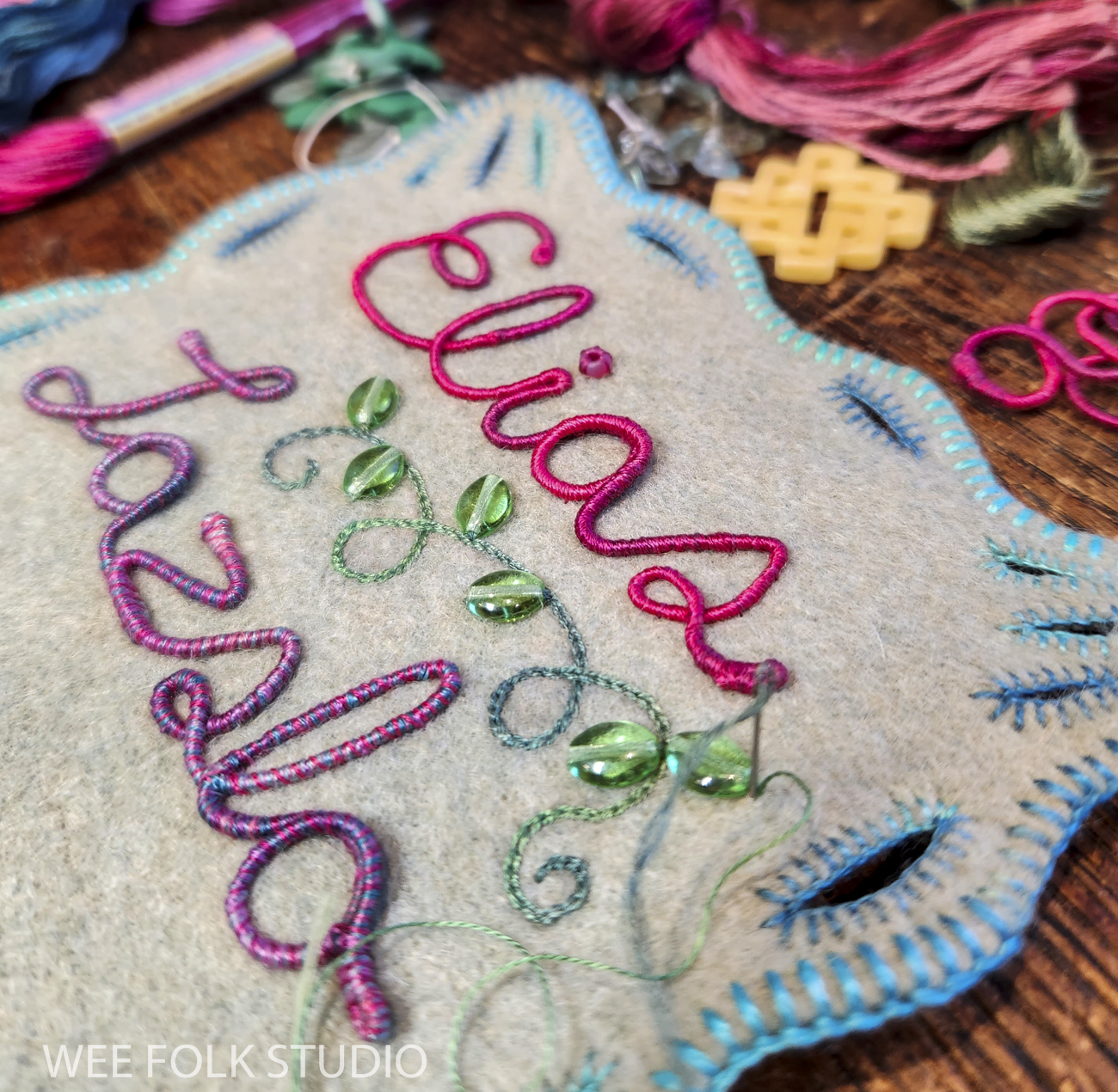
Naturally, I quickly got to work making a banner for Elias. After picking out the basic color scheme, I wrote his first and middle names in cursive handwriting on paper. Using that as a template, I made a 3-dimensional copy with memory thread. That way, I knew what length of wire to use.

I wrapped the memory thread (or wire) with 3 strands of embroidery floss.
UPDATE: I misspelled Laszlo, which is the baby’s maternal great-grandfather’s name! Watch this video to see the remake.

Remaking Laszlo

I usually use variegated floss to wrap the wire, which can look like stripes on the 2nd pass. The wire ends are bent over and wrapped, so that no raw ends are hanging out. It’s similar to the technique I use to make doll limbs in my how-to book Felt Wee Folk.

When I finished wrapping Lazslo and positioned it on the felt background, there wasn’t enough contrast, so I gave it a candy stripe to make it pop more.

I use an ironing board as a work surface. Here, you can see what I’m working on in the middle. On either side are printouts of banners I’ve made in the past, which I used for reference.

I had to wrap the numbers a couple of times because the size was off.

I edged the green felt panel with blanket stitches, using variegated pima cotton thread from the Caron Collection,

I wrote out the birth weight in green first and then did it over in yellow to create more contrast, which seemed to be a recurring theme with this banner.

After sewing the lettering onto the green background panel, I chain-stitched a vine to fill the open space between the names.

Out of my stash, I selected bone beads to make a decorative separator between the names and birth date.

I then sewed the green panel to the lavender background felt.

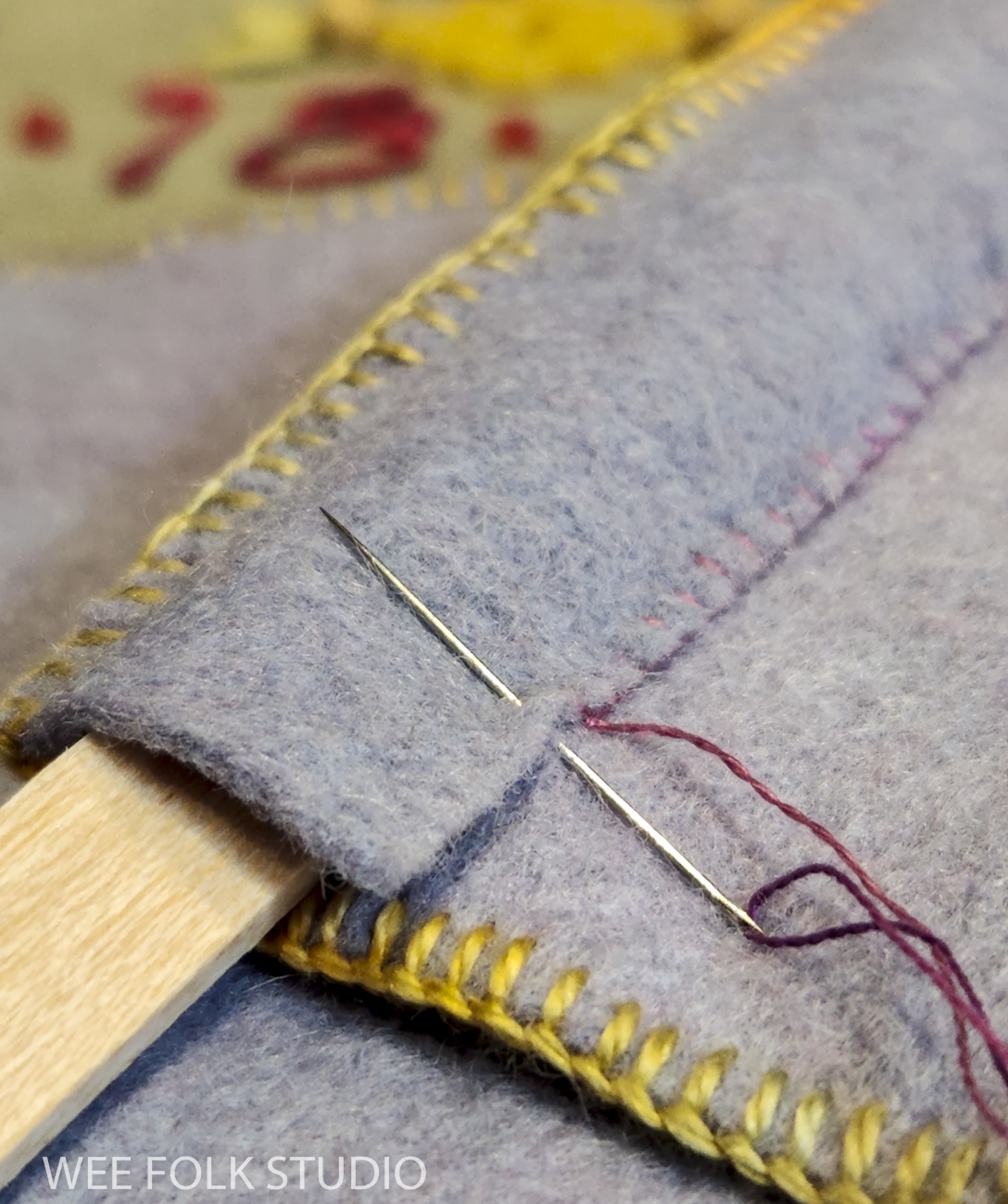
To make the banner rigid at the top, I made a sleeve and inserted a piece of wood.

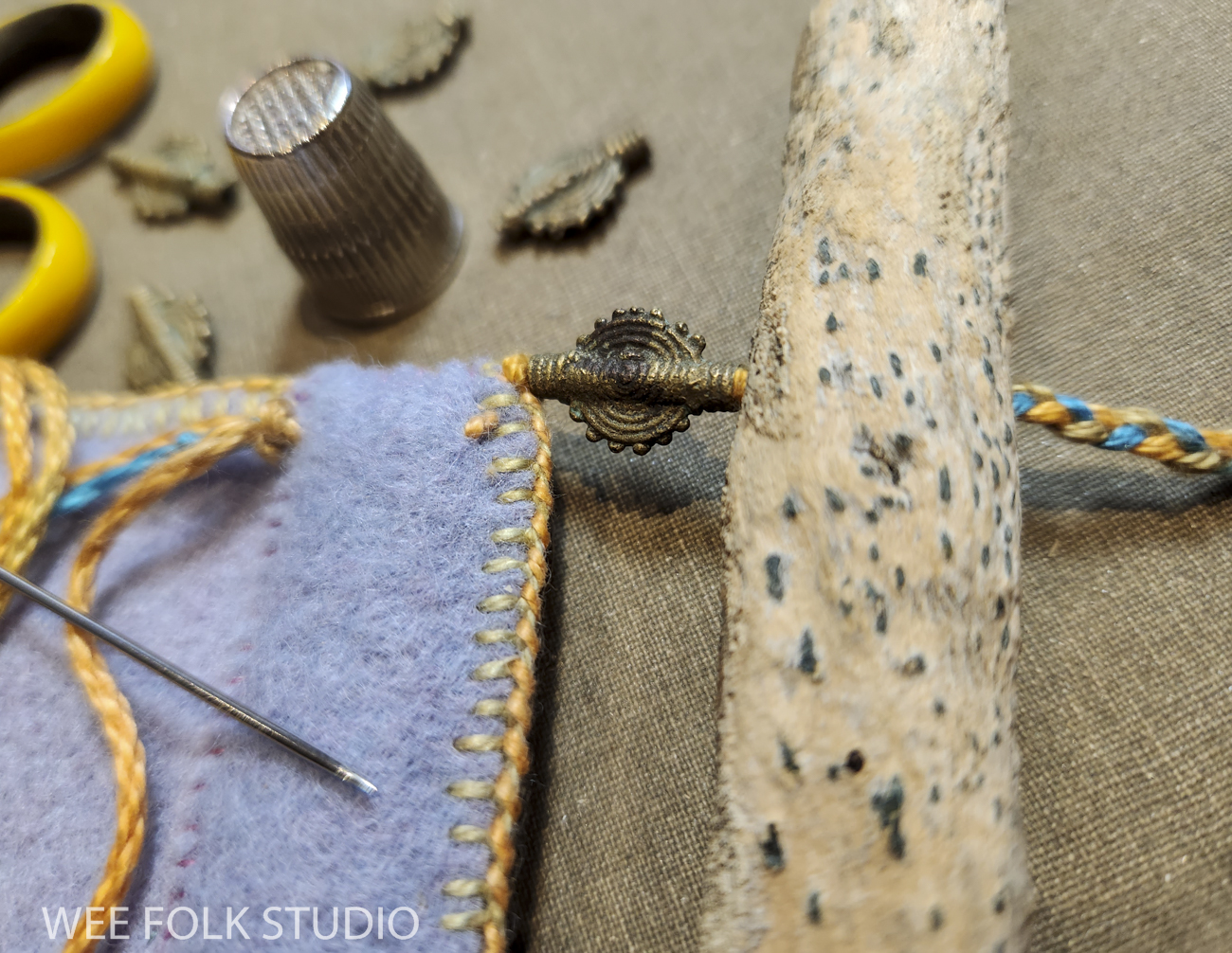
I looked through my driftwood collection and found the right sized stick that would work as a hanging bar. I drilled holes big enough to thread cord through.

I fed cord through the holes and a metal bead separator, hiding the tail threads on the back.

This banner will soon hang on Elias’s bedroom door. Welcome to the world little one! We look forward to getting to know you!

To keep up with new posts, please subscribe to this blog. Your contact info will not be sold or shared. If you’d like to see more frequent photos tracking the projects in my studio, please follow me on Facebook and/or Instagram.

Bedtime Stitches in Pacific Northwest

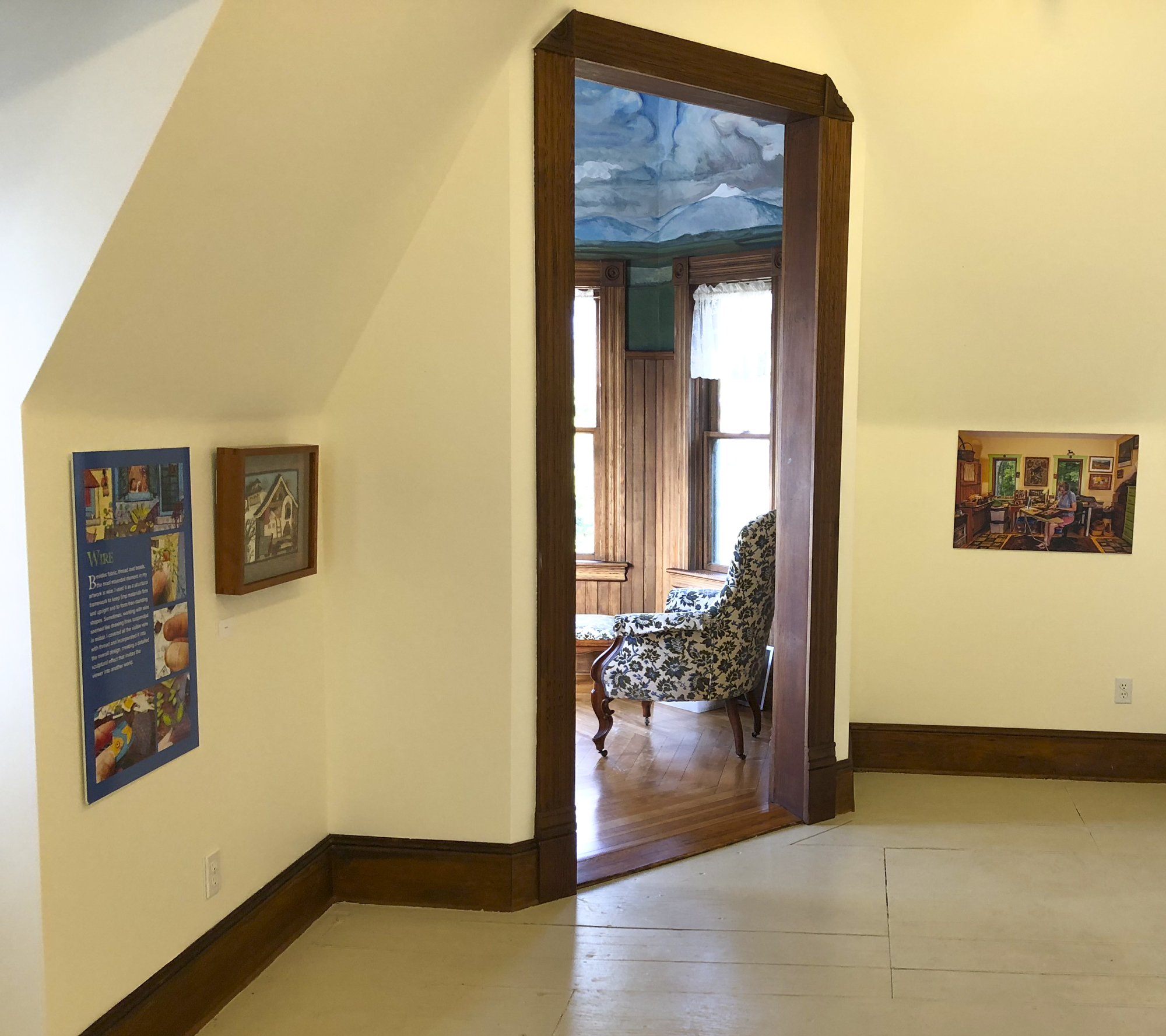
Pacific Northwest Quilt and Fiber Arts Museum in La Conner, WA

I am happy to announce that Bedtime Stitches, the traveling exhibition of original artwork for my picture book, MY BED, is on view at the Pacific Northwest Quilt & Fiber Arts Museum in La Conner, WA through April 30th. This is the westernmost location on the tour and I hope that many of you in the area (including BC, Canada) will make the trip to see the show. To find out where it’s going in the next couple of years, please visit the exhibitions page.

MY BED: Enchanting Ways to Fall Asleep around the World is available worldwide where books are sold, including from online vendors. Autographed copies can be purchased in my Etsy Shop here.

The exhibition of embroidered bas-relief sculptures brings the viewer on an international journey, showing children in varying cultures and home environments around the world. Each intricately rendered scene captures the spirit of a different place and way of life, all the while illuminating the universal theme of children sleeping safe in their beds.

Pacific Northwest Quilt and Fiber Arts Museum in La Conner, WA

I’m especially excited to have my work at the museum because the Pacific Northwest has such an active quilt and fiber arts community. People are already flocking to see the show and telling their friends about it. Recent visitors wrote, “The pieces are even more amazing in person!” and “I found myself standing in front of each frame and ‘dreaming’. I will go back.”

Pacific Northwest Quilt and Fiber Arts Museum in La Conner, WA

In addition to the framed original artwork, visitors will see several interpretive boards that touch on different aspects of my working process, including this one about the animal icons featured throughout the book. While I worked on the animals, I took photos along the way and shared how I made each one. Click the animals to link to posts:

RoosterCamelParrotElephantGoldfishCatDuckSheep,
RabbitCowCrocodileGiraffeDogPony.

I am grateful to the Pacific Northwest Quilt & Fiber Arts Museum for their enthusiastic invitation to show my work and willingness to book it years in advance! The exhibition is spread out on the 3rd floor of their beautiful Tudor-style Victorian mansion.

Pacific Northwest Quilt and Fiber Arts Museum in La Conner, WA

Bedtime Stitches is currently booked into 2025 with the possibility of being extended into 2026. Interested museums and curators are welcome to write me information about hosting the exhibit via the contact form below.

← Back

Thank you for your response. ✨

To keep up with new posts, please subscribe to this blog. Your contact info will not be sold or shared. If you’d like to see more frequent photos tracking the projects in my studio, please follow me on Facebook and/or Instagram.

Adaptive Sled for the snow scene

This father and child pair is included in my winter themed display that is currently on view at Boston Children’s Hospital. The exhibit, which I wrote about in a previous post, is in the Mini-Museum in the Hale lobby, not far from the main entrance to the hospital at 300 Longwood Ave., Boston, Massachusetts through March 15th.

The hospital’s art program manager requested that I make a little adaptive sled for riders with disabilities to include in the snow scene. For reference, she sent a link to this futuristic looking contraption. At first I balked at the idea because of such short notice during the holidays. But, I decided to give it a try, as long as she understood that it would be a naturalistic wee folk version.

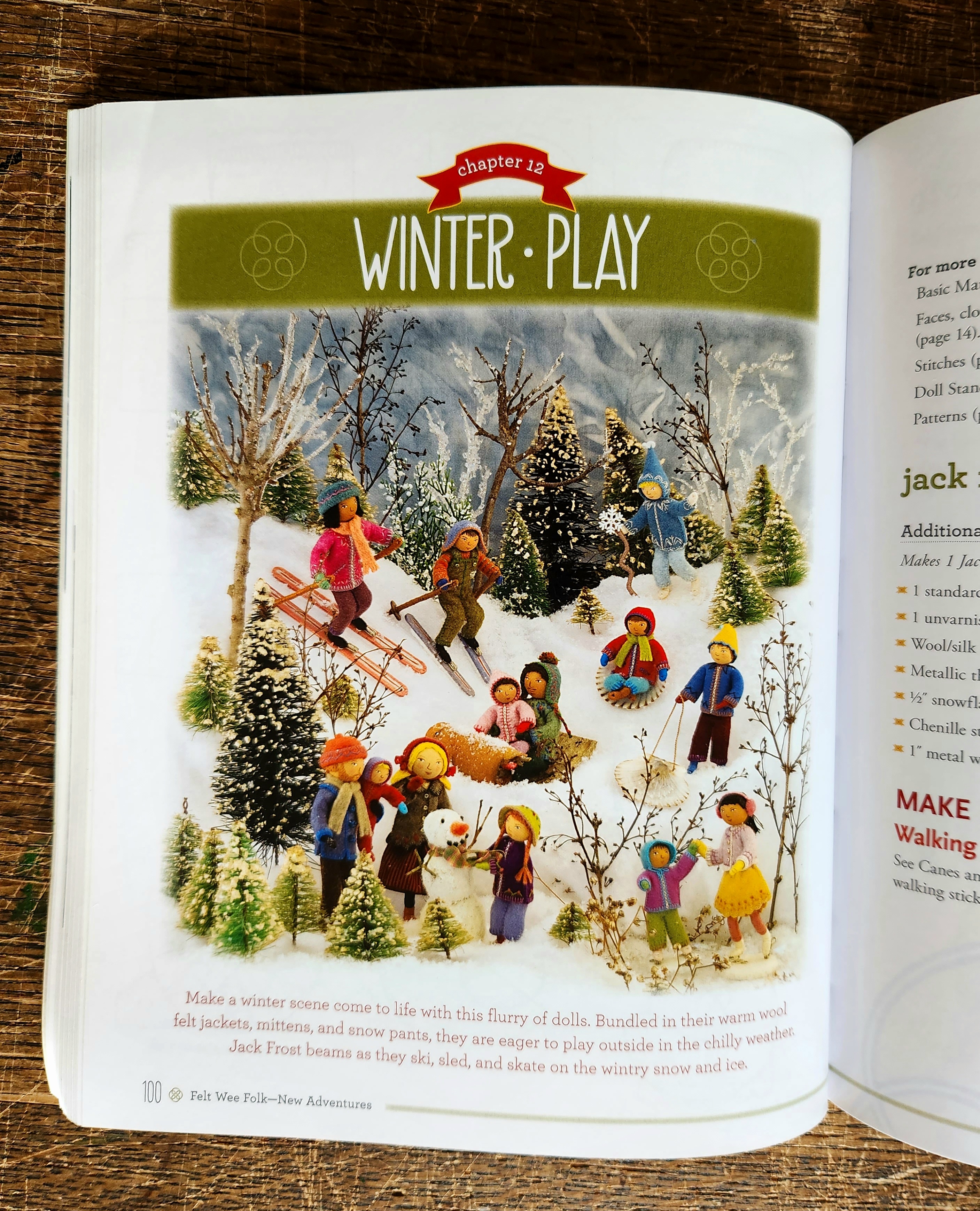
I knew it would take at least a couple of days to make, so I pushed aside other impending deadlines and focused entirely on the sled. I picked out a father and child from the collection of sample dolls I’d made for the Winter Play chapter of my how-to book, Felt Wee Folk.

I studied the photo of the adaptive sled and and made sketches of its basic structure. I measured the figures and bent wire to form the seat, back frame and handle bars.

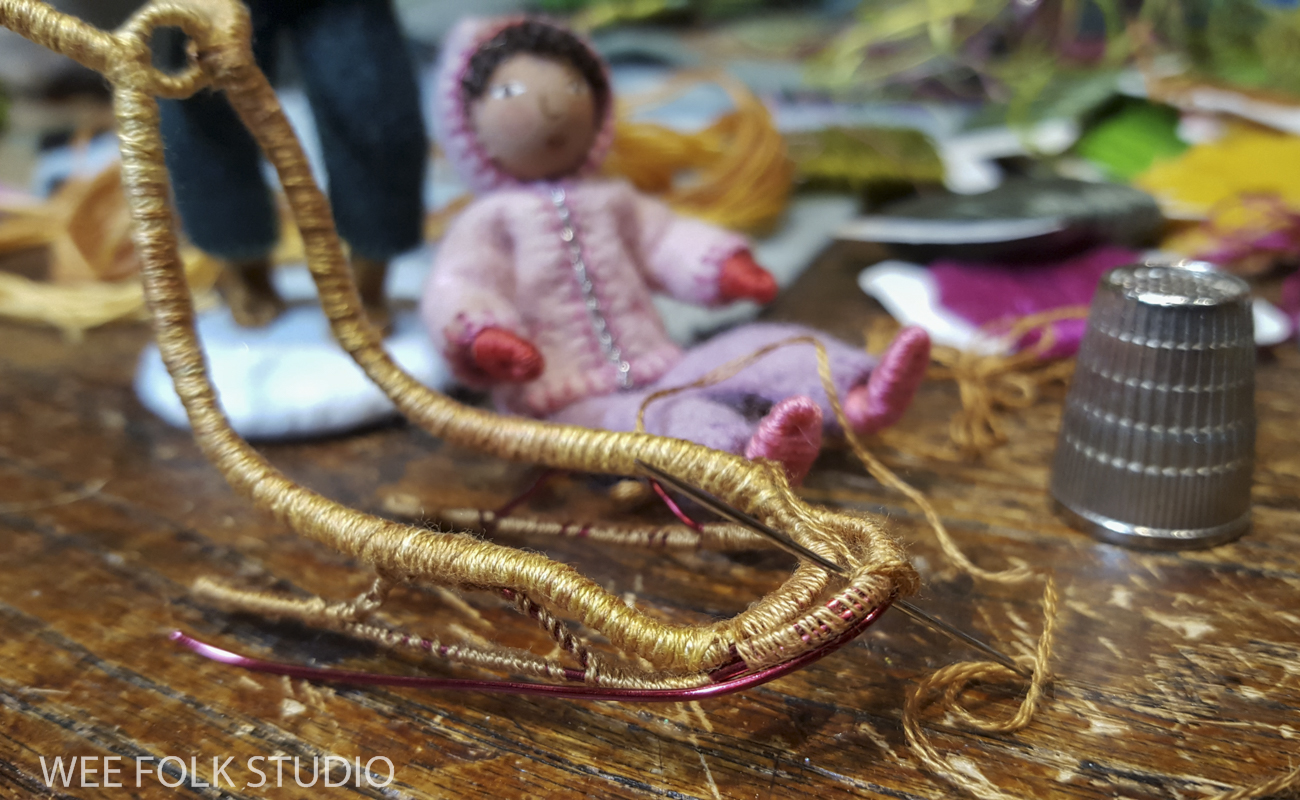
I wrapped embroidery floss around the wire frame, making several passes until the shiny metal was thoroughly covered and the thread looked smooth and even. Wrapping is the most time-consuming part! You can’t really rush the process, otherwise it comes out lumpy and crude looking.

I formed the lower frame and runners out of wire and bound it to the seat frame with thread. At this stage the wrapping was quite fussy, with lots of maneuvering in and around joints.

I added arms to the seat with a finer gauge wire.

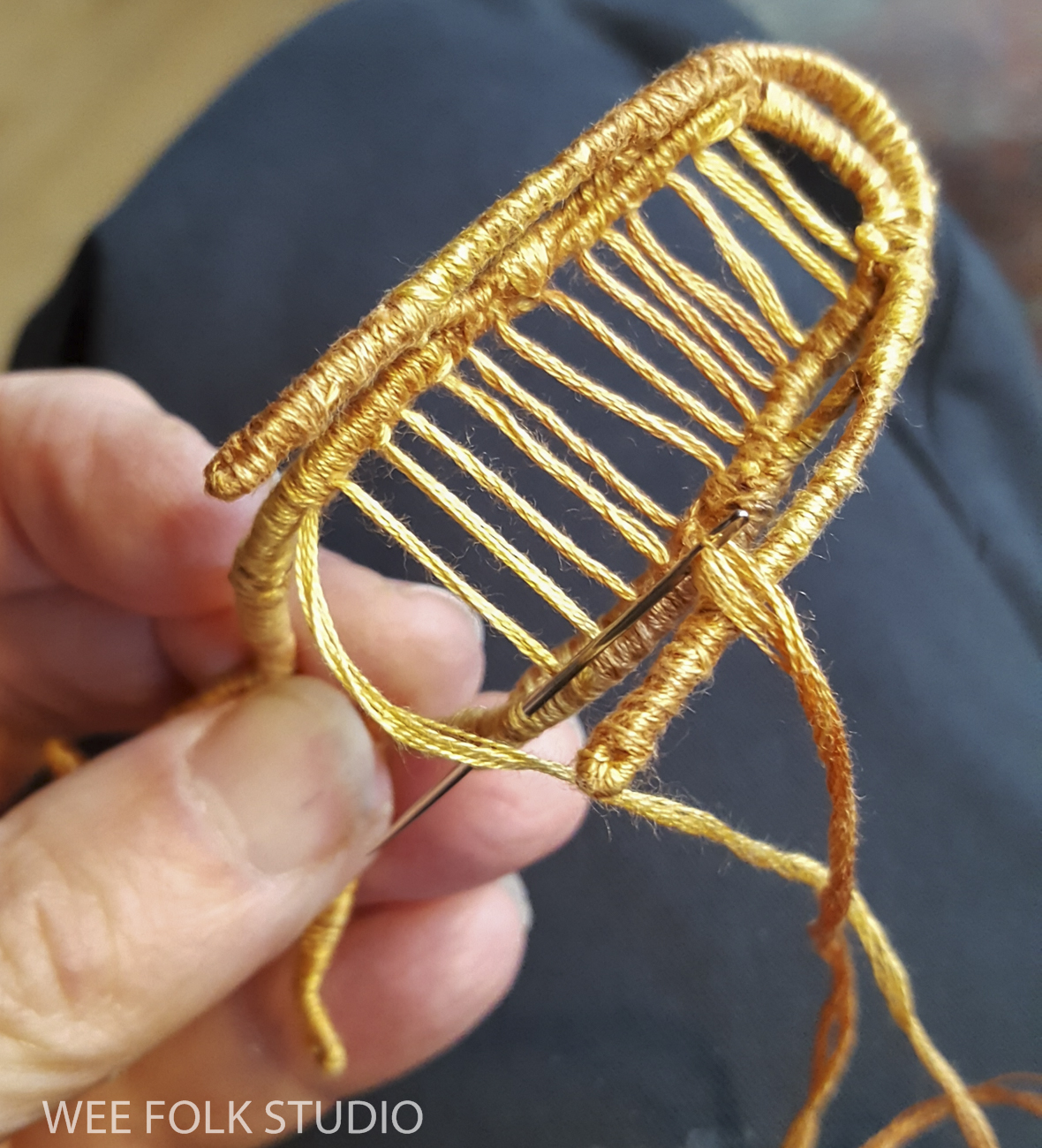
Up until this point, I hadn’t chosen exactly how to finish the seat – felt or floss or a combination. Since the sled was looking more and more like an old fashioned caned chair, I decided to go all out and weave the seat. I’m not sure how warp and weft apply here, but I basically set up a loom.

In this video, you can see the weaving process from the top and the bottom.

Here’s a video of the installation in Boston Children’s Hospital.

I’ve already been contacted by several people who saw the display while going to a doctor’s appointment with their child or grandchild. Hearing their reactions warms my heart and makes it feel like the effort was worth it! If you’re in the area, please stop by the Boston Children’s Hospital’s Mini Museum.

Boston Children’s Hospital Installation

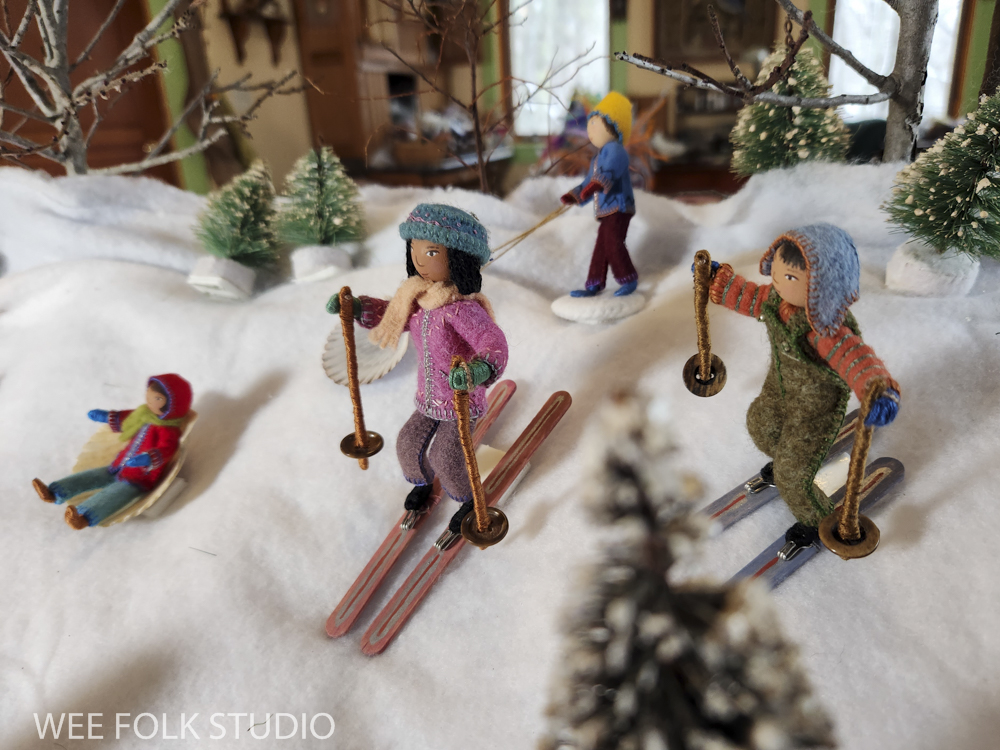
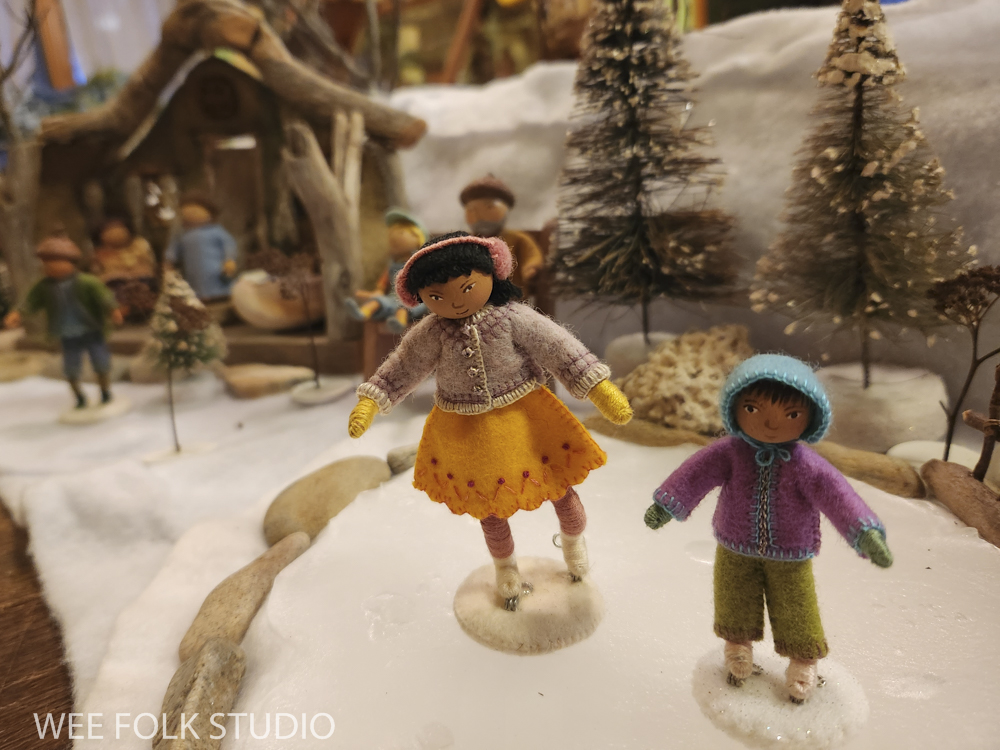
I’m excited to announce that a winter themed display full of my wee folk characters is on view until March 15th at Boston Children’s Hospital, which has been named the country’s #1 pediatric hospital for 9 years in a row.
UPDATE: Good news! The show has been extended until March 27th.

The 8 ft. long case is located in the Mini-Museum in the Hale lobby, not far from the main entrance to the hospital at 300 Longwood Ave., Boston, Massachusetts. The exhibit, which is sponsored by the Art Program at Boston Children’s Hospital is for patients and their families, staff, and visitors to enjoy.

I’m thrilled to be given the opportunity to show my work in the hospital and hope that it provides a bit of comfort and joy to the children and their families who pass by on their way to appointments and treatments.

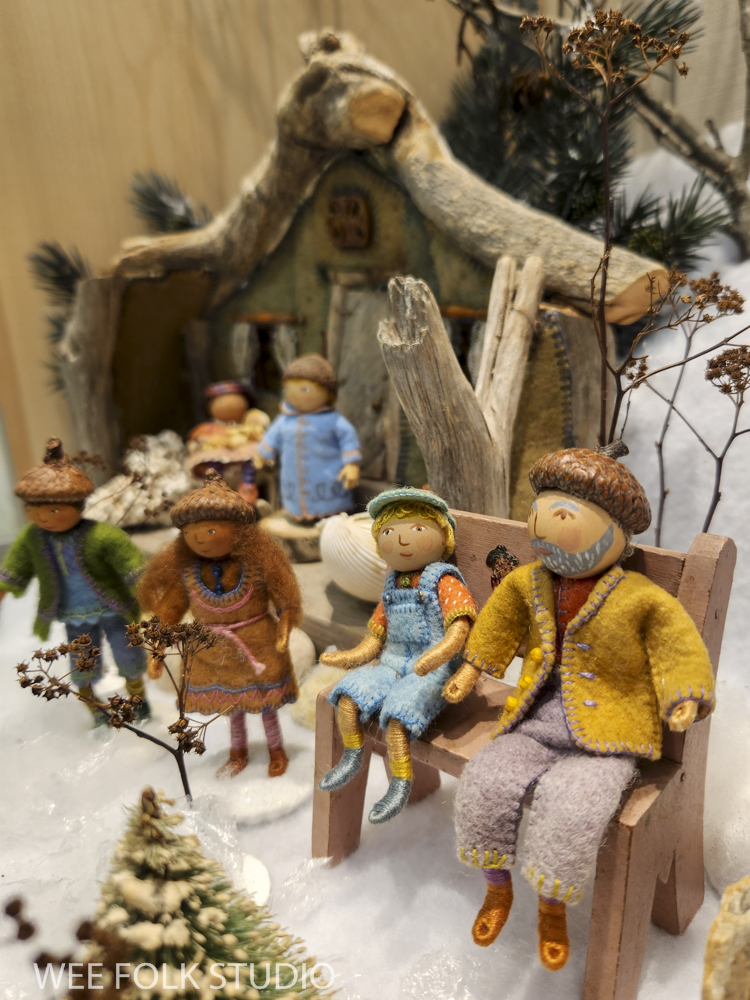
The snow scene is populated with sample dolls from the Winter Play chapter of my how-to book, Felt Wee Folk: New Adventures. The book includes instructions for making the dolls and stands like the ones I used in this scene.

After being invited to show my work and consulting with the hospital’s art program manager, I drew up this sketch that showed how I envisioned the display case. We agreed that placing the 3-dimensional snow scene at child height on the bottom shelf was important.

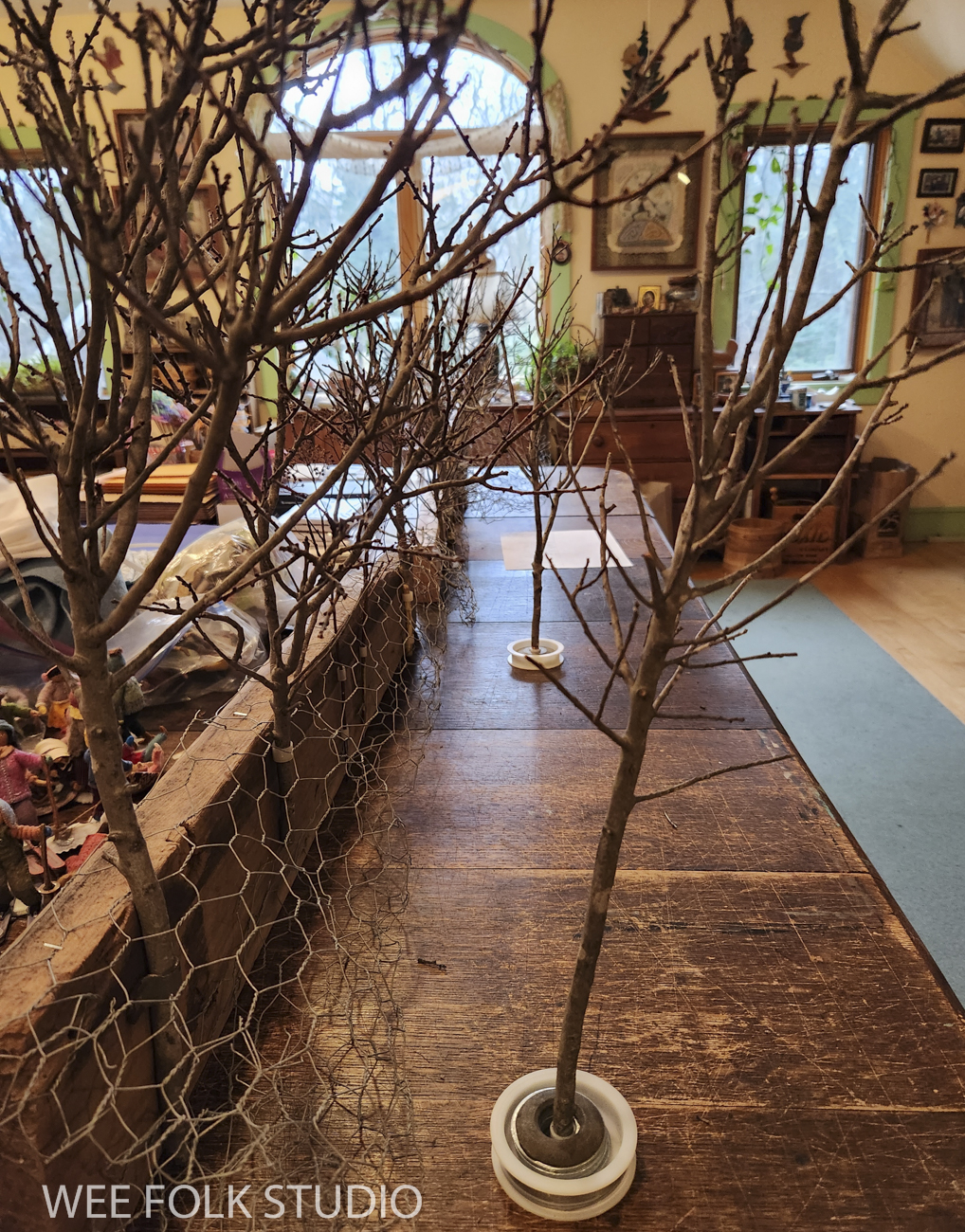
I constructed wood and chicken wire supports for the snow bank and trees, which I tested out on the big oak table in my studio. Bayberry branches, with their densely packed branches are the perfect scale for a scene like this.

For the free-standing trees, I made weighted stands from plastic wire spools and a stack of metal washers, which I padded with stuffing and covered with white felt.

This video shows the practice set-up of the winter scene in my studio.

Snow scene practice set-up in studio

I packed everything up and drove to Boston to set up the scene. Some of the figures aren’t really dressed for cold weather, but they wanted to come along anyway!

Also in the case, above the snow scene set up, are printed enlargements of Frosty Morning, Winter Play (from Felt Wee Folk) and Snow. All 3 are available as cards in my shop.

Here’s a video of the installation in Boston Children’s Hospital.

Snow Scene Display at Boston Children’s Hospital

Most of the figures and houses are from other projects, so I was able to reuse them for this display. I did make something new, though – an adaptive sled for riders with disabilities. I took lots of photos of the process of creating the sled, which I’ll share in a future post.

I’ve already been contacted by several people who encountered the exhibit while going to a doctor’s appointment with their child or grandchild. Hearing their reactions warms my heart and makes it feel like the effort was worth it! If you’re in the area, please stop by the Boston Children’s Hospital’s Mini Museum.

To keep up with new posts, please subscribe to this blog. Your contact info will not be sold or shared. If you’d like to see more frequent photos tracking the projects in my studio, please follow me on Facebook and/or Instagram.

Vintage Valentine

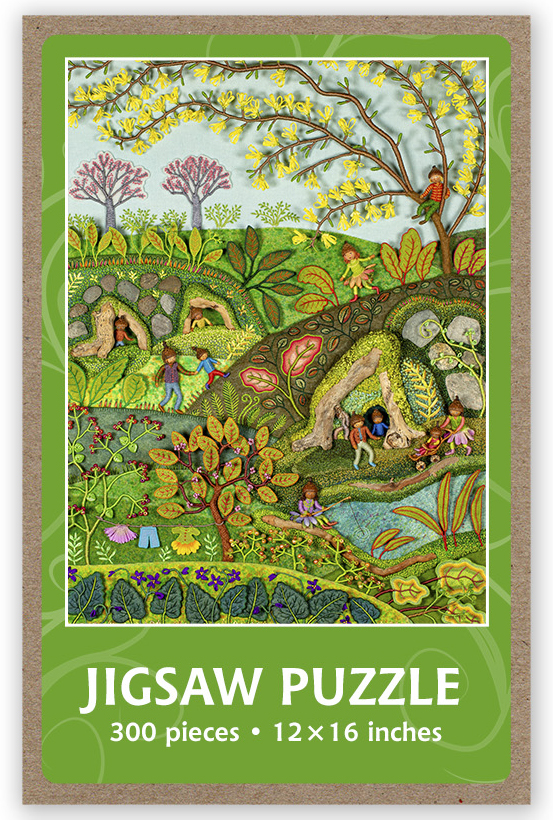
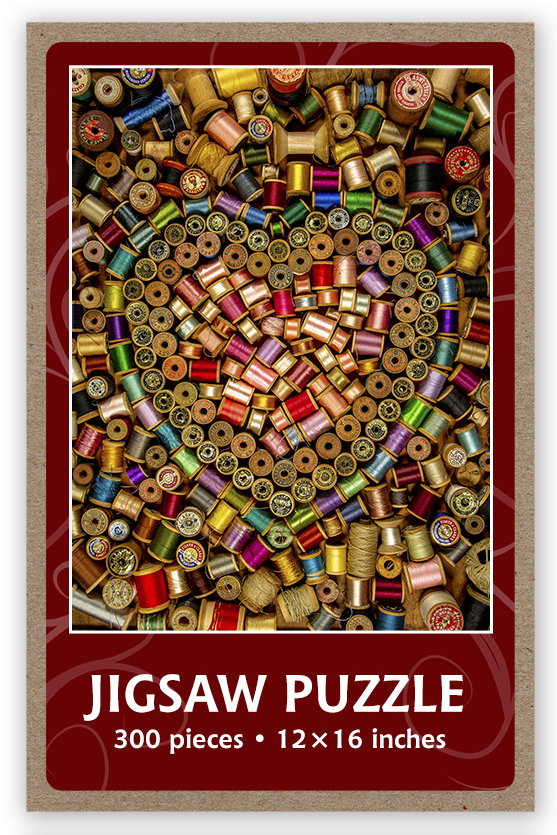
NEW ARRIVALS – just in time for Valentine’s Day! I’m happy to offer more items that make the perfect gift for people who quilt, stitch and sew. In addition to a note card and a poster, my nostalgic assemblage of vintage spools of thread is now available as a jigsaw puzzle and a spiral bound notebook. Please visit my Etsy Shop.

Remember when every household had a wicker sewing box filled with an assortment of threads just like these? My heart-shaped assemblage of vintage spools pays homage to all of the mothers and grandmothers who sewed and mended with skill and patience and passed down their knowledge to the next generation.

Thread Spool Heart Jigsaw Puzzle

JIGSAW PUZZLE: Don’t let its size fool you. I can honestly say that this puzzle is challenging to put together! 300 pieces was plenty big, even for an obsessive puzzle maker like myself. 500 and 1000 piece puzzles would be great, but for a small operation like mine, manufacturing and storing large puzzles isn’t practical and economically feasible. So I compromised on the smaller version.

A couple of years ago, I decided to make an assemblage with my collection of cotton and silk thread. I put some spools on end and some sideways, separating the ones with paper labels from the stamped ones. It was so much fun that I surrounded the heart shape with just about every spool I could find hidden away in my studio.

 Rob took a photo of the arrangement and viola, a piece of art!

I’ve collected vintage wooden spools of thread for decades, knowing that someday I’d make something with them. They are beautiful relics of a bygone era that I could never bring myself to throw out because they are a connection to people and places in my past.

Thread Heart Note Card

I’ve also added more items to my shop that feature my piece Birds of Beebe Woods, including a jigsaw puzzle and notebooks.

Birds of Beebe Woods Spiral Bound Notebook

Please come on over to my shop and have look.

Soft Cover Small Notebooks – Birds and Thread Heart
Posted in Uncategorized | 1 Reply

Harvest Time – part 3 (felt leaves)

In Part 3 in the series about making Harvest Time, I share photos, commentary and a stitch-minute video about embellishing the felt leaves that appear on the ground-cover and bushes. Please note that when I use the word ‘felt”, I’m referring to the noun, not the verb. Felting is agitating and manipulating wool fleece fibers with a barbed needle or soapy water to create a felted surface. That’s how I made the brown soil in the underground part, which I’ll describe in a future post.

In the coming weeks and months, I will post more stories that focus on different aspects of making the fall scene, including the toad stool mushroom, wee folk figures, needle felted tunnels, roots, stones and foliage of all kinds. Part 1 featured moss making. Part 2 is about making the turkey tail mushroom.

Harvest Time is the fall scene in a series of seasonal landscapes that capture the wonder and magic of the natural world, both real and imagined.
Harvest Time note cards and a jigsaw puzzle are available in my Etsy Shop.

When envisioning this piece, I wasn’t sure how it would come together, but that’s normal for me. I knew that I needed to figure out a way to clearly define the edge between above ground and below ground. This is the kind of thing I think about when doing busy work, like stitching hundreds of French knots. I’m always one step ahead, planning the next move. I ended up creating a kind of flap with two sections of felt “sod” that overlapped the underground tunnel to the root cellar.

Felt Leaves
After edging the felt leaves with blanket stitches, I bent wire to match the shape and stitched it to the outside edge. Then I kept going around until the wire was completely covered with thread. I used single strands of floss to give it a fine finished look.

I wanted to fill the ground cover with an eye-catching array of textures, colors and shapes that would balance the composition of the whole piece. To help the leaves perk up and create shadows, I pushed the wire stems through a small hole to the back of the felt background, where it became a leverage point.

Because this scene has an element of fantasy, I felt free to incorporate bright unnatural looking shades.

I searched through my stash and found some variegated yellow embroidery floss to use for the chain stitched veins on these hot pink leaves.

When I embellish with thread, I constantly think about how to enhance and articulate the form, without becoming too cluttered. For instance, adding a dark pink outline around the veins on this leaf help emphasize the lines.

I hadn’t noticed it before, but now I see that the leaves are all made with complimentary colors. That way they pop out at you, both visually and physically!

This Stitch Minute video shows how I made a wire edged felt leaf.

As you can see, I constructed this background piece separately from the other parts of the scene. At the very end, after months of work, I assembled all of the pieces and stitched the sections onto one stretched fabric layer.

I also made larger orange leaves for the berry bush that’s growing next to the moss covered stump.

In future posts, I will focus on different aspects of making Harvest Time, including the toad stool mushroom, wee folk figures, needle felted tunnels, roots, stones and foliage of all kinds.
The overview introduces the Harvest Time piece.
Part 1 features moss making.
Part 2 is about making the turkey tail mushroom.
Part 3 shows the construction of felt leaves.
Part 4 gives a peek at embroidering the plants.
Part 5 is about making the toadstool mushroom
Part 6 shows the process of making the underground