Baby Banner (Eliza Jane)

eliza9WM

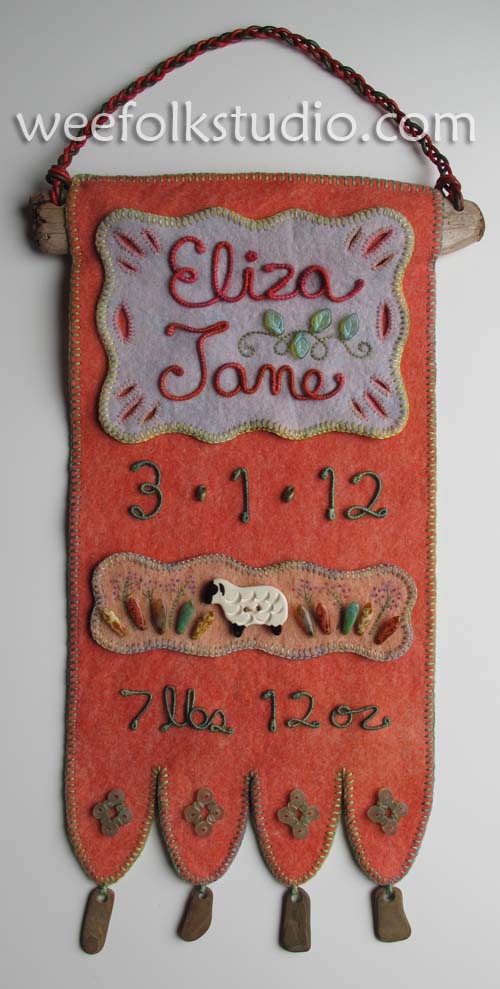
My cousin John and his wife Mariana had a baby girl on March 1st, so I had to drop everything and make a baby banner for Eliza Jane. I took photos along the way, which give an idea of my process. It’s like the wedding banners I’ve been making for a few years. You can see all of them here.

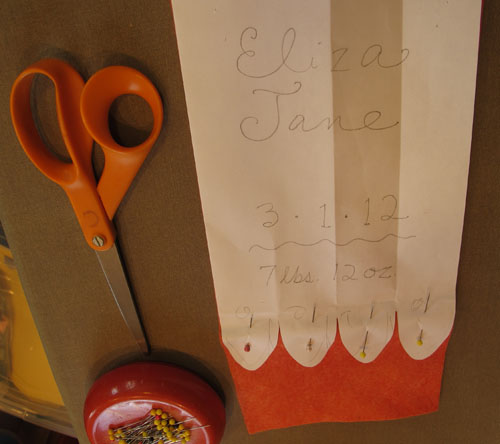
I first made a simple pattern, with her name, birth date and weight written out. Then I cut out a smaller felt square and bent wire to form the letters and numbers.

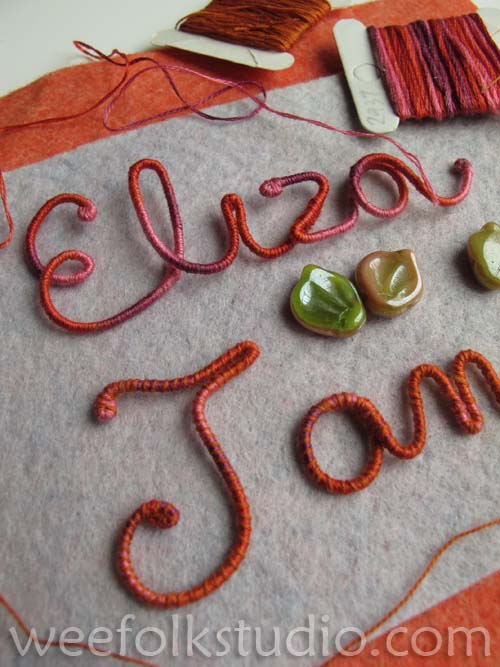
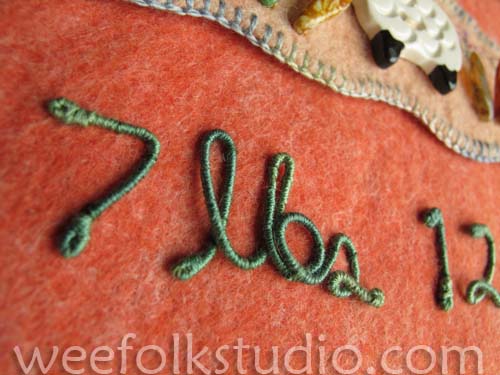
I wrapped the wire with 2 strands of variegated embroidery floss, hiding the knots behind the curled ends. In this case, wire had to overlap to make the Z. I tried making the fancier lower case script Z, but it was hard to read, so I went with the simpler zigzag style. Below you can see how I made an orange stripe with another thread on top of the embroidery floss in JANE.

eliza3WM

I like using variegated thread to edge the felt.

eliza4WM

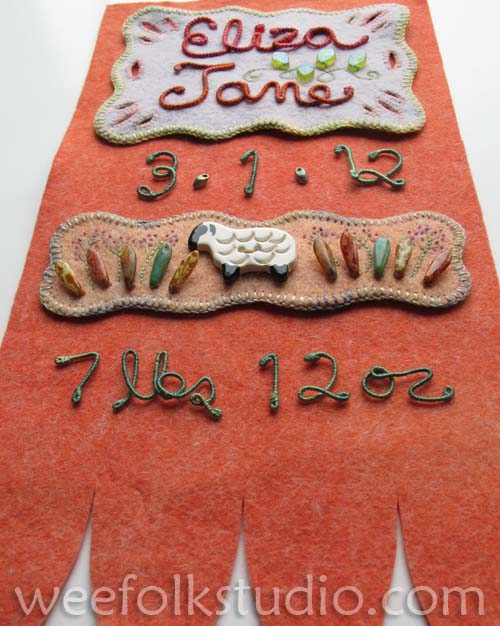
I made a narrow panel for a sheep button and some leaf beads.

eliza5WM

Glass leaf beads and a chain stitched vine fill the space between the words.

eliza6WM

I’ve had this ceramic sheep button for about 30 years. It’s so satisfying to put it to use in just the right place.

eliza7WM

eliza8WM

I braided some Greek leather that I bought at a bead show and made a strap to hang the banner. Working with the leather reminded me of making gimp projects at camp. Remember gimp? What a weird material!

eliza11WM

eliza10WM

eliza12WM

Welcome to the world Eliza Jane!

To keep up with new posts, subscribe to this blog (top right column on the home page). If you’d like to see more frequent photos tracking the projects in my studio, please follow me on Facebook and/or Instagram.

eliza13WM

introducing Phoebe Wahl

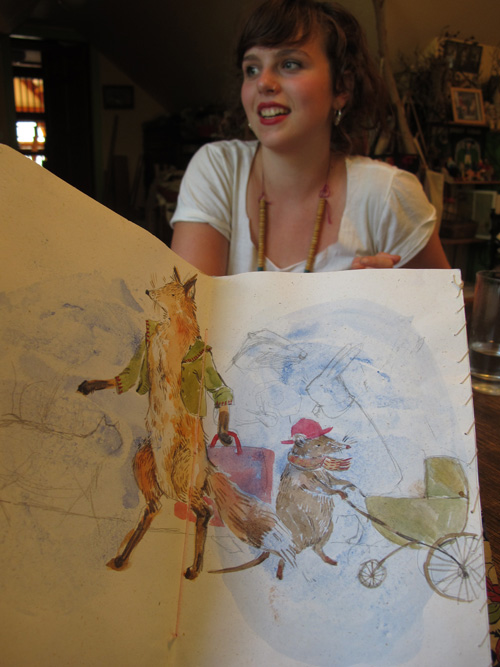
One Monday afternoon in October, I had the pleasure of meeting Phoebe Wahl, who is a junior illustration student at RISD. She’s taking a class with my friend and former teacher Judy Sue Goodwin-Sturges this semester, so Phoebe must have learned about my artwork from her. She sent me an e-mail with a link to her website and I was so charmed by her paintings and cloth characters that I invited her to visit my studio. It’s a manageable distance, so she took the bus from Providence to my home on Cape Cod. She gave me this gnome doll, which she had made the night before.
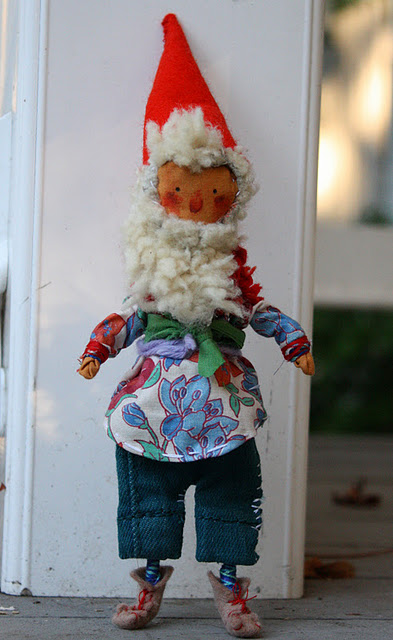
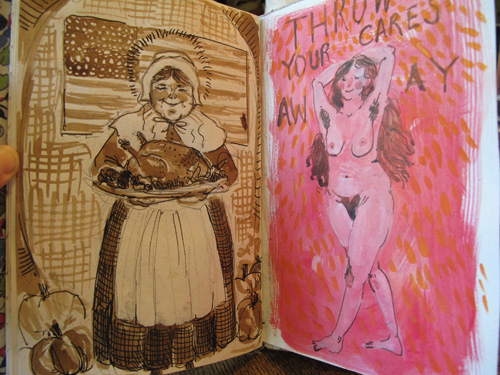
I love how she works quickly, so her dolls are fresh, not fussy. She draws beautifully, too and she showed me her sketch book.
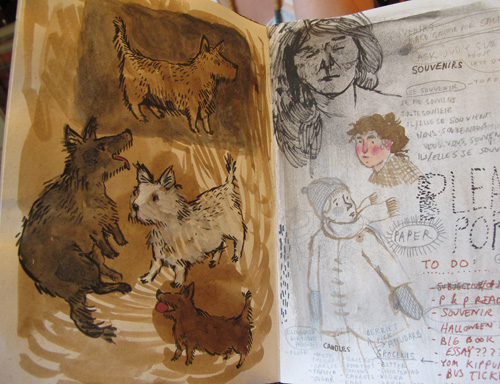
Look at this juxtaposition of pages!
After talking with Phoebe for a bit, I spontaneously called my neighbor, illustrator Molly Bang and asked if we could walk over for a short visit. Phoebe remembers seeing Molly’s book, The Paper Crane when she was young, so it was nice to connect the two. Molly enjoyed meeting her and looking at her work, too.

I recently saw on Phoebe’s blog that she’s made an animated film called CIRCUS. In a few weeks, she made a whole cast of animals and performers, then made the film all by herself in one weekend! The character’s movements could be smoother, but this animation shows such potential!  She describes the film as an experiment and she plans on learning more about stop motion animation this winter. I’m so impressed by her diligence and artistic drive. She is really taking advantage of her time in school to try different ways of bringing her artwork to life. CIRCUS can be seen on vimeo here.

Phoebe describes the project in her own words:

“I made ‘CIRCUS’ for Judy Sue Goodwin-Sturges’ Artist Book class. The assignment was to make a large book, using no paper, and we had another assignment where the theme was ‘circus’ or ‘carnival’. I was stuck trying to think of ideas for traditional artist books and decided to combine both assignments. My visit to your studio definitely inspired me to start incorporating the handmade dolls and animals I have always loved to make into more of my schoolwork. Working hands-on sewing my characters into life is what feels right a lot of the time, although I will always love to make more traditional on-paper illustrations as well. I loved seeing your work from when you were my age at RISD, how even then you were making things that spoke in your voice, and your characters were so wonderful and created with so much love. I was inspired to take my little dolls and animals further even if it meant stretching the boundaries of assignments, since the process of making them is so important to me.
 
Originally I didn’t make the animals to be animated, (maybe somewhere in the back of my mind…) but after I brought the basket of elephants and lions and tigers into class, my professor Judy Sue decided to send me on a different route than the rest of the class, realizing how excited I was about what I was doing, and that I needed to take it further. It took me about two weeks to make all of the animals and dolls, and I made the animation in one sitting the next weekend. I did it completely on my own, locked in our spare room surrounded by desk lamps and animals with my camera taped to a box on a stool instead of a tripod…
 
A lot of my work is rooted in nostalgia. I feel like all the things I am drawing or painting or sewing, I am making for my childhood self. I think ‘CIRCUS’ is less about an actual circus, and more about a toy circus coming to life. That all the characters were touched and loved and imperfect is important to me. I find myself constantly illustrating places or people I want to be. I think ‘CIRCUS’ is an example of my constant quest to return to the magical places I inhabited as a child, where I didn’t even need a camera and a computer to make my toys and drawings come alive.
 
This Wintersession a friend in the animation department and I are doing an independent study, working on another animation. I’m excited to learn the real techniques of stop-motion animation and puppet making, since ‘CIRCUS’ was a bit of an experiment. Hopefully the first of many adventures in animation!”
 
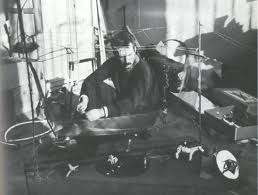
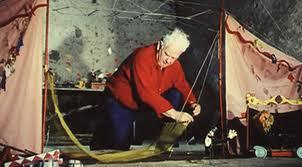
Phoebe’s circus characters remind me of Alexander Calder’s famous miniature circus (shown below).


Phoebe sent a thank you note in this envelope. Be sure to look at her website to see her work. Thanks, Phoebe. I’m looking forward to seeing what you create next.

To keep up with new posts, subscribe to this blog (top right column on the home page). Your contact info will not be shared. If you’d like to see more frequent photos tracking the projects in my studio, please follow me on Facebook and/or Instagram.
Rabbitat – part 5 (garden gate)

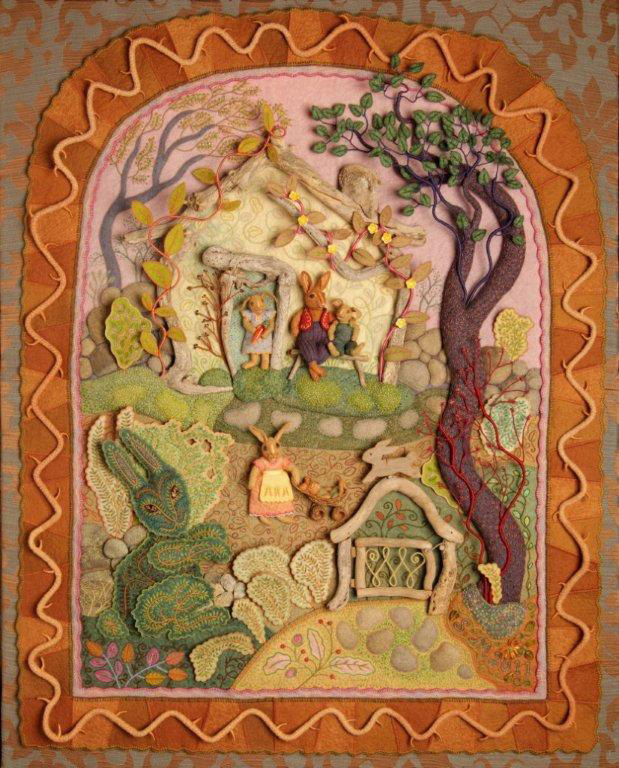
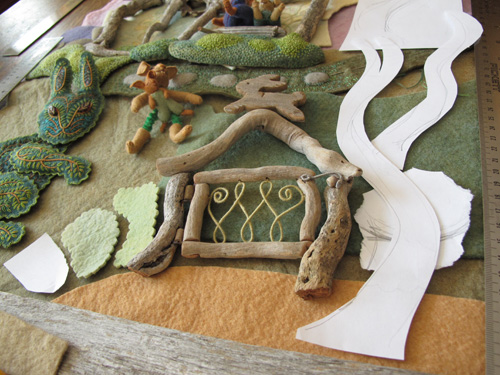
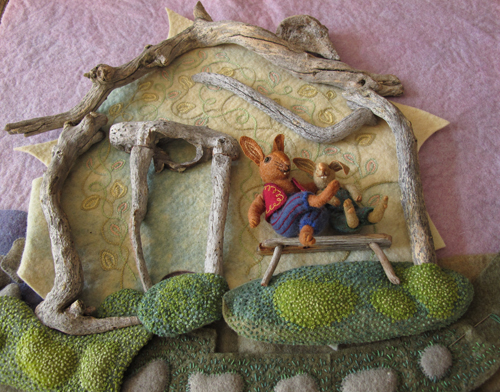
I added the garden gate about half way through the process of making Rabbitat. Since I changed the design from horizontal to vertical, I needed something in the lower right to balance the rabbit topiary on the left. I also wanted to create  a transition from the foreground to the background and make an an entrance into the rabbit world.

I selected some driftwood and carved joints into the pieces. I then drilled holes in the joints and glued the pieces together with wire in the holes for reinforcement.

On a jig saw, I cut out a wooden rabbit shape to put on top of the gate.

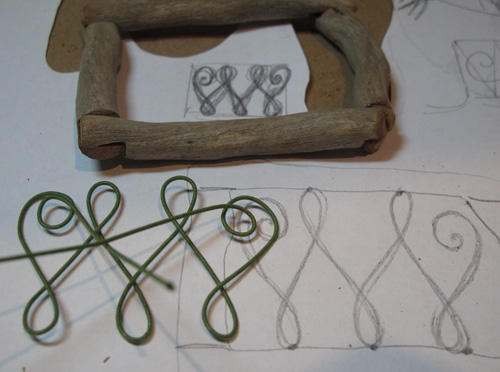
I wanted bars in the gate, so I bent some 32 gauge cloth-covered wire and wrapped it with embroidery floss.

Then I had to figure out what to use for hinges and a latch. I got out my collection of little metal do-dads, but wasn’t satisfied with how they looked. Shiny metal didn’t seem to fit in the rabbit’s world. I ended up using clay tube beads for the hinges and wrapped wire for the latch.

I worked around the gate for many weeks, sewing the tree and constructing parts of the scene’s landscape.

I created a felt stone pathway leading to the gate, with french knot moss. Thinking ahead, I stitched my initials into the design on the right hand corner.

To see more posts in this series and to view the Rabbitat film click here.

windsurfing wedding pair

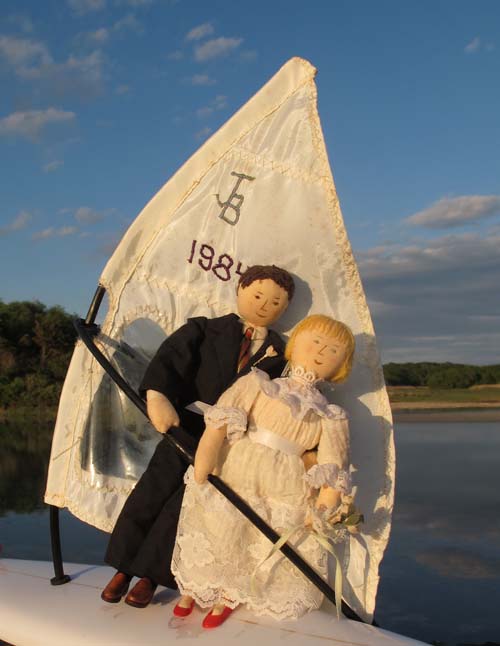
Back in the 80’s, when my friends were getting married, I made portrait bride and groom dolls for their cakes. One memorable pair was Ben and Julie, riding side by side on a toy windsurfer. Julie showed me what her dress would look like ahead of time, so that I could match it.

I don’t think Julie actually wore red pumps at the wedding, but these Tammy shoes were the right size. Ben wore Ken’s leather slip ons. The shoes are stuck onto the board with double sided tape.

Over the years, the dolls had started to fall off the boat, so I reattached their hands to the boom. Now they can go back home to Ben and Julie’s. We went down to Woodneck beach in early evening, just before sunset, to take photos in the low sunlight. See other posts about  more recent wedding figures here and here.

To keep up with new posts, please subscribe to this blog (top right column on the home page). Your contact info will not be sold or shared. If you’d like to see more frequent photos tracking the projects in my studio, please follow me on Facebook and/or Instagram

Rabbitat – part 1 (driftwood house)

After working all winter long, I’ve finally finished Rabbitat! It’s large, compared to my book illustrations, measuring 24″ x 30″ , with a depth of 1 1/2″. I’m waiting for professional photographs of the finished piece, so for now I’ll just show pictures I’ve taken during the process. It’s got lots of parts, which I’ll be showing in several posts. This piece was unlike my book illustrations, which have to meet size and subject specifications and are planned out ahead. I let this project evolve by itself and just followed where it led.

To start, here are some drawings from my sketch book. My first ideas include a vine-covered house, which could be a topiary. A bunny showed up, too.

Then, the house became a structure made of driftwood pieces, with a rabbit topiary outside. I didn’t know who’d be living inside yet.

I combed through all of my driftwood and selected pieces which I could see as a roof and side beams and a doorway.

And carved them in spots, so that they fit together and lay down as flat as possible. I don’t know how the little chair appeared in this picture. Some of you may recognize it from another scene–the Driftwood Clan in my book, Felt Wee Folk.

I drilled holes at the joints and glued wire pins into the holes. That way the parts are held together, but the wire joints keeps the structure flexible. I don’t know if this description is clear, but I essentially use wire in place of dowel pins because I don’t want the joints to break while I’m manipulating and working on the house. I’m always adjusting things until the last-minute, so the joints need to be somewhat bendable.

I decorated the house walls with an embroidered chain-stitched vine pattern on felt. The green mossy patches have lots and lots of french knots.

At this point, I’d decided that rabbits live in the house, so I made a father and son to sit on the bench outside.

I told my husband Rob that I was making a habitat for rabbits and he immediately said, “Oh, it’s a Rabbitat!”

Continued at Rabbitat – part 2 (topiary)

See the Rabbitat film here.

See all of the Rabbitat posts here.

Berry Family dolls

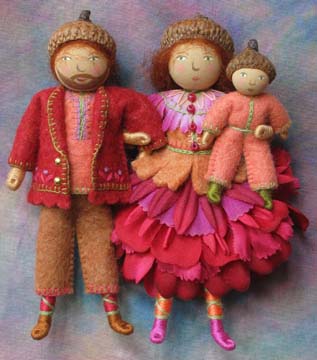
I brought the Berry Family outside for an airing. They’re a bit moth-eaten–a downside to working with wool. For the last couple of winters, I’ve gotten into the habit of bringing all of my felt and felt clothed dolls outside when the temperature dips below freezing, hoping to kill any moths.

I made the mother, father (4″ tall) and baby members of the Berry Family in 2005, as a Ltd. edition of 25. They are based on the patterns from my how-to book, Felt Wee Folk.  All of my Ltd. edition dolls are currently sold out and I won’t be making any more.

The Berry Family, Ltd. edition 2005

uncommon scent dolls

Almost 30 years ago, I made and sold a slew of these sachets, of which I have only one left. The Uncommon Scent Dolls were about 4 inches tall and filled with pleasant smelling spices, leaves and petals. The pattern is the same as the Nativity dolls I showed in an earlier post here.

Uncommon Scent doll, 1982

I remember picking out different woven fabrics and using the selvage edge as much as possible. This was back in the days when I used the zigzag feature on my sewing machine for the appliqued parts.

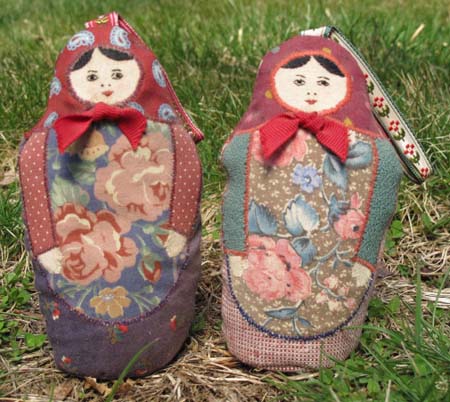
I also made these Matruska doll sachets, modeled after the Russian wooden nesting dolls.

doll sachets, 1985

Wedding Cake figures

My friends, Shona and Amy are tying the knot this Saturday. Their wedding is looking to be more of a do-it-yourself type than the formulaic extravaganzas I’ve been to lately.  Their’s will be much looser, with lots of friends helping out, which reminds me of 30 years ago, when my husband and I got married.  My friend Terry and I volunteered to make their wedding cake. Terry has already baked the cake and she and I will be spending friday working on the decorations. We’ve been planning this cake for months and I’ll try to remember to take pictures as we add the personal touches. I just finished making Shona and Amy dolls to fit a toy boat, which will be on the cake.

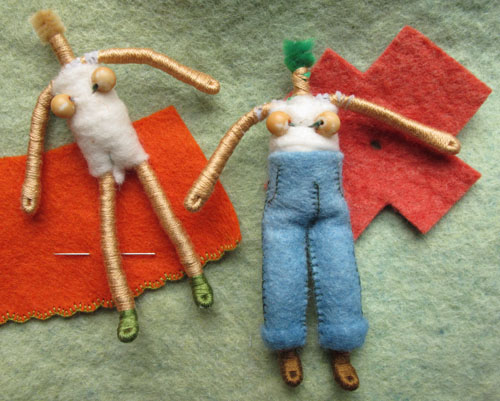
To start, I found a wooden toy boat of the right size and type at Bella Luna Toys. I then made two 3 1/2 inch tall pipe cleaner doll forms, the same way as explained in my how-to book, Felt Wee Folk.

This is what the dolls look like undressed. I wrapped some cotton batting around their middle sections and sewed small beads for breasts, which show that these are women, not girls. Just adding stuffing doesn’t look natural and the beads appear more true to life when they are clothed. I started using beads for breasts a few years ago, when I made my self-portrait, because I wanted to show maturing over time. See my piece, Self-Portrait: A Personal History of Fashion here.

Then, I dressed them in clothing that I thought fit their style and personality.

Now that the dolls had heads, they needed a trip to the hairdresser. I put glue on the top and sides of the bead heads and then draped felt over, using pins to keep the felt in place while it dried. I started devising this wig making technique when I made all of those dolls for my Self-Portrait.

After the glue dried, I cut the felt in the back to conform to the round head and glued the felt to the back. Pins hold the felt in place while it dries. I felt like giving the dolls little fashion magazines to read like women in salons, who sit and wait with curlers or foil origami on their heads.

I sewed the seams together and blanket stitched around the felt edges, using flower thread, which is thicker than embroidery floss. DMC discontinued making flower thread, which is too bad, because it’s great stuff. I still have some of this golden wheat color that worked for both Amy and Shona’s hair.

Shona has curls, so I twisted the thread around the needle and pulled it through, like loose french knots. I really felt like a hairdresser then.

Amy’s doll had straight hair.

I made a flag with their names that would fly above the dolls on the boat. Wire along the flag’s edge helps keep its shape.

I painted the boat and sewed the finished dolls to tiny screw eyes on the cabin. Amy loves to fish, so I made her a fishing rod and attached a bead fish.

Shona, who is a bit of a show-off, is ready at the bow, holding on to the flag pole. I’ll let you know how the launching goes.

To keep up with new posts, please subscribe to this blog. Your contact info will not be sold or shared. If you’d like to see more frequent photos tracking the projects in my studio, please follow me on Facebook and/or Instagram.

Wee Folk centerpiece

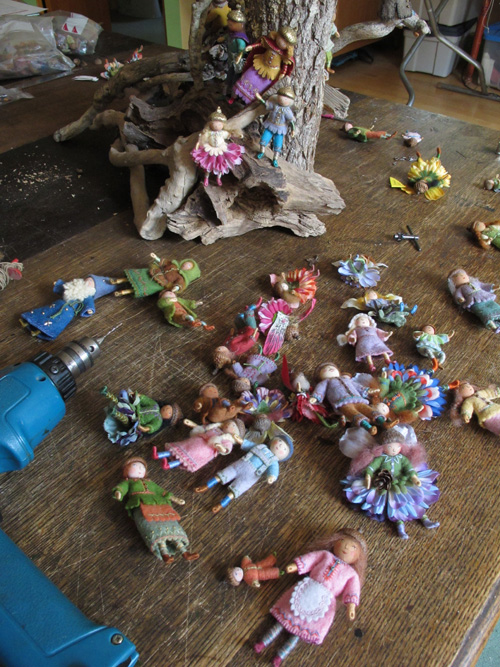
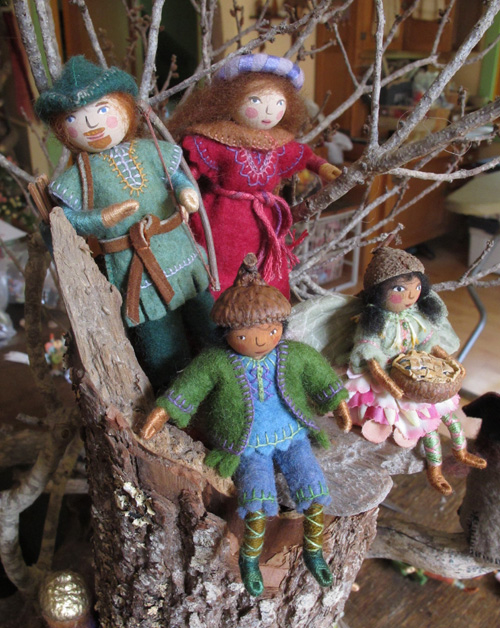
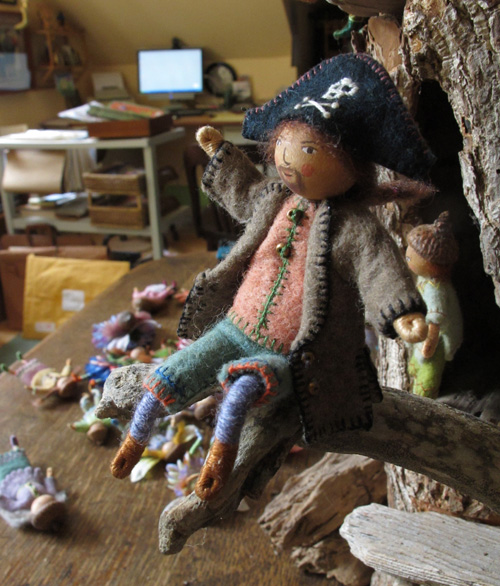
In the last post, I mentioned making a centerpiece for the Pocketful of Posies book release party at Highfield. Since I forgot to take pictures of the finished setup, here are some shots taken during the construction phase. Many of the dolls were models for projects in my how-to book Felt Wee Folk: Enchanting Projects and were unearthed for this event.

I arranged driftwood and logs that the wee folk could sit on and climb up. Old, dried up bayberry bushes, with their compact spread of small branches make good wee folk scale trees.

I drilled holes in the wood for small screw eyes, which served as anchors for the dolls. I felt like a prison guard, shackling their tiny ankles and tying their waists to the screw eyes with wire. But, it was to protect them from easy escape into the hands of big folk.

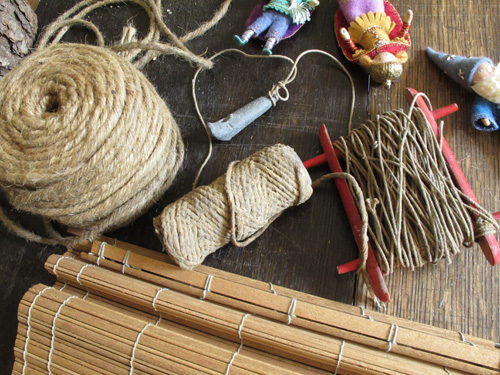
One vertical log needed a rope ladder, so I gathered some possible materials; jute rope and twine, old fishing line, a woven wooden slat place mat .

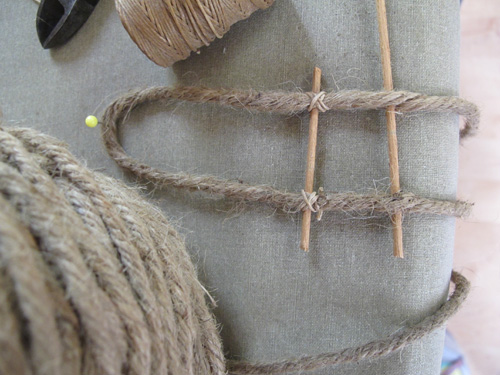
I selected the fatter jute rope and pulled out a wooden slat from the place mat. To make the rungs, I fed broken off wood sections through the rope and lashed them in place with an improvised knot. I wished we had learned knot tying in girl scouts. You never can tell when you’ll need outdoor survival skills!

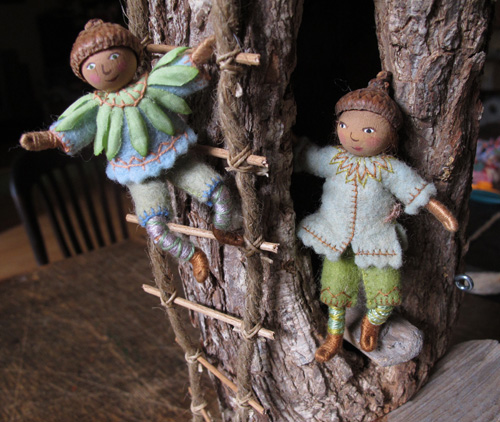
Here’s Jack climbing up the finished rope ladder. See Jack climbing the bean stalk here.

Here are some characters from Felt Wee Folk.

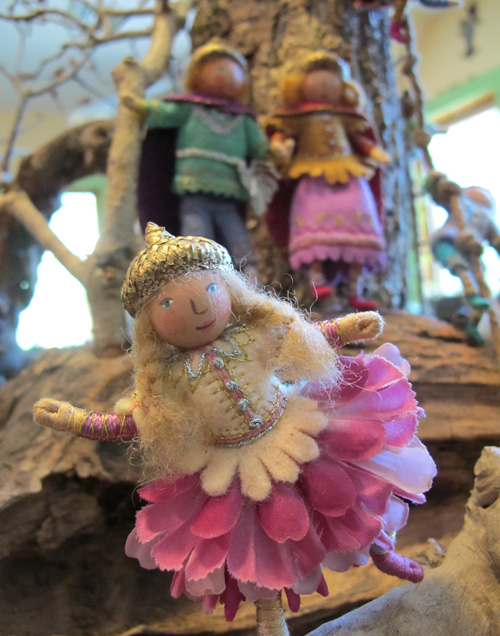
Princess from “Felt Wee Folk: Enchanting Projects”

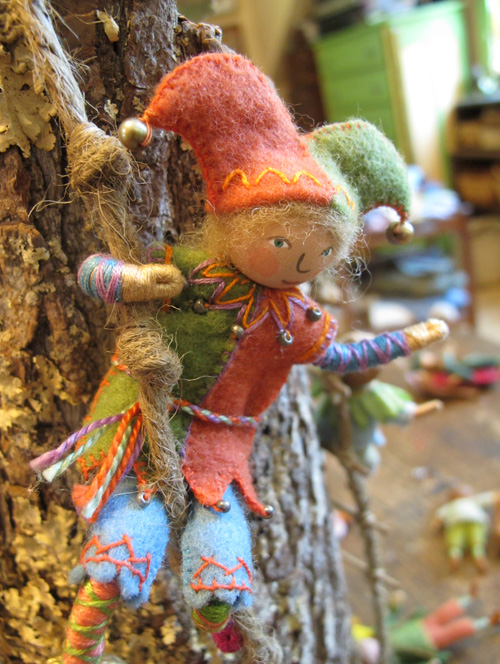
Jester from “Felt Wee Folk: Enchanting Projects”

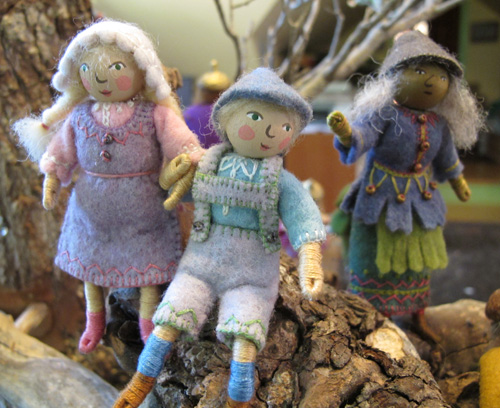
Hansel & Gretel and the Witch from “Felt Wee Folk: Enchanting Projects”

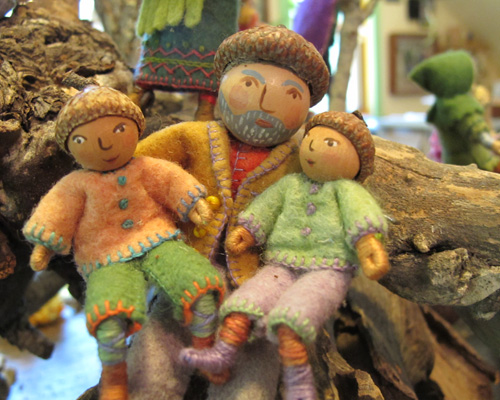
And a grandpa with his grandchildren. It sure was fun playing with these dolls again and bringing them on a short outing to my exhibit at Highfield.