Library community art project

Center square of the Woods Hole Quilt 2007

Every summer, the Woods Hole Public Library sponsors a community art project, inviting patrons of all ages to create a work of art, working separately and using a common medium. In previous years, materials such as discarded books, retired chairs from a local restaurant, outdated nautical charts and even horseshoe crab shells where used. The completed works are then auctioned off for the benefit of the library. A few years ago, I made “Paige Turner” (pictured below) using pages from an old book that was going to be thrown out. And this year, I’m offering 3 items for the auction.

(Find out about the Woods Hole Village Quilt (2007) pictured above here)

Paige Turner from a previous Woods Hole Public Library community art project

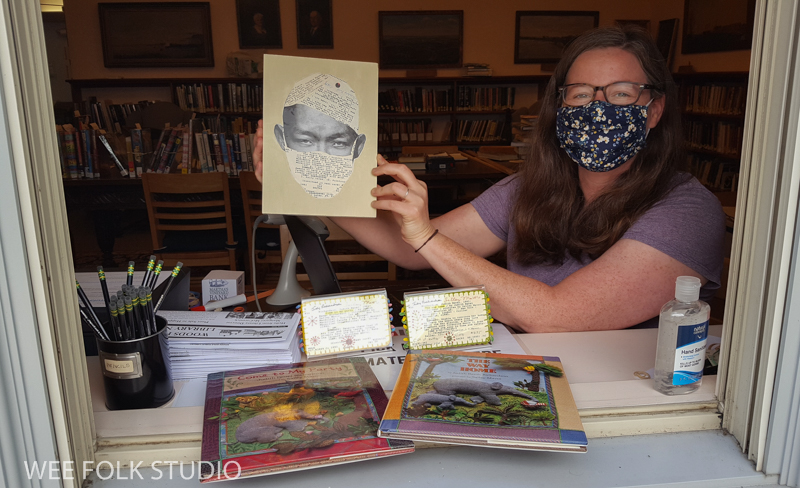
This year’s project features cards from the library’s now decommissioned card catalog. Remember those little wooden drawers that recorded each book in the library, along with their Dewey decimal classification? While combing through the thousands of cards, a volunteer came across the ones made for the 2 books that Judy Richardson wrote and I illustrated. She gave the cards to Judy who asked me if we could participate in the project.
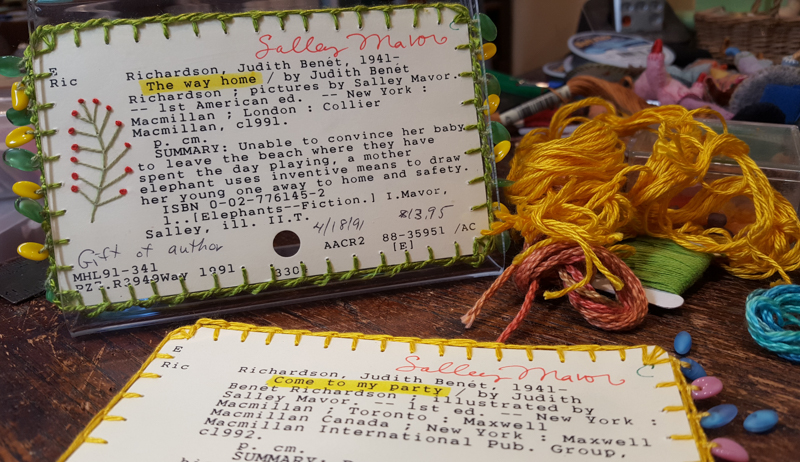
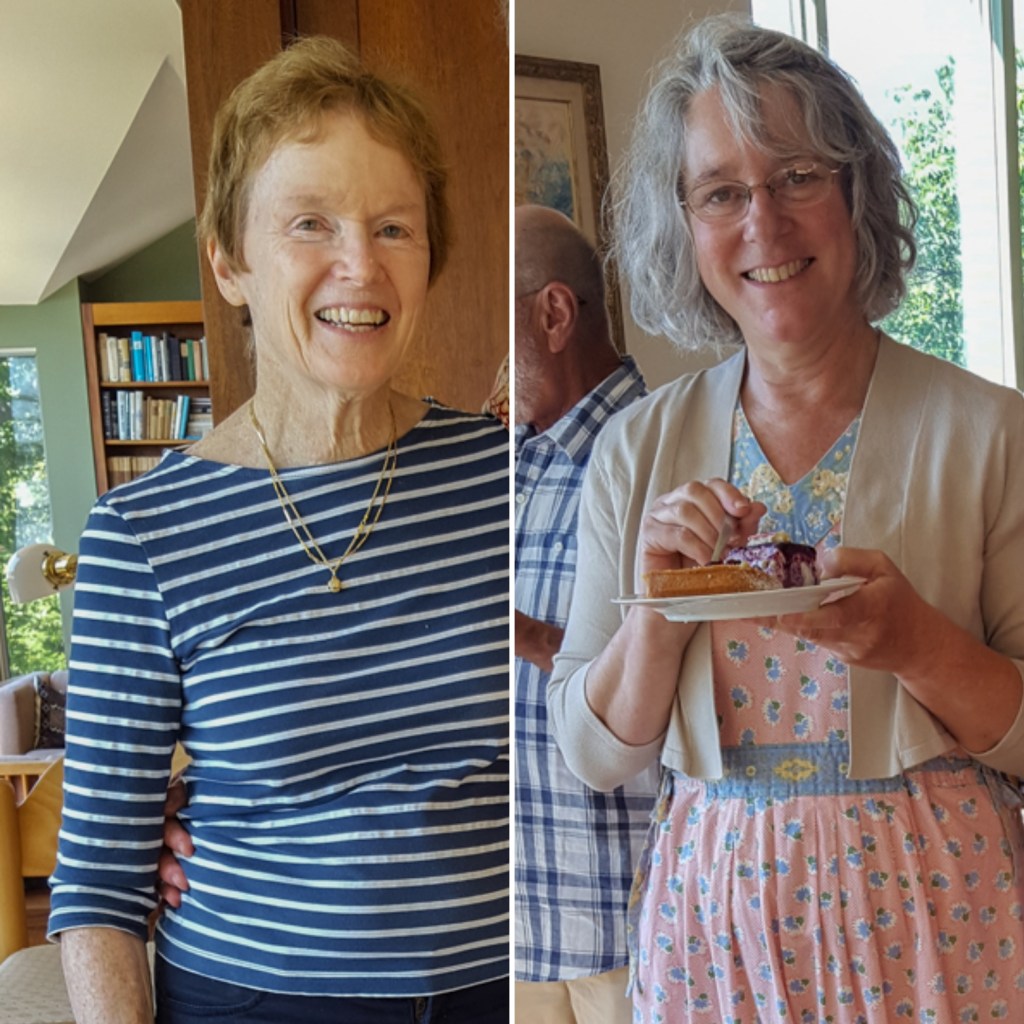
Judy had the idea of decorating the library cards and offering signed copies of our books, The Way Home and Come to My Party for the auction. So, I got out a needle and thread and embellished the cards with stitches and beads. Here we are in a 1991 promo picture for The Way Home, posing with Bella the elephant at the Barnstable County Fair and more recent photos. I wrote about making the pink dress I’m wearing here.

Judy was kind enough to dip into her safely guarded supply and offer our books for the auction.These hard cover books are out of print and very hard to find, especially unused and in perfect condition. Both of us signed the library cards and the title pages inside the books.

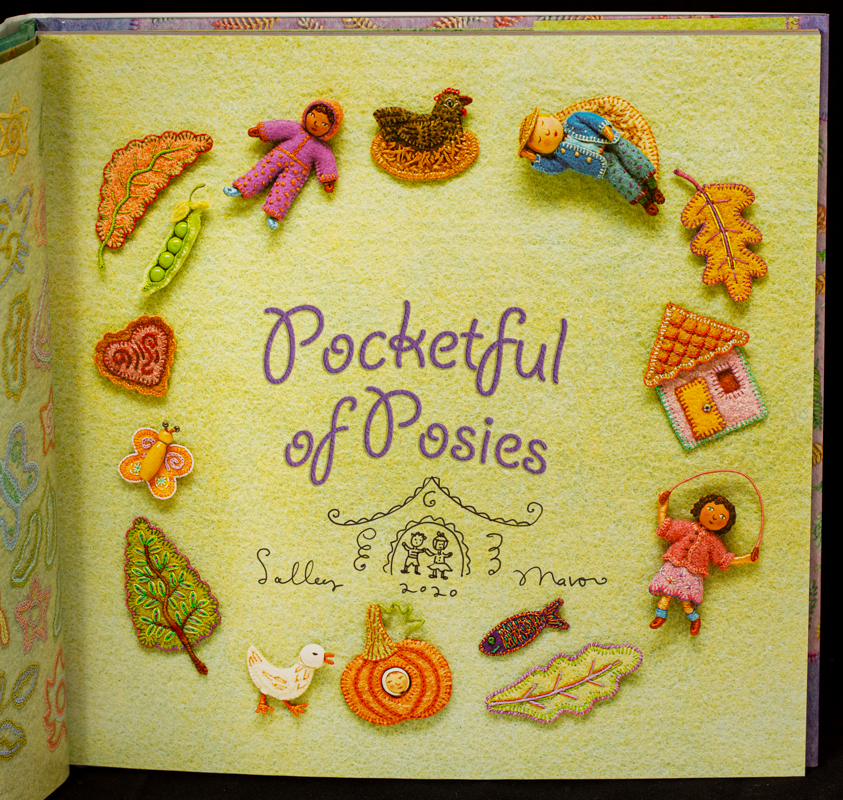
The card for Pocketful of Posies was also found, so I decorated it, too. The auction will go live on Sat. July 25th and run for 2 weeks. You can link to the auction from the library’s website here.

The Woods Hole Public Library is a treasured institution in our village. They’ve adapted to the Covid 19 restrictions and are serving patrons via an outside window. When I dropped off the books, a writer’s workshop was being held outside, with everyone sitting 6 ft. apart in a circle.
Since libraries have gone digital, those old oak drawers need to find new homes and sometimes you can find them for sale. I love my set, which was passed down many years ago from my biology professor grandfather, who used it to catalog his personal library of science books. Now, they hold boxes of beads. So, if you have lots of little things to keep organized and accessible, I recommend getting a set!

To keep up with new posts, subscribe to this blog (top right column on the home page). If you’d like to see more frequent photos tracking the projects in my studio, please follow me on Facebook and/or Instagram.
bed book peek: crocodile

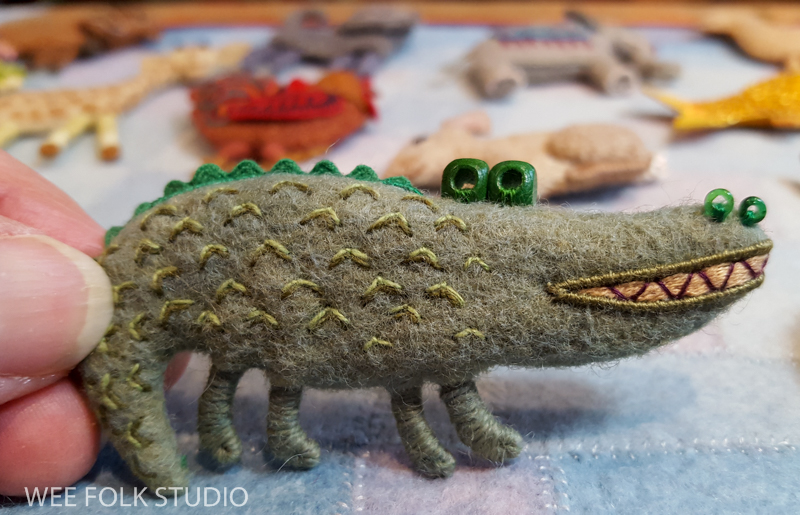
Today, I’m happy to show how I made this crocodile, which will be used as a spot illustration in my upcoming picture book, MY BED. The story about children’s sleeping places in different cultures around the world is written by Rebecca Bond and will be published by Houghton Mifflin Harcourt in Sept. 2020. A touring exhibition of my original embroidered artwork for the book is traveling around the United States. The tour schedule is listed here.

Update: Signed copies of My Bed can be ordered in my shop here. Watch this 8 minute documentary about how I created the illustrations for the book.

For inspiration, I found this felt purse, which is a prototype for a kit I used to sell in the early 2000’s. The different animal kits came with plant dyed wool felt, thread, and beads for the eyes. The purse kits were mostly sold in catalogs and Waldorf School stores, along with my fairy kits.

Using its simple, stylized shape as a jumping off point, I drew sketches until I was happy with the overall pose and level of detail. I thought about how to translate the flat outline into a more 3-dimensional crocodile.

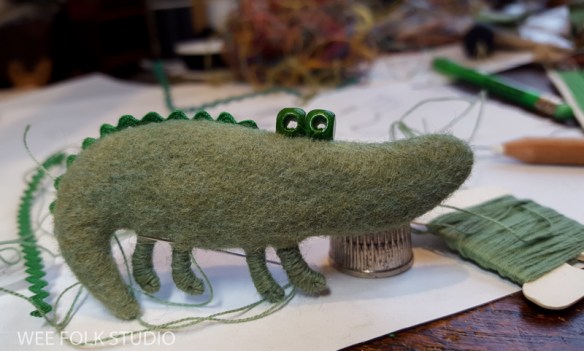
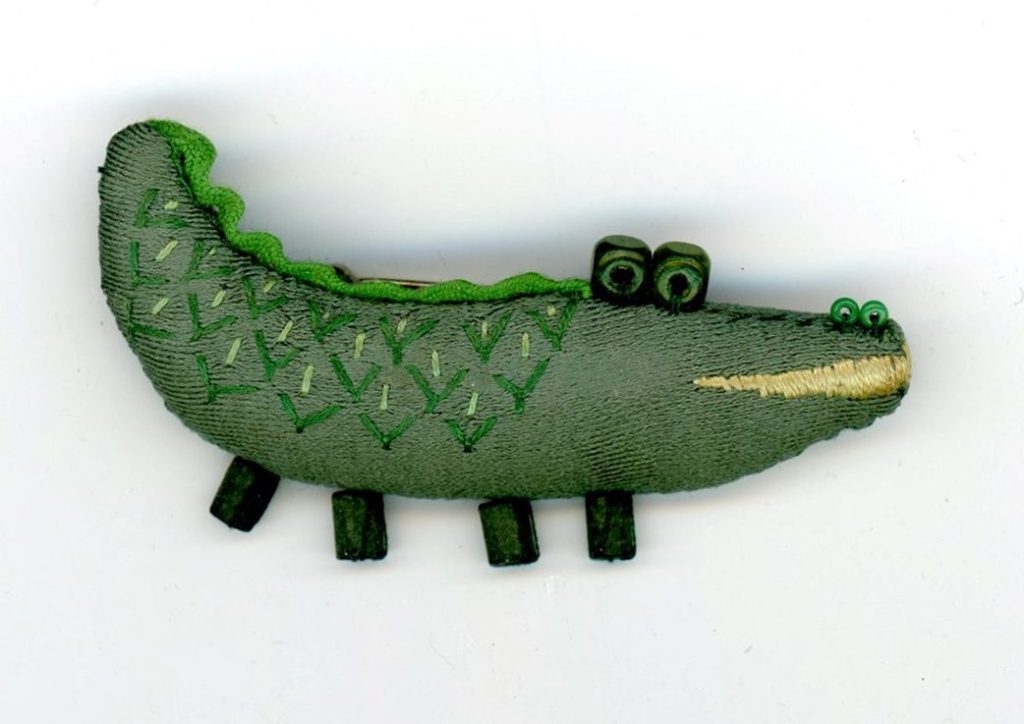
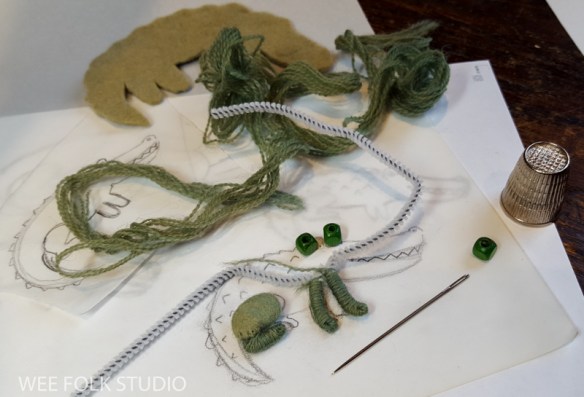
I bent a pipe cleaner and wrapped 2 front legs with tapestry weight wool yarn. I also located square green wooden beads for the crocodile’s eyes. They’ve been in my bead collection since the 70’s, when I made crocodile pins (see one at the end of this post).

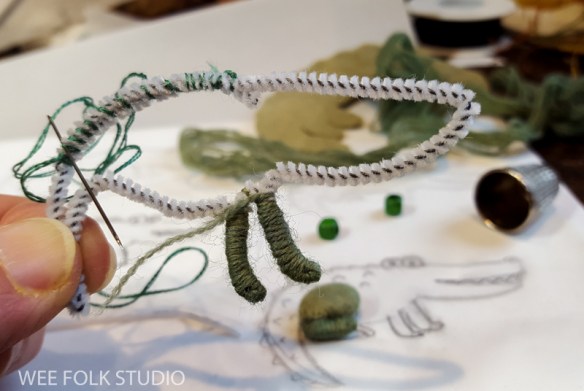
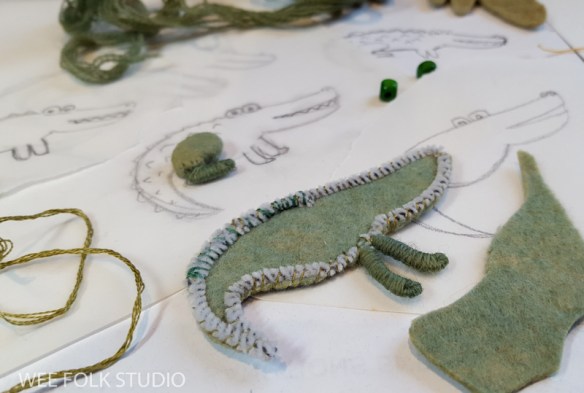
I bent the pipe cleaner to form an outline of the animal’s basic shape and sewed on a backing of green felt.

At this point, I must have forgotten to take pictures, so we’ll have to skip the fussy part where I cover the front of the animal with felt. From the looks of it, I padded the inside of the body with extra layers of felt. My original plan was to put a haunch where the back legs go, but the one I made looked awkward, so I scrapped that idea and made 2 back legs to match the front ones. Then I sewed the beady eyes to the top and stitched rickrack along its back.

I did remember to take a picture of the back, which reveals an unsightly mishmash of stitches that hold the front piece tightly in place.

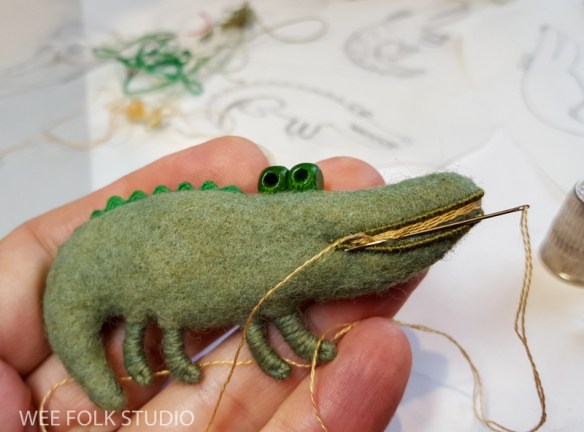
I formed the outline (or lips) of the mouth with wire and covered the shiny metal with embroidery floss. Then I “colored in” the mouth with an overlapping filler stitch.

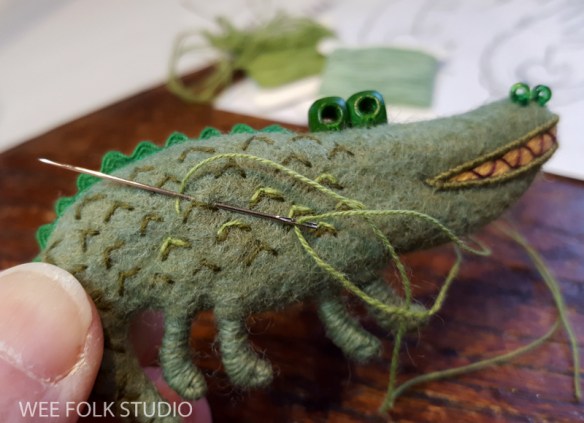
Finishing touches included zigzag teeth, seed beads for nostrils and a fly stitched bumpy texture on the body.

The crocodile I made for the book is very much like pins I used to make over 40 years ago. As you can see, I’m reworking the same themes over and over!

To see other animals and illustrations I’ve made for the book, click here.

To keep up with new posts, subscribe to this blog. If you’d like to see more frequent photos tracking the projects in my studio, please follow me on Facebook and/or Instagram.

bed book peek: Ghana (part 4)

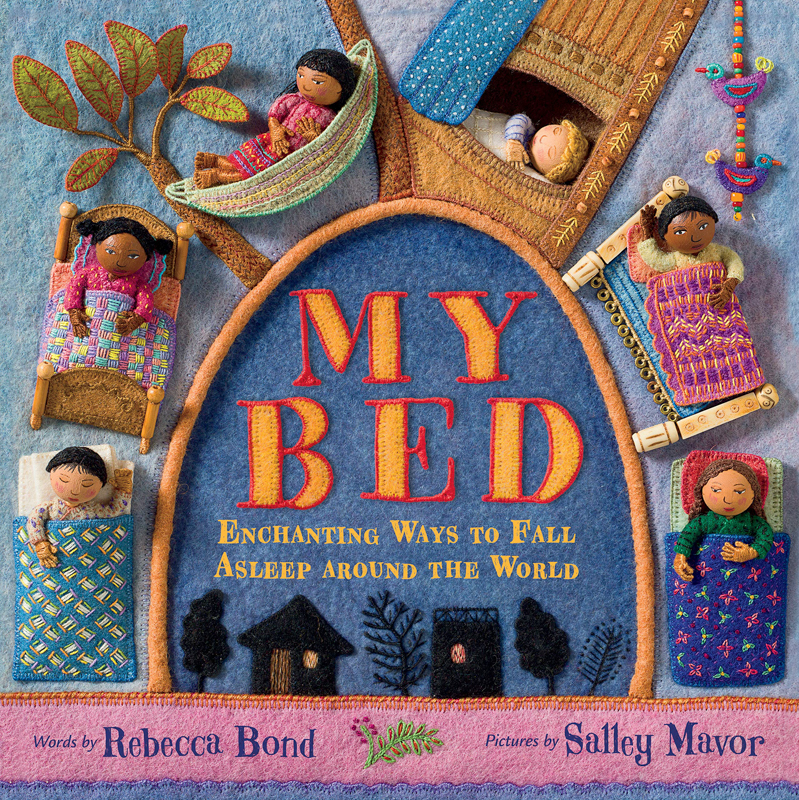
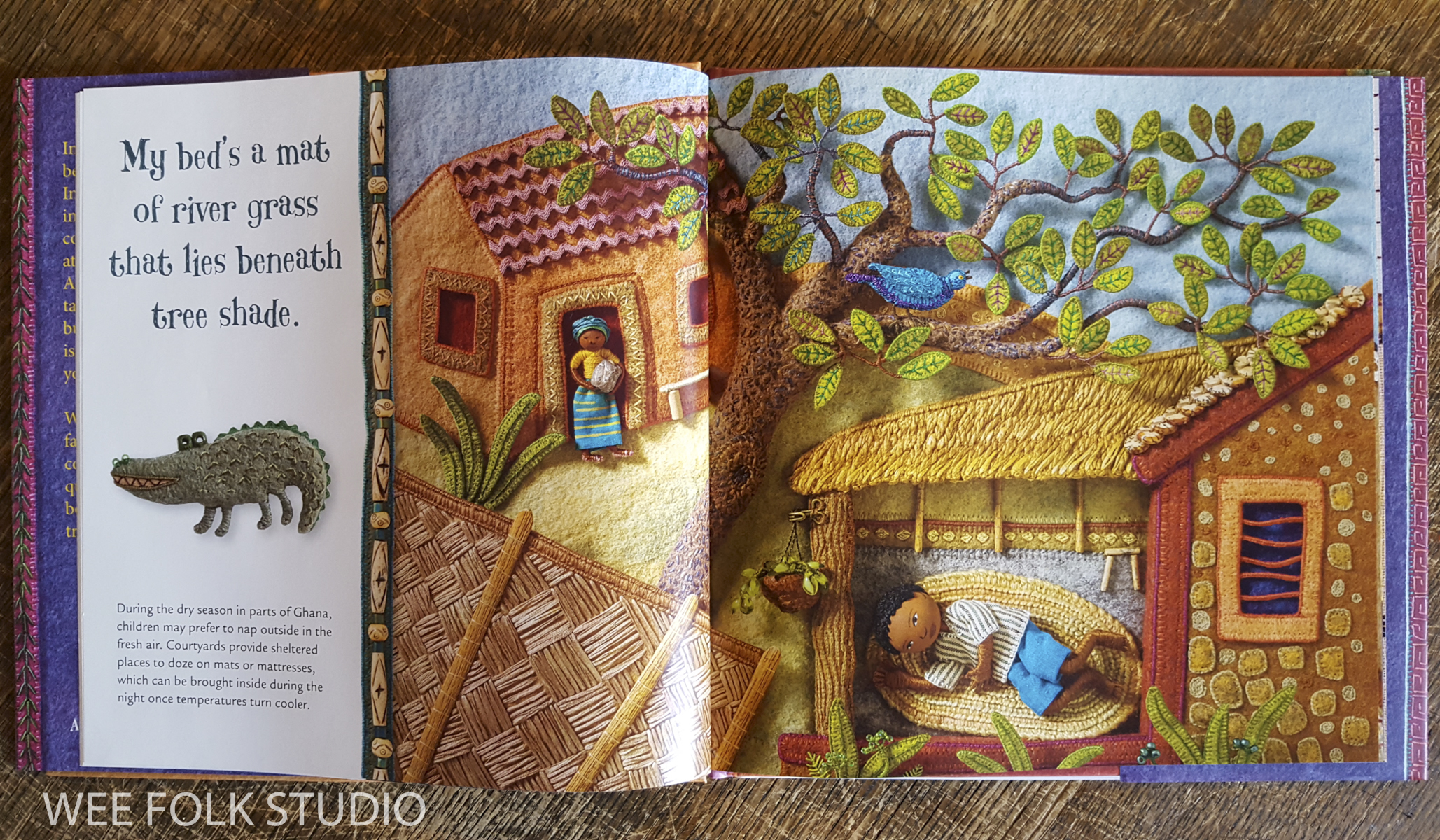
This is Part 4 in a series of posts about making the bas-relief scene set in the West African country of Ghana. A photograph of the piece will be reproduced in my upcoming picture book, MY BED: Enchanting Ways to Fall Asleep around the World. An accompanying US tour of the original artwork used to illustrate the book will begin in the fall of 2020. Information about the exhibition is on this page.

Part 1 shows the process of making the smaller house and background figure.
Part 2 is about making the child and his house in the foreground.
Part 3 shows how I made the shade tree and the bird.

Update: Autographed copies of My Bed are available in my shop here. Watch an 8-minute video about making the artwork for the book.

The book is about where children sleep around the world, with each spread depicting a different culture and living environment. The story is written by Rebecca Bond and will be published by Houghton Mifflin Harcourt in Sept. 2020. Here are links to posts showing other finished illustrations for the book: South America, JapanIndiaAfghanistanRussiaNorth America, ScandinaviaHolland and Iran. To see a list of all my books, click here.

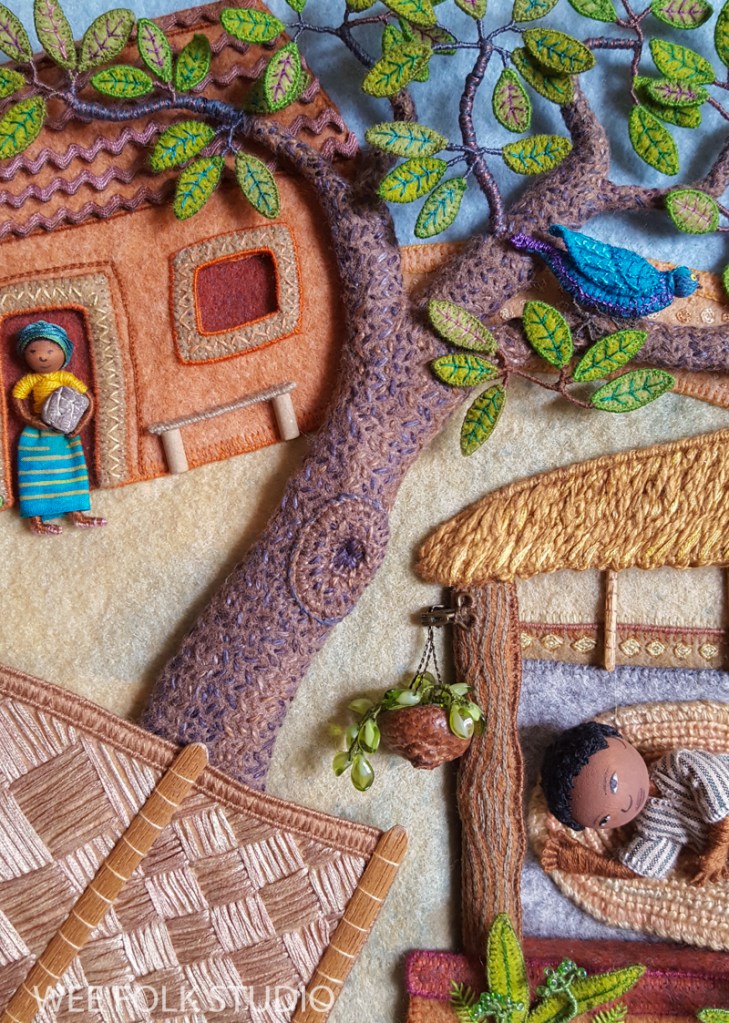
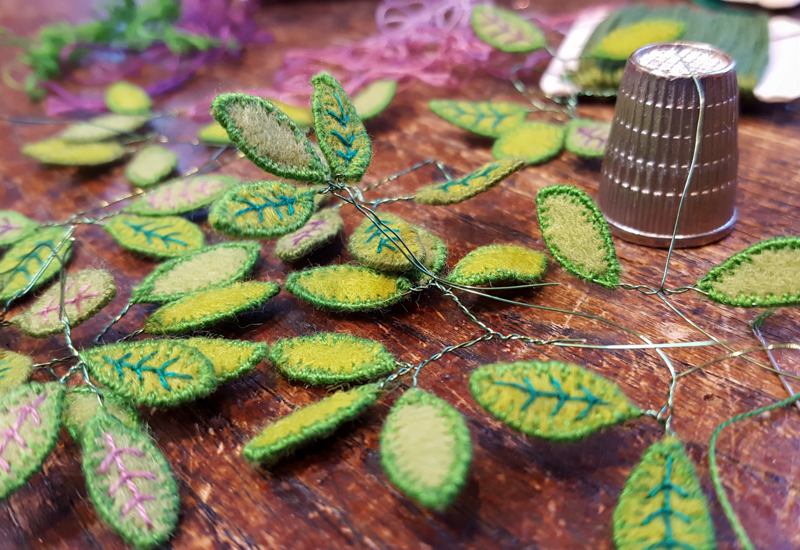
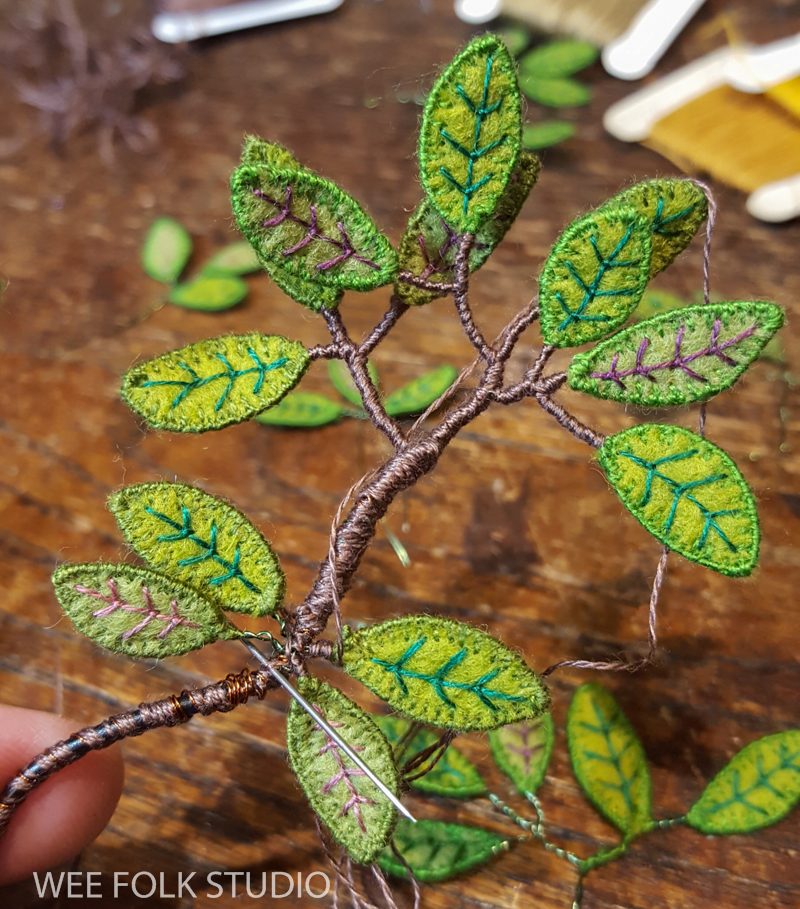
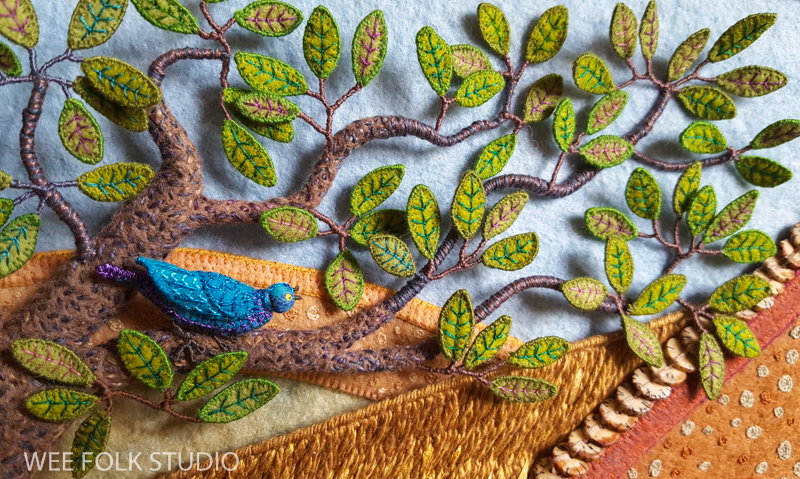
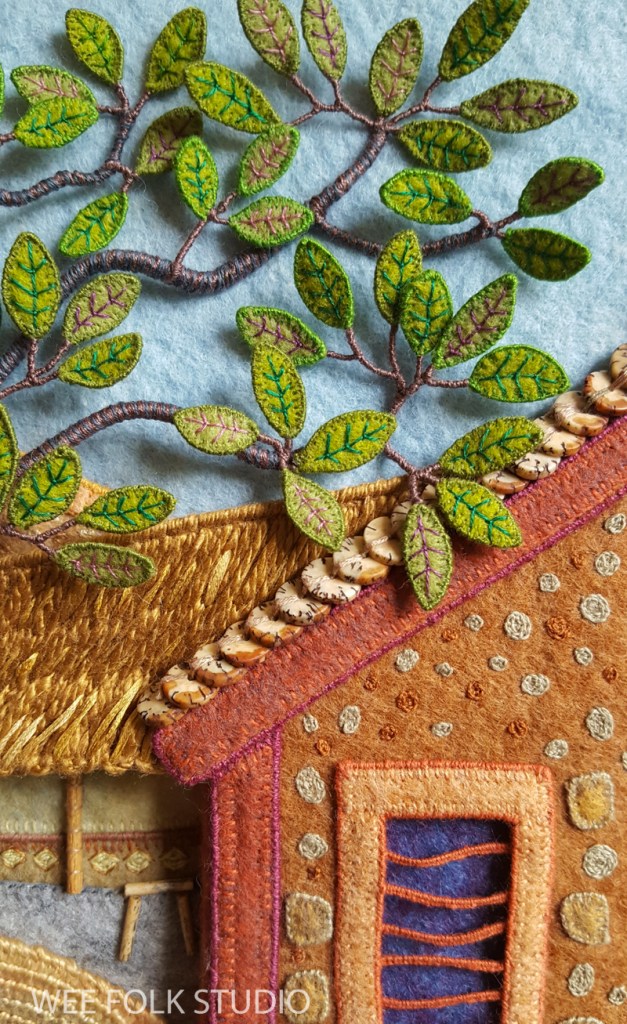
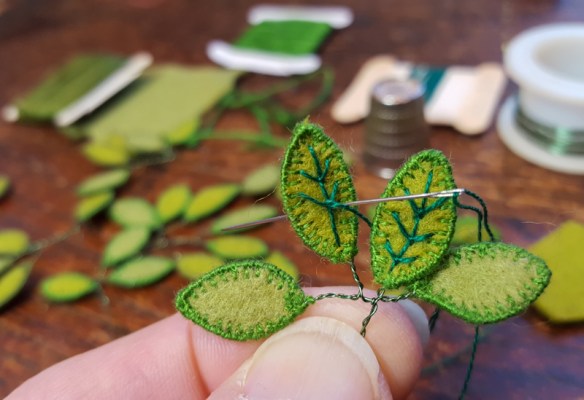
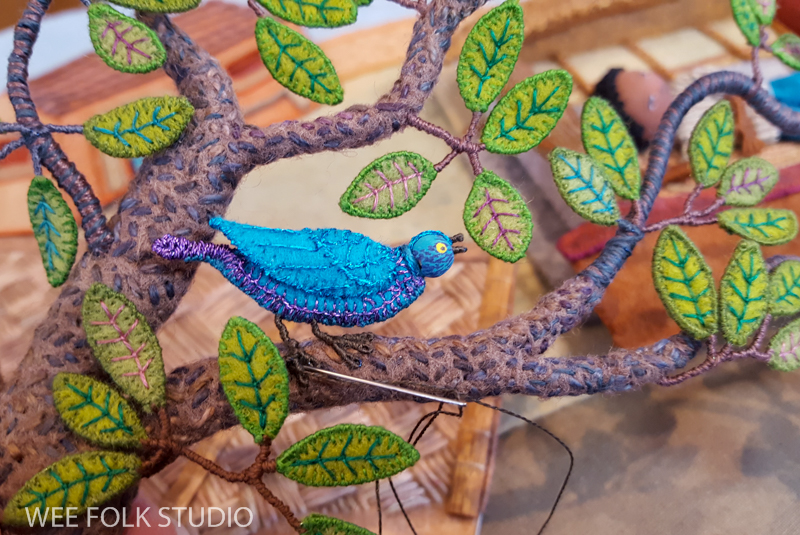
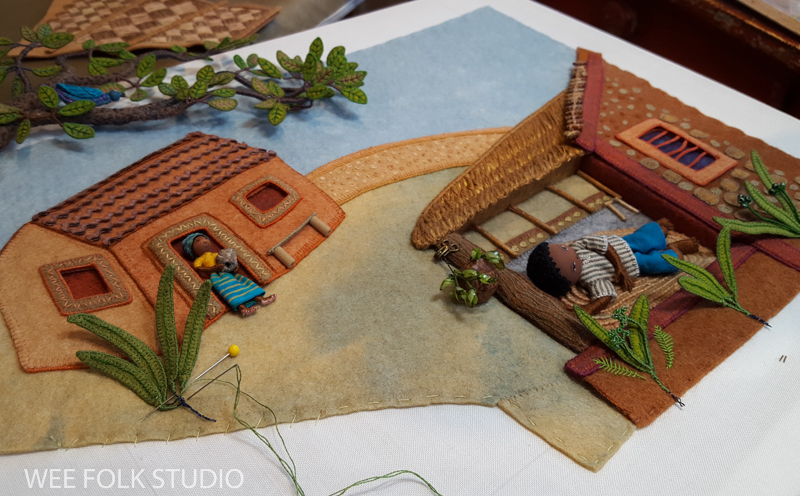
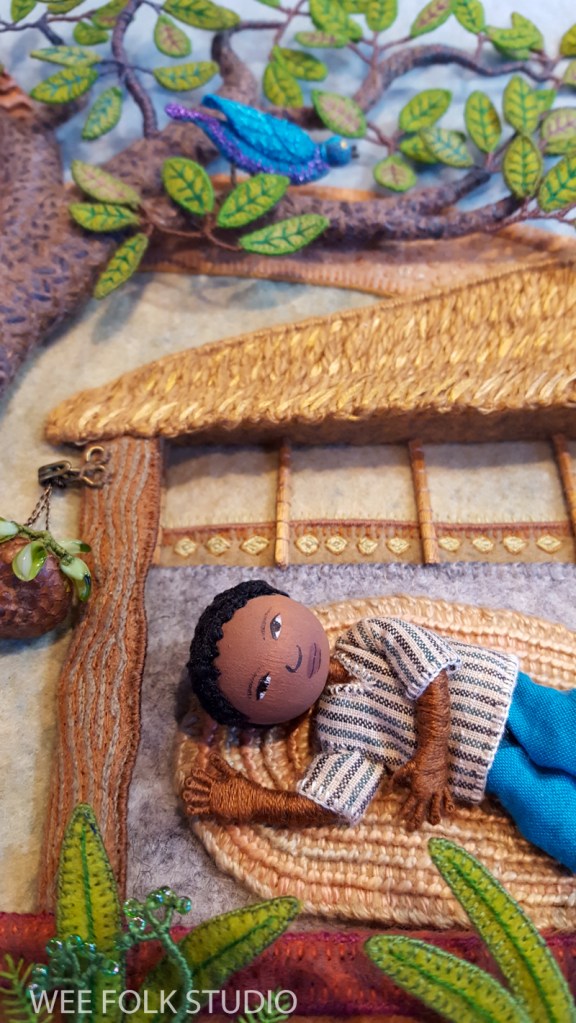
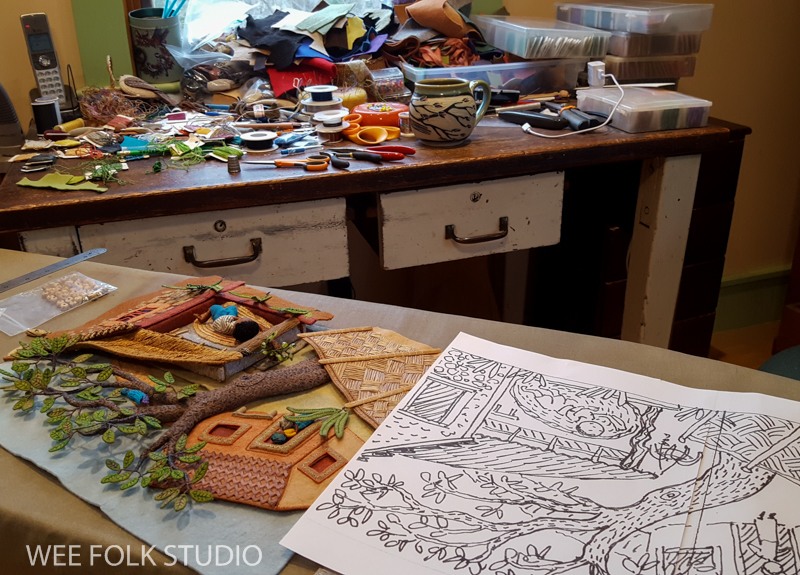
This post shows how I made the leaves, plants and woven fence. It completes the 4 part series about stitching and constructing the many parts in the Ghanaian illustration. Since the shade tree is a prominent feature of the scene (and the text), I wanted to make it as 3-dimensional as possible. Sometimes I embroider leaves to a background fabric, but this tree would stand alone as a separate object. That meant that each individual leaf had to be cut of felt, stitched around the outside and edged with wire. At the time, I didn’t pay attention to how many, but out of curiosity, I just counted 89 leaves.

I grouped them in branches of 3, 4 and 5 leaves and added fly stitches to look like veins.

The clusters accumulated on my work table over the course of a few days.

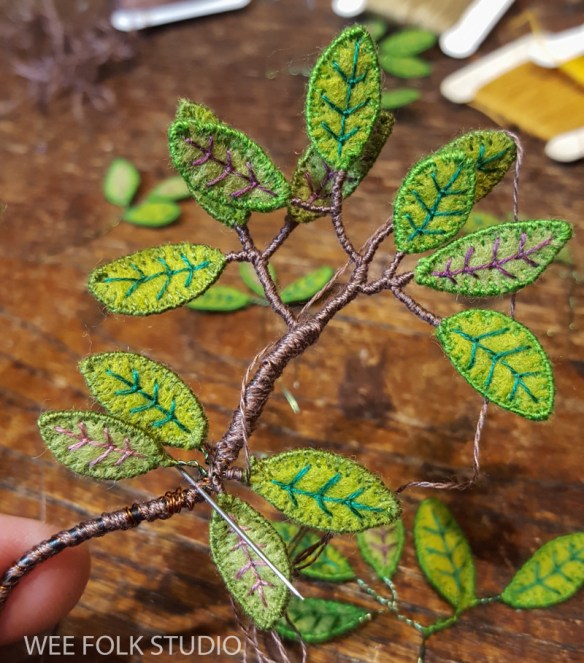
Then I joined the small branches to the larger branches of the tree (which I described in Part 3) and wrapped embroidery floss around the thick and thin wire.

The trick is to get a seamless transition between the felt and wire branches. Wire provides the flexibility to bend and arrange the branches this way and that, to evenly fill the gaps and overlap the leaves.

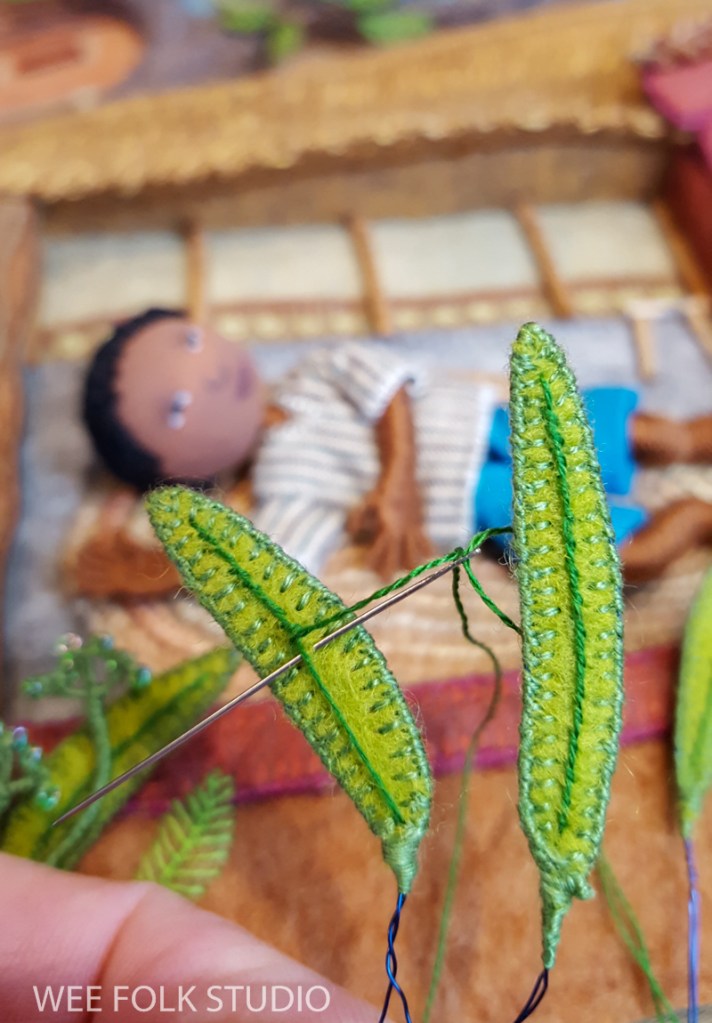
i also made felt plants with long thin leaves. For extra stability, I stitched wire both around the outside edge and down the center vein.

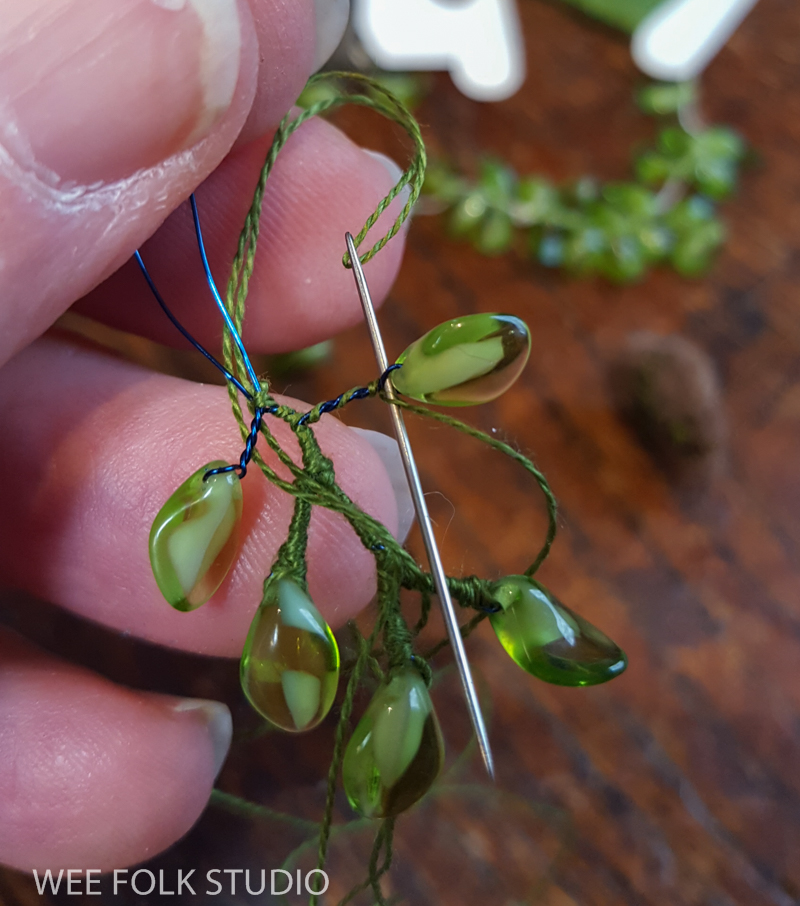
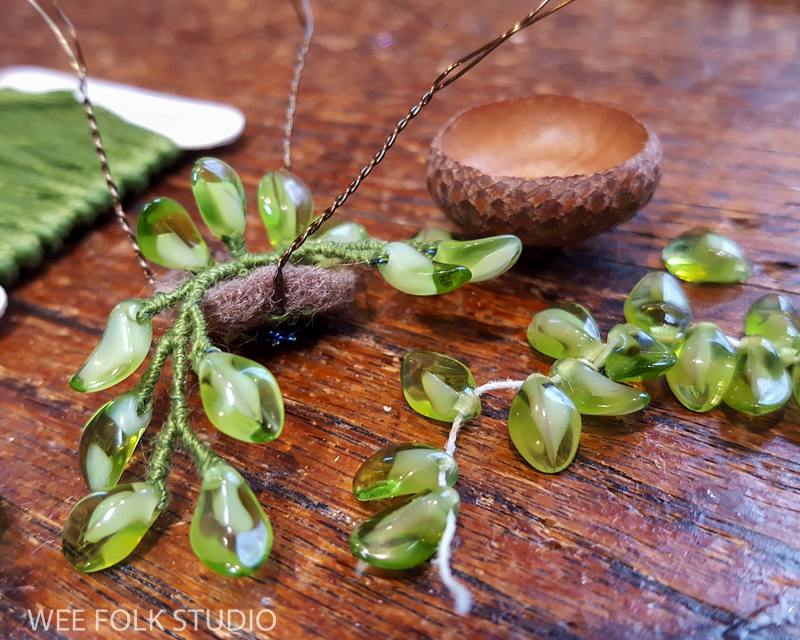
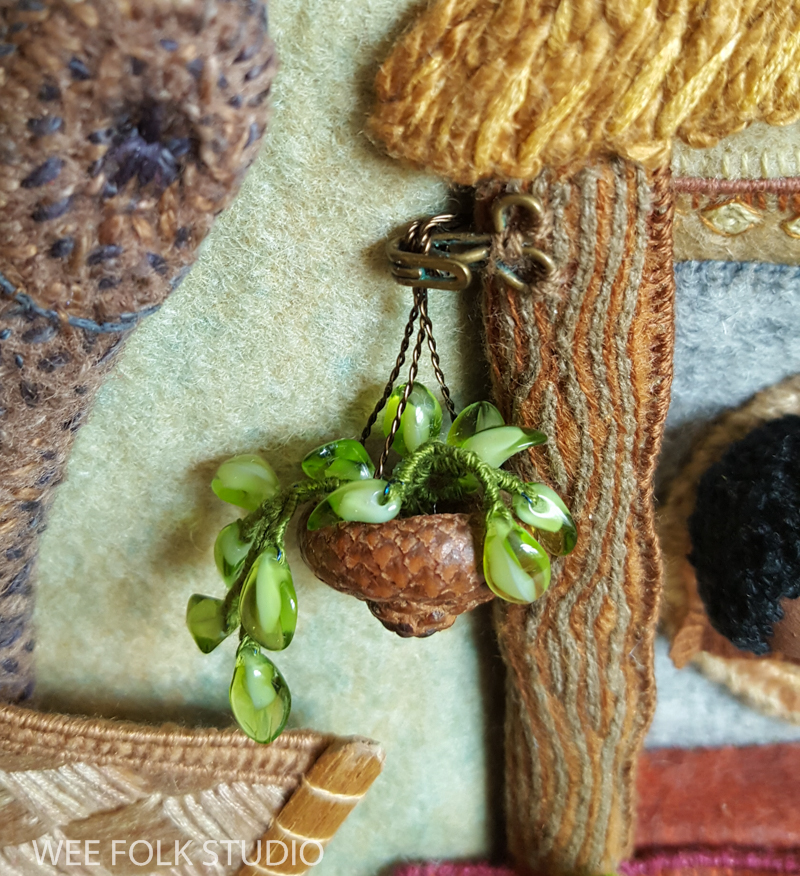
For the hanging plant, I made wire stems and attached glass bead leaves.

The planter is an acorn cap. I sewed the plant and 3 pieces of wire to a circle of brown felt. I rarely use glue, but figured it was the best choice for holding the felt/wire/plant inside the acorn cap.

I found a plant hook of the right size in my hook & eye collection, which has really come in handy for this book project.

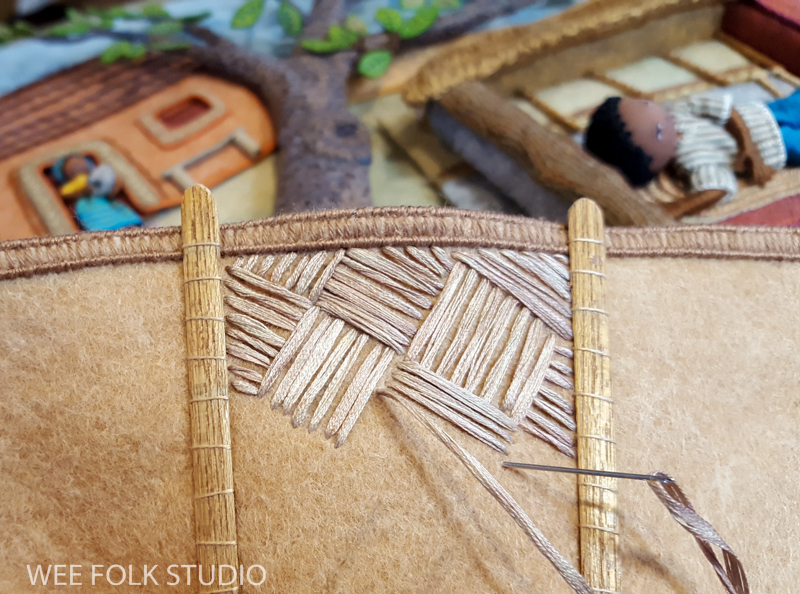
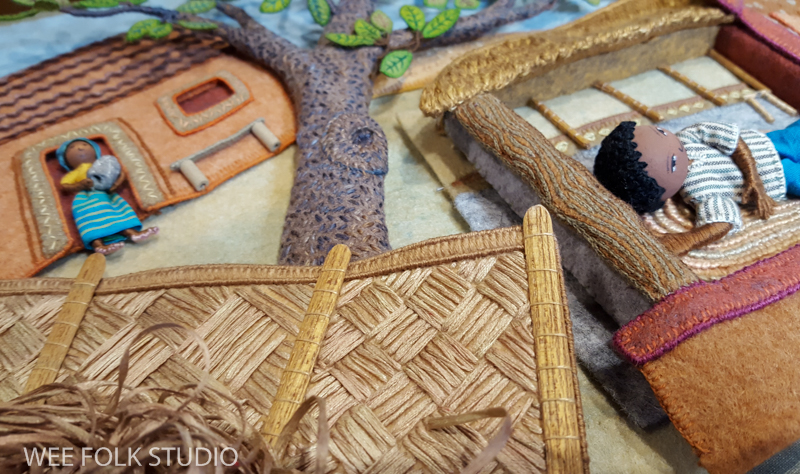
I cut a piece of felt for the fence and stitched 2 rows of wire to the top edge to keep it from being too floppy. I found some small flat pieces of wood in my stash of misc. parts and sewed them to the felt. Then, I stitched silk ribbon in a diagonal square pattern to make it look like it was woven with plant fibers.

I hope that you enjoyed this series about making the Ghanaian scene. Over the past year or so, I’ve written about most of the illustrations in the book, but there are a few more to go. My Bed’s release date of Sept. 8th, 2020 is just around the corner! If you’d like to pre-order autographed copies, please go to my shop. To see a complete list of the “bed book peek” blog entries, please go here.

To keep up with new posts, please subscribe to this blog (top right column on the home page). Your contact info will not be sold or shared. If you’d like to see more frequent photos tracking the projects in my studio, please follow me on Facebook and/or Instagram.
bed book peek – Ghana (part 3)

This is Part 3 in a series of posts about how I made the stitched bas-relief scene set in the West African country of Ghana. A photograph of the piece will be reproduced in my upcoming picture book, MY BED: Enchanting Ways to Fall Asleep around the World. An accompanying US tour of the original artwork used to illustrate the book will begin in the fall of 2020. Information about the exhibition is on this page.

Part 1 shows the process of making the smaller house and figure in the background and Part 2 is about making the child and his house in the foreground.

The book is about where children sleep around the world, with each spread depicting a different culture and living environment. The story is written by Rebecca Bond and will be published by Houghton Mifflin Harcourt in Sept. 2020. Here are links to posts showing other finished illustrations for the book: South America, JapanIndiaAfghanistanRussiaNorth America, ScandinaviaHolland and Iran. To see a list of all my books, click here.

Update: Signed copies of My Bed can ordered in my shop here. 40 pages, 9″ x 9″, words by Rebecca Bond, pictures by Salley Mavor, published by Houghton Mifflin Harcourt.

In this part, I’ll show how I made the shade tree and the bird. Please bear with me while I try to explain ways of working that don’t easily fit into a logical sequence. These are techniques I’ve figured out intuitively over many decades of manipulating materials in my hands and I will do my best to translate into words what my hands have taught me.

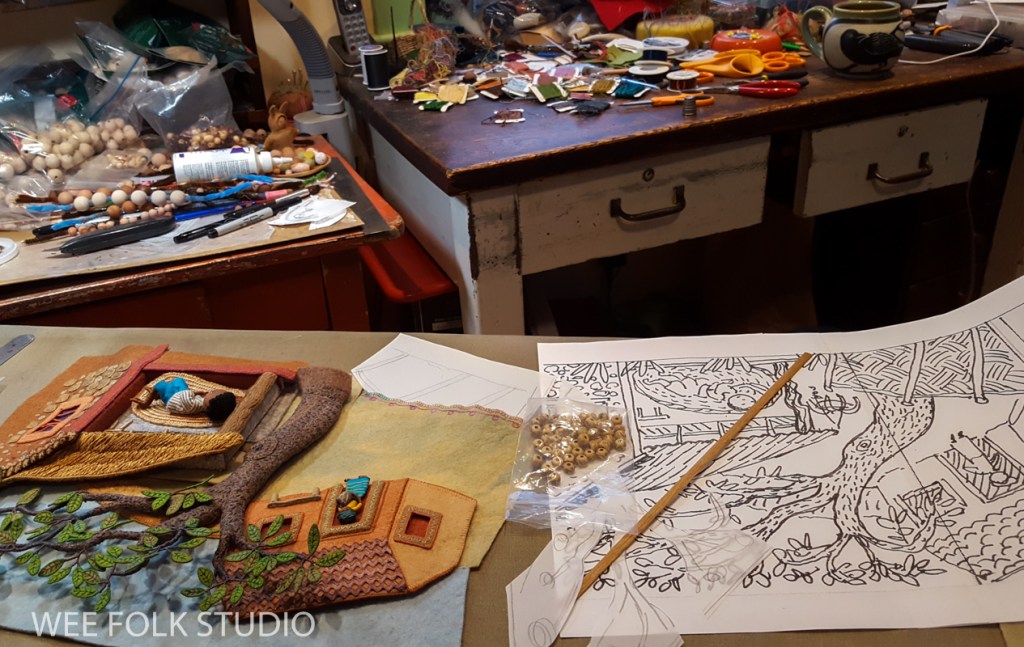
In the beginning, I made thumbnail sketches of all of the pages in the book and enlarged them to full size. I used the drawing of the Ghanaian scene to trace and cut out a template of the tree.

Using the template, I traced and cut the trunk shape out of acid-free mat board. Over the years, I’ve gotten more diligent about using archival materials that won’t deteriorate or stain over time. You can read how I learned my lesson in this post about repairing an older piece.

To give the mat board a stitch-friendly surface, I glued layers of thin quilt batting to the front and back of the mat board. That way, there was something to catch the needle onto. I built up the thickness of the trunk by sewing tapered layers of felt to the top.

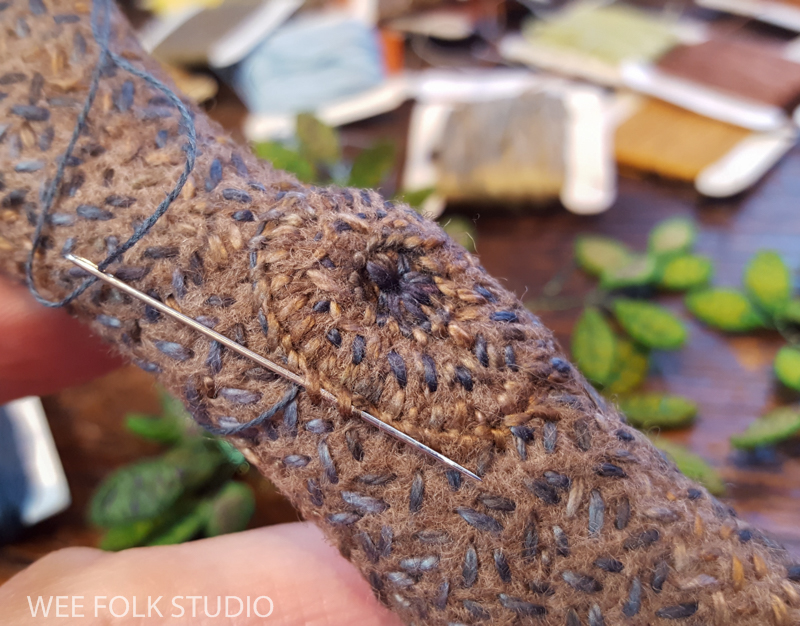
To make thinner branches, I sewed insulated electrical wire to the top where the trunk divides into 3 sections. I covered the tree trunk and thicker branches with brown felt, using a gazillion stitches on the back to pull it tight around the front.

I stitched a zigzag bark texture to the front with variegated pima cotton (Watercolours by Caron). To make the knot in the tree, I cut out a donut shaped piece of felt and blanket stitched it to the trunk.

To make leaves, I cut out pieces of felt and edged them with blanket stitches. Then, I stitched jewelry wire around the outside edges and formed stems by twisting wire.

I attached clumps of 3 or 4 leaves to the tree branches by winding the thin jewelry wire around the thicker insulated electrical wire.

Then, I wrapped the thick and thin wire with embroidery floss, covering the bumps and lumps until it looked smooth.

The original sketch didn’t include a bird, but after watching the scene come together, I decided to add a third blue focal point to catch the eye. The other 2 are the boy’s blue shorts and the blue skirt worn by the woman in the doorway. They stand out in contrast with the overall orange, brown and green color palette. I researched birds in West Africa and found a spectacular bird called the splendid glossy-starling.

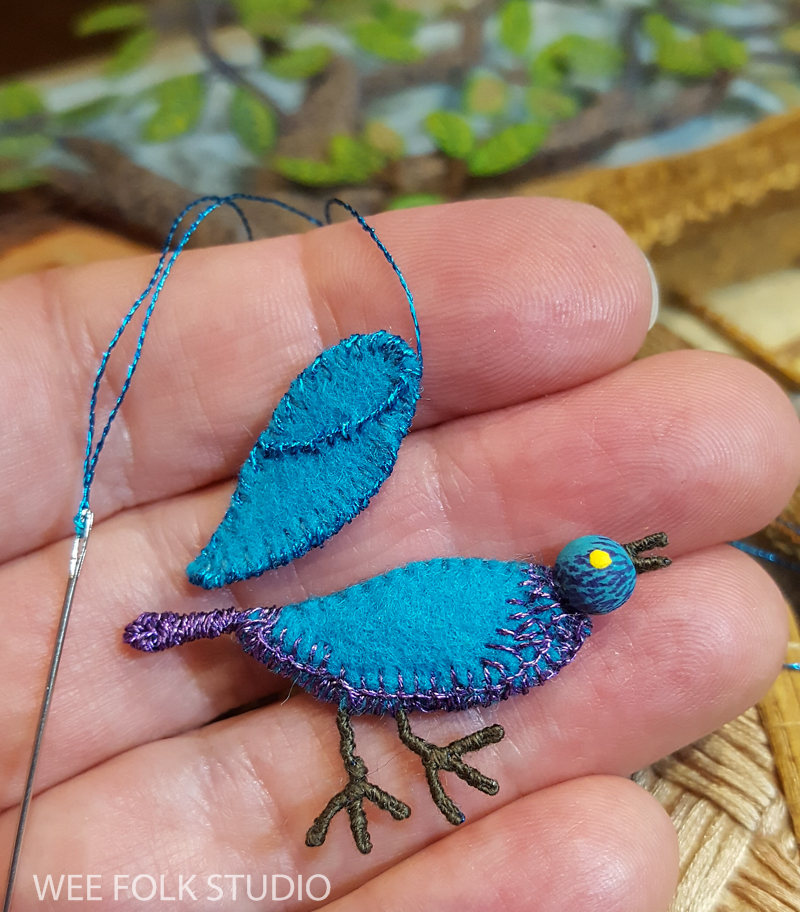
For the bird’s head, I painted a wooden bead blue and formed a beak out of jewelry wire, which I wrapped with embroidery floss. Then I stuck the wire through the bead hole and used the extra length of wire to make the bird’s feet.

I made the bird’s body out of felt and added a wire tail. This starling is really glossy, so I stitched some bling with purple metallic thread on its tail and underbelly.

After sewing the bird’s wire feet to a thick branch on the tree, I could almost hear it sing!

Please stay tuned for Part 4, which will cover how I made the plants and woven fence.

To keep up with new posts, please subscribe to this blog. Your contact info will not be sold or shared. If you’d like to see more frequent photos tracking the projects in my studio, please follow me on Facebook and/or Instagram.

bed book peek – Ghana (part 2)

This is Part 2 in a series of posts about how I made the stitched bas-relief scene set in the West African country of Ghana. The piece will be reproduced in my upcoming picture book, MY BED: Enchanting Ways to Fall Asleep around the World.

Here are links to posts showing other finished illustrations for the book: South America, JapanIndiaAfghanistanRussiaNorth AfricaNorth AmericaScandinavia and Iran. To see a list of all my books, click here.

Update: Signed copies of My Bed can ordered in my shop here. 40 pages, 9″ x 9″, words by Rebecca Bond, pictures by Salley Mavor, published by Houghton Mifflin Harcourt.

In Part 1, I showed the process of making the house and the small figure in the background. Now, I will concentrate on the house and child in the foreground.

Way back in the beginning, after my sketches were approved by Houghton Mifflin’s editorial team and before I started working on the finished scenes, I made heads of all of the children who would inhabit the pages of the book. I wanted to meet the children before embarking on what I knew would be at least a 2 year commitment. After falling in love with them, it didn’t matter how long it would take to make the places they call home.

Except for the fingers and toes, the children’s bodies are basically made the same way as the dolls in my how-to book, Felt Wee Folk. I painted their faces on wooden beads and made wigs by gluing on a piece of felt to the crown of the head, which acts as a needle friendly surface to sew on thread hair.

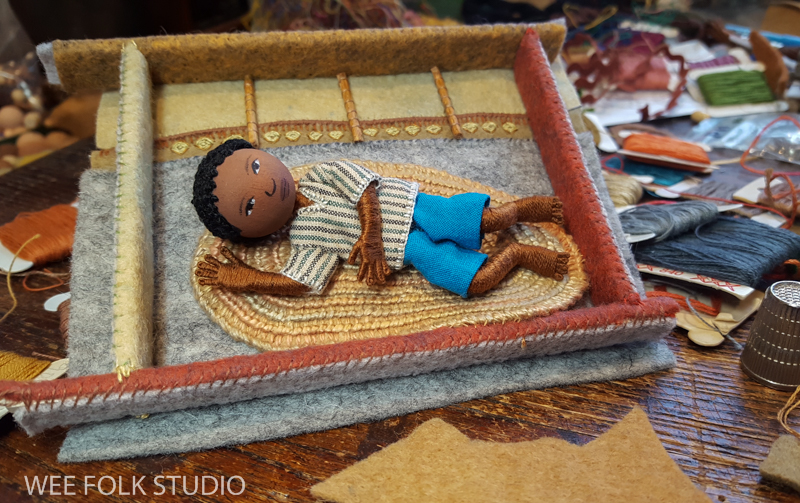
I dressed the Ghanaian boy in cotton shorts and a shirt.

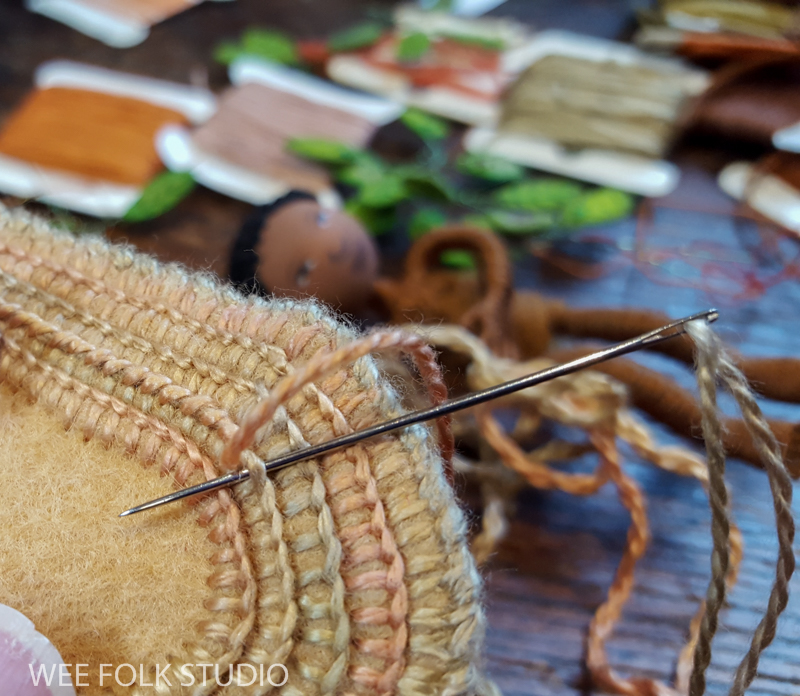
He needed a woven sleeping mat, so I blanket stitched rows of “weaving’ on a piece of felt with variegated pima cotton thread.

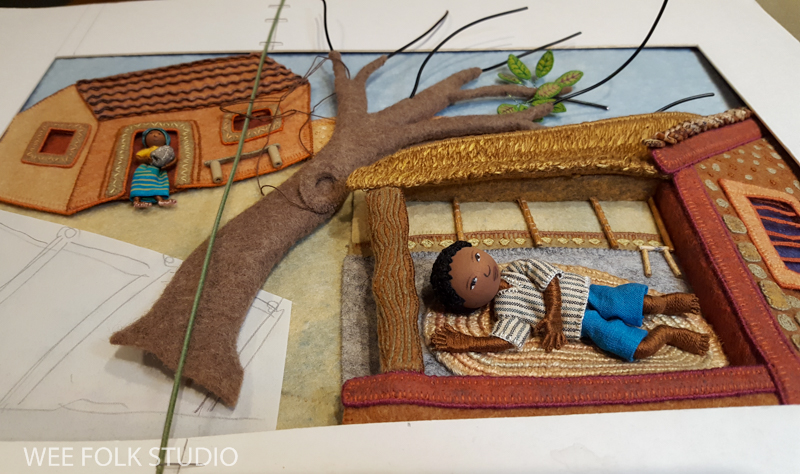
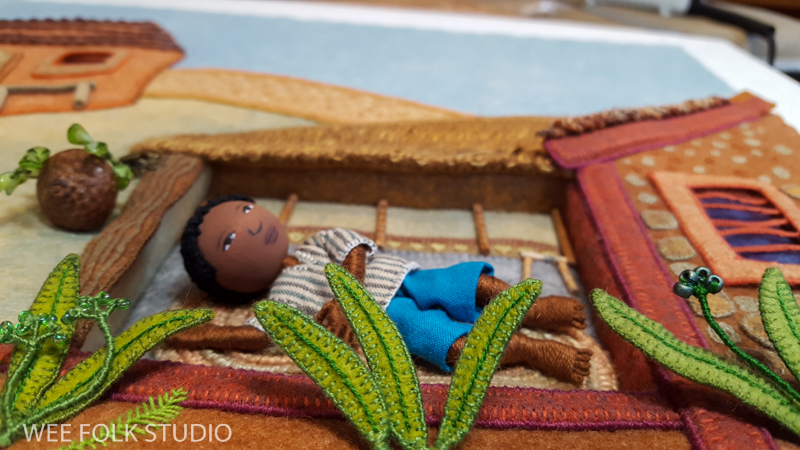
To help make it look like the boy is inside the porch, I built a 1/2″ deep box out of balsa wood that I covered with felt. I’ve also used this method in other scenes for the book to create more depth, such as the inside of the house boat in the scene from Holland. It takes advantage of the space inside the stretcher, behind the background fabric. The box is inserted in a hole cut out of the stretched fabric. Objects recede (about 1/2″), as well as protrude (about 3/4′), making the piece more spatially dynamic.

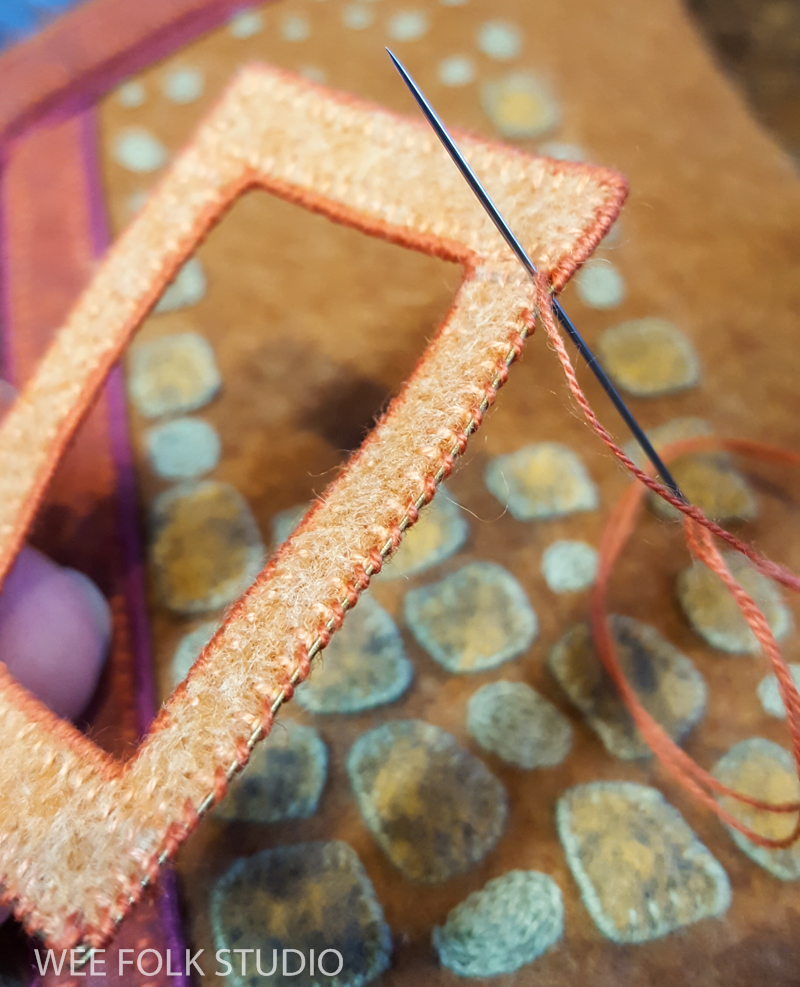
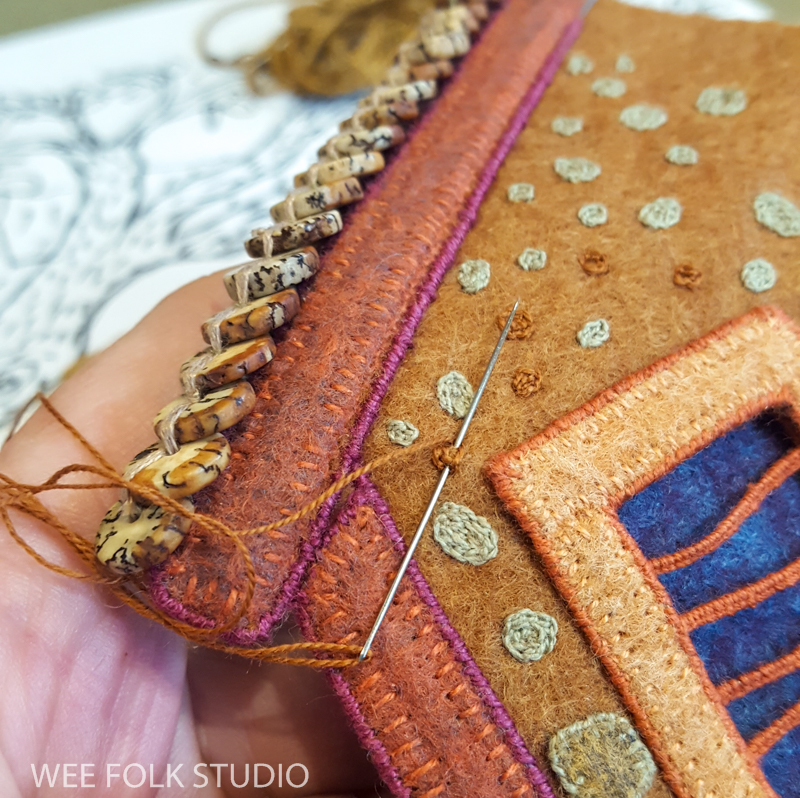
To replicate the stone and mud texture on the house, I appliqued pieces of felt with blanket stitches. For extra structure, the window frame is outlined with wire.

I also chain-stitched spirals to look like stones in the wall and sewed a row of over-lapping bone bead shingles to the roof.

I stitched silk ribbon on felt to create the texture of a straw roof for the porch.

I made a mud and stone wall out of felt to go along the back of the property.

This photo gives an idea of how the box in the porch area recedes.

In future posts, I will show the process of making plants, the shade tree, the bird, and other parts of the scene.

To keep up with new posts, please subscribe to this blog. Your contact info will not be sold or shared. If you’d like to see more frequent photos tracking the projects in my studio, please follow me on Facebook and/or Instagram.

bed book peek – Ghana (part 1)

This is the first in a series of posts that will show how I made another illustration for my upcoming picture book, My Bed. The scene is set in Ghana, in the sub-region of West Africa. By the time I worked on this one, I’d gotten into the habit of taking photos of almost every little step along the way. So, I have a lot of material to share, which is divided into several categories that I’ll write about over the next few weeks.

Update: Signed copies of My Bed can ordered in my shop here. Watch this 8 minute documentary about how I created the illustrations for the book.

Here are links to posts showing other finished illustrations for the book: South America, JapanIndiaAfghanistanRussiaNorth AfricaNorth America, Scandinavia and Iran. To see a list of all my books, click here.

As with all of the scenes in the book, I started by searching online for photos of buildings and living areas in the region. I took this information and drew a series of thumbnail sketches, working out a composition that focused on a child in their particular environment.

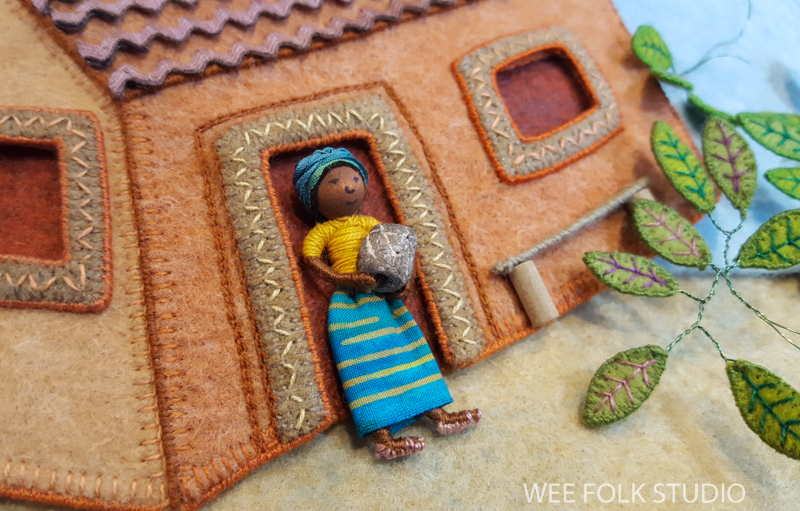
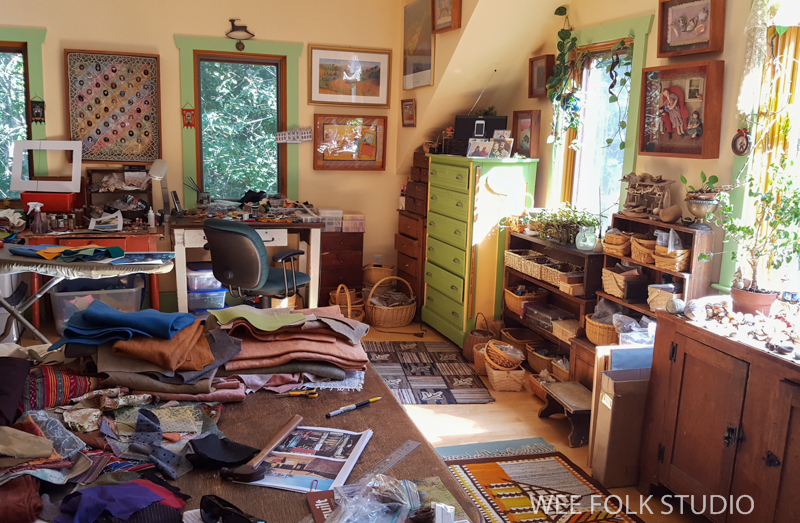
Today, I will show how I made the house that’s off to the side, with a small figure of a woman in the doorway. I selected wool felt from my stash, keeping in mind an overall palette of warm earth tones, complimented with blues and greens. (For questions about felt, please read this post.) It’s actually my favorite color combo, which I chose for my studio walls and window trim.

Even though the house is pieced together in a flat pattern, I wanted to create a sense of inside and outside, so I cut out the side window and door. I sewed wire around the edges to make a structural framework for the otherwise limp felt, adding a crisp outline that helps define its shape.

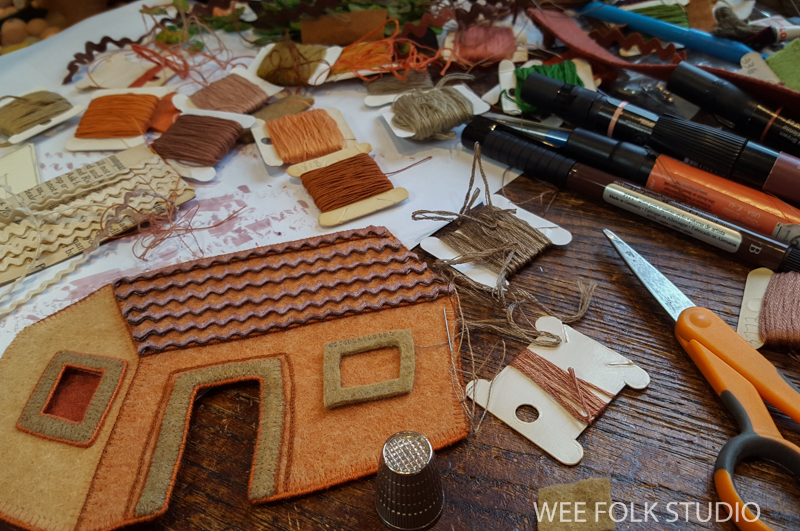
For the roof, I colored some vintage cotton ricrac with a brown magic marker.

To make the ric rac look more 3-dimensional, I outlined the bottom edge with a darker brown marker. Then, I stitched the ric rac rows in place at the pointed tops, which naturally raised up the bottom part, creating a bit of a shadow.

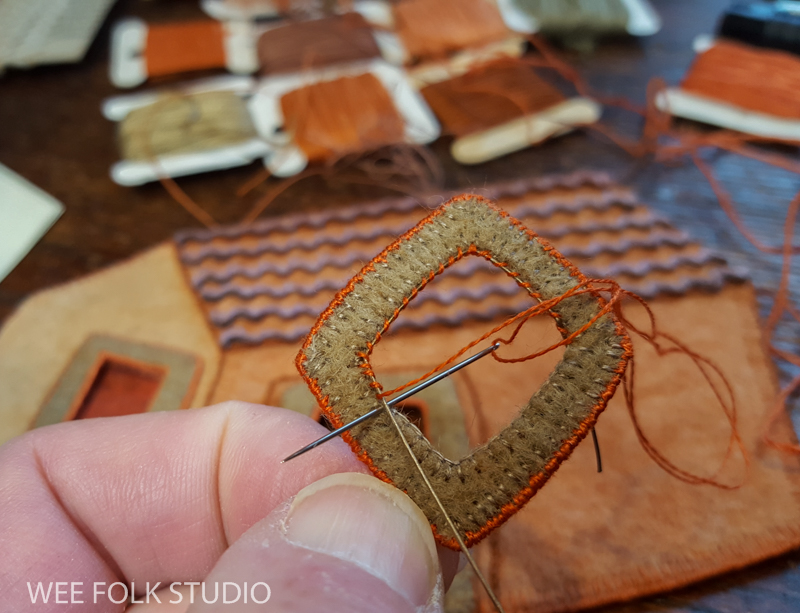
The window frame is first edged with blanket stitch and then outlined with wire.

I added a subtle zigzag pattern to the window and door frames.

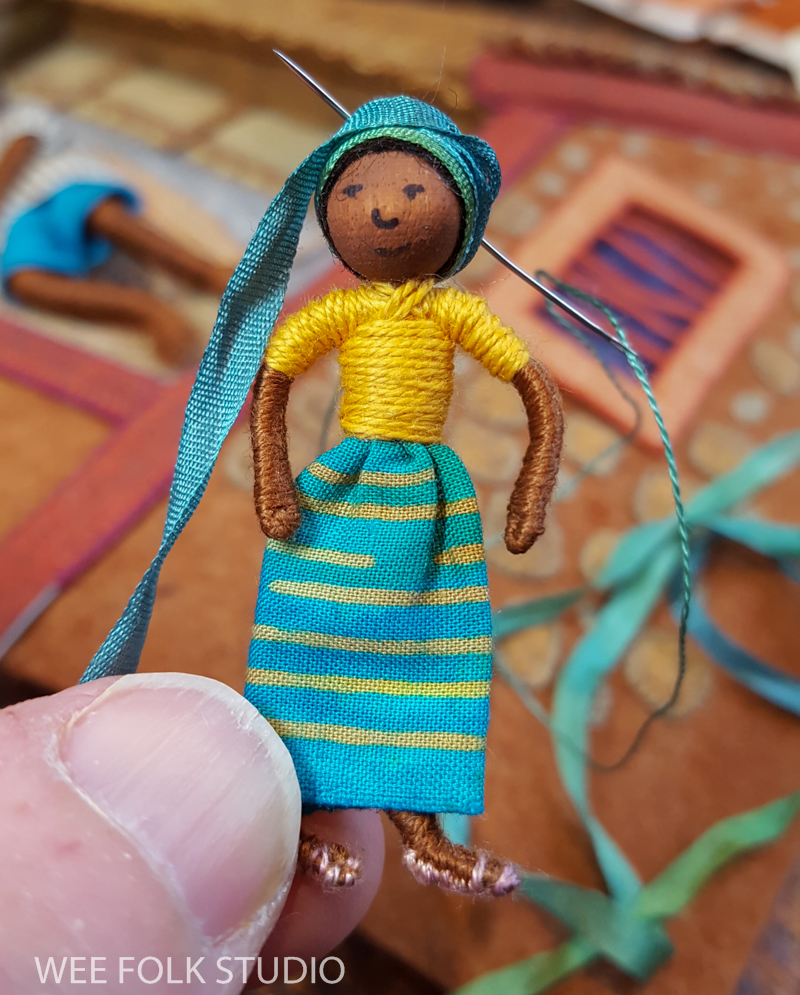
I made a 1 3/4″ figure to stand in the doorway. Her traditional head-wrap is made with silk ribbon that I stitched in place. Throughout the book, children are the featured characters, with very few adults lurking in the background, depicted in tiny scale.

In future posts, I will show the process of making the child resting on a woven mat, the shade tree and other parts of the scene.

To keep up with new posts, please subscribe to this blog. Your contact info will not be sold or shared. If you’d like to see more frequent photos tracking the projects in my studio, please follow me on Facebook and/or Instagram.
bed book peek – back cover

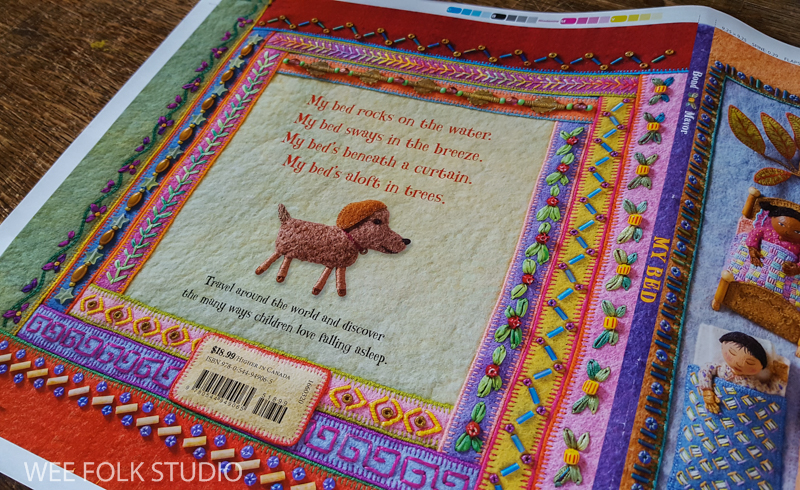
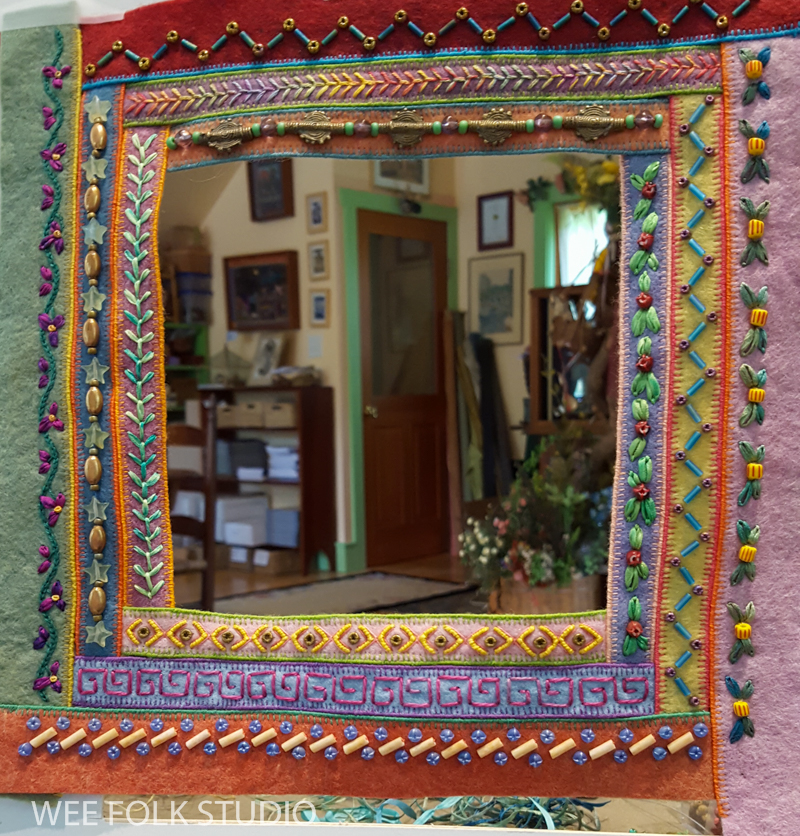
Today, I’d like to share how I made the embellished border strips that will go on the back cover of MY BED. While the cover of the book introduces the children in their beds, the back is purely decorative. I wanted it to be a cross-cultural celebration of color, pattern and texture that hopefully will make the person looking at it to want to open the book. There were a couple of practical requirements, too, like a place for the bar code and an open area for the publisher to print promotional copy and add book reviews in future printings. The above photo is a print-out of an early proof that shows what it will look like.

UPDATE: Autographed copies of My Bed can now be ordered in my shop here. Watch an 8-minute video about making the artwork for the book here:

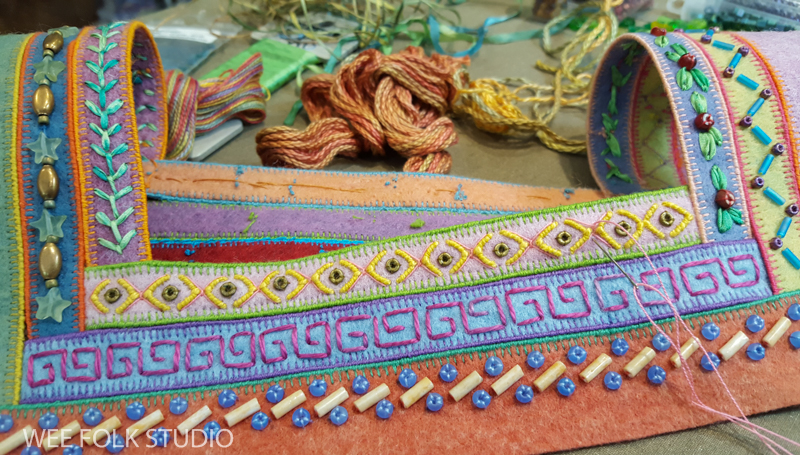
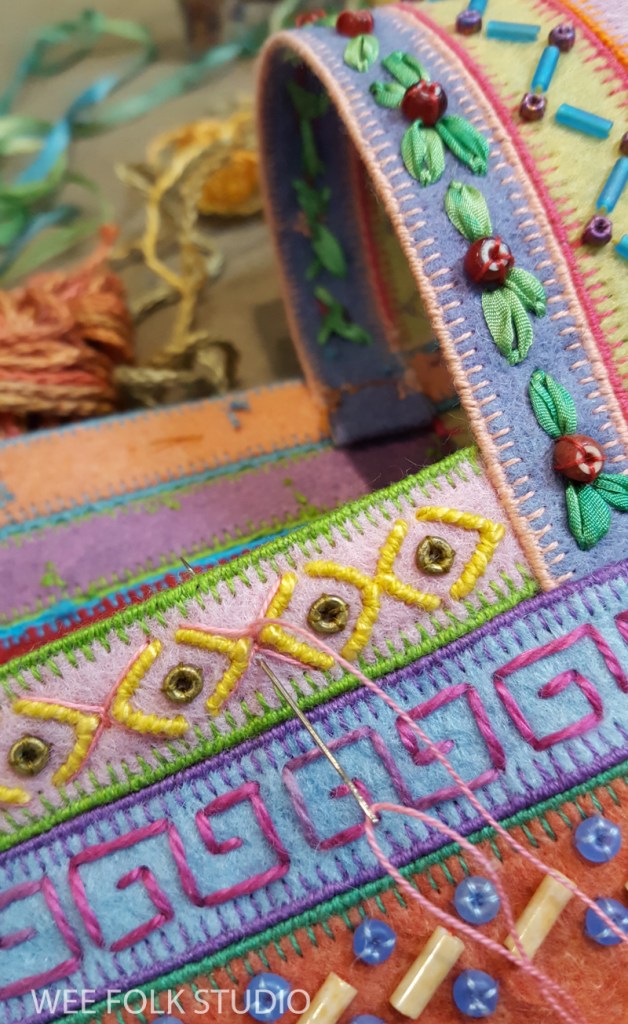
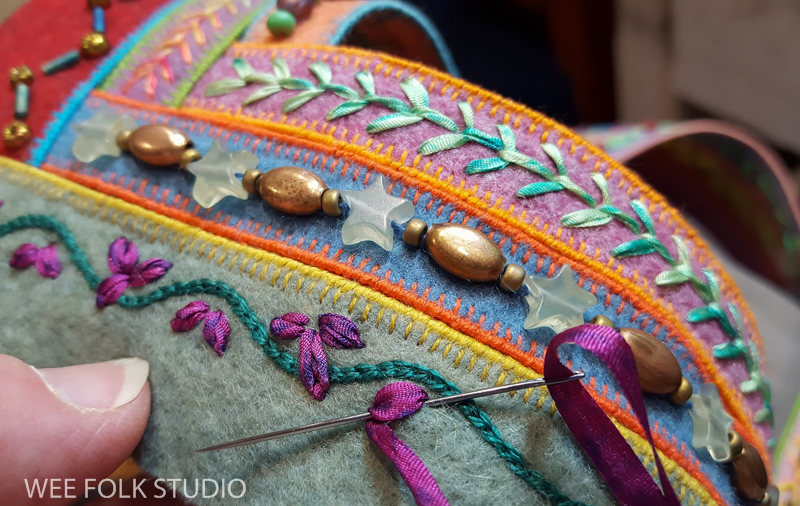
The design includes multiple narrow (about 1/2″ wide) lengths of felt that I embroidered and pieced together in the style of a log cabin quilt. I edged each strip of felt with blanket stitch and then sewed on wire, to make the long sides firm and straight, like bones on a corset. Otherwise, the strips would be too limp and wobbly to work with. You can’t see the wire because it’s wrapped with thread.

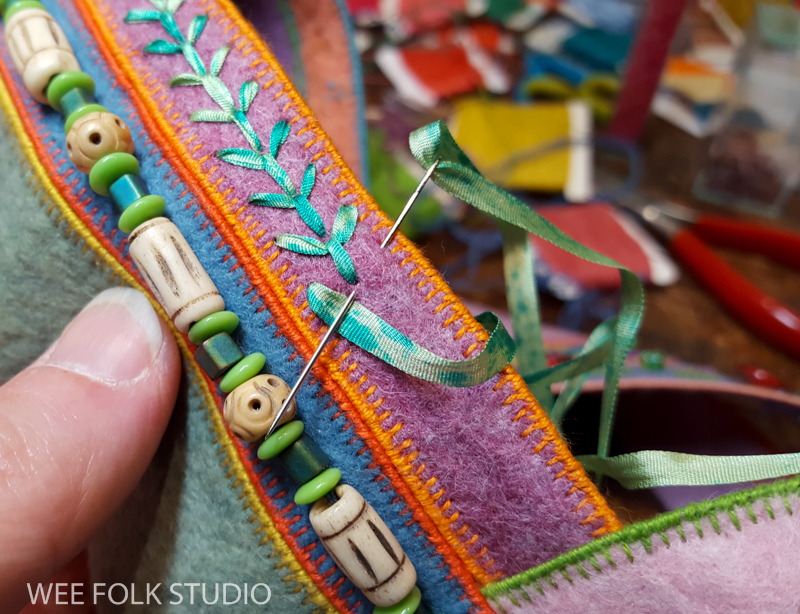
After stitching the strips together, I embellished different motifs on each one with beads, silk ribbon and embroidery stitches.

I combed through my vast collection of beads, which all seemed to be waving their hands wildly, calling out “pick me!”. The hardest part was selecting which ones to use and coming up with a combination that was interesting, but not cluttered looking.

I love embroidering simple stitches with silk ribbon.

I wanted each strip to be distinctive, but also work in harmony with the others.

The border looked like a window when it was finished

The last part involved sewing the border in place on top of a solid felt center piece. Since the book is a perfect square, everything had to line up just right.

At this stage of the process, all of the art is finished and photographed. The book is in production and scheduled to be released in October 2020. Autographed copies can be pre-ordered in my shop here. Please keep in mind that while this book is technically a children’s book, it’s really for all ages! Over the past 2 years, I’ve published posts about making several of the different scenes, with more on the way before the book comes out. Here’s a list of the posts I’ve written so far:

To keep up with new posts, please subscribe to this blog (top right column on the home page). Your contact info will not be sold or shared. If you’d like to see more frequent photos tracking the projects in my studio, please follow me on Facebook and/or Instagram.
This little piggy stayed home

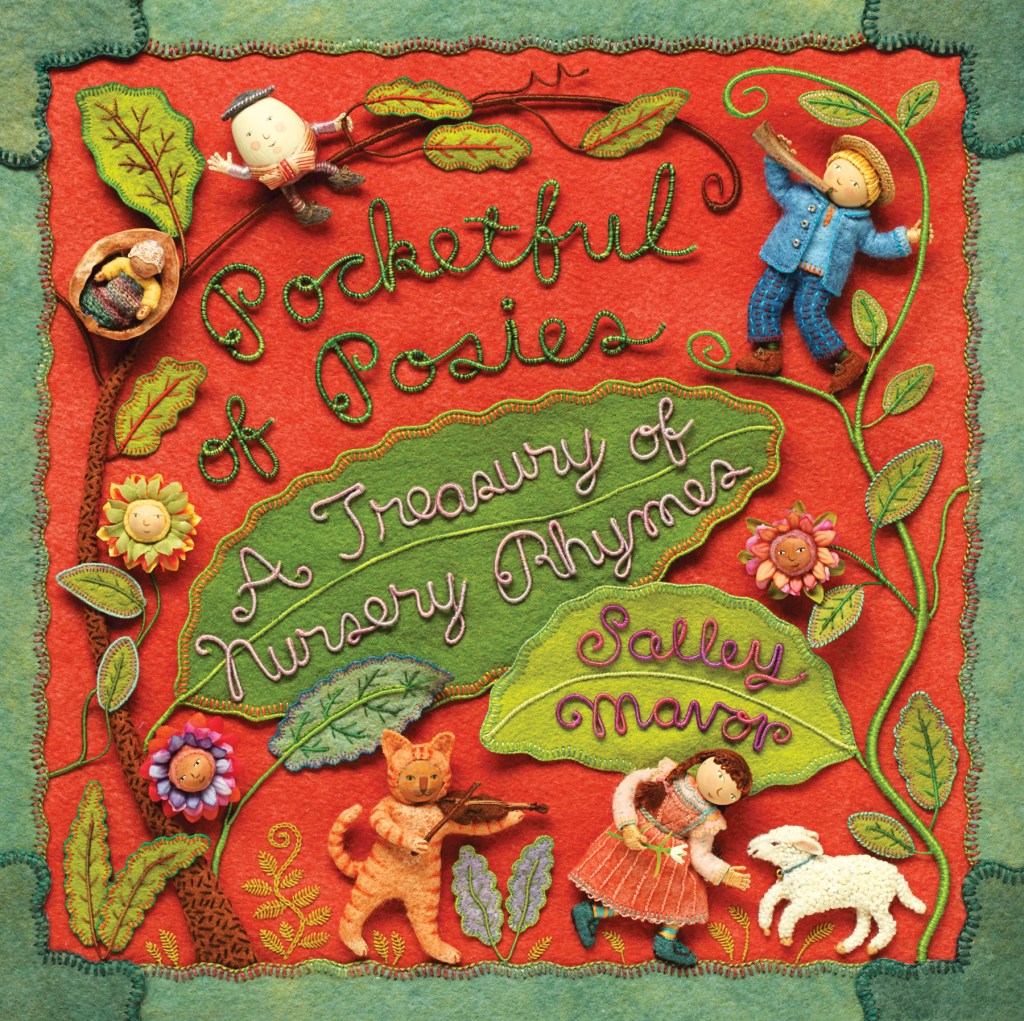
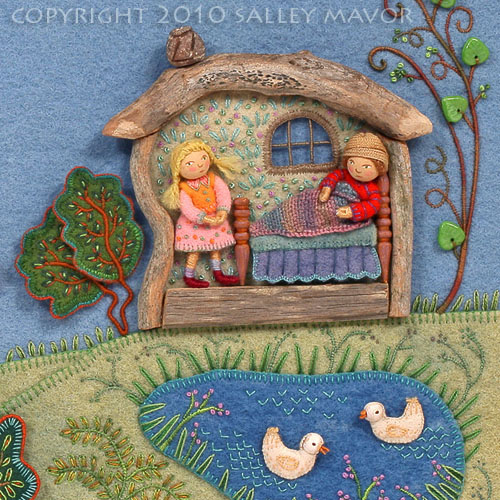
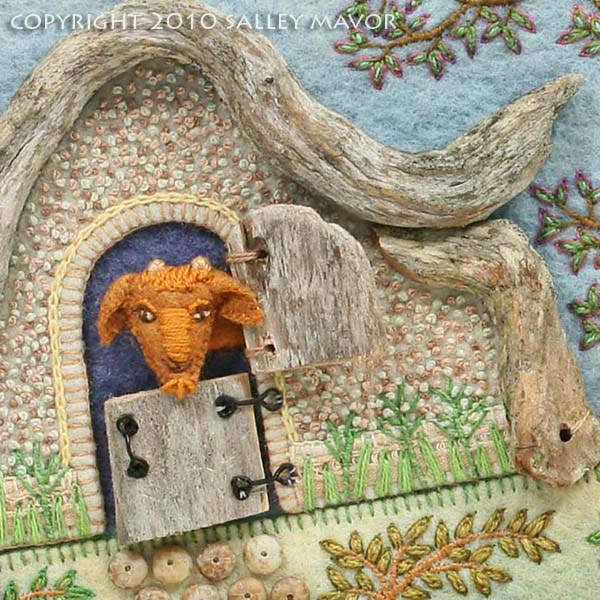
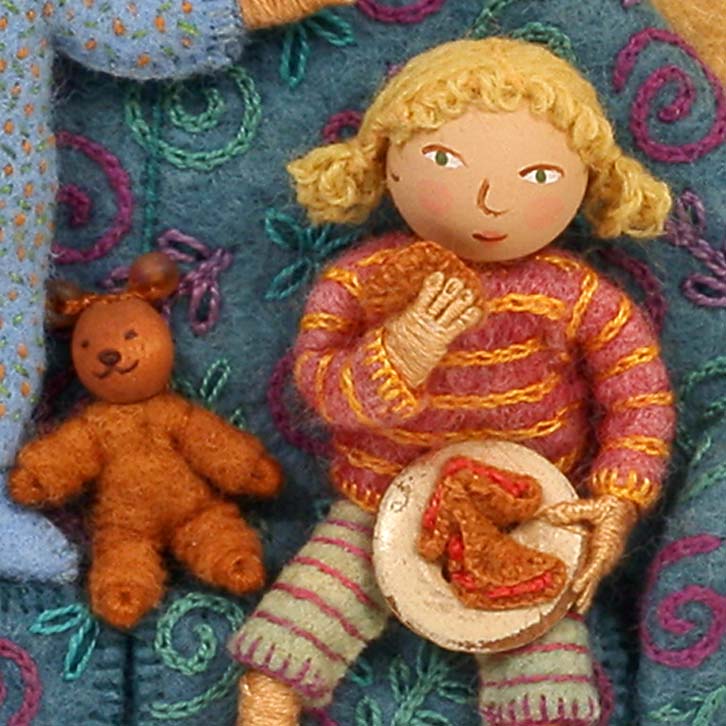
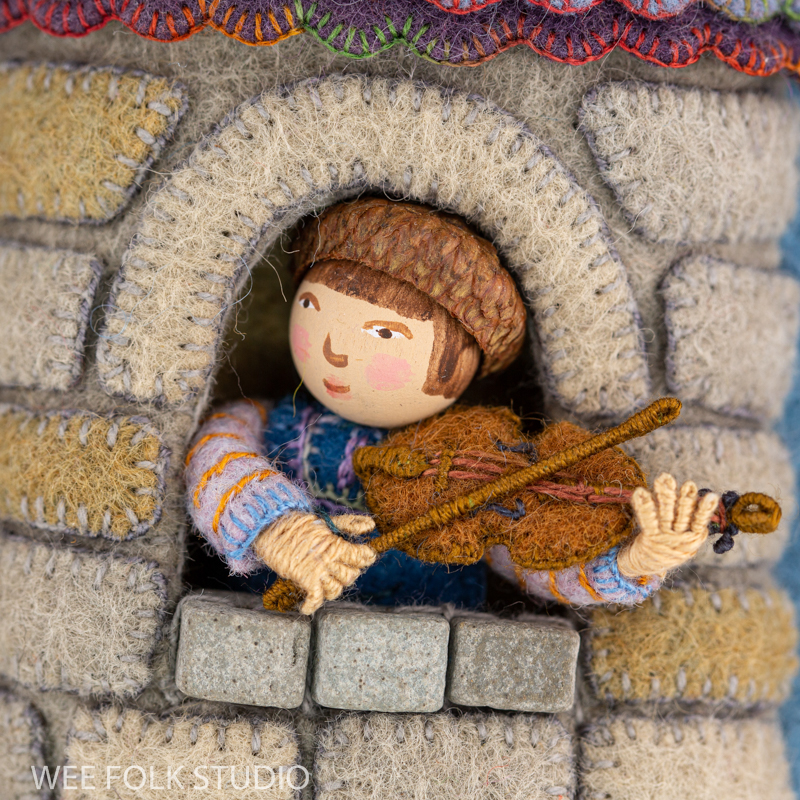
We’re all homebodies now, like this little piggy, as we try to keep the corona-virus from spreading even further than it already has. In searching for comforting images to share during these unsettling times, I noticed that there are an awful lot of scenes with characters in domestic settings in my picture book, Pocketful of Posies: A Treasury of Nursery Rhymes. In many cases, the people and animals are safe inside, peering out of windows, which seems to reflect our collective experience right now. So, as you shelter in place, please take a moment to escape into this warm and fuzzy world, where everything is all stitched up, safe and sound.

This coming fall, it will be 10 years since Pocketful of Posies was published. The book is a favorite baby gift, but it’s really for all ages, especially now, when we all want to feel safe and secure. Personally autographed copies are available in my shop here.

To keep up with new posts, please subscribe to this blog (top right column on the home page). Your contact info will not be sold or shared. If you’d like to see more frequent photos tracking the projects in my studio, please follow me on Facebook and/or Instagram.
bed book peek – cow

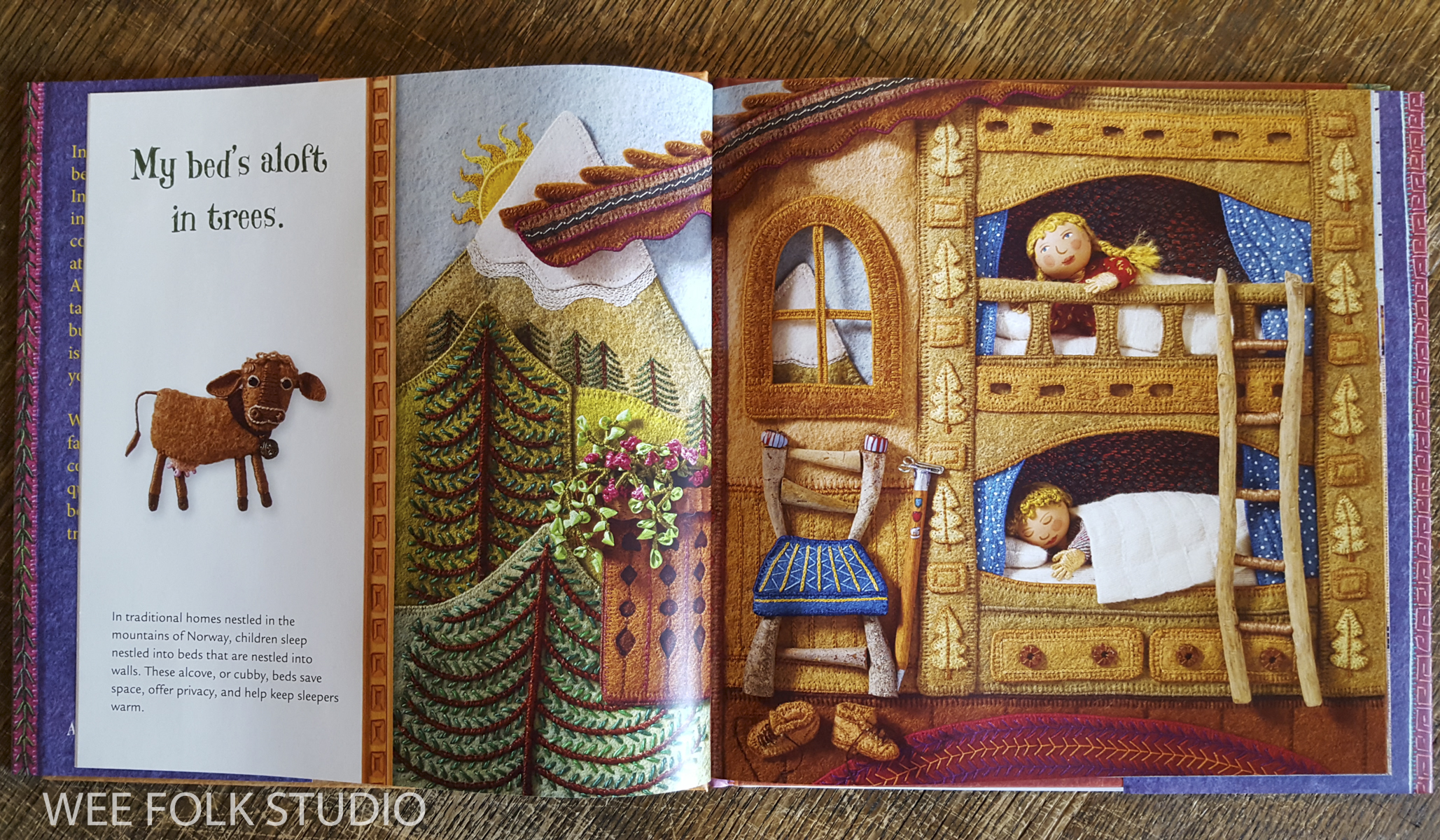
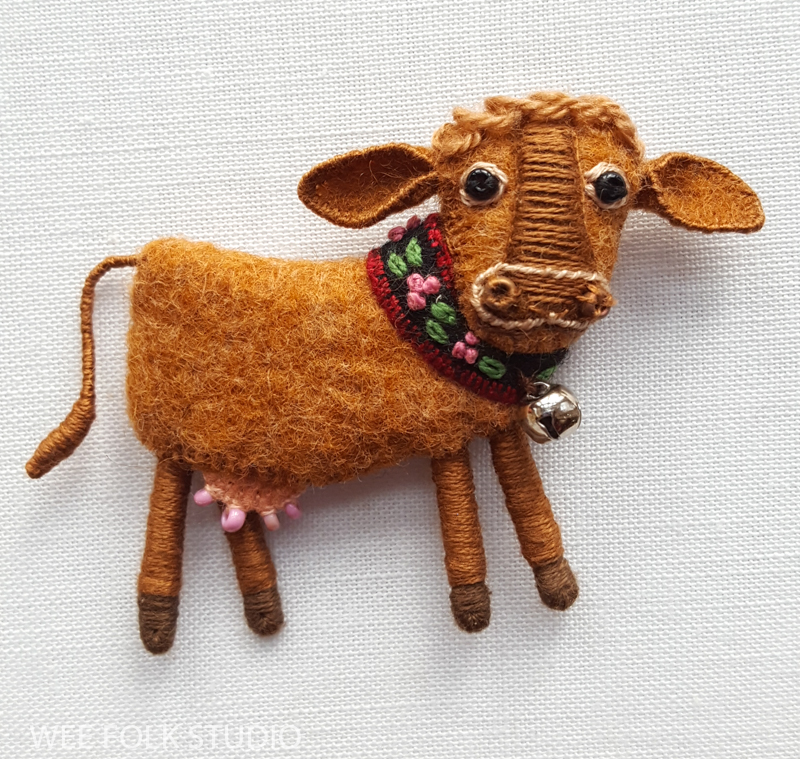
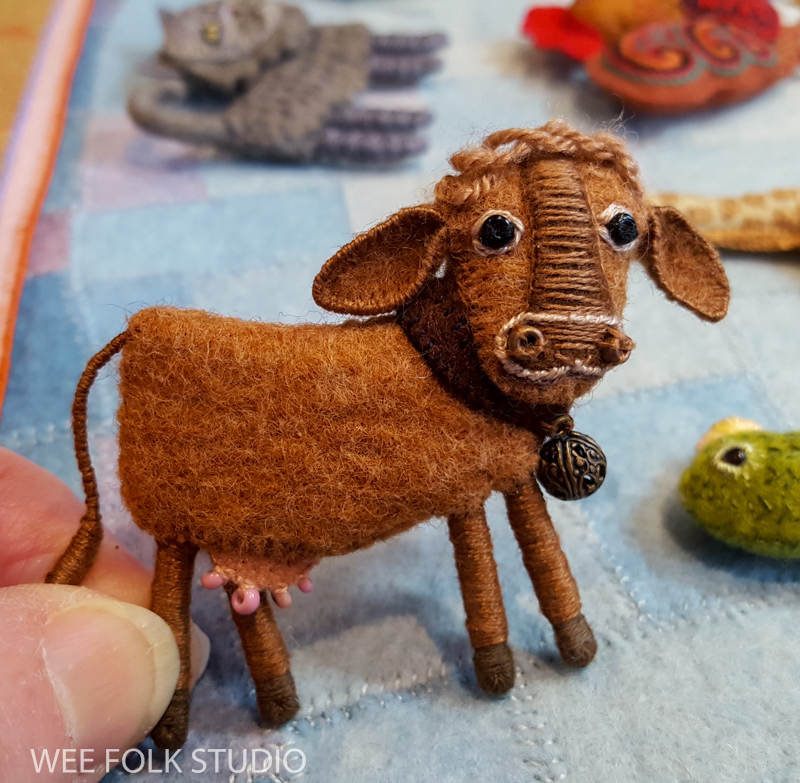
Today, I’m happy to show how I made this cow, which will be used as a spot illustration in my upcoming picture book, MY BED. The story is about children’s sleeping places in different cultures around the world. It’s written by Rebecca Bond and will be published by Houghton Mifflin Harcourt in Sept. 2020. Autographed copies can be pre-ordered in my shop here. A touring exhibition of my original embroidered artwork for the book, Salley Mavor: Bedtime Stitches, will travel around the United States beginning in Nov. 2020. See the updated tour schedule here.

Update: Signed copies of My Bed can ordered in my shop here. 40 pages, 9″ x 9″, words by Rebecca Bond, pictures by Salley Mavor, published by Houghton Mifflin Harcourt. ISBN 978-0-544-94906-5

Each country or region represented in the book has an animal icon that appears on the text panel adjacent to the full illustration. The cow shows up next to the Scandinavian scene, which I’ve written about here.

To see the other animals from the book that I’ve written about so far, please click on the following links.
Animals (spot illustrations) – Rooster, Camel, Parrot, Elephant, Goldfish, Cat, Duck, Sheep, Rabbit

I’ve enjoyed making cows over the years, including the one below, which is from the 2005 board book, Hey, Diddle, Diddle! (Sorry, it’s out of print) Cows are fun to depict because they are so distinct from other animals.

Close Up from “Hey, Diddle, Diddle!” 2005 board book

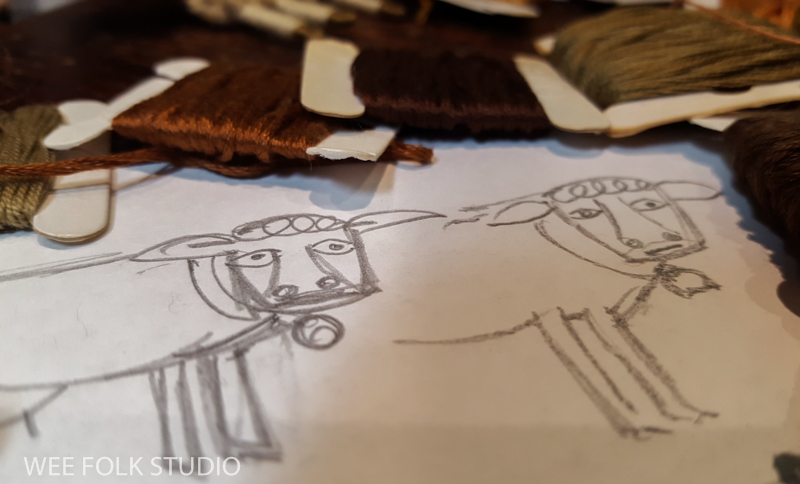
To begin, I drew sketches that exaggerated the cow’s squarish head, outspread ears, big eyes and prominent nostrils.

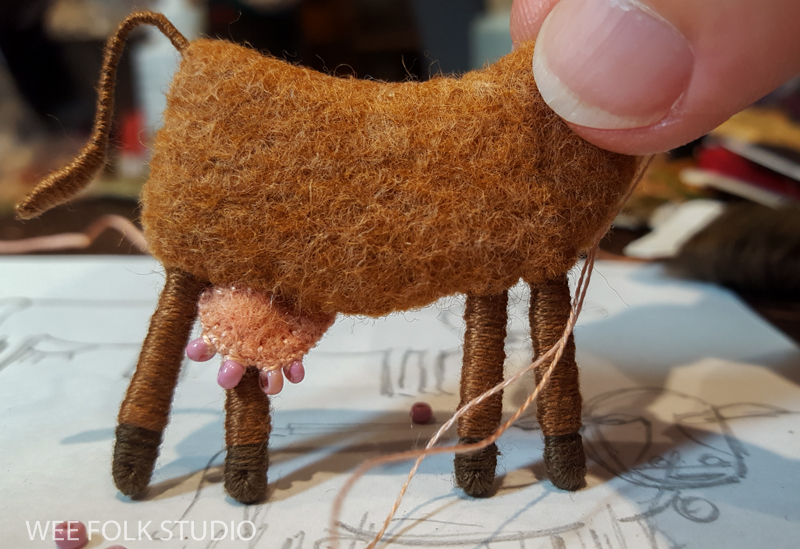
As always, I wrapped the legs first, leaving enough extra pipe cleaner to shape the body.

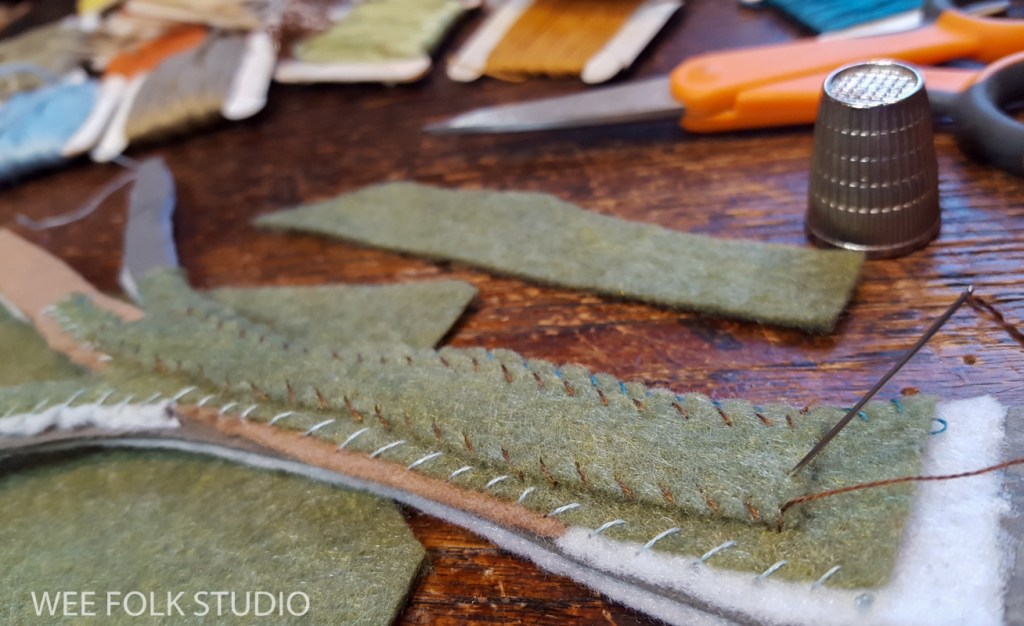
It’s been a while since I made this, so I can’t remember how I attached the felt body. From the looks of it, I first added a thread wrapped wire tail and then stitched pieces of felt to the front and back of the pipe cleaner form.
Then, I made a little pink felt udder with seed bead teats.

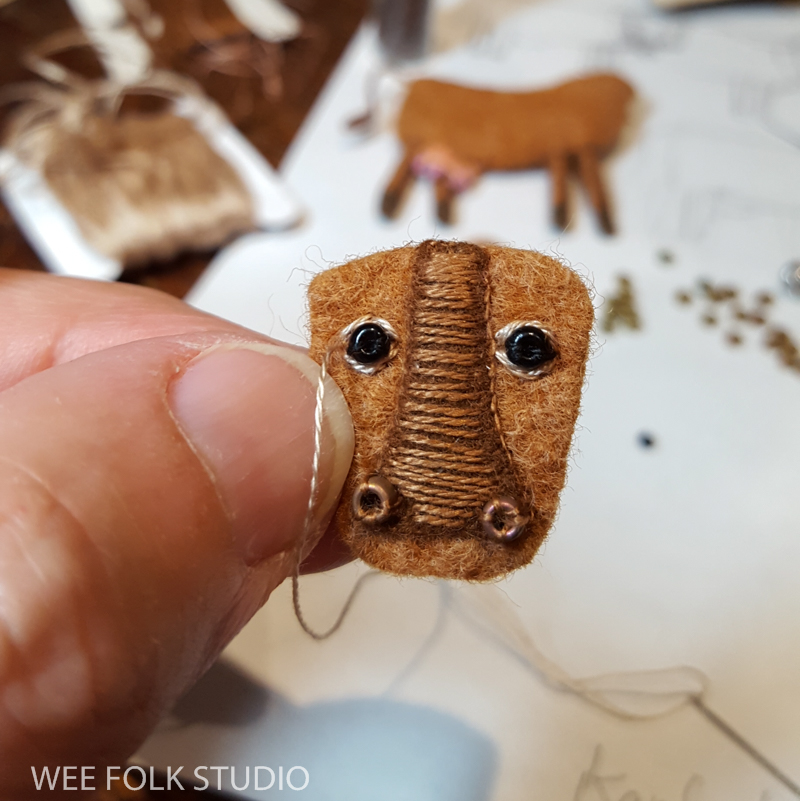
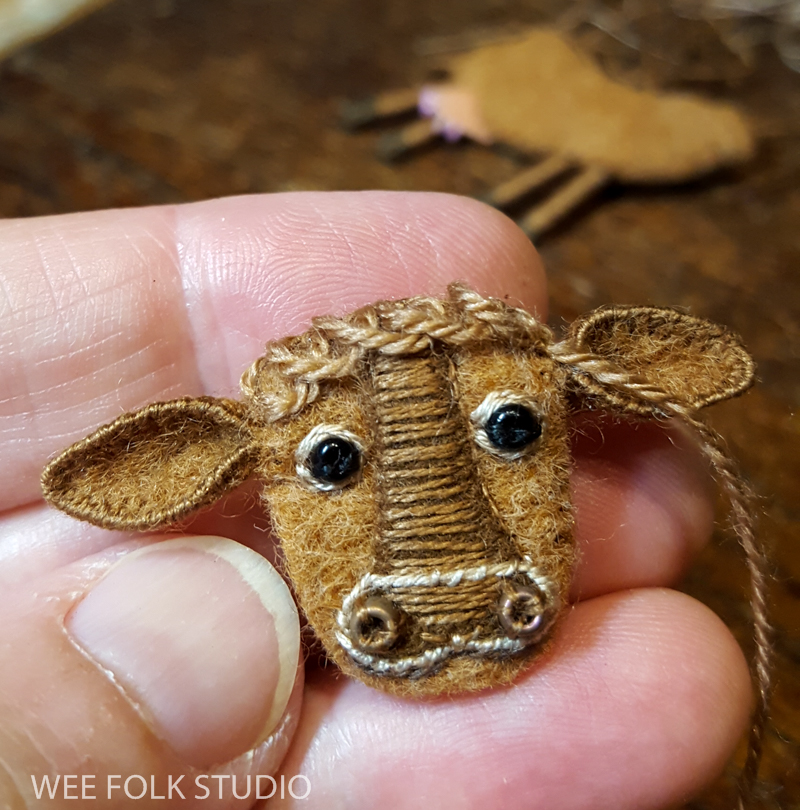
For the cow’s face, I embroidered a nose and sewed on bead nostrils.

To make the eyes more prominent, I outlined them in white.

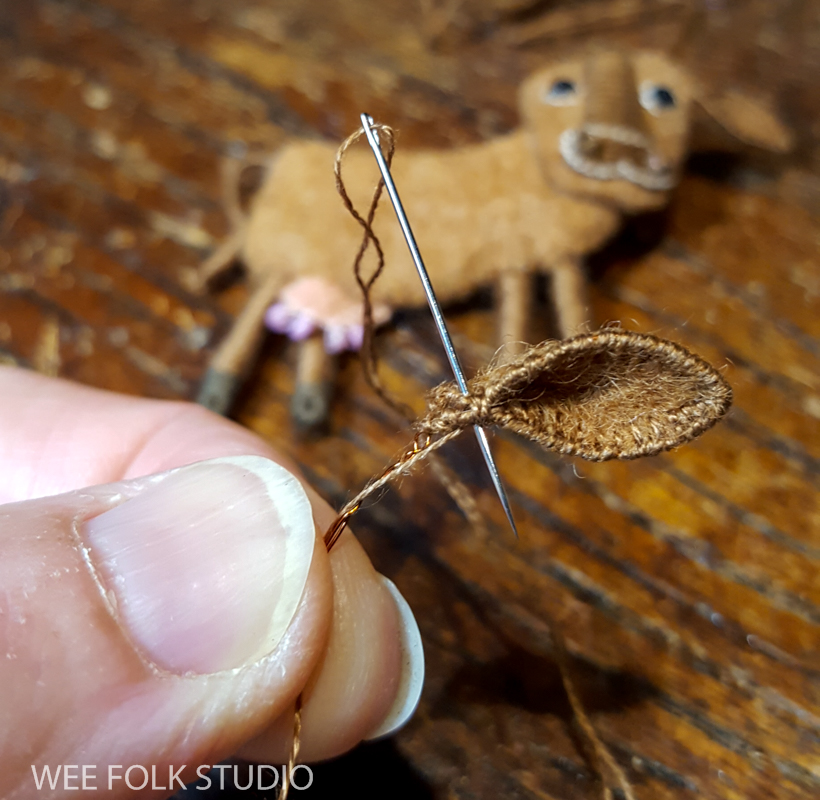
The ears are felt, edged with blanket stitch and wire.

After sewing the ears in place, I looped Silk/Merino wool thread on the top of her head.

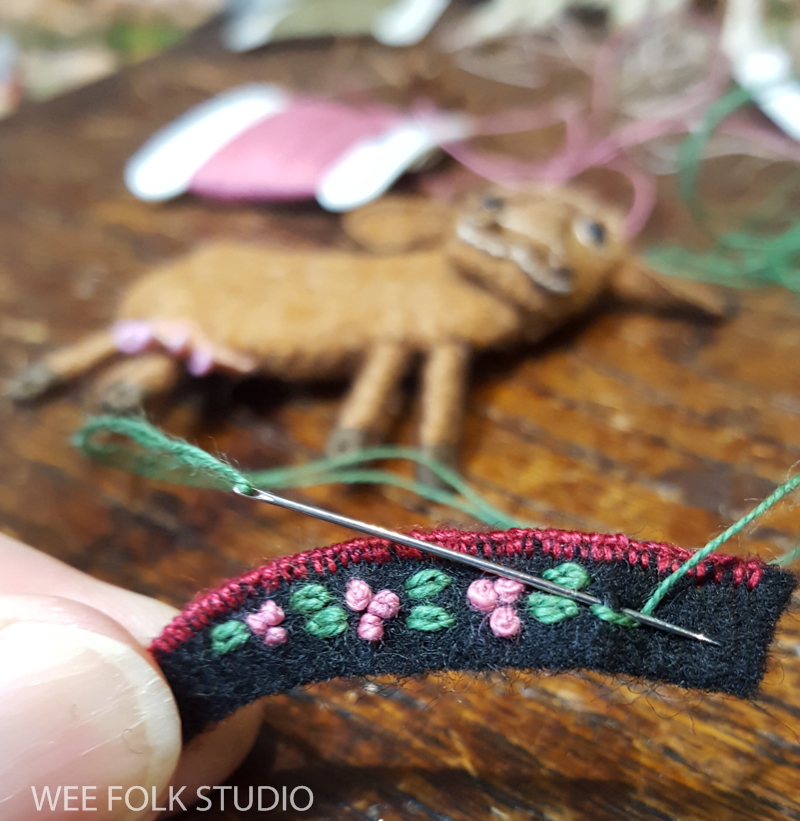
The first cow collar I made was embroidered with pretty flowers, but I had to change it to a plainer version because decorations like that are a Swiss specialty and not Scandinavian.

Before (above) and After (below).

To keep up with new posts, please subscribe to this blog. Your contact info will not be sold or shared. If you’d like to see more frequent photos tracking the projects in my studio, please follow me on Facebook and/or Instagram

scavenger hunt

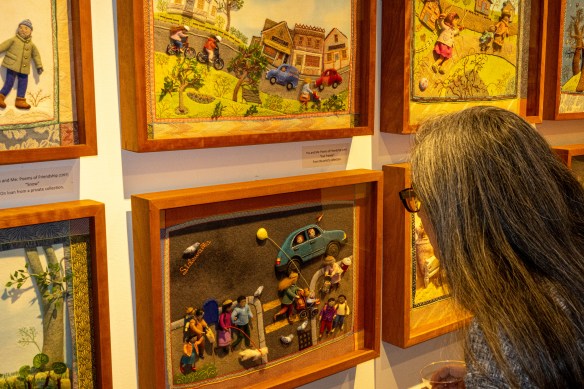
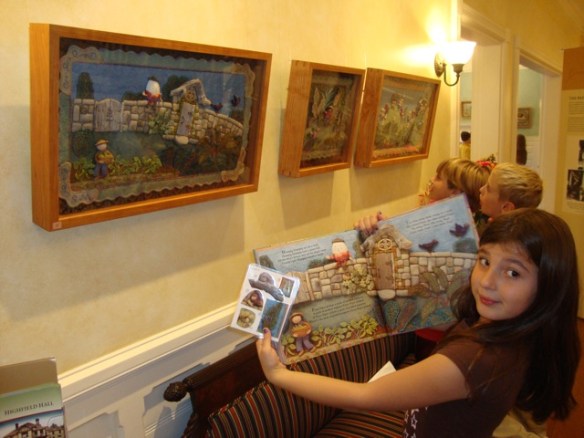
The scavenger hunt at my retrospective exhibition of original picture book art at the Cape Cod Museum of Art has been a hit! Not just with kids, but with all ages. Searching for the details is a fun way to engage with the artwork and helps you see things you might not otherwise notice.

I got the idea from my friend Deb Coulombe, who 10 years ago, put together cards for school groups who came to see the touring exhibition of original art from Pocketful of Posies. With the hunt, the kids experienced my artwork in a playful way that enhanced their museum experience.

So, I took the scavenger hunt concept and brought it to “Salley Mavor: Once Upon a Stitch”, which will be on display for only one more week, until Sunday, Jan. 26th. People are coming from far and wide to see the show, driving and even flying in from out of state. If you’re thinking of making the trip, please note that the Cape Cod Museum of Art is open Thursday 10 am – 7 pm, Friday – Saturday 10 am – 4 pm, Sunday 12 noon – 4 pm. 

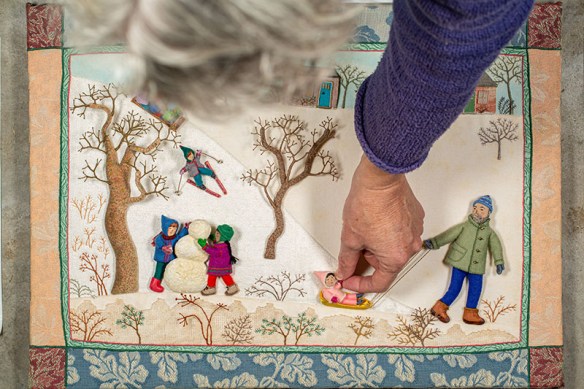
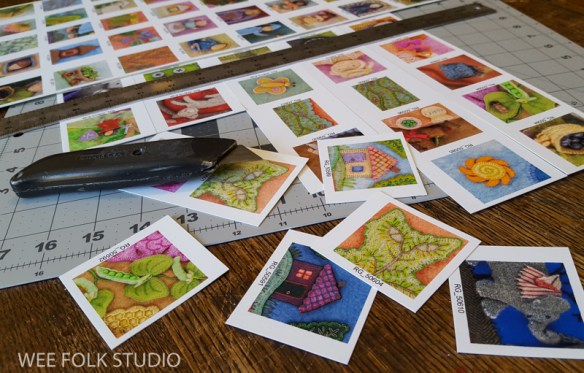
Rob and I spent last fall photographing closeup images of the artwork to use in the scavenger hunt. Because my pieces are sculptural, its a challenge to take pictures that bring out the detail and 3-dimensional quality of the real thing. We’ve tried different approaches, sometimes using a light box (above) to diffuse the light and soften the shadows. I’m constantly getting in the way, fussing and tweaking, which drives Rob crazy!

Rob printed the images on good quality paper on his super duper Epson printer and I cut them up. Even though they’re all square, it reminded me of playing with paper dolls.

Then I divided them up into groups of 4 that I knew would keep people moving around the gallery, like an aerobic activity.

Anyone can play the game and choose from about 20 different laminated cards in the gallery.

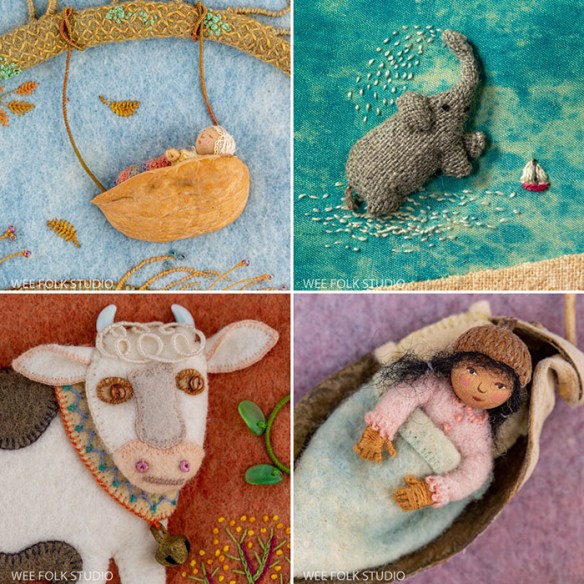
You can also do the scavenger hunt at home by searching for the following images in my books. Each group of 4 that you see below is labeled with a list of books where you can find the images. Have fun!

Details from “Pocketful of Posies”
Details from “Hey, Diddle, Diddle!”, Pocketful of Posies and “In the Heart”
Details from Pocketful of Posies”, “The Way Home”, “Hey, Diddle, Diddle!” and “Wee Willie Winkie”
Details from “Pocketful of Posies, “Mary Had a Little Lamb”, You and Me” and “Come to My Party”
Details from Pocketful of Posies” and You and Me”
Details from “Pocketful of Posies” and “Jack and Jill”

SALLEY MAVOR: Once Upon a Stitch
Dec. 12, 2019 – Jan. 26, 2020

Cape Cod Museum of Art, Dennis, MA
Winter hours: Thursday 10am – 7pm,
Friday – Saturday 10 – 4, Sunday 12 – 4

To keep up with new posts, subscribe to this blog (top right column on the home page). Your contact info will not be shared. If you’d like to see more frequent photos tracking the projects in my studio, please follow me on Facebook and/or Instagram.