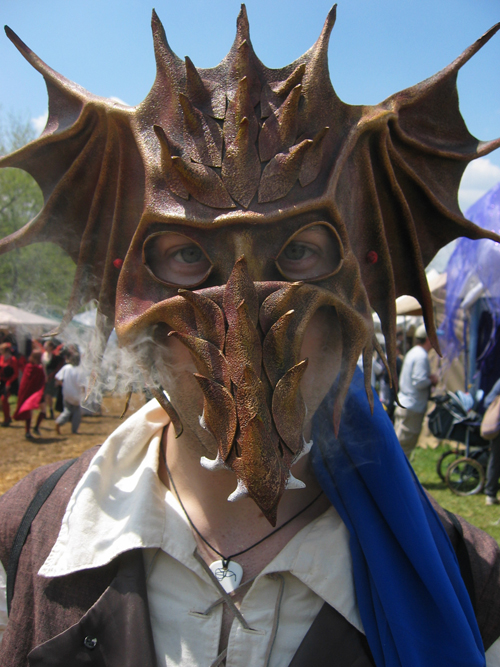
Fairies and other fanciful creatures come to Spoutwood Farm in Pennsylvania every spring. The 19th annual May Day Fairie Festival will be from April 30 to May 2nd this year. Wee Folk Studio was a vendor at the festival for a few years, when we sold fairy kits. One of the highlights of the weekend is seeing the costumes that people have made to wear at the event. If you live anywhere within driving distance of southern Pennsylvania, go to this fair! You will feel out-of-place unless you wear a costume or at least something celebratory. We have a lot of pictures, so in the future, I’ll be posting more photos from past festivals. These masks are made by Mythical Designs.
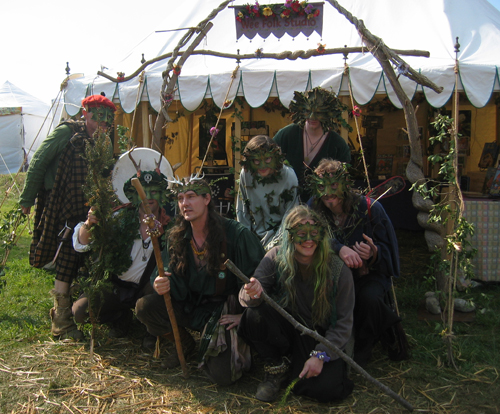
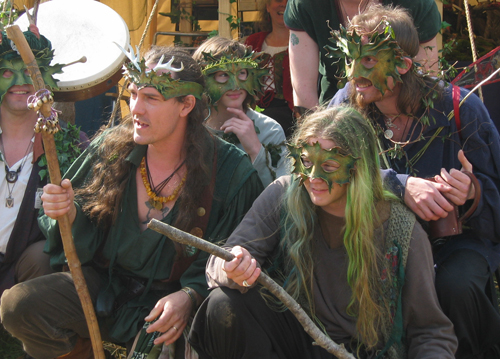
Here are some gorgeous green men who came by our tent in 2005. Their incredible leather masks are made by Fantasy Guild Studios, which will have a booth at the Fairie Festival this year.
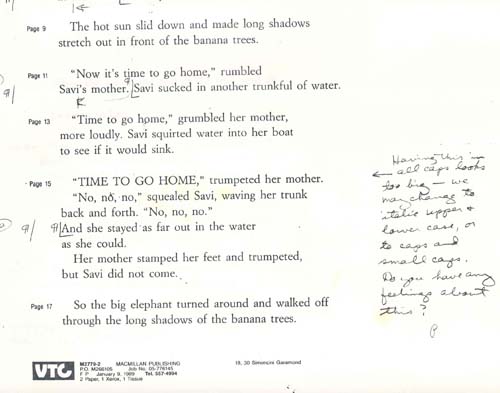
The book was now in production at MacMillan and it would be a year before we would see bound copies of The Way Home. There was a lot for the publisher’s staff to do; select and set the type, write the book jacket flaps, prepare the pages for the printer and arrange the printing in Hong Kong. Judy and I were so excited to see the first printing proofs. We felt this was also proof that our years-long project was really going to become a book!
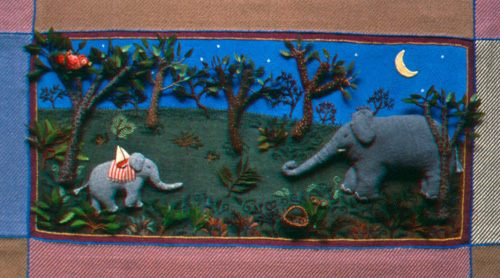
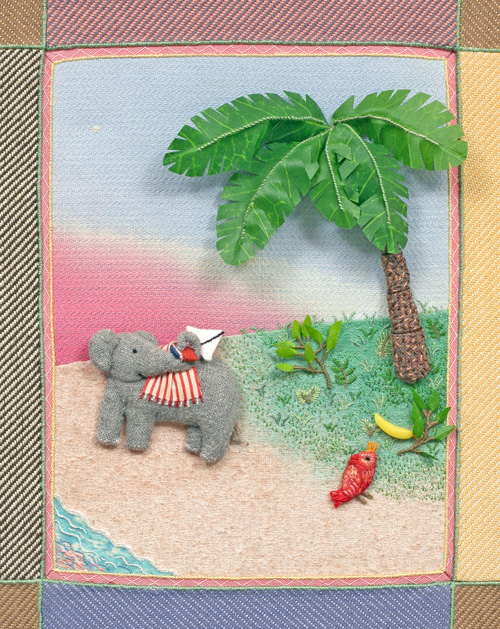
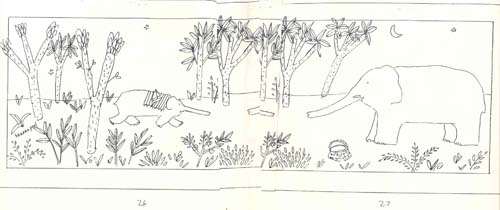
The Way Home, pages 26/27
I learned that producing a book is a lot more complicated than one might think. Everyone involved, the writer, the illustrator, the editors, the production staff and the sales department all play an important part. I was also impressed that everyone I met during the process truly loved children’s books.
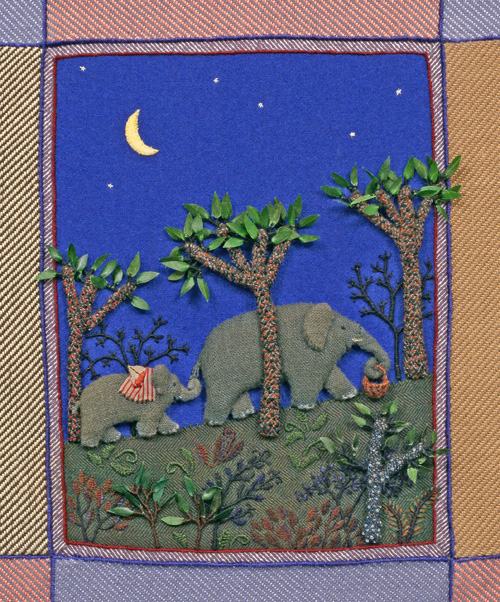
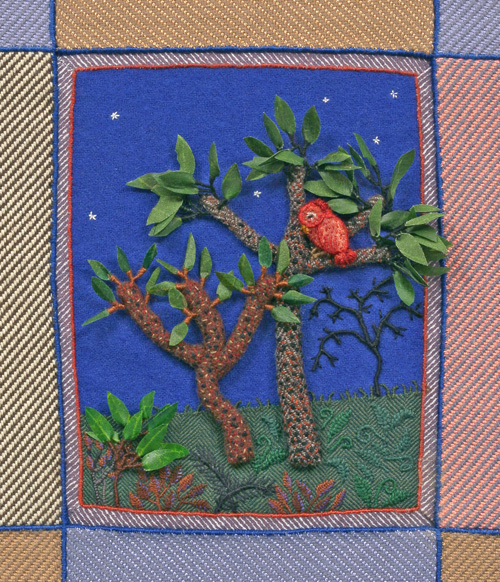
The Way Home, page 30
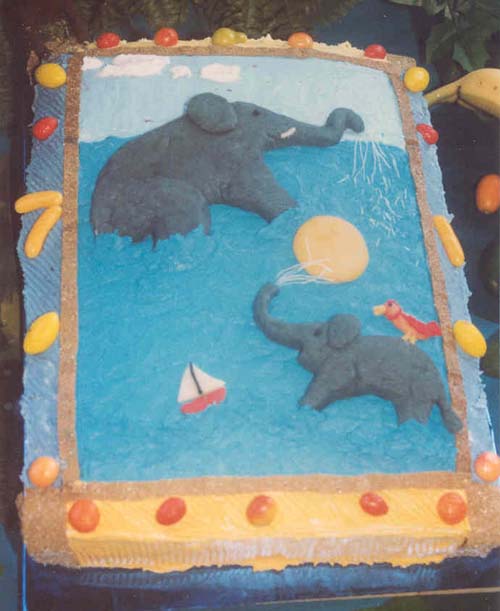
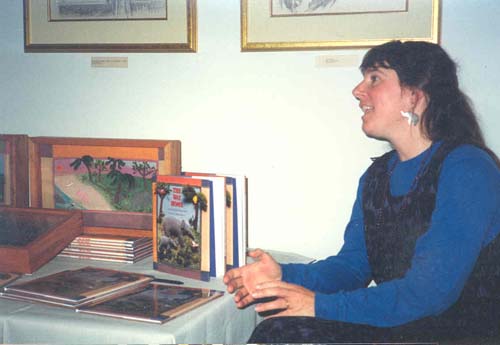
In the spring of 1991, boxes of The Way Home arrived and Judy and I celebrated its publication at the Woods Hole Library, with a party and book signing. You can see an earlier post about the library quilt I worked on here. We shared the event with Molly Bang, whose book, The Yellow Ball, was coming out the same spring. Our friend, Terry (who gave me her daughter’s pants) made a cake for the occasion. She decorated it with marzipan elephants and a yellow ball made of frosting.
setting up for the book party
Terry’s cake
Molly, Judy and Salley signing books
We were so proud of The Way Home and did what we could to promote the book. We had our picture taken with an elephant that came through town for the county fair.
Judy and Salley with elephant at fair, 1991
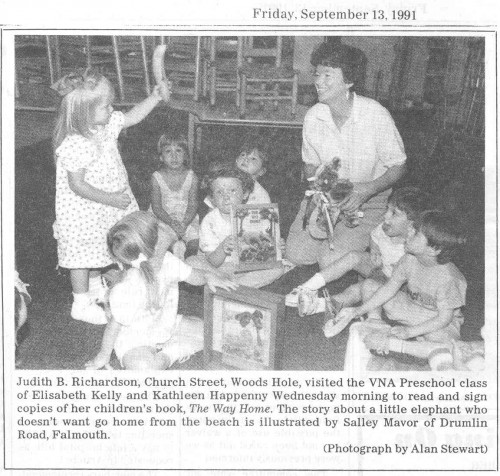
We gave talks, did book signings and visited schools. Judy led banana poem workshops with children and I’d have them sew and stuff yellow felt bananas.
Judy visiting a preschool
Our book did pretty well for an unknown author and illustrator and came out in paperback the next year. Later, Judy and I collaborated on a sequel, Come to My Party, which MacMillan published in 1993. In this book, the red bird character is named Harold and co-stars with Savi in another adventure.
Harold in an illustration from “Come to My Party”
Both books have long been out of print, and I can remember how surprised Judy and I were to get the letter telling us the news. Being new to the book business, we did not know how common it is for children’s books to go out of print. We’ve since learned that only the very best sellers are reprinted and stay available.
Salley at a book signing (note the elephant earrings!)
All in all, the best part about publishing a book was when we heard from parents who said their children wanted The Way Home read over and over. Even today, we meet grown up children who remember Savi and the banana trail. I’m still friends with Judy and Molly and am grateful to have had their help and encouragement throughout the years, but especially in the beginning, 27 years ago, when we all were inspired by a little elephant named Savi.
The End
The Way Home, back cover
To keep up with new posts, please subscribe to this blog. Your contact info will not be shared. If you’d like to see more frequent photos tracking the projects in my studio, please follow me on Facebook and/or Instagram.
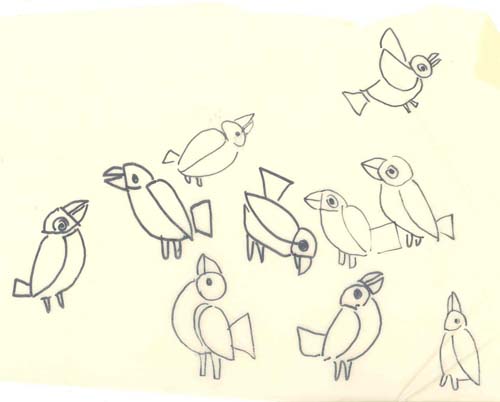
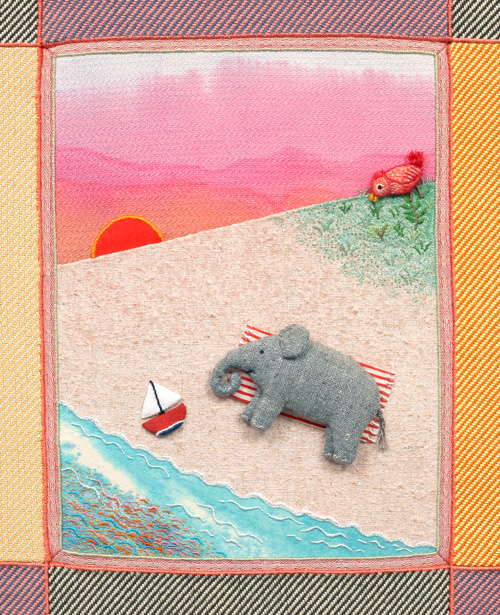
I added the little bird character late in the design phase. Savi seemed so alone on the beach after her mother leaves, and I thought she needed an escort of sorts. Cecelia Yung, the art director, liked the addition and wrote, “About the bird: maybe he can be her “guardian angel”-someone who hovers protectively so that she’s never truly alone. He would be a comforting presence for the child who worries when Savi is alone in the dark. Maybe he can make his appearance when Savi’s mother leaves?”
sketches of birds for “The Way Home”
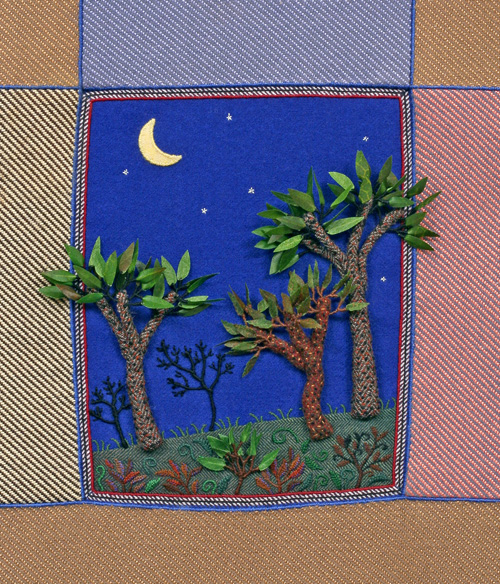
The Way Home, page 18
A few months before the artwork was due, I faced the inevitable and admitted that I would not be able to make the one year deadline. I called Cecilia and told her that I needed more time. She was understanding enough to extend the publication date another 6 months.
The Way Home, page 20
Through the fall and winter, I added the finishing touches, stitching blades of grass and hand sewing the floss edge around the border sections.
sketch of pages 16/17
The Way Home, pages 16/17
I was particularly fussy about the shadows, which were made up of different colored stitches. I kept thinking of something my teacher, Mahler Ryder had said years earlier at RISD, that shadows are not black, but are made up of colors.
The Way Home, pages 16/17 detail
I was saving the book jacket illustration for last and imagined how it would look while I stitched the other pages. I took a mental inventory of what materials would be needed and was shocked to discover I’d forgotten about the sky fabric. I had used every last inch of Peter’s overalls on the inside artwork. I had none left for the cover illustration, the most important of all! This was a drawback of working with unconventional materials. If I worked in watercolor, this would never happen!
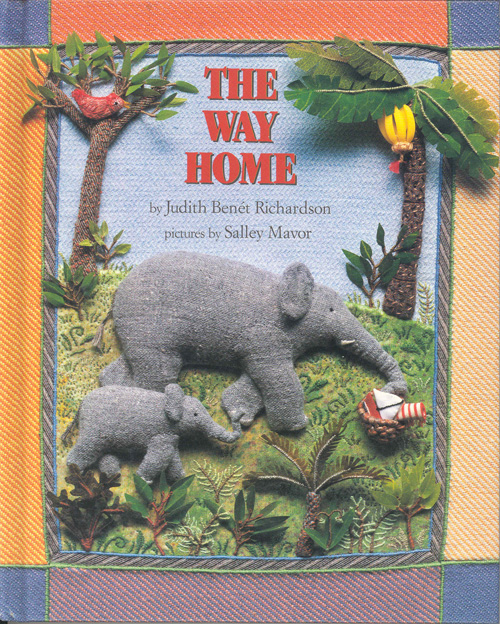
sketch of cover illustration for “The Way Home”
I had dealt with insufficient supplies before. I would have to find something similar, but the weave and shade were unique to an older line of Osh Gosh clothing. before I could work myself into a tizzy, the same fabric literally walked into view.
Molly’s pants back
My friend, Terry came over with her 2-year-old daughter, Molly, who was wearing a pair of jeans made out of the same light blue fabric! Terry is a seamstress and fabric lover, so she was not at all surprised when I asked her if I could have Molly’s pants when she outgrew them, which appeared to be imminent. I’ve kept the pants and when I hold them up at talks, they always get a reaction from both young and old audiences.
in my studio finishing the illustrations for “The Way Home”
The extra 6 months made it possible for me to finish by the new deadline in the spring of ’90. I packed up the illustrations and shipped them to New York. After the editors at MacMillan had a chance to look them over, Cecilia drove the artwork over to Gamma One in the city. Gamma One has a “painting with light” system that works well for textured work. During the minutes-long exposure time, light moves slowly back and forth, helping to define the dimensionality of the art. The 8 x 10 color transparencies were then color corrected to match my original art.
The Way Home, page 32
Cecilia suggested we put an explanation of my technique on the last page.
It reads,
“The original pictures for this book were made in fabric relief. This art form includes many techniques, including applique, embroidery, wrapping, dyeing, and soft sculpture. The background fabric was dyed and then sewed together. Three-dimensional pieces were made from a variety of materials, including covered and stuffed cardboard shapes, wrapped wire, found objects, and fabric. Details were embroidered onto the shapes and background and then the three-dimensional shapes were sewn into place. All stitching was done by hand.”
To keep up with new posts, please subscribe to this blog. Your contact info will not be shared. If you’d like to see more frequent photos tracking the projects in my studio, please follow me on Facebook and/or Instagram.
About 6 months after our visit to New York, I received a telephone call from Phyllis Larkin at MacMillan. I remember being confused because her tone and inflection didn’t match the words she was saying. She was telling me in a slow, flat voice the most exciting news- that she would like to publish The Way Home!
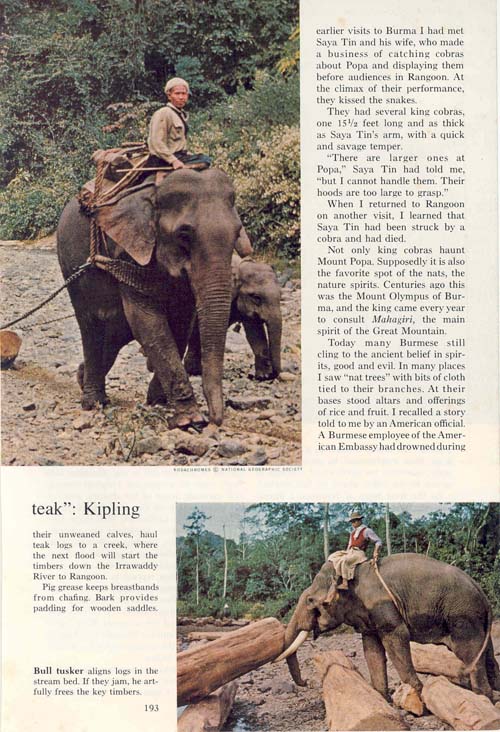
National Geographic article on elephants
Of course, I could hardly believe it and when she asked how long I needed to sew the illustrations, I guessed “one year” on the spot, because I thought any longer might make her change her mind. Now that we had made it over the hurdle and sold our idea to a publisher, I needed to figure out how to bring all of the different elements of the story together in a series of pictures. Referring to National Geographic, I did sketches of elephants and noticed that African and Asian elephants have different shaped ears. When consulted, Judy thought that hers were Asian elephants.
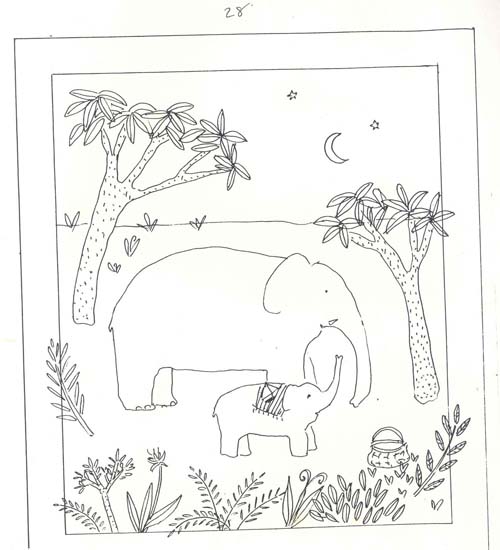
sketches for “The Way Home”
In my imagination, I saw the drama of the story unfolding against the back drop of a landscape changing from day to night, like puppet show scenery, slowly scrolling from left to right.
editing the manuscript
Ian and his friend Sam in my studio, 1988
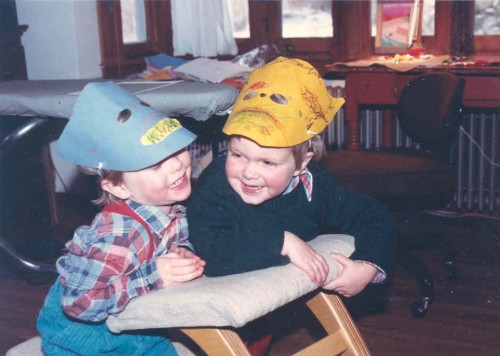
Judy edited the manuscript and I worked on the book whenever I could. The advance payment wasn’t enough to pay for daycare, so I figured out other ways to set aside time to work. I would spend a few hours stitching every evening, after the boys were read to and put to bed. During the day I was part of a coop arrangement, where I’d watch 2 other boys one morning a week and mine were taken care of 2 mornings. This picture shows Ian and his friend Sam in my studio wearing monster masks.
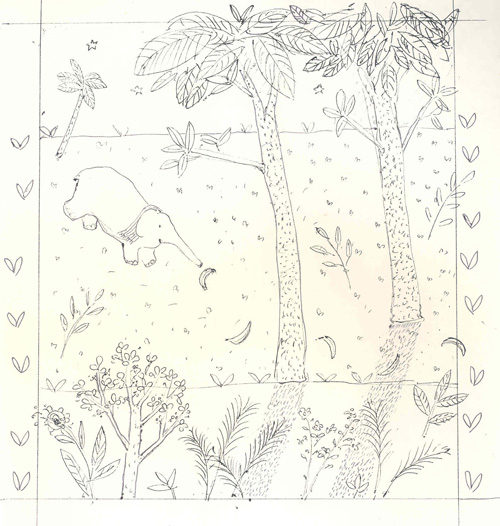
early drawing of Savi following banana trail
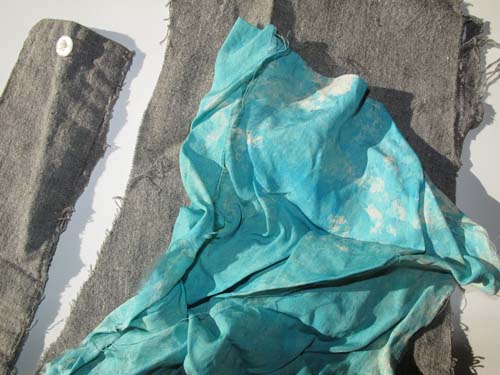
Somehow, I pieced together enough time to make progress and the pages started to take shape. In the beginning, I figured out what fabrics to use for the background, elephants and borders. I found a shirt of my husband’s to use for the elephant’s bodies. The gray Indian cotton was the perfect shade and texture.
Indian cotton shirt and dyed silk
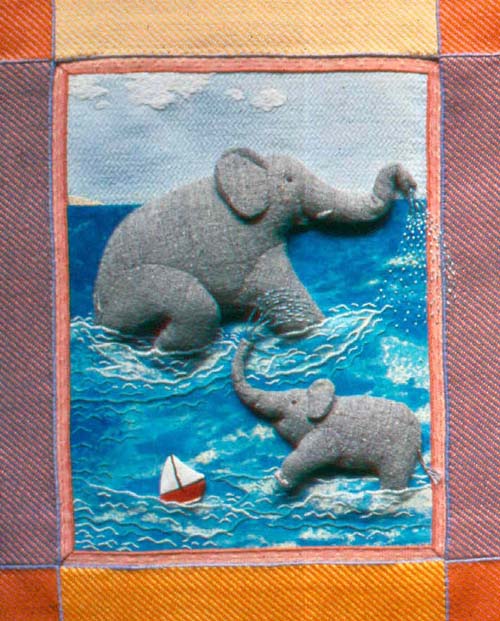
I cut a piece of silk from my grandmother’s old nightgown to use for the water and then dyed it turquoise with a spray bottle. The silk was crumpled up when I sprayed the dye, so some areas were left white, making a foamy, wavy pattern.
The Way Home, page 4
I ripped out the seams of an old, faded pair of my son Peter’s overalls. There was exactly enough fabric to use for each section of sky. I dyed the light blue pieces sunset pink and then graduated shades of dark blue. For the night sky on the last pages, I used a midnight blue colored wool.
The Way Home, pages 26/27
The beach was made of a bumpy piece of raw silk, which I dyed green in the grassy areas. I redid the same scene that I’d made as a sample, matching the fabric with the other illustrations.
The Way Home, page 6
There were logistics to figure out, like how can an elephant carry a towel and toy boat, while leaving her trunk free to pick up bananas? I ended up tucking Savi’s boat into her folded towel, which she carried on her back. I also gave the mother a basket to carry bananas. Cecilia Yung, the art director and I corresponded about the book layout.
sketch for The Way Home pages 26/27
She sent detailed letters, going over every page. She pointed out things that I didn’t think about like allowing enough space for the dedication and copyright information. Her comments focused on making the elephants’ world consistent throughout the book. She reminded me to pay attention to the position of props like the boat and towel and keep the sun’s direction constant. She wrote, “Make sure shadows lengthen steadily in the same direction and of course colors should shift to reflect the sunset and night sky.
The Way Home, pages 22/23
The Way Home, page 14 sketch
There were so many details to consider for such a simple story! I thought about all the smart, observant children out there, who would see my mistakes and write the publisher with their corrections. Then I remembered that the book was aimed at preschoolers who can’t write yet. I then asked myself, “Don’t the littlest ones deserve the best quality books?” At the end of a letter, Cecilia wrote, ” We realize this is a tremendous amount of work for your first book, so do call if you have questions. We’ve very excited about The Way Home and will be glad to help.”
To keep up with new posts, please subscribe to this blog. Your contact info will not be shared. If you’d like to see more frequent photos tracking the projects in my studio, please follow me on Facebook and/or Instagram.
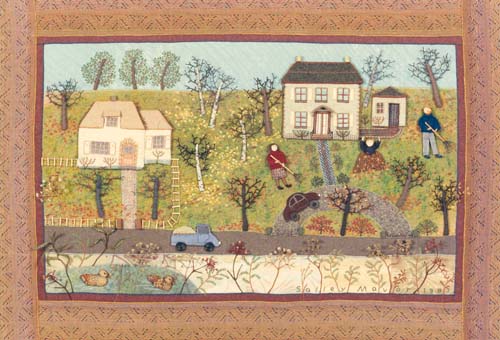
After we moved, Judy and I kept in touch and would see each other when I visited Woods Hole every summer. Back in central Massachusetts, with my son in daycare part-time, I continued to sew pictures, developing my fabric relief technique. I tried out different ways of making people, animals and houses with flat cardboard backs that could be sewn onto a pieced and embellished fabric background. The raised figures and props seemed to work best at a shallow depth of 1/4″ to 3/4″. “Picking Peas” (1986) and “Raking Leaves” (1987) are examples of the change in my way of working.
“Picking Peas” fabric relief 1986
This was a very productive time for me. Even though I was busy taking care of a child, our life was simpler and less social because we hardly knew anyone in our new town.
“Raking Leaves” fabric relief 1987
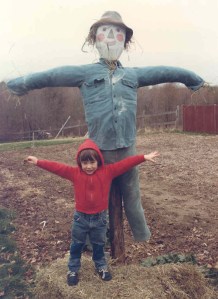
Peter with our scarecrow in Lunenburg 1986
The area was beautiful, and my artwork was influenced by the agricultural landscape of our neighborhood. I started working in my studio in the evenings, a habit I’ve kept ever since.
In an effort to test the illustration market for my type of work, I made a solo trip to New York City, meeting with an agent and a few children’s book editors. The agent wasn’t interested in my type of art, but I recall that one editor was intrigued. She laughed good heartily when I laid out the fabric background for “Noah’s Ark” on her desk and arranged the loose animals in front of her. I realize now that this presentation must have appeared quite unprofessional compared to the ubiquitous black portfolio with plastic sleeves that most illustrators carry. After looking at my various pieces, she told me she liked my work but found it hard to match with a story. She suggested I find a story that I thought would work together with my style and technique.
I went home feeling that I wasn’t practiced enough to take the leap from depicting one moment in a story to filling a 32-page book with enough action and visual variety to make a story come alive. I needed more time to develop my work to a point where I could confidently take on a large illustration project.
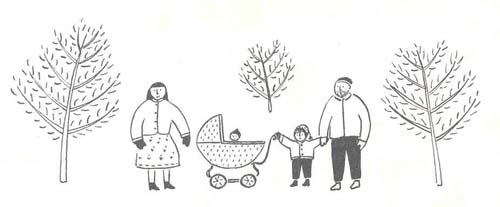
Ian’s birth announcement
‘Noah’s Ark” fabric relief 1986
After our second son Ian was born, I kept working on fabric relief pictures. I remember finishing up the “Noah’s Ark” piece on my worktable, with him rocking next to me in a wind-up swing. You can see an earlier post with several pictures of “Noah’s Ark” here. I continued to make and sell fabric relief pictures, trying new ways of constructing 3-dimentional parts that could be sewn in place.
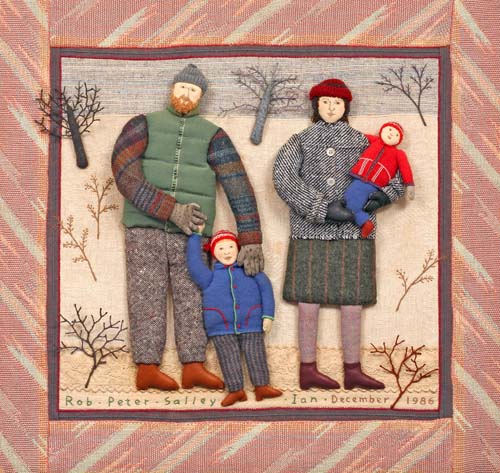
‘Family Portrait” fabric relief 1986
sketch for sample illustration
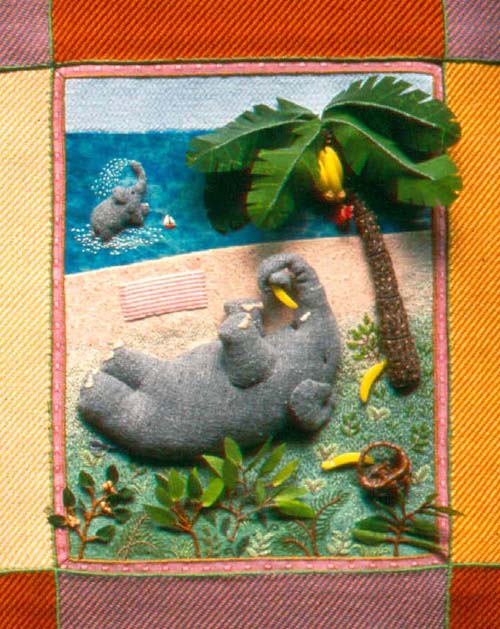
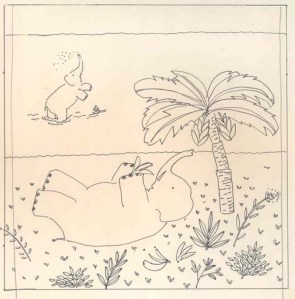
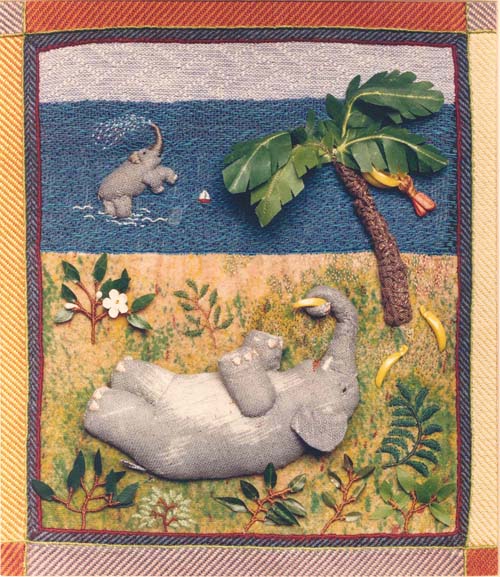
After four years away, we decided to move back to Woods Hole in the fall of 1987. Judy and I soon revived our interest in The Way Home and decided to start over and change our approach to the project. I felt more prepared to illustrate the story and with Judy’s encouragement, started to think how I would make a new sample to show. We wanted to impress the editors with our serious preparation, not wanting them to see us as two inexperienced housewives from Cape Cod. I made another illustration, this time picking a more active part of the story, where the mother elephant is enjoying herself on the beach, while Savi splashes in the water. I found some plastic banana beads that were the right size and cut banana tree leaves from cloth artificial leaves. Planning ahead for the border, I bought some diagonal striped upholstery fabric, in every color available.
The text reads,
“Her mother cooled off in the shade of a banana tree and ate bananas. She rolled her big body from side to side in the sand. Savi stayed in the water.”
2nd sample illustration 1988
We knew that my new and untested method of working in 3-dimensions would be questioned as a viable illustration technique. We gathered everything that we could think of to counteract any skepticism. Since my originals would have to be photographed, we had a professional 4×5 transparency taken of my sample art. We also made a storyboard showing a simple layout in the standard 32-page format. It pictured the progression of the story with the different characters at the beach, in the water, walking through the trees’ shadows, following the banana trail and looking up at the moon at the end.
When we felt ready to present our project, we called and set up appointments with a handful of children’s book publishing houses in New York City. Judy was excited to be able to meet editors in person, because our visit would include showing my portfolio. Generally, writers are asked to submit their stories by mail only. My portfolio (brown leather, not black) held the original sample illustration for The Way Home, a color print and 4×5 transparency of the sample, the storyboard, plus a collection of 8×10 color prints of my fabric relief work from the past 4 years.
Judy and I drove to western Connecticut, where we stayed overnight with friends. The next morning we took the train to New York. We spent the entire day visiting children’s book editors, the most memorable being with Phyllis Larkin, an older, respected editor at MacMillan. When we were introduced and I saw her face, I knew that we had met before. I forget names, but faces make their imprint. I remembered that she was the one to whom I had shown the Noah’s Ark parts a few years earlier. Phyllis behaved as a true editor, asking to read the manuscript first before looking at my portfolio. She carefully read the story and then called in her art editor, Cecilia Yung. We laid out our visual materials and held the 4×5 transparency up to the light. They liked the pairing of Judy’s story with my artwork but had financial concerns about the extra expense of photography. They were also upfront about their inability to offer me an advance large enough to pay for the time it would take to sew the illustrations. We left them a photograph of the sample art and a copy of the manuscript and went home. We were encouraged because they liked our idea, but didn’t know if they would take the leap to offer us a contract. Months went by and we didn’t hear from any of the editors we’d met with. Judy and I put the project in the back of our minds and were fully distracted by summer activities.
To keep up with new posts, please subscribe to this blog. Your contact info will not be shared. If you’d like to see more frequent photos tracking the projects in my studio, please follow me on Facebook and/or Instagram.
This is the story of the making The Way Home, my first picture book for children. In the 5-part series, I explain how the writer, Judy Richardson and I persisted over a period of 8 years, from our first glimmer of an idea in 1983, to having Judy’s story and my illustrations paired together in a book published by MacMillan in 1991. This is not meant to be a guide for those who want to have their own work published. Our unique project and the time and circumstances in which we were working shaped the trajectory of events I will be sharing. There’s a lot to show and tell about this story and I hope that you will follow through until the end of part 5.
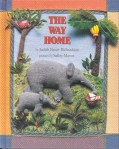
The Way Home, published in 1991
I majored in illustration in art school, but I never thought I’d make illustrations in a way that could be reproduced effectively. At the Rhode Island School of Design during the 1970’s, there wasn’t an obvious major for someone like me, who was interested in many different materials and methods. I didn’t want to limit myself to a particular discipline and was attracted to the illustration department, with its focus on communication, rather than certain processes and mediums. Just as other schools are divided by subject, our student body was separated by technique, and I regret not mingling with people in other majors. Other possible matches, like the sculpture or textile dept. were too specialized for me.
Salley at RISD
The sculpture dept. seemed to me like an all-boys club, with its swarm of black clad, chain-smoking, wiry young men who produced large, austere metal sculptures, the kind that are now rusting in public places. Even the more female dominated textile dept., with its concentration on fabric design and weaving, was too specific for me. All I knew was that total abstraction left me hungry for more and I wanted my artwork to be a kind of narrative that viewers could connect to. In the illustration dept., I could use any materials I wanted, as long as my artwork solved the assignment. I used this time in school to teach myself different ways of working and showed a particular interest in fabric and sewing. For my senior thesis, I made a series of 3-dimentional illustrations of the story “Hansel and Gretel”.
“Hansel & Gretel” RISD senior thesis 1978
illustration from Houghton Mifflin educational reader, 1979
Following graduation in 1978, I spent a few years making soft sculpture. My first freelance illustration job was constructing insect characters and their neighborhood for a story in an educational reader. I found that making all of the parts was easy compared to setting up the scenes for the photo shoot. It was almost like making a movie in miniature, complete with an “Ivory Snow” winter scene. The project was challenging, and I came away thinking that I would have more control of the outcome if I figured out a way to present my sculpture in a different format.
illustration from Houghton Mifflin educational reader, 1979
I started making what I called “fabric relief” sculptures, which were figures and props sewn to cloth backgrounds. I guessed that if my work was hung on the wall, it would be more readily accepted as “art”. I also thought that bas-relief work would be easier to photograph than sculpture in the round. “Mother and Child” was an early fabric relief sculpture that I made with fabric-covered and stuffed cardboard shapes on a pieced and embroidered fabric background.
“Mother and Child”, fabric relief 1983
Molly Bang, an illustrator who lives in Woods Hole, showed me Judith Benet Richardson’s 2-page manuscript for a picture book titled The Way Home. Molly had recently illustrated Judy’s novel for young readers, David’s Landing, which takes place in a village very much like Woods Hole, named Maushope’s Landing. Molly’s cover illustration shows a drawing of the Woods Hole School (built in 1870), where I attended elementary school in the 1960’s.
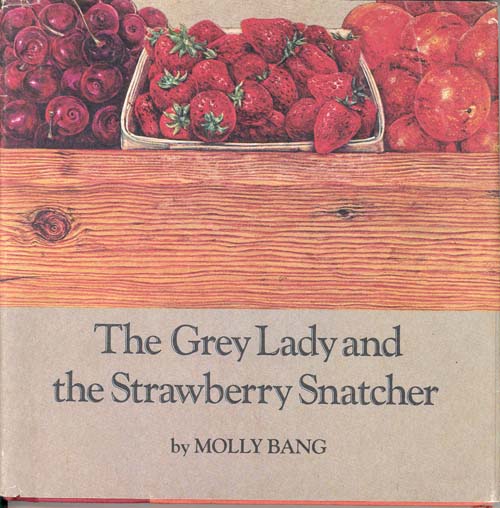
Her 1981 wordless picture book, The Grey Lady and the Strawberry Snatcher, had won recognition as a Caldecott Honor Book and she was nice enough to show an interest in Judy’s writing and my artwork. I liked The Way Home immediately and could envision the baby elephant and her mother at the beach. Today, 27 years later, I marvel at how very fortunate I was to have this story presented to me. As an illustrator who is not a children’s writer, I have learned to appreciate how difficult it is to craft a good story that children will want read to them over and over. Like poetry, everything about it has to work, the characters, the place and the rhythm, without any unnecessary words. Judy’s story had believable and charming characters, a strong sense of place, tension and a problem resolved in the end.
Molly Bang’s ‘Grey Lady and the Strawberry Snatcher” 1981
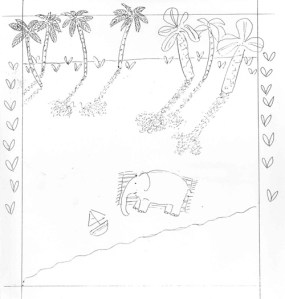
sketch of sample illustration
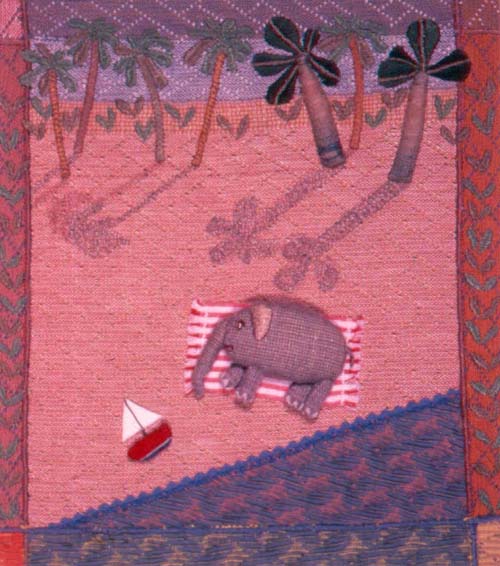
We decided to work together, and I made a sample illustration of Savi, the baby elephant, alone on the beach, with the banana trees casting long shadows. I knew that an editor would want to see just a sample of my work, not the complete set of illustrations. Picking a book size and designing the page layout comes later, after a contract is signed.
This part of the story reads:
“The sun went down a little farther. Savi came out of the water and lay on her towel. She began to feel cold and hungry.”
Sample illustration made in 1983
Judy and I sent out the story and photographs of my sample illustration to a handful of editors, none of whom were interested. Looking at it now, I can see that showing this part of the story was not a good choice for a sample. The artwork and the moment it illustrates were too static and not the obvious scene to pair up with the story. It was the most lonesome point, just after a tense moment when Savi’s mother leaves her because she refuses to get out of the water. I can see why I was drawn to this emotional part, but visually it was too motionless. To sell our idea, we needed to show a more active scene, one that more accurately represented the story as a whole.
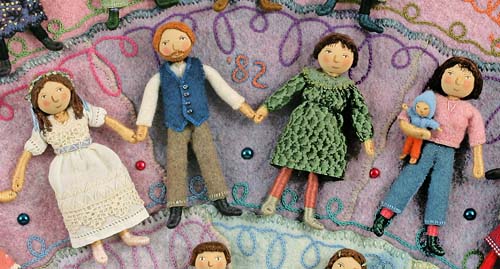
detail from “Self Portrait: A Personal History of Fashion”
That summer our book project was sidetracked by the birth of my first son, Peter. You can see more pictures of my Self Portrait in an earlier post here. Soon after, I moved away with my family to Central Massachusetts. My sample illustration for The Way Home sat in a box, while I adjusted to motherhood and living in a new town.
To keep up with new posts, please subscribe to this blog. Your contact info will not be shared. If you’d like to see more frequent photos tracking the projects in my studio, please follow me on Blue Sky, Facebook and Instagram.
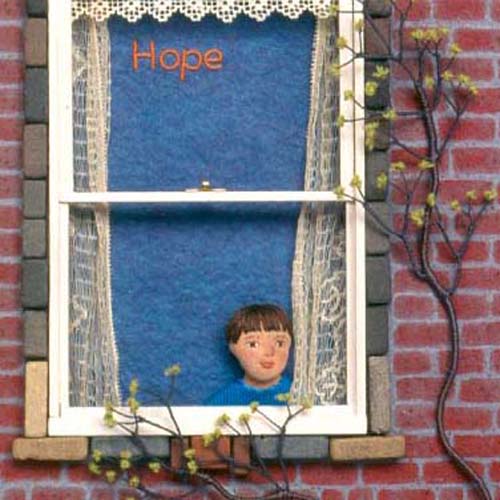
Windows are opportunities to go from one world and into another. They are like mini stages, complete with curtains. I also like the way they provide a structure for bringing pattern and color into a scene. This series of window close-ups are all from children’s books I’ve illustrated. The first one is from You and Me: Poems of Friendship. There are clay “brick” beads framing the window and the ones on the wall are painted on gray felt.
Illustration from "You and Me: Poems of Friendship" 1997
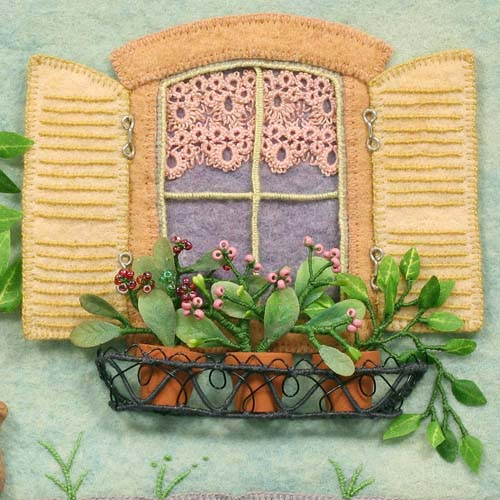
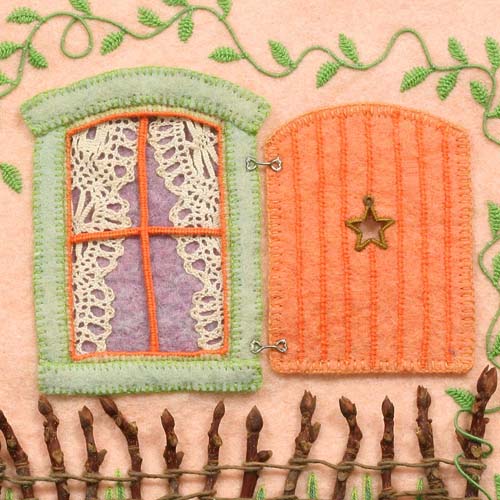
The next two are from the board book, Wee Willie Winkie. The window box is made of wire wrapped in embroidery floss and the fence is a row of budding branches.
This project is from the first edition of my how-to book, Felt Wee Folk: Enchanting Projects. I showed how to make the cat pin on HGTV’s The Carol Duvall Show soon after the book came out in 2003. Here are the same pieces we used in the step-by-step demonstration on the show.
Find out about books I’ve illustrated with fabric relief here. See more cats I made of felt in an earlier post here.
Felt Cat Pin from “Felt Wee Folk”, 2″ x 2.5″
Living without TV, I was unaware of the numerous cable craft shows and was unfamiliar with this new term “tutorial” on the internet. I’m slowly crawling out of my peaceful sewing room, but question how a person can both do their creative work and keep in touch with the vast sewing/fibers network! I suppose, like everything, it’s a question of balance. I hope that you enjoy this cat pin project and use it as a launching pad for other ideas of your own. You can read and see earlier posts about my pin business here.
FELT CAT PIN: To complete the project, you’ll need to understand how to do a blanket stitch, chain stitch, satin stitch and fly stitch.
Materials: 1″ pin back, pinking shears, embroidery needles, 2 green glass beads (about 1/4″), embroidery floss: black, brown, orange, gold, light green, wool felt: 2-1/4″ x 2″ pink, 1-1/2″ x 1-3/4″ blue, 1-1/4 x 1-1/2″ orange
Step 1. Cut out shapes from wool felt: orange for cat, blue for the middle layer and pink for the bottom layer.
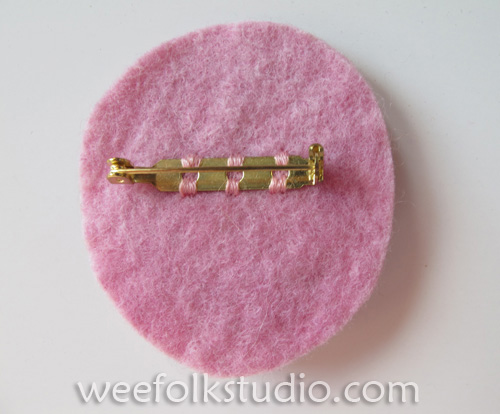
Step 2. Sew the pin back to the bottom layer with floss or sewing thread.
Step 2
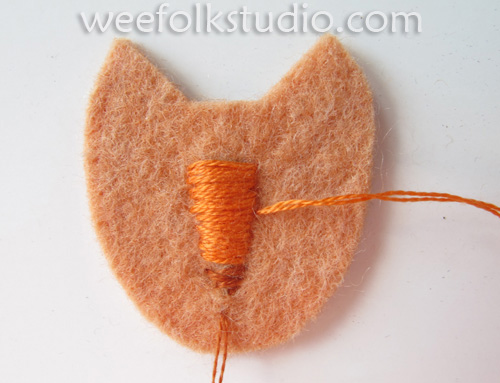
Step 3. Satin stitch the cat’s nose with double strands of orange floss. With brown floss, stitch the bottom end the cat’s nose.
Step 3
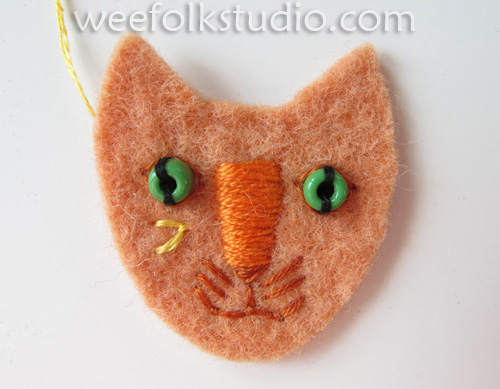
Step 4. Stitch the mouth and whiskers with double strands of brown floss. Sew the green bead eyes onto the cat face with black floss, stitching vertically to make the eye’s pupil. Stitch an outline around the bead eyes with a single strand of brown floss. With a double strand of gold floss, use a fly stitch to make cat’s stripes.
Step 4
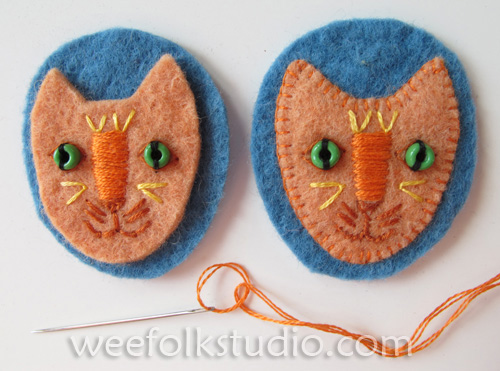
Step 5: With double strands of orange floss, stitch the cat face to the blue middle piece, blanket stitching all around the outside edge of the cat face
Step 5
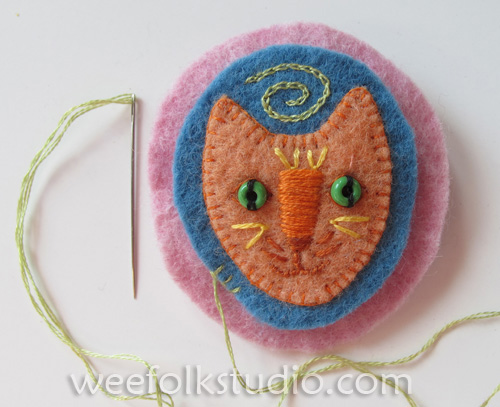
Step 6. With a single strand of light green floss, chain stitch the curly queue on the blue felt, above the cat face. Then, with double strands of light green floss, blanket stitch the blue middle section onto the pink piece.
Step 7. With sharp picking shears, trim around the outside edge of the pink felt piece. You’re finished!
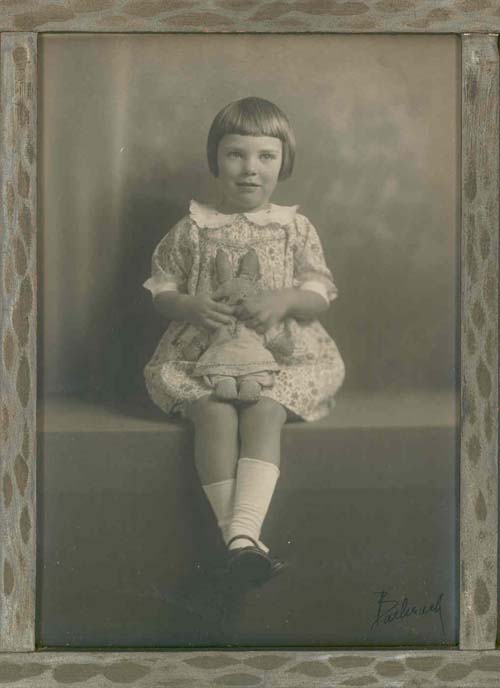
These doll house miniatures belonged to my mother, who was born in 1925 in Providence, RI. In the photograph, she looks like the classic little girl from her era. My sister, brother and I played with the toys, too. The porcelain dolls have been well-loved and are showing wear, but the metal toys held up much better. The mail box is also a bank. I just noticed that the mower (or carpet sweeper?) is named SallyAnn, names my mother would give to my sister and me, only spelled with e’s.
Mitten (n.) A covering for the hand, worn to defend it from cold or injury. It differs from a glove in not having a separate sheath for each finger.
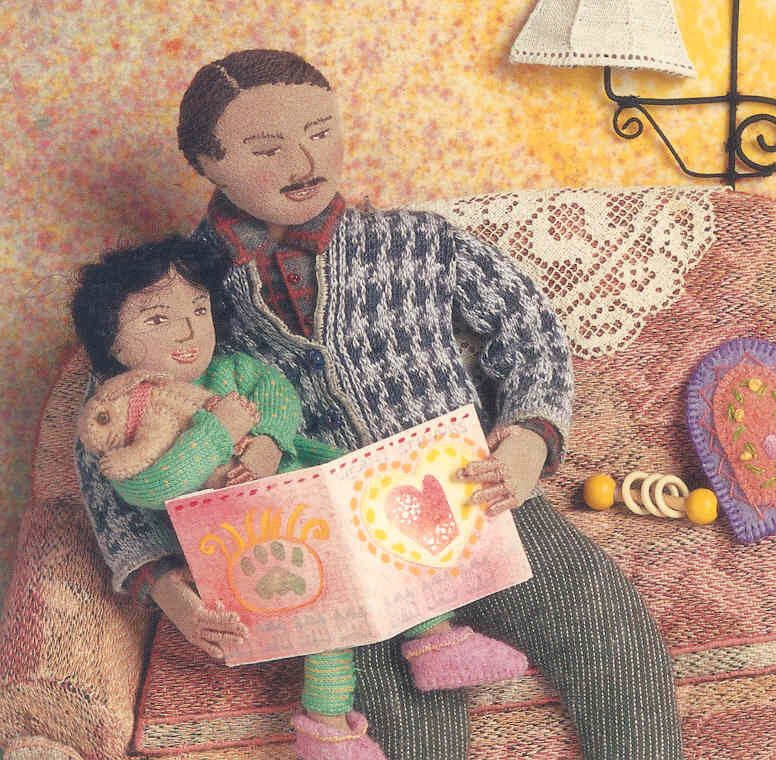
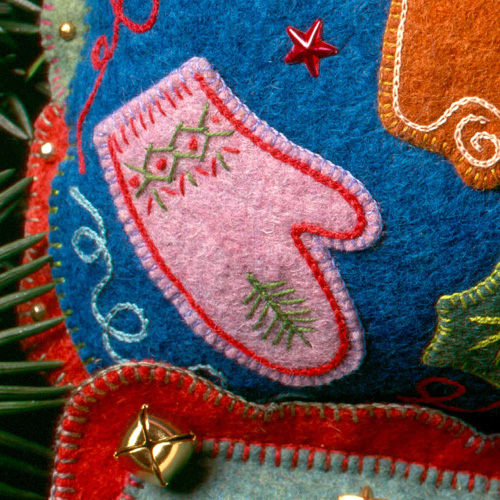
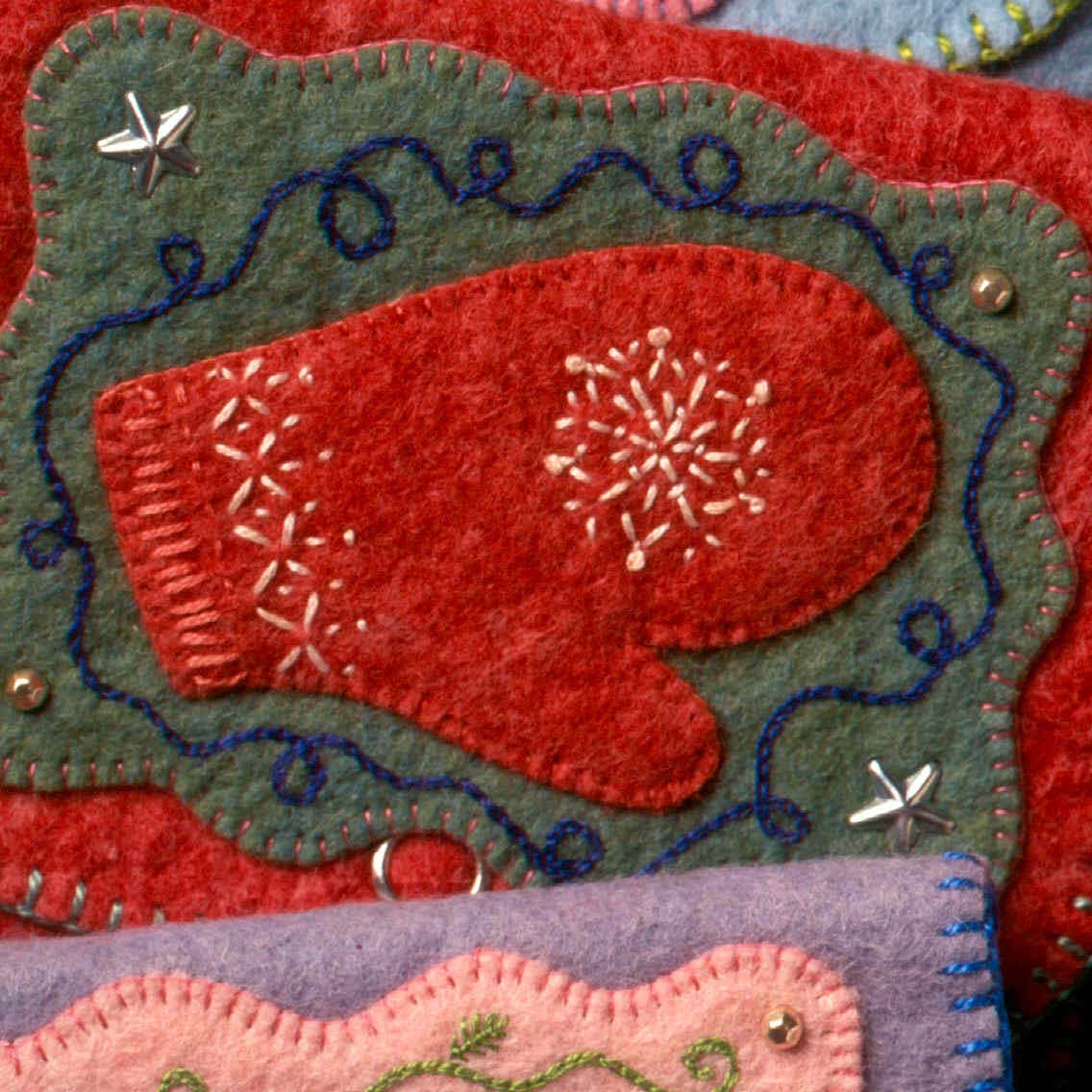
Even though Spring is around the corner, we still have cold snowy weather. Here are some mittens that have appeared in some of my pictures, starting with a detail from the tempera painting “Laplander”, which you can see here. Then there’s a boy with red mittens holding a kitten from You and Me:Poems of Friendship. The cozy father and daughter scene is from In the Heart, where red mittens as well as hearts show up throughout the book. The balsam pillow and felt purse projects are from my how-to book, Felt Wee Folk: Enchanting Projects. Last is a boy dressed for winter from Pocketful of Posies: A Treasury of Nursery Rhymes, which will be published in September.
detail from “Laplander” 1977
detail from “You and Me: Poems of Friendship” 1997
detail from “In the Heart” 2001
detail from the balsam pillow in “Felt Wee Folk” 2003
felt purse from “Felt Wee Folk” 2003
detail from “Pocketful of Posies” 2010
Note: See other posts in the Close-ups series archive here.



 Continued from The Way Home (part 4)