I wrote this post 2 years ago and don’t know why it stayed in the drafts folder all that time. It was clearly written during a period of procrastination or when there was a gap in my work schedule, because it mentions cleaning my studio, which rarely happens. Right now, I’m engrossed in the process of working on a new children’s book, which you can follow here. It’s a calming break from earlier this fall when my Liberty and Justice exhibit caused a ruckus because of its political satire. So, let’s take a little detour and visit some small things around my studio!
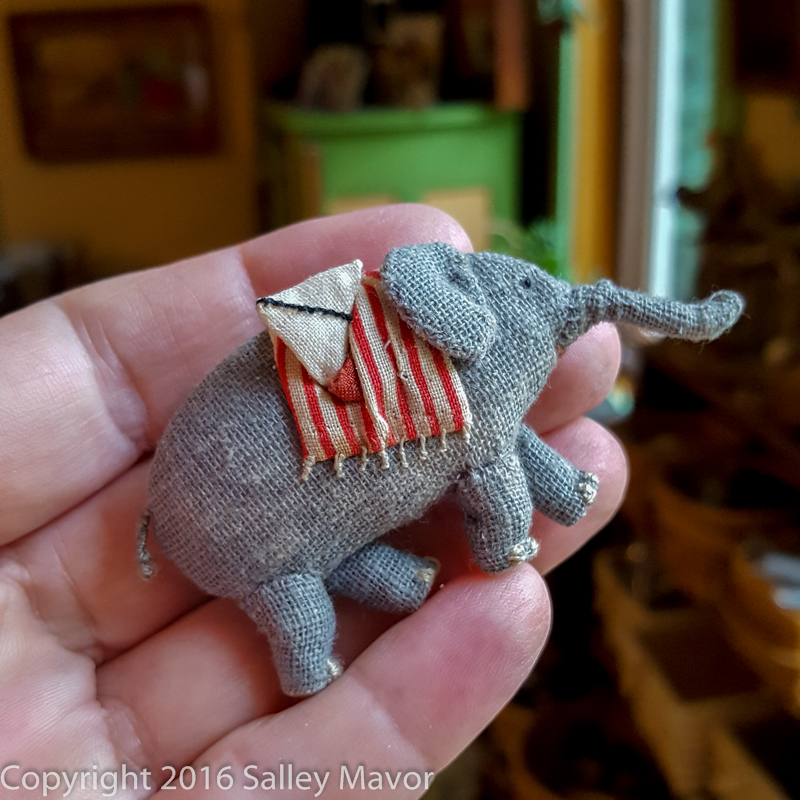
— While cleaning up my studio, I came across the elephant pictured above. Her name is Savi and she is the main character in The Way Home, my first book. This attempt at an elephant wasn’t up to my standards (I think the bumpy trunk bothered me), so she never made it into an illustration. She’s been hanging out in my studio for 25 years. I took her picture and posted it on Instagram and Facebook.
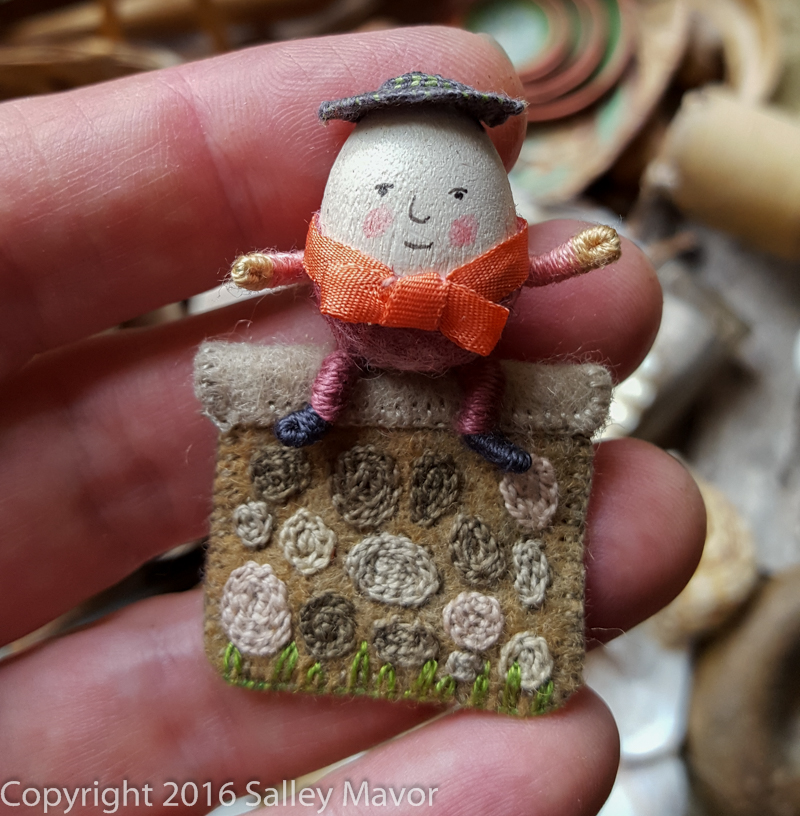
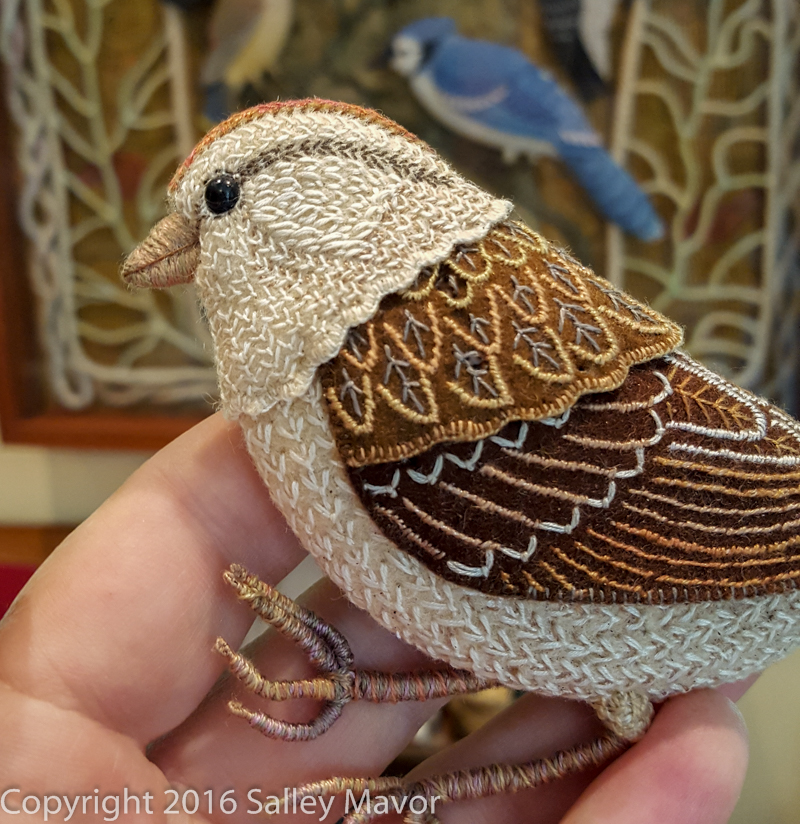
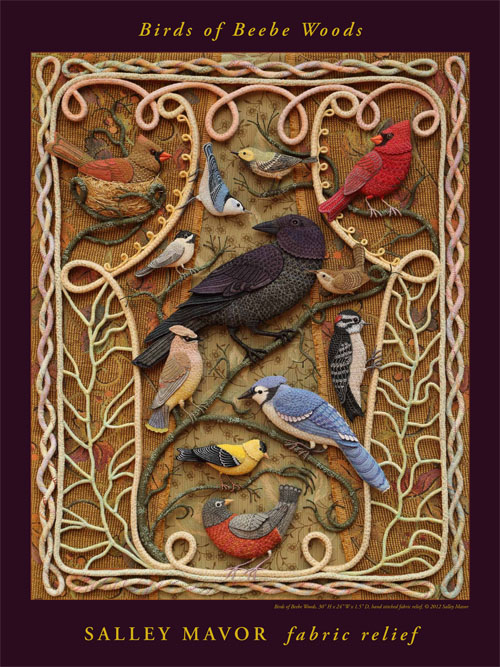
Since then, I’ve found more small things to photograph and post. I’m holding some of them, so you can see the scale in relation to my hand. There’s Humpty Dumpty, 1 inch wee folk characters, a house and leaves that were used as spot illustrations in Pocketful of Posies. There’s a chipping sparrow that wasn’t included in the finished Birds of Beebe Woods. And at the end is a yellow telephone I made while in art school over 40 years ago.
chipping sparrow
To keep up with new posts, please subscribe to this blog. Your contact info will not be sold or shared. If you’d like to see more frequent photos tracking the projects in my studio, please follow me on Facebook and/or Instagram.
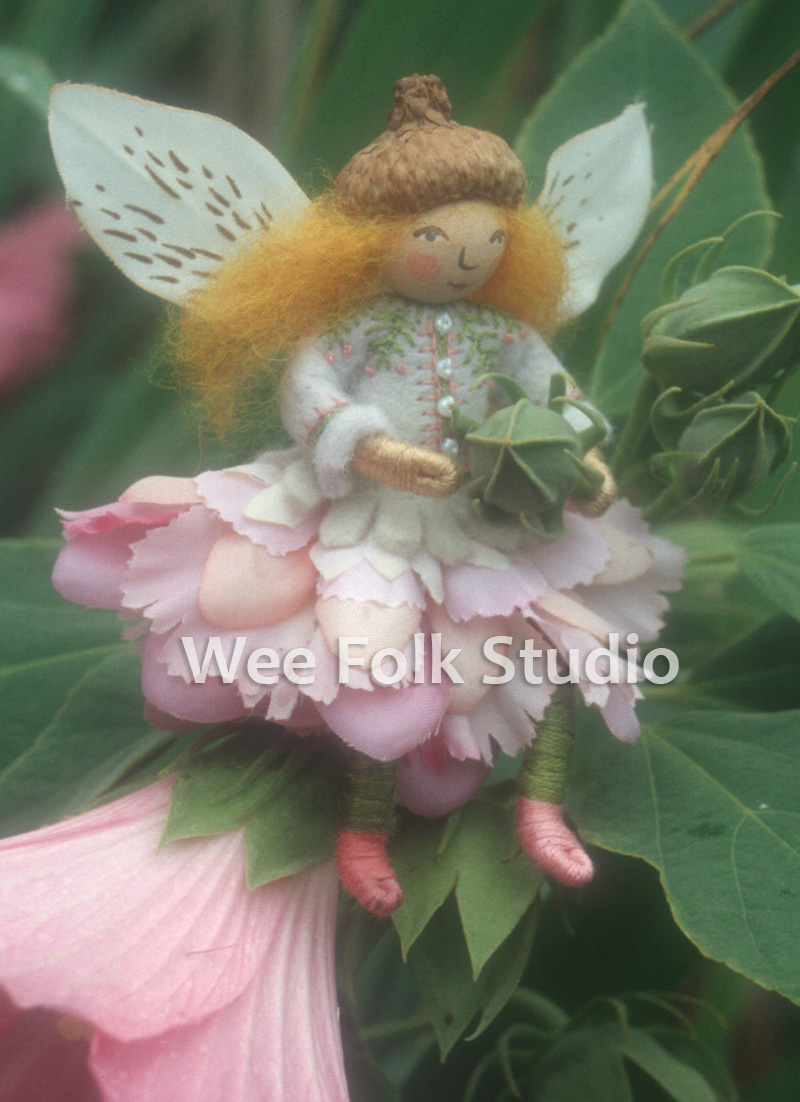
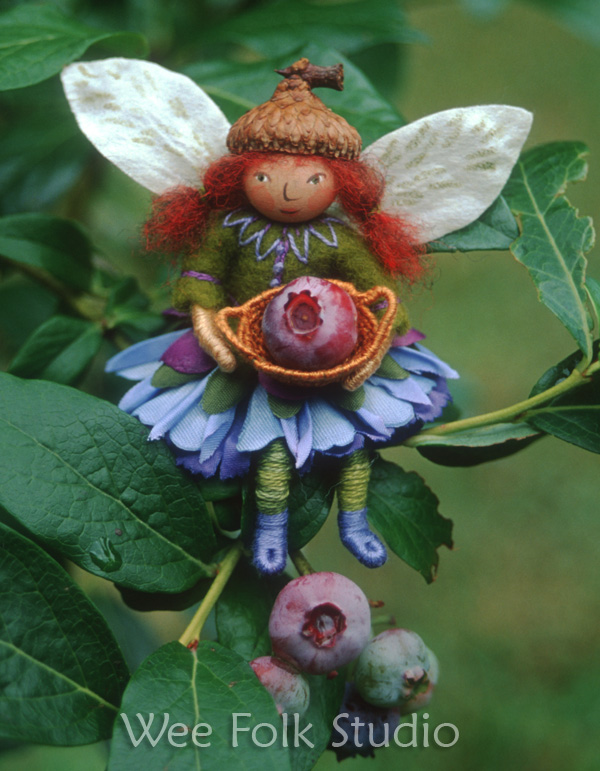
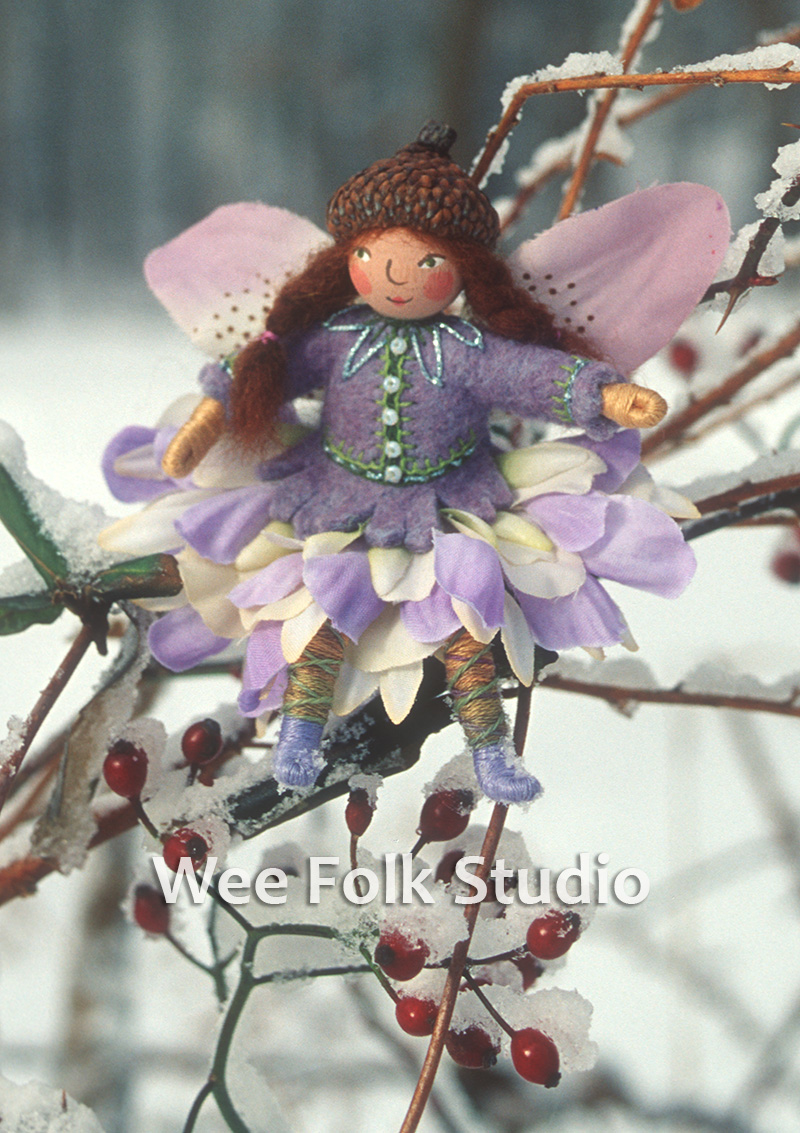
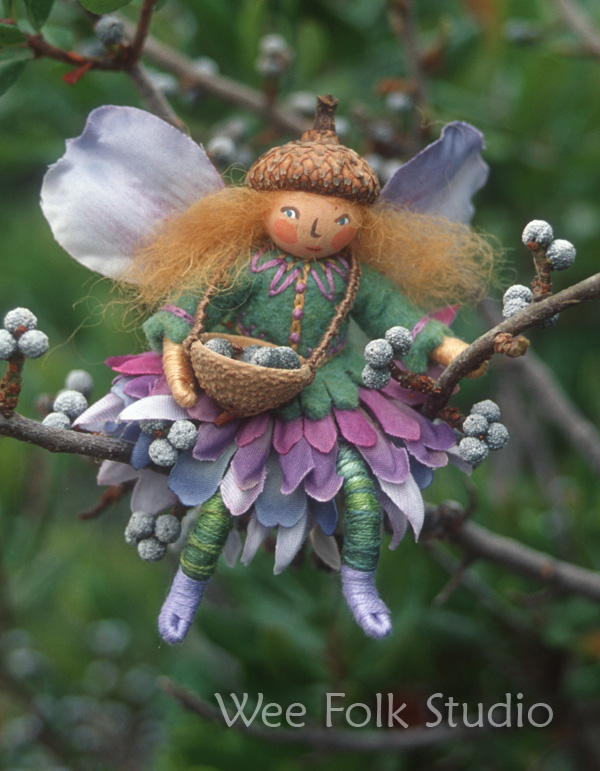
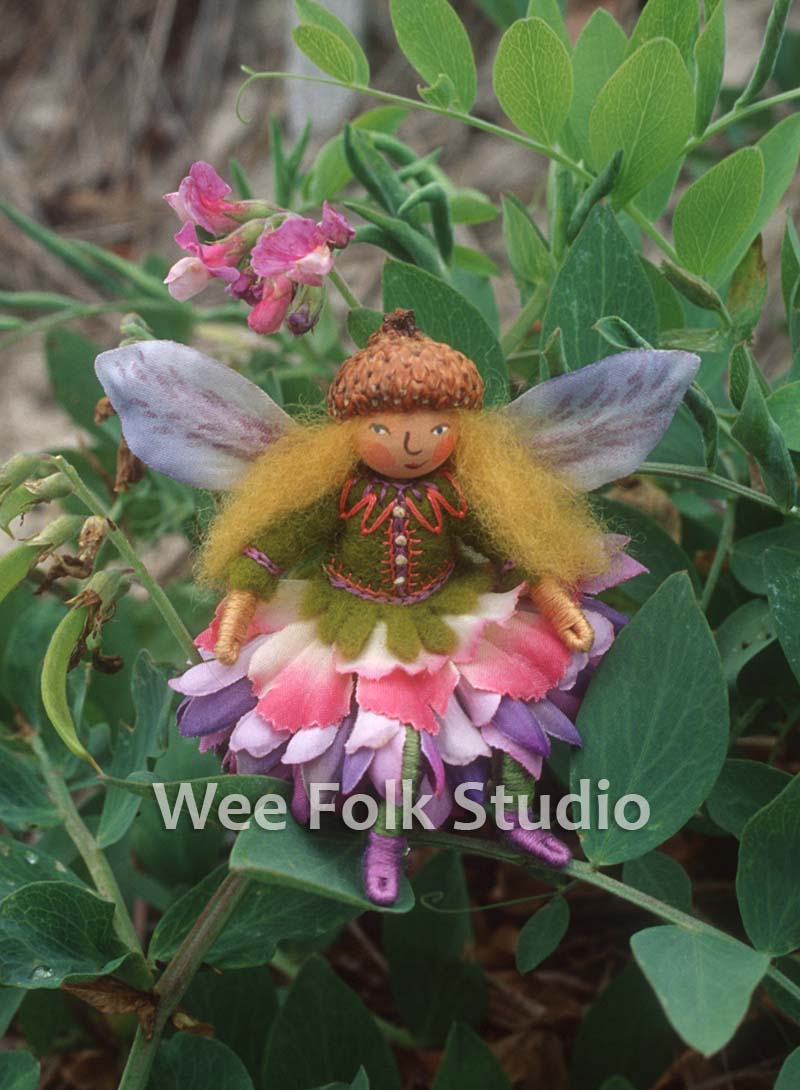
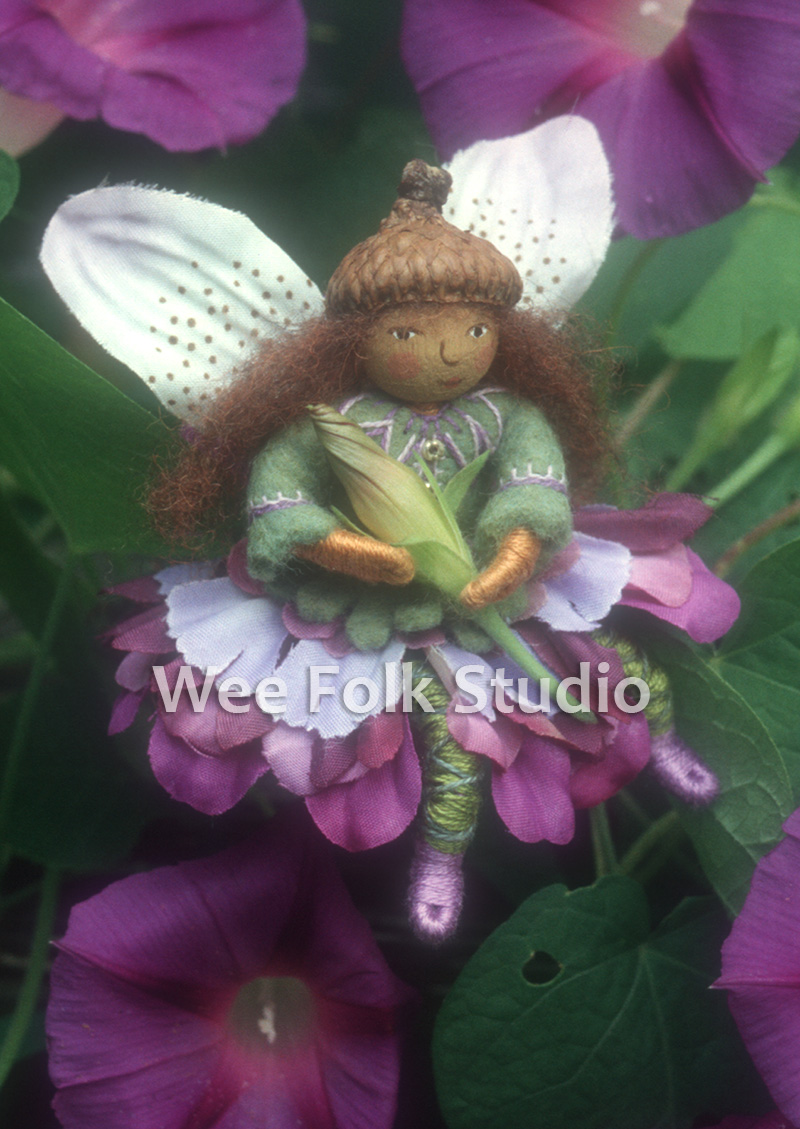
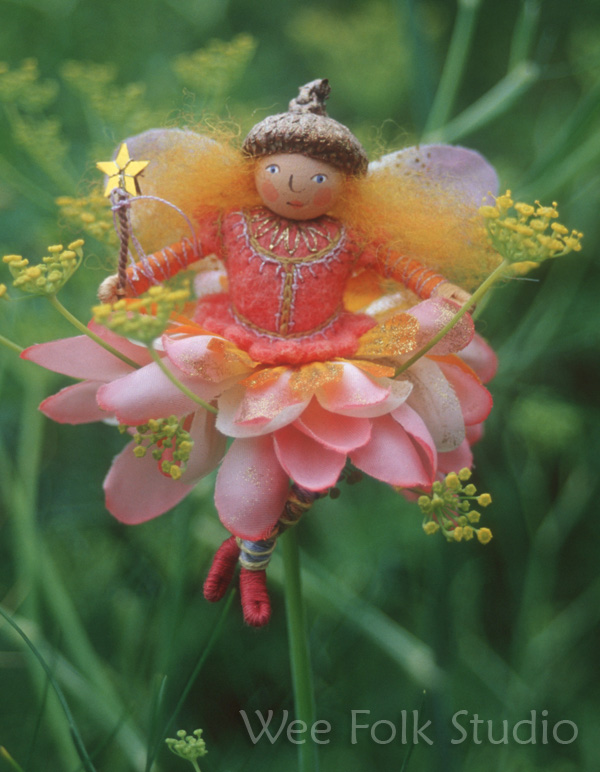
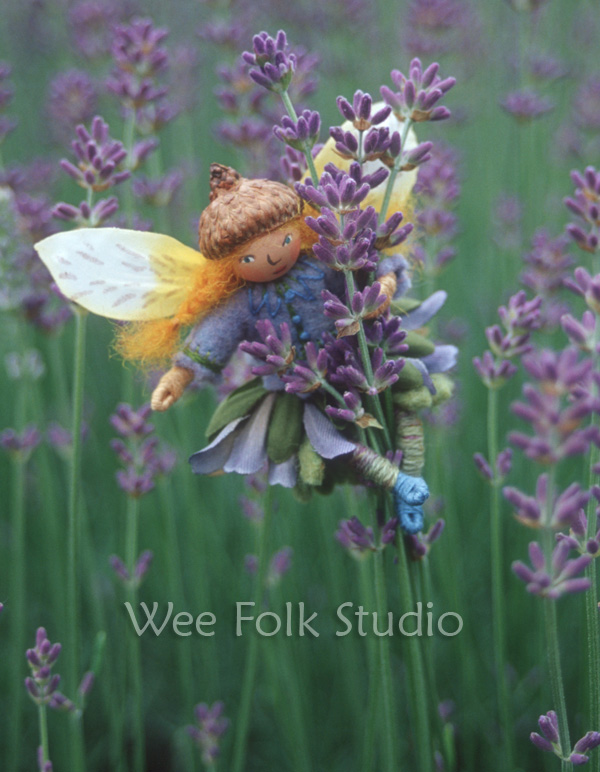
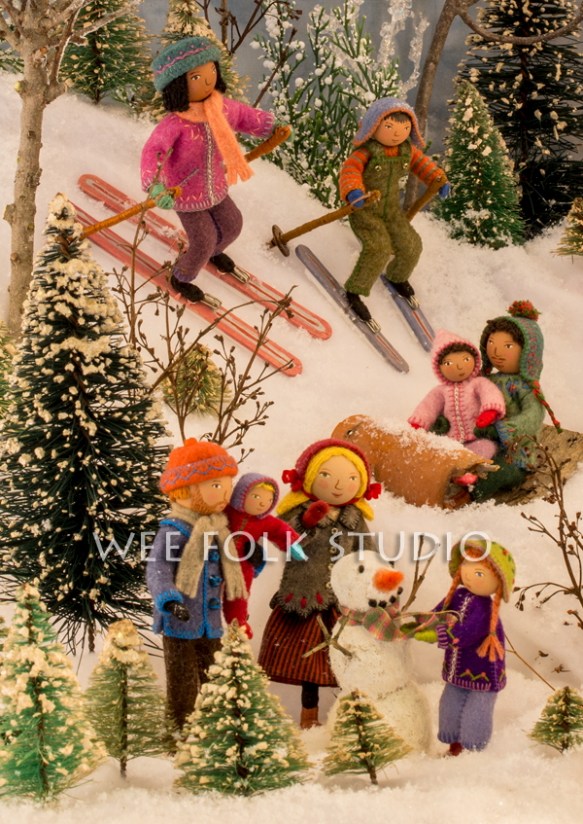
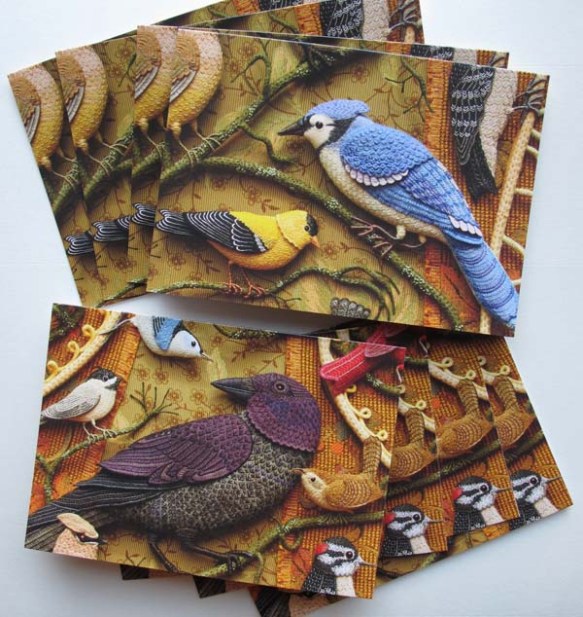
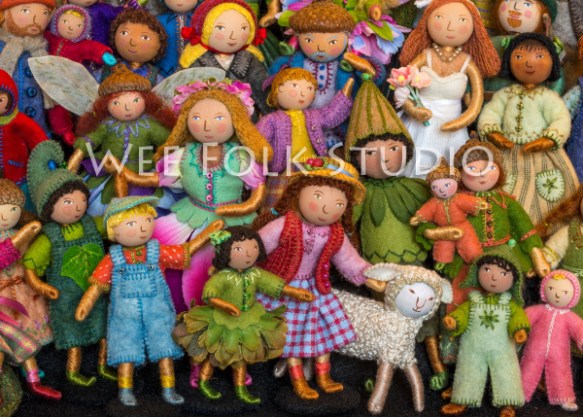
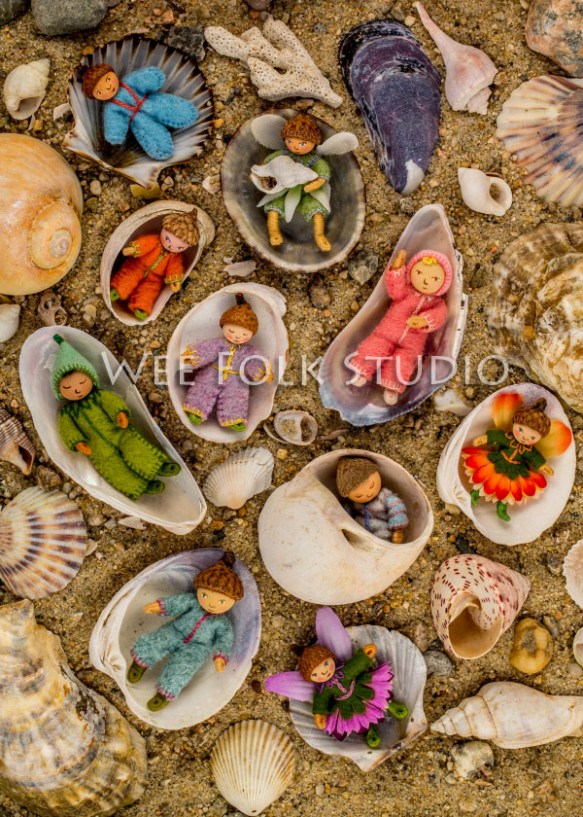
I am happy to offer a very limited supply of discontinued Wee Folk Studio note cards, which were recently discovered in storage. Most of these designs were originally released in the early 2000’s and have been out of print for over 10 years. They come from a time when my business was dominated by fairies, with dozens of varieties of kits and cards sold on a wholesale basis to catalogs and stores.
Back then, I could be seen photographing fairies all over town, along the roadside, at the beach or on the bike path. This all-consuming experience led to writing my how-to book, Felt Wee Folk, which gives step-by-step instructions for making your own fairies and wee folk characters. My work has taken me in other directions since then, but I look back fondly at this period when the possibilities to expand the wee world seemed endless. I don’t think I would be making the kind of art I am today, if I hadn’t gone through this “fairy period”.
The cards will be sold in packs of 8 different designs, 4.25″ x 6″, with envelopes, in a vinyl wallet. The watermark will not appear on the cards. Each set will include 8 different cards, selected at random from a choice of 16 different images — Bay Berry, Morning Glory, Princess Dill, Harvest Folk, Swamp Rose, Dandelion, Lavender, Crystal, Flora and Rosebud, Sweet Pea, Milkweed, Bitter Sweet, Blueberry, Petite Pea, Moon Shell, and Rosita.
UPDATE: The discontinued cards sold out quickly, but there’s another 8 card sampler of fairies and baby wee folk available, which is a good substitute.
To keep up with new posts, please subscribe to this blog (top right column on the home page). Your contact info will not be sold or shared. If you’d like to see more frequent photos tracking the projects in my studio, please follow me on Facebook and/or Instagram
This family recipe was first published on my blog 6 years ago. Based on the numbers of visits since then, the post has been a constant favorite ever since. If you want to bring something special that’s not hard to make to a holiday party this season, try it out!
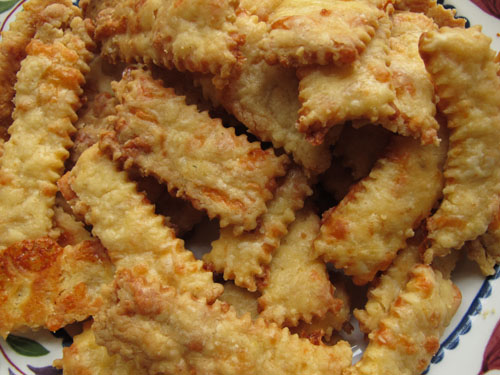
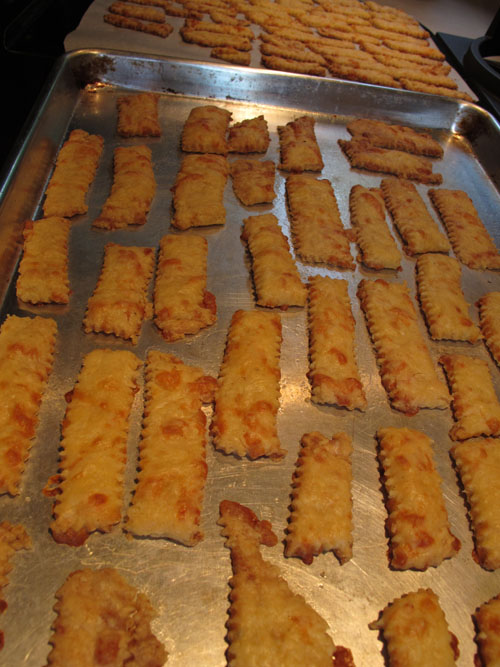
Cheese straws are my favorite offering to bring to holiday gatherings. The recipe comes from my maternal grandmother’s family from Orangeburg, South Carolina. The tradition has been passed down from mother to child for generations. There are cheese straws and then there are these cheese straws, which always get a lot of attention. I’m working on teaching my sons how to make them – they sure like to eat them! The trick is to use the sharpest cheddar cheese you can get and to roll them as thinly as possible.
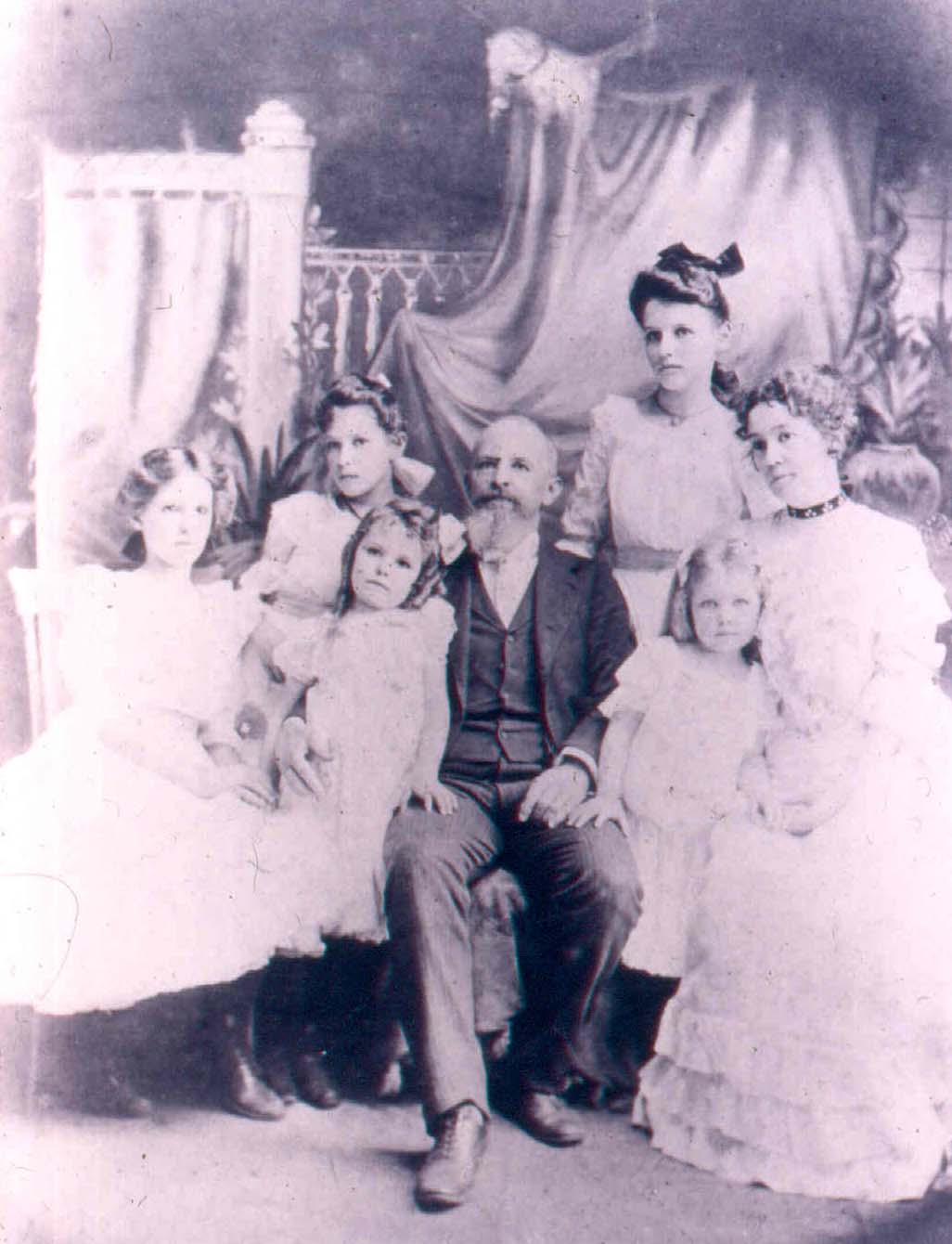
My grandmother (2nd from left) with the Salley family, in about 1900.
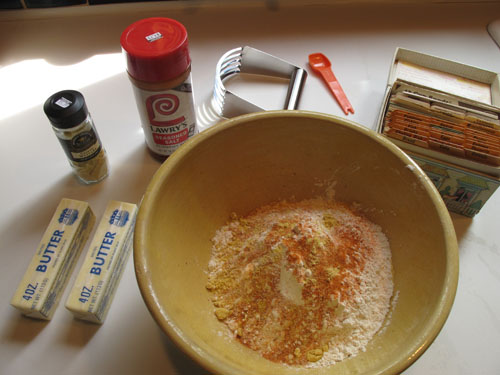
Ingredients: 3 Cups flour, 2 tsp. seasoned salt (I use Lawry’s), 1 tsp. dried mustard, 1 cup butter, 8 oz. very sharp cheddar cheese. Start by mixing the flour, salt and dried mustard in a bowl.
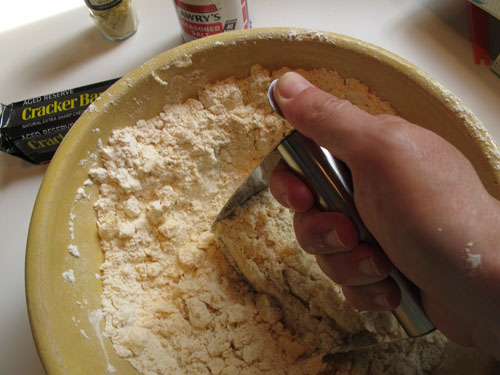
Cut in the butter with a pastry cutter, like you are making pie crust.
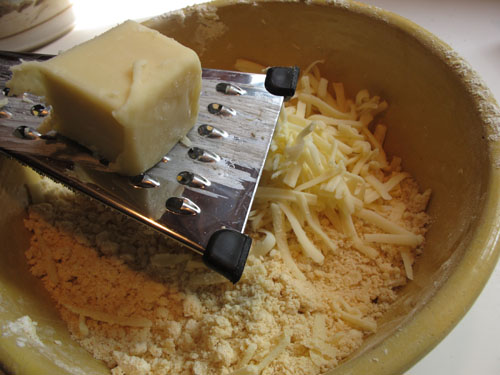
Grate the cheddar cheese and stir it in with the flour mixture.
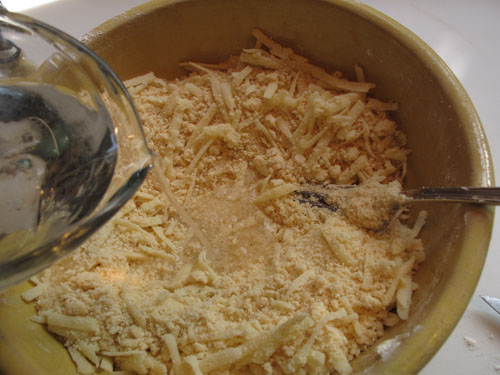
Dribble ice water into the mixture and combine until it sticks together in a doughy consistency. Don’t let it get too soggy!
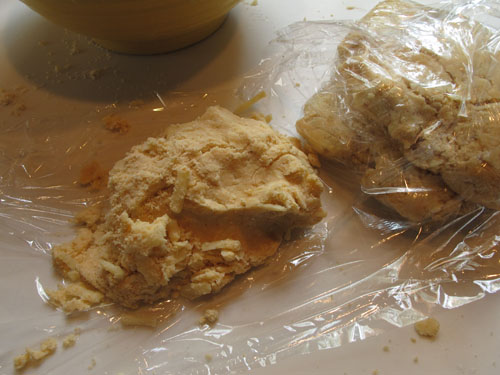
Divide into balls, handling the dough as little as possible. Then wrap the balls and refrigerate for a few hours.
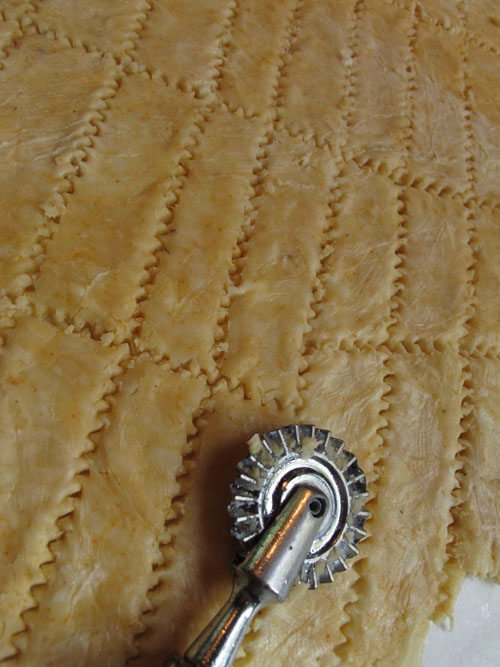
Roll out the dough balls as thinly as possible and cut in strips with a pastry crimper.
Spread the straws out on a cookie sheet and bake in a 350 degree oven for 15 to 20 minutes, until golden brown. They may take longer to cook, so check them often and switch pans to different racks during baking time.
They don’t take long to cool, so immediately sample a few. Now, put them out and watch them disappear! They can be saved in a tin and make a great gift, too.
Since so many of you’ve enjoyed the recipe over the years, I decided to make a card with the cozy kitchen scene (below) on the front and the recipe for making cheese straws printed on the back. That way, it’s a greeting card (or Christmas card) and recipe card all in one. The Cheese Straws card is available in my shop in packs of 4 or 8.
To keep up with new posts, please subscribe to this blog (top right column on the home page). Your contact info will not be sold or shared. If you’d like to see more frequent photos tracking the projects in my studio, please follow me on Facebook and/or Instagram
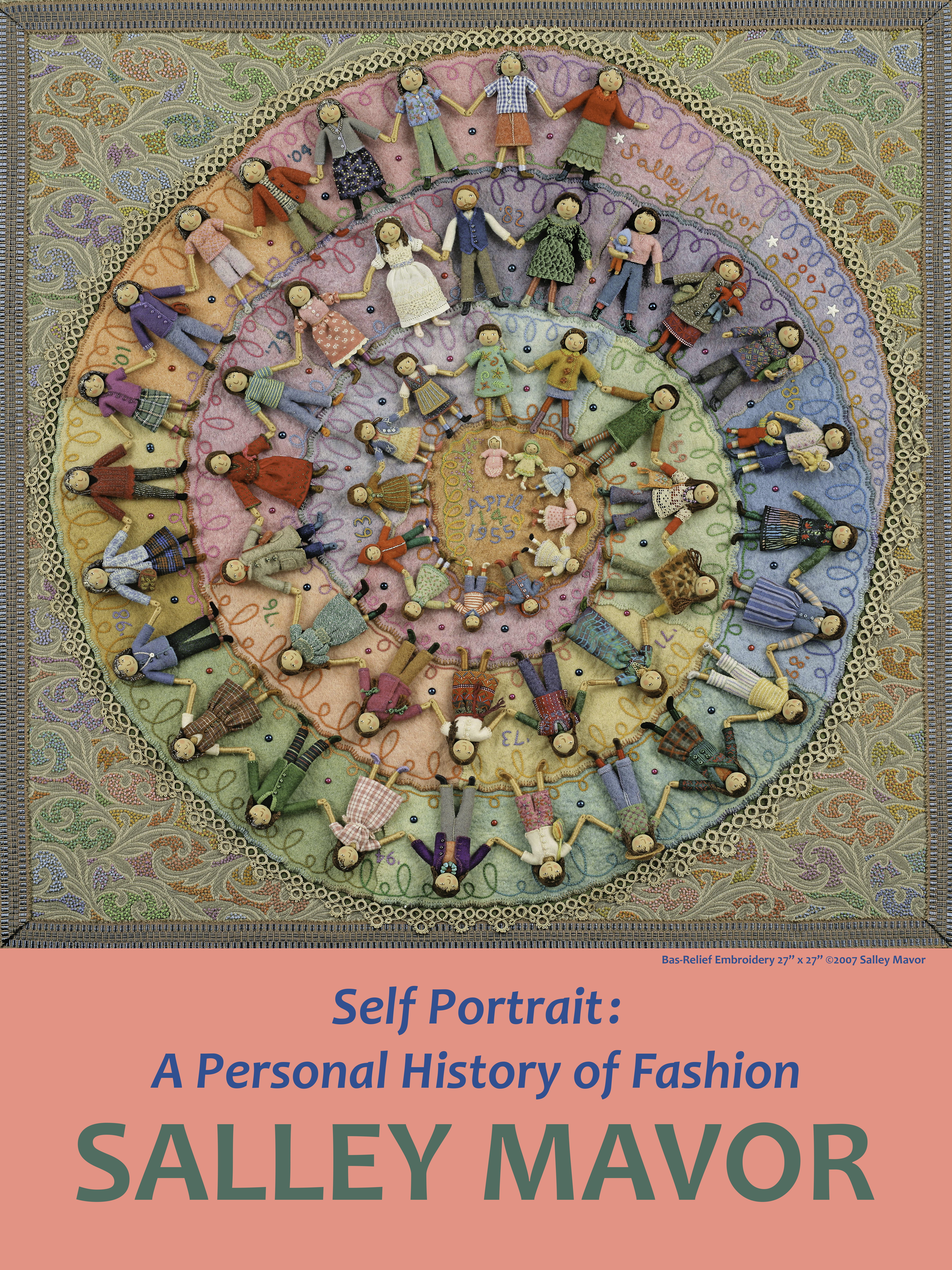
It’s been a while since my Self Portrait was featured in my very first blog post in 2009, so I thought I’d revisit it today.
Self Portrait: a personal history of fashion, 2007
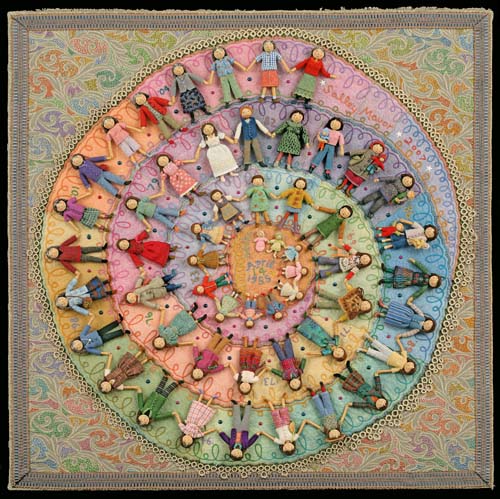
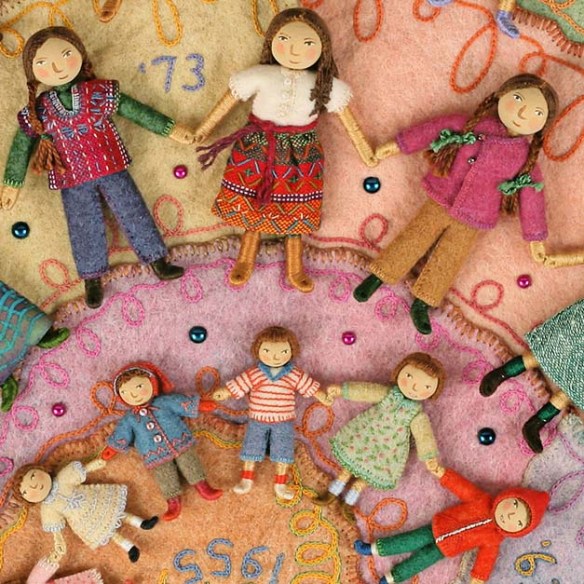
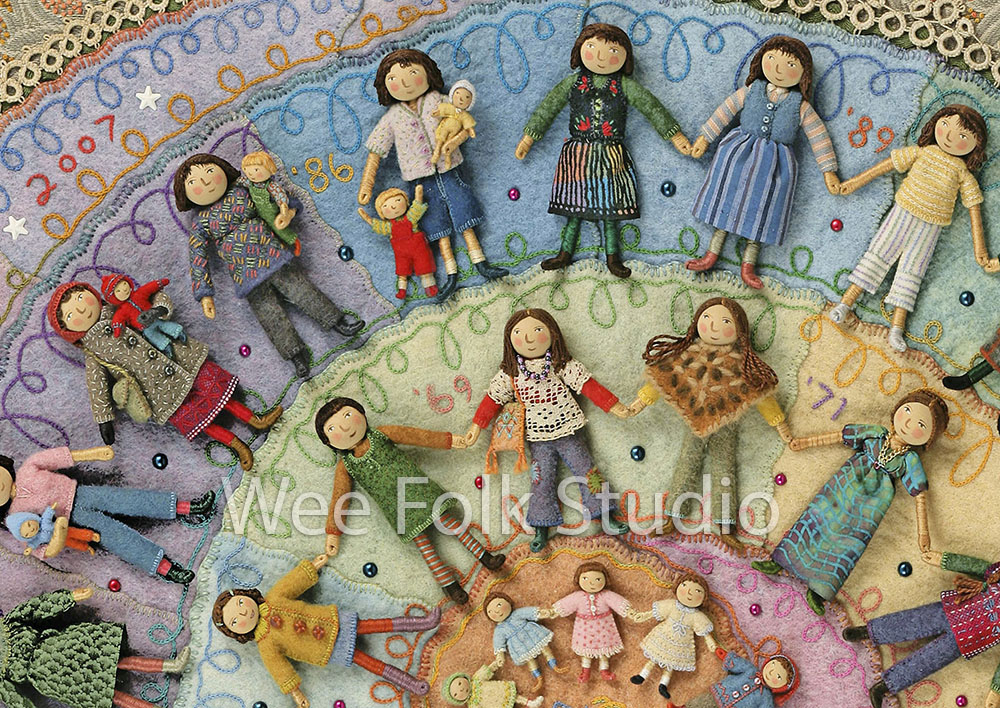
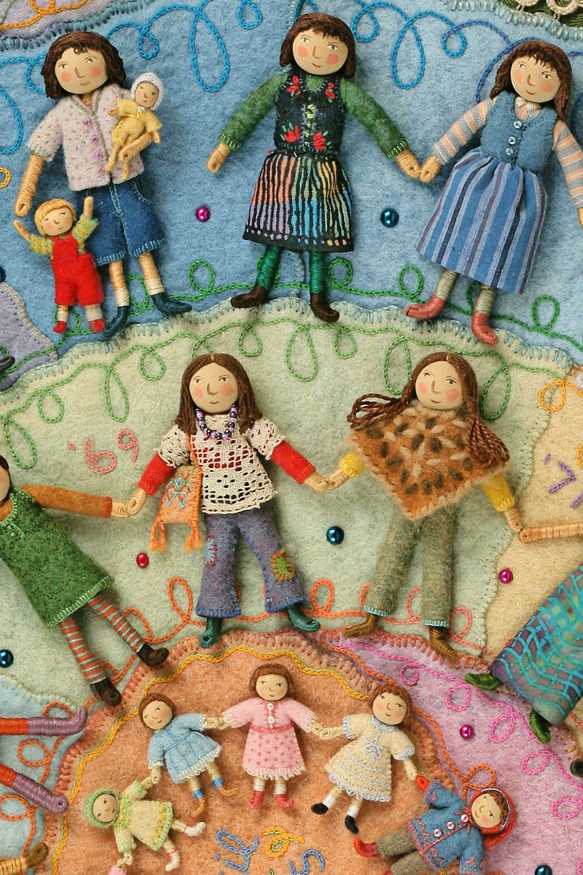
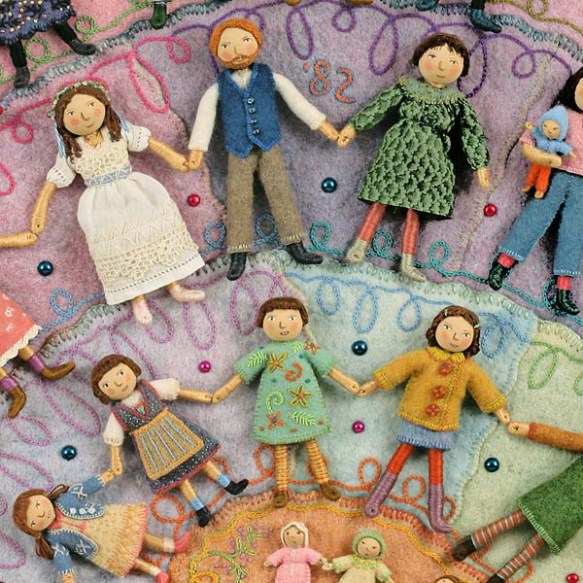
Self Portrait: A Personal History of Fashionis usually on display in its semi-permanent home at the Woods Hole Library, except when it’s included in one of my exhibitions elsewhere. I made the piece for a self-portrait themed invitational exhibition in 2007. It shows a spiral of dolls, one for each year, starting with my birth date in the center. Each figure is dressed in an outfit I would have worn that year, taken from memories, family photos or imagination. The figures range from 1 in. to 3 1/2 in. and are variations of the wee folk and fairy dolls in my how-to book, Felt Wee Folk.
Self Portrait detail
An old acquaintance wrote to tell me that three generations of her family enjoyed seeing my work at the Cahoon Museum. She especially wanted me to know that her 4 year old granddaughter was so taken with my self portrait that they couldn’t tear her away. For little Emma, seeing the progression of dolls opened up the concept of growing up, which led to her asking lots of questions. I love hearing accounts like this, because it reaffirms my intention to make art for all ages, whether it’s book illustration or stand alone embroidered pieces like this one.
Self Portrait note cardPoster – Self Portrait
Note cards and an 18″ x 20″ poster of the Self Portrait is available in my shop here.
This piece seems to resonate with a lot of people whose lives parallel the same time period. I can’t tell you how many women remark that they had an alpaca poncho! As well as clothing memories, we all have a personal soundtrack that goes with different times in our lives. This video is a nostalgic tour through fashion and music that my husband Rob and I put together. At the end, there’s a list of the music.
Self-Portrait detail, 2007
Self-Portrait detail
Since I made many of my own clothes, I remember the fabrics and clothing styles. They are recreated here with smaller scale fabric and embroidered wool felt. My husband, Rob, appears the year we were married and my sons, Peter and Ian, are included through the years when they were little and physically connected to me. The tatting around the outside of the circle was made over 100 years ago by my late grandmother, Louise Salley Hartwell. The wool felt spiral in color gradation is mounted on upholstery fabric, which I embellished with multicolored french knots.
Self Portrait at it’s semi-permanent home, the Woods Hole Public Library
To keep up with new posts, subscribe to this blog. Your contact info will not be shared. If you’d like to see more frequent photos tracking the projects in my studio, please follow me on Facebook and/or Instagram.
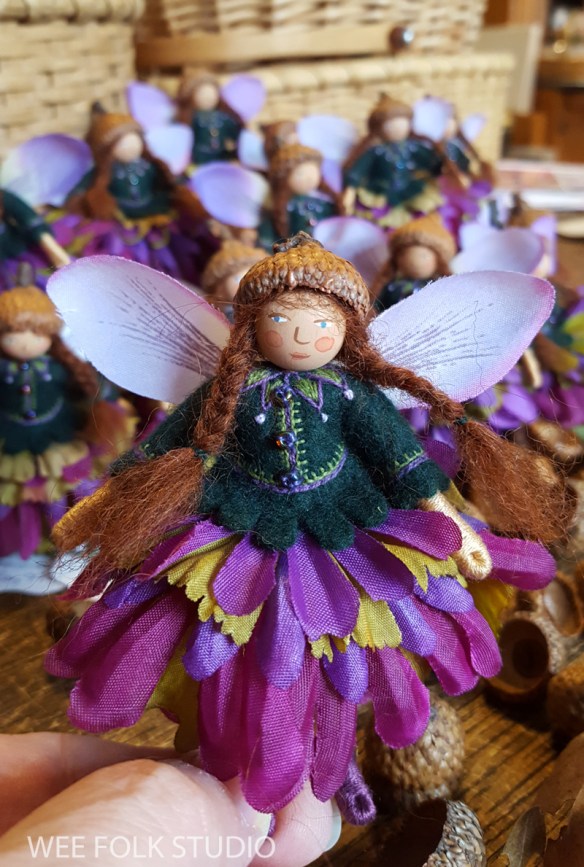
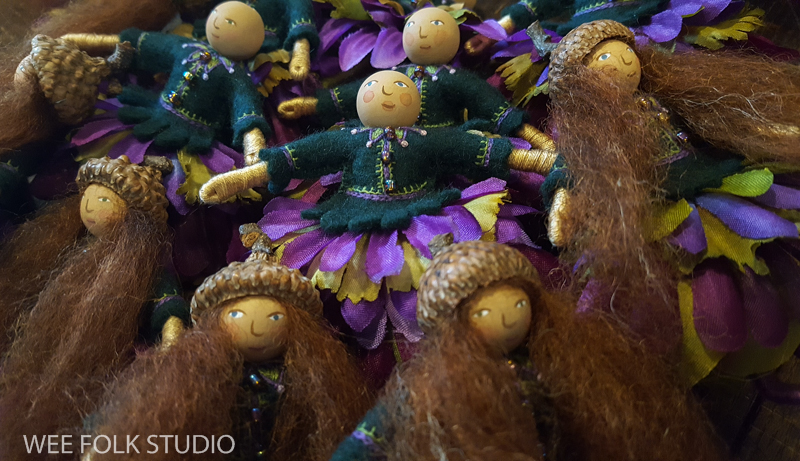
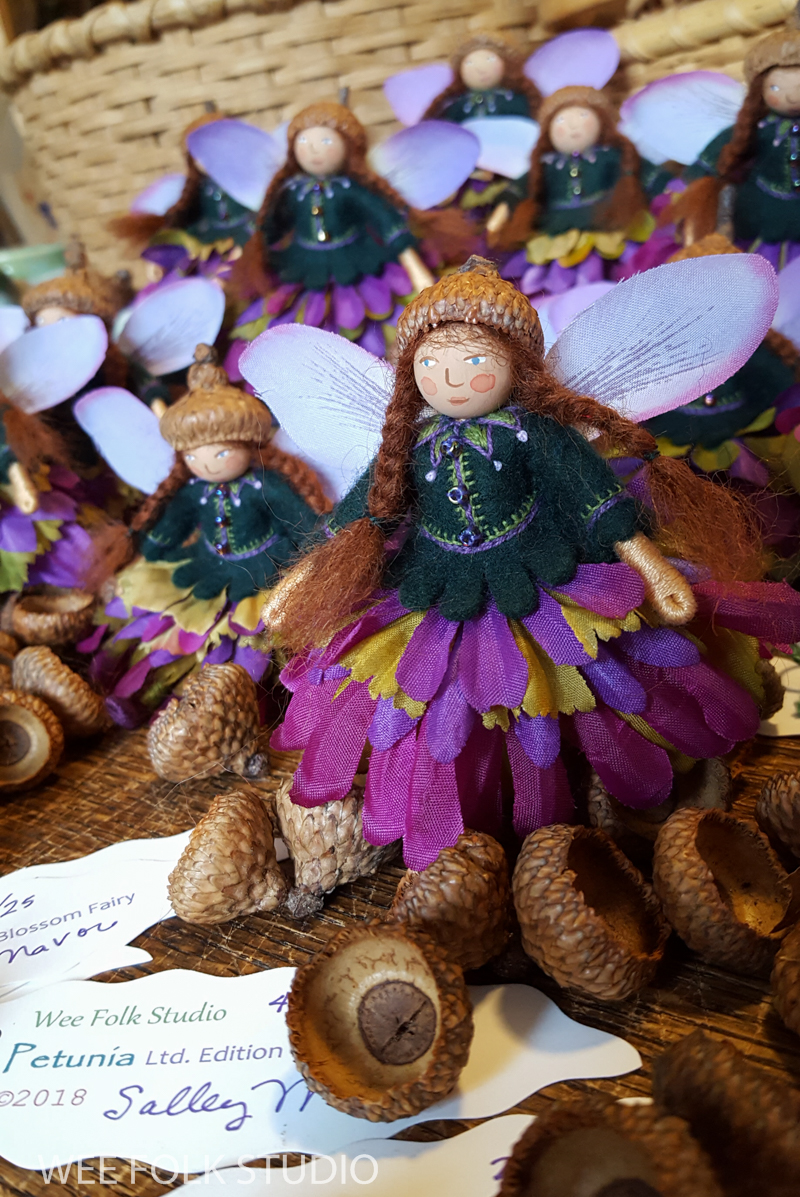
I’d like to introduce PETUNIA, the newest Ltd. Edition Fairy. The group of 25 dolls have been traveling around with me for about 6 months and finally they are all dressed, coiffed and winged! The fairies will be ready to fly off from my Etsy Shop to their new homes on Saturday, Dec. 1, 2018 at 10 AM (Eastern US time). They will be sold on a first come, first served basis. Sorry, no reservations ahead of time. I realize that the hour of the day is in the middle of the night for those of you on the other side of the world, but I can’t figure out how to make it perfectly fair.
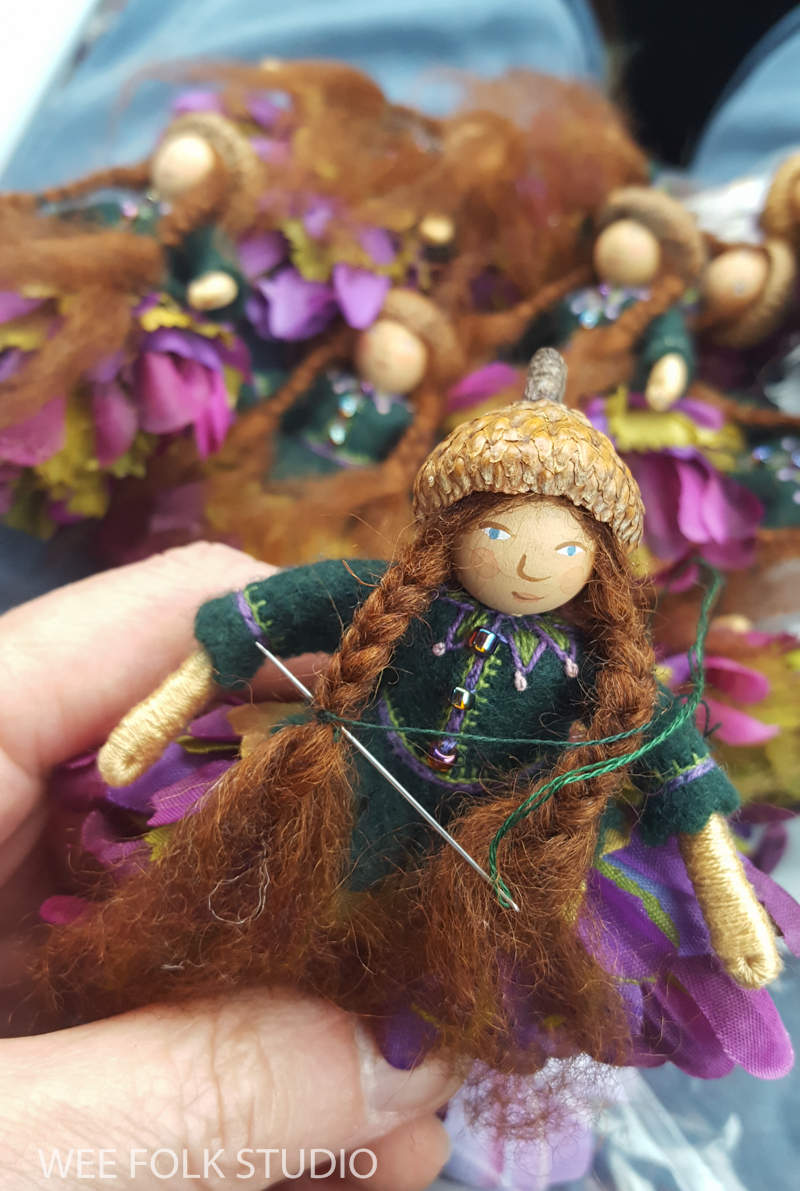
I started making this group while in Scotland last spring. Here I am in the Edinburgh Airport, sewing their felt tunics while waiting for my plane. As with all of the Ltd. Edition Fairies, I only work on them while traveling, when there are long stretches of time to fill going from one place to another. The photo reminds me of a drawing I made of my mother many years ago. She is knitting one of her signature hats featured in my sister Anne Mavor’s 2006 article, “My Mum’s Fair Isle Hat” which she wrote for Interweave Knits Magazine. I wrote about it in this Blog post. I suppose we are all destined to become our mothers in some way!
As you can see, I haven’t weened myself entirely from making fairies. It’s a nice relaxing, portable activity when traveling. I’ve had to put limits on myself at home or else I would make them all the time, instead of pushing myself to do new work. To see this and the other fairies in the archives, click here.
So, 1 or 2 times a year, I complete a group of 25 dolls and offer them in my Etsy Shop. They’re basically the same fairies from my how-to book of dolls, Felt Wee Folk – New Adventures.
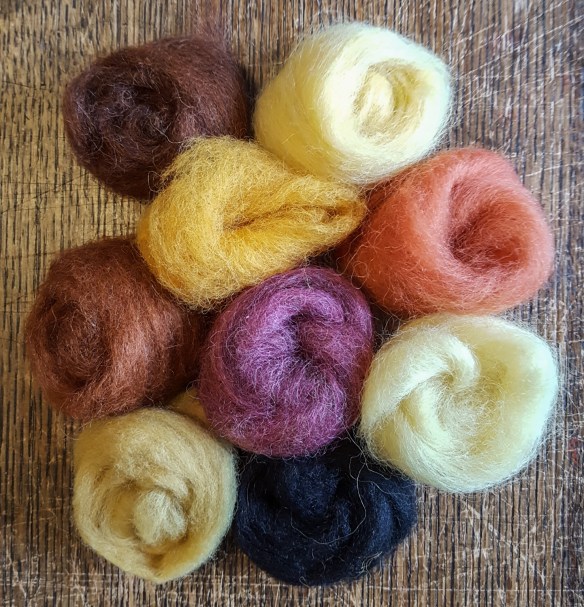
The only potentially messy part is gluing on their hair and acorn caps, so I usually do that in my studio. The hair is wool fleece, which I’ve just added as a multi colored sampler to my Etsy Shop.
During a recent long car ride, I braided their hair and sewed on their wings while sitting in the passenger seat.
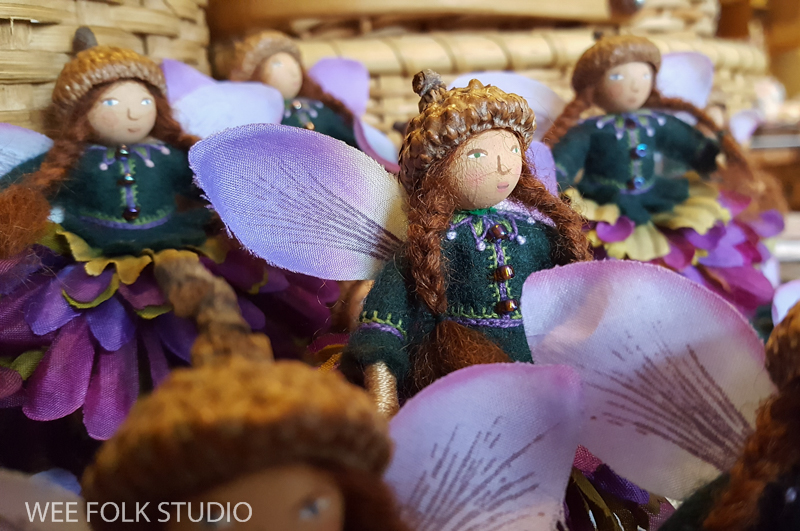
PETUNIA is 3 3/4″ tall, with braided chestnut hair, acorn cap hat, hand embroidered wool felt tunic and petal skirt. Each doll is one of a limited edition of 25 look-alike fairies. They each sell for $85.00 and come with a signed and numbered name tag.
To enter my shop, click here. PETUNIA will be added on Dec. 1 at 10 AM. Good Luck!
To keep up with new posts, please subscribe to this blog (top right column on the home page). Your contact info will not be sold or shared. If you’d like to see more frequent photos tracking the projects in my studio, please follow me on Facebook and/or Instagram
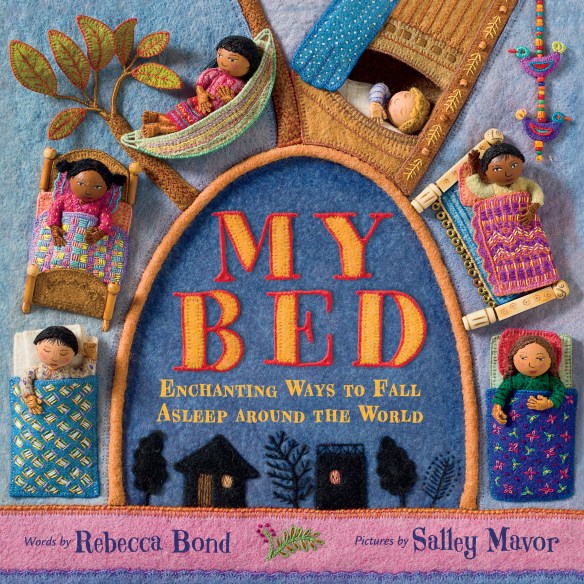
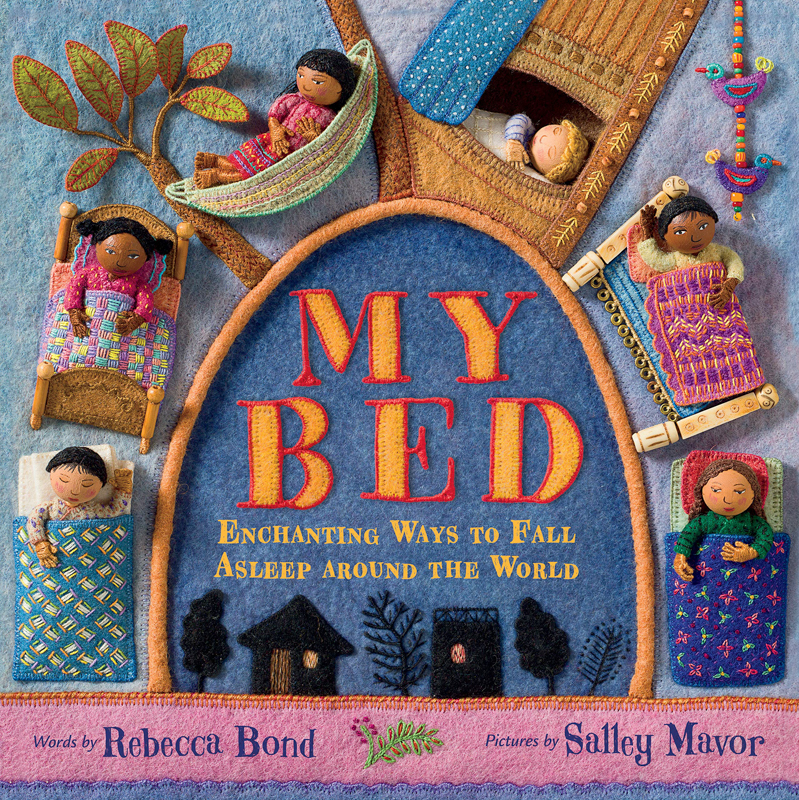
This is the third and final post about making the book illustration with a houseboat on a canal in Holland. To see other posts about this scene, go to Part 1 and Part 2. Eventually, all of the sewn originals will be photographed and printed in MY BED, a picture book about where children sleep around the world. Each spread will depict a child in a different culture and living environment.
Update: Signed copies of My Bed can ordered in my shop here. 40 pages, 9″ x 9″, words by Rebecca Bond, pictures by Salley Mavor, published by HarperCollins. ISBN 978-0-544-94906-5
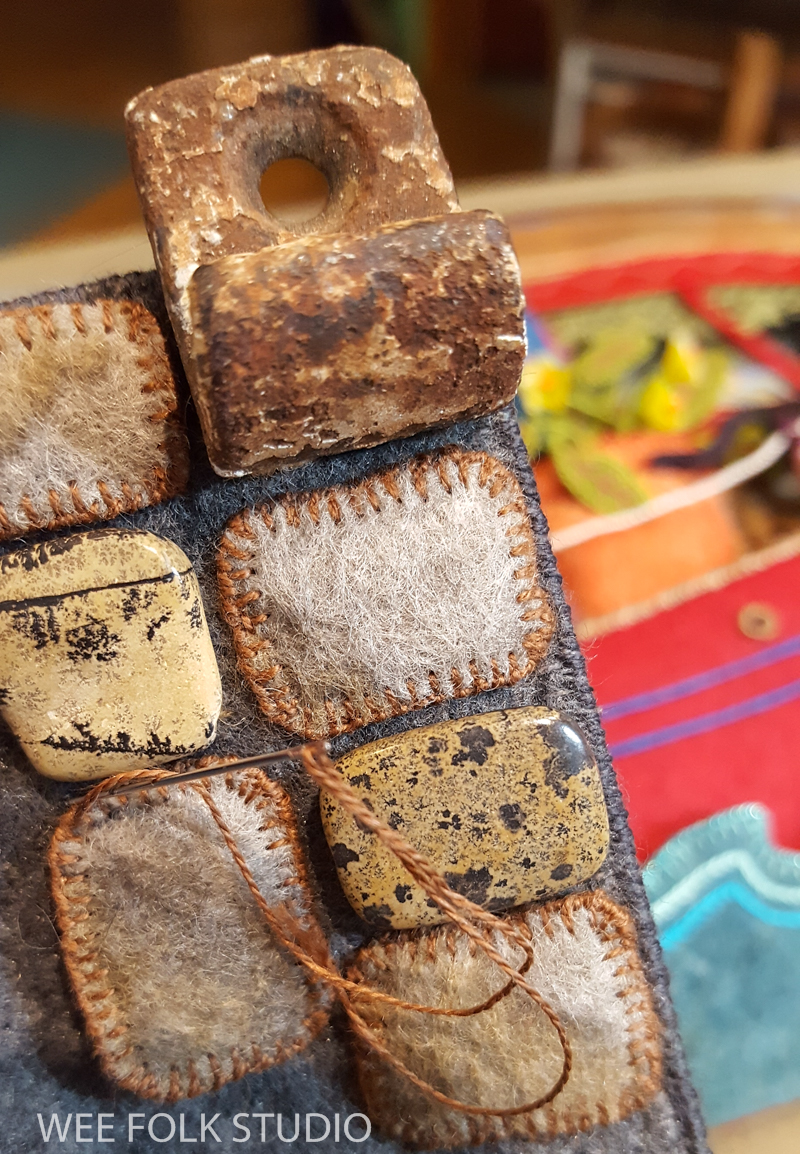
For the stone dock, I sewed felt rectangles in place with blanket stitch, interspersed with flat polished stone beads. There needed to be something to tie the boat line to, so I looked through my collection of miscellaneous old metal objects and picked an appropriately weathered looking one with a hole. How was that attached, you may wonder? I glued a piece of felt on the back of the metal piece and then sewed it to the dock.
I glued felt to the back of the object, instead of directly to the background. That way, you can play around and adjust things until the last minute. The glued on felt provides something to catch the thread when you do sew it in place. And it’s always possible to rip it out and try a new position.
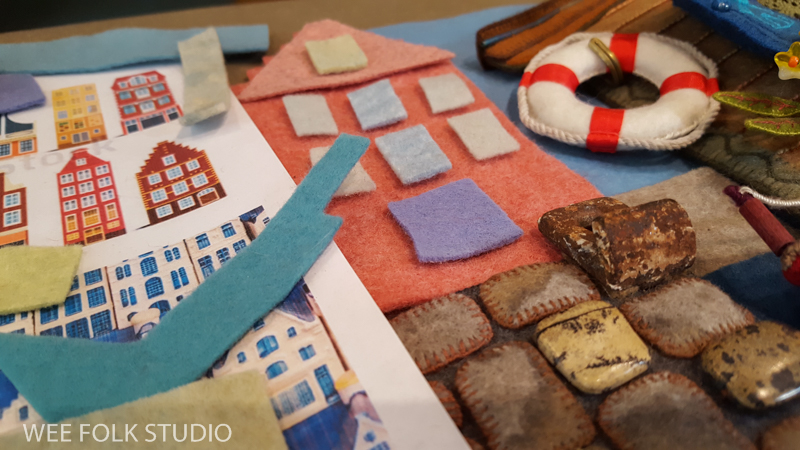
The architecture in Amsterdam is a colorful array of tall narrow buildings with interesting roof treatments.
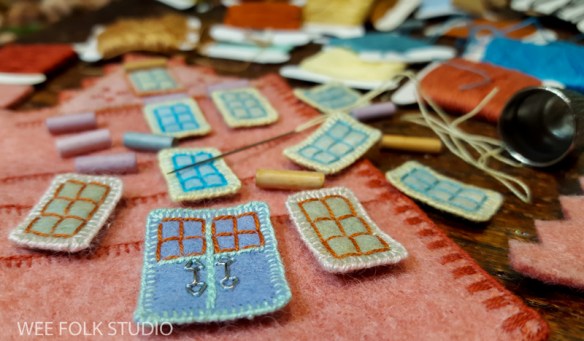
I embroidered blanket stitch with flower thread around the outside of the felt windows and a door. DMC flower thread is no longer available, but Dutch Treat Designs has some of the discontinued thread in stock.
From the images I found, the stepped roof style looked the most distinctively Dutch. I like the way its zigzagged shape stands out against the blue sky. The research photos made me want to visit Amsterdam!
For door hardware, I sifted through old hooks and eyes, until I found a matching pair of the tiniest eyes. A generous admirer recently gave me a box full of them – what a treasure!
Tube beads worked as architectural details above the windows.
And how can you make a scene set in Holland without a bicycle?
The bicycle frame is wire, the wheels are betel nut beads, the handlebars are an eye (from hook and eye) and the seat and gears are metal snap parts. In the photo below, you can see what it looks like in the back, with wire and thread holding everything in place.
I found a cord that looked like a well used dock line and fed it through the hole in the metal part on the canal wall. Then the houseboat could be tied up safely.
I hope that you enjoyed this little peek behind the scenes at making the illustration with a houseboat on a canal in Holland. To see other posts about this scene, go to Part 1 and Part 2.
To keep up with new posts, please subscribe to this blog. Your contact info will not be sold or shared. If you’d like to see more frequent photos tracking the projects in my studio, please follow me on Facebook and/or Instagram.
I am happy to announce Wee Folk Studio’s first ever CYBER WEEK SALE (Nov. 20 – 26)! 20% off all cards, posters and fairy making supplies. Enter ETSY Shop here.
To keep up with new posts, please subscribe to this blog (top right column on the home page). Your contact info will not be sold or shared. If you’d like to see more frequent photos tracking the projects in my studio, please follow me on Facebook and/or Instagram
Back for another peek behind the scenes at making an illustration with a house boat located in Holland. To see Part 1, click here. The scene will be included in My Bed, a book about where children sleep around the world, with each spread depicting a different culture and living environment. Here are links to posts showing other finished illustrations for the book: South America, Japan, India, Afghanistan, Russia, North Africa and Iran.
Update: Signed copies of My Bed can ordered in my shop here. 40 pages, 9″ x 9″, words by Rebecca Bond, pictures by Salley Mavor, published by HarperCollins. ISBN 978-0-544-94906-5
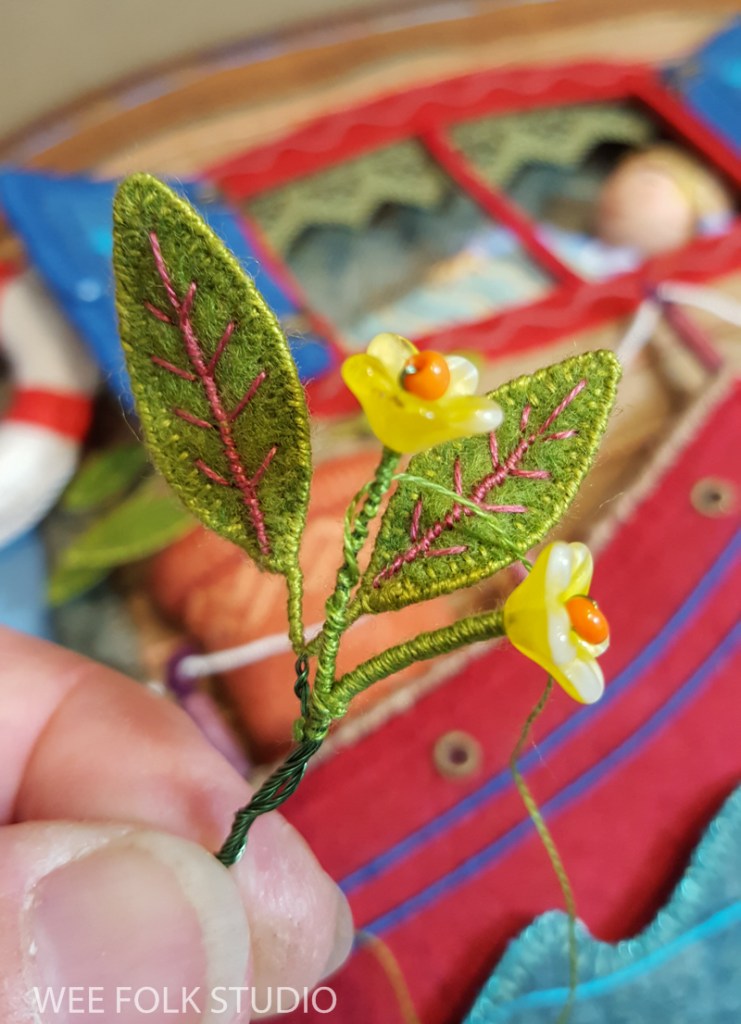
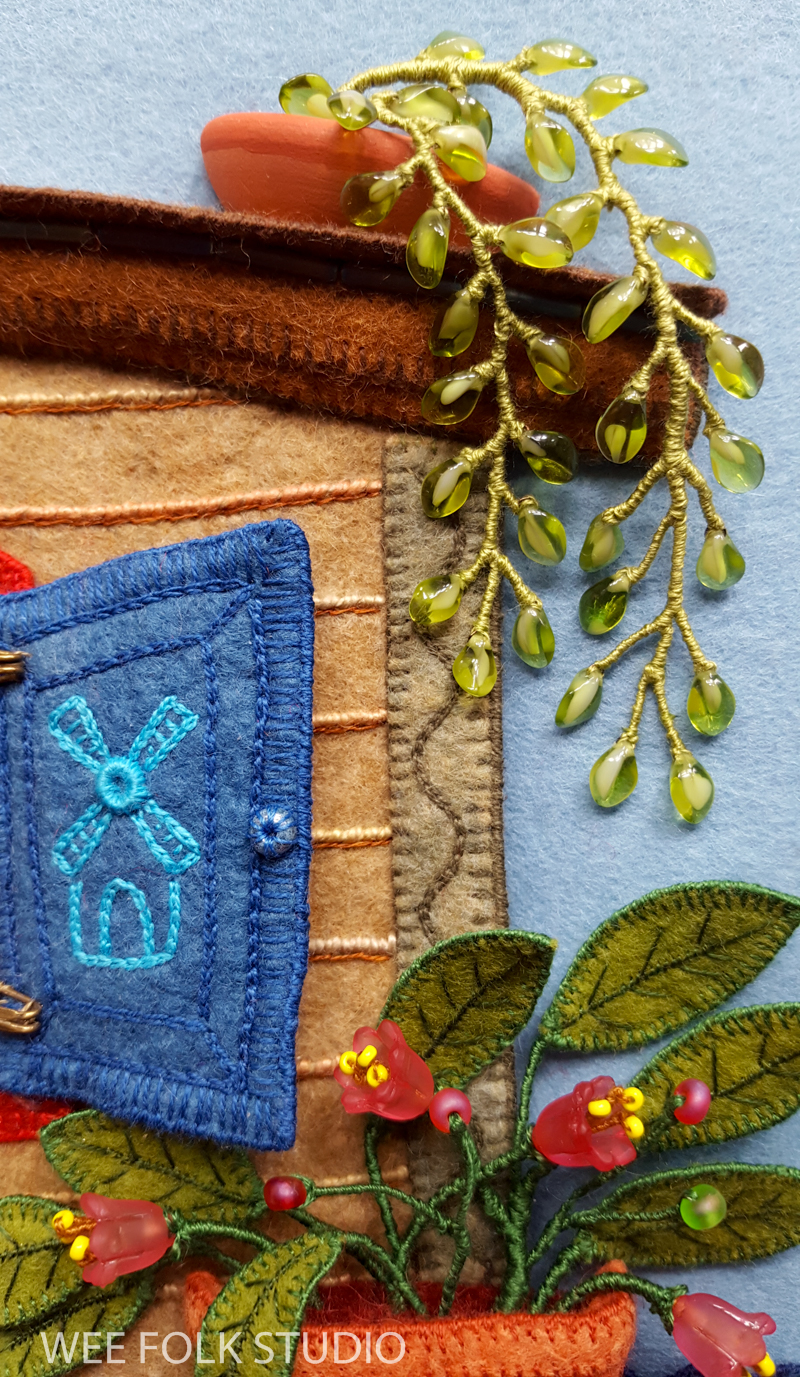
In the research photos of house boats, it seemed that practically every example showed potted plants on deck. So, I constructed little “terracotta” containers out of felt and made flowering plants with beads, felt and wire.
Wrapping wire with a single strand of embroidery floss is tedious work, but a satisfying process for those of us who are detail obsessed. The leaves also have wire around the outside edge, which makes it easier to position and arrange the plant in the end.
These glass leaf beads have spent years packed away in bags and boxes, waiting for a chance to be useful.
They were the perfect size and color for a hanging plant resting on the house boat roof.
And what house boat doesn’t have a cat? I made a felt hood to put over its wooden bead head, kind of like a Halloween costume with ears. I added wire along the outside edges of the ears to make them extra pointy and firm. Sometime felt is too soft and floppy and needs a little cartilage to hold its shape.
The body frame is made with thread wrapped pipe cleaners, just like the legs and arms in the human dolls in my how-to book, Felt Wee Folk.
After adding a felt body, I sewed the cat to the deck at the bow of the house boat, where it keeps a lookout.
Please stay tuned, because there’s more to come in Part 3. To see Part 1, click here.
To keep up with new posts, please subscribe to this blog. Your contact info will not be sold or shared. If you’d like to see more frequent photos tracking the projects in my studio, please follow me on Facebook and/or Instagram.
It’s time to go back to where we were a few month a ago, when I was sharing the process of making illustrations for my children’s book project,My Bed. I’ve been working on the pages, even in the midst of the turmoil over my Liberty and Justice exhibit. The calming effect of embroidery is helping me keep my wits, while dealing with the pressures of being more in the public eye.
Update: Signed copies of My Bed can be ordered in my shop here. Watch this 8 minute documentary about how I created the illustrations for the book.
And now, for some sweet stuff…
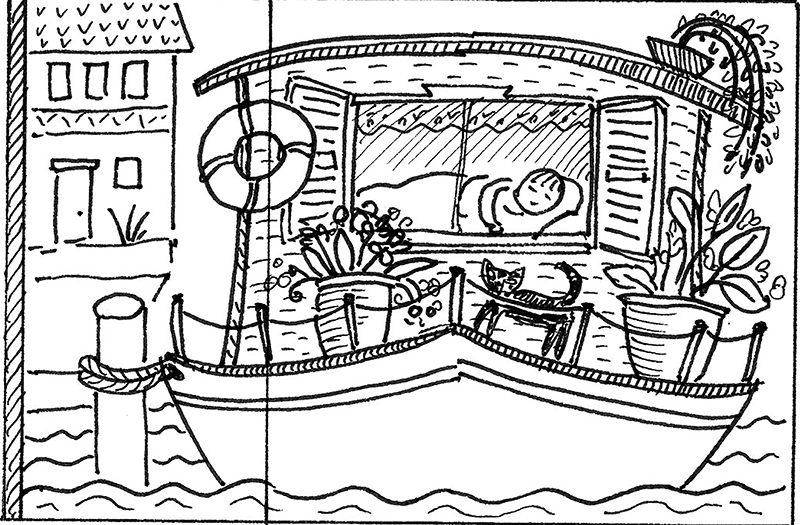
This scene with a Dutch house boat will be included in My Bed, a book about where children sleep around the world, with each spread depicting a different culture and living environment. The story is written by Rebecca Bond and will be published by HoughtonMifflin in 2020. Here are links to posts showing other finished illustrations for the book: South America,Japan, India, Afghanistan, Russia, North Africa, North America, Ghana and Iran. To see a list of all my books, click here.
The book’s wonderfully supportive editorial team, which includes April Prince and Ann Ryder, met in my studio to see the illustrations I’ve completed so far. It was very helpful to go over each page and work toward finalizing the book design. Producing a little children’s book is no simple task, with important decisions to be made along the way. The good news is that they agreed to extend the deadline for the finished art by a few months to next summer, which is a much more realistic time frame. I’ll still work 7 days a week (that’s normal), but my husband and I are taking the time to re-watch episodes of the TV show Northern Exposure in the evenings, which makes us both happier.
The following photos give a peek behind the scenes at making the house boat and the boy who lives inside.
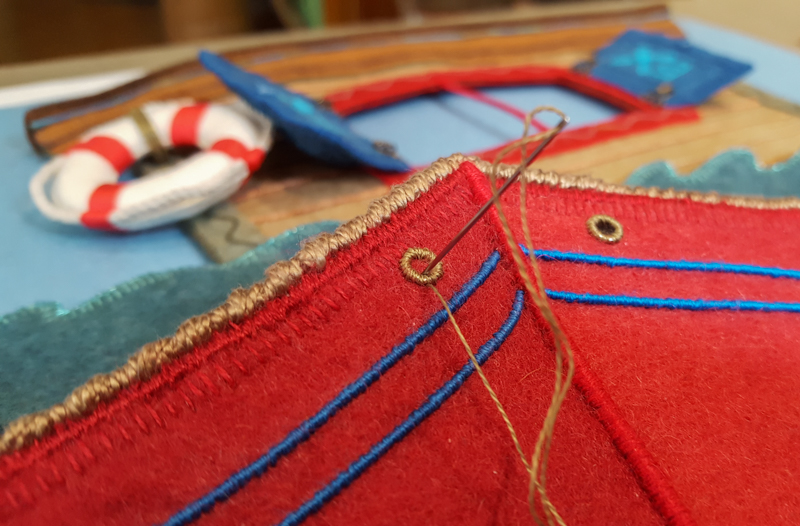
Above is the window frame in the house boat cabin. To give it structure, I reinforced the outside and inside edges with Soft Flex wire. The life ring is made from wool felt, cord and red ribbon.
I couldn’t help adding iconic Dutch windmills to the shutters.
The bow of the boat will protrude about an inch, so it’ll appear more 3-dimensional.
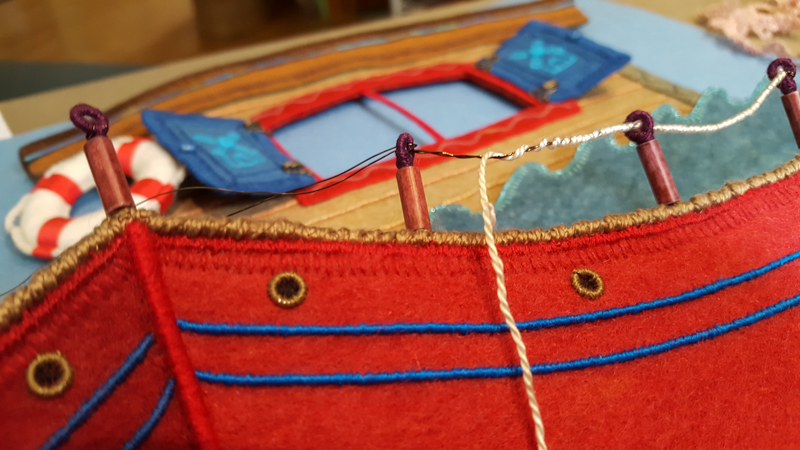
I made stanchions with tube beads and a jewelry ring finding. Those same rings worked well for scupper holes that drain water off the deck.
I enjoyed adding nautical details to the house boat – scupper holes, stanchions, life lines and a rub rail. Well, my naval architect father would want me to use the correct terms.
A little Dutch boy will be inside, behind the window. His head is in this pile on the left, along with the other children’s heads, which you may recognize from other scenes in the book. I made them all way back in the beginning, because I wanted to meet and fall in love with each child first, before moving ahead with the project.
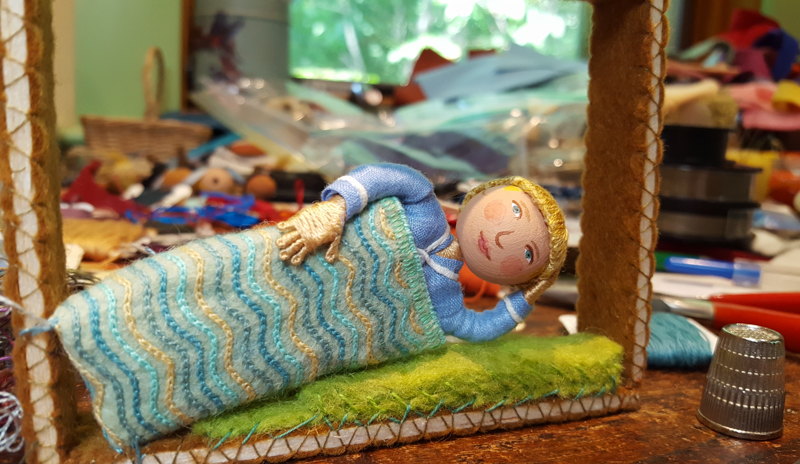
The head, hair and bodies use similar techniques as the dolls in my how-to book, Felt Wee Folk, except for the hands. The boy just needed the top portion of his body, as he will be lying in bed, under the covers.
I made his pajamas out of an old blue handkerchief that already had white edging. It was one of those unused, monogrammed ones you find when cleaning out a deceased relative’s belongings.
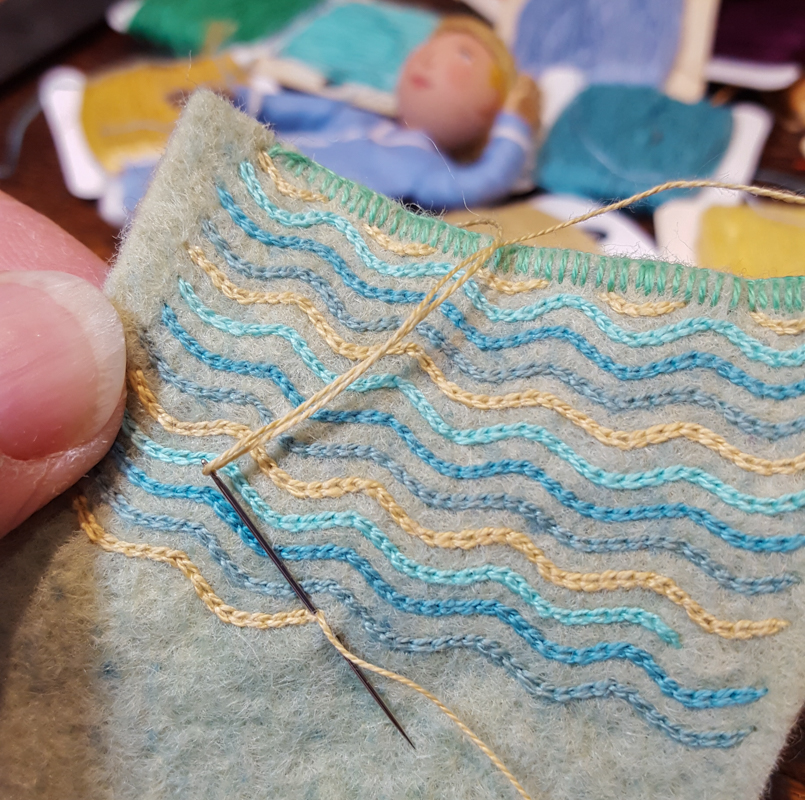
In keeping with the on-the-water theme, his blanket decoration is a wavy chain stitch.
I made a wood box to put him in, which will hide behind the window frame, creating more depth.
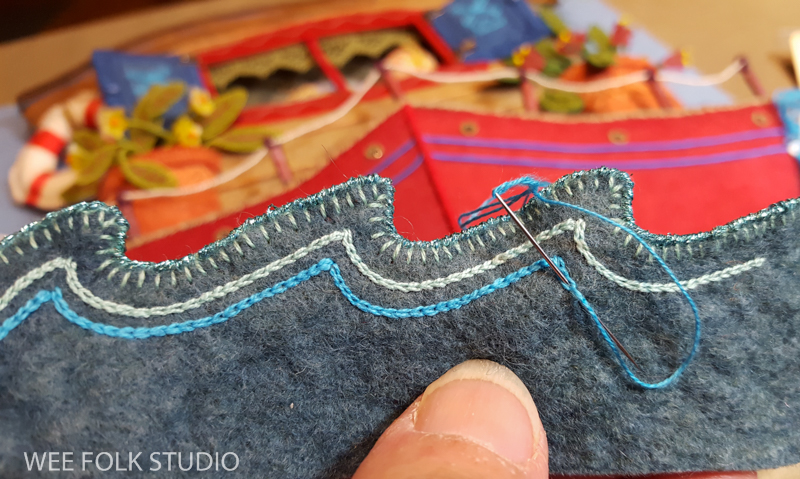
There’ll be a strip of embroidered felt water along the bottom edge of the page, too. Please stay tuned for more parts in this series about making the house boat scene.
To keep up with new posts, please subscribe to this blog. Your contact info will not be sold or shared. If you’d like to see more frequent photos tracking the projects in my studio, please follow me on Facebook and/or Instagram
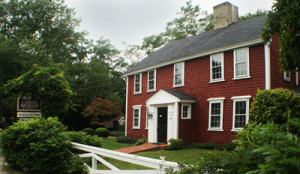
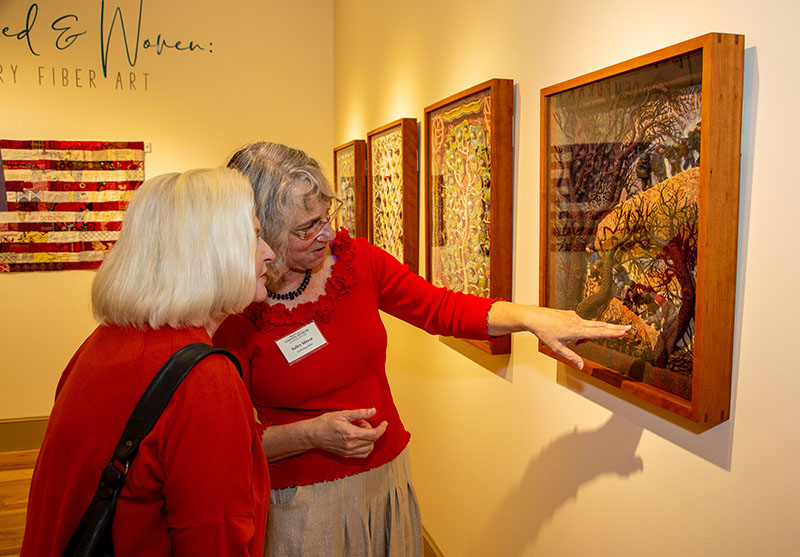
It was fun to see old friends and meet new people in the museum’s beautiful new gallery. The space was added on to the Colonial Georgian home (c.1775) that constitutes the original part of the museum. By early 1800’s, the building was operating as a tavern, an important overnight stop on the Cape Cod stagecoach line between Sandwich and Hyannis. I love how the new addition creates more opportunities for showing art, while maintaining and complimenting the historic parts of the museum.
Stinger by Jody Collella
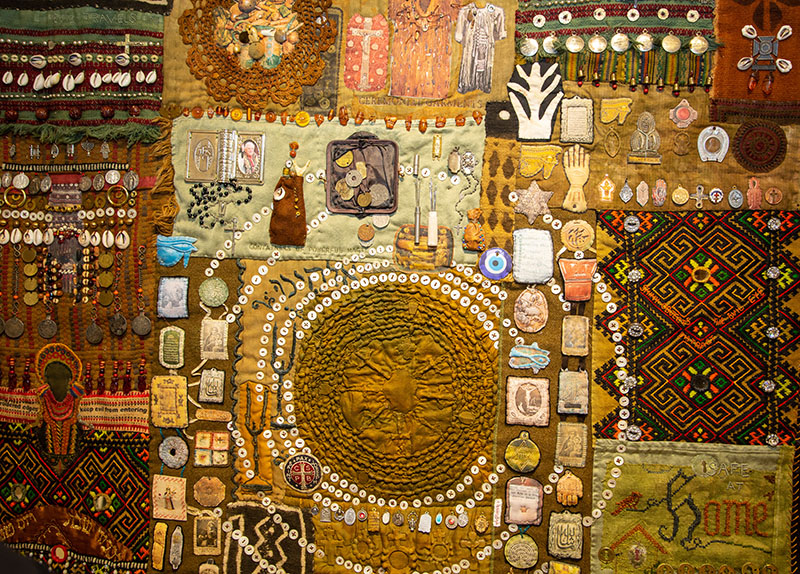
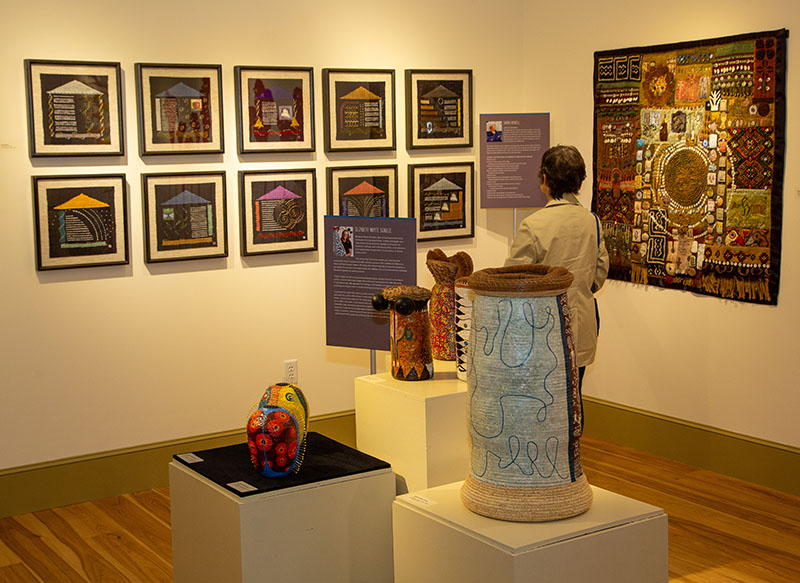
The exhibit is as diverse as fiber art is and includes framed works as well as hanging installations and large scale, free-standing sculpture. Jodi Collella’s extraordinary scorpion made of vintage lace doilies dyed black is the dramatic centerpiece of the show. When the museum director and curator, Sarah Johnson, asked for recommendations of other artists for the show, I told her about the incomparable Diane Savona. As expected, her piece, Security Blanket is powerful and moving. Other pieces on display are Anna Kristina Goransson‘s vibrant felted work, Sarah Haskell‘s framed embroidered houses and baskets by Elizabeth Whyte Schulze.
Detail from “Security Blanket” by Diane Savona
“Beauty in Growth.” by Anna Kristina Goransson
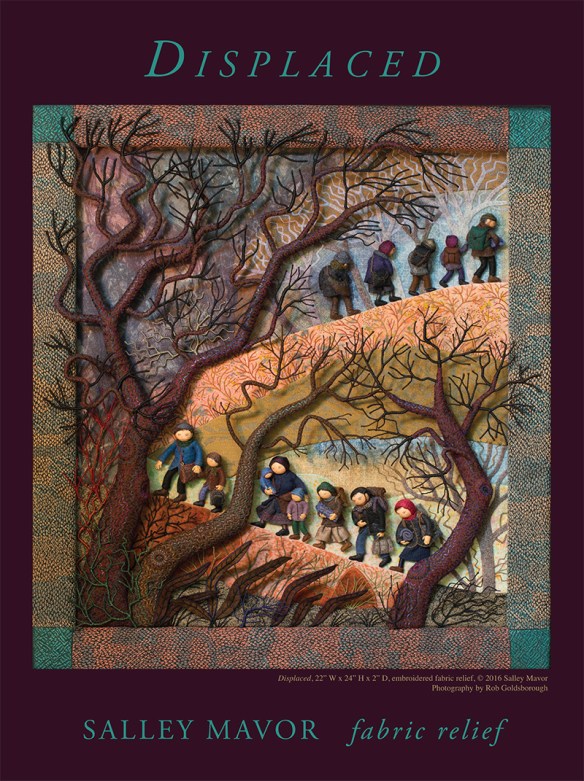
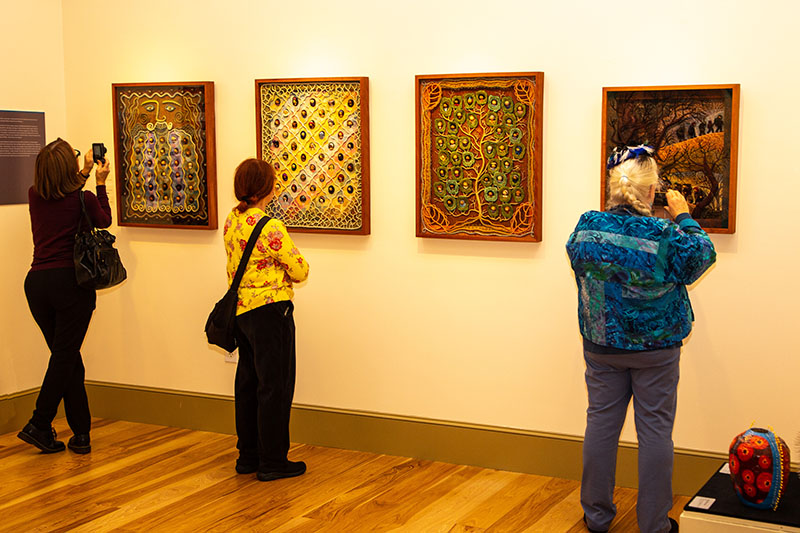
The following pieces of mine are included in the exhibit – Displaced, Cover Up, Face Time and Whiskers. As with all of my work, including illustrations that are reproduced in children’s books, seeing the originals is a different experience than looking at photographs. If you can make the trip to Cape Cod, I encourage you to come and see for yourself.
I am happy to announce that the Cahoon Museum will be hosting the premiere exhibit of original illustrations for my new picture book, MY BED: Where Children Sleep Around the World. The exhibit will be coordinated with the book’s publication by Houghton Mifflin Harcourt in the fall of 2020. Like the traveling show for Pocketful of Posies, I hope to schedule other exhibits, so that more people can see the “real thing”. Interested museums and art centers are welcome to contact me (salley at weefolkstudio.com) for information about hosting an exhibit. It would be wonderful to have the illustrations make their way across the whole country!
Displaced
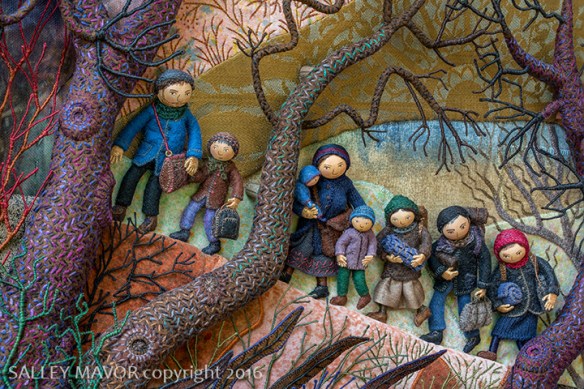
DISPLACED
All winter long, while I sat and worked on this piece, I listened to news stories on the radio about people who are fleeing their home countries amid war and conflict. Even though Displaced is inspired by recent world events, it could very well represent the universal and timeless plight of refugees throughout history. When forming an idea, I often think in terms of creating miniature shallow stage sets and with this one, I envisioned a melodramatic scene full of foreboding as well as hopeful anticipation. The trail of heavily burdened figures are like an operatic chorus, winding its way upward through a threatening landscape. To help create tension in the design, I thought of opposite forces, such as dark/light, despair/hope, trapped/escape, harsh/tender, sharp/soft and horror/beauty.
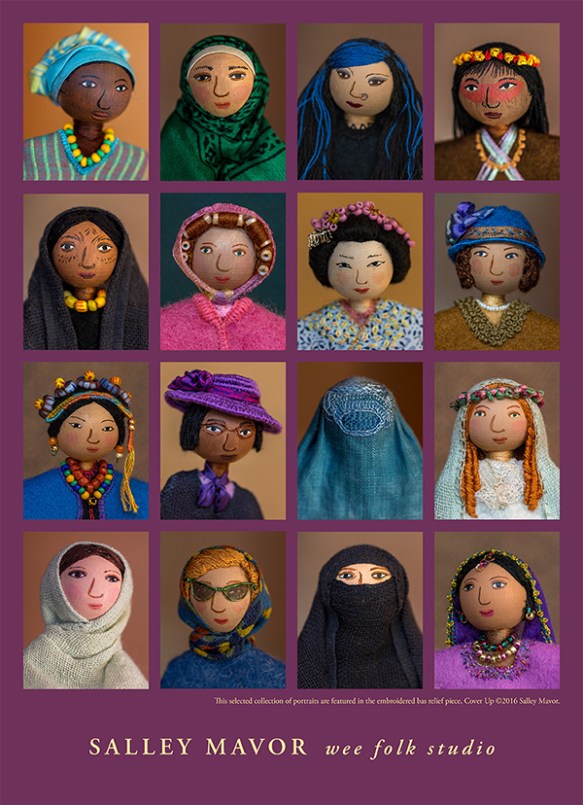
Cover Up
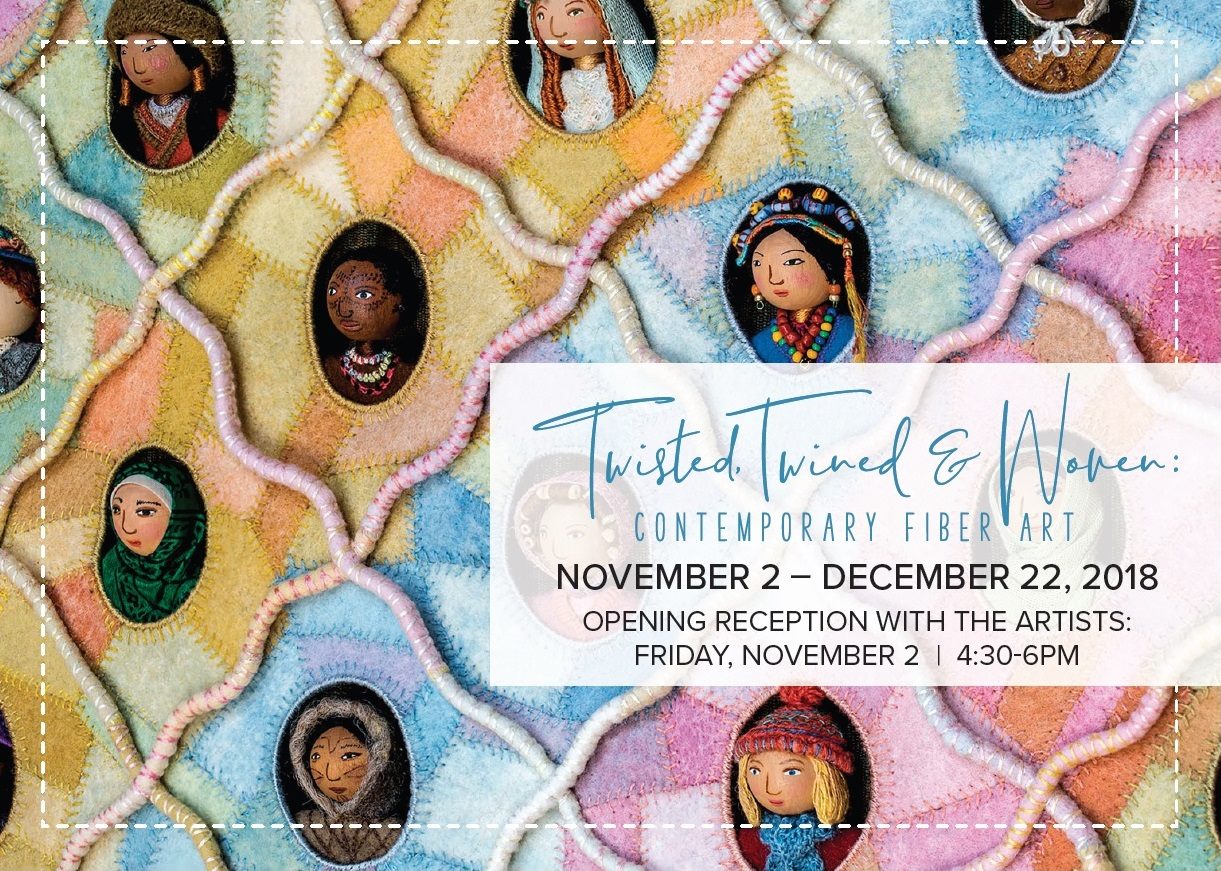
COVER UPis a collective portrait of women from around the world, each with a head covering that reflects the conventions of a particular place, social class or time in history. The 45 depictions invite comparison, pointing out contrasts and similarities between different societies. They all wear some kind of scarf, head piece or mask that serve as identifying markers, whether they are forms of self-expression and fashion, or dictated by religious and cultural tradition.
Face Time
FACE TIME is a broad interpretation of a family tree, showing the faces of humanity through time, from early in history to today. The 41 individuals represent a variety of peoples and cultures throughout the world, all connected through branches of the center tree.
Whiskers
WHISKERS focuses on beards and mustaches, showing an array of male characters from different cultures and historic periods. The piece explores diverse societies and their origins, using needle and thread to signify the unraveling and mending of human cultures throughout history. The large face and beard that contains the various heads is inspired by Assyrian sculpture.
To keep up with new posts, please subscribe to this blog (top right column on the home page). Your contact info will not be sold or shared. If you’d like to see more frequent photos tracking the projects in my studio, please follow me on Facebook and/or Instagram.











































 SALLEY MAVOR