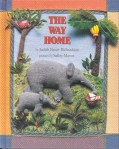
Doll Collection (Scandanavian couple)

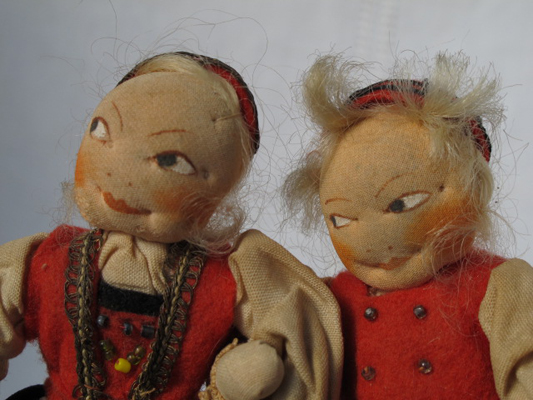
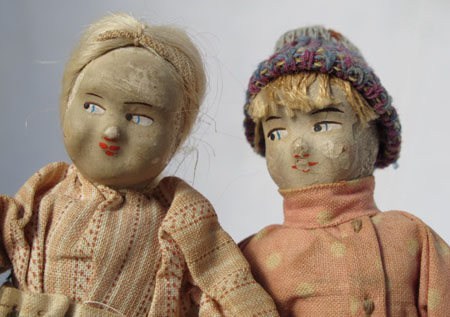
I’d like to share these Scandinavian dolls from my family’s collection. They were either bought by my parents or grandparents in Europe. I have clear memories of playing with this pair of 5″ tall dolls. They are sturdy, with wire bodies and limbs, so they could actually do things, unlike Barbie dolls.

My blogging friend and official doll consultant, Helen from Dollzandthings says, “They look earlier than 50’s to me–maybe 40’s or even late 30’s. It is very hard to identify some of these costume/souvenir dolls because there were so many talented people making dolls–including souvenir dolls and cottage industries. Your dolls seem to have the cutest traits of all the doll makers combined:  great facial expression & painting and great costuming.”
Thank you, Helen for your help. I’ll be seeking your expertise with other dolls from the collection in the future.

Their heads and bodies are covered with stockinette. The clothing is either thin wool felt or cotton. The faces are delicately painted, with some needle sculpting around the mouth and eyes. I love their wispy hair.

Close-ups (dogs)

Ceilidh

I’d like to present this group of dogs in honor of my pet and studio companion, Ceilidh, who died last month. Her name, pronounced Kay-lee, is from the Gaelic word for a folk music and dance party. This is the last photo I took of her this past winter, just before she turned 14.  She was a lab/golden mix and a real sweetheart who gave us many wonderful years.  

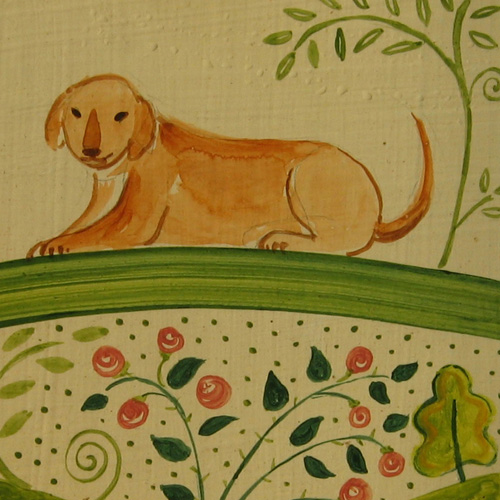
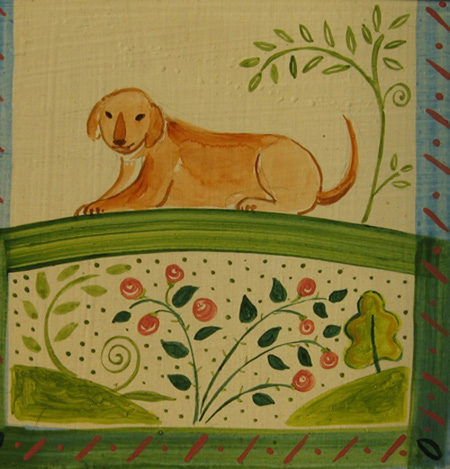
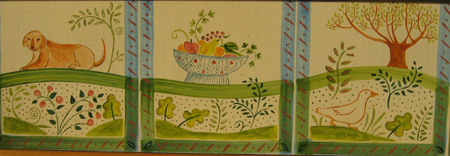
The first picture in the series is a faux tile I made in 1990 for our kitchen.  See all of the tiles on an earlier post here

Faux Tile, 1990

 This white dog is in the “Sidewalks” poem illustration from my book You and Me: Poems of Friendship.  

detail from "You and Me: Poems of Friendship" 1997

 Here’s the dog who laughed to see such sport in Hey, Diddle, Diddle!  

detail from "Hey, Diddle, Diddle!" 2005

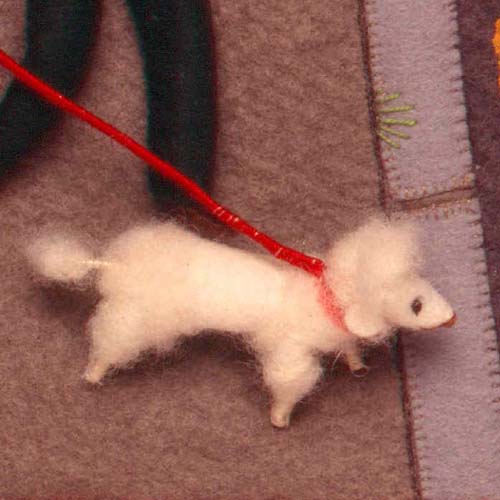
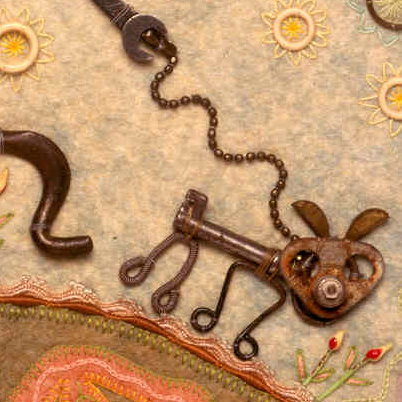
This little dog is made from a key, hook eyes and other found objects. See an earlier post about the whole piece, “Walking the Dog”, here.   

detail from "Walking the Dog" 2005

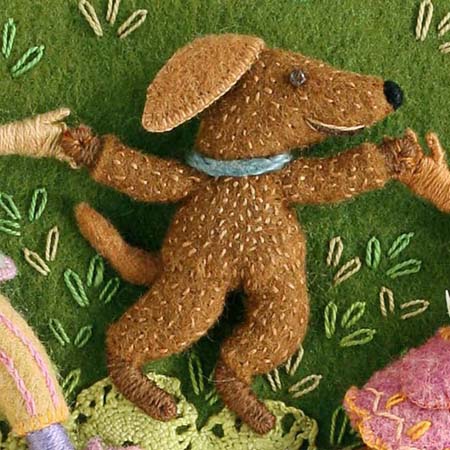
This dog is dancing in a ring around the rosies from my upcoming book, Pocketful of Posies.  

detail from "Pocketful of Posies" 2010

Note: See other posts in the Close-ups series archive here.

Woods Hole in May (land and sea)

view of Great Harbor from Woods Hole Yacht Club

 This weekend, we went out in our motor boat and took an early evening tour of the local area. We left Great Harbor in Woods Hole and cruised through Woods Hole Passage to Hadley’s Harbor on Naushon Island.

Bull Island, Naushon Is.

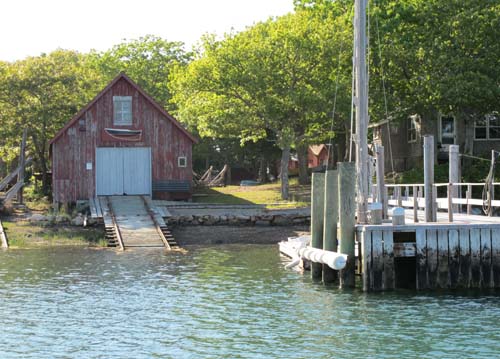
Boat House on Hadley's Harbor, Naushon Is.

Some summer people are starting to arrive, but it’s still quiet. It’s still too cold to go swimming! We cruised along the shore of Buzzard’s Bay.

Penzance Point, Woods Hole from Buzzard's Bay

We came back to the Woods Hole Yacht Club. In a month, the dinghy lines will all be full.

Woods Hole Yacht Club

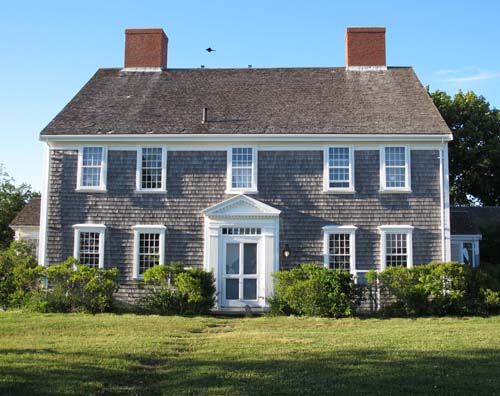
Across the street from the yacht club are some great houses on Bar Neck Rd.

house on Bar Neck Rd., Woods Hole

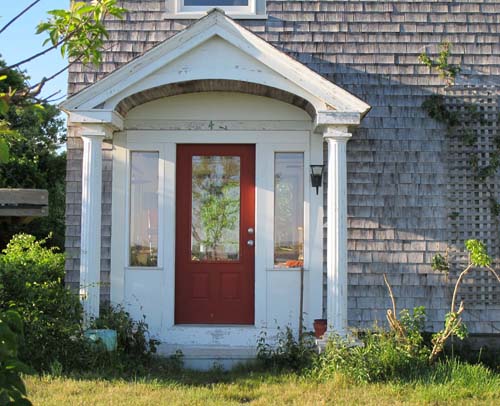
My family rented this house with the red door, when I was about 6 years old.

Bar Neck Rd., Woods Hole

 The Woods Hole May Festival, which my mother started about 40 years ago, was on Saturday at the ball park. It’s a chance for the year ’rounders to come out of hibernation and socialize. Here’s my cousin showing his ’38 John Deere tractor, which he and his father put together from old parts.

'38 John Deere

  And there’s always a May Pole dance with live music. Summer has almost begun!

May Pole at Woods Hole May Festival

Doll Collection (Baltic twins)

This boy and girl pair is from my family’s doll collection. From the look of their outfits, they may be from Russia or the Baltic countries of Lithuania, Latvia or Estonia.

They’re doll house size, about 4″ tall and have cloth wrapped wire limbs. The heads are painted plaster and the girl has a braided white blond wig. I remember playing with them as a child and always loved their yellow crocheted booties. The clothing is crudely made, but the their delicate features, well made heads, wigs and shoes are examples of fine craftsmanship.

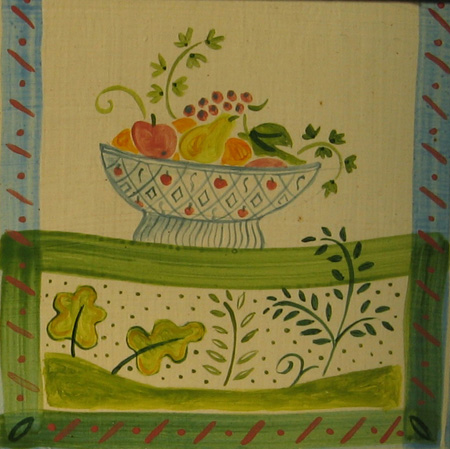
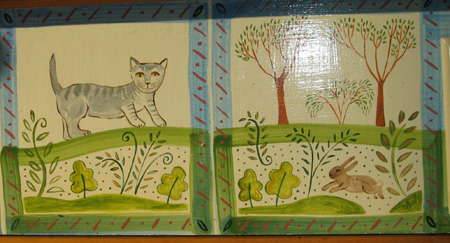
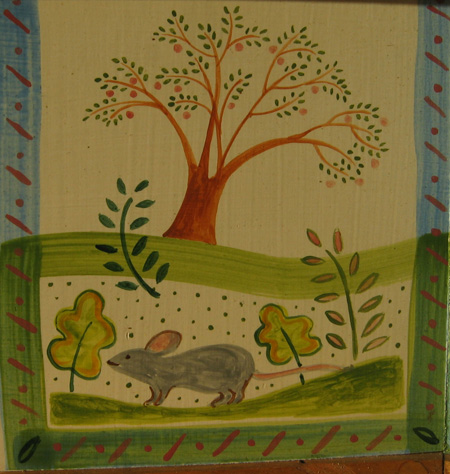
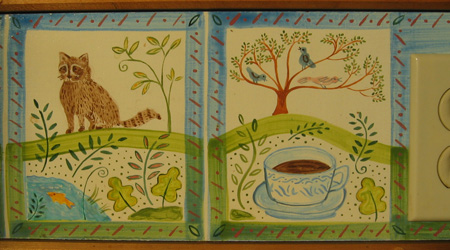
Faux Tiles

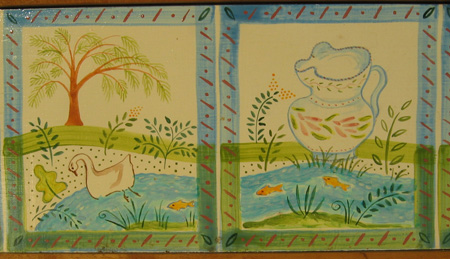
When we built our house almost 20 years ago, I wanted to have a tile splash board behind the kitchen counters. The plan was to make my own hand painted tiles.

My friend Yvette showed me how to apply glazes onto unfired clay tiles. The tiles were fired in a kiln at the artisan tile business where she worked.

I made drawings and planned out a series of tiles that would create a panoramic landscape, decorated with animals and an occasional dish or basket of food. After a few test firings, I could see that the learning curve was too steep for me. The glazes were one color when you paint them and another when they are finished firing. The process was more involved than I had thought. The quality of my tests were not good and it would take a lot of practice to get the tiles to look the way I wanted.

Even though I really wanted to use ceramic tiles, I decided to make “faux tiles” instead. I ended up painting Masonite with acrylic paint and coating it with polyurethane.

I had fun trying to make them look like tiles, adding blue borders, with space between each painted square. With a jig saw, I cut out openings for the electric outlets. When people see our kitchen, they see a row of tiles, not paint on Masonite. The panel has held up well over the years and can be easily washed. I plan in making more for another area in the kitchen when we do some renovations.

To keep up with new posts, please subscribe to this blog. Your contact info will not be sold or shared. If you’d like to see more frequent photos tracking the projects in my studio, please follow me on Facebook, Instagram and BlueSky.

Alex’s dress

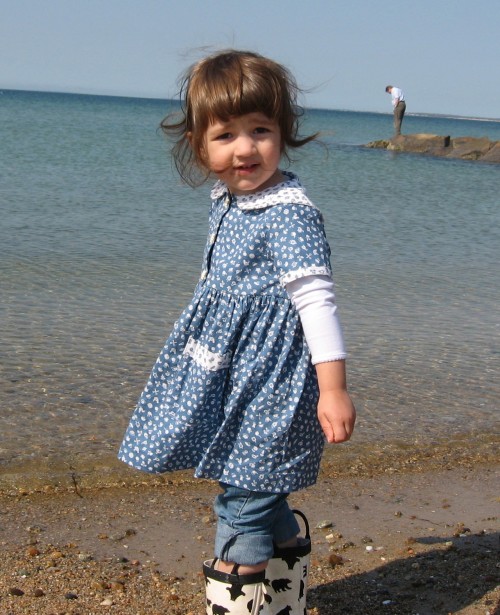
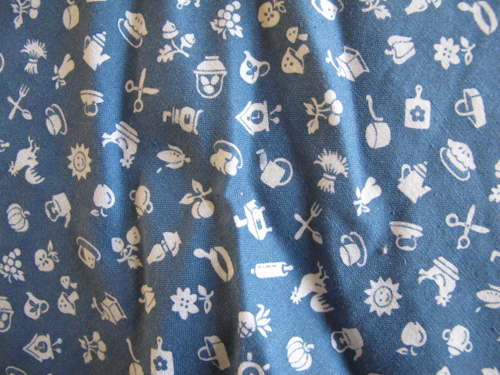
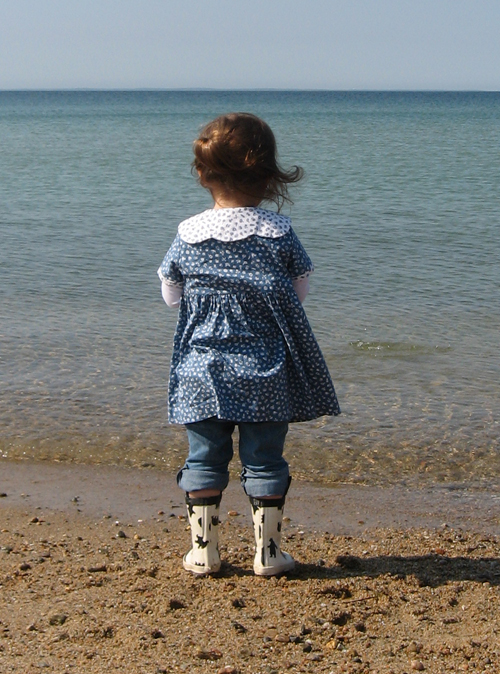
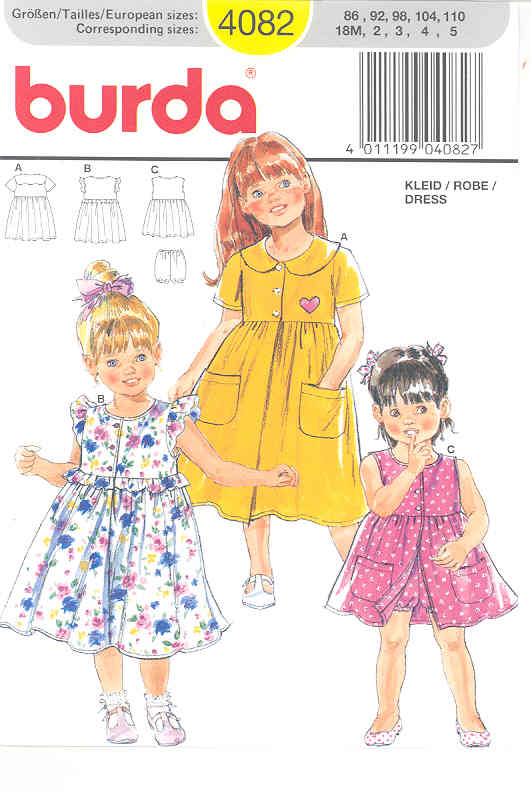
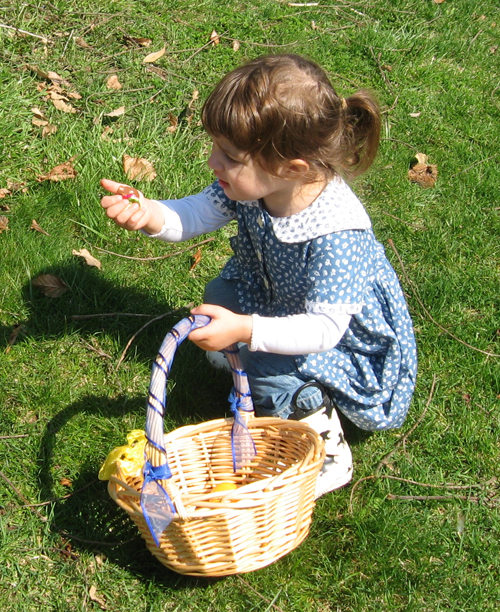
I love to sew children’s clothes and especially enjoy making dresses for little girls. This special girl, Alex, started wearing her blue dress last summer and it still fit her this past Easter in Woods Hole. I like her matching ensemble of jeans and rubber boots. Her parents and grandparents have been family friends for many years and they sent these photos of their little girl to share. I’ve included pictures of the fabric and pattern.

Doll Collection

Among my family treasures is a doll collection that came from my grandmother, Louise Salley Hartwell. My first name comes from my grandmother’s maiden name. As children, we weren’t allowed to touch most of the dolls, but just gaze at them high up in shelves. She found many of the dolls in her travels and collected them throughout her long life of almost 100 years. Here is a photograph of my grandmother on her Gramma Lou’s lap, with one of her sisters. Gramma Lou lived with the Salley family in Orangeburg, SC and taught all 5 daughters how to sew.   

my grandmother, Louise Salley Hartwell, on lap (1892)

  Here’s a group shot of some of the dolls from the collection.  

from my grandmother's doll collection

 This wooden doll is about 10″ tall and most likely has been in the family its whole life.  I have no information about her, but she looks very old.  


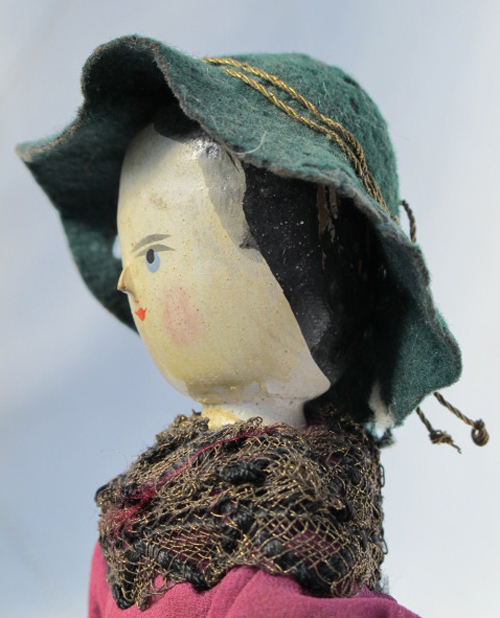
Her face is painted simply, but with an intense expression and it looks like moths have eaten her wool felt hat.  


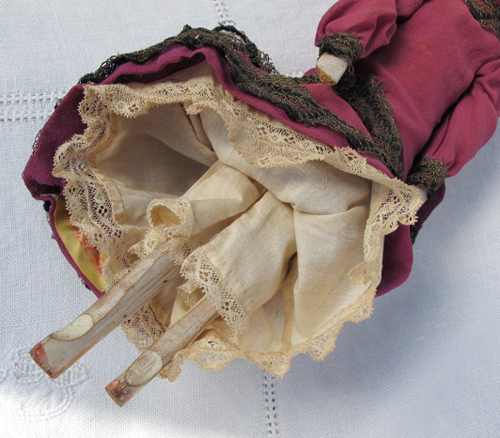
Inside the silk dress hem is a cloth tag that has this written: 35-25:100-M in red ink.  Her legs and arms are simple wooden pegs. 


She has such a delicate little sliver of a nose attached to the wooden head.  

The Way Home (part 5)

Continued from The Way Home (part 4)

The book was now in production at MacMillan and it would be a year before we would see bound copies of The Way Home. There was a lot for the publisher’s staff to do; select and set the type, write the book jacket flaps, prepare the pages for the printer and arrange the printing in Hong Kong. Judy and I were so excited to see the first printing proofs. We felt this was also proof that our years-long project was really going to become a book!

The Way Home, pages 26/27

I learned that producing a book is a lot more complicated than one might think. Everyone involved, the writer, the illustrator, the editors, the production staff and the sales department all play an important part. I was also impressed that everyone I met during the process truly loved children’s books.

The Way Home, page 30

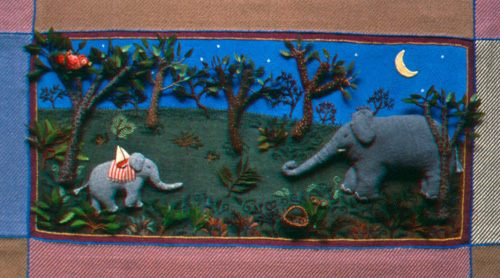
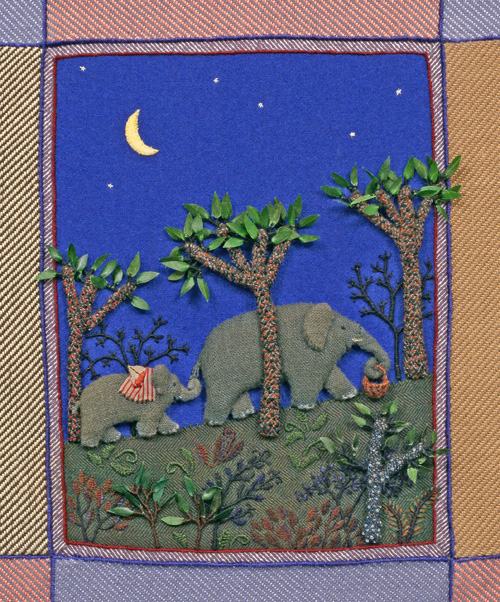
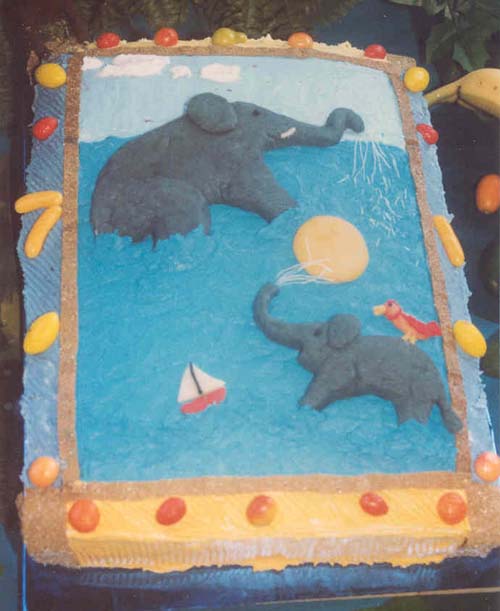
 In the spring of 1991, boxes of  The Way Home arrived and Judy and I celebrated its publication at the Woods Hole Library, with a party and book signing. You can see an earlier post about the library quilt I worked on here. We shared the event with Molly Bang, whose book, The Yellow Ball, was coming out the same spring. Our friend, Terry (who gave me her daughter’s pants) made a cake for the occasion. She decorated it with marzipan elephants and a yellow ball made of frosting.

setting up for the book party

Terry’s cake

Molly, Judy and Salley signing books

We were so proud of  The Way Home and did what we could to promote the book. We had our picture taken with an elephant that came through town for the county fair.

Judy and Salley with elephant at fair, 1991

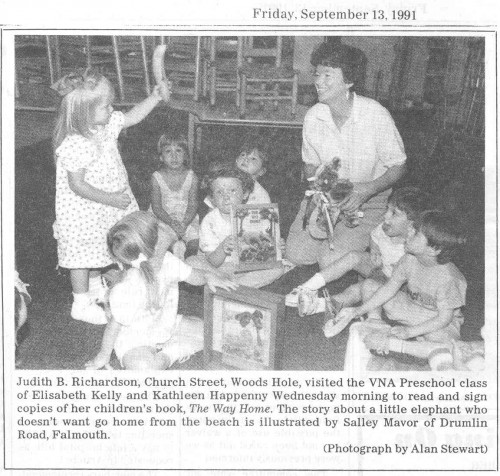
We gave talks, did book signings and visited schools. Judy led banana poem workshops with children and I’d have them sew and stuff yellow felt bananas.

Judy visiting a preschool

Our book did pretty well for an unknown author and illustrator and came out in paperback the next year. Later, Judy and I collaborated on a sequel, Come to My Party, which MacMillan published in 1993. In this book, the red bird character is named Harold and co-stars with Savi in another adventure.

Harold in an illustration from “Come to My Party”

Both books have long been out of print, and I can remember how surprised Judy and I were to get the letter telling us the news. Being new to the book business, we did not know how common it is for children’s books to go out of print. We’ve since learned that only the very best sellers are reprinted and stay available.

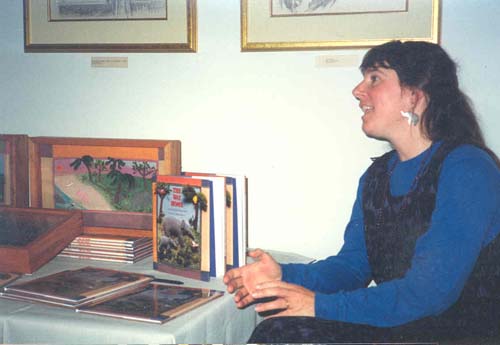
Salley at a book signing (note the elephant earrings!)

All in all, the best part about publishing a book was when we heard from parents who said their children wanted The Way Home read over and over. Even today, we meet grown up children who remember Savi and the banana trail. I’m still friends with Judy and Molly and am grateful to have had their help and encouragement throughout the years, but especially in the beginning, 27 years ago, when we all were inspired by a little elephant named Savi.

The End

The Way Home, back cover

To keep up with new posts, please subscribe to this blog. Your contact info will not be shared. If you’d like to see more frequent photos tracking the projects in my studio, please follow me on Facebook and/or Instagram.

The Way Home (part 4)

 Continued from The Way Home (part 3)

I added the little bird character late in the design phase. Savi seemed so alone on the beach after her mother leaves, and I thought she needed an escort of sorts. Cecelia Yung, the art director, liked the addition and wrote, “About the bird: maybe he can be her “guardian angel”-someone who hovers protectively so that she’s never truly alone. He would be a comforting presence for the child who worries when Savi is alone in the dark. Maybe he can make his appearance when Savi’s mother leaves?”
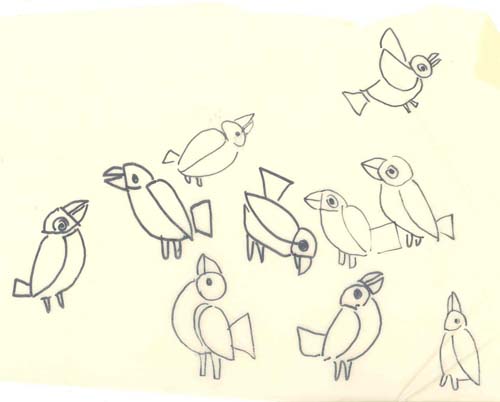
sketches of birds for “The Way Home”
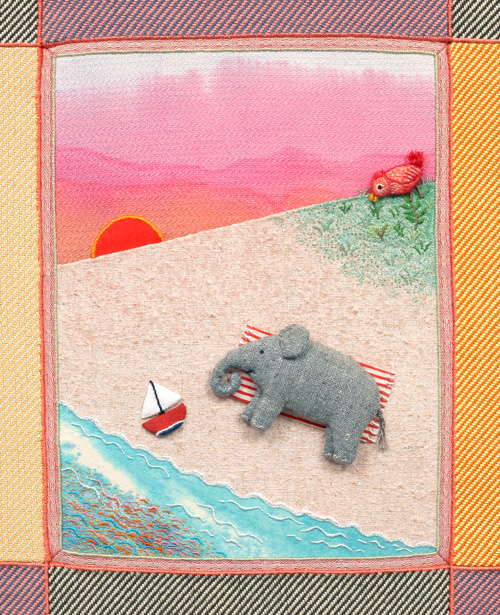
 

The Way Home, page 18

A few months before the artwork was due, I faced the inevitable and admitted that I would not be able to make the one year deadline. I called Cecilia and told her that I needed more time. She was understanding enough to extend the publication date another 6 months.
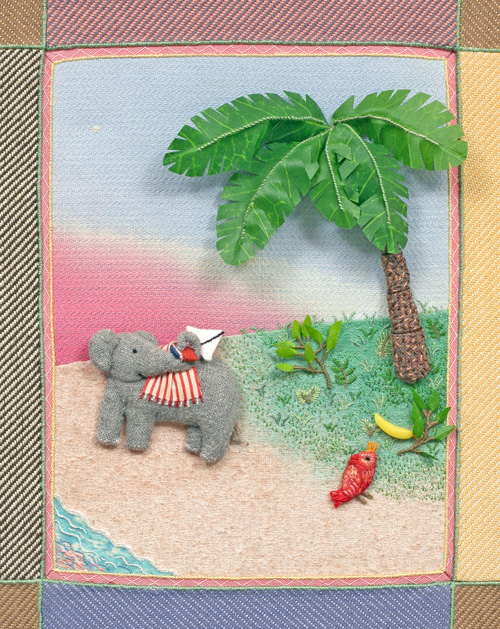
The Way Home, page 20

Through the fall and winter, I added the finishing touches, stitching blades of grass and hand sewing the floss edge around the border sections.

sketch of pages 16/17


The Way Home, pages 16/17

I was particularly fussy about the shadows, which were made up of different colored stitches. I kept thinking of something my teacher, Mahler Ryder had said years earlier at RISD, that shadows are not black, but are made up of colors.

The Way Home, pages 16/17 detail

I was saving the book jacket illustration for last and imagined how it would look while I stitched the other pages. I took a mental inventory of what materials would be needed and was shocked to discover I’d forgotten about the sky fabric. I had used every last inch of Peter’s overalls on the inside artwork. I had none left for the cover illustration, the most important of all! This was a drawback of working with unconventional materials. If I worked in watercolor, this would never happen!

sketch of cover illustration for “The Way Home”

I had dealt with insufficient supplies before. I would have to find something similar, but the weave and shade were unique to an older line of Osh Gosh clothing. before I could work myself into a tizzy, the same fabric literally walked into view.

Molly’s pants back

My friend, Terry came over with her 2-year-old daughter, Molly, who was wearing a pair of jeans made out of the same light blue fabric! Terry is a seamstress and fabric lover, so she was not at all surprised when I asked her if I could have Molly’s pants when she outgrew them, which appeared to be imminent. I’ve kept the pants and when I hold them up at talks, they always get a reaction from both young and old audiences.

in my studio finishing the illustrations for “The Way Home”

The extra 6 months made it possible for me to finish by the new deadline in the spring of ’90. I packed up the illustrations and shipped them to New York. After the editors at MacMillan had a chance to look them over, Cecilia drove the artwork over to Gamma One in the city. Gamma One has a “painting with light” system that works well for textured work. During the minutes-long exposure time, light moves slowly back and forth, helping to define the dimensionality of the art. The 8 x 10 color transparencies were then color corrected to match my original art.
The Way Home, page 32

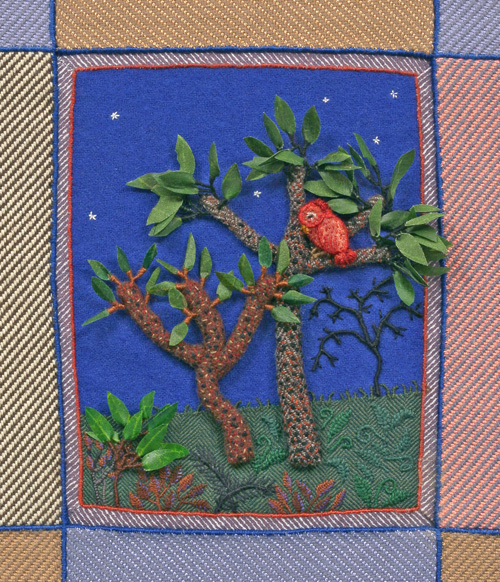
Cecilia suggested we put an explanation of my technique on the last page.
It reads,

“The original pictures for this book were made in fabric relief. This art form includes many techniques, including applique, embroidery, wrapping, dyeing, and soft sculpture. The background fabric was dyed and then sewed together. Three-dimensional pieces were made from a variety of materials, including covered and stuffed cardboard shapes, wrapped wire, found objects, and fabric. Details were embroidered onto the shapes and background and then the three-dimensional shapes were sewn into place. All stitching was done by hand.”

To be continued in The Way Home (part 5). 

To keep up with new posts, please subscribe to this blog. Your contact info will not be shared. If you’d like to see more frequent photos tracking the projects in my studio, please follow me on Facebook and/or Instagram.