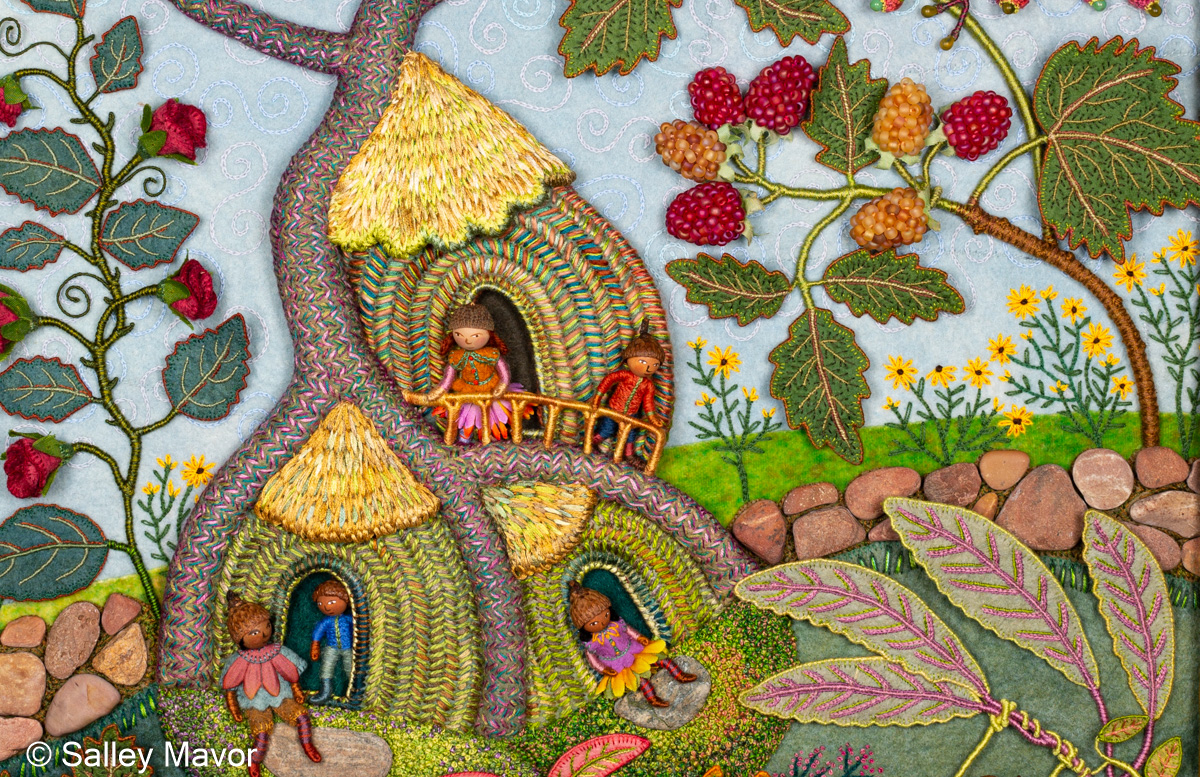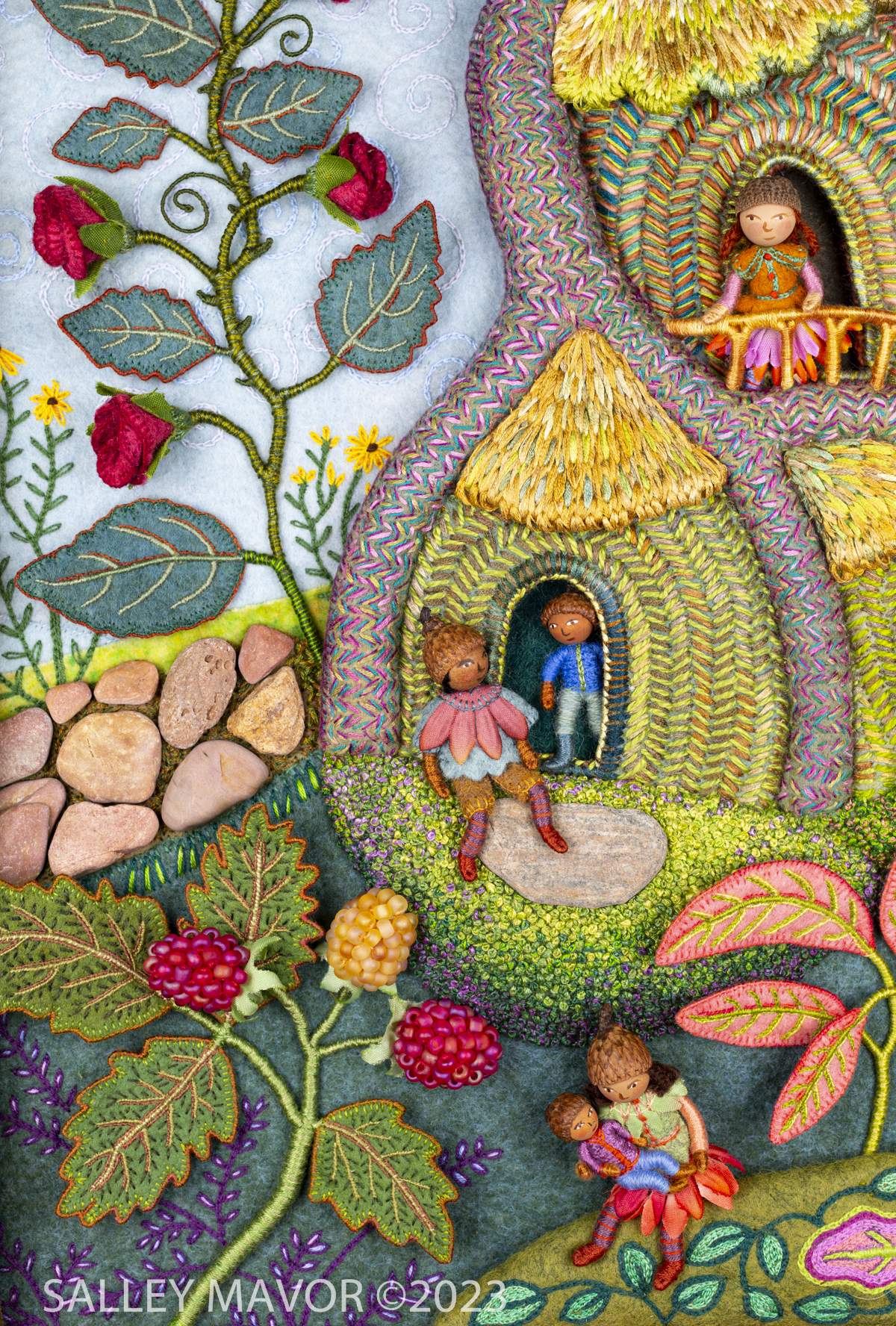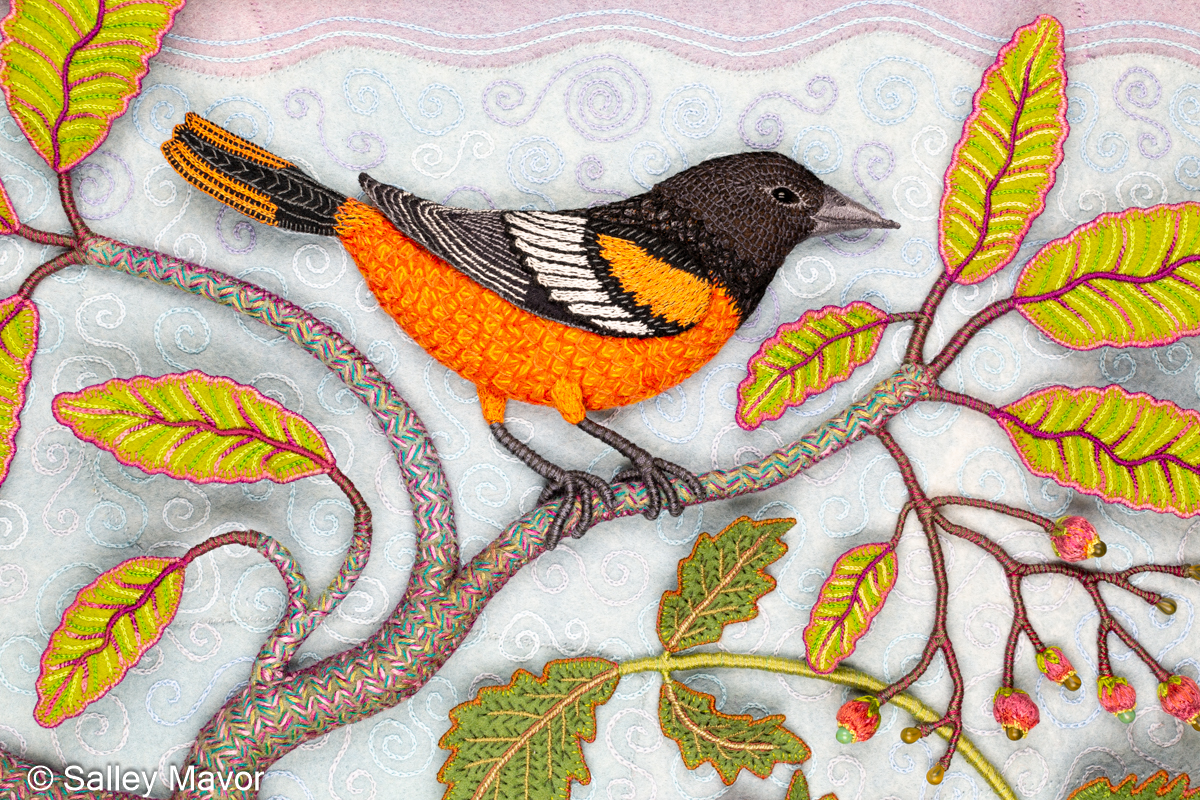
Summertime: Part 8 – stitching flora

In Part 8 of the series about Summertime, I share photos and videos documenting the process of stitching flora. So far, I’ve written an overview of the piece, Part 1 – Tree Trunks, Part 2 – Tree Houses, Part 3 – leaves, stems & branches, Part 4 – Baltimore Oriole (body), Part 5 – Baltimore oriole (head and feet), Part 6 – rose vine, and Part 7 – raspberry plants.

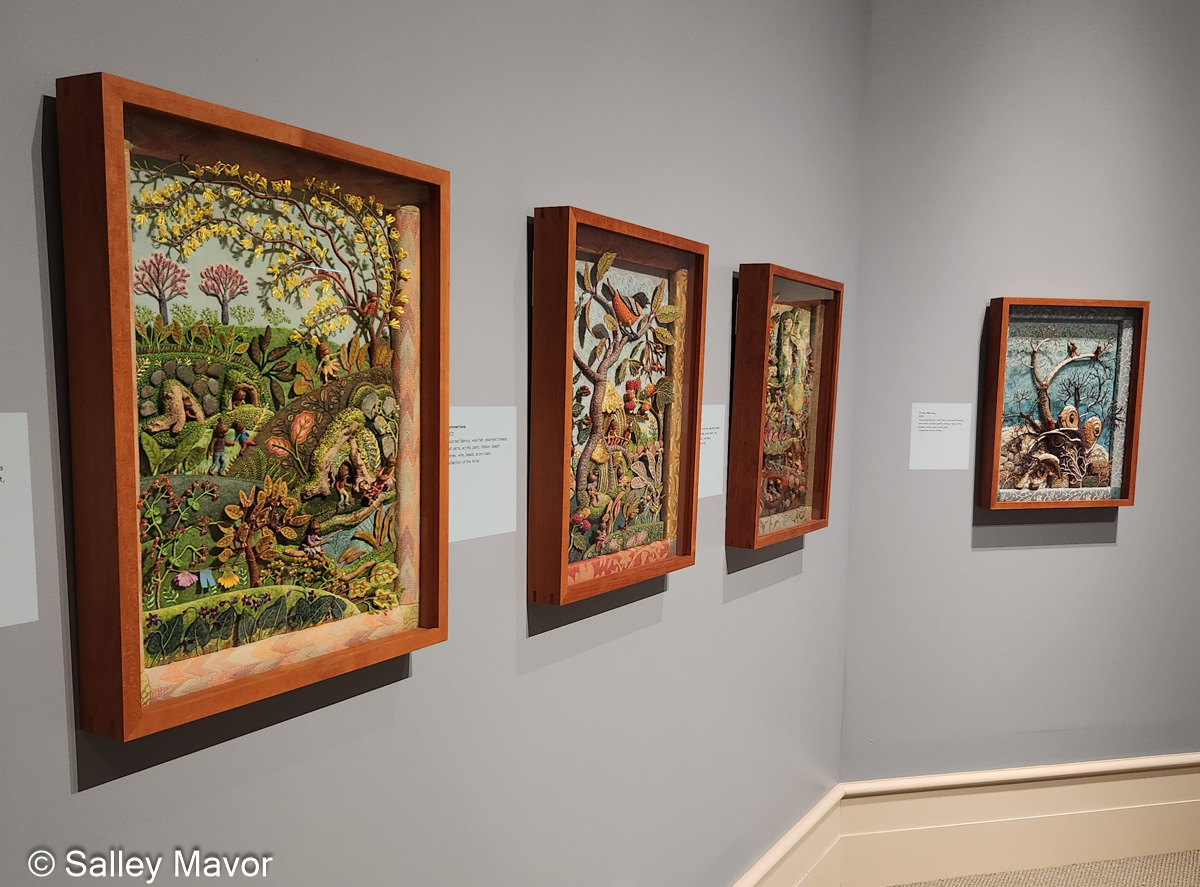
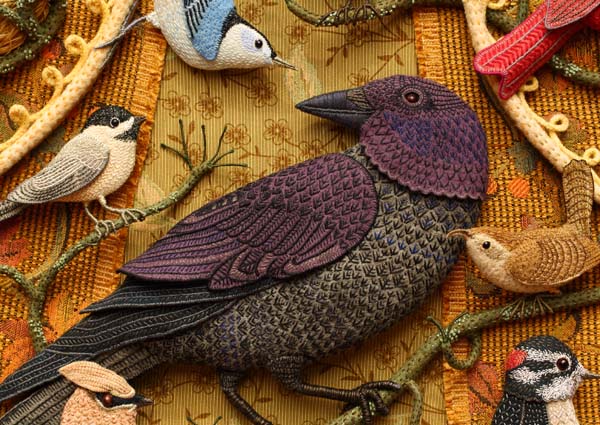
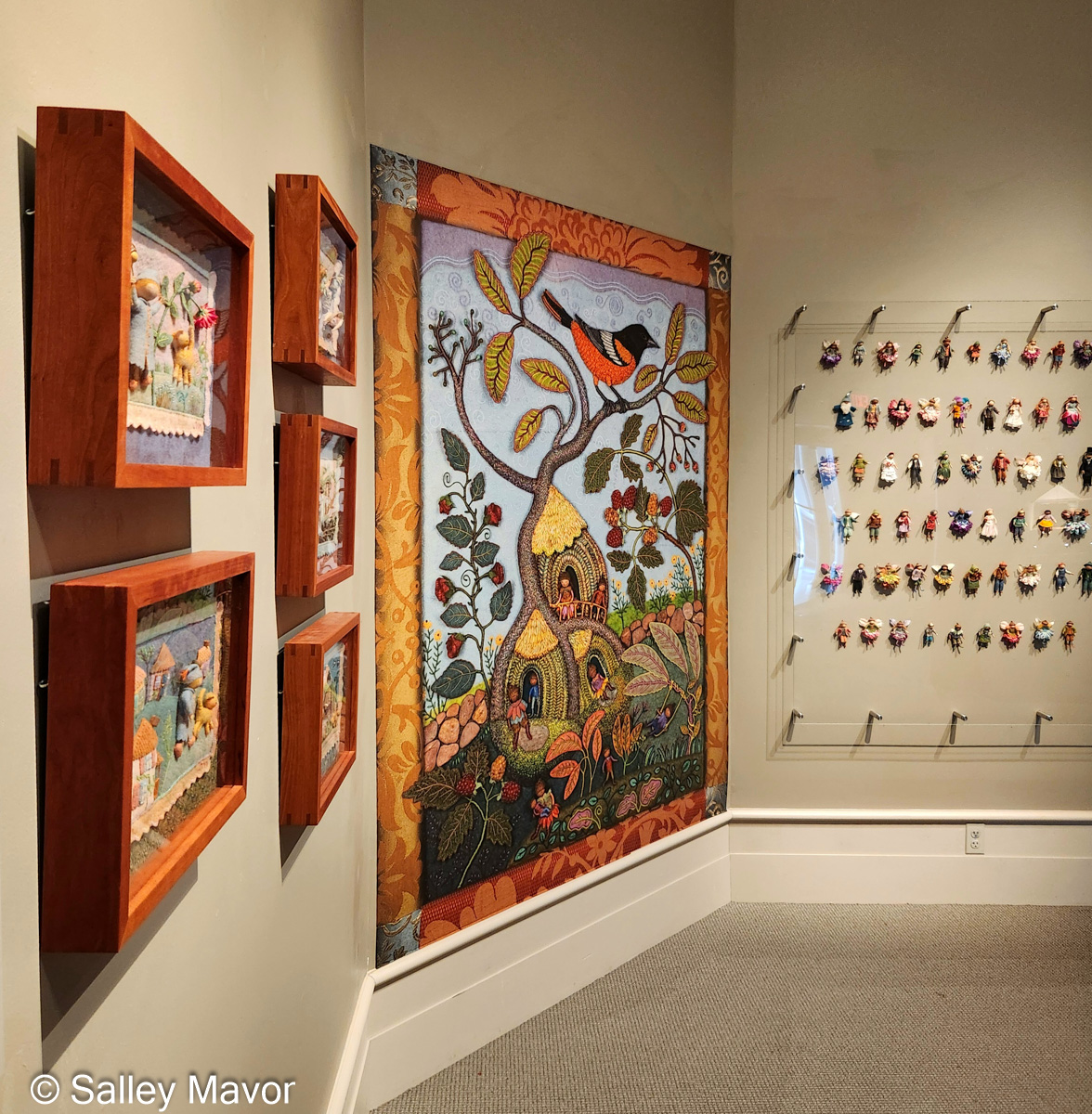
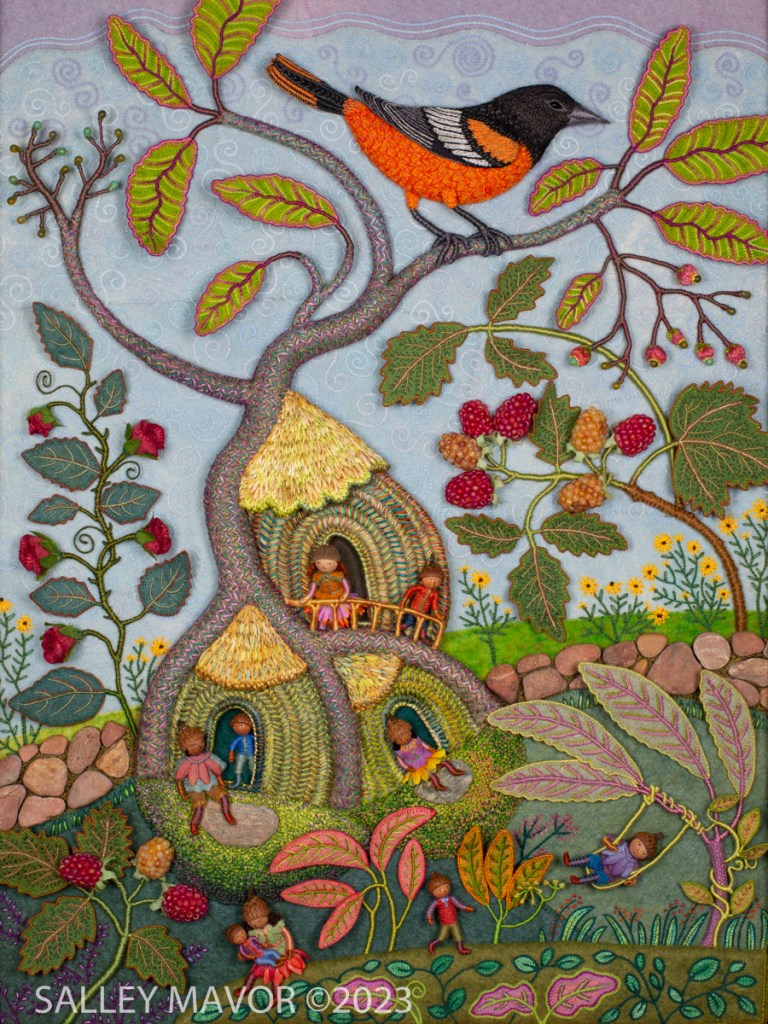
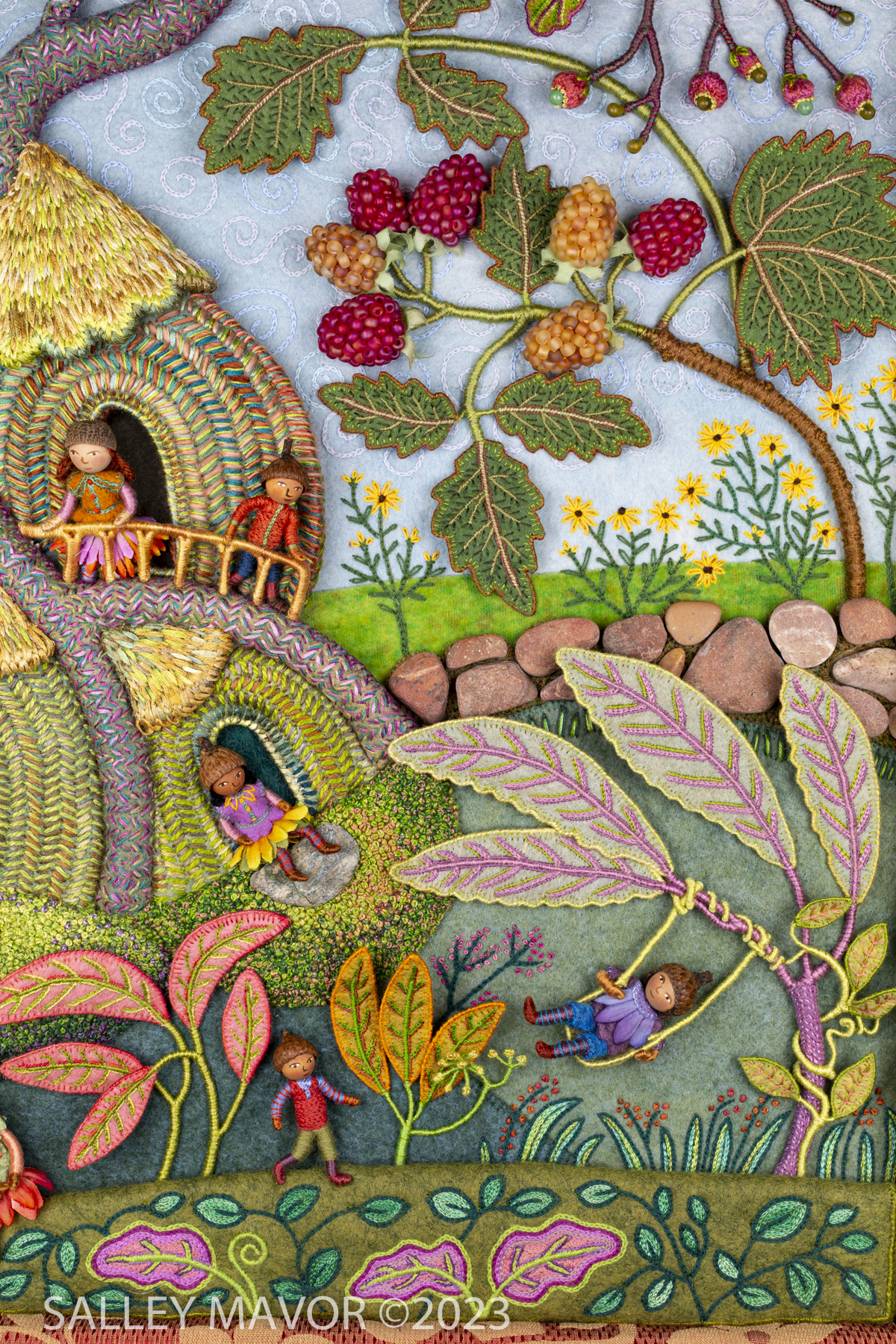
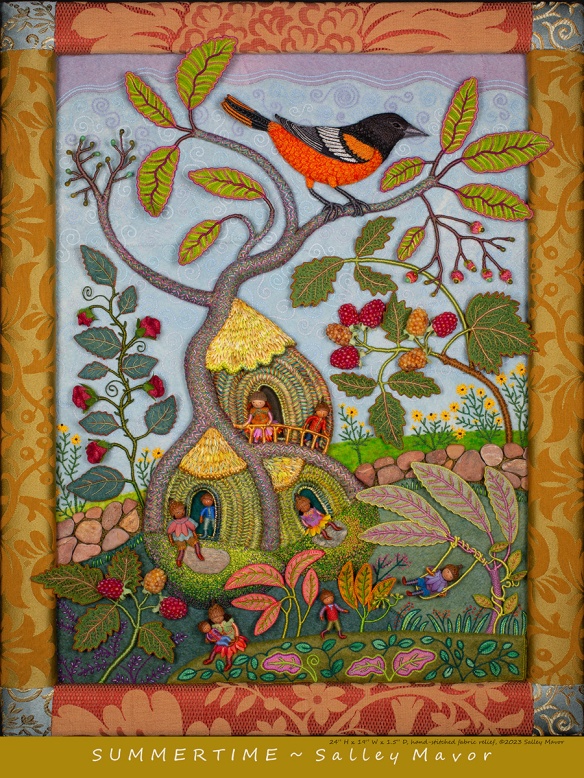
Summertime is the summer scene in a series of four seasonal landscapes that capture the wonder and magic of the natural world. Posters, note cards, prints, bookmarks, and jigsaw puzzles of Summertime and the other scenes in the series (Frosty Morning, Mossy Glen and Harvest Time) are available in my Etsy Shop.

See the Four Seasons Series and dozens of other works in my exhibition, To Every Season: Works by Salley Mavor at the New England Quilt Museum, Sept. 9 – Dec. 31, 2025.The show includes recent work, as well as rarely seen early pieces on loan from private collections.
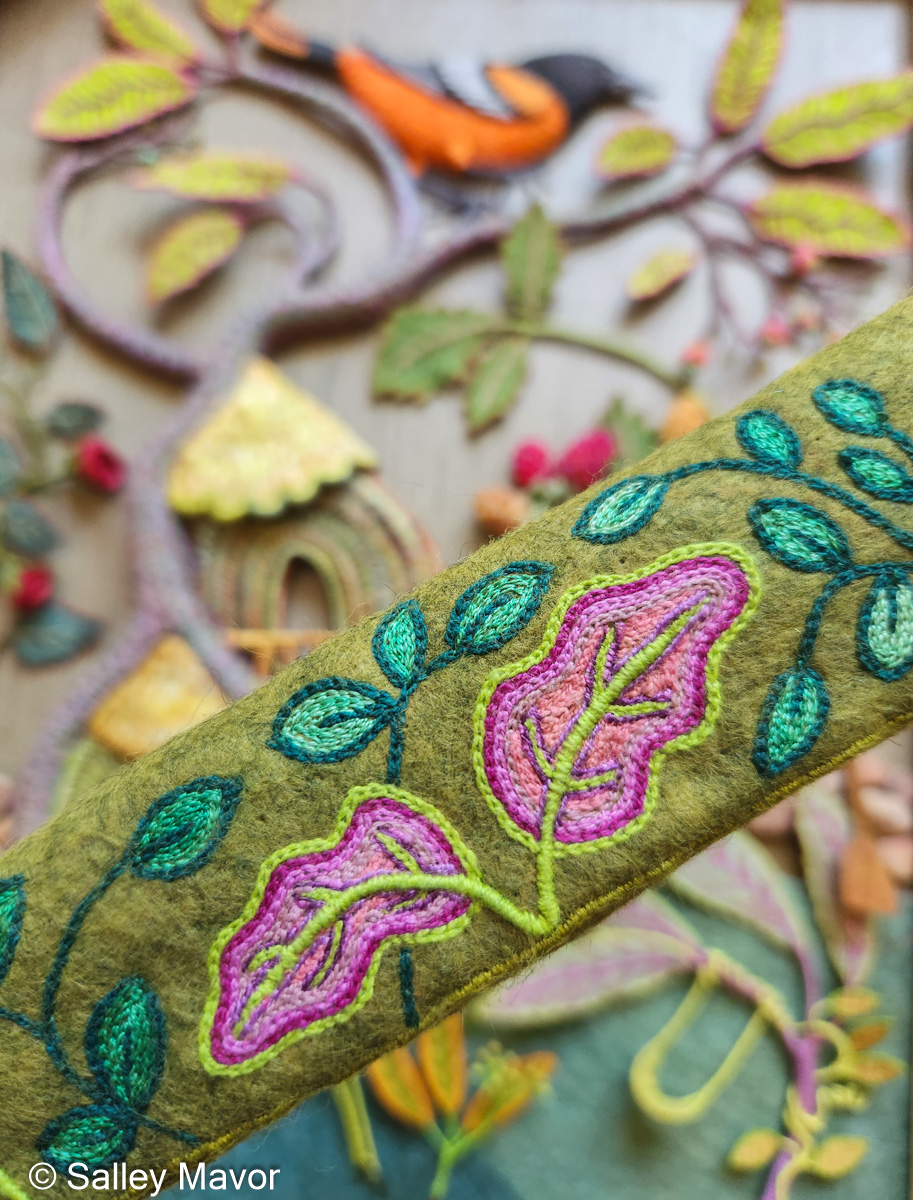
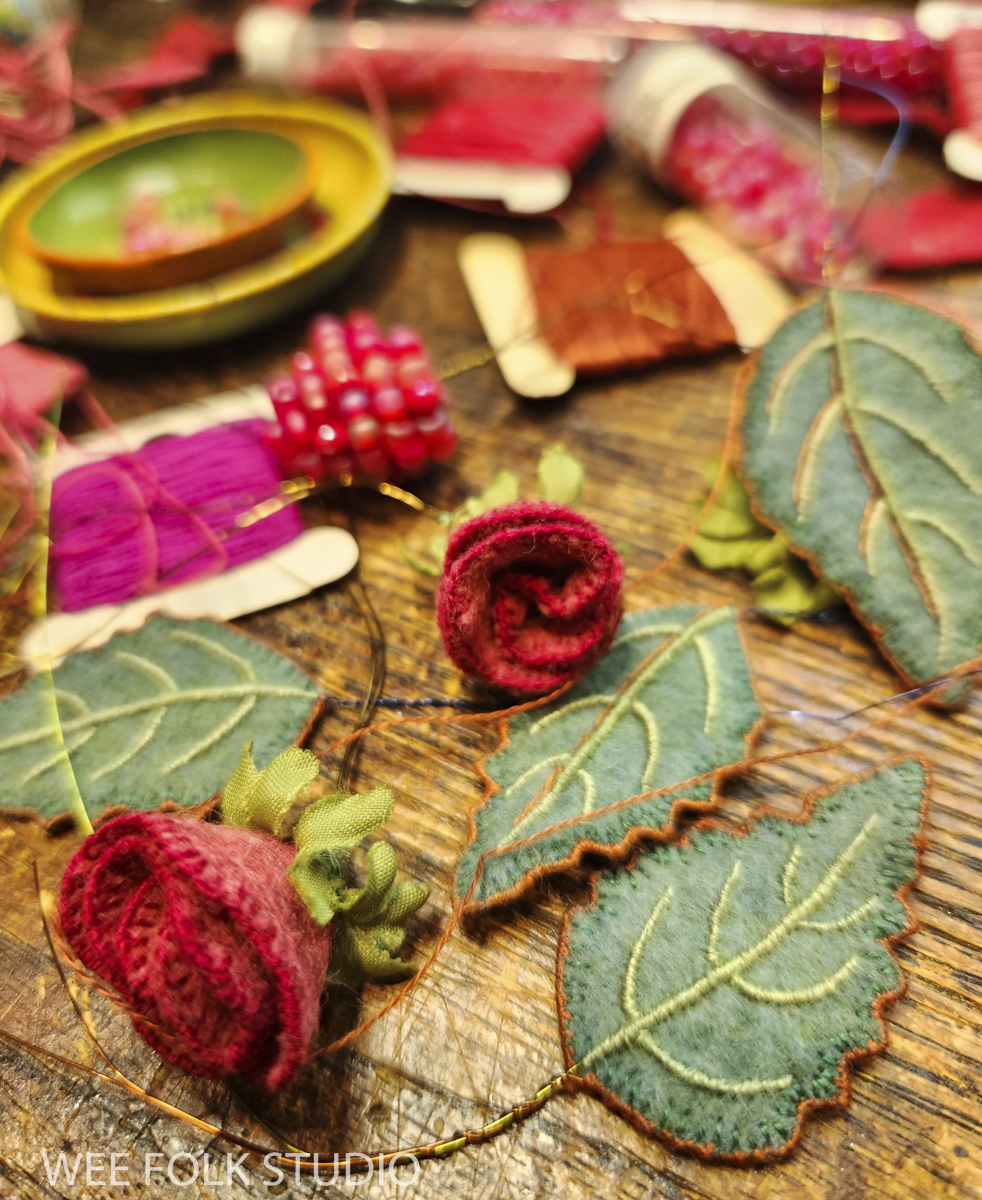
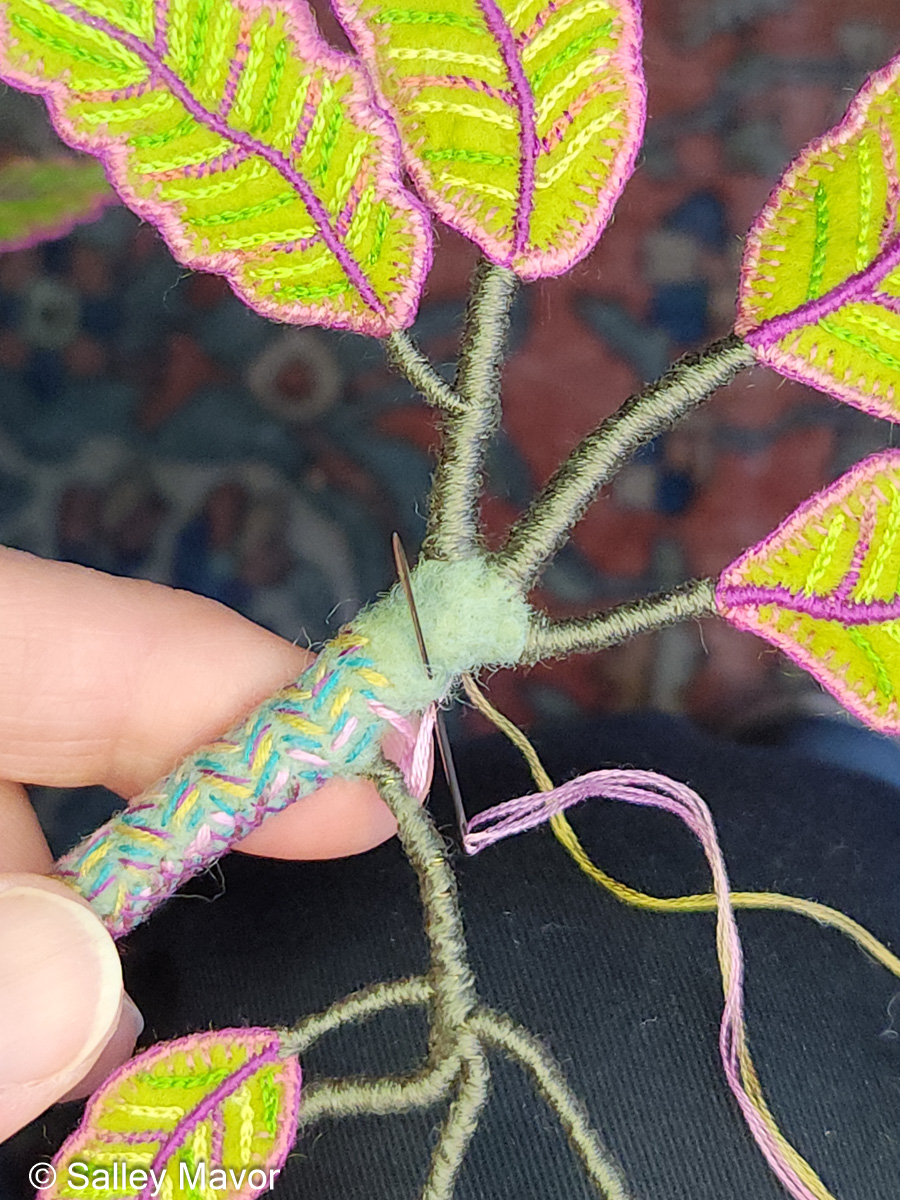
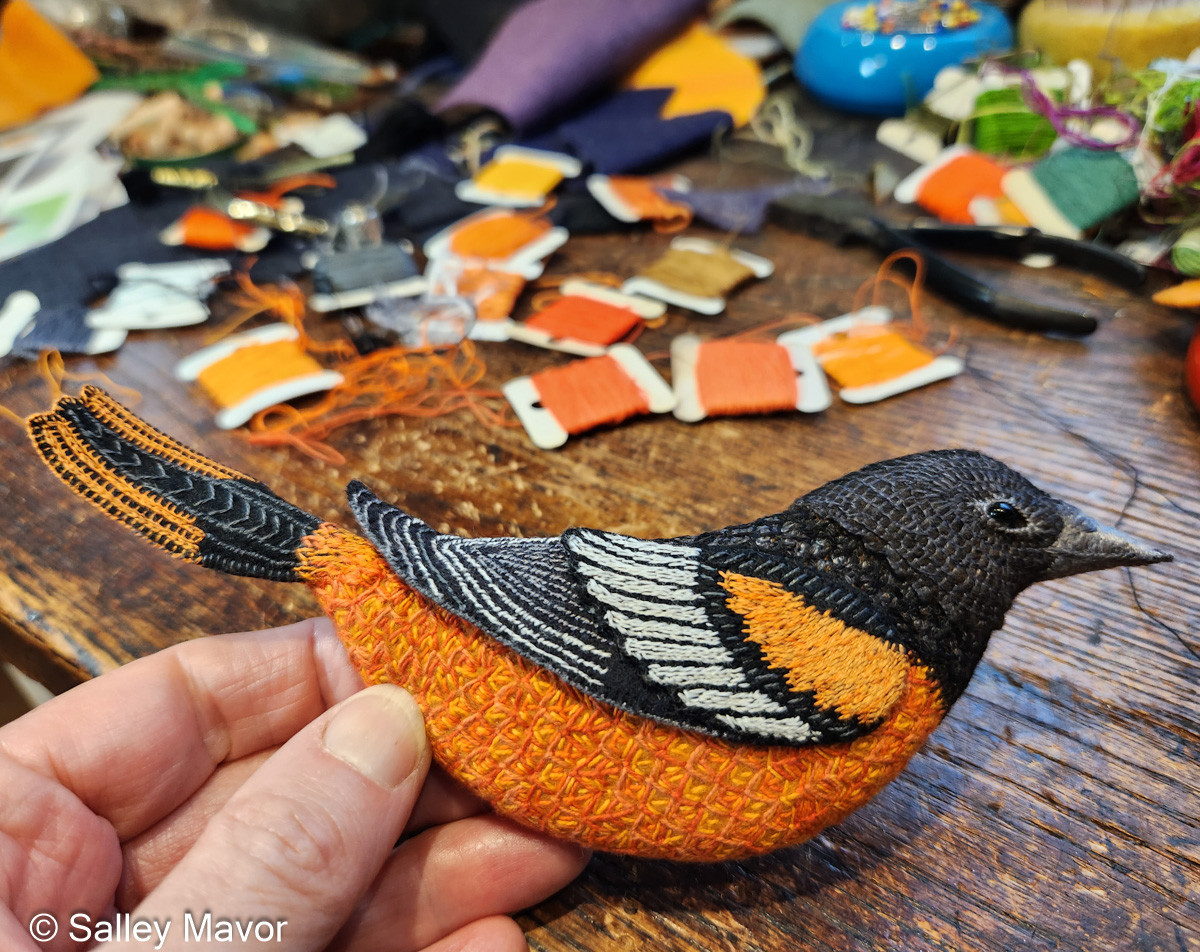
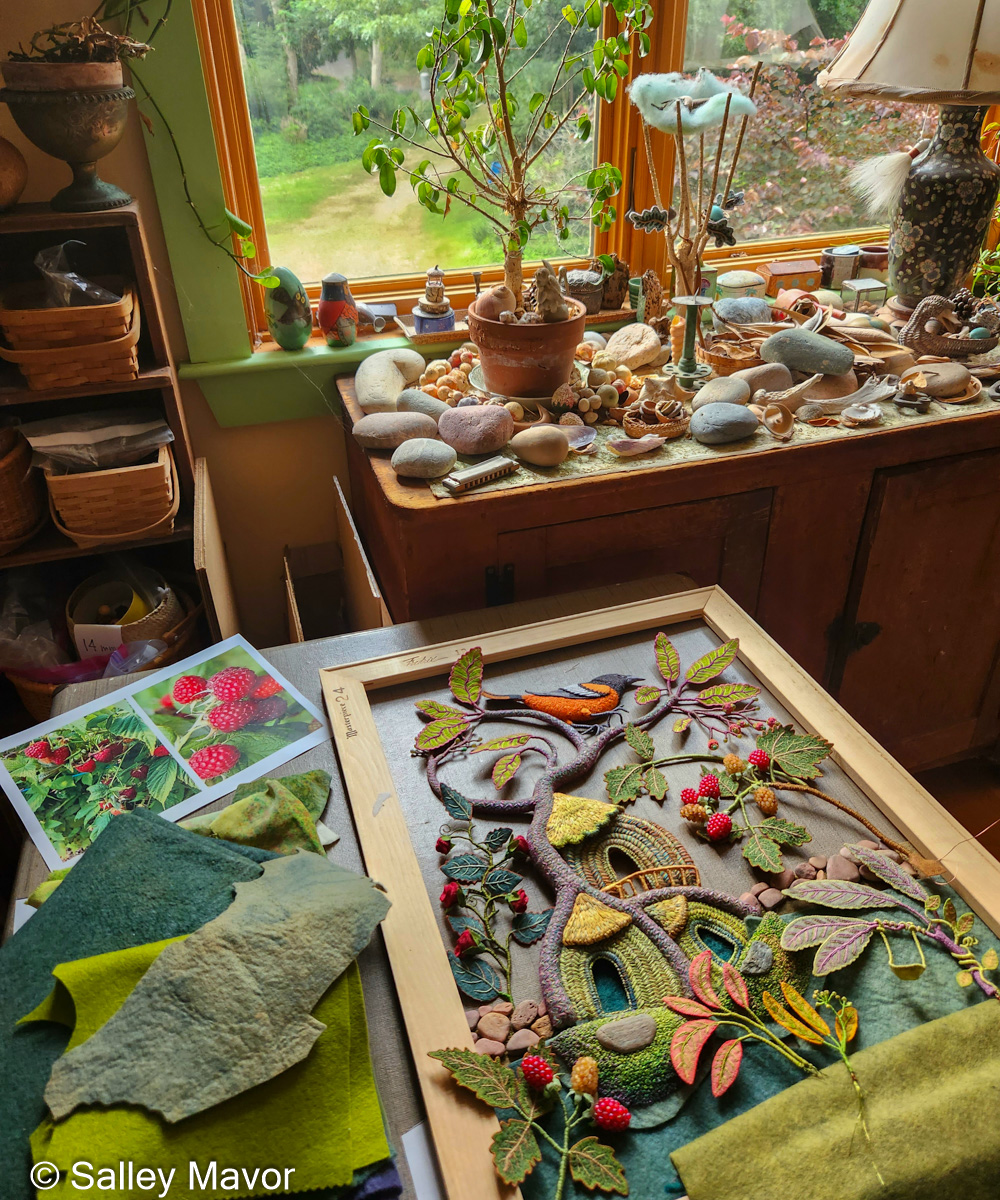
Towards the end of the project, after months of constructing most of the 3-dimensional parts of the scene, I was ready to zero in and add embroidered leaves and flowers where they were needed. In the following video, you can see how I spread out on different work tables in my studio. Every horizontal surface was full of materials and tools, as well as the bits and pieces I’d finished making.

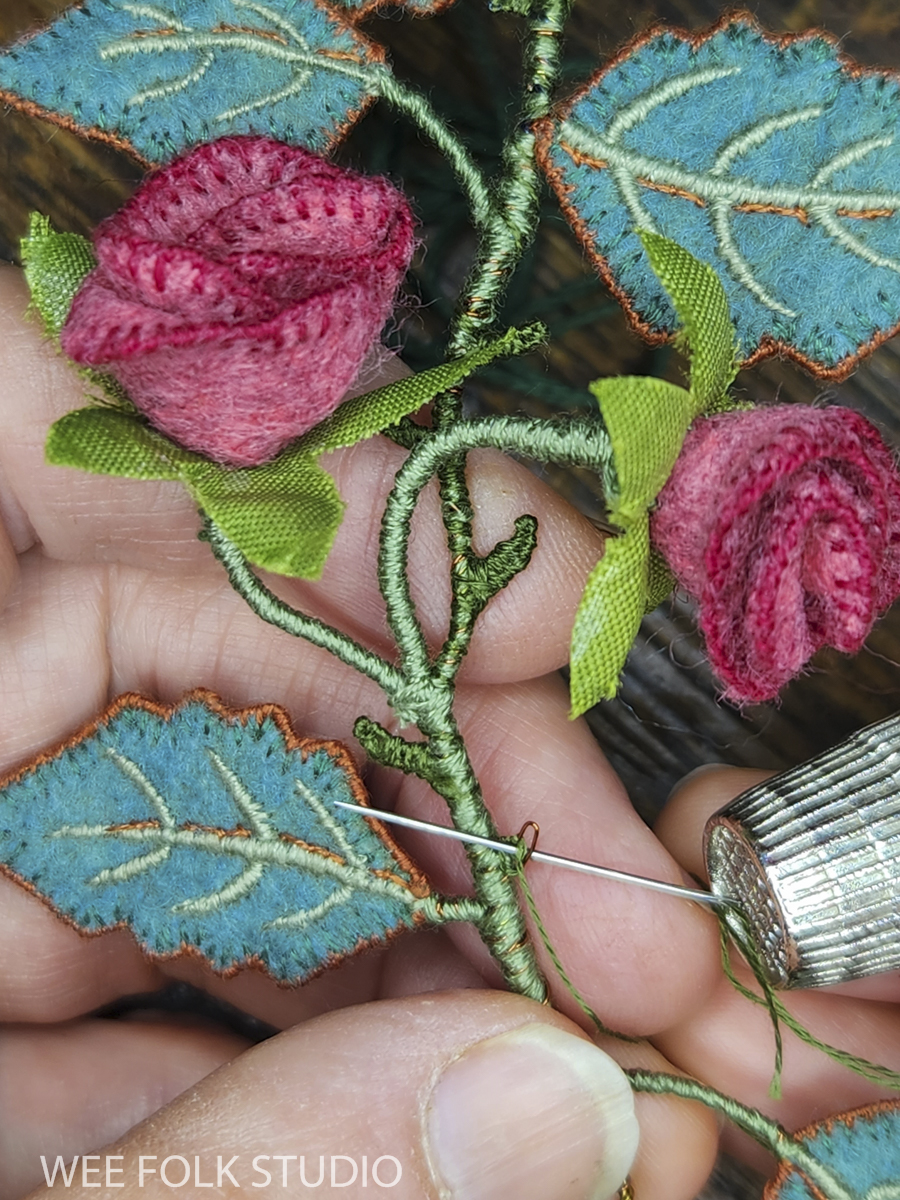
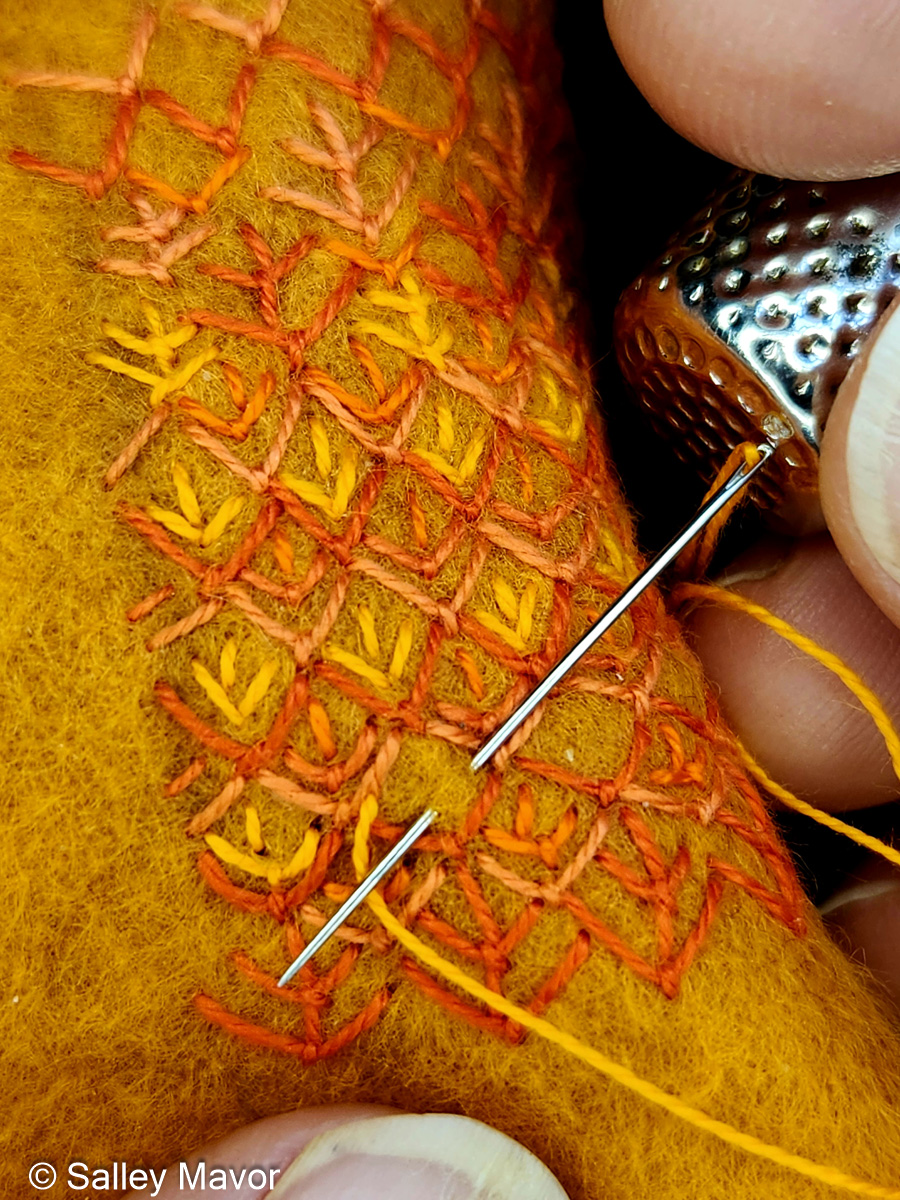
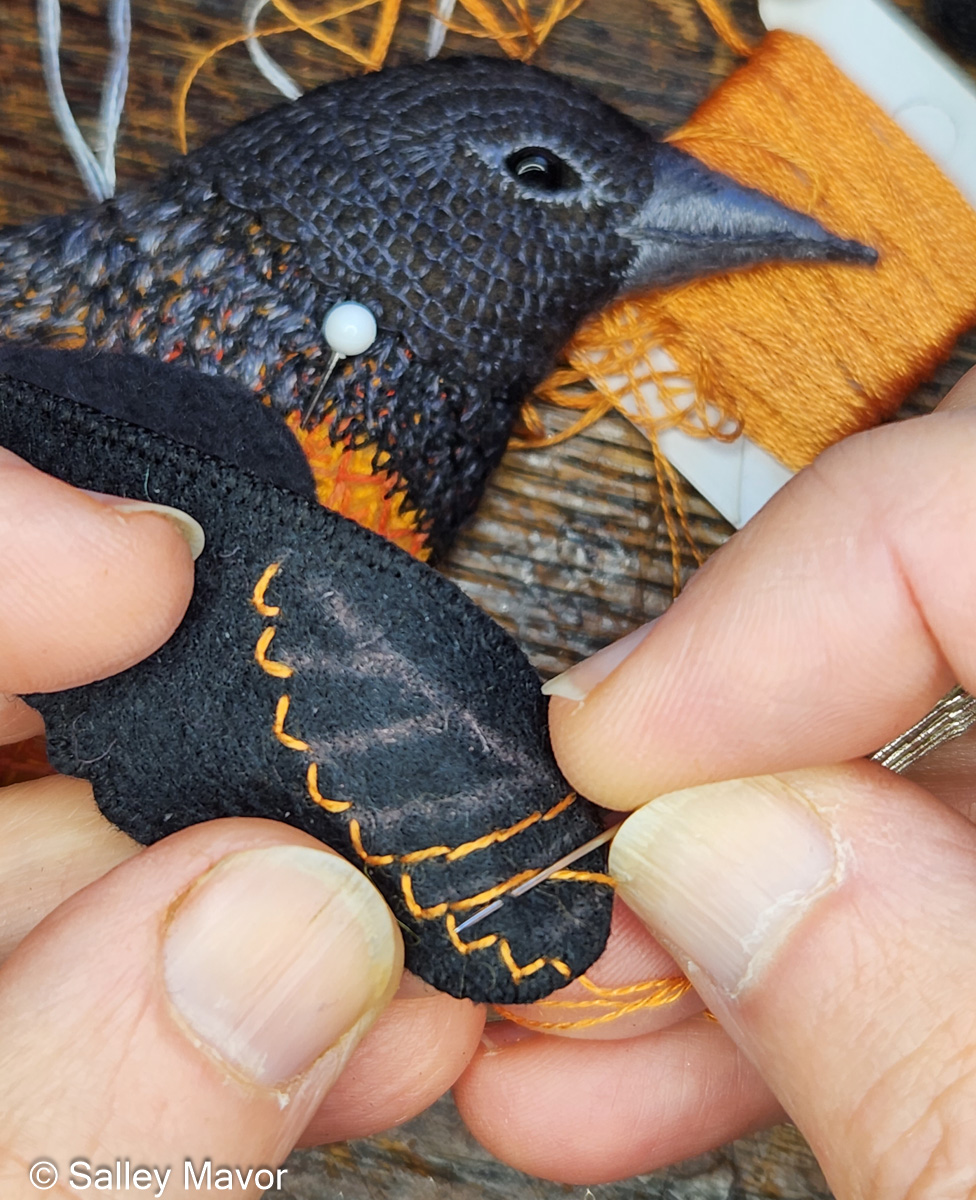
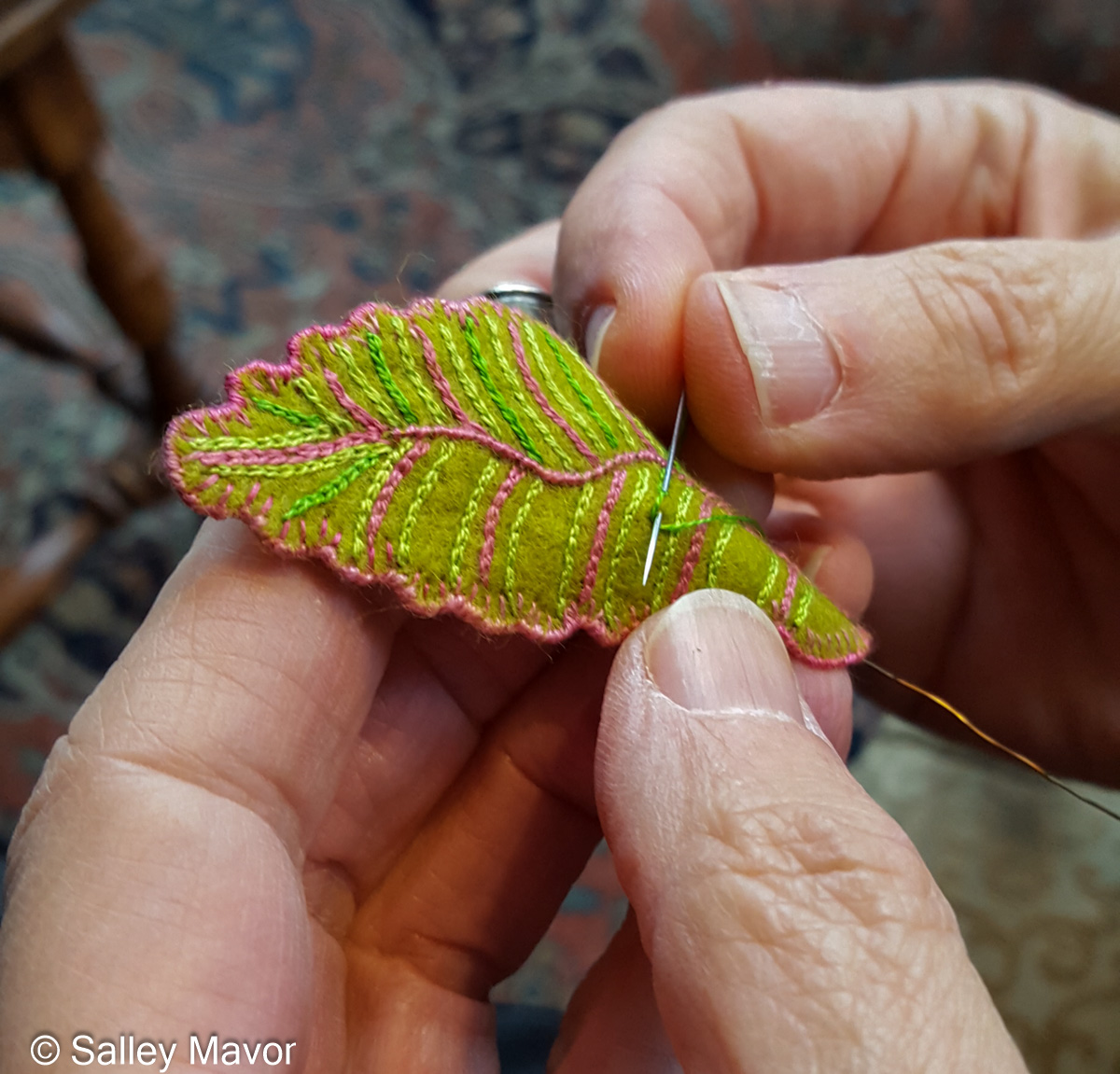
To do the stitching, I require very few things – a piece of felt, a needle, thread, and a thimble. And good lighting, of course. And closeup glasses. No hoop, no cumbersome magnifying equipment and no fancy needles or scissors.

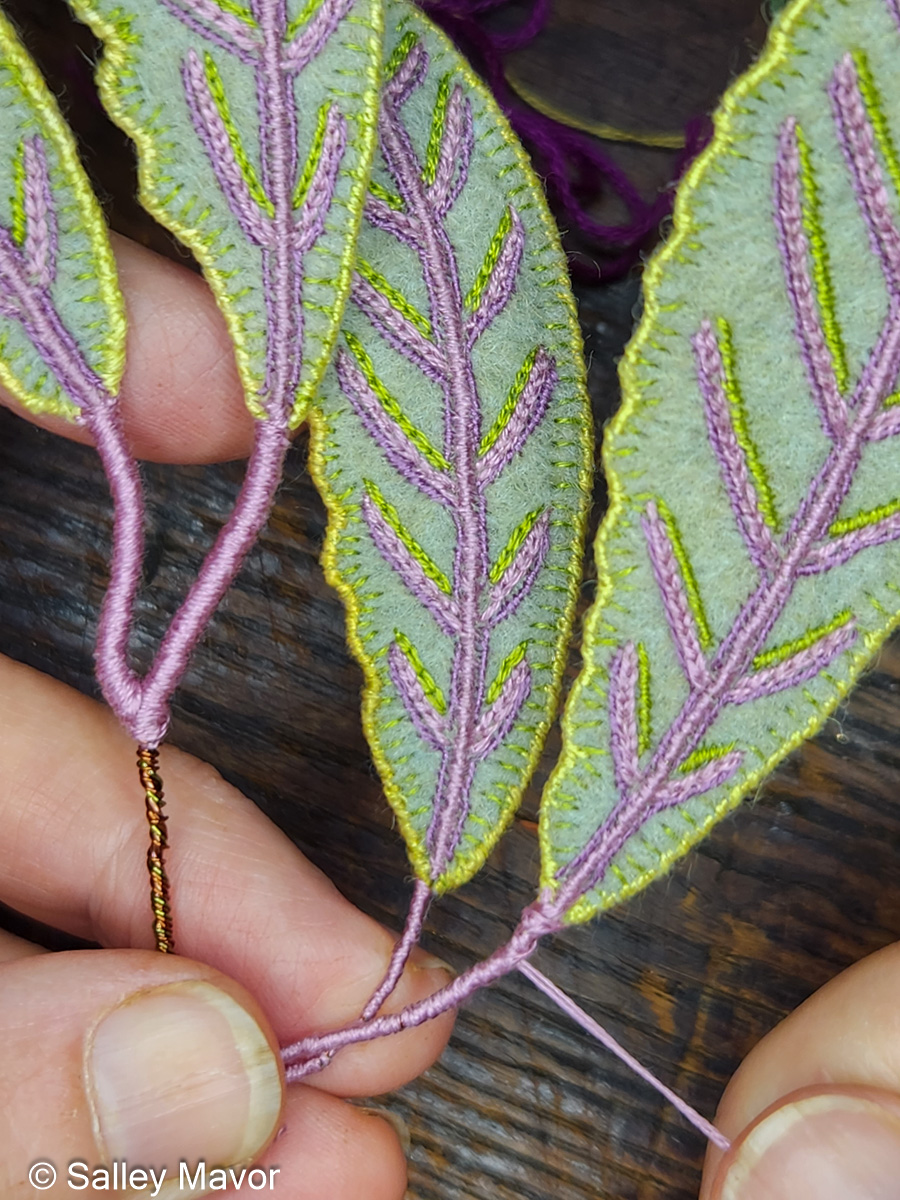
It was almost impossible to draw markings on this fuzzy wool felt, even with chalk. So, I mostly worked freehand and removed the stitched red guide lines later in the process. I used DMC cotton flower thread, which is thicker and bolder than embroidery floss. In this video, watch how I chain-stitched leaves and added Parawire stems on top.

Chain-stitching these leaf shapes was as soothing as filling in a coloring book.

I added patches of black-eyed susans to open areas of blue sky below the raspberries and above the stone wall (coming in part 9).

In other open areas, I chain-stitched blades of grass, dotted with little French knot flowers.

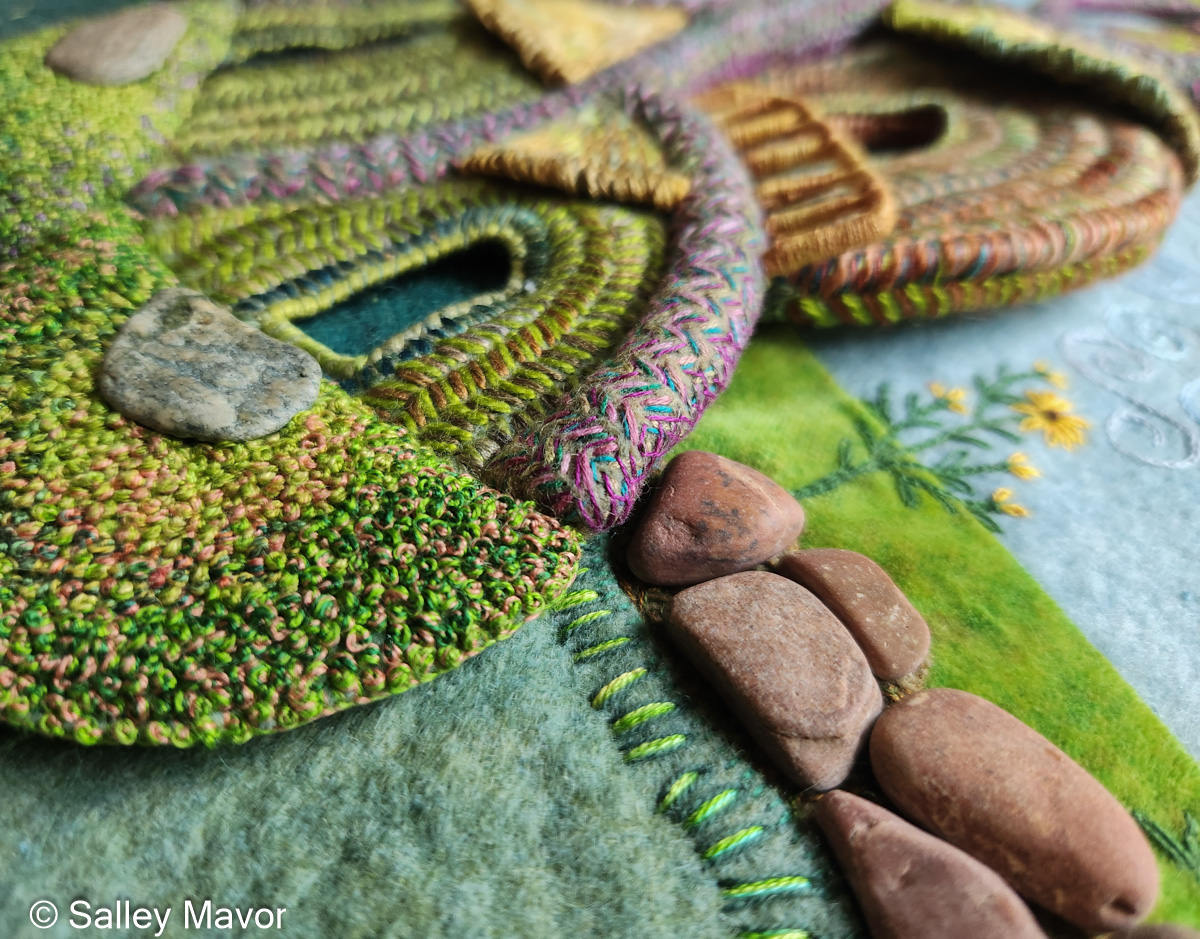
I was nearing the end of the project, which meant that it was time to tackle the border. I got out my stash of upholstery fabric and tried out different color combinations. Red and gold popped out at me; they contrasted with the blue sky and brought out the color of the raspberries. I padded the wooden stretchers with cotton quilt batting and sewed the upholstery fabric around the frame, which created a shallow box to fill with all of the parts.

Stay tuned for Part 9, where I’ll share photos and videos documenting the process of stitching moss and the sky, and building the stone wall in Summertime.
To keep up with new posts, please subscribe to this blog. Your contact info will not be sold or shared. If you’d like to see more frequent photos tracking the projects in my studio, please follow me on Facebook, Instagram and BlueSky.

Summertime: Part 7 – raspberry plants

In Part 7 of the series about Summertime, I share photos and videos documenting the process of making the raspberry plants. So far, I’ve written an overview of the piece, Part 1 – Tree Trunks, Part 2 – Tree Houses, Part 3 – leaves, stems & branches, Part 4 – Baltimore Oriole (body), Part 5 – Baltimore oriole (head and feet), Part 6 – rose vine, Part 8 – stitching flora, and Part 9 – moss, sky and stone wall.

Summertime is the summer scene in a series of four seasonal landscapes that capture the wonder and magic of the natural world. Posters, note cards, prints, bookmarks, and jigsaw puzzles of Summertime and the other scenes in the series (Frosty Morning, Mossy Glen and Harvest Time) are available in my Etsy Shop.

See the Four Seasons Series and dozens of other works in my exhibition, To Every Season: Works by Salley Mavor at the New England Quilt Museum, Sept. 9 – Dec. 31, 2025.The show includes recent work, as well as rarely seen early pieces on loan from private collections.

RASPBERRIES
The idea to add raspberries came late in the process, months after I’d begun stitching and constructing the piece. I was inspired by our new raspberry patch, which was producing the most succulent fruit I’d ever grown. The raspberries practically begged to be featured in the summer scene! My original design included flowers, but I was much more excited about making raspberries.

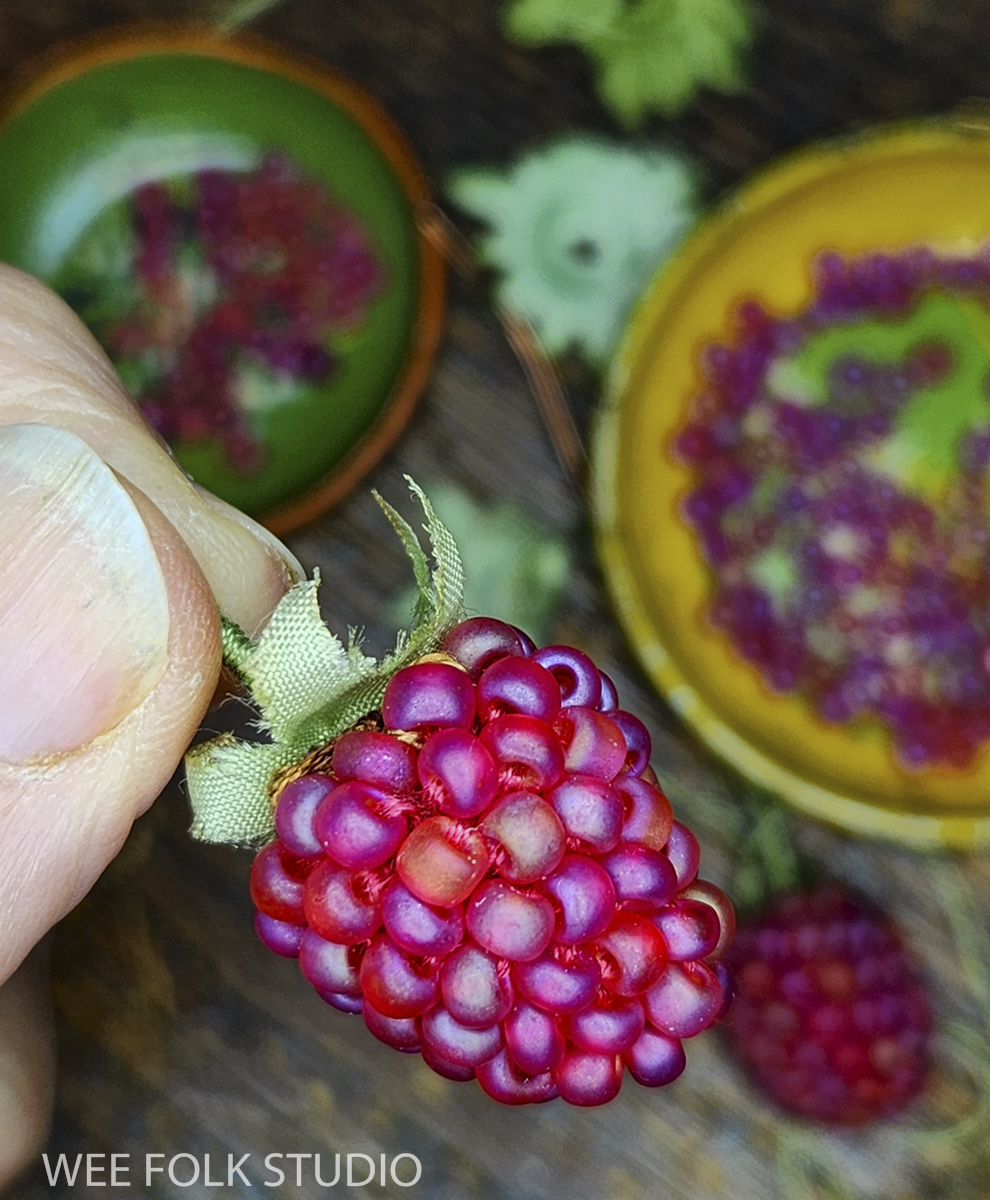
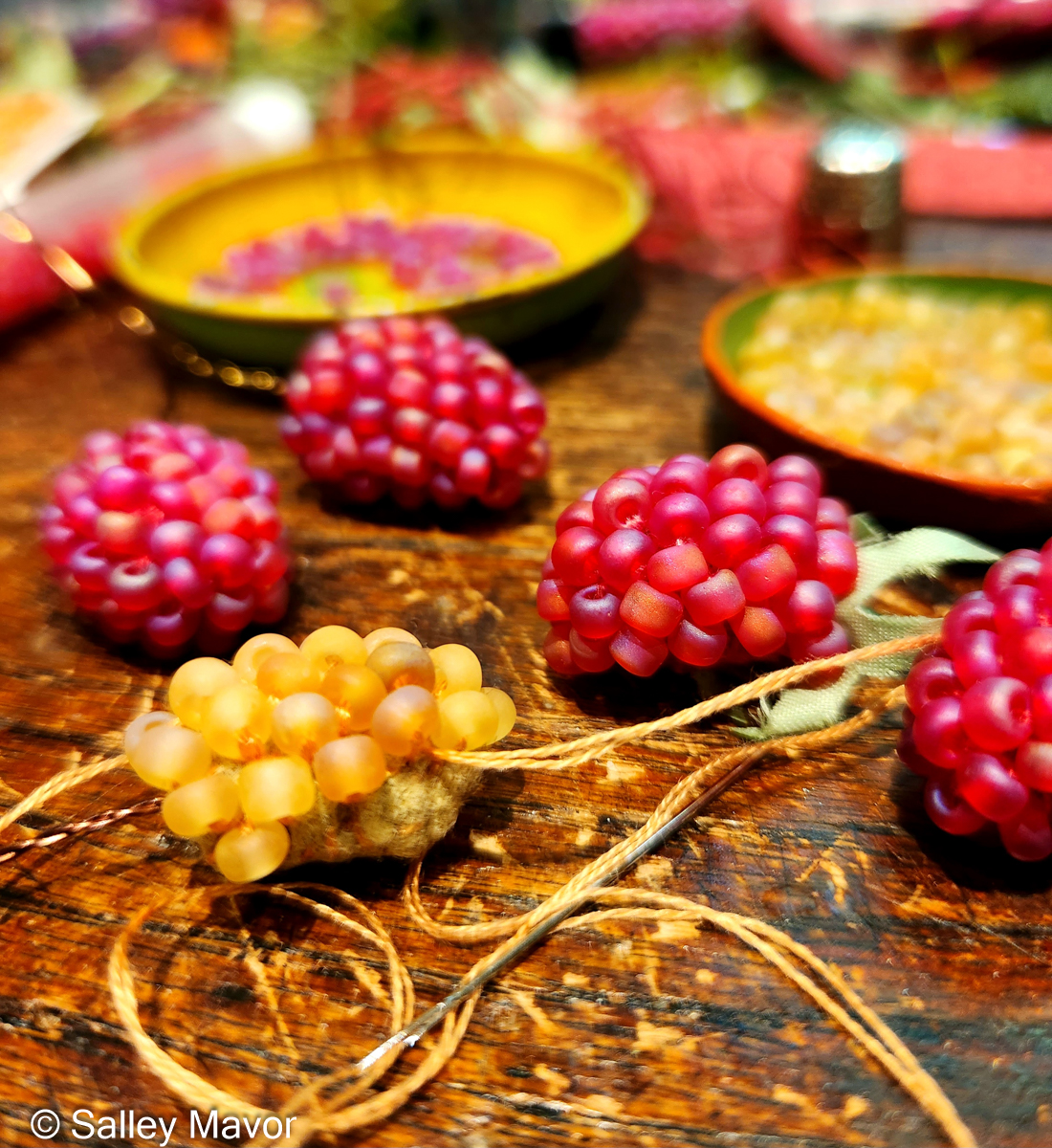
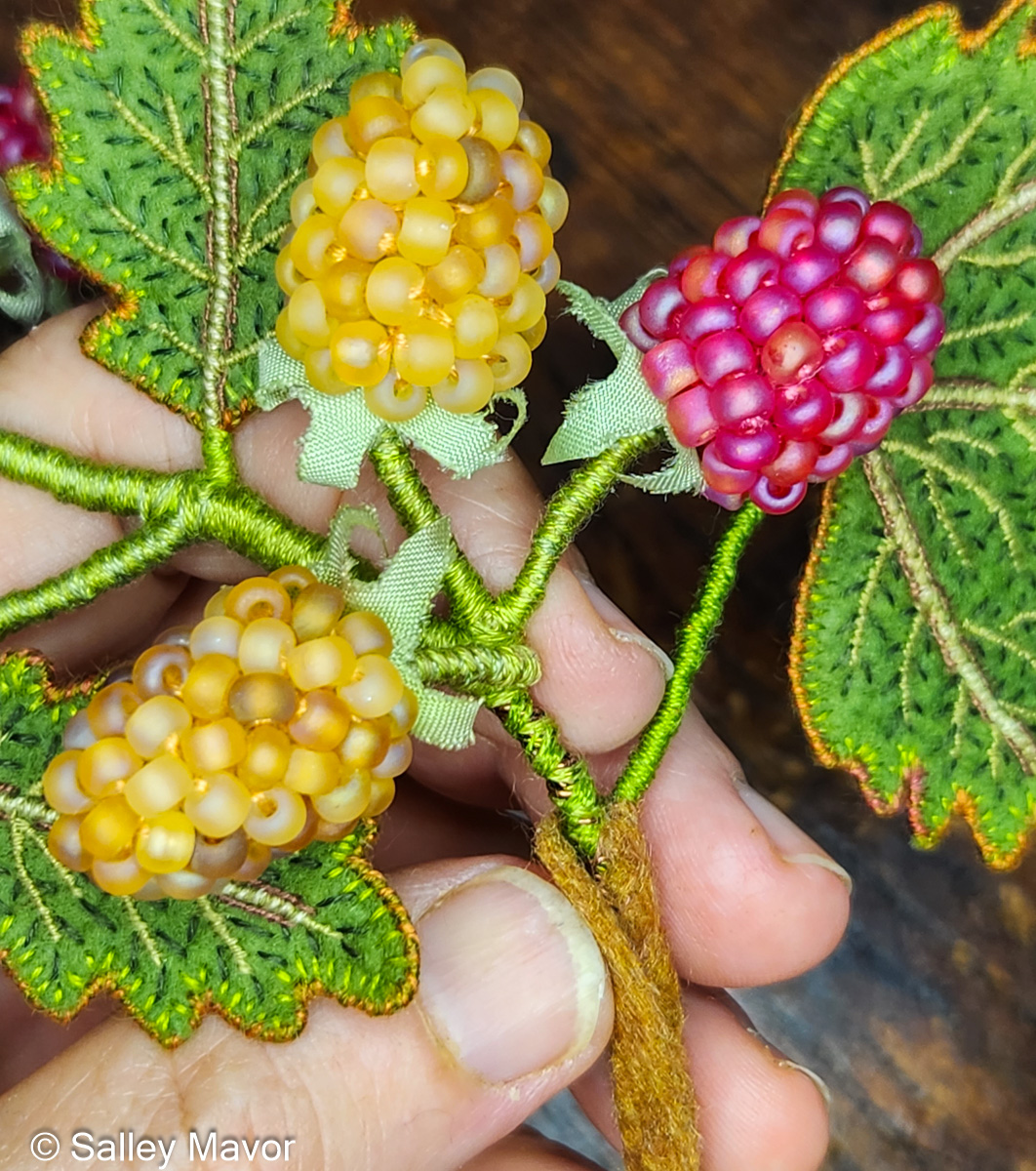
Now came the fun part, where I examined raspberries, both real and in photos, imagining how to replicate them with stitching and found objects. I searched through my stash and found some frosted glass beads that were just the right shade of reddish pink. The goal wasn’t to reproduce exact copies, but to make the imitation raspberries look even more scrumptious than real ones. The following video demonstrates how I made the felt core, sewed on the beads, and wrapped the stem with embroidery floss.

My supply of beads was limited, so I conserved them by covering just the top and sides of the felt core, leaving a bare back that could more easily be sewn to the background fabric. When I ran out of red beads, I used yellow ones to make more raspberries.

RASPBERRY LEAVES
Looking closely, I noticed that raspberry leaves were quite complex, with fine saw-like teeth that would be hard to replicate in felt. I ended up making a stylized version that was as pointy as I could get.

The following video shows how I sewed wire around the outside edge and embroidered veins on a felt raspberry leaf.

Once there were enough berries and leaves, I linked them together with wire branches. Then, I covered the wire with embroidery floss.

This video shows how I twisted Parawire to make stems and branches and then wrapped the wire with embroidery floss.

This video shows how I covered the thicker bottom branches with a strip of brown felt.

This project is a clear example of the importance of flexibility in my working process. There’s a reason that I steer away from textiles and needlework that involve grids, graphs or patterns. In the beginning, I’m not so certain about how my art is going to develop. Sure, I start with a basic design and structure, but I like to keep a door open for change. In this case, raspberries showed up.

Stay tuned for Part 8, where I’ll share photos and videos documenting the process of stitching flora in Summertime.

To keep up with new posts, please subscribe to this blog. Your contact info will not be sold or shared. If you’d like to see more frequent photos tracking the projects in my studio, please follow me on Facebook, Instagram and BlueSky.
Summertime: Part 6 – rose vine

In Part 6 of the series about Summertime, I share photos and videos that document the process of making the rose vine. So far, I’ve written an overview of the piece, Part 1 – Tree Trunks, Part 2 – Tree Houses, Part 3 – leaves, stems & branches, Part 4 – Baltimore Oriole (body), and Part 5 – Baltimore oriole (head and feet). Part 7 – raspberry plants, and Part 8 – stitching flora.

Summertime is the summer scene in a series of four seasonal landscapes that capture the wonder and magic of the natural world. Posters, note cards, prints, bookmarks, and jigsaw puzzles of Summertime and the other scenes in the series (Frosty Morning, Mossy Glen and Harvest Time) are available in my Etsy Shop.

See the Four Seasons Series and dozens of other works in my exhibition, To Every Season: Works by Salley Mavor at the New England Quilt Museum, Sept. 9 – Dec. 31, 2025. The show includes recent work, as well as rarely seen early pieces on loan from private collections.

ROSES
I learned how to make basic felt roses like these years ago from Mimi Kirchner’s blog. Mimi’s tutorial is available here. I love how deceptively simple the process is, starting with a circle of felt and folding it like origami to make a rose shape. Watch the following video to see how I finished off the raw felt edges with blanket stitching and folded the circle to make a rose.

Felt Rose

LEAVES
To cut out the sharp-toothed edge around the rose leaves, I used pinking shears. The following video shows how I stitched wire around the outside of a felt leaf and embroidered its stem and veins.

Felt Rose Leaf

I twisted wire to make a central vine and added the roses, leaves, thorns, and curly tendrils. Besides felt and embroidery floss, the most common material in my artwork is wire. Felt alone is too floppy and needs structural supports. I used Parawire in a range of gauges, from 24 to 32, to build up the thickness and strength I wanted.

The last step was disguising the shiny metallic wire with embroidery floss. Part 3 in this series includes videos of wrapping wire stems and branches on other foliage in the Summertime piece. I wound 1 or 2 strands of floss around and around the stems until the surface was evenly covered. It was a bit tricky to make the thorns look sharp!

Stay tuned for Part 7, where I’ll share photos and videos documenting the process of making the raspberry plants in Summertime. To keep up with new posts, please subscribe to this blog. Your contact info will not be sold or shared. If you’d like to see more frequent photos tracking the projects in my studio, please follow me on Facebook, Instagram and BlueSky.
Summertime: Part 5 – Baltimore Oriole (head and feet)

In this Part 5 of the series about Summertime, I share photos, videos and commentary that document the process of making the Baltimore Oriole’s head and feet. So far, I’ve written an overview of the piece, Part 1 – Tree Trunks, Part 2 – Tree Houses, Part 3 – leaves, stems & branches, and Part 4 – Baltimore Oriole (body), Part 6 – rose vine , Part 7 – raspberry plants, and Part 8 – stitching flora.

Summertime is the summer scene in a series of four seasonal landscapes that capture the wonder and magic of the natural world. Posters, note cards, prints, bookmarks, and jigsaw puzzles of Summertime and the other scenes in the series (Frosty Morning, Mossy Glen and Harvest Time) are available in my Etsy Shop.

See the Four Seasons Series and dozens of other works in my exhibition, To Every Season: Works by Salley Mavor at the New England Quilt Museum, Sept. 9 – Dec. 31, 2025. The show includes recent work, as well as rarely seen early pieces on loan from private collections.

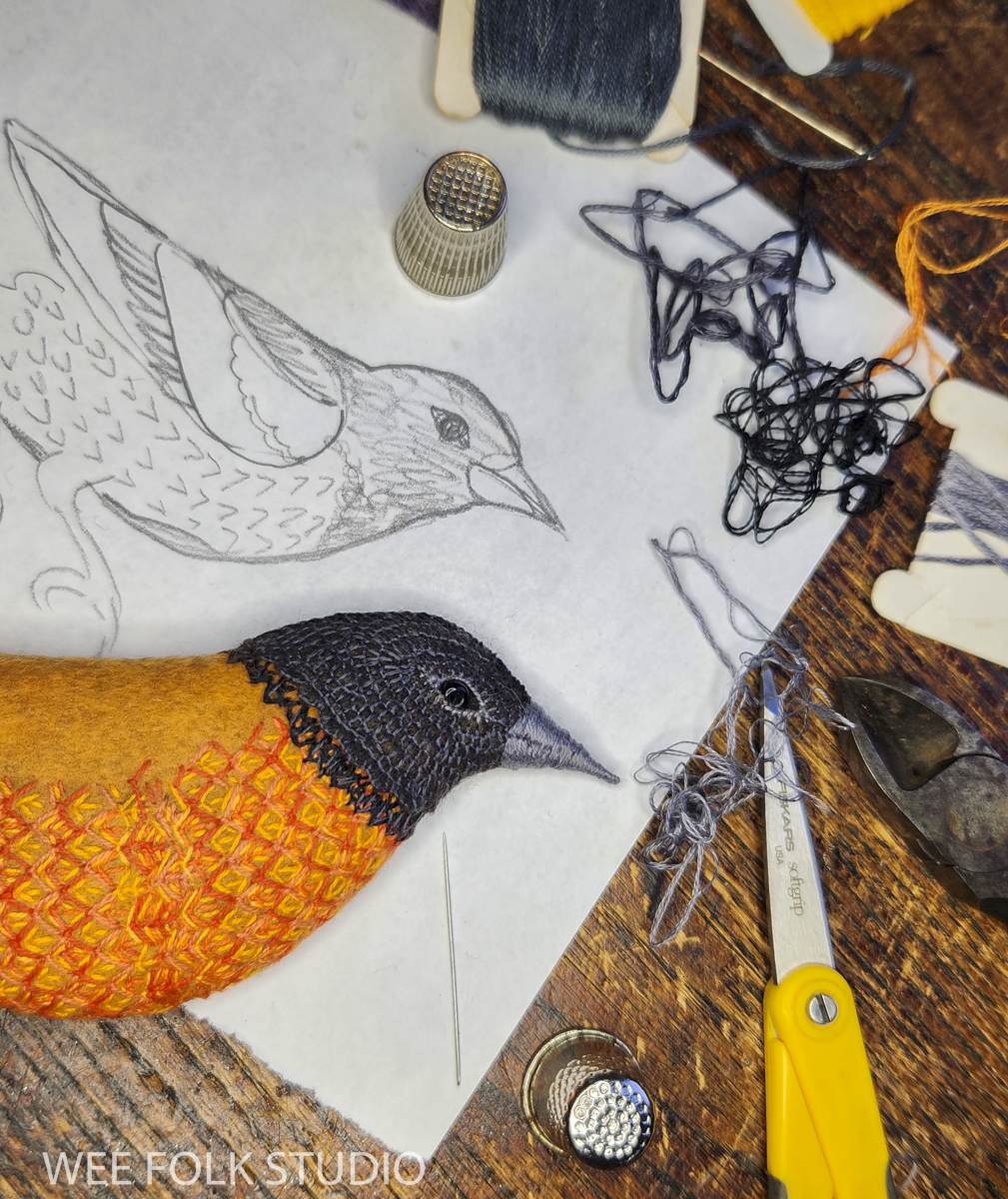
I wouldn’t call myself an avid bird watcher, but I do appreciate the subtle differences that make each species unique. For this piece, the trick was to capture the bird’s distinguishing features without being too scientific. To understand the nuances of an Oriole, I studied photos and made sketches, paying particular attention to the position, size and angle of its head, eyes and beak.

BEAK
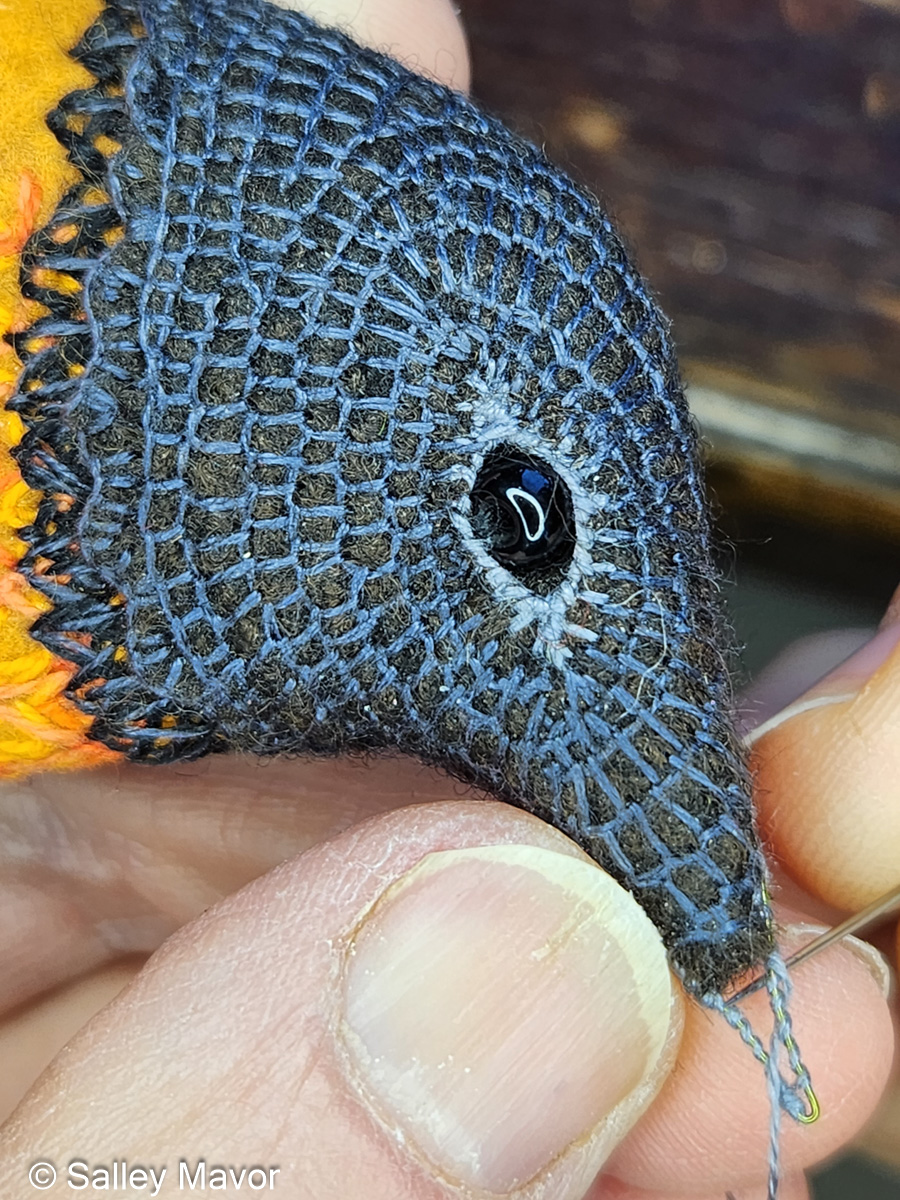
I must have been so focused on making the bird’s hood and eye (it’s a glass bead) that I forgot to take photos of that part. So, let’s skip ahead to the beak. To make it pointy, I formed a wire extension and wrapped it with embroidery floss.

I articulated the shape of the beak with floss, stitching over and around, until it had a smooth and seamless appearance.

Watch this video to see how I stitched the beak. It even shows what the back looks like!

After the beak was finished, I embroidered black feathers with fly stitches on the neck and throat area.

I sewed the wing and tail (see Part 4) in place and got to work on making the Oriole’s feet.

FEET
I shaped the bird’s feet and legs with wire, twisting it around to form 4 toes – 1 short and 3 long. Then, I wrapped the wire with embroidery floss, winding the thread up and down until no shiny wire was exposed and the feet were the right thickness.

Watch this video to see how I constructed the legs and feet and attached them to the bird’s body.

Stay tuned for Part 6, where I’ll share photos and videos documenting the process of making the rose vine. If you want to receive email notices when I publish new posts, please subscribe to this blog using the form below.

To keep up with new posts, please subscribe to this blog. Your contact info will not be sold or shared. If you’d like to see more frequent photos tracking the projects in my studio, please follow me on Facebook, Instagram and BlueSky.
Summertime: Part 4 – Baltimore Oriole (body)

In this Part 4 of the series about Summertime, I share photos, videos and commentary that document the process of making the Baltimore Oriole’s body, including its breast, wing and tail. The bird’s head and feet will be featured in Part 5, which is next in line. So far, I’ve written an overview of the piece, Part 1 – Tree Trunks, Part 2 – Tree Houses, and Part 3 – leaves, stems & branches, Part 5 – Baltimore Oriole (head and feet), Part 6 – rose vine , Part 7 – raspberry plants, and Part 8 – stitching flora.

Summertime is the summer scene in a series of four seasonal landscapes that capture the wonder and magic of the natural world. Posters, note cards, prints, bookmarks, and jigsaw puzzles of Summertime and the other scenes in the series (Frosty Morning, Mossy Glen and Harvest Time) are available in my Etsy Shop.

See the Four Seasons Series and dozens of other works in my exhibition, To Every Season: Works by Salley Mavor at the New England Quilt Museum, Sept. 9 – Dec. 31, 2025.

Enchanting Threads: The Art of Salley Mavor at the Albany Institute of History and Art

BALTIMORE ORIOLE
I chose a male Baltimore Oriole for the summer scene mostly because of its flashy appearance. They also epitomize the season for me. Pairs of orioles are frequent visitors to our yard in early summer, when we lure them with orange halves and grape jelly. I hadn’t made a bird this size since Birds of Beebe Woods (2012), which you can get a glimpse of on the wall in the following video. 

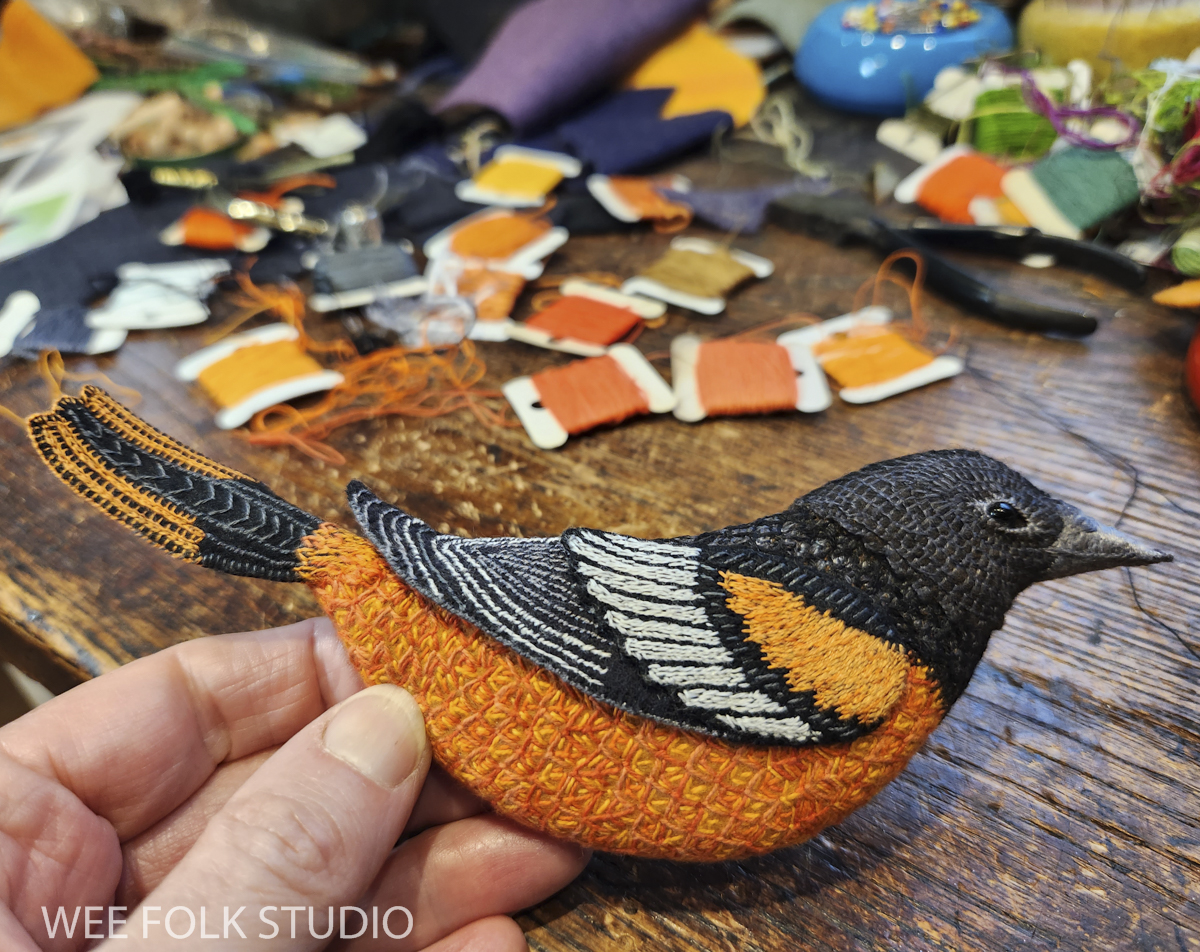
First, I looked at photos of orioles and made a simple drawing that showed its size and proper proportions. Then, I cut the basic shape out of acid-free matte board and padded it with thick felt (which is similar to how I made pins early in my career). Throughout the process of making the bird, I referred to photos, especially when selecting colors and stitches for the body, wing, and tail.

I wanted to make the bird realistic enough to be recognized as a species, but patterned and abstracted in a way that made it fun to stitch. It ended up being something between a stylized bird and a biological illustration.

BREAST
For the oriole’s distinctive orange breast, I embroidered different combinations of fly stitches that are reminiscent of Faire Isle patterns. It brought me back to a dozen years ago, when I stitched the crow’s breast in Birds of Beebe Woods.

detail from “Birds of Beebe Woods”

I used cotton flower thread, which has a matte finish that’s different from the glossy sheen of cotton embroidery floss. DMC flower thread is no longer available, so if you’re interested, Dutch Treat Designs has some of the discontinued thread in stock. 

Watch a Stitch Minute video of embroidering the oriole’s breast with fly stitches.

WING
I usually work freehand without marks, because it’s hard to draw on fuzzy wool felt. In this case, I was able to make chalk pencil lines on the black felt wing.

Watch a Stitch Minute video of embroidering the bird’s wing.

TAIL
So much of a bird’s personality comes through in the angle and pose of its tail. Doing the stitching was the easy part. Positioning the tail and attaching it to the body took more patience and perseverance.

Watch a Stitch Minute video of embroidering and attaching the bird’s tail.

Stay tuned for Part 5, where I’ll share photos and videos documenting the process of making the Baltimore Oriole’s head and feet. If you want to receive email notices when I publish new posts, please subscribe to this blog using the form below.

To keep up with new posts, please subscribe to this blog. Your contact info will not be sold or shared. If you’d like to see more frequent photos tracking the projects in my studio, please follow me on Facebook, Instagram and BlueSky.

Harvest Time – Part 2 (turkey tail mushroom)

In Part 2 in the series about making Harvest Time, I share photos, commentary and a stitch-minute video about creating the turkey tail mushroom overhanging the doorway in the stump. In the coming weeks and months, I will post more stories that focus on different aspects of the process of making the fall scene, including the toad stool mushroom, wee folk figures, tunnels, roots, stones and foliage of all kinds.
The overview introduces the Harvest Time piece.
Part 1 features moss making.
Part 2 is about making the turkey tail mushroom.
Part 3 shows the construction of felt leaves.
Part 4 gives a peek at embroidering the plants.
Part 5 is about making the toadstool mushroom
Part 6 shows the process of making the underground

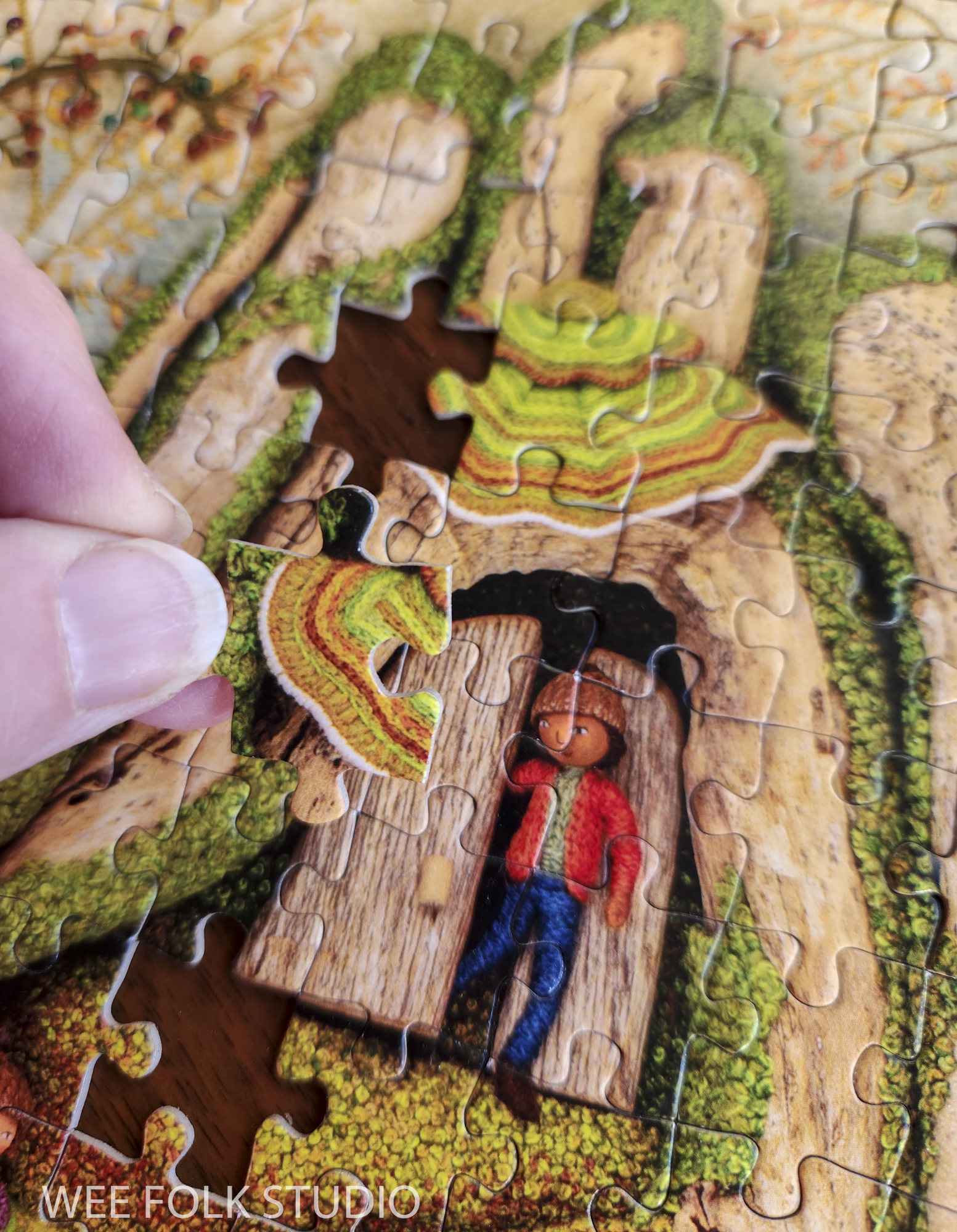
Harvest Time is the fall scene in a series of seasonal landscapes that capture the wonder and magic of the natural world, both real and imagined. Harvest Time and the other scenes I’ve completed and written about, SummertimeFrosty Morning and Mossy Glen, are available as note cards and jigsaw puzzles in my shop here.

Harvest Time Puzzles are available in my Etsy shop.

Turkey tail mushrooms or shelf fungi are found all over the world. They usually grow on dead hardwood stumps and downed hardwood trunks or branches.

Turkey Tail Mushrooms

I love how Glen Carliss used shelf fungi for the roofs in “Glendell Towers”, which he made for The Fairy Houses of Highfield Hall, an outdoor exhibition that I curated in 2015. Glen told me that he’d been eyeing the mushrooms growing on trees along his road for years, imaging what to do with them.

Glendell Towers by Glen Carliss

I didn’t use actual mushrooms in Harvest Time, but I was inspired by their fanciful appearance. My photo search came up with multiple color combinations, from earthy hues to shades as garish as 1960’s fashion. I chose a more subdued mixture of fall colors for the mushroom roof.

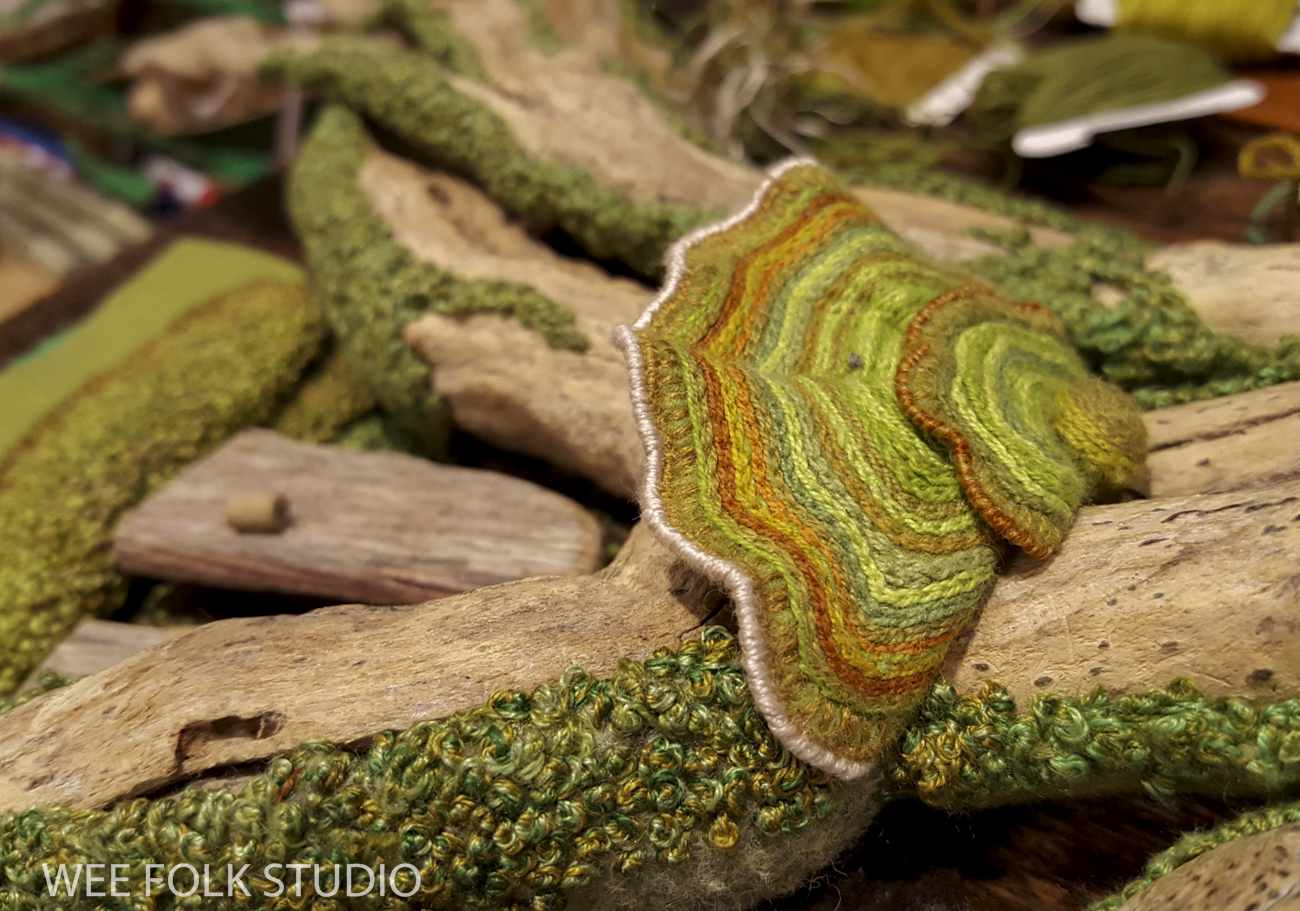
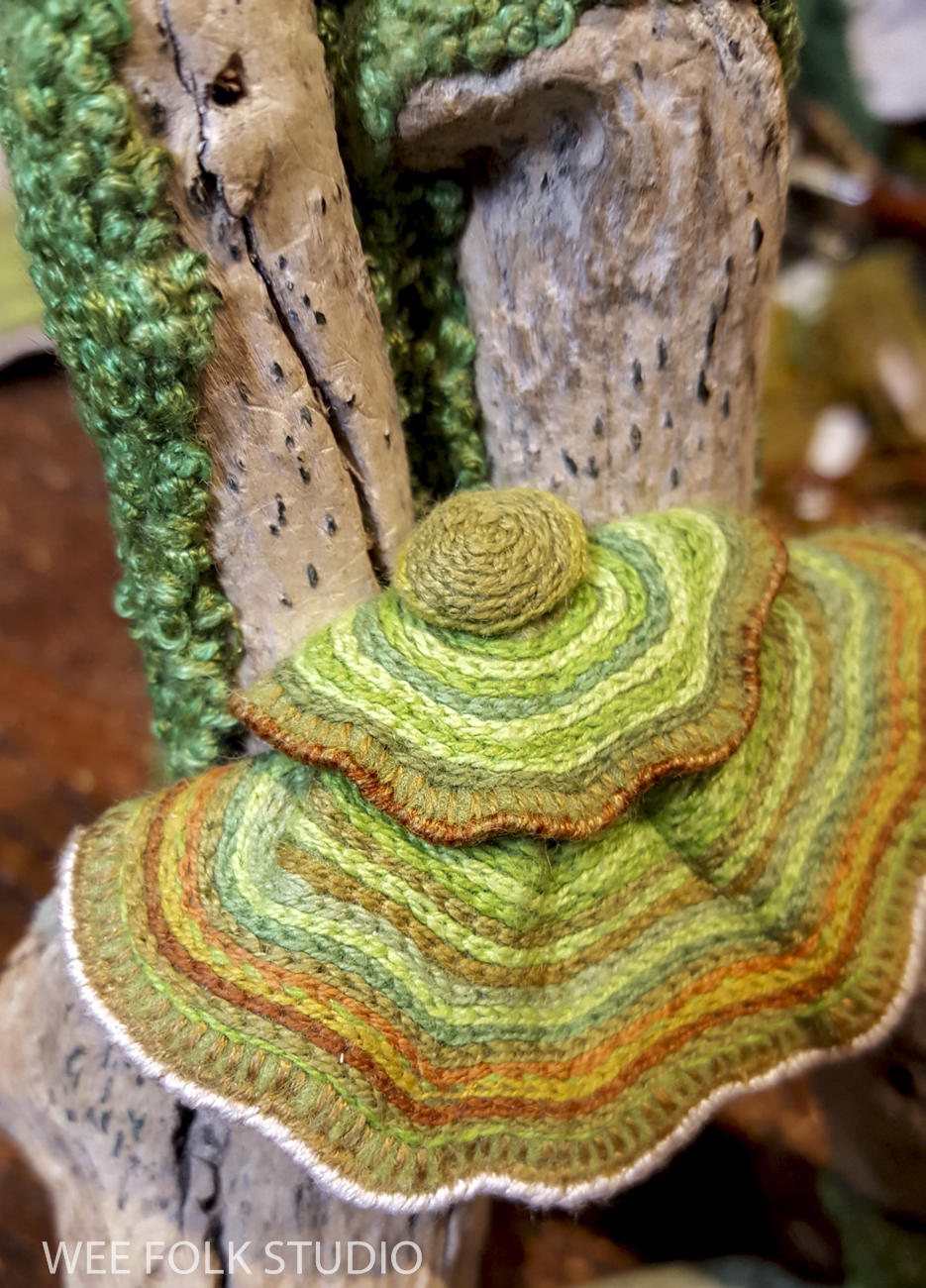
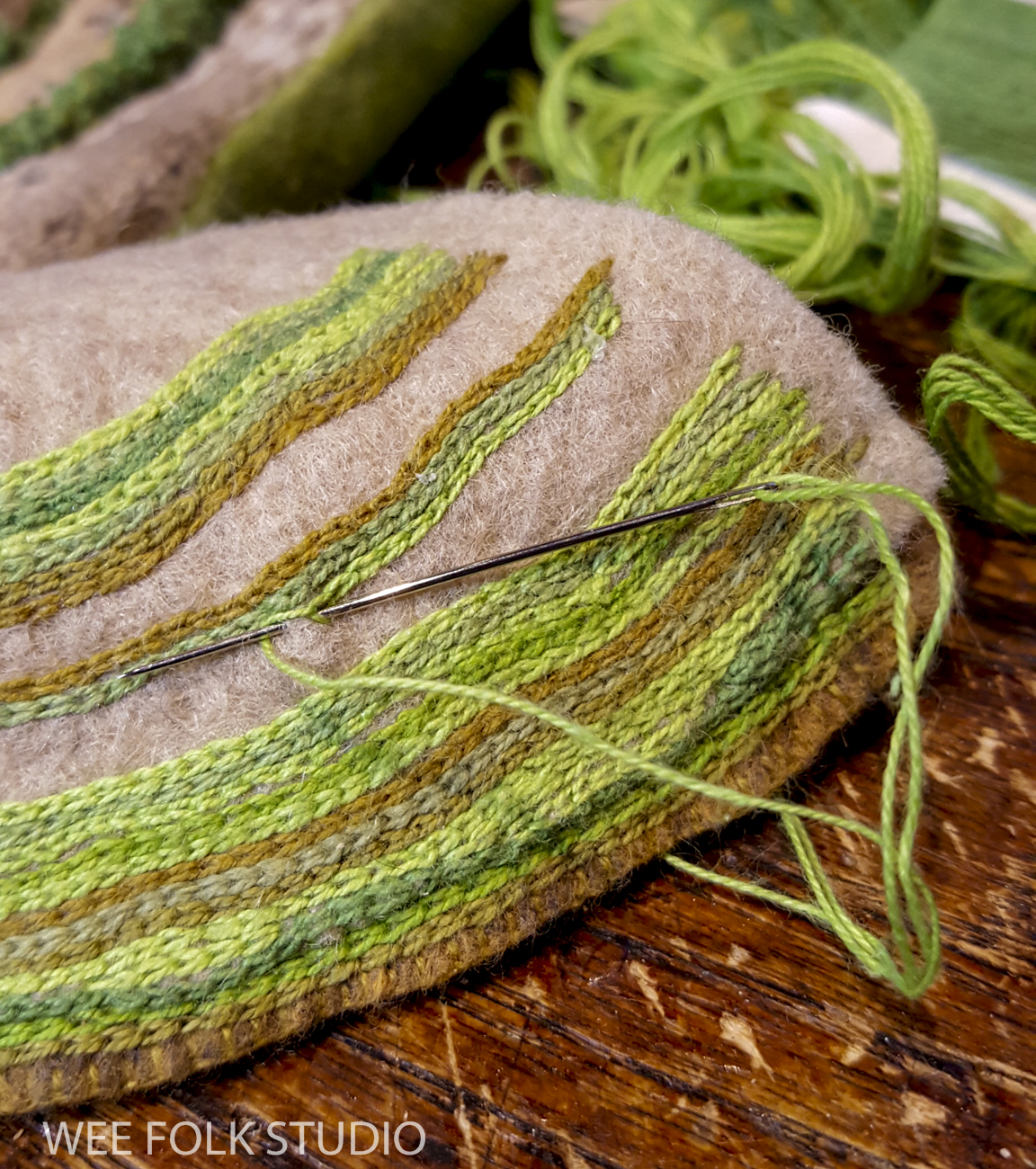
To make the striped concentric pattern, I chain stitched rows and rows of different shades of green and orange DMC cotton flower thread to a piece of felt. It took two tries to get the shape and colors the way I wanted it.

In this Stitch Minute video, I demonstrate chain stitching the stripes and adding wire.

After we filmed it, I wasn’t happy with the overall shape and color combo, so I started over and made a new one that was more curvy and included orange and yellow.

I stitched wire around the outside edge and covered it with white embroidery floss.

Then I made a smaller mushroom and a really little one that looked like a pompom on top of a hat. It’s been a year since I started working on this piece, so my memory is a bit foggy. I can only guess at how I formed the layers into a roof shape and attached it to the driftwood. I do remember that the mushroom wasn’t very cooperative and I had to torture it into shape. Most likely, I glued felt to the wood and then sewed the mushroom to the felt.

During the process, I constantly measured the depth of the trunk to make sure that it would fit behind the glass when the finished piece was framed. After the mushroom roof was added, there was just enough clearance!

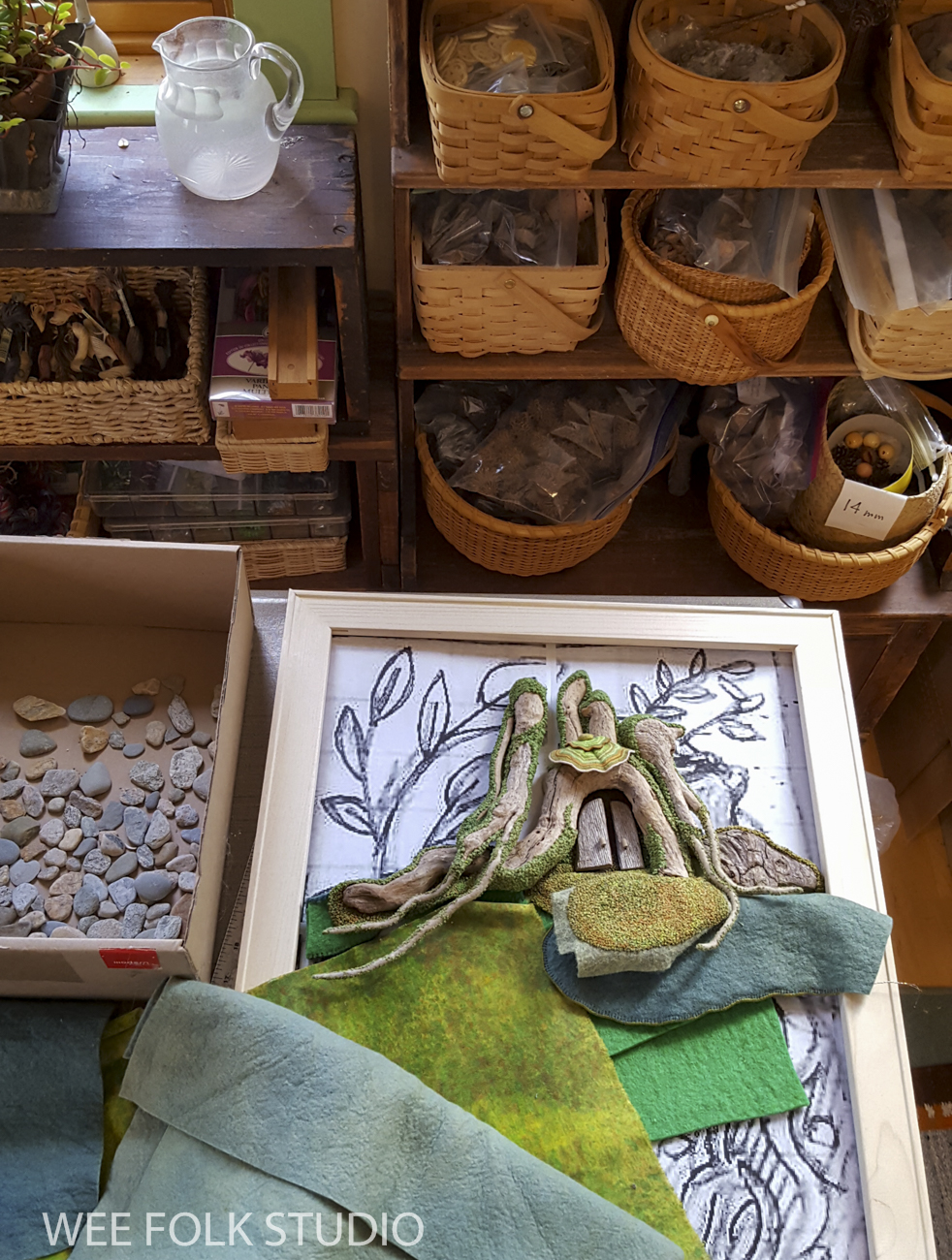
My use of found objects is mostly limited to individual items that are sewn in place and incorporated into embroidered scenes. This trunk was different because it was made up of several driftwood parts that created a fairly large mass that stuck out from the background. Its depth and breadth would determine how I created everything else in the landscape.

Now that the trunk was finished, I could start building the other parts of the scene, including the ground at its base.

Part 3 will show the process of making the felt and stitched foliage growing on the ground at the foot of the tree trunk.

To keep up with new posts, please subscribe to this blog. Your contact info will not be sold or shared. If you’d like to see more frequent photos tracking the projects in my studio, please follow me on Facebook, Instagram and BlueSky.
Summertime: Part 3 – leaves, stems, and branches

As promised, I’m picking up where we left off last year and continuing the series about Summertime, the fourth of my seasonal landscapes. In the coming months, I’ll share photos, videos and commentary about different aspects of the project, from raspberries to wee folk inhabitants to a life size Baltimore Oriole. I went overboard documenting the process, so there’s a ton of material to show. So far, I’ve written an overview of the piece, Part 1 – Tree Trunks, and Part 2 – Tree Houses, Part 4 – Baltimore Oriole (body) , Part 5 – Baltimore Oriole (head and feet), Part 6 – rose vine , Part 7 – raspberry plants, and Part 8 – stitching flora..

Summertime is the summer scene in a series of four seasonal landscapes that capture the wonder and magic of the natural world. Posters, note cards, prints, bookmarks, and jigsaw puzzles of Summertime and the other scenes in the series (Frosty Morning, Mossy Glen and Harvest Time) are available in my Etsy Shop.

See the Four Seasons Series and dozens of other works in my exhibition, To Every Season: Works by Salley Mavor at the New England Quilt Museum, Sept. 9 – Dec. 31, 2025.

Enchanting Threads: The Art of Salley Mavor at the Albany Institute of History and Art

LEAVES
Some of the foliage in this piece are realistic interpretations, like the leaves on the rose vine and raspberry plants (which will be covered in future posts), but others are pure fantasy. I wanted the scene to look believable, without being completely true to life. It’s not biological illustration; I was more interested in creating a unique ecosystem where little people could live alongside birds and berries.

I made the leaves with 3 basic materials – wool felt, wire, and embroidery floss. The following Stitch Minute video demonstrates how to make a simple leaf, edged in wire.

Stitch Minute – leaf

STEMS
Wire is literally the backbone of my work. I use it as a structural framework to keep floppy materials (like felt) firm enough to exist in space, above the background fabric. In this piece, I used copper wire made by Parawire to edge the leaves and form their stems.

The trick is to cover all of the shiny metal with floss. It takes many passes around the wire to make a smooth surface.

This video shows how I wrapped the wire stems on the central tree in the Summertime scene.

For me, making curvy stems and bending them around is like doodling with wire. I’m never sure how a vine is going to grow and climb. This purple bush was calling out for something extra, so I made a curly vine to wrap around its trunk.

In this Stitch Minute video, you can see how I wrapped the curly vine, including its little corkscrew tendril.

BRANCHES
After years of developing ways of making tree branches, my preferred method these days is forming wire armatures and covering them with felt or embroidery floss. I usually embroider a textured “bark” pattern onto the felt before sewing it around the wire. Thicker tree trunks involve a different process, which I wrote about in Part 1.

In the following video, you can see how I stitched felt to cover the section that branches off into 3 separate wire limbs.

Stay tuned for Part 4 in this series, which will be about the Baltimore Oriole. If you want to receive email notices when I publish new posts, please subscribe to this blog using the form below.

To keep up with new posts, please subscribe to this blog. Your contact info will not be sold or shared. If you’d like to see more frequent photos tracking the projects in my studio, please follow me on Facebook, Instagram and BlueSky.

Summertime Poster!

I’m thrilled to announce that 18″ x 24″ posters of Summertime are now available in my shop! This frameable poster is the closest thing to seeing the piece in person, which I realize is out of reach for many of you (visit this page for current exhibitions). The original bas-relief embroidered scene is just an inch larger than the printed reproduction, so the scale of the wee folk, raspberries, and thousands of stitches is very similar to their actual size. If you’ve seen my other posters, like the one of Birds of Beebe Woods, you know that the photography and printing quality is very good, too.

Will the other scenes in the series, Frosty Morning, Harvest Time, and Mossy Glen be made into posters as well? It really depends on how much interest there is. I’d like to eventually offer all four seasons, but first I’m testing the market with Summertime posters to determine if it’s worth the financial investment. I’m excited to be adding Summertime posters to the list of books, notecards, puzzles, notebooks and bookmarks now available in my shop.

Enter Salley Mavor’s Etsy Shop

Summertime is one of four seasonal landscapes that will be icluded in my solo exhibition, Works by Salley Mavor: To Every Season at the New England Quilt Museum, Sept. 9 – Dec. 27, 2025.

The Four Seasons series is included in “Enchanted Threads: The Art of Salley Mavor” at the
Albany Institute of History and Art in Albany, NY.

To keep up with new posts, please subscribe to this blog. Your contact info will not be sold or shared. If you’d like to see more frequent photos tracking the projects in my studio, please follow me on Facebook, Instagram and BlueSky.

Enchanting Threads opens!

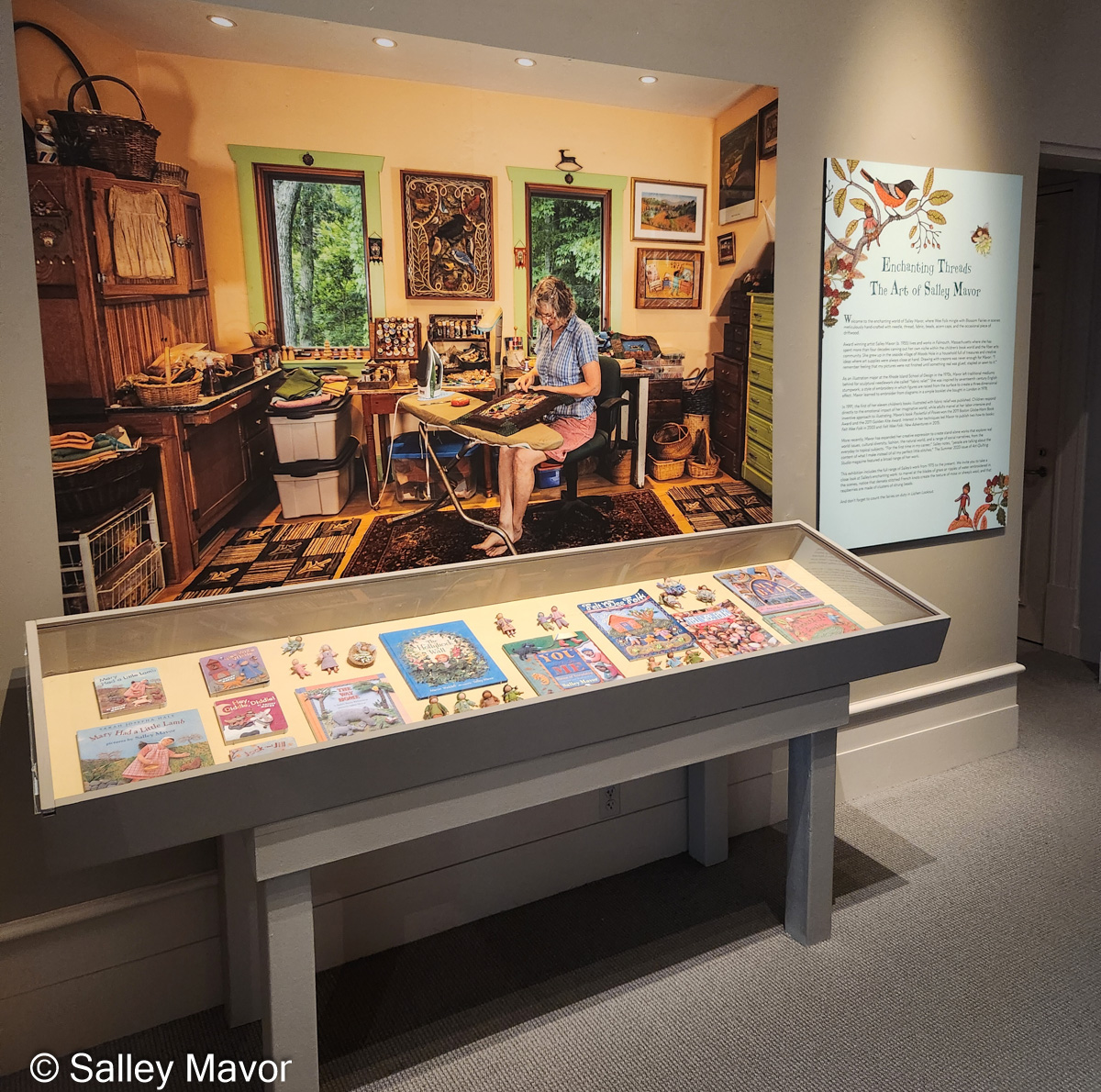
I’m excited to share photos of my new exhibition, which opened last weekend at the Albany Institute of History & Art. Enchanting Threads: The Art of Salley Mavor will be on view for 7 months, through March 2, 2025. So, there’s plenty of time to plan a trip to Albany, NY with your friends and family! For those who live too far away to visit, I’ll try to give you an idea of how the show looks.

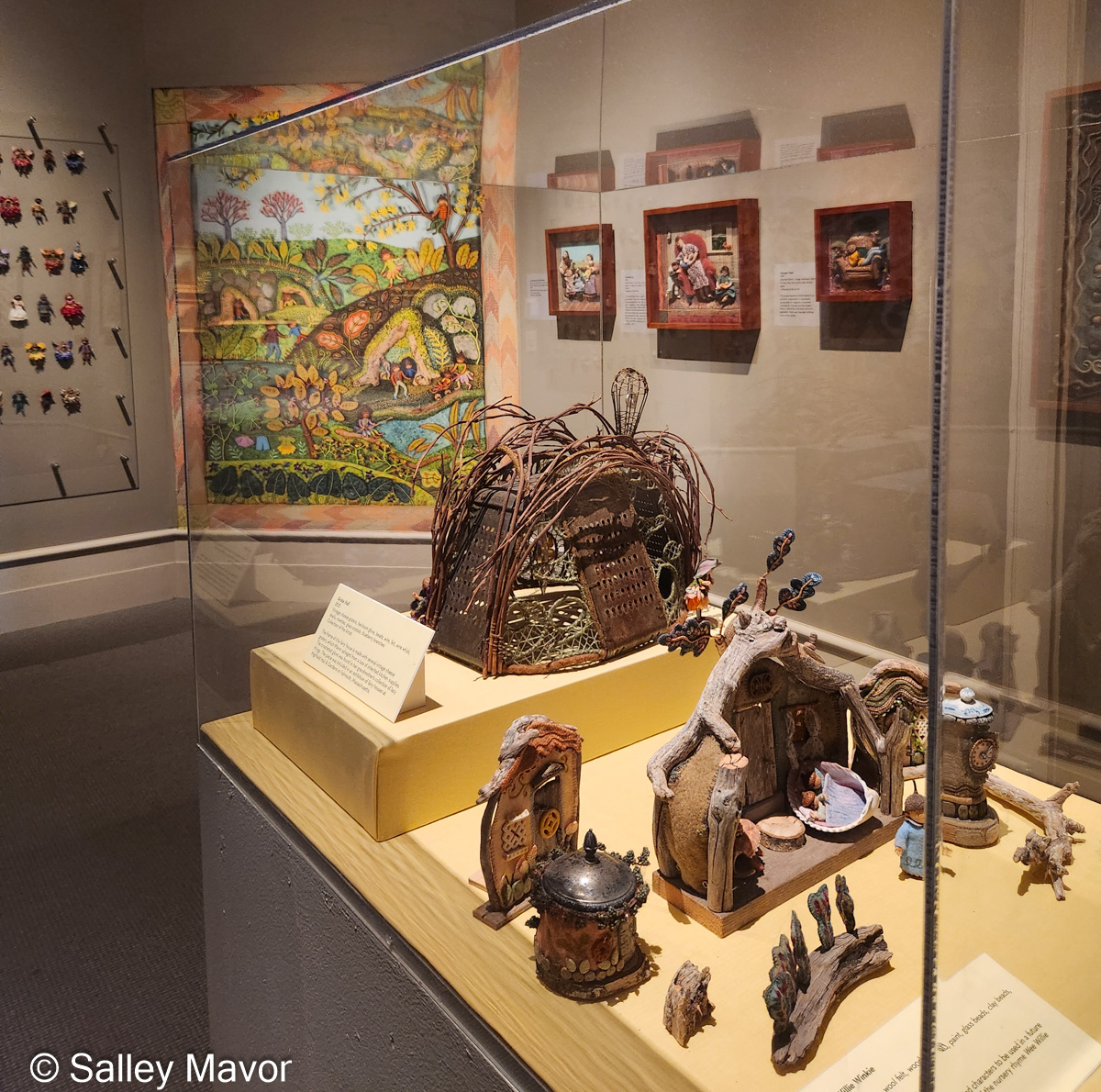
The museum’s exhibition team did a fantastic job designing the layout and hanging my artwork, which is spread throughout 4 galleries. It’s one of the most artful and tasteful presentations of my life’s work that I’ve seen!

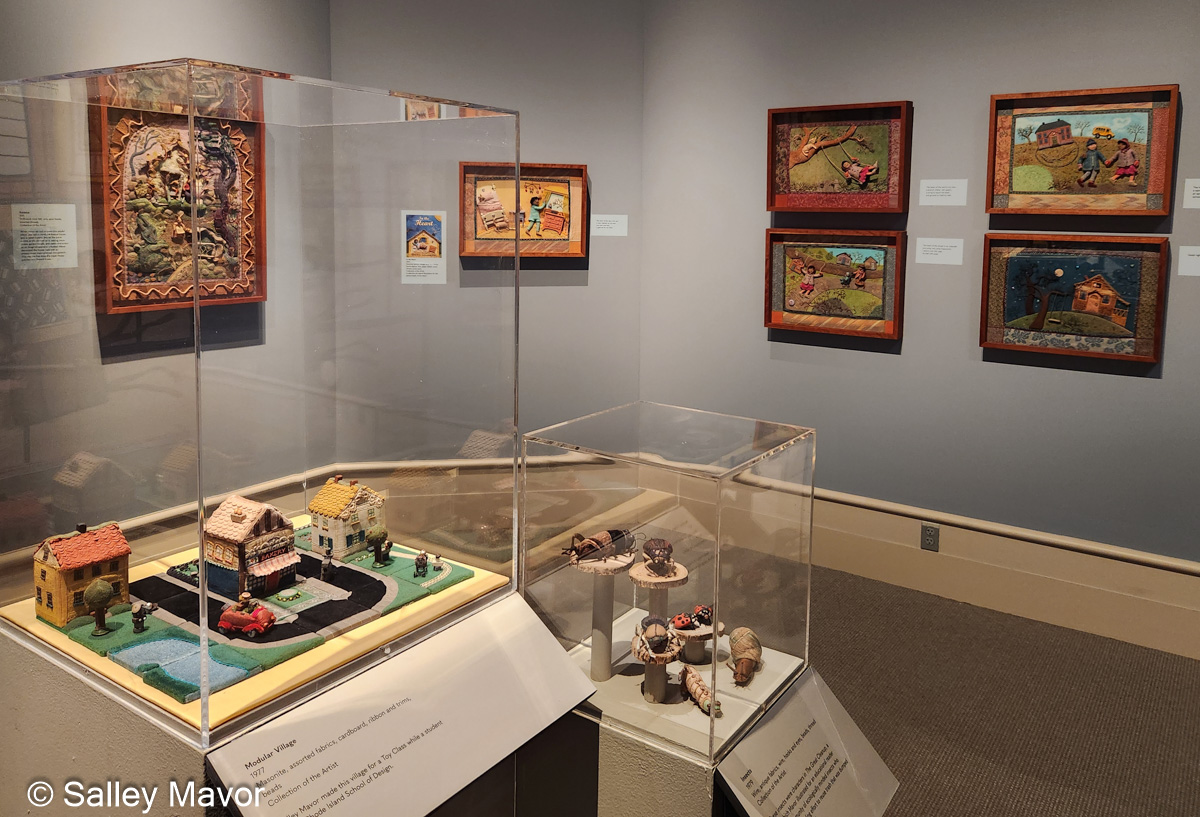
For the first time, visitors will see both original embroidered artwork and 8 ft. tall printed enlargements of some pieces, including Summertime, from my series of seasonal landscapes. I’m glad that Rob took hires photos, so that the blown-up reproductions are clear enough to see every stitch. It feels as if you could step inside the scene and pick raspberries!

The framed 24″ high originals in the four seasons series are displayed together. Over the past few years I’ve documented the process of making Mossy Glen, Summertime, Harvest Time, and Frosty Morning with photos, videos and commentary.

Seasonal Landscape Series

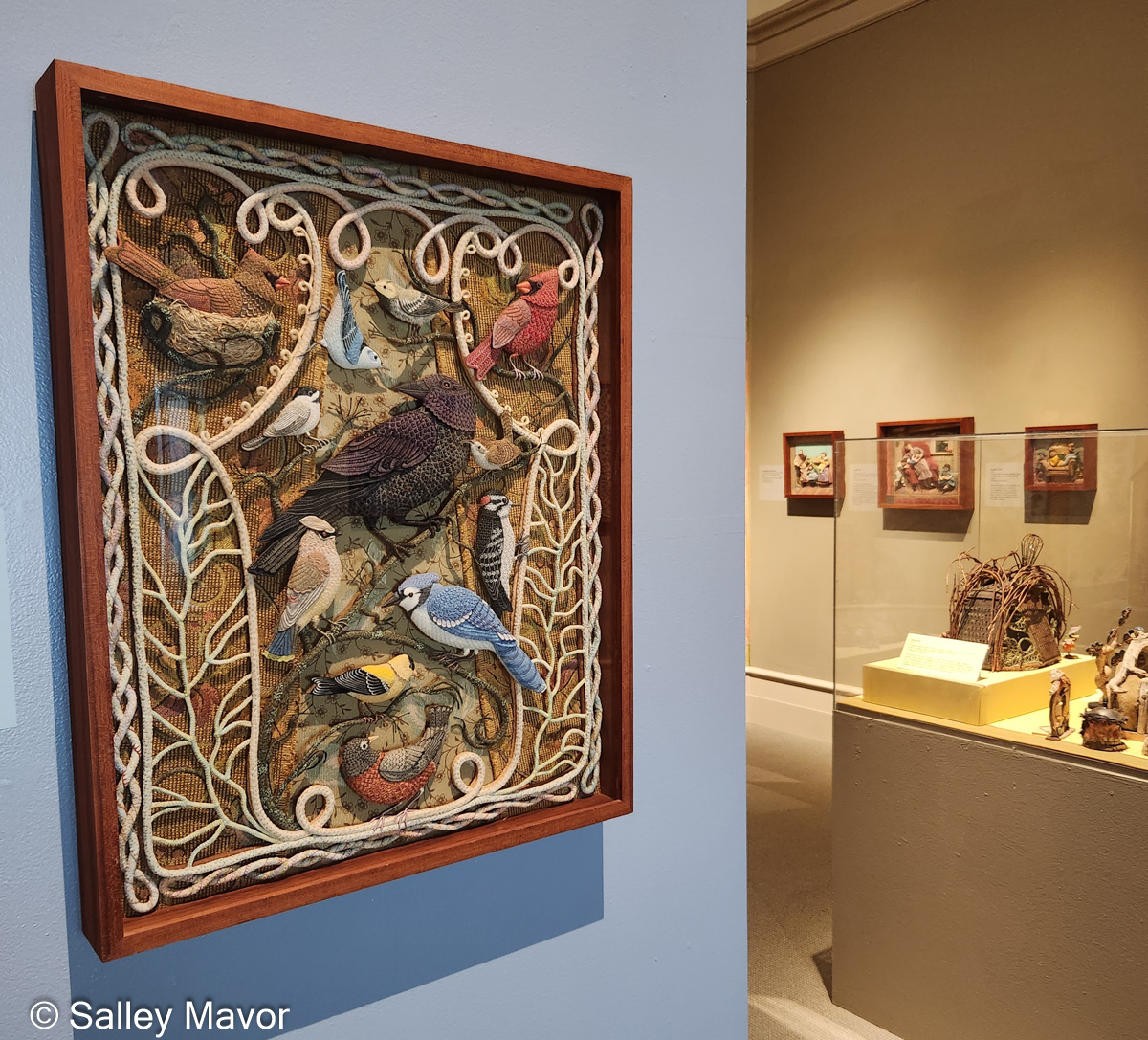
Enchanting Threads includes just about everything in my personal collection, from the doll house I made in 1975 to Birds of Beebe Woods. Past exhibitions have included several pieces on loan from private collectors, but I figured that borrowing artwork from their owners for 7 months was too much to ask.

Birds of Beebe Woods

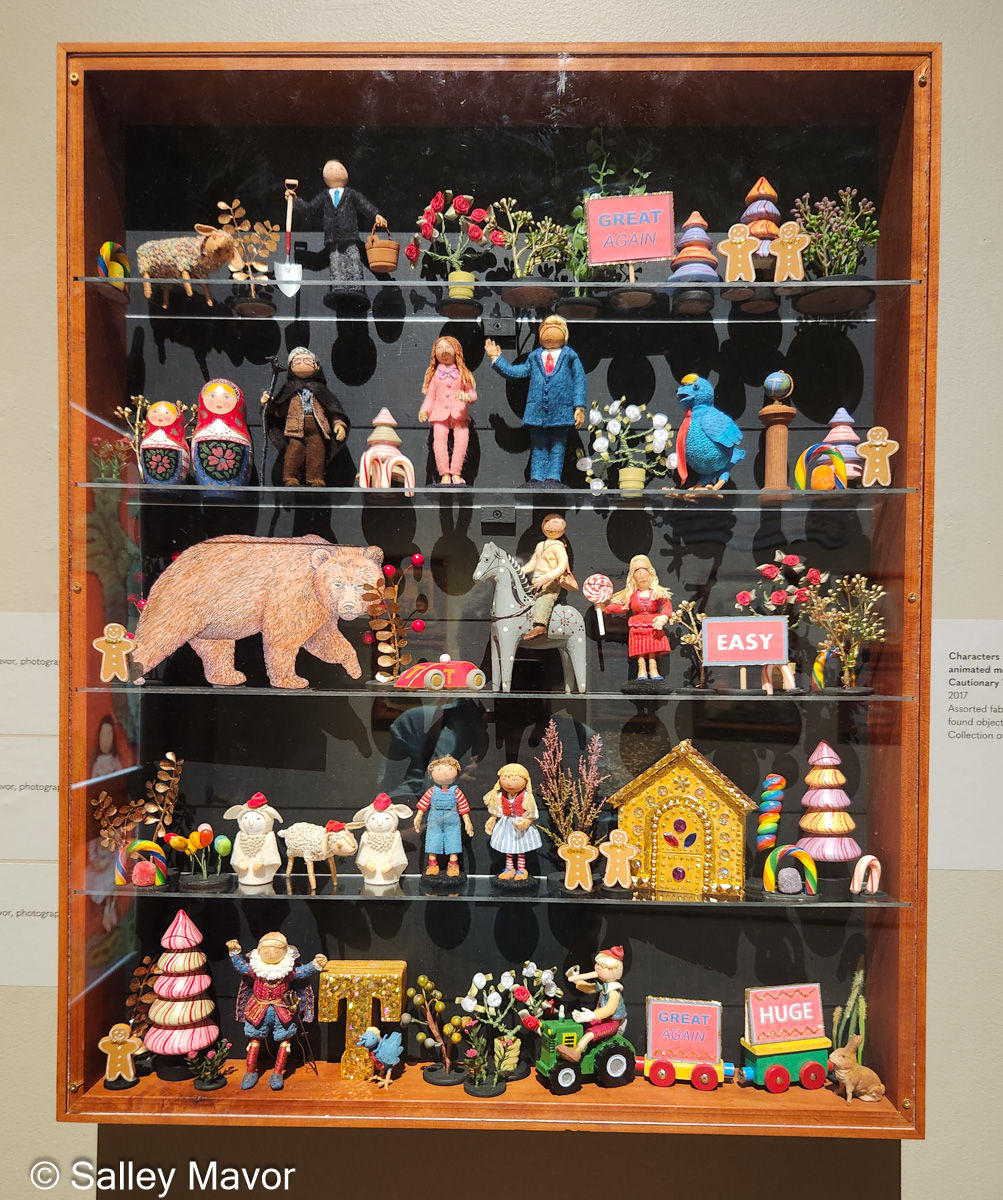
The show features over 100 framed tableaus, original picture book illustrations, and sculptural objects from the past 40 years, including fairy houses, walls crowded with wee folk dolls, and the cast of characters from my stop-motion film Liberty and Justice.

Characters, props and scenery from the stop-motion film, Liberty and Justice.

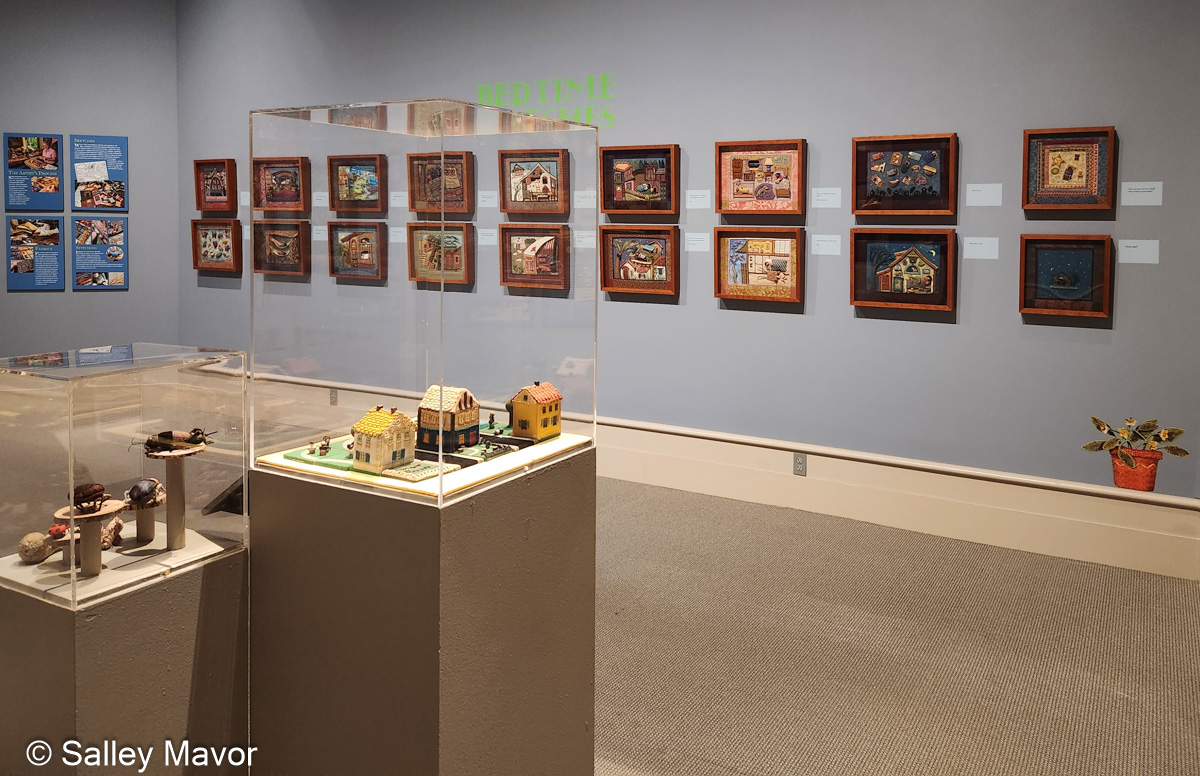
Bedtime Stitches, the touring exhibition of the entire collection of original illustrations for my most recent picture book, MY BED: Enchanting Ways to Fall Asleep around the World, is included, too. To find out where Bedtime Stitches is going next, please visit the Exhibitions Page.

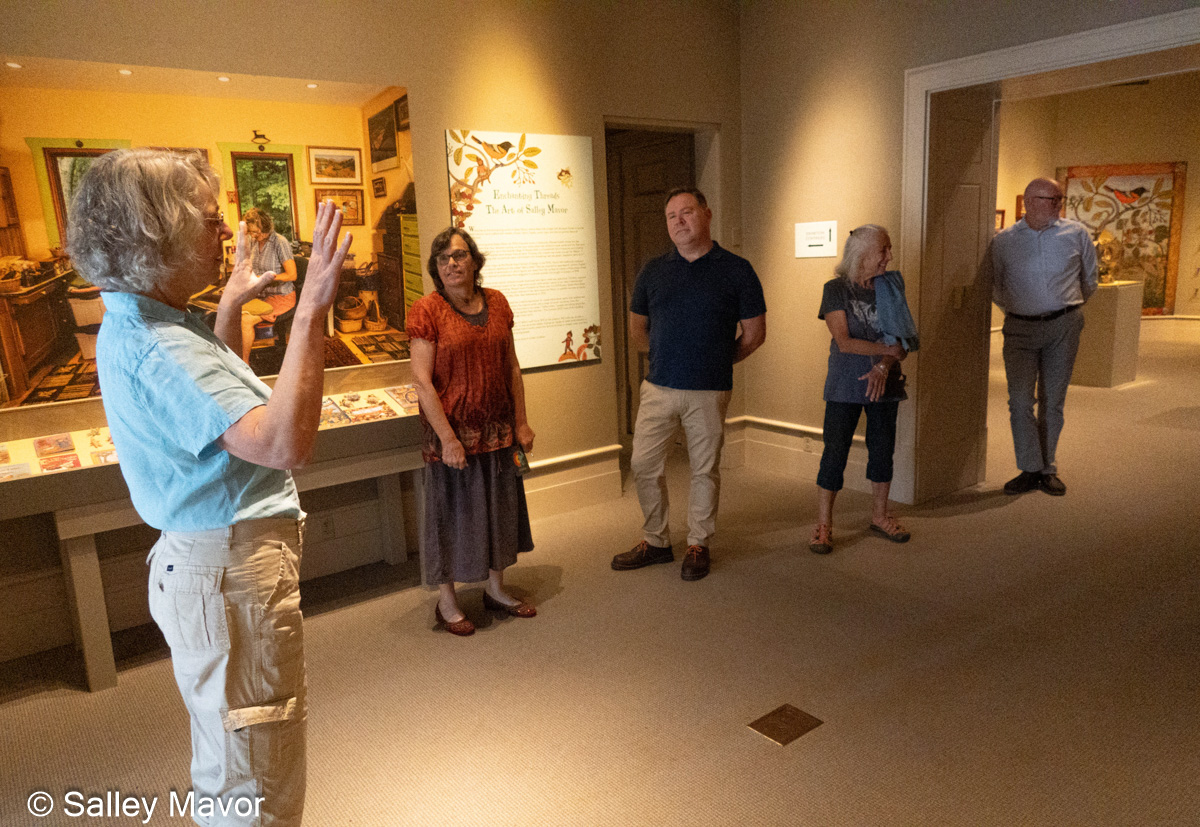
I had an opportunity to walk around the galleries with museum staff and docents, and answer questions that they thought visitors would be curious about, such as how long it takes to make a piece (2 to 6 months) and if everything is really hand stitched (it is). I’m looking forward to returning to Albany to give a talk about my work to the general public in early December (date TBA).

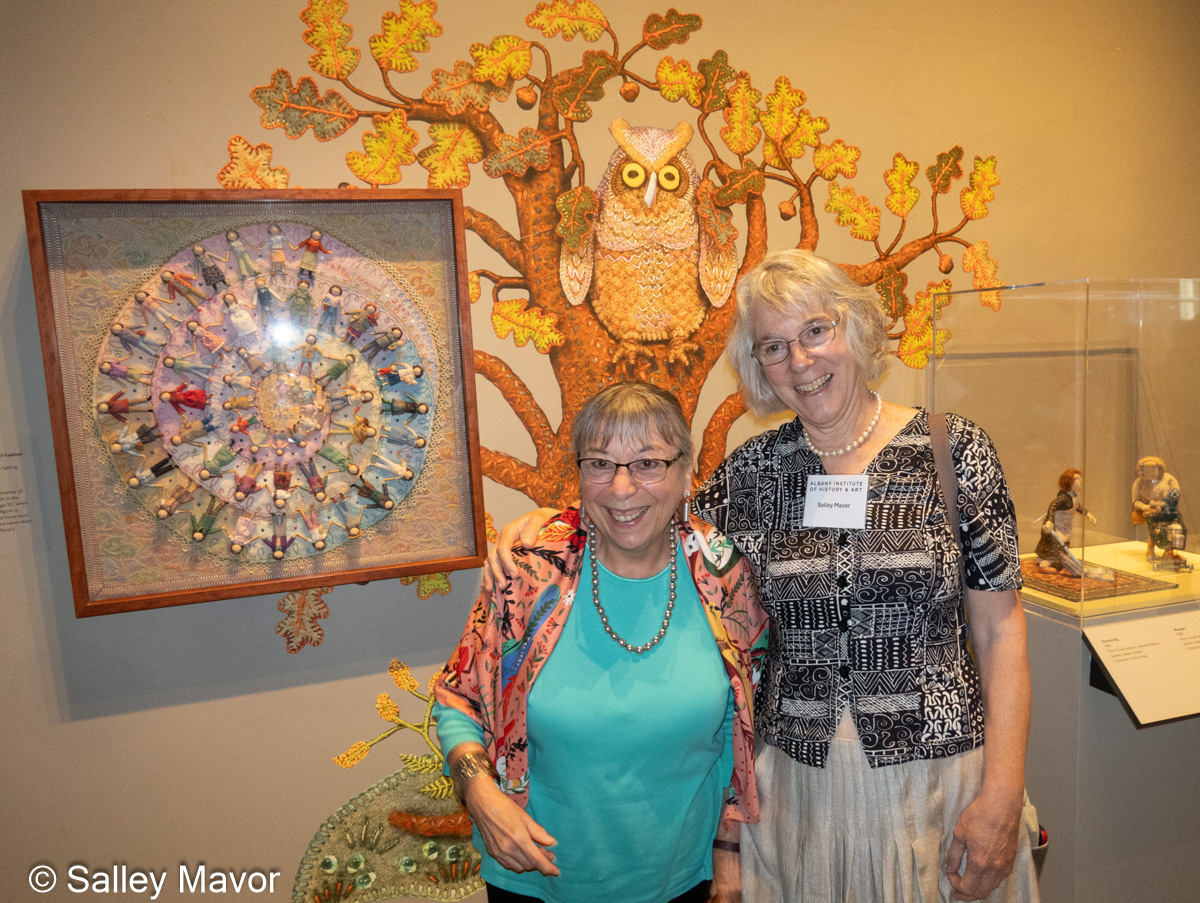
At the opening, I had the pleasure of meeting Janny Mironchuk, a long-time fan, who is responsible for bringing my work to the Albany Institute of History & Art. At my urging, she contacted the museum’s curator and suggested that they consider hosting an exhibition of my work. I’m grateful to Janny for approaching the museum and helping to set the stars in alinement for this exhibition to happen!

Over the years, I’ve come to realize that landing an art show is an art in itself, with no sure path to getting there. For me, attracting the attention of exhibition committees and curators hasn’t been easy. I’ve sent out countless proposals that go unanswered, but every once in a while, I hear from a venue that wants to work with me. These opportunities often involve fans who are passionate about my work and want to see it in person, close to where they live. A personal recommendation from someone who is part of a museum’s local community can sometimes convey enthusiasm better than an artist’s own entreaty can, especially if one’s art is not easily defined. Happily, plans are underway for two solo exhibitions in 2025 and 2027, which will be listed on the Exhibitions Page when their locations and dates are confirmed. That being said, I certainly welcome inquiries from museums and art centers who are interested in hosting future exhibitions.

I believe that my embroidered pieces have the most value when they are put on public display, where people can become emersed in their detail and 3-demensional quality up close. That’s why I’ve decided not to deplete my supply of original artwork by selling it. (Books, prints, cards and puzzles are for sale in my shop.) Otherwise, it would take many years to create enough new pieces to fill an exhibition space. Now, I always have a body of work available to show. After 50 years of single-minded dedication to making art, I feel a shift taking place. Instead of stitching every spare minute, I’m happy to take time to play with my grandchildren and weed the garden. I don’t know what’s coming next, but my wish is to keep living an artistic life and to share my vision with the world.

To keep up with new posts, please subscribe to this blog. Your contact info will not be sold or shared. If you’d like to see more frequent photos tracking the projects in my studio, please follow me on Facebook, Instagram and BlueSky.
Summertime: Part 1 – Tree Trunks

In this Part 1 of the series about making Summertime, I share photos and commentary about how I created the tree trunks, which provide the framework for the whole composition. In this post, I reveal what’s inside the trunks and show how I covered them with felt and embroidered embellishment. Future posts will discuss other elements of the piece, including the treehouses, plants, raspberries, wee folk, and the Baltimore Oriole. So far, I’ve written an overview of the piece, Part 1 – Tree Trunks, Part 2 – Tree Houses, Part 3 – leaves, stems & branches, Part 4 – Baltimore Oriole (body), Part 5 – Baltimore Oriole (head and feet), Part 6 – rose vine, Part 7 – raspberry plants, and Part 8 – stitching flora.

Summertime is the summer scene in a series of four seasonal landscapes that capture the wonder and magic of the natural world. Posters, note cards, prints, bookmarks, and jigsaw puzzles of Summertime and the other scenes in the series (Frosty Morning, Mossy Glen and Harvest Time) are available in my Etsy Shop.

See the Four Seasons Series and dozens of other works in my exhibition, To Every Season: Works by Salley Mavor at the New England Quilt Museum, Sept. 9 – Dec. 31, 2025.

Before threading the first needle, I pictured the scene in my head for months, mostly while taking walks or riding on the bike path. During this early stage of the process, I made a lot of thumbnail sketches and worked out the basic design. Once I could clearly see a path forward, I enlarged a drawing to the full 19″ x 24″ size and used it as a simple guideline. All of the color choices, design changes, and stitching details would come later, as the piece evolved.

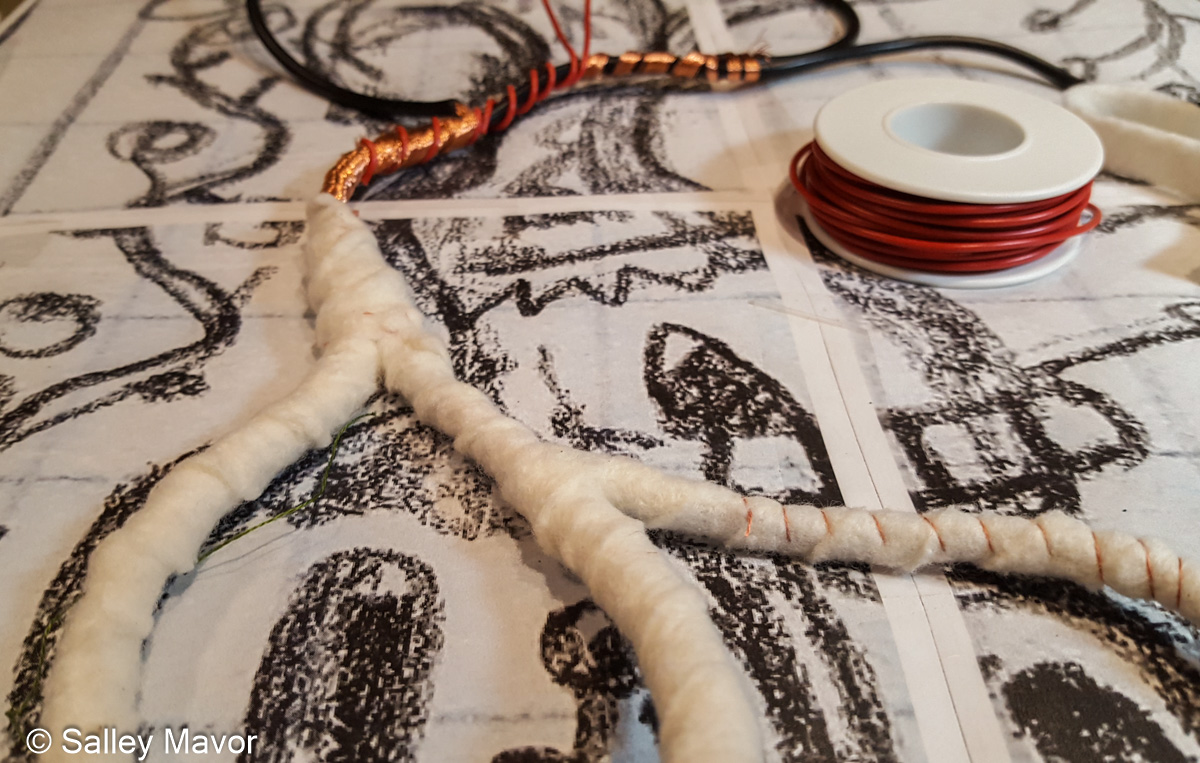
I formed the structure of the tree with insulated electrical wire of different thicknesses that I found at the hardware store. To make forked branches, I stripped the plastic coating at the ends and wound the exposed copper wire around the adjoining branches. The whole idea was to make an armature that was flexible and strong enough to bend and manipulate as needed.

To build up the thickness of the tree, I wrapped the wire with cut strips of cotton quilt batting, which I roughly stitched in place.

The next step was to cover the padded wire with wool felt. I started by stitching felt pieces to the back of the tree trunk and branches, making a flat surface that would eventually be sewn to the background sky.
Then I stitched pieces of felt over the curved front. The photo below gives a view from the back, as I overlapped the front strip of felt over the back piece. The messy seams will all be covered with embroidery and hidden in the back.
After covering the tree with felt, I stitched a zigzag “bark” texture up and down the branches with pima cotton.

At first, I liked how the pink and tan variegated thread looked, but soon realized that it alone was too subtle and needed more saturated accent colors to help it pop in contrast to the sky background.

I added bright turquoise and then decided to go even further with hot pink, which I also used to create a cross-hatched effect along the sides of the trunks.

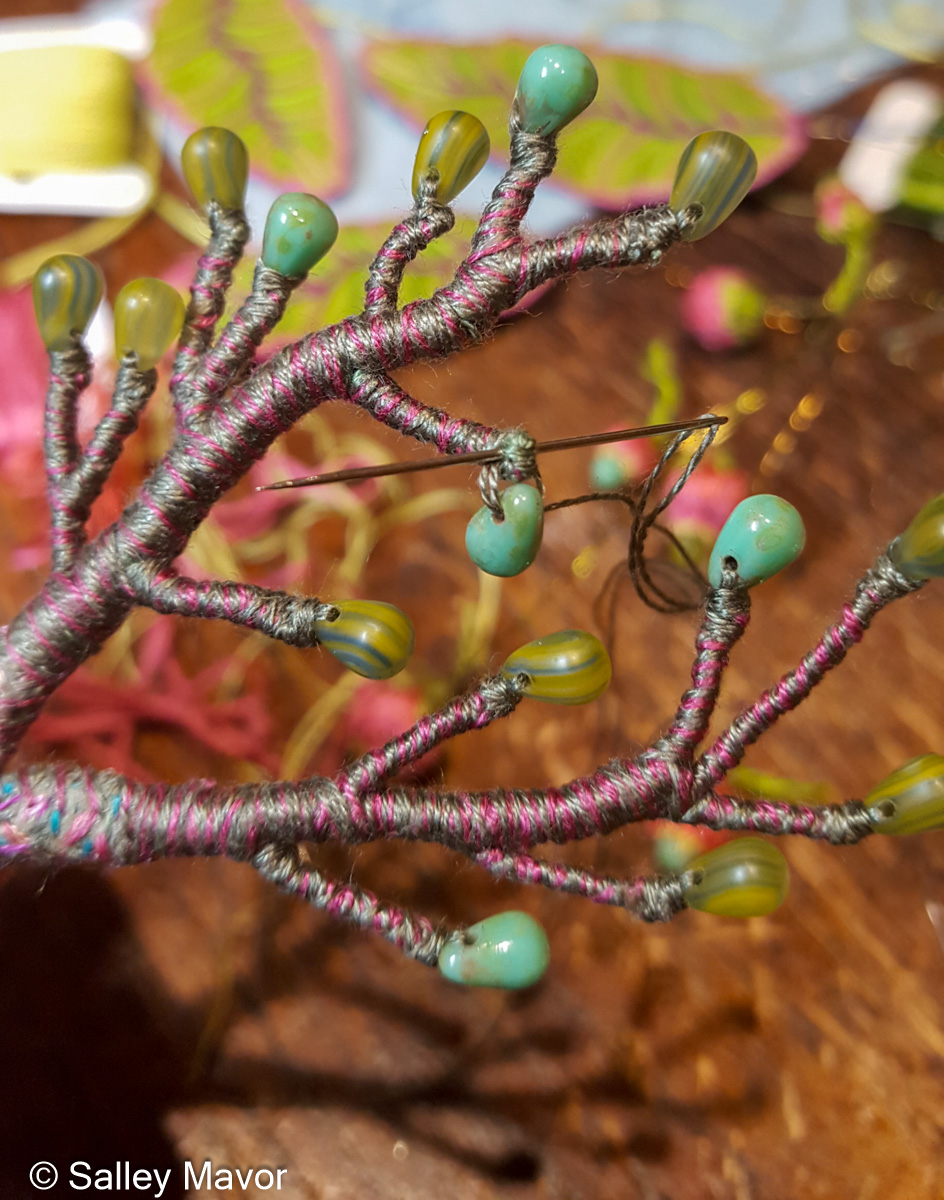
I used finer gauge wire to form the smaller branches and wrapped them with embroidery floss.

I sewed some glass beads that have been stored in my stash for 20 years to the tips of the branches. It felt so good to finally put them to use!

Stay tuned for future posts in this series about Summertime. In Part 2, I will show how I made the thatch-roofed treehouses nestled into the tree trunks. If you want to receive email notices when I publish new posts, please subscribe to this blog using the form below.

To keep up with new posts, please subscribe to this blog. Your contact info will not be sold or shared. If you’d like to see more frequent photos tracking the projects in my studio, please follow me on Facebook, Instagram and BlueSky.