bed book peek – cow

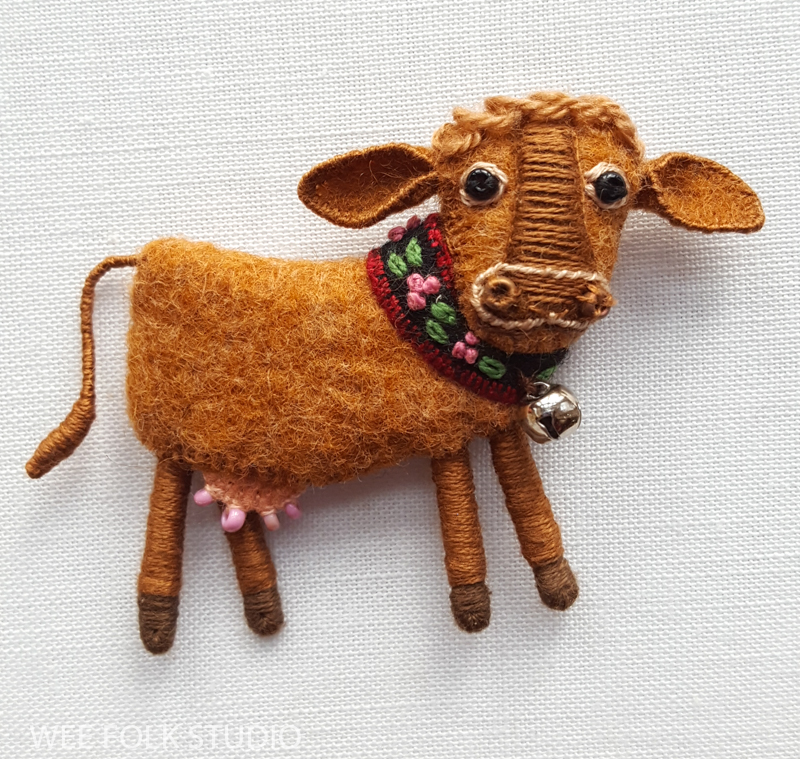
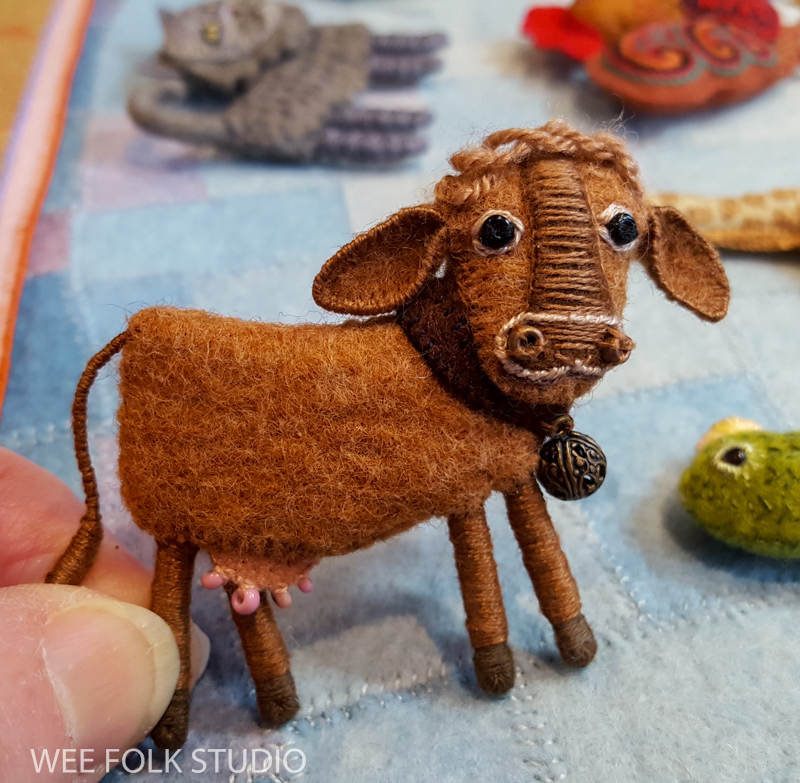
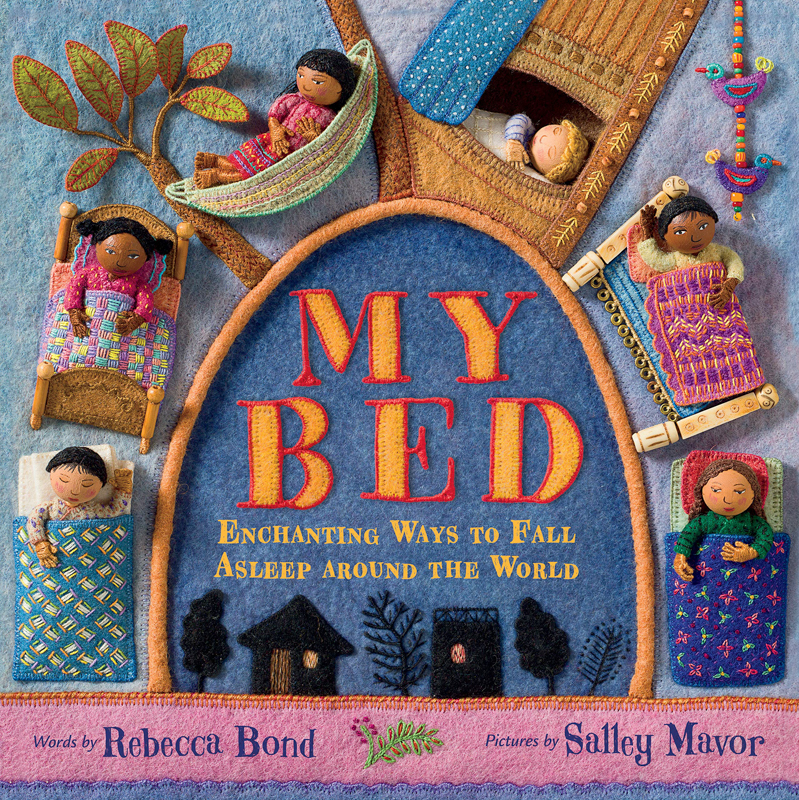
Today, I’m happy to show how I made this cow, which will be used as a spot illustration in my upcoming picture book, MY BED. The story is about children’s sleeping places in different cultures around the world. It’s written by Rebecca Bond and will be published by Houghton Mifflin Harcourt in Sept. 2020. Autographed copies can be pre-ordered in my shop here. A touring exhibition of my original embroidered artwork for the book, Salley Mavor: Bedtime Stitches, will travel around the United States beginning in Nov. 2020. See the updated tour schedule here.

Update: Signed copies of My Bed can ordered in my shop here. 40 pages, 9″ x 9″, words by Rebecca Bond, pictures by Salley Mavor, published by Houghton Mifflin Harcourt. ISBN 978-0-544-94906-5

Each country or region represented in the book has an animal icon that appears on the text panel adjacent to the full illustration. The cow shows up next to the Scandinavian scene, which I’ve written about here.

To see the other animals from the book that I’ve written about so far, please click on the following links.
Animals (spot illustrations) – Rooster, Camel, Parrot, Elephant, Goldfish, Cat, Duck, Sheep, Rabbit

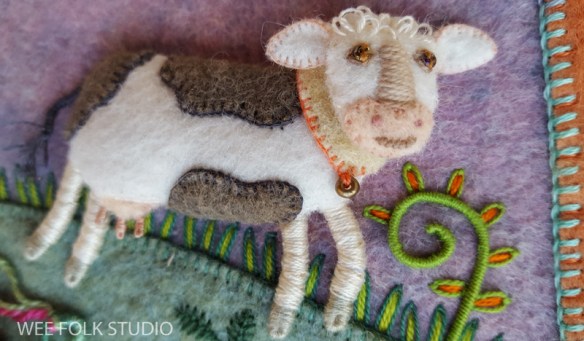
I’ve enjoyed making cows over the years, including the one below, which is from the 2005 board book, Hey, Diddle, Diddle! (Sorry, it’s out of print) Cows are fun to depict because they are so distinct from other animals.

Close Up from “Hey, Diddle, Diddle!” 2005 board book

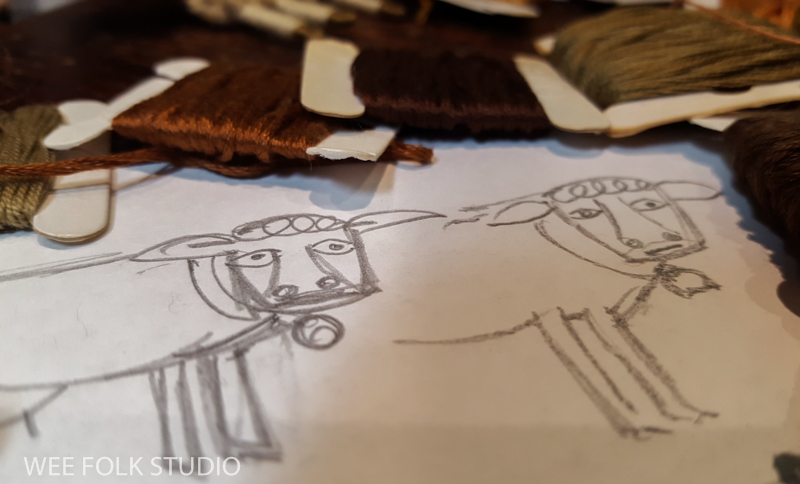
To begin, I drew sketches that exaggerated the cow’s squarish head, outspread ears, big eyes and prominent nostrils.

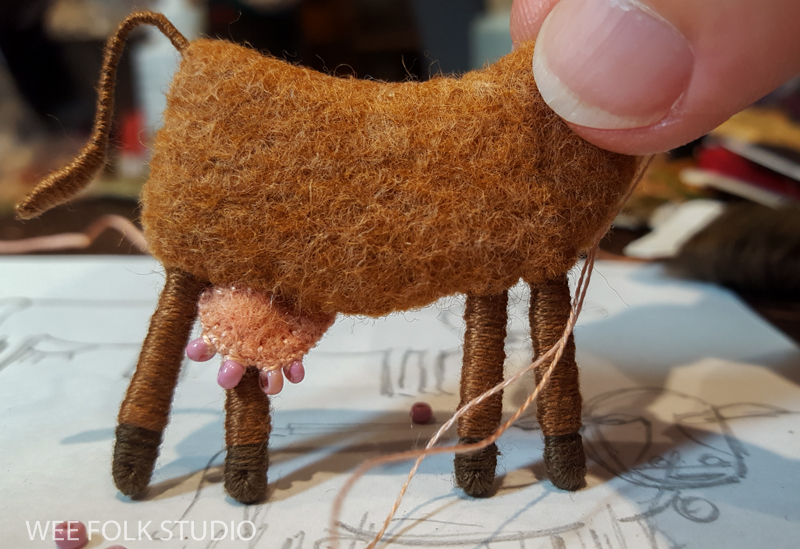
As always, I wrapped the legs first, leaving enough extra pipe cleaner to shape the body.

It’s been a while since I made this, so I can’t remember how I attached the felt body. From the looks of it, I first added a thread wrapped wire tail and then stitched pieces of felt to the front and back of the pipe cleaner form.

Then, I made a little pink felt udder with seed bead teats.

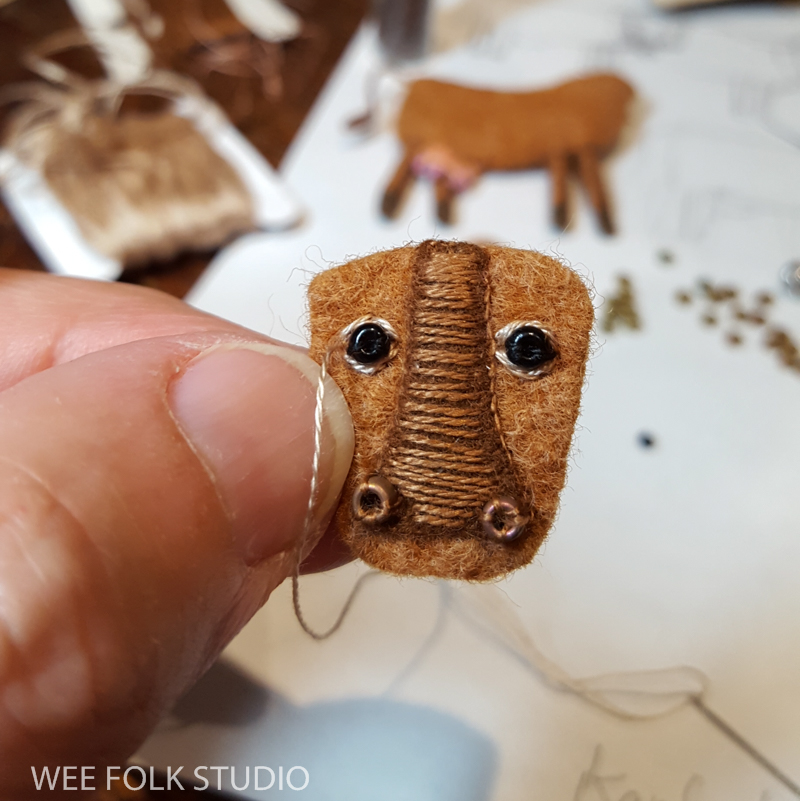
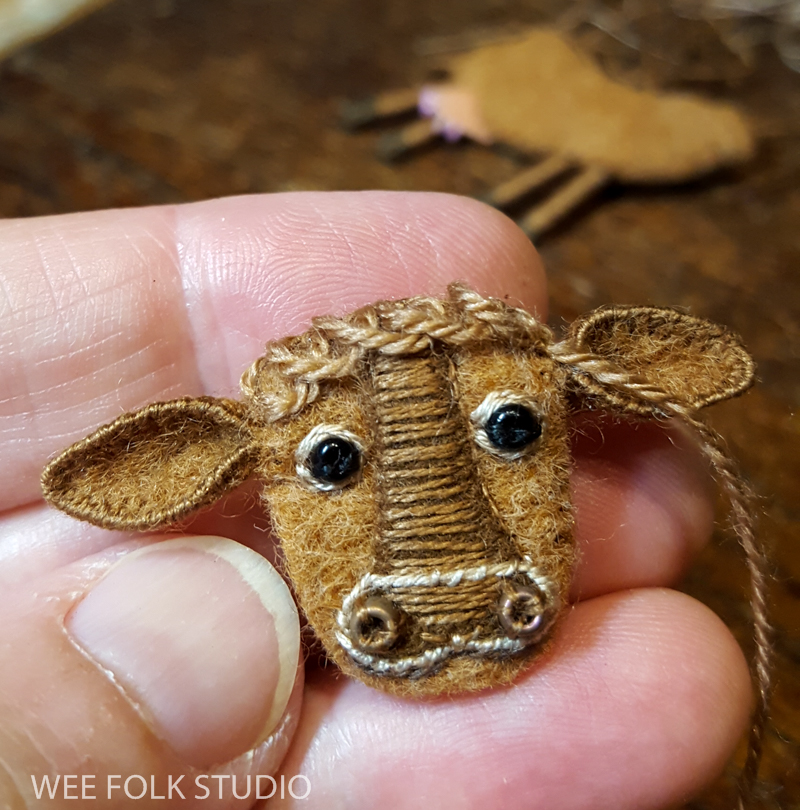
For the cow’s face, I embroidered a nose and sewed on bead nostrils.

To make the eyes more prominent, I outlined them in white.

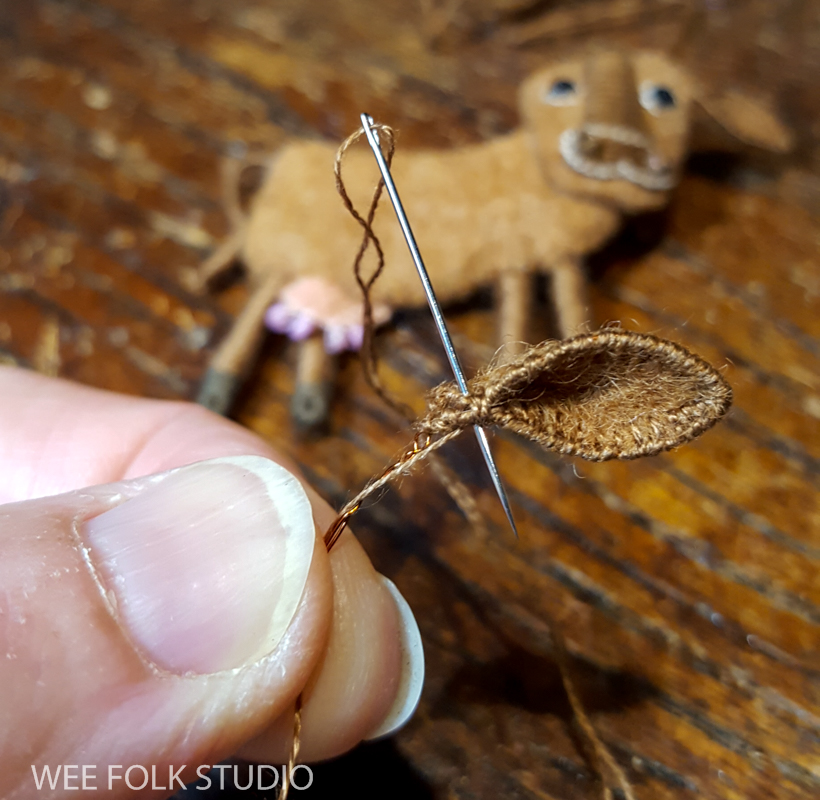
The ears are felt, edged with blanket stitch and wire.

After sewing the ears in place, I looped Silk/Merino wool thread on the top of her head.

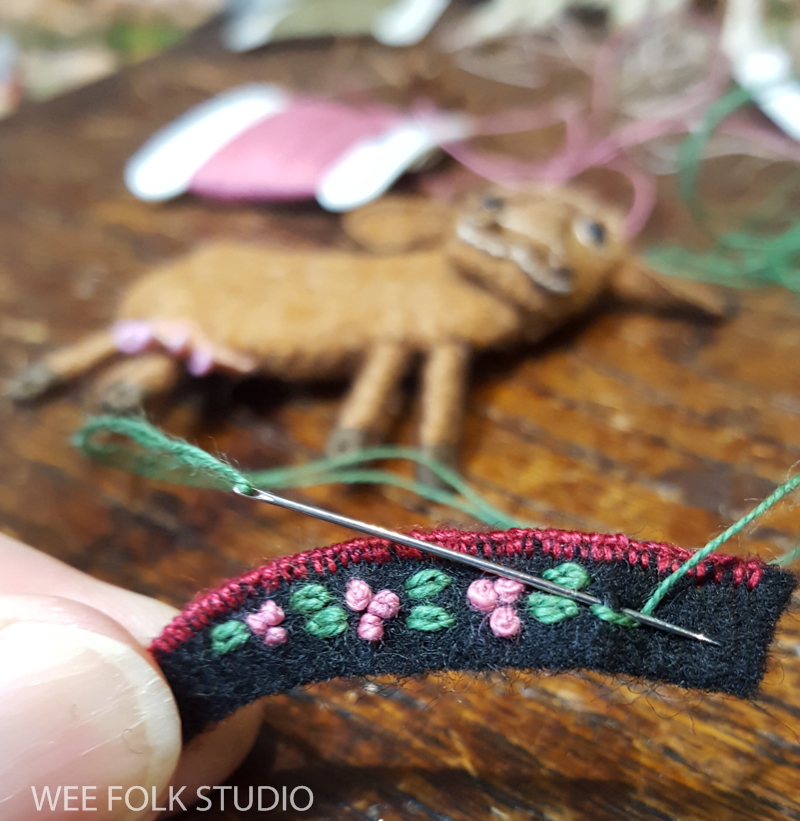
The first cow collar I made was embroidered with pretty flowers, but I had to change it to a plainer version because decorations like that are a Swiss specialty and not Scandinavian.

Before (above) and After (below).

To keep up with new posts, please subscribe to this blog. Your contact info will not be sold or shared. If you’d like to see more frequent photos tracking the projects in my studio, please follow me on Facebook and/or Instagram

scavenger hunt

The scavenger hunt at my retrospective exhibition of original picture book art at the Cape Cod Museum of Art has been a hit! Not just with kids, but with all ages. Searching for the details is a fun way to engage with the artwork and helps you see things you might not otherwise notice.

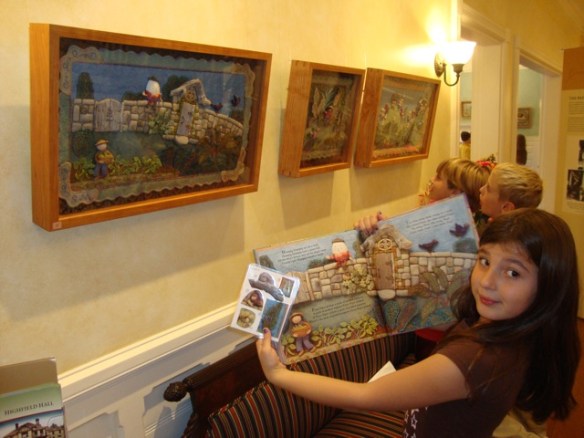
I got the idea from my friend Deb Coulombe, who 10 years ago, put together cards for school groups who came to see the touring exhibition of original art from Pocketful of Posies. With the hunt, the kids experienced my artwork in a playful way that enhanced their museum experience.

So, I took the scavenger hunt concept and brought it to “Salley Mavor: Once Upon a Stitch”, which will be on display for only one more week, until Sunday, Jan. 26th. People are coming from far and wide to see the show, driving and even flying in from out of state. If you’re thinking of making the trip, please note that the Cape Cod Museum of Art is open Thursday 10 am – 7 pm, Friday – Saturday 10 am – 4 pm, Sunday 12 noon – 4 pm. 

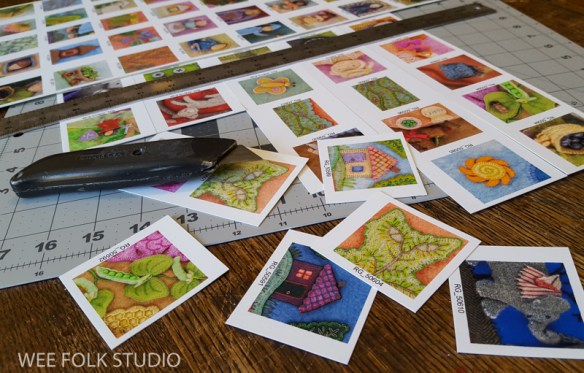
Rob and I spent last fall photographing closeup images of the artwork to use in the scavenger hunt. Because my pieces are sculptural, its a challenge to take pictures that bring out the detail and 3-dimensional quality of the real thing. We’ve tried different approaches, sometimes using a light box (above) to diffuse the light and soften the shadows. I’m constantly getting in the way, fussing and tweaking, which drives Rob crazy!

Rob printed the images on good quality paper on his super duper Epson printer and I cut them up. Even though they’re all square, it reminded me of playing with paper dolls.

Then I divided them up into groups of 4 that I knew would keep people moving around the gallery, like an aerobic activity.

Anyone can play the game and choose from about 20 different laminated cards in the gallery.

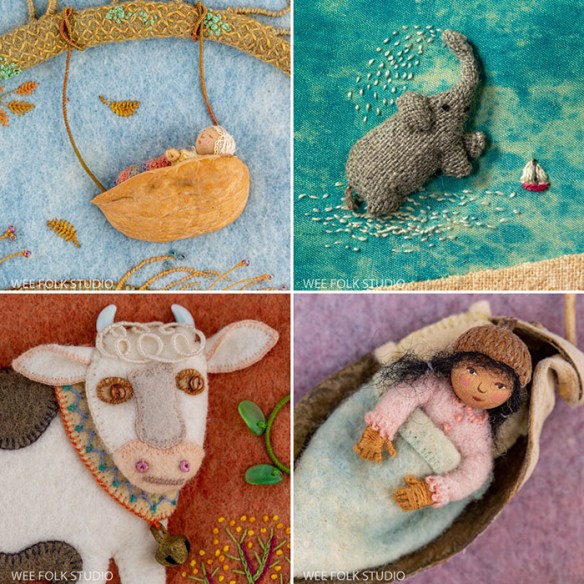
You can also do the scavenger hunt at home by searching for the following images in my books. Each group of 4 that you see below is labeled with a list of books where you can find the images. Have fun!

Details from “Pocketful of Posies”
Details from “Hey, Diddle, Diddle!”, Pocketful of Posies and “In the Heart”
Details from Pocketful of Posies”, “The Way Home”, “Hey, Diddle, Diddle!” and “Wee Willie Winkie”
Details from “Pocketful of Posies, “Mary Had a Little Lamb”, You and Me” and “Come to My Party”
Details from Pocketful of Posies” and You and Me”
Details from “Pocketful of Posies” and “Jack and Jill”

SALLEY MAVOR: Once Upon a Stitch
Dec. 12, 2019 – Jan. 26, 2020

Cape Cod Museum of Art, Dennis, MA
Winter hours: Thursday 10am – 7pm,
Friday – Saturday 10 – 4, Sunday 12 – 4

To keep up with new posts, subscribe to this blog (top right column on the home page). Your contact info will not be shared. If you’d like to see more frequent photos tracking the projects in my studio, please follow me on Facebook and/or Instagram.

Behind the Glass – part 2

Hey Diddle, Diddle! 2005

In this second post in the series Behind the Glass, I’ll show close-up photos of a double page spread reproduced in Hey Diddle, Diddle! (2005) and 2 illustrations from You and Me: Poems of Friendship (1997). You can see part 1 in the series here. These loaned pieces were temporarily removed from their frames in preparation for my upcoming exhibition, making it possible to get up close and take photos from different angles. I’m enjoying seeing the characters again and remembering making them all those years ago.

Hey Diddle, Diddle! 2005

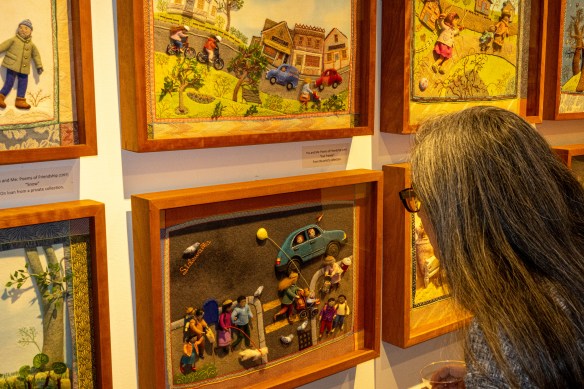
The retrospective exhibition, Salley Mavor: Once Upon a Thread will be at the Cape Cod Museum of Art Dec. 12, 2019 – Jan. 16, 2020. It will include original illustrations from my picture books, from the first (The Way Home,1991) to the latest (Pocketful of Posies 2010).  Between the borrowed ones and others that I’ve kept, there will be lots of original pieces on display, with a dozen titles represented. This show will be an opportunity for visitors to see the detail and 3-dimensional quality of my artwork in person and also view pieces from private collections that are rarely shown in public.

Hey Diddle, Diddle! 2005

Yes, that’s a real silver spoon, a tiny one meant to go with a salt seller. The plate was cut out of Fimo clay with a cookie cutter. After hardening it in the oven, I painted the face and dish pattern.

Hey Diddle, Diddle! 2005

The next set of images show closeups of 2 spreads from You and Me: Poems of Friendship (1997). One illustrates the poem Sidewalks, which describes different ways of showing oneself and interacting on a public sidewalk.

Sidewalks, You and Me: Poems of Friendship 1997

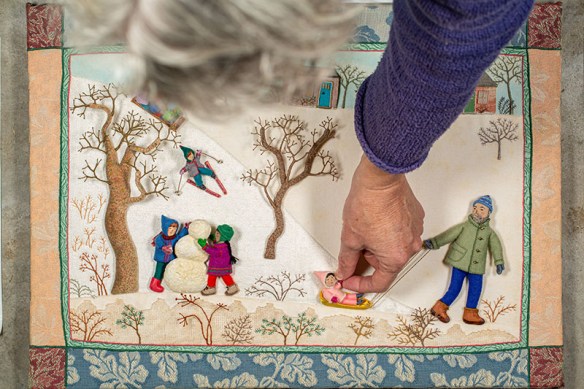
The last piece in this post is from the poem Snow. I hadn’t seen it for over 20 years and was happy to take it out of its frame and get up close with a camera. The owner seemed reluctant to part with it for a few months, but the timing ended up being convenient for her, since she’s selling her house and moving into a new place. I told her that it would be returned in better shape with sparkling clean glass.

SNOW, You and Me: Poems of Friendship 1997

To keep up with new posts, subscribe to this blog (top right column on the home page). Your contact info will not be shared. If you’d like to see more frequent photos tracking the projects in my studio, please follow me on Facebook and/or Instagram.

baby banner for Xavier

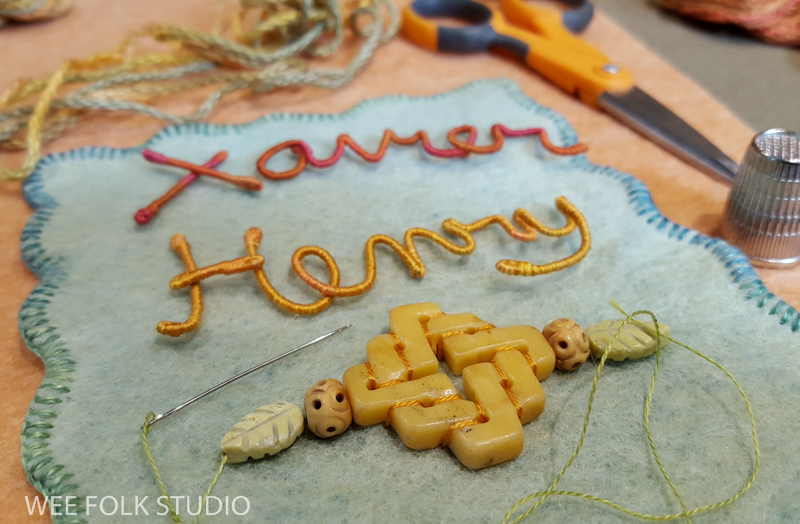
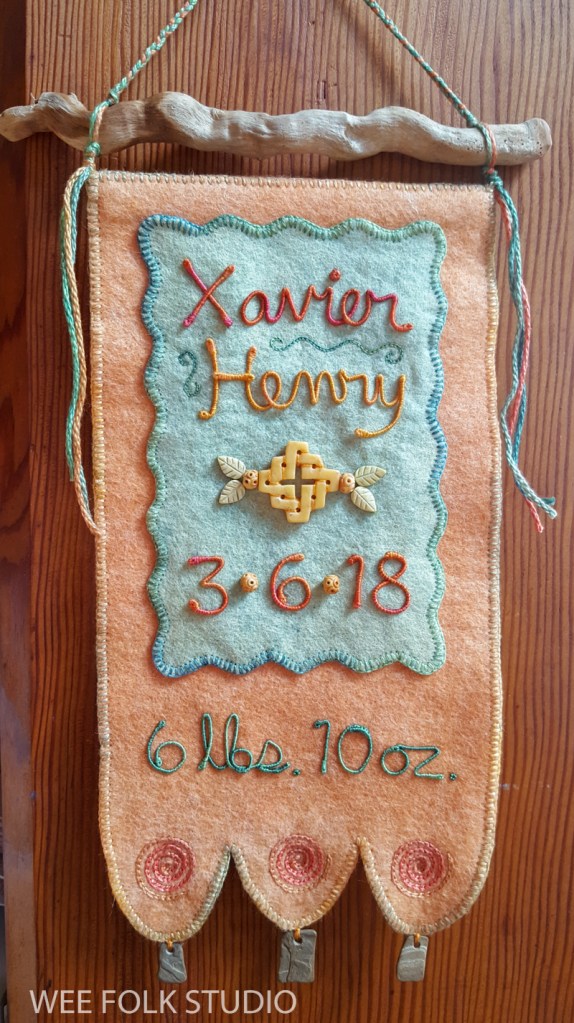
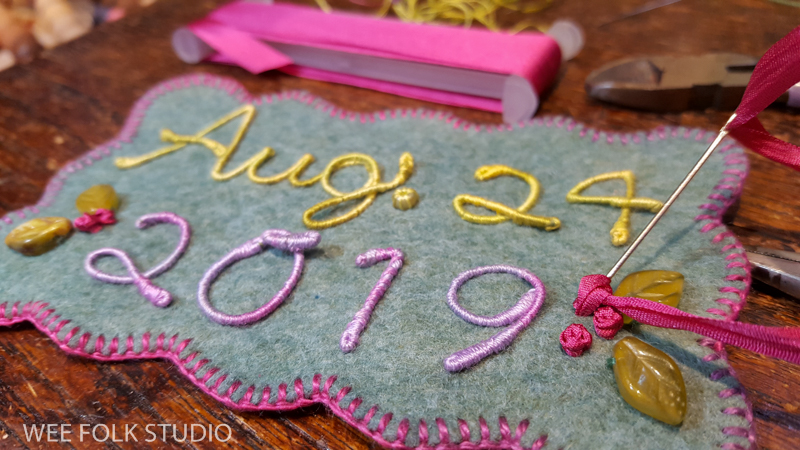
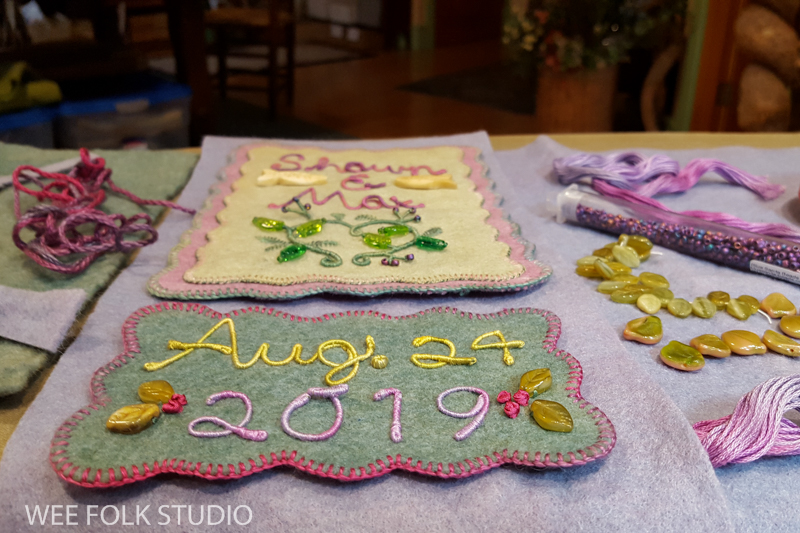
Since delivering the artwork for my upcoming book, My Bed to the publisher, I’ve had time to catch up on overdue gifts. Like this baby banner for Xavier, the newest member of a family of dear friends. He is now a toddler, and I hope the banner is something he won’t ever outgrow.

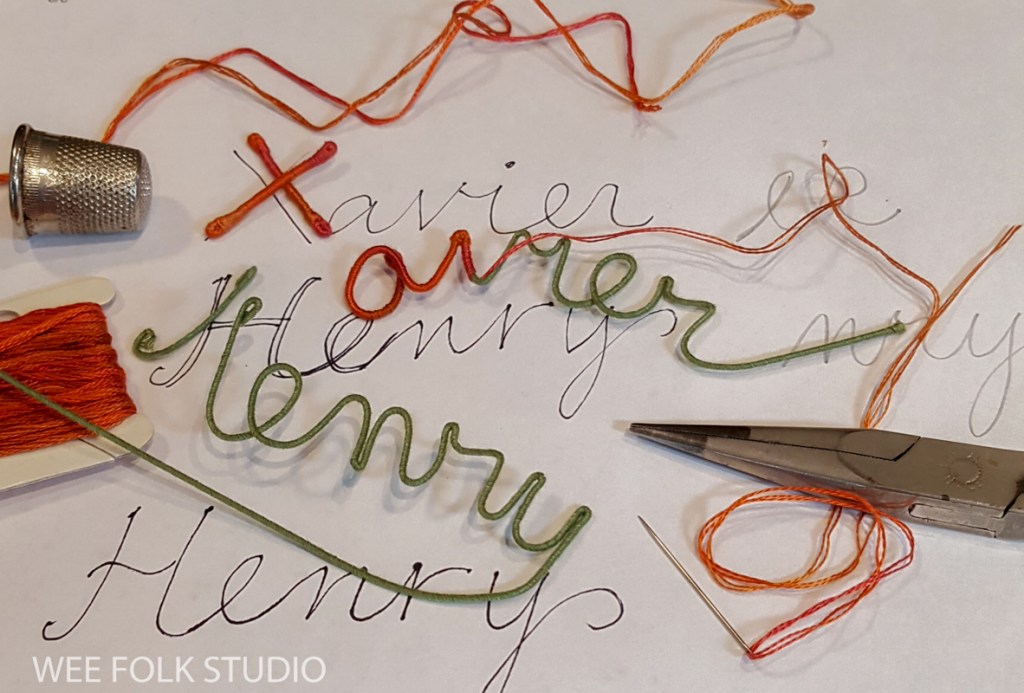
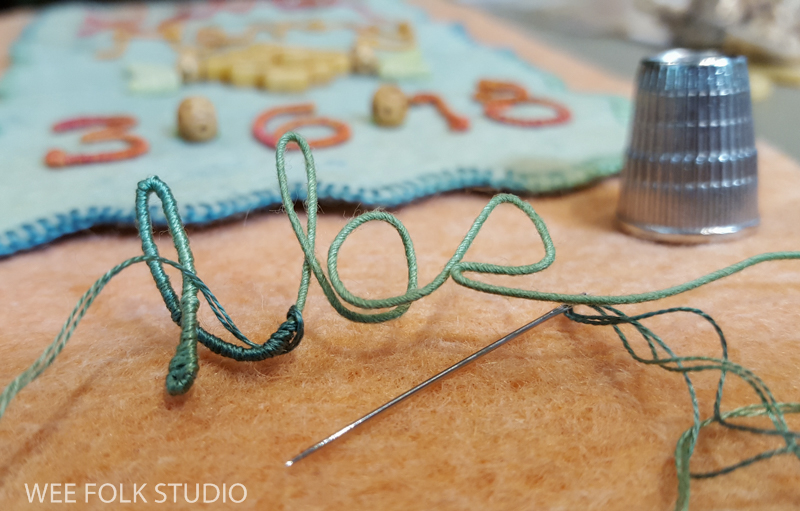
I make banners for friends and family that commemorate special events like weddings and births. You can see others I’ve made by scrolling through the archives here. They all feature 2 of my favorite things; embroidery and handwriting. When I form letters in wire, I think back to that day in 3rd grade in the Woods Hole School, when Mrs. Cleveland called each student up to her desk, one at a time, to show us how to write out our names in cursive handwriting. I was transfixed, watching her make a line of loops and bumps that magically spelled my name, without lifting her pencil off the paper.

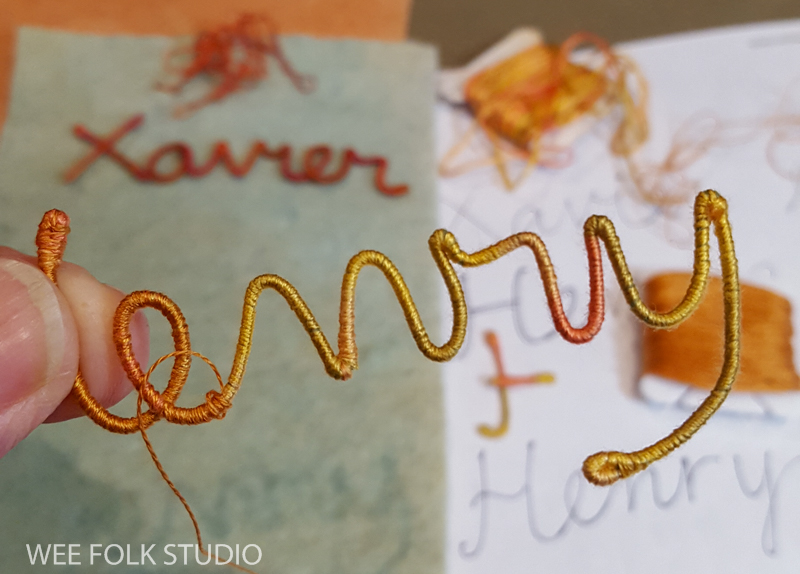
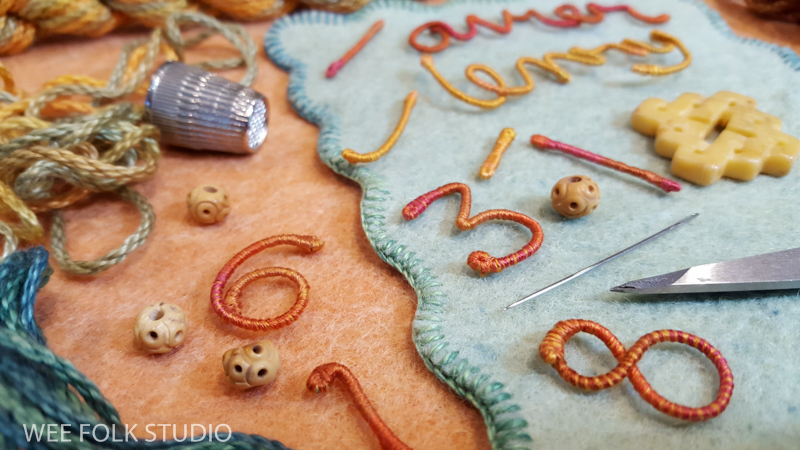
I use floral wire to make the letters, because it’s covered with green thread that provides a non-slippery surface to wrap embroidery floss on top of.

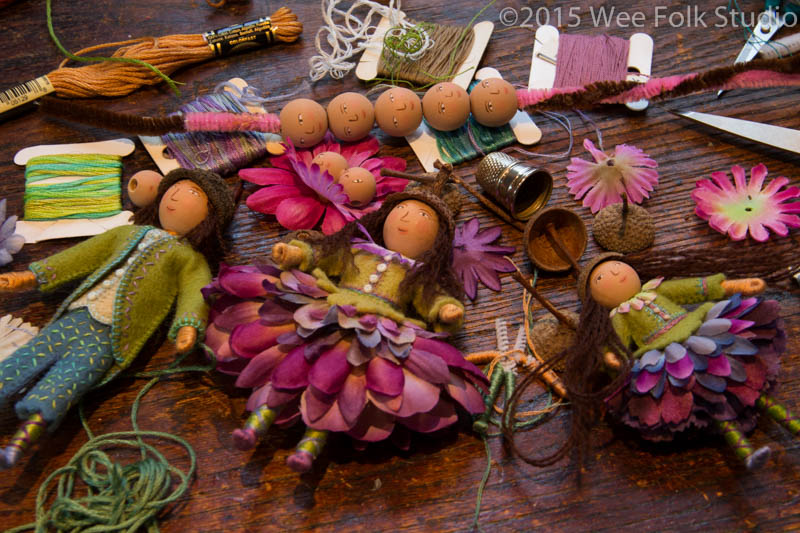
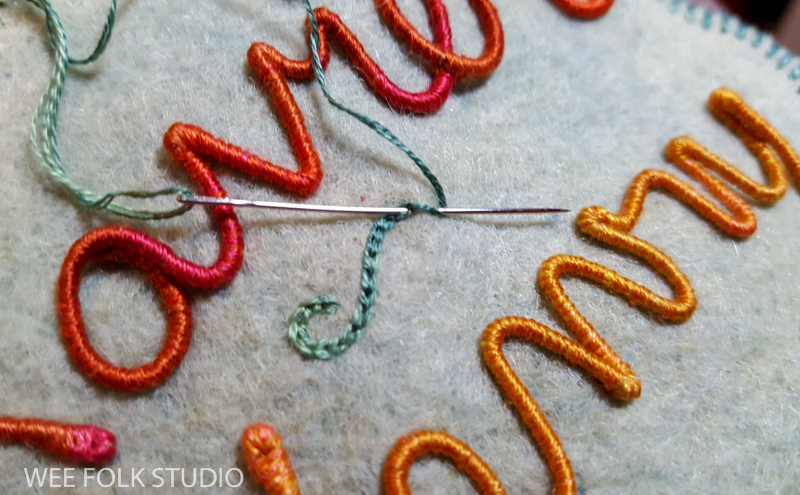
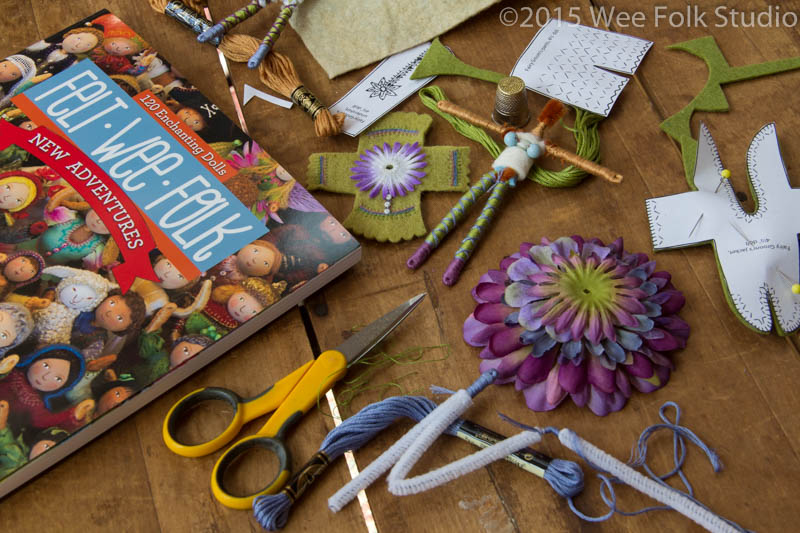
I usually use variegated floss to wrap the wire, which can look like stripes on the 2nd pass. The wire ends are bent over and wrapped, so that no raw ends are hanging out. It’s similar to the technique I use to make doll limbs in my how-to book Felt Wee Folk.

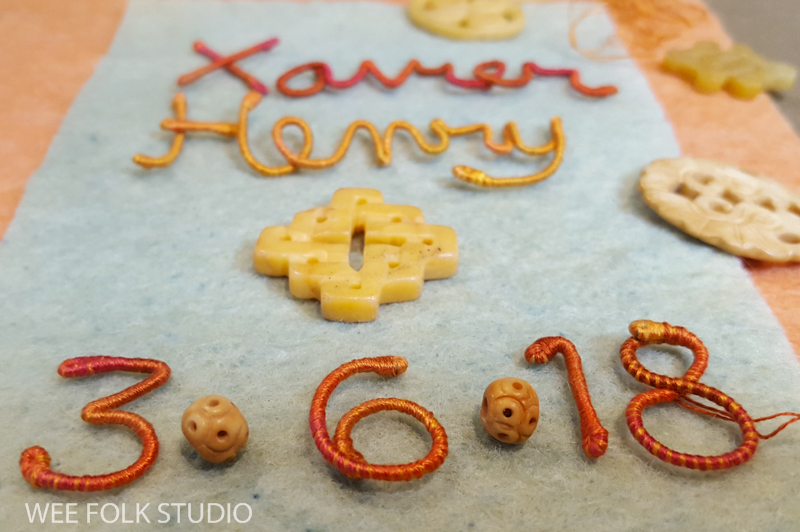
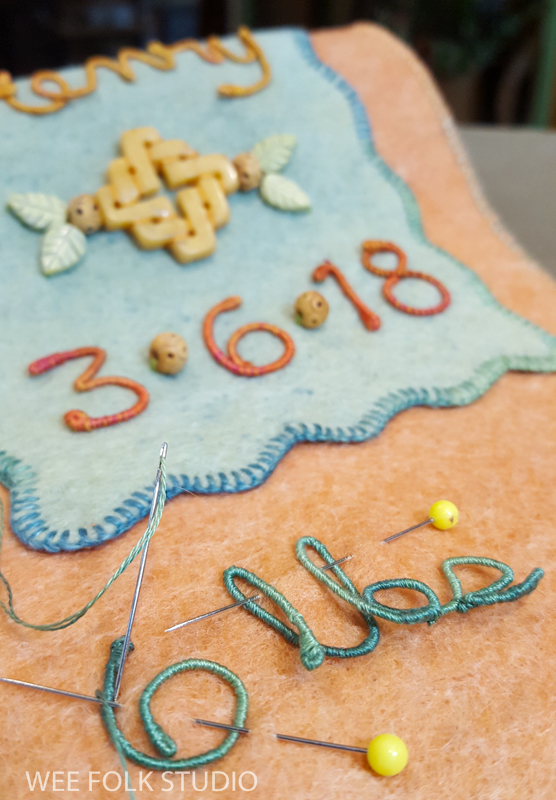
Out of my stash, I selected bone beads to make a decorative separator between the names and birth date.

And what better than a bead to dot the i.

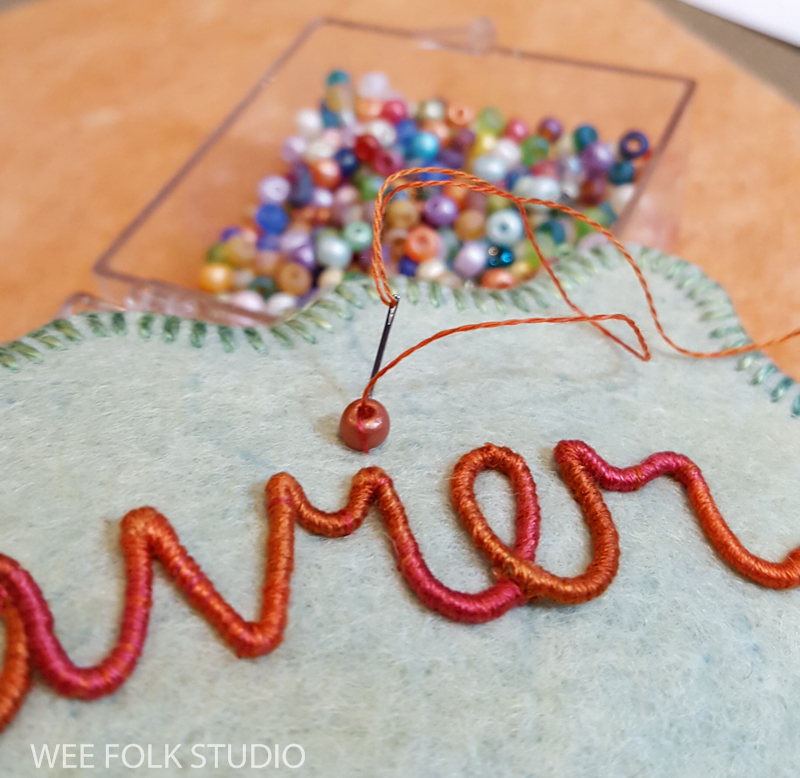
A little chain stitch never hurt, either.

Writing out the letters in wire sometimes follows a different path than actual handwriting, especially for b’s.

Over the years, I’ve adapted my handwriting on paper as well as wire to a personal style that’s part cursive and part block letters.

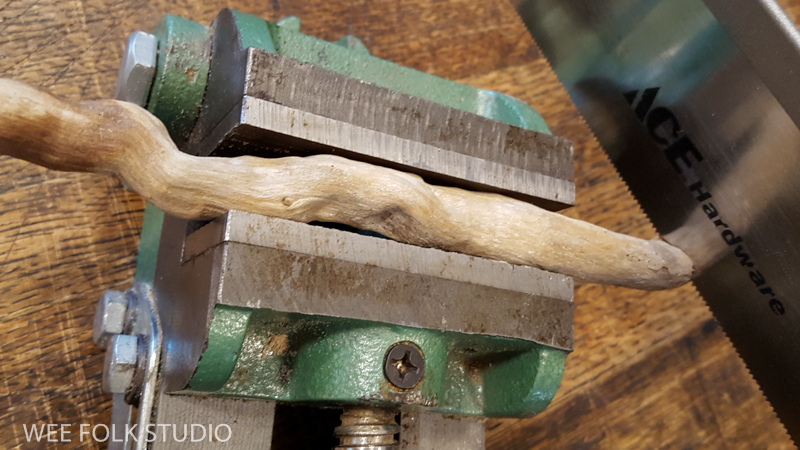
I went through my collection of driftwood, picked out a bumpy piece, and cut it to the right length with a saw.

Many years ago, I bought these beach stones with drilled holes. I use them sparingly on special projects.

This shows how I sew the wrapped lettering to the felt banner piece.

For a hanging cord, I braided pima cotton made by Caron.

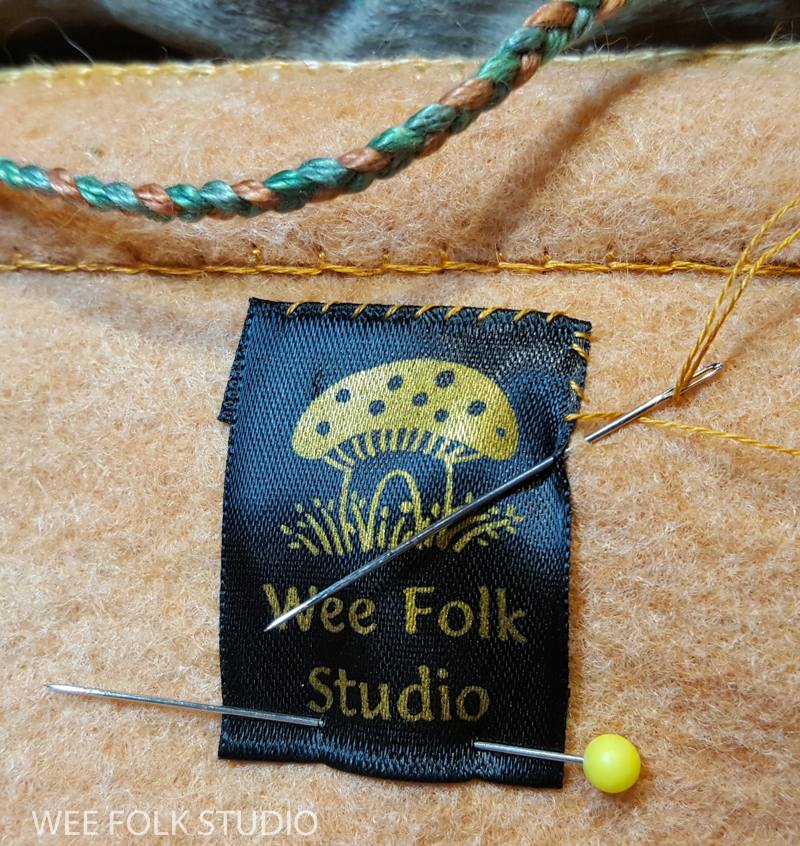
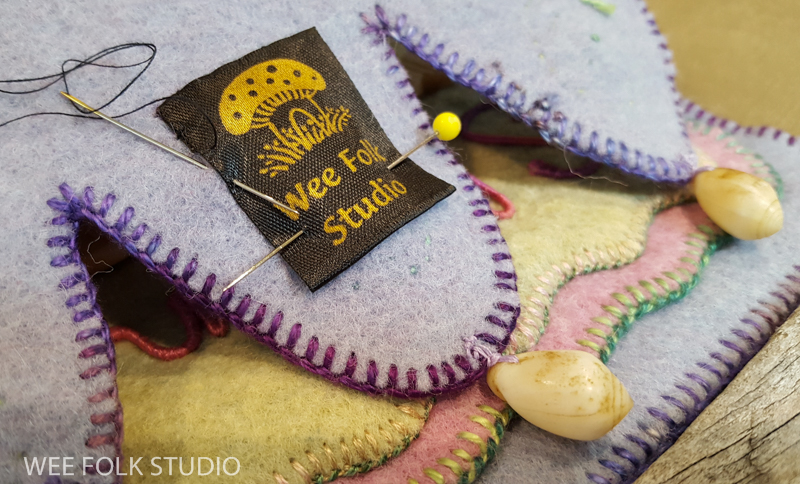
I have lots of Wee Folk Studio labels left over from when I made felt purse kits, so I sewed one to the back of the banner.

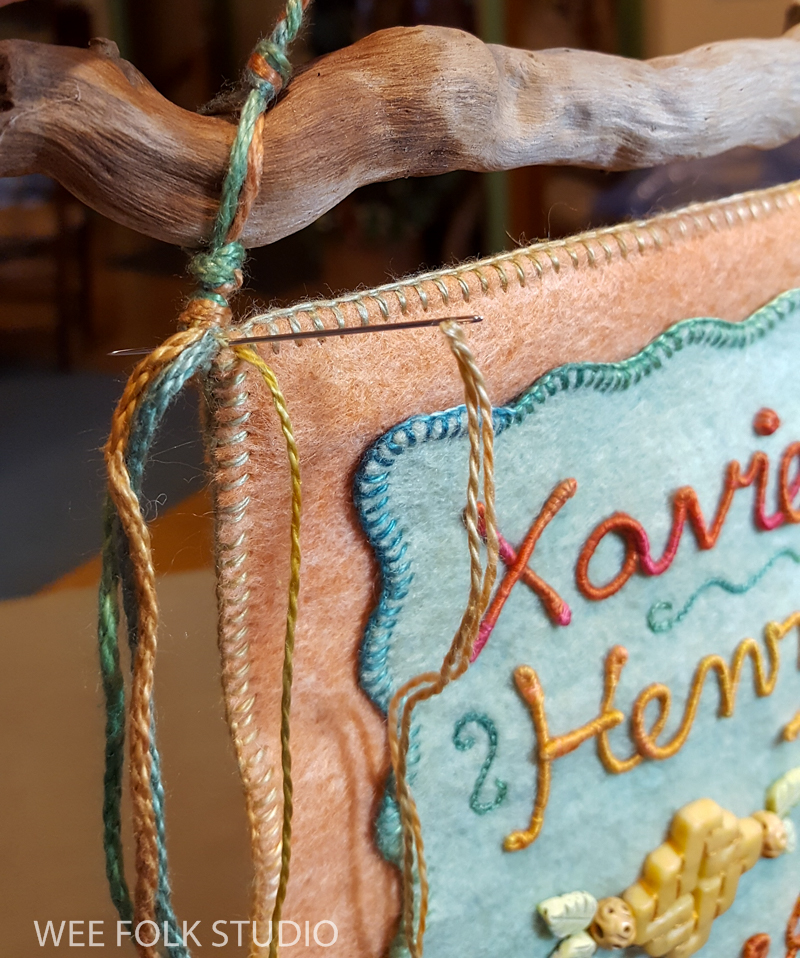
I attached the cord to the wood bar with knots and stitched it to the banner at the top corners.

This banner will soon hang on Xavier’s bedroom door. Welcome to the world little Xavy and congratulations to his parents, Mark and Cal!

To keep up with new posts, subscribe to this blog (top right column on the home page). Your contact info will not be shared. If you’d like to see more frequent photos tracking the projects in my studio, please follow me on Facebook and/or Instagram.

Wedding Banner: Shawn & Max

Today is Shawn and Max’s wedding day. The bride is a family friend and I wanted to make a banner to commemorate the occasion. This kind of project is quick (about a week) in comparison to the other work I do, which takes months or years. In the weeks since delivering the artwork for my upcoming book, My Bed to the publisher, I feel like a free woman! Besides gardening and paying attention to my husband Rob, I have indulged in making fun gifts like this.

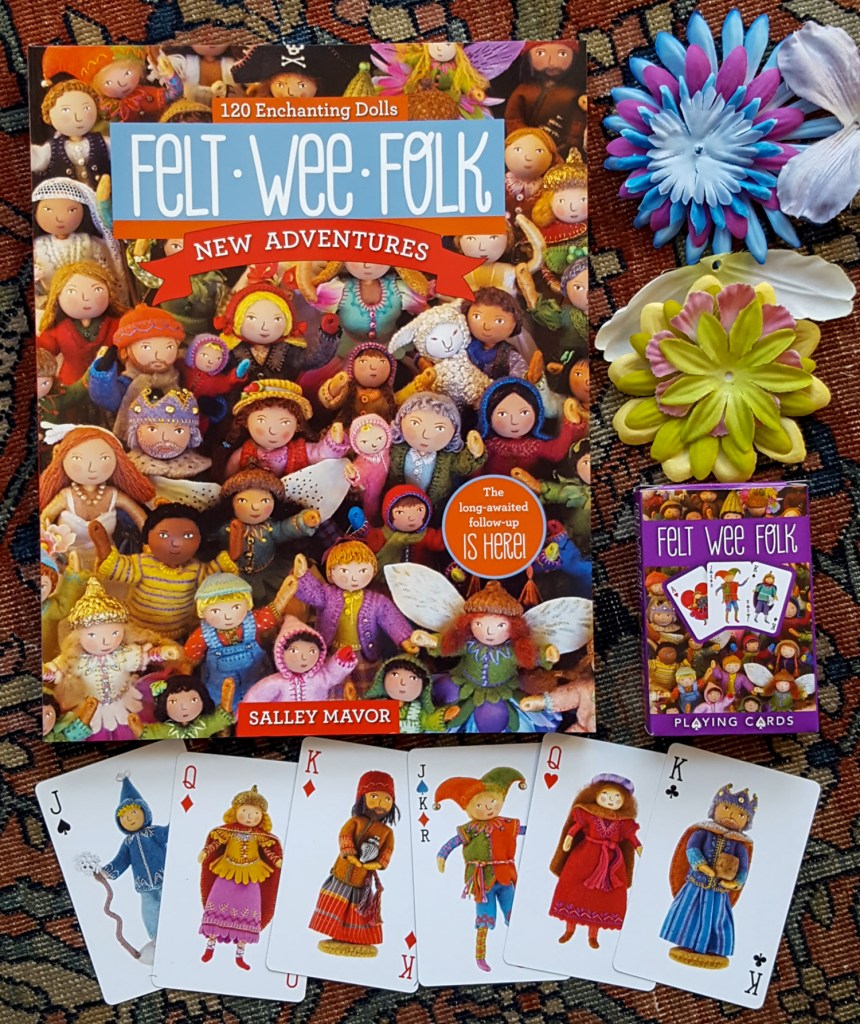
It’s been a long time since I made a banner – you can see others in the archives here. I’ve also made personalized wedding dolls, which match the look and style of real-life couples. They inspired the new chapter in the 2nd edition of my how-to book, Felt Wee Folk: New Adventures.

Personalized wedding dolls from the archives

The banner features 2 of my favorite things, cursive handwriting and embroidery. I start by forming the letters with paper covered florist wire.

Then, I wrap the wire with a double strand of variegated embroidery floss.

The letters flow from one to the next, with occasional breaks, like in Max’s name below. I made a separate piece to complete the “x”.

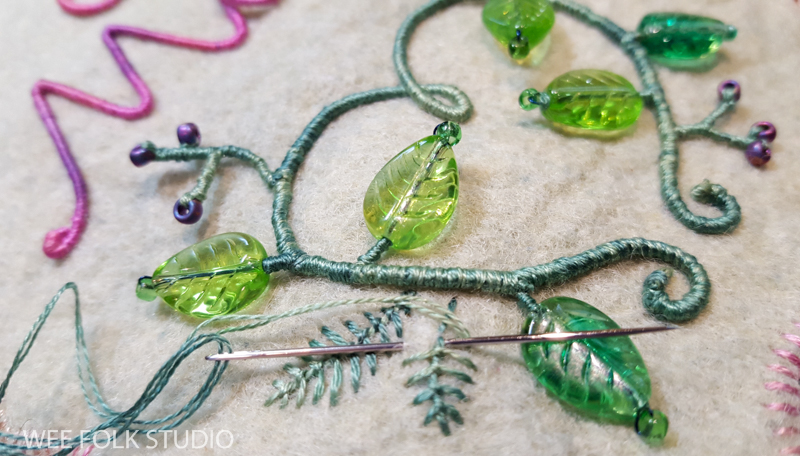
In a nod to the theme of love, I made a heart shaped vine of wire and glass beads.

After I sewed the wire heart to the background felt, I stitched more leaves with embroidery floss.

For much of my art, borders are an important element. I like to define the edges using blanket stitching with a thick variegated thread – Watercolours by Caron.

The wedding date is written in light letters and numbers on a separate dark piece of felt.

I added glass leaf beads and silk ribbon French knot roses.

I put 2 carved bone fish beads in the open areas around their names and sewed the felt sections to the long banner piece.

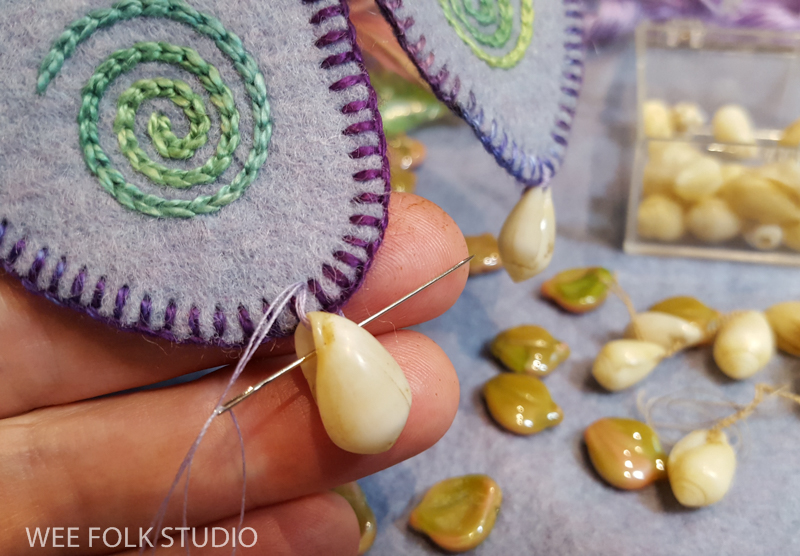
After chain stitching spirals to the scalloped bottom edged, I sewed shells to the points. These shells are from old souvenir necklaces from Hawaii.

I even remembered to sew a Wee Folk Studio label to the back.

I cut a piece of driftwood to hang the banner from, drilled holes in it and attached the banner with thread. I then made a braided cord with variegated thread – Watercolours by Caron.
Congratulations Shawn and Max. May you have a long and happy marriage!

To keep up with new posts, please subscribe to this blog (top right column on the home page). Your contact info will not be sold or shared. If you’d like to see more frequent photos tracking the projects in my studio, please follow me on Facebook and/or Instagram
Horn Book Cover

UPDATE: I just received word that my 2012 cover was voted the winner of The Horn Book Magazine’s Cover Madness contest in the January/February category! As part of this year’s centennial celebration of the magazine’s founding, this “very-subjective, not-serious event” will continue with more contests to pick covers from previous issues published in March/Aril, May/June, etc. By the end of Cover Madness, 6 different covers will “emerge as winners”.

I am especially honored to have my work recognized this way. Even though the children’s book community has always been very supportive, I sometimes feel like an imposter because of my singular vision and nontraditional illustration medium. I hope that you enjoy this account from 2012 about how I made the cover!


This is an edited and republished version of a post that was first written in 2012.

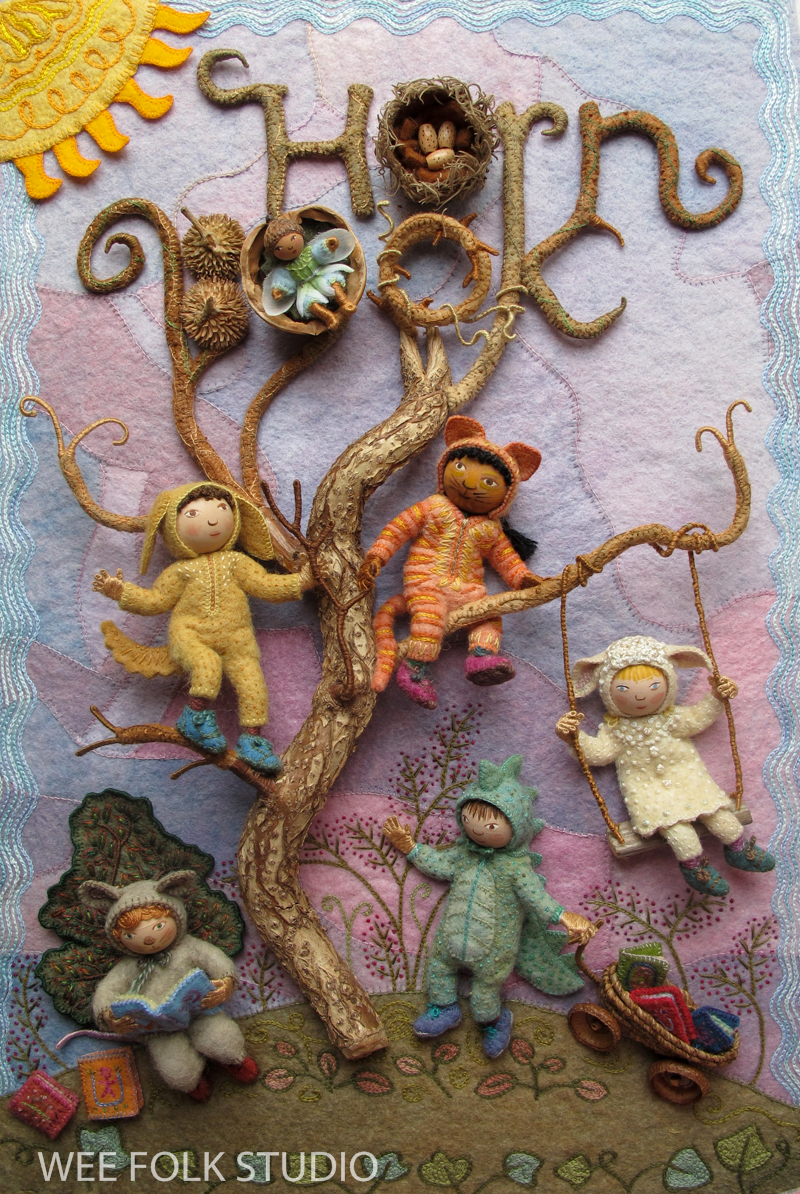
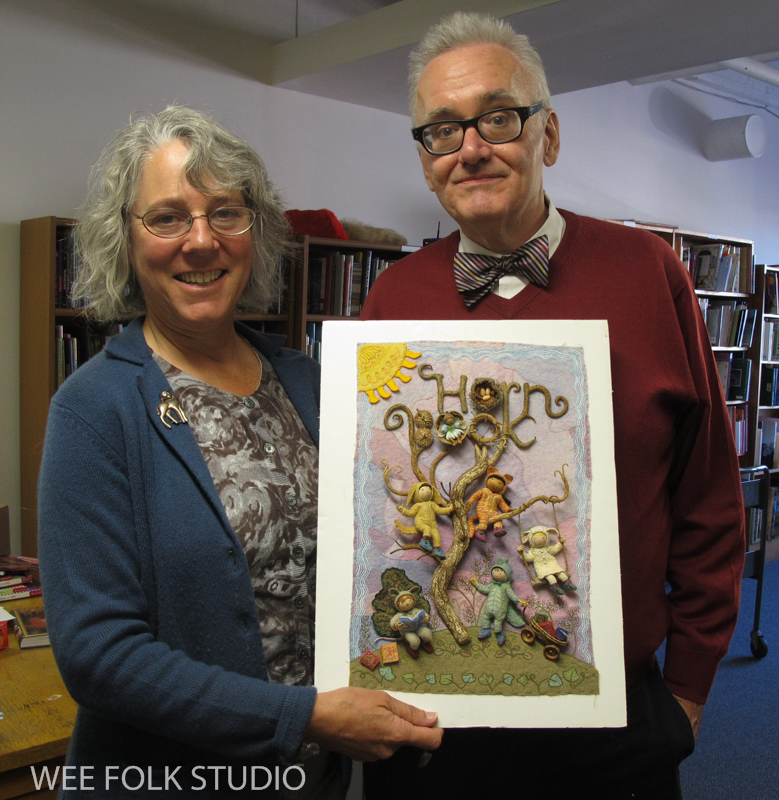
The Jan/Feb 2012 issue of The Horn Book Magazine is out, with my illustration on the cover. This issue has many wonderful articles and book reviews, including the 2011 Boston Globe-Horn Book Award speeches, which were delivered at the colloquium on Sept. 30th, 2011. As an award recipient for Pocketful of Posies, I had the honor of illustrating a cover for the magazine. You can find out more about my award here.

Read on to see the process of making the cover illustration, which I worked on for about 6 weeks this past summer. The original size of the scene is about 12″ wide and 18″ high. I first found a twisted vine to use as the central tree and made a sketch with the Horn Book logo and child characters. I then drilled holes on the vine where wire branches would go.  

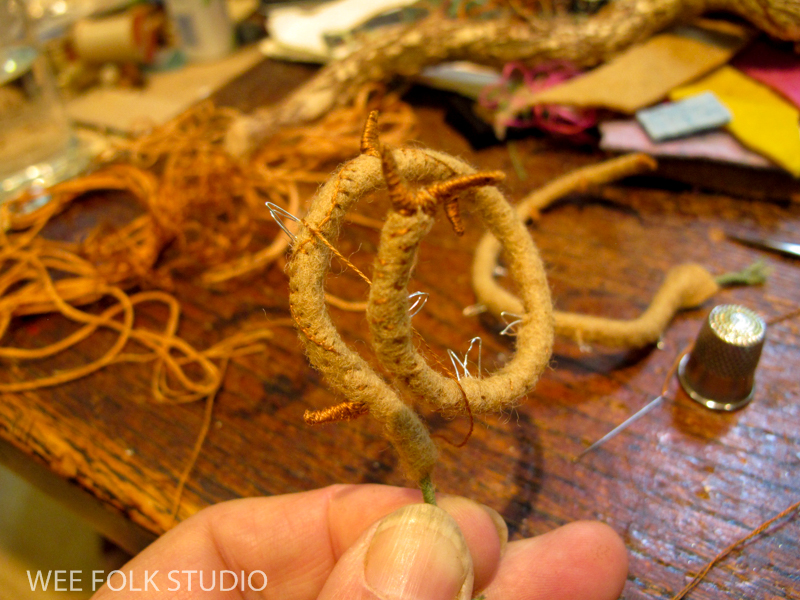
To form the branches, I covered wire with felt and embroidered them to match the real vine/tree trunk. This coiled branch has thread-wrapped wire thorns attached.

The Horn Book logo was rendered in wire branches and found objects. For one of the O’s, I sawed the back of a walnut-shell, so that it would lay flat and not stick out too much.  The O in the word Horn is a nest-like acorn cap from an oak tree in Iowa and the B’s spiky acorn caps are from northern California.

I thought that a solid color background would looked too plain, so I stitched together scraps of naturally dyed wool felt to make a more interesting field for the action.

I made a little fairy to fit in the walnut-shell.

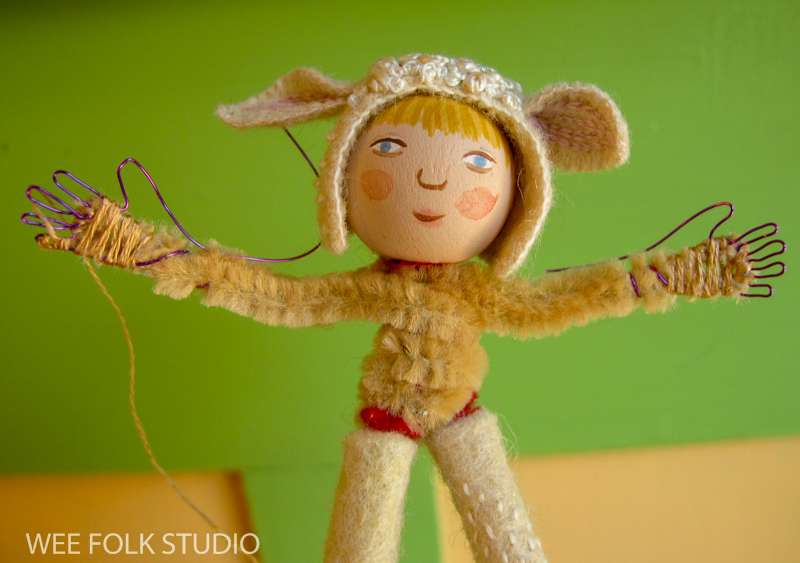
I didn’t want the characters to be animals, but children dressed in animal costumes. So, I made every effort to make them look like children by giving them bangs, ponytails, hands and shoes. These figures are made with similar techniques found in my how-to book, Felt Wee Folk.

During the process, I changed some of the characters in the original sketch and substituted a boy in a dinosaur costume pulling an acorn cap wheeled wagon full of books.

I printed out the words on acetate, so that I’d be sure to leave enough room at the bottom edge. I then embroidered plants and leaves to the felt background.

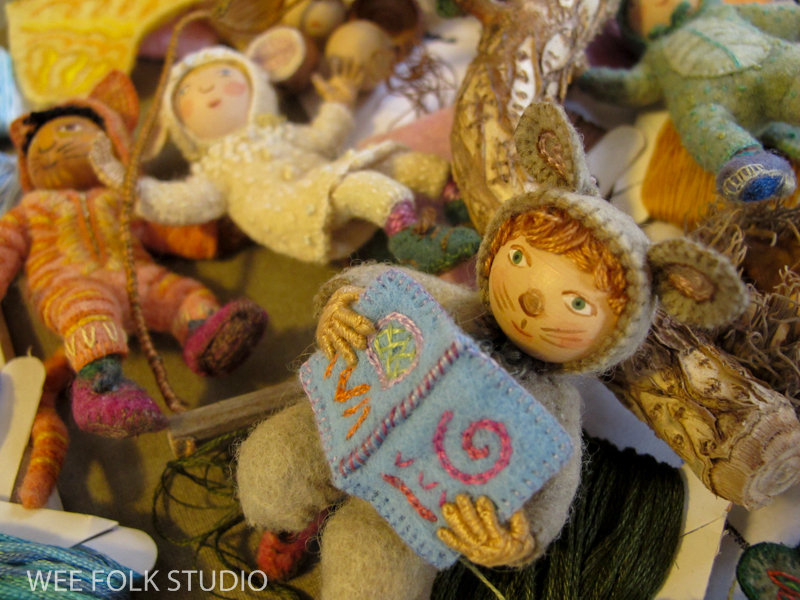
This little child/mouse is getting red shoes.

The Horn Book staff suggested I include a reading child, so I made a felt book for the face-painted mouse.

All of the parts piled up as I worked. It’s a miracle nothing got lost!

It was really fun thinking up costumes to make for these kids. I wanted to create a scene of children immersed in imaginary play and story.

I added a sun to the upper left corner and embroidered a wavy chain-stitched border. Then, I sewed the felt background to a sheet of foam core board, pulling it flat and straight.

Then, I stitched the tree, characters and other props in place, right through the foam core board. After everything was in place, I took it to the photographer, so he could take its picture. After that, I removed it from the foam core board and remounted the felt background and all of the parts on a cloth-covered stretcher. It is now framed behind glass and was recently bought by a collector. It was a joy to work on this project with Lolly Robinson at the Horn Book Magazine! Having my illustration on the cover will be a great opportunity for many people to discover my work for the first time.

Here I am with Roger Sutton, editor in chief of The Horn Book.

To keep up with new posts, please subscribe to this blog (top right column on the home page). Your contact info will not be sold or shared. If you’d like to see more frequent photos tracking the projects in my studio, please follow me on Facebook and/or Instagram
bed book peek: Scandinavia – part 3

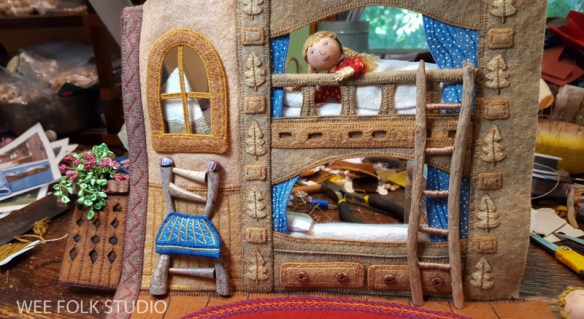
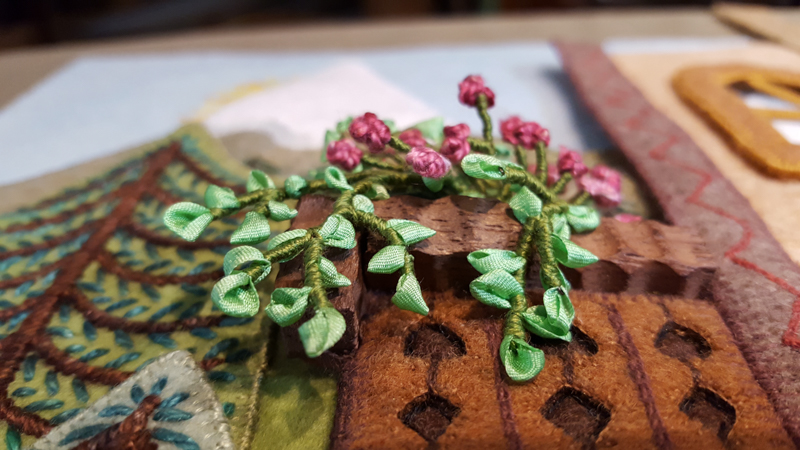
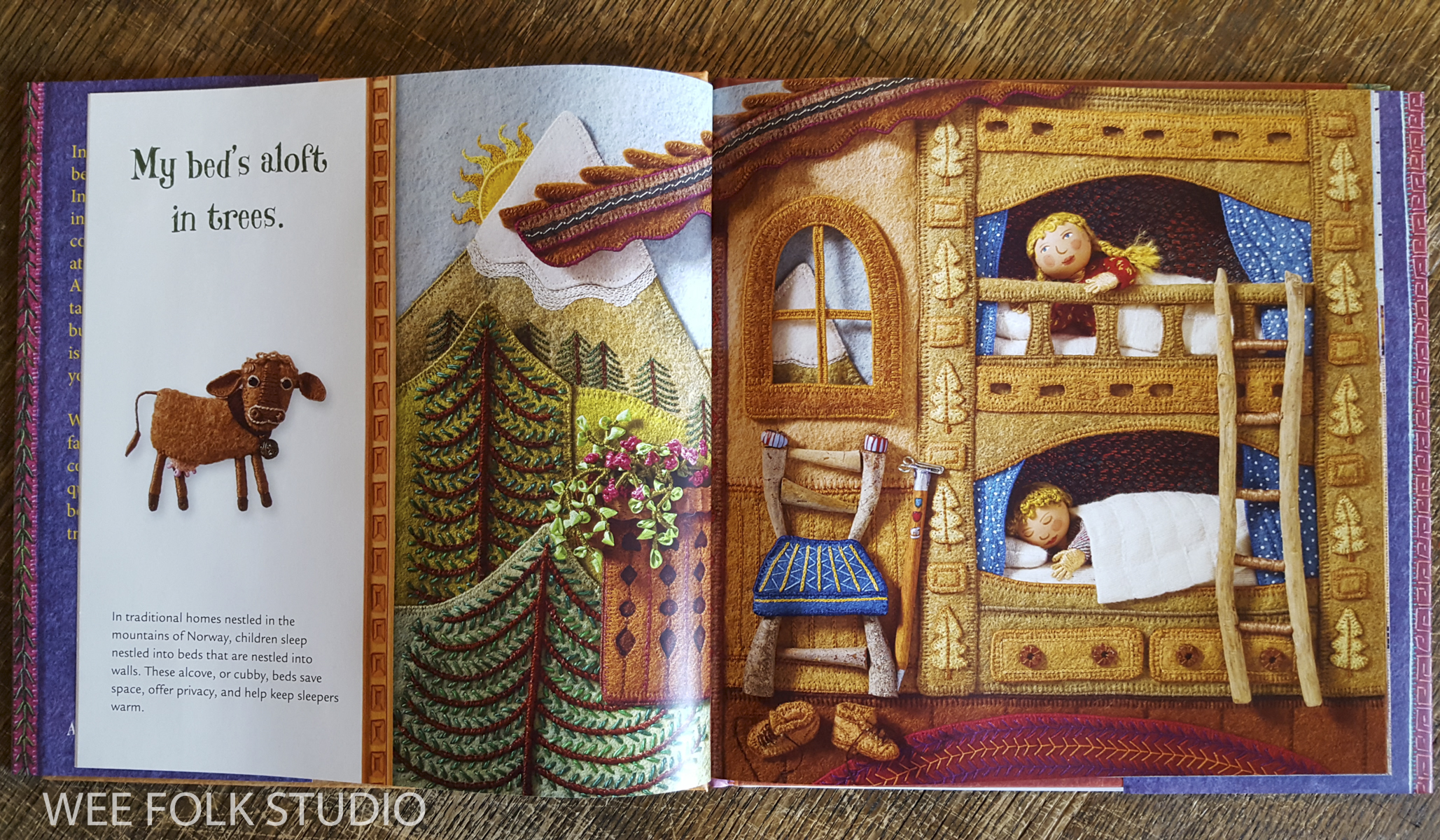
In this part 3 of the series about the Scandinavian scene in MY BED, the children and the chair are the focus. Part 1 shows parts of the inside, such as making the framework for the cubby style bunk beds. Part 2 gives a glimpse at the what’s outside: the balcony, flowers, mountains, sun and trees.

Update: Signed copies of My Bed can ordered in my shop here. Words by Rebecca Bond, pictures by Salley Mavor, published by Houghton Mifflin Harcourt.

This illustration will be included in My Bed, a book about where children sleep around the world, with each spread depicting a different culture and living environment. The story is written by Rebecca Bond and will be published by HoughtonMifflin in 2020. Here are links to posts showing other finished illustrations for the book: South America, JapanIndiaAfghanistanRussiaNorth AfricaNorth America and Iran. To see a list of all my books, click here.

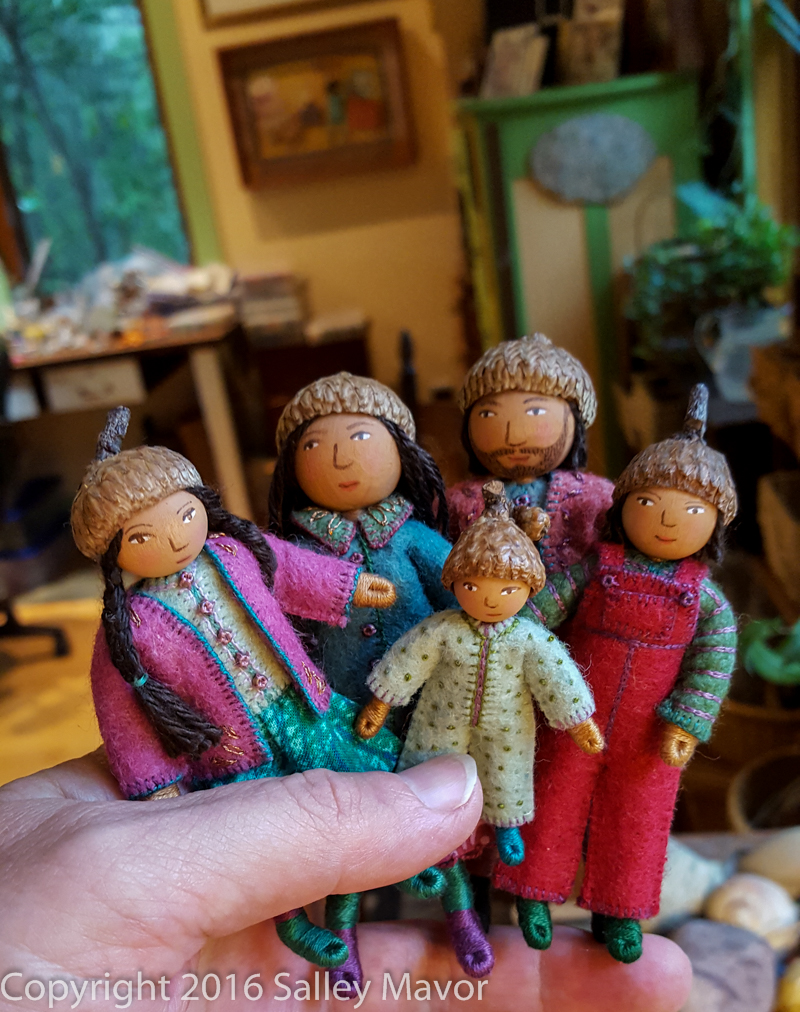
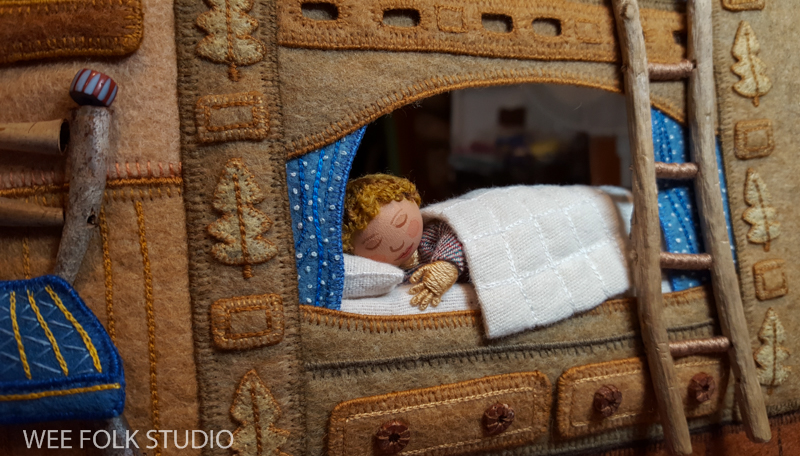
As with all of the characters in this book, I painted their features and personalities on 20 millimeter wooden beads with tiny brushes. Then, I made their wigs and bodies, using the same techniques taught in my how-to book, Felt Wee Folk: New Adventures.

This little girl has a custom made nightie, patterned with little embroidered flowers.

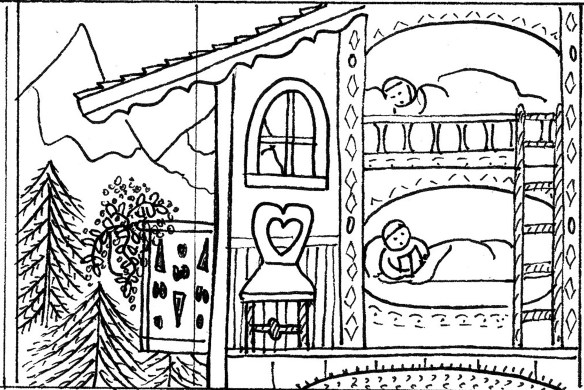
Even before threading the first needle to make the finished illustrations, I mapped out the entire book, with sketches of each page. It’s a square book, with artwork covering 3/4 of the double page spread. The remaining 1/4 page will hold the text of the story and the animal icons.

When making the parts of the scenes, I match the layouts pretty closely. Books come with certain constraints: number of pages, dimensions, titles, credits and text. Drawings serve as guides, but there are always little changes here and there to the finished illustrations. Surprises are bound to happen – that’s what keeps it fun! Of course, to do this, your editorial team needs to be supportive. You just have to be mindful of the outside measurements and avoid letting anything important get lost in the center gutter.

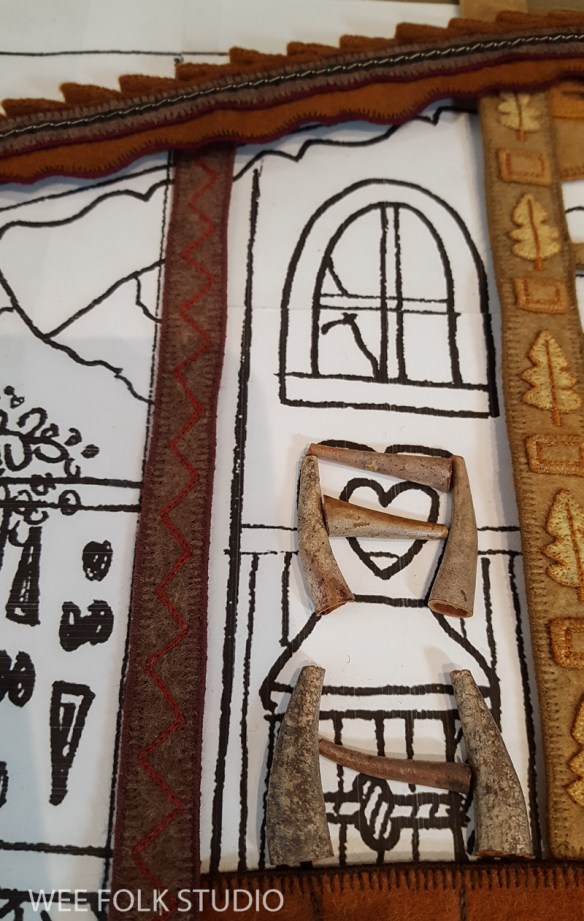
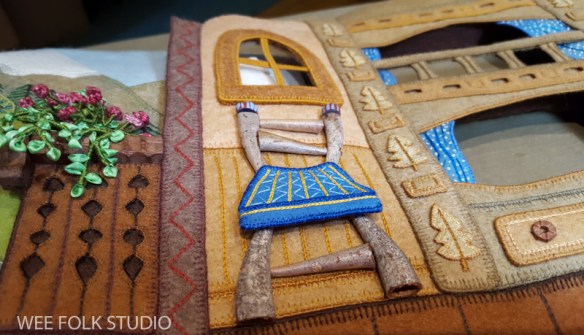
I could have made the chair in a lot of different ways, but these cactus thorns called out to me. Please don’t ask where I got them – I’ve lost track, since they’ve been in my stash for decades.

Generally, I use a combination of flat pattern and sculpture in my work, without much regard to formal perspective. In this scene, I felt that the chair seat needed to appear more dimensional than usual, so I tapered the angle, with the yellow stripes accentuating its depth.

Stay tuned for Part 4 in this series, which will show more interior details.

To keep up with new posts, please subscribe to this blog. Your contact info will not be sold or shared. If you’d like to see more frequent photos tracking the projects in my studio, please follow me on Facebook and/or Instagram.

bed book peek: Scandinavia – part 1

It feels like time to share another illustration from the bed book. This one is set in Scandinavia, with children sleeping in a cubby style bunk bed. I must have made it last summer, from the look of the green leaves outside the window in the photo above, It’s hard to keep track of time because I’ve been working 7 days a week for about 2 1/2 years straight. Between the Wee Folk Players series, the animated film and this book project, it’s been a stitching marathon around here. Hey, I’m not complaining – this is what I love to do and it’s a handy excuse for getting out of social obligations. But, I’m almost finished, with just the cover to do this month. And then, I’m going to switch gears to the garden, which has 2 years worth of overgrowth!

This scene will be included in My Bed, a book about where children sleep around the world, with each spread depicting a different culture and living environment. The story is written by Rebecca Bond and will be published by HoughtonMifflin in 2020. Here are links to posts showing other finished illustrations for the book: 
Holland, South America, JapanIndiaAfghanistanRussia, North AmericaNorth Africa and Iran. To see a list of all my books, click here

Update: Signed copies of My Bed can be ordered in my shop here. Watch this 8 minute documentary about how I created the illustrations for the book.

I am happy to announce that the original illustrations for the book will tour the country after the book is published in the fall of 2020. The Cahoon Museum in Cotuit, Massachusetts will host the premiere exhibit and other venues will follow. As with Pocketful of Posies, I am scheduling a traveling exhibit, so that more people can see the “real thing”, which is a totally different experience than looking at reproductions on the printed page. Interested museums and art centers are welcome to contact me (salley at weefolkstudio.com) for information about hosting the exhibit. You can help bring the show to a place near you by reaching out to your local venues and telling them about this opportunity. It would be wonderful to have the original illustrations make their way across the whole country!   

To make this double page spread, I started with the roof, which has a string of felt shingles folded over, accordion style. Then, I got to work on the walls and bed frame in the interior.

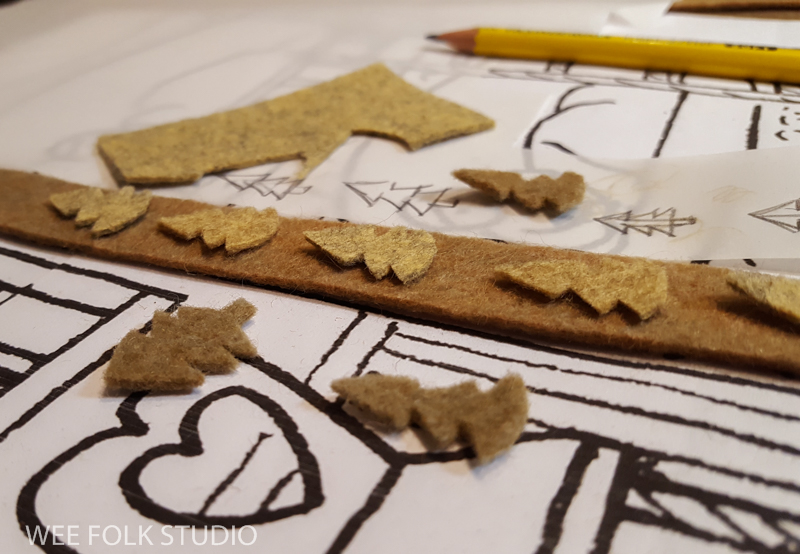
I cut out little tree shapes and edged them with blanket stitch.

There was enough variety in the brown hues to make the shapes stand out on top of the background strip. So, you may ask, “Where do you get your felt?” The stuff I use is a plant dyed, thick wool/rayon mix, that I hoarded a few years ago. Unfortunately, the business seems to be on hiatus. You can get some nice plant dyed and commercially dyed wool felt from A Child’s Dream, though.

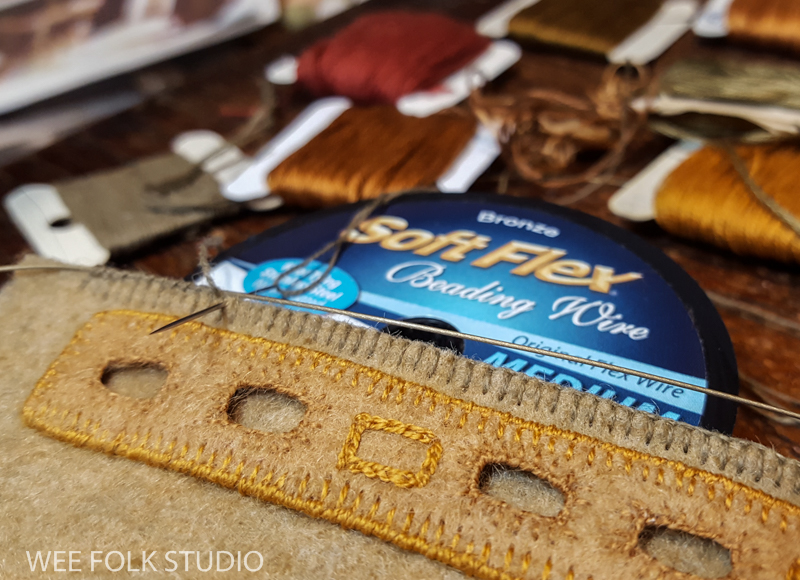
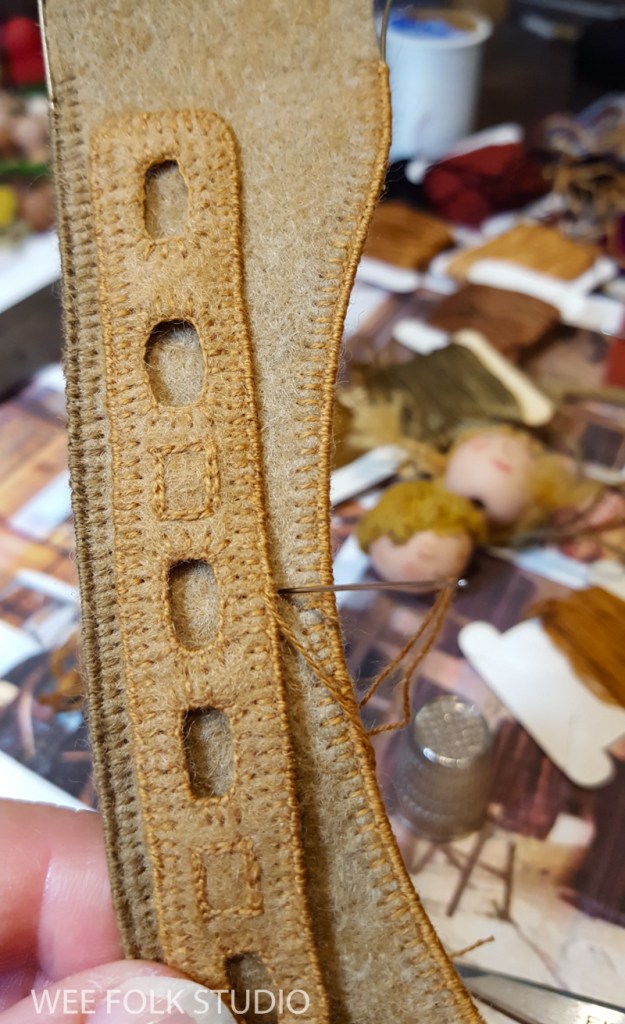
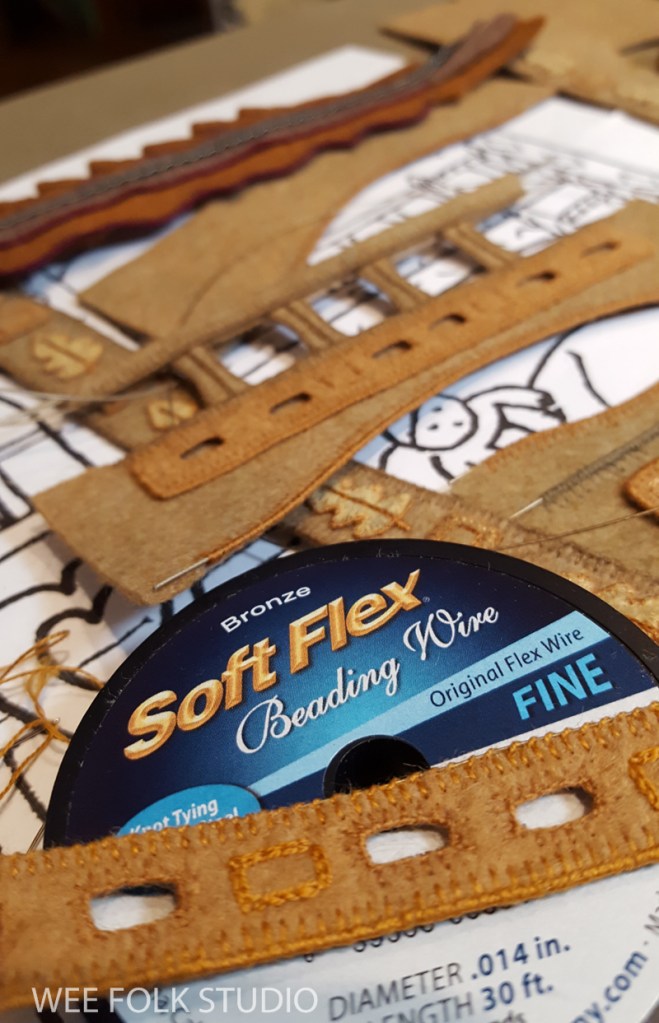
I sewed Soft Flex beading wire along the edges of the architectural details in this illustration. It adds a firmness that helps keep the felt pieces from flopping over.

Stay tuned for part 2, which will cover the exterior scenery.

To keep up with new posts, please subscribe to this blog. Your contact info will not be sold or shared. If you’d like to see more frequent photos tracking the projects in my studio, please follow me on Facebook and/or Instagram.

Bed Book Peek: North America (part 3)

In this Part 3, I will describe making all the miscellaneous elements in the children’s bedroom. Part 1 was about the little girl and her bed and Part 2 showed the baby, the crib and the dog.

Update: Signed copies of My Bed can ordered in my shop here. 40 pages, 9″ x 9″, words by Rebecca Bond, pictures by Salley Mavor, published by Houghton Mifflin Harcourt. ISBN 978-0-544-94906-5

The scene will be included in My Bed, a book about where children sleep around the world, with each spread depicting a different culture and living environment. The story is written by Rebecca Bond and will be published by HoughtonMifflin in 2020. Here are links to posts showing other finished illustrations for the book: 
Holland, South America, JapanIndiaAfghanistanRussiaNorth Africa and Iran.
To see a list of all my books, click here

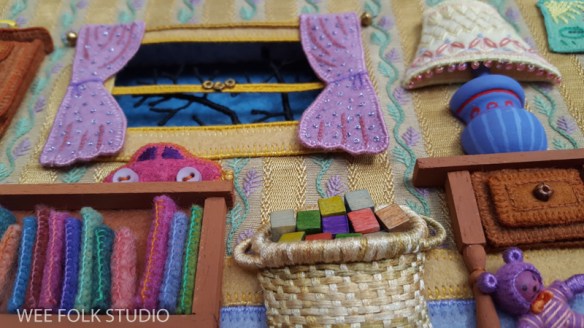
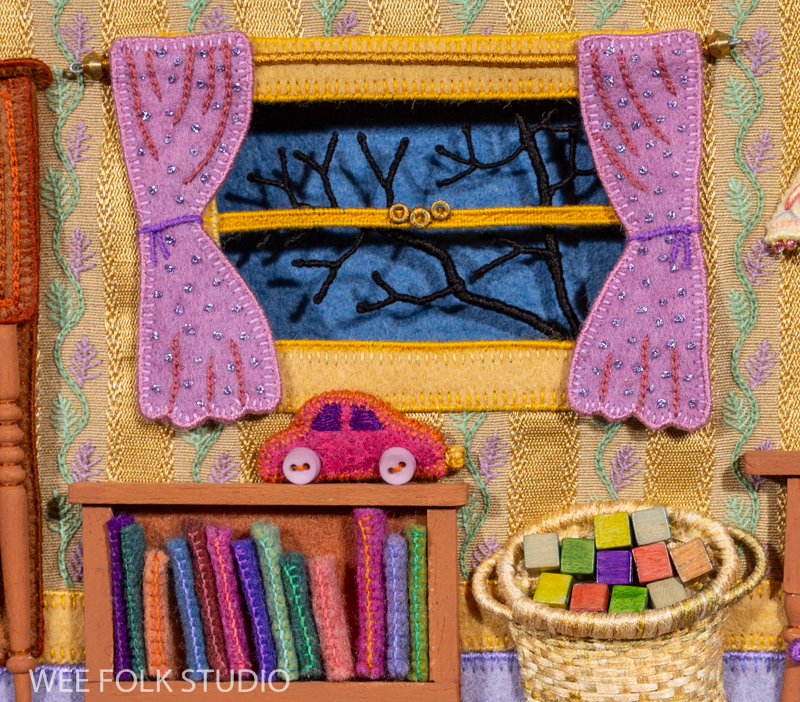
Besides making the figures, my favorite part of creating an illustration is filling the artwork with elements that help develop the characters and tell their story. Most of the spreads in this book show the children’s environment both inside and out. In this one, the wholly interior scene was an opportunity to indulge my passion for miniatures, from the wall paper to the lampshade. Making objects in relief is a lot different than rendering mini replicas of furniture for a doll house, though. Since the maximum depth I have to work with is 1 inch, everything is pretty flat and is made to look more sculptural than it really is.

The lampshade is embroidered felt, with wire stitched to the top and bottom rims for structure. I added dangling seed beads to give it some personality. As you can see, the shade is just half a circle, with the flat back sewn to the wall. The lamp is a miniature turned wooden pot that I sawed in half and painted.

Even the kid’s drawings on the wall are embroidered on felt. Chain stitching is my go-to method for forming lines.

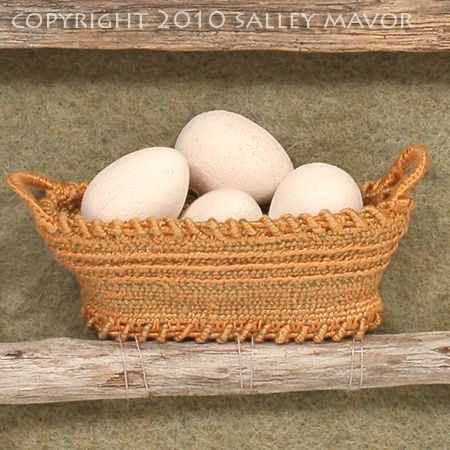
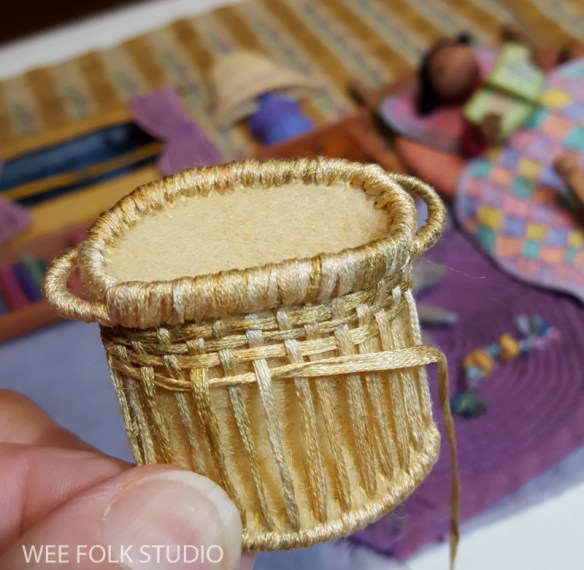
This is the first time I’ve made a basket with silk ribbon. In the past, I’ve woven them with thread wrapped wire, like the egg basket in Pocketful of Posies. Like the lampshade, it’s made in relief (about 1/2″), with a flat back. I really like the silk ribbon made by Silk Road Fibers. I used it other scenes for this book, including the palm fronds in North Africa.

I made blocks to fill the toy basket by coloring square wooden beads with different colored magic markers. It’s important to find parts with holes, so you can sew them in place. Just like with painting doll heads, I strung them on a pipe cleaner for support.

Then, I sewed the basket to the background fabric.

Through the window, you can see a thread wrapped tree branch. It’s inside a balsa wood box that I sewed in back, behind the background fabric. I’ve used this method in other scenes where I want to show receding depth. It’s a way to make use of the hidden space inside the stretcher.

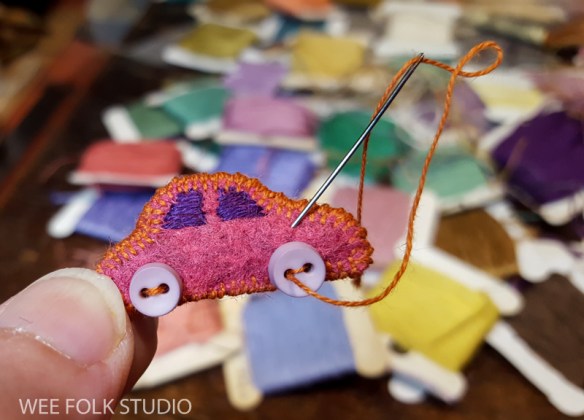
This little toy car reminded me of the pins I used to make.

I may have reached my mini limit with this purple bear.

I hope you enjoyed taking an inside look at making this scene for My Bed.
Part 1 is about the little girl and her bed and Part 2 shows the baby, the crib and the dog.

To keep up with new posts, please subscribe to this blog. Your contact info will not be sold or shared. If you’d like to see more frequent photos tracking the projects in my studio, please follow me on Facebook and/or Instagram

bed book peek : duck

Let’s start the new year with a duck. It’ll be a spot illustration in my new picture book,  My Bed: Celebrating Children’s Beds Around the World. Each double page spread will have a text panel with a corresponding animal. The duck will appear alongside the scene with a houseboat in Holland, which you can see here.

Update: Signed copies of My Bed can be ordered in my shop here. Watch this 8 minute documentary about how I created the illustrations for the book.

As with the other animals I’ve made so far (elephant and goldfish, parrot and sheep, rooster, cat, camel and bunny. I start with research photos. In this case, I searched for pictures of a classic rubber ducky, with webbed feet. I was so interested in figuring out how to make the feet, that I tackled them first. That turned out to be a mistake because they ended up being too small and out of proportion to the body that came later.
The duck is a good example of how I really work, which is not in a straight line, but here, there and everywhere. My creative process is full of experiments that may or may not end up in the finished piece, but they are essential to getting there.

The second pair of feet (pictured below) are a little bit larger and more neatly defined. It’s not unusual for me to take several tries to get something the way I imagine it. There’s a lot of ripping out and starting over, which is one of the advantages of using thread. For the feet, I devised a kind of weaving stitch that created the webbing between the 3 toes.

The body and wing are made of 2 shades of yellow felt.

The beak was a bit tricky to get to look right and took several attempts. It started with a thread wrapped piece of wire that’s bent into two V shapes for the top and bottom of the beak.
I then stitch the thread wrapped wire onto the head. The round shape of the head is from a wooden bead that is covered with felt, which I forgot to document with a photo. I wasn’t happy with how this beak (below photo) was coming out, so I ripped it out and started over.

I’ve had practice making bird beaks for the Birds of Beebe Woods and the Twitter Bird in my animated film, Liberty and Justice, but it’s like a new experience every time. When faced with a new challenge, I let my hands guide me, trusting that a solution will appear. That’s what keeps it interesting and never boring!

This is the second try at forming the duck’s beak.

After stitching the top and bottom beak in place, I wrapped thread around the wire. I then added a seed bead eye and stitched on the wing.

It looks like I opened up the bottom of the duck’s body to make room for it’s legs. They were the last to stitch in place, with the first pair lingering in the sidelines.

After looking at the duck for a while, I decided that it need more personality. The plain rubber ducky look just wasn’t enough! So I added some details, like the embroidered feather texture and the distinguishing lines on the wings.

To keep up with new posts, please subscribe to this blog. Your contact info will not be sold or shared. If you’d like to see more frequent photos tracking the projects in my studio, please follow me on Facebook and/or Instagram.