Mossy Glen – part 5: Leaves

In this Part 5 of the series about making the spring landscape, Mossy Glen, I share photos, videos and commentary about how I created the leaves. Part 1 is all about stitching a moss-like texture, Part 2 gives a glimpse at how I made the cherry trees, Part 3 is about the stone walls and Part 4 shows how I made the forsythia blossoms.

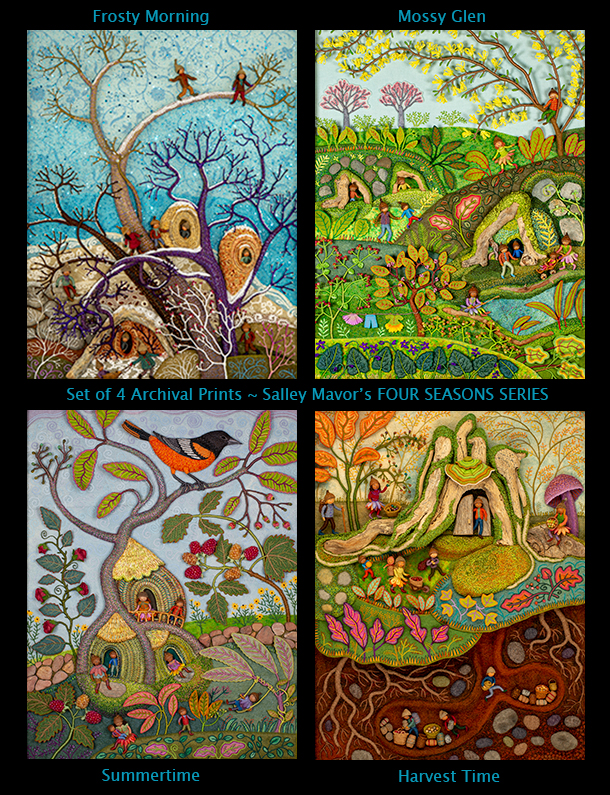
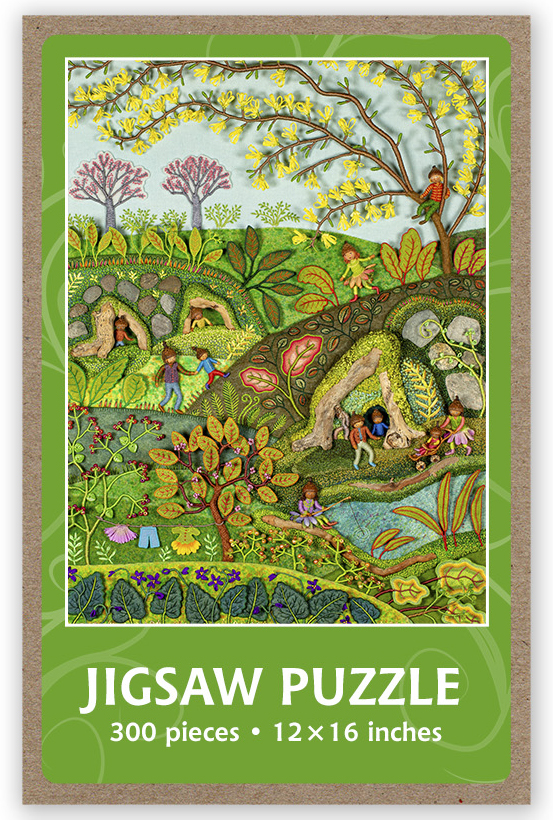
Mossy Glen is the spring scene in a series of seasonal landscapes that capture the wonder and magic of the natural world. Note cards, prints, bookmarks, and jigsaw puzzles of Mossy Glen and the other scenes in the series (Frosty MorningHarvest Time, and Summertime) are available in my Etsy Shop.

Spring is the season when nature shows its most attractive side, when every new leaf and bud is a delight to behold. The undergrowth is neat and tidy, with manageable mossy lawns and tiny plants just starting to emerge in the miniature landscape. It’s when I go scouting for places to photograph my wee folk characters outside, like Polly’s Washing Day, which is a note card in my shop here.
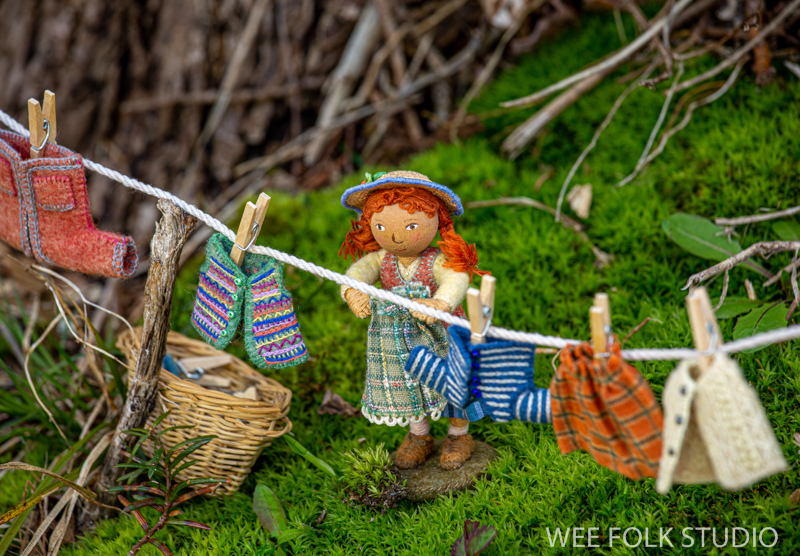
Polly’s Washing Day note card

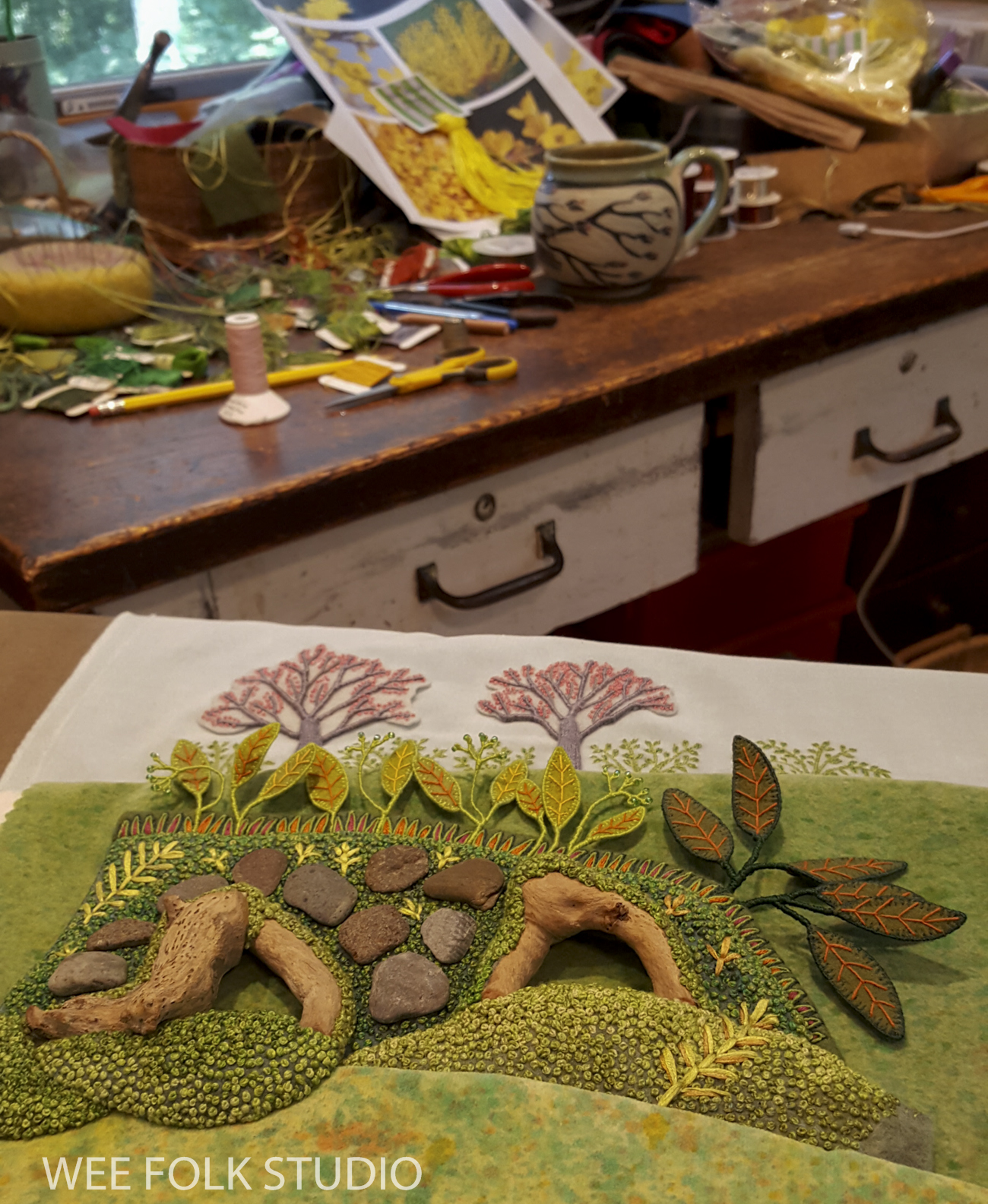
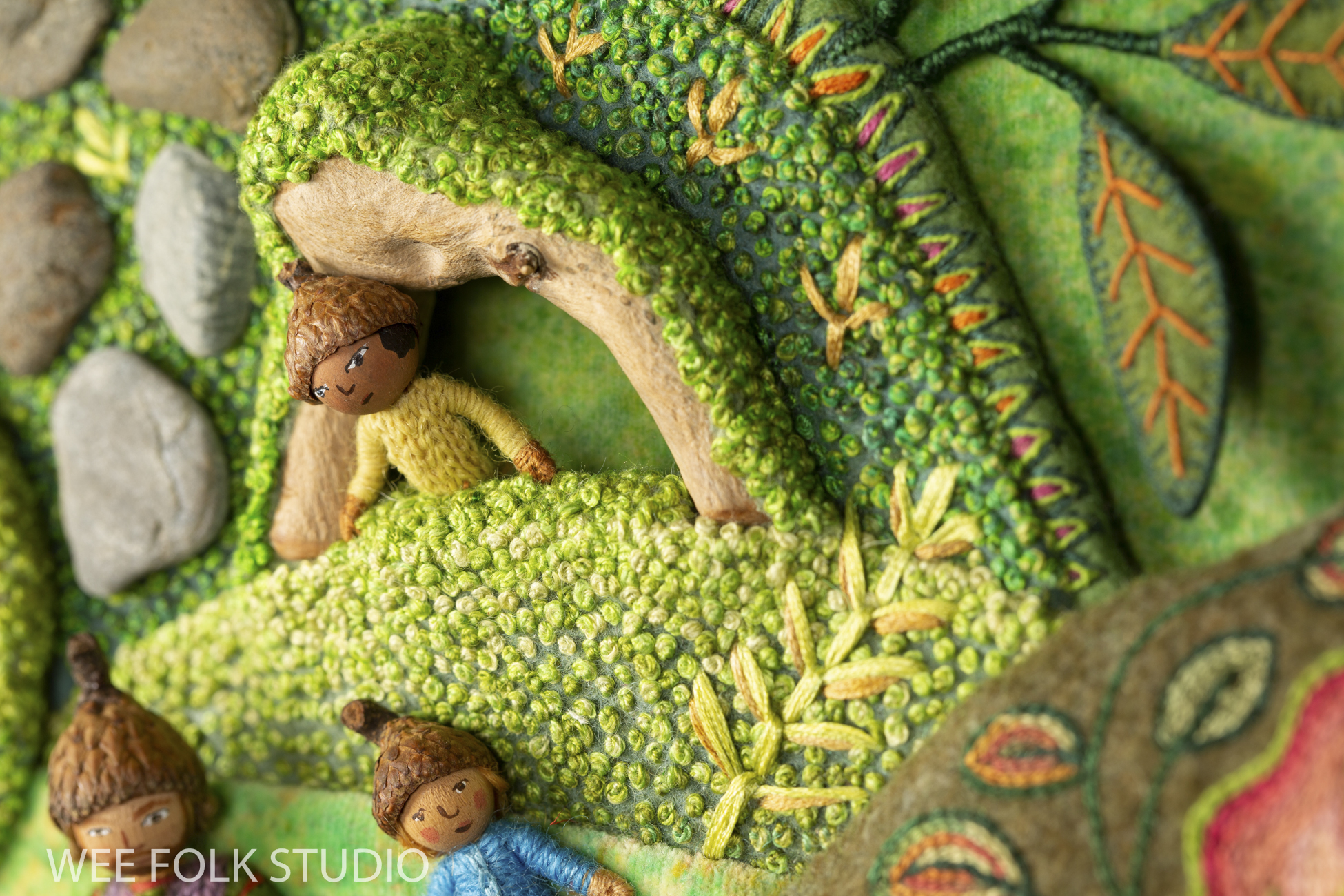
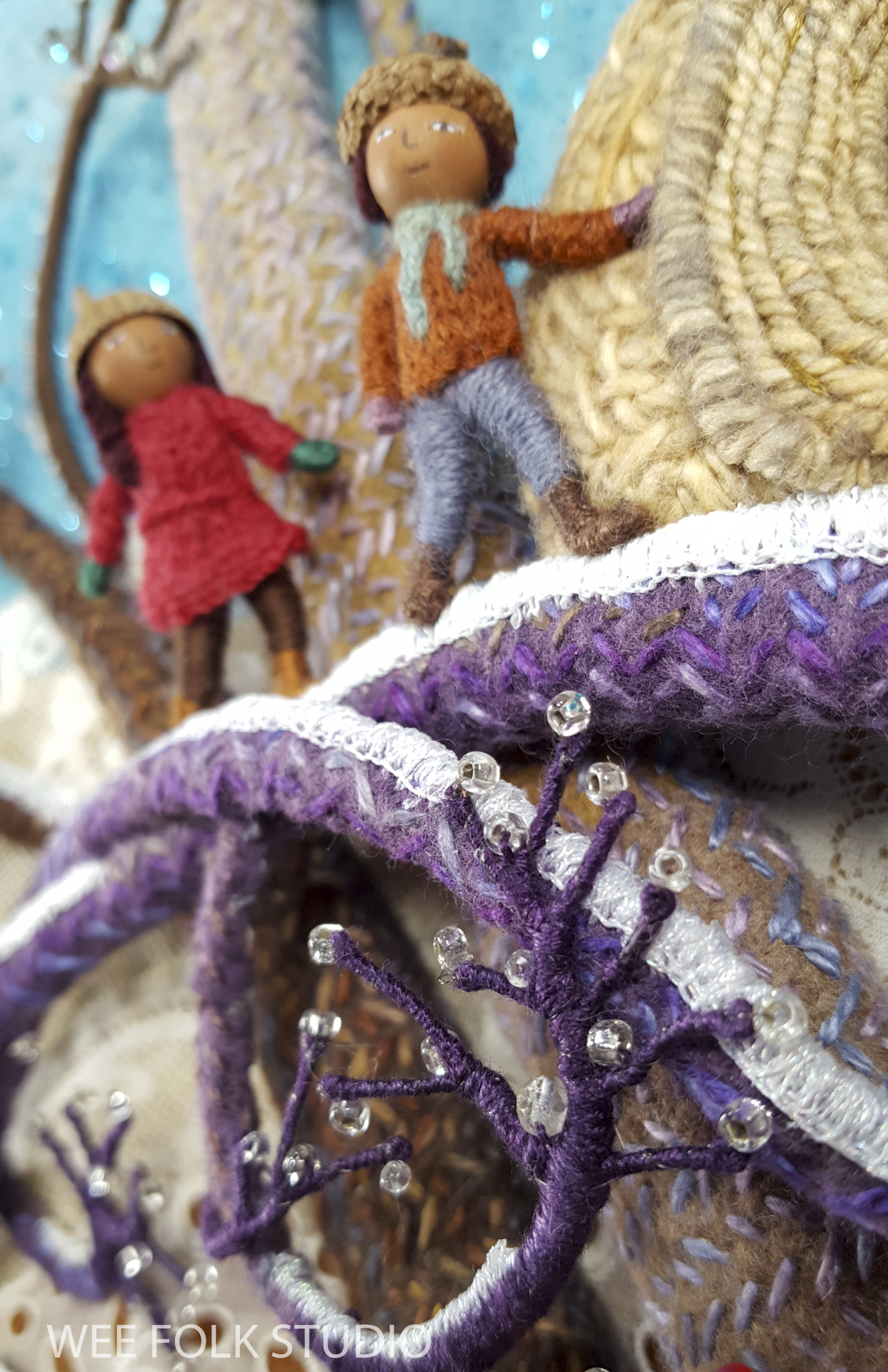
When planning out Mossy Glen, I pictured hillsides in different shades of light green, punctuated with 3-dimensional leaves.

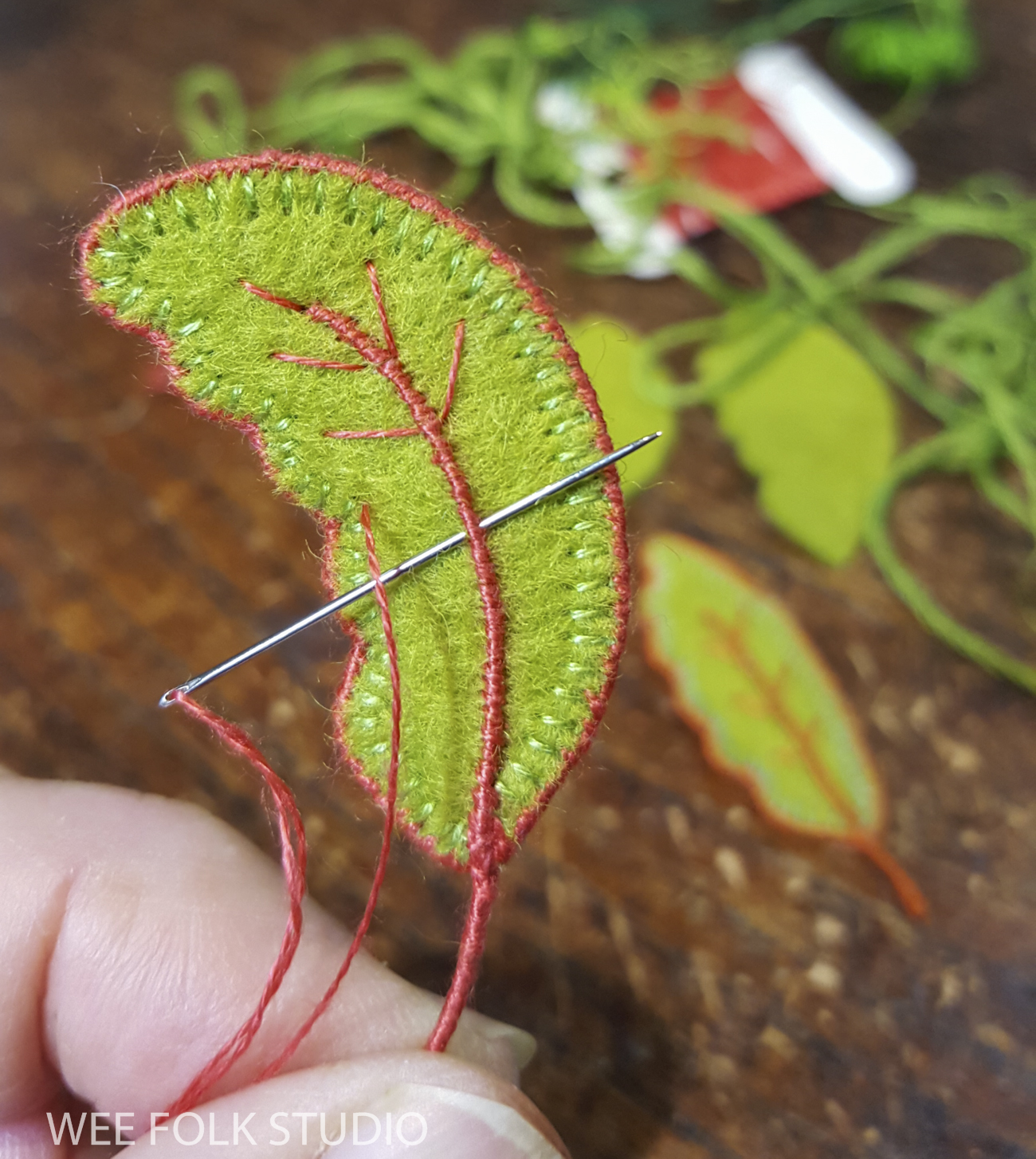
I made separate leaves with wool felt and wire, which you can watch in this Stitch Minute Video.

Stitch Minute – Leaf

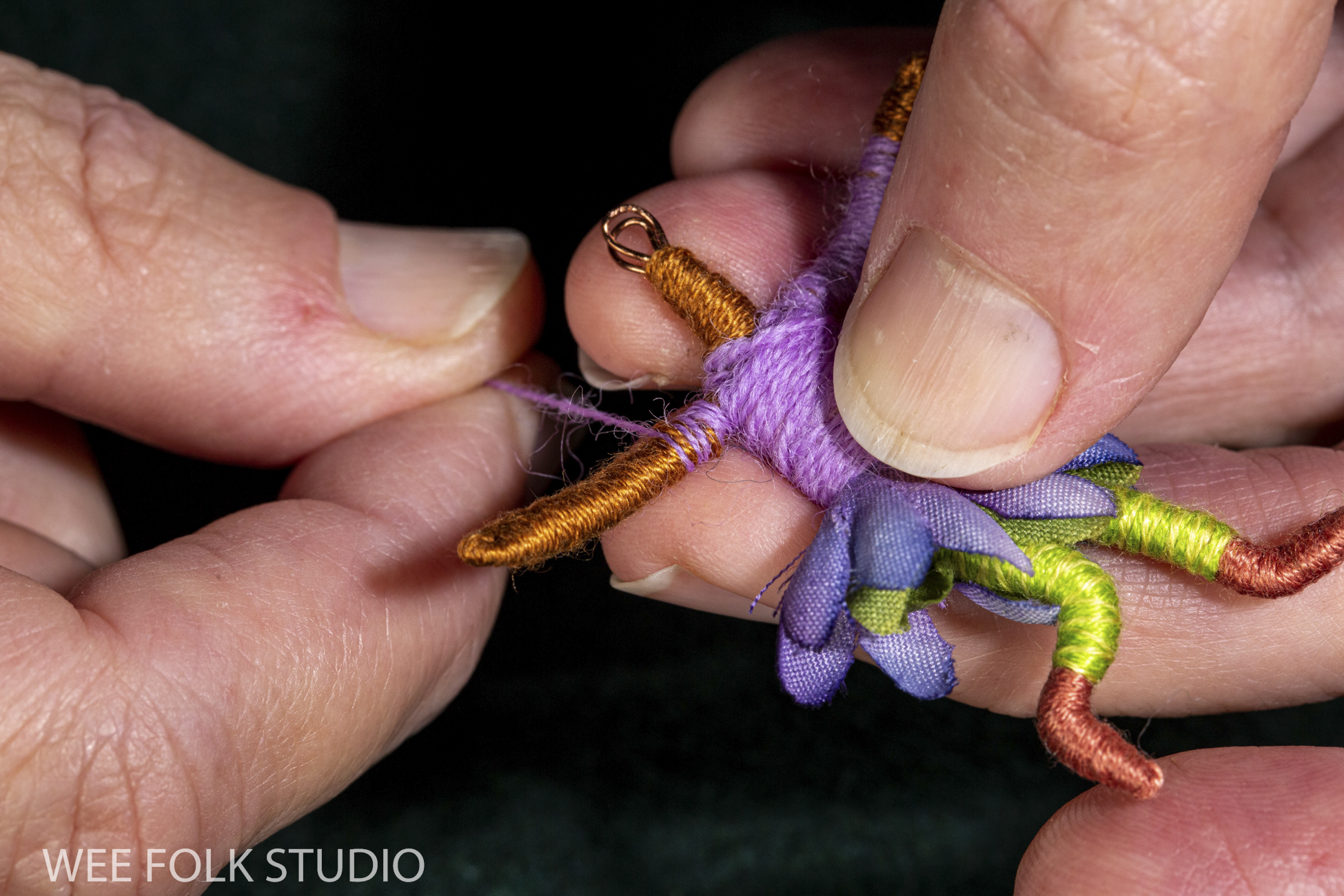
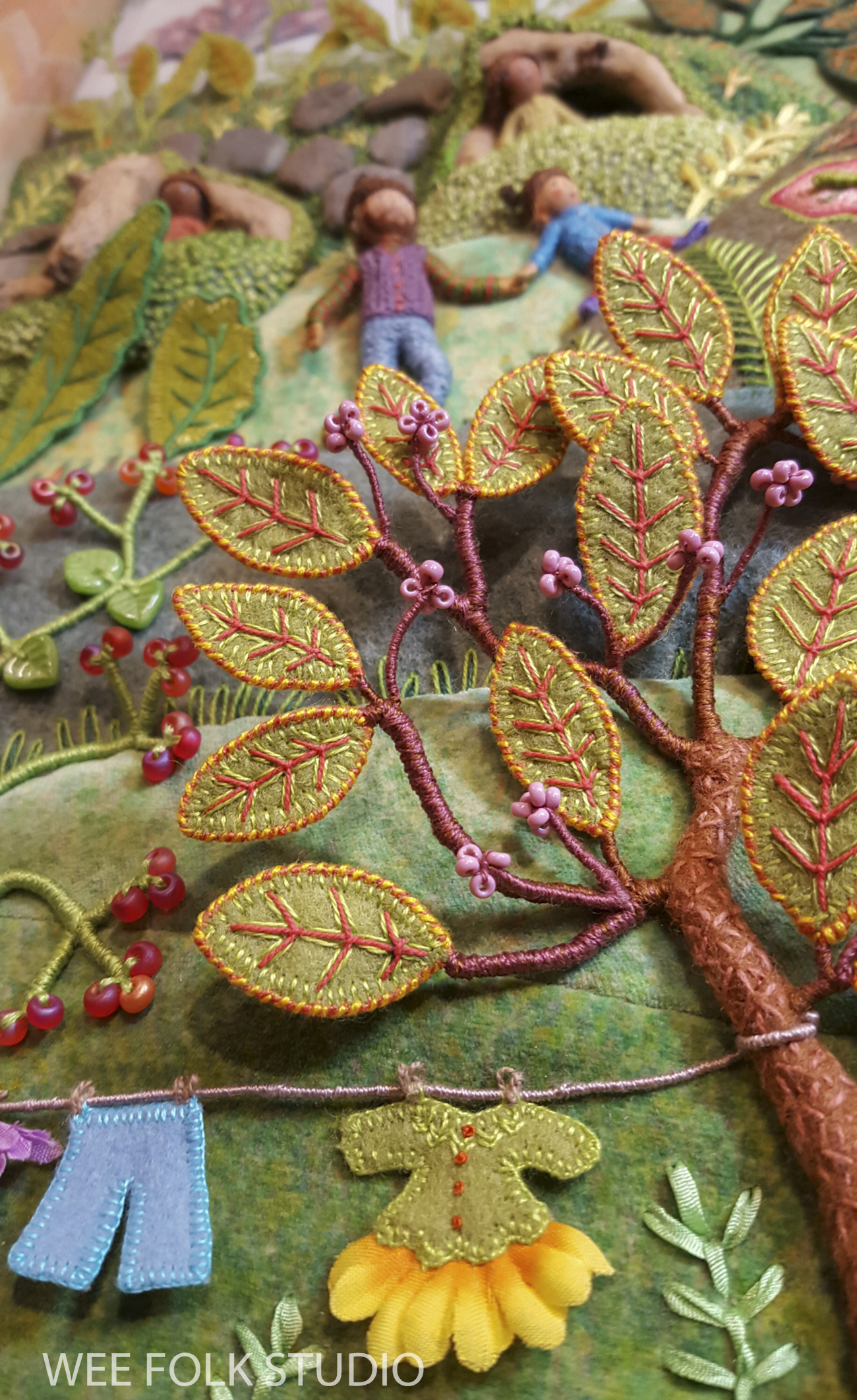
I made branches of wire wrapped with embroidery floss, which I embellished with glass seed beads.
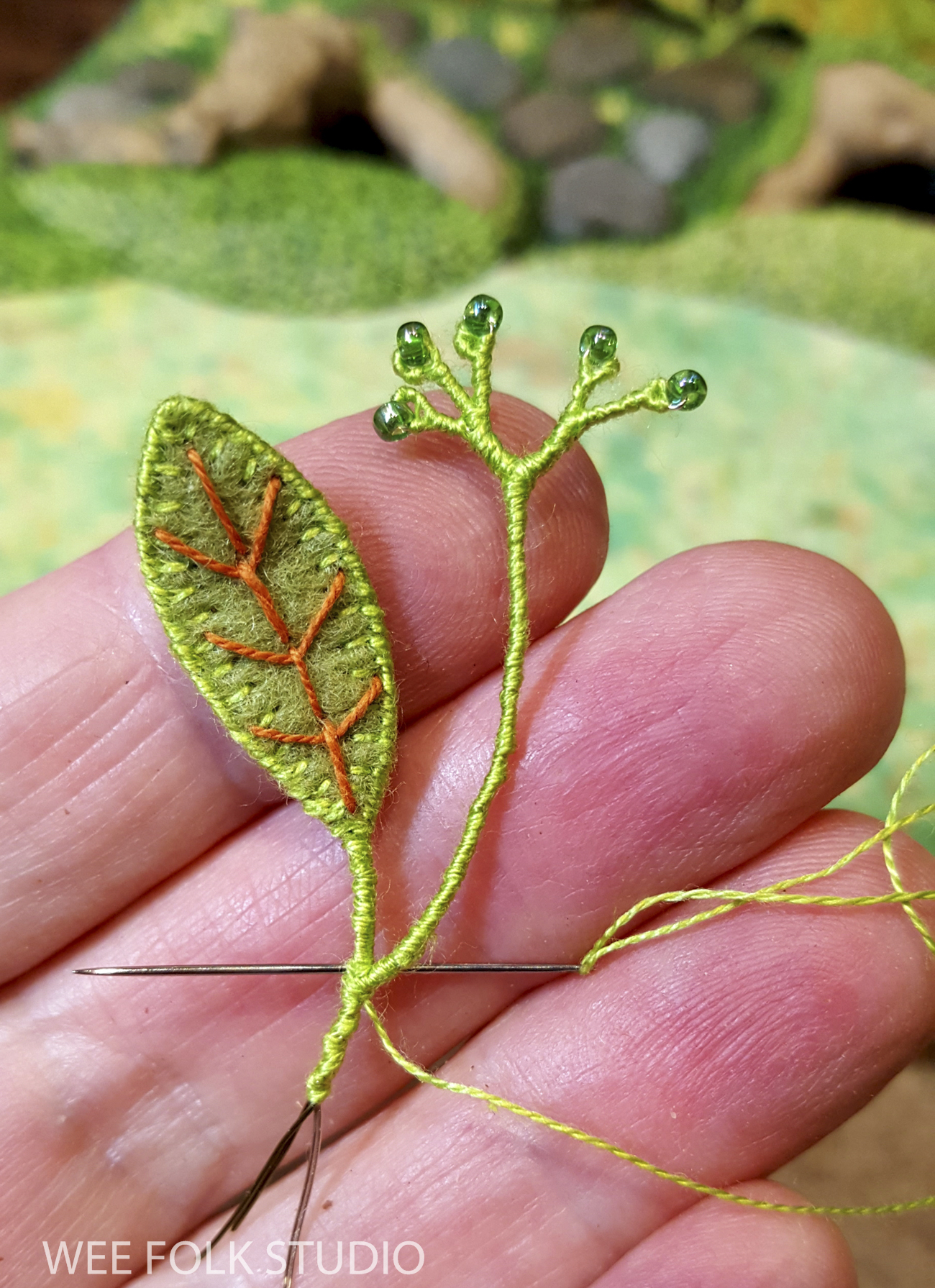
To add more stability to the larger leaves, I made the center vein with wire. All of the wire is covered with thread to hide the shiny metal.
I made long skinny leaves to go around the pond.
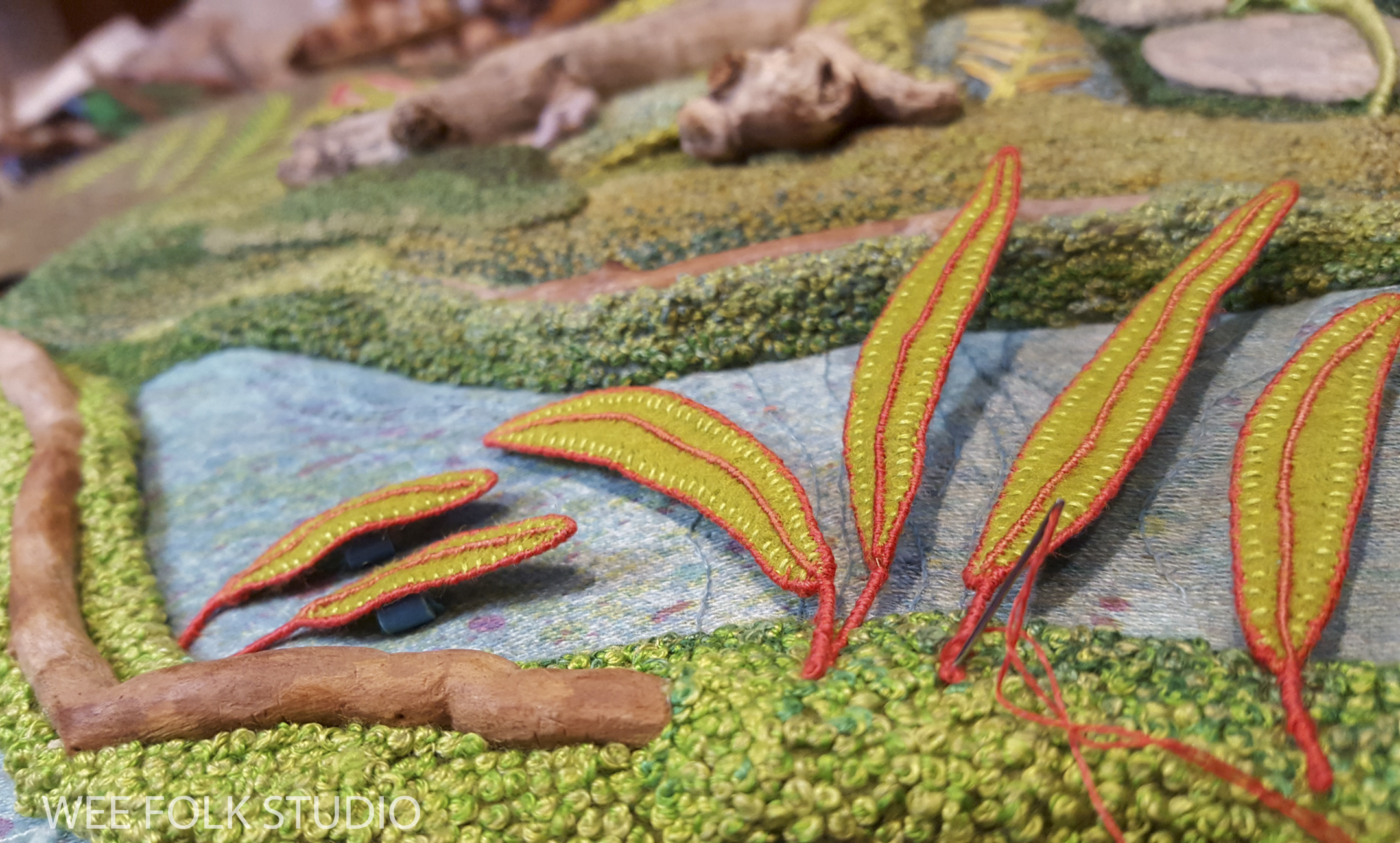
Even though the leaves had wire all around the outside edges and along the center veins, they weren’t rigid enough to keep them airborne and separate from the background pond fabric. So, I sewed blue tube beads to the undersides of the leaves, giving them the needed lift. Then, I sewed the beads to the pond fabric.

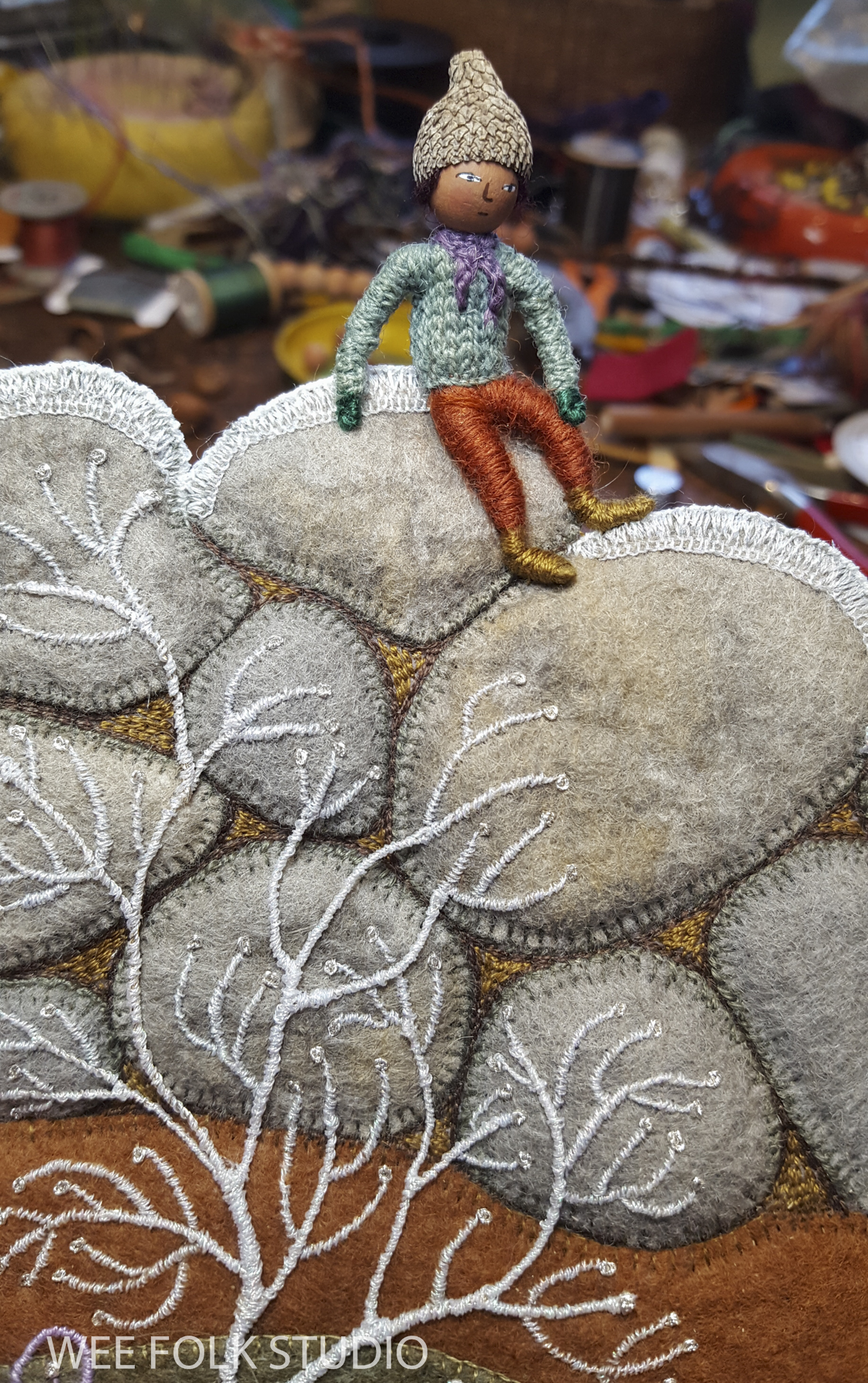
I also made bushes with felt leaves, wire branches and bead berries.
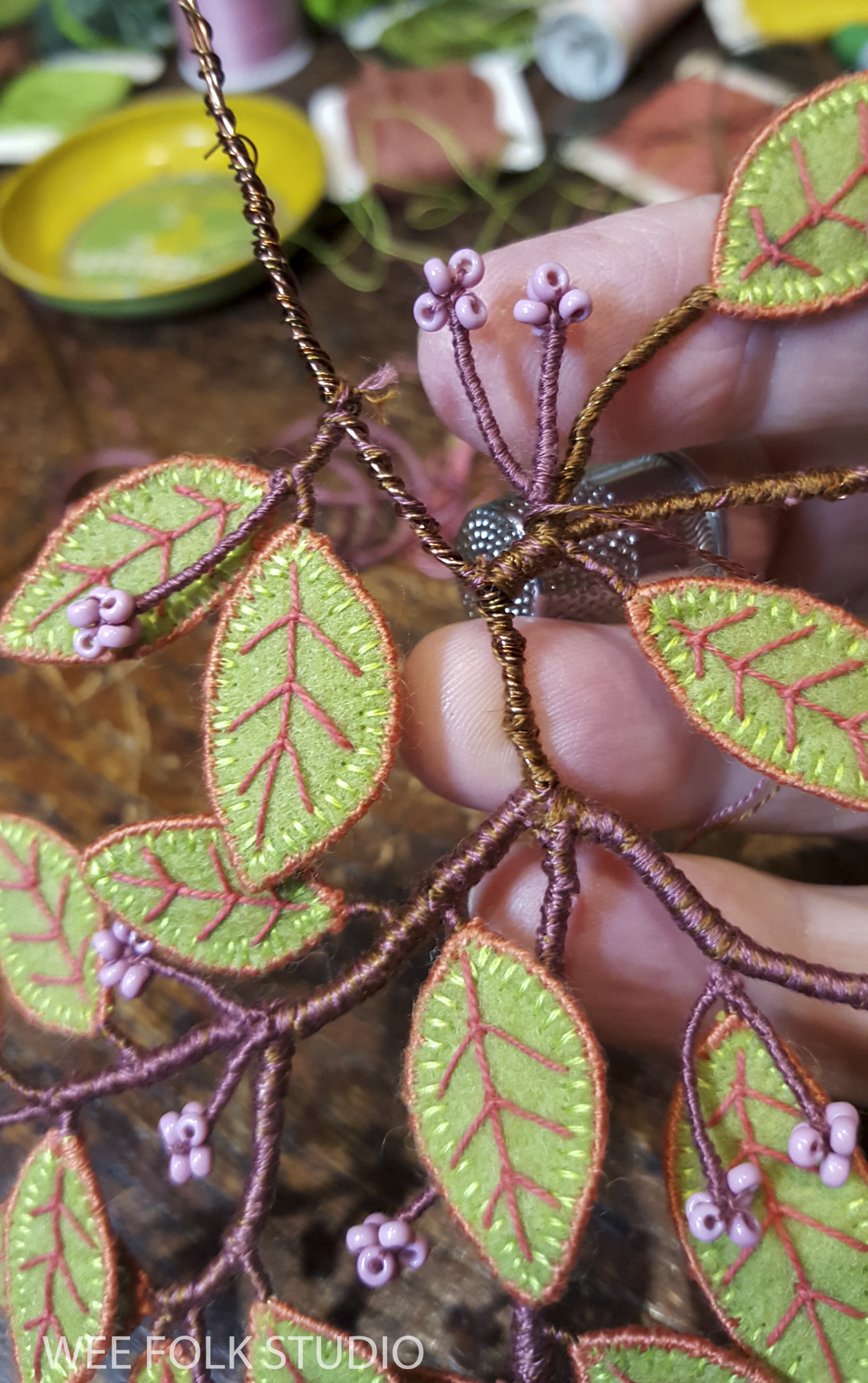
You can see the process of making the bush is this Stitch Minute Video.

Stitch Minute – Bush

This bush was one of the last parts I made for the scene and when it was finished, I eagerly sewed it in place. But every time I looked at the completed piece, I felt that something was off with the color and contrast of the bush. It blended in with the background and didn’t stand out enough. So, I did what I’ve done many other times when I’m not satisfied with how something looks, I snipped the thread holding the bush in place and figured out how to improve it.
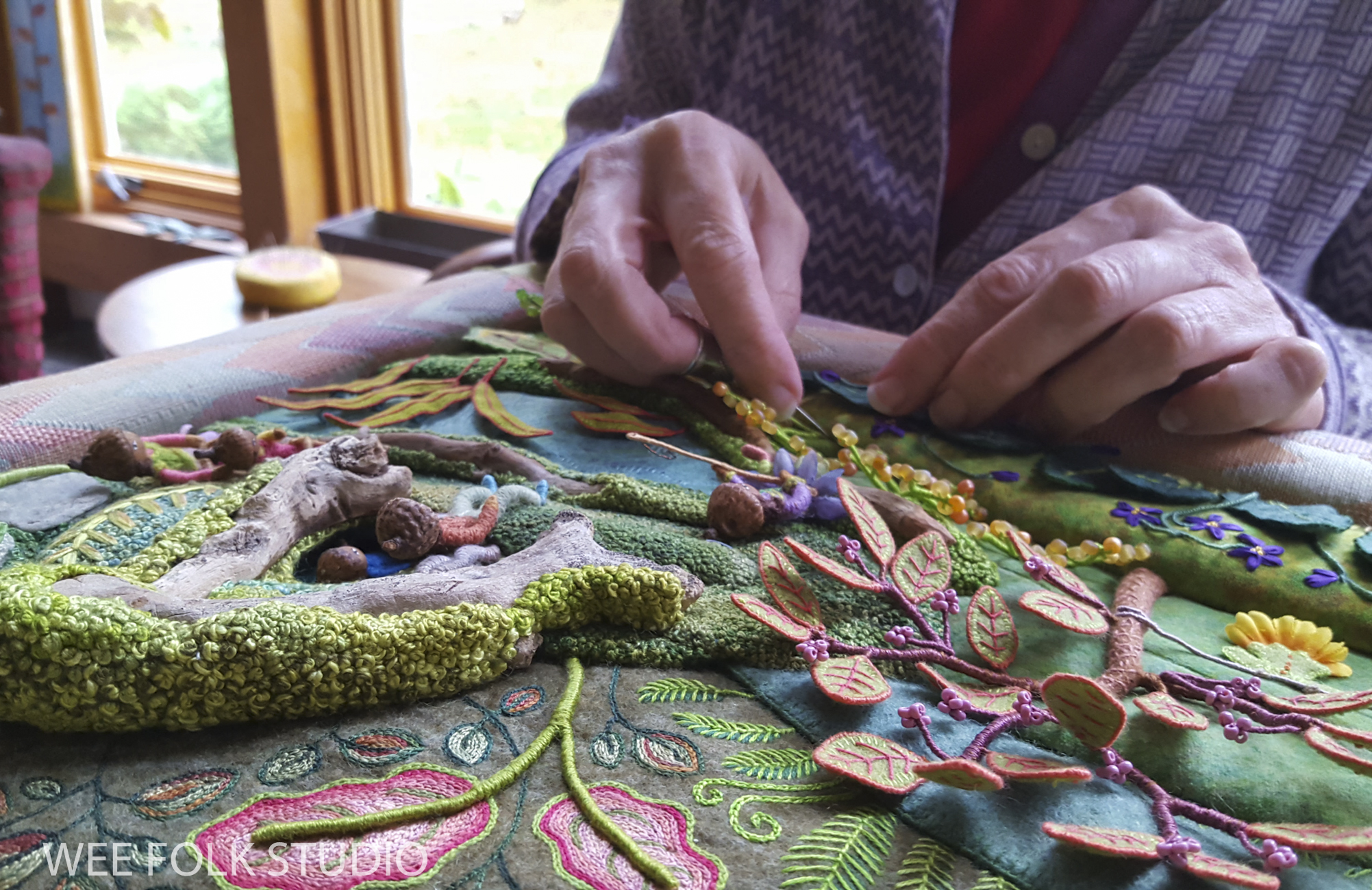
In this case, I brightened the leaf edges with yellow thread, which created a vibrant striped effect. I also outlined the leaf veins with light green to heighten the contrast. It was fussy work because the threads kept getting caught on the branches and beads. But, in the end I was happy with the results, which is all that mattered.
Stay tuned for more posts about making Mossy Glen. Other parts in the series will focus on other plants, embroidered embellishments and the wee folk characters.
Mossy Glen (overview)
Part 1 (moss)
Part 2 (cherry trees)
Part 3 (stone walls)
Part 4 (forsythia)
To keep up with new posts, please subscribe to this blog. Your contact info will not be sold or shared. If you’d like to see more frequent photos tracking the projects in my studio, please follow me on Facebook and/or Instagram.

Mossy Glen – part 4: forsythia

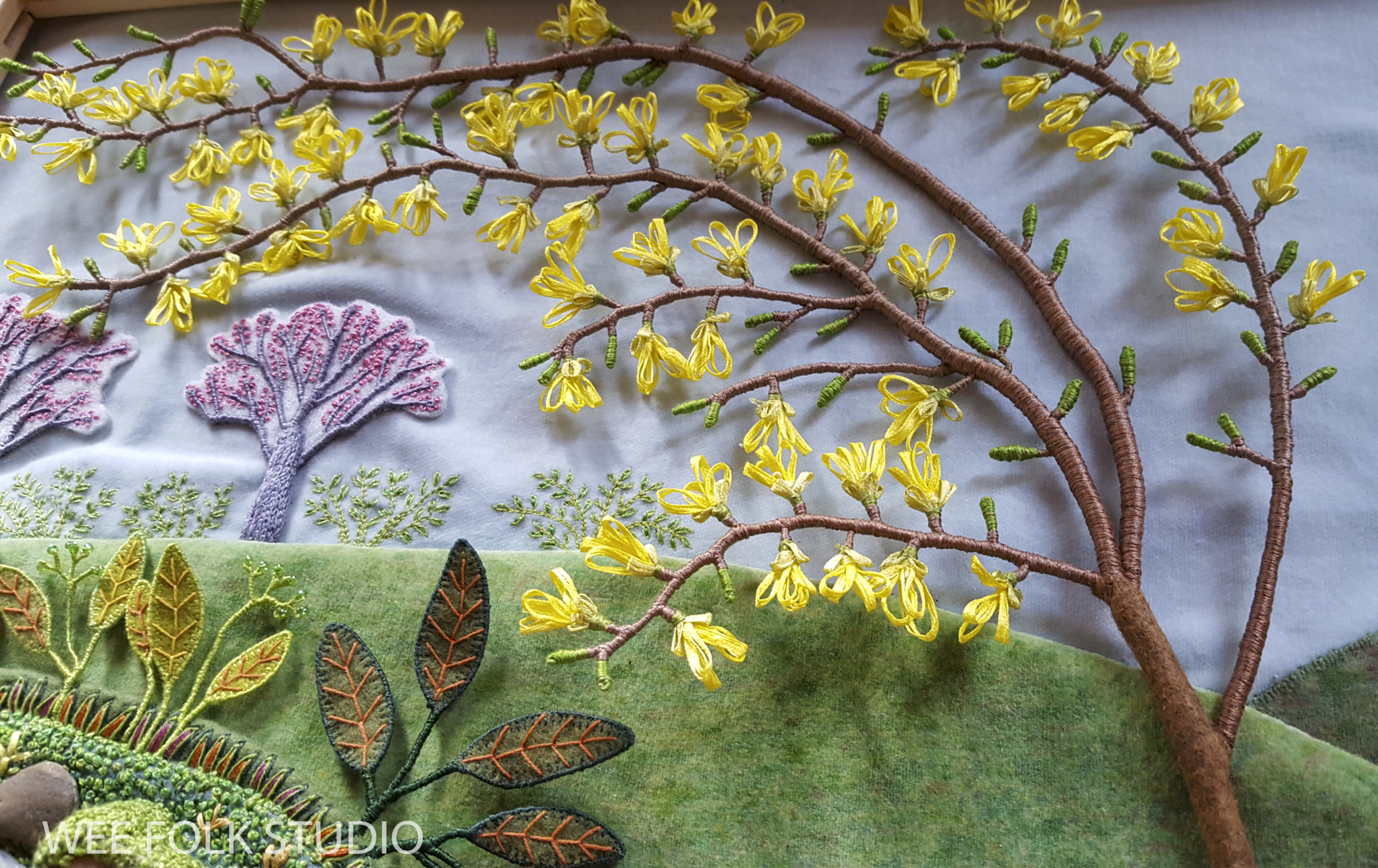
In this Part 4 of the series about making the spring landscape, Mossy Glen, I share photos and commentary about how I created the sweeping forsythia bush that arches above the hillside. Part 1 is all about stitching a moss-like texture, Part 2 gives a glimpse at how I made the cherry trees and Part 3 is about how I incorporated stone walls into the scene.

Mossy Glen is the spring scene in a series of seasonal landscapes that capture the wonder and magic of the natural world. Note cards, prints, bookmarks, and jigsaw puzzles of Mossy Glen and the other scenes in the series (Frosty MorningHarvest Time, and Summertime) are available in my Etsy Shop.

Before we escape into Mossy Glen’s land of innocence, I want to acknowledge what’s happening in the real world. The shocking and merciless attack on Ukraine by the Russian military is just too horrible to ignore. At times like this, I find it helpful to channel my distress into art. In this case, I already had images to work with. All I had to do was rearrange the photos and present them in context. So, this past week, on International Women’s Day, I posted the following image in solidarity with the people of Ukraine. The response on Facebook and Instagram was immediate and heartfelt, so I’m sharing it here as well. The group of portraits, featuring a Ukrainian in a traditional folk costume in the center, are some of the 48 women from around the world in my 2016 piece, Cover Up, which you can see and read about here.

In Solidarity with Ukraine

Forsythia
One of the first signs of spring around here, besides snowdrops and daffodils are the telltale splashes of yellow forsythia bushes. They’re only noticeable for a few weeks, before leafing out and blending in with every other nondescript mass of leggy branches along the roadside. When forsythia are in full blossom, though, they are an important marker of the changing season.

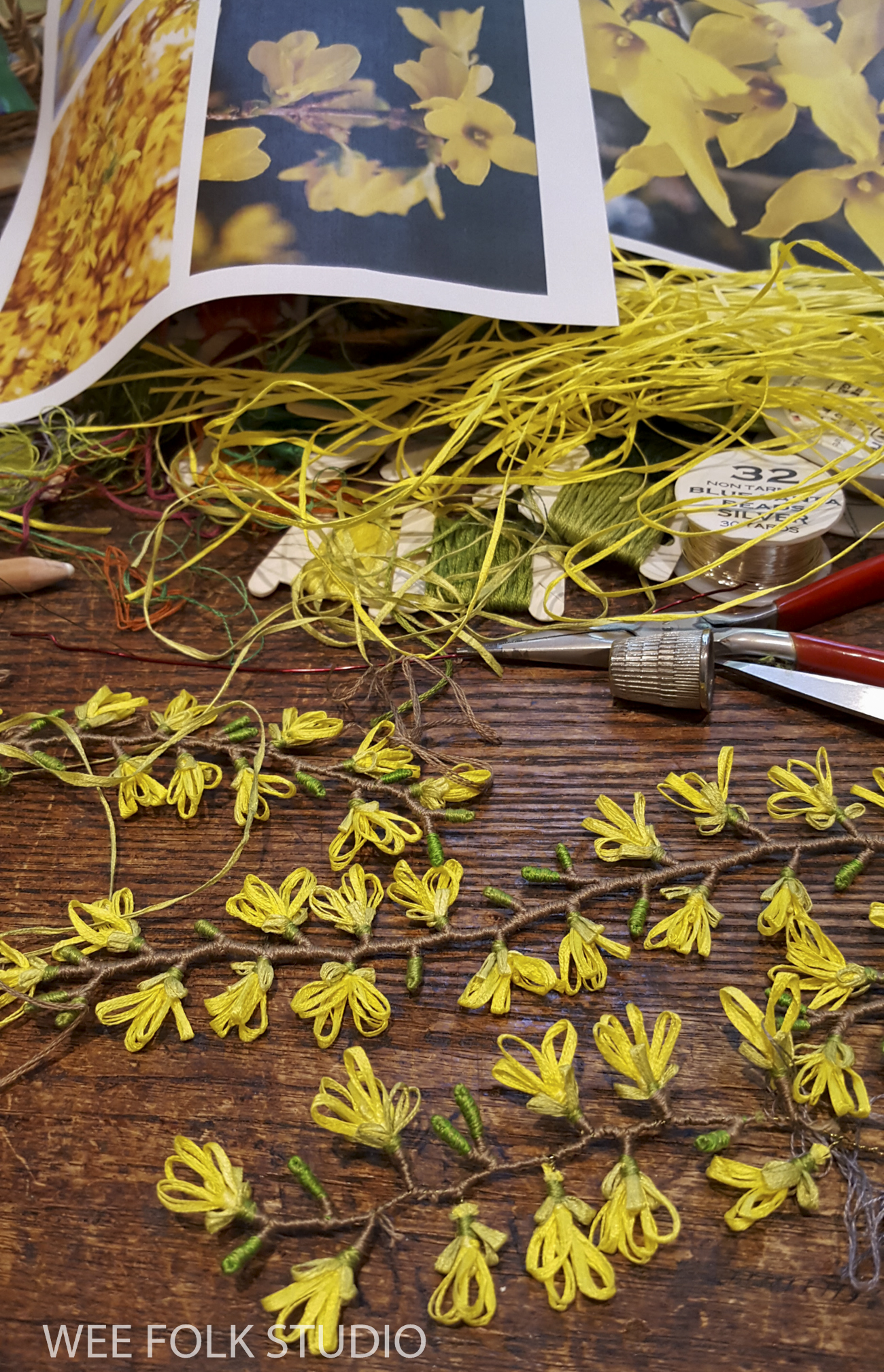
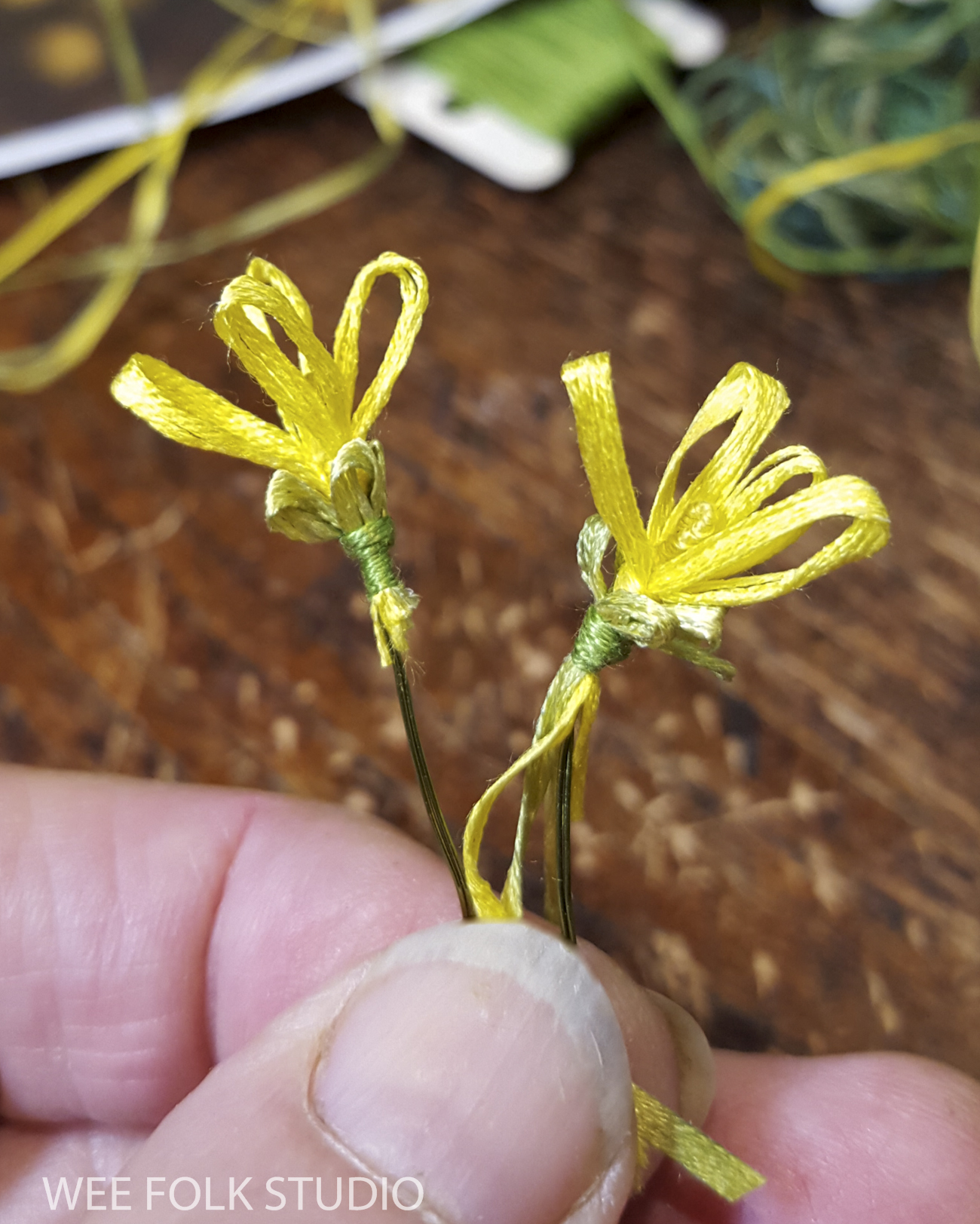
Once I decided to make a forsythia bush, I had to figure out how to construct the different parts. The wire branches would be straightforward, but the flowers needed a new approach. I knew that I wouldn’t be able to replicate them perfectly, so I thought of ways to give the impression of delicate blossoms.

After experimenting with different threads and yarns and finding the flowers too droopy and clumsy, I tried silk ribbon. The petals perked right up and held their shape!

The process of forming the flowers was quite fussy. It’s much easier to show than tell how, so here’s a Stitch Minute video to give you the basics.

Forsythia

The silk ribbon I used is from Silk Road Fibers. They have a ton of different colors.

I filled the wire branches with about 100 flowers and buds.

Then I wrapped brown embroidery floss around the branches, covering the messy wire stems.

The stems were still a bit bumpy, so I wrapped more layers with 2 or 3 strands of floss, until they were smooth like this.

Stay tuned for more posts about making Mossy Glen. Other parts in the series will focus on the leaves, embroidered embellishments and the wee folk characters.
Mossy Glen (overview)
Part 1 (moss)
Part 2 (cherry trees)
Part 3 (stone walls)

To keep up with new posts, please subscribe to this blog Your contact info will not be sold or shared. If you’d like to see more frequent photos tracking the projects in my studio, please follow me on Facebook and/or Instagram.

Mossy Glen: Part 3 – stone walls

In this Part 3 of the series about making the spring landscape, Mossy Glen, I share photos and commentary about how I incorporated stone walls into the scene. Part 1 is all about making moss and Part 2 gives a glimpse at how I made the cherry trees.

Why did I use real stones instead of making them with felt, as I did for Frosty Morning, (which you can see here)? I’ve asked myself the same question and have no clear answer, besides a feeling that real stones somehow balanced out and matched the realness of the wooden doorways.

Mossy Glen is the spring scene in a series of seasonal landscapes that capture the wonder and magic of the natural world. Note cards, prints, bookmarks, and jigsaw puzzles of Mossy Glen and the other scenes in the series (Frosty MorningHarvest Time, and Summertime) are available in my Etsy Shop.

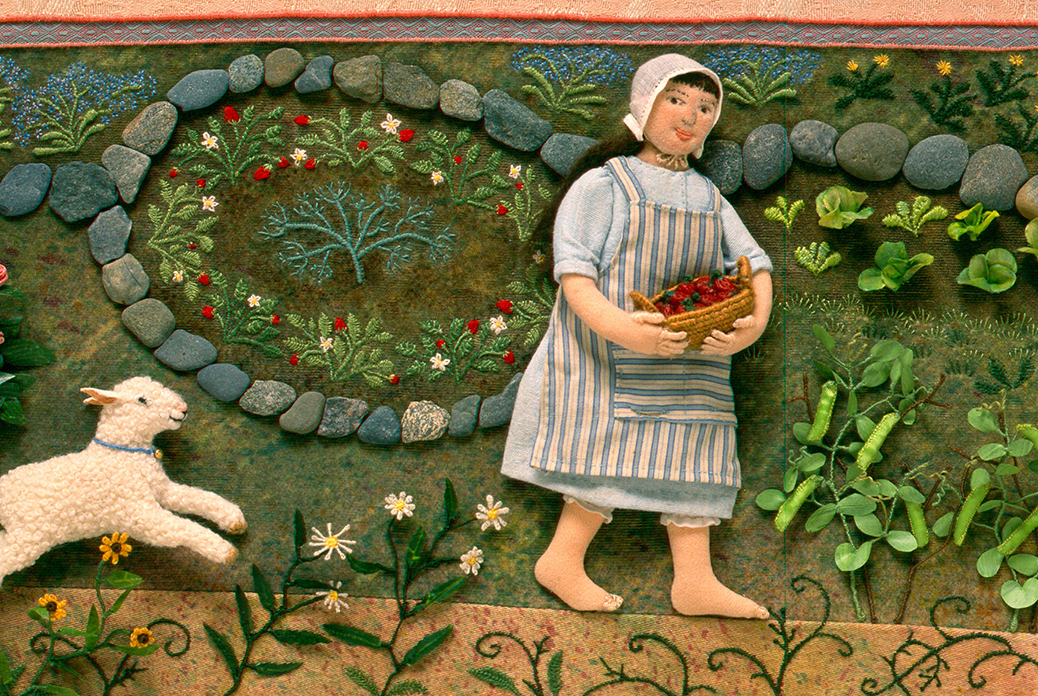
I first time I used real stones in my artwork was in 1995 for the picture book, Mary had a Little Lamb. I can remember sitting on the beach, sifting through the sand for small flat stones to use in the garden scene. When it came time to glue them to the background fabric, I was a nervous wreck, afraid of dropping glue in the wrong place by mistake and ruining all my work.

This time, I found more stones than sand to sift through at the beach.

Woodneck Beach, Falmouth, MA

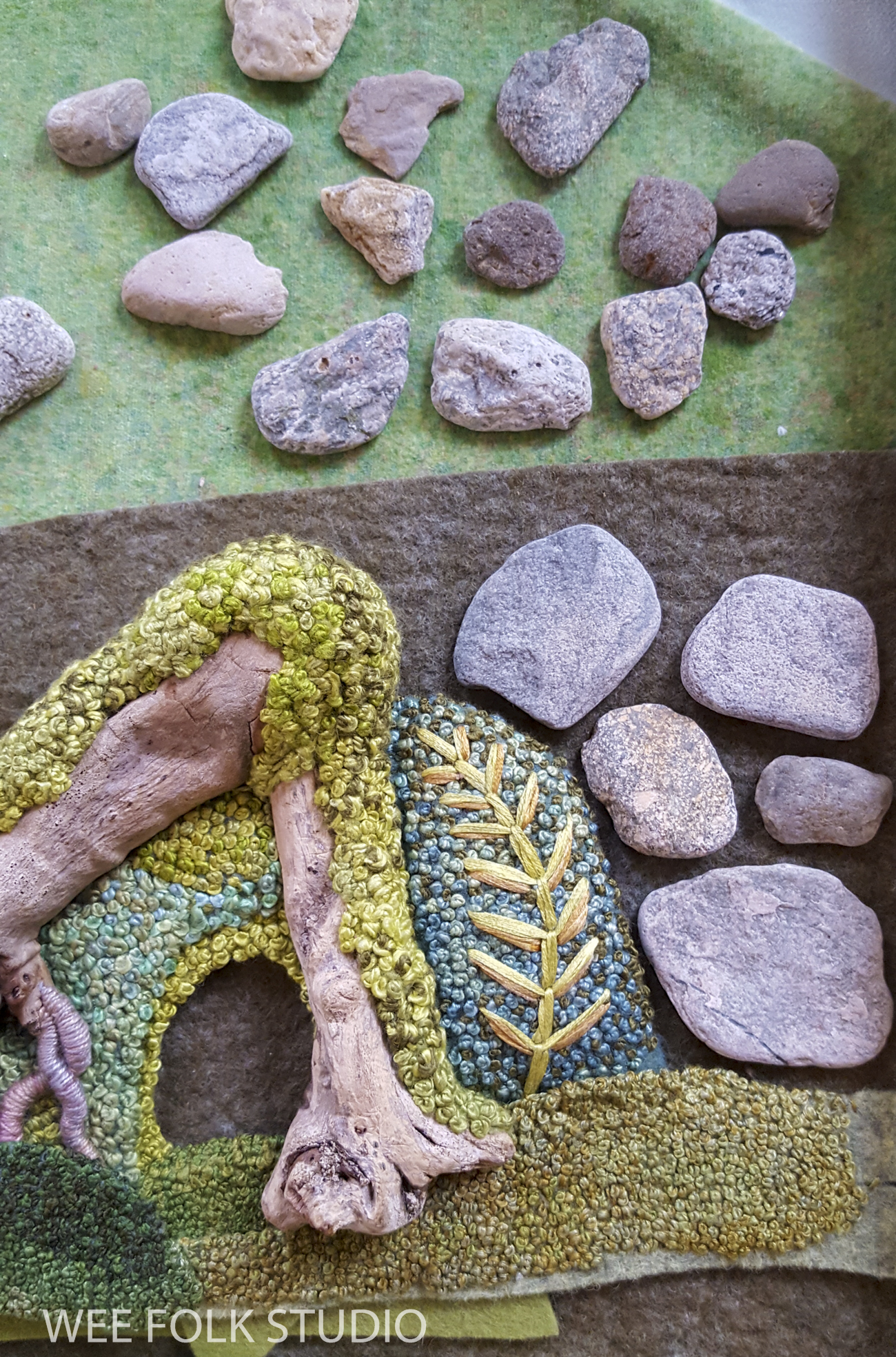
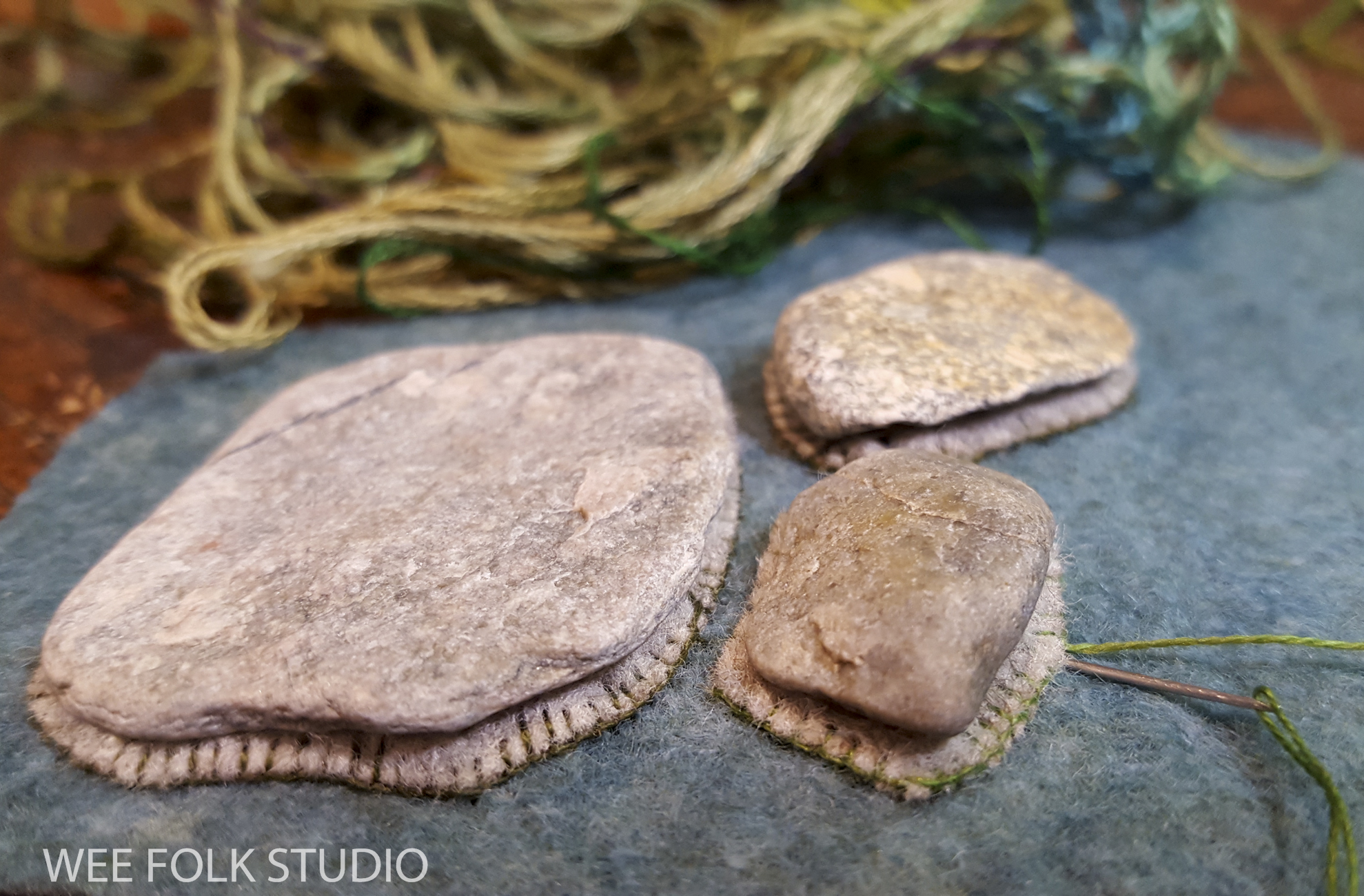
I came home with a varied selection of stones, ranging in size from 1/2″ to 1 1/4″. They needed to be thin so they wouldn’t be too heavy and flat on the back so the glue would have a surface to adhere to.

As I played around with their arrangement, I decided to add a mossy felt section to the composition, which I embellished with silk ribbon. This ribbon is made by Silk Road Fibers.

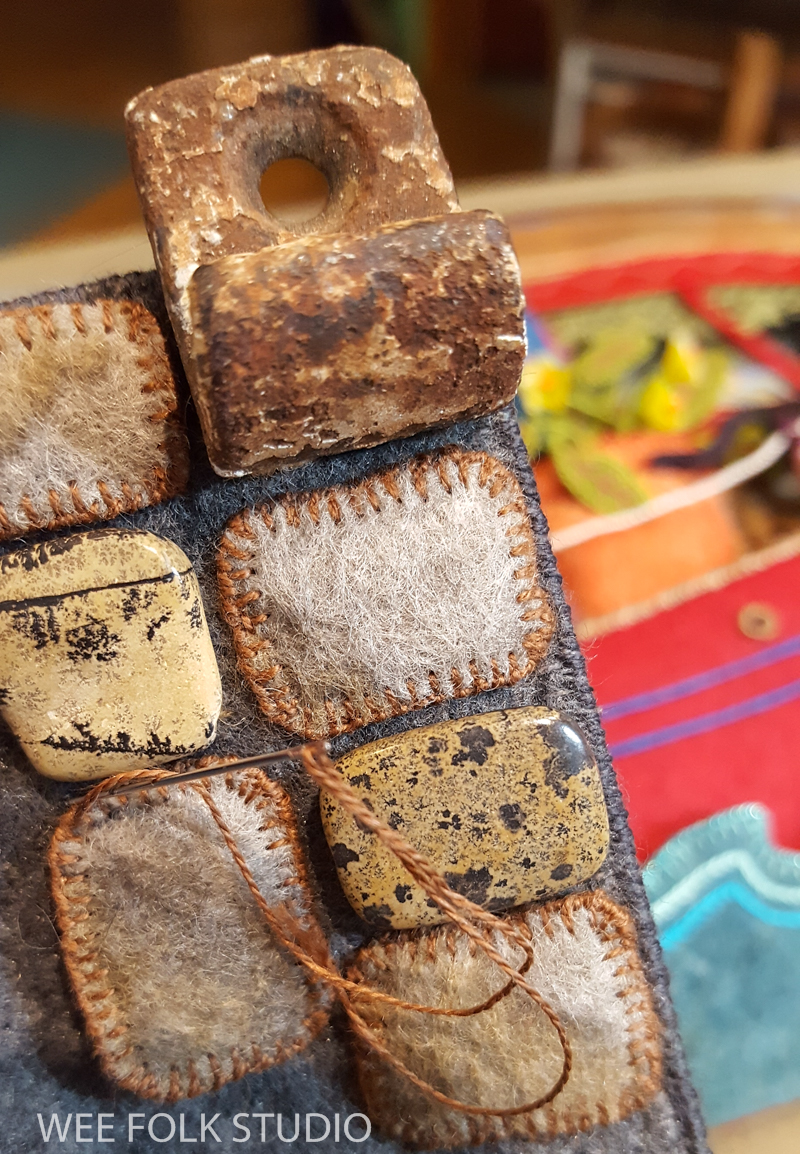
One downside of using glue is that once you’ve cemented something in place, that’s where it stays. I’d rather have the flexibility to move parts around, so I glued stones to individual pieces of felt. That way, I could make adjustments as I built the wall. It’s a lot easier to rip out a bunch of stitches than move a glued object.
Aleene’s makes a variety of fabric embellishing adhesives that all work well. Do I use hot glue? No, because it’s stringy, messy, shoddy looking and I don’t trust its holding capabilities.

Once the stones and their felt backings were sewn in place, I covered the felt and filled in the cracks with a gazillion french knots, making a carpet of moss.

As with the moss in other parts of the Mossy Glen (that you can see here), I combined different shades of green embroidery floss to give it a naturalistic appearance.

As I stitched french knots around the stones, I realized that the mossy wall was too plain and would look better with something growing in front of it.

So, I formed a vine out of wire, silk ribbon and embroidery floss. Even though I documented the process with photos, it’s hard to remember exactly how I made it. All I know is that the silk ribbon loopy leaves came first and then I covered the wire and ribbon with embroidery floss. In my head, can hear my mother’s voice saying that the floss covered a multitude of sins.

I sewed the vine in place in the spaces between the stones.

I expanded the Mossy Glen neighborhood to include another stony bank with 2 more doorways.

This time, I glued the stones directly to the background fabric because I was more confident about their placement.

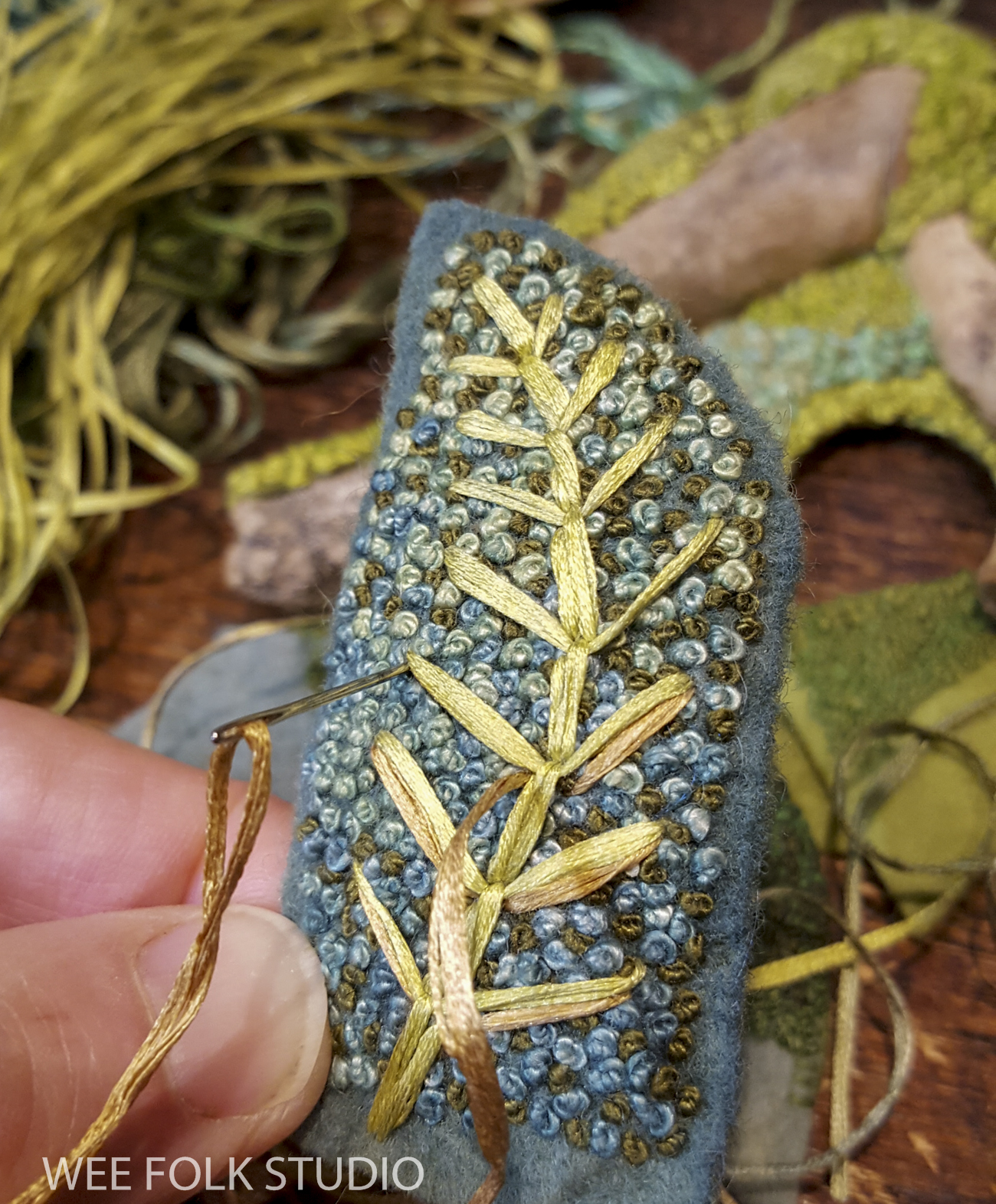
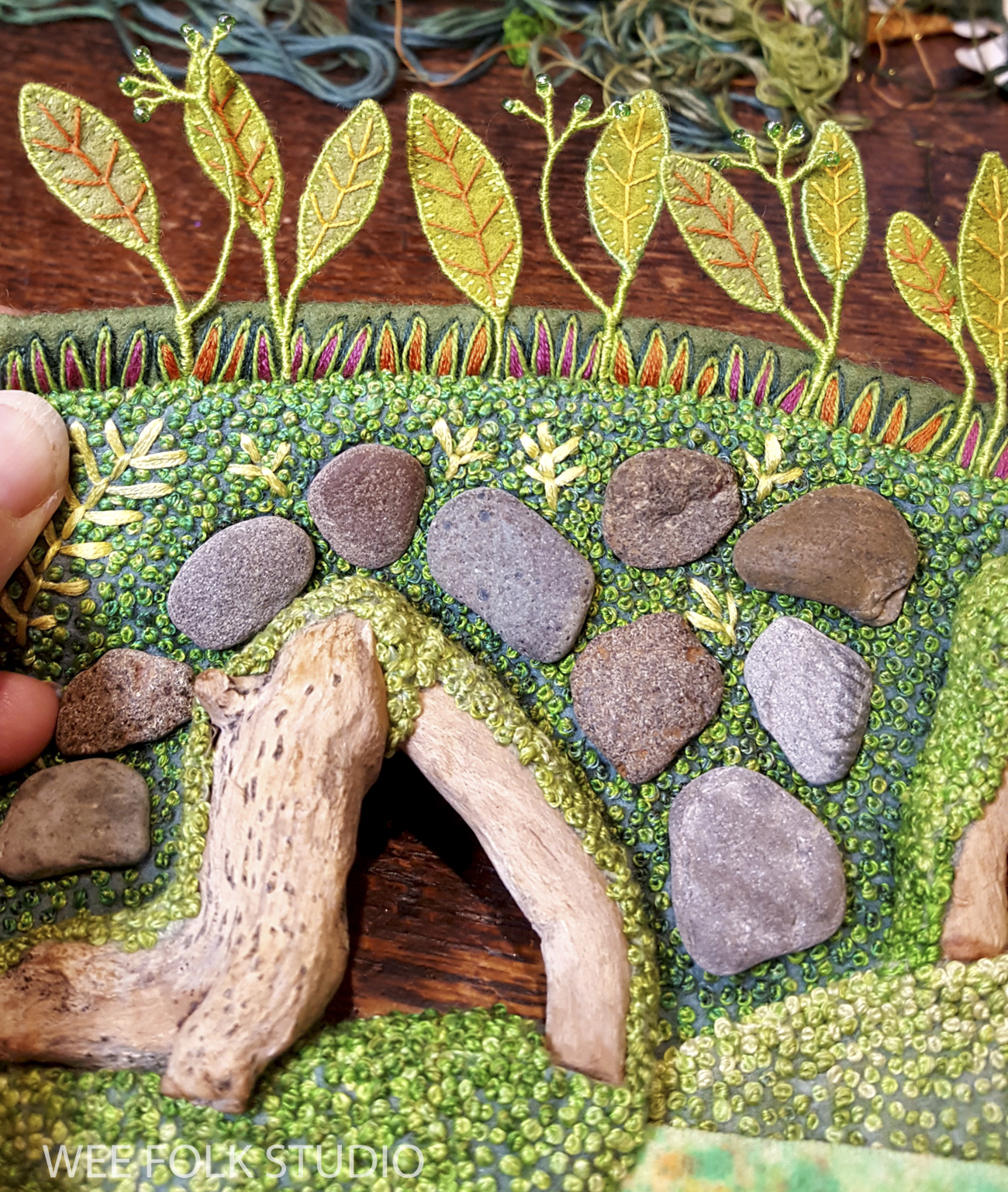
When I stitched around the stones, I left some room between the knots, so the blue green felt showed through. Again, I thought the hillside was too plain, so I stitched a few plants with silk ribbon.

As I embellished around the stones, I periodically checked the positioning of the moss covered wooden doorways, to make sure that they fit OK.

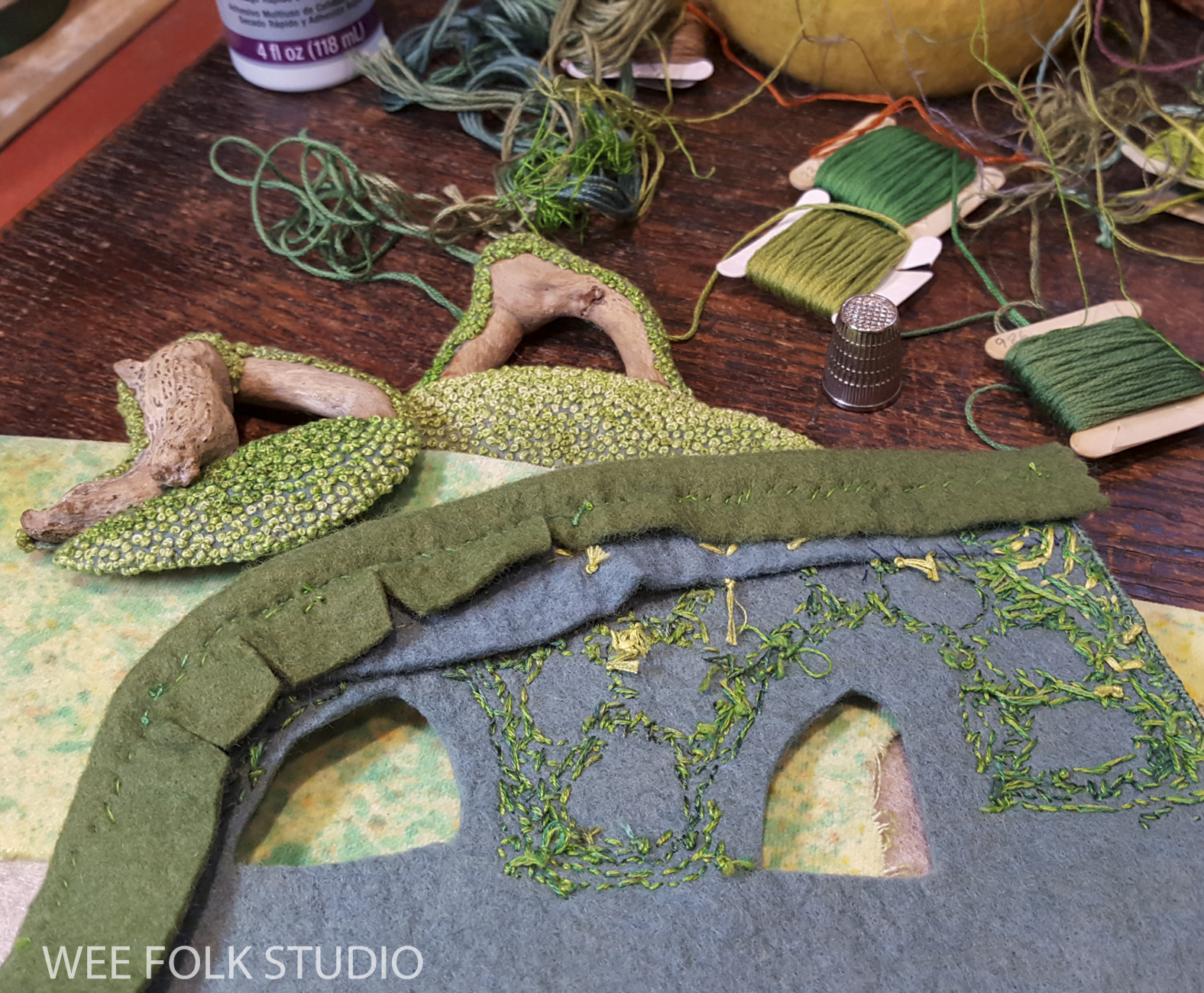
Here’s a photo showing the back of the hillside, with a green felt strip along the top edge. It’s kind of like piping without a cord filler inside.

I added the green strip along the top of the mound to create a space for blades of grass. In contrast to the myriad of greens, I used bright warm colors to stitch the grass.

Stay tuned for more posts about making Mossy Glen. Other parts in the series will focus on the forsythia bush, leaves, embroidered embellishments and the wee folk characters.
Mossy Glen (overview)
Part 1 (moss)
Part 2 (cherry trees)
Part 4 (forsythia)

Mossy Glen: Part 2 – Cherry Trees

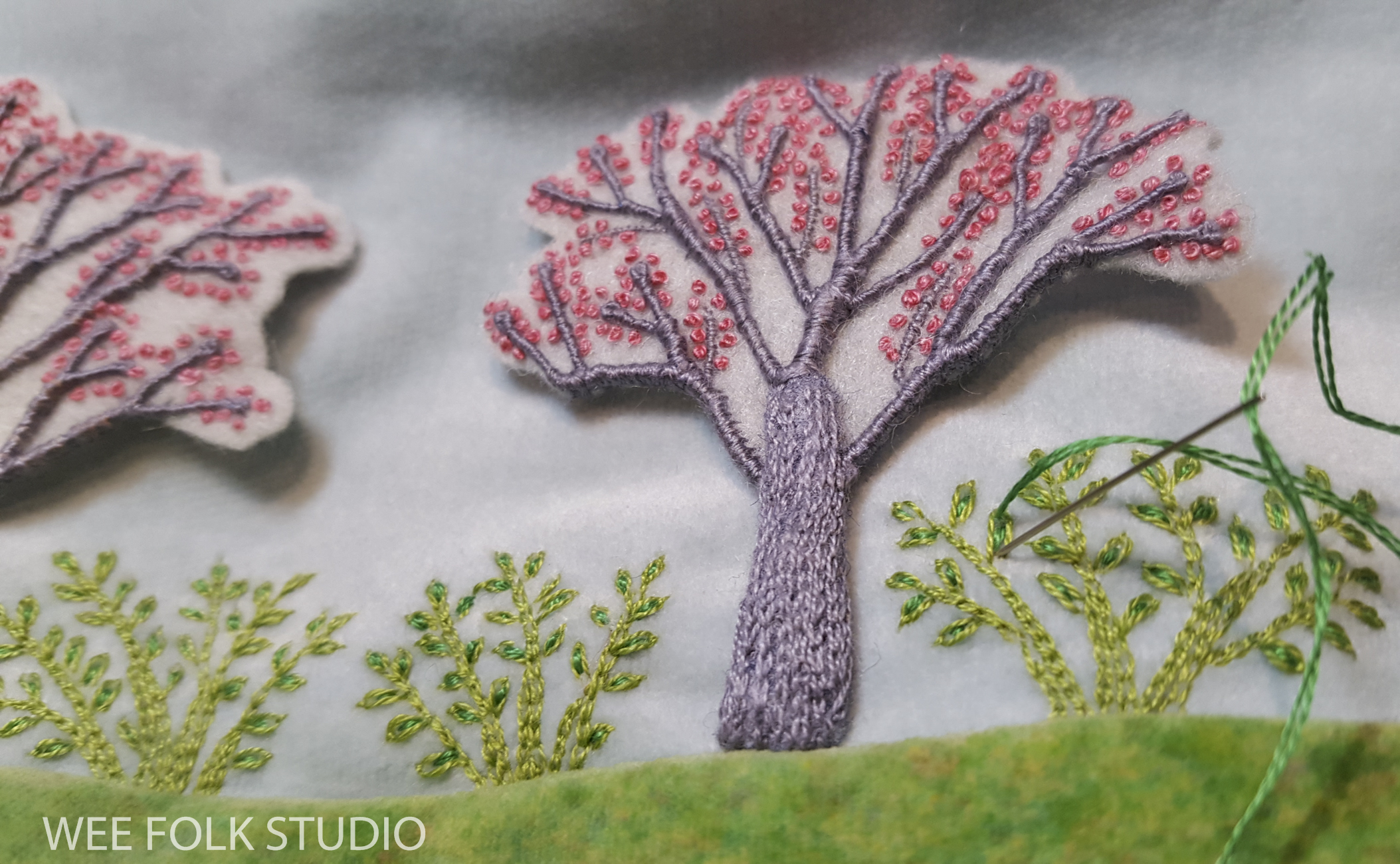
Flowering trees in the spring are glorious, aren’t they? Maybe we appreciate them because their showy display is so brief. In this Part 2 of the series about making Mossy Glen, I share photos, videos and commentary about how I created the cherry trees that sit atop the hillside, off in the distance.

Mossy Glen is the spring scene in a series of seasonal landscapes that capture the wonder and magic of the natural world. Note cards, prints, bookmarks, and jigsaw puzzles of Mossy Glen and the other scenes in the series (Frosty MorningHarvest Time, and Summertime) are available in my Etsy Shop.

The pink tinted trees against the blue sky remind me of the blossoming apple trees in this book jacket illustration for my 1995 book, Mary Had a Little Lamb.

Mary Had a Little lamb 1995

Of course, apple and cherry trees are shaped differently and their flowers aren’t the same shade of pink. I also constructed them differently – the apple trees are embroidered directly onto cotton velveteen, whereas the cherry trees in Mossy Glen are made with a combination of wrapped wire and embroidery on wool felt.

I also made the cherry trees as separate objects that could be shifted around. That way, I could adjust their position according to how the surrounding parts came out. Over the years, I’ve found that keeping an open-ended playful element in my process is more and more important. The idea of following a set pattern or grid, without much wiggle room, such as in knitting, cross-stitching or weaving makes me feel trapped and constrained, without room to breath.

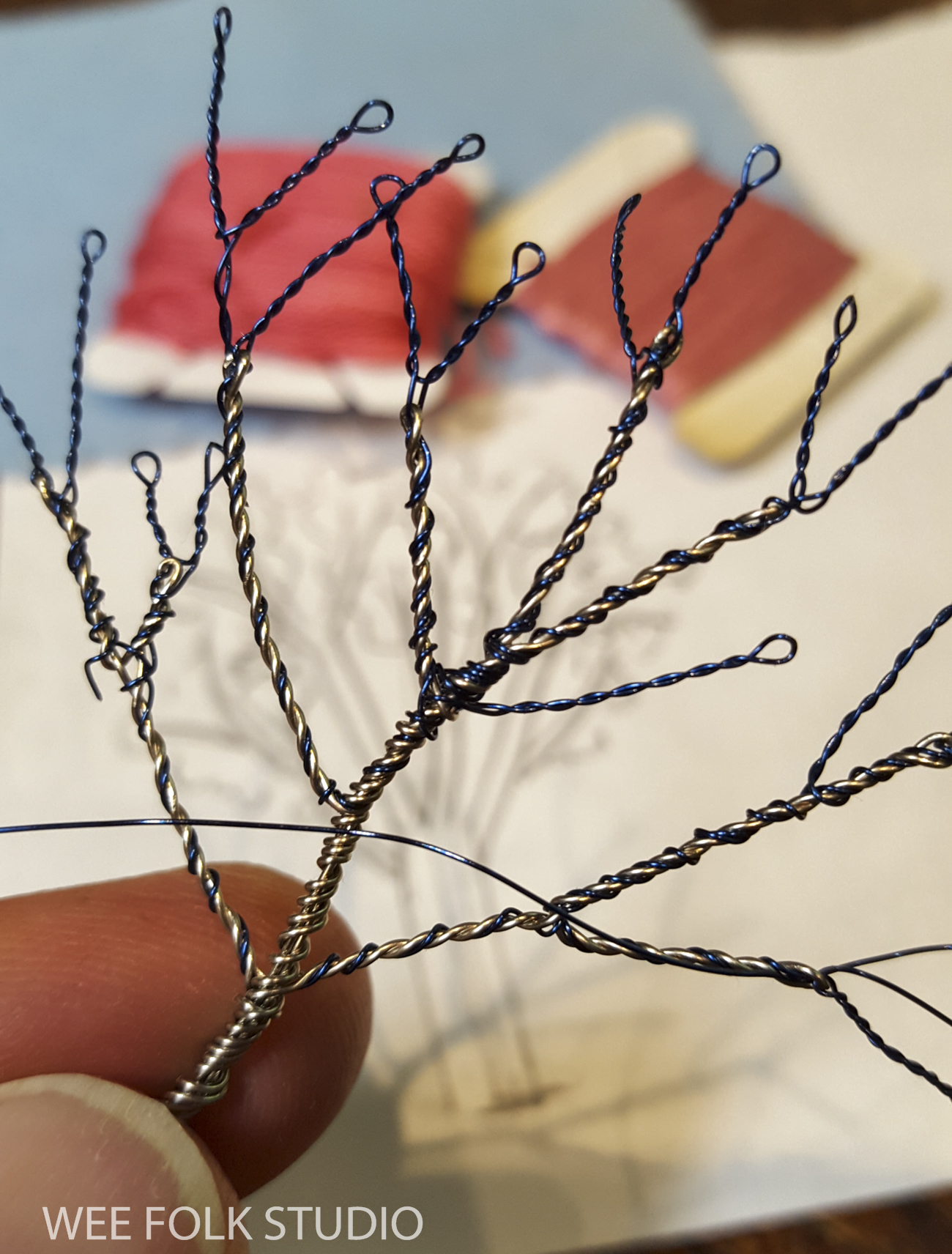
I formed the tree shapes with wire, using a finer gauge for the smaller branches. The loops on the ends were big enough to sew a needle and thread through.

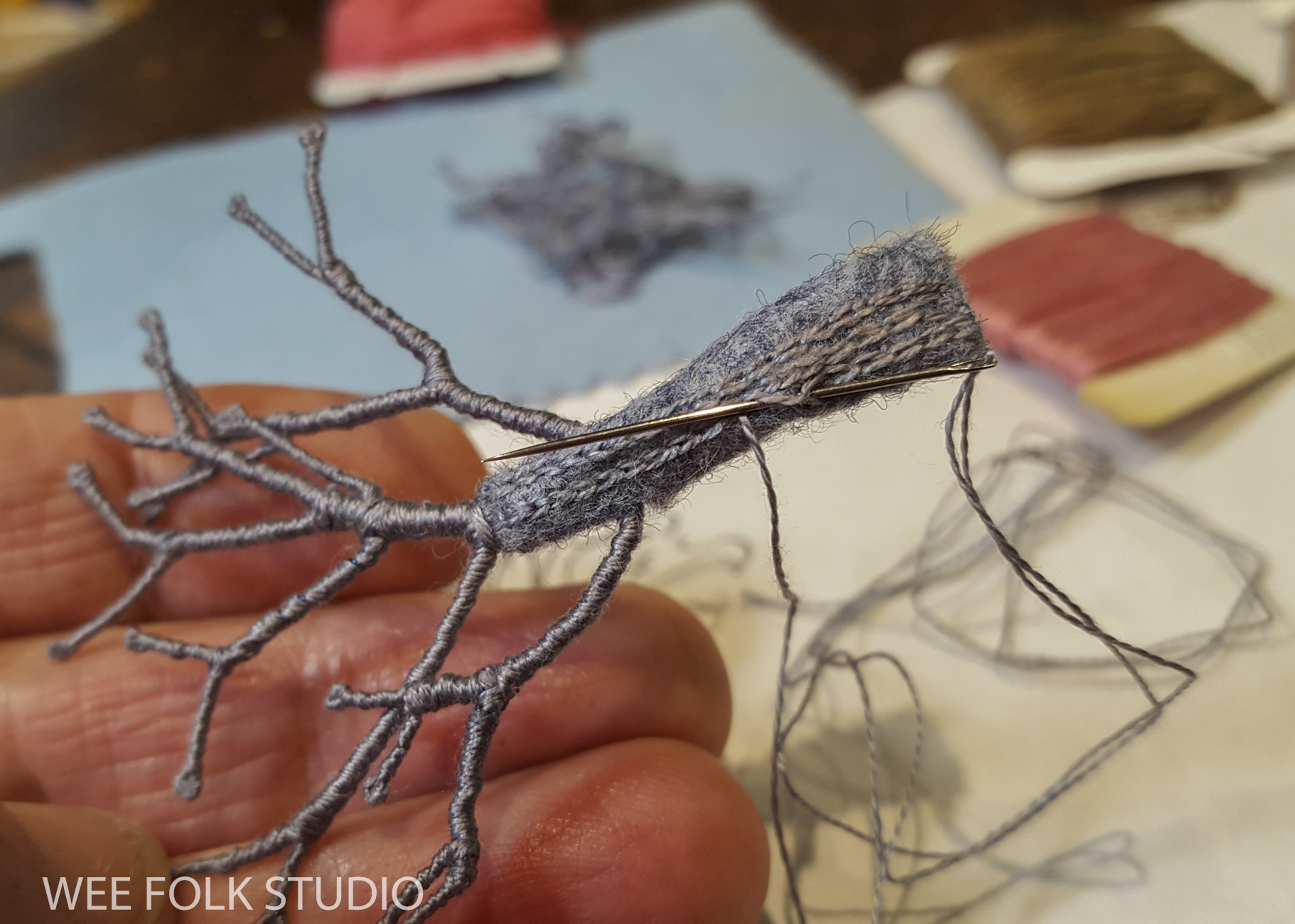
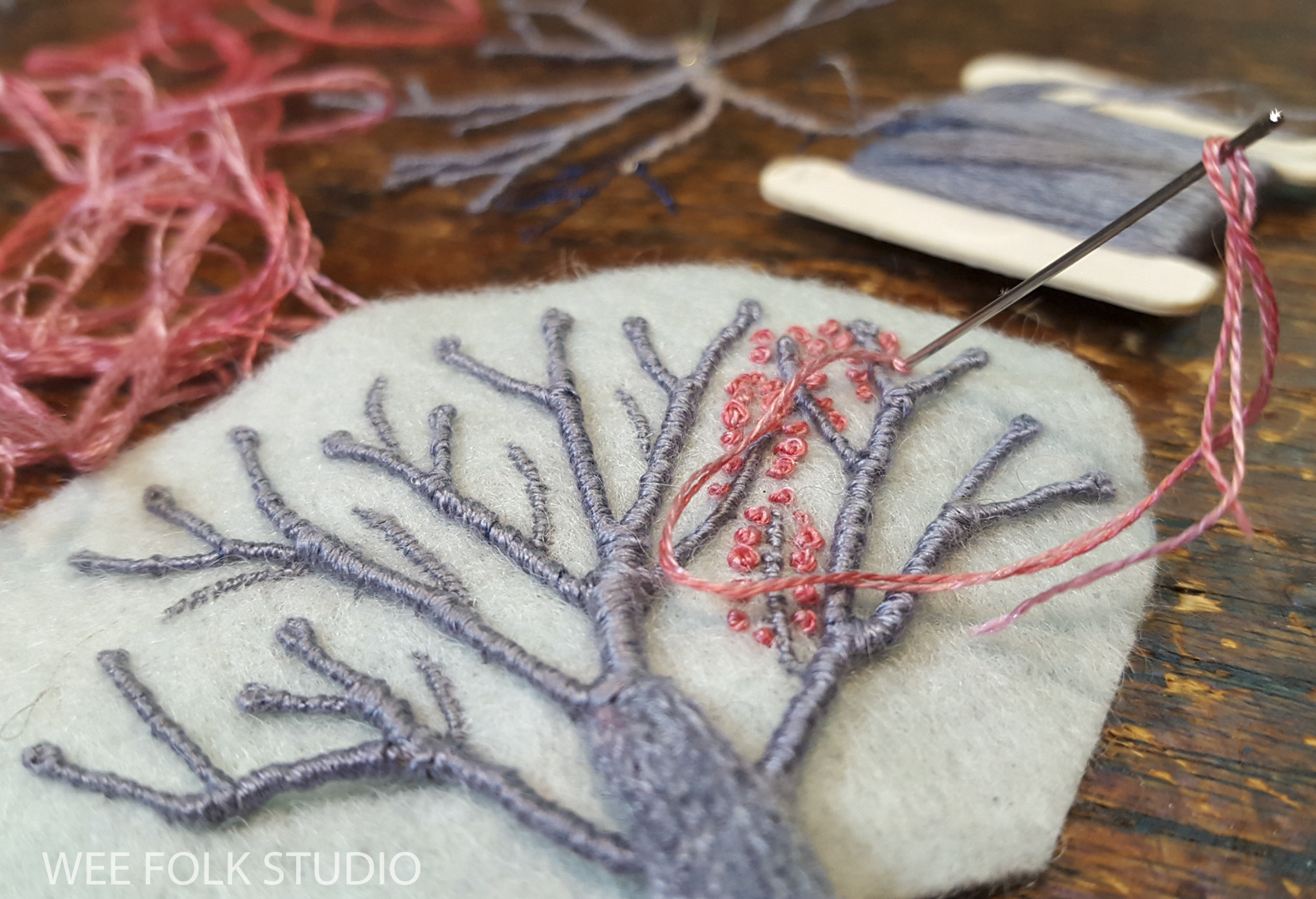
I wrapped the branches with embroidery floss and covered the trunk with wool felt, which I embellished with vertical rows of chain stitching. This Stitch Minute video shows how I wrapped the wire and stitched the blossoms with french knots.

Stitch Minute – wire tree

This was the first time I can remember creating a tree with its own section of sky attached. Luckily, I had some pale blue felt that was almost the same shade as the cotton velveteen background sky.

After sewing the wire tree to the felt, I embroidered a few extra branches to fill in the gaps and added pink blossoms with french knots.

I made a patch of sorts, by cutting the felt around the contours of the treetop. At this point, I’d figured out where to put the trees, so it was okay to decorate the surrounding area. Watch this Stitch Minute video to see how I stitched some little bushes onto the velveteen background.

Stitch Minute – bushes

In the future, I’ll give a closer look at how I made the foliage on the hillside that’s positioned below and in front of the cherry trees.

Stay tuned for more posts about making Mossy Glen. Other parts in the series will focus on the stone walls, forsythia bush, embroidered embellishments and the wee folk characters.
Mossy Glen (overview)
Part 1 (moss)
Part 2 (cherry trees)
Part 3 (stone walls)
Part 4 (forsythia)

To keep up with new posts, please subscribe to this blog Your contact info will not be sold or shared. If you’d like to see more frequent photos tracking the projects in my studio, please follow me on Facebook and/or Instagram.

Bedtime Stitches opens in Lincoln, NE and other news

First off, I’d like to welcome the influx of new subscribers, who’ve recently discovered my work through The Quilt Show. I hope that you enjoy exploring my needle and thread universe that you don’t get too lost in the archives!
————————————————————————————————–
Today’s post includes an exhibition announcement with a virtual gallery tour, a zoom interview hosted by Niisha HandCrafted from Dubai, UAE and a preview of the fall landscape in my 4 seasons series.

Southeastern New England took the brunt of last weekend’s blizzard, but miraculously we didn’t lose power. Sunday was both a gross and fine motor skills kind of day, with shoveling outside and stitching inside in front of the wood-stove. Gotta have a balance of physical exertion and fiddly handwork or weird things start to happen!

I’m working on the fall landscape (autumn for some of you) in my 4 seasons series. As you can see, this scene will have a moss-covered habitat for the wee folk that is surrounded by chain-stitched vegetation. There’s still a lot more to do, but if I can complete it by spring, this yet-to-be-named piece will join Mossy Glen and Frosty Morning in my retrospective show at the Brick Store Museum in Kennebunk, ME this summer (June 3 – Sept. 11, 2022).

Bedtime Stitches Touring Exhibition
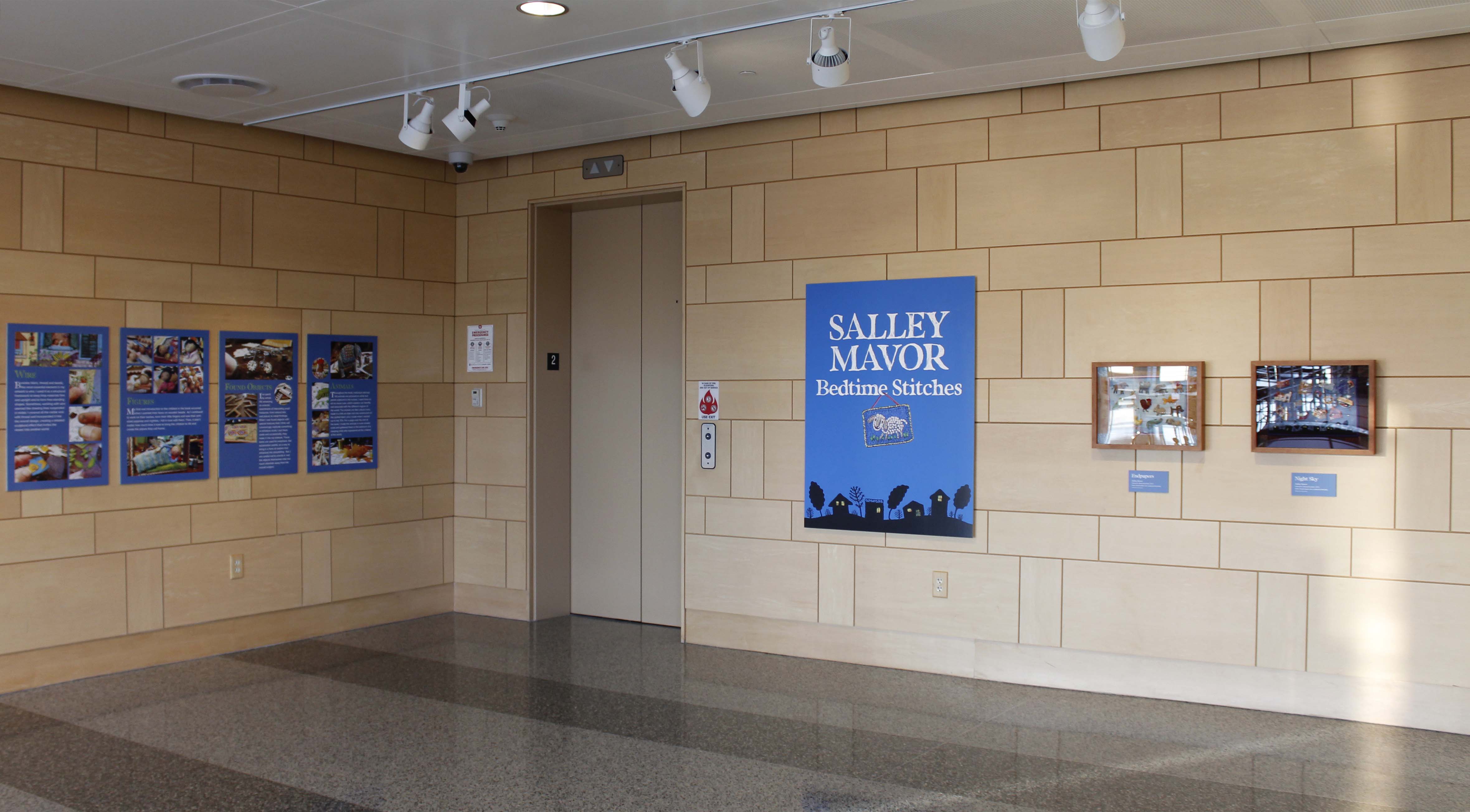
The International Quilt Museum in Lincoln, Nebraska is hosting Bedtime Stitches through April 9, 2022. Even if you live too far away and can’t see the show in person, you can have a virtual gallery tour on their web page here.

The Bedtime Stitches exhibition is a unique opportunity for the public to see the detail and 3-dimensional quality of my actual hand-stitched artwork, which was photographed and printed in the book, MY BED: Enchanting Ways to Fall Asleep around the World.

Russia

The collection of artwork takes the viewer on an international journey, showing where children sleep in varying cultures and living environments around the world. Along with the framed embroidered pieces, interpretive boards give a background peek at my process. See where the show is going for the next few years on the exhibitions page.

View the virtual gallery tour here.

Bedtime Stitches at the International Quilt Museum

Signed copies of My Bed can be ordered in my shop here. Watch this 8 minute documentary about how I created the illustrations for the book.

Visitors to the exhibition, as well as those of you at home with a copy of My Bed, can hunt for details in the artwork using the downloadable sheet below.

And finally, I want to share a zoom interview I did with Niisha HandCrafted from Dubai, UAE, which can be seen on her Facebook page. If you’re interested in learning about my artwork, where it came from and why I do it, this interview is for you. Prompted by Niisha’s insightful questions, I blab on for over an hour about all kinds of things – how I got started and grew as an artist, what I think about “slow stitching”, as well as offer advice for people who want to build a creative life of their own.

Mossy Glen: Part 1 (moss)

Wouldn’t it be nice to step out your front door onto a mossy carpet every morning?  In this Part 1 of the series about making Mossy Glen, I share photos, videos and commentary about how I created just that for the wee folk who live there.

Mossy Glen is the spring scene in a series of seasonal landscapes that capture the wonder and magic of the natural world. Note cards, prints, bookmarks, and jigsaw puzzles of Mossy Glen and the other scenes in the series (Frosty MorningHarvest Time, and Summertime) are available in my Etsy Shop.

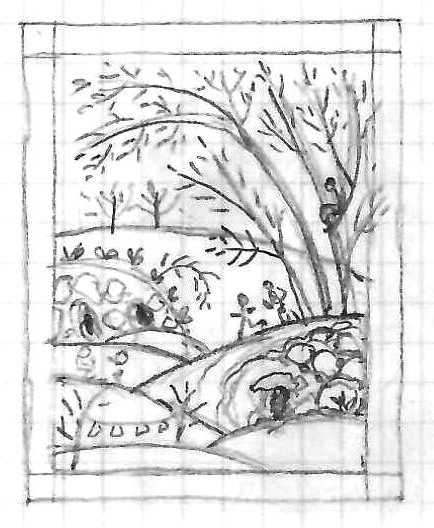
I always start a project with an image in my head. In this case it included a forsythia bush overhanging a neighborhood made up of stone walls and doorways nestled into moss covered mounds. I drew a thumbnail sketch of the basic composition and printed it out in full scale using Block Posters. Over the 5 months working on Mossy Glen, I used the enlarged drawing as a general guide, not as an exact template.

Faux Moss
About 10 years ago, I fell in love with stitching moss while making my piece Rabbitat, which you can learn about in this film.

Rabbitat 2011

I can’t believe it’s taken so long to get back into embroidering moss. The simple idea of stitching multiple French knots side by side to form a naturalistic ground cover isn’t a new concept, but it reached a heightened level of obsession with Mossy Glen. It’s one of those repetitive activities that has you totally mesmerized.

Out of curiosity, I calculated that each square inch of faux moss contains an average of 144 knots, depending on the thickness of the thread, number of strands and the density of the stitches. That means that Mossy Glen is covered with several thousand knots.

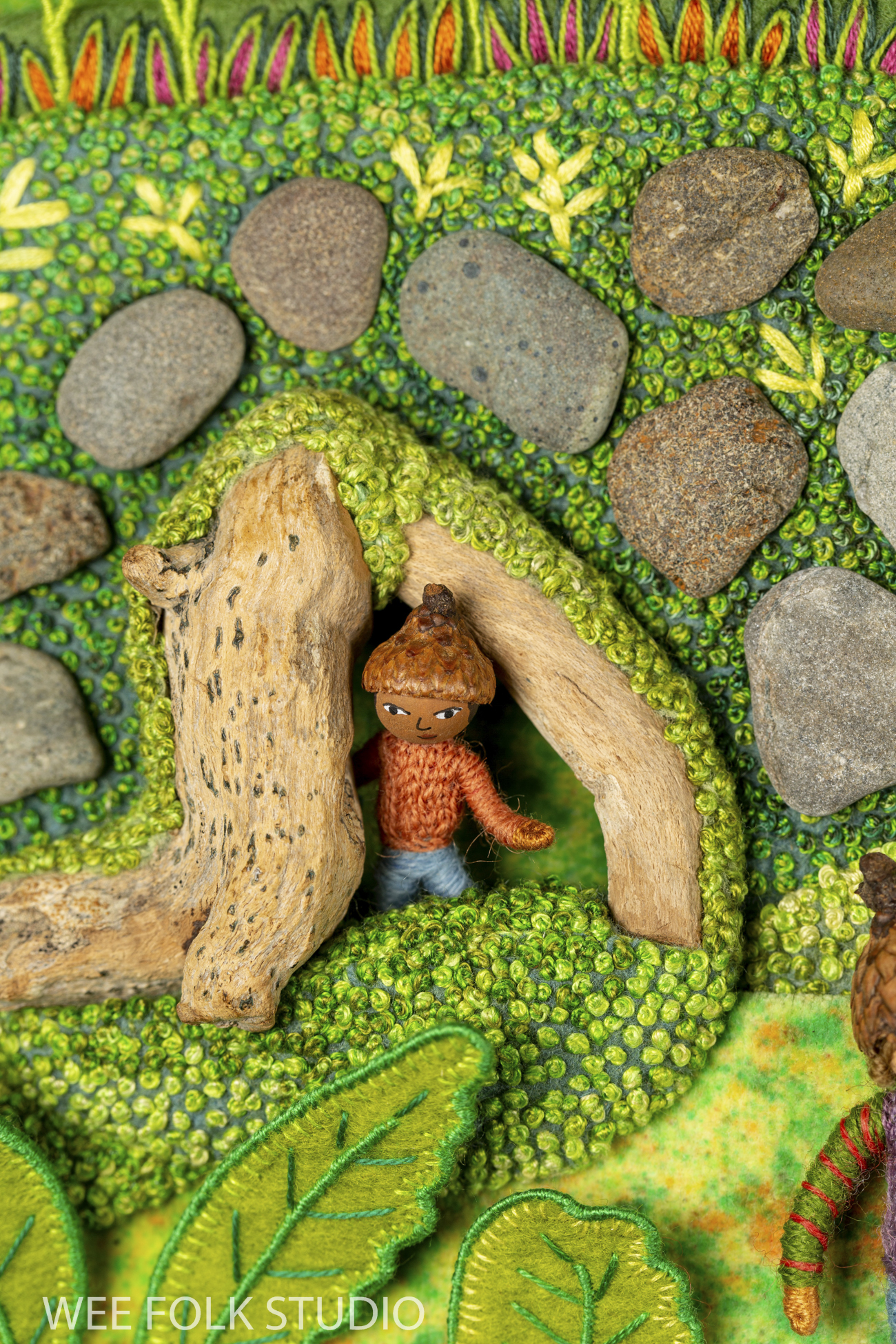
If you follow me on Facebook and/or Instagram, you’ve gotten a preview of the process of making Mossy Glen. Last summer I shared photos and videos of whatever part I was working on that particular day. One constant question was, “How do you stitch on wood?” Back then, I was immersed in the act of creating and didn’t want to switch on the explaining part of my brain. Now, I’m ready to talk about it.

So, how do I stitch onto wood? It helps to think of art is an illusion, that the goal is to make the viewer perceive something in a way that suspends disbelief, like magic. The thing is, people who make stuff are super curious and aren’t satisfied until they can make sense of how something is done.

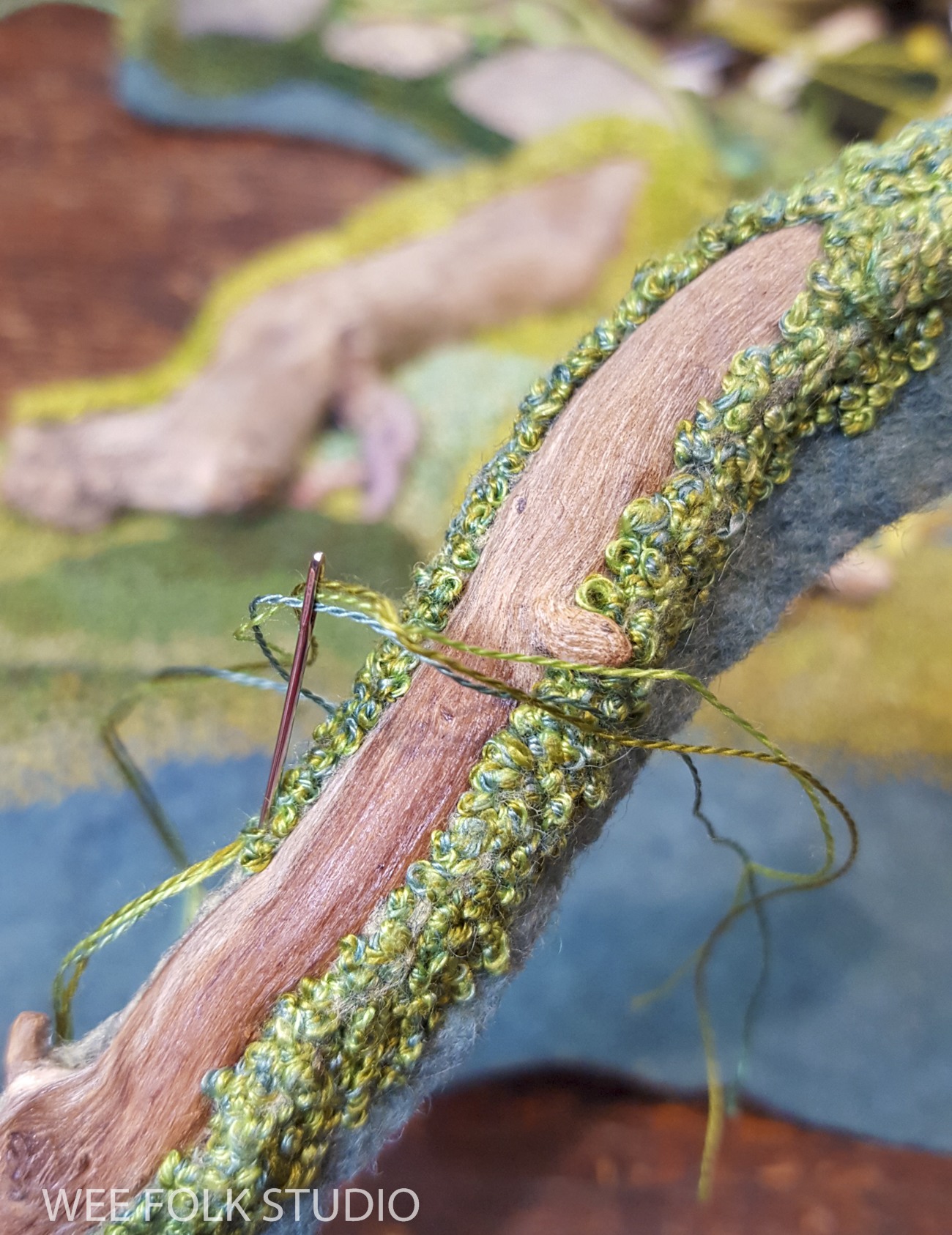
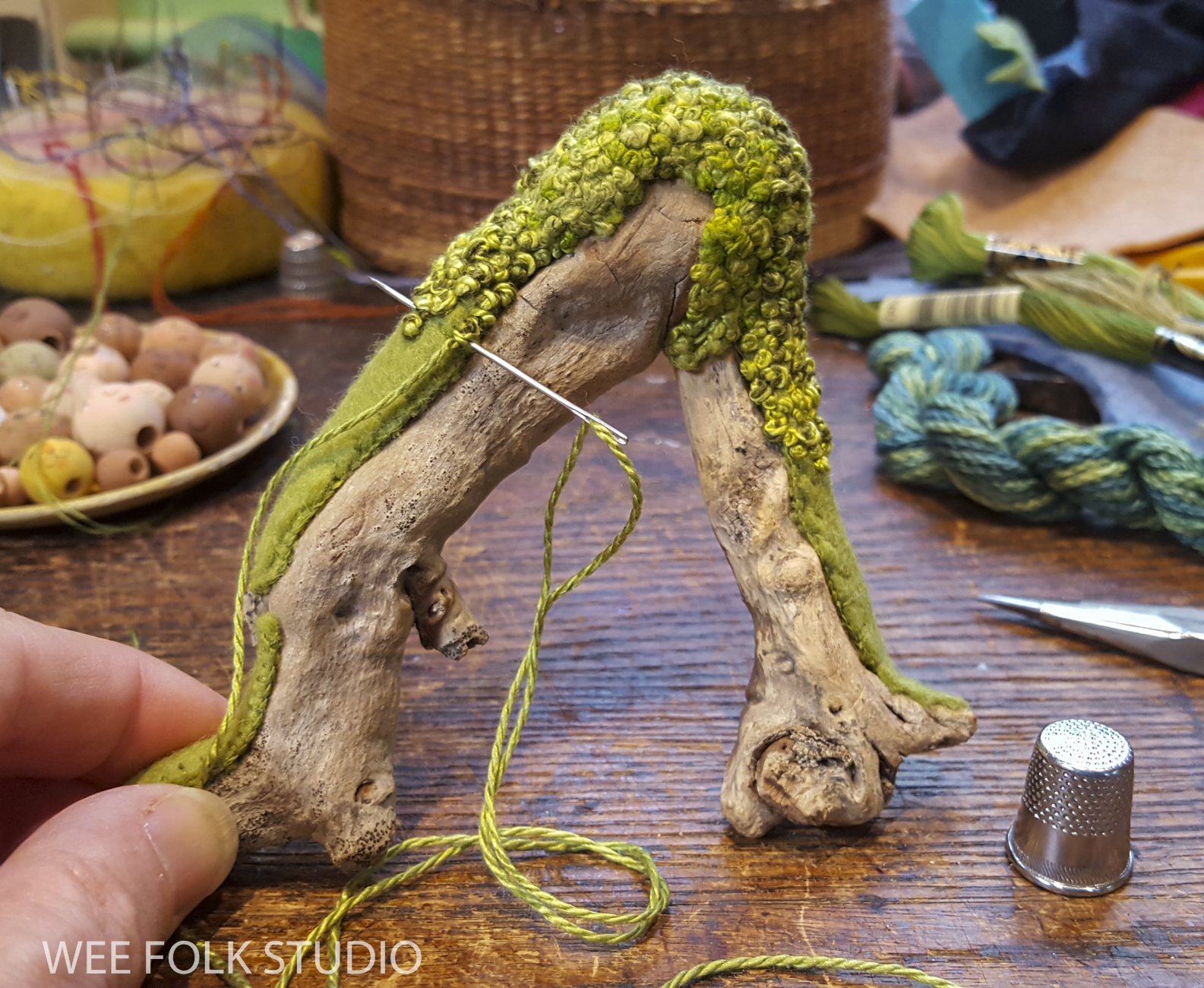
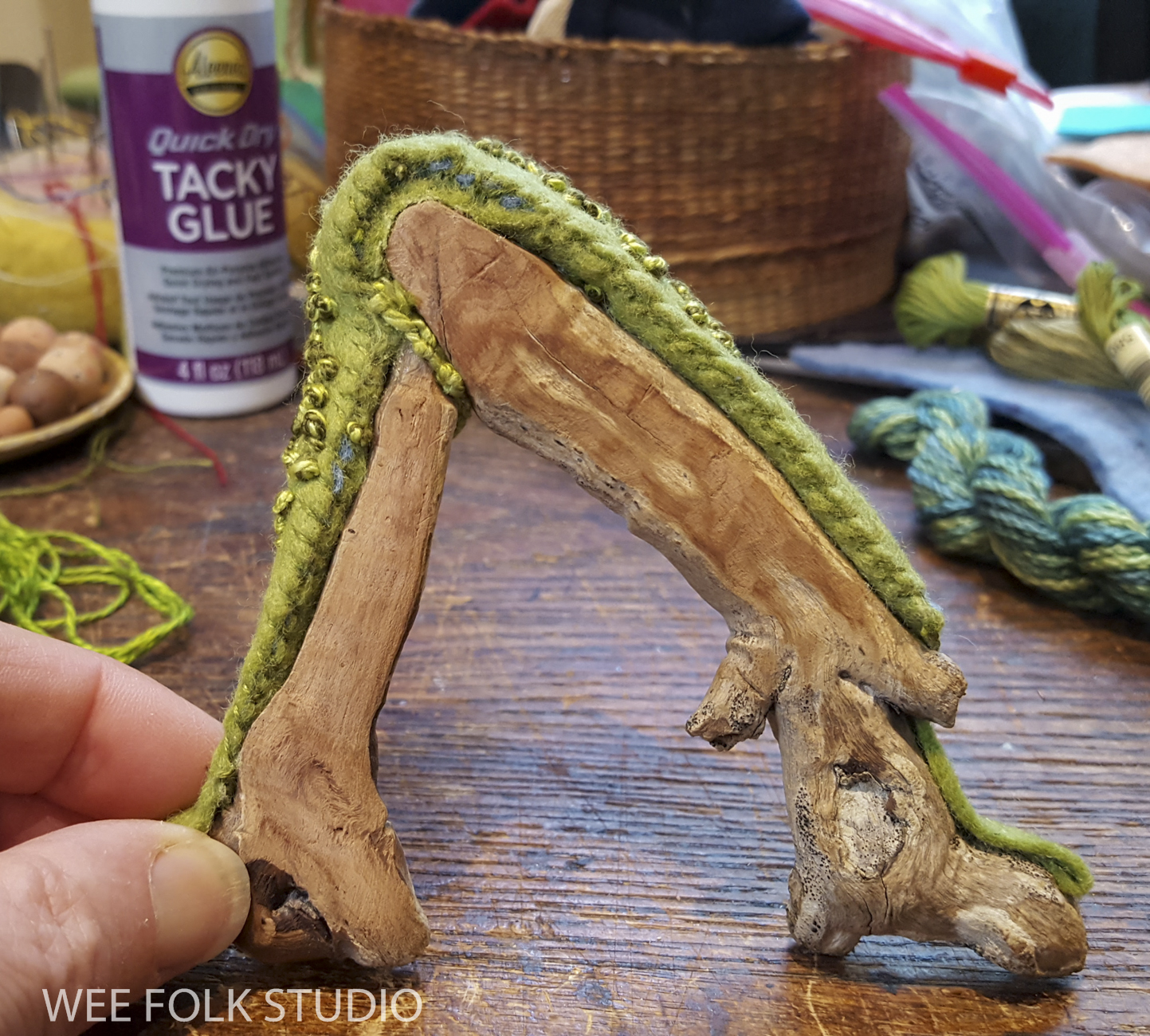
Here’s the simple rundown – 1. find interesting pieces of wood, 2. glue pieces of felt to the wood, 3. stitch onto the felt. As long as there is something to catch a needle with, you can make stitches. I usually shy away from using glue because it’s messy and unpredictable, but decided to try it for this purpose. Aleene’s glue makes a variety of fabric embellishing adhesives that all work well. Do I use hot glue? No, because it’s stringy, messy, shoddy looking and I don’t trust its holding capabilities.

French knots/Colonial knots
It’s been pointed out by people who know such things, that I’m actually making a Colonial knot, not a French knot. It has something to do with the twist at the end. Being self-taught, I’ve never paid attention to the names of different stitches or doing them the “right” way. I just use the basics in combinations that work for me. Here’s a Stitch Minute video that shows how I stitched the knots.

Stitch Minute – Moss

Thread
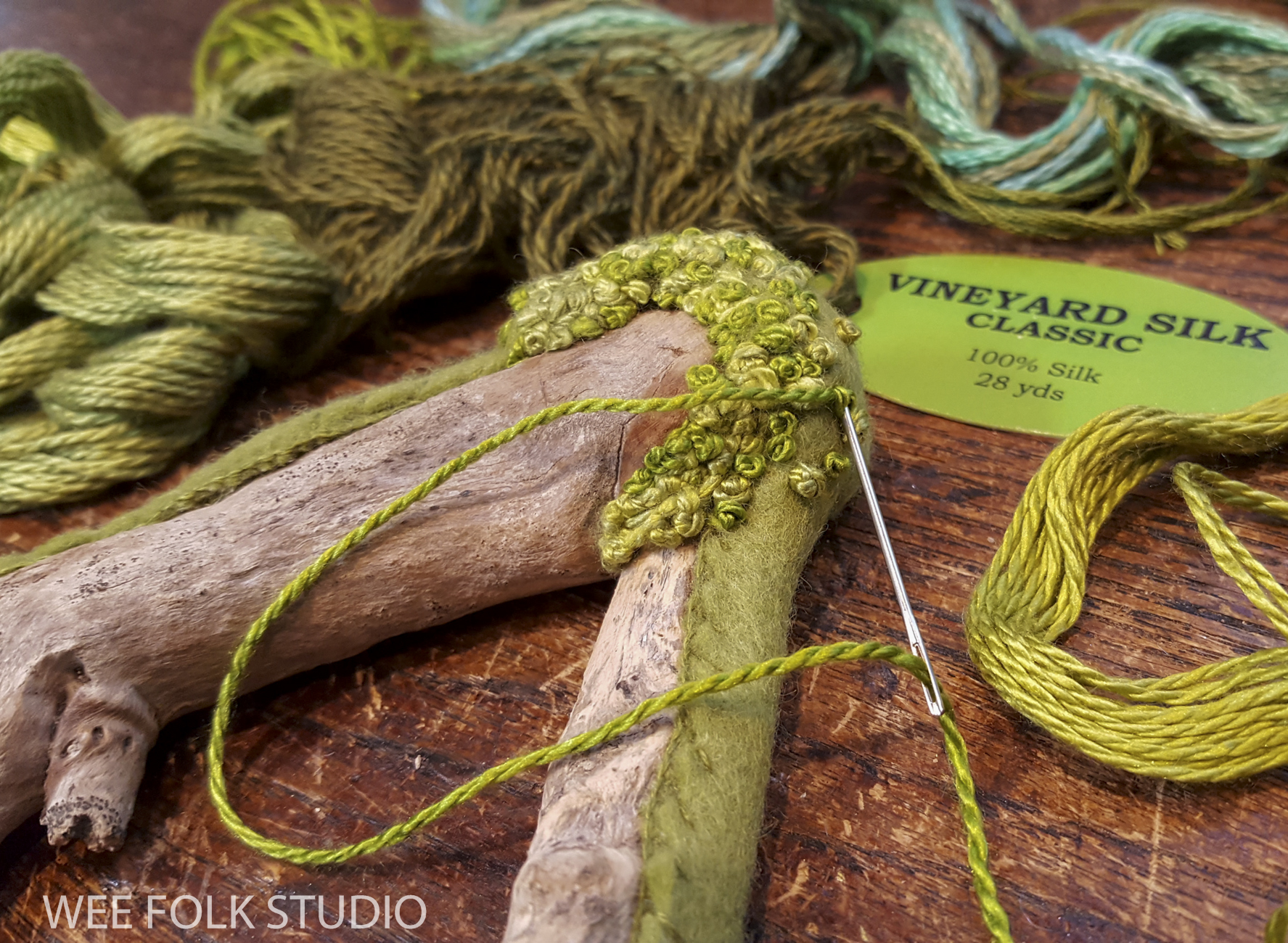
To make the moss, I used all kinds of thread, from silk to cotton floss, depending on what kind of look I was after. The naturalistic appearance comes from combining different shades of green in groups of 3 or 4 strands. I used these threads: DMC cotton floss, Vineyard Silks and Watercolours by Caron,

This 2 minute video gives a further glimpse into my process.

Stitching Moss with Salley Mavor

Stay tuned for more posts about making Mossy Glen. Future parts in the series will focus on the stone walls, the cherry trees, the forsythia bush, the embroidered embellishments and the wee folk characters.
Mossy Glen (overview)
Part 1 (moss)
Part 2 (cherry trees)
Part 3 (stone walls)
Part 4 (forsythia)

To keep up with new posts, please subscribe to this blog Your contact info will not be sold or shared. If you’d like to see more frequent photos tracking the projects in my studio, please follow me on Facebook and/or Instagram.

Mossy Glen overview

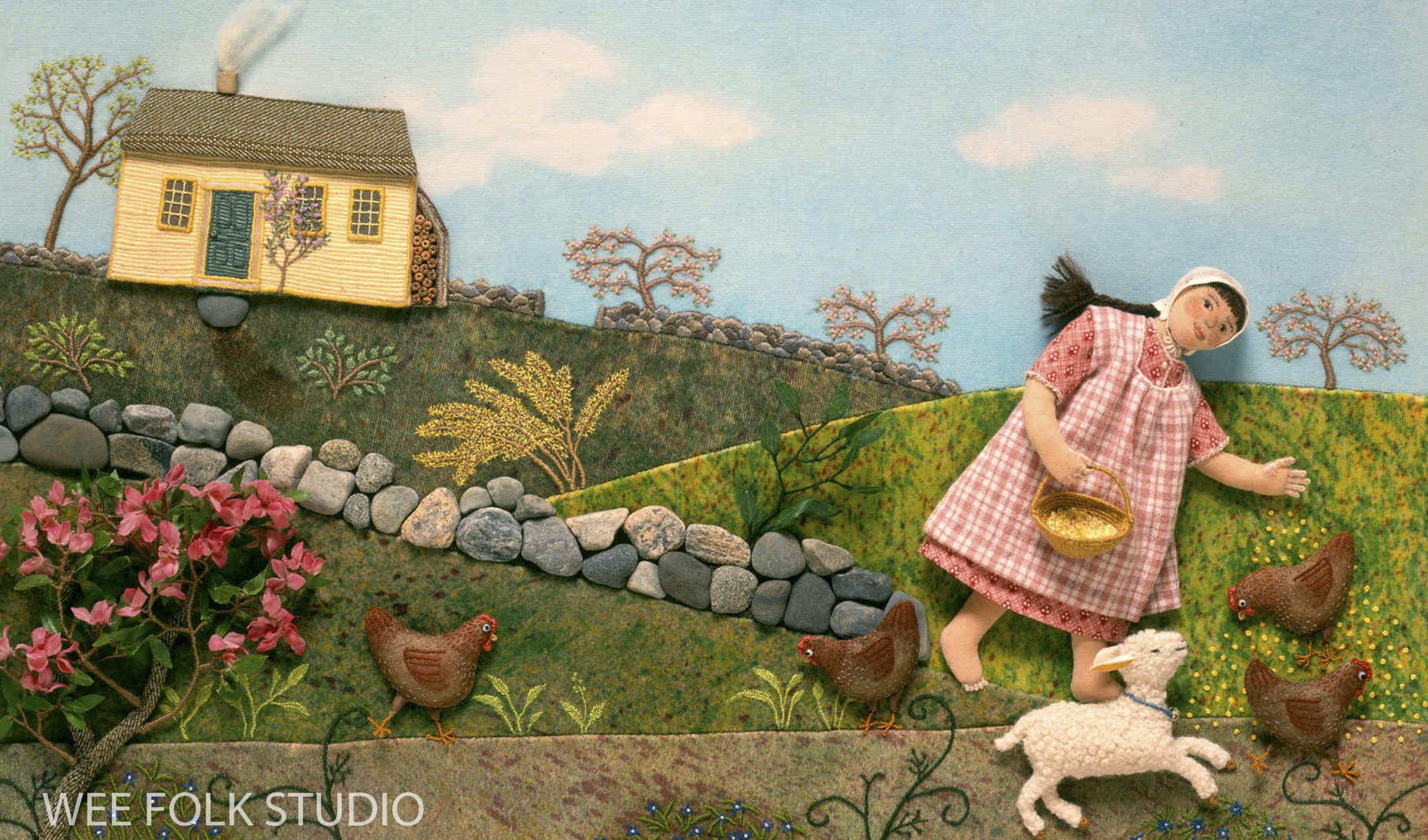
On this cold January day, I’d like to transport us all to springtime in the Mossy Glen. I began making this new piece in my 4 seasons series last May, just when light green buds started appearing on the maple trees. While I worked on it all summer and into the early fall, I took photos of different stages of the process. As with last year’s winter landscape, Frosty Morning, I will be posting several stories about how I created the different parts for Mossy Glen, from the plants and moss to the little characters frolicking about.

To do that, it’s going to take some adjustment on my part. First off, I’m going to have to turn on the explaining part of my brain, which has been dormant for quite a while. Writing this introductory post and sorting out which photos to include is a way to ease the transition from doing to talking about doing. While I’m in the middle of a project, I give myself over to whatever I’m envisioning and trust that it will work out. I solve each problem as it appears, always keeping the big picture in mind. I don’t try to explain the process, even to myself, for fear of dispelling the magic.

Mossy Glen is the spring scene in a series of seasonal landscapes that capture the wonder and magic of the natural world. Note cards, prints, bookmarks, and jigsaw puzzles of Mossy Glen and the other scenes in the series (Frosty Morning, Harvest Time, and Summertime) are available in my Etsy Shop.

Throughout the months that I was making Mossy Glen, I shared glimpses of my work table on Facebook and/or Instagram. Understandably, my followers were curious about how this or that was made. I gave brief and evasive answers, like “I’ll explain later when it’s finished.” and “Let’s just call it magic.” It’s a tease of sorts, but true to my experience. Now that the piece has been finished for a while, I’m free to go back and review the process with a more analytical eye.

There’s a lot to show and I’m still figuring out how to organize the parts. I’ll be sharing several Stitch Minute videos that give closeup views of me working on different sections of the piece.

I’ll be covering moss-making and stone wall building…

and forsythia blossoming…

and views of constructing the little figures living in the hillside.

I’ll show how I made the cherry trees…

and violets…

and even a mini clothes line.

Please stay tuned for more photos, videos and explanations in the coming weeks.
Part 1 (moss)
Part 2 (cherry trees)
Part 3 (stone walls)
Part 4 (forsythia)
Part 5 (felt and wire leaves)
Part 6 (stitched leaves)

Mossy Glen, Frosty Morning and Harvest Time jigsaw puzzles and note cards are available in my Etsy shop.

To keep up with new posts, please subscribe to this blog Your contact info will not be sold or shared. If you’d like to see more frequent photos tracking the projects in my studio, please follow me on Facebook and/or Instagram.

Frosty Morning – part 6 (wee folk)

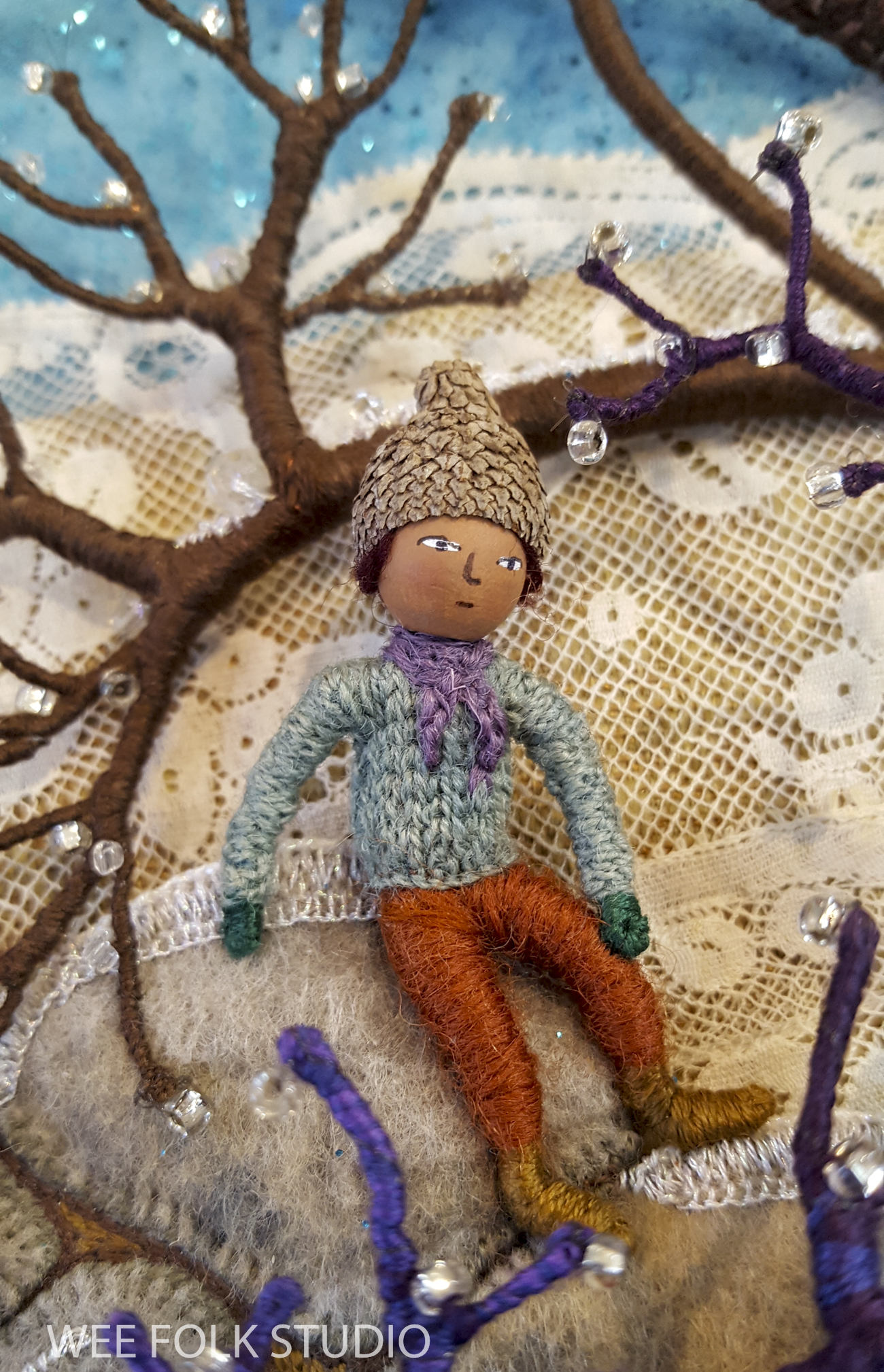
This 6th and final part in the Frosty Morning series is about making the wee folk characters who live in the winter landscape. All of the other stuff, the trees, the icy snow cover and the sparkling sky are just meant to set the stage for the little people to frolic in. While I worked on this piece, I thought about what the wee folk would look like and what they would be doing. Adding a narrative element with human (or animal) faces helps me fall in love with what I’m making. The scenery may be lovely, but without play actors, there is no story. And without that, what’s the point?

This year, I’m working on a group of seasonal landscapes that capture the wonder and magic of the natural world, both real and imagined. Frosty Morning, Mossy Glen, Summertime and Harvest Time are available as jigsaw puzzles and note cards in my shop here

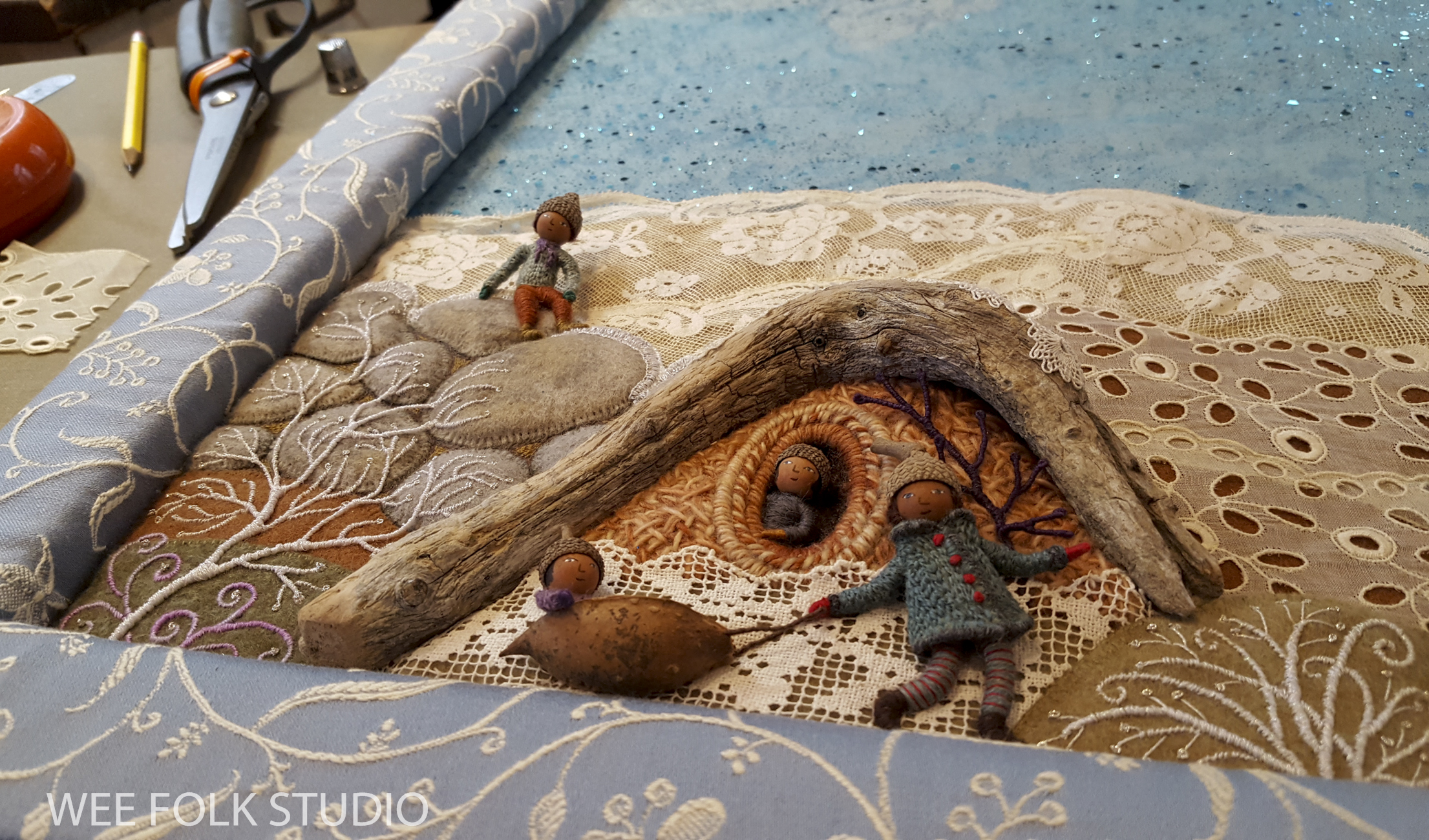
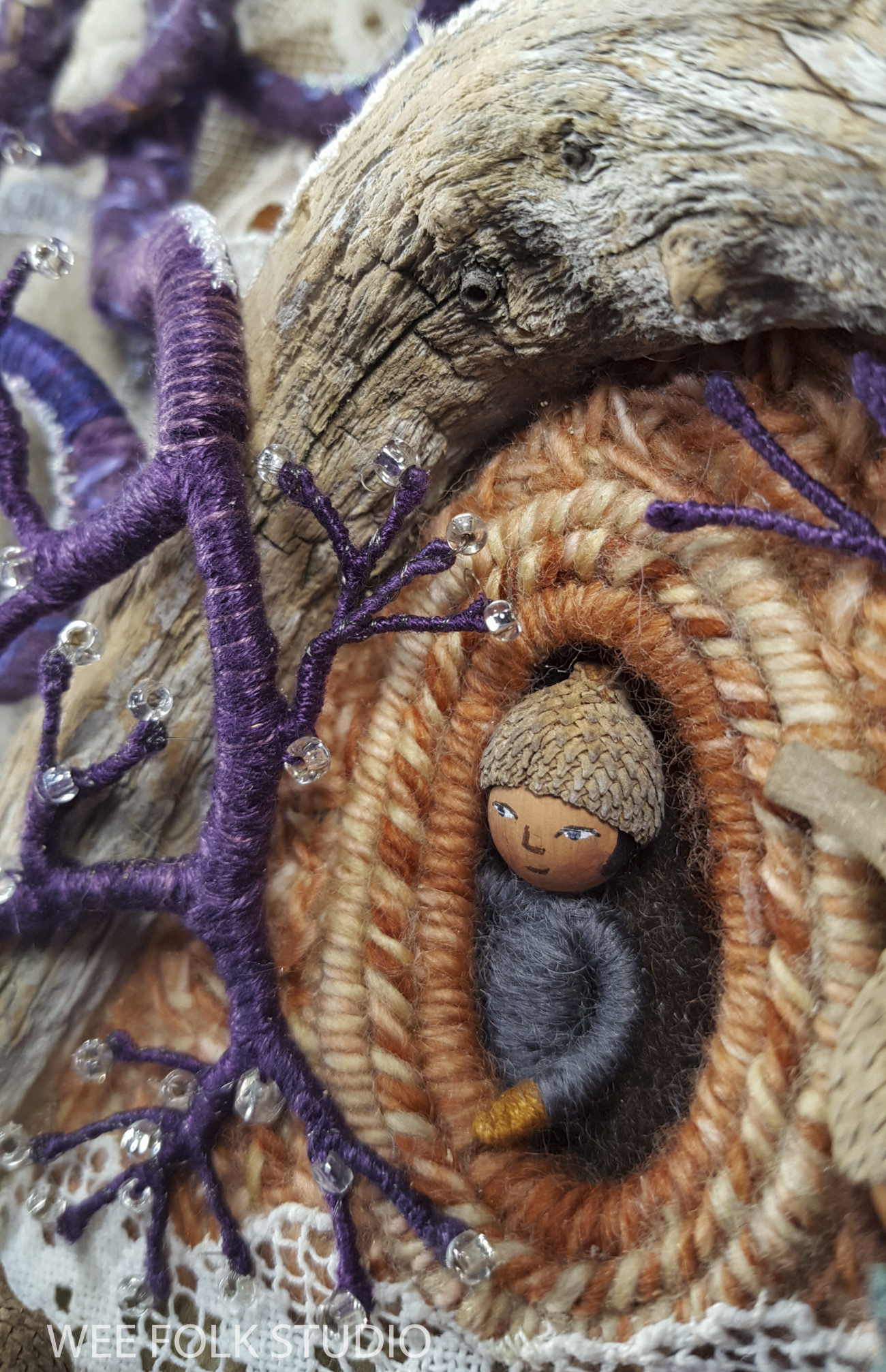
The full figures are about 2″ tall, with smaller ones peeking out of the holes in the shelters. To make them, I used the same basic techniques that I teach in my how-to book Felt Wee Folk, with some adjustments in the armature material and clothing.

I used wool tapestry yarn or mending wool to stitch and wrap their winter clothing. Whenever I share photos showing dolls wearing sweaters, people actually think I knit them! For something this small it’s much easier to create the allusion of knitting with rows of chain stitches. For other examples of faux knitted outfits, see Polly Doll‘s Irish knit sweater here and her Fair Isle vest here.

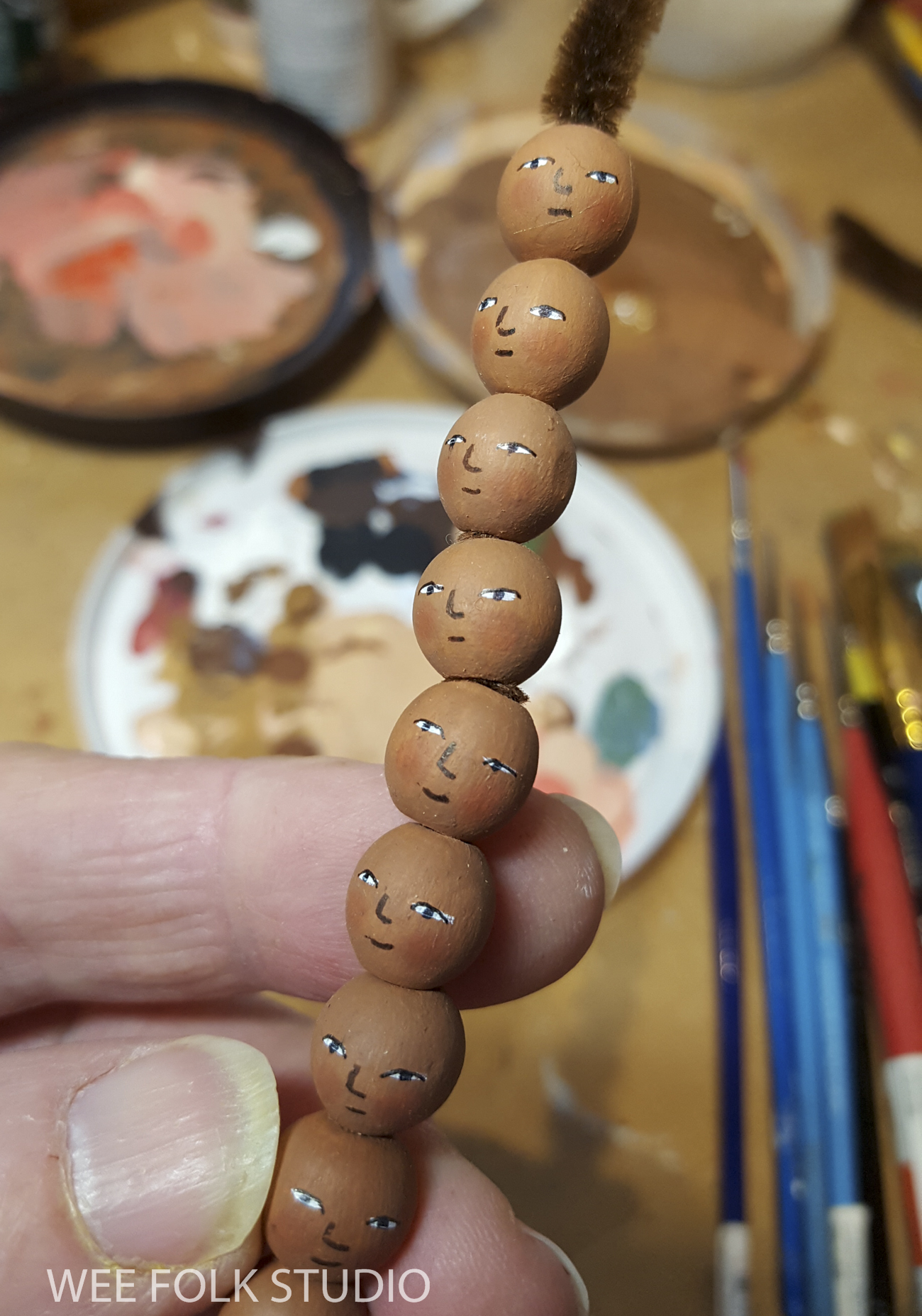
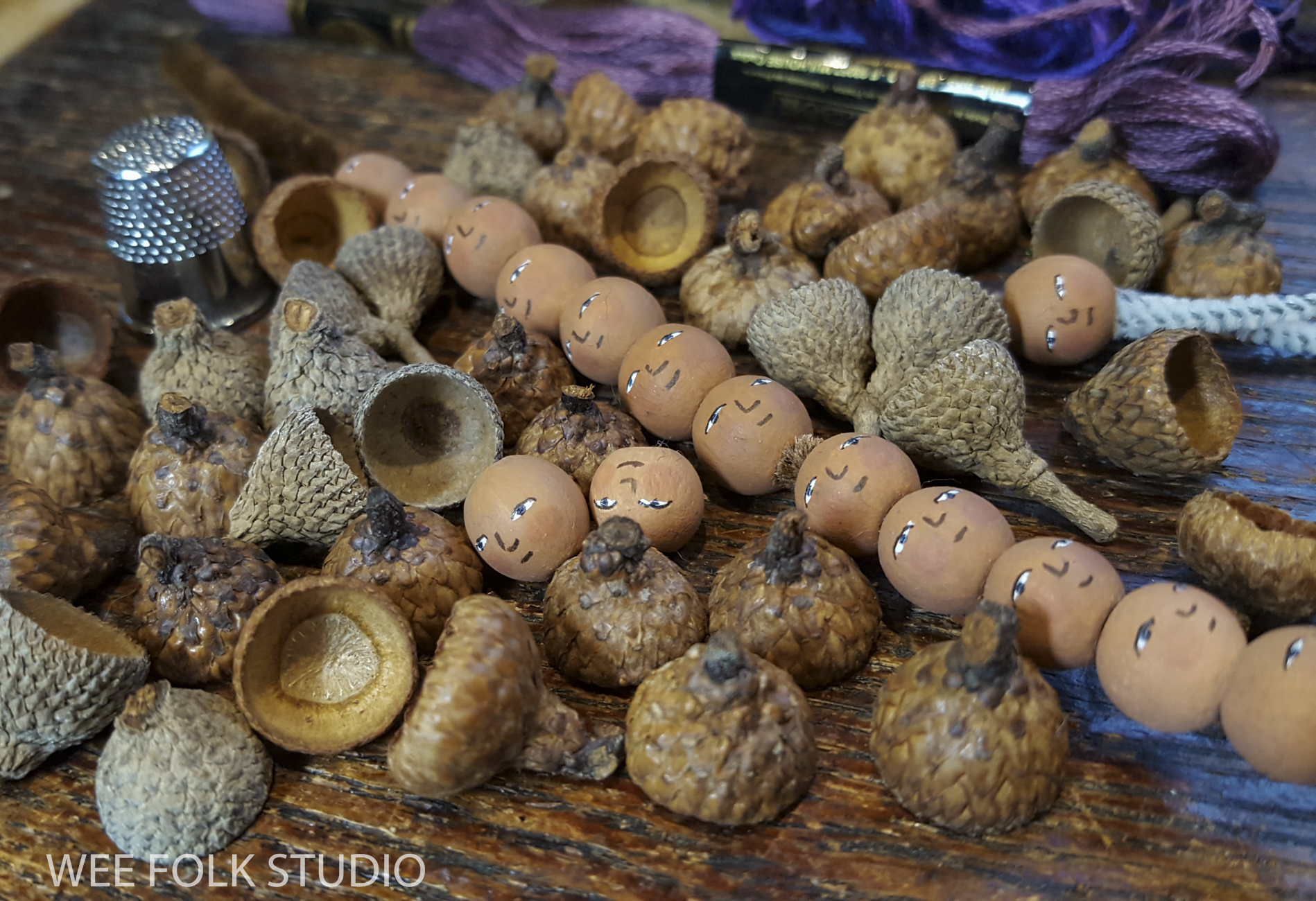
When making people, I always start by painting their faces on wooden beads. Then, after meeting them, I feel motivated to bring them to life.

I’ve been saving some really small acorn caps for just this kind of project.

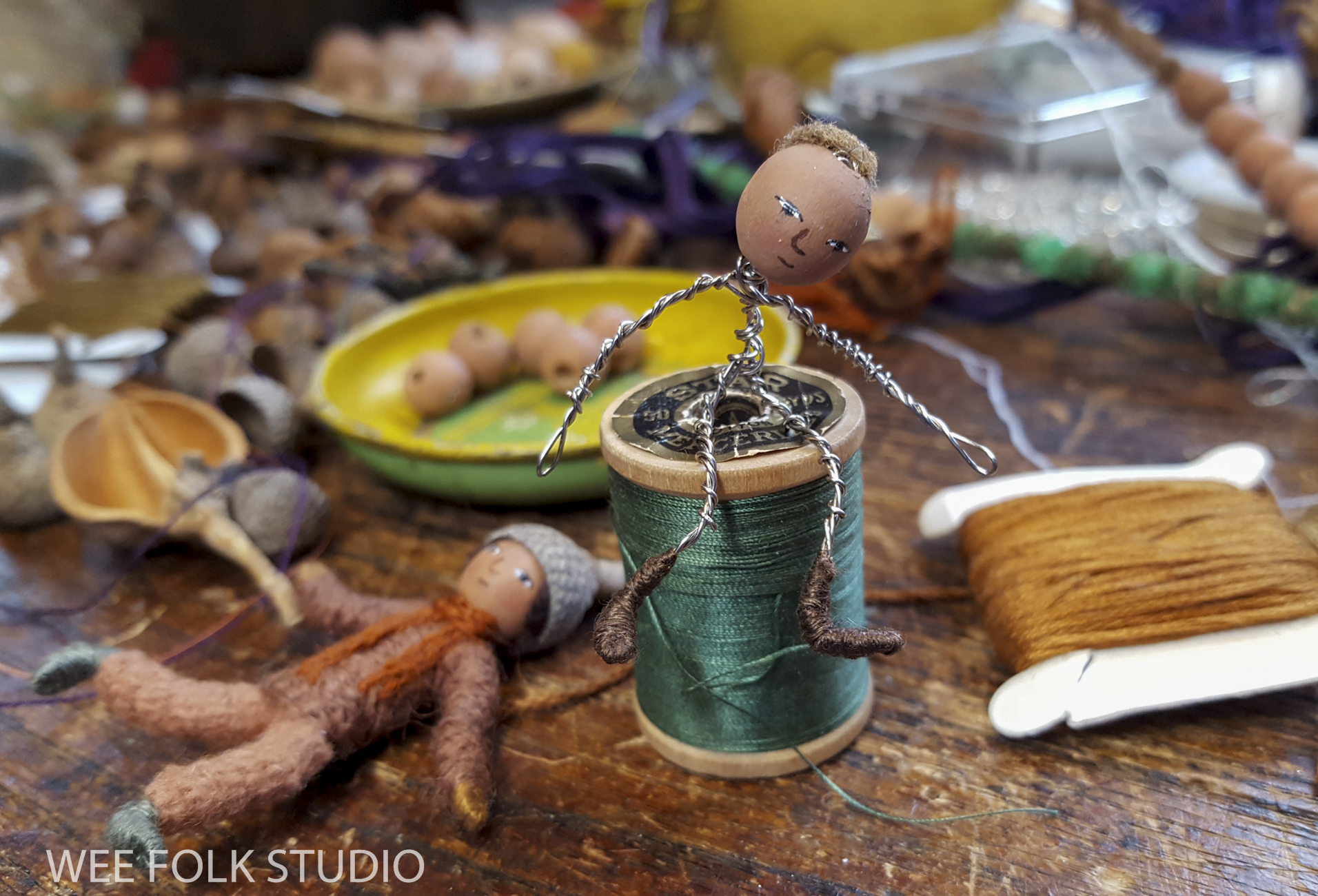
Instead of pipe cleaners, which would be too bulky, I formed the body armature out of 24 gauge jewelry wire. The bead heads were glued to the wire neck at the very end, when the clothing was finished. I glued small pieces of felt onto the top of the bead heads, in a kind of Mohawk. Later, when I added yarn hair, the felt gave the threaded needle something to catch onto.

Miraculously, this old mending wool from my collection of deceased relatives’ ephemera escaped being eaten my moths. It was the perfect weight with which to stitch miniature clothing.

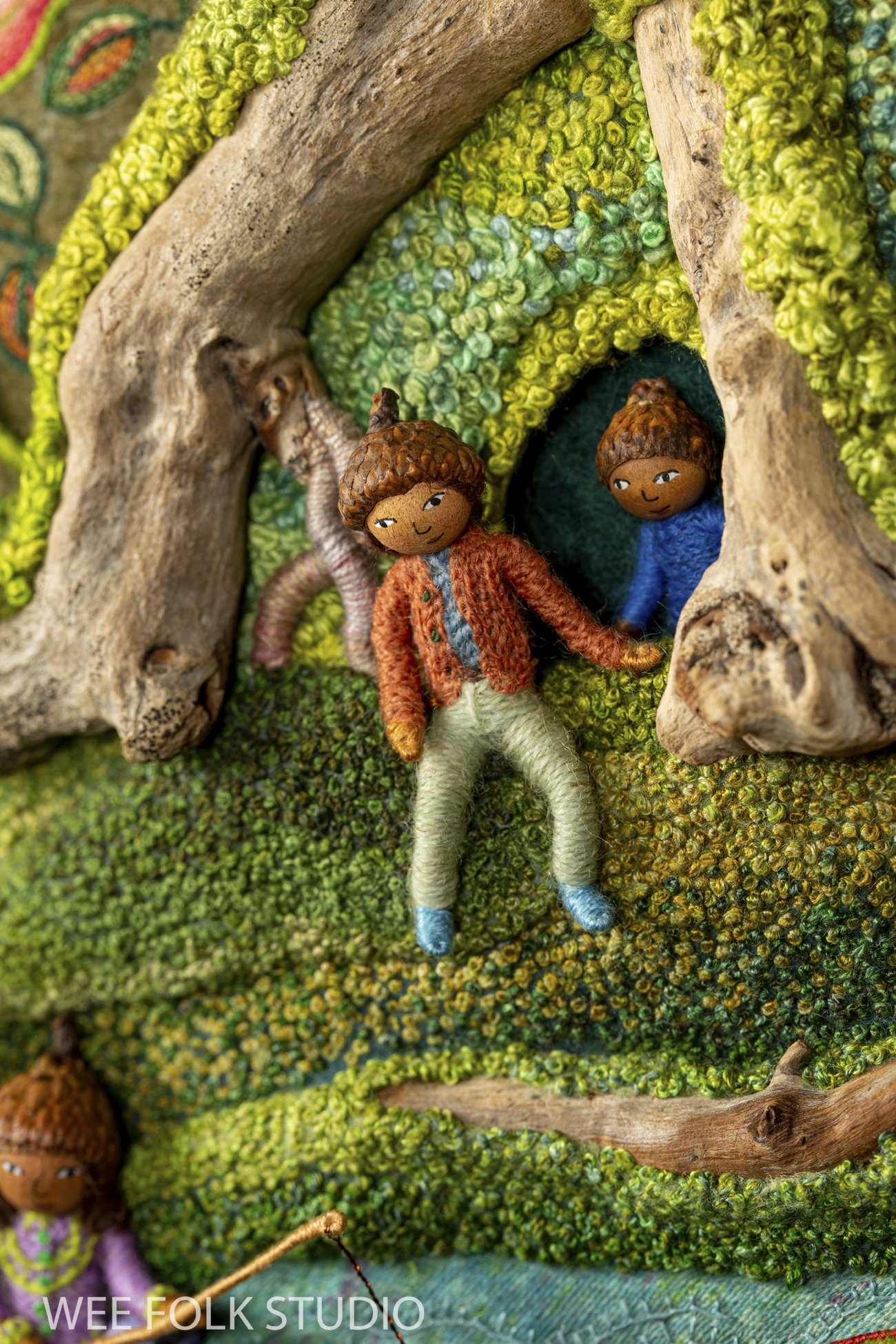
In this sequence of photos, you can see how I wrapped and stitched yarn around the wire arms and legs and then made a separate faux knitted coat to go on top. I completed the look with French knot buttons, striped leggings, wool hair, and a glued on acorn cap.

The group of little people grew and grew until there seemed to be the right amount.

The sled is made from a pod I found so long ago that I can’t remember where it came from. An image search identified it as a coming from a Foxglove tree.

With just a few stitches, I sewed the characters in place – pulling the sled, looking out from shelters and climbing along tree branches.

When all of the parts were finished, it was time to mount the piece.

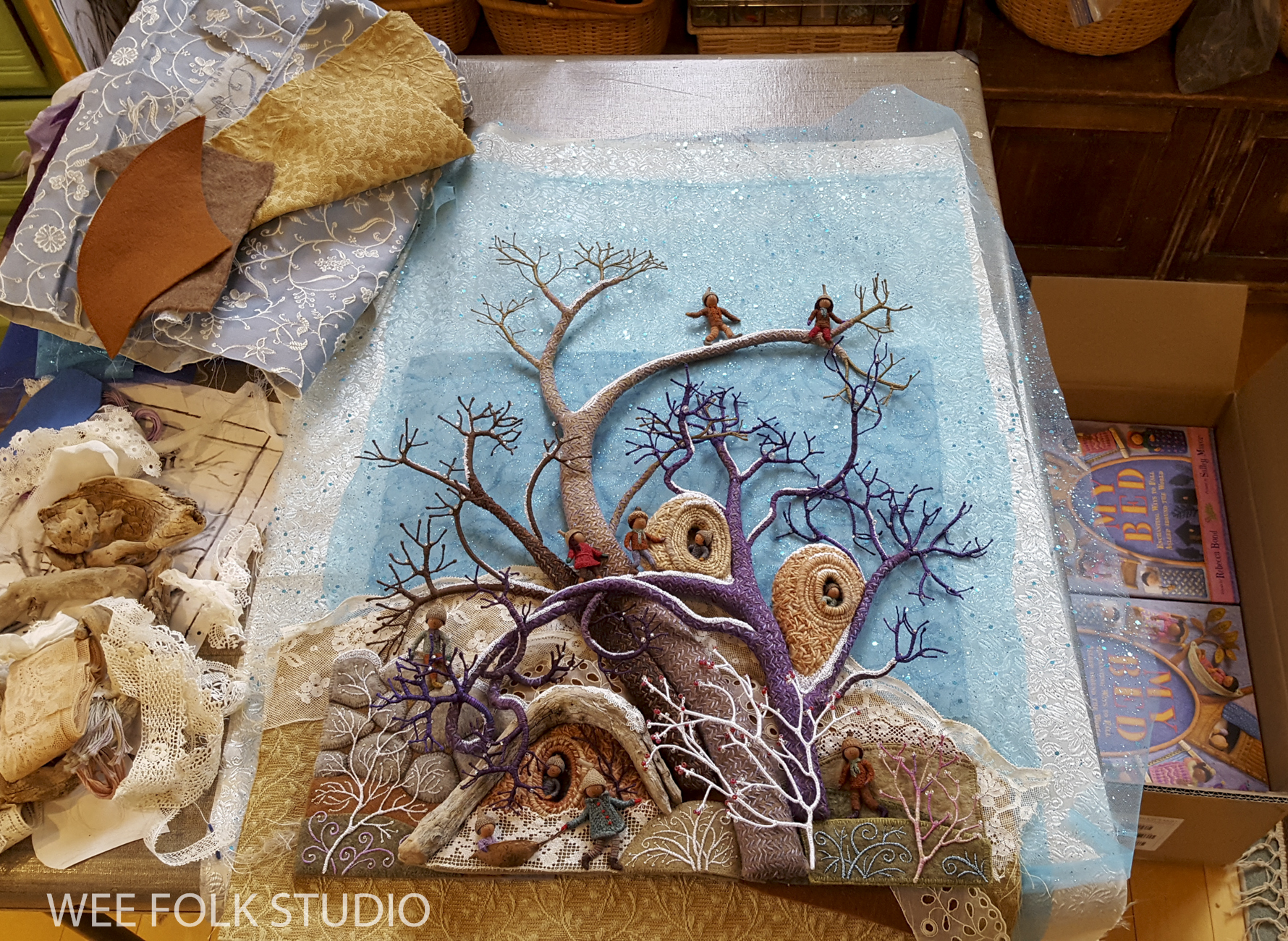
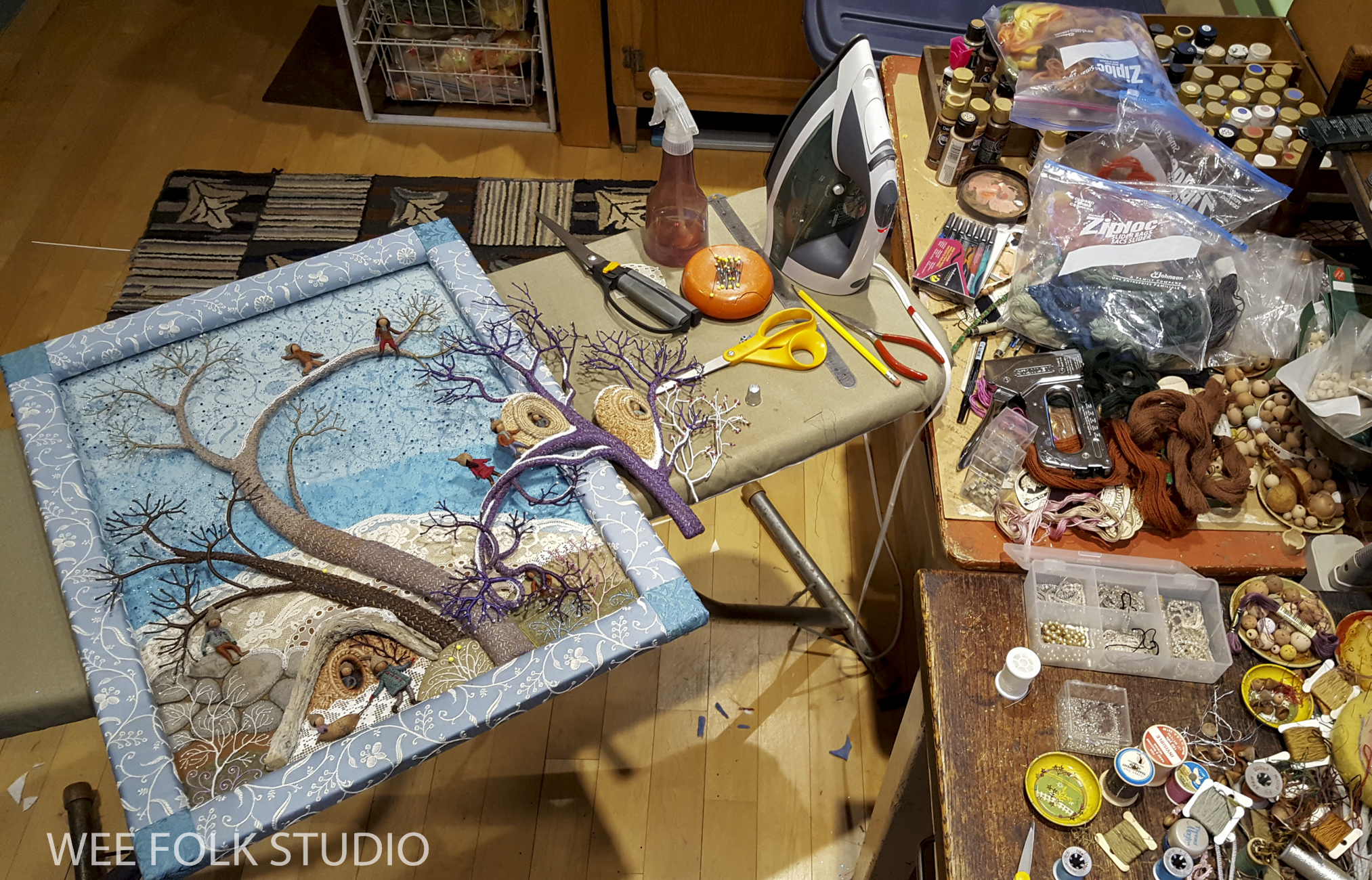
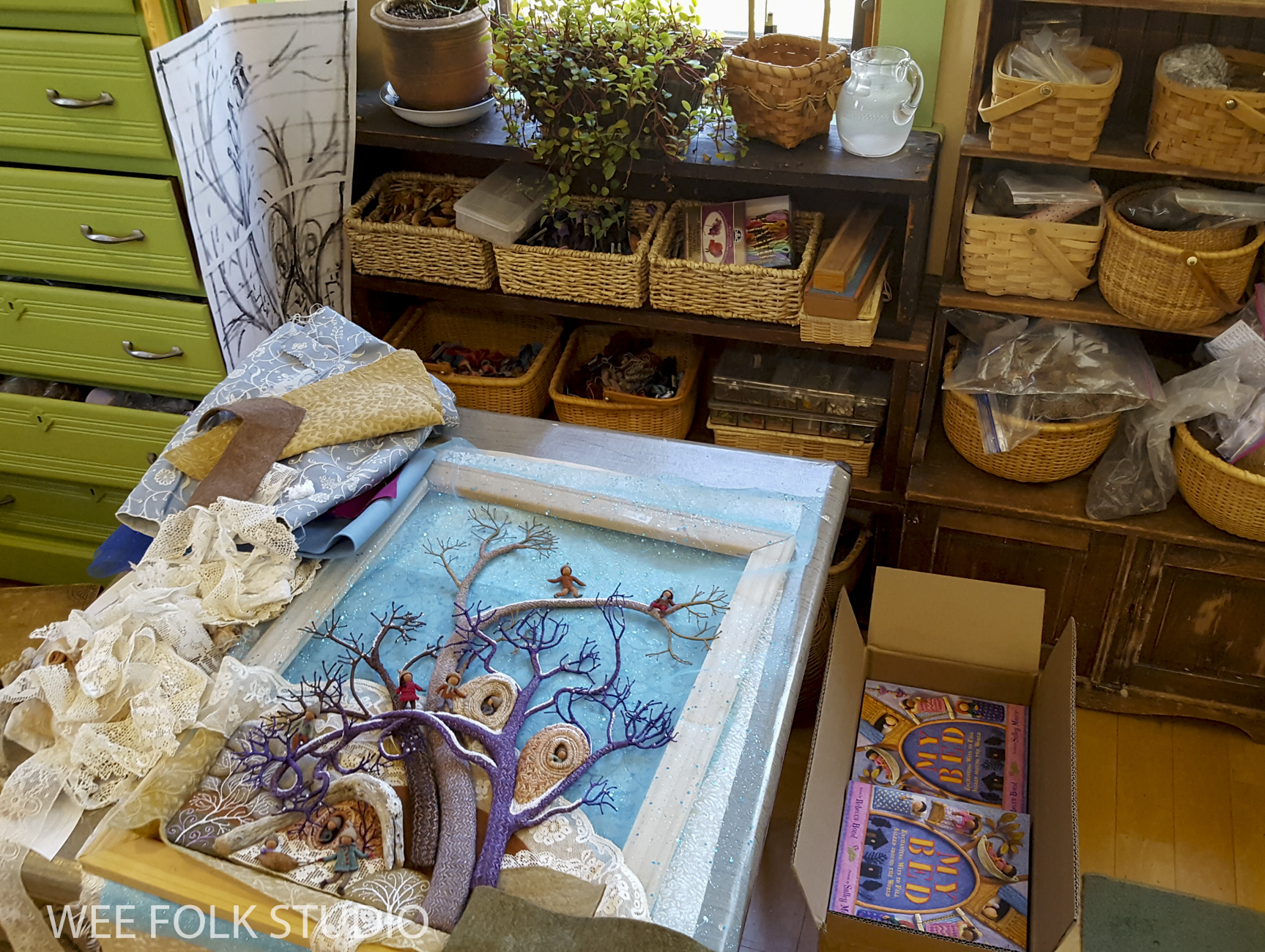
I made a border frame by padding and covering a wooden stretcher with upholstery fabric. I then hand sewed the layered background fabrics to the back of the stretcher, making it as taught as possible. After that, I sewed the different landscape sections to the background surface, starting with the lace snow cover, stone wall and driftwood house and ending with the trees.

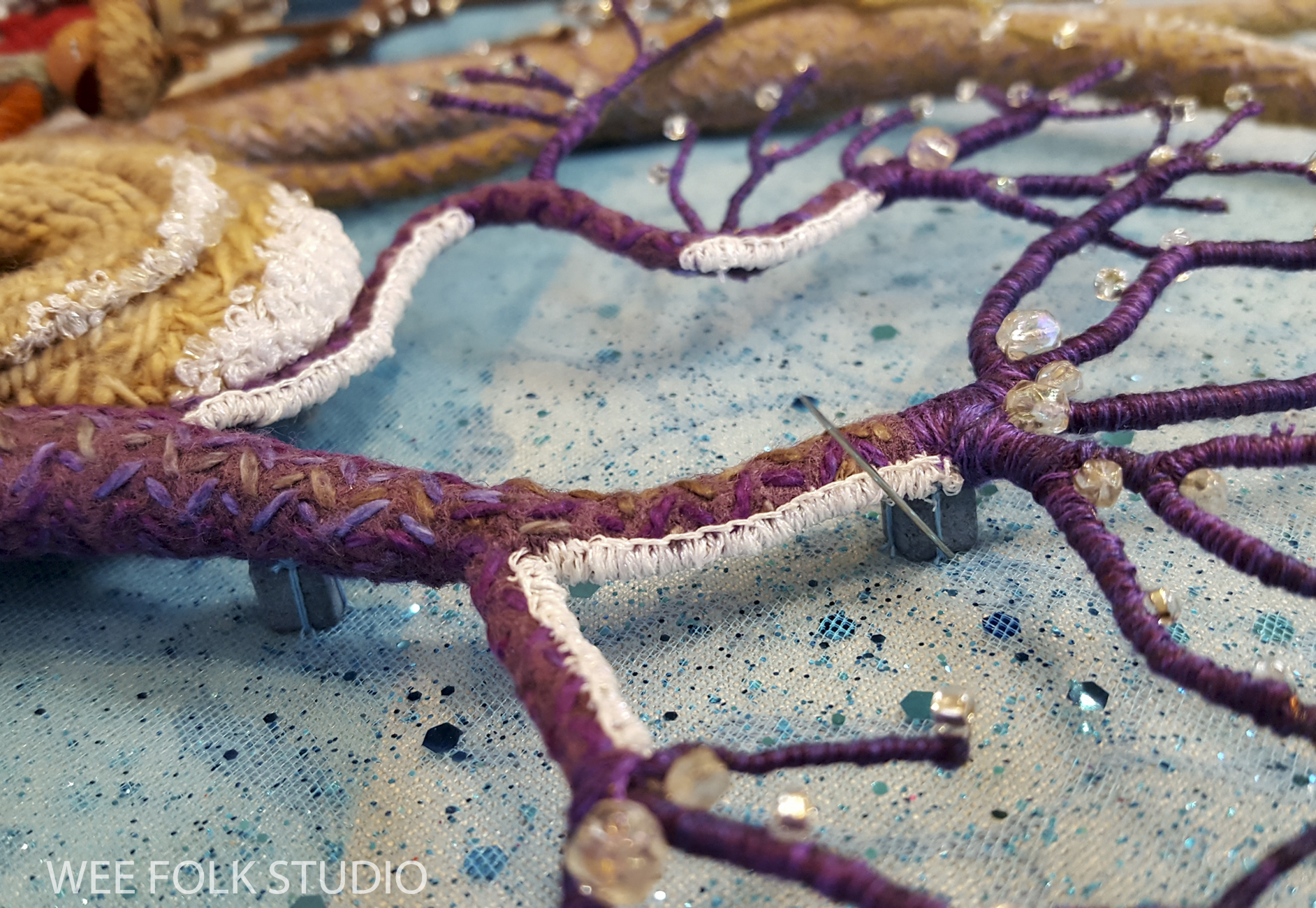
To help prop up the tree limbs, I sewed beads to the back and stitched them to the background fabric.

I hope that you’ve enjoyed this close look at the process of making Frosty Morning. When the Spring scene is finished, I’ll write about it as well.

Part 1 shows how I made the tree trunks.
Part 2 gives a close look at how I formed and wrapped the wire tree branches. Part 3 is about constructing the rounded shelters.
Part 4 is about making the stone wall and the ice covered bush in front of it.
Part 5 is about adding sparkle to the scene.

To keep up with new posts, subscribe to this blog. If you’d like to see more frequent photos tracking the projects in my studio, please follow me on Facebook and/or Instagram.
Frosty Morning – part 5 (sparkles)

Part 5 in the Frosty Morning series is about adding sparkle to the winter scene. This piece was inspired by what I saw outside our front door this past January. That morning, the frozen landscape shimmered like a Las Vegas show costume, with the tips of every branch glittering with crystalline ice drops. I was so dazzled that I decided right then to try to recreate the scene, even though it would mean venturing into more glitzy territory than I was accustomed to.

This year, I’m working on a group of seasonal landscapes that capture the wonder and magic of the natural world, both real and imagined. Frosty Morning, Mossy Glen, Summertime and Harvest Time are available as jigsaw puzzles and note cards in my shop here

In the same way that it’s challenging to capture the true to life iridescence of any winter landscape in photographic form, I’m finding that this piece is so much more sparkly and engaging than I’m able to convey here. That said, there will be opportunities to see Frosty Morning and the other yet to be completed scenes in the series in person. I’m hoping to have all 4 seasons finished by next year, so that they can be included in my retrospective exhibition, What a Relief: The Art of Salley Mavor, June 4 – Sept. 11, 2022 at the Brick Store Museum in Kennebunk, ME.

I rummaged through my stash looking for anything transparent and shiny and found strings of different sized vintage glass beads. Most of these were given to me years ago by an old family friend who was cleaning out boxes of misc. stuff she inherited.

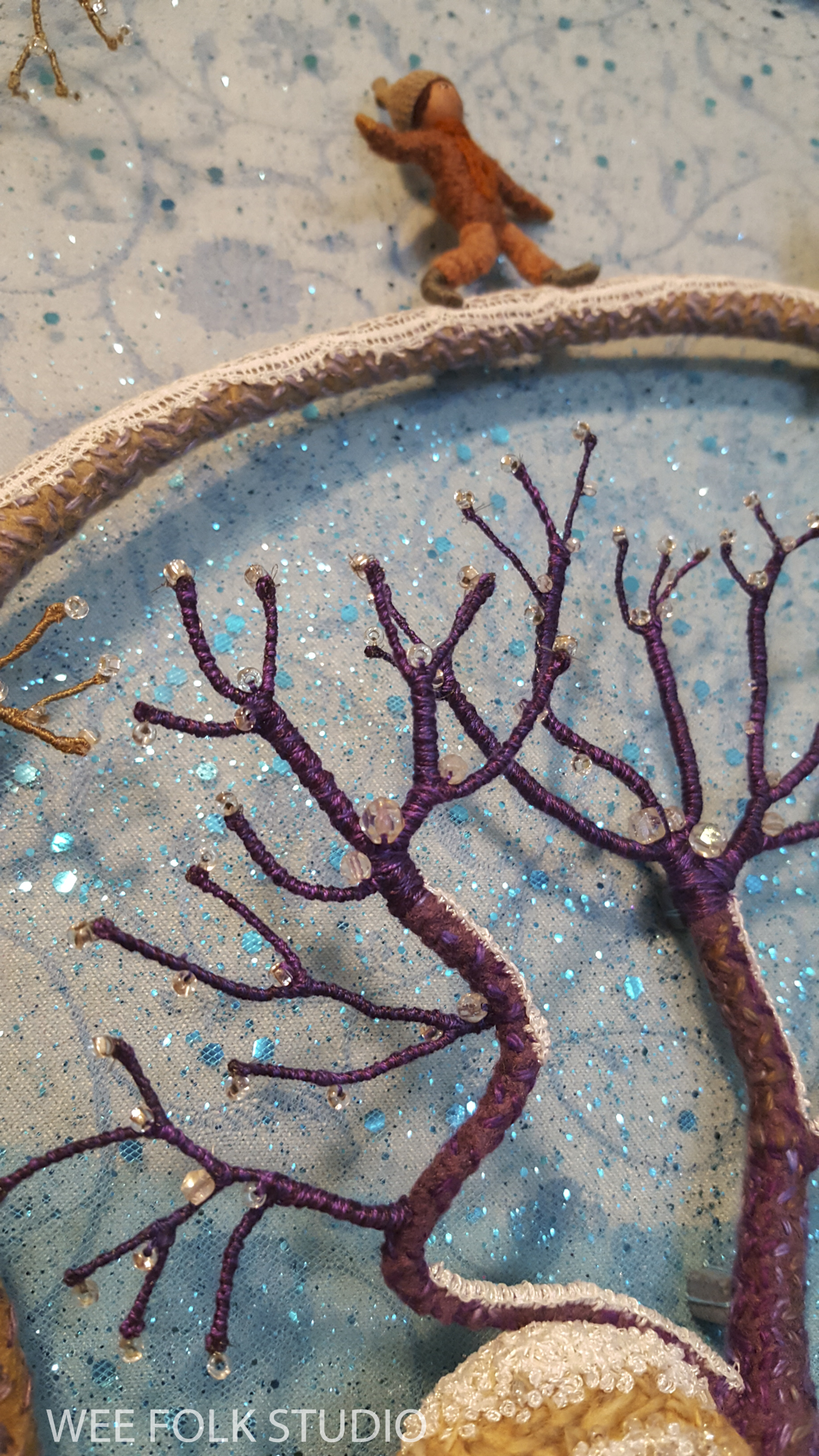
Looking to recreate the ice crystal droplets I saw that January morning, I sewed glass beads to different points along the wrapped wire branches (see part 3).

I must have sewn hundreds of beads onto all of the the branches. It seemed like I couldn’t add too many!

If you’ve followed me for a while, you’ll know that I don’t really subscribe to the less is more theory. More is more would be more accurate.

I made some of the branches completely white with frost, with both clear ice drops and red berries.

I wanted the sky to shimmer, too, so I used blue tulle that came spattered-painted with shiny spots. It was fun searching through the girly tutu isle of the fabric store, an area I’ve never had a reason to explore before.

A single layer of the mesh looked too dull, so I made 3 layers, transitioning from light on the top, to dark at the horizon. Behind the tulle fabric is the wrong side of a piece of blue upholstery fabric with a subtle floral pattern.

For the snowy spots on the tree limbs. I used the dreaded metallic thread. Even though it’s the most frustrating material I’ve ever worked with, it provided the sparkle I wanted.

Stay tuned for the 6th and final part in the Frosty Morning series, which will be all about making the wee folk characters who live in the winter landscape.

Part 1 shows how I made the tree trunks.
Part 2 gives a close look at how I formed and wrapped the wire tree branches. Part 3 is about constructing the rounded shelters.
Part 4 is about making the stone wall and the ice covered bush in front of it.

To keep up with new posts, subscribe to this blog. Your contact info will not be shared. If you’d like to see more frequent photos tracking the projects in my studio, please follow me on Facebook and/or Instagram.
Frosty Morning: part 4 (stone wall)

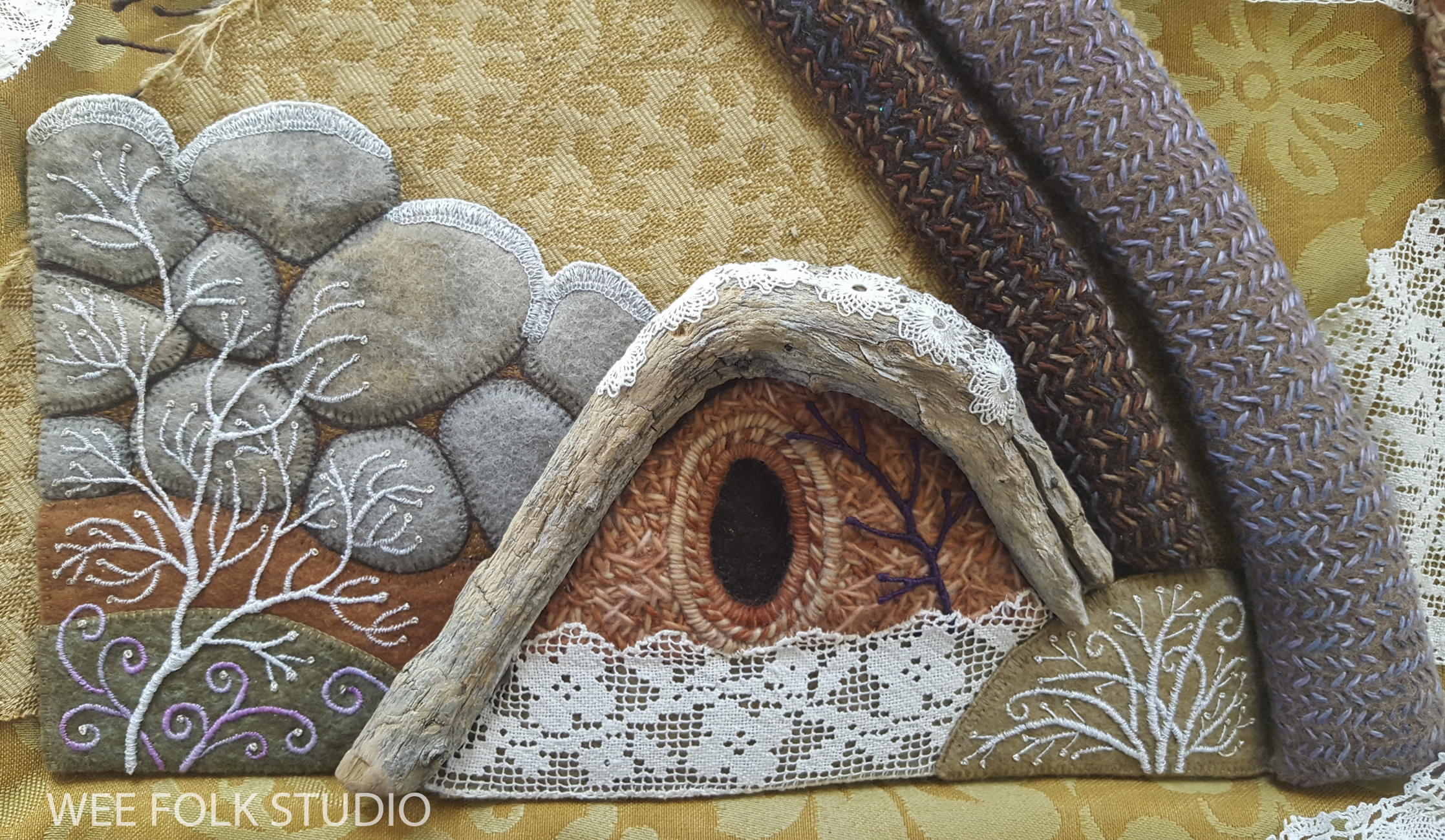
Part 4 in the Frosty Morning series is about making the stone wall and the ice covered bush in front of it. Part 1 shows how I made the tree trunks, Part 2 gives a close look at how I formed and wrapped the wire tree branches and Part 3 is about constructing the rounded shelters. Yes, I will eventually get to the wee folk characters!

This year, I’m working on a group of seasonal landscapes that capture the wonder and magic of the natural world, both real and imagined. Frosty Morning, Mossy Glen, Summertime and Harvest Time are available as jigsaw puzzles and note cards in my shop here

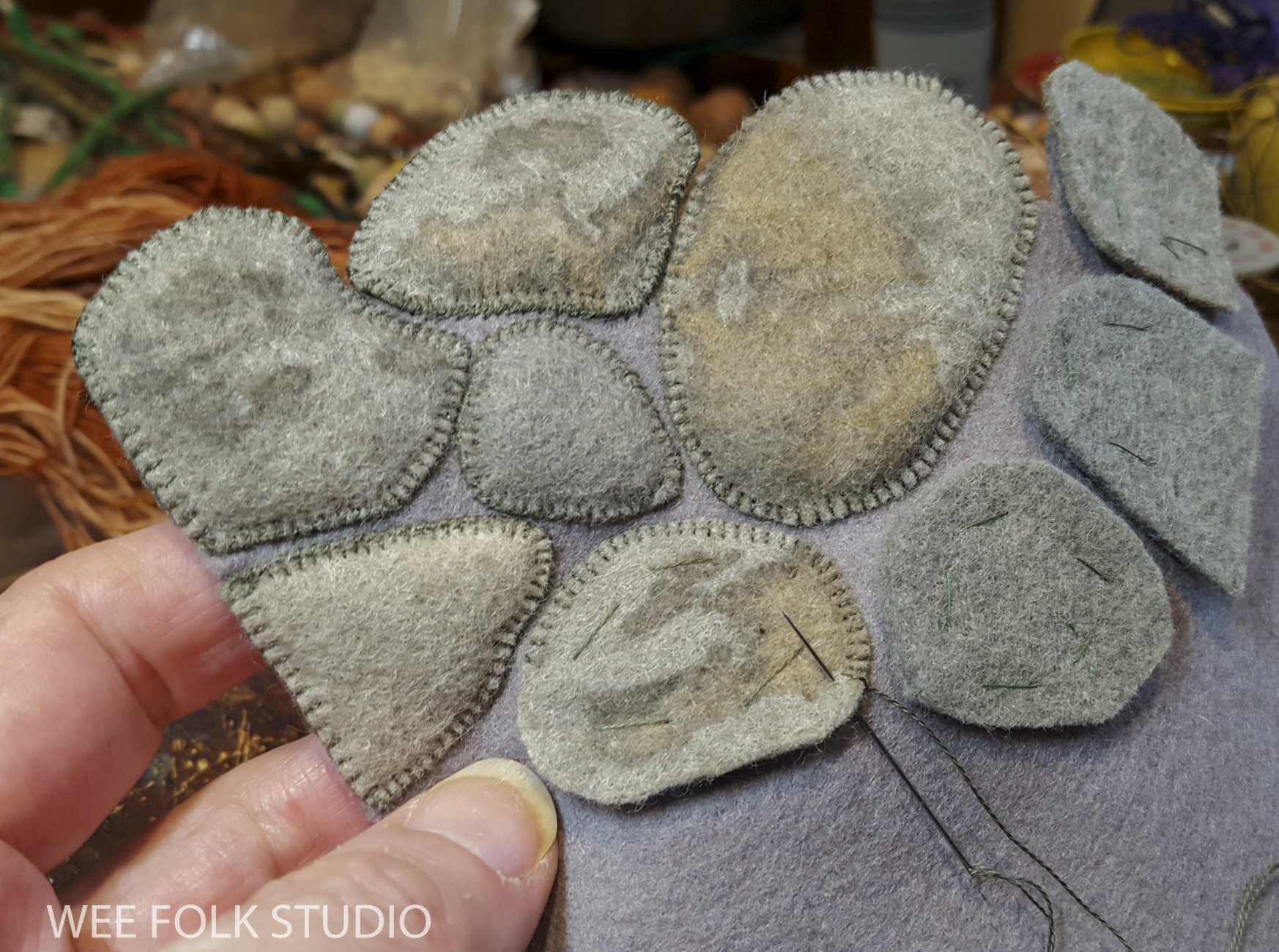
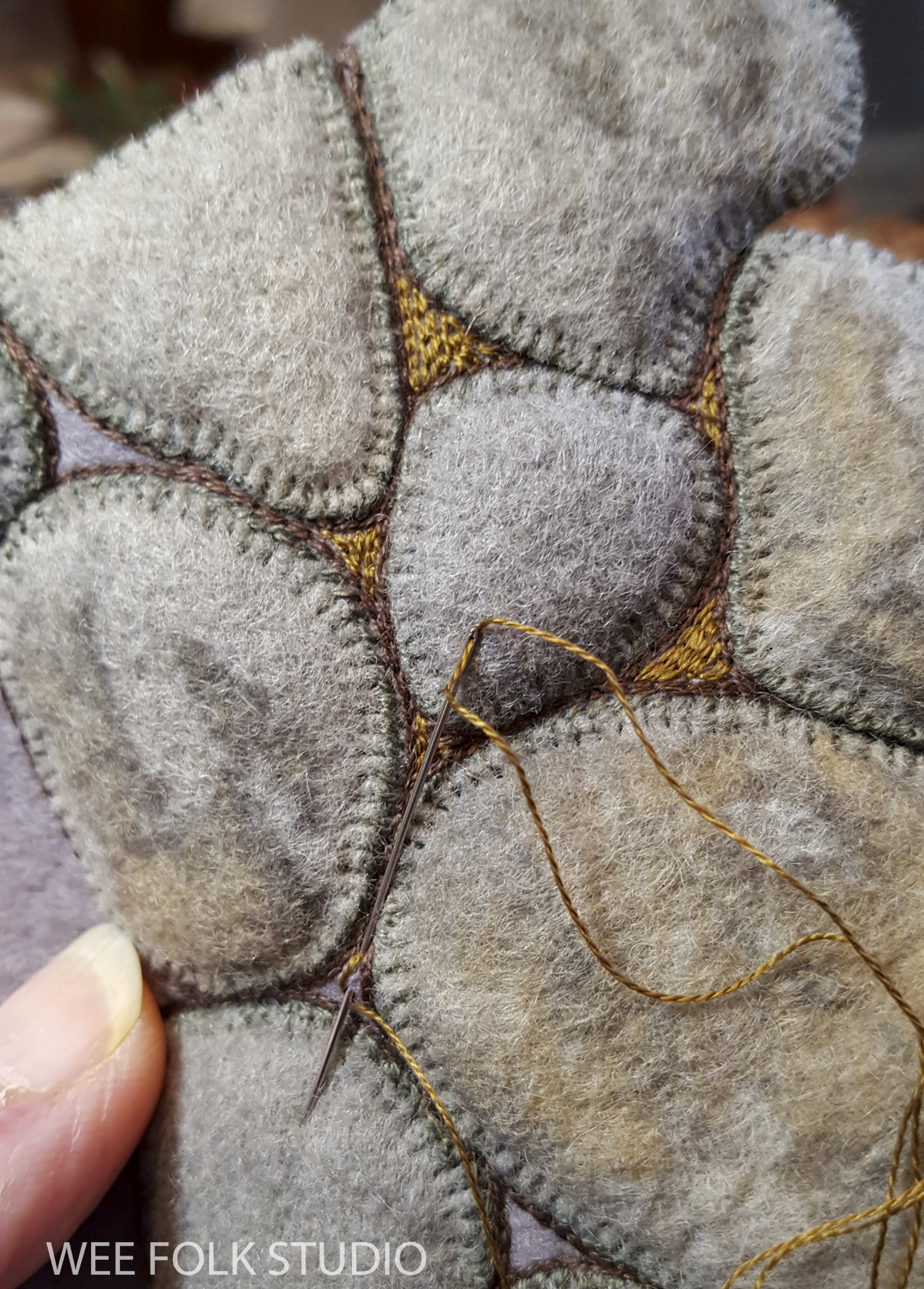
To begin, I cut stone shapes out of a special piece of wool felt that I’ve kept just for this kind of thing. It’s from a bunch of unevenly dyed “seconds” that I was lucky enough to purchase years ago. That source has since dried up, so I guard my stash very carefully. After blanket stitching the felt shapes 2/3 of the way around, I slipped another layer or two of felt inside the pockets and then finished stitching around the outside edges. That way, they puffed up a bit and looked more 3-dimensional.

I’ve used this felt to make stone walls in other pictures, such as Rabbitat and the Netherlands scene in MY BED.

I then outlined the stones and filled in the gaps with chain stitches.

To create the look of snowfall on top the the wall, I blanket stitched a few rows with white metallic thread.

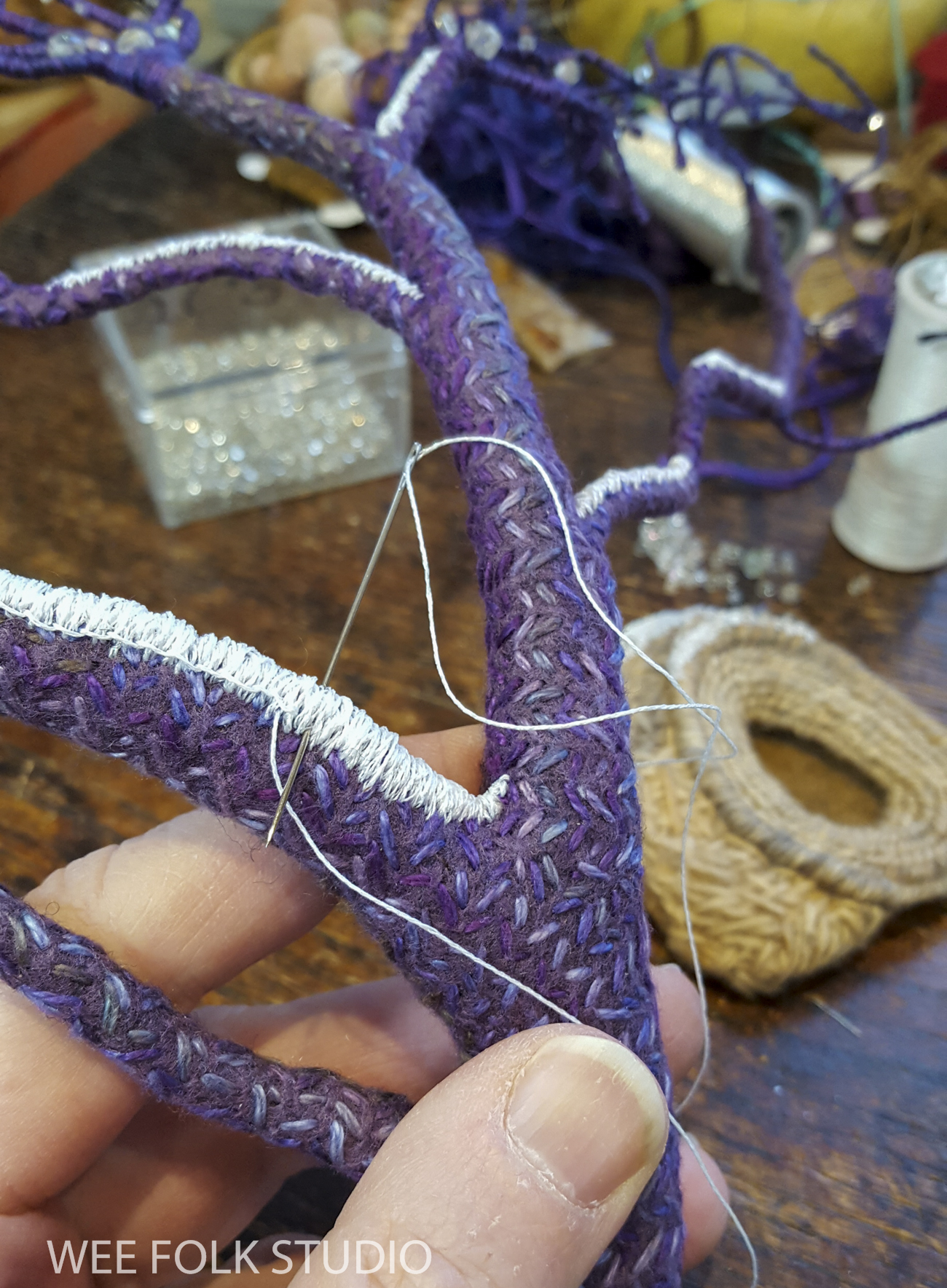
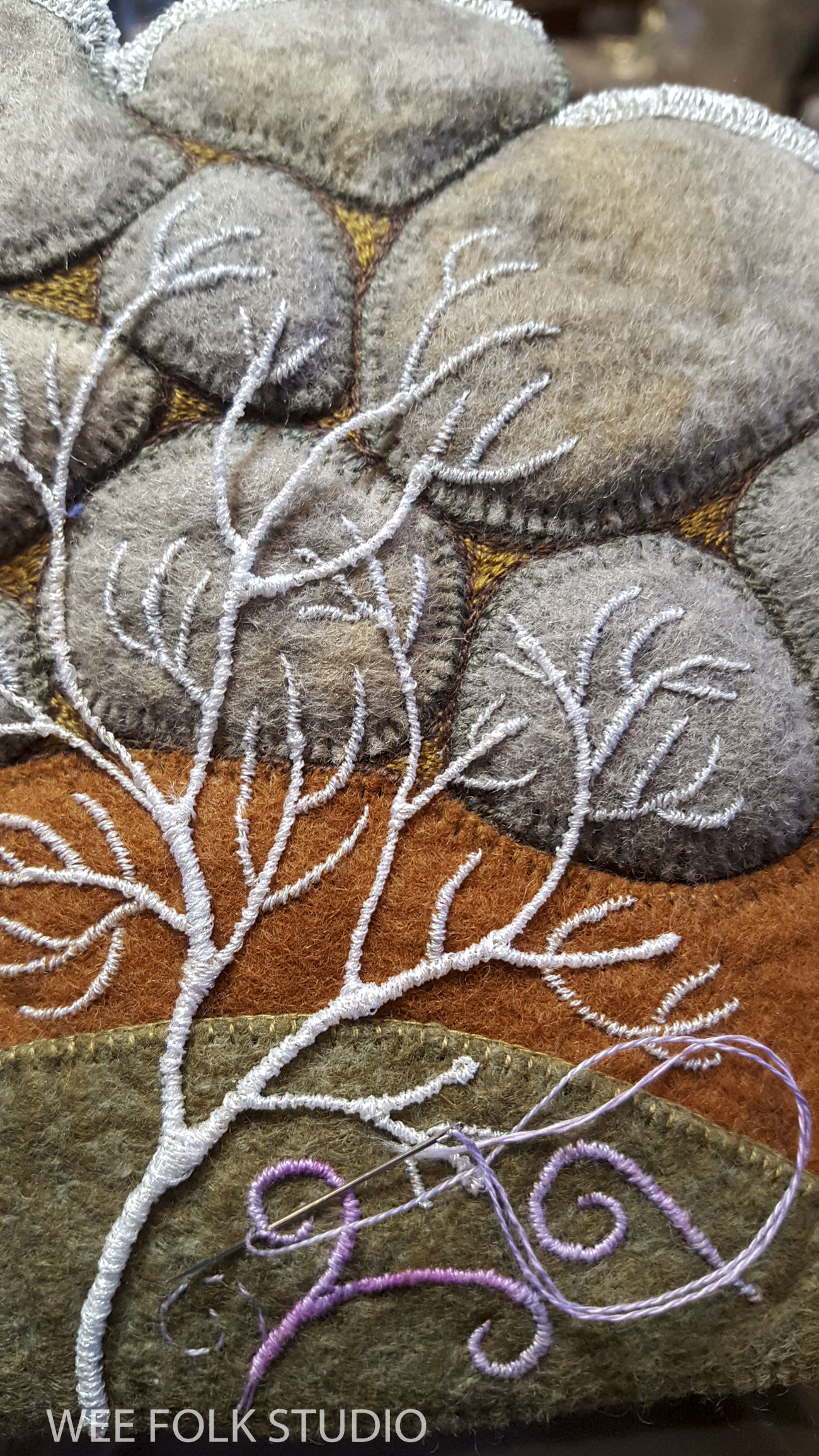
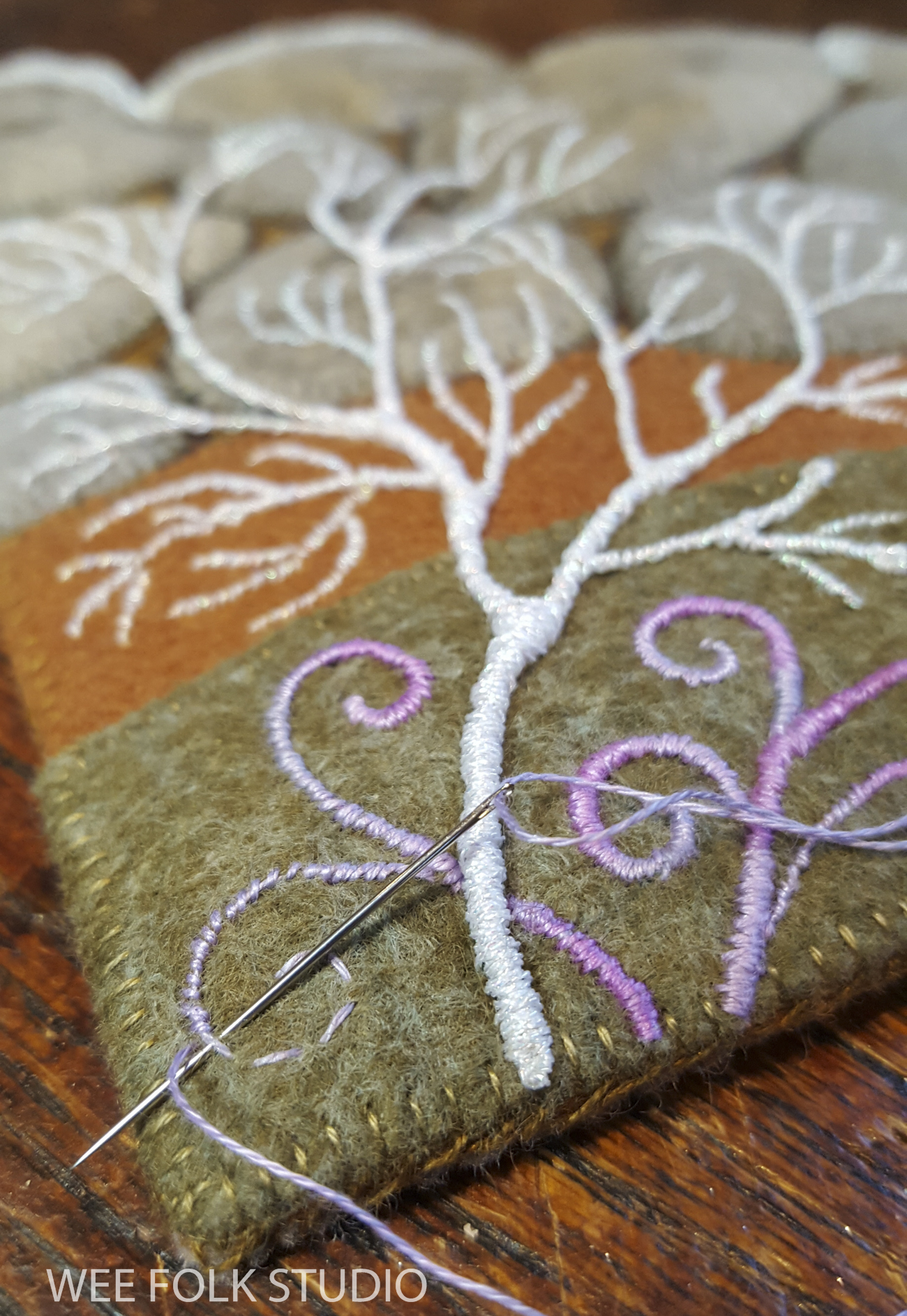
Then I bent and twisted wire to form branches, which I wrapped with white metallic thread. I don’t know about you, but I find stitching with metallic thread frustrating and frankly, a yucky experience! No matter what you do to lubricate the thread, it’s a rough ride. Even though metallic and other synthetic threads are frustrating to work with, I suffered through because I wanted the glittery, magical look that comes with it.

I sewed the wire branches in place…

and embroidered smaller offshoots onto the felt background.

It was such a relief to thread my needle with cotton floss and stitch the curly-cues at the bottom.

To help add a little accent, I dotted the tips of the branches with silver french knots.

Now, with the lower half of the composition sufficiently grounded, I could move on to other more fantastical areas of the piece.

Stay tuned for Part 5 in the Frosty Morning series, which will be all about adding ice and snow and sparkly touches to the winter landscape.

To keep up with new posts, subscribe to this blog. Your contact info will not be shared. If you’d like to see more frequent photos tracking the projects in my studio, please follow me on Facebook and/or Instagram.