Whiskers (part 1)

Ok, it’s been awhile since I’ve checked in. My only excuse is that it’s winter – my favorite time to hunker down and go full throttle on a project. There’s no way I’m going to some place warm! I know that some of you are of like mind, but we happy hibernators generally don’t get much agreement out there. I’m happy to say that I just finished a piece I’ve been working on since fall. Cover Up depicts cultural and national forms of head coverings and tribal markings that reflect notions of female modesty, fashion, status and conformity from different times and places.

20151224_100403.jpg

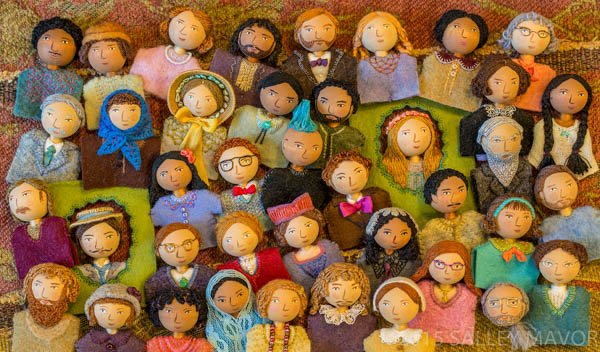
For now, let’s play catch up with a series of posts about a 24″ x 30″ piece I finished last summer. Whiskers focuses on beards and mustaches, showing an array of male characters from different cultures and historic periods.

Whiskersblog

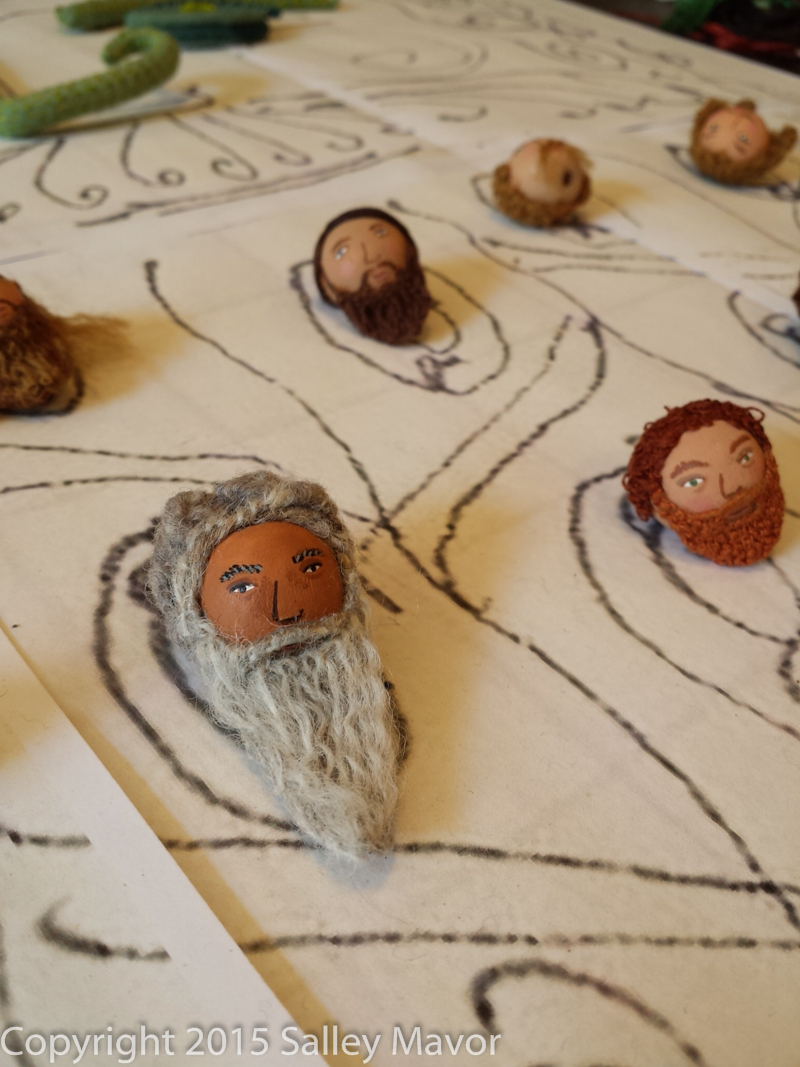
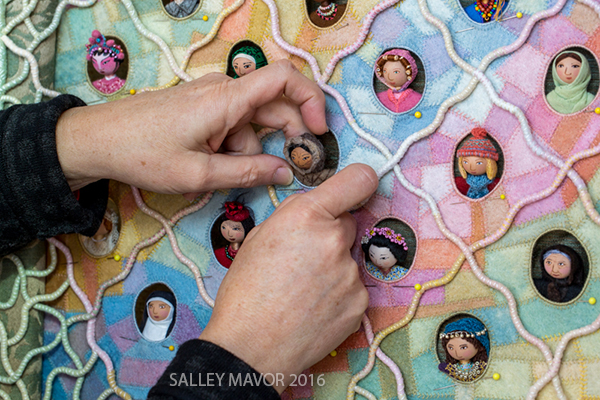
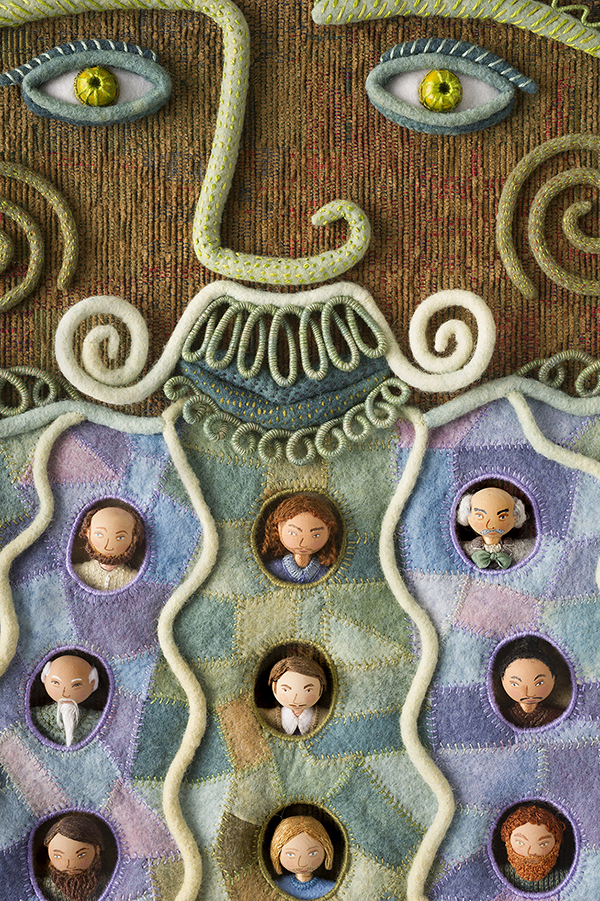
Little men peek out and display themselves like an unlikely collection of international souvenir dolls. Their painted wooden heads appear in vertical lines, within a large man’s beard, which acts as a holding place. The bulk of the large beard is comprised of small pieces of felt that are patched together by hand with embroidery stitches. The large man’s bas relief face and beard are defined with lengths of wire covered with felt or wrapped with thread. Whiskers explores diverse societies and their origins, using needle and thread to signify the unraveling and mending of human cultures throughout history.

IMG_2107
IMG_20150521_144107

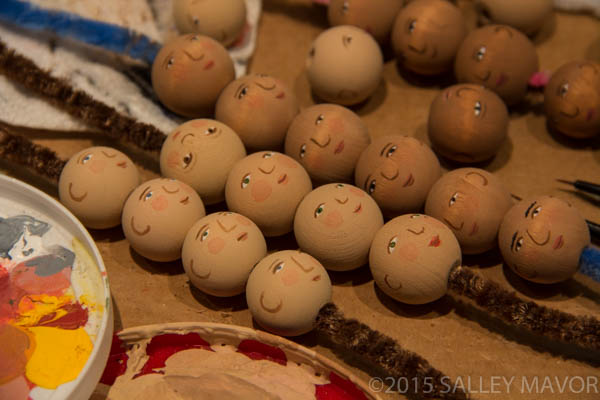
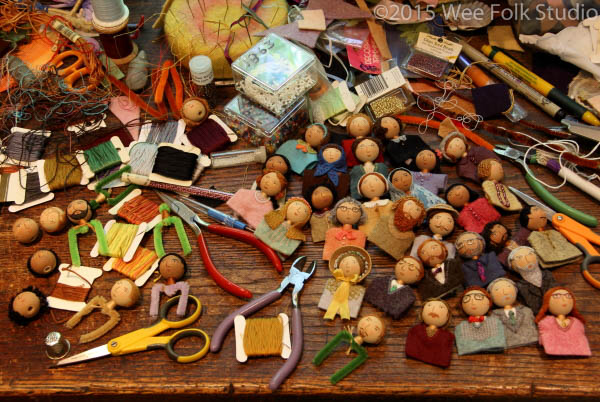
I made the heads like the wee folk dolls in my how-to book, Felt Wee Folk – New Adventures. Some beards are painted on the wooden bead head. I also tried something new, by gluing embroidered felt beards to their faces.

Whiskersprocess2
IMG_20150711_101219

I had a blast researching beard styles for the collection of characters. This piece is a continuation of a new series that explores history and fashion.  Face Time (shown below) is a previous piece showing cameo portraits from early civilizations to the present day. See Whiskers Part 2 here.

To keep up with new posts, please subscribe to this blog. Your contact info will not be sold or shared. If you’d like to see more frequent photos tracking the projects in my studio, please follow me on Facebook, Instagram and BlueSky.

Posies exhibit in Greenville, SC

Posiesupcountry4

Last week, Rob and I visited Greenville, South Carolina, where I gave a talk in conjunction with my Pocketful of Posies exhibit. It was a pleasure to meet the people who came to see the show and hear about my work at the Upcountry History Museum  last Thursday. Before heading inside the museum, I couldn’t resist standing next to the enormous banner outside.

The museum staff did a superb job hanging the show! I’m happy to say that it’s the most creative and professionally presented installation I’ve seen on the five-year tour. There’s plenty of time to visit the show, which is on display until Feb. 14th, 2016. This could very well be its last venue, as I’m no longer soliciting new locations. Of course, it could be a different story if an invitation from a great place with funds to ship the artwork comes forth.

Posiesupcountry1

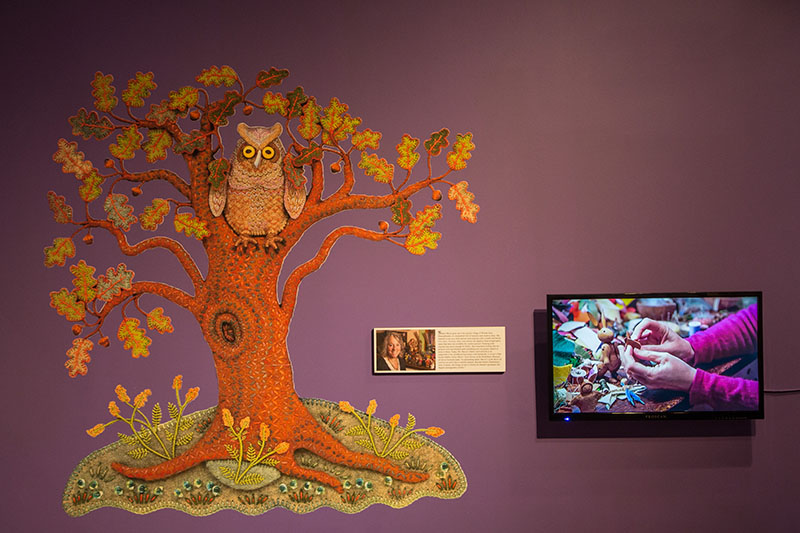
The bold choice of lilac purple walls really sets off the natural golden brown wooden frames. They covered one area with a 6′ blow-up of the “Wise Old Owl” and a screen, which shows my Rabbitat video and Felt Wee Folk book trailer on a loop. Signage with different versions and information about the rhymes hang below the framed illustrations. For this, the previous exhibitor, the Bel Air Library in Maryland generously shared their research about the rhymes with the Upcountry History Museum. To give an idea of how I make the figures, they laid out step-by-step parts in a display case. They’re the same ones I made and photographed for Felt Wee Folk. And last but not least, the black box theater lighting makes everything pop and sparkle!

Pocketful of Posies, Oct. 17, 2015 – Feb. 14, 2016 at the Upcountry Museum – Furman University, Greenville, South Carolina.

Posiesupcountry2

Posiesupcountry5

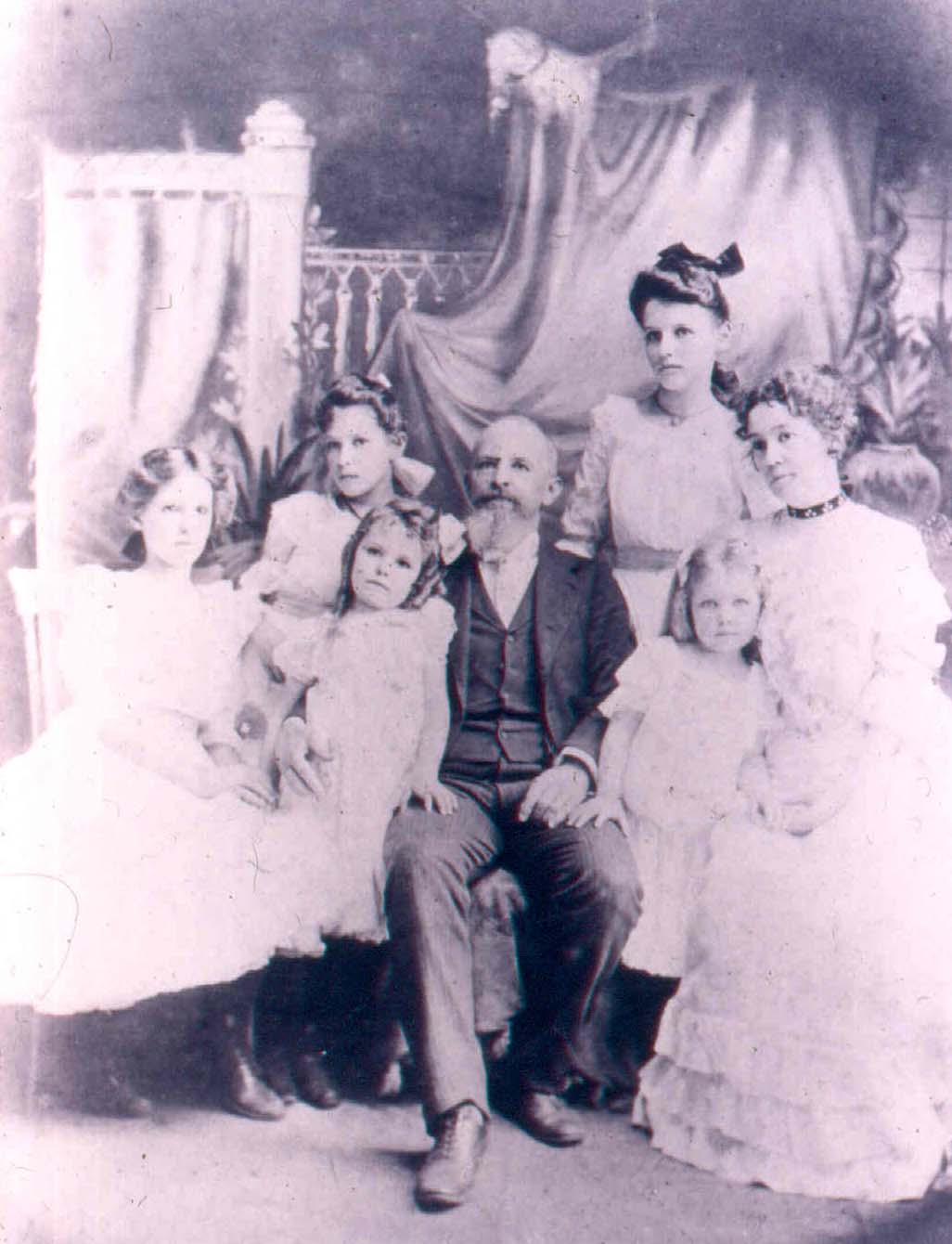
We really enjoyed our visit and took a few extra days to see a friend and relative in the area. I spent a wonderful day near Columbia with my cousin, also named Salley with an “e”. Her 5-year-old grand-daughter is also named Salley, so our family surname continues to be passed down. Our grandmothers were 2 of the 5 independently minded, high spirited Salley sisters of Orangeburg, SC. In this circa 1900 photo, my cousin’s grandmother has their father’s arm around her and mine is standing, 2nd from the left.

Salleyfamily

And we had a fantastic visit with my RISD classmate, Niki Bonnett, who lives in Asheville, NC. What an artsy, fun town! Years ago, Niki designed the poster and catalog for my pins, which you can see here. We could have soaked up the southern hospitality for a bit longer, but had to fly home.

SalleyNikiAsheville


opportunities to see original artwork

I am excited to share the news that there will be opportunities to see my original fabric-relief artwork in different parts of the country this fall and winter. The Pocketful of Posies exhibit, will be at the Upcountry Museum – Furman University in Greenville, South Carolina, Oct. 17, 2015 – Feb. 14, 2016. Next month I will head down to Greenville to give a talk about my work on Thurs., Nov. 19th at 7:00 pm. This is the last scheduled exhibit on the 5 year tour and I hope that many of you can make the trip to see the show!

And, 2 of my larger pieces will be included in Insects to Elephants: Mother Nature’s Menagerie at the Wisconsin Museum of Quilts and Fiber Arts in Cedarburg, Wisconsin.  Birds of Beebe Woods and Rabbitat will be displayed from Oct 21. 2015 – January 10, 2016.

Poster 22x28 2SM

Birds0001blogWMrabbitat

Also, my piece, FaceTime is part of the group show, Entangled at Some Things Looming in Reading Pennsylvania until Oct. 24th.

FaceTimeDetail1WM

making Face Time (part 3)

FaceTime-1350
FaceTimeWM

This is Part 3 in a series about making my newest piece, Face Time. It picks up where I left off in Part 2, which covers the embroidered felt wreath-like frames. Part 1 explains the concept of the piece and shows the making of the heads.

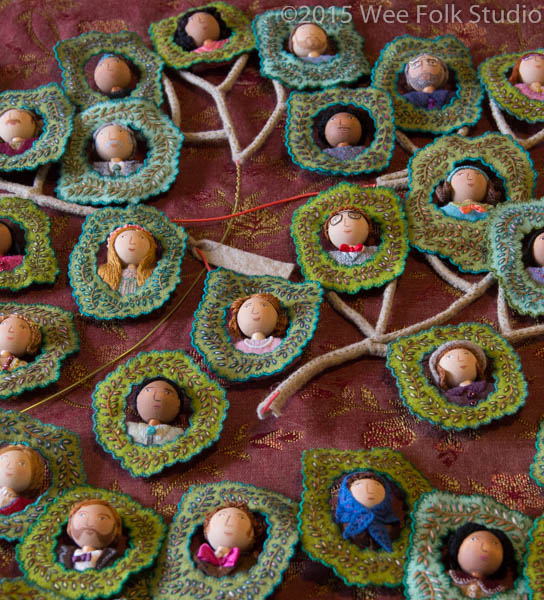
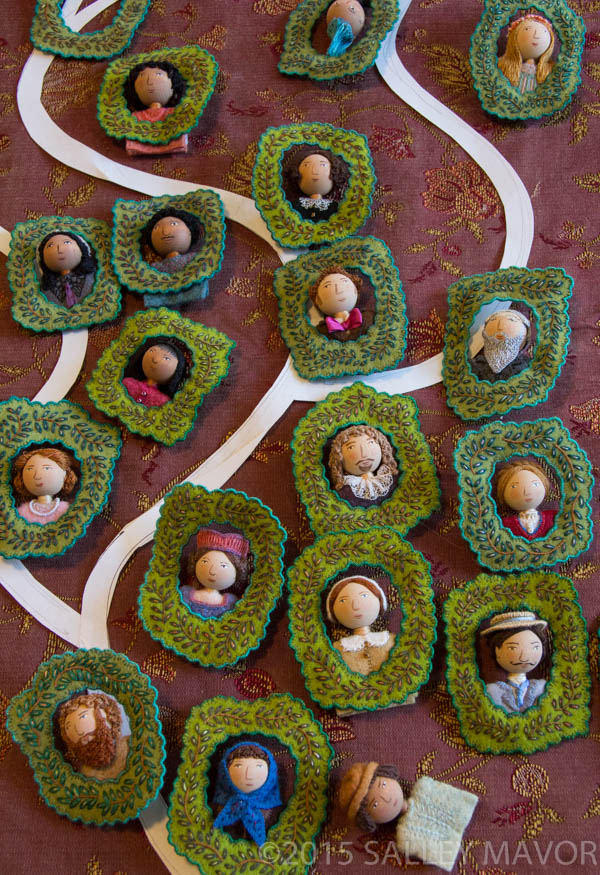
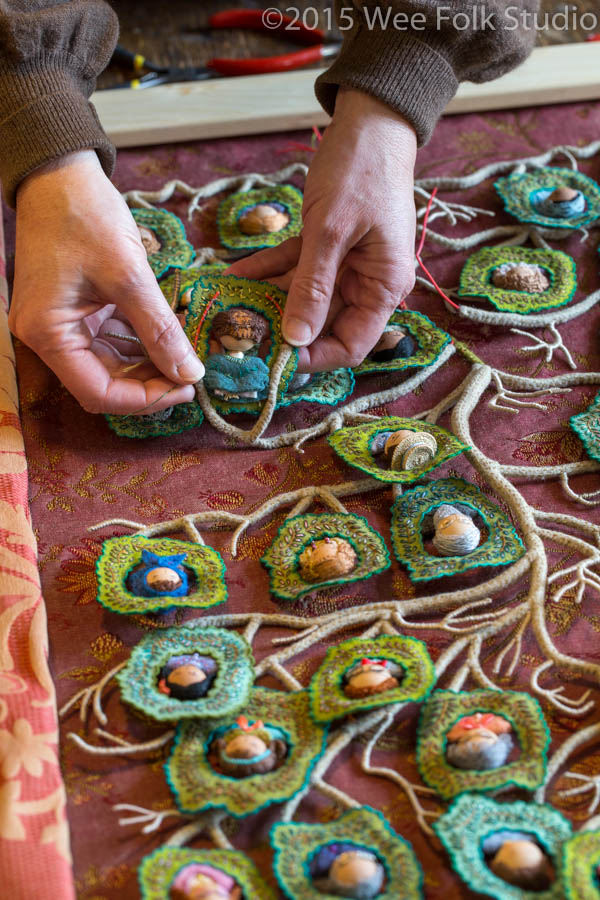
After all 41 frames were finished and each bust was safely sewn inside its own personal cameo, I arranged the characters according to time period. It was like putting together a puzzle, fitting the pieces in chronological order. Characters from the past were rooted at the bottom of the tree and others cascaded upward through time to contemporary folks at the very top.

FaceTime-1527

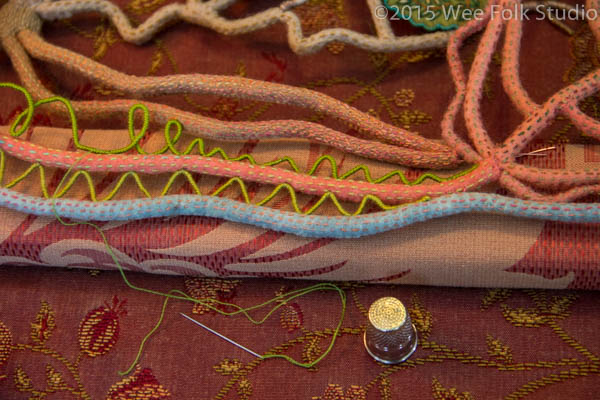
Tree branches were formed with felt covered wire. Embroidery floss seed stitches on the felt created a bark-like texture. The smaller branches are made of floss wrapped wire. I sewed the branches to the back of the “cameos”, extending the wire around the frame to give each little portrait some structure, like bendable bones.

FaceTime-19559

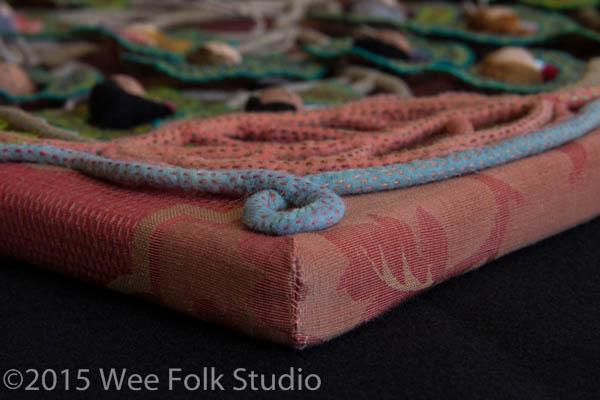
With this piece, I tried out a new kind of border/frame. Instead of putting fabric on top of and around the sides of a wooden stretcher, I stapled the background fabric to the back, creating a space inside for the 3-d tree. I padded the stretcher bars with cotton batting and covered it with fabric, like upholstering furniture. It required quite a bit of fussing and hand stitching to make the corners look good. This way the finished piece can be hung with or without another outside frame or shadow box.

FaceTime-1530

I made felt covered wire leaf forms for the corners, first embroidering the strips of felt with seed stitches.

FaceTime-1537-2

And then filled in some gaps with floss wrapped wire doodles.

FaceTime-1575
FaceTime-1814

Thank you for following along through the process! As with Birds of Beebe Woods, I am not selling Face Time and will be entering it into juried shows around the country. Please visit the events page from time to time to see where my original work is on display.

For those of you interested in making your own characters, please refer to my how-to book, Felt Wee Folk – New Adventures, for basic guidance.

FaceTimeWM
FaceTimeDetail3WM
FaceTimeDetail1WM
FaceTimeDetail2WM

To keep up with new posts, please subscribe to this blog. Your contact info will not be sold or shared. If you’d like to see more frequent photos tracking the projects in my studio, please follow me on Facebook and/or Instagram.

making Face Time (part 2)

FaceTime-19446
FaceTimeWM

This is Part 2 in a series about making my newest piece, Face Time. It picks up where I left off in Part 1, which is about the painted and wigged wooden bead heads.

FaceTimeWM-1357

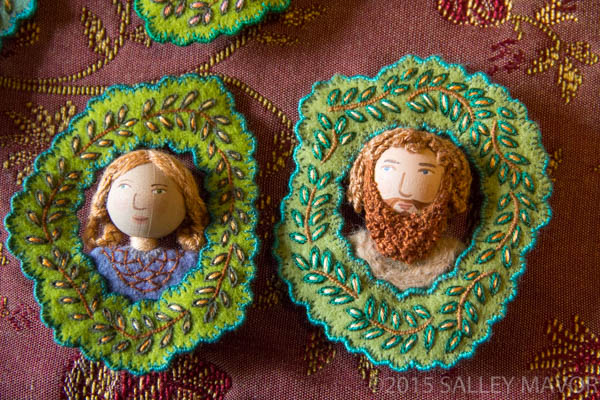
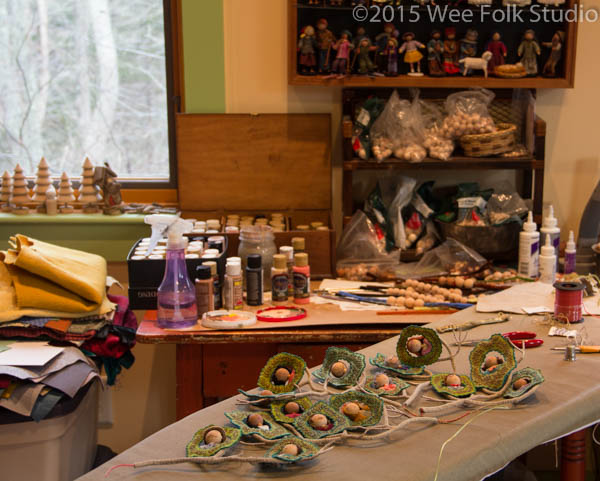
I wanted each character to peek out of their own frame, like cameo portraits. I cut pieces out of felt with scalloped shears and embroidered the edges. This, along with stitching the leaves and stems took many, many hours.

FaceTimeWM-1355
FaceTimeWM-1353

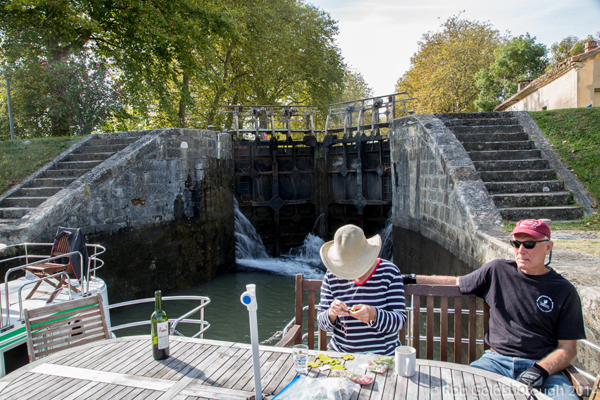
I brought them with me on boat excursions near home…

FaceTimesalley
IMG_9952-2

and far away on our canal trip in France. I got a lot done on the plane ride, too.

salleymakingfairies3

Finally, all 41 busts had their own wreath-like frame.

FaceTime-111141

The heads are based on the wee folk dolls in my how-to book Felt Wee Folk – New Adventures. This little lady’s bonnet is made with wire wrapped with embroidery floss.

FaceTimebonnet-


After the wreaths were completed and the busts sewn in place, I figured out their arrangement on tree branches. They would be grouped according to time period, going from the past at the bottom to the present at the top.

FaceTime-1332

The tree branches were made of felt covered wire.

To be continued in Part 3

FaceTime-1524

To keep up with new posts, please subscribe to this blog. Your contact info will not be sold or shared. If you’d like to see more frequent photos tracking the projects in my studio, please follow me on Facebook and/or Instagram.

making Face Time (part 1)

About a year ago, my newest piece, Face Time started taking shape. I took pictures along the way, while its collection of little heads grew on my work table. The piece was completed this past winter after about 6 months of work.

UPDATE: Face Time was the first of 3 collective portraits. Cover Up and Whiskers also focus on bringing to life different people from around the world, using themes of history, style and cultural identity. In each piece, head and shoulder busts peek out of “cameo” framed holes.

I’m often asked how long it takes to make a large piece like this (24″ x 30″). It’s hard to say for sure, because my days are interspersed with so many distractions having to do with the business side of being an artist. Of course, I’d rather be stitching every day in my studio, but I fear that that would lead to an obscure life, without a presence beyond my studio walls. At least 50% of my work time is spent promoting my art in some way; e-mails, interviews and other publicity, Etsy Shop, editors and publishers, social media, writing blog posts, arranging exhibits, etc. OK, that’s enough of a reality check–shall we stick with the romantic notion of spending all day stitching in a window seat?

I’d like to take you through the making of Face Time, so you can have a sense of what’s involved.  If you’ve read my post, When to tell how and when not to, you’ll know that I don’t always show my process, but this is one of those instances when I’ve taken enough photos to warrant a 3 part series. I’m excited to share the new direction my work has taken!

Face Time

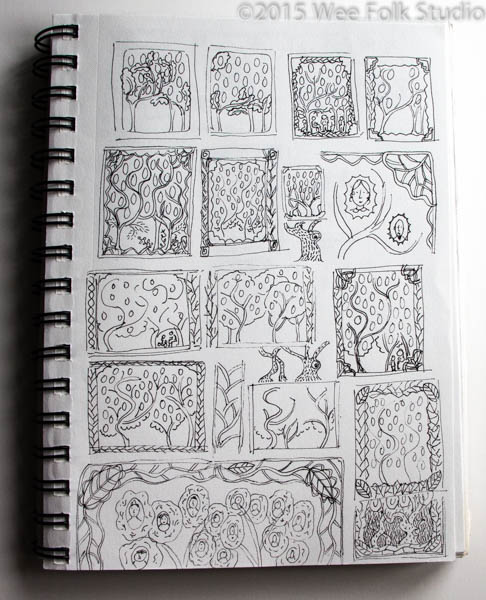
For Face Time, I started in the usual way, thinking about the idea for a long time before jotting down tiny drawings in my sketch book. While I worked, the concept remained strong and constant, while the overall design changed with time. I also considered how the parts will be rendered in embroidery and 3 dimensional needlework.

FaceTime-2051

I wanted to show different people from all over, evolving through time, from long ago civilizations at the bottom, to present day people at the top. I wasn’t so interested in making a personal family tree, but a depiction of a collective heritage. I envisioned a group of faces from a variety of backgrounds and cultures peeking out of the greenery, all linked to a tree-like form.

FaceTimeWM-9573
FaceTime-9577

Researching fashion history was very fun! Online, I found pictures of hair styles, beards, hats and garments. In addition to wigs and painted facial features, each wooden head had a bit of clothing showing at the neck and shoulders. They expand on the wee folk doll projects from my how-to book, Felt Wee Folk: New Adventures. Wire glasses were something new, which I thought contributed to the individuality of some characters.

FaceTimeWM-9612

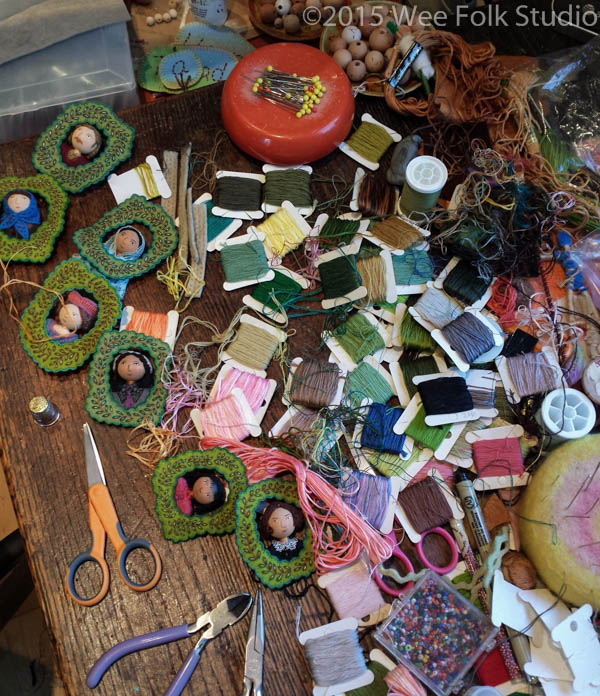
Over a period of many weeks, the heads grew in number, filling my already crowded work table.

FaceTimeworktable-1
IMG_9725

There ended up being 41 heads in all, covering many centuries. Here they are, in a group shot, before they were separated by leaves and branches in the finished piece. I will show more about that in part 2.

FaceTimegroupWM-

To keep up with new posts, please subscribe to this blog. Your contact info will not be sold or shared. If you’d like to see more frequent photos tracking the projects in my studio, please follow me on Facebook and/or Instagram.

Birds at Highfield this summer!

Birdsdetail3WM

I recently cleaned the glass which protects the Birds of Beebe Woods. While the piece was uncovered and exposed, Rob took some new photos. This time he didn’t aim the camera straight on. We thought we’d try coming from the side a bit, to emphasize the sculptural quality of the birds.

Birdsdetail2WM

Birds0001blogWMI think these photos better translate the experience of looking at the real piece. Of course, it’s best viewed without glass, but it’s necessary for protection from light and dust.

Printed reproductions in the form of posters and cards are available from my Etsy Shop.

Birds of Beebe Woods is on display at Highfield Hall, Falmouth, MA until Sept. 15th. I’m also excited about the upcoming outdoor exhibit, Fairy Houses of Highfield Hall (June 28 – Aug. 31), which I’m curating again this year.

Birdsdetail1WM

Face Time premiere showing

FaceTimeDetail2WM

For the past 9 months or so, while working on it, I’ve been offering occasional peeks at Face Time. This new piece deals with themes that I continually return to; passage of time, patterns that show change and growth, and connections between living beings.

It’s finished now and I’ll bring it with me this Tuesday, April 21st, when I give a talk at 7:00 pm at the Newton Free Library in Newton, Massachusetts. Face Time has been tucked away in my studio and has not yet been exhibited publicly, so this will be its premiere showing. It’ll only be on view for a few hours, while I’m at the library.

FaceTimeWM

Face Time features a tree with a variety of embroidered felt wreath-like “cameos” with heads and shoulders representing a broad cross-section of humanity. The 41 individuals include a wide swath of characters that show changes in style over time. They branch out through history, from long ago civilizations at the tree’s roots, to present day portrayals at the tree top. It’s not my family tree, but a depiction of the world’s collective heritage.

In this piece, I’ve basically used the wig making techniques introduced in my new how-to book Felt Wee Folk – New Adventures, but have added more period fashion details, like beards, hats and glasses.

I hope to meet some of you from the Boston area on Tuesday night at the Newton Free Library. My talk, Once Upon a Thread will be at 7:00 pm. I’ll bring along books to sell, too. The Pocketful of Posies Exhibit will be on display at the library until April 29th.

FaceTimeDetail1WM

Where can Face Time be seen in the future? I can’t say for certain, since I’m entering it in juried shows and won’t know for a while if, where and when it’ll be exhibited. I’ll be sure to include any showings on the exhibits page.

FaceTimeDetail3WM

When to tell how and when not to

cropped-salleymavorselfportraitfull3.jpgQuite often, I am asked to show more details and to expand on how I work. I’ve been thinking a lot about this subject and wondering how to respond to these requests. In this post, I will explain how I choose when and when not to tell how I make things.
family56

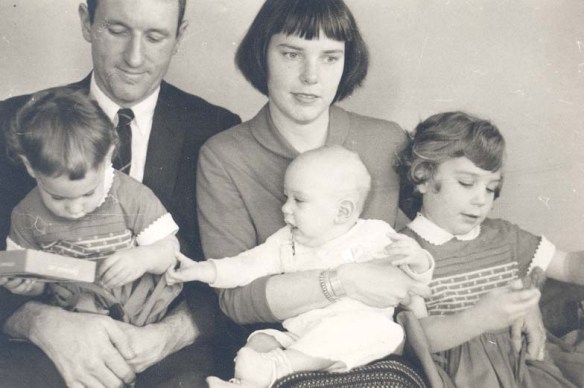
Salley, Jimmy and Anne, with parents Mary and Jim Mavor 1956

But first, I want to say it’s my birthday today and my sister Anne’s, too. 60 years ago, my mother’s water broke while she was making a bunny cake for Anne’s 3rd birthday. So, she went to a hospital in Boston and had me. Needless to say there was no birthday party for Anne that year. So, I can’t think of my birthday without thinking of Anne. When we were young, we had joint parties, but nowadays we rarely spend our birthday together, as we live on opposite coasts. Growing up, we spent a lot of time making things and my most vivid memories are about creating art, making music and dancing. Today, Anne and I are both artists, bringing our own visions into the world.

salley58blog

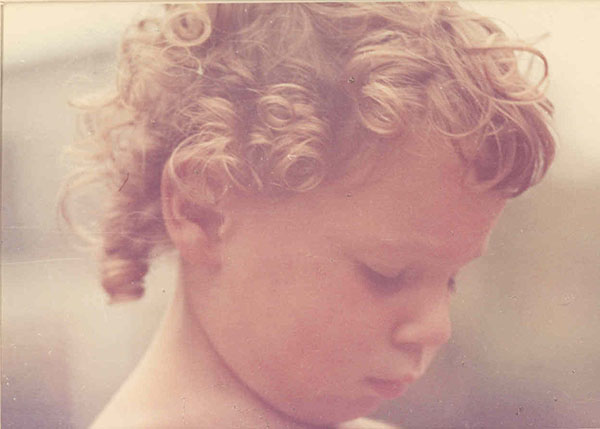
Salley at age 2

Turning 60 has emboldened me to share some thoughts I’ve been mulling over.  As I’ve grown older, I can see more clearly what works in my life and what doesn’t. I try to remember to do what makes me feel whole and alive and to not feel obligated to do everything I’m asked or expected to do. And since a big measure of my well-being comes from making art, I want to set things up so I can continue to develop my art form for as long as possible.

PlayHouse

Anne and Salley, 1956

I could stay cordoned off in my studio, shielded from the distractions of the world and the internet and thereby turn out a higher number of pieces. But, I enjoy communicating with the larger world through this blog, Facebook and Instagram. It takes up A LOT of time, so I have to find a balance. Interestingly, in terms of artistic output, I was much more prolific before the internet, even with little kids around! When you’re connected like this and the pool of people gets larger, more questions, requests and suggestions come forth. The kind of people who follow me are wonderful and gracious. You are so appreciative when I share behind the scenes photos, especially process close-ups. Your encouragement to keep doing what I’m doing has made a big difference in my life. Your excitement comes through in your comments and it makes me happy! girlindoorway62blog

April 14, 1960

April 14, 1960

So, why do I describe how to make some things and not others? I’ll get to that eventually, but please indulge me a little bit longer, just because it’s my birthday! I also want to address the issue of how embroidery and handwork has been and is still, for the most part, perceived today. Besides being designated as “women’s handiwork”, needlework has a strong tradition of teaching and learning through imitation, with instructions and patterns aplenty. Today, a vast needlecraft industry is built around this technique driven culture of copying, with businesses supplying materials, equipment, tools, patterns and kits for stitchers, knitters and quilters of all kinds.
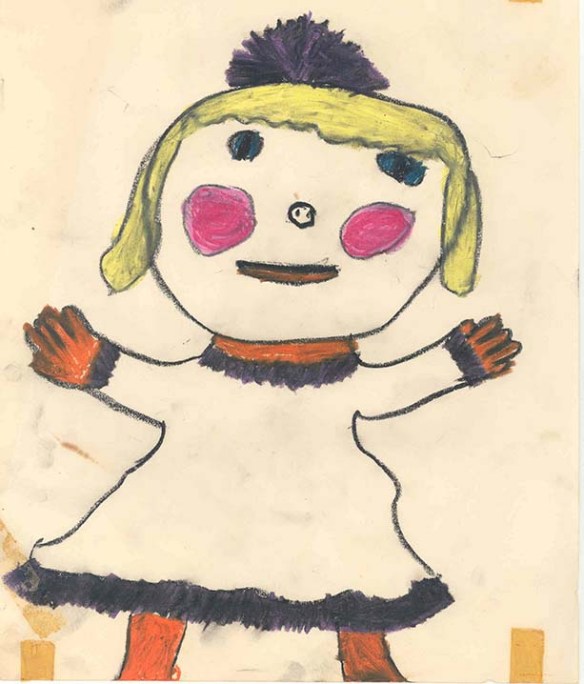
largegirl62blog I realize that people need a place to start and they derive great satisfaction from being guided through the process. That is why I used to make kits and have written how-to books about making dolls (Felt Wee Folk). My goal is to show the basic framework, with a variety of possibilities, so that the reader can gain the confidence to add more personal touches and create something that is uniquely their own. I want to share my techniques for making the dolls, which I see as a much-needed opening for people to play and express themselves.

Siblingsblog Even though the mainstream needlework network doesn’t mesh with what I do, I am a part of it because I’ve authored how-to books, which are marketed within this world. But other than that, I operate in a different needle and thread universe. This is not surprising, since my work is generally an anomaly in any group I’m lumped into; embroidery, stumpwork, dolls, art quilts, miniatures, fiber art, children books, etc. The narrative and decorative style of my fabric relief pieces doesn’t really fit into the abstract, conceptual contemporary fiber art scene. And I suppose that writing the Felt Wee Folk books opened me up to being characterized as only a teacher of doll making techniques. Showing how to make these “cute” dolls, illustrating story books and organizing fairy house exhibits may have compromised my status in the serious art world, but knowing my work has touched many lives is of more value to me personally.

I identify myself as an artist first and foremost. To me, it doesn’t matter what medium or materials you use for your work to be considered art. Not today, in an art world that recognizes all manner of expressions. Not in this age of the internet, where individuals can build careers and gain followers, despite the hierarchy of the art establishment and opinions of curators and critics.  I don’t want to be the kind of “serious” artist who, in an effort to have their work recognized as legitimate, dissociates themselves from the world of hobby needlework. There is too much real humanity and power in stitched objects that are labored over so lovingly. Just read the comments in last week’s Give-away post to understand the meaning and importance we give to making something by hand for another person. Your stories are so touching and life-affirming!

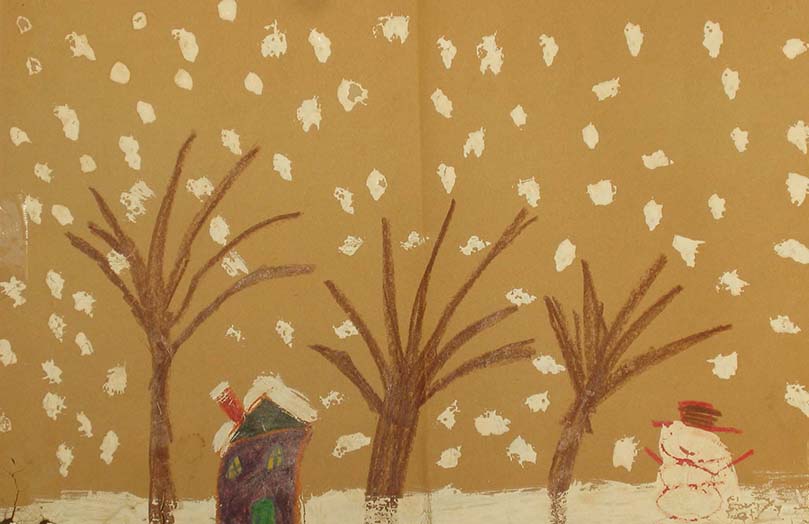
snowstorm63blog But, where does the artist who creates original work with needle and thread fit into the imitation model engrained in and perpetuated by the needlecraft industry? In order to explore new concepts and ideas, I have found it necessary to educate the public and protect myself from misconceptions about my work. For instance, people ask (not once, but many times) if I have a pattern to make Birds of Beebe Woods. Others want directions for making illustrations from Pocketful of Posies. And I am constantly asked how I make the little hands with fingers. I can understand asking about the hands, but the idea of providing patterns for my larger fabric relief pieces and illustrations has me totally baffled. I think that artists working in other mediums would be equally taken aback if asked for patterns and instructions.

With needlework, the distinction between art and craft is particularly fuzzy (no pun intended). That subject will still be discussed and debated long after I’ve threaded my last needle. For me, it points to the question of when to tell how and when not to. I am not worried about individuals copying my techniques, I just don’t want to spend my time and energy telling how I do it — time and energy that would otherwise go toward artistic growth. I find reviewing and explaining in detail the process of making something I’ve lived and struggled with for months like sliding backward into the muck, hindering any movement forward.

My children’s book illustrations and stand-alone pieces are much more involved and complicated than what I teach in Felt Wee Folk. Through 40 years of experimentation, I have devised methods of working that I consider proprietary knowledge. For instance, the way I make hands with little fingers is too linked to my personal artistic expression to show how in detail. I don’t want to upset the creative process by constantly organizing the steps in my mind and thinking in terms of explaining it to another. That would hold me back and limit the possibilities. I think the act of creating something new shouldn’t be overly dissected, else it lose its magic.

Mavor kids 1964

Mavor kids 1964

As an artist, I draw the line on what parts of my process to share and what parts I want to remain a mystery, even to myself. People wonder how I can give away “all of my secrets”, but I don’t look at it that way. In Felt Wee Folk, I’ve simplified some doll making techniques to a point where I can teach them step by step. Nonetheless, I won’t be writing any more how-to books or teaching classes. But, I will share projects in progress, thoughts, inspirations, travels, and give glimpses behind the scene. My sketchbook is brimming with ideas and I intend to devote as much time as I can to making new work.

firstbook2blog

First book 1963

This blog is full of photos that show the development of projects. What is shown and what is not usually depends on how engrossed I am and if I can remember to take pictures. Sometimes I take photos of different stages of making a piece, but that just skims the surface and may be perceived is a tease of sorts. I see it as documentation, not as a tutorial, which takes a different, more systematic approach. My husband Rob and I sometimes document with video, which we did for my outdoor environmental piece, Hither and Yon.

So, the simple explanation is that I show what I’m willing to share and don’t show what I’m not. I hope that I’ve explained my position on when to tell and when not to in a way you can understand. It mostly comes down to one’s personal preference and when you’re 60, you get to decide. Even though there’s no denying that I’m a grown up now, I’m still going to play with dolls! Thank you for reading my birthday musings all the way to this point. For now, I will continue to offer glimpses into my world through the wonders of social media.  For the past few weeks, many of you have followed along on Instagram and Facebook, while I construct a fairy house for this summer’s exhibit (June 28 – Aug. 31, 2015), the Fairy Houses of Highfield Hall in Falmouth MA.  There will be many more needle and thread adventures ahead, so please come along on the journey!

Updated on April 19th — Thank you so much for your supportive comments. Some of you may have gotten the impression that I do not want to give directions because I don’t want others to copy what I’m doing. That is not my concern. It’s OK with me if people make work that is similar to and inspired by mine, as long as they have the experience of figuring it out themselves and they make it their own. I’m more interested in protecting my creative process, so that I can keep my muse alive and focus on growing as an artist.
Posies goes to Lexington, MA

PFOPPosterSpring2015blog

I am pleased to announce that, after a few month’s pause, the Pocketful of Posies Traveling Exhibit has resumed and will be shown in several venues this year. Just yesterday, Rob and I drove to Lexington, MA, to deliver and hang 33 original embroidered illustrations from the book. Luckily, it wasn’t snowing that day, but there were tall walls of snow lining every street and sidewalk around town!

My artwork is on display at the Lexington Public (Cary Memorial) Library, Lexington, Massachusetts from now until March 30th. The exhibit is in the meeting room gallery, so I recommend contacting the library ahead to find out when the room is not being used for an event. It would be disconcerting to make the trip and find out that there’s a meeting going on in the room. I’ll be giving an Artist Talk and book signing on Wed., March 4th @ 7:00 pm. A collection of wee folk dolls from my new book, Felt Wee Folk – New Adventures will make a special appearance!

This exhibit came about because someone came into the library last year looking for my work. When she found out that the Pocketful of Posies Traveling Exhibit  was actually in Lexington, Kentucky, she suggested that the library get in touch with me to see if it could come here, too. Well, I’m happy that they did and we arranged to have a show this month.

The next stop on the tour is April 2 – 29 at the Newton Free Library, Newton, Massachusetts, with an Artist Talk on April 21 @ 7:00 pm.

Then the artwork will go south to these locations:

August 17 – Sept. 25, 2015 at the Harford County Public Library, Bel Air Branch, 100 E. Pennsylvania Ave, Bel Air, Maryland.

Oct. 17, 2015 – Feb. 28, 2016 at the Upcountry Museum – Furman University, Greenville, South Carolina. Artist talk to be announced.

Will there be any more shows after this? Perhaps.The artwork has been touring for 5 years, and at this stage, I’m involved with other projects and am too busy to search out for more locations and send out proposals. But, I’m always willing to discuss the idea with interested venues who contact me.