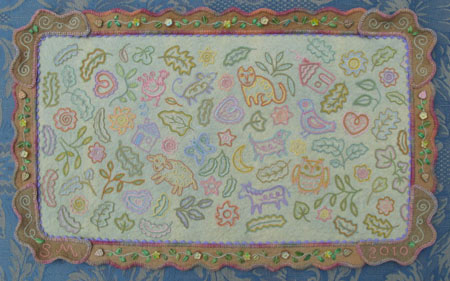
Pocketful of borders (title page)

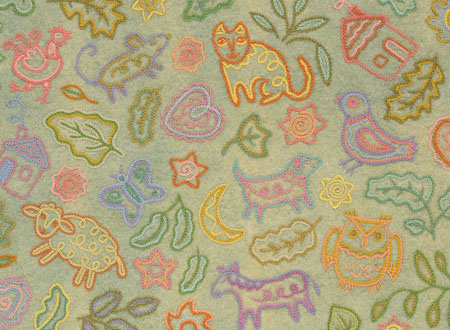
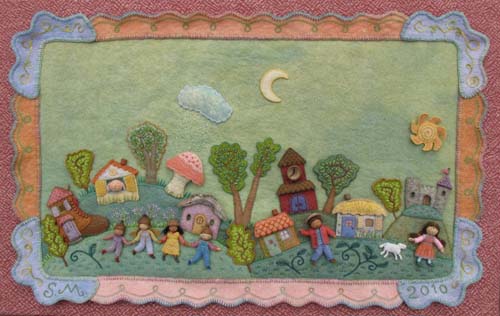
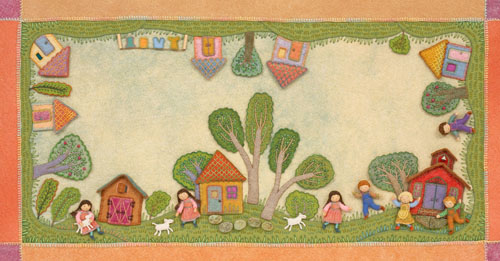
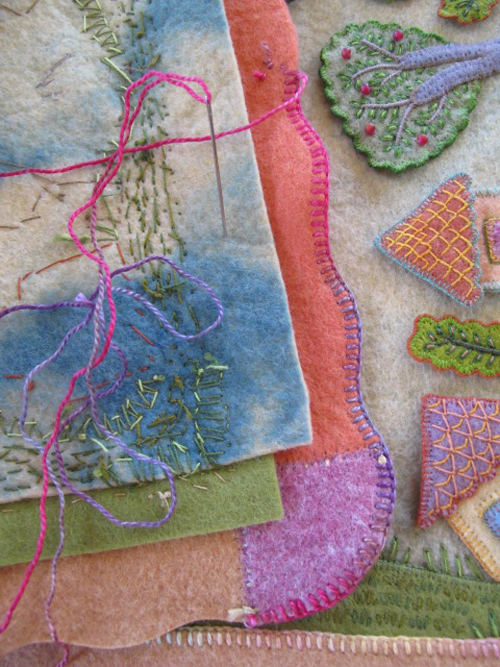
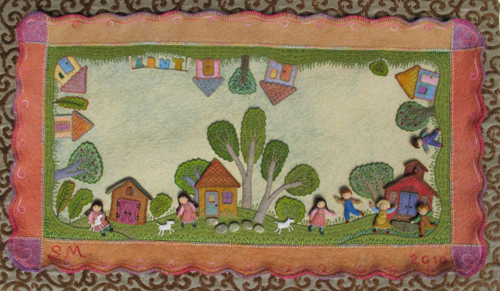
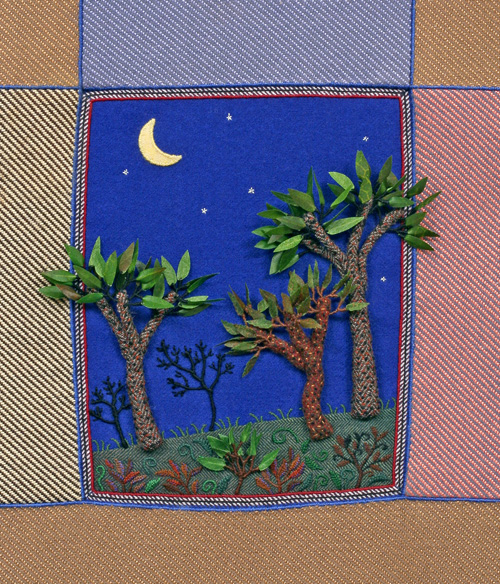
Last week, I made a border for the title page from “Pocketful of Posies”. As I mentioned before, all 50 original illustrations need to be mounted and framed for the traveling exhibit this fall. Because the title page artwork was designed to bleed to the page’s edge and is without any kind of border, it requires a similar but different treatment than “Mary Had a Little Lamb” .

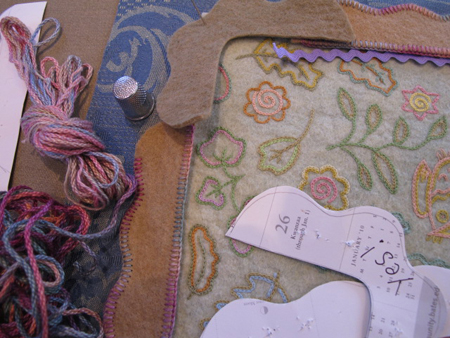
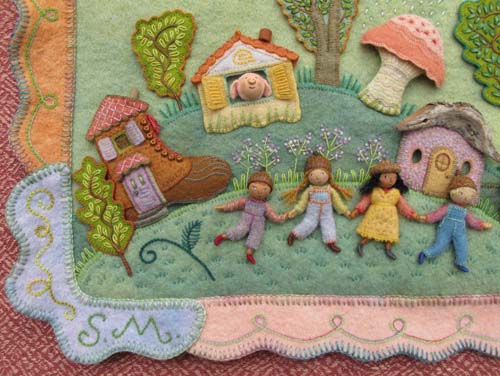
First, I picked  upholstery fabric from my stash to stretch for the background. Then I tried out different felt colors and chose ones that I thought complimented the artwork. This process can be tricky because I have to try many color combinations before I’m happy with the dynamics. For this one, I chose a contrasting pale violet for the corners to give the border a strong visual impact, without overpowering the artwork.

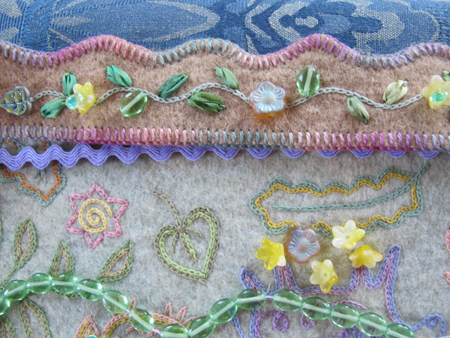
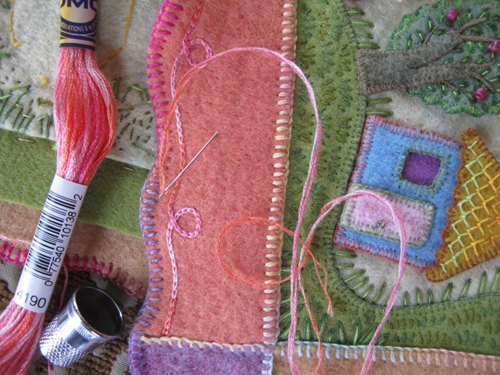
Each border section was blanket stitched with 3-ply pima cotton (Watercolours by Caron).

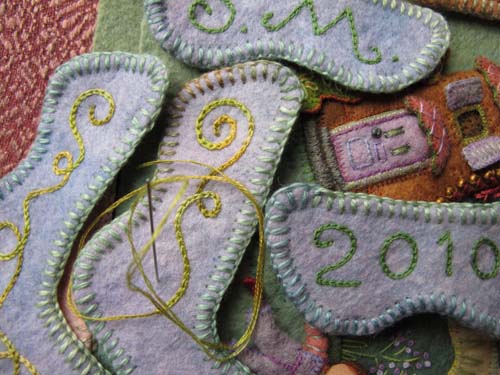
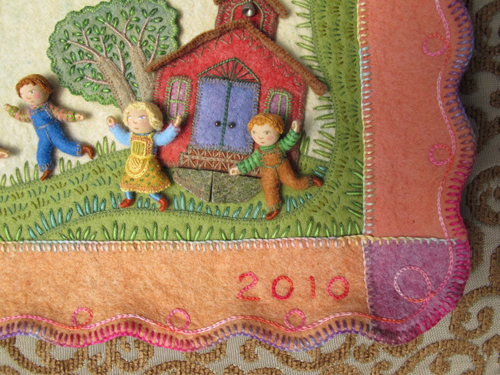
I then chain stitched the year and my initials on the bottom left and right corners. The corners needed something to set them apart, so I doodled a chain stitch with 2-ply variegated yellow/green embroidery floss.

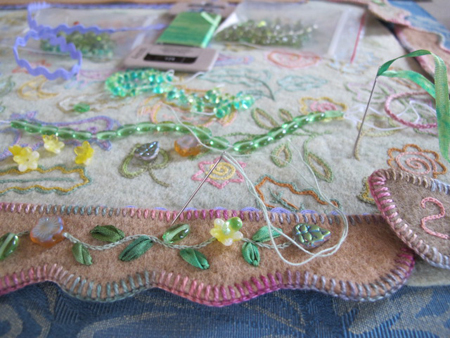
Now, the sides, top and bottom pieces looked plain, so I decorated them with some chain stitched loops of flower thread. There wasn’t enough contrast, so I outlined the loops with stem stitches, using 1 ply variegated pink/purple embroidery floss.

I sewed the corners to the side pieces, measuring to make sure they were even lengths. Then, using a corner ruler, I squared up the border and pinned it on top of the artwork.

I then sewed the border in place and sewed it to the upholstery fabric background.

This title page shows a landscape filled with different characters and buildings from the rhymes in the book. The title and other information will be printed in the open areas in the sky.

Note: See other posts in the Pocketful of Borders series here.

Pocketful of borders (Mary Had a Little Lamb)

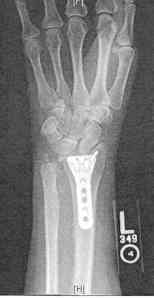
x-ray of my wrist

I’ve recently resumed working in my studio after months recuperating from my fall and broken wrist in January. It was  a bad break that required surgery to put in a plate and several screws.   Two orthopedic surgeons told me the break was too complicated for them to fix and that I needed a hand specialist. Now, I look at the x-ray of my wrist and appreciate the intricacies of the hand surgeon’s fine detailed work. I’m glad that I waited the ten days after the break to have her do the surgery in Boston. Today, after 2 months of hand therapy, I’ve regained most of my wrist’s rotation, but still have limited flexibility and strength. Even though the break was in my subdominant left hand, I need the full use of my wrist to hold materials that I stitch with my right. As I work, I can feel the tendons in my hand and wrist pulling and aching, but I’m determined to sew! My physical therapist told me that she will work with me another month, to see if we can get back as much use as possible.     

"Mary Had a Little Lamb", pages 26/27 from the book, "Pocketful of Posies"

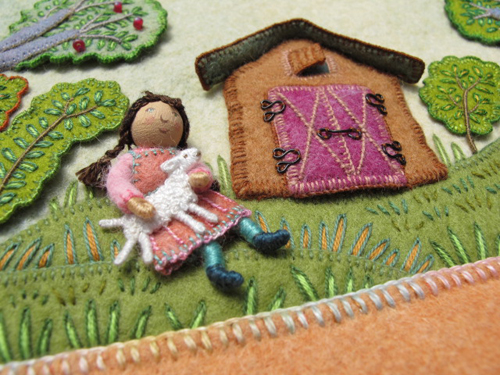
detail from "Mary Had a Little Lamb"

 Before the accident, I was going to spend the winter making borders for all 50 of the original illustrations from my upcoming book Pocketful of Posies: A Treasury of Nursery Rhymes . So, I have a lot of work to catch up on.     


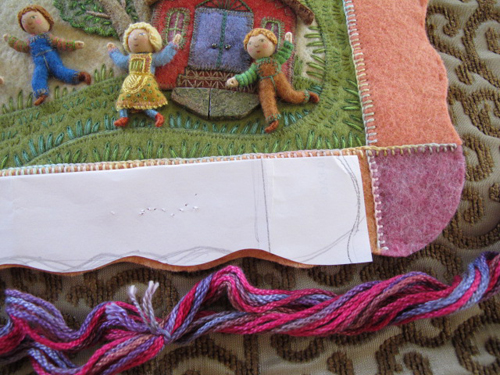
The pictures now need to be given borders and mounted on stretched backgrounds before being framed under glass for the traveling exhibit. The illustrations were photographed a year ago for reproduction in the book and now can be reworked for their 2nd life as framed pieces of original art. I just finished the border on the double-page spread for the rhyme, “Mary Had a Little Lamb”. There was already a felt border, but I needed to finish the outside edge. I made a scalloped pattern and cut around the outside so that the corners were rounded.     


Then, with some variegated cotton thread (Watercolours by Caron), I sewed a blanket stitch around the curved edge.  I added a decorative curly-cued chain stitch made with 2-ply variegated embroidery floss (DMC).     


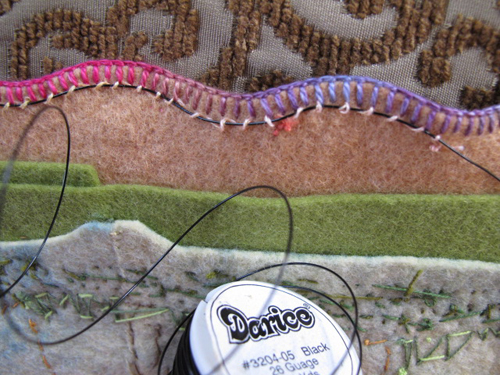
The scalloped border looked too flat, so I sewed 26-gauge wire to the underside, near the outside edge.     


I embroidered the date and my initials to the bottom border. Then, I bent the wire to make a wavy edge, just like you’d do with pie crust around the outside edge of a pie pan. The felt artwork is then sewn to a stretched piece of upholstery fabric.    


Here’s the finished picture. In the book, the words from the rhyme will be printed in the large open spaces and the book’s gutter will be in the center.     

"Mary Had a Little Lamb" ready for framing

Note: See other posts in the Pocketful of Borders series here.

Close-ups (owls)

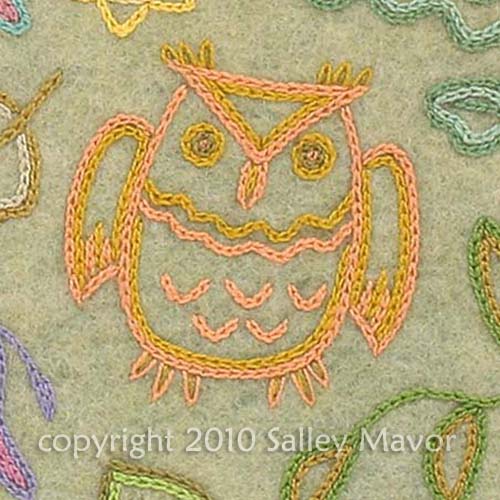
Owls have such distinctive shapes and characteristics that make them visually appealing.  They can be identified by a simple silhouette or depicted in all their glory with every feather rendered in detail. This series begins with an owl (enlarged x 2) from an illustration for the Halloween poem in my book, You and me: Poems of Friendship and then continues with a felt purse from my how-to book, Felt Wee Folk. There’s the tiniest owl from In the Heart and then two from my upcoming (Sept./2010) book, Pocketful of Posies.

detail from "You and Me: Poems of Friendship" 1997

detail from “You and Me: Poems of Friendship” 1997

owlpurse2WM

detail from "In the Heart" 2001

detail from “In the Heart” 2001

detail from endpapers in "Pocketful of Posies" 2010

detail from endpapers “Pocketful of Posies” 2010

detail from "Pocketful of Posies" 2010

detail from “Pocketful of Posies” 2010

Note: See other posts in the Close-ups series archive here.

Dragons

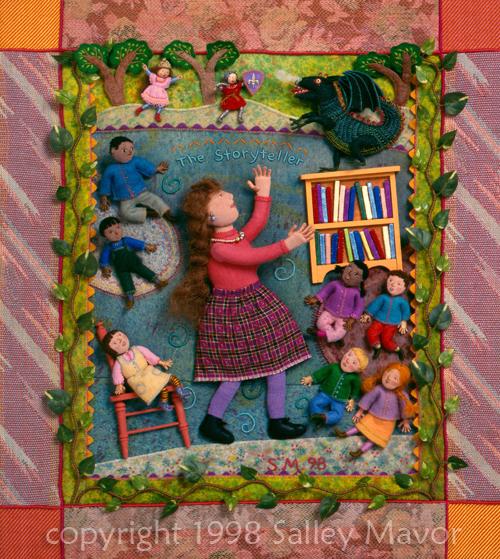
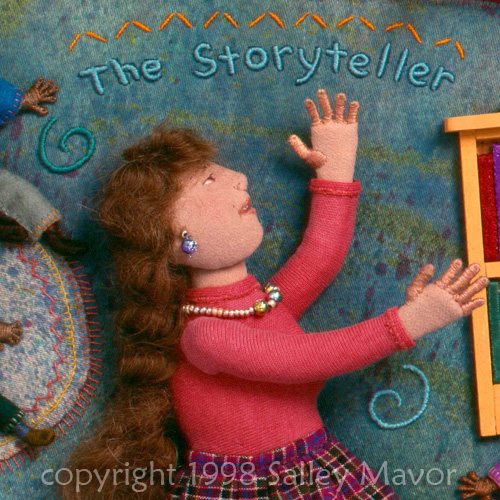
Here are 2 fabric relief pictures that incorporate the story of St. George and the Dragon. These pieces were personal projects and not made for an illustration job or to be published in a book. Both “George’s Chair” and “The Storyteller” illustrate the power of the imagination, one through reading a book and the other with storytelling.

georgeWM   The chair was made with worn upholstery fabric and sticks out about 1″ from the surface. It has a lace doily on top and the chair’s legs are polymer clay.

georgeanddragonWM George’s chain mail hood is made from metallic fabric and his arms, legs and sword are wire wrapped with metallic thread. The princess has an acorn cap crown sprayed with gold paint.

Georgedragon2WM

georgereadingWM

storytellerWM

storytellerwomanWM

storytellerdragonWM

storytellerchairwm

Fairie Festival (wee folk studio)

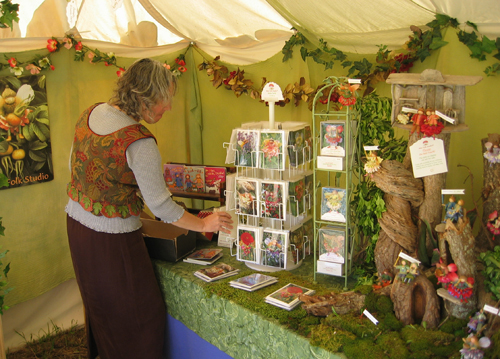
Wee Folk Studio went to the May Day Fairie Festival for a few years when we were still making fairy kits. We set up a tent and displayed many fairy related items. There were Blossom fairy kits, Ltd. edition dolls, note cards and books for sale. We don’t sell at fairs anymore, so we won’t be there this year, but I highly recommend going if you are at all interested in fairies and fantasy. The fair will be held April 30 – May 2nd this year at Spoutwood Farm in Pennsylvania.

Along with the 12 x 15 canvas tent, we transported a trailer full of trees, branches and vines to make an arched entryway. For me, decorating the tent , inside and out was as much an art project as making miniature dolls and illustrations.

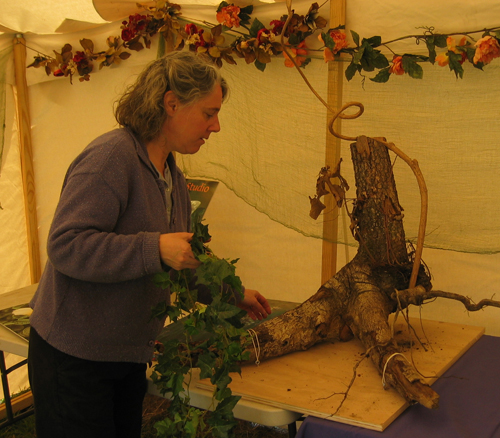
Inside our tent, we set up tables and hung ivy and flower garlands. Here I am, early in the display phase, with the tree stump base.

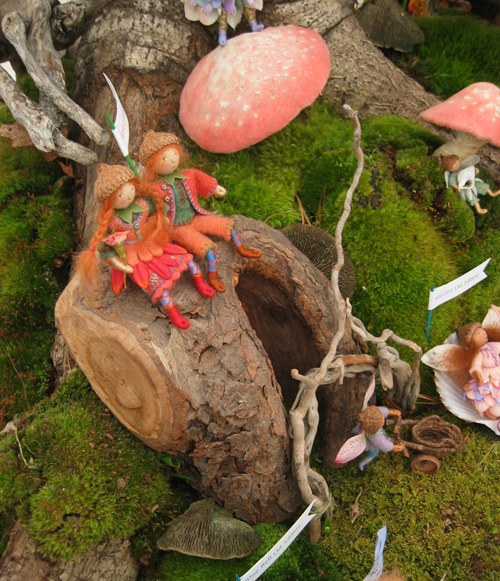
We brought boxes of moss to use around the tree stump display, which I sprayed with water all weekend.

Some customers came in wearing these wonderful bark back packs. They said that they made them at a workshop.

The Way Home Giveaway Winners

Thank you to all of you who read the 5-part story about my first book, The Way Home. Congratulations to the 3 winners of the giveaway! Nancy, Nikki and Carol have been selected at random and will each receive a signed copy of The Way Home. I had a lot of fun piecing together the past and would like to continue writing more stories about my other books, so keep visiting!

The Way Home (part 5)

Continued from The Way Home (part 4)

The book was now in production at MacMillan and it would be a year before we would see bound copies of The Way Home. There was a lot for the publisher’s staff to do; select and set the type, write the book jacket flaps, prepare the pages for the printer and arrange the printing in Hong Kong. Judy and I were so excited to see the first printing proofs. We felt this was also proof that our years-long project was really going to become a book!

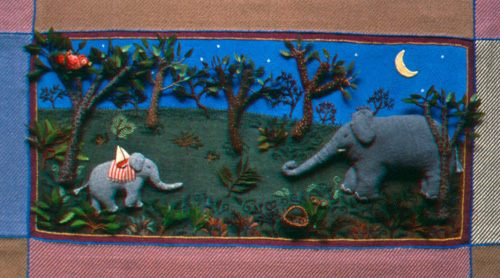
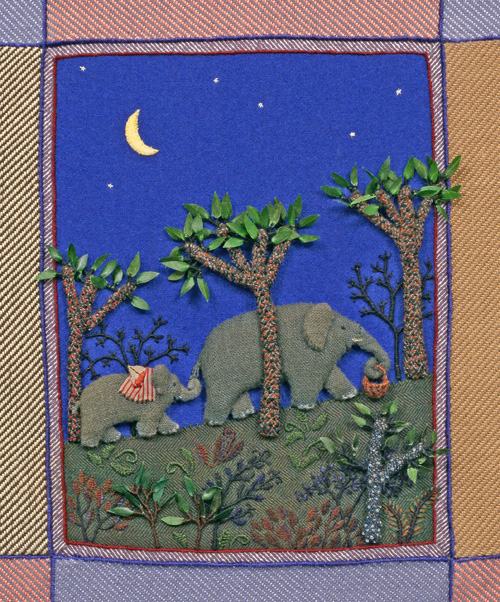
The Way Home, pages 26/27

I learned that producing a book is a lot more complicated than one might think. Everyone involved, the writer, the illustrator, the editors, the production staff and the sales department all play an important part. I was also impressed that everyone I met during the process truly loved children’s books.

The Way Home, page 30

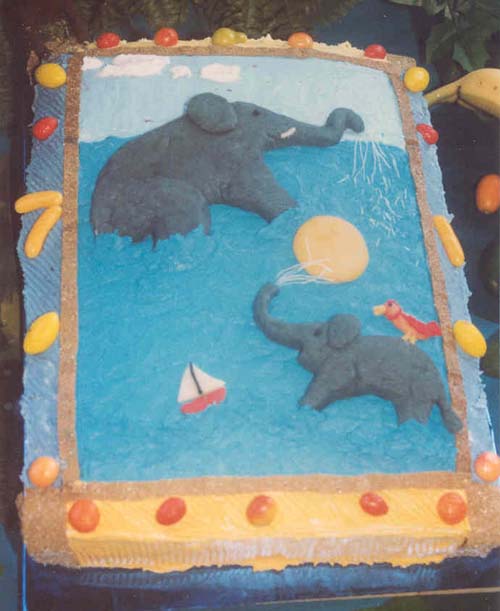
 In the spring of 1991, boxes of  The Way Home arrived and Judy and I celebrated its publication at the Woods Hole Library, with a party and book signing. You can see an earlier post about the library quilt I worked on here. We shared the event with Molly Bang, whose book, The Yellow Ball, was coming out the same spring. Our friend, Terry (who gave me her daughter’s pants) made a cake for the occasion. She decorated it with marzipan elephants and a yellow ball made of frosting.

setting up for the book party

Terry’s cake

Molly, Judy and Salley signing books

We were so proud of  The Way Home and did what we could to promote the book. We had our picture taken with an elephant that came through town for the county fair.

Judy and Salley with elephant at fair, 1991

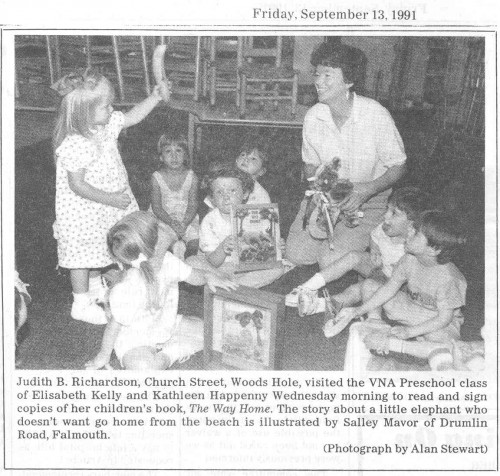
We gave talks, did book signings and visited schools. Judy led banana poem workshops with children and I’d have them sew and stuff yellow felt bananas.

Judy visiting a preschool

Our book did pretty well for an unknown author and illustrator and came out in paperback the next year. Later, Judy and I collaborated on a sequel, Come to My Party, which MacMillan published in 1993. In this book, the red bird character is named Harold and co-stars with Savi in another adventure.

Harold in an illustration from “Come to My Party”

Both books have long been out of print, and I can remember how surprised Judy and I were to get the letter telling us the news. Being new to the book business, we did not know how common it is for children’s books to go out of print. We’ve since learned that only the very best sellers are reprinted and stay available.

Salley at a book signing (note the elephant earrings!)

All in all, the best part about publishing a book was when we heard from parents who said their children wanted The Way Home read over and over. Even today, we meet grown up children who remember Savi and the banana trail. I’m still friends with Judy and Molly and am grateful to have had their help and encouragement throughout the years, but especially in the beginning, 27 years ago, when we all were inspired by a little elephant named Savi.

The End

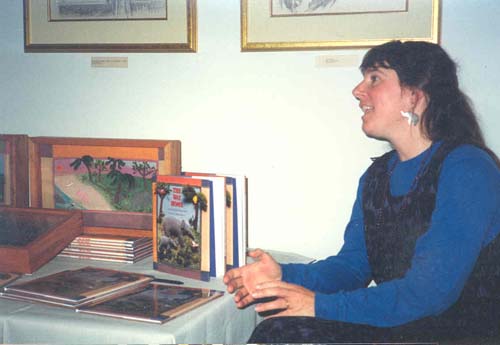
The Way Home, back cover

To keep up with new posts, please subscribe to this blog. Your contact info will not be shared. If you’d like to see more frequent photos tracking the projects in my studio, please follow me on Facebook and/or Instagram.

The Way Home (part 4)

 Continued from The Way Home (part 3)

I added the little bird character late in the design phase. Savi seemed so alone on the beach after her mother leaves, and I thought she needed an escort of sorts. Cecelia Yung, the art director, liked the addition and wrote, “About the bird: maybe he can be her “guardian angel”-someone who hovers protectively so that she’s never truly alone. He would be a comforting presence for the child who worries when Savi is alone in the dark. Maybe he can make his appearance when Savi’s mother leaves?”
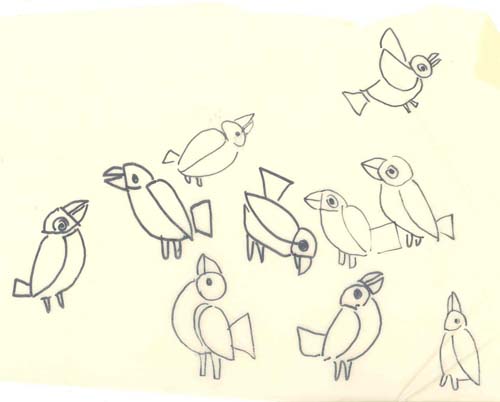
sketches of birds for “The Way Home”
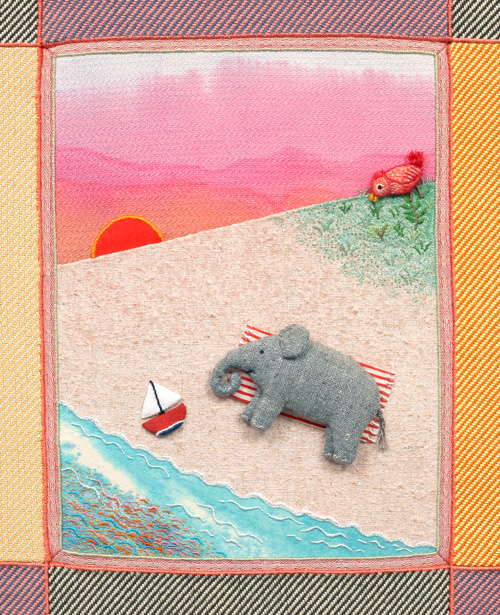
 

The Way Home, page 18

A few months before the artwork was due, I faced the inevitable and admitted that I would not be able to make the one year deadline. I called Cecilia and told her that I needed more time. She was understanding enough to extend the publication date another 6 months.
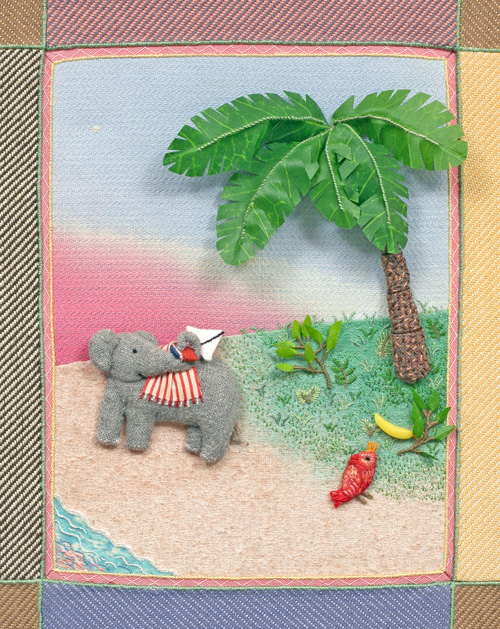
The Way Home, page 20

Through the fall and winter, I added the finishing touches, stitching blades of grass and hand sewing the floss edge around the border sections.

sketch of pages 16/17


The Way Home, pages 16/17

I was particularly fussy about the shadows, which were made up of different colored stitches. I kept thinking of something my teacher, Mahler Ryder had said years earlier at RISD, that shadows are not black, but are made up of colors.

The Way Home, pages 16/17 detail

I was saving the book jacket illustration for last and imagined how it would look while I stitched the other pages. I took a mental inventory of what materials would be needed and was shocked to discover I’d forgotten about the sky fabric. I had used every last inch of Peter’s overalls on the inside artwork. I had none left for the cover illustration, the most important of all! This was a drawback of working with unconventional materials. If I worked in watercolor, this would never happen!

sketch of cover illustration for “The Way Home”

I had dealt with insufficient supplies before. I would have to find something similar, but the weave and shade were unique to an older line of Osh Gosh clothing. before I could work myself into a tizzy, the same fabric literally walked into view.

Molly’s pants back

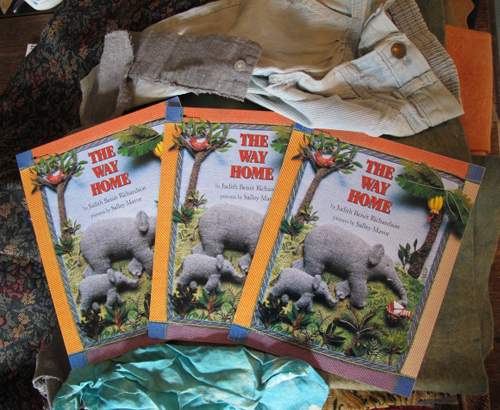
My friend, Terry came over with her 2-year-old daughter, Molly, who was wearing a pair of jeans made out of the same light blue fabric! Terry is a seamstress and fabric lover, so she was not at all surprised when I asked her if I could have Molly’s pants when she outgrew them, which appeared to be imminent. I’ve kept the pants and when I hold them up at talks, they always get a reaction from both young and old audiences.

in my studio finishing the illustrations for “The Way Home”

The extra 6 months made it possible for me to finish by the new deadline in the spring of ’90. I packed up the illustrations and shipped them to New York. After the editors at MacMillan had a chance to look them over, Cecilia drove the artwork over to Gamma One in the city. Gamma One has a “painting with light” system that works well for textured work. During the minutes-long exposure time, light moves slowly back and forth, helping to define the dimensionality of the art. The 8 x 10 color transparencies were then color corrected to match my original art.
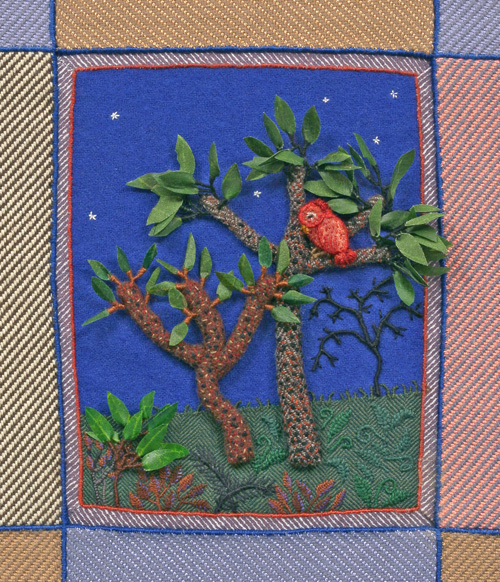
The Way Home, page 32

Cecilia suggested we put an explanation of my technique on the last page.

It reads,

“The original pictures for this book were made in fabric relief. This art form includes many techniques, including applique, embroidery, wrapping, dyeing, and soft sculpture. The background fabric was dyed and then sewed together. Three-dimensional pieces were made from a variety of materials, including covered and stuffed cardboard shapes, wrapped wire, found objects, and fabric. Details were embroidered onto the shapes and background and then the three-dimensional shapes were sewn into place. All stitching was done by hand.”

To be continued in The Way Home (part 5). 

To keep up with new posts, please subscribe to this blog. Your contact info will not be shared. If you’d like to see more frequent photos tracking the projects in my studio, please follow me on Facebook and/or Instagram.
The Way Home (part 3)

Continued from The Way Home (part 2)

About 6 months after our visit to New York, I received a telephone call from Phyllis Larkin at MacMillan. I remember being confused because her tone and inflection didn’t match the words she was saying. She was telling me in a slow, flat voice the most exciting news- that she would like to publish The Way Home!

National Geographic article on elephants

Of course, I could hardly believe it and when she asked how long I needed to sew the illustrations, I guessed “one year” on the spot, because I thought any longer might make her change her mind. Now that we had made it over the hurdle and sold our idea to a publisher, I needed to figure out how to bring all of the different elements of the story together in a series of pictures. Referring to National Geographic, I did sketches of elephants and noticed that African and Asian elephants have different shaped ears. When consulted, Judy thought that hers were Asian elephants.

sketches for “The Way Home”

In my imagination, I saw the drama of the story unfolding against the back drop of a landscape changing from day to night, like puppet show scenery, slowly scrolling from left to right.

editing the manuscript


Ian and his friend Sam in my studio, 1988

Judy edited the manuscript and I worked on the book whenever I could. The advance payment wasn’t enough to pay for daycare, so I figured out other ways to set aside time to work. I would spend a few hours stitching every evening, after the boys were read to and put to bed. During the day I was part of a coop arrangement, where I’d watch 2 other boys one morning a week and mine were taken care of 2 mornings. This picture shows Ian and his friend Sam in my studio wearing monster masks.

early sketch of Savi following banana trail

early drawing of Savi following banana trail

Somehow, I pieced together enough time to make progress and the pages started to take shape. In the beginning, I figured out what fabrics to use for the background, elephants and borders. I found a shirt of my husband’s to use for the elephant’s bodies. The gray Indian cotton was the perfect shade and texture.

Indian cotton shirt and dyed silk

I cut a piece of silk from my grandmother’s old nightgown to use for the water and then dyed it turquoise with a spray bottle. The silk was crumpled up when I sprayed the dye, so some areas were left white, making a foamy, wavy pattern.

The Way Home, page 4

I ripped out the seams of an old, faded pair of my son Peter’s overalls. There was exactly enough fabric to use for each section of sky. I dyed the light blue pieces sunset pink and then graduated shades of dark blue. For the night sky on the last pages, I used a midnight blue colored wool.

The Way Home, pages 26/27

The beach was made of a bumpy piece of raw silk, which I dyed green in the grassy areas. I redid the same scene that I’d made as a sample, matching the fabric with the other illustrations.

The Way Home, page 6

There were logistics to figure out, like how can an elephant carry a towel and toy boat, while leaving her trunk free to pick up bananas? I ended up tucking Savi’s boat into her folded towel, which she carried on her back. I also gave the mother a basket to carry bananas. Cecilia Yung, the art director and I corresponded about the book layout.

sketch for The Way Home pages 26/27

She sent detailed letters, going over every page. She pointed out things that I didn’t think about like allowing enough space for the dedication and copyright information. Her comments focused on making the elephants’ world consistent throughout the book. She reminded me to pay attention to the position of props like the boat and towel and keep the sun’s direction constant. She wrote, “Make sure shadows lengthen steadily in the same direction and of course colors should shift to reflect the sunset and night sky.

The Way Home, pages 22/23


The Way Home, page 14 sketch

There were so many details to consider for such a simple story! I thought about all the smart, observant children out there, who would see my mistakes and write the publisher with their corrections. Then I remembered that the book was aimed at preschoolers who can’t write yet. I then asked myself, “Don’t the littlest ones deserve the best quality books?” At the end of a letter, Cecilia wrote, ” We realize this is a tremendous amount of work for your first book, so do call if you have questions. We’ve very excited about The Way Home and will be glad to help.”

To be continued in The Way Home (part 4). 

sketch, The Way Home, page 28

To keep up with new posts, please subscribe to this blog. Your contact info will not be shared. If you’d like to see more frequent photos tracking the projects in my studio, please follow me on Facebook and/or Instagram.
The Way Home (part 2)

Continued from The Way Home (part 1)

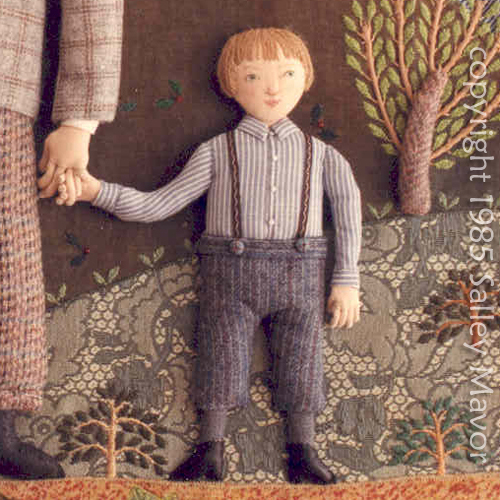
After we moved, Judy and I kept in touch and would see each other when I visited Woods Hole every summer. Back in central Massachusetts, with my son in daycare part-time, I continued to sew pictures, developing my fabric relief technique. I tried out different ways of making people, animals and houses with flat cardboard backs that could be sewn onto a pieced and embellished fabric background. The raised figures and props seemed to work best at a shallow depth of 1/4″ to 3/4″. “Picking Peas” (1986) and “Raking Leaves” (1987) are examples of the change in my way of working.

“Picking Peas” fabric relief 1986

This was a very productive time for me. Even though I was busy taking care of a child, our life was simpler and less social because we hardly knew anyone in our new town.

“Raking Leaves” fabric relief 1987


Peter with our scarecrow in Lunenburg 1986

The area was beautiful, and my artwork was influenced by the agricultural landscape of our neighborhood. I started working in my studio in the evenings, a habit I’ve kept ever since.

In an effort to test the illustration market for my type of work, I made a solo trip to New York City, meeting with an agent and a few children’s book editors. The agent wasn’t interested in my type of art, but I recall that one editor was intrigued. She laughed good heartily when I laid out the fabric background for “Noah’s Ark” on her desk and arranged the loose animals in front of her. I realize now that this presentation must have appeared quite unprofessional compared to the ubiquitous black portfolio with plastic sleeves that most illustrators carry. After looking at my various pieces, she told me she liked my work but found it hard to match with a story. She suggested I find a story that I thought would work together with my style and technique.

I went home feeling that I wasn’t practiced enough to take the leap from depicting one moment in a story to filling a 32-page book with enough action and visual variety to make a story come alive. I needed more time to develop my work to a point where I could confidently take on a large illustration project.

Ian’s birth announcement


‘Noah’s Ark” fabric relief 1986

After our second son Ian was born, I kept working on fabric relief pictures. I remember finishing up the “Noah’s Ark” piece on my worktable, with him rocking next to me in a wind-up swing. You can see an earlier post with several pictures of “Noah’s Ark” here. I continued to make and sell fabric relief pictures, trying new ways of constructing 3-dimentional parts that could be sewn in place.

‘Family Portrait” fabric relief 1986


sketch for sample illustration

After four years away, we decided to move back to Woods Hole in the fall of 1987. Judy and I soon revived our interest in The Way Home and decided to start over and change our approach to the project. I felt more prepared to illustrate the story and with Judy’s encouragement, started to think how I would make a new sample to show. We wanted to impress the editors with our serious preparation, not wanting them to see us as two inexperienced housewives from Cape Cod. I made another illustration, this time picking a more active part of the story, where the mother elephant is enjoying herself on the beach, while Savi splashes in the water. I found some plastic banana beads that were the right size and cut banana tree leaves from cloth artificial leaves. Planning ahead for the border, I bought some diagonal striped upholstery fabric, in every color available.

 The text reads,

“Her mother cooled off in the shade of a banana tree and ate bananas. She rolled her big body from side to side in the sand. Savi stayed in the water.”

2nd sample illustration 1988

We knew that my new and untested method of working in 3-dimensions would be questioned as a viable illustration technique. We gathered everything that we could think of to counteract any skepticism. Since my originals would have to be photographed, we had a professional 4×5 transparency taken of my sample art. We also made a storyboard showing a simple layout in the standard 32-page format. It pictured the progression of the story with the different characters at the beach, in the water, walking through the trees’ shadows, following the banana trail and looking up at the moon at the end.

When we felt ready to present our project, we called and set up appointments with a handful of children’s book publishing houses in New York City. Judy was excited to be able to meet editors in person, because our visit would include showing my portfolio. Generally, writers are asked to submit their stories by mail only. My portfolio (brown leather, not black) held the original sample illustration for The Way Home, a color print and 4×5 transparency of the sample, the storyboard, plus a collection of 8×10 color prints of my fabric relief work from the past 4 years.

Judy and I drove to western Connecticut, where we stayed overnight with friends. The next morning we took the train to New York. We spent the entire day visiting children’s book editors, the most memorable being with Phyllis Larkin, an older, respected editor at MacMillan. When we were introduced and I saw her face, I knew that we had met before. I forget names, but faces make their imprint. I remembered that she was the one to whom I had shown the Noah’s Ark parts a few years earlier. Phyllis behaved as a true editor, asking to read the manuscript first before looking at my portfolio. She carefully read the story and then called in her art editor, Cecilia Yung. We laid out our visual materials and held the 4×5 transparency up to the light. They liked the pairing of Judy’s story with my artwork but had financial concerns about the extra expense of photography. They were also upfront about their inability to offer me an advance large enough to pay for the time it would take to sew the illustrations. We left them a photograph of the sample art and a copy of the manuscript and went home. We were encouraged because they liked our idea, but didn’t know if they would take the leap to offer us a contract. Months went by and we didn’t hear from any of the editors we’d met with. Judy and I put the project in the back of our minds and were fully distracted by summer activities.

To be continued in The Way Home (part 3).

Summer in Woods Hole, 1988

To keep up with new posts, please subscribe to this blog. Your contact info will not be shared. If you’d like to see more frequent photos tracking the projects in my studio, please follow me on Facebook and/or Instagram.