I’ve finally joined the rest of the world by opening an Etsy shop! It’s taken a while for me to figure out what kind of items to sell, since I’ve given up mass-producing dolls and kits, etc. I could have really used a service like this 30 years ago, or even 10 years ago. At the moment, I’m happy to offer three brand new posters of some of my more popular fabric relief pieces; Self Portrait: A Personal History ofFashion,Rabbitat and On Halloween.
The 18″ x 24″ posters are high quality reproductions, printed on sturdy 100 lb. paper. My sister, Anne Mavor did a beautiful job with the graphic design–so tastefully done. I’m very excited to be offering these, so please visit my shop!
It’s time to bring back the Close-ups. I started the series 2 years ago, when I fell off a ladder and broke my wrist. Using one hand, I wrote about and showed pictures of past projects, organized by theme. It helped me get through the 4 month recovery period, when I couldn’t sew. See the whole Close-ups series here.
Right now, I’m in hibernation, making parts that will be used in an animation my husband Rob and I are doing. This “little” project is growing into more than a winter activity, though, and it will be a long while before we’re finished. I want to wait until we have a finished film (probably a few minutes long) before we show anything, including process photos. I’ve got other art related commitments to take care of this year, so I’ll soon have to put the animation project aside until I have more time to get totally immersed.
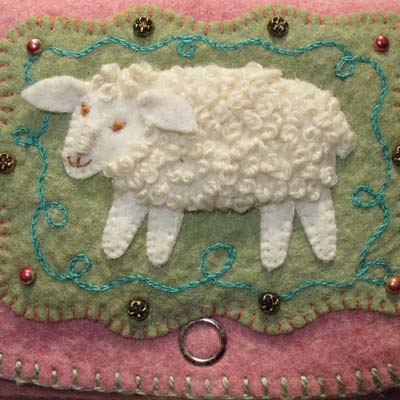
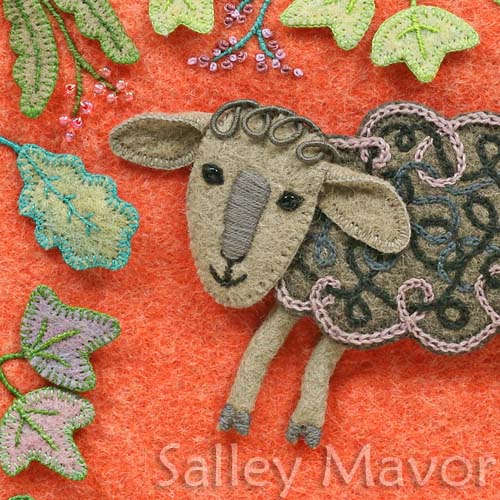
Back to sheep–which are giving birth at this time of year. Maybe it’s their expressions, or their ears, or their white fluffy body balls with stick legs, but sheep are very satisfying to portray. This first image at the top of the post is a detail from my picture book Mary Had a Little Lamb. See more pictures from the book here. The one below is part of an embroidered piece I made in art school in 1974.
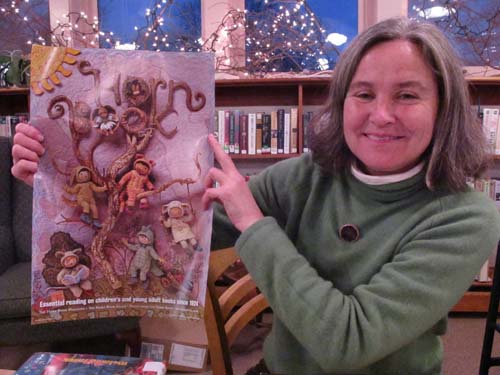
I am overwhelmed by the response to the Horn Book poster giveaway! Thank you to everyone (107) who entered. I am very touched by so many lengthy, thoughtful and generous comments on the giveaway post, well beyond the usual minimal missives.
Drum roll, please. The winner is Marianne Monaghan! I’ll notify her by e-mail and find out where to send the poster. Anyone who’d like to buy posters ($7 within the US, $10 outside the US) from the Horn Book can call (Eastern Standard Time) or email any of the following:
I gave a poster to Woods Hole Library Director Margaret McCormick, to hang up in our library.
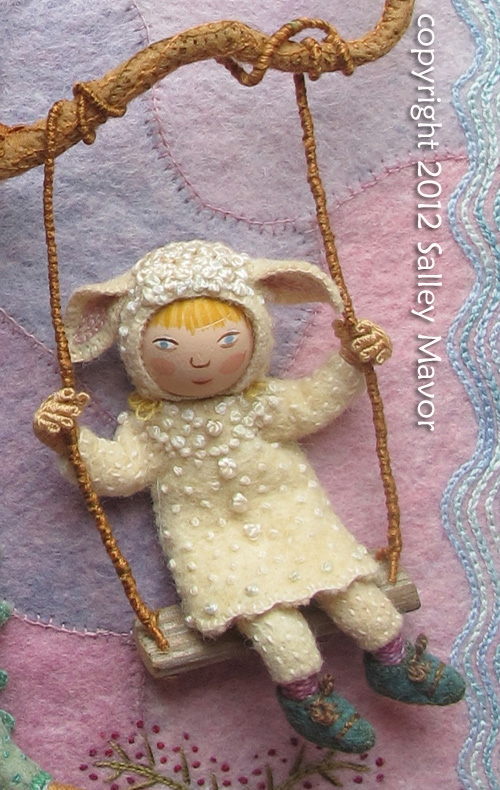
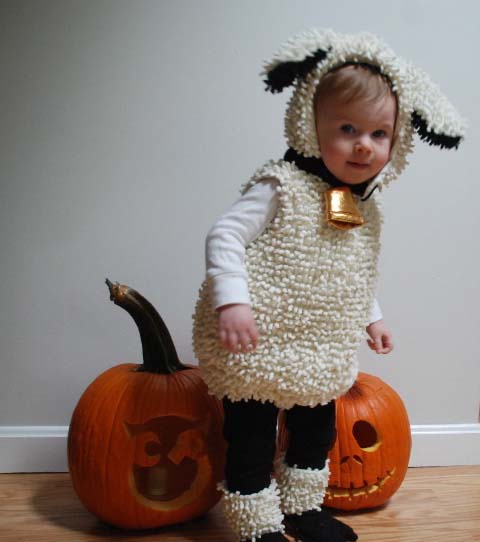
I just had to show you this picture of one-year-old Helen dressed as a lamb, which was in the most recent Woods Hole Library newsletter. Her mother, Kellie Porter was working at the desk in the library when I brought in the poster. Kellie and I were both surprised to see the similarity between her daughter/lamb and my little girl/lamb swinging from the tree in the poster. I made the artwork for the magazine this past summer and Kellie hadn’t seen the Horn Book cover until I showed her the poster, so the resemblance was unexpected. By the way, Helen’s costume is not homemade, but I think it could easily be copied. I wish I had thought to add a collar and bell!
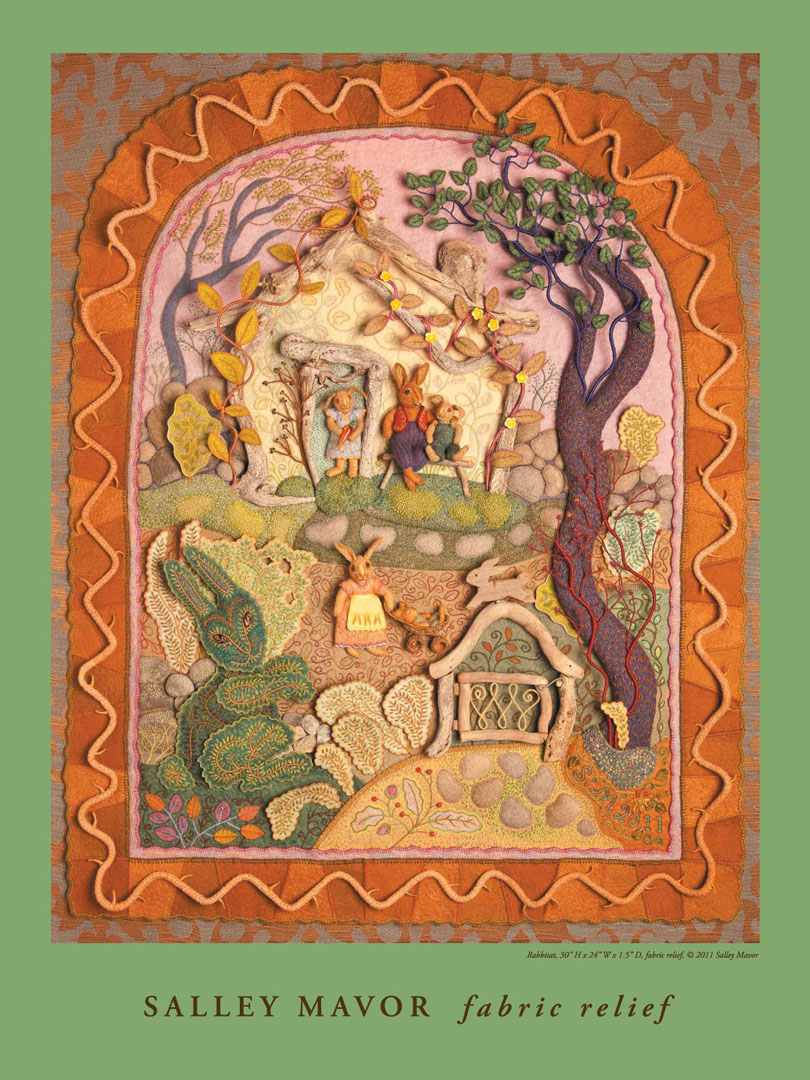
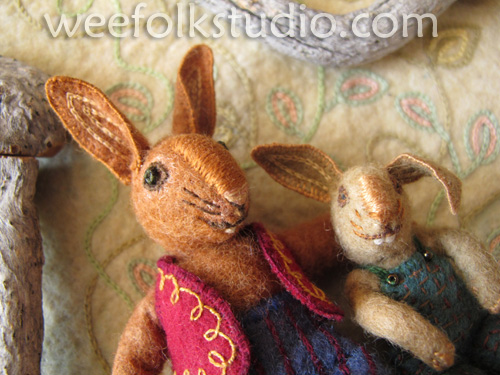
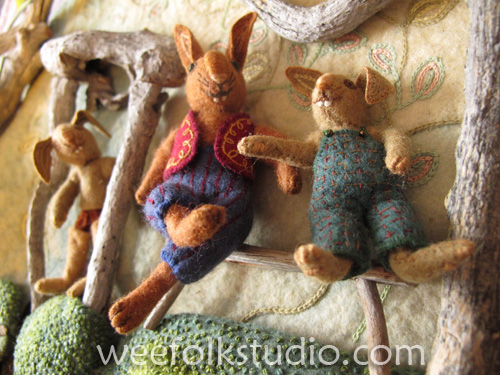
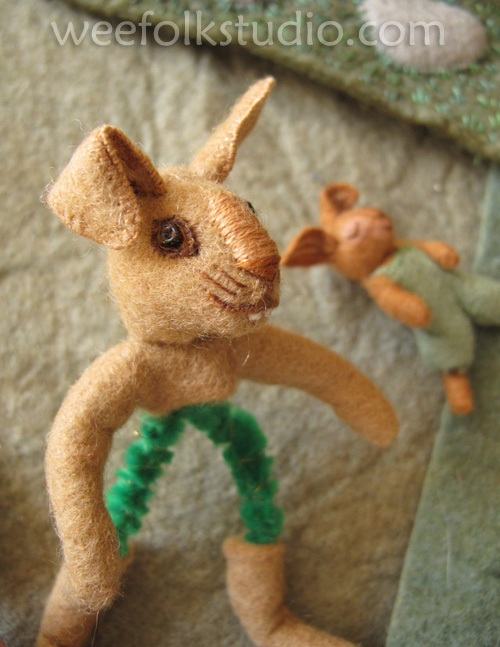
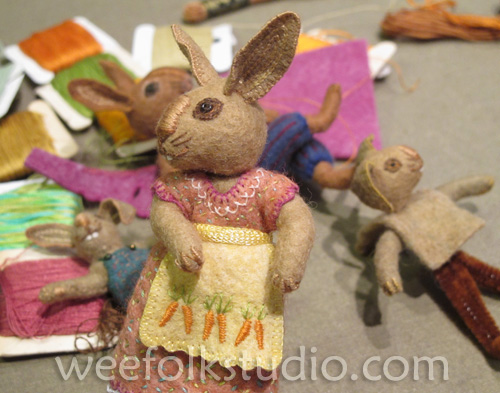
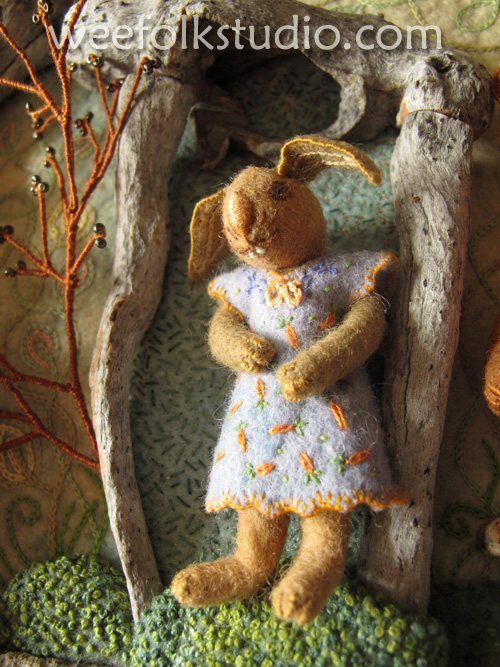
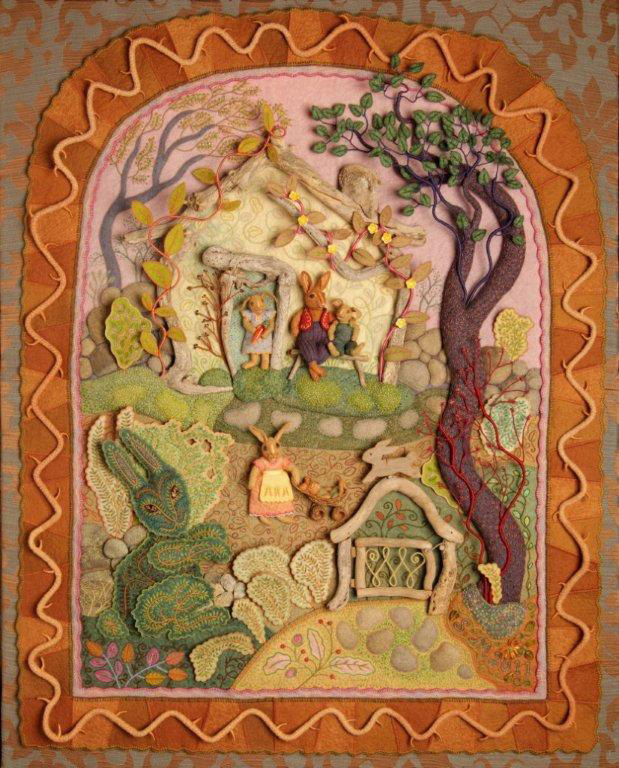
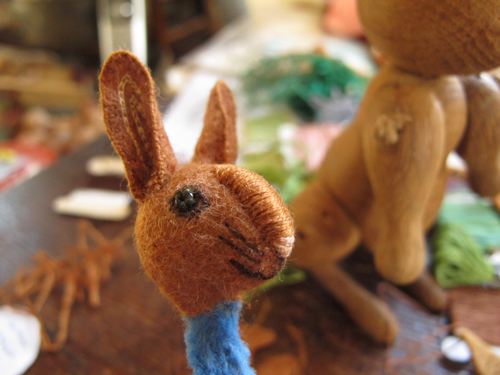
Originally, I was going to make human characters living in the drift wood house, but I kept imagining long ears sticking up from their heads, so they changed into a rabbit family. Hence the name Rabbitat (see film here). The mother and father dolls are about 4 inches tall and made with a bendable pipe-cleaner armature. The heads are made from wooden beads covered with wool felt. There’s a seam down the front of the face, under the embroidered nose.
As soon as I added front teeth, they lost their bland cuteness and took on personality, or should I say rabbitality?
Maybe I just identified with them more, having been a buck toothed child.
The faces are embroidered, with glass bead eyes.
The ears have fine wire sewn around the outside edge, so they can be bent expressively.
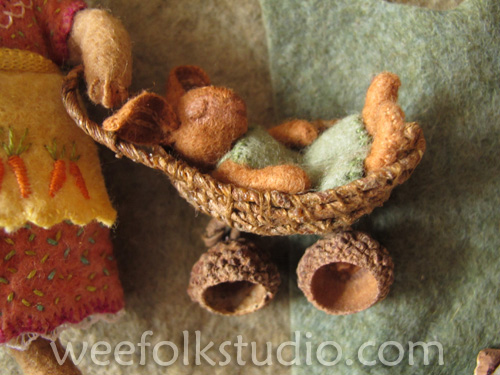
The baby carriage is made from this wire, which is covered with a bark-like natural material I found at a florist supply business. The wheels are acorn caps with holes drilled in the center.
I embroidered a carrot motif on the clothing.
And let’s not forget the biggest character of all — the rabbit topiary.
To see more posts in this series and to view the Rabbitat film click here.
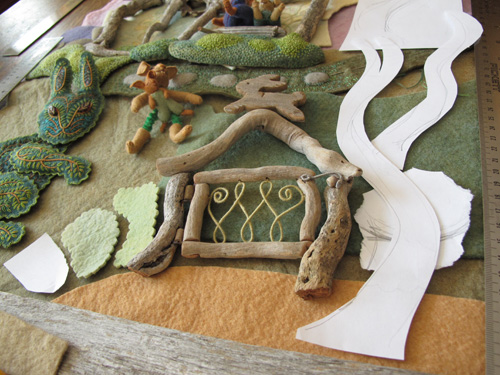
I added the garden gate about half way through the process of making Rabbitat. Since I changed the design from horizontal to vertical, I needed something in the lower right to balance the rabbit topiary on the left. I also wanted to create a transition from the foreground to the background and make an an entrance into the rabbit world.
I selected some driftwood and carved joints into the pieces. I then drilled holes in the joints and glued the pieces together with wire in the holes for reinforcement.
On a jig saw, I cut out a wooden rabbit shape to put on top of the gate.
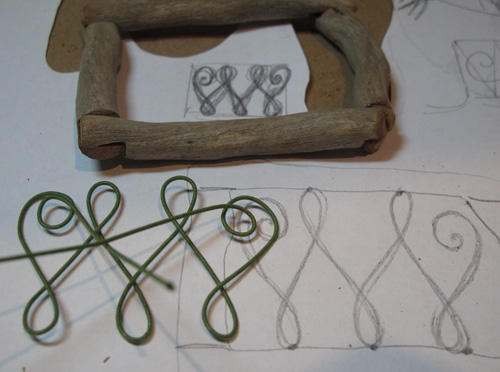
I wanted bars in the gate, so I bent some 32 gauge cloth-covered wire and wrapped it with embroidery floss.
Then I had to figure out what to use for hinges and a latch. I got out my collection of little metal do-dads, but wasn’t satisfied with how they looked. Shiny metal didn’t seem to fit in the rabbit’s world. I ended up using clay tube beads for the hinges and wrapped wire for the latch.
I worked around the gate for many weeks, sewing the tree and constructing parts of the scene’s landscape.
I created a felt stone pathway leading to the gate, with french knot moss. Thinking ahead, I stitched my initials into the design on the right hand corner.
To see more posts in this series and to view the Rabbitat film click here.
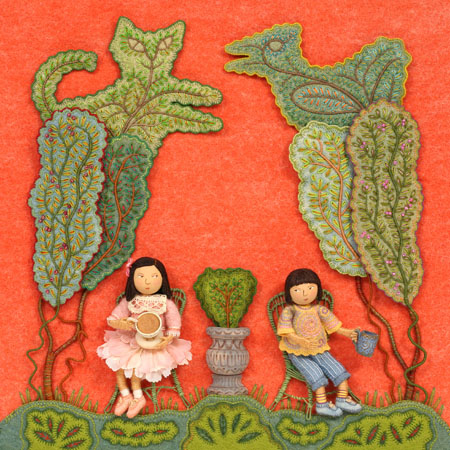
Back in December, when I started making this new piece, I had no definite plan, but knew that the scene would include topiary of some kind. I had so much fun using animal shaped topiary in the Molly my sister and I rhyme illustration in Pocketful of Posies that I wanted to make more.
Molly My Sister and I, from "Pocketful of Posies" 2010
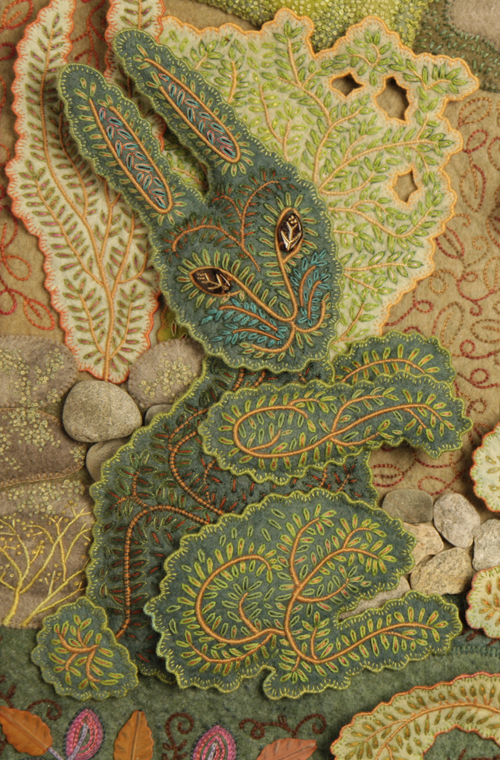
I thought about animals with distinctive forms that could be identified easily and envisioned a rounded, contained rabbit with ears poking upward. I cut separate parts out of dark green felt and started embroidering branches and leaves. The eyes, nose, mouth and whiskers are wire wrapped with embroidery floss. I also sewed wire along the scalloped outside edge, so that the pieces could be bent and shaped. Two glass leaf beads make the eyes.
The body, head and limbs are all constructed separately and stuffed on the back to raise them up.
While I was working on the topiary, I decided that rabbits rather than people would live in the driftwood house and started constructing a rabbit family.
I also decided to turn the scene into a vertical picture and enlarged the dimensions enough to create a yard in front. Since this is not an illustration with size and type placement specifications, I was free to change things around as I went along.
This is how the rabbit topiary looks in the finished piece.
To be continued.
Here are some opportunities to see the original picture:
Rabbitat will also appear at this reception before traveling to Vermont:
Woods Hole Public Library, Woods Hole, Massachusetts, Sunday, July 10th 5:00 – 7:00 pm. Reception to celebrate the Golden Kite Award for Pocketful of Posies. Original illustrations from the book will be displayed and Salley will give a brief talk. A short film about the making of her newest piece, Rabbitat, will be shown. See the film here.
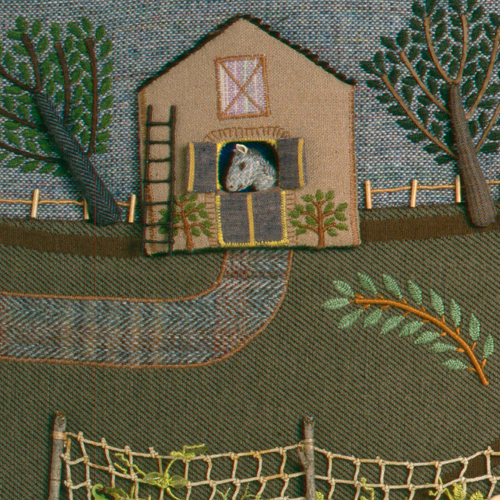
Houses are my favorites, but I also love to add barns my scenes. This first one is a detail from Picking Peas, which I made in 1986. I used the sewing machine to applique the door and window, but hand embroidered leaves along the ribbon tree branches. See the full fabric relief picture on this post.
detail from "Picking Peas" 1986
These barns are on the title page of the first edition of Mary Had a Little Lamb from 1995. At this point, I sewed everything by hand and no longer used a sewing machine. The “snow” is an old linen table-cloth.
detail from "Mary Had a Little Lamb" 1995
Jump ahead 9 years to this illustration from the 2006 board book, Jack and Jill. I’m using wool felt, so the look is softer and more fuzzy.
detail from “Jack and Jill” 2006
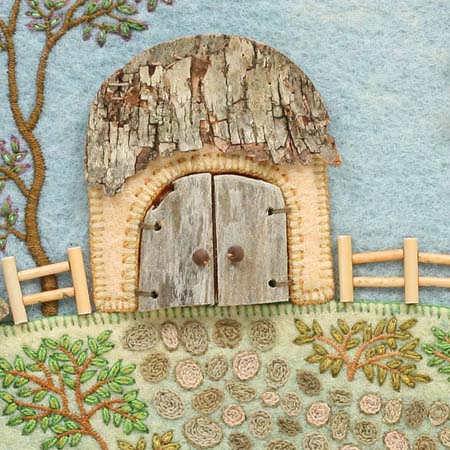
The last two barns are from Pocketful of Posies. The roof is a piece of bark and the door is driftwood.
detail from "Pocketful of Posies" 2010
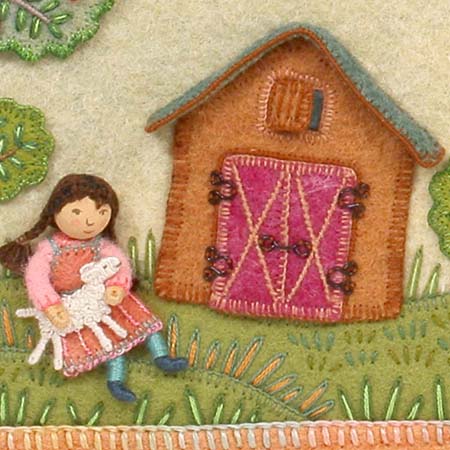
This barn from the Mary Had a Little Lamb rhyme makes use of hook and eye parts. The lamb is about 1/2″ long.
After working all winter long, I’ve finally finished Rabbitat! It’s large, compared to my book illustrations, measuring 24″ x 30″ , with a depth of 1 1/2″. I’m waiting for professional photographs of the finished piece, so for now I’ll just show pictures I’ve taken during the process. It’s got lots of parts, which I’ll be showing in several posts. This piece was unlike my book illustrations, which have to meet size and subject specifications and are planned out ahead. I let this project evolve by itself and just followed where it led.
To start, here are some drawings from my sketch book. My first ideas include a vine-covered house, which could be a topiary. A bunny showed up, too.
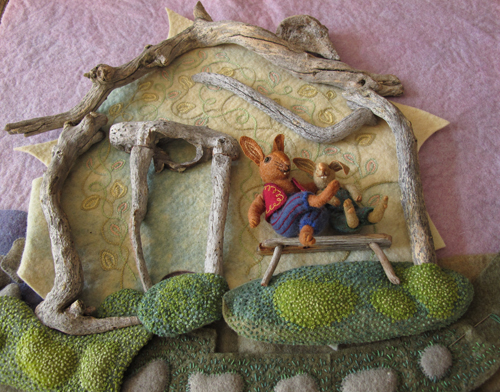
Then, the house became a structure made of driftwood pieces, with a rabbit topiary outside. I didn’t know who’d be living inside yet.
I combed through all of my driftwood and selected pieces which I could see as a roof and side beams and a doorway.
And carved them in spots, so that they fit together and lay down as flat as possible. I don’t know how the little chair appeared in this picture. Some of you may recognize it from another scene–the Driftwood Clan in my book, Felt Wee Folk.
I drilled holes at the joints and glued wire pins into the holes. That way the parts are held together, but the wire joints keeps the structure flexible. I don’t know if this description is clear, but I essentially use wire in place of dowel pins because I don’t want the joints to break while I’m manipulating and working on the house. I’m always adjusting things until the last-minute, so the joints need to be somewhat bendable.
I decorated the house walls with an embroidered chain-stitched vine pattern on felt. The green mossy patches have lots and lots of french knots.
At this point, I’d decided that rabbits live in the house, so I made a father and son to sit on the bench outside.
I told my husband Rob that I was making a habitat for rabbits and he immediately said, “Oh, it’s a Rabbitat!”
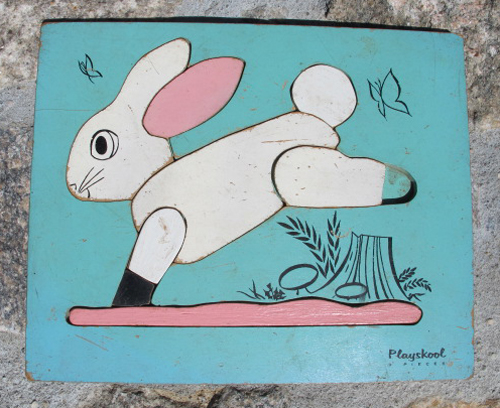
This rabbit Playskool puzzle has been in our family since the 50’s. It’s lost several pieces over the years, but replacements are easily made with a jig saw. My mother kept this crayon drawing I did at about age 8, of Easter bunnies hauling eggs in wagons. Happy Easter!
I love baskets and have included all kinds in my artwork since the beginning, like this Easter basket crayon drawing from my childhood.
crayon drawing, age 7
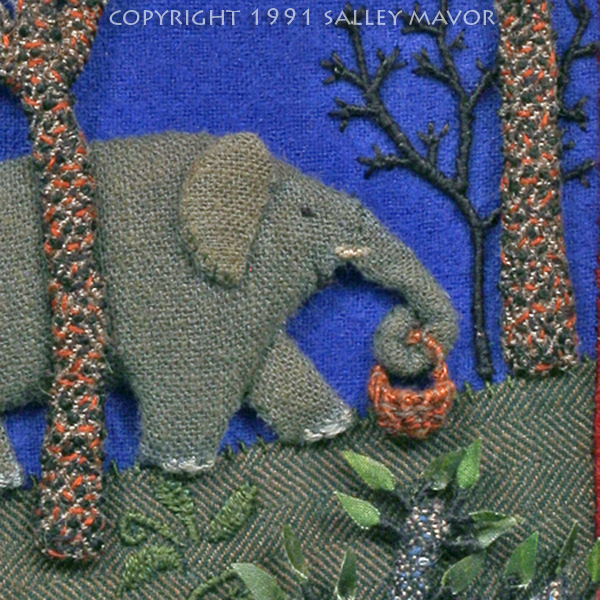
The elephant mother in my first picture book, The Way Home (1991), needed a way to carry bananas, so I made tiny (1/2″) wire baskets, wound in embroidery floss. Read my story about the making of The Way Home here.
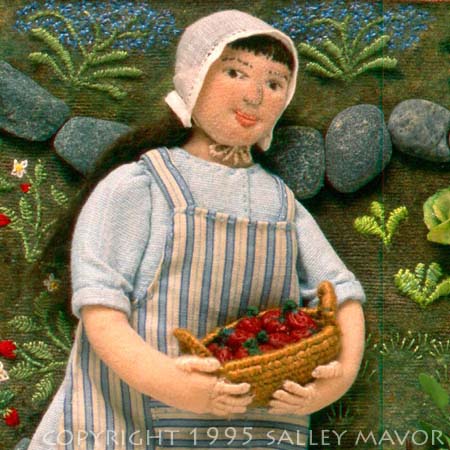
Here is Mary, from Mary Had a Little Lamb, holding a basket of clay strawberries. This basket is also made with thread wrapped wire, but a little bigger at 1 1/4″. Real stones are glued in the garden.
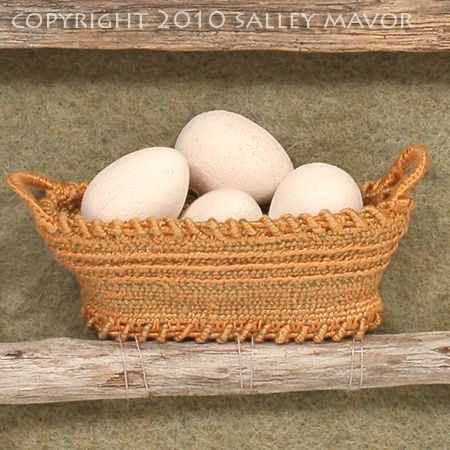
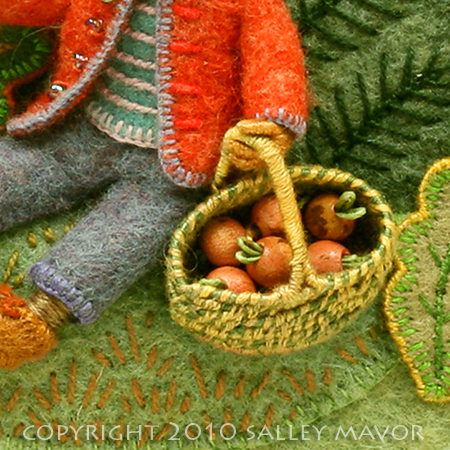
This egg basket appears in Pocketful of Posies, in the illustration for the rhyme, Higgety, pickety, my black hen. It’s made by coiling and wrapping wire with embroidery floss. You can see glimpses of the green florist wire through the thread. I can’t for the life of me remember how I did the pattern on the top and bottom. The original is about 2 inches long and filled with 1/2 inch wooden eggs.
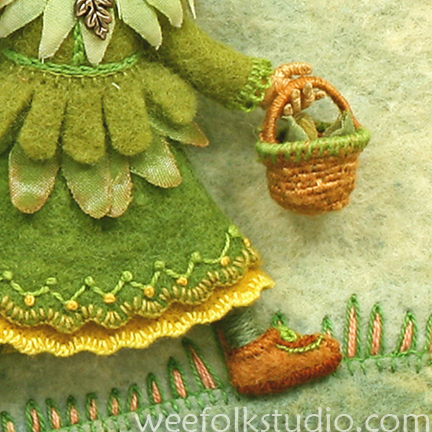
Also from Pocketful of Posies, Daffy Down Dilly’s 3/4″ basket is made the same way.
This detail from Jerry Hall is enlarged quite a bit, with the original basket being less than 1″.
























 SALLEY MAVOR