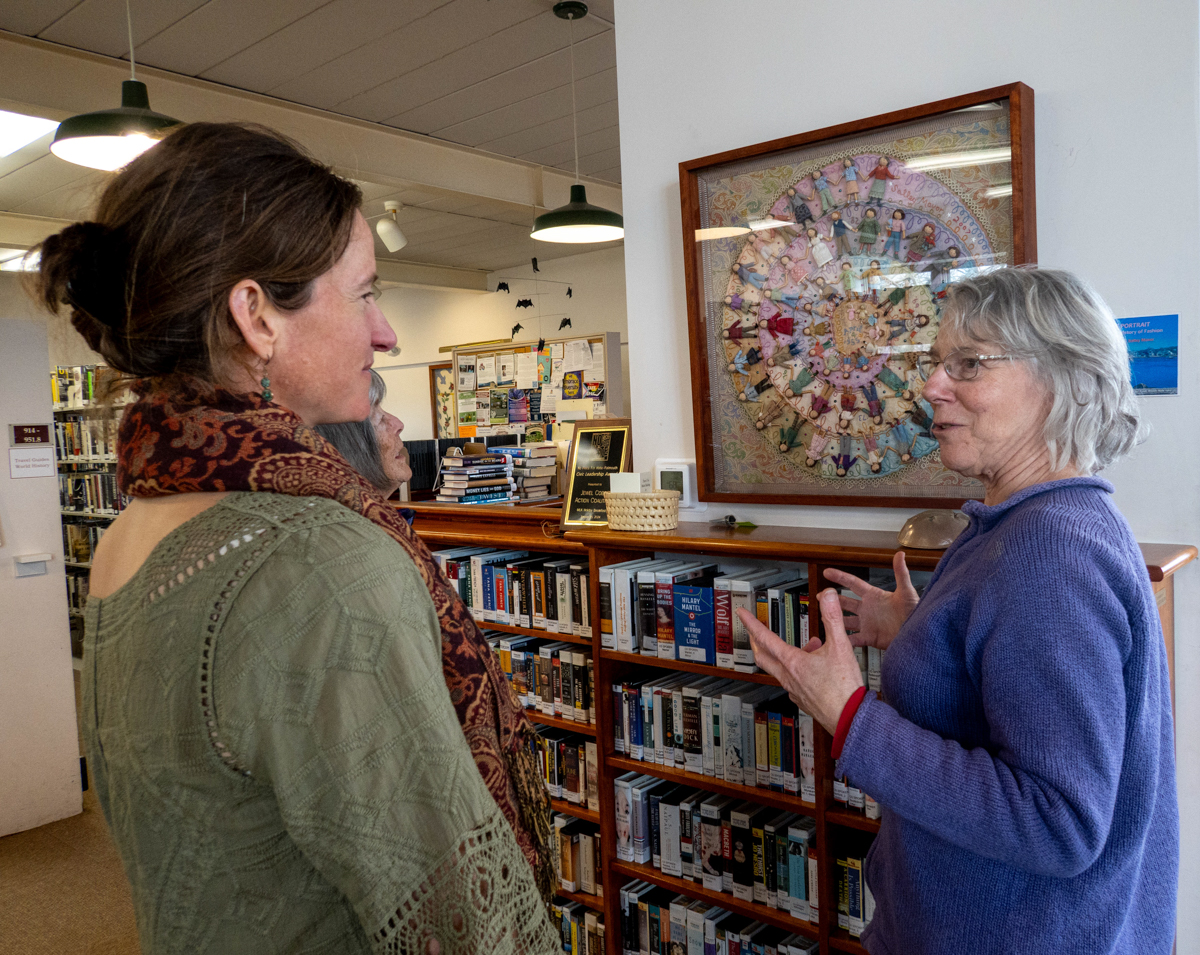
Self Portrait returns to Woods Hole Library

My Self Portrait: A Personal History of Fashion is back on public display at the Woods Hole Library. The library has been its semi-permanent home (except when it is exhibited elsewhere) since I made the piece in 2007. So, why loan it to the Woods Hole Library? Because this particular stone building has been a constant source of comfort and stability during my whole life. It’s a central part our community that reflects the unique charm and character of our village.15 years ago, I made a quilt square of the library for the Woods Hole Village Quilt, which is also on view.

Center square of the Woods Hole Quilt

My Self Portrait shows a spiral of dolls, one for each year up to age 52, which was my age in 2007. My birth date is embroidered in the center. Yes, I’ll soon be turning 70! Each figure is dressed in an outfit I would have worn that year, taken from memories, family photos or my imagination. The figures range from 1 in. to 3 1/2 in. and are variations of the wee folk dolls in my how-to book, Felt Wee Folk.
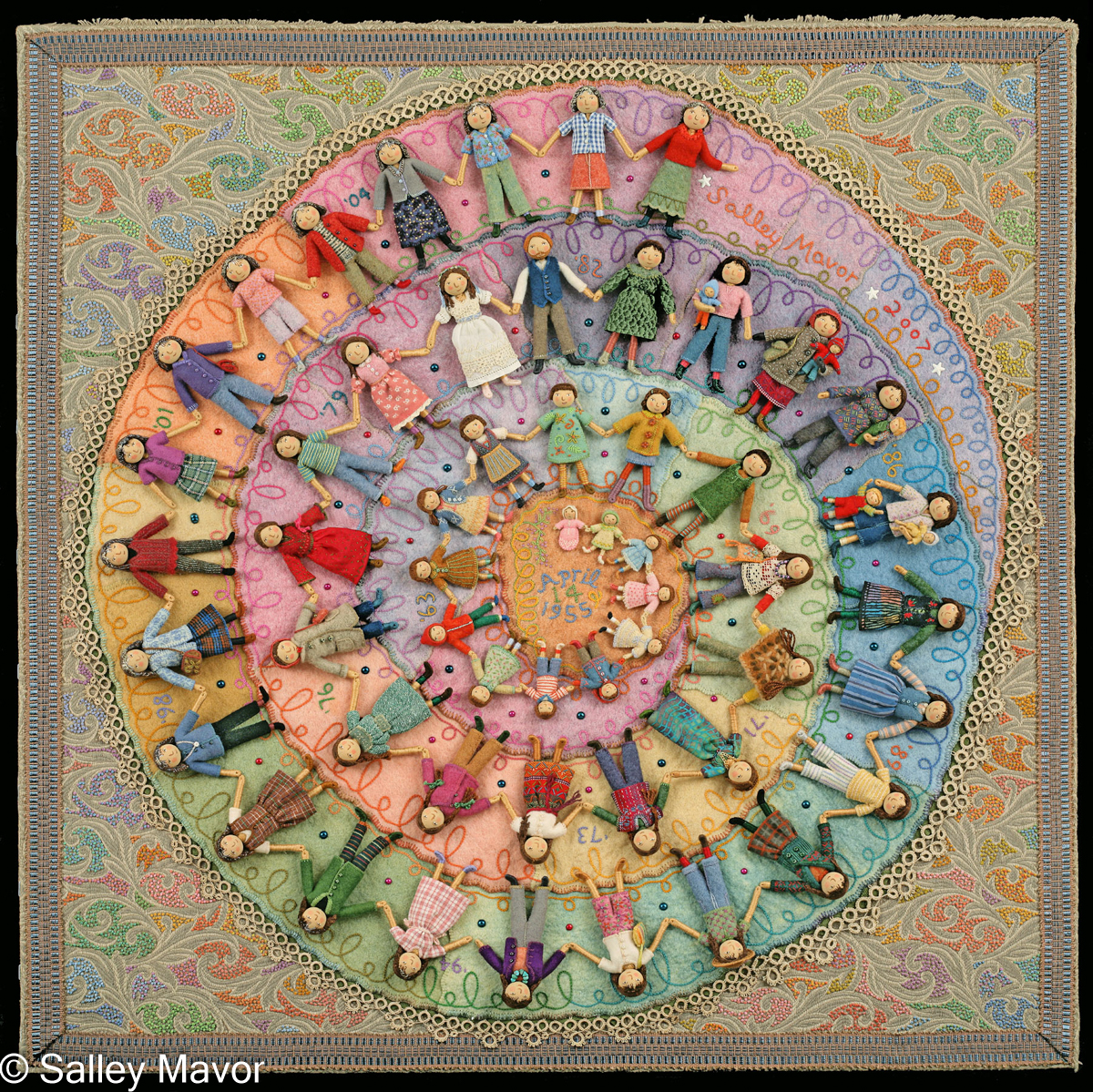
Since I made many of my own clothes, I remember the fabrics and clothing styles. They are recreated here with smaller scale fabric and embroidered wool felt. My husband, Rob, appears the year we were married and my sons, Peter and Ian, are included through the years when they were little and physically connected to me. The tatting around the outside of the circle was made over 100 years ago by my grandmother. This piece resonates with a lot of people whose lives parallel the same time period. I can’t tell you how many women remark that they had an alpaca poncho, too!

A woman wrote to tell me that 3 generations of her family enjoyed seeing my work at a recent exhibition. She especially wanted me to know that her 4 year old granddaughter was so taken with my self portrait that they couldn’t tear her away. For little Emma, the progression of dolls opened up the concept of growing up and visualized the passage of time in a simple, direct way. I love hearing accounts like this, because it reaffirms my intention to make art for all ages, whether it’s book illustration or stand alone embroidered pieces like this one. 

NEW PODCAST: In this podcast interview, I share the inspiration and process behind my Self Portrait: A Personal History of Fashion. The Object Itself Podcast, hosted by the Albany Institute of History and Art was published 1/23/25.

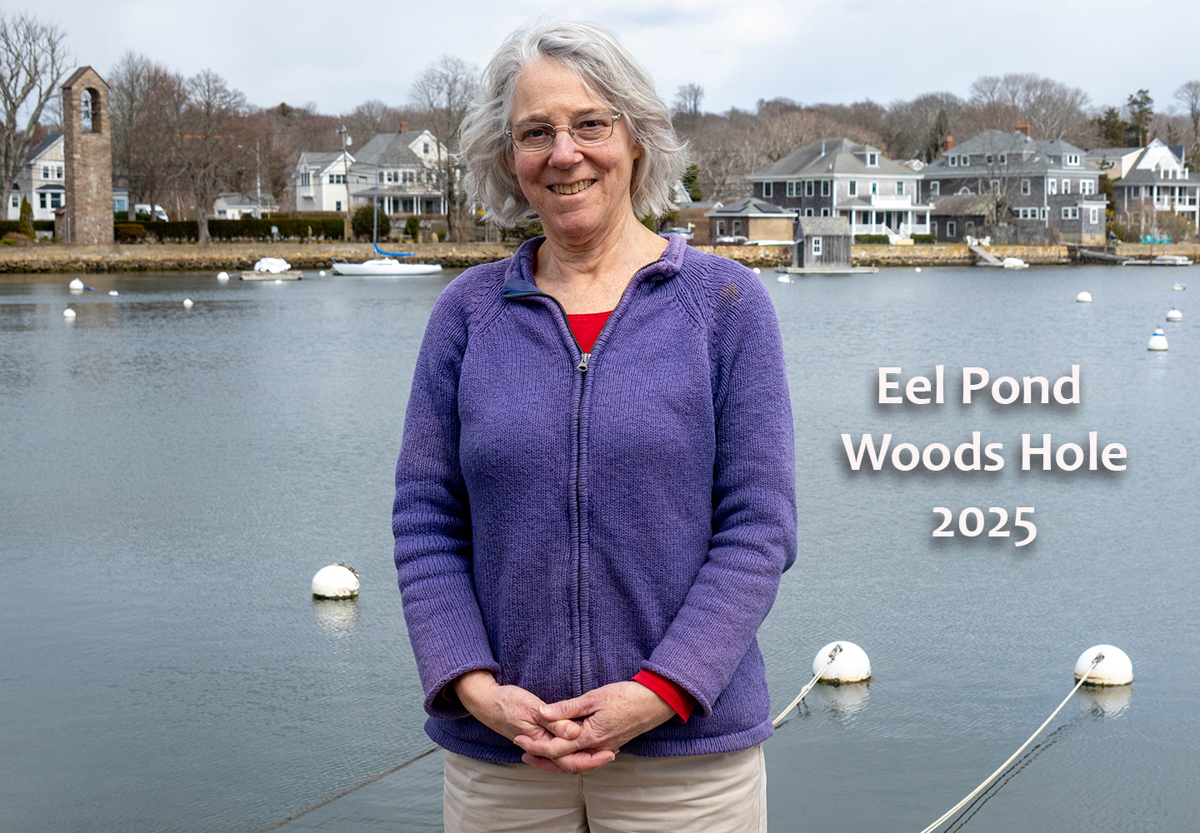
The following 2 photos of me with Eel Pond in the background, one taken in 1960 and the other in 2025, are hung on the wall next to the Self Portrait.

VIDEO tour through fashion and music: As well as clothing memories, we all have a personal soundtrack that goes with different times in our lives. This video is a nostalgic tour through fashion and music that my husband Rob and I put together. At the end, there’s a list of the music that I remember listening to.

10 minute nostalgic tour through fashion and music

Note cards and posters of the piece are available in my Etsy shop here.

To keep up with new posts, please subscribe to this blog. Your contact info will not be sold or shared. If you’d like to see more frequent photos tracking the projects in my studio, please follow me on Facebook, Instagram and BlueSky.

Summertime: Part 3 – leaves, stems, and branches

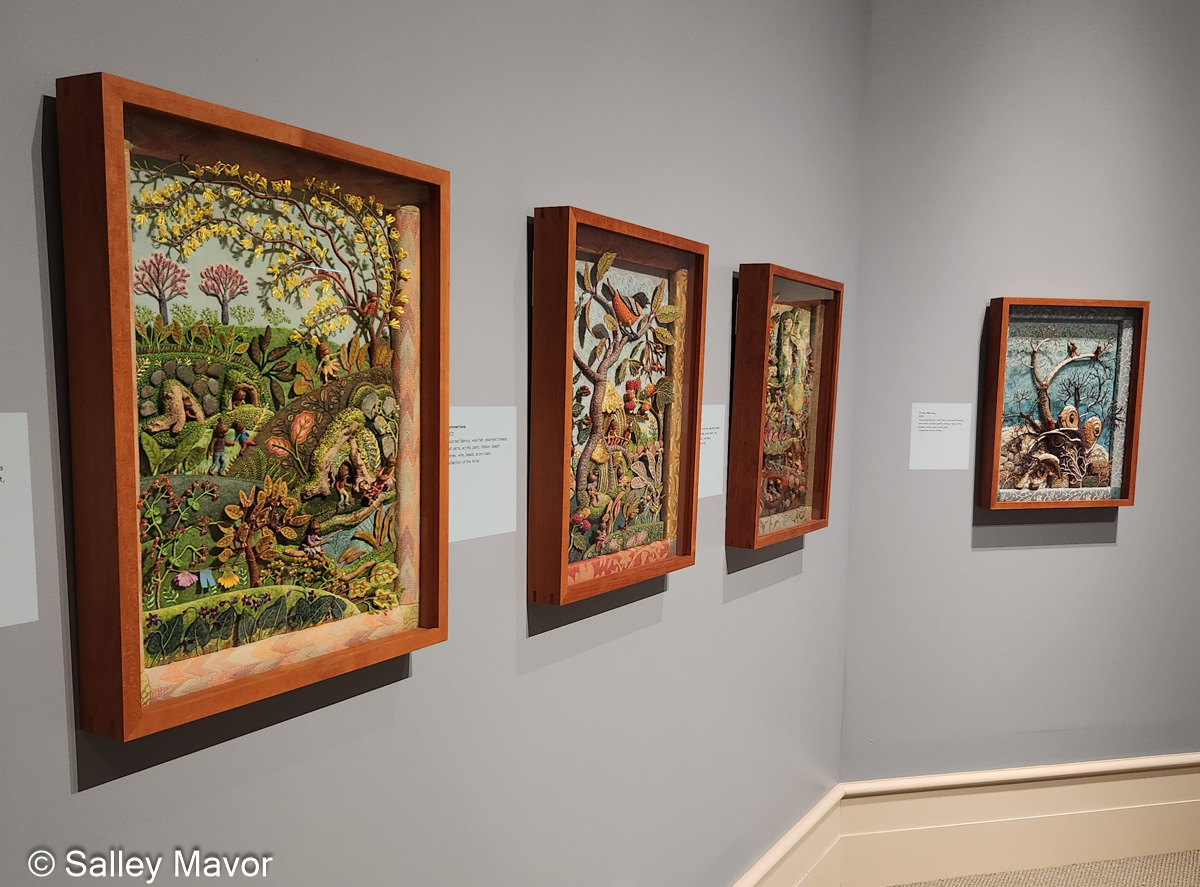
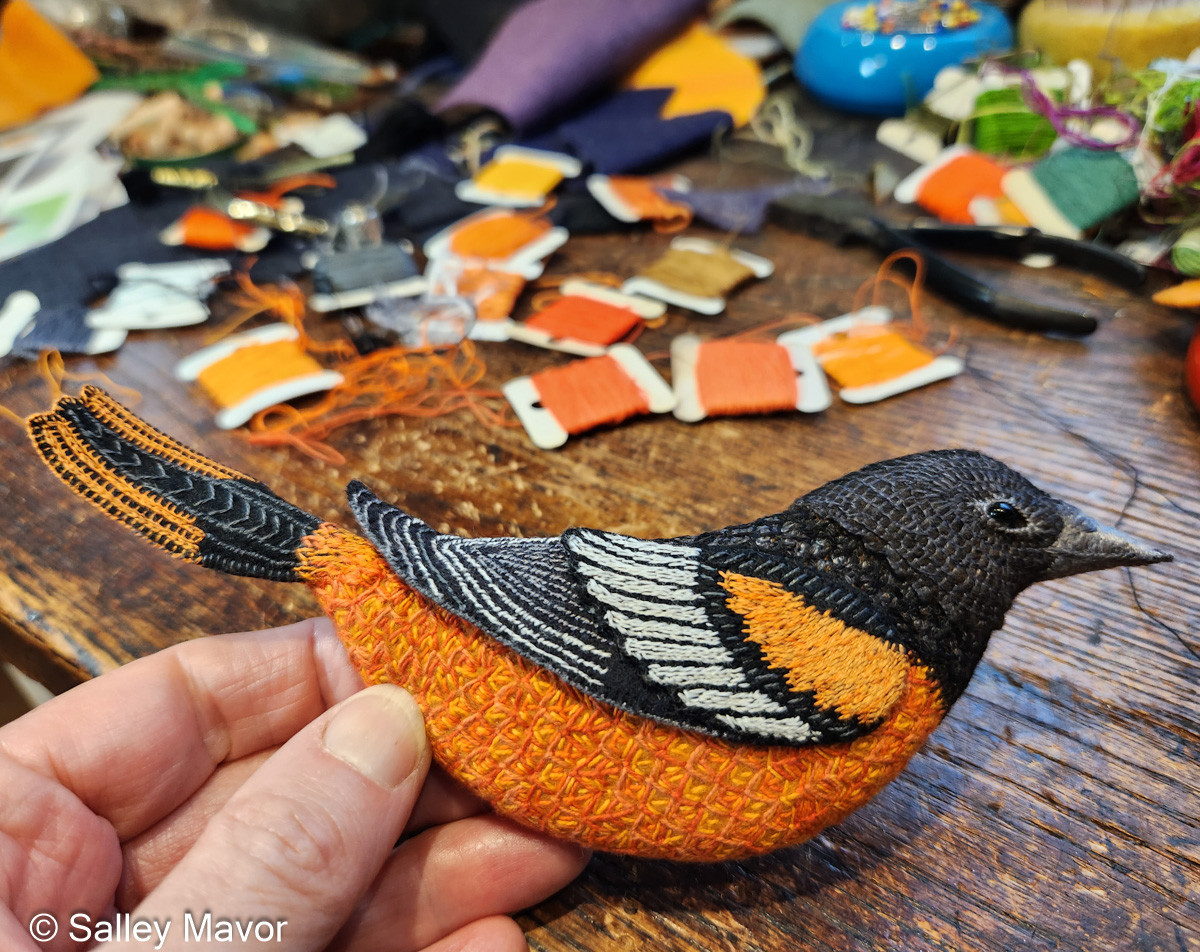
As promised, I’m picking up where we left off last year and continuing the series about Summertime, the fourth of my seasonal landscapes. In the coming months, I’ll share photos, videos and commentary about different aspects of the project, from raspberries to wee folk inhabitants to a life size Baltimore Oriole. I went overboard documenting the process, so there’s a ton of material to show. So far, I’ve written an overview of the piece, Part 1 – Tree Trunks, and Part 2 – Tree Houses, Part 4 – Baltimore Oriole (body) , Part 5 – Baltimore Oriole (head and feet), Part 6 – rose vine , Part 7 – raspberry plants, and Part 8 – stitching flora..

Summertime is the summer scene in a series of four seasonal landscapes that capture the wonder and magic of the natural world. Posters, note cards, prints, bookmarks, and jigsaw puzzles of Summertime and the other scenes in the series (Frosty Morning, Mossy Glen and Harvest Time) are available in my Etsy Shop.

See the Four Seasons Series and dozens of other works in my exhibition, To Every Season: Works by Salley Mavor at the New England Quilt Museum, Sept. 9 – Dec. 31, 2025.

Enchanting Threads: The Art of Salley Mavor at the Albany Institute of History and Art

LEAVES
Some of the foliage in this piece are realistic interpretations, like the leaves on the rose vine and raspberry plants (which will be covered in future posts), but others are pure fantasy. I wanted the scene to look believable, without being completely true to life. It’s not biological illustration; I was more interested in creating a unique ecosystem where little people could live alongside birds and berries.

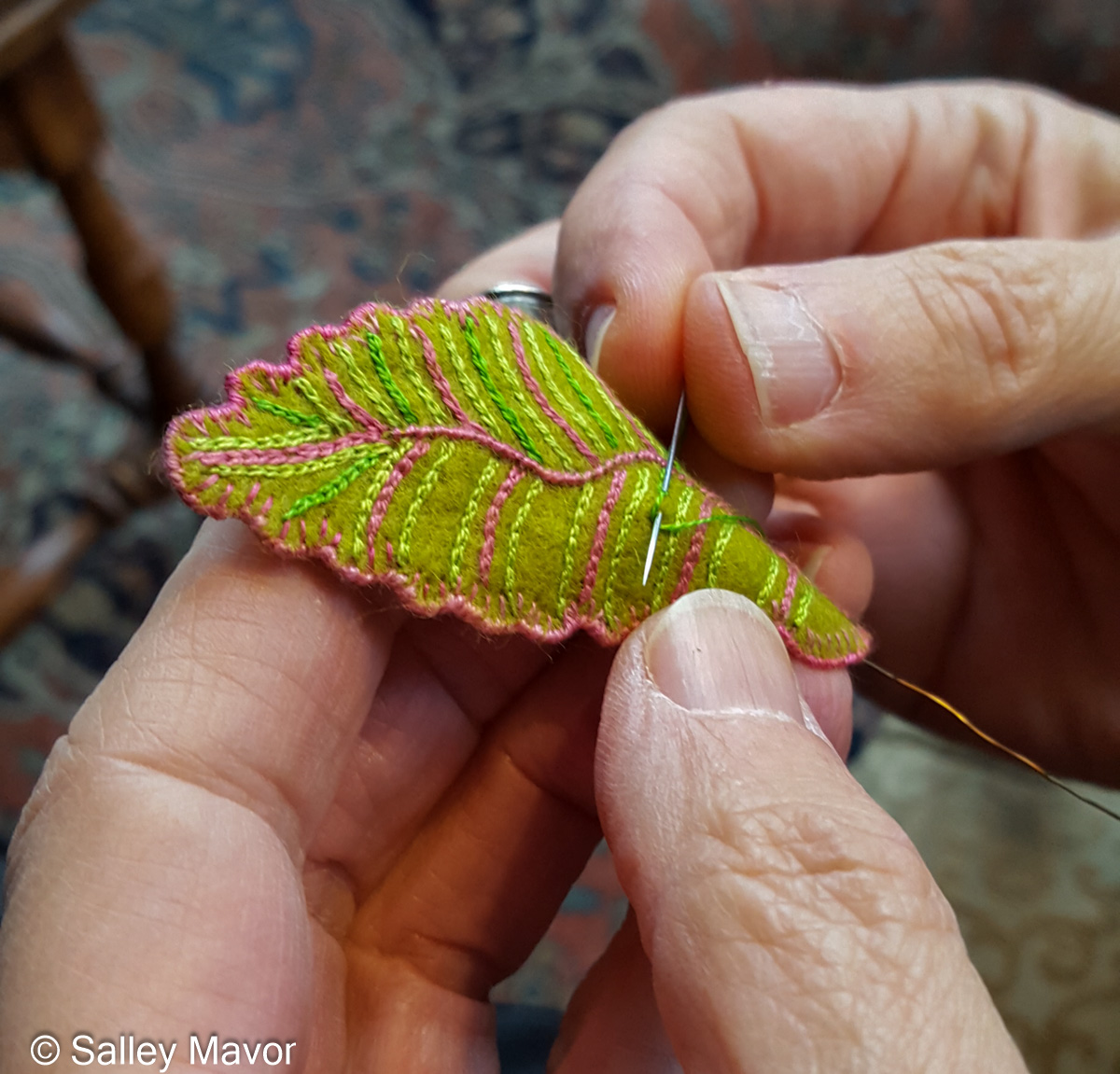
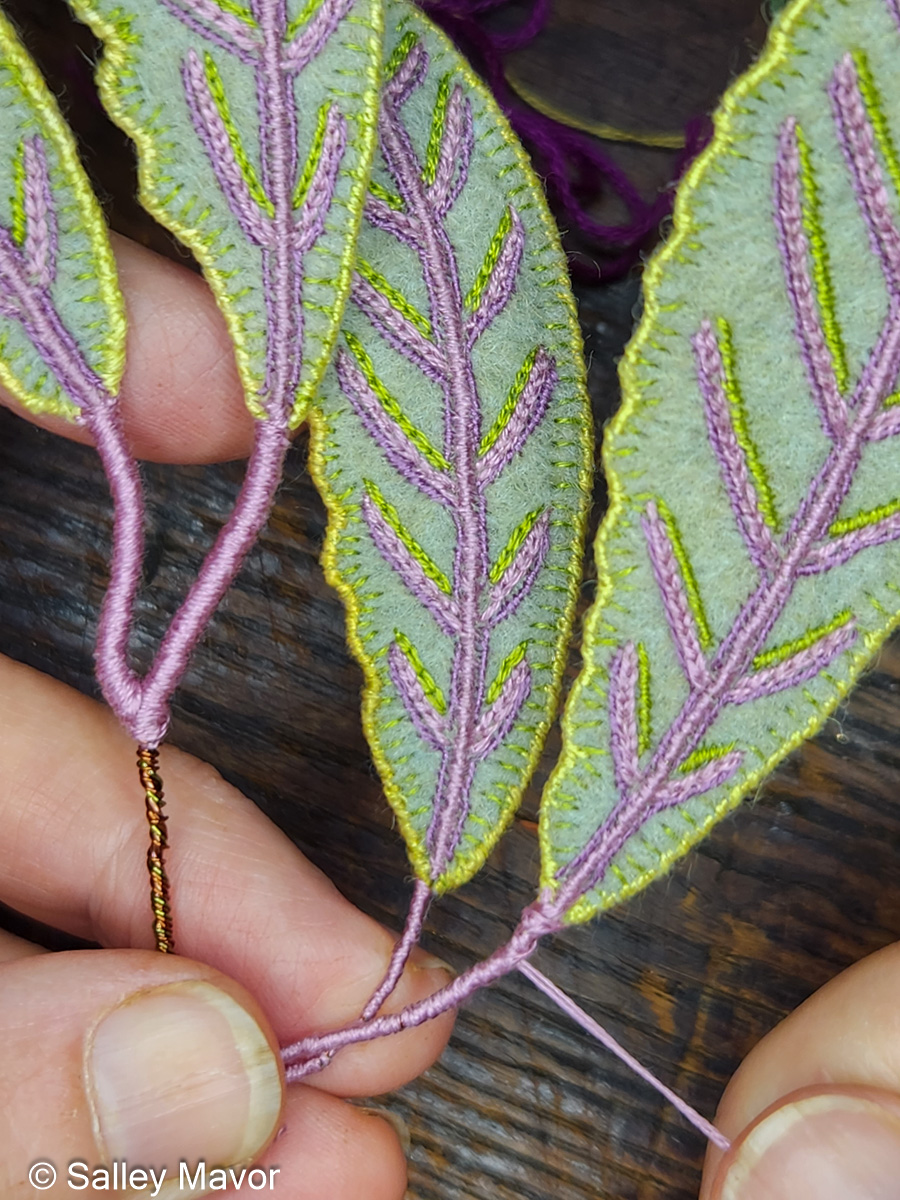
I made the leaves with 3 basic materials – wool felt, wire, and embroidery floss. The following Stitch Minute video demonstrates how to make a simple leaf, edged in wire.

Stitch Minute – leaf

STEMS
Wire is literally the backbone of my work. I use it as a structural framework to keep floppy materials (like felt) firm enough to exist in space, above the background fabric. In this piece, I used copper wire made by Parawire to edge the leaves and form their stems.

The trick is to cover all of the shiny metal with floss. It takes many passes around the wire to make a smooth surface.

This video shows how I wrapped the wire stems on the central tree in the Summertime scene.

For me, making curvy stems and bending them around is like doodling with wire. I’m never sure how a vine is going to grow and climb. This purple bush was calling out for something extra, so I made a curly vine to wrap around its trunk.

In this Stitch Minute video, you can see how I wrapped the curly vine, including its little corkscrew tendril.

BRANCHES
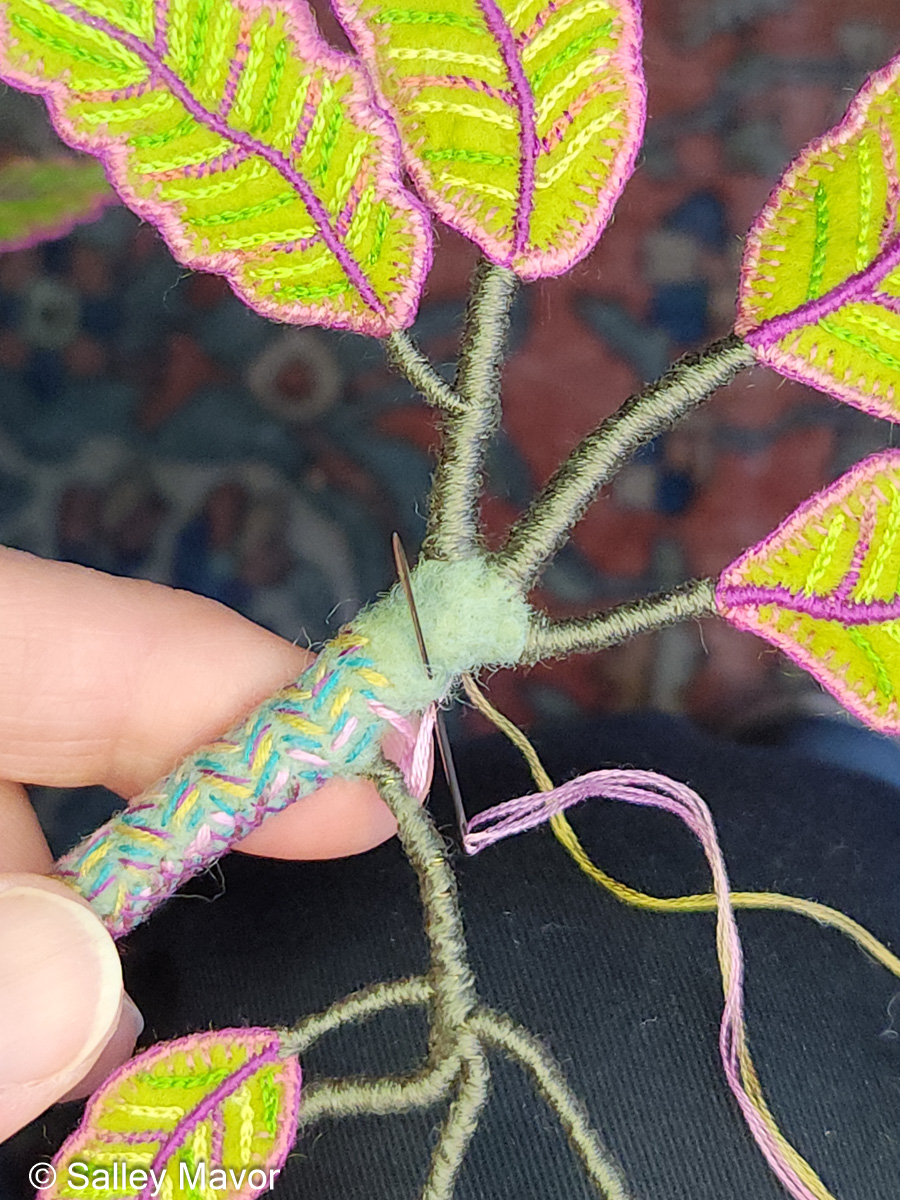
After years of developing ways of making tree branches, my preferred method these days is forming wire armatures and covering them with felt or embroidery floss. I usually embroider a textured “bark” pattern onto the felt before sewing it around the wire. Thicker tree trunks involve a different process, which I wrote about in Part 1.

In the following video, you can see how I stitched felt to cover the section that branches off into 3 separate wire limbs.

Stay tuned for Part 4 in this series, which will be about the Baltimore Oriole. If you want to receive email notices when I publish new posts, please subscribe to this blog using the form below.

To keep up with new posts, please subscribe to this blog. Your contact info will not be sold or shared. If you’d like to see more frequent photos tracking the projects in my studio, please follow me on Facebook, Instagram and BlueSky.

Mossy Glen: Part 7 – Violets and Berries

In this Part 7 of the series about making the spring landscape, Mossy Glen, I share photos, videos and commentary about how I created violets and berry bushes. Part 1 is all about stitching a moss-like texture, Part 2 gives a glimpse at how I made the cherry trees, Part 3 is about the stone walls, Part 4 shows how I made the forsythia blossoms, Part 5 features wire and felt leaves and Part 6 is about chain-stitching leaves.

winding wire stems with embroidery floss

Mossy Glen is the spring scene in a series of seasonal landscapes that capture the wonder and magic of the natural world. Note cards, prints, bookmarks, and jigsaw puzzles of Mossy Glen and the other scenes in the series (Frosty MorningHarvest Time, and Summertime) are available in my Etsy Shop.


While I write this post, I’m in the midst of preparing for my upcoming retrospective exhibition in Kennebunk, Maine at the Brick Store Museum. Even though I’ve hardly picked up a needle and thread this spring, I’m still being creative, but in a different way. My approach to curating this show is similar to how I imagine and labor over my artwork. It’s all about taking a lot of small details and arranging them in a way that contributes to the story. The exhibition, What a Relief: The Art of Salley Mavor will tell the story of my evolution as an artist, from childhood to today. Just like my art, this exhibit will be very busy, with a ton of original 3-dimensional pieces to eye as closely as you like. As my husband Rob says, “With Salley’s art, more is more.”

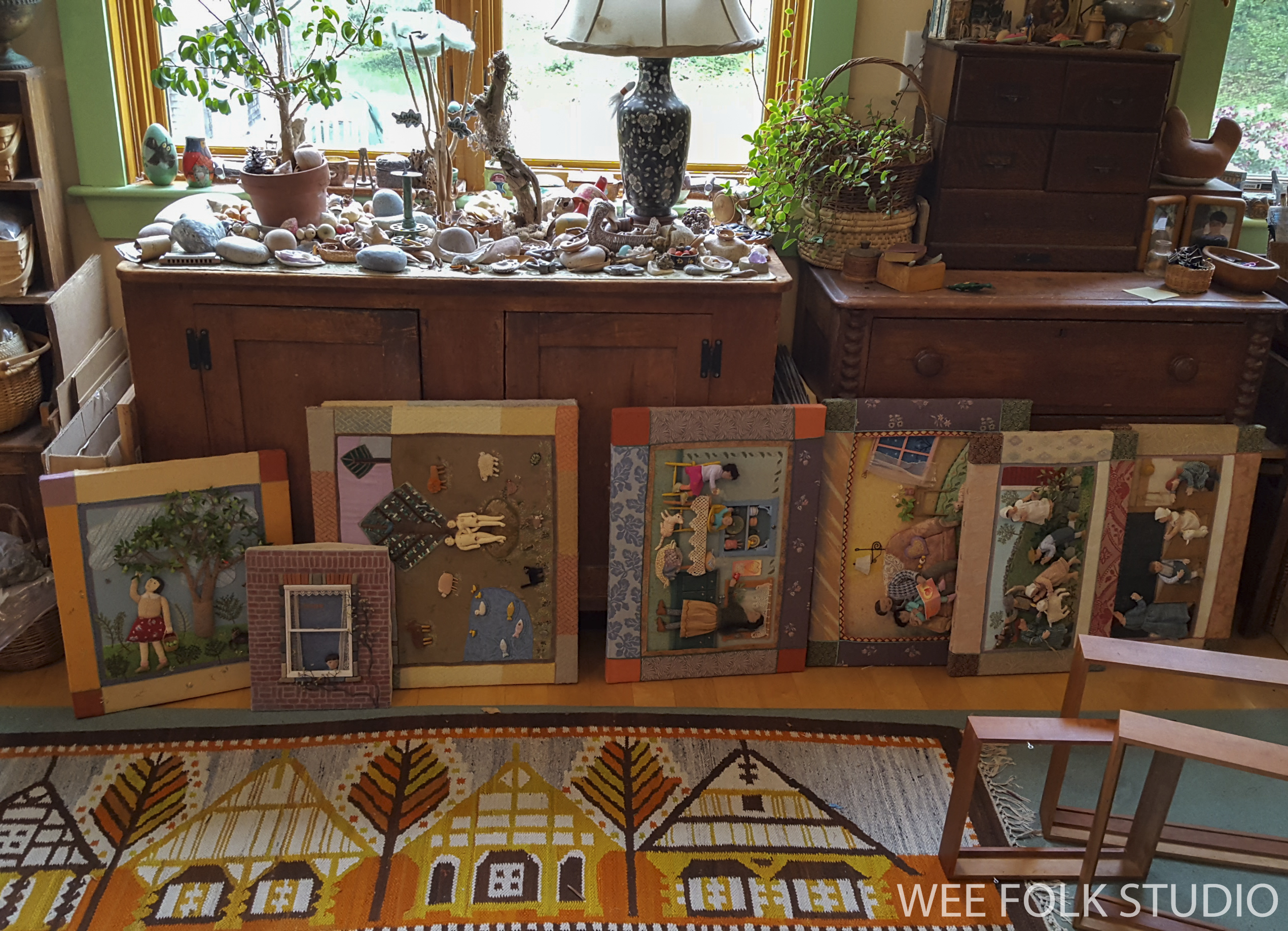
Early work from the 80’s and 90’s on loan for the exhibition, What a Relief: The Art of Salley Mavor.

What a Relief: The Art of Salley Mavor at the Brick Store Museum in Kennebunk, Maine, (June 7 – Sept. 11, 2022). I will be there on Sat., June 25th from 1 – 3 pm for a meet and greet and book-signing event.

The retrospective exhibition will feature a large selection of my artwork, spanning over 40 years, from early on to the present day. Over 100 pieces from my collection and rarely seen works on loan from private collections will fill walls a cases in multiple galleries on the museum’s entire first floor. Original picture book illustrations, including the entire series from my most recent book, MY BED will also be shown.

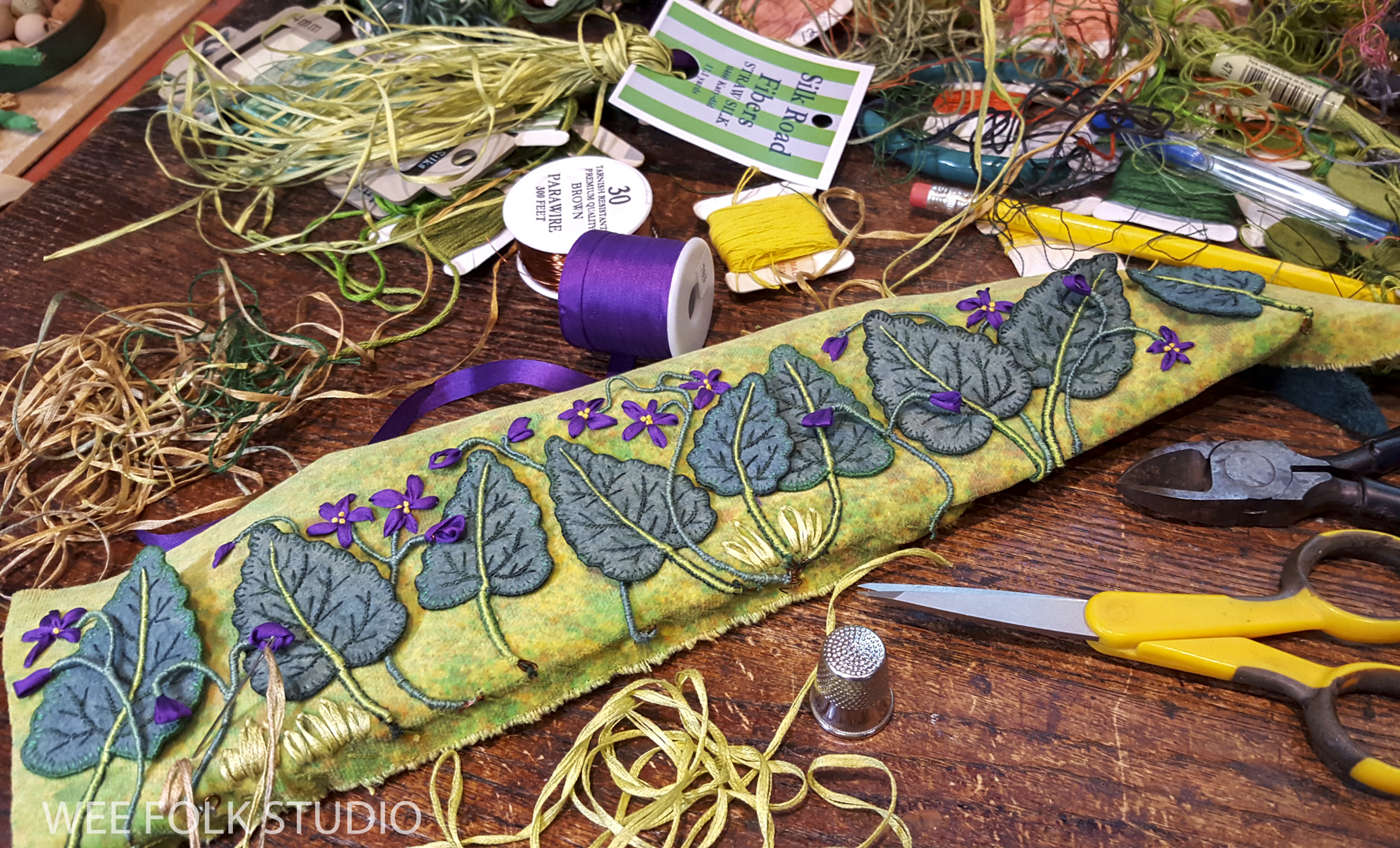
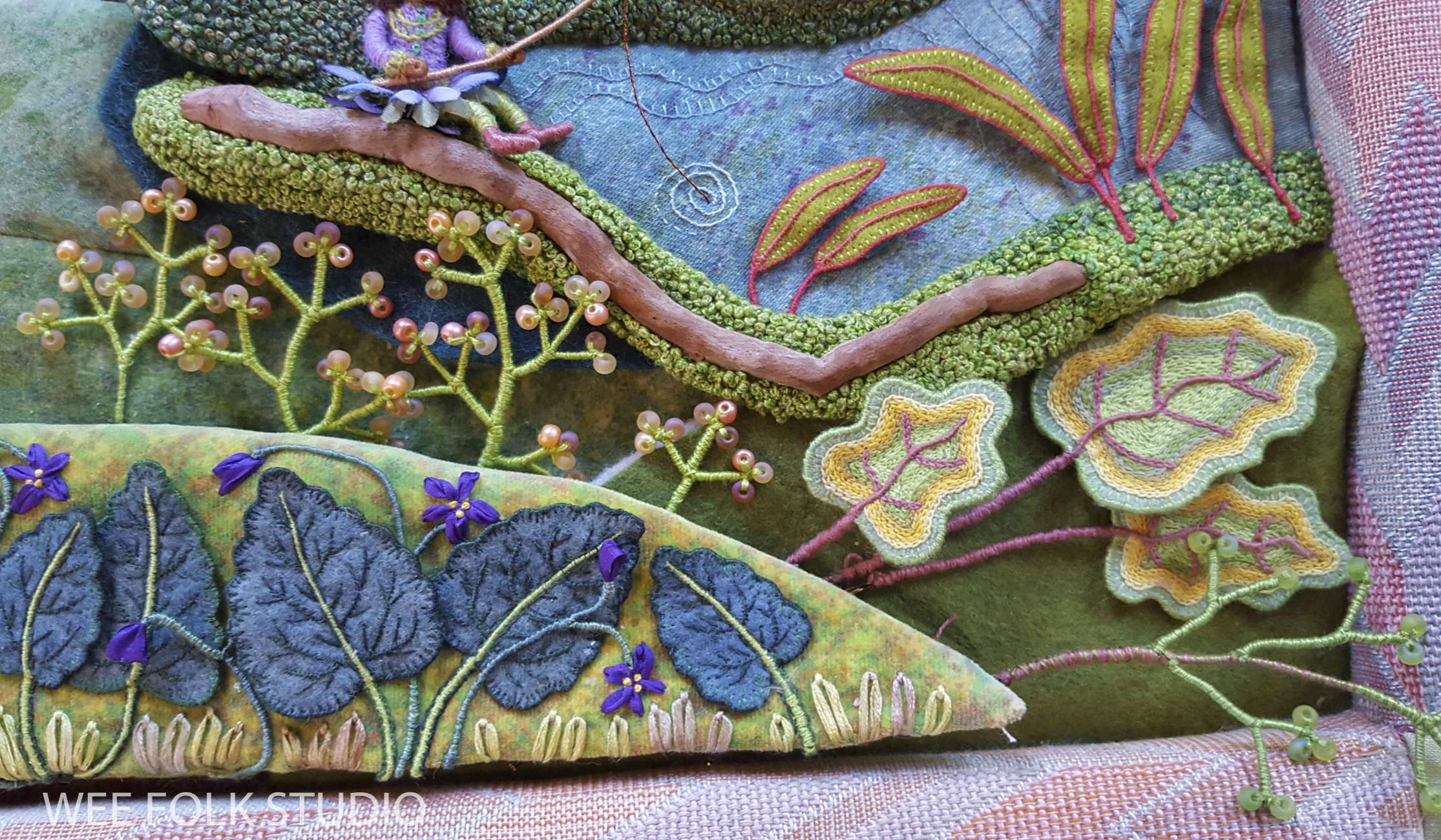
Now back to the patch of violets, which appear in the lower left foreground of Mossy Glen. I chose violets because I thought a dark leafed plant would bring some weight to the bottom of the composition. I also wanted something larger scale, to offset all of the itty bitty berries and leaves.

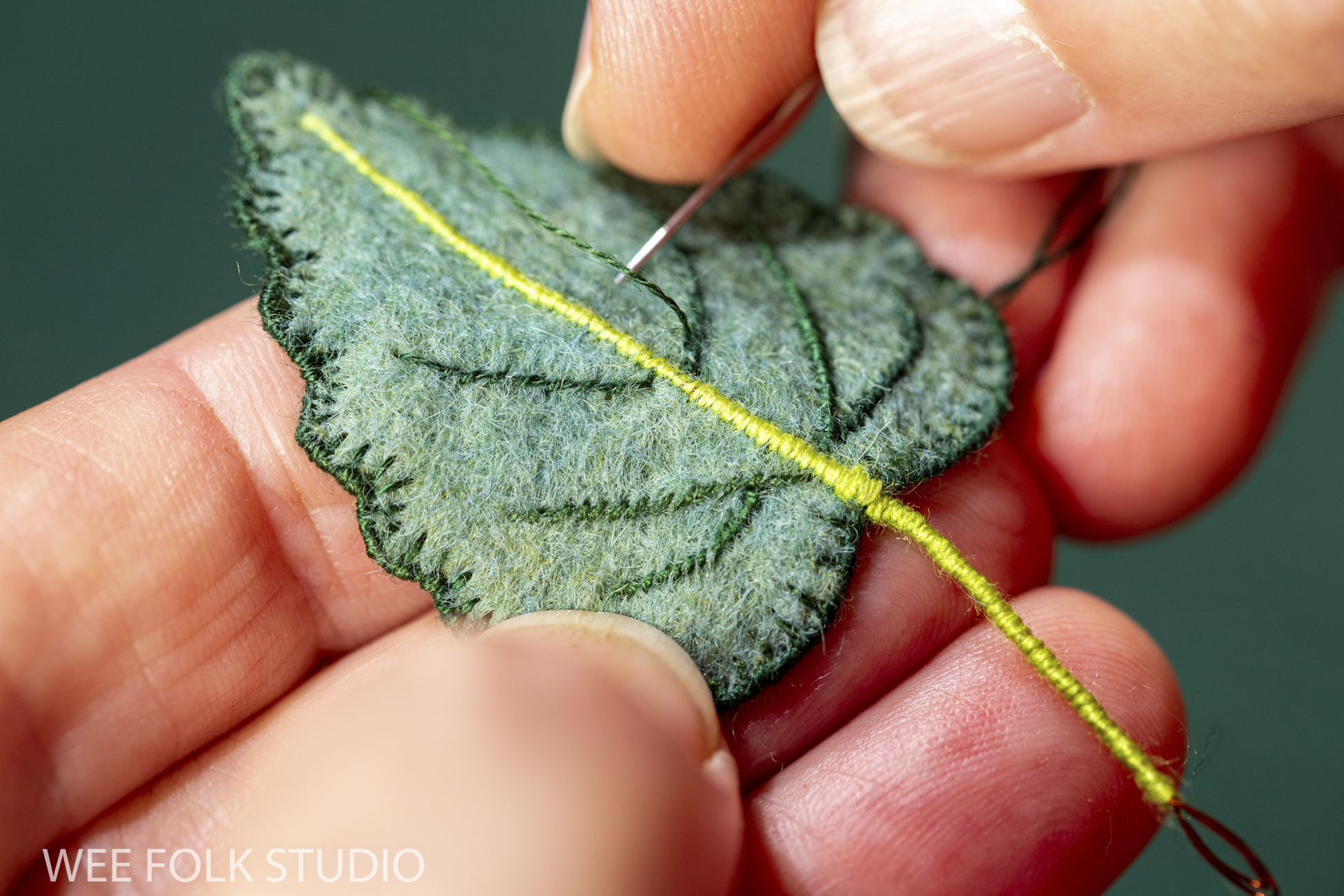
I constructed the leaves out of wool felt and wire and embroidered the veins.

You can see the process of making the leaves in this Stitch Minute video.

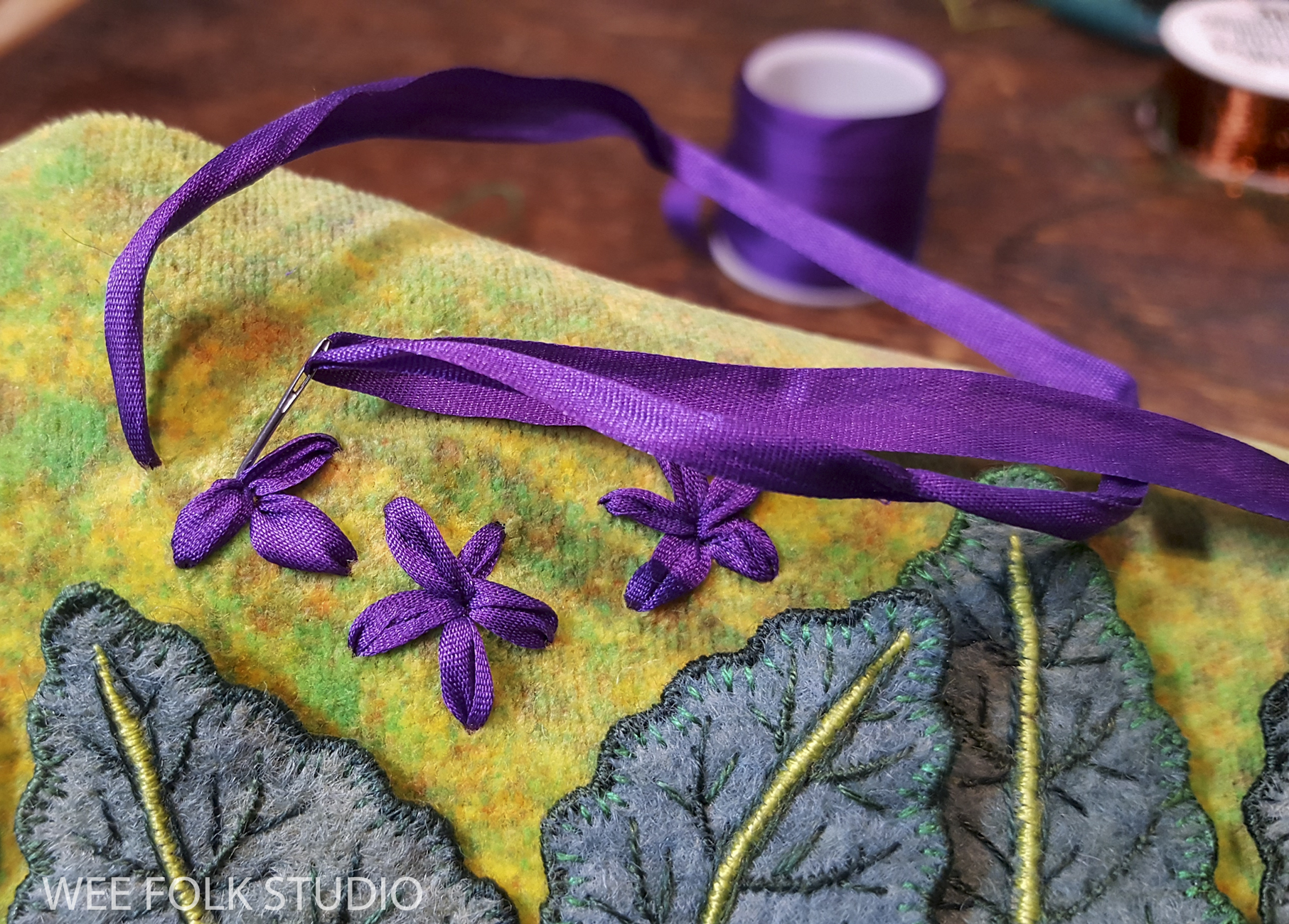
After sewing the leaves to the background fabric, I stitched flowers with silk ribbon.

I created stems with wire, silk ribbon and embroidery floss.

The silk ribbon was so fun to use that I couldn’t resist adding some “grass” to the bottom edge.

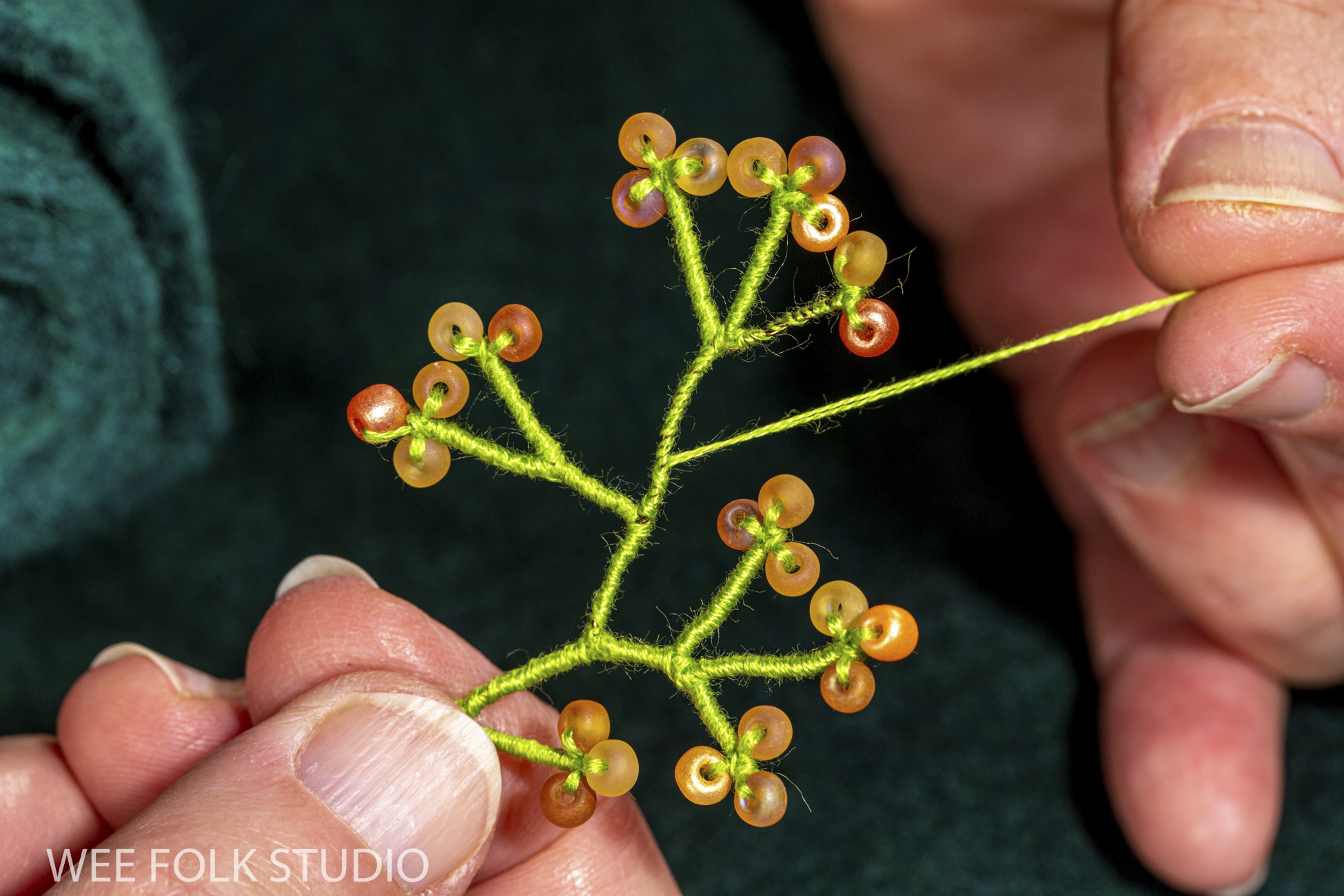
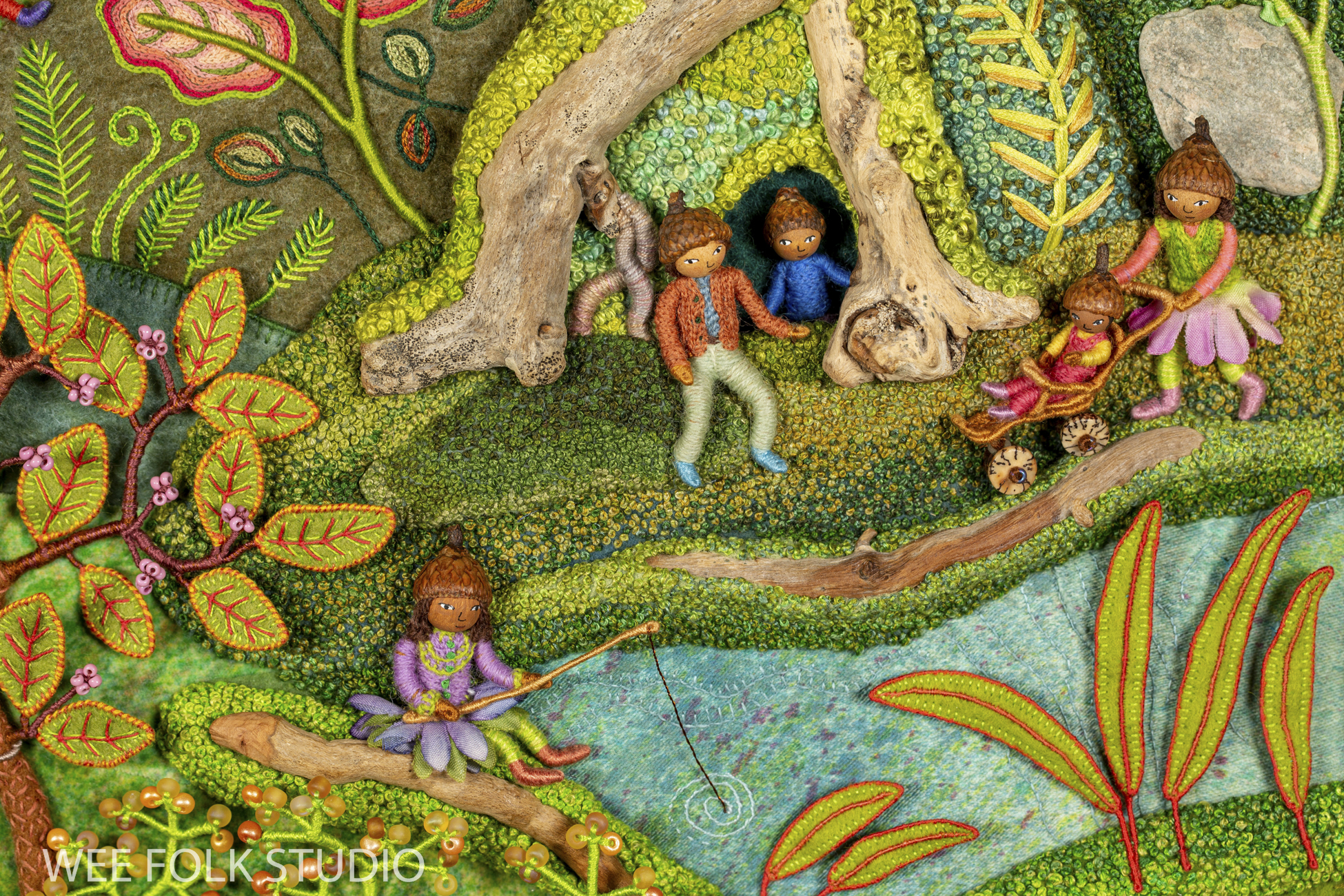
Scattered throughout Mossy Glen are berry bushes, which I make with wire, glass beads and embroidery floss.

You can see how I form wire and bead berry bushes in this Stitch Minute video.

Wire and glass bead berry bush

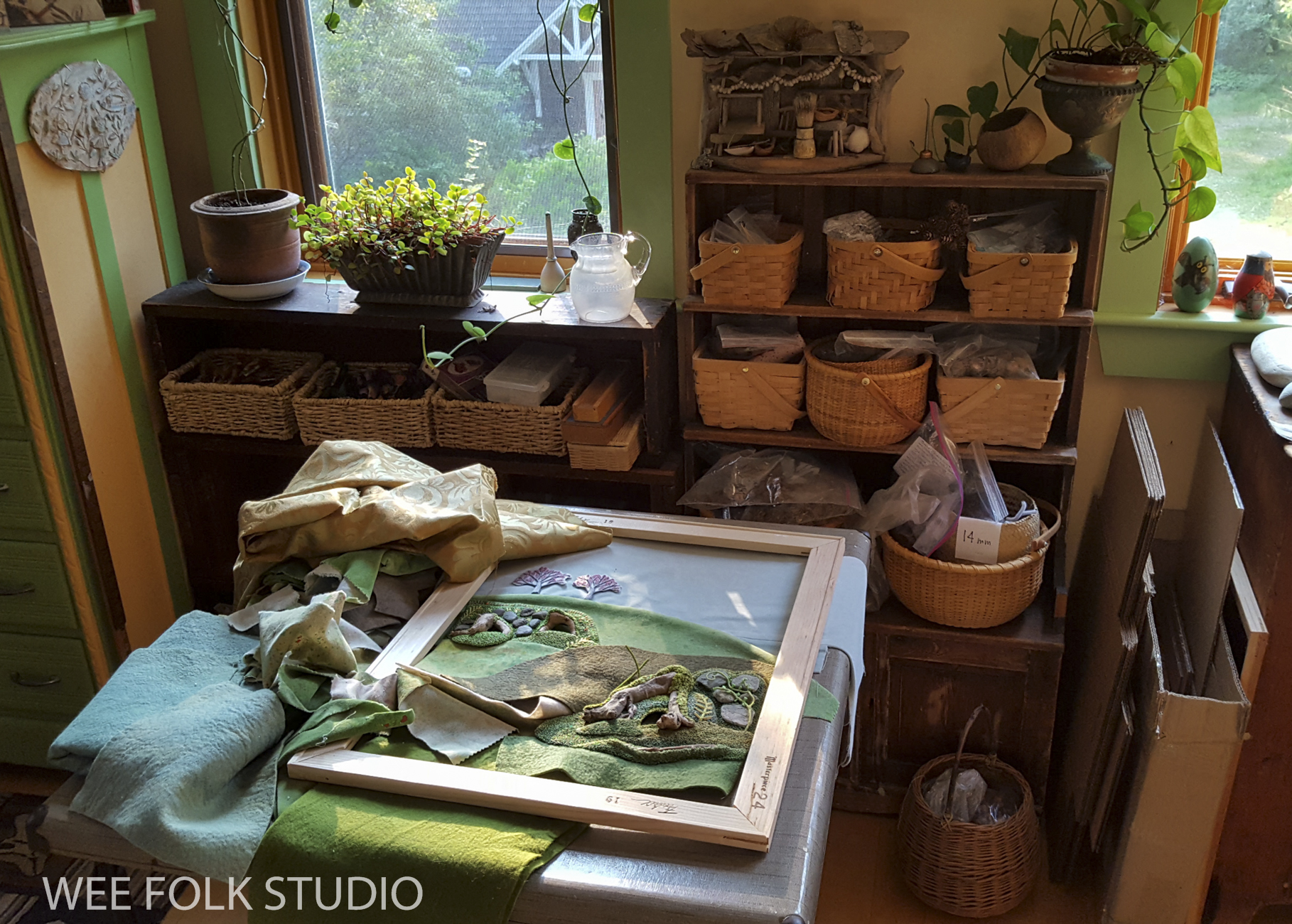
At this stage of the project, I picked out some upholstery fabric from my stash and used it to cover the stretcher frames. It hurts my brain to try to explain why and how it’s done, but the process involves cotton padding and lots of contorted hand sewing, kind of like upholstering a piece of furniture. In putting the covered stretcher on top, I’m basically freeing up an extra 1/2″ of depth that would normally be wasted behind the stretched fabric.

I then stapled the background fabric to the back of the covered stretcher and started assembling the pieces on top, inside the upholstered border frame.

Stay tuned for a final post about making the wee folk characters in Mossy Glen.
Mossy Glen (overview)
Part 1 (moss)
Part 2 (cherry trees)
Part 3 (stone walls)
Part 4 (forsythia)
Part 5 (wire and felt leaves)
Part 6 (chain stitched leaves)

To keep up with new posts, please subscribe to this blog. Your contact info will not be sold or shared. If you’d like to see more frequent photos tracking the projects in my studio, please follow me on Facebook and/or Instagram.

Mossy Glen: Part 2 – Cherry Trees

Flowering trees in the spring are glorious, aren’t they? Maybe we appreciate them because their showy display is so brief. In this Part 2 of the series about making Mossy Glen, I share photos, videos and commentary about how I created the cherry trees that sit atop the hillside, off in the distance.

Mossy Glen is the spring scene in a series of seasonal landscapes that capture the wonder and magic of the natural world. Note cards, prints, bookmarks, and jigsaw puzzles of Mossy Glen and the other scenes in the series (Frosty MorningHarvest Time, and Summertime) are available in my Etsy Shop.

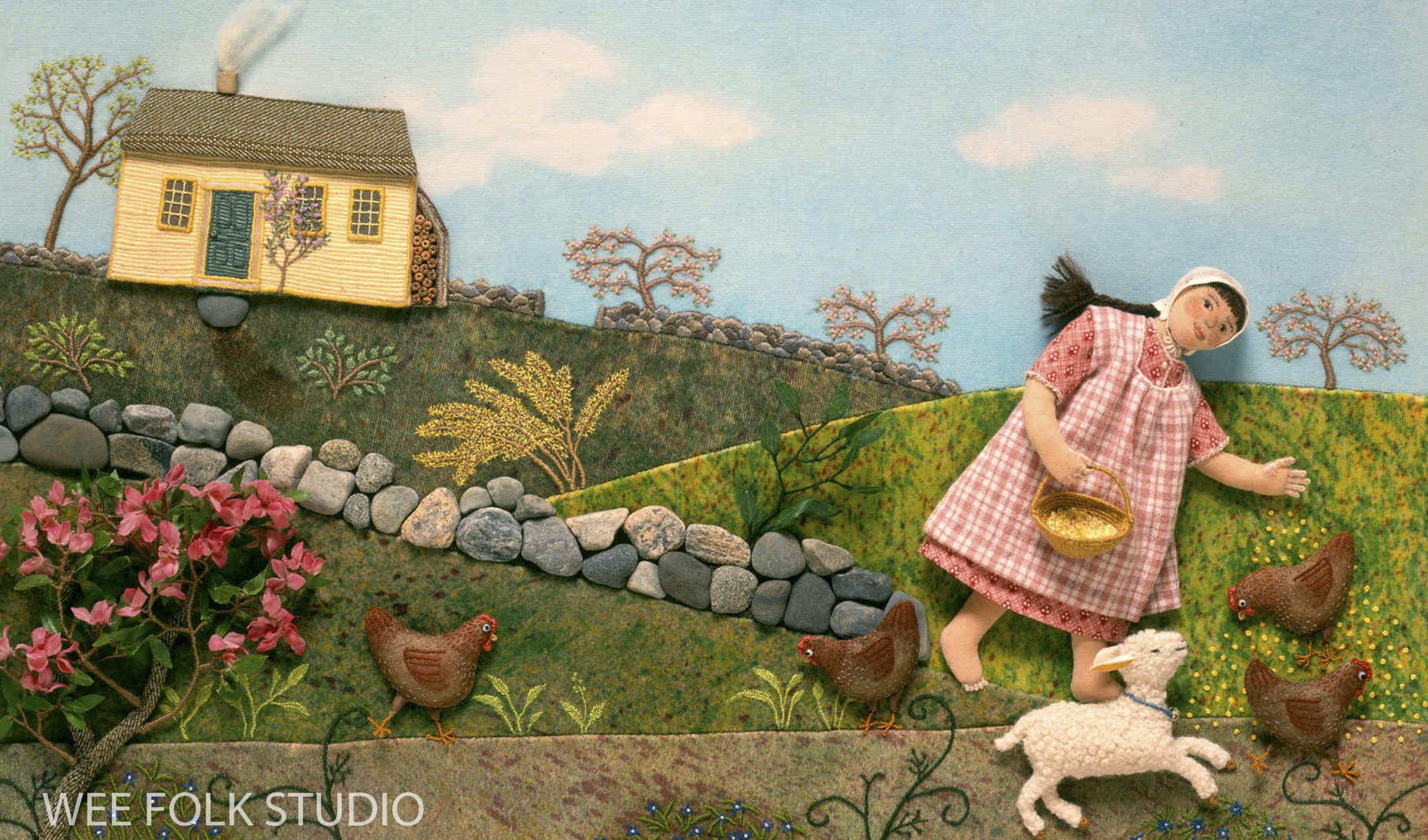
The pink tinted trees against the blue sky remind me of the blossoming apple trees in this book jacket illustration for my 1995 book, Mary Had a Little Lamb.

Mary Had a Little lamb 1995

Of course, apple and cherry trees are shaped differently and their flowers aren’t the same shade of pink. I also constructed them differently – the apple trees are embroidered directly onto cotton velveteen, whereas the cherry trees in Mossy Glen are made with a combination of wrapped wire and embroidery on wool felt.

I also made the cherry trees as separate objects that could be shifted around. That way, I could adjust their position according to how the surrounding parts came out. Over the years, I’ve found that keeping an open-ended playful element in my process is more and more important. The idea of following a set pattern or grid, without much wiggle room, such as in knitting, cross-stitching or weaving makes me feel trapped and constrained, without room to breath.

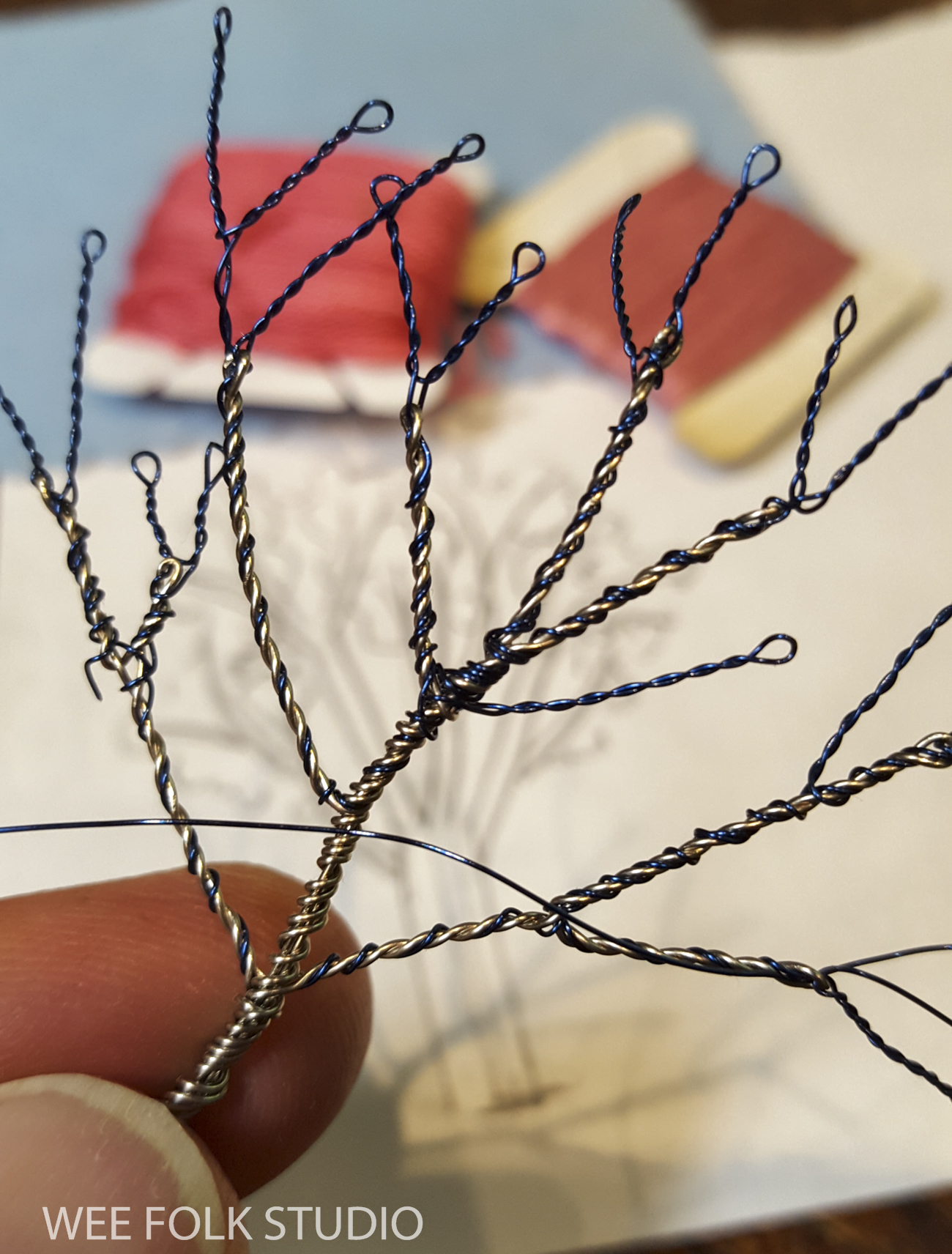
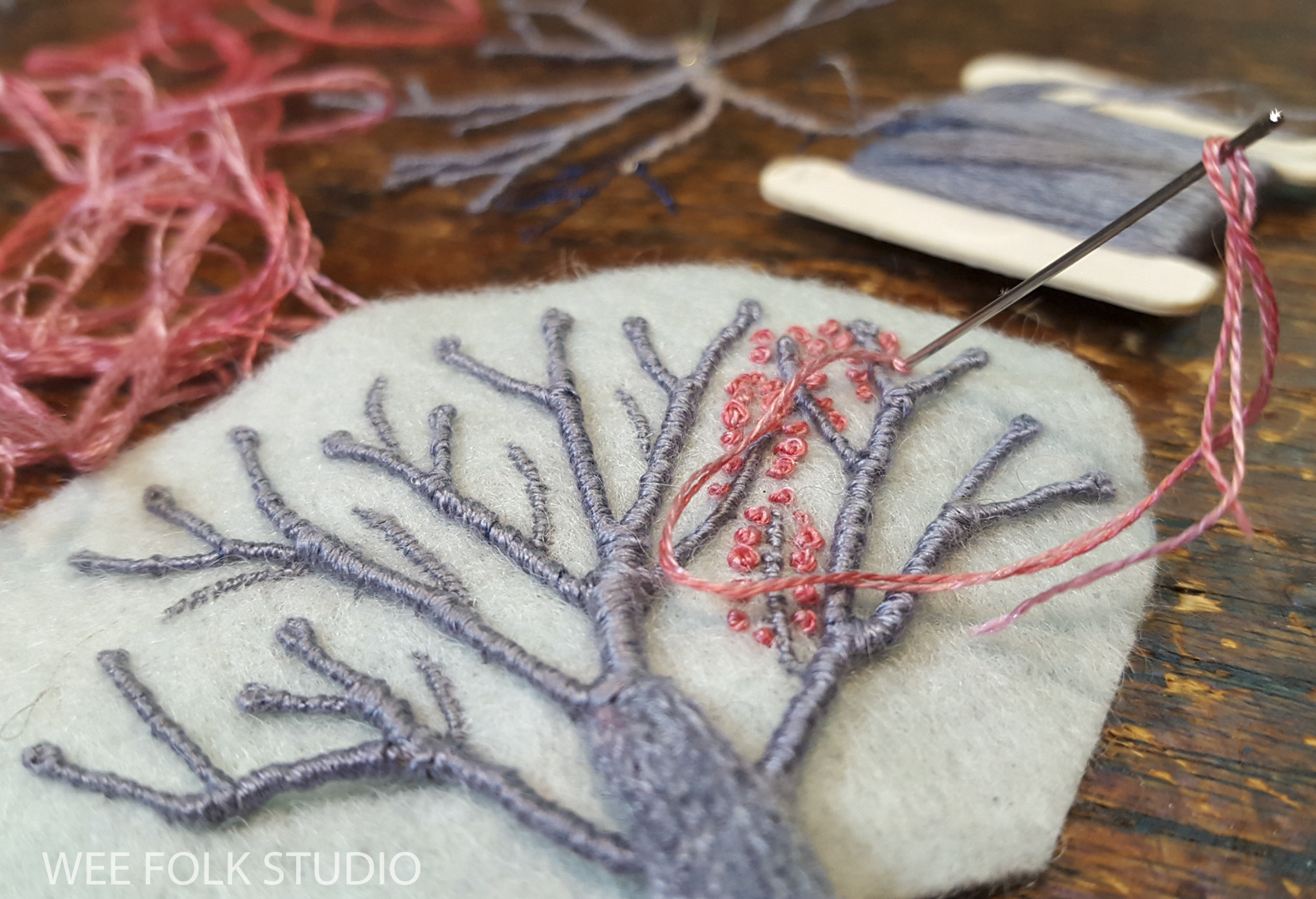
I formed the tree shapes with wire, using a finer gauge for the smaller branches. The loops on the ends were big enough to sew a needle and thread through.

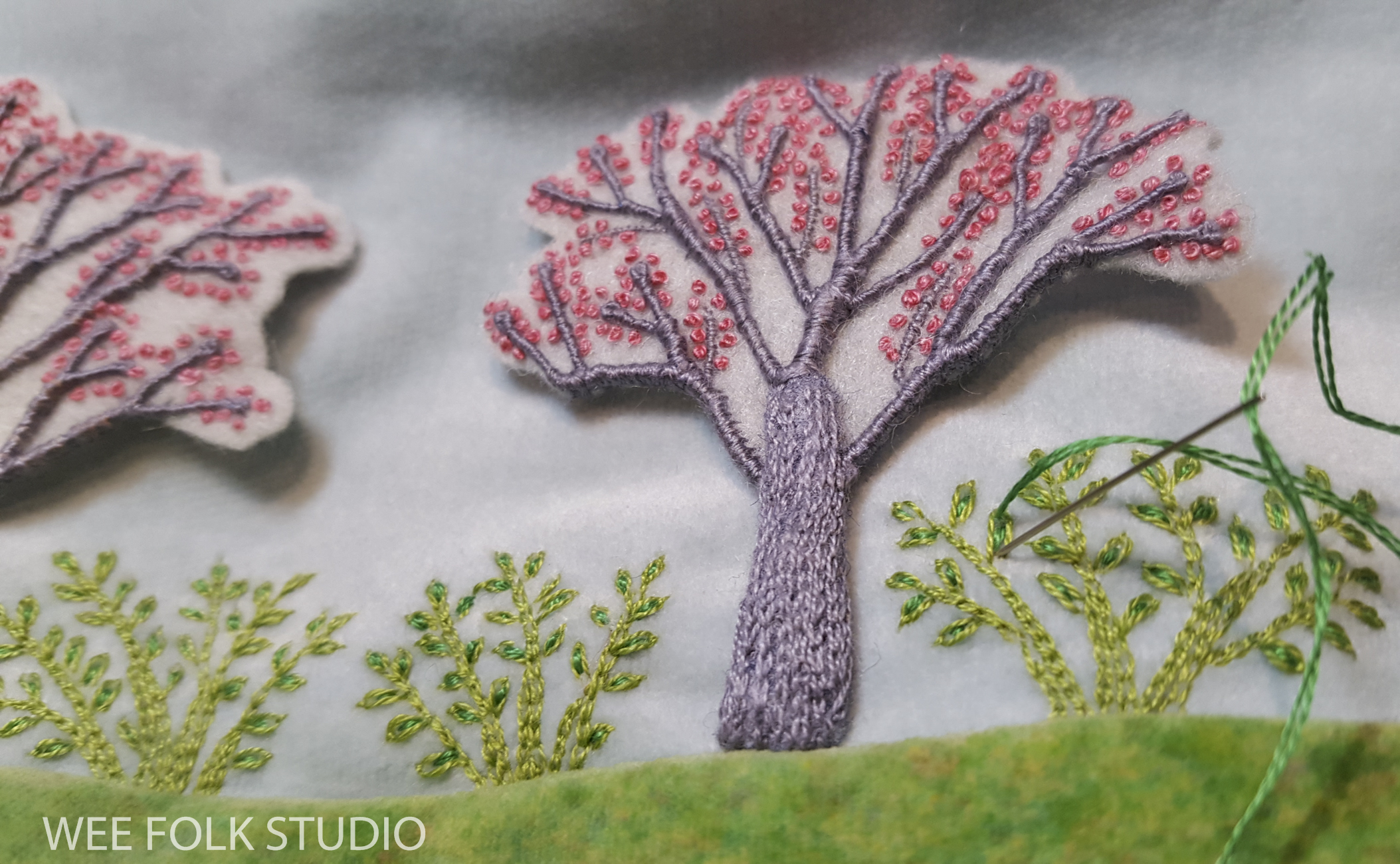
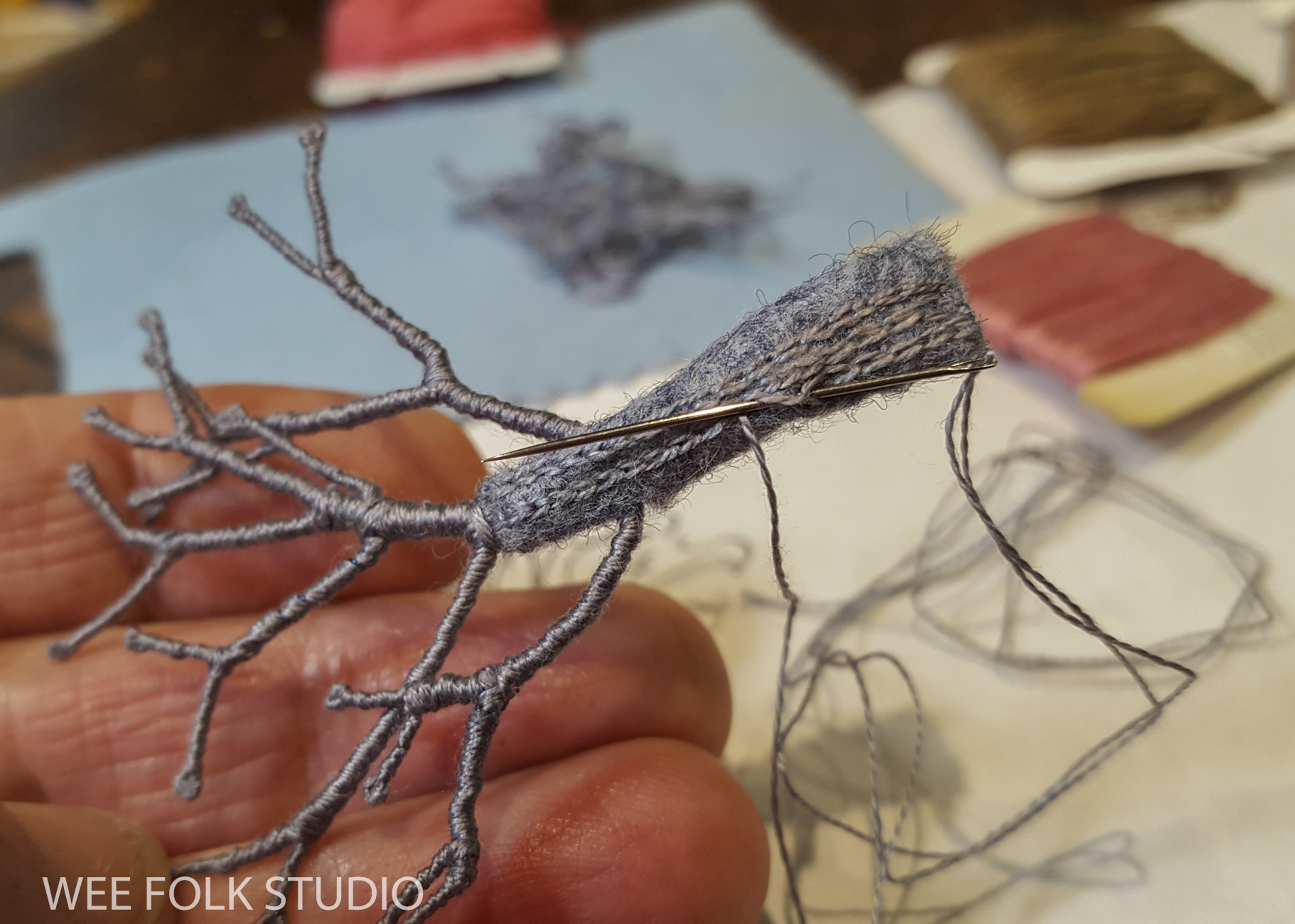
I wrapped the branches with embroidery floss and covered the trunk with wool felt, which I embellished with vertical rows of chain stitching. This Stitch Minute video shows how I wrapped the wire and stitched the blossoms with french knots.

Stitch Minute – wire tree

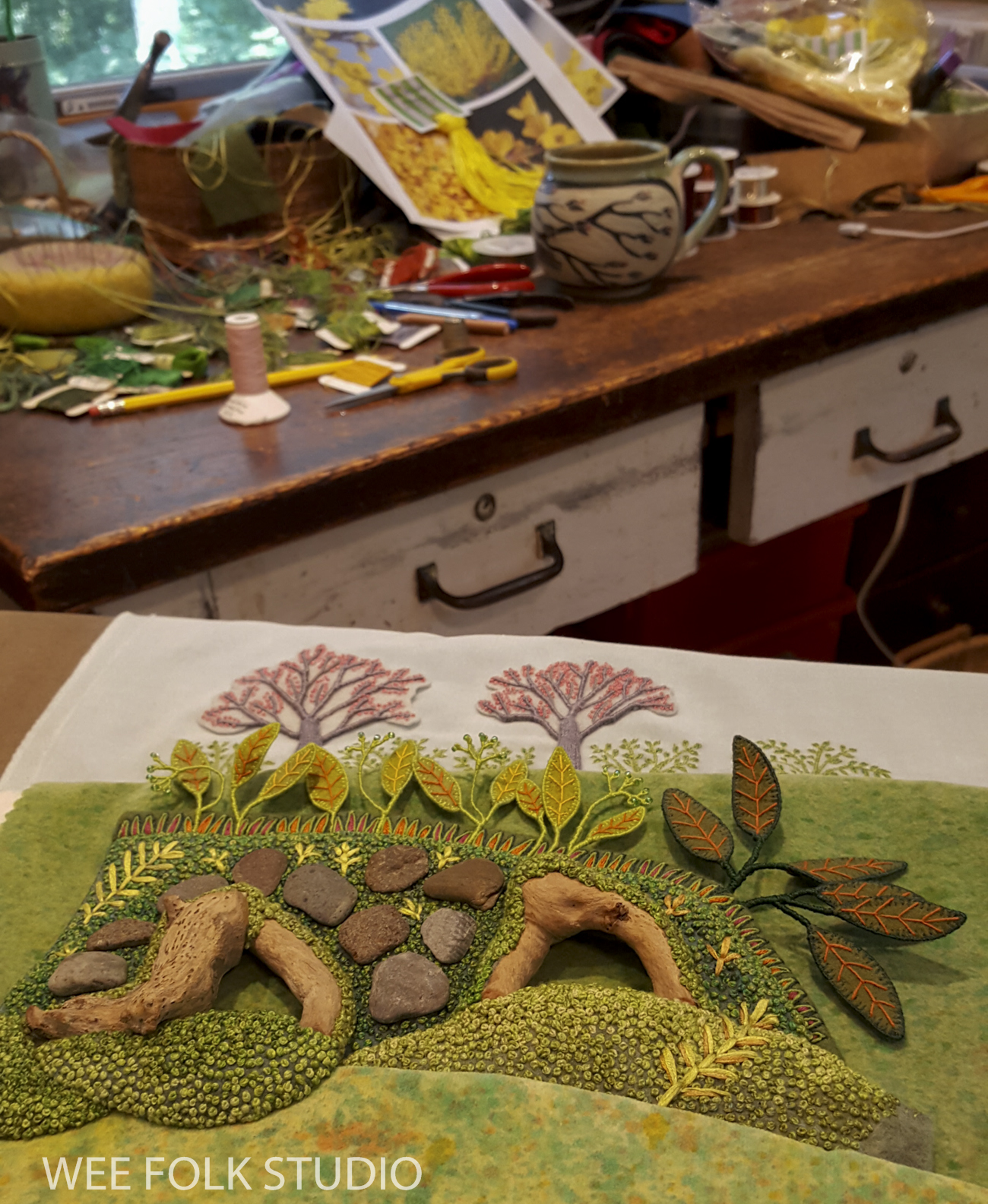
This was the first time I can remember creating a tree with its own section of sky attached. Luckily, I had some pale blue felt that was almost the same shade as the cotton velveteen background sky.

After sewing the wire tree to the felt, I embroidered a few extra branches to fill in the gaps and added pink blossoms with french knots.

I made a patch of sorts, by cutting the felt around the contours of the treetop. At this point, I’d figured out where to put the trees, so it was okay to decorate the surrounding area. Watch this Stitch Minute video to see how I stitched some little bushes onto the velveteen background.

Stitch Minute – bushes

In the future, I’ll give a closer look at how I made the foliage on the hillside that’s positioned below and in front of the cherry trees.

Stay tuned for more posts about making Mossy Glen. Other parts in the series will focus on the stone walls, forsythia bush, embroidered embellishments and the wee folk characters.
Mossy Glen (overview)
Part 1 (moss)
Part 2 (cherry trees)
Part 3 (stone walls)
Part 4 (forsythia)

To keep up with new posts, please subscribe to this blog Your contact info will not be sold or shared. If you’d like to see more frequent photos tracking the projects in my studio, please follow me on Facebook and/or Instagram.