bed book peek: Scandinavia – part 4

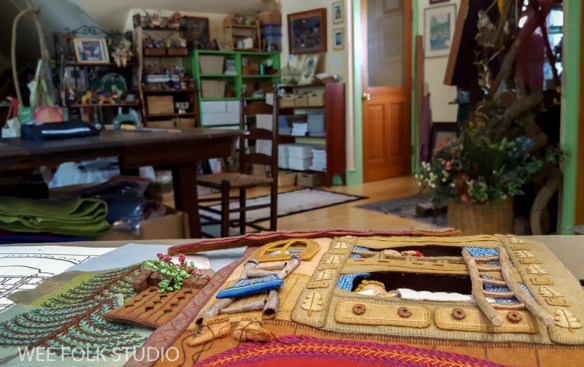
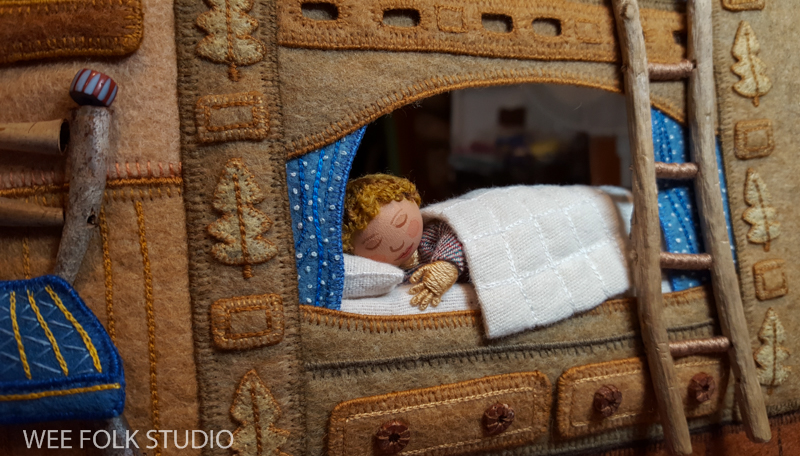
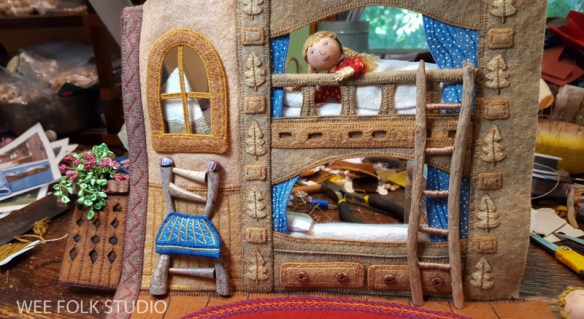
In this 4th and final post in the series about the Scandinavian scene, I will show extra details, such as the ladder, shoes and rug. Part 1 is about making the framework for the cubby style bunk beds. Part 2 gives a glimpse at what’s outside: the balcony, flowers, mountains, sun and trees. Part 3 focuses on the chair and the children.

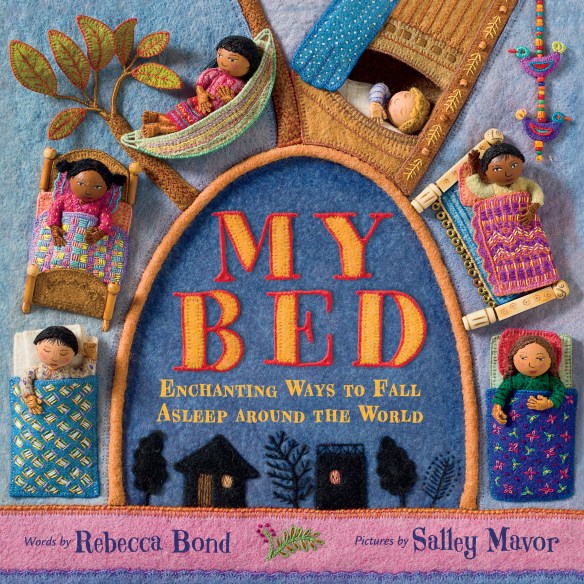
This illustration will be included in My Bed, a book about where children sleep around the world, with each spread depicting a different culture and living environment. The story is written by Rebecca Bond and will be published by HoughtonMifflin in the Fall of 2020. Here are links to posts showing other finished illustrations for the book: South America, JapanIndiaAfghanistanRussiaNorth AfricaNorth America, Holland and Iran.


Pocketful of Posies Exhibit at the Upcountry History Museum, Greenville, SC – 2015

The photos I show on this blog and the reproductions printed in my books are a way of sharing my artwork with a large audience. But seeing the actual 3 dimensional hand stitched pieces is a different experience. No matter how good the photography is, there is no substitute for the real thing. When the originals from Pocketful of Posies toured the country (see photo above), the response was terrific. So, I wanted to do something similar with the Bedtime Stitches touring exhibition.
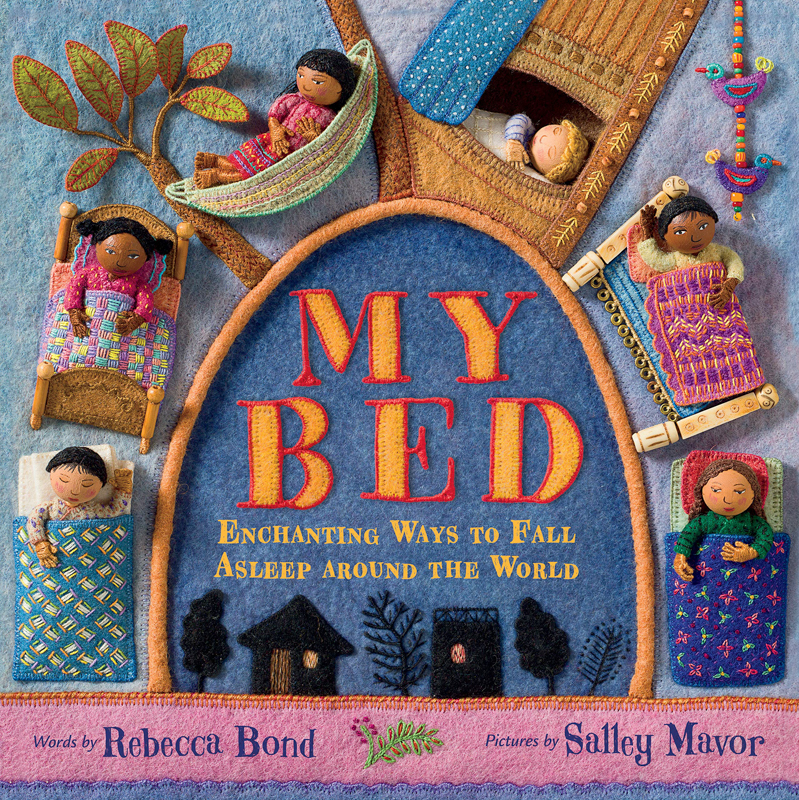
Update: Signed copies of My Bed can ordered in my shop here. Words by Rebecca Bond, pictures by Salley Mavor, published by Houghton Mifflin Harcourt.


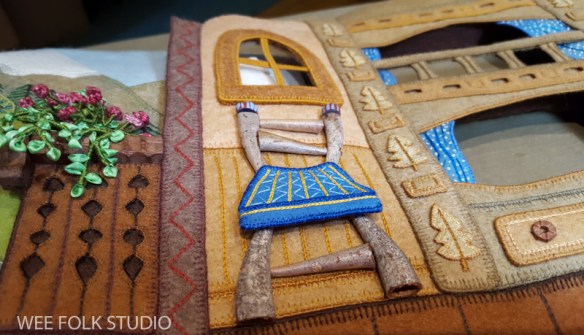
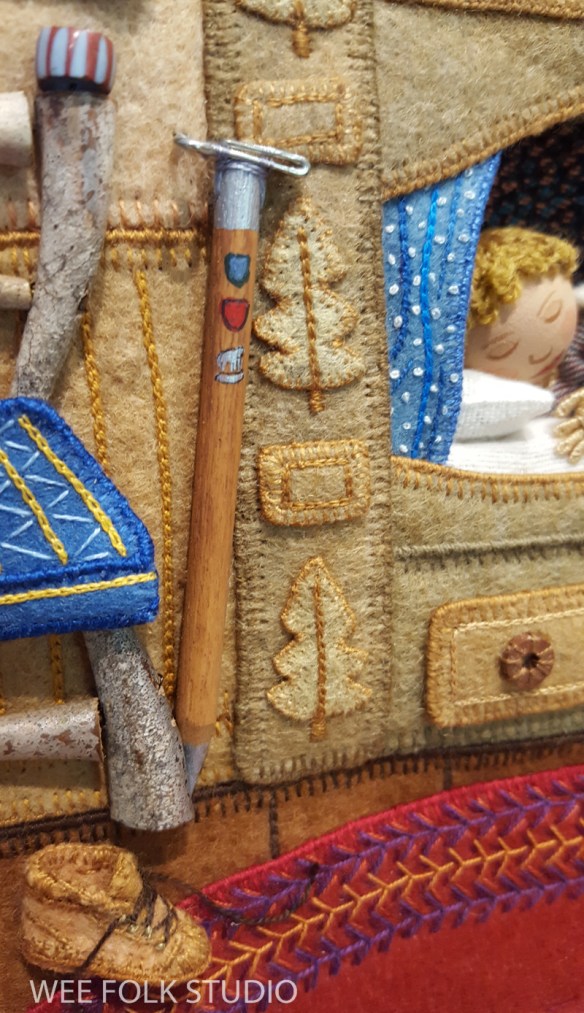
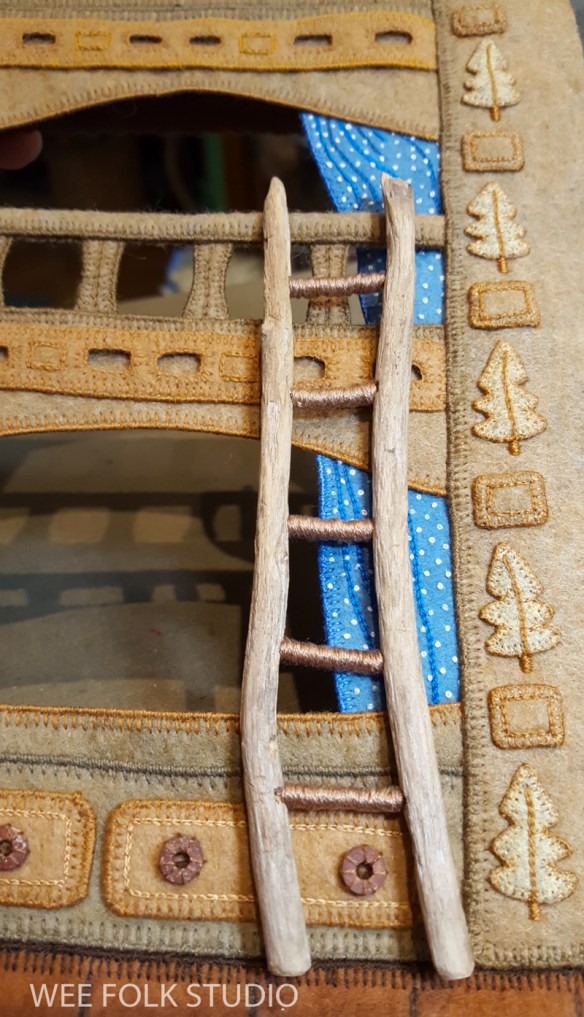
Back to this scene – The bunk beds needed a ladder, of course. To make it, I began by picking driftwood from my collection. I wanted wood with a bit of curve to it, as a relief from all the straight lines in the design. For some reason, I decided to make the ladder rungs out of wire instead of wood. Maybe I thought it would be less fragile. After attaching the wire through drilled holes, I wrapped it with embroidery floss.
In this book there are several instances where I use the space behind the backdrop layer to create more depth. In this illustration, I put the children inside their cubby beds, in a shallow space framed with a 1/2″ deep box of made of balsa wood covered with felt. I didn’t think to take a picture, but you can see what it looks like in the photo below, which is from the Holland scene.
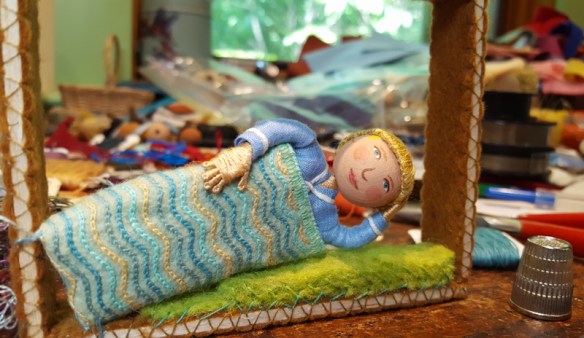
This is what it looked like before the background fabric was added to the back of the box. You can see my studio wall through the open area behind the child.

I’ve always thought that the area inside the back of the stretched fabric was wasted space. So, I’ve been figuring out ways to use it, with interesting results. I cut a hole in the stretched fabric, inserted the box and secured it in place with stitches.
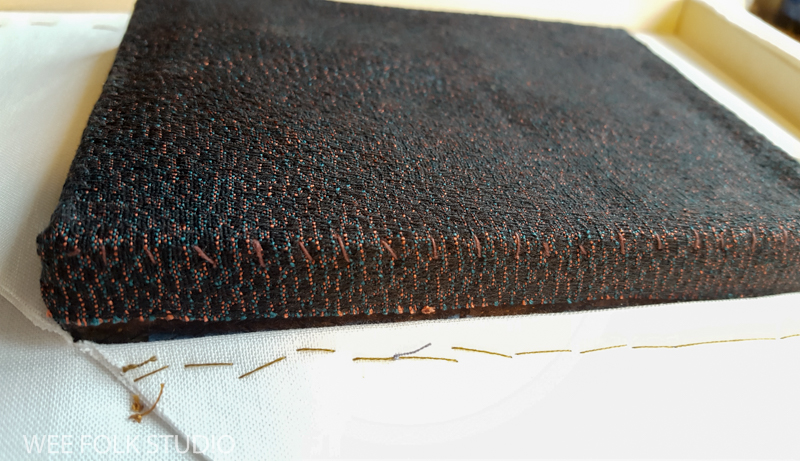
With this extra layer, the viewer has the experience of looking into the picture and entering the children’s world.

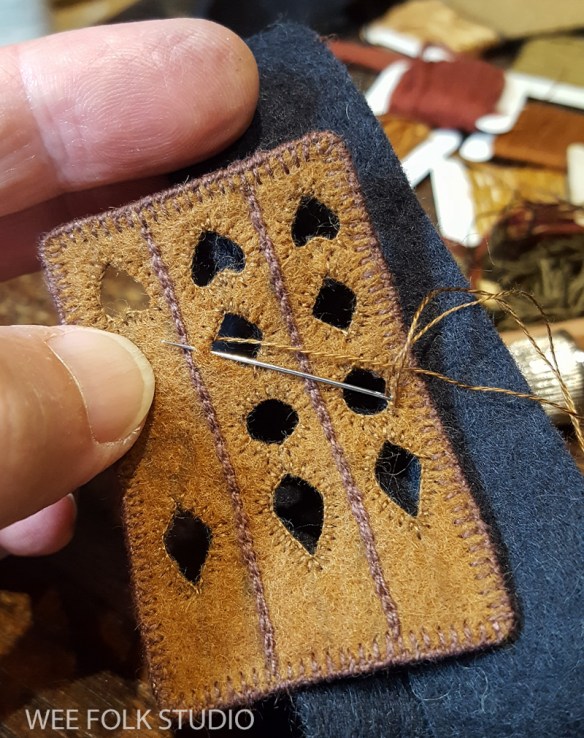
The last touch was a pair of little shoes, which show up in many styles within the illustrations in this book.
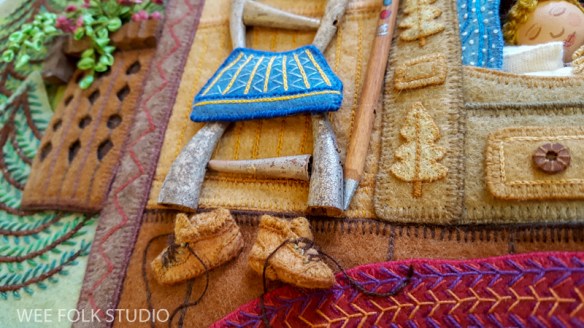
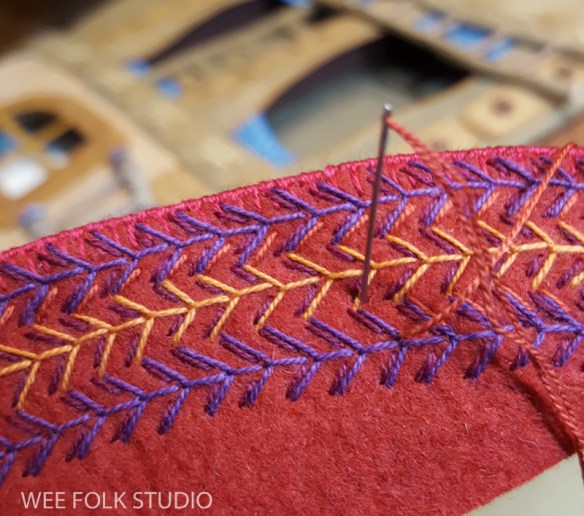
And I made a red rug for the floor. The fly stitch is turning out to be one of my favorites.
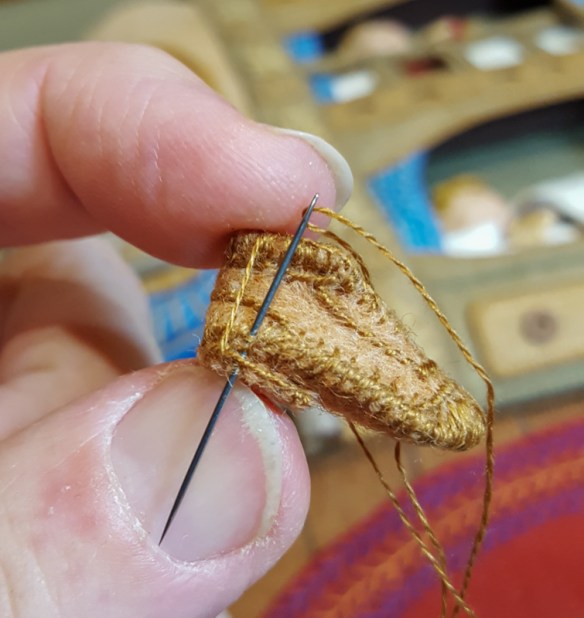
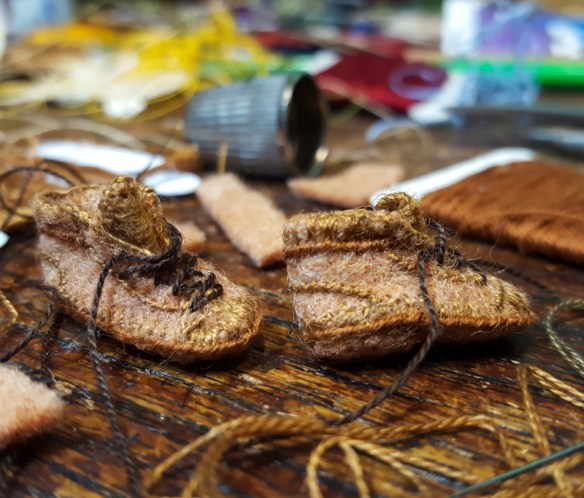
What can I say about making the hiking boots? I basically copied the structure and stitching details of real shoes, only shrinking the scale to about 3/4″.
I’m happy to say that all the illustrations are finished and will soon be heading over to the photographer and production team at HoughtonMifflin. Leading up to the book’s publication in the Fall of 2020, I will continue to share more peeks behind the scenes about making the spreads and animal icons for MY BED.

For more about making the Scandinavian scene, please look at Part 1Part 2 and Part 3.

To keep up with new posts, please subscribe to this blog. Your contact info will not be sold or shared. If you’d like to see more frequent photos tracking the projects in my studio, please follow me on Facebook and/or Instagram.
bed book peek: Scandinavia – part 3

In this part 3 of the series about the Scandinavian scene in MY BED, the children and the chair are the focus. Part 1 shows parts of the inside, such as making the framework for the cubby style bunk beds. Part 2 gives a glimpse at the what’s outside: the balcony, flowers, mountains, sun and trees.

Update: Signed copies of My Bed can ordered in my shop here. Words by Rebecca Bond, pictures by Salley Mavor, published by Houghton Mifflin Harcourt.

This illustration will be included in My Bed, a book about where children sleep around the world, with each spread depicting a different culture and living environment. The story is written by Rebecca Bond and will be published by HoughtonMifflin in 2020. Here are links to posts showing other finished illustrations for the book: South America, JapanIndiaAfghanistanRussiaNorth AfricaNorth America and Iran. To see a list of all my books, click here.

As with all of the characters in this book, I painted their features and personalities on 20 millimeter wooden beads with tiny brushes. Then, I made their wigs and bodies, using the same techniques taught in my how-to book, Felt Wee Folk: New Adventures.

This little girl has a custom made nightie, patterned with little embroidered flowers.

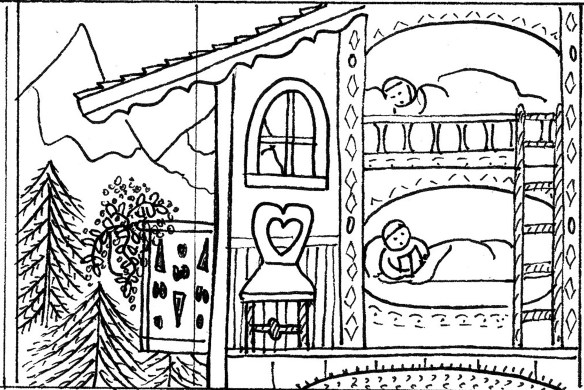
Even before threading the first needle to make the finished illustrations, I mapped out the entire book, with sketches of each page. It’s a square book, with artwork covering 3/4 of the double page spread. The remaining 1/4 page will hold the text of the story and the animal icons.

When making the parts of the scenes, I match the layouts pretty closely. Books come with certain constraints: number of pages, dimensions, titles, credits and text. Drawings serve as guides, but there are always little changes here and there to the finished illustrations. Surprises are bound to happen – that’s what keeps it fun! Of course, to do this, your editorial team needs to be supportive. You just have to be mindful of the outside measurements and avoid letting anything important get lost in the center gutter.

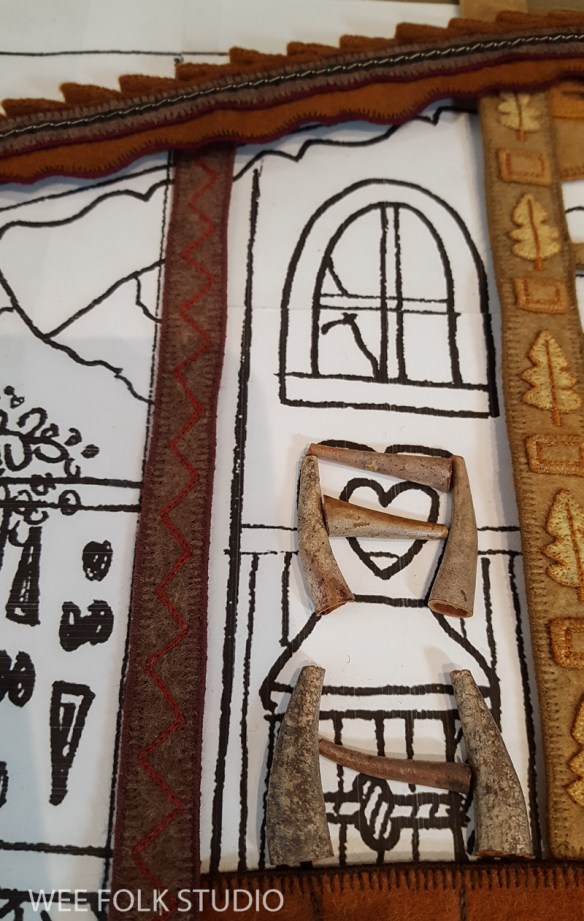
I could have made the chair in a lot of different ways, but these cactus thorns called out to me. Please don’t ask where I got them – I’ve lost track, since they’ve been in my stash for decades.

Generally, I use a combination of flat pattern and sculpture in my work, without much regard to formal perspective. In this scene, I felt that the chair seat needed to appear more dimensional than usual, so I tapered the angle, with the yellow stripes accentuating its depth.

Stay tuned for Part 4 in this series, which will show more interior details.

To keep up with new posts, please subscribe to this blog. Your contact info will not be sold or shared. If you’d like to see more frequent photos tracking the projects in my studio, please follow me on Facebook and/or Instagram.

bed book peek: Scandinavia – part 2

Let’s continue with the Scandinavian scene. Part 1 showed parts of the inside, such as making the framework for the cubby style bunk beds. This post will give a glimpse at the what’s outside: the balcony, flowers, mountains, sun and trees.

This illustration will be included in My Bed, a book about where children sleep around the world, with each spread depicting a different culture and living environment. The story is written by Rebecca Bond and will be published by HoughtonMifflin in 2020. Here are links to posts showing other finished illustrations for the book: South America, JapanIndiaAfghanistanRussia, North Africa, North America and Iran. To see a list of all my books, click here.

Update: Signed copies of My Bed can ordered in my shop here. 40 pages, 9″ x 9″, words by Rebecca Bond, pictures by Salley Mavor, published by Houghton Mifflin Harcourt. ISBN 978-0-544-94906-5

To make the balcony, I cut out holes in a piece of felt and edged everything with blanket stitch. I finish every raw edge this way to help contain the object I’m making, so that it’s less obviously made of felt. I want the viewer to take in the whole scene and be immersed in the subject, before noticing what materials I use.

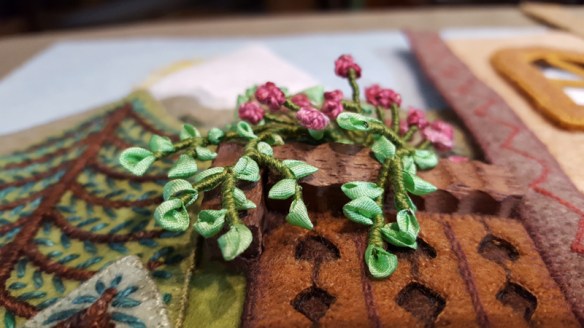
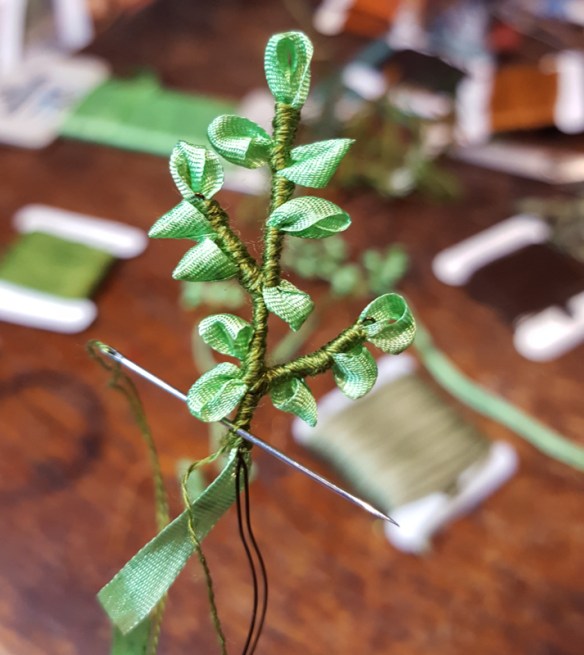
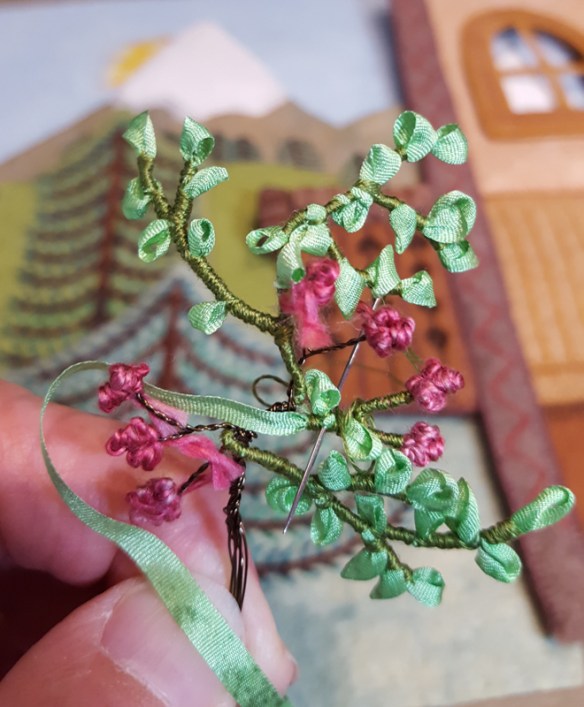
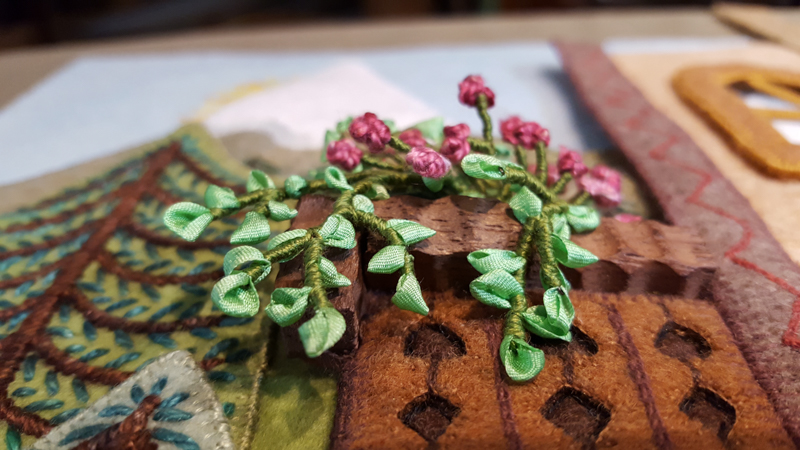
For the flowering plant, I tried something new for the leaves; silk ribbon. I will now attempt to describe how this works in steps. Keep in mind that you use one long length of ribbon to make multiple leaves. 1. Twist wire to form stems. 2. Starting at the tip, loop a silk ribbon leaf. 3. Cover wire stem and ribbon by wrapping with embroidery floss. 4. Loop more leaves down the stem, covering the ribbon and wire with floss. Yikes, this is hard to explain! I hope that you can understand the process somewhat.

The flowers are clumps of French knots stitched with pima cotton thread.

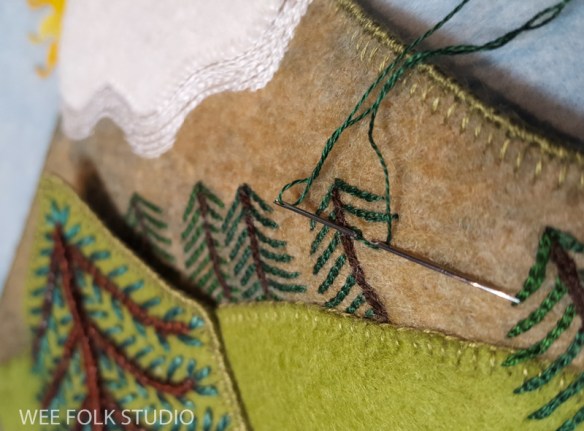
I made stylized fir trees with covered wire trunks and branches. The branches and pine needles are stitched with variegated pima cotton made by Caron.

I’ve been using wire more and more to create a raised edge or outline, like on the sun and mountain below.

And the chain stitch is becoming a favorite way of forming lines.

I sewed curtains from blue felt, chain stitching lines to look like folds and decorating with white French knots.

The whole time I worked, I referred to the drawing, making sure that the scene fit into the page dimensions, without anything important getting lost in the book gutter.

To make the window, I edged a piece of felt with blanket stitches and wire. Even with photos documenting the process, I wasn’t immediately sure how I made the window grilles shown below. I remember looping lines of thread on wire, which was similar to casting on a knitting needle. Then, I joined 2 lengths by stitching them together down the middle. The wire gives the grilles enough firmness to hold their shape after being sewn in place inside the window frame.

Stay tuned for Part 3 in this series, which will show the children and more of the interior. To see Part 1, click here.

I am happy to announce that the original illustrations for the book will tour the country after the book is published in the fall of 2020. The Cahoon Museum in Cotuit, Massachusetts will host the premiere exhibit and other venues will follow. As with Pocketful of Posies, I am scheduling a traveling exhibit, so that more people can see the “real thing”, which is a totally different experience than looking at reproductions on the printed page. Interested museums and art centers are welcome to contact me (salley at weefolkstudio.com) for information about hosting the exhibit. You can help bring the show to a place near you by reaching out to your local venues and telling them about this opportunity. It would be wonderful to have the original illustrations make their way across the whole country!   

To keep up with new posts, please subscribe to this blog. Your contact info will not be sold or shared. If you’d like to see more frequent photos tracking the projects in my studio, please follow me on Facebook and/or Instagram.

bed book peek: Scandinavia – part 1

It feels like time to share another illustration from the bed book. This one is set in Scandinavia, with children sleeping in a cubby style bunk bed. I must have made it last summer, from the look of the green leaves outside the window in the photo above, It’s hard to keep track of time because I’ve been working 7 days a week for about 2 1/2 years straight. Between the Wee Folk Players series, the animated film and this book project, it’s been a stitching marathon around here. Hey, I’m not complaining – this is what I love to do and it’s a handy excuse for getting out of social obligations. But, I’m almost finished, with just the cover to do this month. And then, I’m going to switch gears to the garden, which has 2 years worth of overgrowth!

This scene will be included in My Bed, a book about where children sleep around the world, with each spread depicting a different culture and living environment. The story is written by Rebecca Bond and will be published by HoughtonMifflin in 2020. Here are links to posts showing other finished illustrations for the book: 
Holland, South America, JapanIndiaAfghanistanRussia, North AmericaNorth Africa and Iran. To see a list of all my books, click here

Update: Signed copies of My Bed can be ordered in my shop here. Watch this 8 minute documentary about how I created the illustrations for the book.

I am happy to announce that the original illustrations for the book will tour the country after the book is published in the fall of 2020. The Cahoon Museum in Cotuit, Massachusetts will host the premiere exhibit and other venues will follow. As with Pocketful of Posies, I am scheduling a traveling exhibit, so that more people can see the “real thing”, which is a totally different experience than looking at reproductions on the printed page. Interested museums and art centers are welcome to contact me (salley at weefolkstudio.com) for information about hosting the exhibit. You can help bring the show to a place near you by reaching out to your local venues and telling them about this opportunity. It would be wonderful to have the original illustrations make their way across the whole country!   

To make this double page spread, I started with the roof, which has a string of felt shingles folded over, accordion style. Then, I got to work on the walls and bed frame in the interior.

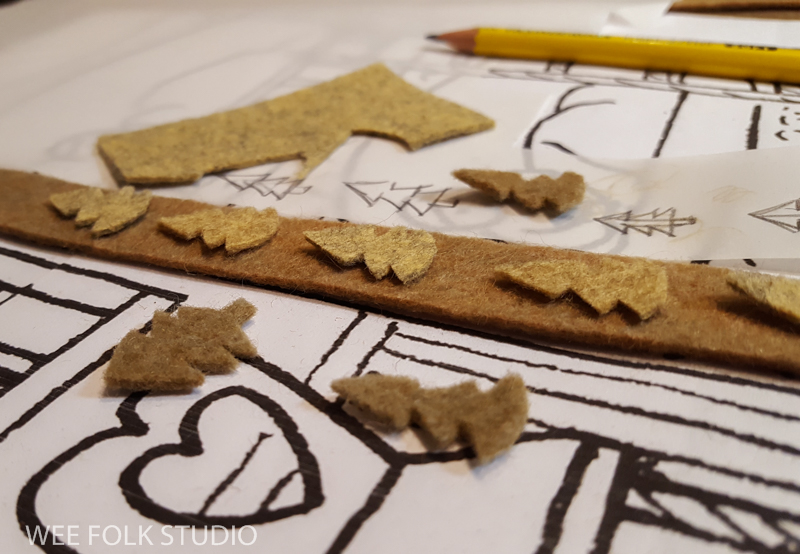
I cut out little tree shapes and edged them with blanket stitch.

There was enough variety in the brown hues to make the shapes stand out on top of the background strip. So, you may ask, “Where do you get your felt?” The stuff I use is a plant dyed, thick wool/rayon mix, that I hoarded a few years ago. Unfortunately, the business seems to be on hiatus. You can get some nice plant dyed and commercially dyed wool felt from A Child’s Dream, though.

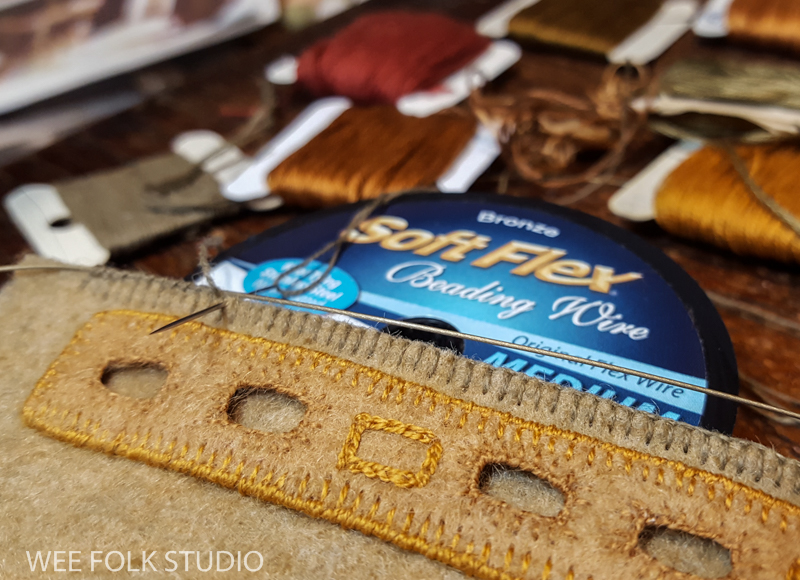
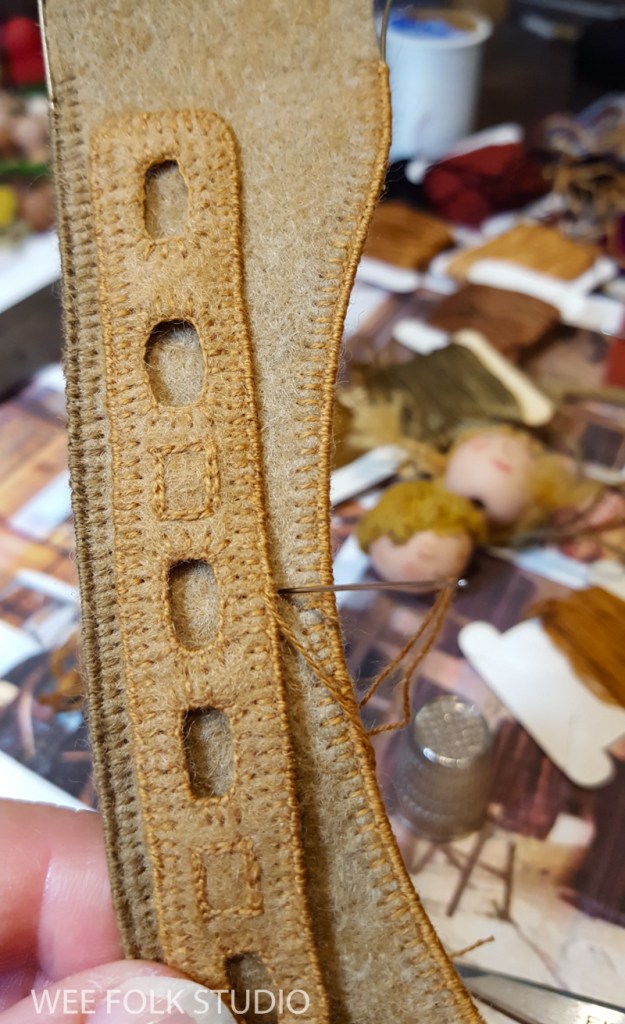
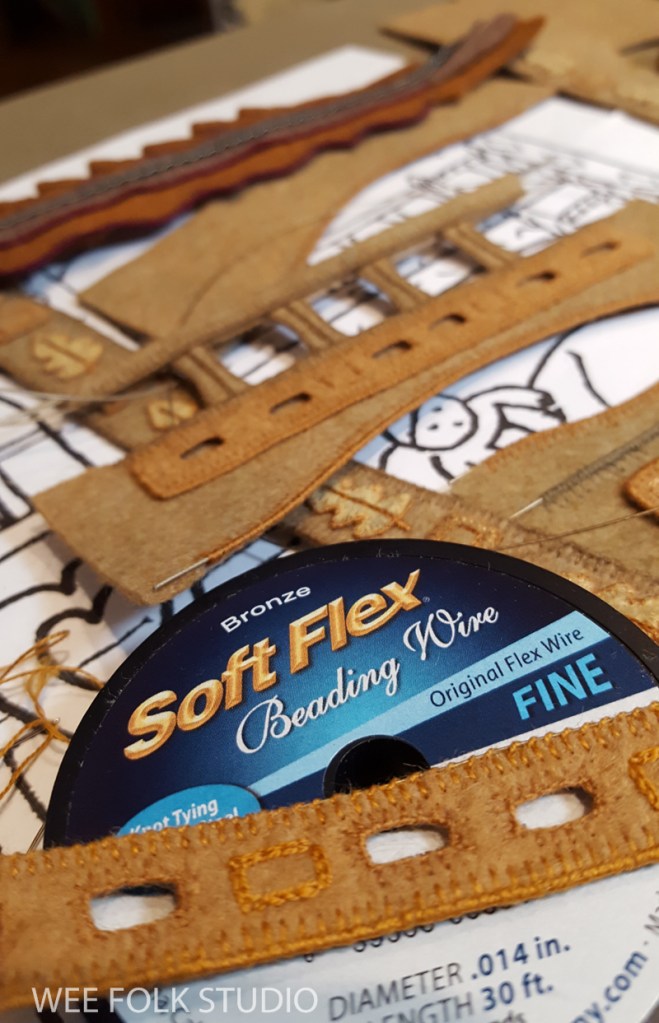
I sewed Soft Flex beading wire along the edges of the architectural details in this illustration. It adds a firmness that helps keep the felt pieces from flopping over.

Stay tuned for part 2, which will cover the exterior scenery.

To keep up with new posts, please subscribe to this blog. Your contact info will not be sold or shared. If you’d like to see more frequent photos tracking the projects in my studio, please follow me on Facebook and/or Instagram.

bed book peek : bunny

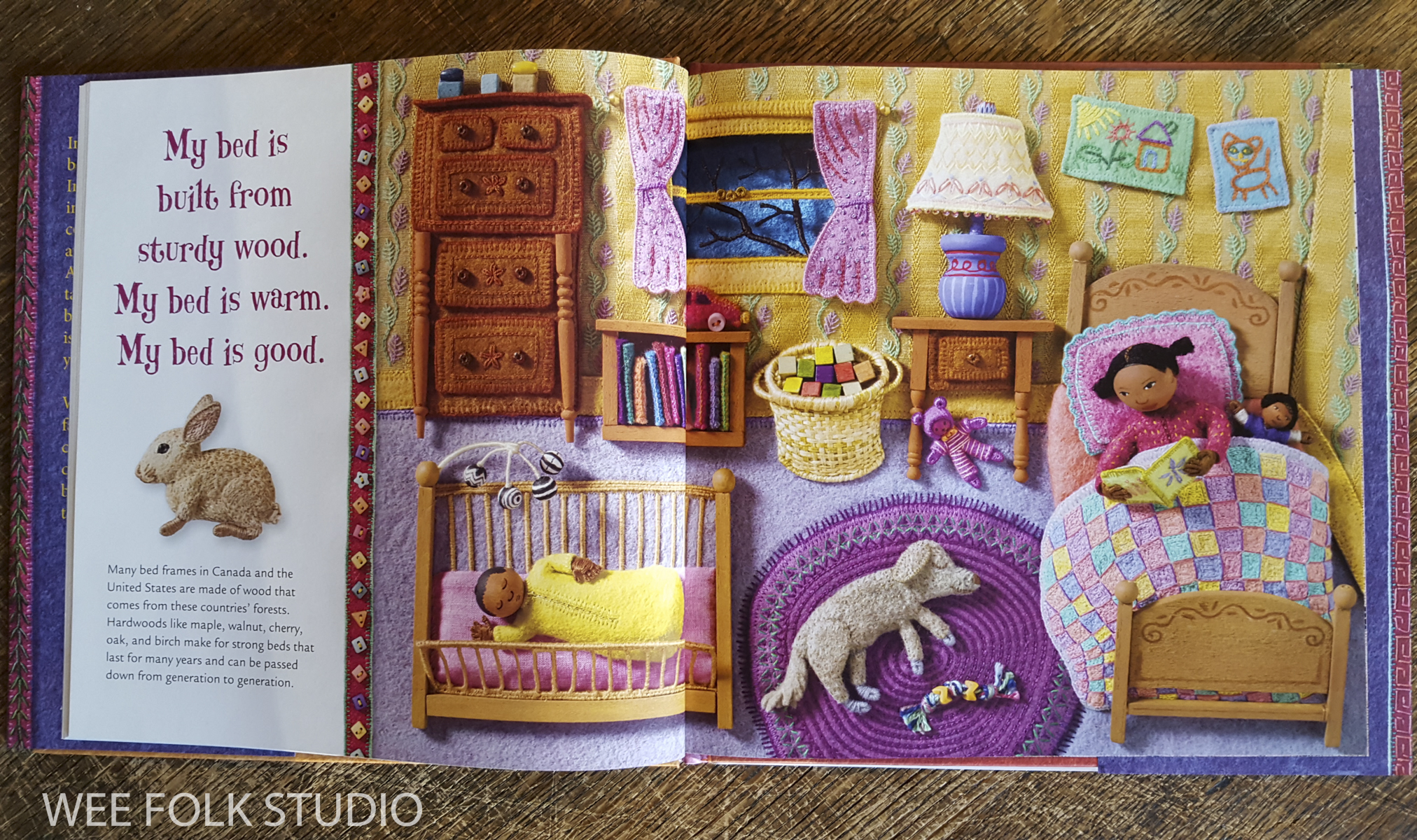
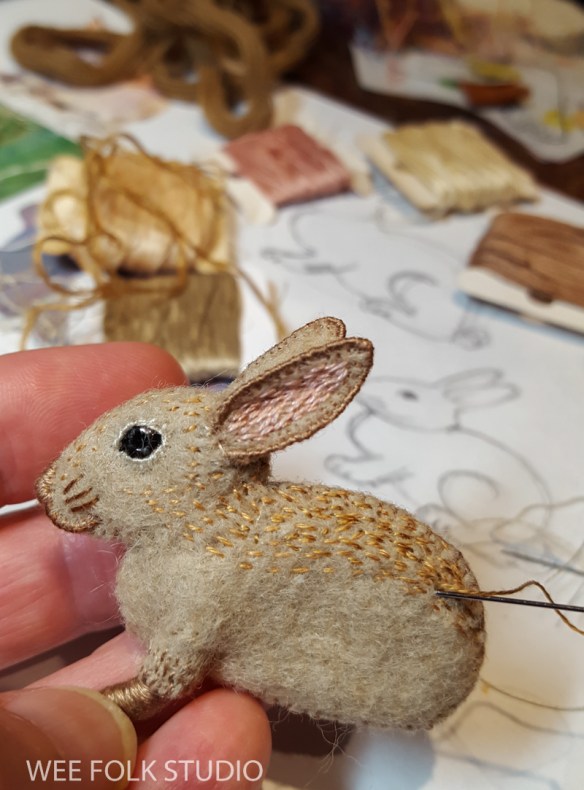
How could I resist posting a little cottontail bunny at this time of year? It will be used as a spot illustration in my upcoming children’s book, My Bed: Celebrating Children’s Beds Around the World, which will be published in 2020. Other animals in the series that I’ve written about so far are elephant and goldfish, parrot and sheep, rooster, cat, duck, crocodile, dog, giraffe and camel.

Update: Signed copies of My Bed can be ordered in my shop here. Watch this 8 minute documentary about how I created the illustrations for the book.

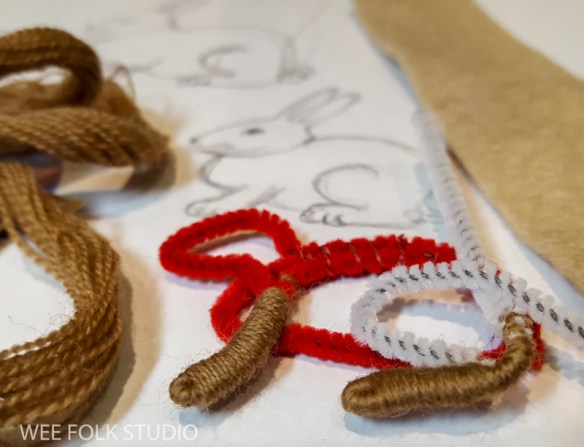
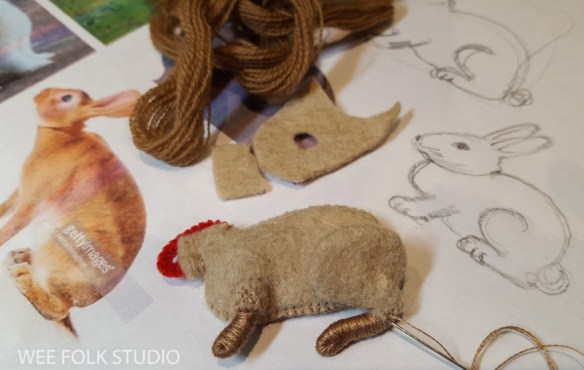
As usual, I started by researching pictures of bunnies and then making sketches to work from. I formed an outline of the animal shape in pipe cleaners and wrapped the legs. The wrapping is basically the same technique that I teach for the dolls in my how-to book, Felt Wee Folk.

The hind leg haunches are made separately. I covered the front side with wool felt and crisscrossed the back with stitches to keep it taut like a drum.

Then, I covered the body with a felt piece. I must have covered the top portion of the front leg with another small piece of felt, but I can’t remember. Each time I make something, I try different ways to do it in a non-linear fashion. That’s why it’s hard to explain the process in a step-by-step manner.

Some people think I “needle felted” the body, but I didn’t. That’s a different process that involves poking wool fleece fibers with a barbed needle. I use flat pieces of wool felt that are cut out and sewn in place. It’s fussy, but it works for me. I admit to not really enjoying the repeated jabbing motion of needle felting and would rather focus on embroidery.

The bunny’s head was made from pieces of felt, including the ears. The eye is a seed bead inserted in a cut out hole. The ears are edged with wire, to give them stability and flexibility. Details are stitched with embroidery floss.

The area between the head and body looks seamless, but there are hidden stitches underneath. They are covered with felt fibers, which I coax and smoothed over the seam with a needle. That’s the closest I get to needle felting.

Then I covered the body with little embroidery floss stitches. And lastly, I sewed the hind leg in place and added a cotton tail. Happy Easter!

To keep up with new posts, please subscribe to this blog. Your contact info will not be sold or shared. If you’d like to see more frequent photos tracking the projects in my studio, please follow me on Facebook and/or Instagram.

Bed Book Peek: North America (part 3)

In this Part 3, I will describe making all the miscellaneous elements in the children’s bedroom. Part 1 was about the little girl and her bed and Part 2 showed the baby, the crib and the dog.

Update: Signed copies of My Bed can ordered in my shop here. 40 pages, 9″ x 9″, words by Rebecca Bond, pictures by Salley Mavor, published by Houghton Mifflin Harcourt. ISBN 978-0-544-94906-5

The scene will be included in My Bed, a book about where children sleep around the world, with each spread depicting a different culture and living environment. The story is written by Rebecca Bond and will be published by HoughtonMifflin in 2020. Here are links to posts showing other finished illustrations for the book: 
Holland, South America, JapanIndiaAfghanistanRussiaNorth Africa and Iran.
To see a list of all my books, click here

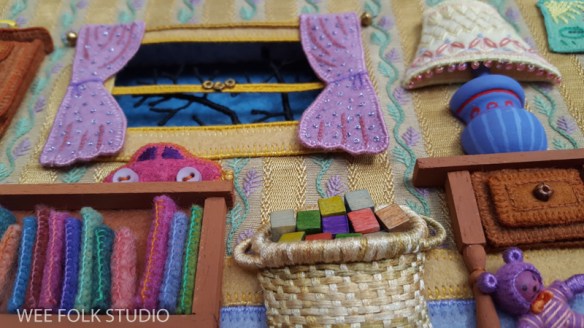
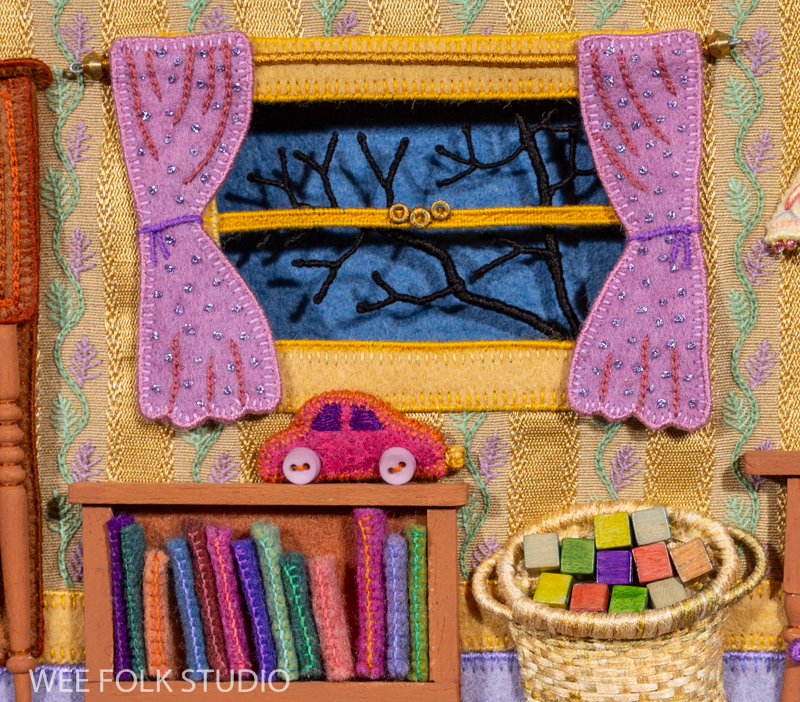
Besides making the figures, my favorite part of creating an illustration is filling the artwork with elements that help develop the characters and tell their story. Most of the spreads in this book show the children’s environment both inside and out. In this one, the wholly interior scene was an opportunity to indulge my passion for miniatures, from the wall paper to the lampshade. Making objects in relief is a lot different than rendering mini replicas of furniture for a doll house, though. Since the maximum depth I have to work with is 1 inch, everything is pretty flat and is made to look more sculptural than it really is.

The lampshade is embroidered felt, with wire stitched to the top and bottom rims for structure. I added dangling seed beads to give it some personality. As you can see, the shade is just half a circle, with the flat back sewn to the wall. The lamp is a miniature turned wooden pot that I sawed in half and painted.

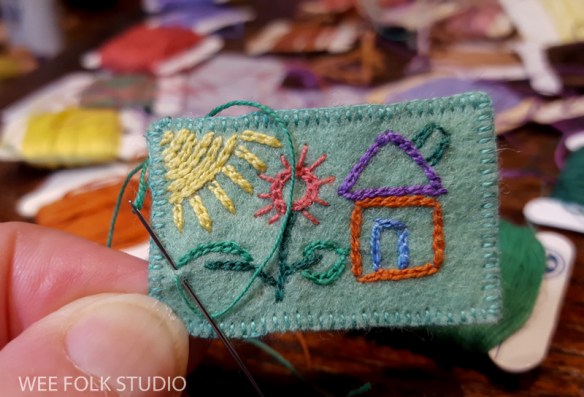
Even the kid’s drawings on the wall are embroidered on felt. Chain stitching is my go-to method for forming lines.

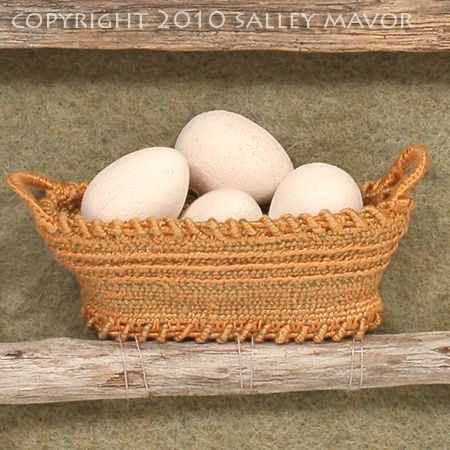
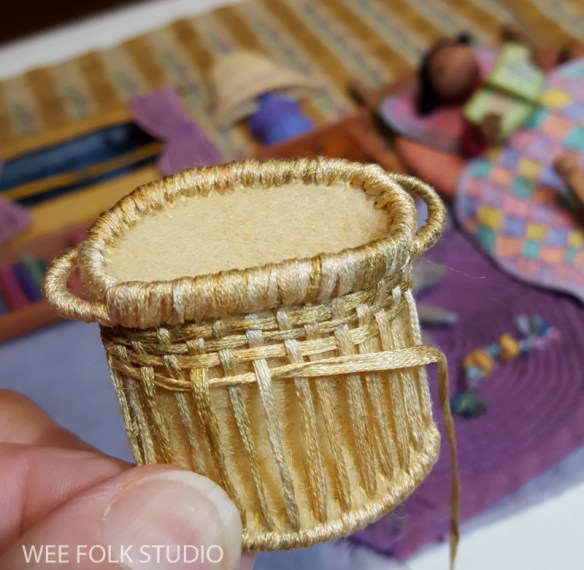
This is the first time I’ve made a basket with silk ribbon. In the past, I’ve woven them with thread wrapped wire, like the egg basket in Pocketful of Posies. Like the lampshade, it’s made in relief (about 1/2″), with a flat back. I really like the silk ribbon made by Silk Road Fibers. I used it other scenes for this book, including the palm fronds in North Africa.

I made blocks to fill the toy basket by coloring square wooden beads with different colored magic markers. It’s important to find parts with holes, so you can sew them in place. Just like with painting doll heads, I strung them on a pipe cleaner for support.

Then, I sewed the basket to the background fabric.

Through the window, you can see a thread wrapped tree branch. It’s inside a balsa wood box that I sewed in back, behind the background fabric. I’ve used this method in other scenes where I want to show receding depth. It’s a way to make use of the hidden space inside the stretcher.

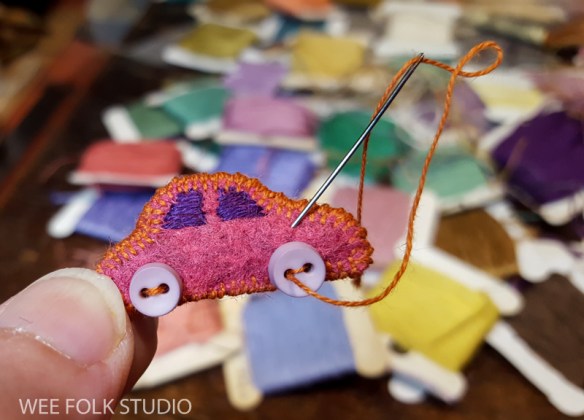
This little toy car reminded me of the pins I used to make.

I may have reached my mini limit with this purple bear.

I hope you enjoyed taking an inside look at making this scene for My Bed.
Part 1 is about the little girl and her bed and Part 2 shows the baby, the crib and the dog.

To keep up with new posts, please subscribe to this blog. Your contact info will not be sold or shared. If you’d like to see more frequent photos tracking the projects in my studio, please follow me on Facebook and/or Instagram

Bed book peek – North America (part 2)

In part 1, we were introduced to this little girl in her cozy bed and quilt. In this part 2, I will describe how I made her baby sibling sleeping in a crib and her pet dog lying on a rug. Part 3 will come next, with photos of all the miscellaneous elements in the bedroom.

Update: Signed copies of My Bed can ordered in my shop here. 40 pages, 9″ x 9″, words by Rebecca Bond, pictures by Salley Mavor, published by Houghton Mifflin Harcourt. ISBN 978-0-544-94906-5

The scene will be included in My Bed, a book about where children sleep around the world, with each spread depicting a different culture and living environment. Here are links to posts showing other finished illustrations for the book:
Holland, South America, JapanIndiaAfghanistanRussiaNorth Africa and Iran. To see a list of all my books, click here.

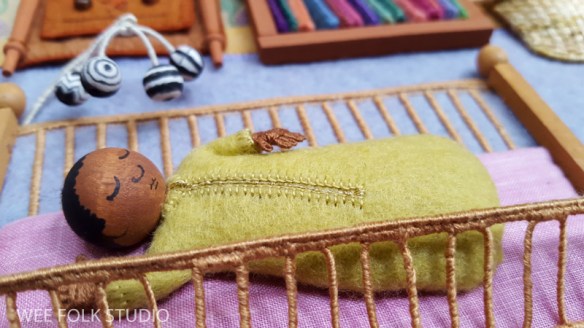
When making the baby’s head, I was faced with the dilemma of how to deal with the bead hole on top. Normally, when making a doll from my how-to book, Felt Wee Folk, the hole is covered with hair or a hat. But in this case I wanted to paint on the hair. So, I glued a small scrap of black felt inside the whole, which blended in with the painted bead surface.

I must say that it felt strange to lay the baby face up, instead of on their stomach, which is what I did in the 80’s with my kids. But, that’s what you’re supposed to do now for their safety. This is just one example of the kind of things that come up when you illustrate a children’s book.

The head, foot and bottom of the crib are made of wood, but the sides are formed with wire, wrapped in embroidery floss. I love using wire for detailed touches because it’s cooperative and strong at the same time. I’d say, when you can’t figure out how to get something to hold its shape, use wire. I use non tarnish beading wire in a variety of gauges and Soft Flex wire for straight lines or wide curves.

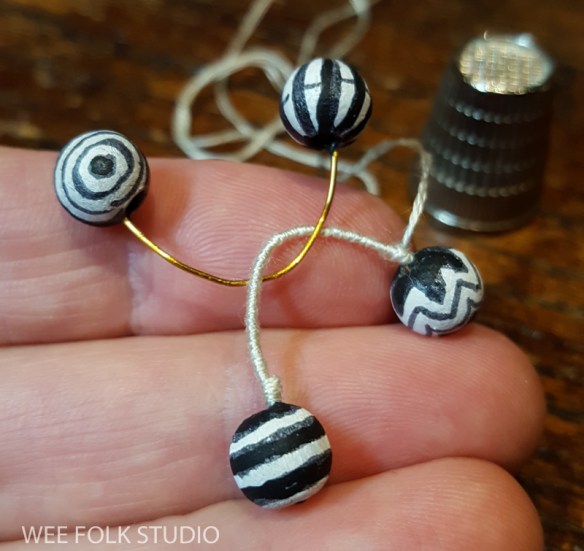
I made a black and white mobile-like contraption from beads and wire to hang over the crib. Have you noticed the black and white products for newborns? The reason is that that the sharp contrast of black and white is easier for them to see when their vision is still blurry. So much for pastels.

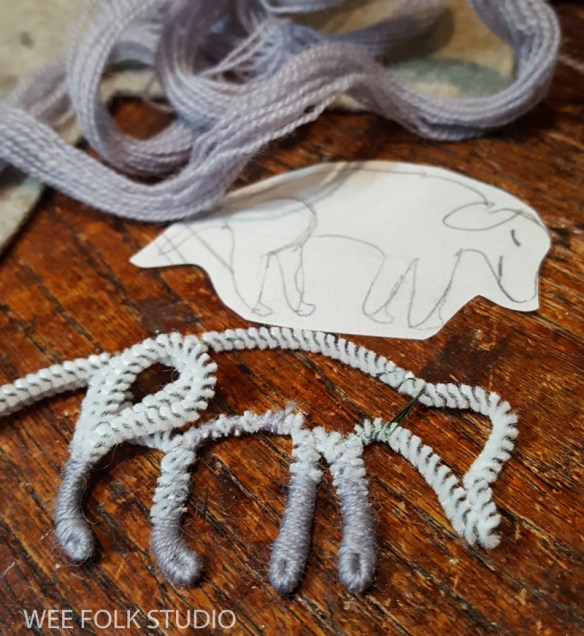
Now, let’s look at the dog making process. If you follow the other posts about animals for the book, you’ll see that I use pipe cleaners to form their basic shapes. I wrapped the dog’s legs with wool tapestry yarn, so the color and texture would blend with its wool felt body.

For my illustrations, I make all of the parts in shallow relief – characters, animals, furniture, architecture, foliage and everything. After the parts are made separately, they are arranged and sewn to a background fabric. For photographic and framing purposes, nothing should stick up more than an inch from the surface. With that in mind, this dog was made to lay flat on a rug. It didn’t have to be able to stand up or have its back viewed.

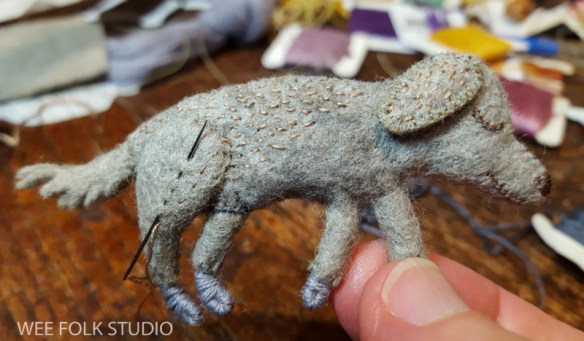
I then covered the legs and formed the body and tail with felt.

Looking at this photo, it’s hard to see how the dog’s head was attached to the rest of the body. There is a seam at the neck, but I smoothed the felt fibers a bit with a needle, to cover the stitching. The finishing touch was a stitched fur texture on its body and ears.

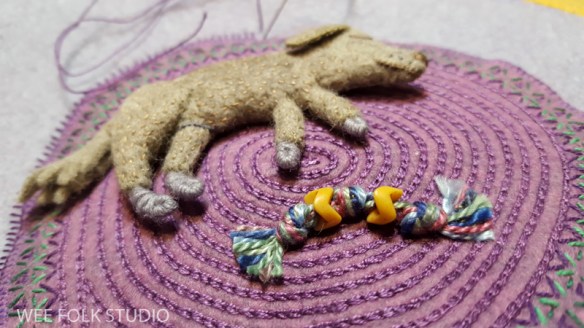
Then I stitched a circular felt rug for the dog to sleep on.

After the dog was sewn in place, I added a knotted rope chewy toy, made with beads and perle cotton. Please stay tuned for part 3, which will conclude the series and show all of the miscellaneous elements in the bedroom.

To keep up with new posts, please subscribe to this blog. Your contact info will not be sold or shared. If you’d like to see more frequent photos tracking the projects in my studio, please follow me on Facebook and/or Instagram.

bed book peek : duck

Let’s start the new year with a duck. It’ll be a spot illustration in my new picture book,  My Bed: Celebrating Children’s Beds Around the World. Each double page spread will have a text panel with a corresponding animal. The duck will appear alongside the scene with a houseboat in Holland, which you can see here.

Update: Signed copies of My Bed can be ordered in my shop here. Watch this 8 minute documentary about how I created the illustrations for the book.

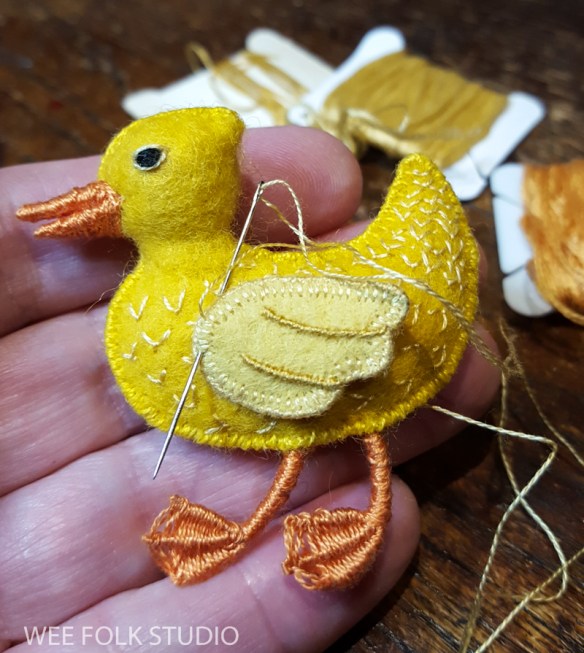
As with the other animals I’ve made so far (elephant and goldfish, parrot and sheep, rooster, cat, camel and bunny. I start with research photos. In this case, I searched for pictures of a classic rubber ducky, with webbed feet. I was so interested in figuring out how to make the feet, that I tackled them first. That turned out to be a mistake because they ended up being too small and out of proportion to the body that came later.

The duck is a good example of how I really work, which is not in a straight line, but here, there and everywhere. My creative process is full of experiments that may or may not end up in the finished piece, but they are essential to getting there.

The second pair of feet (pictured below) are a little bit larger and more neatly defined. It’s not unusual for me to take several tries to get something the way I imagine it. There’s a lot of ripping out and starting over, which is one of the advantages of using thread. For the feet, I devised a kind of weaving stitch that created the webbing between the 3 toes.

The body and wing are made of 2 shades of yellow felt.

The beak was a bit tricky to get to look right and took several attempts. It started with a thread wrapped piece of wire that’s bent into two V shapes for the top and bottom of the beak.

I then stitch the thread wrapped wire onto the head. The round shape of the head is from a wooden bead that is covered with felt, which I forgot to document with a photo. I wasn’t happy with how this beak (below photo) was coming out, so I ripped it out and started over.

I’ve had practice making bird beaks for the Birds of Beebe Woods and the Twitter Bird in my animated film, Liberty and Justice, but it’s like a new experience every time. When faced with a new challenge, I let my hands guide me, trusting that a solution will appear. That’s what keeps it interesting and never boring!

This is the second try at forming the duck’s beak.

After stitching the top and bottom beak in place, I wrapped thread around the wire. I then added a seed bead eye and stitched on the wing.

It looks like I opened up the bottom of the duck’s body to make room for it’s legs. They were the last to stitch in place, with the first pair lingering in the sidelines.

After looking at the duck for a while, I decided that it need more personality. The plain rubber ducky look just wasn’t enough! So I added some details, like the embroidered feather texture and the distinguishing lines on the wings.

To keep up with new posts, please subscribe to this blog. Your contact info will not be sold or shared. If you’d like to see more frequent photos tracking the projects in my studio, please follow me on Facebook and/or Instagram.
Bed Book peek – Holland (part 3)

This is the third and final post about making the book illustration with a houseboat on a canal in Holland. To see other posts about this scene, go to Part 1 and Part 2. Eventually, all of the sewn originals will be photographed and printed in MY BED, a picture book about where children sleep around the world. Each spread will depict a child in a different culture and living environment.

Update: Signed copies of My Bed can ordered in my shop here. 40 pages, 9″ x 9″, words by Rebecca Bond, pictures by Salley Mavor, published by HarperCollins. ISBN 978-0-544-94906-5

Here’s a list of links to posts showing other finished illustrations for the book: 
AfghanistanRussiaNorth AfricaSouth AmericaIndiaJapan and Iran. To see a list of all my books, click here.

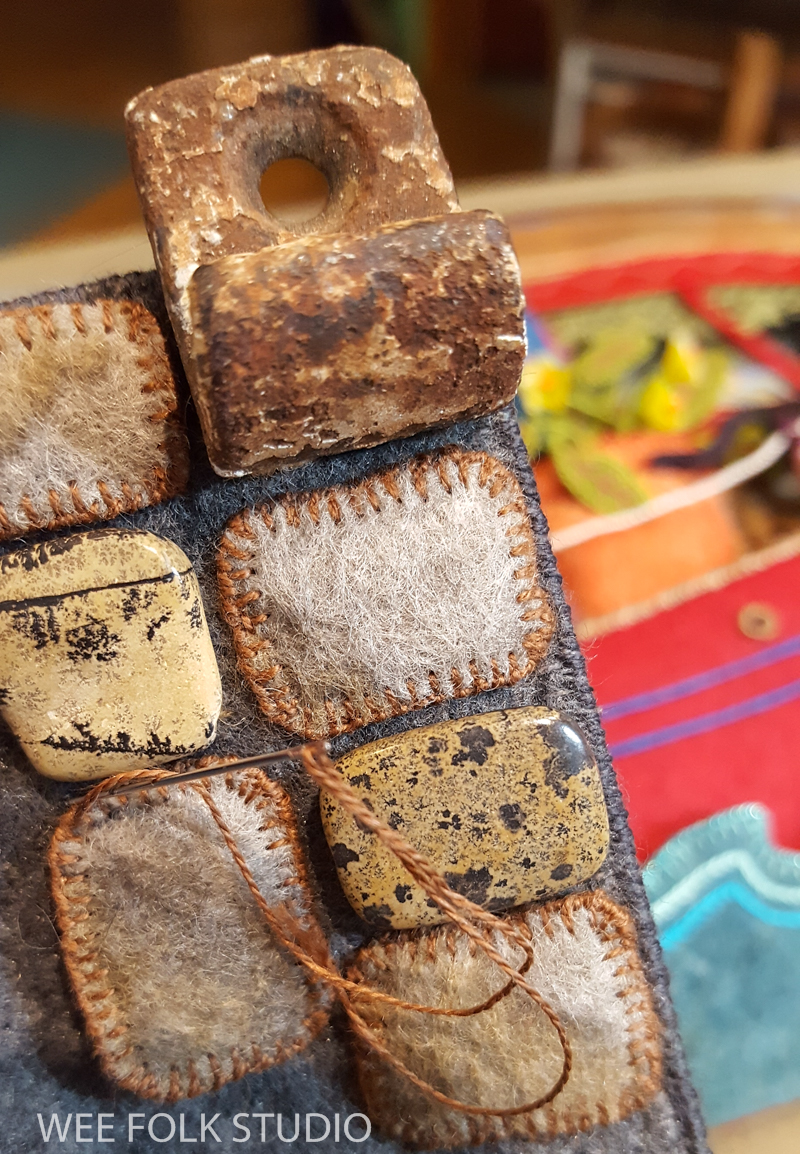
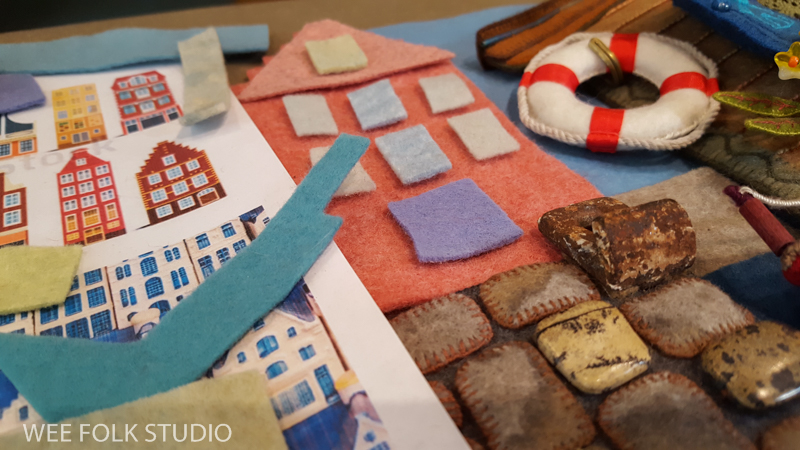
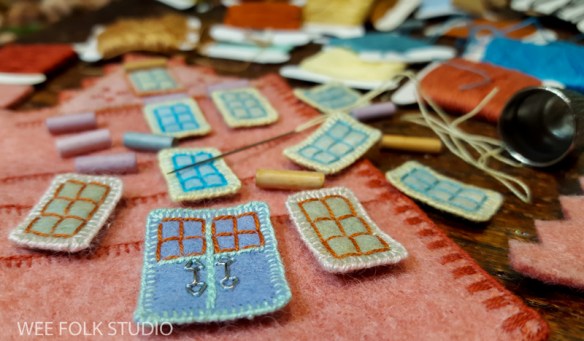
For the stone dock, I sewed felt rectangles in place with blanket stitch, interspersed with flat polished stone beads. There needed to be something to tie the boat line to, so I looked through my collection of miscellaneous old metal objects and picked an appropriately weathered looking one with a hole. How was that attached, you may wonder? I glued a piece of felt on the back of the metal piece and then sewed it to the dock.

I glued felt to the back of the object, instead of directly to the background. That way, you can play around and adjust things until the last minute. The glued on felt provides something to catch the thread when you do sew it in place. And it’s always possible to rip it out and try a new position.

The architecture in Amsterdam is a colorful array of tall narrow buildings with interesting roof treatments.

I embroidered blanket stitch with flower thread around the outside of the felt windows and a door. DMC flower thread is no longer available, but Dutch Treat Designs  has some of the discontinued thread  in stock. 

From the images I found, the stepped roof style looked the most distinctively Dutch. I like the way its zigzagged shape stands out against the blue sky. The research photos made me want to visit Amsterdam!

For door hardware, I sifted through old hooks and eyes, until I found a matching pair of the tiniest eyes. A generous admirer recently gave me a box full of them – what a treasure! 

Tube beads worked as architectural details above the windows.

And how can you make a scene set in Holland without a bicycle? 

The bicycle frame is wire, the wheels are betel nut beads, the handlebars are an eye (from hook and eye) and the seat and gears are metal snap parts. In the photo below, you can see what it looks like in the back, with wire and thread holding everything in place.

I found a cord that looked like a well used dock line and fed it through the hole in the metal part on the canal wall.  Then the houseboat could be tied up safely.

I hope that you enjoyed this little peek behind the scenes at making the illustration with a houseboat on a canal in Holland. To see other posts about this scene, go to Part 1 and Part 2

To keep up with new posts, please subscribe to this blog. Your contact info will not be sold or shared. If you’d like to see more frequent photos tracking the projects in my studio, please follow me on Facebook and/or Instagram.
Bed Book peek: Holland (part 2)

Back for another peek behind the scenes at making an illustration with a house boat located in Holland. To see Part 1, click here. The scene will be included in My Bed, a book about where children sleep around the world, with each spread depicting a different culture and living environment.
Here are links to posts showing other finished illustrations for the book:
South AmericaJapanIndiaAfghanistanRussia, North Africa and Iran.

Update: Signed copies of My Bed can ordered in my shop here. 40 pages, 9″ x 9″, words by Rebecca Bond, pictures by Salley Mavor, published by HarperCollins. ISBN 978-0-544-94906-5

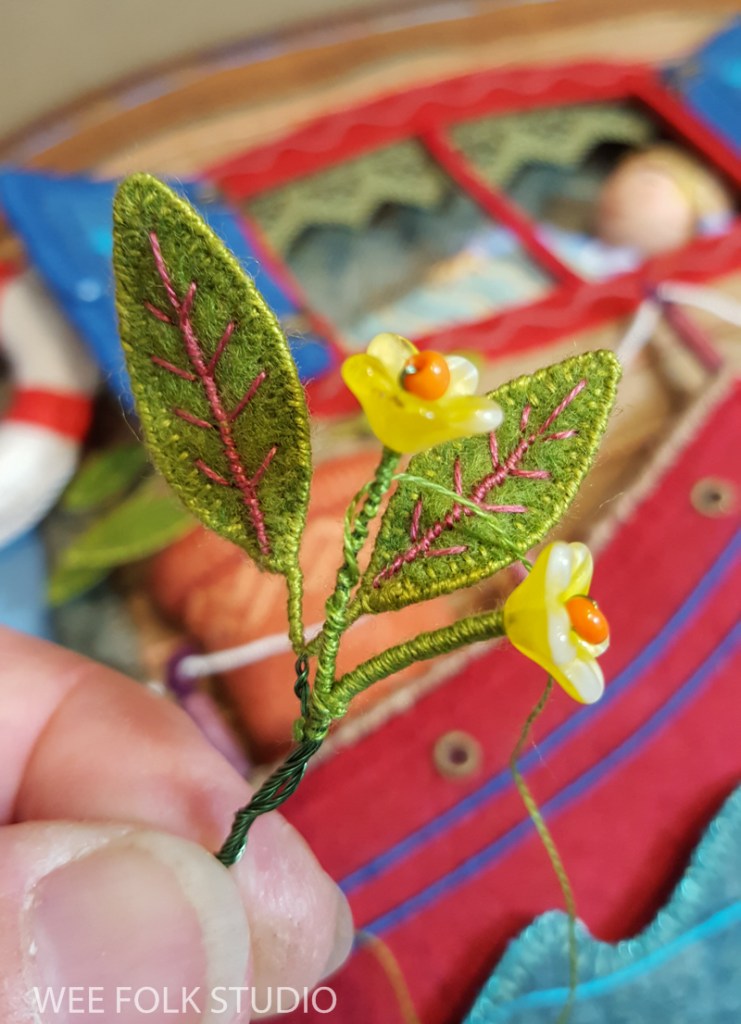
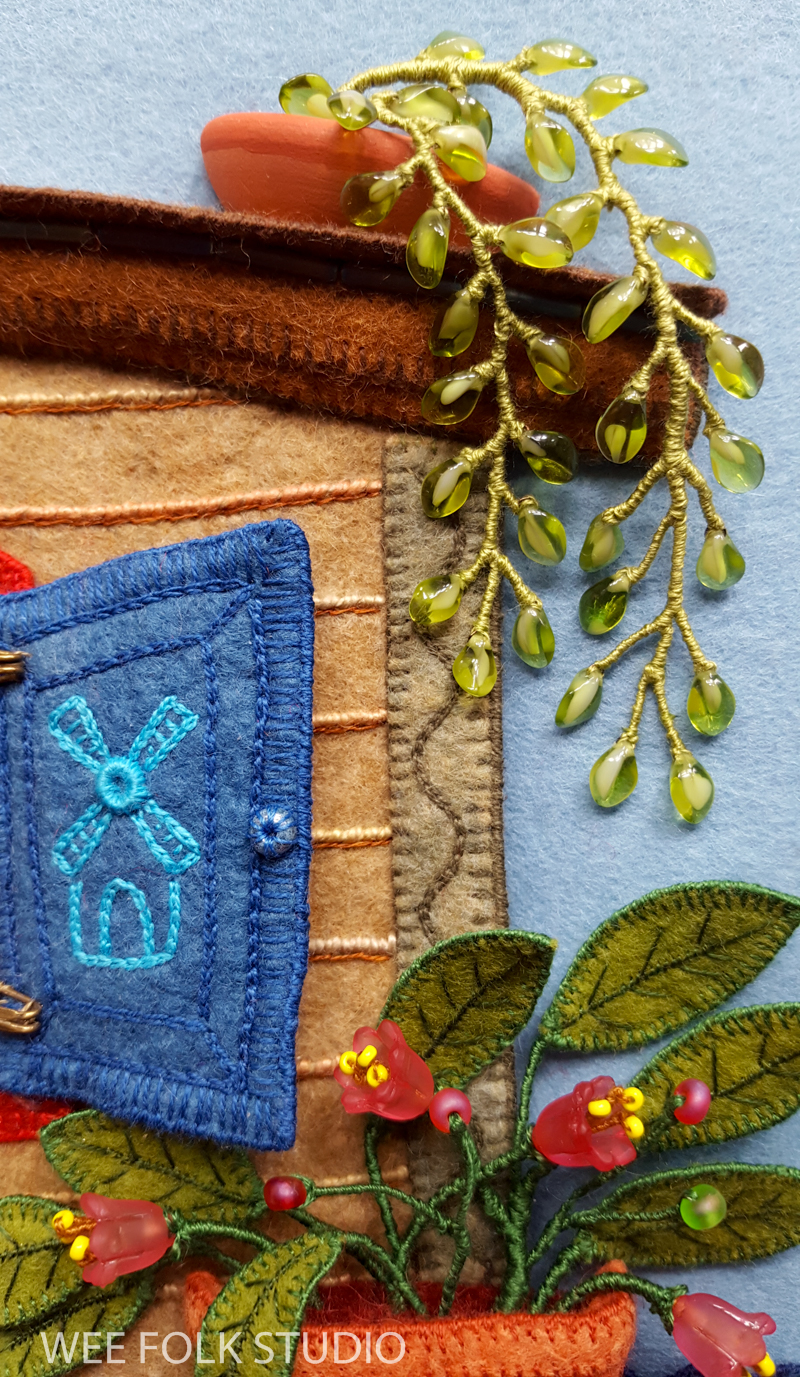
In the research photos of house boats, it seemed that practically every example showed potted plants on deck. So, I constructed little “terracotta” containers out of felt and made flowering plants with beads, felt and wire.

Wrapping wire with a single strand of embroidery floss is tedious work, but a satisfying process for those of us who are detail obsessed. The leaves also have wire around the outside edge, which makes it easier to position and arrange the plant in the end.

These glass leaf beads have spent years packed away in bags and boxes, waiting for a chance to be useful.

They were the perfect size and color for a hanging plant resting on the house boat roof.

And what house boat doesn’t have a cat? I made a felt hood to put over its wooden bead head, kind of like a Halloween costume with ears. I added wire along the outside edges of the ears to make them extra pointy and firm. Sometime felt is too soft and floppy and needs a little cartilage to hold its shape.
The body frame is made with thread wrapped pipe cleaners, just like the legs and arms in the human dolls in my how-to book, Felt Wee Folk.

After adding a felt body, I sewed the cat to the deck at the bow of the house boat, where it keeps a lookout.

Please stay tuned, because there’s more to come in Part 3. To see Part 1, click here.

To keep up with new posts, please subscribe to this blog. Your contact info will not be sold or shared. If you’d like to see more frequent photos tracking the projects in my studio, please follow me on Facebook and/or Instagram.