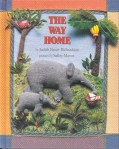
Continued from The Way Home (part 2)
About 6 months after our visit to New York, I received a telephone call from Phyllis Larkin at MacMillan. I remember being confused because her tone and inflection didn’t match the words she was saying. She was telling me in a slow, flat voice the most exciting news- that she would like to publish The Way Home!
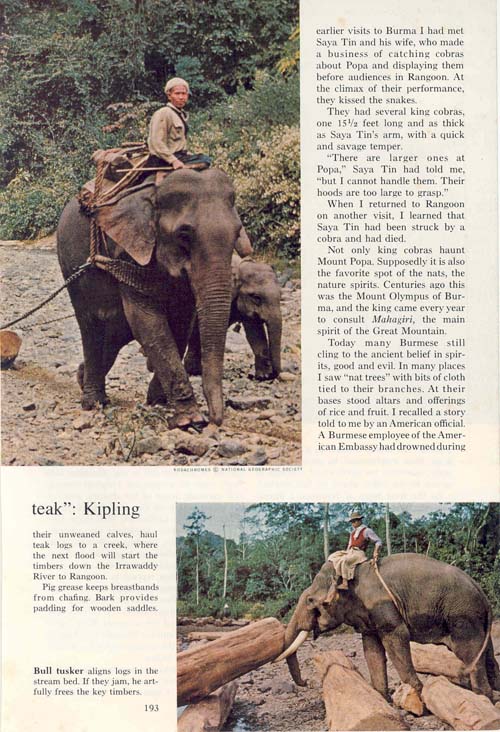
National Geographic article on elephants
Of course, I could hardly believe it and when she asked how long I needed to sew the illustrations, I guessed “one year” on the spot, because I thought any longer might make her change her mind. Now that we had made it over the hurdle and sold our idea to a publisher, I needed to figure out how to bring all of the different elements of the story together in a series of pictures. Referring to National Geographic, I did sketches of elephants and noticed that African and Asian elephants have different shaped ears. When consulted, Judy thought that hers were Asian elephants.

sketches for “The Way Home”
In my imagination, I saw the drama of the story unfolding against the back drop of a landscape changing from day to night, like puppet show scenery, slowly scrolling from left to right.
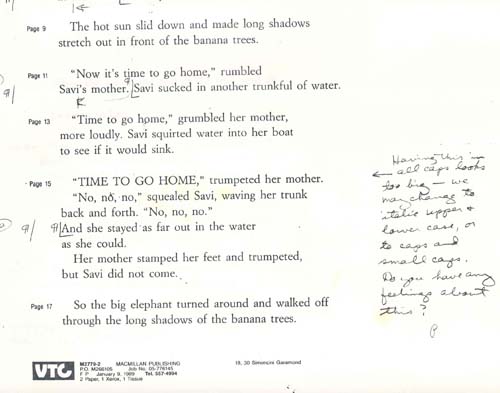
editing the manuscript
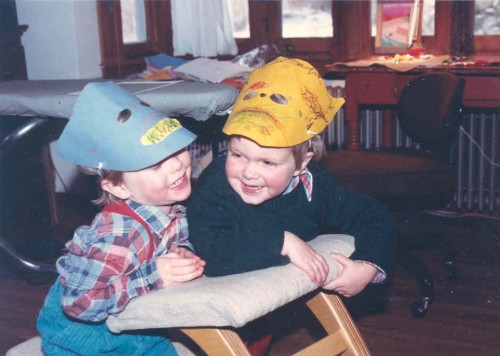
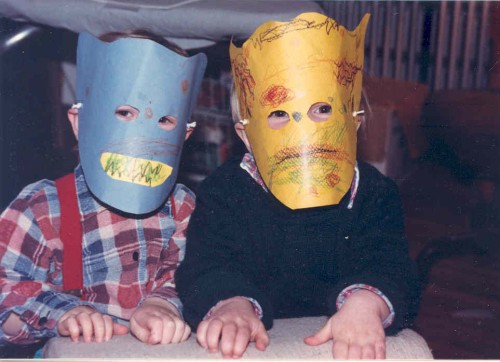
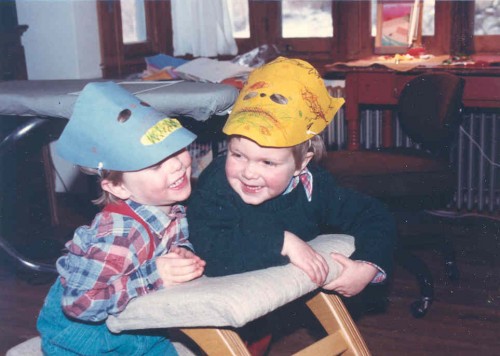
Ian and his friend Sam in my studio, 1988
Judy edited the manuscript and I worked on the book whenever I could. The advance payment wasn’t enough to pay for daycare, so I figured out other ways to set aside time to work. I would spend a few hours stitching every evening, after the boys were read to and put to bed. During the day I was part of a coop arrangement, where I’d watch 2 other boys one morning a week and mine were taken care of 2 mornings. This picture shows Ian and his friend Sam in my studio wearing monster masks.
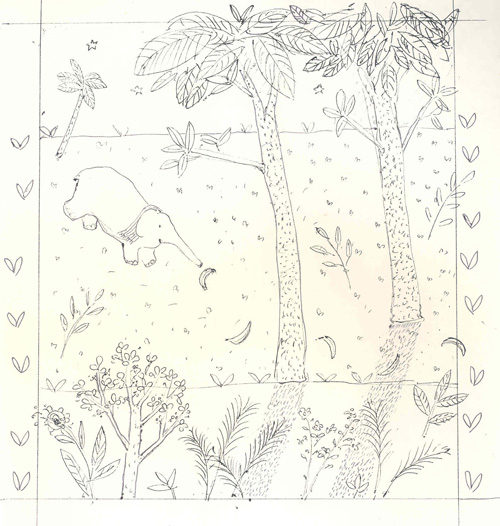
early drawing of Savi following banana trail
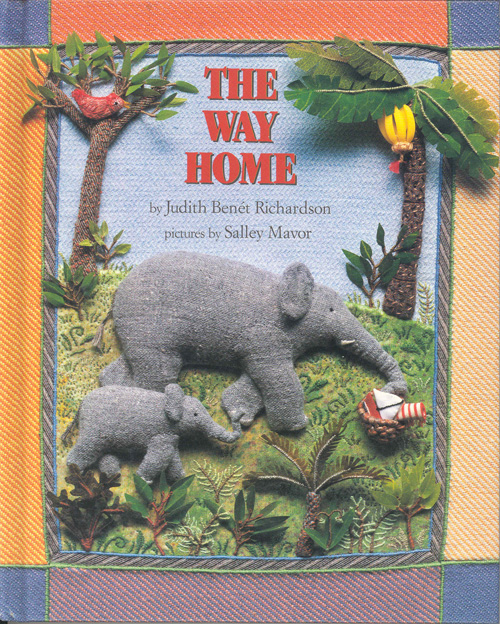
Somehow, I pieced together enough time to make progress and the pages started to take shape. In the beginning, I figured out what fabrics to use for the background, elephants and borders. I found a shirt of my husband’s to use for the elephant’s bodies. The gray Indian cotton was the perfect shade and texture.
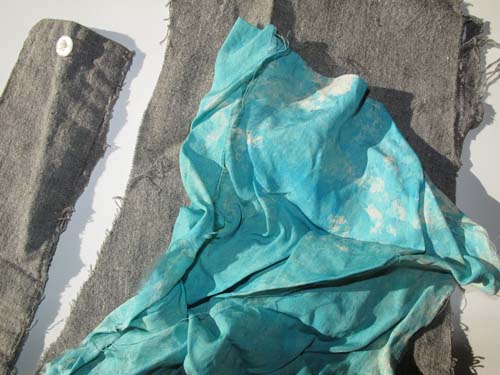
Indian cotton shirt and dyed silk
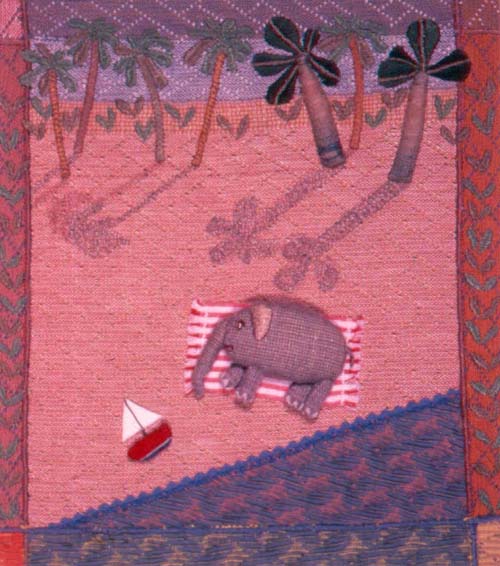
I cut a piece of silk from my grandmother’s old nightgown to use for the water and then dyed it turquoise with a spray bottle. The silk was crumpled up when I sprayed the dye, so some areas were left white, making a foamy, wavy pattern.
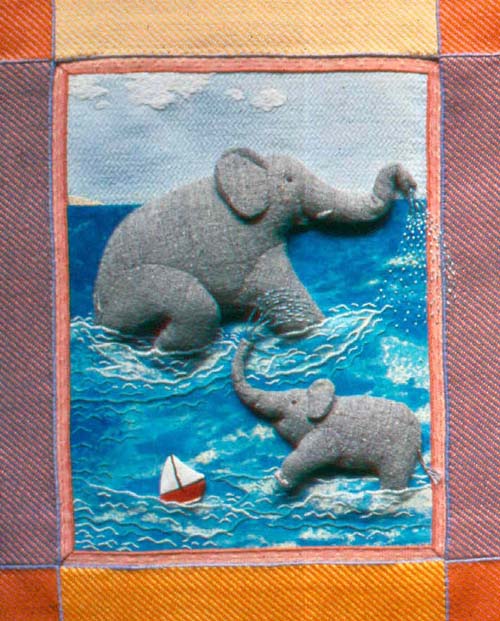
The Way Home, page 4
I ripped out the seams of an old, faded pair of my son Peter’s overalls. There was exactly enough fabric to use for each section of sky. I dyed the light blue pieces sunset pink and then graduated shades of dark blue. For the night sky on the last pages, I used a midnight blue colored wool.
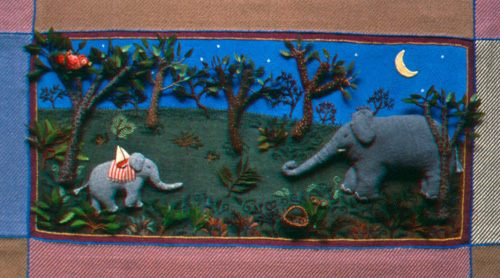
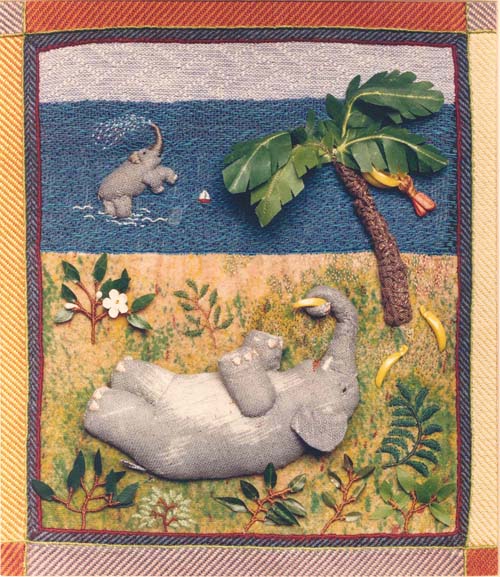
The Way Home, pages 26/27
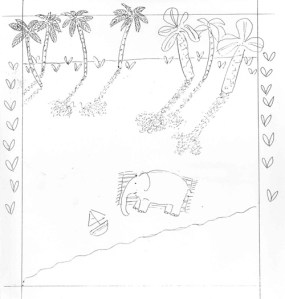
The beach was made of a bumpy piece of raw silk, which I dyed green in the grassy areas. I redid the same scene that I’d made as a sample, matching the fabric with the other illustrations.
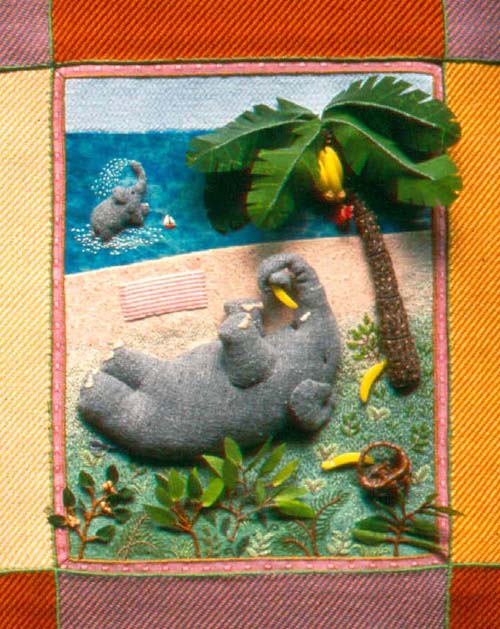
The Way Home, page 6
There were logistics to figure out, like how can an elephant carry a towel and toy boat, while leaving her trunk free to pick up bananas? I ended up tucking Savi’s boat into her folded towel, which she carried on her back. I also gave the mother a basket to carry bananas. Cecilia Yung, the art director and I corresponded about the book layout.
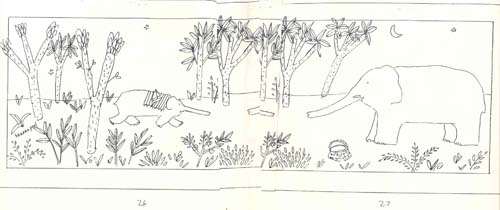
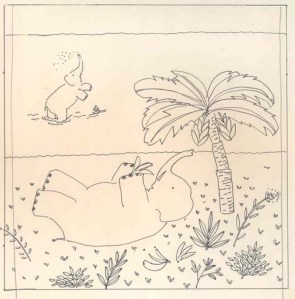
sketch for The Way Home pages 26/27
She sent detailed letters, going over every page. She pointed out things that I didn’t think about like allowing enough space for the dedication and copyright information. Her comments focused on making the elephants’ world consistent throughout the book. She reminded me to pay attention to the position of props like the boat and towel and keep the sun’s direction constant. She wrote, “Make sure shadows lengthen steadily in the same direction and of course colors should shift to reflect the sunset and night sky.

The Way Home, pages 22/23

The Way Home, page 14 sketch
There were so many details to consider for such a simple story! I thought about all the smart, observant children out there, who would see my mistakes and write the publisher with their corrections. Then I remembered that the book was aimed at preschoolers who can’t write yet. I then asked myself, “Don’t the littlest ones deserve the best quality books?” At the end of a letter, Cecilia wrote, ” We realize this is a tremendous amount of work for your first book, so do call if you have questions. We’ve very excited about The Way Home and will be glad to help.”
To be continued in The Way Home (part 4).
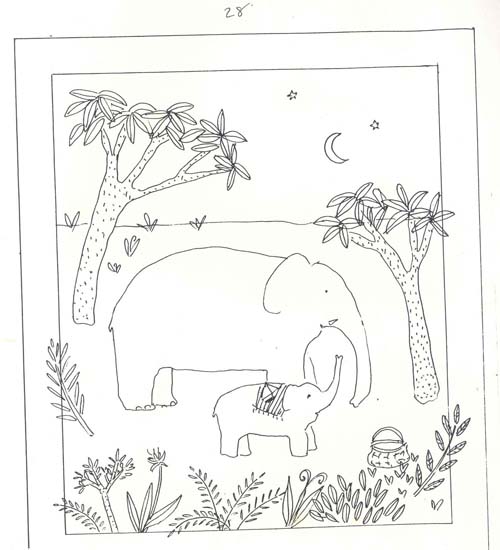
sketch, The Way Home, page 28
To keep up with new posts, please subscribe to this blog. Your contact info will not be shared. If you’d like to see more frequent photos tracking the projects in my studio, please follow me on Facebook and/or Instagram.








 SALLEY MAVOR