This post picks up where I left off in Part 1 of the series about the scene set in Russia. I’m working on a picture book that will depict a variety of cultures, each with their own style and decorative tradition, from textiles to furniture to architecture.
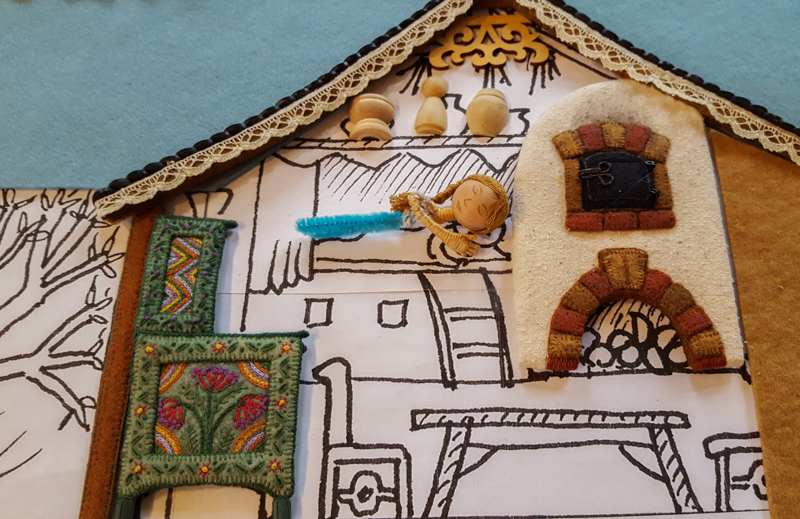
From the start, I wanted to feature painted furniture in the Khokhloma style, which is like Scandinavian tole painting. After doing some research, I designed a floral and striped pattern for a cabinet.
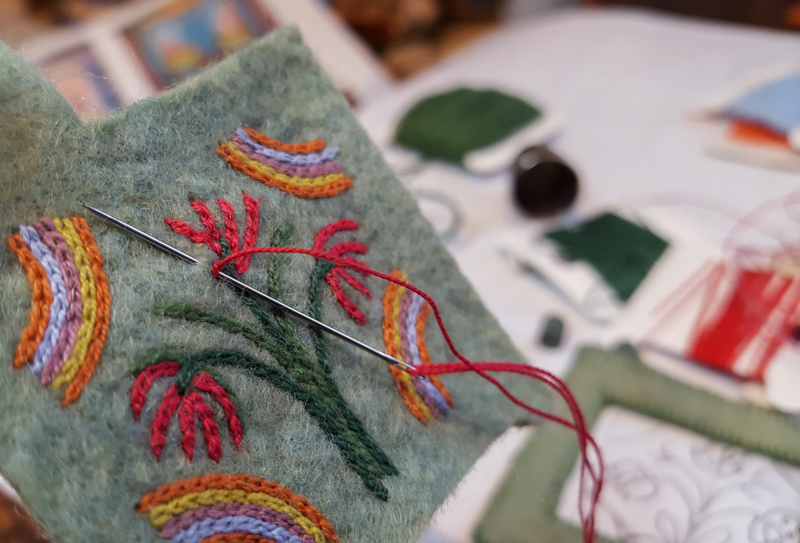
Lately, I’ve been using chain stitch more than ever to “draw” lines. This felt panel is embroidered with DMC flower thread, which unfortunately has been discontinued. It’s thicker, not as shiny as regular embroidery floss and has a sturdy feel that I find satisfying. I treasure my supply of flower thread and have enough to last a while longer.
Update: Catriona from Dutch Treat Designs contacted me to say, “We still sell DMC Flower Thread. We have available for purchase almost 1/2 of the colors DMC made. DMC discontinued the manufacture of their 180 colors of Flower Thread in 2003. We bought the remaining inventory from a large DMC distributor, and offer those colors here for your convenience to purchase while they last. We don’t have every color, but we have many of them.”
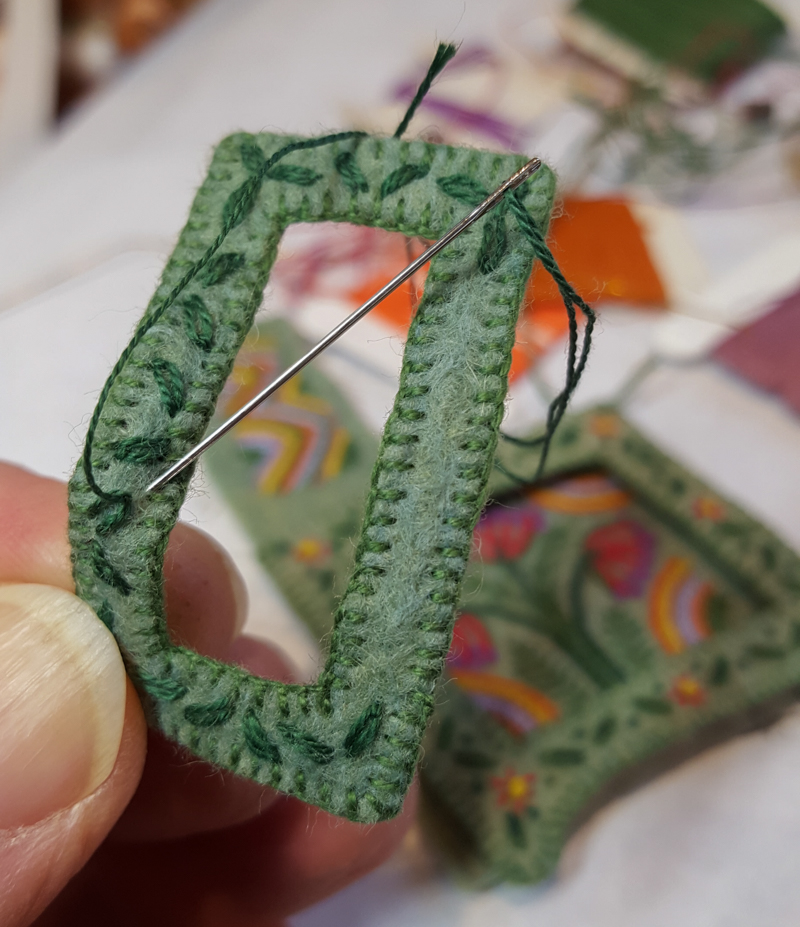
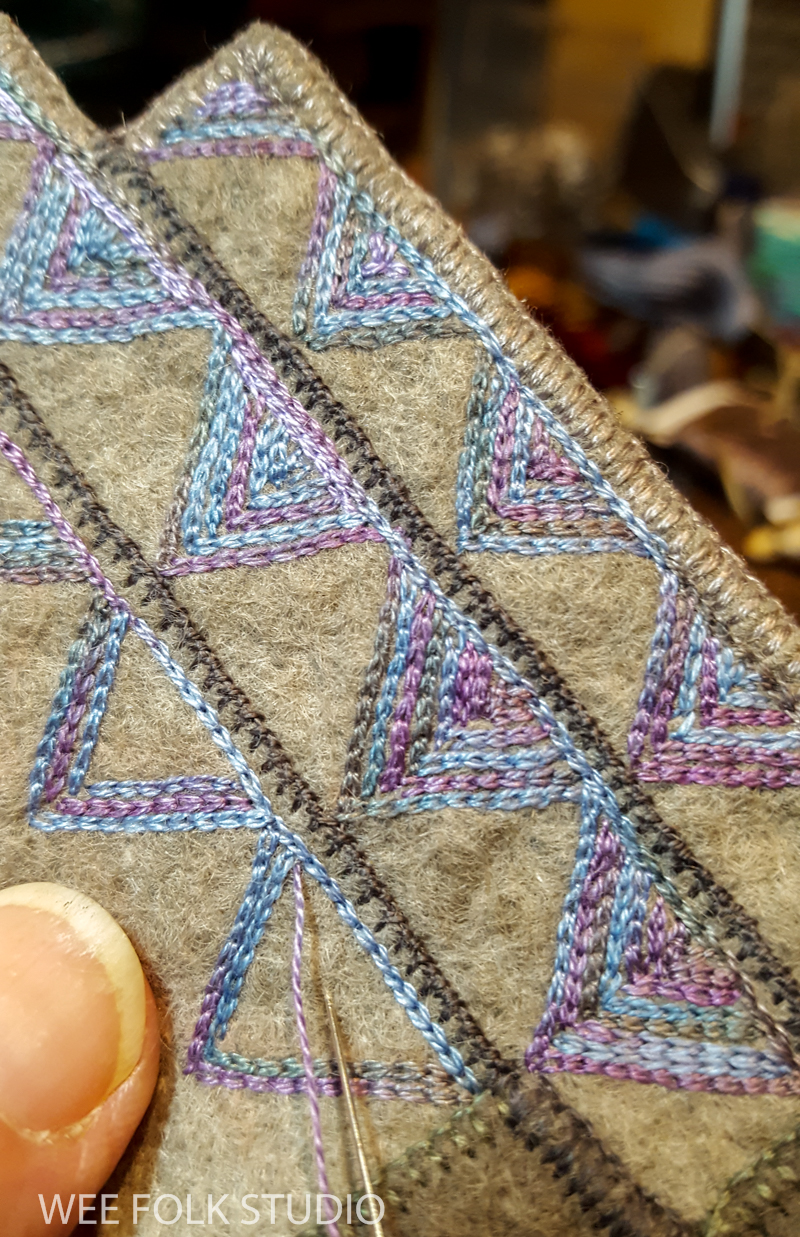
To make frames for the side panels, I cut out pieces of felt and sewed a blanket stitch around the edges.
Wire comes in handy for so many things. In the this case, I used it to create molding along the top edge of the counter top.
The feet are fashioned from tube beads.
I made the table and chairs out of pieces of wood, including small turned balusters that are sold to make doll house stairs.
I painted the chairs red and decorated them with a fine marking pen.
Stay tuned because there’s more to come! Part 3 in the series will show what’s outside of the house.
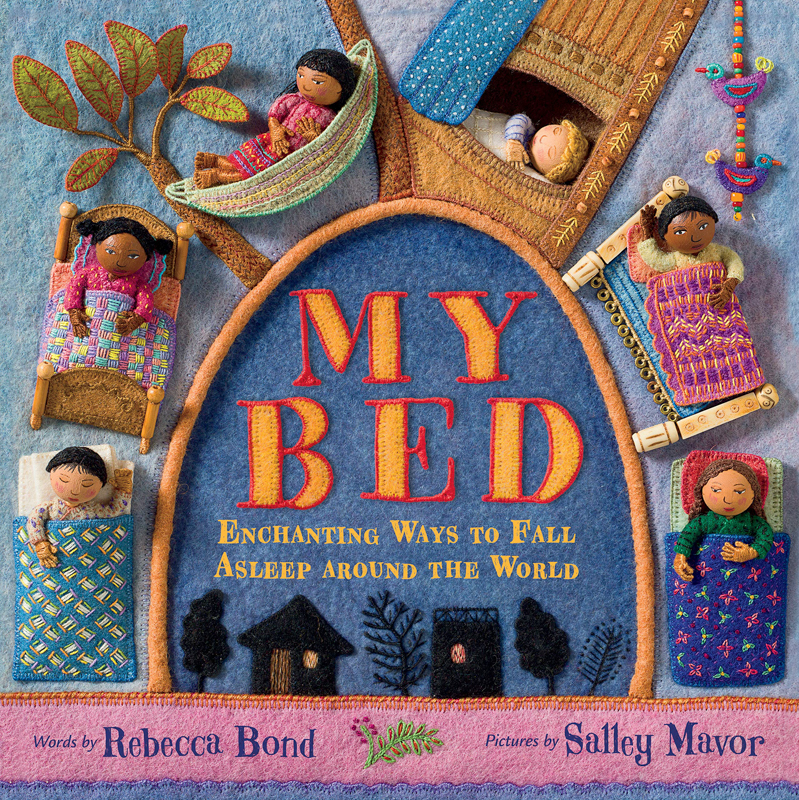
Update: Signed copies of My Bed may ordered in my shop here. 40 pages, 9″ x 9″, words by Rebecca Bond, pictures by Salley Mavor, published by Houghton Mifflin Harcourt. ISBN 978-0-544-94906-5
To keep up with new posts, subscribe to this blog. Your contact info will not be sold or shared. If you’d like to see more frequent photos tracking the projects in my studio, please follow me on Facebook and/or Instagram.
Update: Signed copies of My Bed may be ordered in my shop here. Watch this 8-minute documentary about how I created the illustrations for the book.
This scene shows the inside and outside of a house, with a traditional Russian oven as the centerpiece. Besides its use for heating in winter, people slept on top of the oven to keep warm. I was first introduced to this kind of “stove bed” many years ago, when it was depicted in a magical stage set made for a Russian themed Christmas Revels performance at Sanders Theatre in Cambridge, MA.
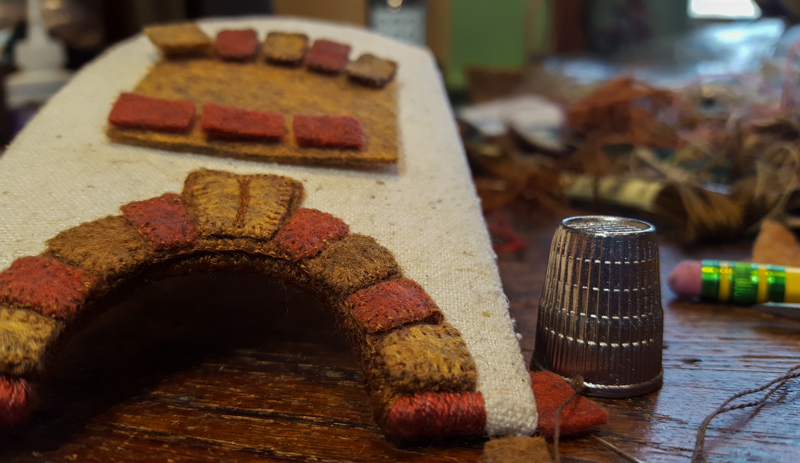
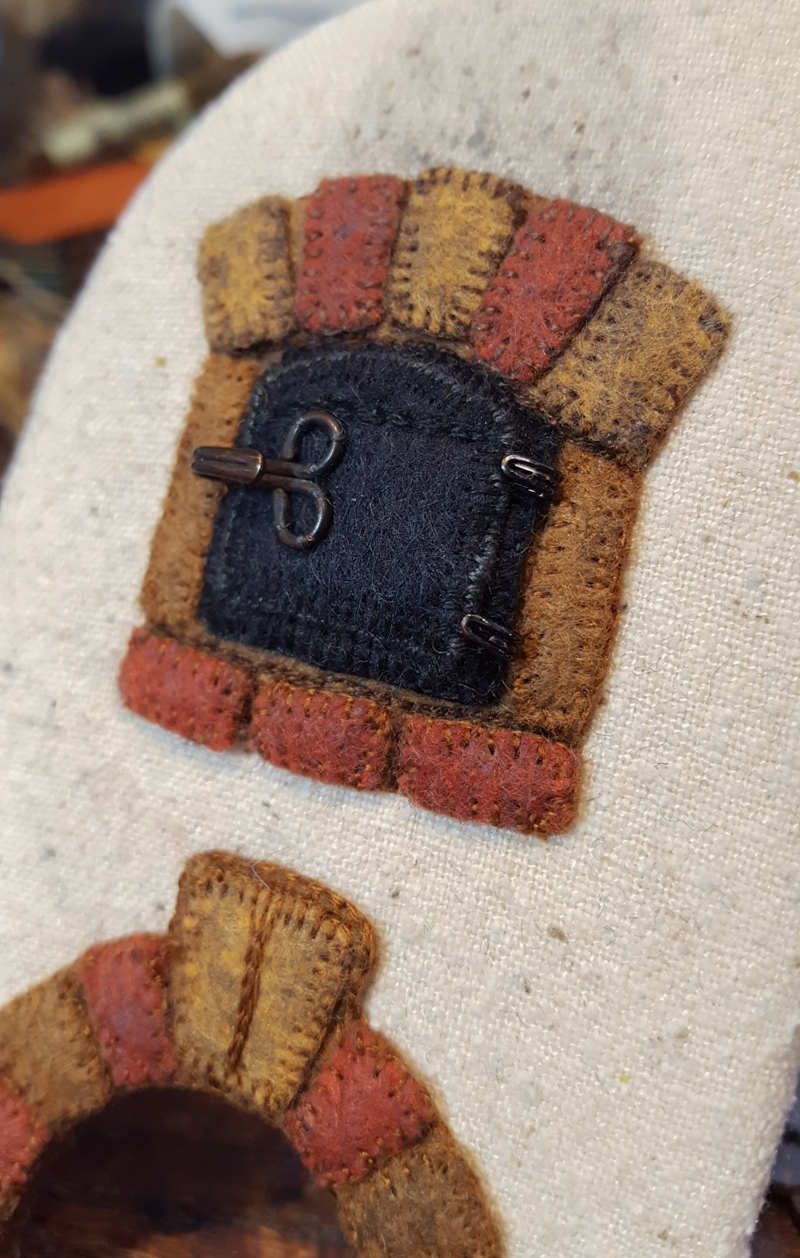
I started with the stove, using wool felt for the bricks and raw silk to convey the bumpy texture of masonry.
For some of the illustrations in this book, I returned to some tried and true techniques that I developed way back in the 70’s, when I made fabric pins. To make a firm stove shape, I cut out a piece of acid-free mat board and covered it with fabric. As usual, hooks and eyes make size-appropriate hardware.
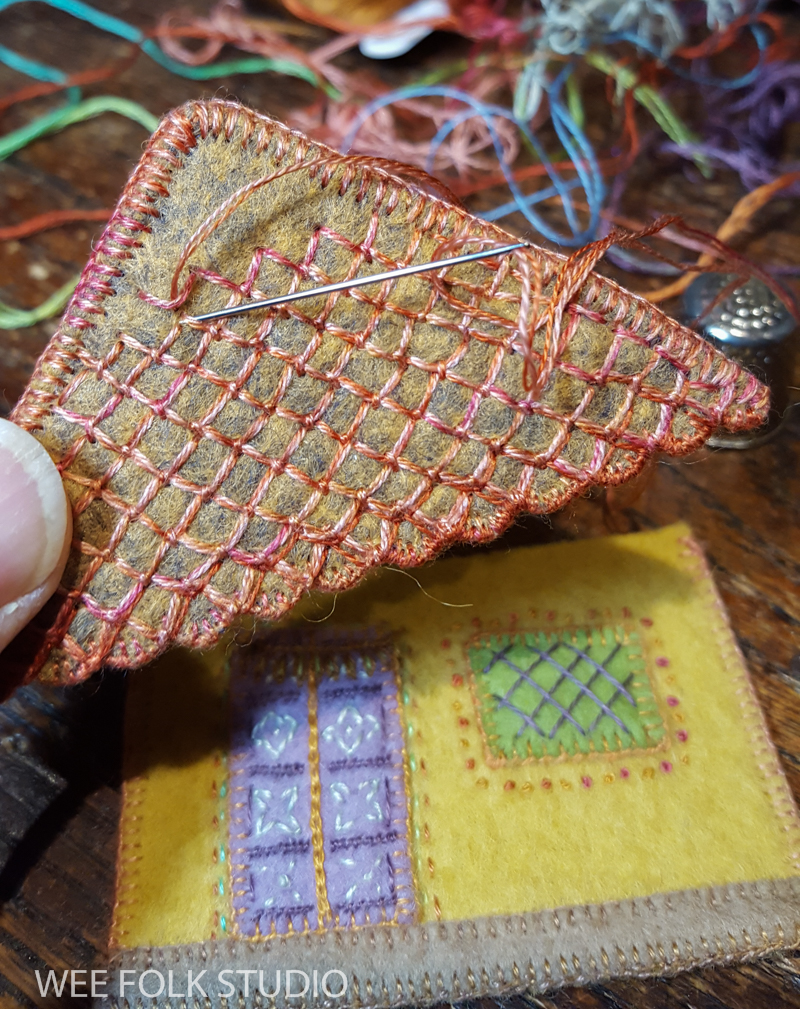
For roof tiles, I sewed together a string of bone beads that have been in my stash forever.
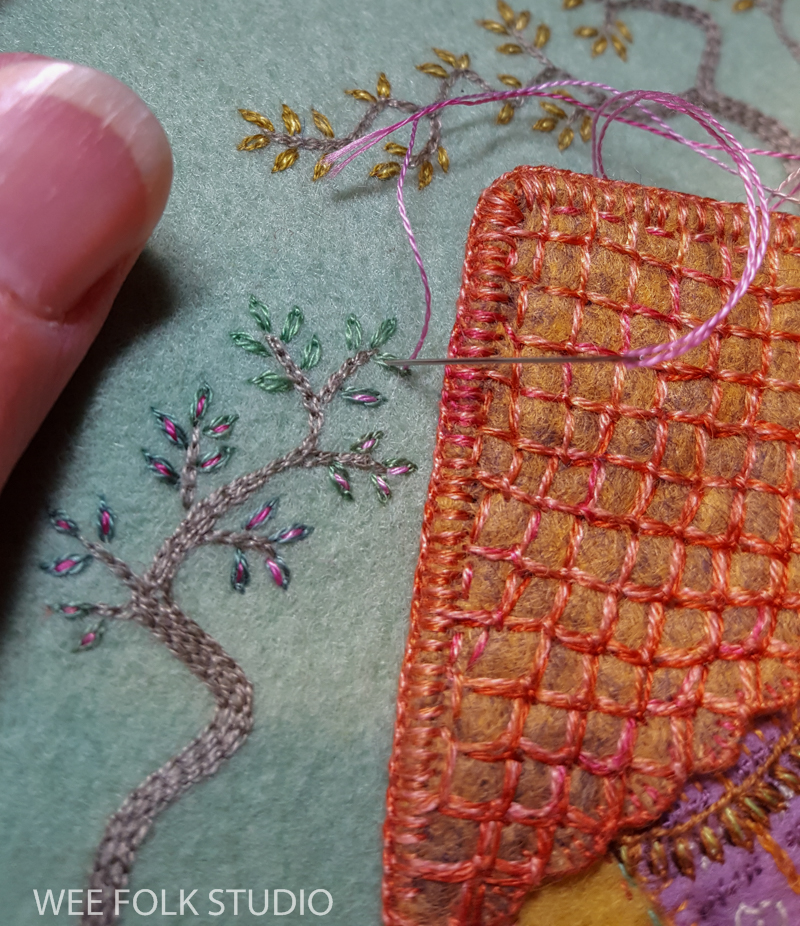
It isn’t often that I find a use for lace from my vast supply. Most of the time, white lace comes across as lace. It’s hard to make it appear like something else, unless it’s dyed a color. But in this case, it could work as gingerbread style molding.
I made the head and the top portion of a sleeping child.
I created a recessed area for the child to rest on and sewed the stove and rooftop together. It was solid enough to stand on its own. More posts about the Russian scene: Part 2, Part 3
UPDATE: An exhibition of the original bas-relief artwork for MY BED has been traveling since the book was published in 2020. The touring schedule can be seen here. Interested museums and art centers are welcome to contact me (salley at weefolkstudio.com) for information about hosting an exhibit.
To keep up with new posts, subscribe to this blog (top right column on the home page). Your contact info will not be sold or shared. If you’d like to see more frequent photos tracking the projects in my studio, please follow me on Facebook and/or Instagram.
Now that our movie LIBERTY and JUSTICE is finished and being entered into film festivals, I’m resuming work on MY BED. It’s a picture book about children’s sleeping places around the world that will be published by Houghton Mifflin Harcourt in Sept. 2020. A touring exhibition of my original embroidered artwork for the book will travel around the United States. The tour schedule is listed here.
Update: Signed copies of My Bed can be ordered in my shop here. Watch this 8 minute documentary about how I created the illustrations for the book.
It will be a crunch to get the artwork completed by the deadline, so I’ll have to work even more obsessively than usual, if that’s at all possible! In addition to creating 3/4 spread illustrations, I’m making a series of animal icons that’ll be spot art, appearing on the adjacent text panels throughout the book. The miniature stuffed animals relate to the geographic area of each corresponding scene. Other animals in the series that I’ve written about so far are, parrot and sheep, rooster,cat,duck,bunny, giraffe, crocodile, cow, dog and camel.
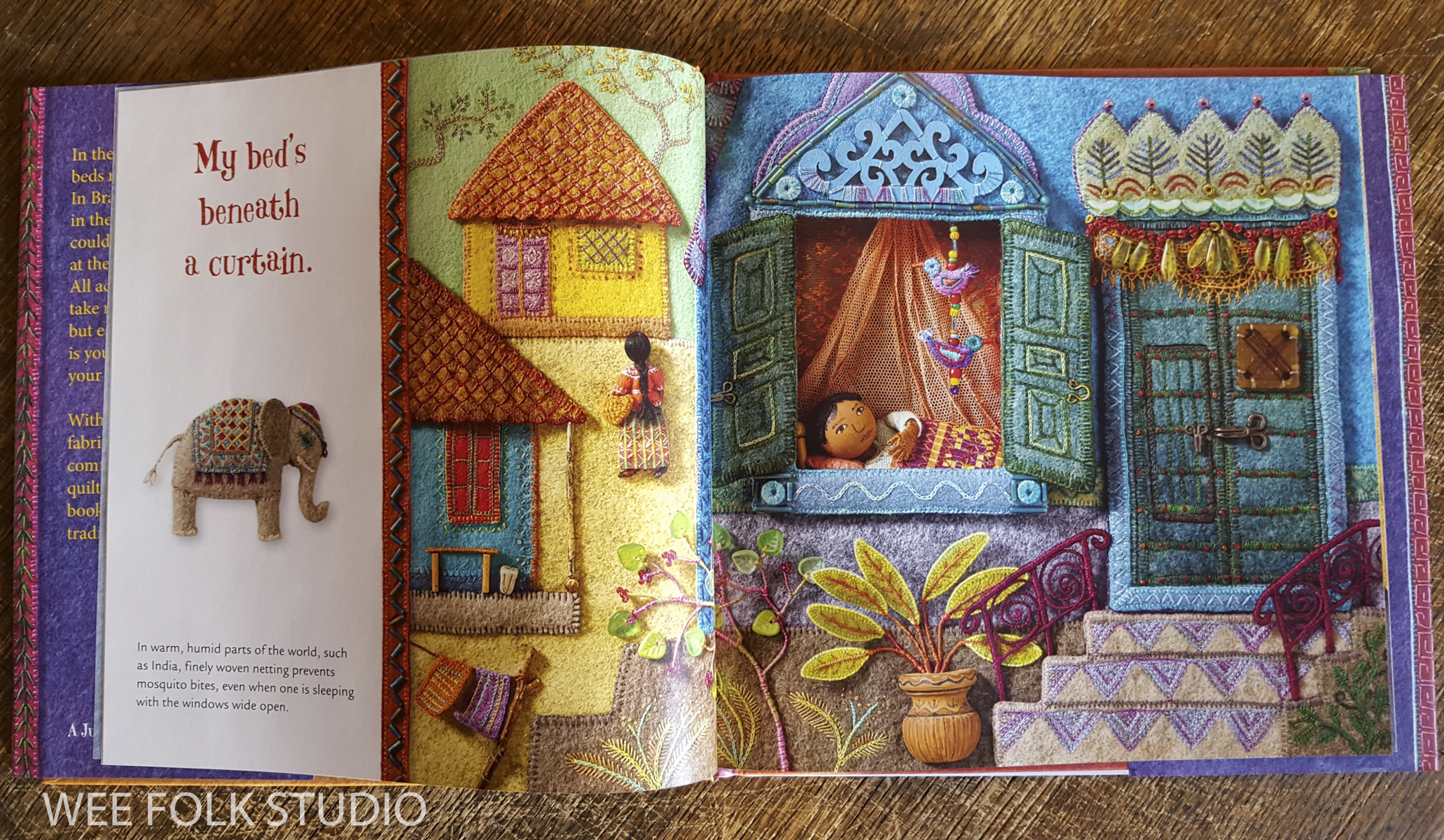
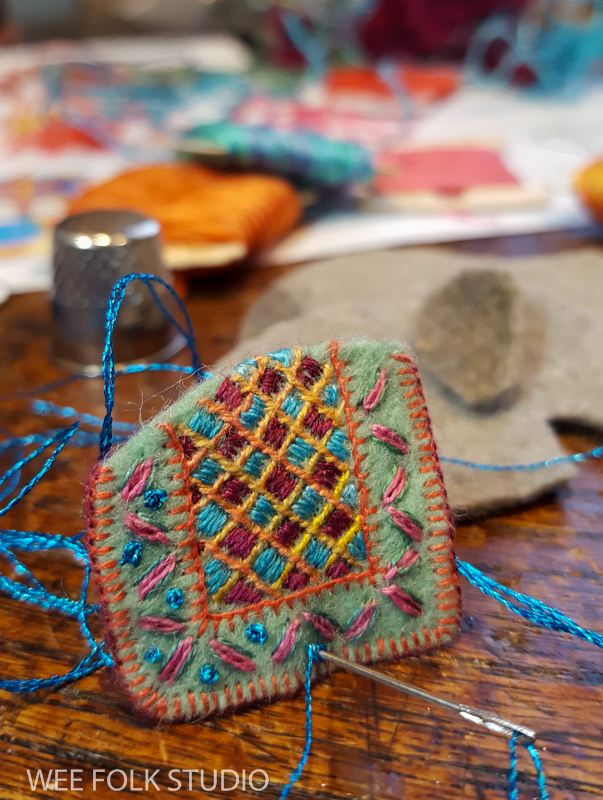
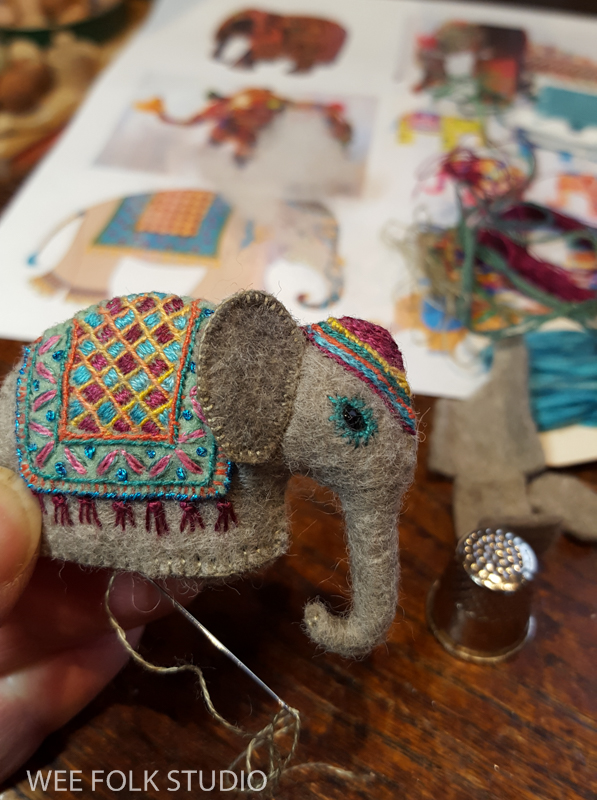
To get ideas, I researched traditional decorated elephants from India. After cutting the elephant shape out of grey felt, I embroidered a blanket with cotton floss and metallic thread. I just love the Indian sense of color and pattern!
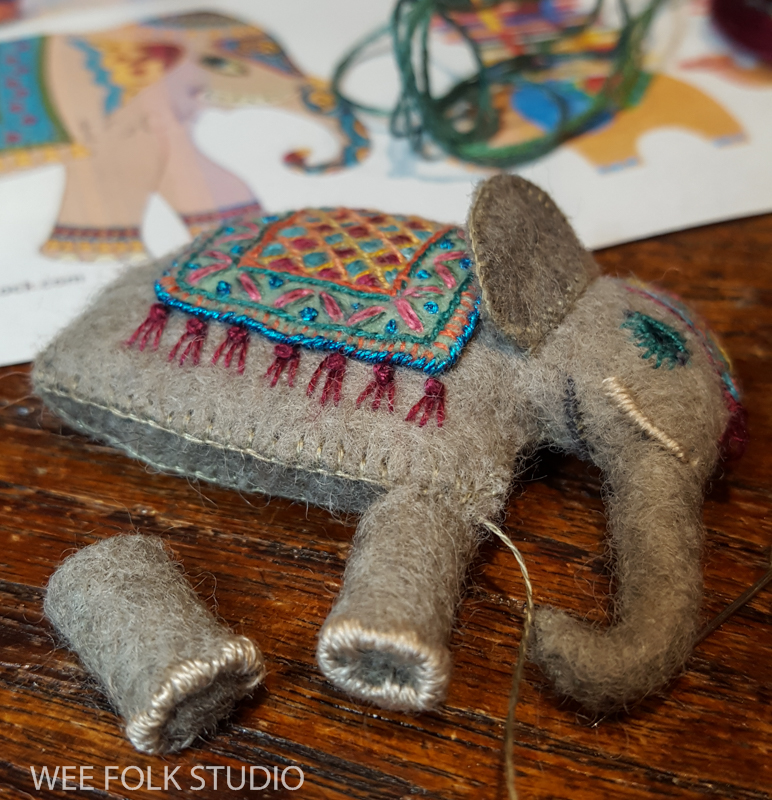
The trunk has a wire inside to help it curl.
For the eye, I cut a slit in the felt and stitched it like a button hole for the bead to fit inside. Then, I chain stitched a head covering and added a tassel.
To make the legs, I rolled strips of felt into tubular shapes and embroidered toes onto one end. The wrapped wire tail came last.
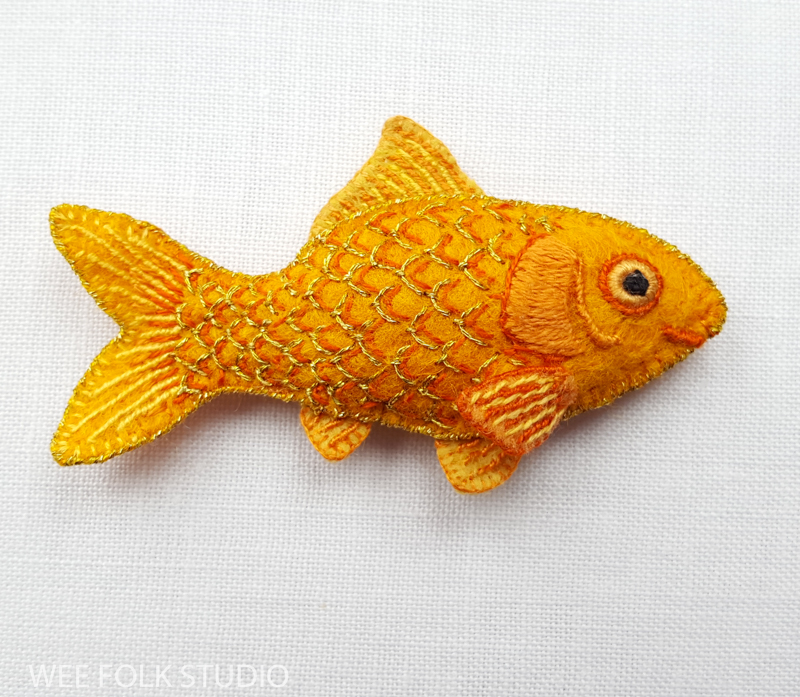
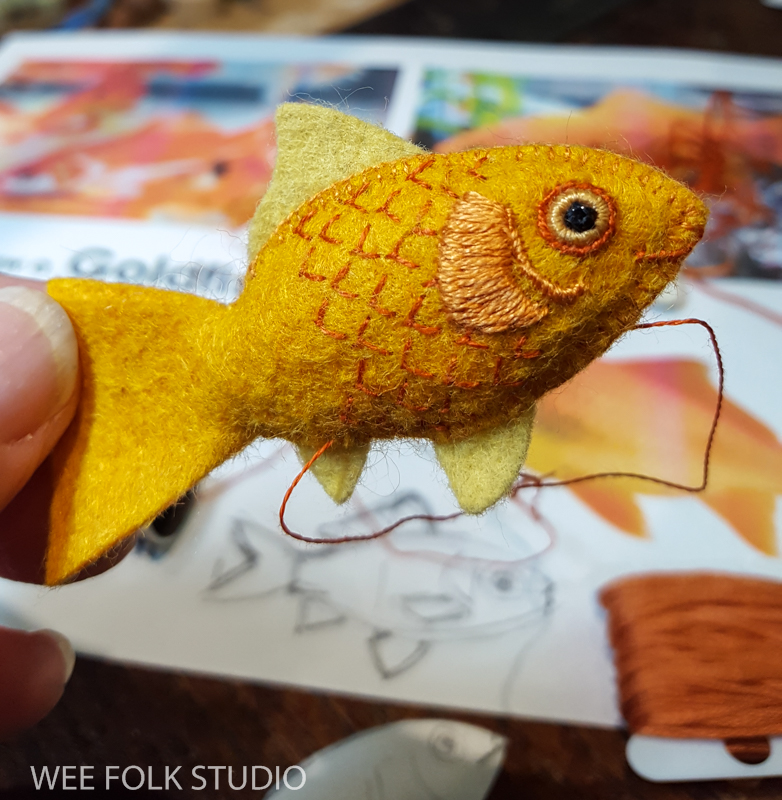
Beside all the yellow and orange tones, the fish needed just a hint of glimmer, so I added some metallic thread to its scales.
To see other animals and illustrations I’ve made for the book, click here.
To keep up with new posts, subscribe to this blog. If you’d like to see more frequent photos tracking the projects in my studio, please follow me on Facebook and/or Instagram.
Today, I am excited to share a couple of animals, which will be used as spot illustrations in my upcoming book MY BED. The story about children’s sleeping places in different cultures around the world is written by Rebecca Bond and will be published by Houghton Mifflin Harcourt in Sept. 2020.
Update: Signed copies of My Bed can be ordered in my shop here. Watch this 8 minute documentary about how I created the illustrations for the book.
In addition to creating full page illustrations, I’m making a series of animal icons that will appear on the adjacent text panels throughout the book. The miniature stuffed animals relate to the geographic area of each corresponding scene. Other animals in the series that I’ve written about so far are: elephant and goldfish, rooster,cat,duck,bunny, giraffe, crocodile, cow, dog and camel.
These little animals bring back memories of the late 70’s, when I made a line of fabric pins. Of course, what I’m making today is much more intricate, but they are similar in size and concept.
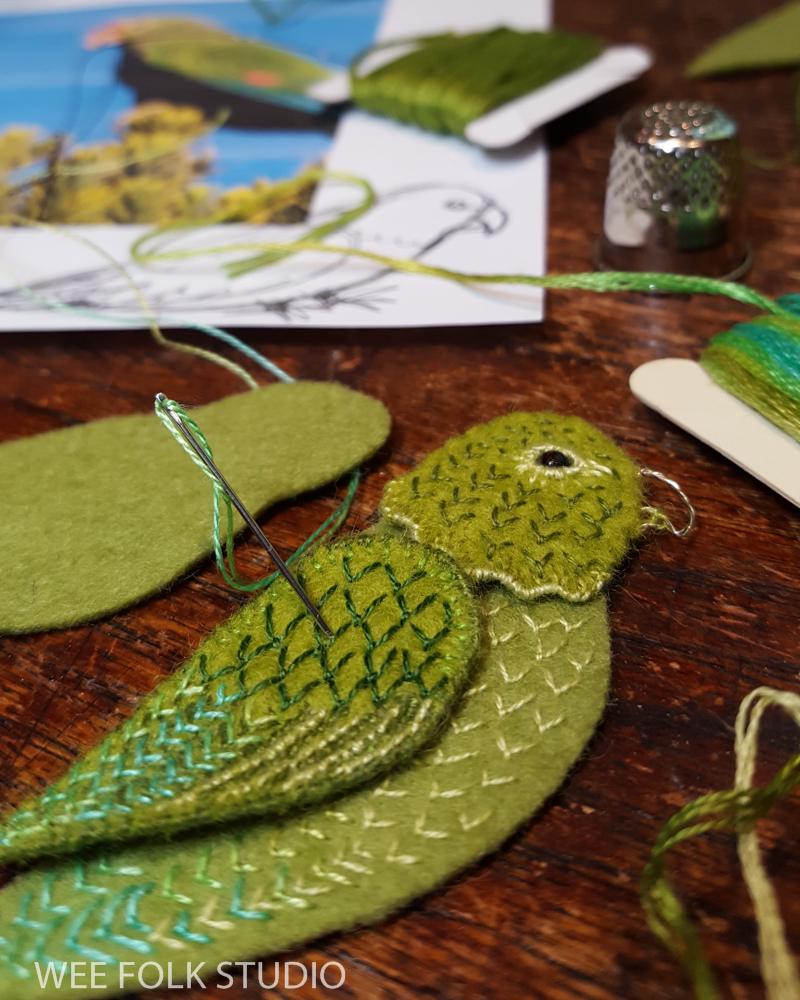
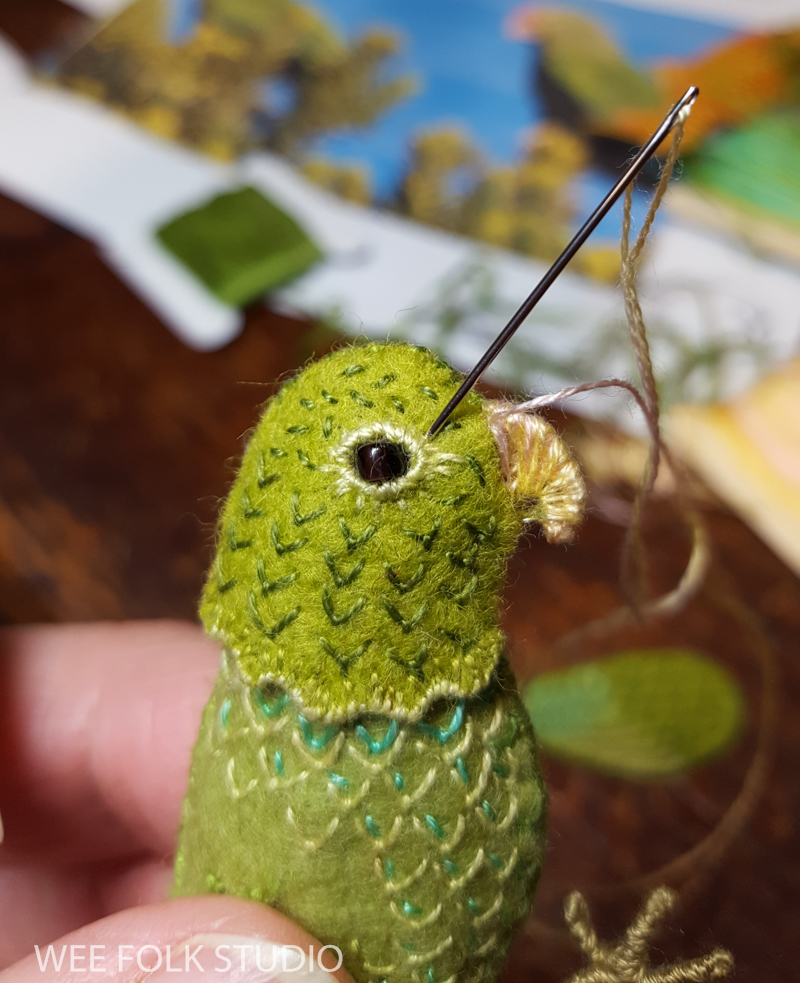
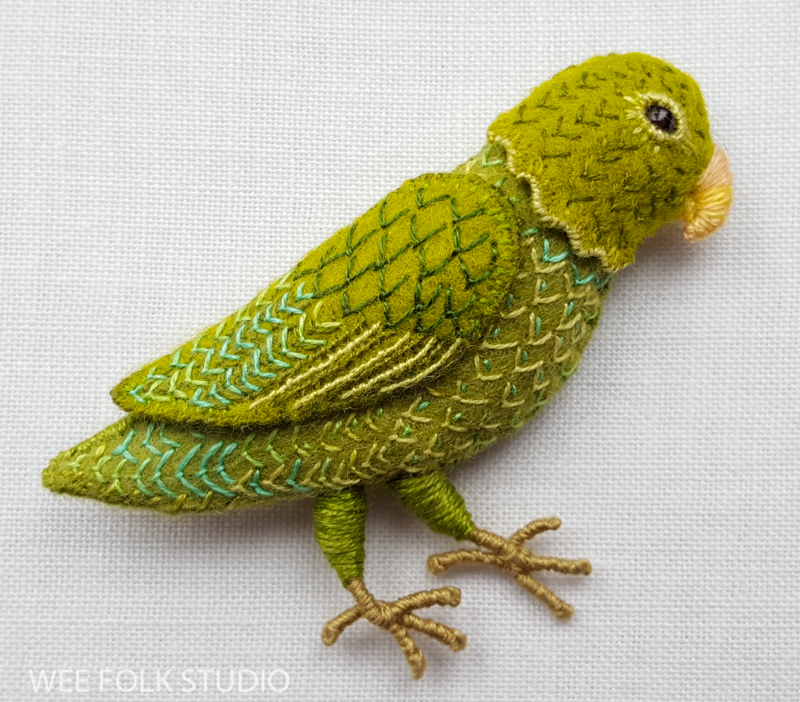
After doing photo research and drawing a simple parrot shape, I cut out pieces of felt and began embroidering feathers.
I formed the outline of the parrot’s beak with wire. Its eye is a glass seed bead, set inside a cut out hole.
I wrapped the beak with embroidery floss.
Then I added bird’s feet made of floss wrapped wire.
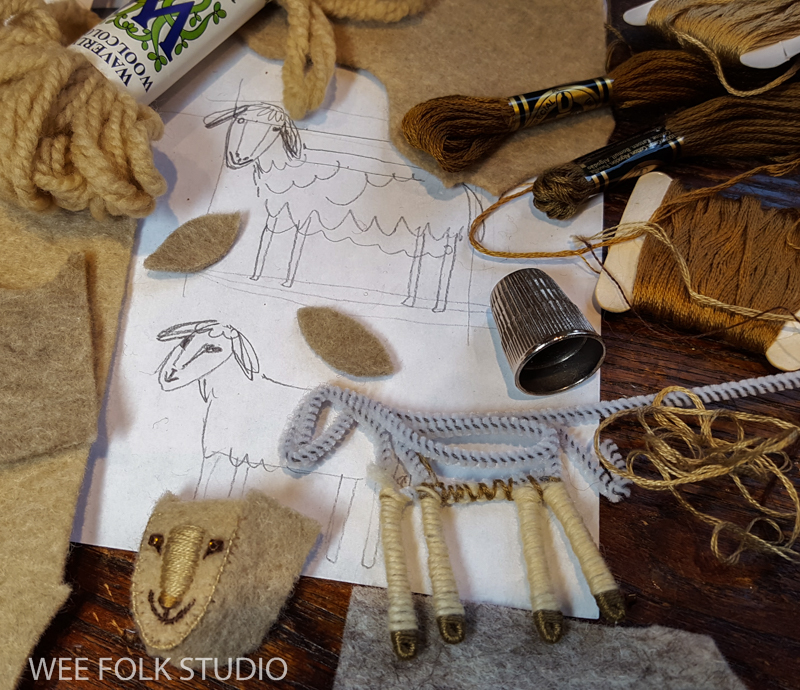
The sheep will go with the scene set in Afghanistan.
In my research, I found pictures of local breeds with particularly long faces and ears.
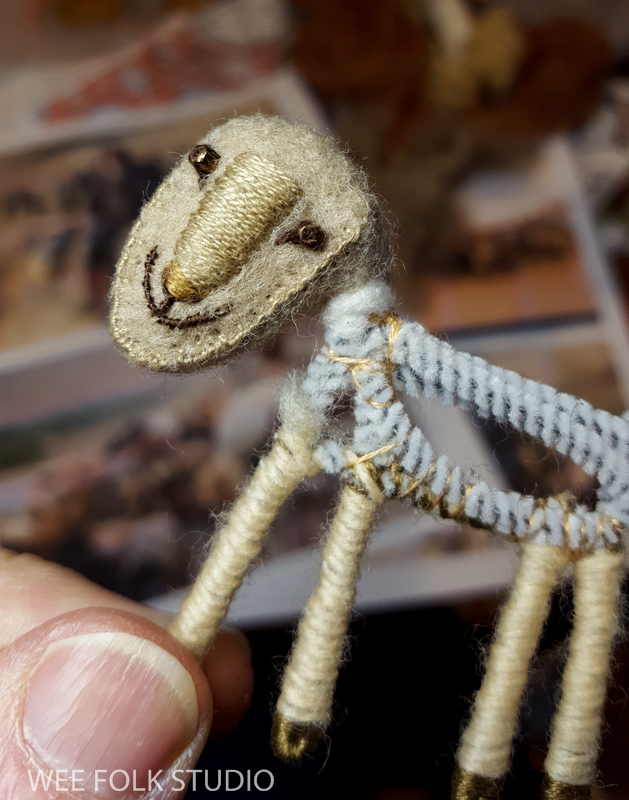
The sheep’s legs are made with a pipe cleaner, using the same basic technique that used for the dolls in my how-to book, Felt Wee Folk. It’s face is embroidered wool felt, with seed bead eyes.
Luckily, I had some wool yarn of the right natural shade for the fleece. It was fun to make a tangled mess of french knots.
Then, I sewed on it’s ears, hiding the ends on the top with wool yarn. I’ll be sharing more animals (and scenes) as the book progresses.
To keep up with new posts, subscribe to this blog (top right column on the home page). If you’d like to see more frequent photos tracking the projects in my studio, please follow me on Facebook and/or Instagram.
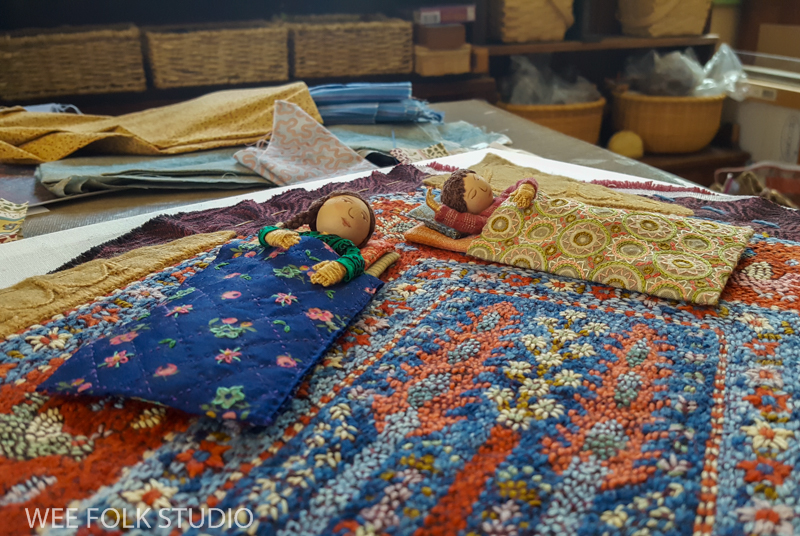
Children, bedding, slippers and an ottoman take center stage in this 2nd part of the series about making an illustration of an a scene set in Afghanistan for my new picture book. To see how the carpet was made, click here for Part 1. The story about children’s sleeping places in different cultures around the world was written by Rebecca Bond. It will be published by Houghton Mifflin Harcourt in 2020.
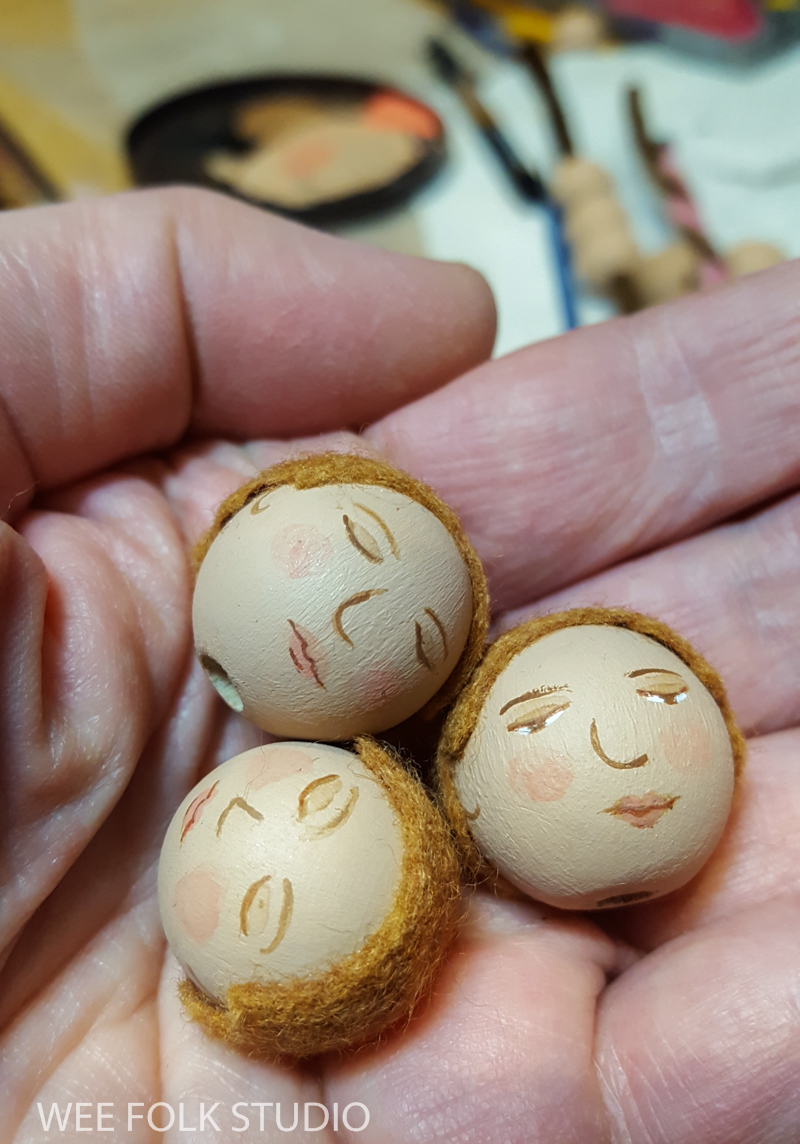
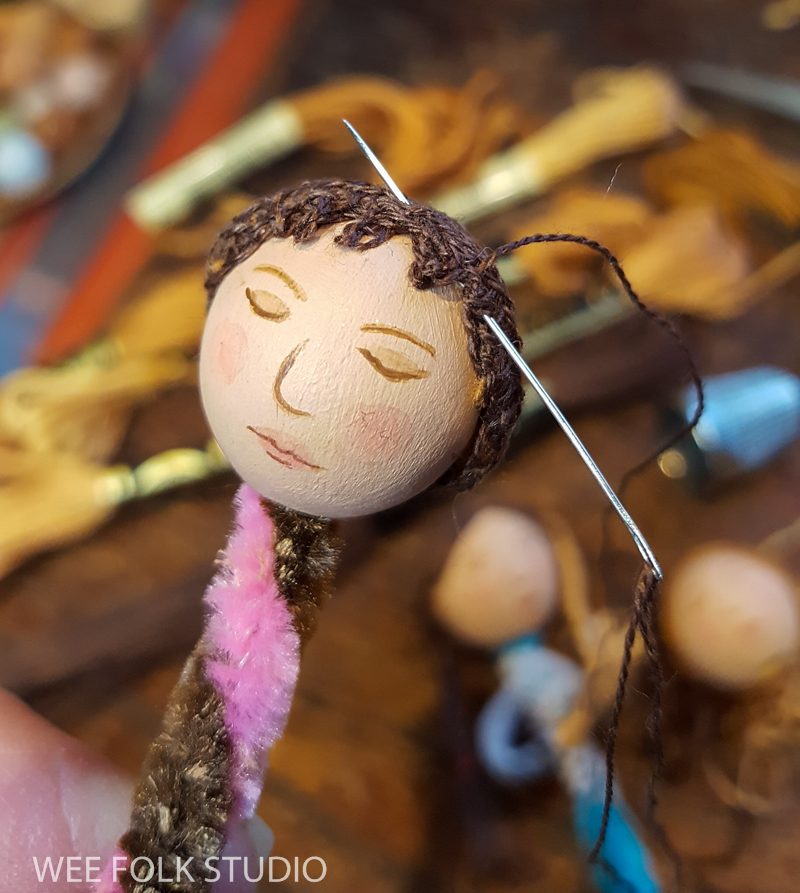
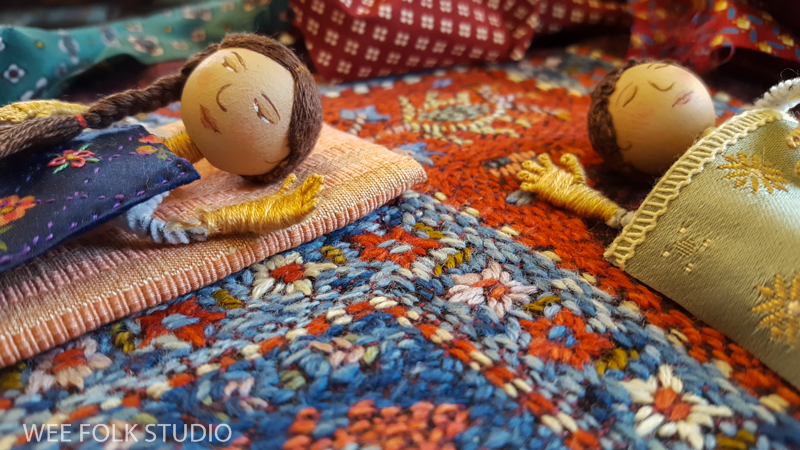
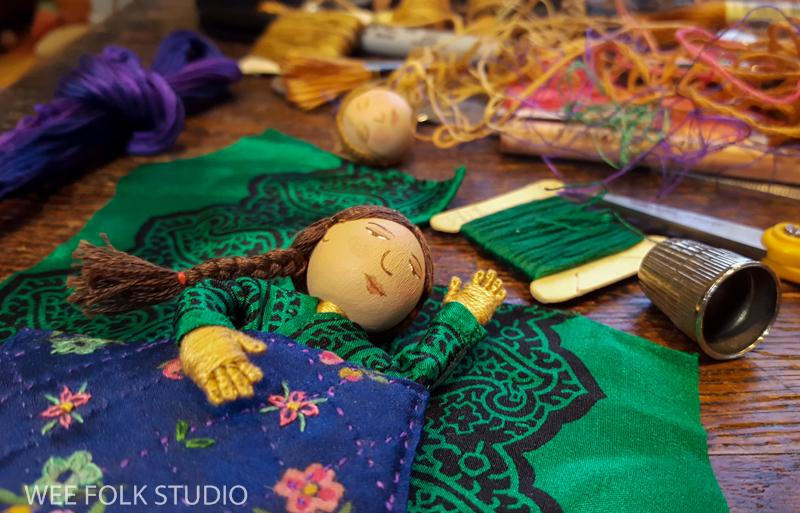
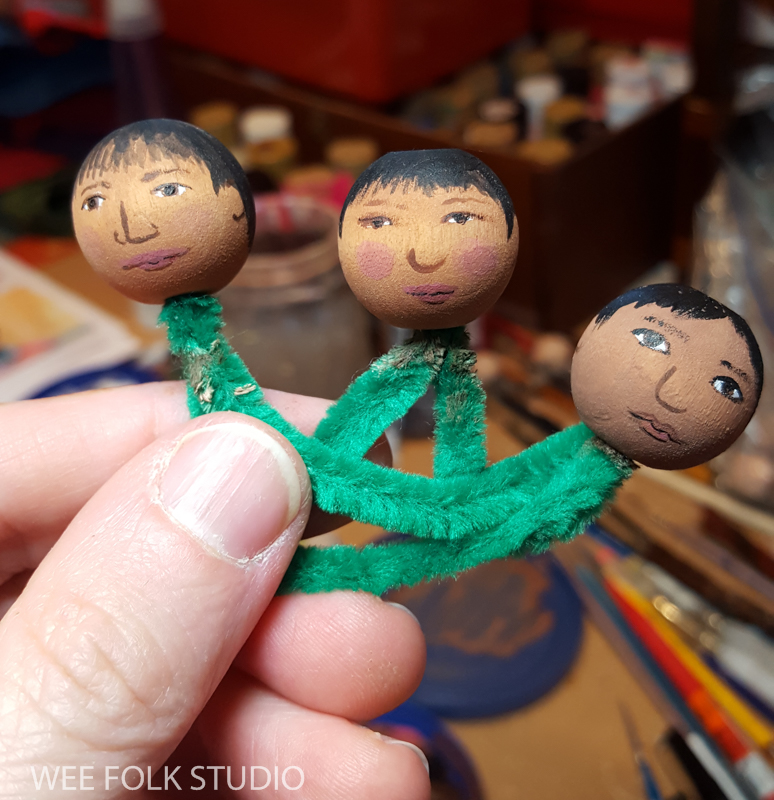
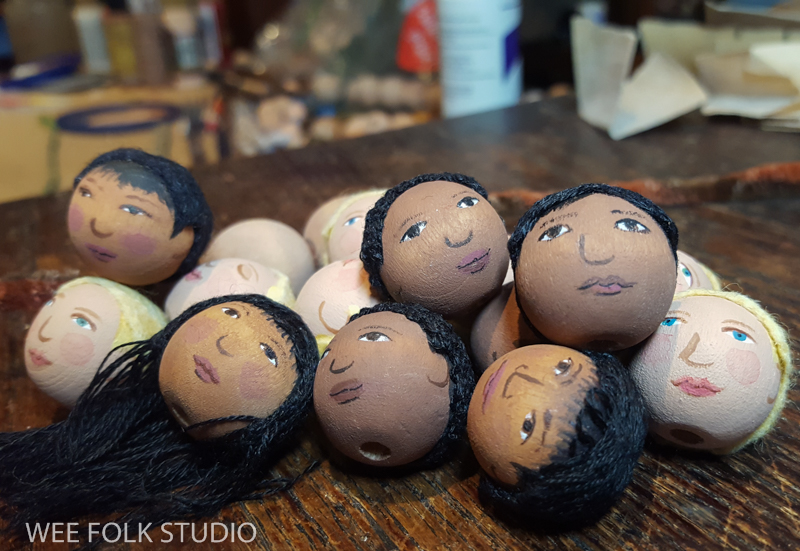
When creating characters, I start with painting faces on bead heads. Based on past experience, I think painting their features is more nuanced and emotive than anything I can achieve with stitches and fabric. It works best to paint a bunch and pick out the ones I like, kind of like an audition. Then I add hair, using the same wig-making technique shown in the new edition of my how-to book, Felt Wee Folk – New Adventures.
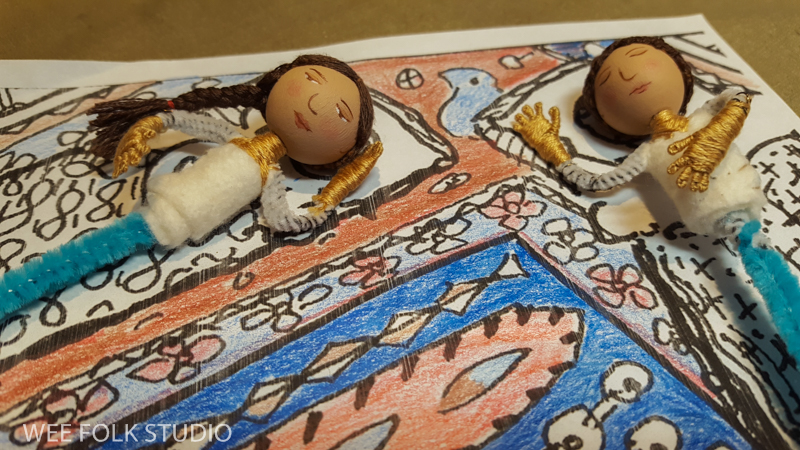
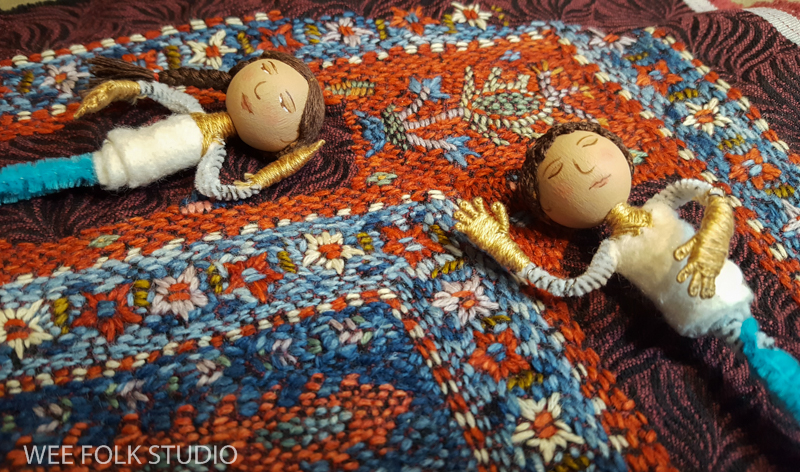
To check the scale of this slumbering pair, I positioned them on the layout sketch and then the actual rug.
For a miniature quilt, I stitched and embellished a piece of printed blue fabric.
It took awhile sorting through piles and piles of fabric to find some that were not only appropriate and compatible, but also distinctive enough to contrast with the rug.
These green pajamas are made from a silk remnant.
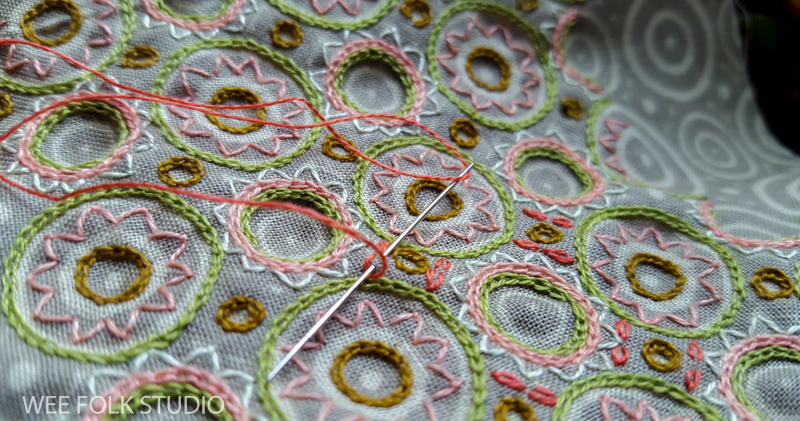
For this coverlet, I gave up on finding a print that I liked and added embroidery to a simple grey and white print.
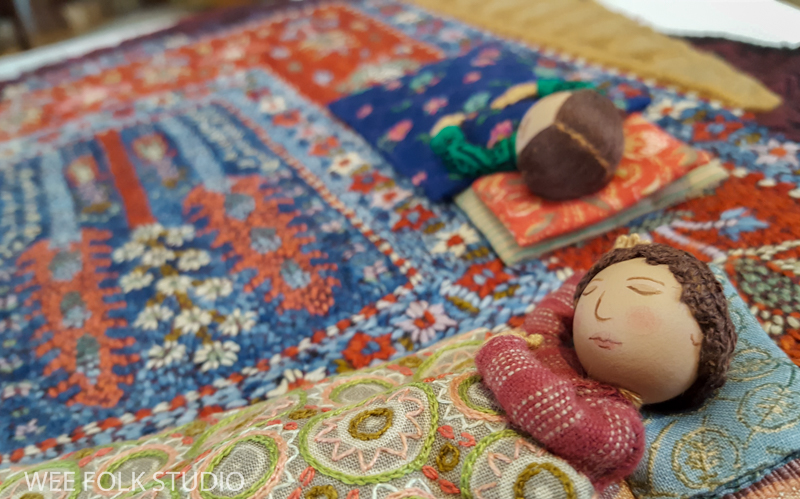
I made mattresses and pillows and put the children to bed.
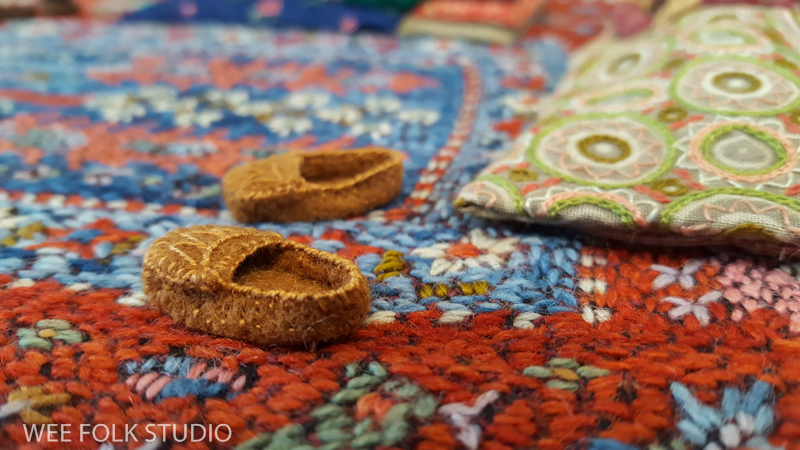
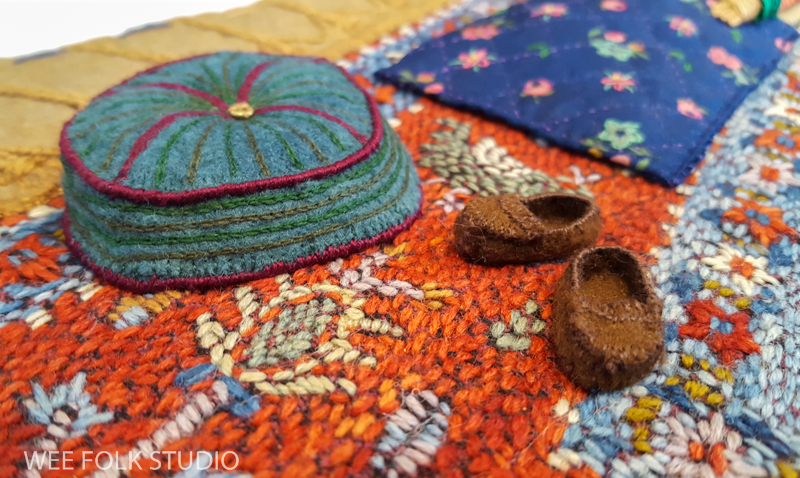
It was so fun making these wee slippers to place by the bedside.
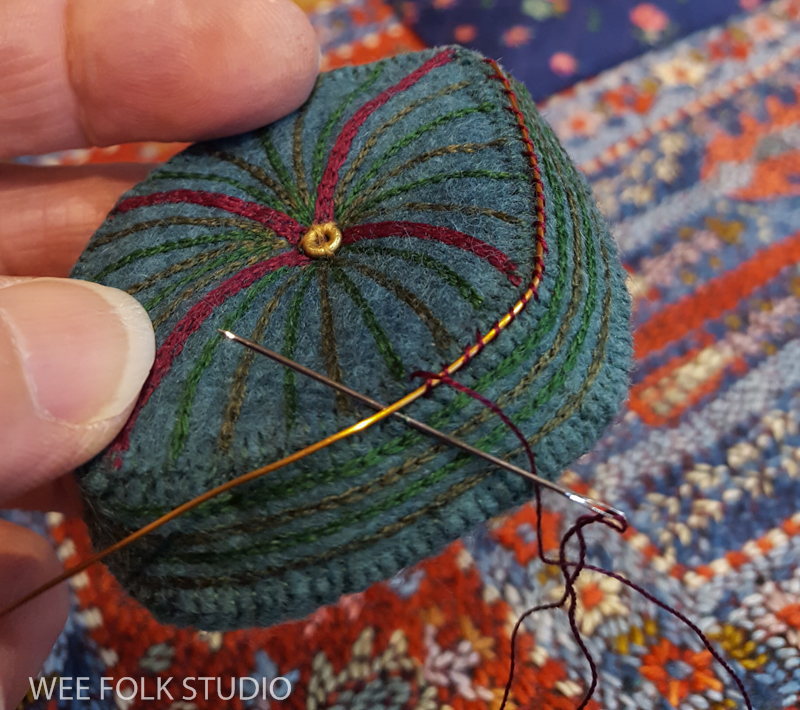
There was also some mini upholstery to do, with this little ottoman.
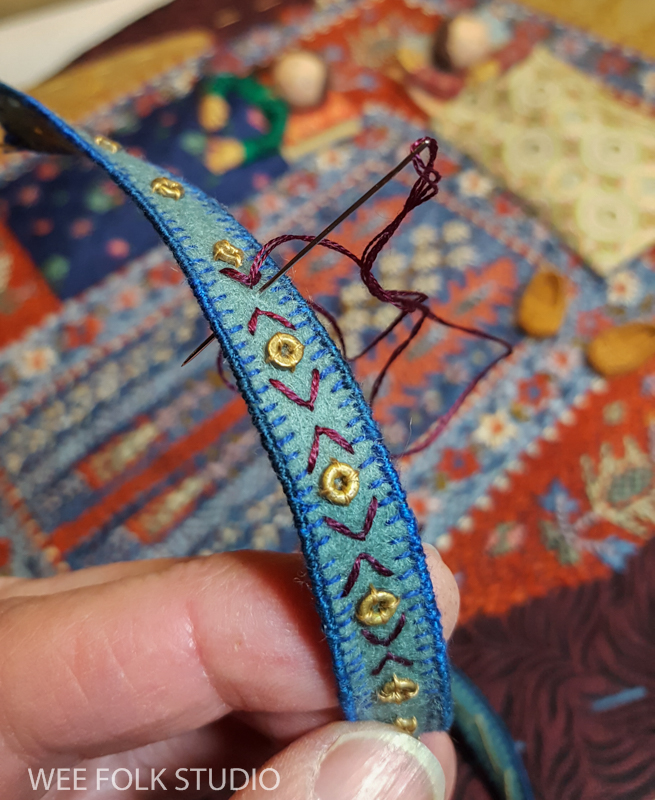
Each of the illustrations has its own patterned strip, which will be used in the book design phase of the project. To keep it rigid and straight, I stitched Soft Flex beading wire along the edge. It feels good to have finished this one and I’m excited to move on to the next scene, which will be from a very different part of the world.
Here are links to posts about other illustrations I’ve finished for the book: South America,Japan and India.
Update: Signed copies of My Bed are available in my shop here. 40 pages, 9″ x 9″, words by Rebecca Bond, pictures by Salley Mavor, published by Houghton Mifflin Harcourt. ISBN 978-0-544-94906-5
To keep up with new posts, subscribe to this blog. If you’d like to see more frequent photos tracking the projects in my studio, please follow me on Facebook and/or Instagram.
As soon as we finished filming scenes for our animated film, Liberty and Justice and handed it over to the musicians to score the sound track, I resumed work on my children’s book. It feels strange and wonderful to be engaged with only one project and a non-political one at that! But, it’s also like snuggling into bed and pulling up the covers, knowing that they’ll be yanked off come summer, when the movie is out. UPDATE: The finished film can be watched here.
I’m illustrating My Bed, a story written by Rebecca Bond, which is a tour around the world that focuses on where children sleep. It will be published by Houghton Mifflin Harcourt in 2020. Here are links to posts about other illustrations for the book: South America,Japan, North Africa, North America, Holland, India, Iran, Ghana and Russia. To see a list of all my books, click here.
Update: Signed copies of My Bed can be ordered in my shop here. Watch this 8 minute documentary about how I created the illustrations for the book.
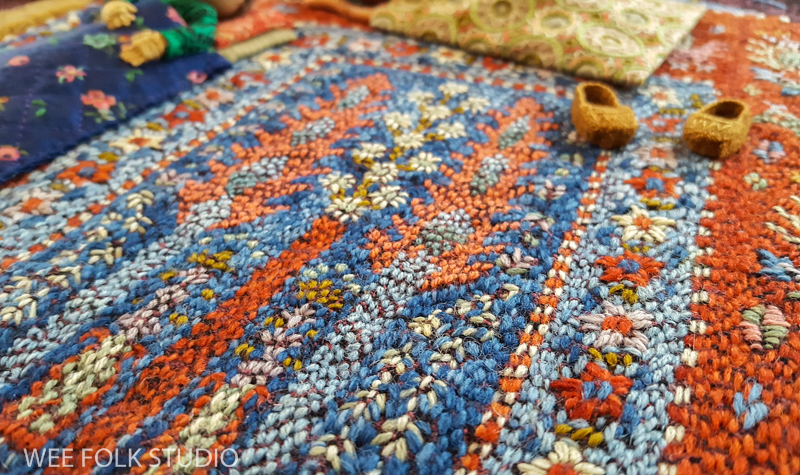
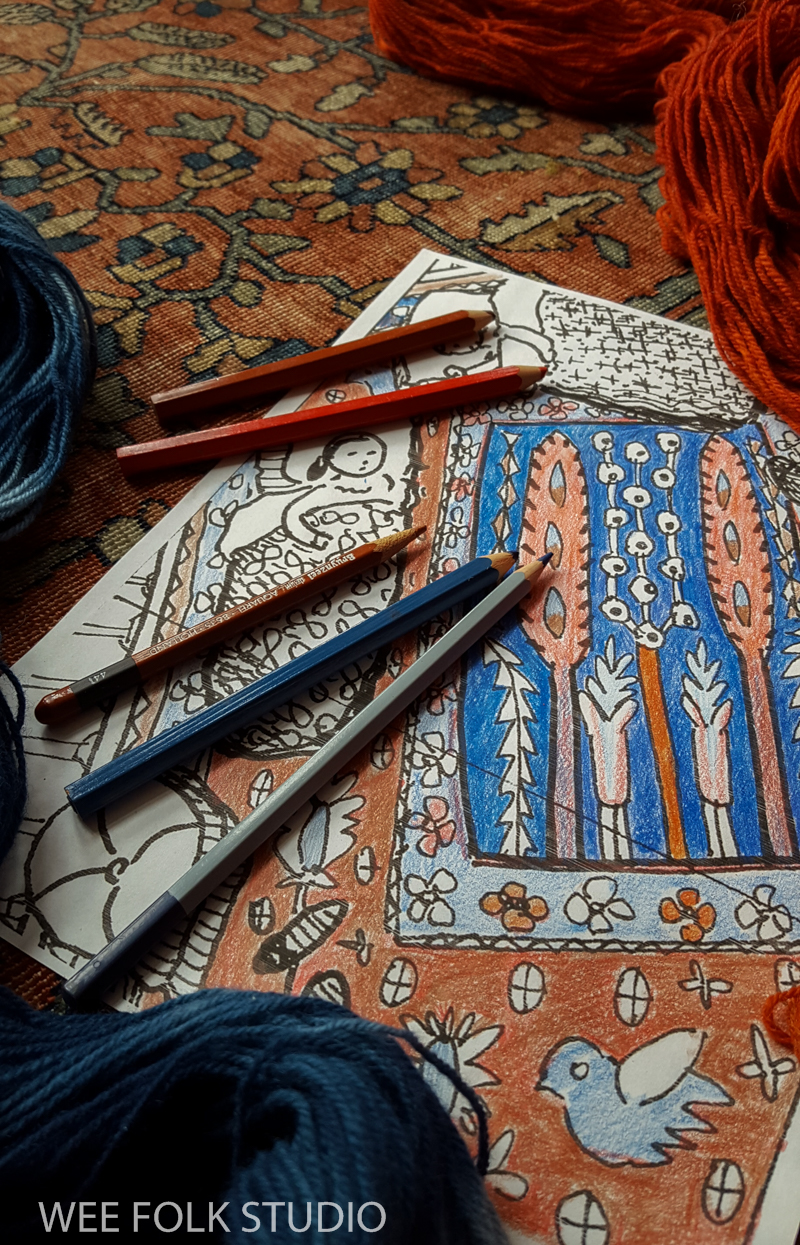
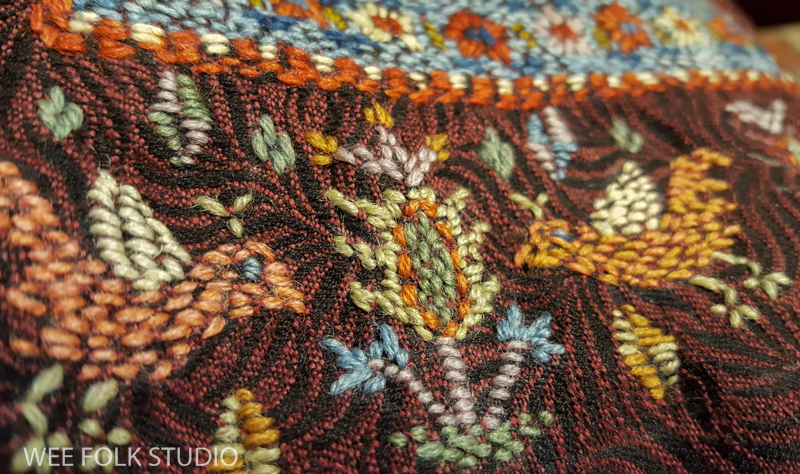
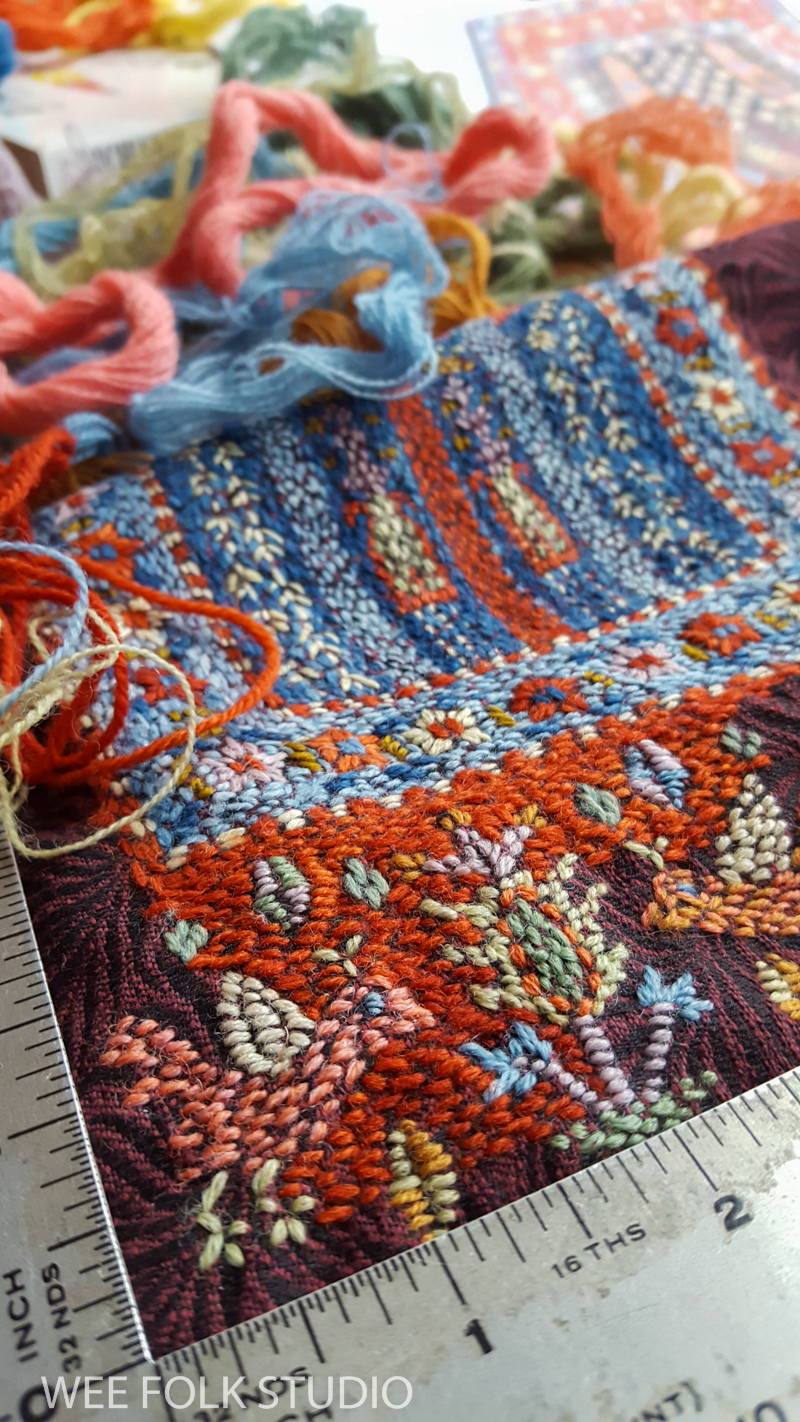
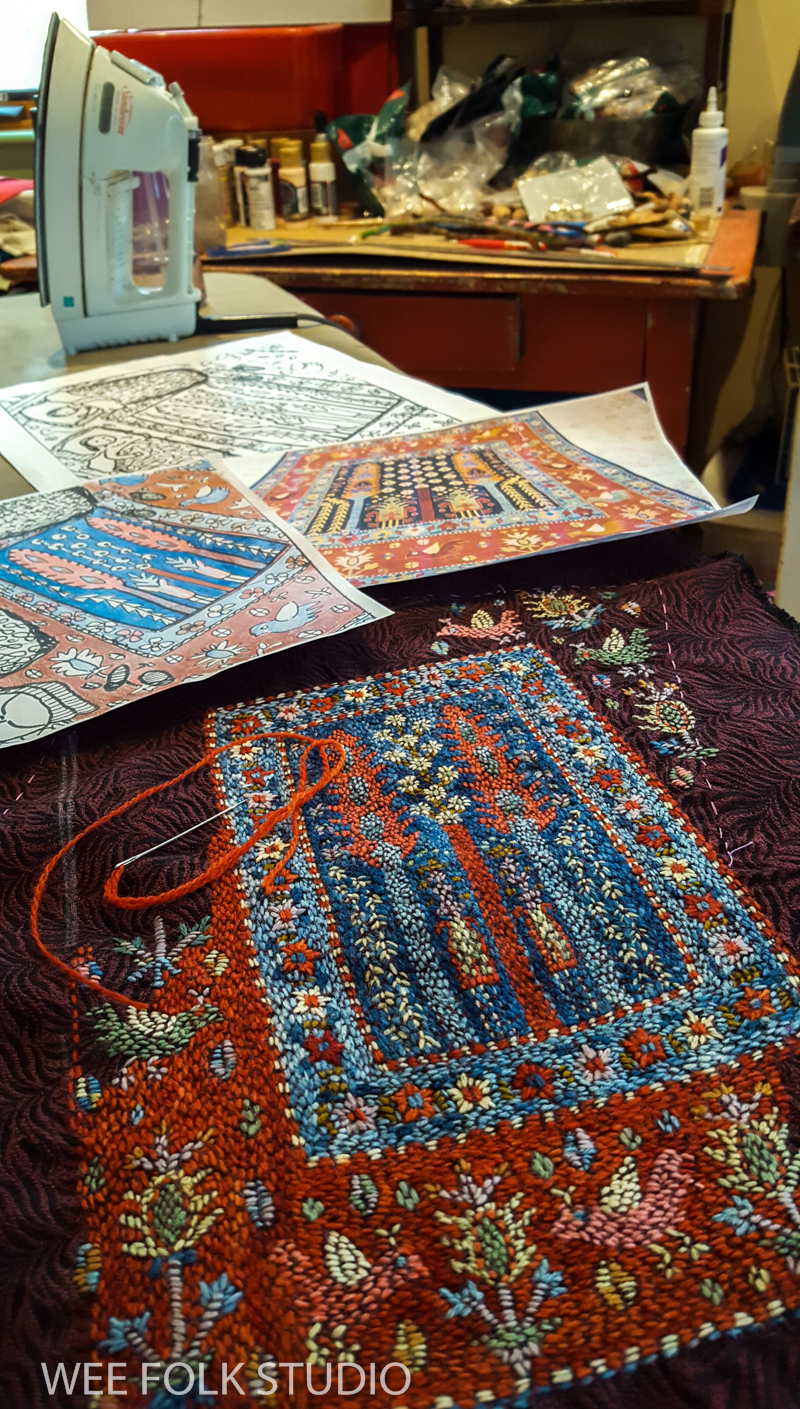
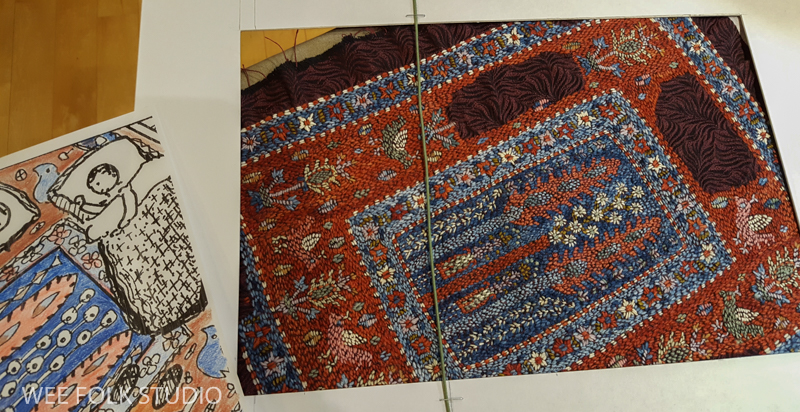
This scene, set in Afghanistan, has a pair of children sleeping on a family made floor rug, which features prominently in the verse. While researching carpets from the region, a photo of one with birds and trees caught my eye, so I adapted it to fit on the page. I don’t usually use color in my layouts, but in this case, I filled in the sketch with red and blue pencils to see what it looked like. Luckily, My son Ian had given me a gift of yarn he dyed for a class project – blue indigoand red rose madder.
Along with the indigo and rose madder dyed yarn, I added other colors of tapestry wool. I chose a piece of dark upholstery fabric for the background, figuring that little bits of fabric would be visible around the stitches and a dark color would show off the colors better than a light fabric. The black and dark red pattern would add a richness and I could draw the rug’s patterns with white chalk, which would fade away with handling.
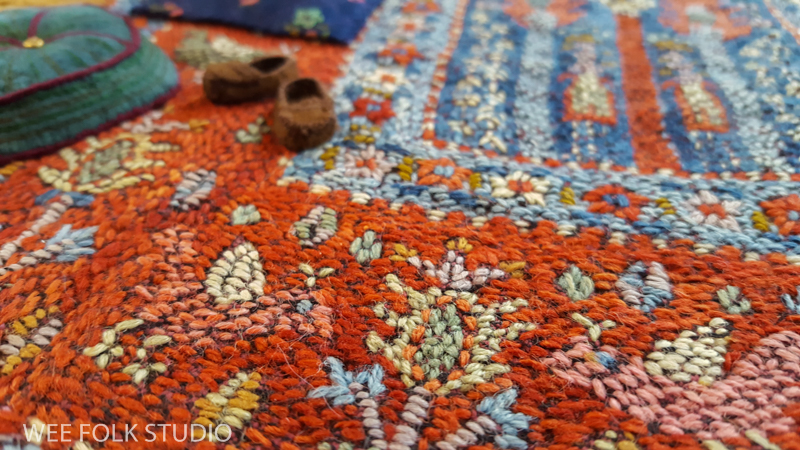
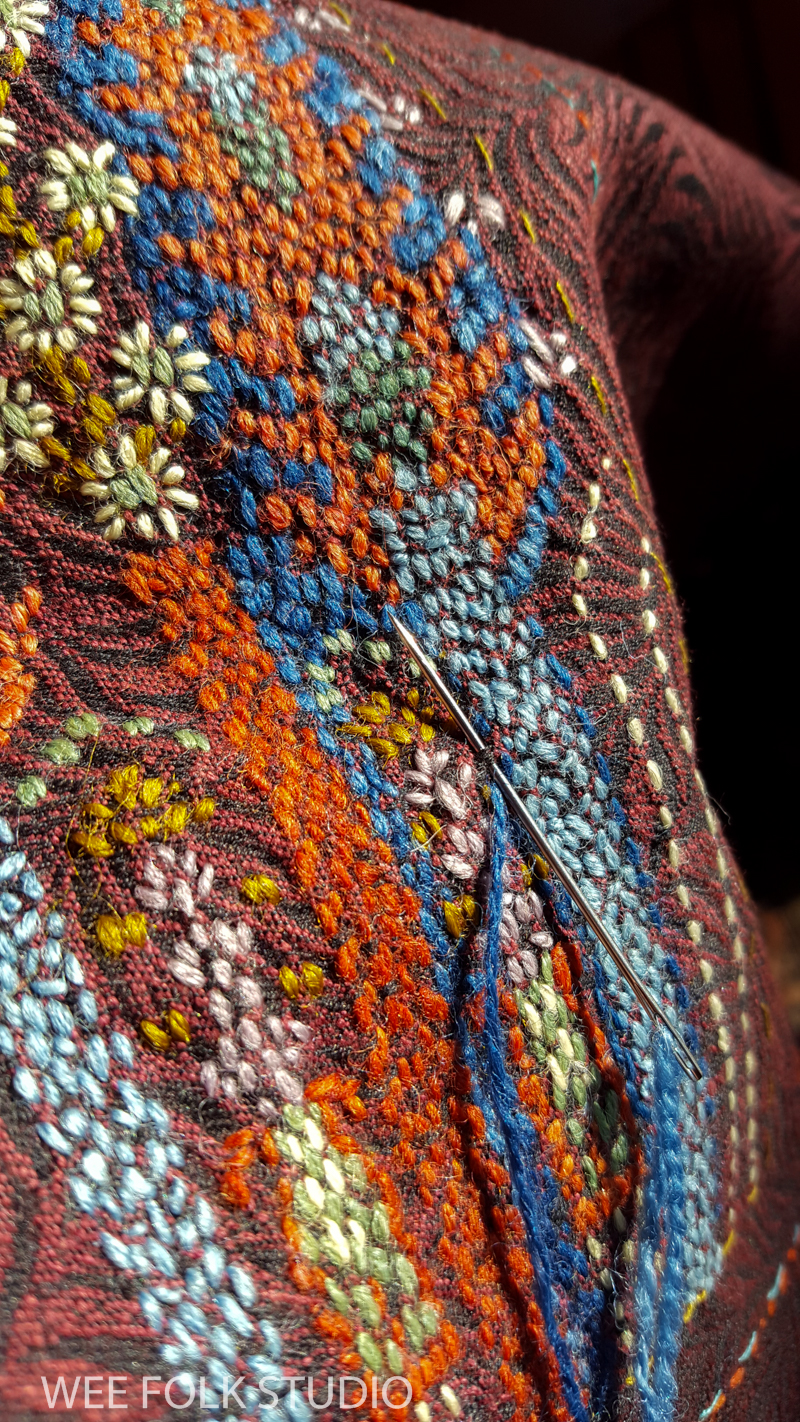
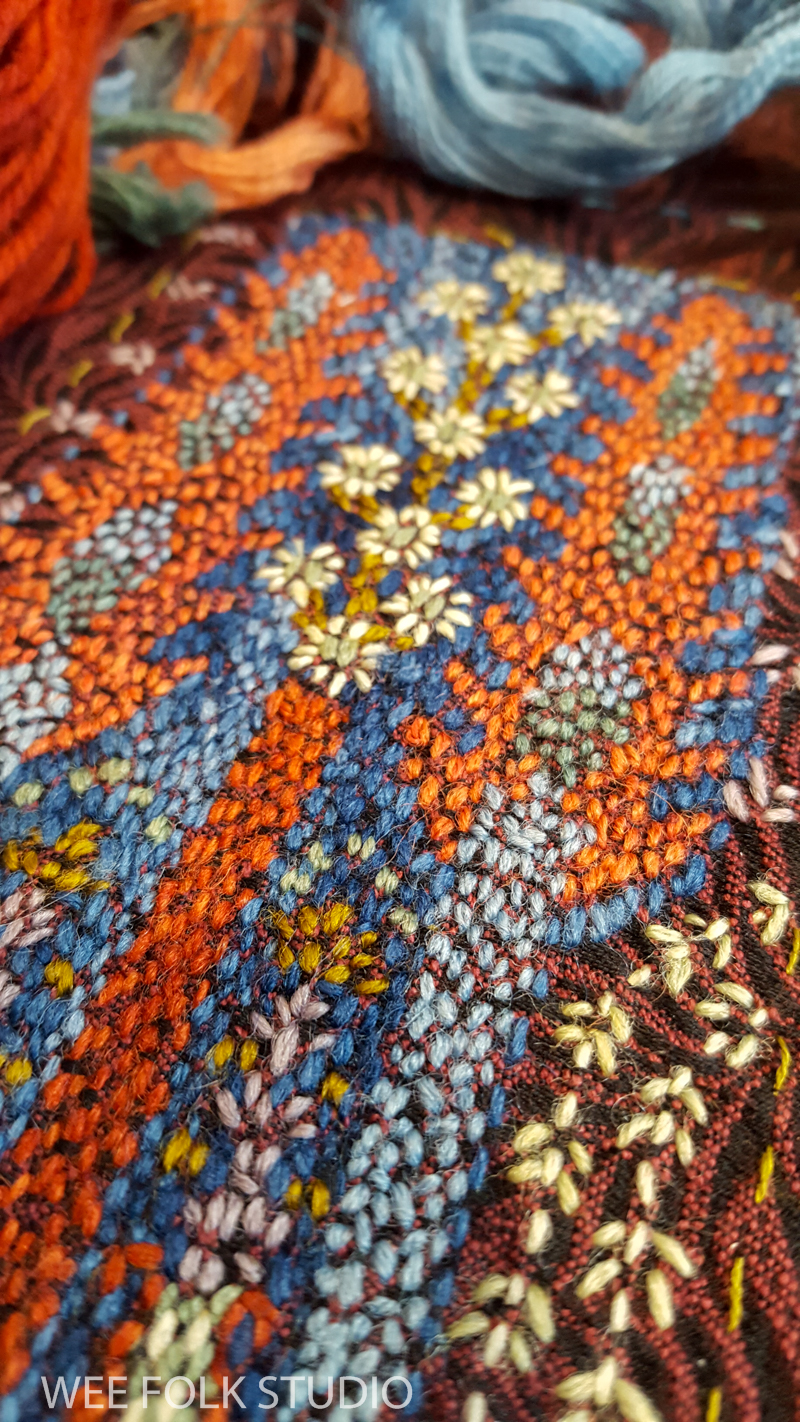
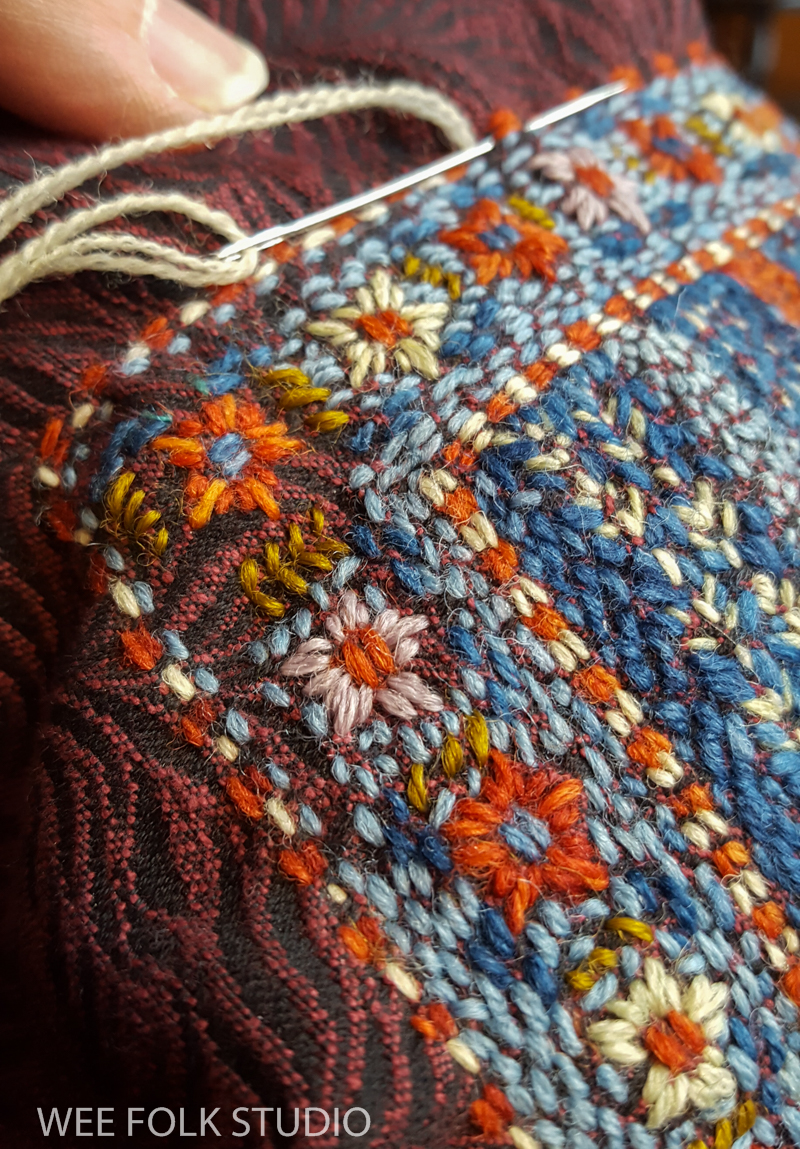
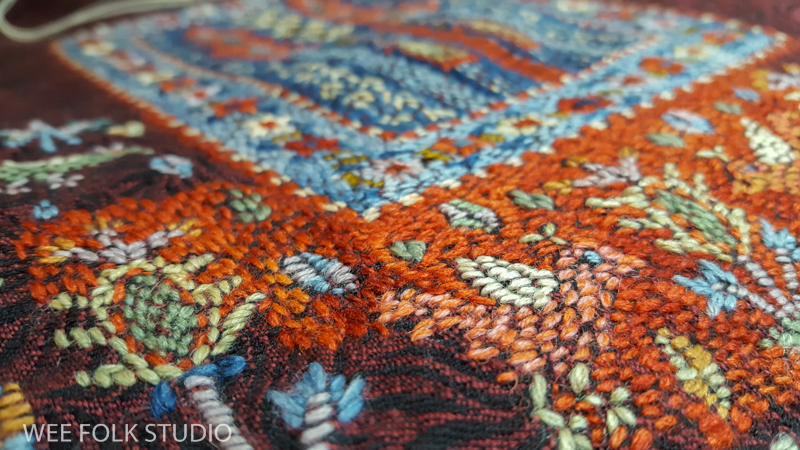
I honestly don’t know what one would call this kind of embroidery. It’s just a lot of seed stitches crammed together, making a stipple effect. I wanted to give the impression of a woven rug, without actually using a grid format. Perfectly straight lines would look odd when everything else in the book is a bit wobbly.
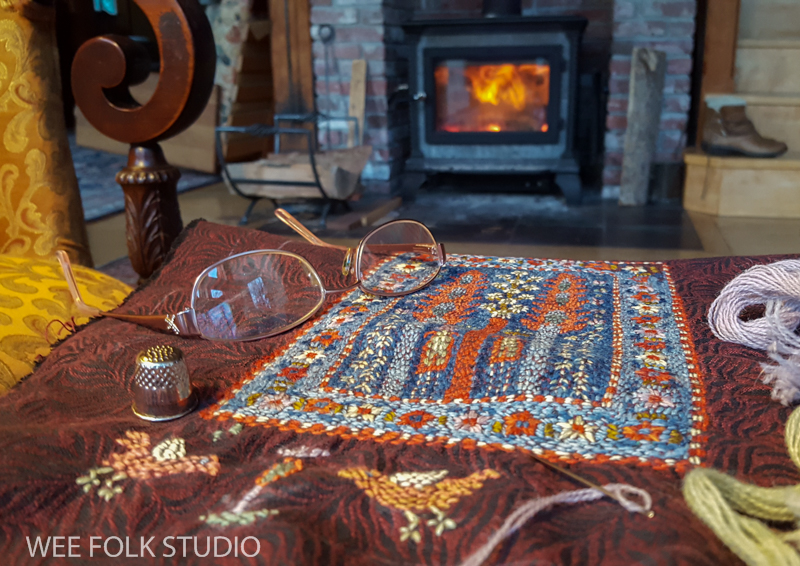
This was the perfect project to work on in winter, staying warm in front of the wood stove. As you can see, I don’t use an embroidery hoop. I usually work with fabric pieces that are too small or thick (like felt) to fit in a hoop, so I don’t even think about using one. I also prefer working with a pliable piece instead of a taught drum. That way you can make the needle go in and out in one stitch, instead of separate down and up moves.
It’s hard to estimate how long it took to stitch the rug, because I worked on it off and on for a month or so, between filming sessions, in waiting rooms and sitting in the passenger seat while traveling. It was closest to filling in a coloring book that I’ve experienced since childhood, but there were times when I couldn’t just follow the pattern and had to adjust the design to fit into the page dimensions.
I love how the unevenly dyed yarn gives a variegated appearance, like you see in authentic rugs.
The best part is the texture of the closely stitched surface, which feels like a real woven carpet. The process of making it was soothing and calming, for sure.
It’s important to keep in mind that this rug is part of an illustration that will have characters and bedding on top of it. Yes, it can be valued alone, as a textile, but that’s not sufficient enough for me. My hunger for a narrative compels me to add other elements. I liken it to the difference between a garment draped on a hanger and that same piece of clothing worn on a person who is alive in the world.
Here, you can see the 3/4 page layout inside the frame. The vertical green wire indicates where the gutter, or page fold will be located. And the two blank areas are sleeping spots for the children, who will be the subject of Part 2.
To keep up with new posts, subscribe to this blog. If you’d like to see more frequent photos tracking the projects in my studio, please follow me on Facebook and/or Instagram.
Welcome to the neighborhood, in this 3rd part of the series about making an illustration set in India for my new picture book. The story about children’s sleeping places in different cultures around the world was written by Rebecca Bond. It will be published by Houghton Mifflin Harcourt in 2020.
Update: Signed copies of My Bed can ordered in my shop here. 40 pages, 9″ x 9″, words by Rebecca Bond, pictures by Salley Mavor, published by Houghton Mifflin Harcourt. ISBN 978-0-544-94906-5
In this scene, the boy’s house takes up 2/3 of the spread and the surrounding village is pictured in the left 1/3. I used a lighter colored background to separate it from the darker house in the foreground. And since the house is blue, I thought, why not offset the sky with green?
Making little dwellings is a favorite diversion, so working on this part of the illustration was a total indulgence!
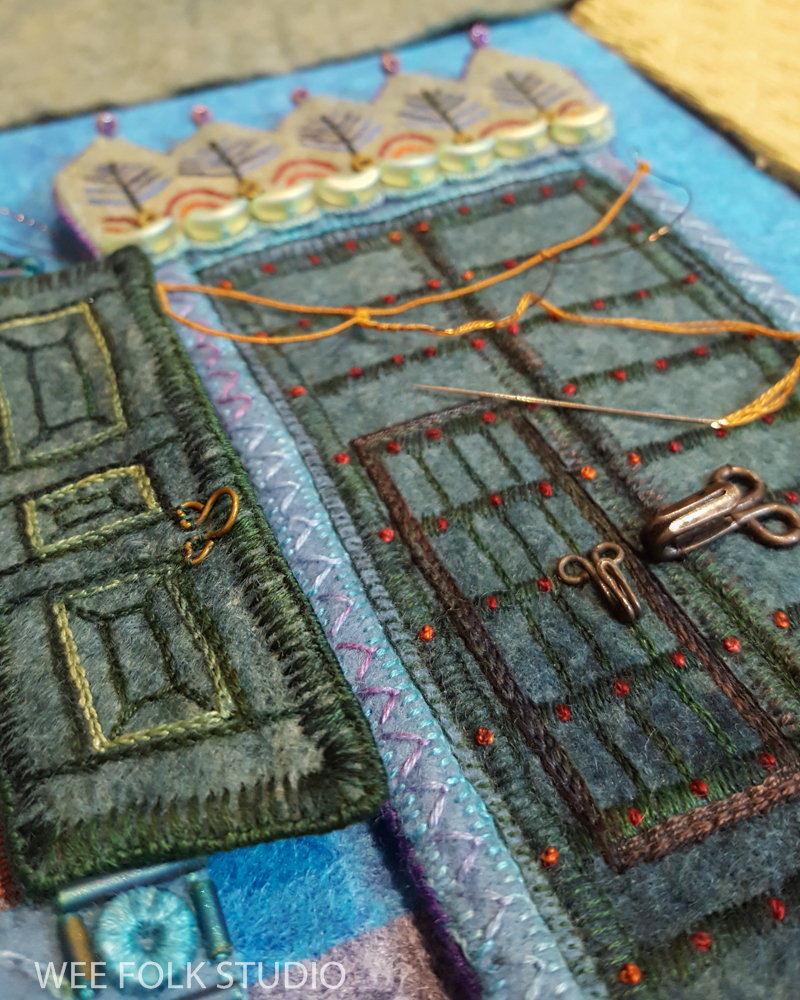
Roof tiles emerge in rows of fly stitches…
and tube beads strung with wire stack up to make a front porch post.
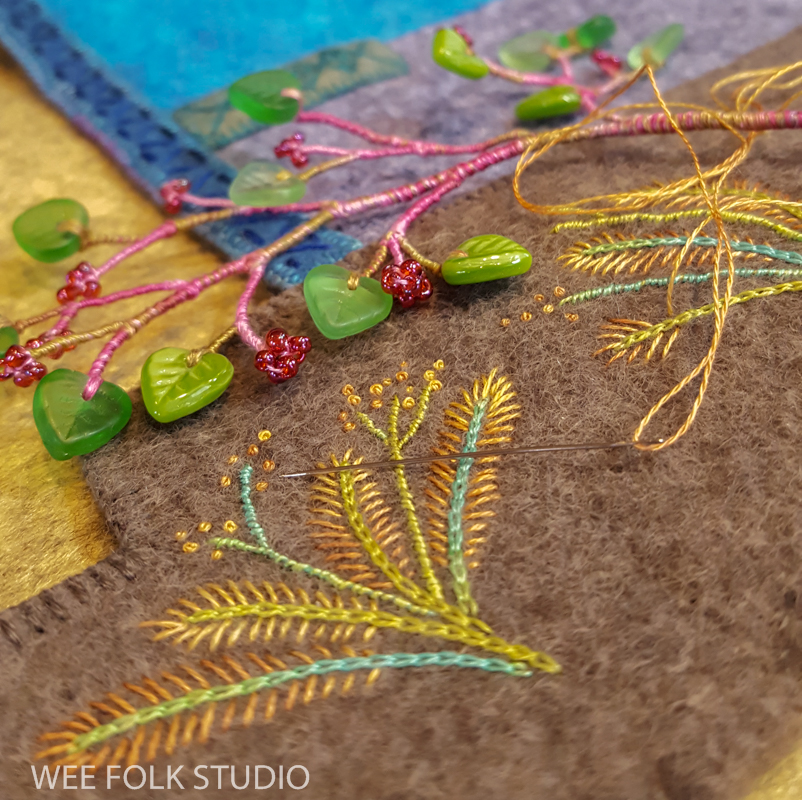
There’s always seems to be an area that needs tree and leaf embellishment.
This story focuses on children, with adult figures off in the distance, so they have to be really tiny.
She may be one of the smallest wee people I’ve put in an illustration. I loved making her outfit and braiding her hair.
I hope that you’ve enjoyed this little peek behind the scenes. To see the whole piece, please go to Part 1 here and Part 2 here.
To keep up with new posts, please subscribe to this blog. Your contact info will not be sold or shared. If you’d like to see more frequent photos tracking the projects in my studio, please follow me on Facebook and/or Instagram.
It’s all about the front stoop in this 2nd part of the series about making an illustration for my new picture book, MY BED.
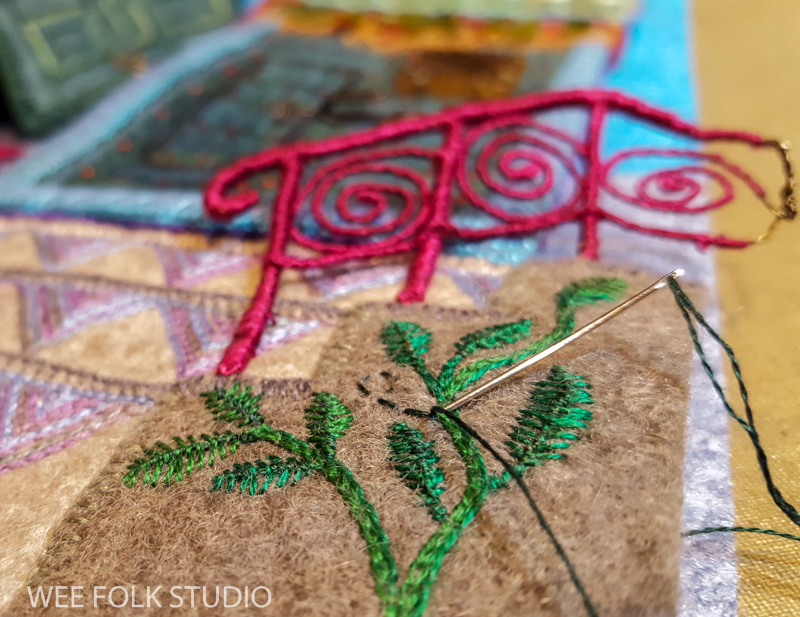
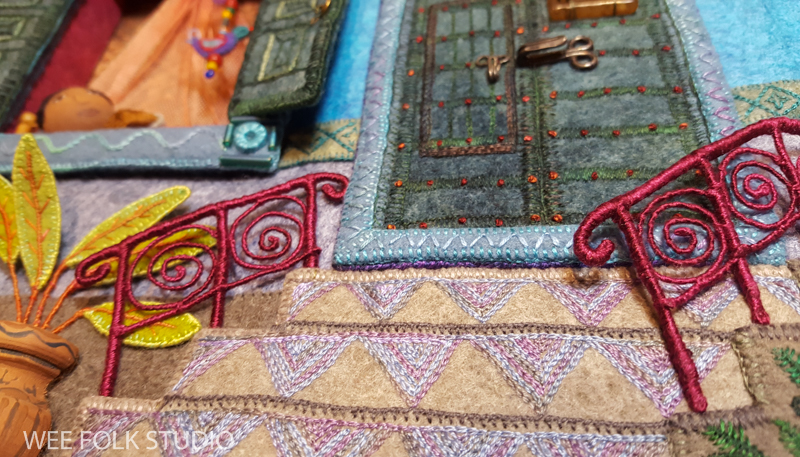
In this scene set in India, the front steps are just another opportunity to embellish and decorate. Some patterns are flat and others are sculptural. The railing is made of wire wrapped in embroidery floss.
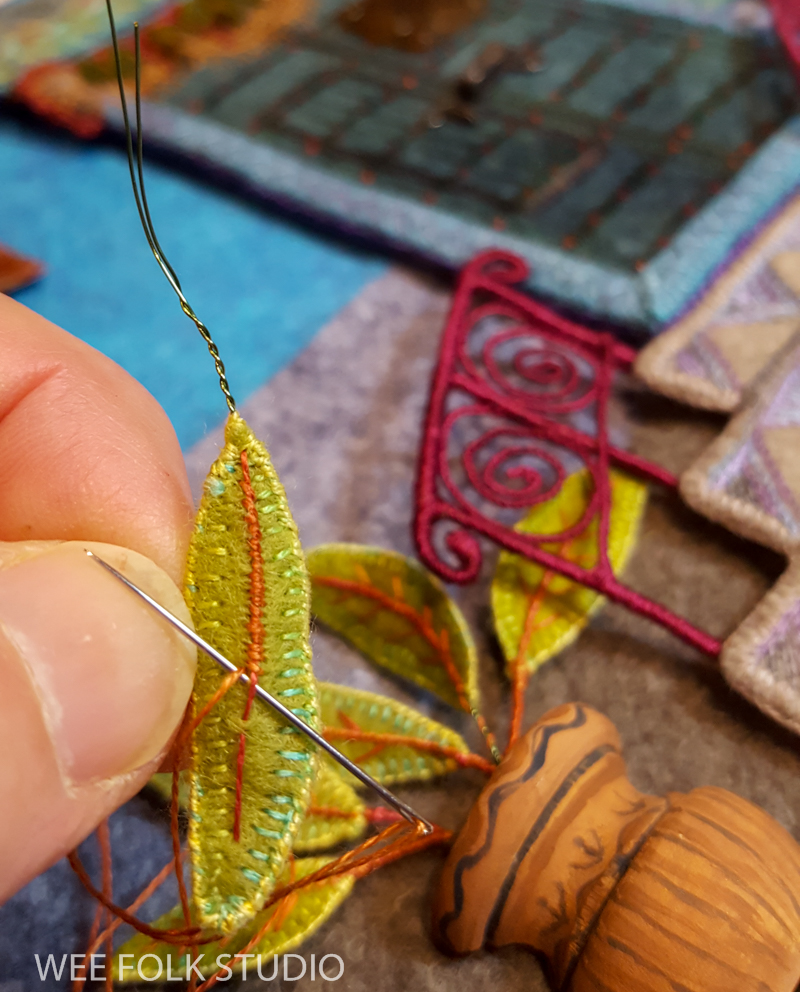
Leaves for a potted plant are edged with wire for more flexibility when it comes time to position them.
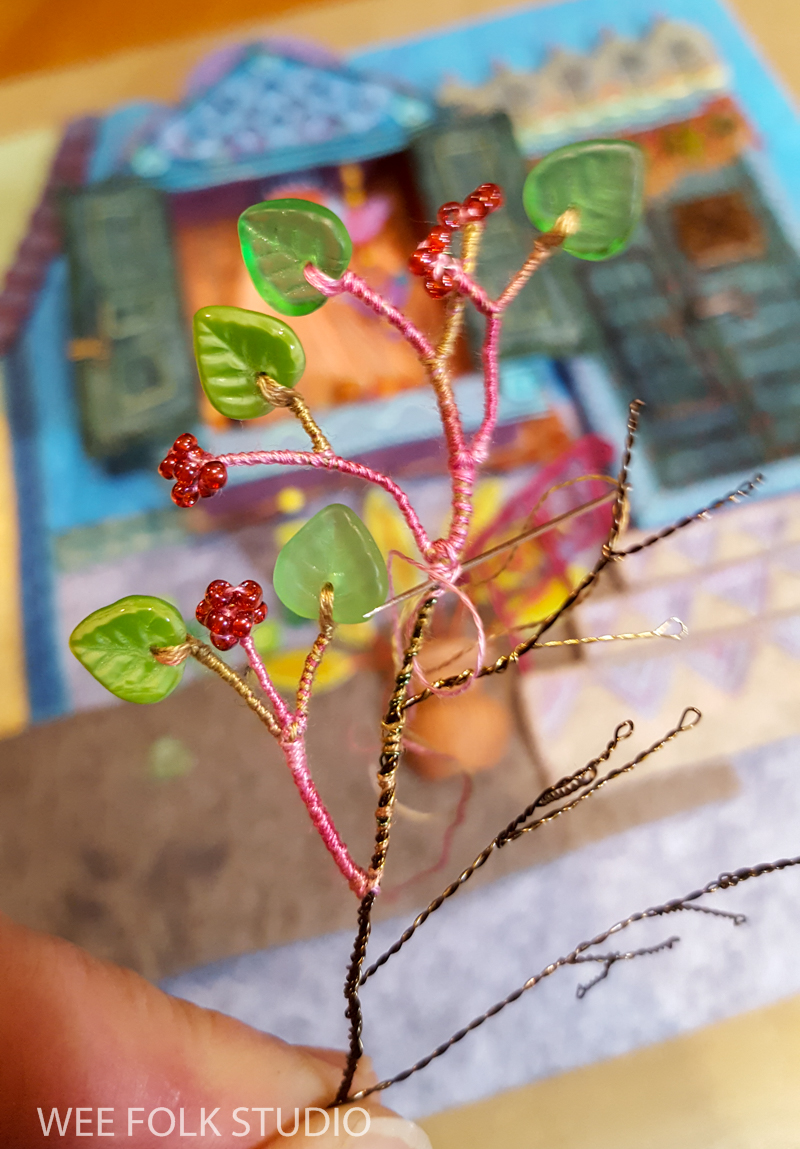
I sculpted some of the foliage with wire, beads and floss…
and embroidered other plants to felt.
More will come in part 3. You can see part 1 here.
Update: Signed copies of My Bed can ordered in my shop here. 40 pages, 9″ x 9″, words by Rebecca Bond, pictures by Salley Mavor, published by Houghton Mifflin Harcourt. ISBN 978-0-544-94906-5
To keep up with new posts, please subscribe to this blog. Your contact info will not be sold or shared. If you’d like to see more frequent photos tracking the projects in my studio, please follow me on Facebook and/or Instagram.
In between animating scenes for Liberty and Justice, I’ve been working on a new picture book that explores varied cultures from around the world. The deadline for handing over the finishes is a year from now, so there isn’t a minute to spare! The story about where children sleep around the world iswritten by Rebecca Bond and will be published by Houghton Mifflin Harcourt in 2020. Here are links to posts about other illustrations for the book: South America,Japan, North Africa, North America, Holland, Iran, Ghana and Afghanistan. To see a list of all my books, click here.
Update: Signed copies of My Bed can ordered in my shop here. Watch this 8 minute documentary about how I created the illustrations for the book.
Months ago, when I starting working on the book, I made a whole collection of children’s heads that would be used in different scenes. There’s something intimate about painting faces and stitching hair that helps connect with the characters. Getting to know the children is the first step in committing to a couple of years of work creating the environments they live in.
This illustration set in India uses the boy on the top right of the pile.
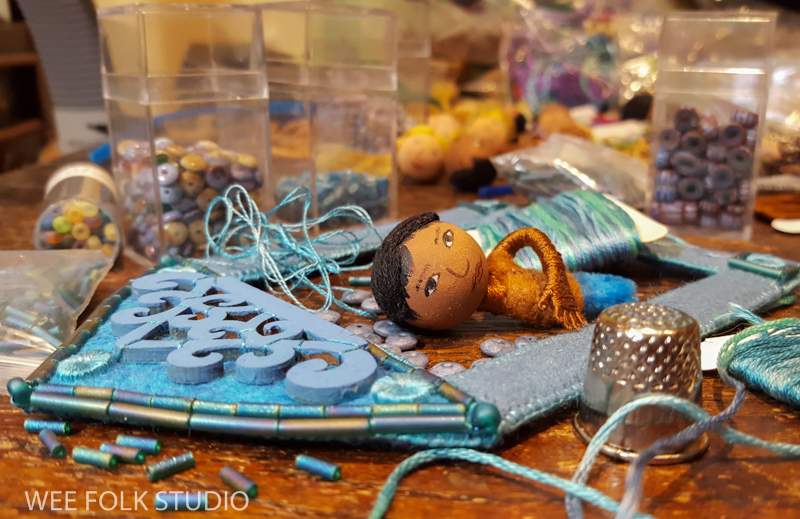
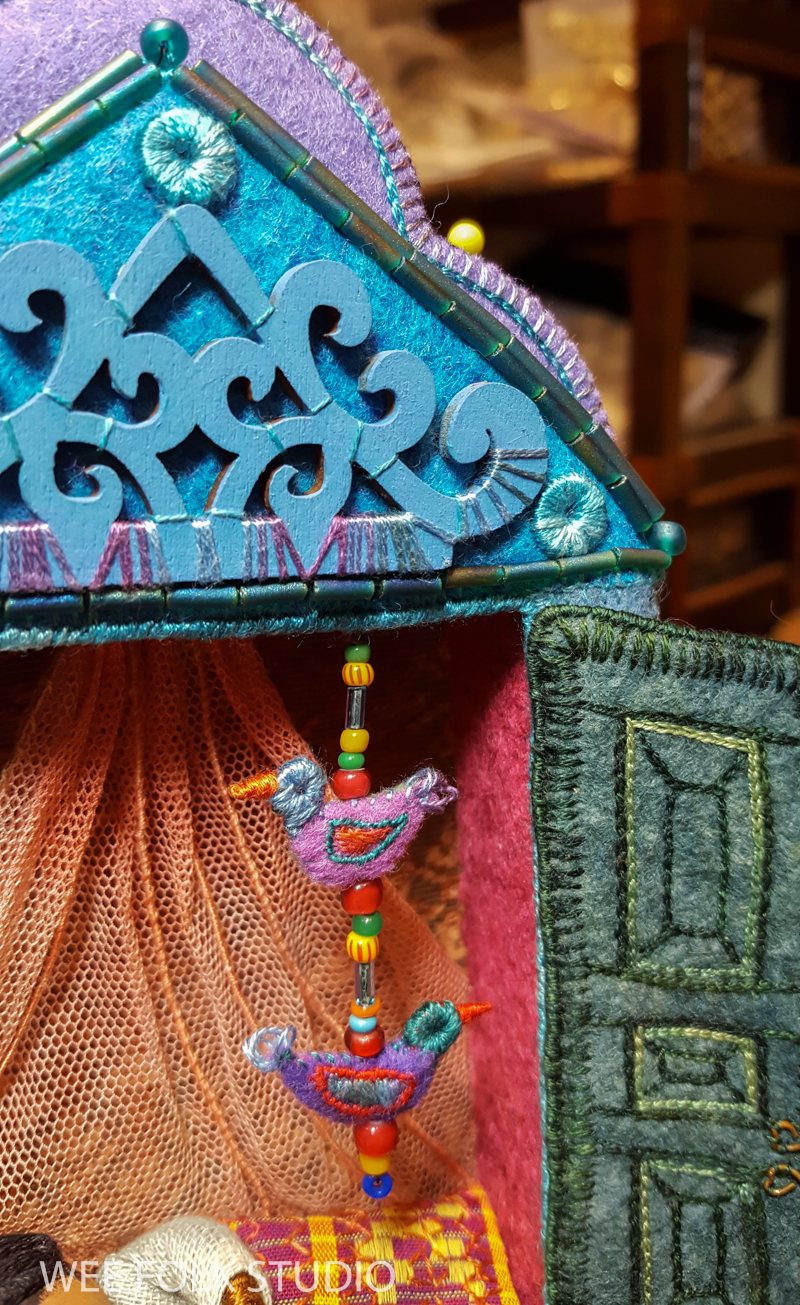
To create characteristically Indian architectural detail, I used beads that have been in my stash for decades, waiting for the right opportunity to show their stuff.
I loved researching Indian houses, so full of luscious colors. It felt wonderful to indulge my love of patterns, after exercising restraint in the Japanese scene.
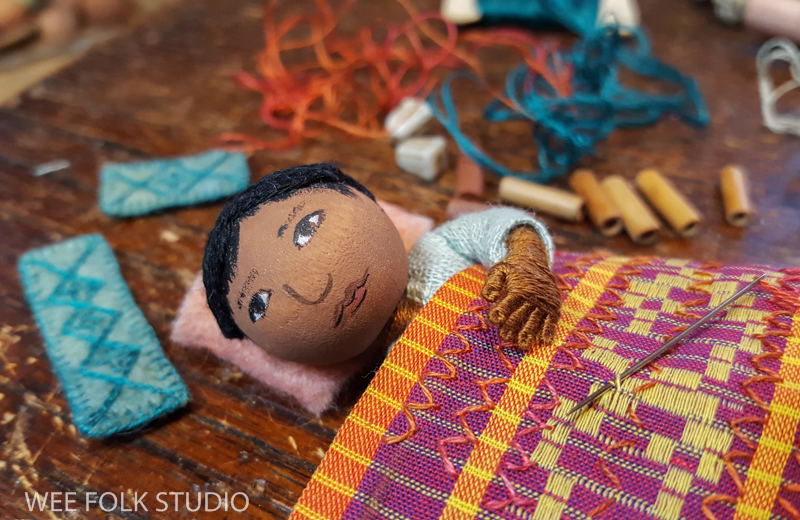
The boy slept on my work table until his bedroom was available.
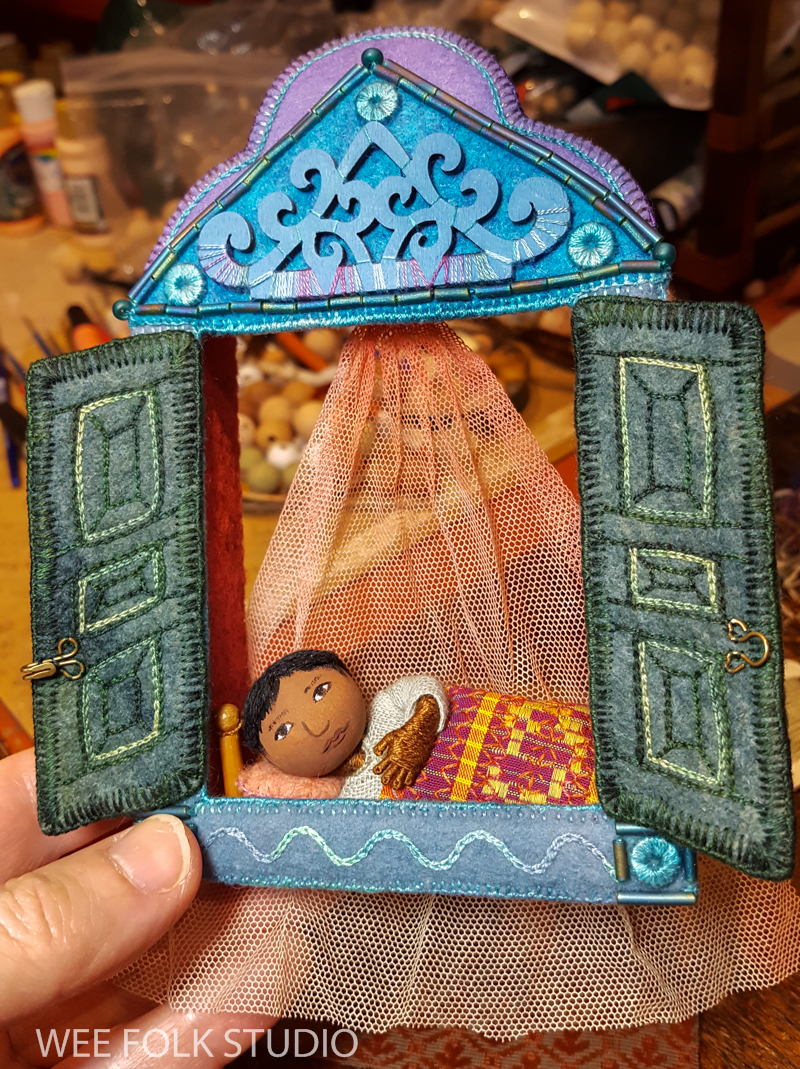
I built a 3/4″ deep box that will be inset, so the viewer can look inside the window and see the boy sleeping.
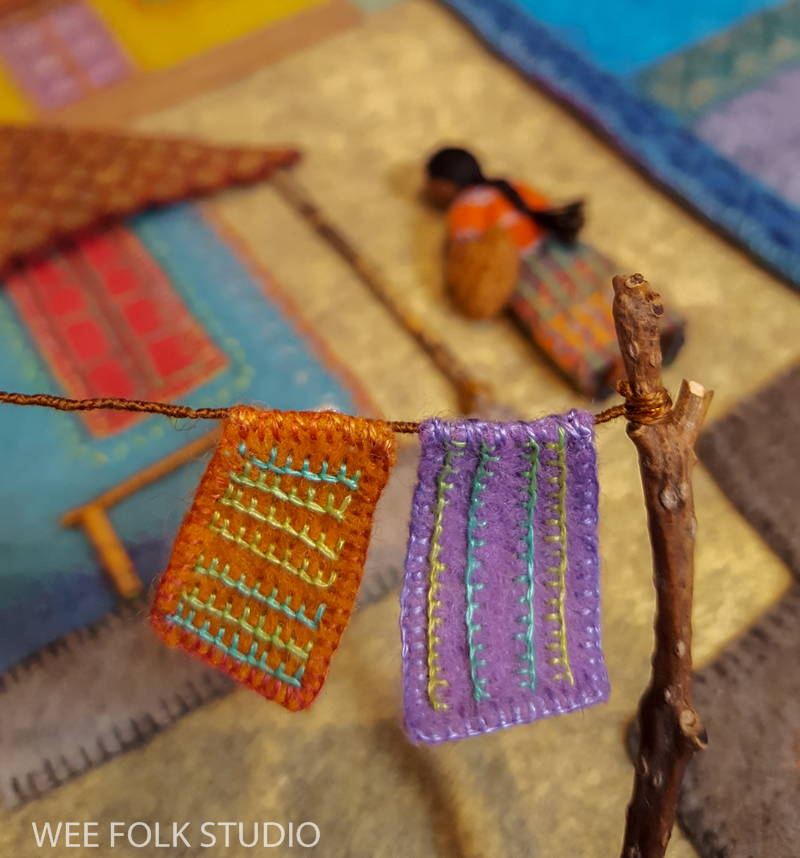
The hanging decorations were made to scale.
There is so much to share from this scene, that I’ve divided it into 3 parts, with many more photos coming in the future. See part 2 here.
To keep up with new posts, please subscribe to this blog. Your contact info will not be sold or shared. If you’d like to see more frequent photos tracking the projects in my studio, please follow me on Facebook and/or Instagram.
Today, I’d like to give a little behind-the-scenes peek at a recently completed scene for My Bed. Over the next year, I will continue to work on illustrations for the book, which will feature sleeping places in different cultures around the world. Here are links to posts about other illustrations for the book: South America,Russia, North Africa, North America, Scandinavia, Ghana, Holland, India, Iran, Ghana and Afghanistan. To see a list of all my books, click here.
Update: Signed copies of My Bed can be ordered in my shop here. Watch this 8 minute documentary about how I created the illustrations for the book.
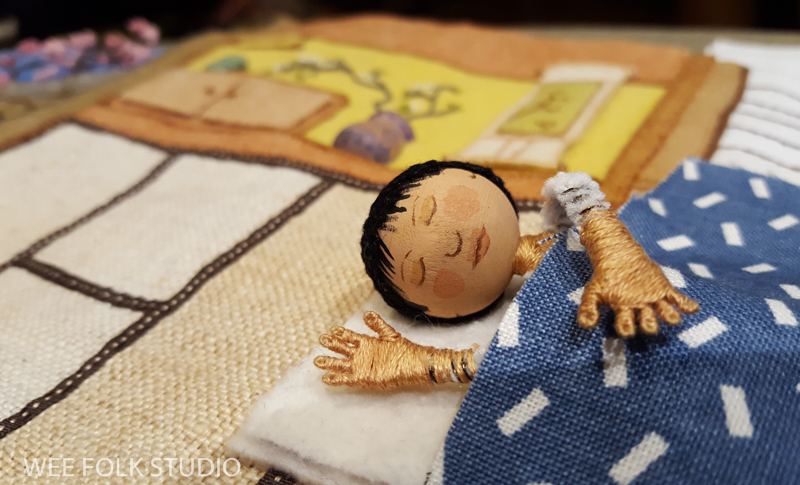
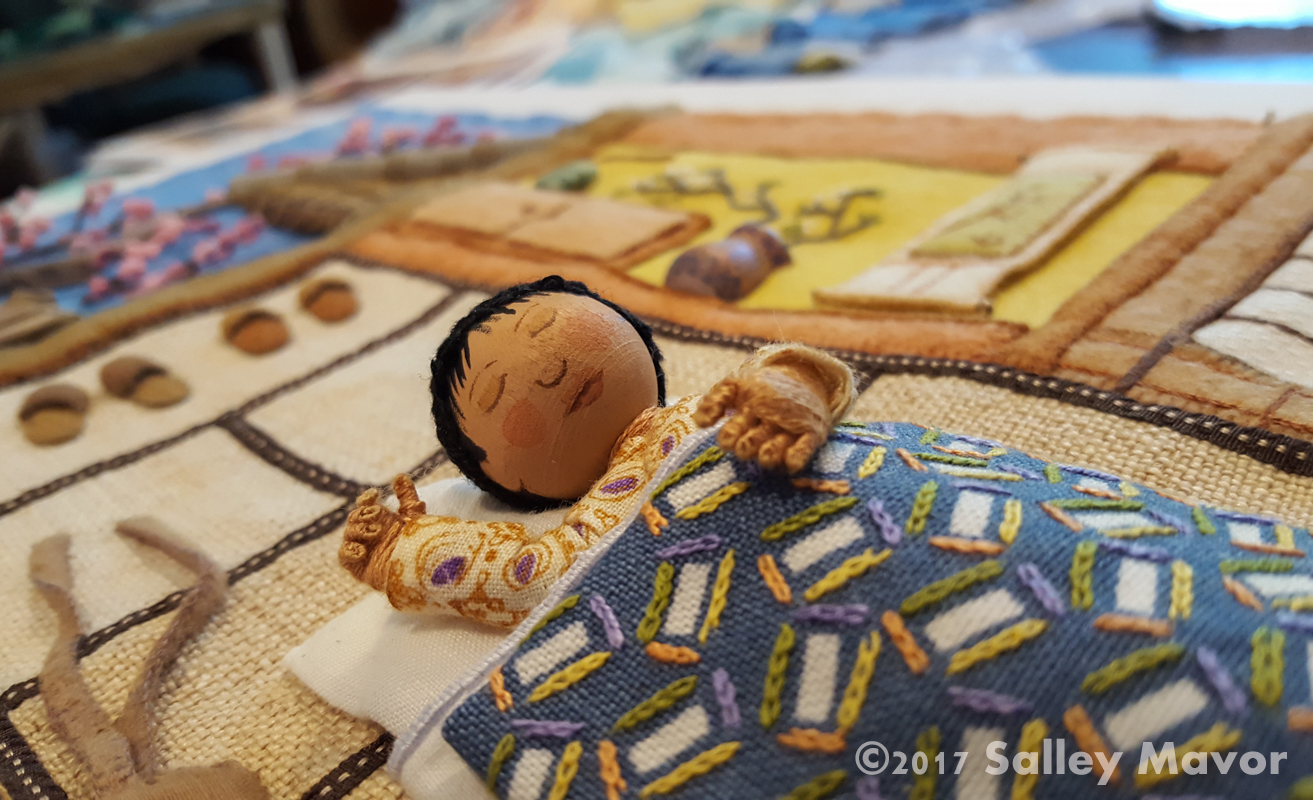
This double page spread has children sleeping on futons in a traditional Japanese interior. To represent a spare and ordered Japanese aesthetic, I deviated from my usual style, which tends to be busy and curvy. I can’t remember the last time I made so many straight lines and right angles!
The tatami (floor mat) is made with some 75 yr. old linen fabric from my grandmother. The texture and age stains make the floor covering look woven and worn. I loved figuring out what items to display in the tokonoma (alcove).
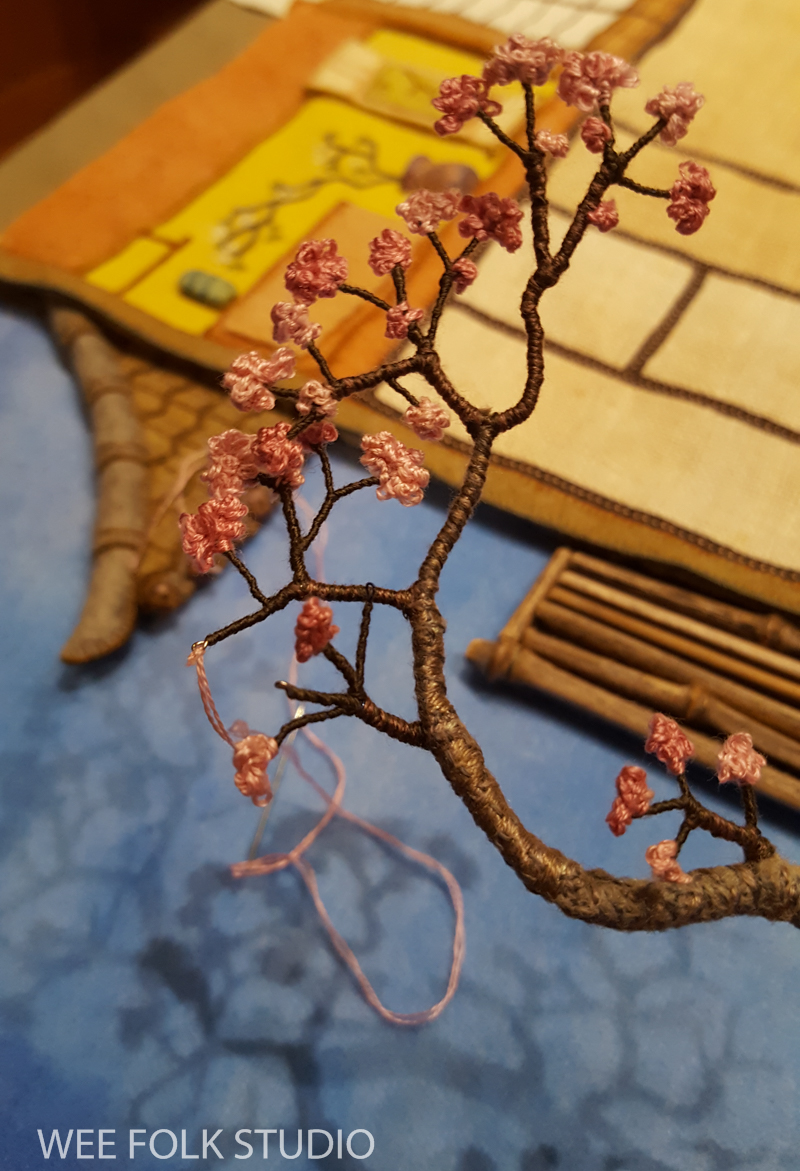
Here’s a video of stitching French knot blossoms on the ikebana (floral arrangement).
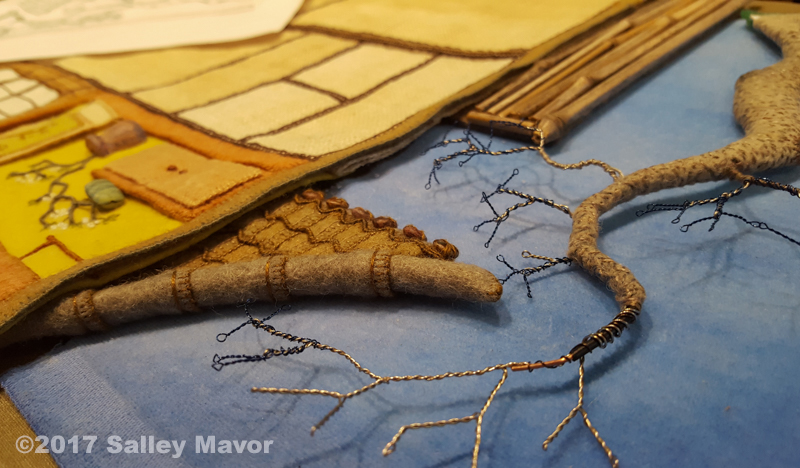
I researched Japanese buildings for this roof section…
and made a fence out of real bamboo shoots.
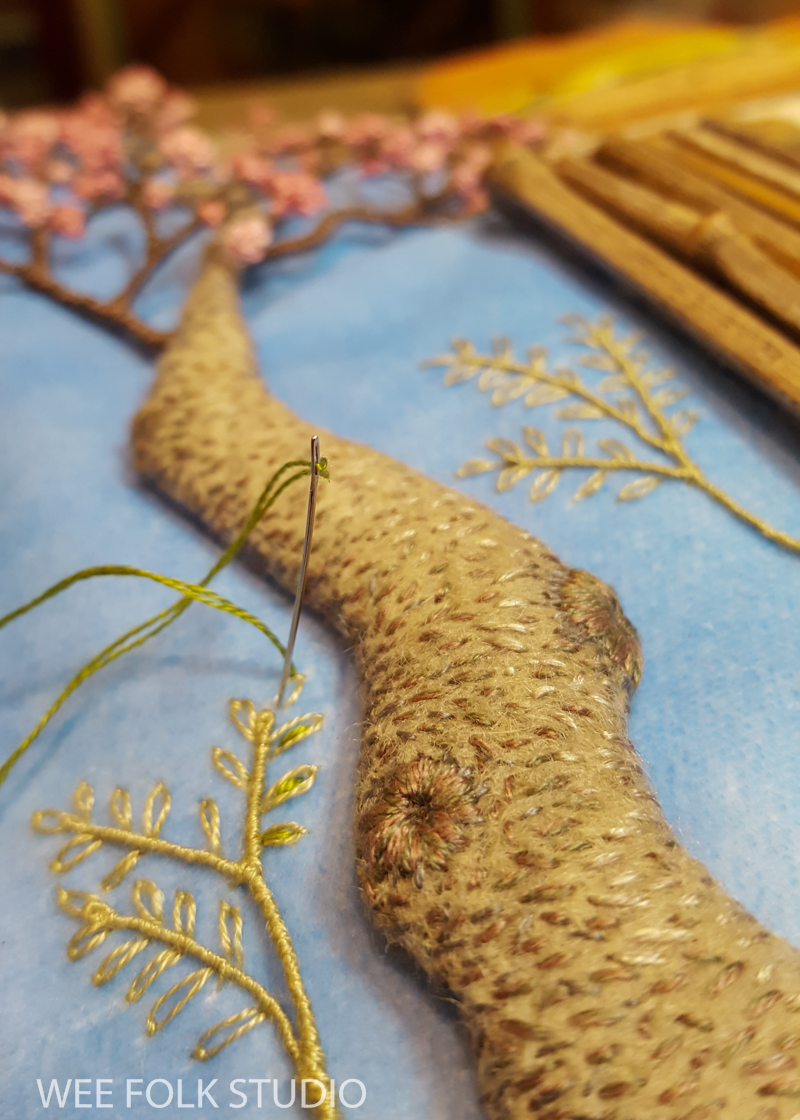
Outside, the cherry tree provided a welcome opportunity for curves and repetitious little stitches.
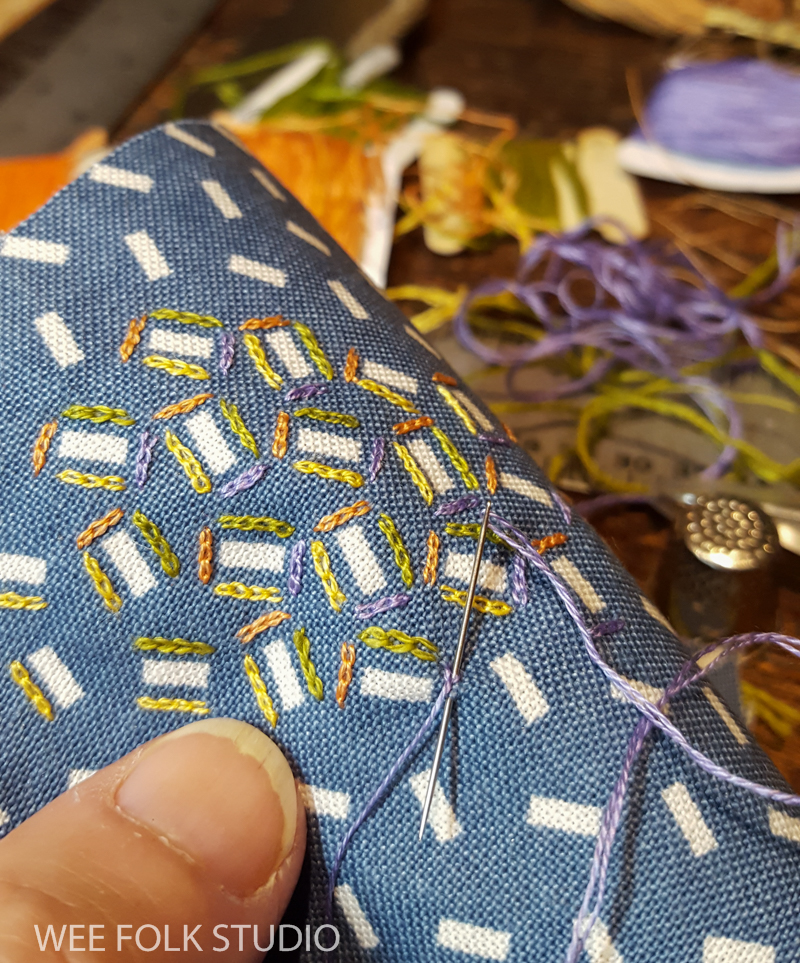
To make a bed covering, I found some blue cotton in my stash…
and embellished it with chain stitching.
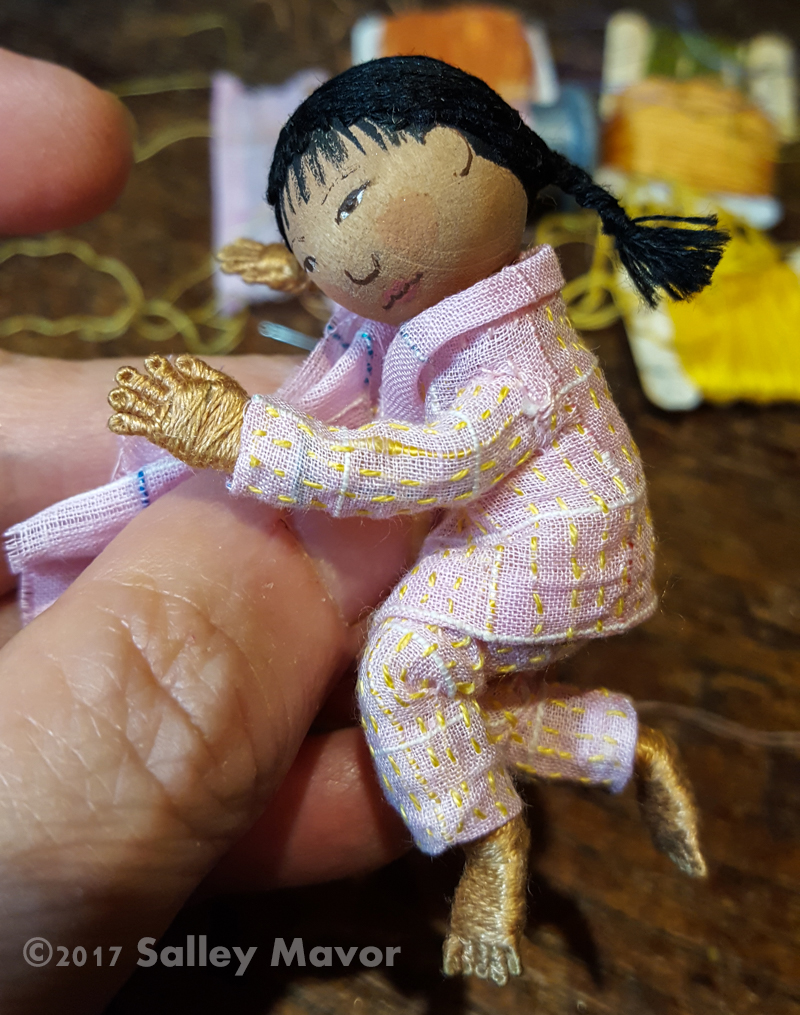
Her pajamas also got some extra yellow thread accents.
To keep up with new posts, please subscribe to this blog. Your contact info will not be sold or shared. If you’d like to see more frequent photos tracking the projects in my studio, please follow me on Facebook, Instagram and BlueSky.

 From the start, I wanted to feature painted furniture in the Khokhloma style, which is like Scandinavian tole painting. After doing some research, I designed a floral and striped pattern for a cabinet.
 Lately, I’ve been using chain stitch more than ever to “draw” lines. This felt panel is embroidered with DMC flower thread, which unfortunately has been discontinued. It’s thicker, not as shiny as regular embroidery floss and has a sturdy feel that I find satisfying. I treasure my supply of flower thread and have enough to last a while longer.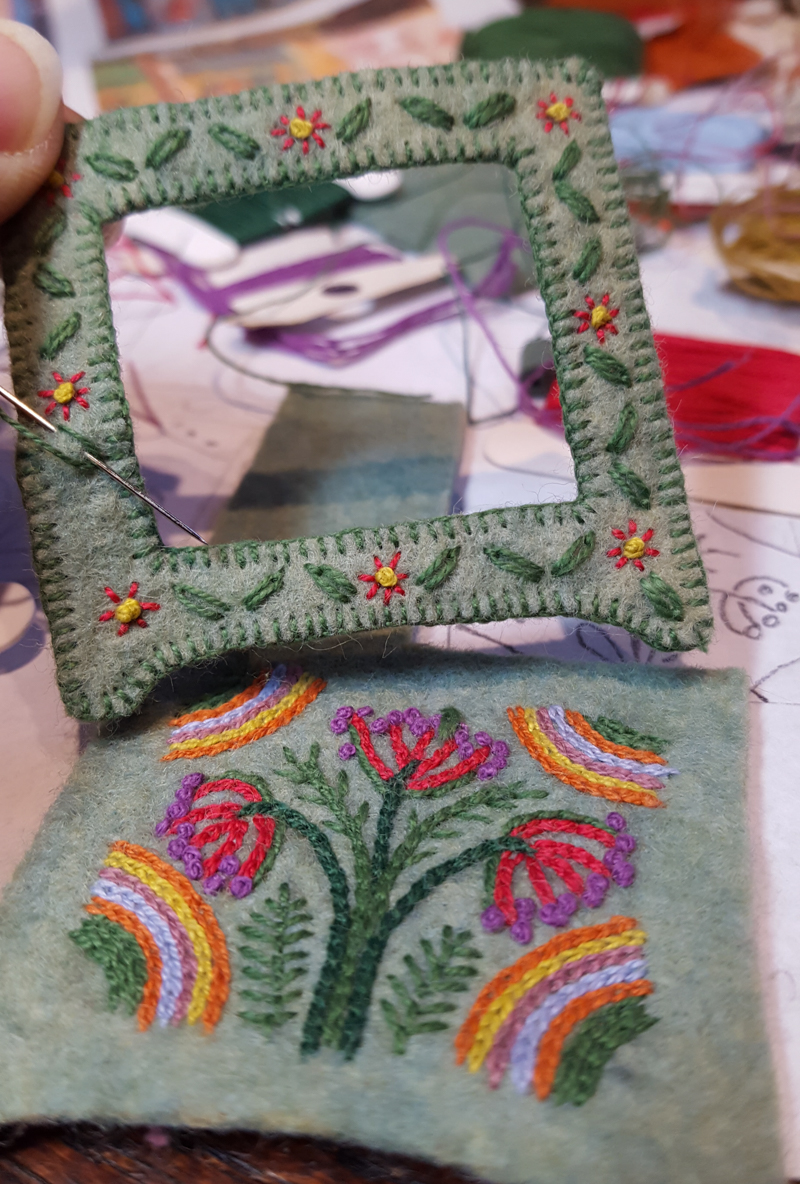
 Wire comes in handy for so many things. In the this case, I used it to create molding along the top edge of the counter top.
 The feet are fashioned from tube beads.
 I made the table and chairs out of pieces of wood, including small turned balusters that are sold to make doll house stairs.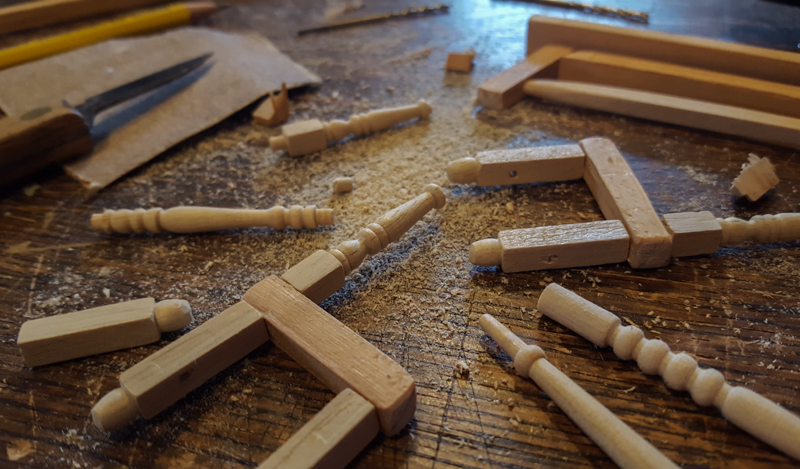


















 It was so fun making these wee slippers to place by the bedside.
















 SALLEY MAVOR