The peapods were the gateway to my life of stitching. I started making peapods and other pins in art school in the 1970s, as a totally separate project from my class assignments. Some of my friends knew about them, but my teachers hadn’t any idea.

One day during class, I was listening to a critique, sewing some peapods, when my teacher, Judy-Sue Goodwin-Sturges, noticed what I was doing. She looked more closely, asked me a few questions and said, “Why don’t you do this kind of thing for your illustrations? Try sewing them.”

With that simple encouragement, I stopped trying so hard to translate the images in my head through a brush or pen. Given permission to work outside of traditional illustration mediums, I found that I was much happier and energized. I was no longer struggling to keep in step, but, with a needle and thread, I could dance. For some reason, I’d been under the impression that in art school, one does “serious” fine art and I’d kept my interest in sewing and handcrafts underground. I rediscovered the joy of creating and learned to trust my hands and gut feelings to help work out challenges.


After graduation, I added more designs and started mass producing pins and selling them on a wholesale basis to shops. I had to really push myself to call shops and and arrange in-person visits to businesses. I was more content sitting at home, covering little red beads with sheer lavender fabric to make bunches of grapes or sewing strings of green wooden beads inside a velvet ribbon peapod. Despite my shyness about pedaling my wares, I found the marketing part of the business to be a creative exercise. I’d spent my teenaged years working in my mother’s import shop in Woods Hole, From Far Corners, and the experience of dealing with customers and knowing the difference between wholesale and retail was helpful.

I started making custom pins of people’s cats, based on photographs they sent. I found that Siamese cat owners were particularly fussy about their breed and one time had to redo a blue point. The cat ears are made from a coiled wire bead, which I cut in half.

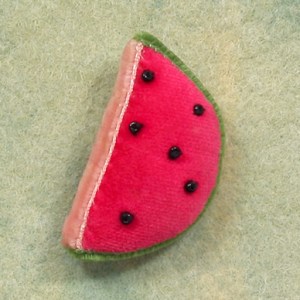
Some of the pins like the cat and the watermelon have a cardboard shape inside to give them stability. I’d sew a little pocket, turn it right side out and slip the cardboard in, put in some stuffing and sew up the pocket.

I used my Singer Featherweight, the same machine on which I learned to sew, to do the machine part. There was always a lot of hand sewing to finish and attach the pin back. I had some labels printed with my name and sewed them under the pinback. They were the same kind of labels you get at fabric stores for sewing on children’s camp clothes.

This is the first of 3 parts. The story is continued in PINS (part 2).
To keep up with new posts, please subscribe to this blog. Your contact info will not be sold or shared. If you’d like to see more frequent photos tracking the projects in my studio, please follow me on Facebook and/or Instagram.



 SALLEY MAVOR