Pocketful of Borders: Jack Sprat & My son John

All of the borders from Pocketful of Posies are finished and the artwork is hung at Highfield for the first leg of the tour. The book release party will be held at Highfield Hall in Falmouth, MA on Sunday, Sept. 26, from 4 to 6pm. I hope to see some of you there!  

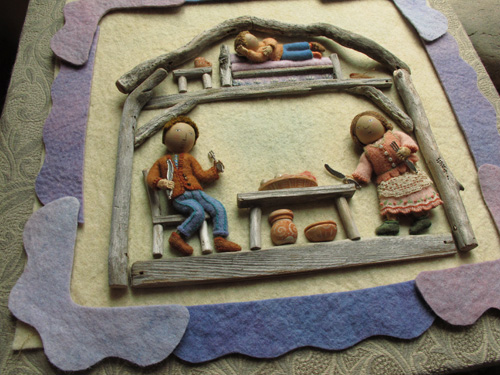
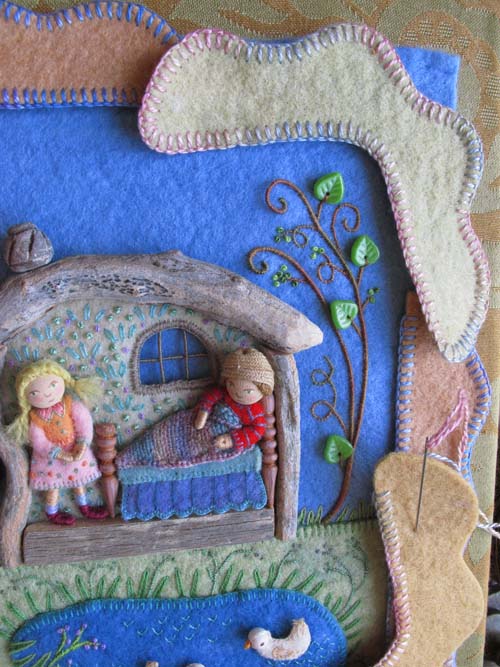
I still have some photos which show the border making process for a few more illustrations. This one incorporates two different rhymes, Jack Sprat (who ate no fat) and Deedle, deedle dumpling, my son John (who went to bed with his trousers on).   


The gray of the driftwood house is too monochromatic for me, so I added a favorite color combination of orange and blue to the figures and props. I used cool colors on the felt border, allowing the warmer browns and oranges to pop out visually. Jack Sprat and his wife are holding doll house utensils.   


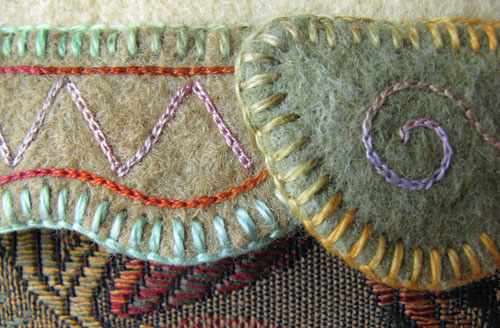
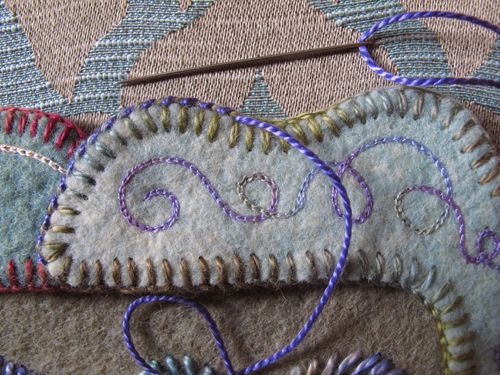
I embroidered the border pieces with variegated thread.   


The driftwood beams and floor boards are sewn onto the felt background through tiny drilled holes. No dreaded glue! Now that I think of it, I did use some glue on the furniture.   


But sewed son John’s bed in place.   


I can remember really liking the process of building the house, which was so different from sewing. There was sawing, sanding, drilling, carving and whittling. Sawdust mingled with threads on the floor.   

Jack Sprat from "Pocketful of Posies" 2010

Note: See other posts from the Pocketful of Borders series here.

Pocketful of Borders: Go to bed first

There are only 5 more borders to make before we hang the first installment of the Pocketful of Posies Traveling Exhibit at Highfield Hall in Falmouth next week. Besides stitching, all I’ve been doing for the past month is eating, sleeping and occasionally riding my bike for exercise. It takes about 8 to 10 hours of sewing to complete each border, so I’ve been aiming for one a day. My broken wrist  set me back 4 months last winter, so I’m making up for it now.

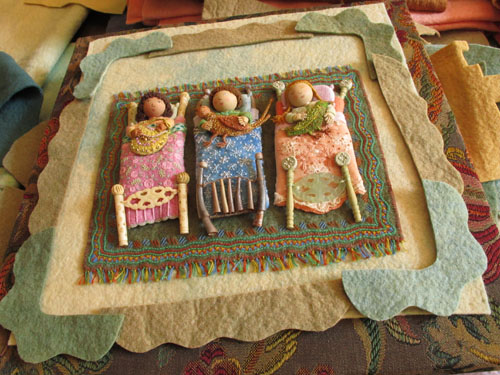
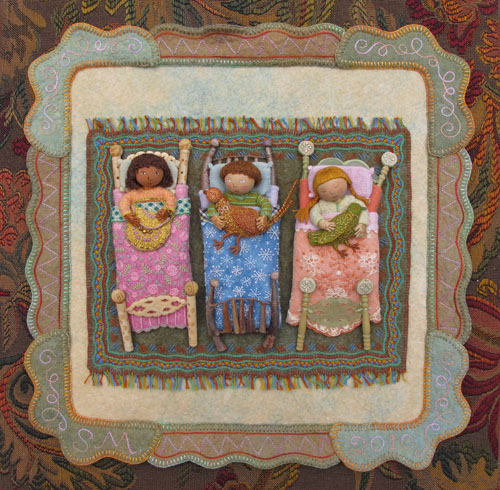
“Go to bed first, a golden purse” begins the last rhyme in the book.  Here’s my work table with the illustration surrounded by piles of wool felt.

The border colors have been selected and cut.

I was so intent on finishing this one, that I skipped taking pictures of the stitching process. The rug under the beds is decorated with embroidery on felt, with thread tassels.

The different beds are made with found objects like beads, dowels, and hollow thorns.

It’s always a good idea to end a bedtime story book with a picture of a sleeping child.

Note: See other posts from the Pocketful of Borders series here.

Pocketful of Borders: Old woman who lived in a shoe, etc.

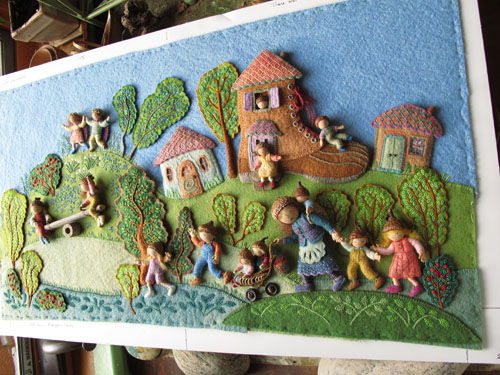
This double page spread from Pocketful of Posies has three rhymes dispersed throughout; There was an old woman who lived under a shoe, Lillies are white and See saw, Margery Daw. Since I’m so busy stitching, I’ll just show pictures of the border making process without description.

Note: See other posts from the Pocketful of Borders series here.

Pocketful of Borders: Humpty Dumpty

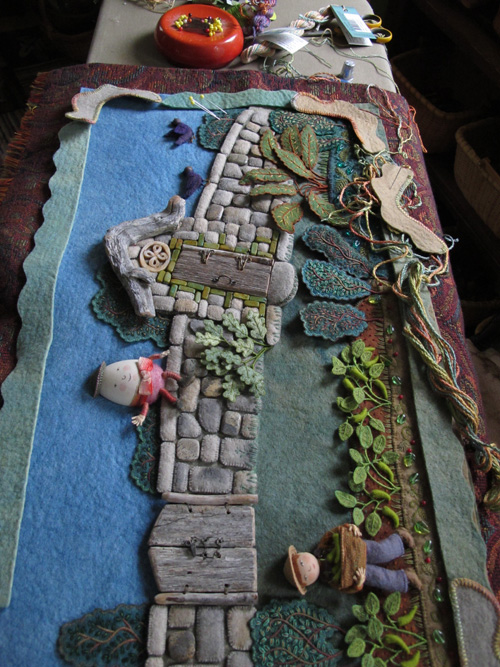
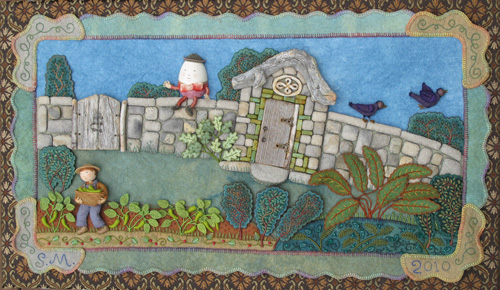
Here’s a shot of my work table (ironing board) with a border in progress. It shows the illustration from Pocketful of Posies that includes “Humpty Dumpty”, “Peter picked a peck of pickled peppers” and “Two little dicky birds sitting on a wall”.

There’s lots of foliage and a stone wall build with a combination of stone beads and individually appliqued felt stones. Peter Piper’s hat and basket of peppers are made with thread wrapped and coiled wire.

I had fun using some interesting pieces of driftwood and other found objects.

detail from “Pocketful of Posies” 2010

Note: See other posts from the Pocketful of Borders series here.

Pocketful of Borders: my black hen

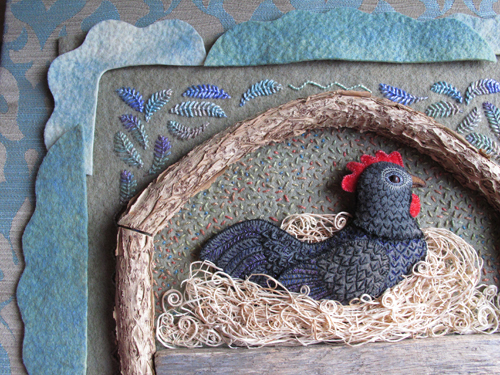
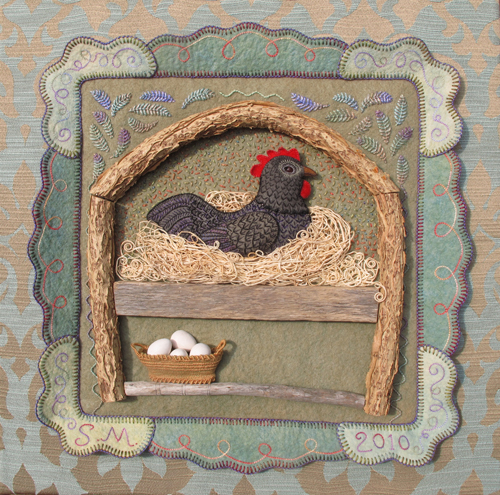
This illustration from Pocketful of Posies is for the rhyme, Hickety, pickety, my black hen, she lays eggs for gentlemen. My descriptions will be brief, as I’m working hard to finish all of the borders for the upcoming traveling show. The colors vary in this series of photos becuase I took them at different times of day, under different lighting conditions. The color green is famously difficult to reproduce anyways. Here’s the fabric relief piece sewn to foam core board, before a border was attached. Yes, I made the egg basket, by wrapping and coiling wire around and around. Pretty obsessive, but necessary!

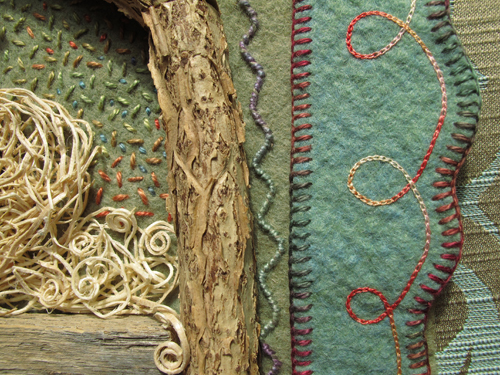
The arched hen-house is made with bittersweet vine, with driftwood floor boards.

The border need a little punch, so I sewed some purple perle cotton around the outside edges.

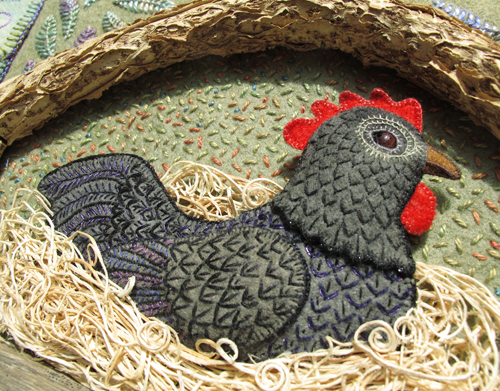
The embroidered leaves could also be seen as feathers.

The hen’s nest is made from some curly excelsior packing material and her feathers are highlighted with purple metallic thread.

This coloring is more true to the original piece.

Note: See other posts from the Pocketful of Borders series here.

Pocketful of Borders: Donkey & Elsie Marley

I’m making good progress on the borders for the Pocketful of Posies Exhibit and thought I’d show one from earlier this summer. This double page spread illustrates the nursery rhymes “Donkey, donkey, old and gray…” and “Elsie Marley has grown so fine, she won’t get up to feed the swine…”.

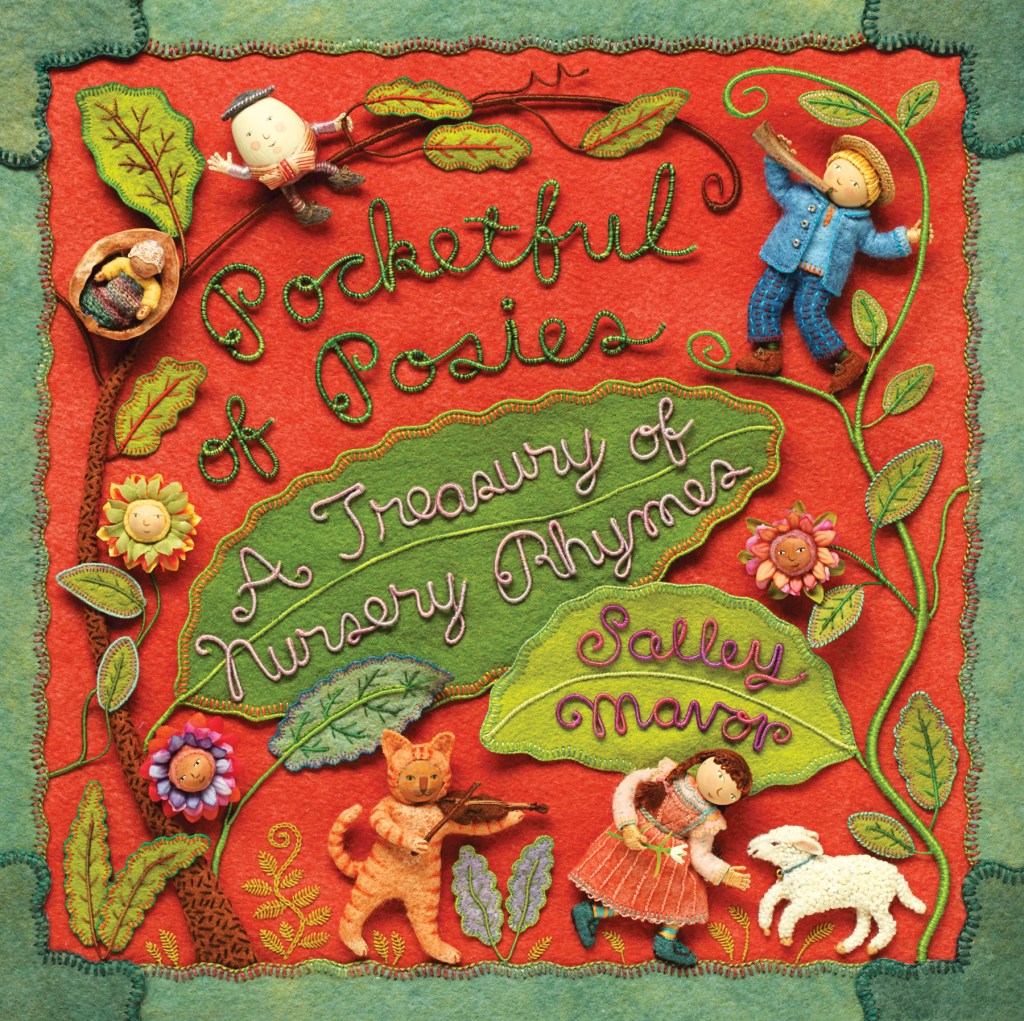
UPDATE: Autographed copies of Pocketful of Posies: A Treasury of Nursery Rhymes are available in my Etsy Shop here.

The hungry swine were fun to make! The stones on the path were made with chain stitches in a tight spiral.

See a detail shot of the driftwood roofs and tree in an earlier post here.

Note: See other posts from the Pocketful of Borders series here.

To keep up with new posts, please subscribe to this blog (top right column on the home page). Your contact info will not be sold or shared. If you’d like to see more frequent photos tracking the projects in my studio, please follow me on Facebook and/or Instagram

Closeups (summer trees)

Before summer passes us by, I’ve gathered a group of trees from my artwork to show. The first one is a crayon drawing on lined paper from 1963, when I was 8 years old.

crayon on lined paper, 1963, age 8

Jumping ahead 20 years, this tree is from an early fabric relief picture called “Jumping Girl”. My obsession with embroidering leaves was underway!

detail from “Jumping Girl” 1985

This is from my first children’s book, The Way Home, published in 1991. By this time, I’d started making branches with thread wrapped wire. Read the story of the making of the book here.

detail from “The Way Home” 1991

Here’s a faux tile I made for my kitchen in 1990. See the other tiles in an earlier post here.

Faux Tile, 1990

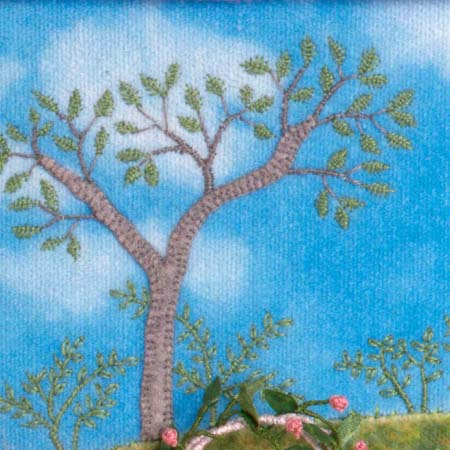
About 10 years ago, I started using more felt and appliqued this tree trunk to the dyed cotton velveteen sky in my book, The Hollyhock Wall.

detail from “The Hollyhock Wall ” 1999

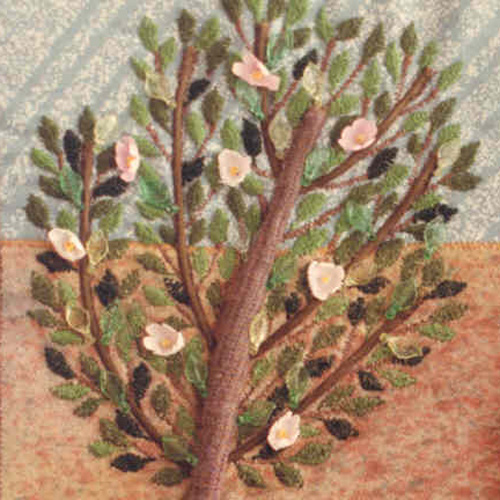
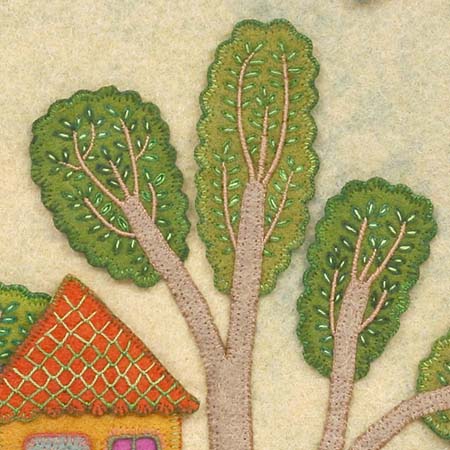
Now, I’m using felt almost exclusively. The next 2 details of trees are from my picture book, Pocketful of Posies: A Treasury of Nursery Rhymes.

detail from “Pocketful of Posies” 2010

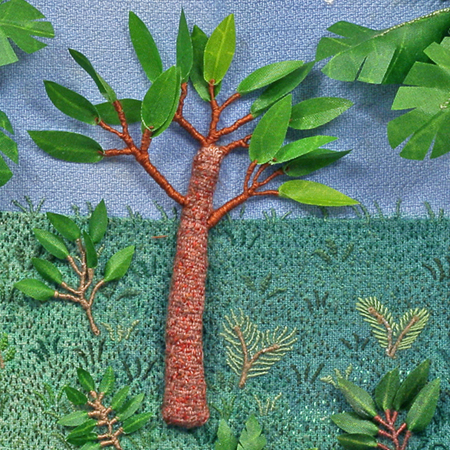
I incorporated many found objects in the “Posies” book and here’s a glimpse of  driftwood and bark buildings, with a tree between.

detail from “Pocketful of Posies” 2010

Note: See other posts in the Close-ups series archive here.

Pocketful of Borders: Jack and Jill

detail from “Pocketful of Posies” 2010

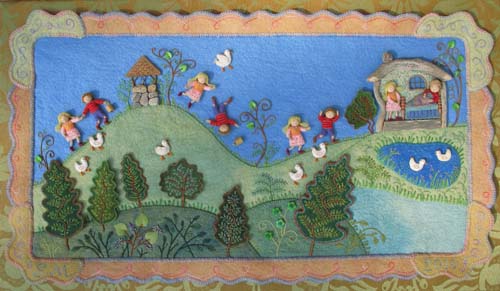
I’ve just finished adding a border to the double page illustration for Jack and Jill, which is part of my upcoming book, Pocketful of Posies. For those of you who are new to this blog, I am preparing 51 illustrations for framing, so that they can be displayed in a traveling show.

The artwork was previously mounted on foam core board for photography purposes. Now, it will be dressed up and given a new border and background. I stretched upholstery fabric and picked out felt colors that complimented and contrasted with the blue and green scene.

I looked through my basket of Watercolour pima cotton threads from the Caron Collection.

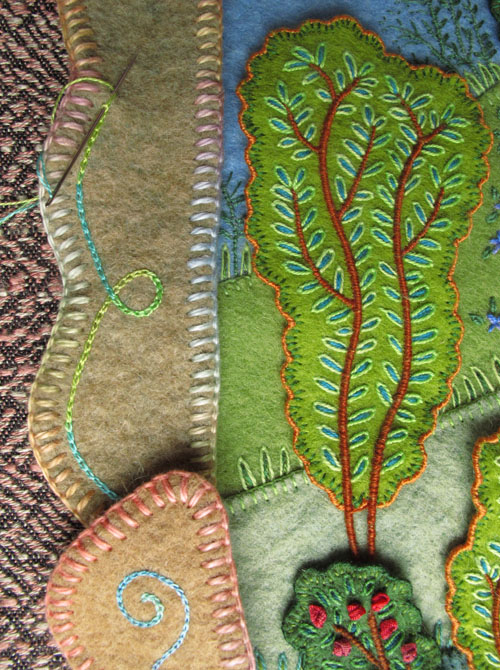
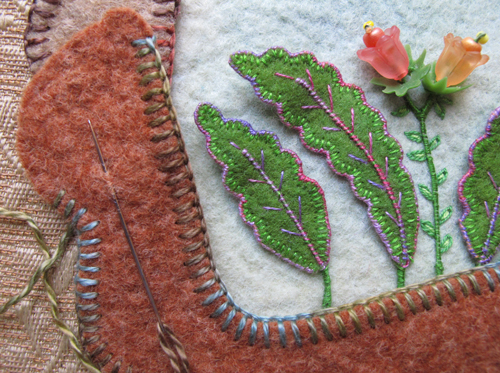
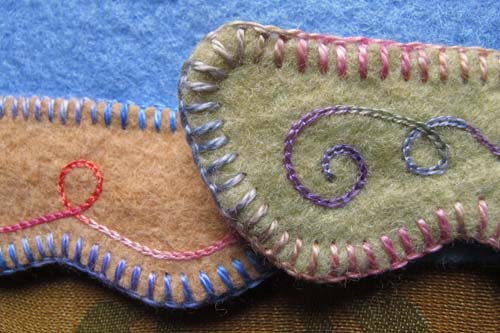
And used bright blue and variegated light pastel thread for the blanket stitch edging along the felt border pieces.

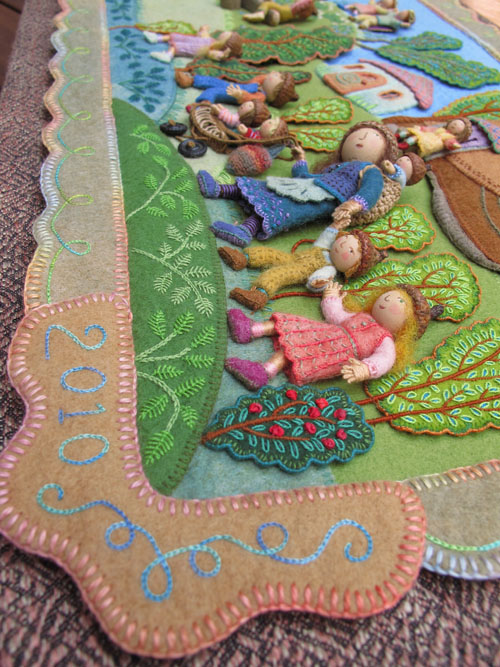
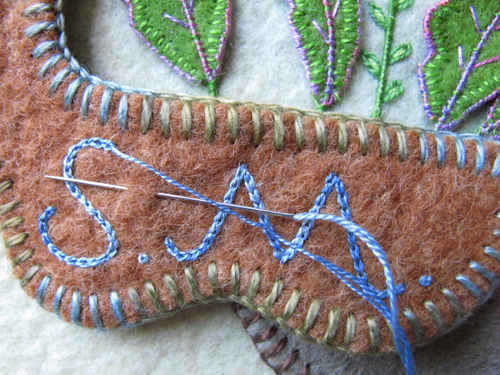
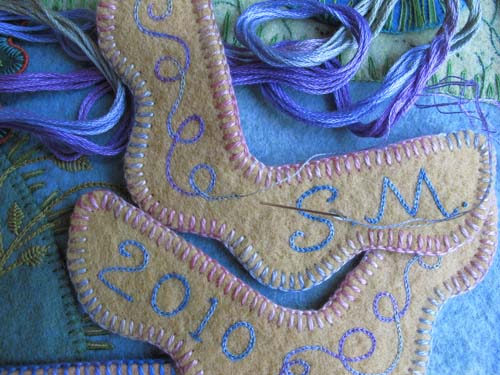
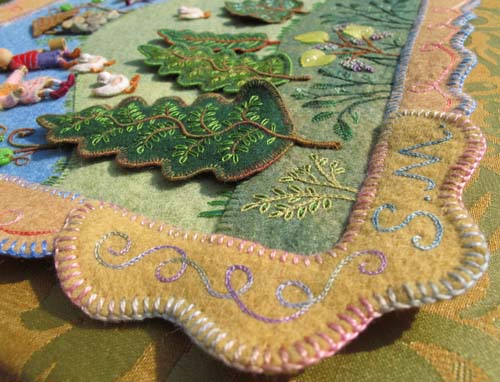
I then chain stitched my initials and the date on the bottom corner pieces with variegated embroidery floss. I’m enjoying the mindless doodling of the chain stitching.

The outside blanket stitch and the embroidery floss curls pick up colors from the illustration.

Then the border pieces are sewn to the inside artwork and onto the stretched back ground.

Now, it is ready for framing!

Note: See other posts from the Pocketful of Borders series here.

Close-ups (shells)

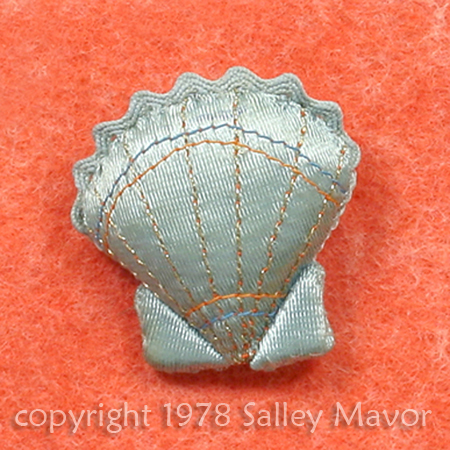
This is a series of shell images, starting with a fabric scallop pin, which I made in the late 70’s. See the story about my pins in earlier posts here.

shellpinWM

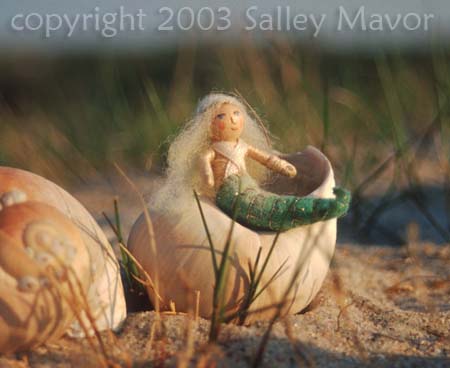
The scale and natural delicacy of shells make them suitable props for my little dolls. Here’s a 2″ mermaid photographed on the beach.

mermaidWM

This is an appliqued felt purse from the 90’s, which is like the ones featured in my how-to book, Felt Wee Folk: Enchanting Projects.

shellpurseWM

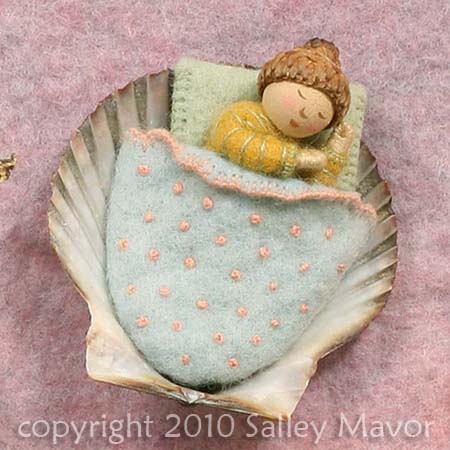
Shells make good sleeping places, too. This is a detail from an illustration in Wee Willie Winkie, from the page which reads, “Are the children in their beds?”.

WWWshellbedwM

Here is a detail from “Mary, Mary, quite contrary, how does your garden grow?”, which is included in my picture book, Pocketful of Posies; A Treasury of Nursery Rhymes.  

marymaryWM

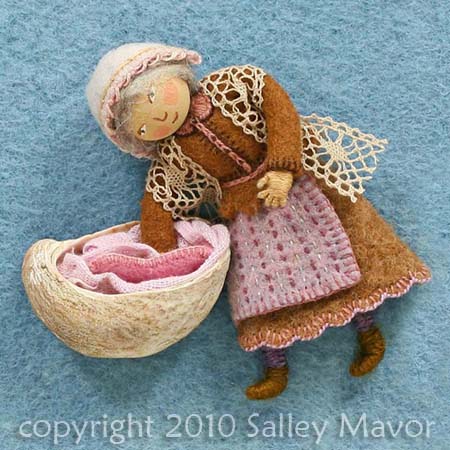
This is from “the old woman stands at the tub, tub, tub” verse, which is also in Pocketful of Posies. Her washing tub is made from a “boat” shell that is commonly found on our local beaches.

PFOPshelltubWM

Note: See other posts in the Close-ups series archive here.

Wedding Banner (Leigh & Brendan)

The 2nd summer wedding is coming up soon, so I’m making another felt banner for Leigh and Brendan (see Karen & Graham’s on an earlier post here). I get the impression that the bride and groom are kind of traditional, so I’m resisting the temptation to go wild with color and add too many funky embellishments.
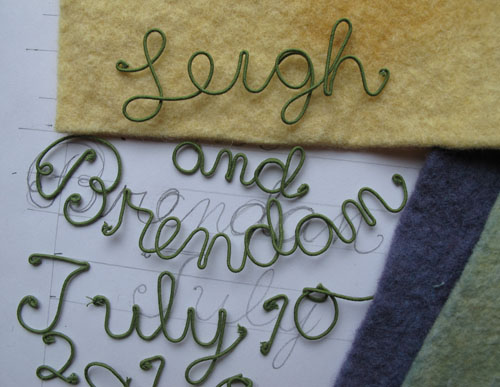
 

I started by bending 32 gauge cloth-covered wire to form the names and wedding date. I’m really having fun bringing language into my artwork this way. I started figuring out this technique a few years ago when I was working on Pocketful of Posies, and have no idea if the same kind of thing has been done before. Once you get into the rhythm, the wrapping goes quite fast. After all those years wrapping fuzzy pipe cleaners with embroidery floss for fairy limbs, this seems easy.
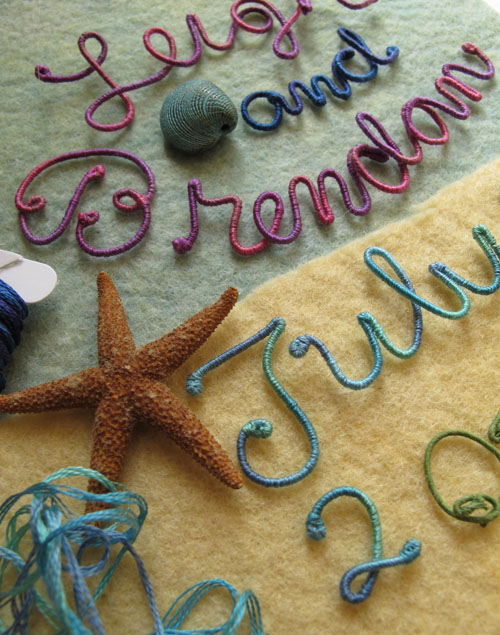
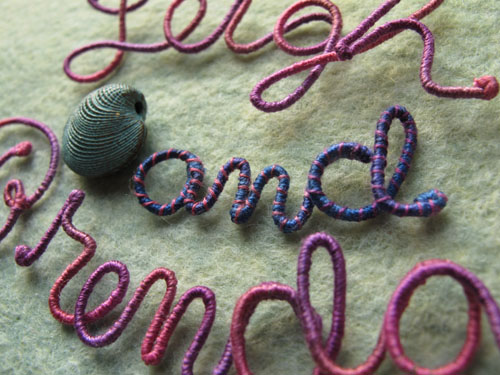
I had to put in some color, though and wrapped the wire names in bright pink variegated embroidery floss. The couple’s invitation had a seaside motif, so I added a metal shell charm and got out a dried star fish from my collection of found objects. The dark blue and had too much weight compared to the names, so I lightened it by winding around a single strand of pink floss.
After bending and wrapping the characters for the date, I cut out a piece of yellow felt to mount them on. I don’t make patterns and plan everything out ahead of time, but construct as I go. I always start with the lettering and then figure out later how much room they’re going to need.

Then, I had to figure out how to place everything on the purple blue felt background. At this point, I realized that the star fish didn’t have anything to offer and would have to go. I go through this editing process often, latching onto some interesting found object and then seeing that it has served its purpose of moving the design along and is no longer needed. A writer friend describes the revision process the same way. She said, “You have to be willing to let go of favorite words and phrases.”
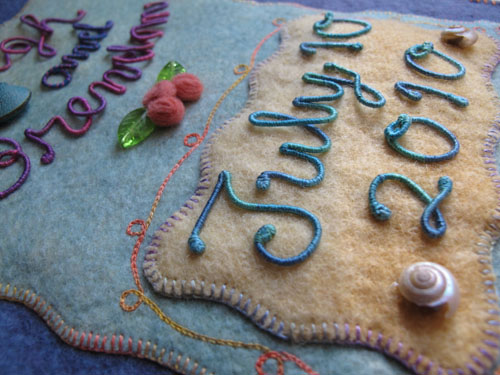
I decided to incorporate a more conventional floral decoration and added some of Mimi’s Kirchner’s felt roses and some glass leaf beads. If you haven’t learned how to make them yet, go to her tutorial on her blog here. I also got out the dreaded glue because that was the only way to attach some shells around the date. The yellow felt piece called out for some embellishment, so I added a chain-stitched loopy line around it.

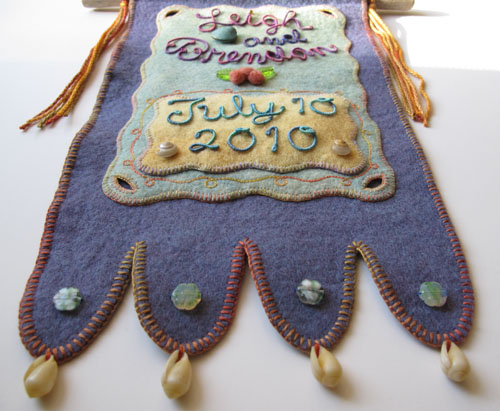
Then, I cut out  a banner of blue felt, with scallops on the bottom and blanket stitched all around with variegated pima cotton from the Caron Collection. I found an old shell necklace, the souvenir kind from Hawaii, and sewed some shells to the scalloped bottom edge. I was glad that they already had holes.
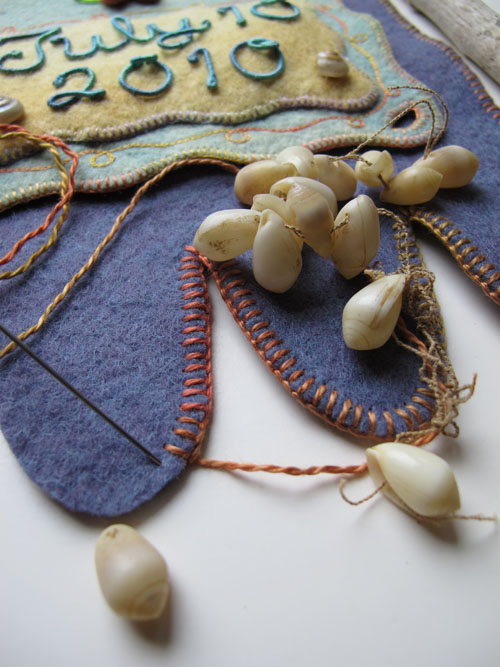
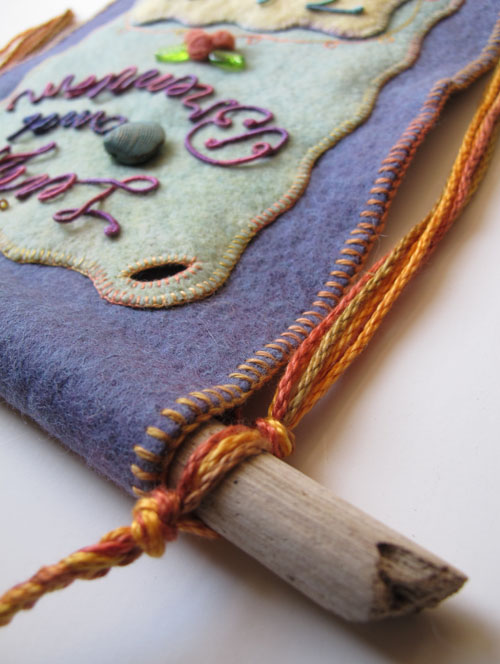
I sewed a casing for a drift wood stick at the top, then tied and braided a pima cotton strap.
Here’s the finished banner, ready to wrap up and bring to the wedding.

To keep up with new posts, subscribe to this blog (top right column on the home page). If you’d like to see more frequent photos tracking the projects in my studio, please follow me on Facebook and/or Instagram.