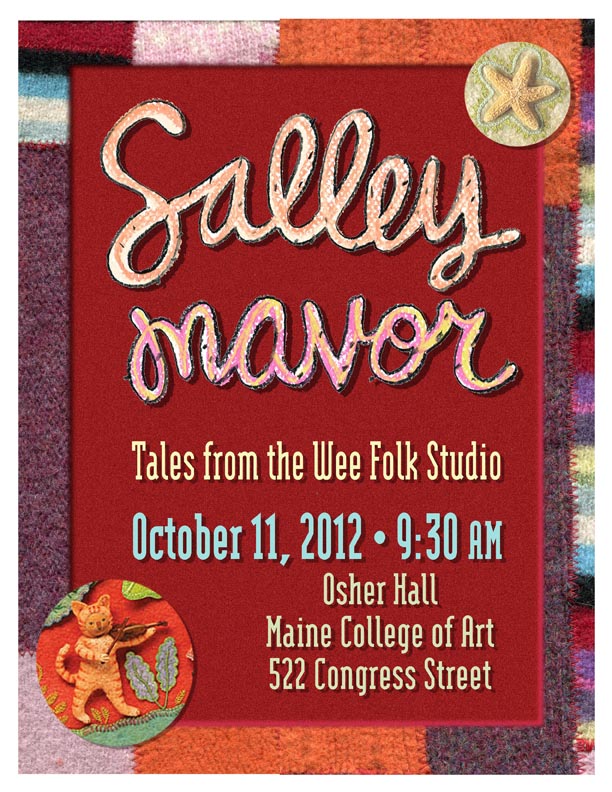
Last week, I had a wonderful visit to the Maine College of Art in Portland. Illustration faculty member, Jamie Hogan and I met at a conference last spring and she invited me to come and talk to a group of illustration majors. Our time at RISD in the 70’s overlapped a bit, but since we weren’t in the same classes, we never knew each other. My husband and I also fit in a short visit with our son Ian, who is a painting major at MECA. In preparation, I tried to remember what kind of things I would have appreciated hearing about at their age and changed my usual slide presentation, gearing it to a younger art student audience.
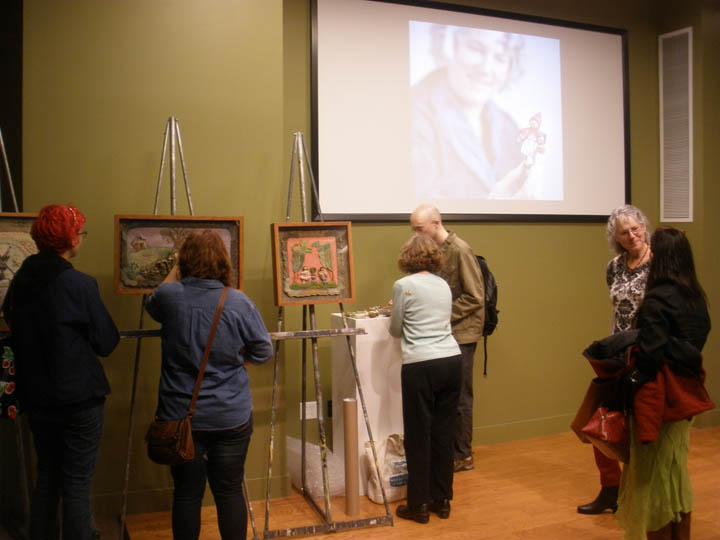
I started by showing the students my first book, made at age 8, and then progressed to projects I’m working on today. Sharing stories of failures as well as successes, I described my journey to find and express my own personal artistic vision. I encouraged them to discover their own unique way as well. I emphasized the value of an art education, no matter where it leads, and predicted that their time at school will benefit them in ways that they may not see until much later. The skills they are learning are basic to our human experience, because they are being challenged to look carefully at what they see, solve problems imaginatively, and to learn how to create something new. This is a special time, when students are surrounded by a supportive community that believes in the power of art. We’ve all heard the opinion that art is unnecessary and impractical in today’s harsh world, so I think spending time with other motivated artists is essential.
I told them about people I meet who are skilled technically, but lack the confidence to create original designs. Many are mature women who copy patterns and faithfully follow directions, always coloring inside the lines, so to speak. In a lot of ways, needlework traditions have been kept alive through this culture of imitation. For many, this is a comfortable and peaceful way to spend time. Others want to break out and do original work, but are struggling to find a way. Technique can be perfected through hours and hours of practice, but creating something new takes a sophisticated understanding of design, color and composition–the principles of which one can learn in art school. But, folk artists create strong, well designed artwork, so art training isn’t always necessary. Being original could have more to do with self-confidence and a willingness to experiment than education. Of course, it’s never too late to grow artistically, it’s just easier to learn the vocabulary when you’re young.


It was a pleasure to meet so many students who are serious about what they are working on. I love how funky and fragile they are at the same time. Their teacher, Jamie Hogan followed up with an e-mail, saying that “the Salley effect is rippling through the department!” She told about one senior who had an epiphany after my talk. She remembered that she really liked to do sculpture, but had gotten wrapped up in trying to paint realistically. Now she’s going to return to making 3D things, and somehow combining them with painting and air brushing, and she’s filled with a new enthusiasm. Thank you, Jamie, for passing this on. Hearing the students’ reactions makes it all worthwhile!
By the way, a spot has opened up in my Felt Banner Workshop on Oct. 27th. Intermediate to experienced stitchers are welcome to sign up. Check it out here.

 SALLEY MAVOR