Two weeks ago,I announced my new project featuring climate change activist Greta Thunberg, which you can see here. Since then, I’ve heard from many of you who would like to purchase cards with the wee folk version of Greta and her quote. I am happy to say that note cards, postcards and prints are now available in my shop. Profits from sales will go to support climate science research at the Woods Hole Research Center. _________________________________________________________ Set of 4 Note Cards – $10.00 – Buy here. Set of 10 Postcards – $10.00 – Buy here. 8.5″ x 11″ Archival Print – $15.00 – Buy here.
Thank you for purchasing prints and cards! With your help, we can bring more awareness to this important issue.
Greta is looking at you.
If you missed the post about making the Greta doll, please check it out here.
To keep up with new posts, subscribe to this blog (top right column on the home page). Your contact info will not be shared. If you’d like to see more frequent photos tracking the projects in my studio, please follow me on Facebook and/or Instagram.
Quite often I’m asked to teach how I make things. Requests for classes, tutorials, patterns and directions from groups and individuals who are eager to learn my methods regularly fill my email box. It’s perfectly reasonable to ask such questions and I’m happy that people are interested in learning new ways of working. But for me, these inquiries only remind me of how much I operate outside of the mainstream, in a different needle and thread universe. In this post, which is a rewrite of a story published in 2015, I explain my approach to making art and my personal philosophy about sharing knowledge.
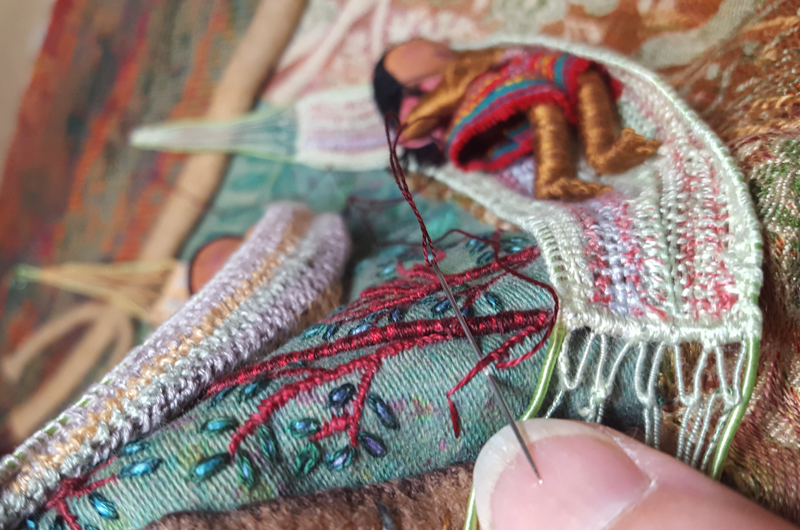
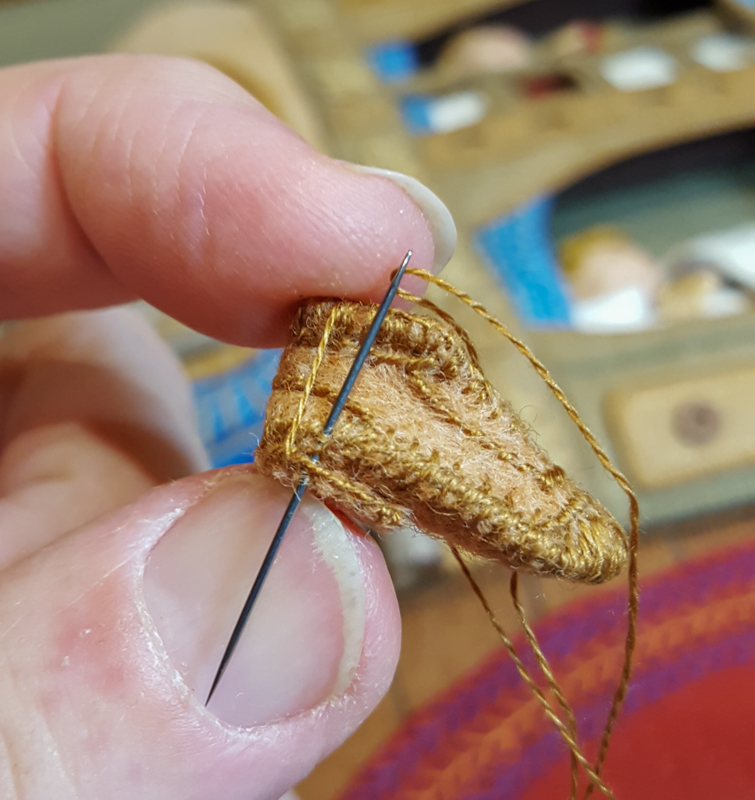
Stitching foliage in the S. America scene.
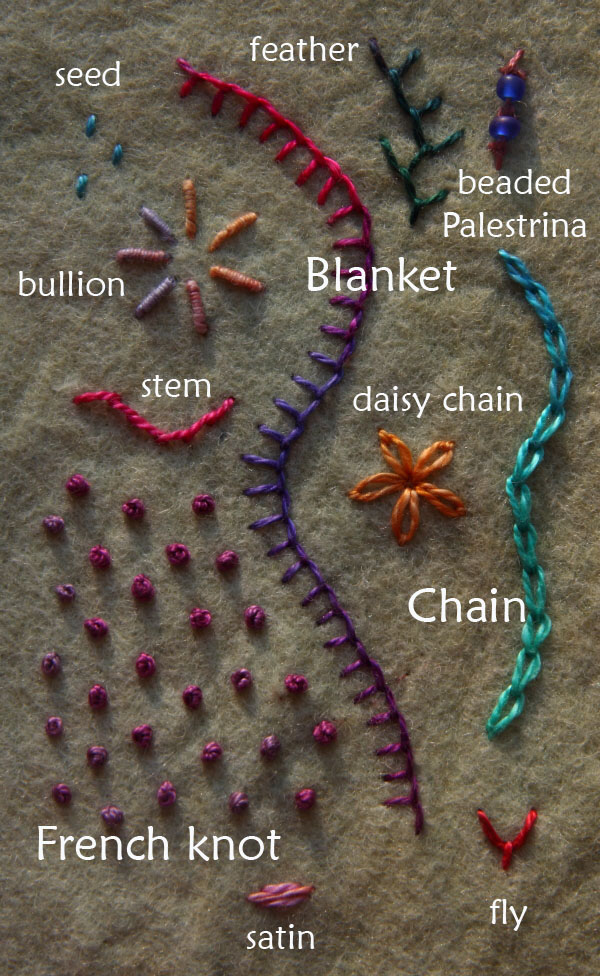
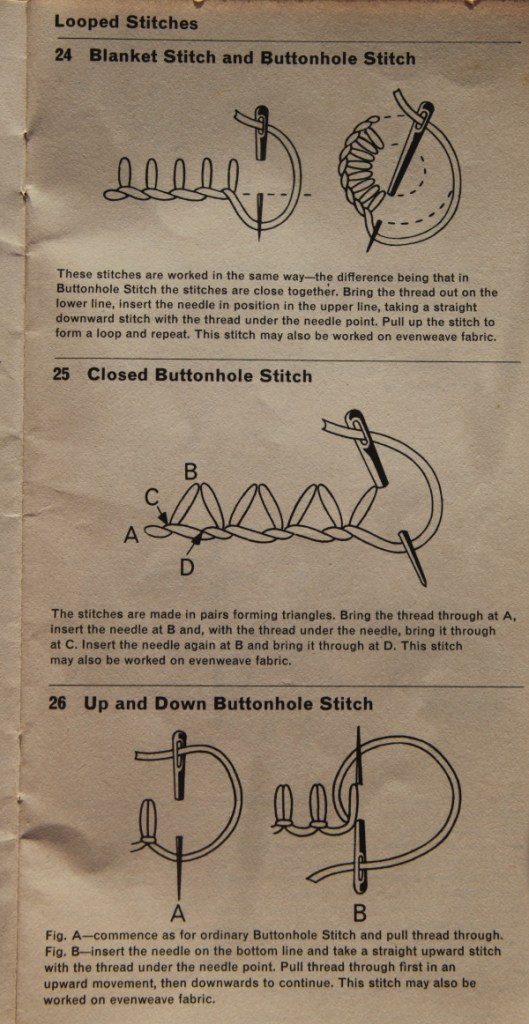
There’s a strong needlework tradition of teaching and learning through imitation, with instructions and patterns aplenty. It used to be that women passed down their knowledge to the next generation in the family. Today, a vast needle-craft industry is built around a technique driven culture of copying, with businesses supplying materials, equipment, tools, patterns and kits for embroiderers, knitters and quilters of all kinds. It’s a challenge to find my place within this culture because that’s not how I came to do what I do. I learned how to embroider from diagrams in a simple booklet I bought at the Needlewoman Shop in London in 1978. And I only use half a dozen basic stitches in my work. Everything else I taught myself through experimentation and lots and lots of practice.
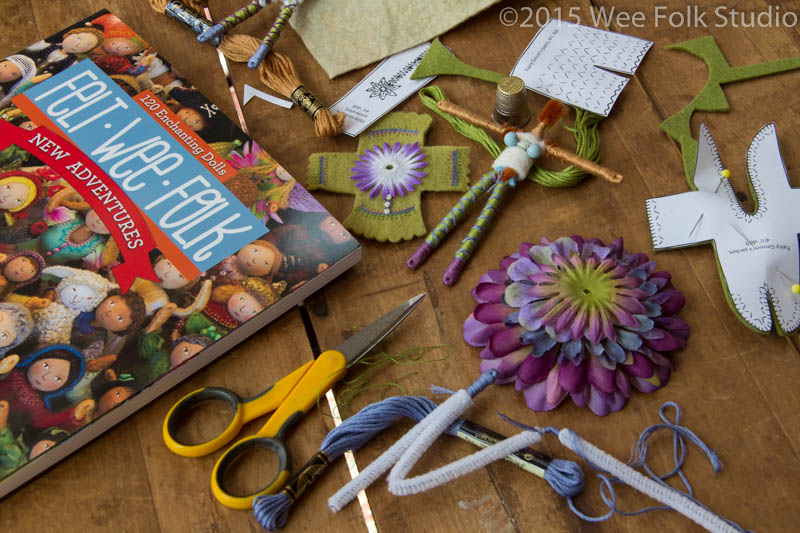
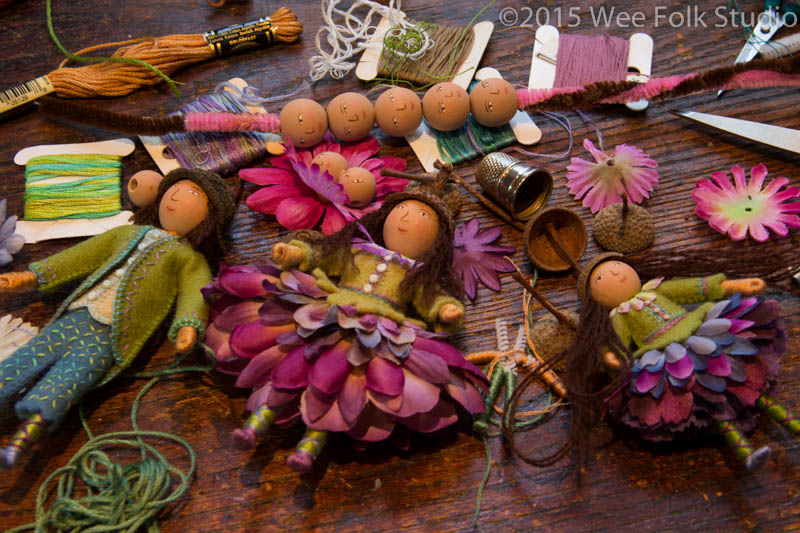
I realize that people need a place to start and they derive great satisfaction from being guided through the process. That is why I used to make kits and wrote Felt Wee Folk, a how-to book about making dolls. My goal is to show the basic framework, with a variety of possibilities, so that the reader can gain the confidence to add more personal touches and create something that is uniquely their own. Through the book, I share my techniques for making the dolls, which I see as a much-needed opening for people to play and express themselves.
With needlework, the distinction between art and craft is particularly fuzzy (no pun intended). That subject will still be discussed and debated long after I’ve threaded my last needle. For me, it points to the question of when to tell how and when not to. I am not worried about individuals copying my techniques, I just don’t want to spend my time and energy telling how I do it — time and energy that would otherwise go toward artistic growth. I find reviewing and explaining in detail the process of making something I’ve lived and struggled with for months like sliding backward into the muck, hindering any movement forward.
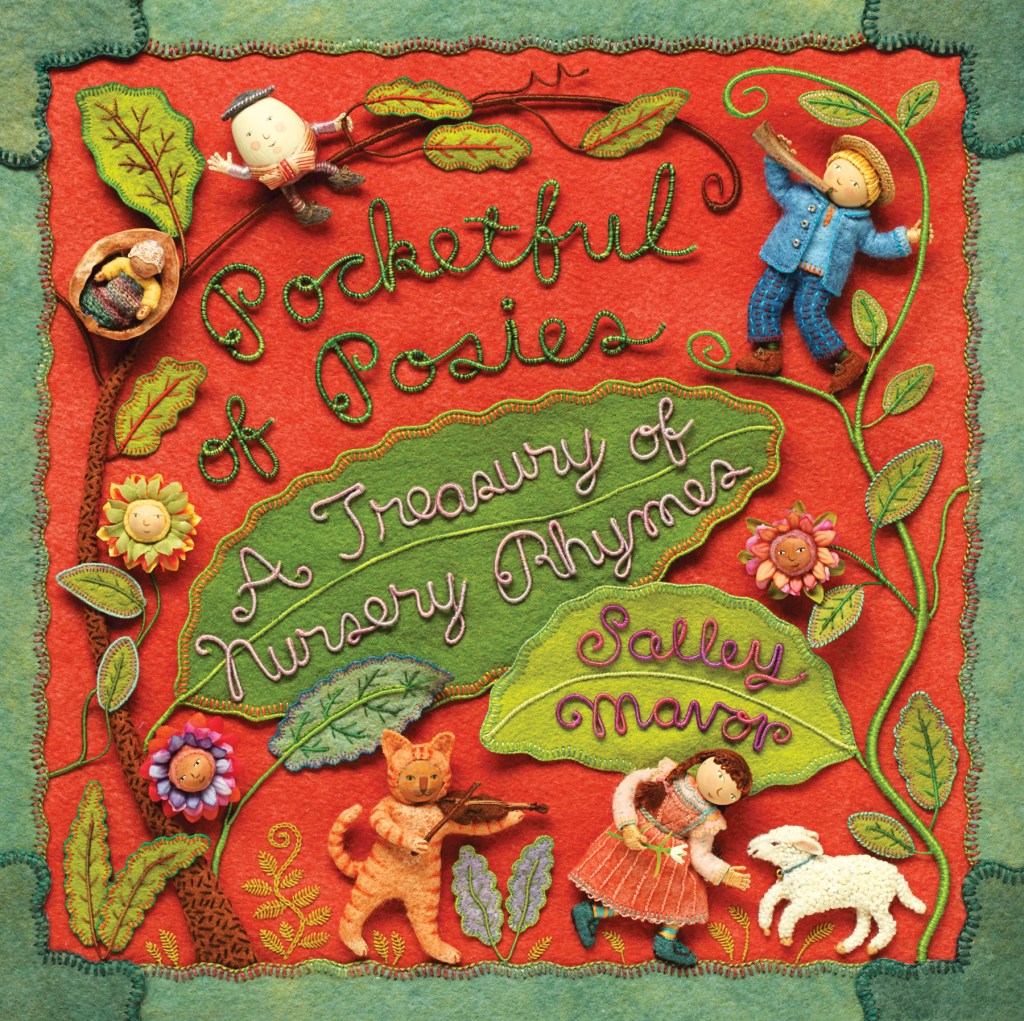
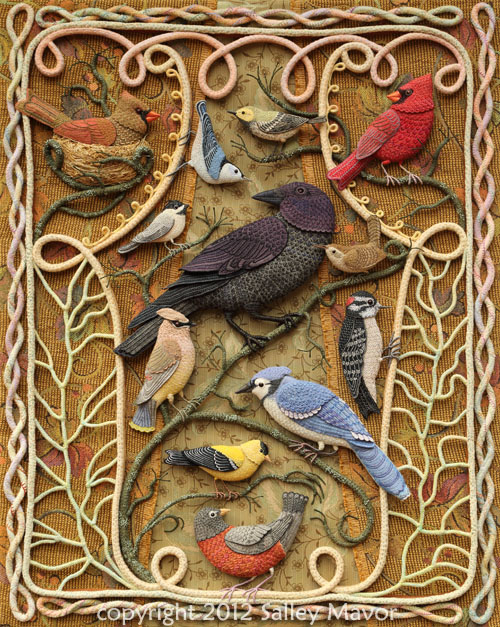
So, where does the artist who creates original work with needle and thread fit into the imitation model ingrained in and perpetuated by the needle-craft industry? In order to explore new concepts and ideas, I have found it necessary to educate the public and protect myself from misconceptions about my work. For instance, people frequently ask if I have a pattern to make Birds of Beebe Woods. Others want directions for making the illustrations from Pocketful of Posies. The idea of providing patterns for my fabric relief pieces has me totally baffled. I think that artists working in other mediums would be equally taken aback if asked for patterns and instructions.
Pocketful of posies
My children’s book illustrations and stand-alone pieces are much more involved and complicated than what I teach in Felt Wee Folk. Through 40 years of experimentation, I have devised methods of working that I consider proprietary knowledge. For instance, the way I make hands with little fingers is too linked to my personal artistic expression to show how in detail. I don’t want to upset the creative process by constantly organizing the steps in my mind and thinking in terms of explaining it to another. That would hold me back and limit the possibilities. I think the act of creating shouldn’t be overly dissected, else it loses its magic.
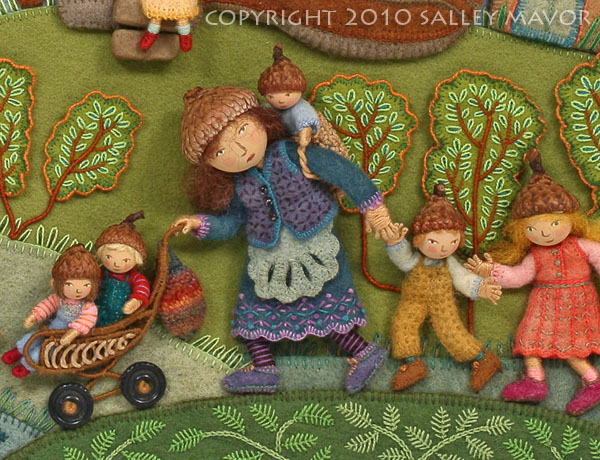
Old Woman Who Lived in a Shoe from “Pocketful of Posies”
Even though conventional needlework businesses don’t completely mesh with what I do, I am a part of it because I’ve authored a how-to book which is marketed within this world. But other than that, I operate independently, outside of the mainstream. That is not surprising, since my work is generally an anomaly in any group I’m lumped into; embroidery, stumpwork, dolls, art quilts, miniatures, fiber art, children’s books, etc. The narrative and storytelling aspect of my fabric relief pieces doesn’t really fit into the abstract, conceptual contemporary fiber art scene. I suppose that writing Felt Wee Folk opened me up to being categorized as a teacher of doll making techniques. And since delving into political satire with the Wee Folk Players, my work is proving to be even harder to classify!
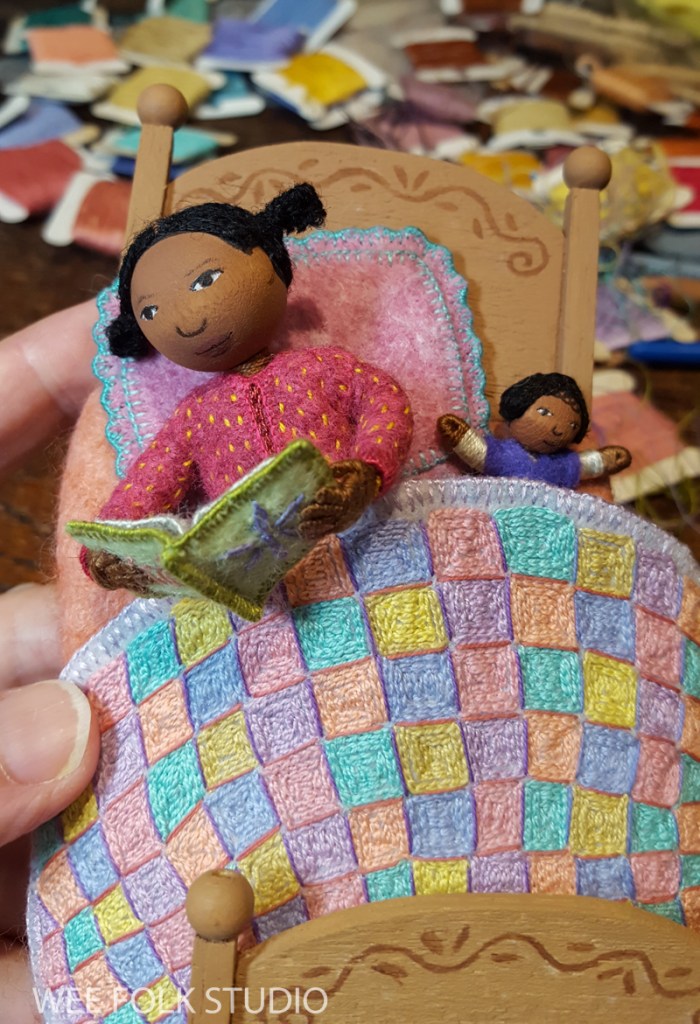
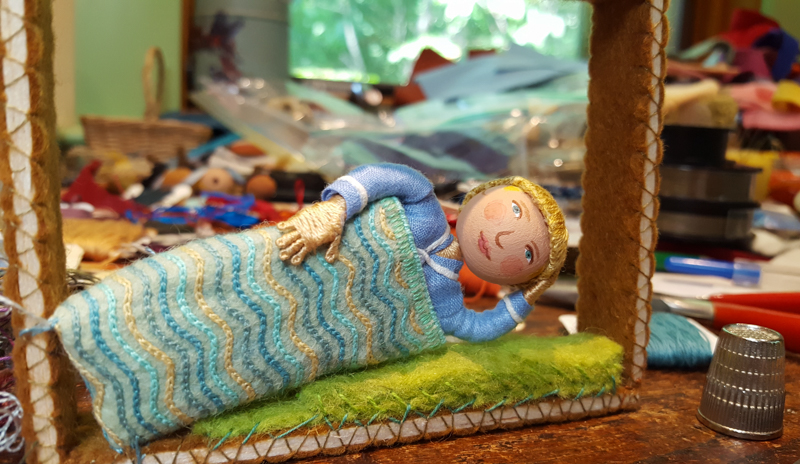
Props and characters from “Liberty and Justice” animationMY BED: Enchanting Ways to Fall Asleep around the World
I identify myself as an artist first and foremost. To me, it doesn’t matter what medium or materials you use for your work to be considered art. Not today, in an art world that recognizes all manner of expressions. Not in this age of the internet, where individuals can build careers and gain followers, despite the hierarchy of the art establishment and opinions of curators and critics. I don’t want to be the kind of “serious” artist who, in an effort to have their work recognized as legitimate, dissociates themselves from the world of hobby needlework. There is too much real humanity and power in stitched objects that are labored over so lovingly.
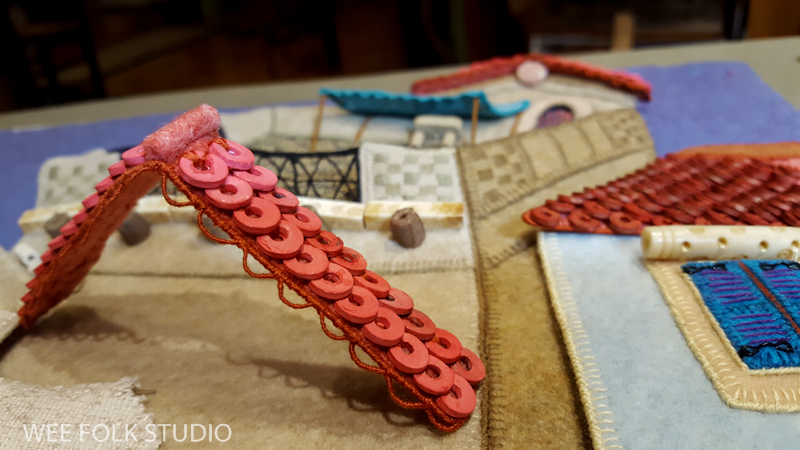
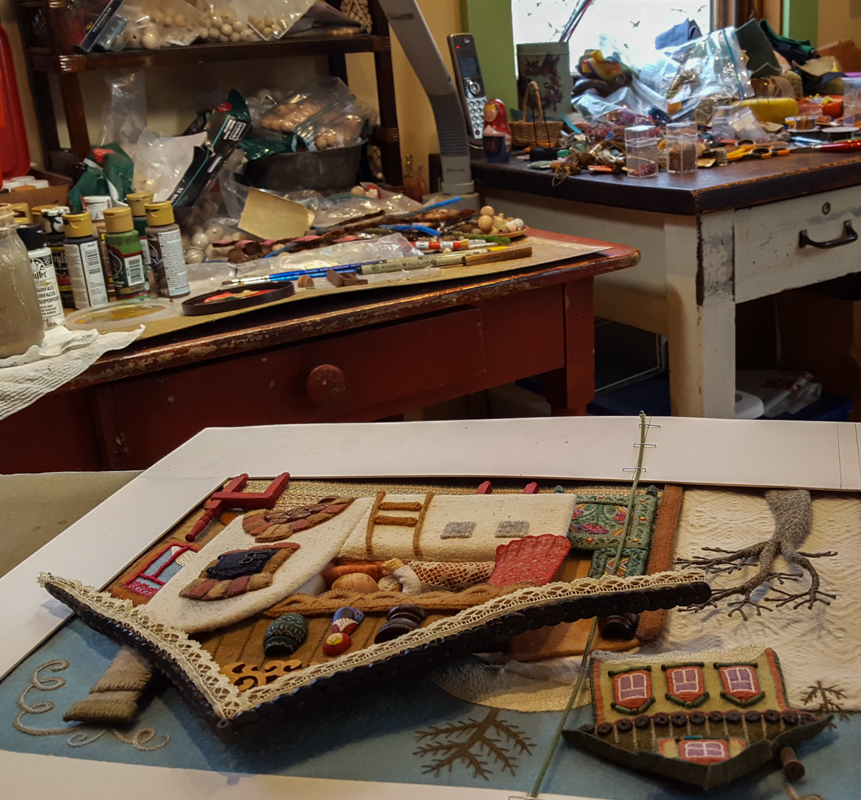
Cover UpMY BED in progressMT BED in progress
As an artist, I draw the line on what parts of my process to share and what parts I want to remain a mystery, even to myself. People wonder how I can give away “all of my secrets”, but I don’t look at it that way. In Felt Wee Folk, I’ve simplified some doll making techniques to a point where I can teach them step by step. Nonetheless, I won’t be writing any more how-to books or teaching classes. But I will share projects in progress, thoughts, inspirations, travels, and give glimpses behind the scenes. My sketchbook is brimming with ideas, and I intend to devote as much time as I can to making new work.
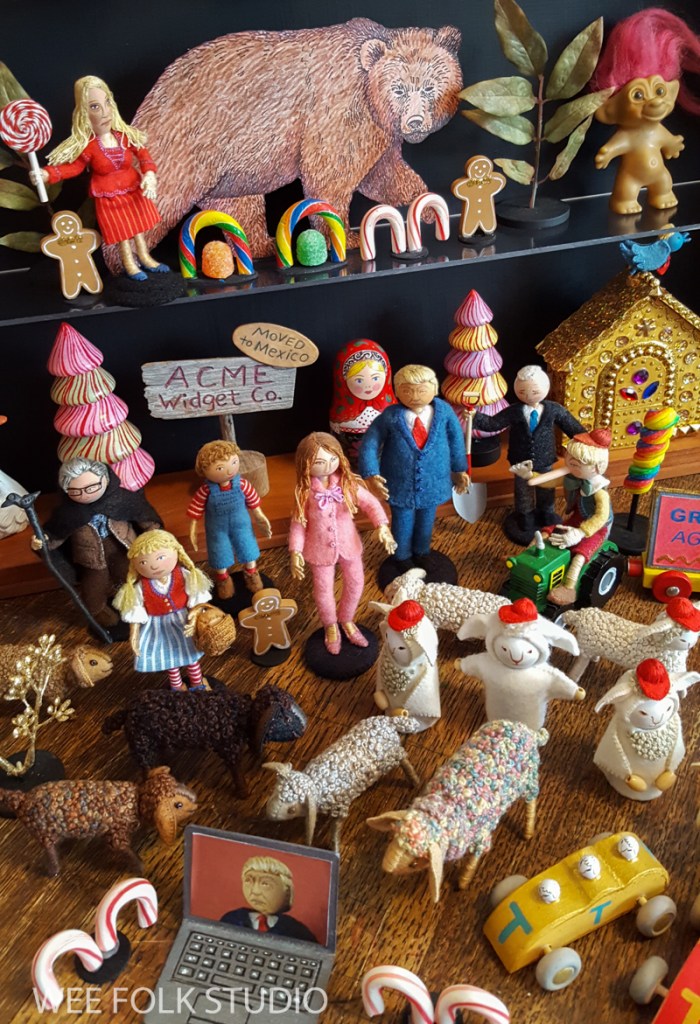
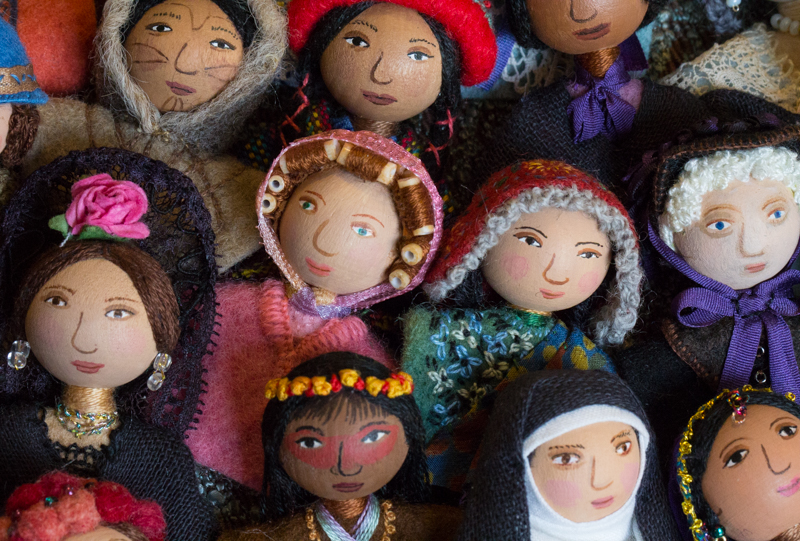
Wee Folk figures
This blog is full of photos that show the development of projects. What is shown and what is not usually depends on how engrossed I am and if I remember to take pictures. Sometimes I take photos and make videos of different stages of making a piece, but that just skims the surface and may be perceived is a tease of sorts. I see it as documentation, not as a tutorial, which takes a different, more systematic approach.
MY BED in progress
So, the simple explanation is that I show what I’m willing to share and don’t show what I’m not. I will continue to offer glimpses into my world through the wonders of social media and I hope you come along on the adventure!
MY BED in progressMY BED in progress
To keep up with new posts, subscribe to this blog. Your contact info will not be shared. If you’d like to see more frequent photos tracking the projects in my studio, please follow me on Facebook and/or Instagram.
Ever since learning about Greta Thunberg, the 17 year-old Swedish environmental activist, I’ve wanted to make a wee folk version of her. But, the idea of making such an inspiring public figure into just a cute little doll with braids didn’t seem like enough to do her justice. Greta symbolizes the upcoming generation who will experience climate change much more profoundly than people my age and they must be heard. I kept thinking that the real Greta would not like being turned into a passive fetish object, without her strong message and a call to action. So, I figured out a way to both depict her likeness and quote her, while also supporting the issues she is calling attention to.
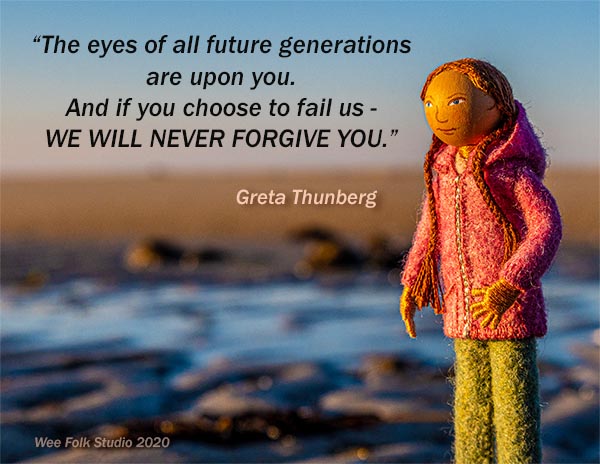
After making the Greta doll, I set out to photograph her outside in a natural setting. The aim was to take a photo that would have room to incorporate one of her famous quotes. So, on a recent beautiful day, Rob and I went around the corner to Woodneck Beach. The conditions were perfect! The low tide created an interesting landscape and the late afternoon sun gave off the kind of warm glow that photographers can only wish for. The result was the image below, which we are making into prints to sell as a fundraiser for climate science research.
8.5″ x 11″ archival print for sale to benefit climate research
BUY PRINTS and NOTE CARDS and support CLIMATE SCIENCE RESEARCH: The image of Greta Thunberg with her quote is available for sale in my shop HERE. All profits will go to the Woods Hole Research Center, a leading source of climate science that drives the urgent action needed to solve climate change. ____________________________________________________________ Set of 4 Note Cards – $10.00 – Buy here. Set of 10 Postcards – $10.00 – Buy here. 8.5″ x 11″ Archival Print – $15.00 – Buy here.
Woods Hole Research Center is an organization of renowned researchers who work with a worldwide network of partners to understand and combat climate change. They have been focused on climate change since it first emerged as a pubic policy issue 35 years ago. Headquartered in Falmouth, MA, they currently work in more than twenty countries around the globe – from the Amazon to the Arctic. World-class science is the foundation of everything they do. They share their learning with scientific colleagues, lawmakers, private sector leaders, and the public in order to turn knowledge into far-reaching action. For more information, visit whrc.org.
The Greta Effect Animation During the process of making the Greta doll, the partially made pipe cleaner body sat on my work table, looking at me in an intense way. I thought, we have to film her doing just that! So, Rob and I made this short animated film, “The Greta Effect”.
The following photos show the process of making the Greta doll and the video:
To paint a likeness on the round wooden bead, I referred to photos of Greta. In this small scale, I was limited to a few brush strokes to make her face recognizable.
With the exception of a few added details, the Greta doll is made with the same basic techniques that are taught in my how-to book, Felt Wee Folk. After painting the face, I glued a felt wig to the bead head and let it dry. Then, I stitched embroidery floss hair to the felt, which provided something for the needle to grab onto. It was fun to make her tell-tale braids.
This photo gives you an idea of how her hands were made.
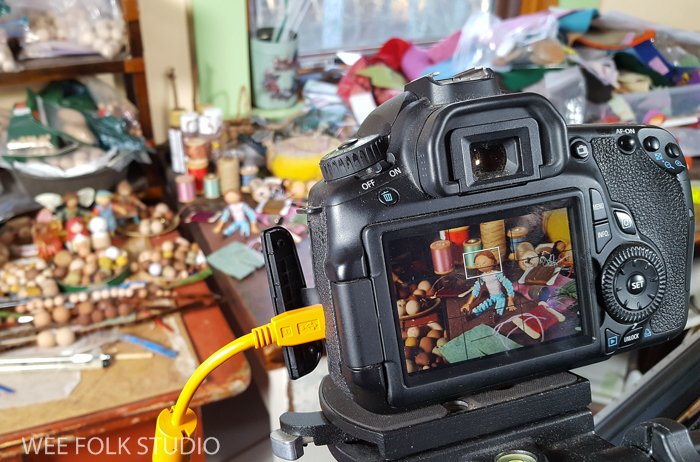
Partway through the process, we filmed the Greta doll sitting on my work table, turning her head to look straight out at the viewer, as if to say, “I’m looking at you!”.
It took 2 tries to do the animation because I messed up the first attempt by kicking the tripod. We started over the next day.
Even though the scene is only 11 seconds long, it took all day to animate. In addition to my turning the doll’s head incrementally, Rob manually rotated the camera and moved it along the slider, one frame at a time (24 frames per second). It brought back memories of our year in the basement, filming Liberty and Justice.
Then it was time to make her clothing. I made her pants and shoes and…
a zippered anorak out of pink felt….
sewing it in place, so that it’s never coming off!
Who knows if the real Greta will ever see this, but if she does, I hope that she approves of using her image and quote to support climate science research. Again, prints and not cards may be purchased in my shop HERE.
To keep up with new posts, subscribe to this blog (top right column on the home page). Your contact info will not be shared. If you’d like to see more frequent photos tracking the projects in my studio, please follow me on Facebook and/or Instagram.










 SALLEY MAVOR