The Way Home (part 4)

 Continued from The Way Home (part 3)

I added the little bird character late in the design phase. Savi seemed so alone on the beach after her mother leaves, and I thought she needed an escort of sorts. Cecelia Yung, the art director, liked the addition and wrote, “About the bird: maybe he can be her “guardian angel”-someone who hovers protectively so that she’s never truly alone. He would be a comforting presence for the child who worries when Savi is alone in the dark. Maybe he can make his appearance when Savi’s mother leaves?”
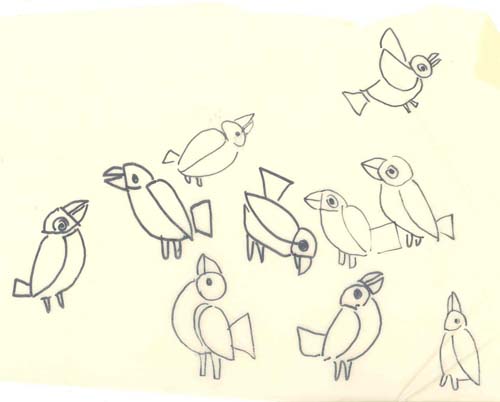
sketches of birds for “The Way Home”
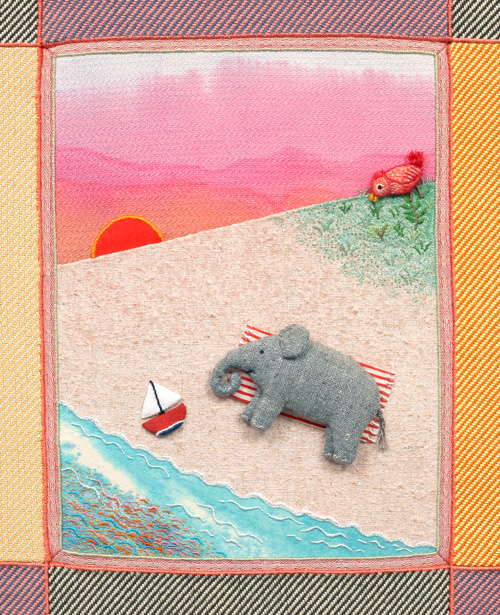
 

The Way Home, page 18

A few months before the artwork was due, I faced the inevitable and admitted that I would not be able to make the one year deadline. I called Cecilia and told her that I needed more time. She was understanding enough to extend the publication date another 6 months.
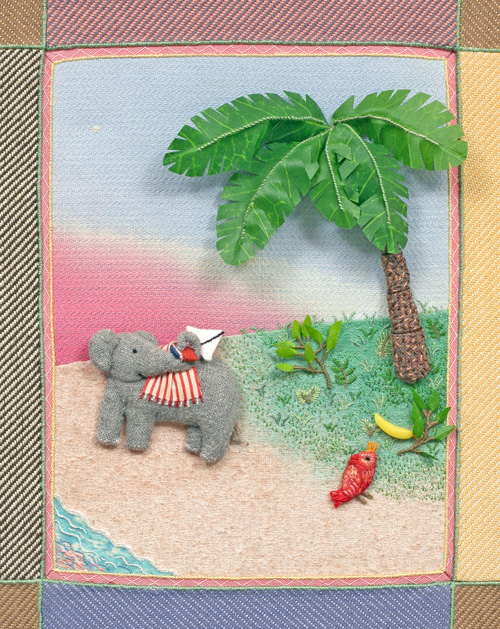
The Way Home, page 20

Through the fall and winter, I added the finishing touches, stitching blades of grass and hand sewing the floss edge around the border sections.

sketch of pages 16/17


The Way Home, pages 16/17

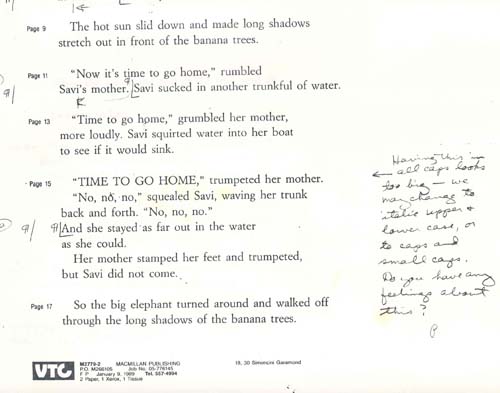
I was particularly fussy about the shadows, which were made up of different colored stitches. I kept thinking of something my teacher, Mahler Ryder had said years earlier at RISD, that shadows are not black, but are made up of colors.

The Way Home, pages 16/17 detail

I was saving the book jacket illustration for last and imagined how it would look while I stitched the other pages. I took a mental inventory of what materials would be needed and was shocked to discover I’d forgotten about the sky fabric. I had used every last inch of Peter’s overalls on the inside artwork. I had none left for the cover illustration, the most important of all! This was a drawback of working with unconventional materials. If I worked in watercolor, this would never happen!

sketch of cover illustration for “The Way Home”

I had dealt with insufficient supplies before. I would have to find something similar, but the weave and shade were unique to an older line of Osh Gosh clothing. before I could work myself into a tizzy, the same fabric literally walked into view.

Molly’s pants back

My friend, Terry came over with her 2-year-old daughter, Molly, who was wearing a pair of jeans made out of the same light blue fabric! Terry is a seamstress and fabric lover, so she was not at all surprised when I asked her if I could have Molly’s pants when she outgrew them, which appeared to be imminent. I’ve kept the pants and when I hold them up at talks, they always get a reaction from both young and old audiences.

in my studio finishing the illustrations for “The Way Home”

The extra 6 months made it possible for me to finish by the new deadline in the spring of ’90. I packed up the illustrations and shipped them to New York. After the editors at MacMillan had a chance to look them over, Cecilia drove the artwork over to Gamma One in the city. Gamma One has a “painting with light” system that works well for textured work. During the minutes-long exposure time, light moves slowly back and forth, helping to define the dimensionality of the art. The 8 x 10 color transparencies were then color corrected to match my original art.
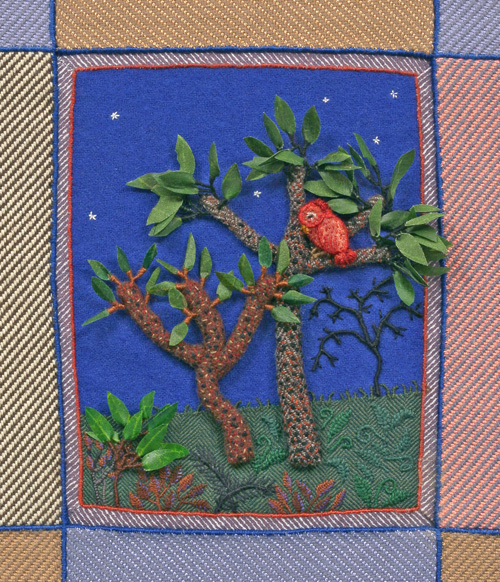
The Way Home, page 32

Cecilia suggested we put an explanation of my technique on the last page.

It reads,

“The original pictures for this book were made in fabric relief. This art form includes many techniques, including applique, embroidery, wrapping, dyeing, and soft sculpture. The background fabric was dyed and then sewed together. Three-dimensional pieces were made from a variety of materials, including covered and stuffed cardboard shapes, wrapped wire, found objects, and fabric. Details were embroidered onto the shapes and background and then the three-dimensional shapes were sewn into place. All stitching was done by hand.”

To be continued in The Way Home (part 5). 

To keep up with new posts, please subscribe to this blog. Your contact info will not be shared. If you’d like to see more frequent photos tracking the projects in my studio, please follow me on Facebook and/or Instagram.
The Way Home (part 3)

Continued from The Way Home (part 2)

About 6 months after our visit to New York, I received a telephone call from Phyllis Larkin at MacMillan. I remember being confused because her tone and inflection didn’t match the words she was saying. She was telling me in a slow, flat voice the most exciting news- that she would like to publish The Way Home!

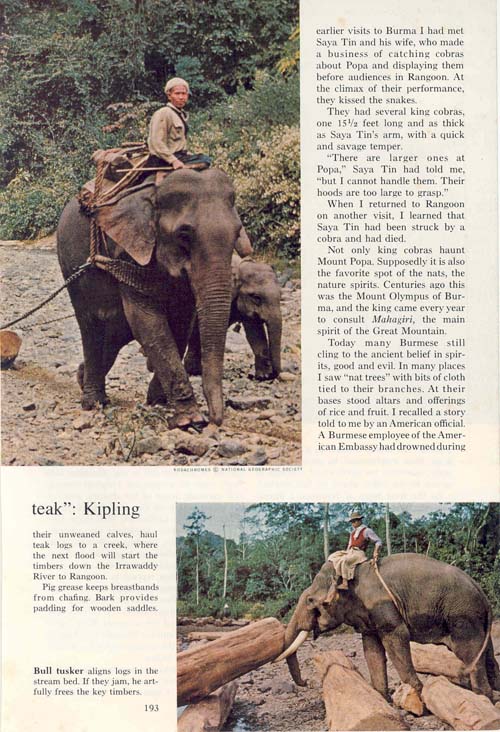
National Geographic article on elephants

Of course, I could hardly believe it and when she asked how long I needed to sew the illustrations, I guessed “one year” on the spot, because I thought any longer might make her change her mind. Now that we had made it over the hurdle and sold our idea to a publisher, I needed to figure out how to bring all of the different elements of the story together in a series of pictures. Referring to National Geographic, I did sketches of elephants and noticed that African and Asian elephants have different shaped ears. When consulted, Judy thought that hers were Asian elephants.

sketches for “The Way Home”

In my imagination, I saw the drama of the story unfolding against the back drop of a landscape changing from day to night, like puppet show scenery, slowly scrolling from left to right.

editing the manuscript


Ian and his friend Sam in my studio, 1988

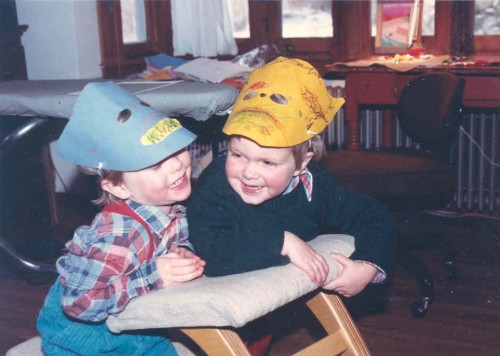
Judy edited the manuscript and I worked on the book whenever I could. The advance payment wasn’t enough to pay for daycare, so I figured out other ways to set aside time to work. I would spend a few hours stitching every evening, after the boys were read to and put to bed. During the day I was part of a coop arrangement, where I’d watch 2 other boys one morning a week and mine were taken care of 2 mornings. This picture shows Ian and his friend Sam in my studio wearing monster masks.

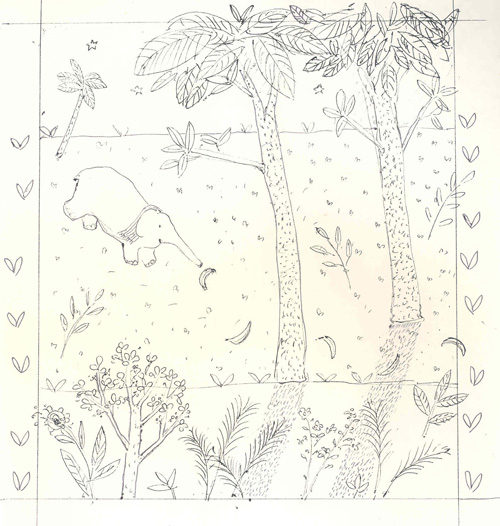
early sketch of Savi following banana trail

early drawing of Savi following banana trail

Somehow, I pieced together enough time to make progress and the pages started to take shape. In the beginning, I figured out what fabrics to use for the background, elephants and borders. I found a shirt of my husband’s to use for the elephant’s bodies. The gray Indian cotton was the perfect shade and texture.

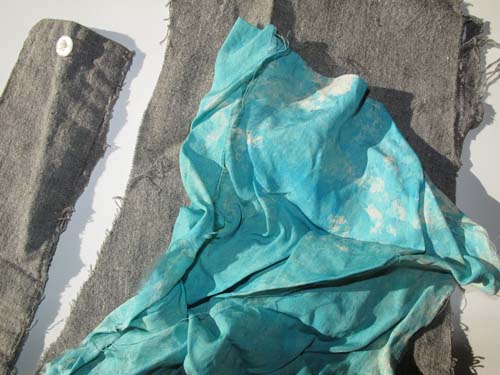
Indian cotton shirt and dyed silk

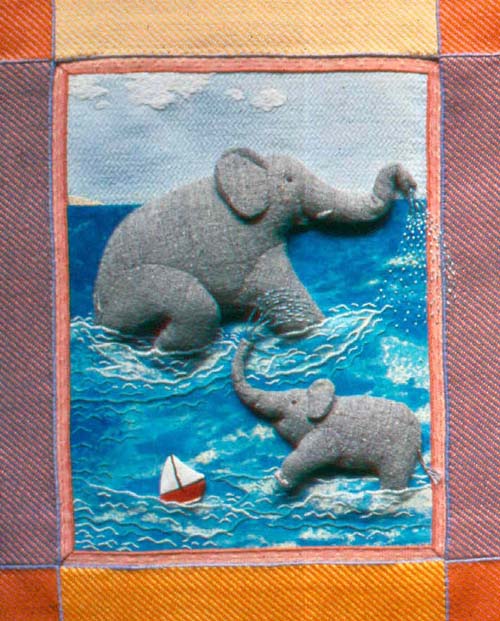
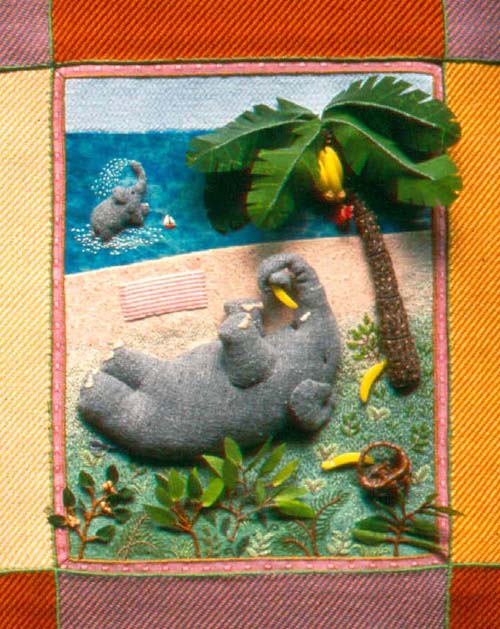
I cut a piece of silk from my grandmother’s old nightgown to use for the water and then dyed it turquoise with a spray bottle. The silk was crumpled up when I sprayed the dye, so some areas were left white, making a foamy, wavy pattern.

The Way Home, page 4

I ripped out the seams of an old, faded pair of my son Peter’s overalls. There was exactly enough fabric to use for each section of sky. I dyed the light blue pieces sunset pink and then graduated shades of dark blue. For the night sky on the last pages, I used a midnight blue colored wool.

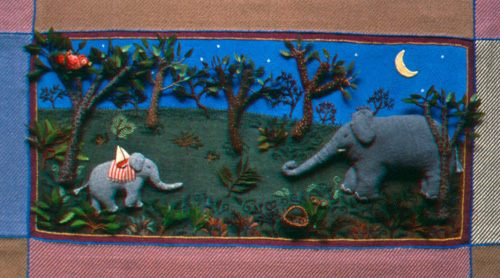
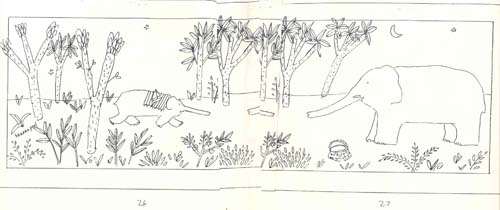
The Way Home, pages 26/27

The beach was made of a bumpy piece of raw silk, which I dyed green in the grassy areas. I redid the same scene that I’d made as a sample, matching the fabric with the other illustrations.

The Way Home, page 6

There were logistics to figure out, like how can an elephant carry a towel and toy boat, while leaving her trunk free to pick up bananas? I ended up tucking Savi’s boat into her folded towel, which she carried on her back. I also gave the mother a basket to carry bananas. Cecilia Yung, the art director and I corresponded about the book layout.

sketch for The Way Home pages 26/27

She sent detailed letters, going over every page. She pointed out things that I didn’t think about like allowing enough space for the dedication and copyright information. Her comments focused on making the elephants’ world consistent throughout the book. She reminded me to pay attention to the position of props like the boat and towel and keep the sun’s direction constant. She wrote, “Make sure shadows lengthen steadily in the same direction and of course colors should shift to reflect the sunset and night sky.

The Way Home, pages 22/23


The Way Home, page 14 sketch

There were so many details to consider for such a simple story! I thought about all the smart, observant children out there, who would see my mistakes and write the publisher with their corrections. Then I remembered that the book was aimed at preschoolers who can’t write yet. I then asked myself, “Don’t the littlest ones deserve the best quality books?” At the end of a letter, Cecilia wrote, ” We realize this is a tremendous amount of work for your first book, so do call if you have questions. We’ve very excited about The Way Home and will be glad to help.”

To be continued in The Way Home (part 4). 

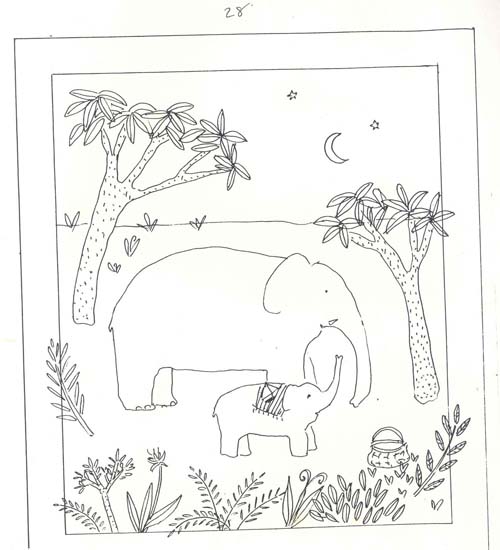
sketch, The Way Home, page 28

To keep up with new posts, please subscribe to this blog. Your contact info will not be shared. If you’d like to see more frequent photos tracking the projects in my studio, please follow me on Facebook and/or Instagram.

Pins (part 1)

The peapods were the gateway to my life of stitching. I started making peapods and other pins in art school in the 1970s, as a totally separate project from my class assignments.  Some of my friends knew about them, but my teachers hadn’t any idea.

peapodpin2WM

One day during class, I was listening to a critique, sewing some peapods, when my teacher, Judy-Sue Goodwin-Sturges, noticed what I was doing. She looked more closely, asked me a few questions and said, “Why don’t you do this kind of thing for your illustrations? Try sewing them.”

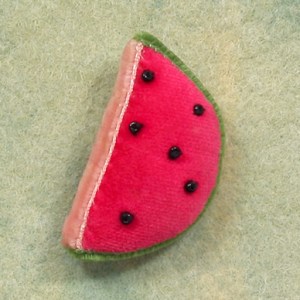
Watermelon pin 1977
Bunch of Grapes Pin 1977

With that simple encouragement, I stopped trying so hard to translate the images in my head through a brush or pen. Given permission to work outside of traditional illustration mediums, I found that I was much happier and energized. I was no longer struggling to keep in step, but, with a needle and thread, I could dance.  For some reason, I’d been under the impression that in art school, one does “serious” fine art and I’d kept my interest in sewing and handcrafts underground. I rediscovered the joy of creating and learned to trust my hands and gut feelings to help work out challenges.

catpinWM

After graduation, I added more designs and started mass producing pins and selling them on a wholesale basis to shops. I had to really push myself to call shops and and arrange in-person visits to businesses. I was more content sitting at home, covering little red beads with sheer lavender fabric to make bunches of grapes or sewing strings of green wooden beads inside a velvet ribbon peapod.  Despite my shyness about pedaling my wares, I found the marketing part of the business to be a creative exercise. I’d spent my teenaged years working in my mother’s import shop in Woods Hole, From Far Corners, and the experience of dealing with customers and knowing the difference between wholesale and retail was helpful.

carrot2WM

I started making custom pins of people’s cats, based on photographs they sent. I found that Siamese cat owners were particularly fussy about their breed and one time had to redo a blue point. The cat ears are made from a coiled wire bead, which I cut in half.

back of Cat pin

Some of the pins like the cat and the watermelon have a cardboard shape inside to give them stability. I’d sew a little pocket, turn it right side out and slip the cardboard in, put in some stuffing and sew up the pocket.

cardboard patterns for pins

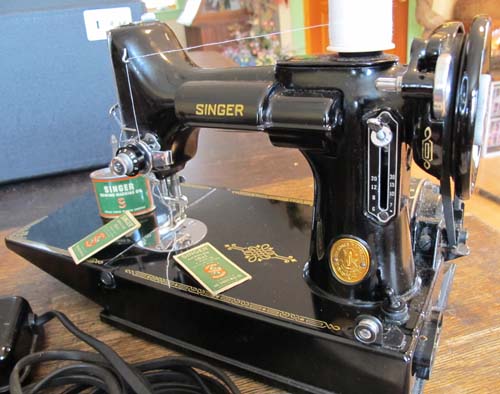
I used my Singer Featherweight, the same machine on which I learned to sew, to do the machine part. There was always a lot of hand sewing to finish and attach the pin back.  I had some labels printed with my name and sewed them under the pinback. They were the same kind of labels you get at fabric stores for sewing on children’s camp clothes.

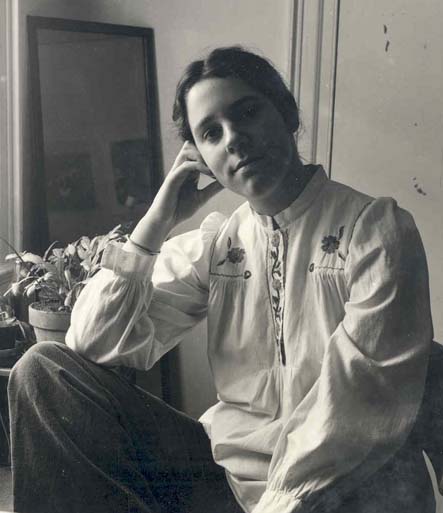
In the studio 1979

This is the first of 3 parts.  The story is continued in PINS (part 2).  

To keep up with new posts, please subscribe to this blog. Your contact info will not be sold or shared. If you’d like to see more frequent photos tracking the projects in my studio, please follow me on Facebook and/or Instagram.
 

My Studio 1977

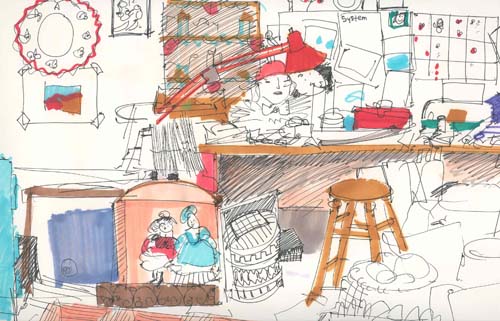
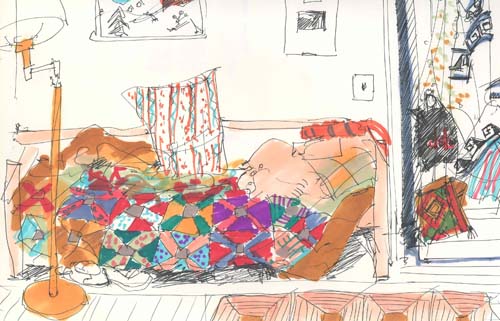
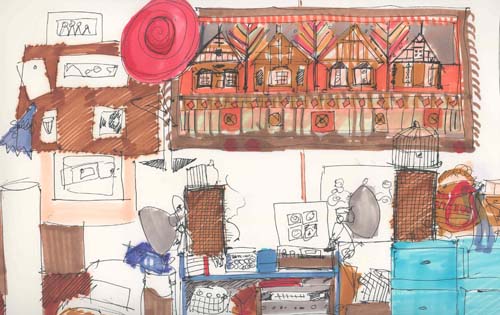
Recently, I found a set of four pen and marker drawings in an old portfolio. Seeing my old apartment in Providence brought the 1976-77 RISD school year back into focus. I remember that we were given an assignment in class to go home and draw all four walls of our rooms.

east wall of my studio in 1977

During my years at RISD, the illustration dept. did not have studio spaces for students, so we turned our bedrooms into our studios. This is the first year I lived outside of a dorm, in an apartment with decent sized rooms. Over the year, I filled up my room with materials and work areas. This was a transitional period in my art, where I was moving away from drawing and painting to 3-dimentional pieces. I was making a lot of dolls, including these Can Can dancers that I can see in the drawing, on the floor. I taught myself how to make dolls with wire armatures, so that they could be posed for photographs. I must have seen some dolls made with stuffed nylon stockings and tried making some myself. At the time, there were no instruction books or classes on this kind of soft sculpture. The school’s textile dept. was more oriented toward weaving and fabric design, which I was not interested in. I wanted to tell a story through my artwork, so I continued taking illustration classes, teaching myself something new with each assignment.

I experimented on my own with materials and techniques, always adapting and changing my approach.  Looking back, I can see that working on illustration assignments with a clear deadline, forced me to concentrate on the narrative part of my artwork and kept me from becoming too focused on the process of creating.  My goal was  to effectively communicate an idea, not just show how well I could sew something.  Ironically, the 3-dimentional work was much more time consuming, but it didn’t seem to matter, since I was inspired and having much more fun! I no longer have the Can Can Dancers, but found this photograph.

Can Can Dancers, 1977

I brought my trusty Singer Feather-weight sewing machine to school and set up a sewing table.  I used this machine for years until I got a Bernina that could do fancy stitches. Today, I rarely get out a machine, but do all stitching by hand.

south wall of my studio in 1977

The table was an old thing of my grandmother’s that I painted orange. It’s still very much in use in my studio today. I got my old sewing machine out of storage to take its picture.  It runs forward and back and is  good for stitching small things.

Singer Feather-weight

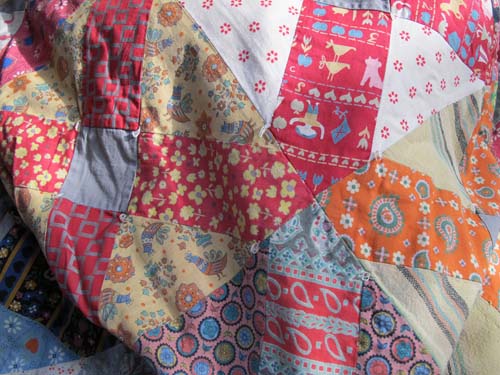
A few years earlier, while in high school, I sewed the quilt pictured on the bed on the Singer Feather-weight. It was the first of just a few usable quilts that I’ve  made.

west wall of my studio in 1977

I plan on redoing this quilt, taking out the thread ties, putting on a new back and hand quilting the whole thing. The fabrics were all pieces we had in the house, mostly from clothes that my mother, sister and I made.

my first quilt, about 1972

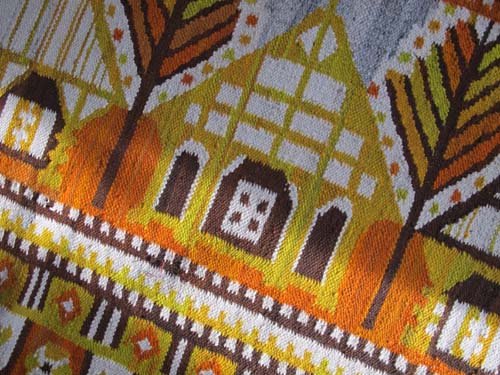
I can identify many things in this drawing, the stereo speakers, my red hat, flood lights, rolls of paper, and the rug hanging on the wall. My mother gave me this beautifully woven wool rug and it seemed too nice to put on the floor.

north wall of my studio in 1977

 I still have the rug, which I now keep on the floor in my studio.

Scandinavian wool rug

My Studio 2009

I’m often asked how much time I spend in my studio. Well, my husband Rob would say,”When Salley’s not eating or sleeping, she’s up working in her studio.”

my studio in 2009

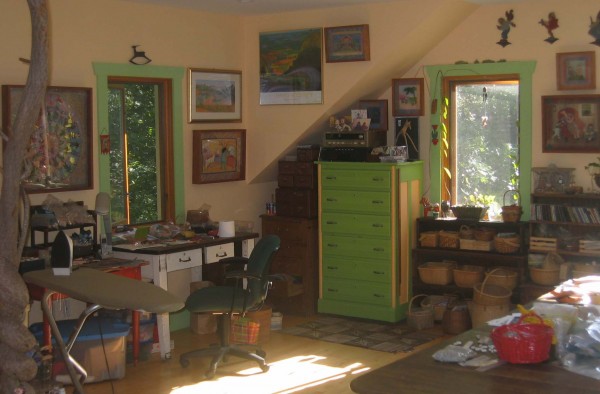
I moved into this studio above our garage about 6 years ago. Before we fixed it up, it was an unfinished space with bats flying around. Rob had been working on me for years to consider making the area into a studio. I loved my work space downstairs, which was a room conveniently located just off our living room. When the boys were young, I could work and keep an eye on them at the same time, but now they didn’t want or need me to keep an eye on them. At first I thought the 24′ x 24′ room would be too large a space for me to feel comfortable working in, but now I’m glad for the extra room.  I like cozy spaces and my actual working area is quite small, but I need room for storing my materials and for displaying all of the things that I like to have around for inspiration.

my work table in 2009

Picking colors for the walls and trim was important. I wanted the feel of being inside a cantaloupe, with green trim, like the inside layer of rind right next to the orange fruit. I tried out different shades of paint , buying quarts and painting sheets of foam core board to hold up around the room, in different light. I ended up with a light peachy shade for the walls and a light green for the window trim. The painters looked at me funny when I showed them my choice, but later they said, “You know, this came out pretty good”. I also painted an old chest of drawers to match with brighter shades of orange and green. The paint had names like pumpkin seed, summer town and prairie splendor. I wonder whose job it is to come up with paint names!

display area in my studio, 2009

Rob calls my studio “Kit Peak” from the years when I cranked out a steady stream of Blossom Fairy kits. I gave up the kits a couple of years ago in order to finish illustrating my new book, which is a hefty 72 pages. Pocketful of Posies: A Treasury of Nursery Rhymes is now in production and will be released next fall. It takes a whole year after the artwork is delivered for a book to get to the bookstores. The pieces are photographed, the type layout is designed and corrected, copy is edited and corrected, printing proofs made and corrected, printing and binding done and then the books are sent via a container ship back from Hong Kong. I just saw the newest layouts of the book and Houghton Mifflin is doing such a good production job that I can hardly contain my excitement!

display table in studio, 2009